Burnt orange is a natural anchor for an autumn leaf garland because it can cover most of the repeated motifs without making every leaf look identical. The strongest arrangements keep burnt orange recognizable from one end of the strand to the other while changing the supporting shade, leaf silhouette, cord color, or spacing.
A burnt orange maple leaf has more visual width than a narrow oak leaf or small vine leaf, so color proportions should be judged on the finished garland rather than on individual motifs. Mustard, chocolate brown, olive, burgundy, cream, rust, and muted green can all support burnt orange, but each changes which parts of the strand attract attention.
The tutorials credited below support the crochet leaf or garland construction concepts. The burnt orange palettes and color placements are editorial adaptations, so follow each creator for the original construction details.
Quick List
- Burnt Orange And Mustard Crochet Autumn Leaf Garland
- Burnt Orange And Chocolate Brown Crochet Leaf Vine Garland
- Burnt Orange And Olive Crochet Simple Leaf Garland
- Burnt Orange And Cream Crochet Alternating Leaf Garland
- Burnt Orange And Rust Crochet Maple Leaf Garland
- Burnt Orange And Golden Yellow Crochet Large Fall Leaf Garland
- Burnt Orange And Brown Crochet Oak Leaf Garland
- Burnt Orange And Sage Crochet Maple Leaf Garland
- Burnt Orange And Terracotta Crochet Autumn Maple Garland
- Burnt Orange And Chocolate Crochet Mixed Autumn Leaf Garland
- Burnt Orange And Oatmeal Crochet Autumn Leaf Garland
Let Burnt Orange Repeat Often Enough to Lead the Garland
A garland is read as a sequence rather than as one isolated crochet motif. That means burnt orange should return often enough that the eye recognizes it as the main color across the entire strand.
You do not have to alternate burnt orange with another shade leaf by leaf. A group of two or three burnt orange leaves followed by one mustard or brown leaf can create a stronger dominant-and-accent relationship.
Before joining separate motifs, arrange them across a table in the approximate order they will hang. Color problems that are difficult to notice on individual leaves become much clearer when the complete sequence is visible.
Choose the Garland Cord Color Separately From the Burnt Orange Leaves
The connecting strand can quietly support the leaves or become another noticeable color line. Chocolate brown, muted olive, oatmeal, or the same burnt orange can each produce a different result.
A dark brown cord can suggest stems and branches while defining orange leaves against a pale wall. An oatmeal cord creates more separation and can keep a dense autumn palette from appearing too dark. Using burnt orange for both leaves and cord produces the most unified result.
Also check the intended background. Burnt orange and brown that look clearly different on a white table may merge more against wood paneling, brick, or dark furniture.
Use Burnt Orange Leaf Spacing to Control Visual Density
Close spacing creates a fuller band of burnt orange and works well when the garland should function as a substantial mantel decoration. Wider spacing gives individual maple, oak, or simple leaves more room to show their silhouettes.
Larger leaves generally need more background space between motifs. Small vine leaves can sit closer together without hiding one another.
Make a short sample or temporarily lay out several finished leaves at the actual display location before committing to the whole strand.
1. Burnt Orange And Mustard Crochet Autumn Leaf Garland

This palette keeps burnt orange as the repeating main leaf color and uses mustard as a lighter seasonal interruption. A neutral or brown connecting strand can keep both warm shades distinct. Because the colors are related in temperature, the difference in lightness becomes especially useful when the garland is viewed from across a room.
Burnt Orange Should Appear More Often Than Mustard Leaves
Use burnt orange for the majority of the motifs rather than alternating the shades equally by default. A pattern such as several burnt orange leaves followed by one mustard leaf keeps the title color clearly dominant.
Lay out the sequence before attaching separate leaves so mustard does not accidentally cluster at one end.
Burnt Orange and Mustard Need Enough Value Separation
Two warm yarns can have noticeably different hues but still look similar in grayscale. Compare the actual burnt orange and mustard yarn before making the complete set.
If the shades merge from a distance, keep the mustard leaves physically separated by burnt orange rather than placing several adjacent yellow-orange motifs together.
Burnt Orange Works Well With a Quiet Garland String
A beige, brown, or other restrained cord lets the orange-and-mustard sequence remain the main visual feature. Avoid adding another highly saturated cord color unless you intentionally want a three-color garland.
Creator Credit: Little Bitty Noggins
2. Burnt Orange And Chocolate Brown Crochet Leaf Vine Garland

A continuous vine creates a softer botanical line than a row of large separate leaves. Burnt orange can cover most of the leaves while chocolate brown runs through the connecting chain or appears on occasional leaves. This places the darkest color along the structural line instead of dividing every motif into two shades.
Burnt Orange Should Stay Visible Along the Whole Crochet Vine
Do not place all the burnt orange leaves in one half and all the chocolate leaves in the other unless you want deliberate color blocking.
Repeating burnt orange along the full length keeps the seasonal color recognizable even when part of the vine curves behind another decoration.
Chocolate Brown Can Ground Burnt Orange Without Filling Every Leaf
Use chocolate brown on the vine, selected leaves, or both. The darker shade can make burnt orange feel more defined without turning the garland predominantly brown.
If the vine will hang against dark wood, test the chocolate section against that background before committing to a long strand.
Burnt Orange Vine Leaves Need Space When the Garland Curves
A continuous vine can wrap around wreaths, mirrors, and shelf corners. Curving the strand may cause nearby leaves to overlap.
Check how the burnt orange leaves sit on the intended curve so their silhouettes remain recognizable rather than forming one dense orange mass.
Creator Credit: Hooked by Robin
3. Burnt Orange And Olive Crochet Simple Leaf Garland
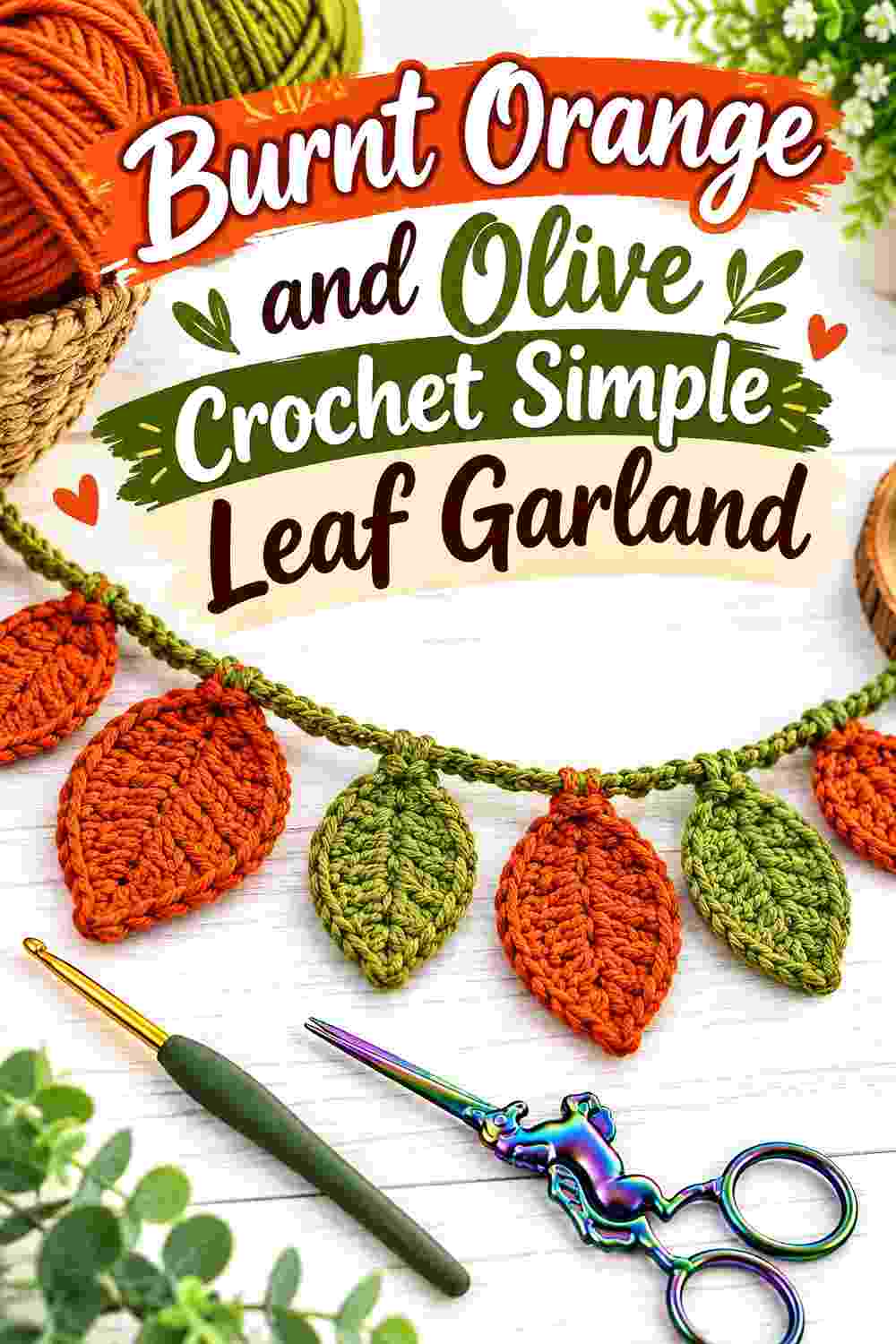
Olive gives burnt orange a muted green counterpoint that still feels botanical. Use burnt orange as the majority leaf color, olive on occasional motifs, and keep the string in one of those two shades or a subdued neutral.
Burnt Orange Should Lead the Olive Crochet Leaf Sequence
Repeat burnt orange more frequently than olive so the green acts as a supporting foliage color rather than splitting the strand equally.
An olive leaf after every few burnt orange leaves can create enough visual relief without changing the autumn identity.
Olive Gives Burnt Orange Crochet Leaves a Cooler Break
Because the colors differ in temperature as well as hue, olive can be effective even in relatively small amounts.
Place olive between groups of burnt orange leaves instead of creating one large green cluster. That distributes the contrast across the full garland.
Burnt Orange Leaf Scale Should Be Checked Before Repeating
Make one completed burnt orange motif and place it where the garland will hang. Leaf size affects how many color changes the strand can handle.
A small garland can become busy quickly if every compact leaf changes shade, while larger display areas can support more variation.
Creator Credit: Crochet with Yarnhild
4. Burnt Orange And Cream Crochet Alternating Leaf Garland
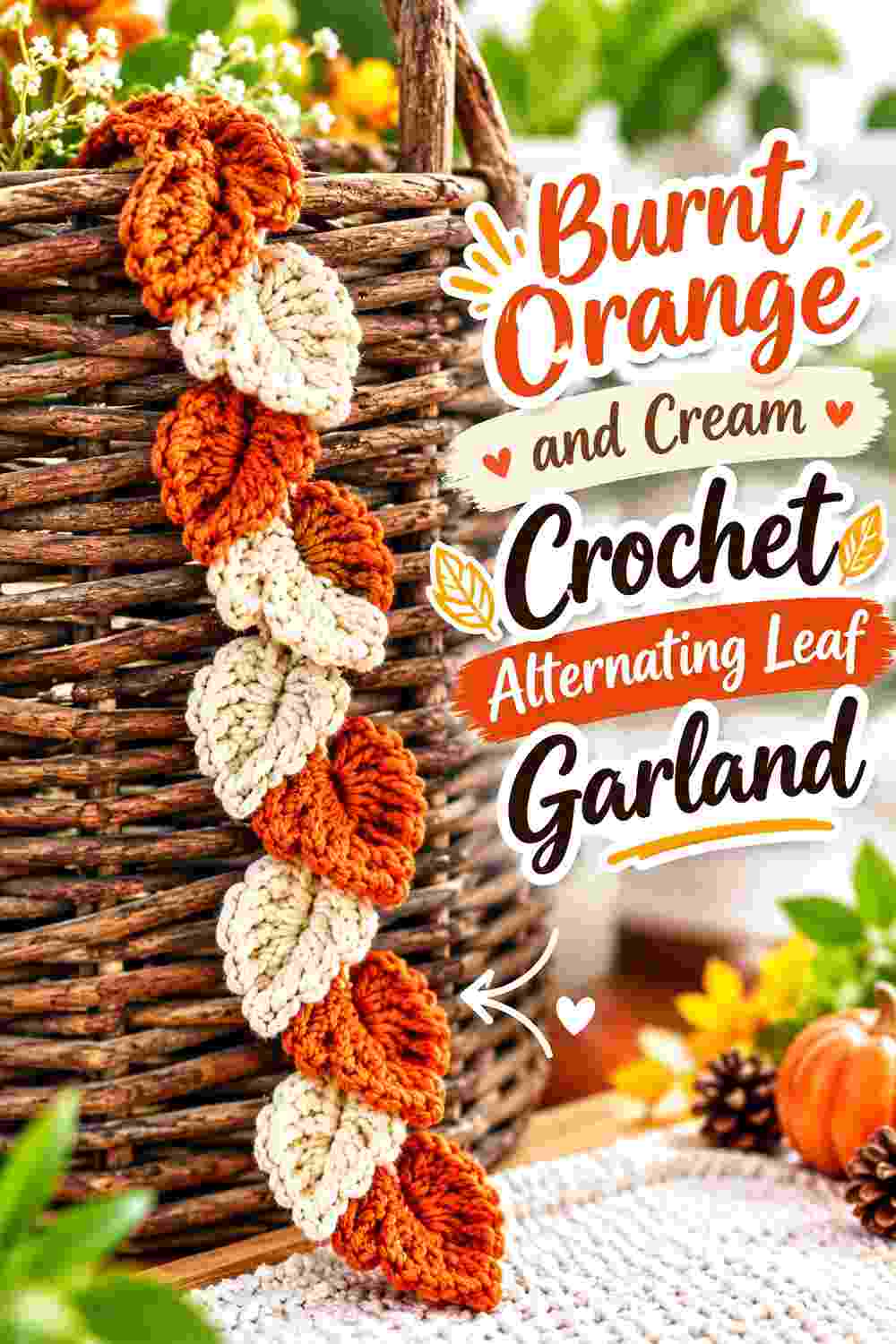
Cream creates the strongest light-dark separation in this collection. Instead of making every other leaf cream, keep burnt orange dominant and use cream as occasional breathing space along a flowing leaf strand.
Burnt Orange Should Control Most of the Alternating Crochet Leaves
An equal orange-cream alternation creates a balanced two-color garland. For a clearly burnt-orange-led version, use cream less often.
Groups of burnt orange leaves interrupted by one cream motif create a softer rhythm while preserving the orange emphasis.
Cream Can Separate Dense Burnt Orange Leaf Groups
Place a cream leaf between two visually heavy orange sections when the strand begins looking too uniform.
The light motif effectively creates negative space without increasing the physical gap between leaves.
Burnt Orange Leaf Direction Matters as Much as Cream Placement
When leaves point in alternating directions, color and orientation create two patterns at once.
Avoid making every cream leaf point one way and every burnt orange leaf the other unless you deliberately want color tied to direction. Mixing orientations keeps the strand more organic.
Creator Credit: Príncipe del Crochet
5. Burnt Orange And Rust Crochet Maple Leaf Garland
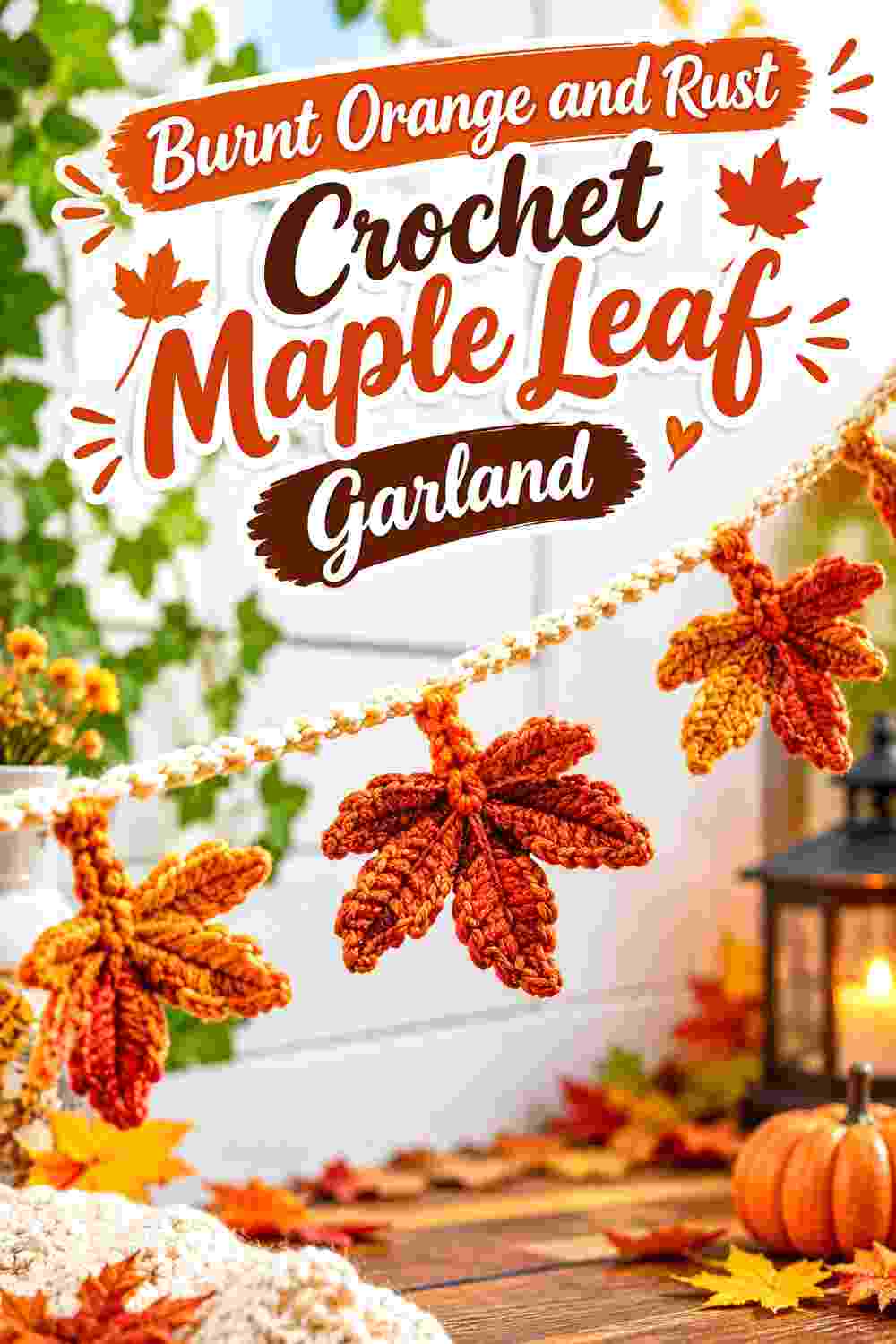
Rust and burnt orange create a tonal scheme rather than strong contrast. The difference should be intentional: burnt orange can cover the majority of the maple leaves, while deeper rust appears on selected motifs or stems.
Burnt Orange Maple Leaves Need Clear Separation From Rust
Compare the two yarns side by side before producing many motifs. If the colors are extremely close, the garland may appear almost monochromatic from normal viewing distance.
That can work well if a tonal effect is the goal, but use stronger spacing or a contrasting cord if you still want individual leaves to stand apart.
Rust Can Deepen Burnt Orange Without Changing the Autumn Direction
Use rust where you want the sequence to become darker without introducing a contrasting green or neutral.
A few rust leaves among burnt orange can suggest natural variation while keeping the overall garland strongly orange.
Burnt Orange Maple Points Need Enough Background Space
Maple leaves have a broader, more complex outline than simple oval leaves. Allow enough distance between motifs for the points to remain recognizable.
If the leaves overlap heavily, tonal burnt orange and rust shades can merge into one irregular color mass.
Creator Credit: NuNi
6. Burnt Orange And Golden Yellow Crochet Large Fall Leaf Garland
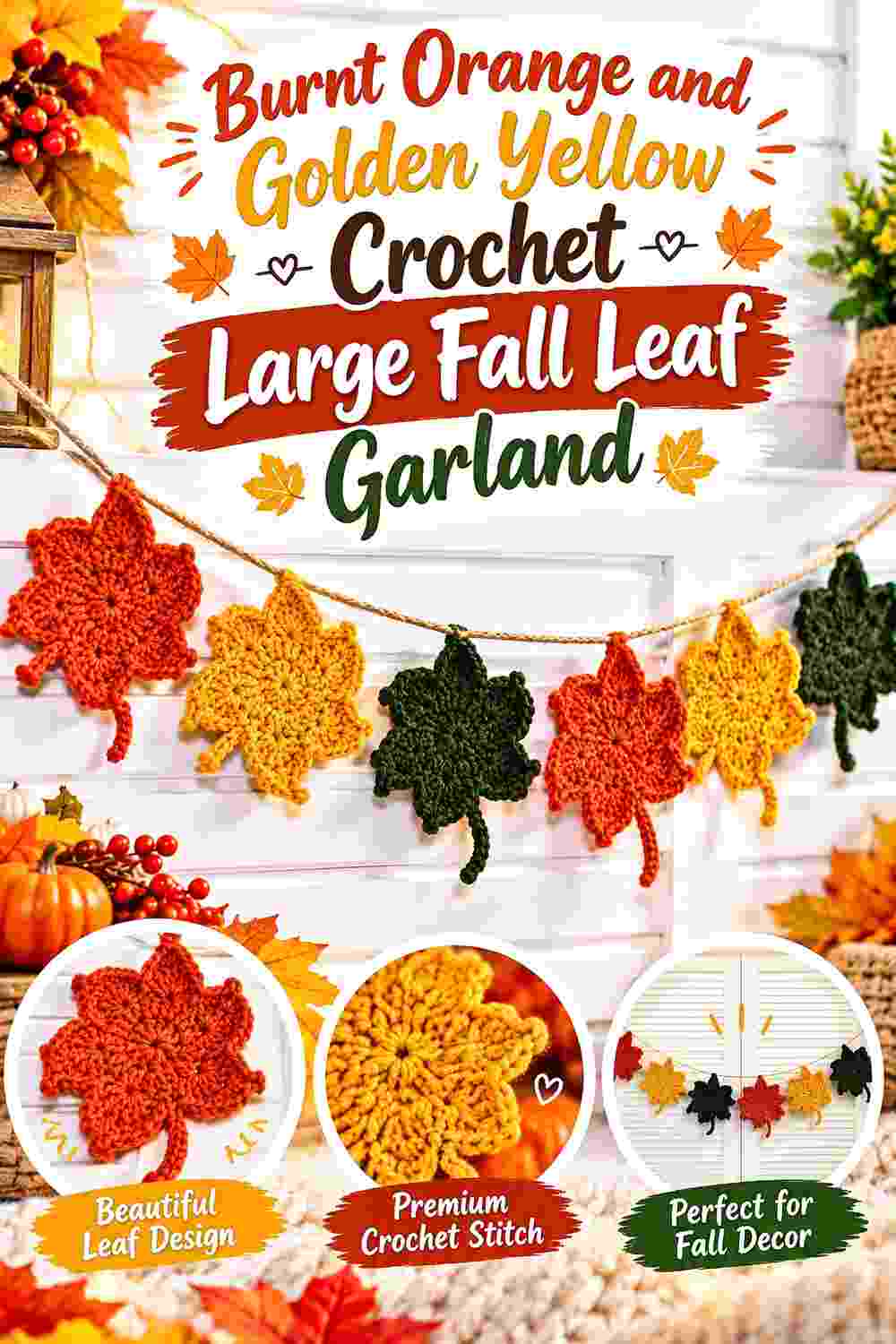
Large leaves make color placement visible from farther away, so golden yellow does not need to appear often. Use burnt orange across most of the larger motifs and reserve yellow for selected leaves that break the sequence.
Burnt Orange Should Dominate Large Crochet Leaf Motifs
A large golden-yellow leaf occupies more visual area than a small accent motif, even when only a few appear.
Keep the majority of the large leaves burnt orange if orange should remain the first color noticed across the mantel or wall.
Golden Yellow Can Brighten a Burnt Orange Garland Center
One useful layout is to place the lighter shade closer to the center of the strand and surround it with burnt orange.
This creates a focal point without requiring many yellow leaves. For a more even look, distribute the yellow accents symmetrically instead.
Burnt Orange Large Leaves Need More Room Between Motifs
Scale the spacing to the leaves. Large burnt orange motifs crowded edge to edge can lose their individual outlines.
Temporarily position several completed leaves at the display site before deciding how many the full garland needs.
Creator Credit: BitKnits
7. Burnt Orange And Brown Crochet Oak Leaf Garland
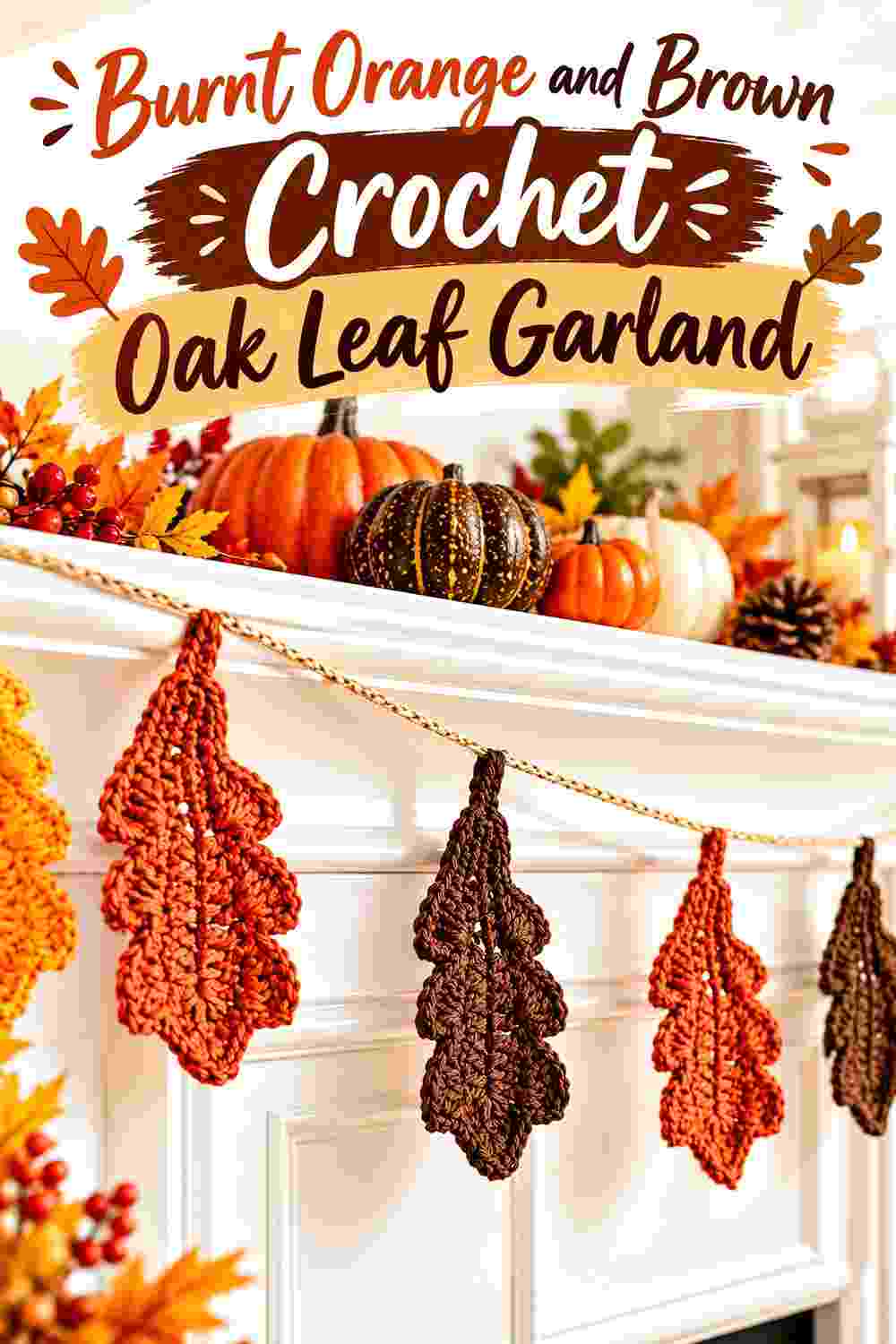
Oak leaves have a narrower, lobed profile that works naturally with an earthy orange-and-brown palette. Make burnt orange the repeated leaf color and use brown through selected leaves, stems, or the connecting cord.
Burnt Orange Should Keep the Oak Crochet Garland From Becoming Too Dark
Chocolate or chestnut-like browns can occupy substantial visual weight, particularly against wood furniture.
Keep burnt orange across most of the oak leaves and move more of the brown into stems or the hanging strand when you want a clearer orange emphasis.
Brown Cord Can Outline Burnt Orange Oak Leaves
A brown connecting line visually relates to stems and branches while allowing orange to remain concentrated in the foliage.
Check the cord against the actual wall or mantel. A very dark strand can disappear against dark wood and change how the leaves appear to float.
Burnt Orange Oak Leaves Benefit From Varied Orientation
Turn selected burnt orange leaves slightly rather than lining every oak motif in exactly the same direction.
Because the color is repeated heavily, orientation becomes another way to create visual variation without adding extra shades.
Creator Credit: Yarnspirations
8. Burnt Orange And Sage Crochet Maple Leaf Garland
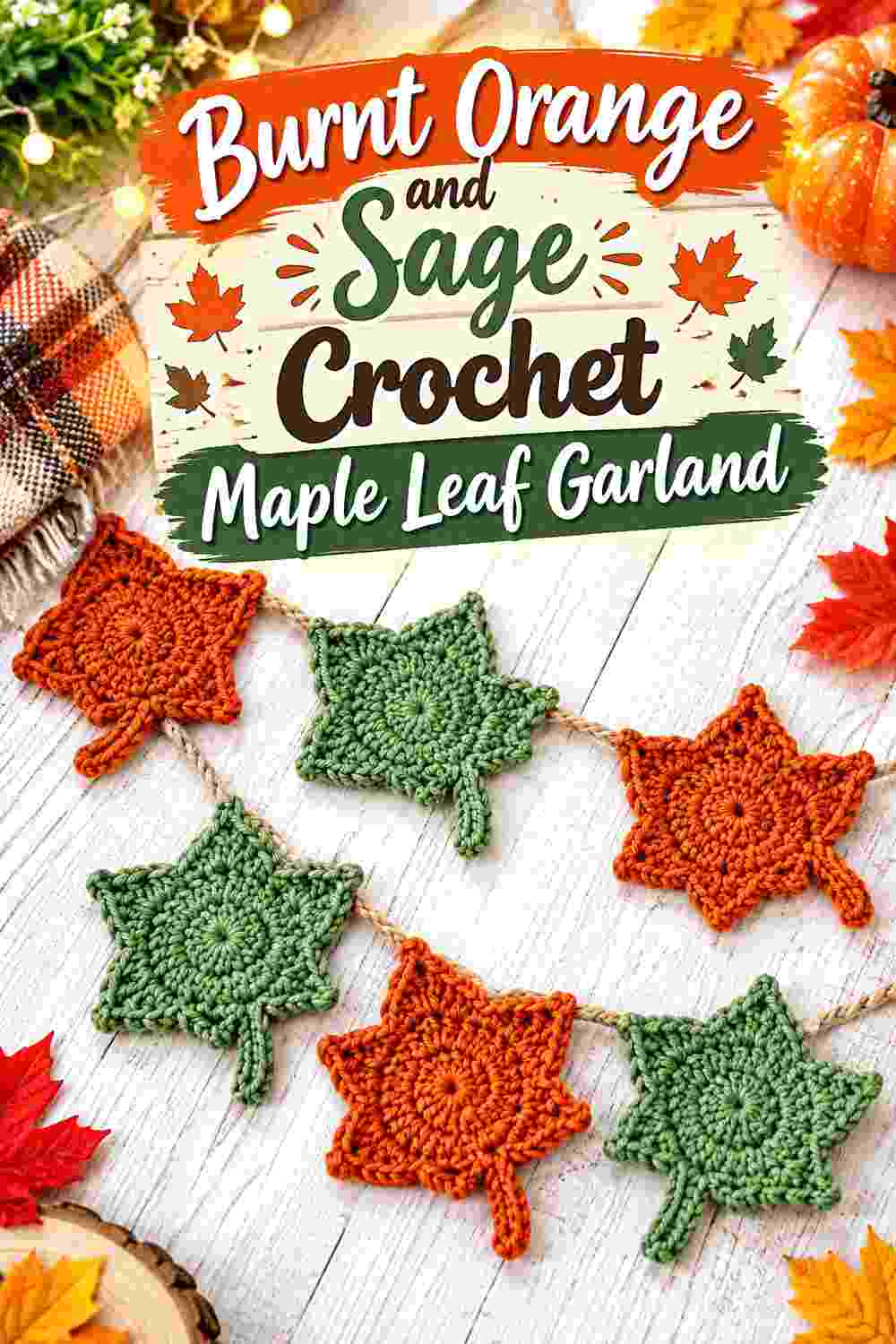
Sage produces a softer green contrast than olive. Use it as an occasional leaf color while keeping the broader maple silhouettes predominantly burnt orange.
Burnt Orange Should Stay More Saturated Than the Sage Accents
If your sage is deliberately muted, let that difference remain part of the palette instead of trying to balance both shades equally.
Burnt orange can carry the visual energy while sage provides quieter intervals across the strand.
Sage Leaves Need Burnt Orange Repetition on Both Sides
Avoid placing all the sage motifs together unless you want a deliberately blocked section.
Surrounding each sage accent with burnt orange helps the muted green read as part of the same garland rather than a separate mini-section.
Burnt Orange Maple Leaves Need a Cord That Does Not Compete
With orange and sage already creating warm-cool contrast, the connecting cord can stay understated.
Brown, oatmeal, muted olive, or burnt orange itself can work as a visual support depending on the background.
Creator Credit: Hopeful Turns
9. Burnt Orange And Terracotta Crochet Autumn Maple Garland
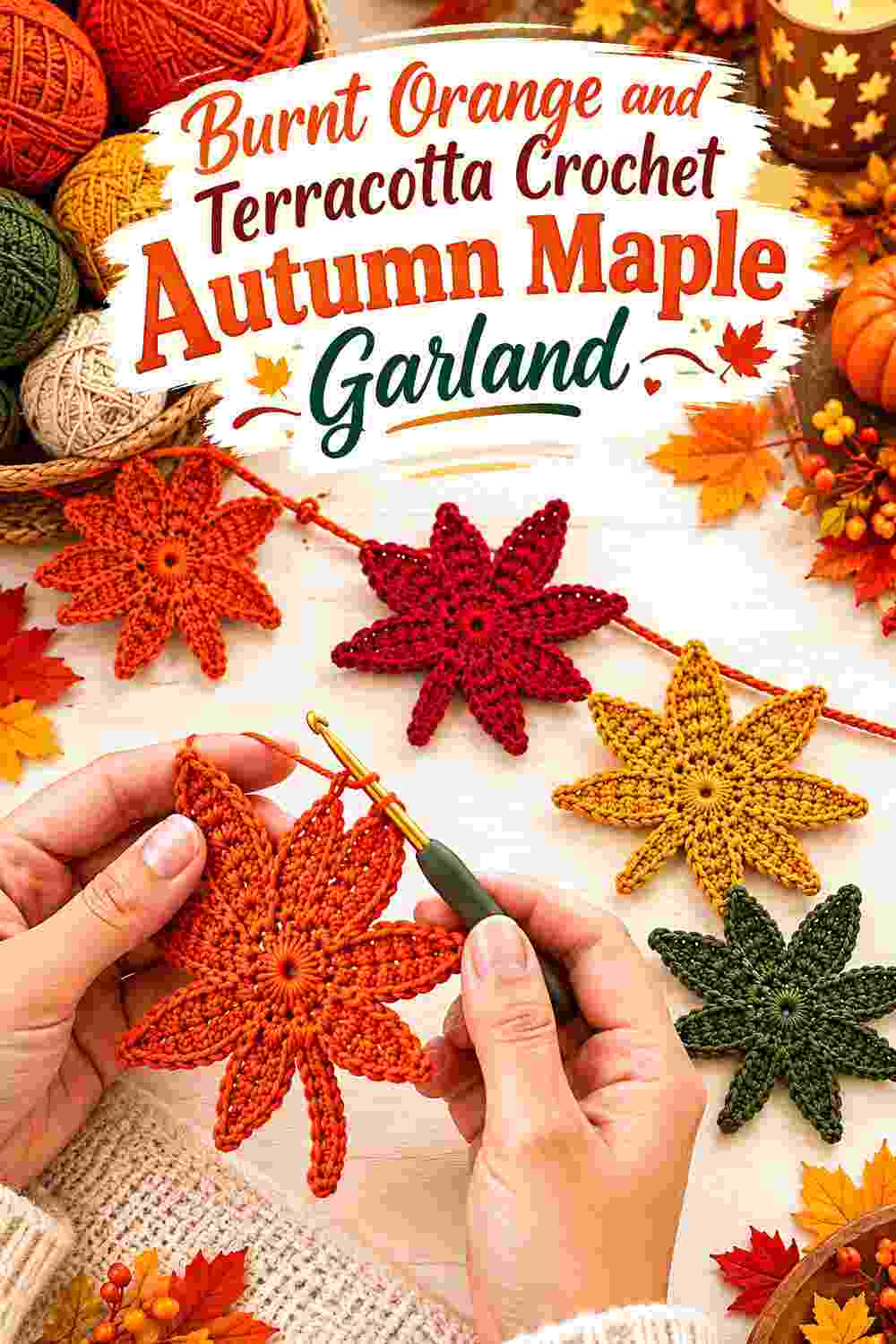
Terracotta keeps the palette close and earthy while still allowing subtle variation from burnt orange. This works well when you want a garland that reads mostly orange rather than obviously multicolored.
Burnt Orange Should Remain the Brightest Maple Leaf Shade
Choose a terracotta that is visibly distinct from the burnt orange yarn when placed side by side.
If both shades appear nearly identical, use terracotta for only a few leaves and let differences in spacing or orientation add the remaining variation.
Terracotta Can Create Tonal Groups Around Burnt Orange Leaves
Instead of alternating one-for-one, group the colors.
For example, several burnt orange maple leaves can lead into a short terracotta section before burnt orange returns. Grouping makes a low-contrast palette easier to read.
Burnt Orange Maple Silhouettes Need Clear Edges
When the palette is tonal, leaf shape carries more of the design. Avoid crowding the motifs so tightly that their points overlap heavily.
The recognizable maple outline should still be visible when the garland is viewed at its normal display distance.
Creator Credit: Tuba Crochet
10. Burnt Orange And Chocolate Crochet Mixed Autumn Leaf Garland

A mixed autumn garland can include more than one leaf shape and other seasonal motifs, but burnt orange should still provide a repeated visual thread. Use orange on the major leaves and selected accompanying pieces while chocolate brown grounds smaller details or the cord.
Burnt Orange Leaves Should Lead the Mixed Crochet Motifs
When pumpkins, acorns, or multiple leaf shapes appear together, color can keep the strand cohesive.
Repeat burnt orange across several different motif types rather than assigning orange to only one shape. That allows the eye to follow the color even as the silhouettes change.
Chocolate Brown Can Separate Burnt Orange Autumn Shapes
Use brown between or around brighter motifs when the mixed sequence starts feeling crowded.
A quieter dark cord or brown acorn detail can create visual pauses without requiring larger empty spaces.
Burnt Orange Should Not Compete With Every Extra Garland Color
A multi-motif project can invite too many autumn shades. If burnt orange is the article’s main direction, keep the additional palette controlled.
Choose one or two supporting colors rather than making every pumpkin, leaf, and acorn a different shade.
Creator Credit: Annie’s Attic Videos
11. Burnt Orange And Oatmeal Crochet Autumn Leaf Garland

Oatmeal gives burnt orange a light neutral partner without the sharper contrast of bright white. Use orange for the leaves and oatmeal primarily through the connecting strand or occasional accent motifs.
Burnt Orange Should Carry Most of the Crochet Leaf Surface
Keep oatmeal secondary so the finished garland still reads immediately as burnt orange.
A neutral cord plus mostly orange leaves is the simplest arrangement. Occasional oatmeal leaves can be added where the strand needs a visual pause.
Oatmeal Cord Can Separate Burnt Orange Leaves From Dark Backgrounds
Against dark paint, brick, or wood, a lighter cord creates a visible line between the orange motifs.
Test the strand against the actual background before deciding whether oatmeal should remain only on the cord or repeat in a few leaves.
Burnt Orange Leaves Need Balanced Placement Before Joining
Arrange all completed motifs in order before attaching them permanently.
Because oatmeal is much lighter, one neutral leaf can attract more attention than several burnt orange leaves. Move the accent until the full strand looks balanced rather than judging it in isolation.
Creator Credit: hibouchoucaillou
Comparing Burnt Orange Autumn Leaf Garland Color Directions
For the strongest burnt-orange emphasis, choose the oatmeal, chocolate-brown, or brown oak-leaf versions. In those palettes, the supporting colors can remain mostly on the cord, stems, or occasional leaves while orange occupies most of the foliage.
For softer multicolor autumn displays, mustard, olive, sage, and burgundy introduce clearer shifts between motifs. These work especially well when separate leaves can be arranged before joining.
The rust and terracotta ideas create the most tonal appearance. Their value comes from subtle differences rather than high contrast, so leaf silhouette and spacing become especially important.
If the garland itself needs more visual weight, larger maple or fall leaves can fill a mantel or broad wall area. A continuous leaf vine produces a lighter line that is easier to curve around a wreath, mirror, shelf edge, or other shaped display.
Conclusion
A burnt orange crochet autumn leaf garland does not need twelve unrelated colors to create variety. Changing the supporting shade, leaf silhouette, spacing, cord, and orange-to-accent ratio can produce noticeably different finished displays while keeping burnt orange at the center.
Use mustard or golden yellow for a lighter harvest palette, chocolate or brown for a woodland direction, olive or sage for botanical contrast, and rust or terracotta for a nearly tonal orange strand. Cream or oatmeal can create the clearest separation when the garland needs to show against a darker background.
Before assembling a long strand, make a few leaves and arrange them at the actual display location. Burnt orange can behave differently against white walls, dark wood, brick, or colorful seasonal decor, and the spacing that works on a table may feel too dense once the garland hangs. Use the credited tutorials for their original leaf and garland construction details.
Frequently Asked Questions
What colors work well with Burnt Orange in a crochet autumn leaf garland?
Mustard, chocolate brown, olive, burgundy, cream, rust, sage, terracotta, golden yellow, and oatmeal can all support burnt orange. Choose the second shade according to the amount of contrast you want and the background where the garland will hang.
Should every leaf in a Burnt Orange crochet garland be the same color?
No. Burnt orange can remain dominant while selected leaves use a supporting autumn shade. Repeating orange more frequently than the accent color keeps the garland visually connected.
What cord color works with Burnt Orange crochet leaves?
Burnt orange creates the most unified strand, brown gives the garland an earthy branch-like line, and cream or oatmeal can create more contrast. The display background should also influence the choice.
How do I keep Burnt Orange crochet maple leaves from looking crowded?
Give broad maple motifs enough space for their points to remain visible. Temporarily lay out several finished leaves at the intended display site and increase the spacing if neighboring silhouettes overlap too heavily.
Can I mix Burnt Orange maple and oak leaves in one crochet garland?
Yes. Keep color repetition consistent so the different silhouettes still feel connected. Burnt orange can appear on both leaf types while a second shade is used more selectively.
How can I make a mostly Burnt Orange crochet garland look less repetitive?
Change leaf orientation, spacing, silhouette, or the color of occasional motifs instead of adding many extra colors. A brown cord, mustard accent leaf, or mix of maple and oak shapes can create variation while keeping burnt orange dominant.
Should Burnt Orange leaves be lighter or darker than the garland cord?
Either relationship can work. A darker brown cord frames burnt orange leaves, while a lighter oatmeal cord creates a softer separating line. Compare the full combination against the wall, mantel, or shelf where the garland will actually hang.