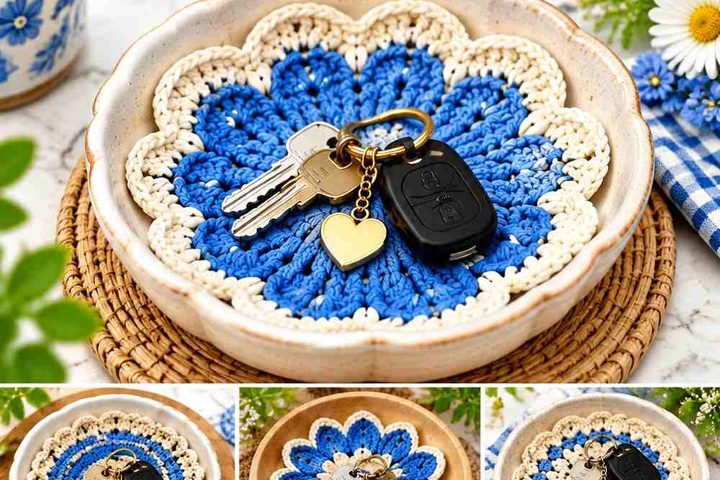
Pomegranate Pink and Sage Cream give a crochet ring dish liner a useful combination of stronger color and softer neutral-green contrast. Pomegranate Pink can make the center more noticeable when the dish is empty, while Sage Cream can lighten the rim and separate the crochet from a darker dish. Reverse those roles and the liner becomes quieter overall, with pink concentrated where it will remain visible around stored rings.
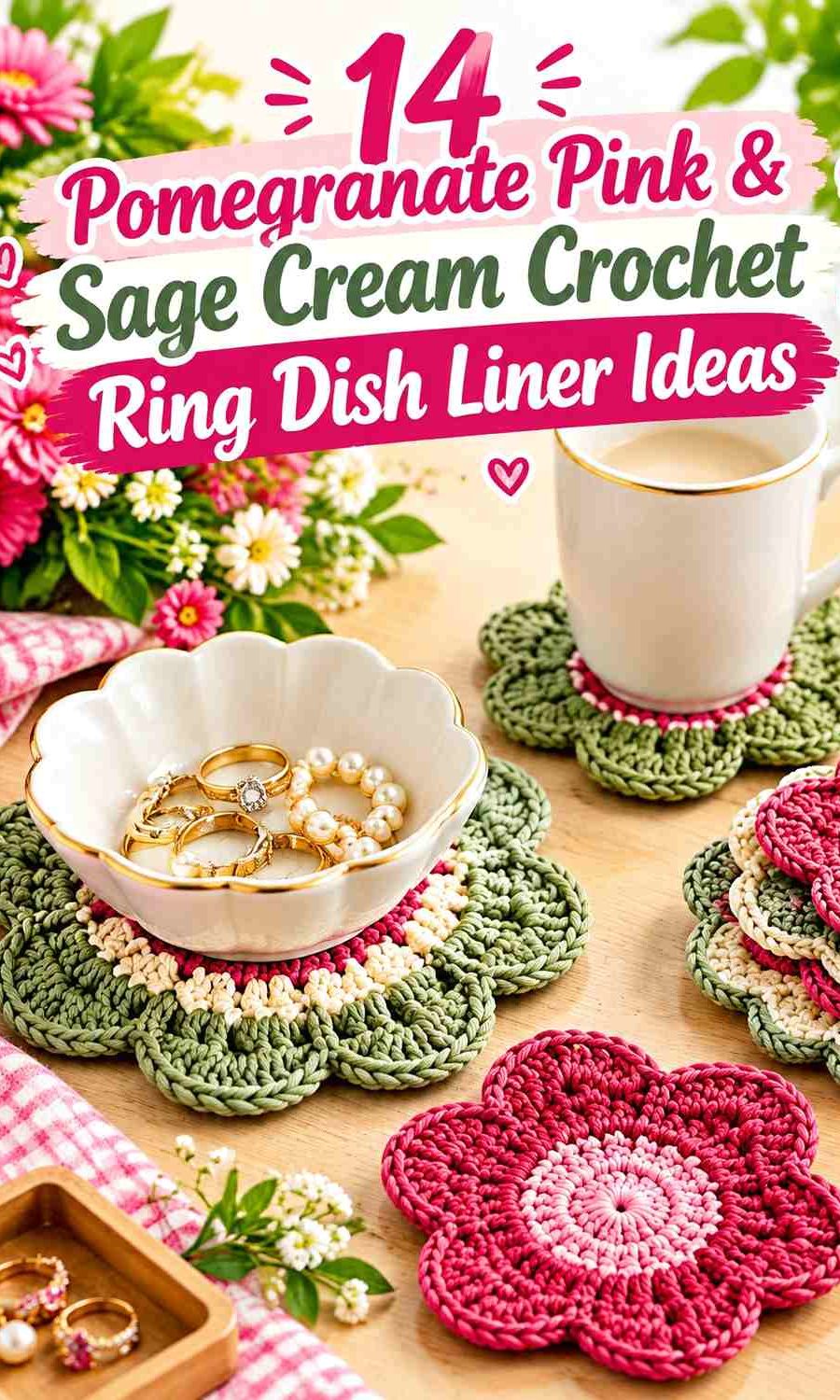
A ring dish liner also behaves differently from a coaster used on a table. Rings may cover much of the center, while the outer edge remains visible. Raised or very open details can also matter more because small settings, prongs, and narrow bands sit directly on the crochet surface. A flatter central area can therefore be useful when the liner will be used every day.
The credited tutorials include round coasters, flower coasters, doily-style pieces, flat-circle constructions, and a coaster/tray set whose flat forms can be adapted to a removable ring-dish liner. The Pomegranate Pink and Sage Cream layouts below are independent editorial color directions rather than claims that the creators used these exact shades.
Quick List
- Pomegranate Pink center with Sage Cream rim
- Sage Cream center with Pomegranate Pink rim
- Pomegranate Pink medallion with Sage Cream field
- Sage Cream medallion with Pomegranate Pink field
- Broad Pomegranate Pink and Sage Cream concentric rings
- Sage Cream liner with fine Pomegranate Pink rings
- Pomegranate Pink liner with fine Sage Cream rings
- Half Pomegranate Pink and half Sage Cream liner
- Radial Pomegranate Pink and Sage Cream sections
- Pomegranate Pink flower center on Sage Cream
- Sage Cream flower center on Pomegranate Pink
- Sage Cream liner with a Pomegranate Pink scalloped rim
- Marled Pomegranate Pink and Sage Cream liner
- Graduated Pomegranate Pink and Sage Cream ring liner
Plan Pomegranate Pink and Sage Cream Around Where Rings Will Sit
The center of a liner may look like the natural place for the strongest color, but that area can disappear once several rings are placed in the dish. If Pomegranate Pink is the shade you most want visible, consider repeating it near the perimeter or in an outer band rather than using it only in a tiny central circle.
For a dish that is usually empty on display, the opposite approach can work well: a concentrated Pomegranate Pink center can become the focal point, with Sage Cream keeping the surrounding area lighter.
Keep Pomegranate Pink and Sage Cream Texture Practical for Rings
Color does not need heavy texture to make a small liner interesting. Concentric rings, broad blocks, edging, and motif boundaries can provide plenty of variation while leaving the primary ring-resting surface comparatively flat.
If you choose a flower or doily-inspired construction, inspect the finished openings and raised areas with the rings you actually intend to store. A very prominent setting or fine prong can interact differently with open crochet than a plain band.
Check Pomegranate Pink and Sage Cream Against the Actual Ring Dish
The dish itself becomes a third visible color around the crochet. Sage Cream can create useful separation from a dark ceramic or wood-toned dish, while Pomegranate Pink can provide a stronger outline inside a pale cream or white dish.
Compare the yarns inside the dish before deciding how narrow the outer border should be. If Pomegranate Pink and Sage Cream are similar in light/dark value, larger color areas will usually stay more distinct than very fine rings.
1. Pomegranate Pink and Sage Cream Crochet Ring Dish Liner With a Pink Center
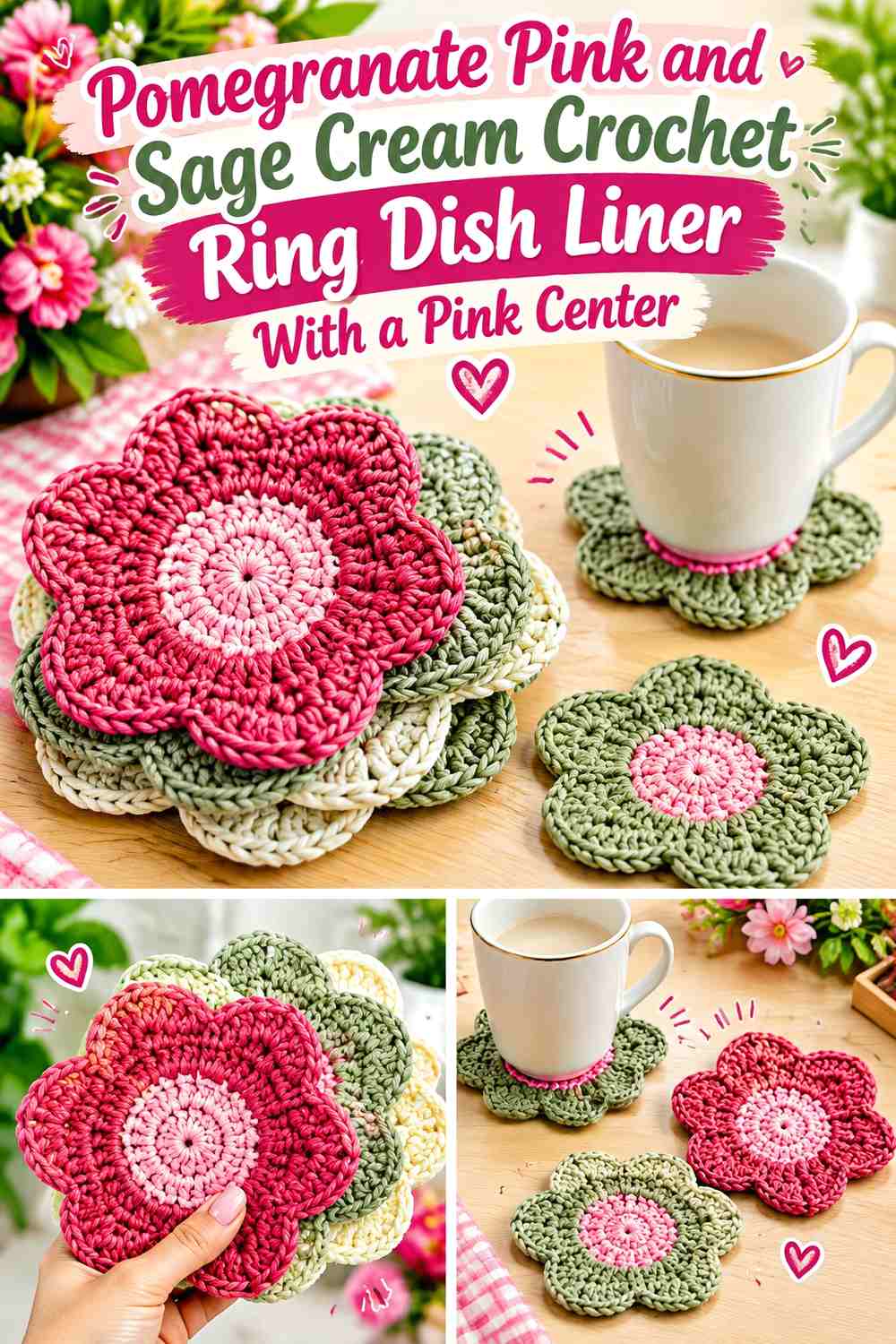
Let Pomegranate Pink cover most of the central resting area and use Sage Cream around the perimeter. This makes the liner clearly pink when the dish is empty while giving the deeper color a softer boundary where the crochet meets the dish.
Pomegranate Pink Should Extend Beyond the Smallest Ring-Pile Area
Make the Pomegranate Pink center broad enough that some remains visible around a few stored rings. A tiny center accent can disappear completely as soon as jewelry is added.
Keeping the center largely one color also lets the shape of the rings provide visual detail without several small color changes competing underneath them.
Sage Cream Can Separate Pomegranate Pink From the Ring Dish Rim
Use Sage Cream as the outer band when you want a lighter transition between the strong center and the dish itself.
Keep the Sage Cream rim proportionate. If it occupies nearly half the liner, the finished piece will read as a balanced two-color design rather than a Pomegranate Pink-led one.
Creator Credit: VivCrochets
2. Pomegranate Pink and Sage Cream Crochet Ring Dish Liner With a Sage Cream Center

Reverse the hierarchy by letting Sage Cream cover the main ring-resting area and concentrating Pomegranate Pink around the outside. This keeps the center visually quiet while ensuring the stronger shade remains visible even when jewelry occupies the middle.
Sage Cream Can Keep the Ring-Resting Center Visually Light
Use Sage Cream broadly through the center when you want rings to sit against a softer background rather than a saturated field.
A continuous center is also useful when several ring metals, stones, and shapes already create enough visual variation inside the dish.
Pomegranate Pink Can Frame the Sage Cream Liner After Rings Are Added
Place Pomegranate Pink near the perimeter so it remains visible around the jewelry instead of disappearing underneath it.
Because the rim is less likely to be covered completely, a relatively narrow pink band can carry more visual weight than the same amount of color in the center.
Creator Credit: ElyseCrochets 💌
3. Pomegranate Pink Medallion and Sage Cream Crochet Ring Dish Liner
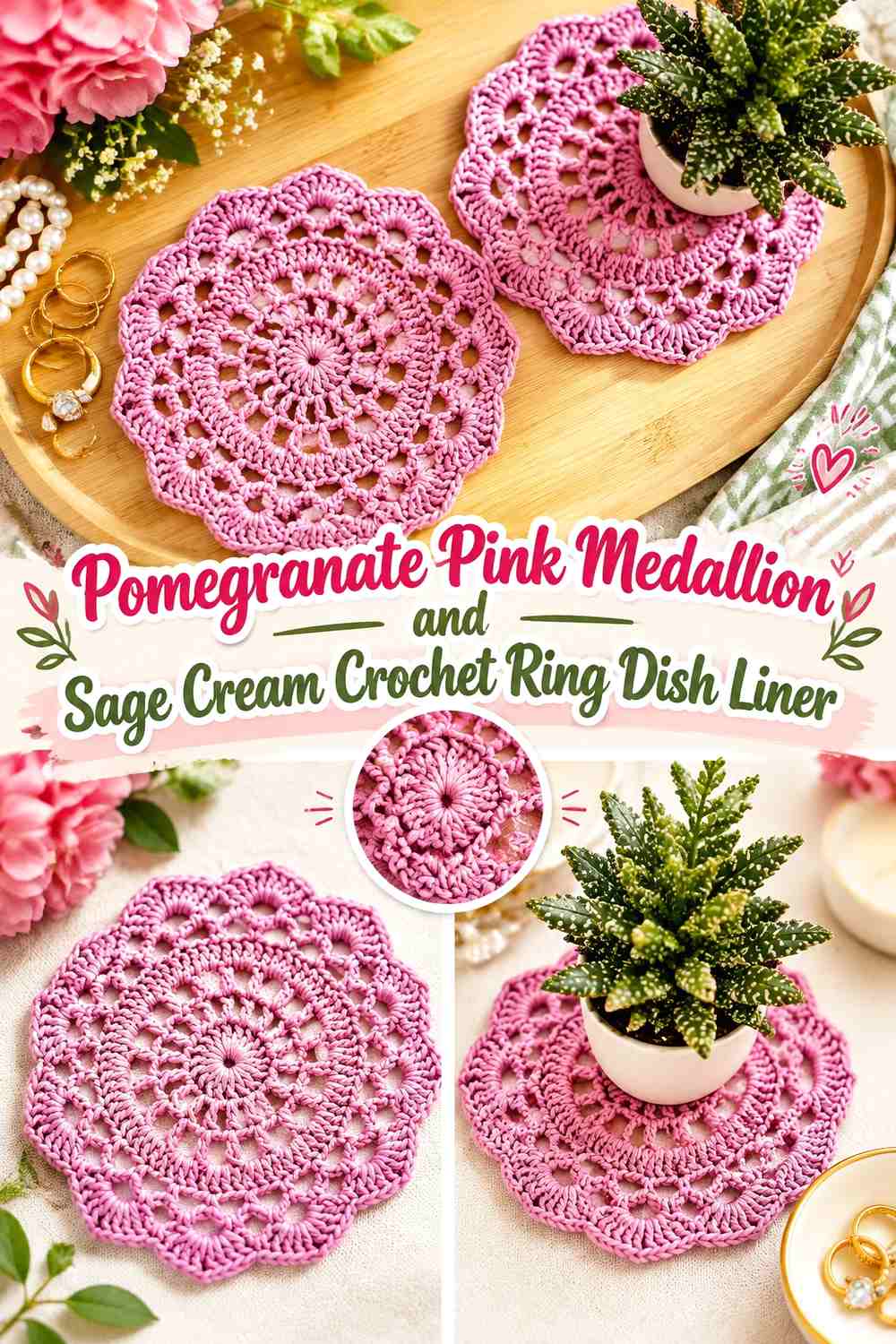
Use Pomegranate Pink for a defined central medallion, surround it with a broad Sage Cream field, and leave the outer area comparatively simple. This gives the liner a focal center without making pink the dominant surface.
Pomegranate Pink Needs Enough Size to Read as a Medallion
Avoid reducing Pomegranate Pink to a dot at the middle. Give it enough area to remain recognizable between one or two rings.
If the dish usually holds many pieces, accept that the medallion may become a detail seen mainly when the liner is empty rather than trying to enlarge it until it takes over the palette.
Sage Cream Should Give the Pomegranate Pink Center Breathing Room
Keep a substantial Sage Cream area around the medallion so the stronger center does not visually run straight into the dish edge.
This broad neutral-green field also distinguishes the idea from a simple Pomegranate Pink center with a narrow border.
Creator Credit: Kristines Crochets
4. Sage Cream Medallion and Pomegranate Pink Crochet Ring Dish Liner
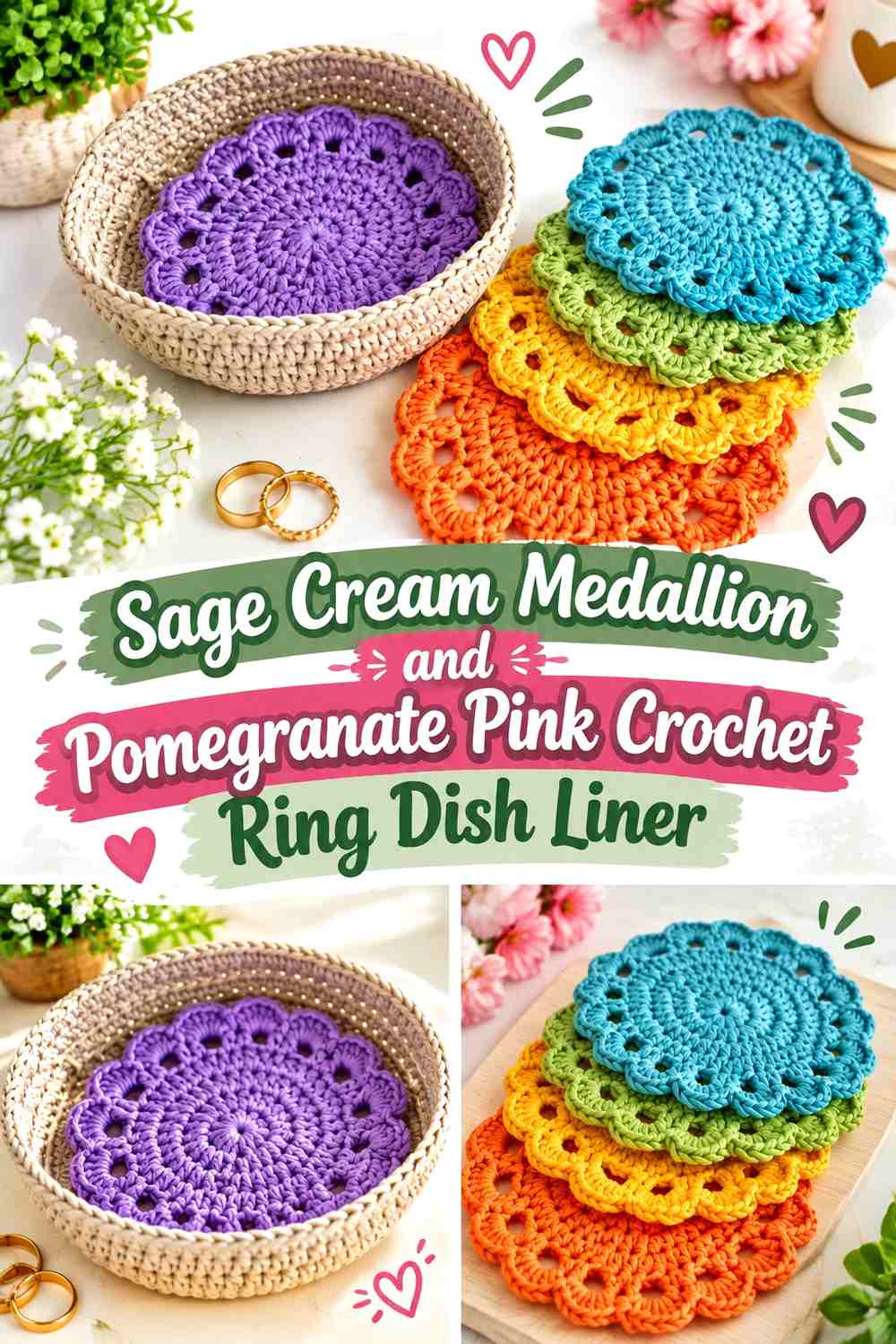
Place a Sage Cream medallion in the middle and use Pomegranate Pink throughout most of the surrounding liner. The small light center interrupts the stronger field while preserving a distinctly pink overall result.
Sage Cream Can Create a Clear Focal Break Inside Pomegranate Pink
Make the Sage Cream center large enough to be visible around a single ring or small stack.
A pale center can be especially effective when Pomegranate Pink would otherwise create one uninterrupted field from the middle to the edge.
Pomegranate Pink Should Stay Broad Around the Sage Cream Medallion
Keep the surrounding area largely pink rather than adding more Sage Cream bands automatically.
The uninterrupted Pomegranate Pink field is what separates this idea from a multiring design and keeps the small center accent meaningful.
Creator Credit: Lanas y ovillos
5. Broad Pomegranate Pink and Sage Cream Concentric Crochet Ring Dish Liner
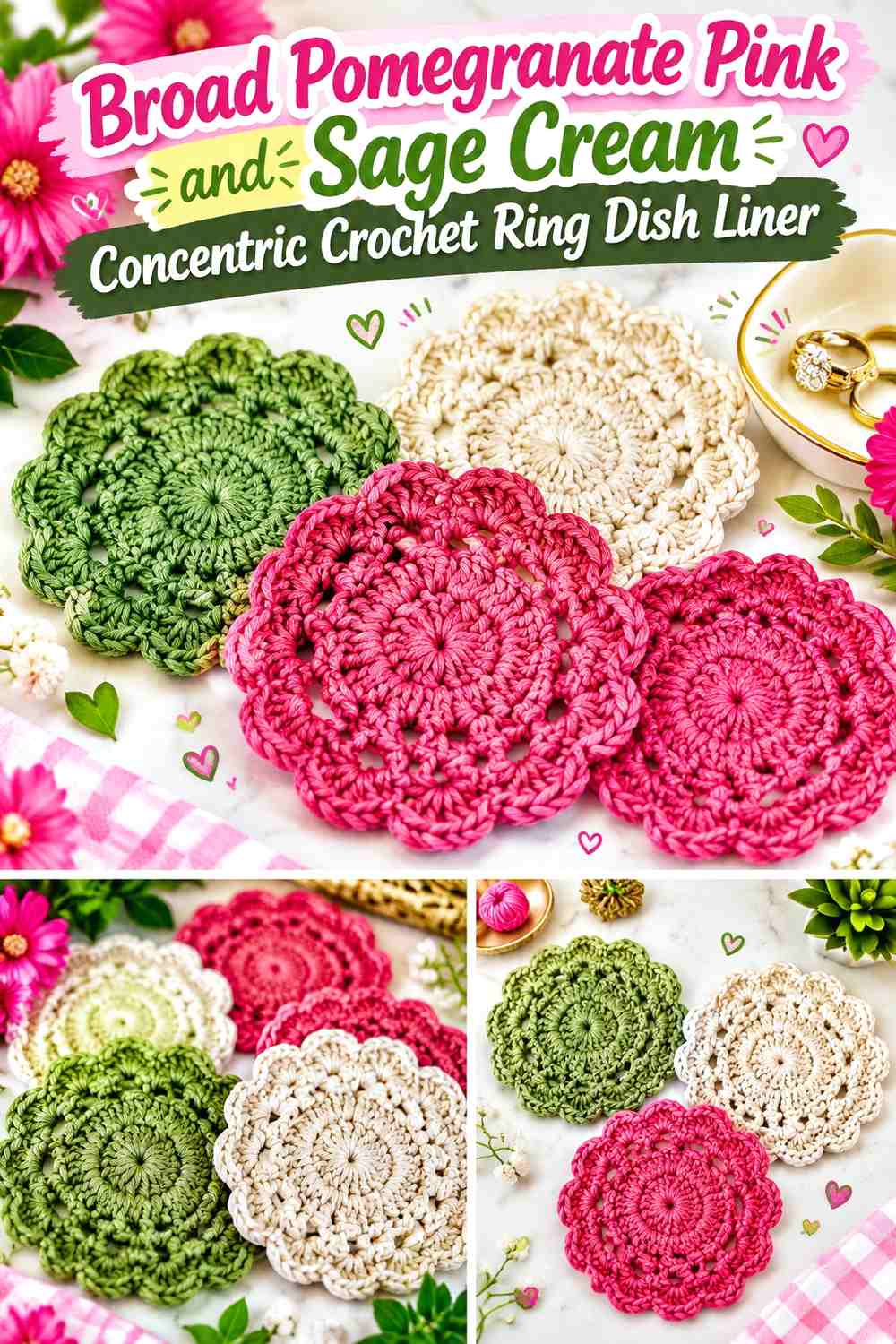
Alternate a few substantial rings from the center outward. Broad bands allow both colors to remain recognizable even when several jewelry pieces cover parts of the liner.
Pomegranate Pink Broad Rings Need Clear Sage Cream Separation
Leave enough Sage Cream between major pink areas that the deeper bands do not visually merge into one large field.
Consider which ring will remain most visible when jewelry sits in the center. An outer Pomegranate Pink band may influence the everyday appearance more than an equally wide inner one.
Sage Cream Ring Width Controls the Weight of Pomegranate Pink
Wider Sage Cream sections make the liner read lighter and more open, while broader Pomegranate Pink bands create a richer overall result.
Avoid finishing with an extremely narrow accidental-looking band at the edge. Adjust the final color proportion so the outer ring feels deliberate.
Creator Credit: Leonela Cevallos
6. Sage Cream Crochet Ring Dish Liner With Fine Pomegranate Pink Rings
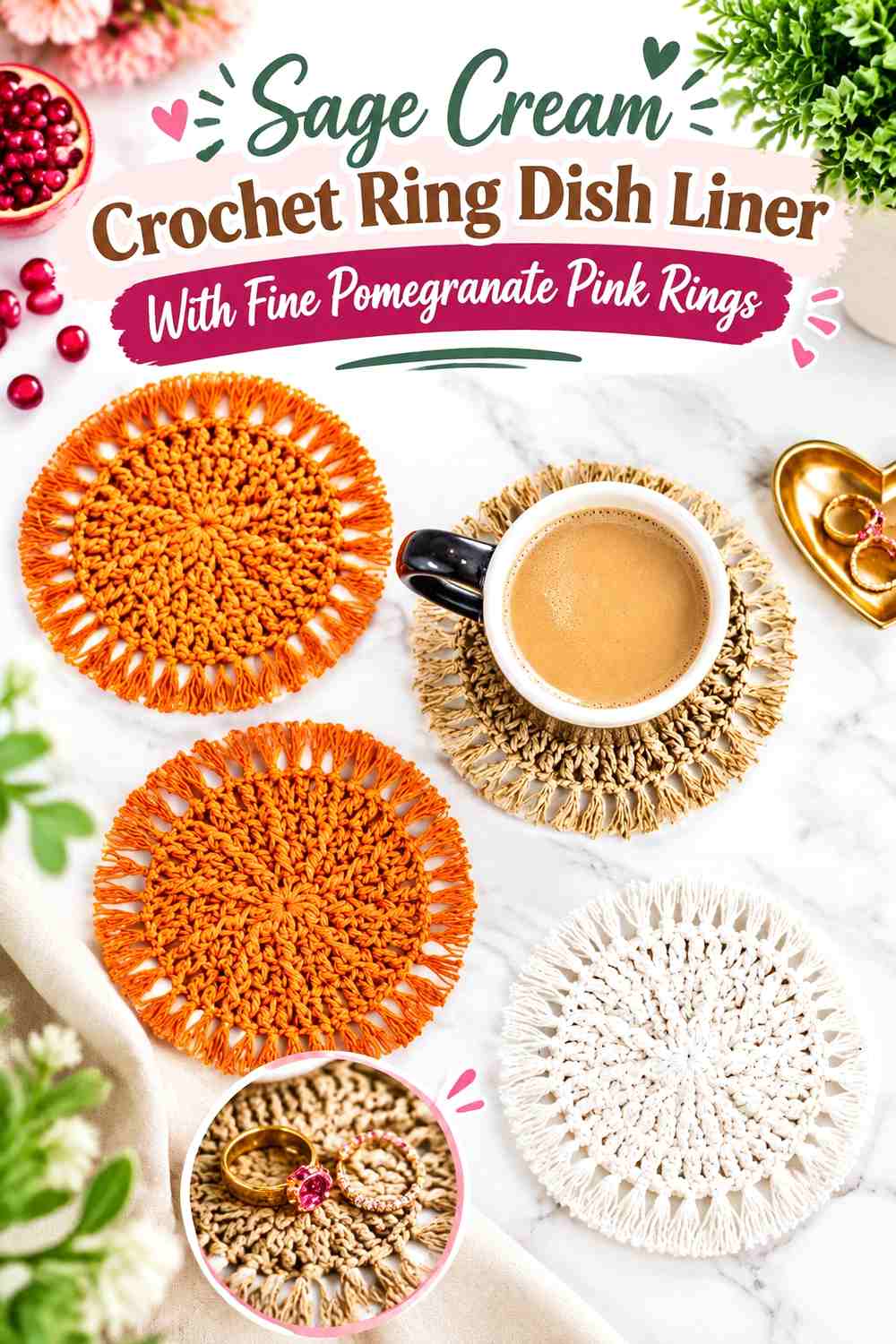
Let Sage Cream form one continuous light background and introduce Pomegranate Pink through narrow concentric lines. The repeated dark accents give the liner structure without dividing it into equally dominant blocks.
Pomegranate Pink Fine Rings Need Consistent Sage Cream Spacing
Repeat the Pomegranate Pink accents according to a clear rhythm instead of inserting thin color changes at random intervals.
Fine rings can look stronger as a group than they do individually. View the liner from normal dresser or bedside-table distance before deciding that it needs another pink line.
Sage Cream Should Remain Visible Between Every Pomegranate Pink Ring
Give Sage Cream enough space to continue functioning as the main field.
If the actual yarns have softer value contrast, slightly wider Pomegranate Pink bands can remain clearer than numerous very fine lines.
Creator Credit: The Turtle Trunk
7. Pomegranate Pink Crochet Ring Dish Liner With Fine Sage Cream Rings
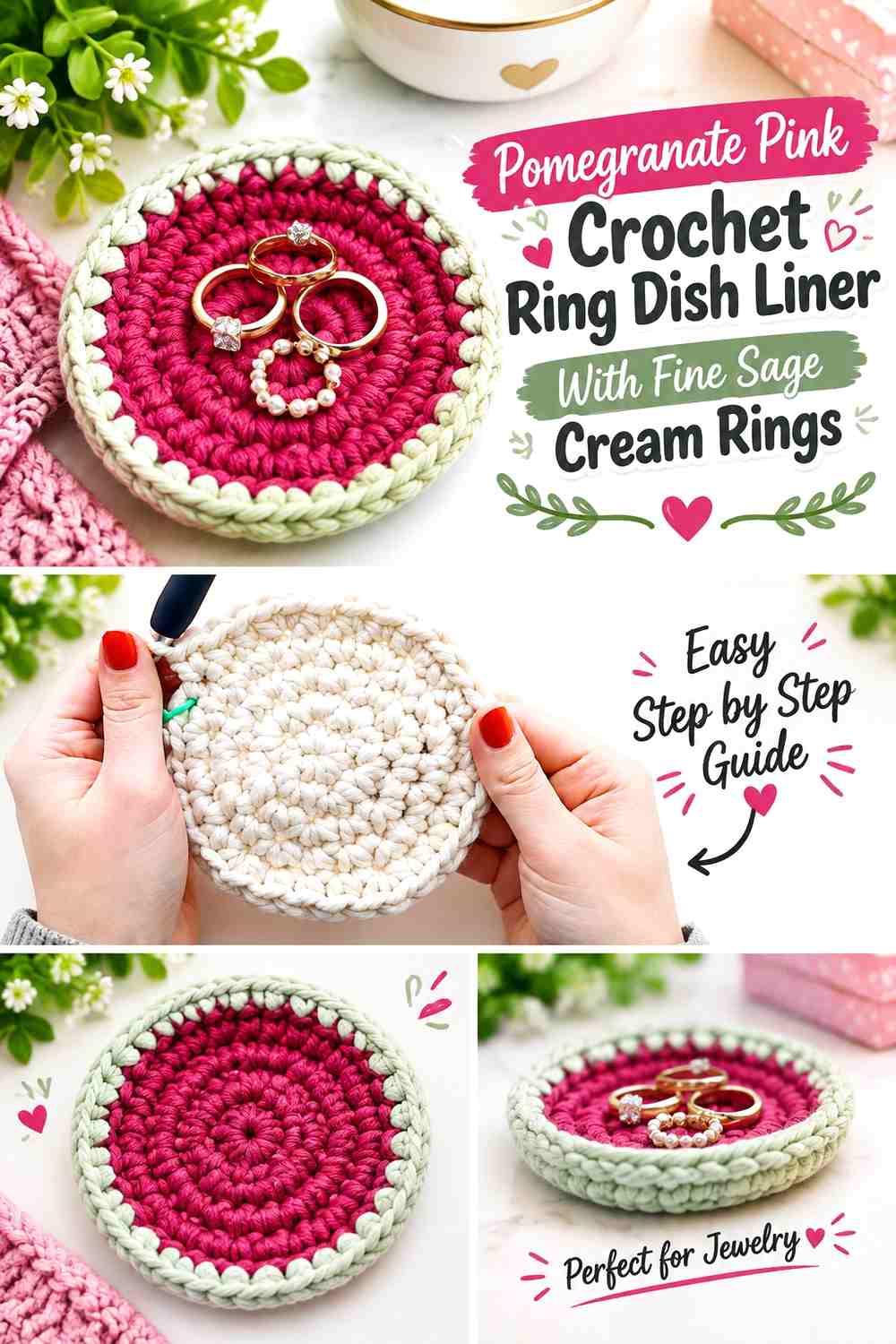
Reverse the fine-ring idea by making Pomegranate Pink continuous and using Sage Cream as repeated light lines. The result stays strongly pink but gains small breaks that follow the circular shape of the dish.
Sage Cream Fine Rings Can Break Up a Large Pomegranate Pink Field
Use Sage Cream at regular intervals so the light lines feel connected to the round construction rather than randomly placed.
Keep the rings broad enough to remain visible once shadows from jewelry fall across the liner.
Pomegranate Pink Should Connect Every Sage Cream Ring
Leave enough Pomegranate Pink between the lighter accents for the deep color to remain one continuous background.
If Sage Cream starts occupying nearly as much surface as pink, the design moves closer to balanced concentric striping rather than a Pomegranate Pink-led liner.
Creator Credit: Sewrella
8. Half Pomegranate Pink and Half Sage Cream Crochet Ring Dish Liner
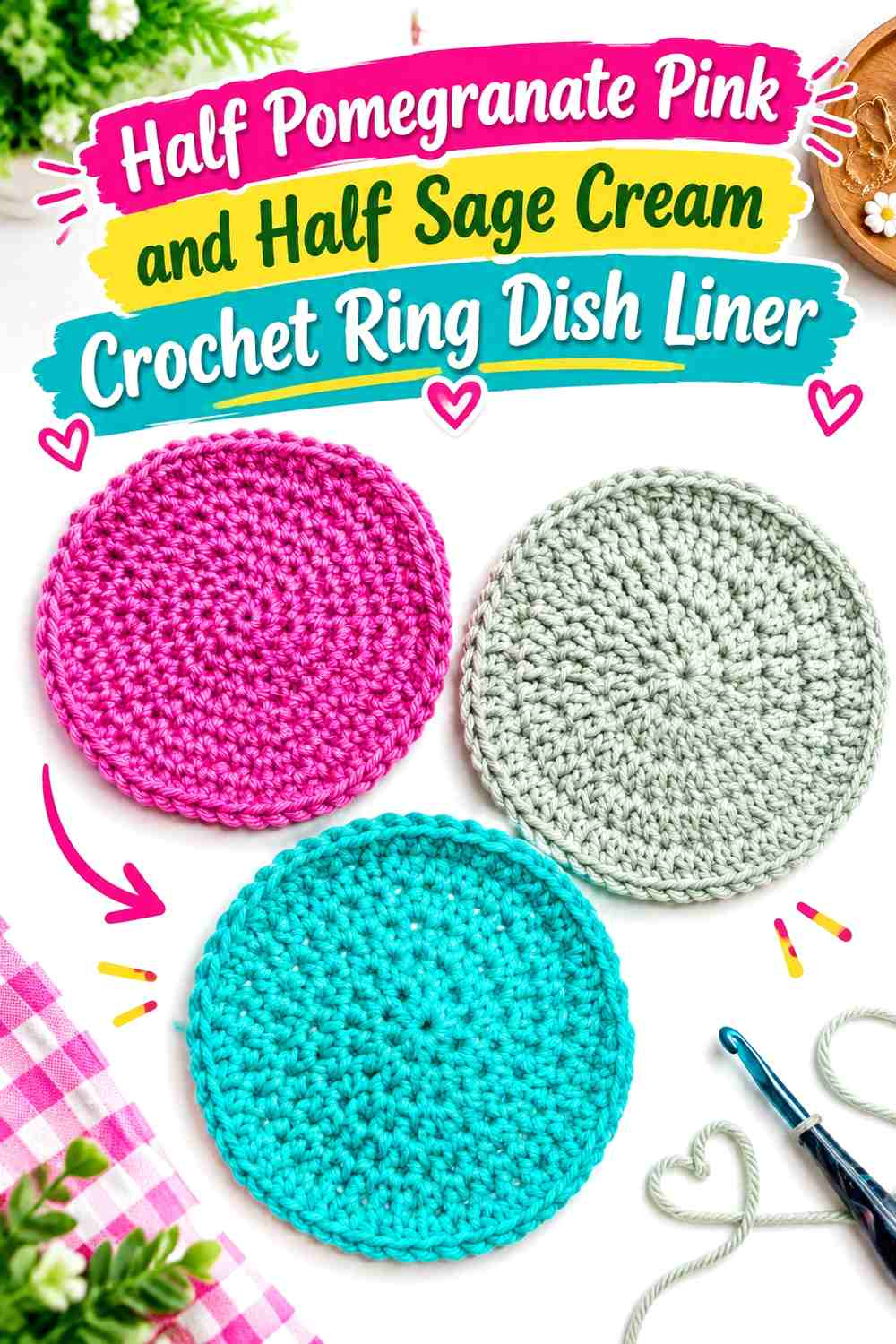
Divide the liner into two large color regions rather than working from center to edge. This gives both shades comparable importance and creates a strong graphic split beneath the jewelry.
Pomegranate Pink Needs a Complete Liner Section Beside Sage Cream
Give Pomegranate Pink an uninterrupted half or similarly substantial region so it remains readable even when a ring overlaps the central boundary.
Scattered pink patches would produce a much busier effect and weaken the simple split-color direction.
Sage Cream Should Meet Pomegranate Pink Along a Clean Division
Keep the main transition clear rather than adding a narrow intermediate band.
Rotate the finished liner inside the dish before settling on its final position. A diagonal split can look very different from a horizontal one even though the crochet itself has not changed.
Creator Credit: The Loopy Lamb
9. Radial Pomegranate Pink and Sage Cream Crochet Ring Dish Liner
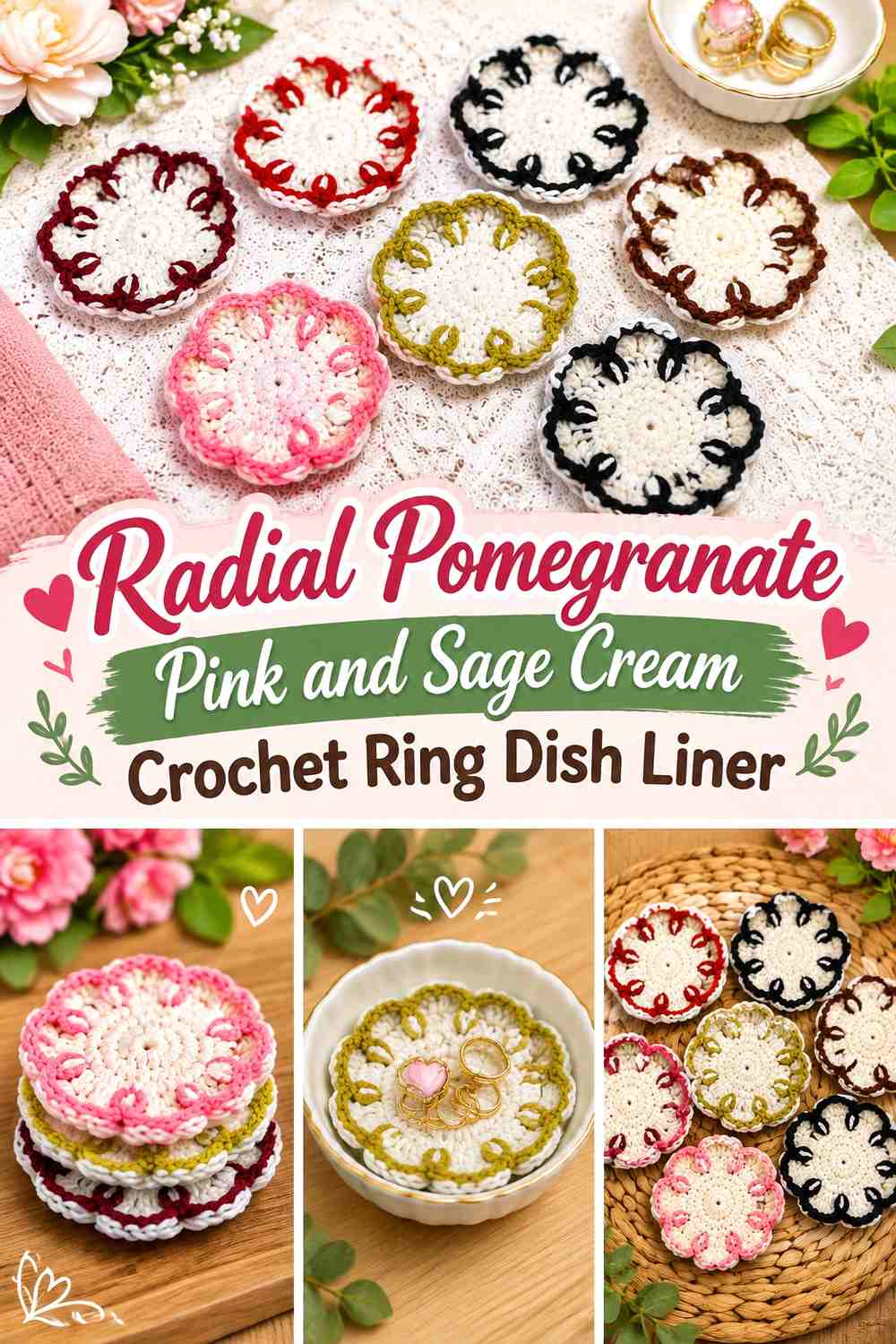
Use the two colors in wedge-like or petal-oriented sections that move outward from the center. This changes the visual direction completely from concentric stripes and can make the liner appear more dynamic while remaining only two colors.
Pomegranate Pink Radial Sections Need Consistent Repetition Beside Sage Cream
Repeat Pomegranate Pink at a clear interval around the circle instead of scattering uneven dark sections.
Keep the wedges broad enough that they remain understandable once one or two rings cover the middle where the sections converge.
Sage Cream Can Prevent Pomegranate Pink Radial Sections From Crowding the Center
Use Sage Cream to create visible breaks between the stronger sections, especially toward the outer edge where the radial structure is easiest to see.
If the middle becomes too visually busy, simplify the color meeting point rather than adding another center motif.
Creator Credit: Thao’s Homemade Crochet
10. Pomegranate Pink Flower-Center and Sage Cream Crochet Ring Dish Liner

Use a flower-inspired center in Pomegranate Pink and keep the surrounding area Sage Cream. This places the strongest decorative color exactly in the middle while leaving the larger ring-resting field quieter.
Pomegranate Pink Can Define the Flower Without Filling the Entire Liner
Keep the floral center clearly pink so the motif remains recognizable when the dish is empty.
For everyday ring storage, avoid extending highly raised floral texture across the entire surface if it gives fine jewelry more edges to interact with.
Sage Cream Can Calm the Area Around the Pomegranate Pink Flower
Use Sage Cream broadly beyond the flower so the motif remains the single focal feature.
This lighter surrounding area also gives the pink petals or central shape more separation than they would have inside a fully Pomegranate Pink liner.
Creator Credit: Amy’s DIY Frugal Life
11. Sage Cream Flower-Center and Pomegranate Pink Crochet Ring Dish Liner

Reverse the floral palette with a Sage Cream center surrounded by Pomegranate Pink. The pale flower becomes a calm break inside a stronger circular field.
Sage Cream Should Stay Visible Inside the Pomegranate Pink Flower Area
Make the central motif large enough that the lighter shape can still be seen beside a small ring.
If several rings usually occupy the dish, consider repeating a little Sage Cream near the outer edge so the secondary color does not vanish entirely during use.
Pomegranate Pink Can Give the Sage Cream Flower a Strong Background
Use Pomegranate Pink around the motif rather than changing colors inside every small detail.
The broad deeper field is what allows the Sage Cream flower to stand apart and keeps the design from becoming overly intricate.
Creator Credit: Crochet Me Lovely
12. Sage Cream Crochet Ring Dish Liner With a Pomegranate Pink Scalloped Rim
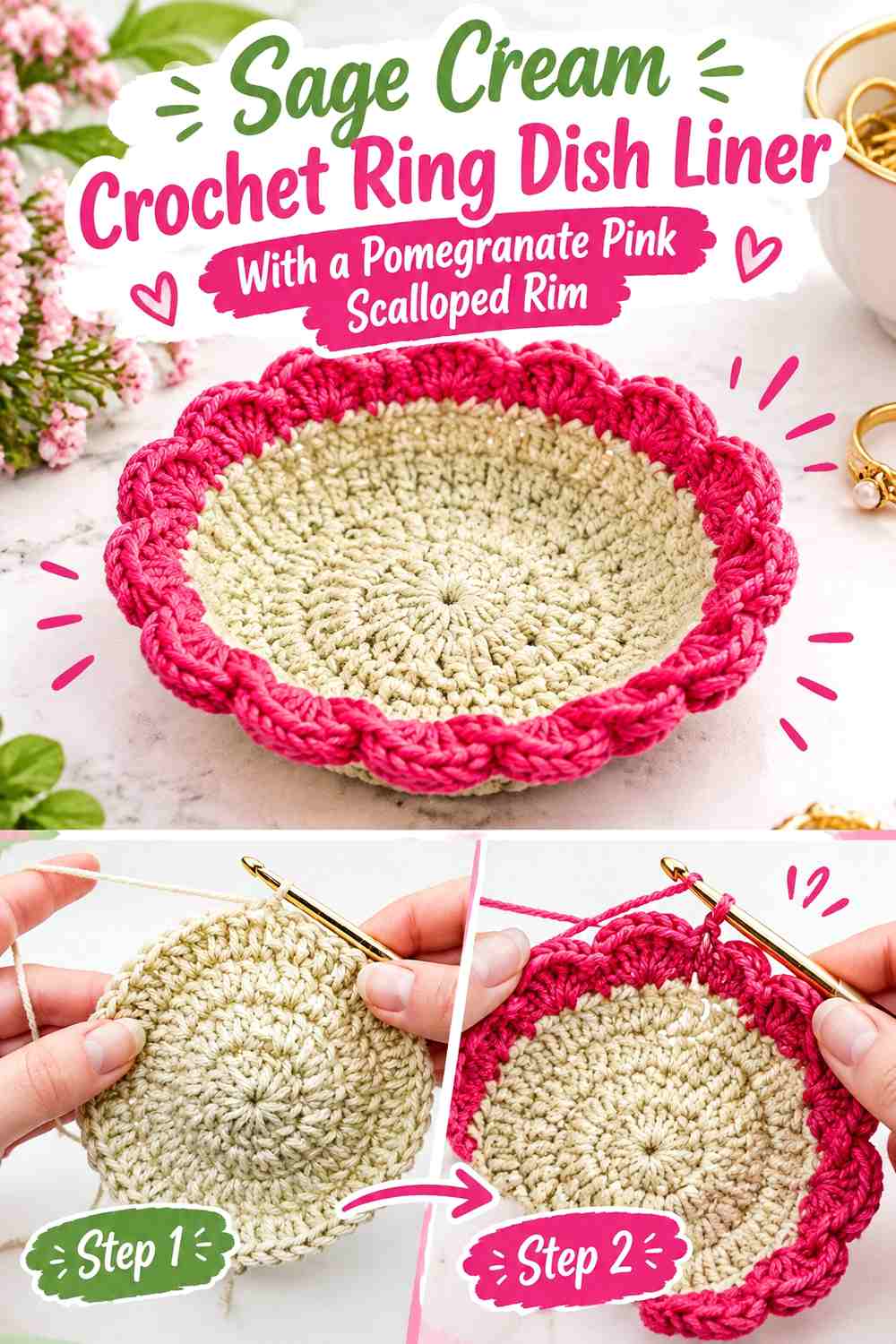
Keep the central surface Sage Cream and reserve Pomegranate Pink for a shaped or scalloped outer edge when the chosen flat-circle construction supports an appropriate finishing treatment. This puts the stronger color where jewelry is least likely to hide it.
Sage Cream Can Keep the Main Ring-Resting Surface Quiet
Use Sage Cream through most of the interior so rings sit on one comparatively simple color field.
A restrained center also leaves room for the outer shape to become the decorative feature instead of competing with another motif.
Pomegranate Pink Can Make the Sage Cream Outer Edge the Focal Detail
Use the stronger shade on the perimeter where it can remain visible around the stored jewelry.
Check the liner inside the actual dish before making an elaborate edge. If the dish walls hide most of the perimeter, a simpler, slightly broader Pomegranate Pink ring may be more useful than detailed scallops that disappear from view.
Creator Credit: Crochet With Julie
13. Marled Pomegranate Pink and Sage Cream Crochet Ring Dish Liner
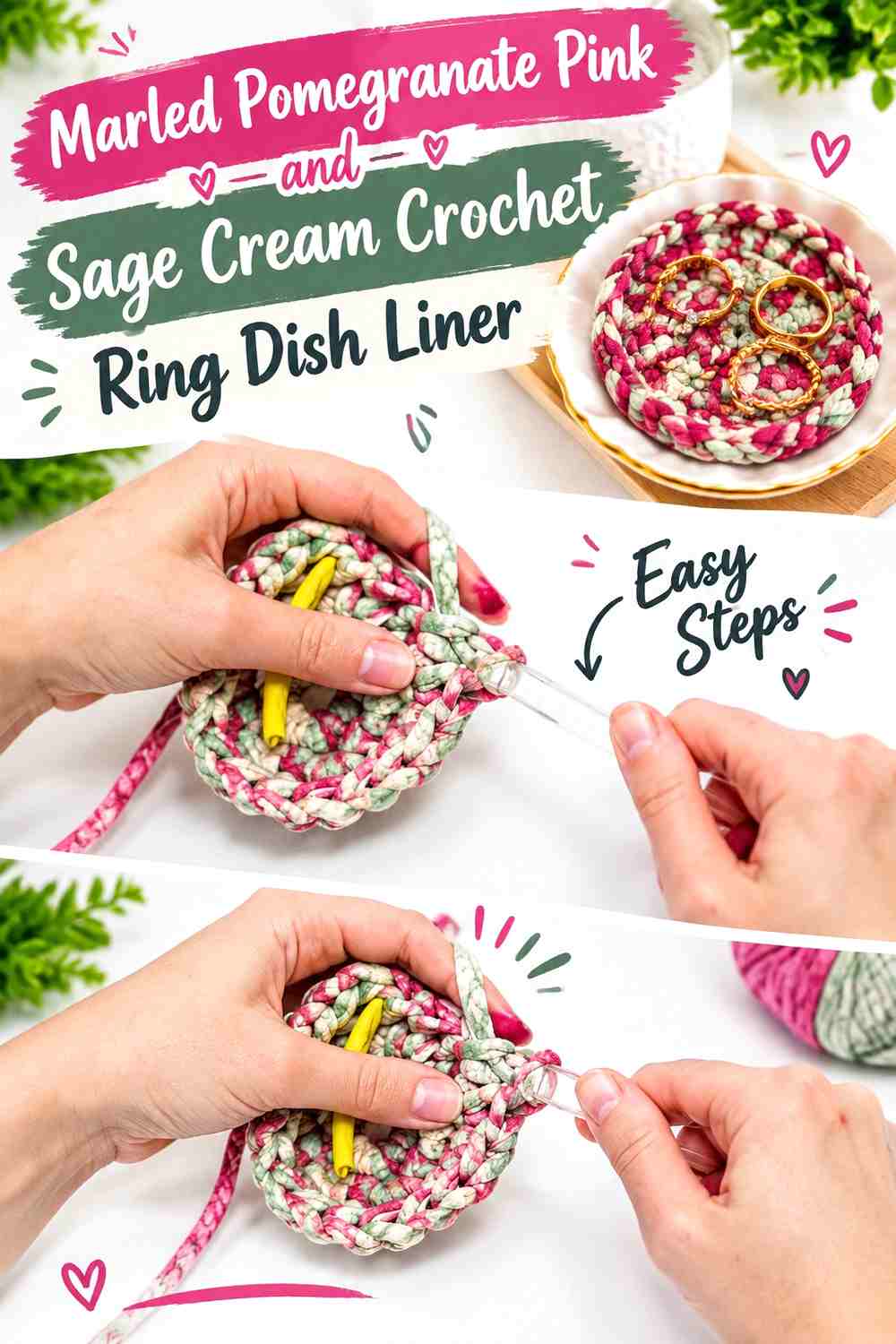
Blend both shades throughout the central surface instead of assigning them separate blocks. The result gives the liner its softest color boundary, so a single solid outer ring can restore definition around the mixed center.
Pomegranate Pink and Sage Cream Need Testing Before You Blend the Liner
Work a small sample and view it from normal display distance. Both colors should still look intentionally present rather than collapsing into an unclear middle tone.
If your blending method changes the fabric thickness, also check whether the liner still lies flat inside the ring dish rather than cupping or bunching.
Solid Pomegranate Pink Can Frame the Mixed Pomegranate Pink and Sage Cream Center
Use Pomegranate Pink alone at the perimeter when you want the blended body to have a stronger edge.
For a lighter result, Sage Cream can take the same role instead. One solid boundary is usually enough around a surface that already mixes both shades throughout.
Creator Credit: WOOLANDTHEGANG
14. Graduated Pomegranate Pink and Sage Cream Crochet Ring Dish Liner
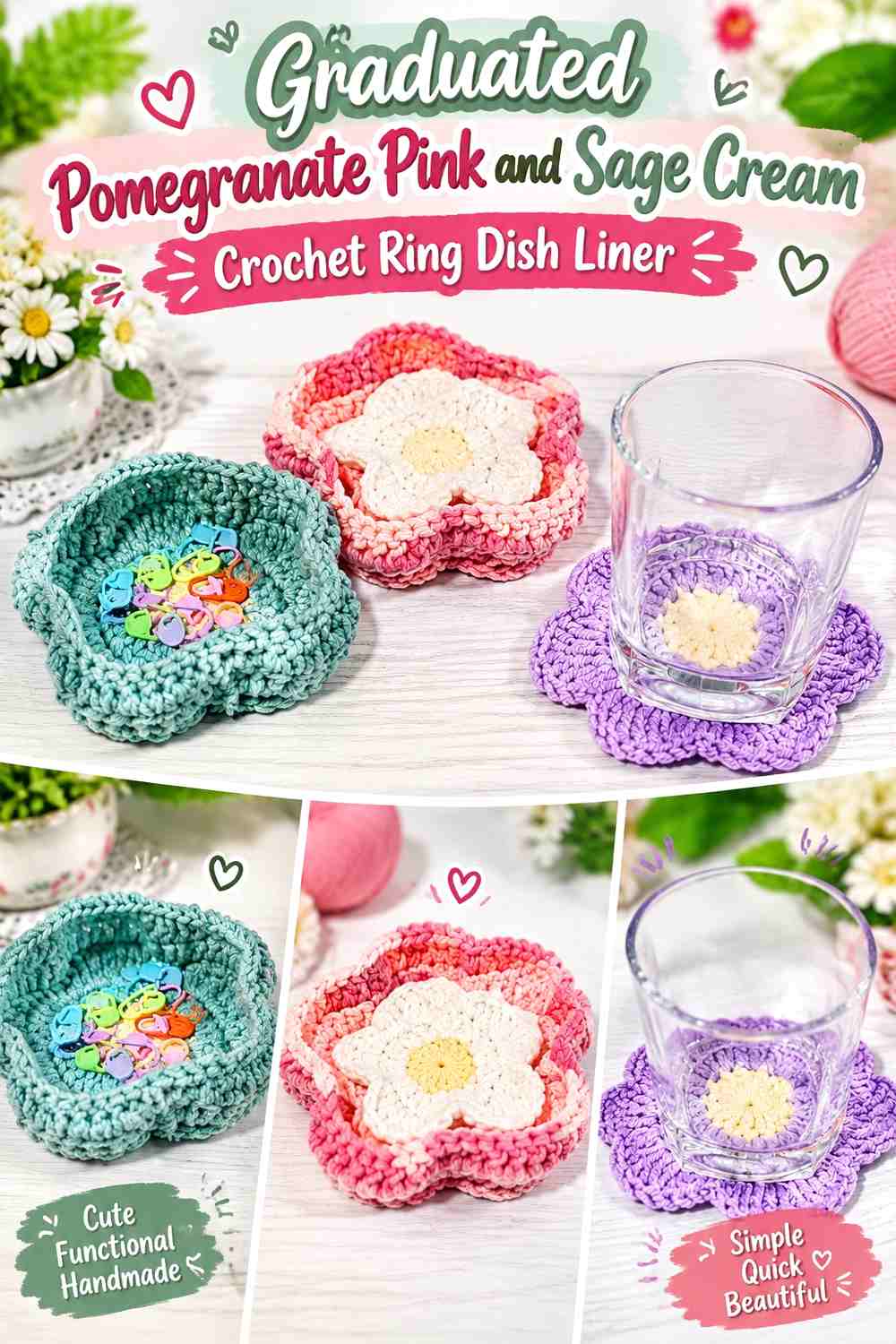
Change the visual proportion from the center outward instead of alternating equal bands. The middle can begin Pomegranate Pink-heavy, intermediate rings can become more balanced, and the outer edge can finish Sage Cream-heavy.
Pomegranate Pink Can Recede as Sage Cream Moves Toward the Ring Dish Edge
Start with a substantial Pomegranate Pink center or inner ring and reduce the amount of the stronger shade in later sections.
Make the progression clear enough to remain visible after jewelry is added. Several tiny differences in ring width can disappear once rings interrupt the center.
Sage Cream Should Expand Clearly as Pomegranate Pink Narrows
Increase the Sage Cream share toward the perimeter so the liner genuinely shifts toward a lighter outer edge.
You can reverse the progression if you want a Pomegranate Pink frame, but keep the changing proportions deliberate rather than simply alternating equal stripes.
Creator Credit: Crochet Musings
Which Pomegranate Pink and Sage Cream Ring Dish Liner Should You Choose?
Choose Ideas 1, 4, 7, or 11 when Pomegranate Pink should control most of the visible liner. Ideas 2, 3, 6, 10, and 12 give Sage Cream more surface area while concentrating pink in centers, rings, flowers, or edging.
Ideas 5 and 8 give both colors substantial importance in very different ways. Broad concentric rings emphasize the circular dish shape, while the half-and-half design creates one bold directional split. Idea 9 is the strongest radial treatment rather than a center-to-edge composition.
Choose Idea 13 when you want the two colors blended throughout the surface and Idea 14 when you prefer a gradual shift from a stronger center toward a softer perimeter.
Conclusion
Pomegranate Pink and Sage Cream can produce 14 noticeably different crochet ring dish liners simply by changing where the two shades sit in relation to the center and rim. Pomegranate Pink works well as a focal medallion, broad field, radial accent, flower, fine ring, or outer frame. Sage Cream can lighten the ring-resting surface, separate stronger bands, create a calm motif center, or help the liner stand apart from a dark dish.
Before deciding on the final layout, put the crochet sample inside the actual ring dish and add several rings. That simple check shows which center details disappear, how much rim remains visible, and whether raised or open areas suit the jewelry you intend to store.
Use the credited tutorials for their demonstrated coaster, doily, flat-circle, or small-tray construction concepts, and apply these Pomegranate Pink and Sage Cream layouts as independent color-planning directions.
Frequently Asked Questions
Should Pomegranate Pink or Sage Cream Be the Main Color in a Crochet Ring Dish Liner?
Either can lead. Pomegranate Pink gives the liner a stronger, more saturated appearance, while Sage Cream creates a softer central field. Give the supporting shade a clear role at the rim, center, motif, or concentric band.
Where Should Pomegranate Pink Go If Rings Usually Cover the Center?
Use some Pomegranate Pink near the perimeter, in an outer ring, or along a visible shaped edge. A pink center alone may disappear beneath several rings, while a repeated outer accent can keep the color visible during everyday use.
How Can I Check Whether Pomegranate Pink and Sage Cream Have Enough Contrast?
Compare the actual yarns under the lighting where the ring dish will sit. A grayscale photo can help determine whether the shades also differ in light/dark value. Stronger value contrast supports finer rings and edging; softer contrast usually works better in larger blocks.
Is Openwork Suitable for a Pomegranate Pink and Sage Cream Ring Dish Liner?
It depends on the jewelry. Large openings and pronounced raised details can give fine settings, prongs, or narrow ring components more places to interact with the crochet. A relatively flat, closed center can be a practical choice when the dish holds delicate pieces.
Should Pomegranate Pink or Sage Cream Be Used at the Ring Dish Rim?
Use the shade that gives useful separation from the dish itself. Sage Cream can lighten the edge inside a dark dish, while Pomegranate Pink can create stronger definition inside a pale dish. Test the actual yarn and dish together before deciding.
Can Pomegranate Pink and Sage Cream Be Used in Equal Amounts?
Yes. Broad alternating rings, a half-and-half composition, or repeated radial sections can give the two shades comparable visual weight. Remember that rings may cover more of one area than another, changing the apparent balance during use.
What Can I Substitute for Pomegranate Pink and Sage Cream?
Preserve the relationship rather than matching the shade names exactly. Replace Pomegranate Pink with another rich berry-pink or muted reddish pink, and replace Sage Cream with a pale softened green or warm green-neutral. Maintain enough contrast for the center, rim, bands, or motif placement you choose.