Golden ochre gives a crochet vest a warm yellow-brown base that can move in several directions depending on the supporting shade. Cream makes it lighter, chocolate brown deepens it, olive and sage keep the palette earthy, while teal, navy, plum, and charcoal create stronger contrast. Here, “golden ochre” describes the general color direction rather than a specific commercial yarn shade.

A vest also gives color a clear set of places to work. V-neck ribbing, crewneck bands, armhole edging, hems, granny squares, checks, stripes, pockets, collars, and button bands can all carry a second shade while golden ochre stays dominant across the body.
The tutorials credited below support the vest construction concepts. The golden ochre palettes are independent editorial adaptations, so the creators are not being presented as using these exact color combinations.
Quick List
- Golden Ochre And Cream Crochet Ribbed Vest
- Golden Ochre And Chocolate Brown Crochet V Neck Vest
- Golden Ochre And Olive Crochet Checkerboard Vest
- Golden Ochre Cream And Rust Crochet Argyle Vest
- Golden Ochre And Oatmeal Crochet Cropped Vest
- Golden Ochre And Charcoal Crochet Hooded Button Vest
- Golden Ochre And Camel Crochet Collared Vest
- Golden Ochre And Navy Crochet Striped Vest
- Golden Ochre And Burgundy Crochet Scallop Button Vest
- Golden Ochre And Sage Crochet Granny Square Tie Vest
- Golden Ochre And Warm White Crochet Simple Vest
- Golden Ochre And Deep Teal Crochet Layering Vest
- Golden Ochre And Dusty Rose Crochet Boxy Sweater Vest
- Golden Ochre And Plum Crochet Classic Sweater Vest
- Golden Ochre And Stone Crochet Open V Neck Vest
Keep Golden Ochre Dominant Across a Crochet Vest
If golden ochre is the main color idea, give it the largest visual areas. On a simple sweater vest, that usually means the front and back body. On checkerboard, argyle, striped, or granny-square designs, it can mean the greatest number of blocks, the widest stripes, or a consistently repeated motif border.
A lighter or darker accent does not need equal coverage to remain visible. Cream neckline ribbing or charcoal armhole edging can stand out strongly against golden ochre even when those sections use relatively little yarn.
Check Golden Ochre Contrast Around Vest Necklines and Armholes
Necklines and armhole bands are narrow, which makes value contrast important. Golden ochre beside camel may create a subtle tonal transition, while cream or charcoal will produce much clearer separation.
If you are unsure, place the yarns side by side and photograph them in grayscale. Two shades that become nearly the same gray can still work together, but expect a blended effect rather than crisp outlining around small vest details.
Plan Golden Ochre Ribbing, Motifs, and Stripes as One Palette
Look at the whole vest before assigning each finishing shade. If a checkerboard body already contains a large amount of brown, golden ochre ribbing may restore warmth around the edges. If the body is mostly solid golden ochre, brown ribbing may provide useful definition instead.
The same principle applies to motifs and stripes: repeat supporting colors deliberately rather than introducing a new shade every time the construction changes.
1. Golden Ochre And Cream Crochet Ribbed Vest
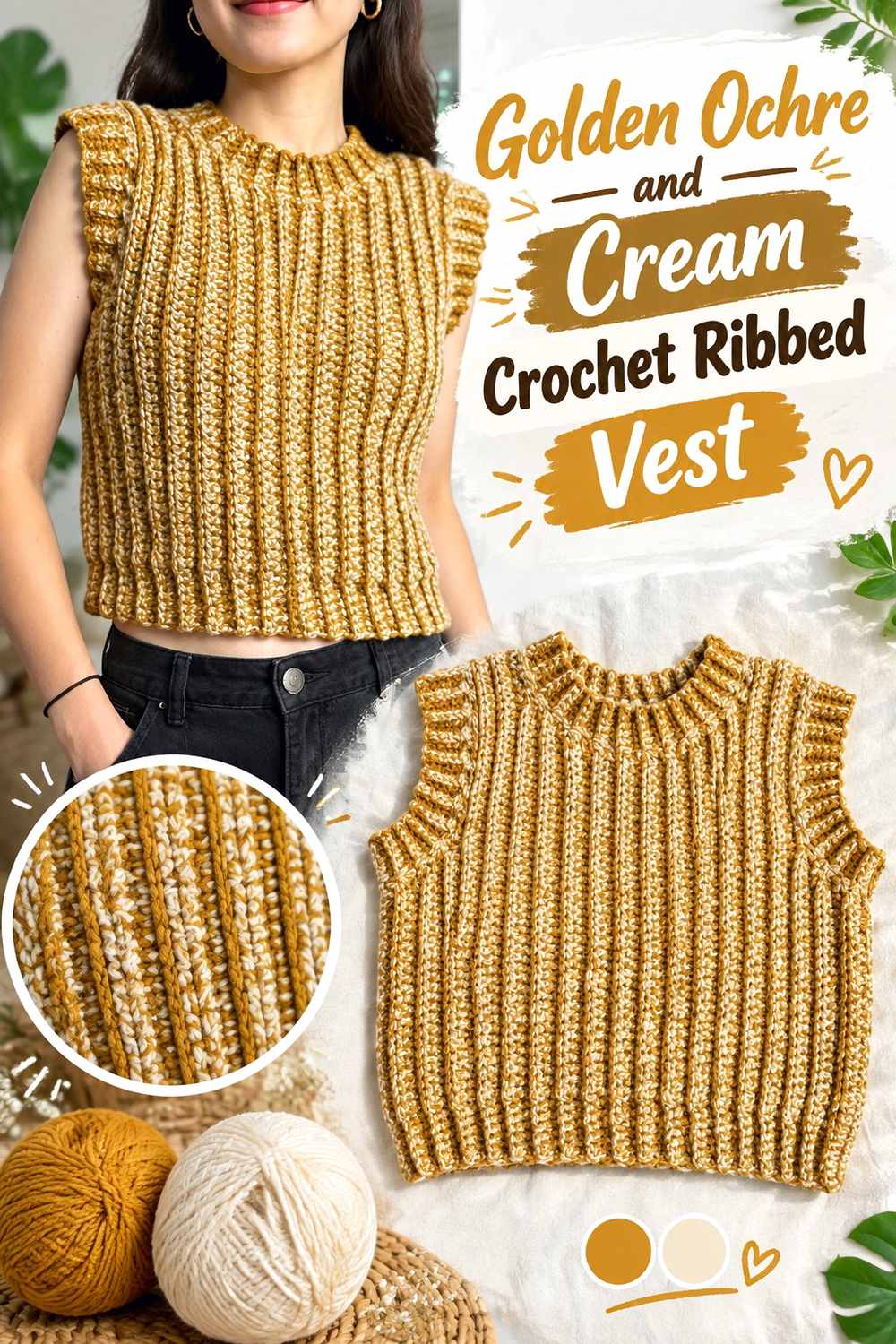
Golden ochre works especially well on a ribbed vest because the continuous warm color allows the directional texture to remain visible. Cream can provide a lighter break around the crewneck, armholes, or hem without dividing the entire body into color blocks.
Golden Ochre Should Carry the Main Ribbed Crochet Vest Surface
Keep broad ribbed areas golden ochre if you want texture to provide most of the visual movement. Frequent cream stripes can interrupt the direction of the ribbing and make color more prominent than stitch definition.
If you want additional cream, concentrate it around areas where the stitch direction or construction already changes.
Golden Ochre Looks Clearer With Cream Crochet Vest Edging
Cream neckline and armhole bands create obvious separation against golden ochre. You do not necessarily need cream at the hem as well.
If the neckline and both armholes already form a strong light frame, keeping the lower band golden ochre can prevent the vest from looking completely outlined in cream.
Creator Credit: VivCrochets
2. Golden Ochre And Chocolate Brown Crochet V Neck Vest
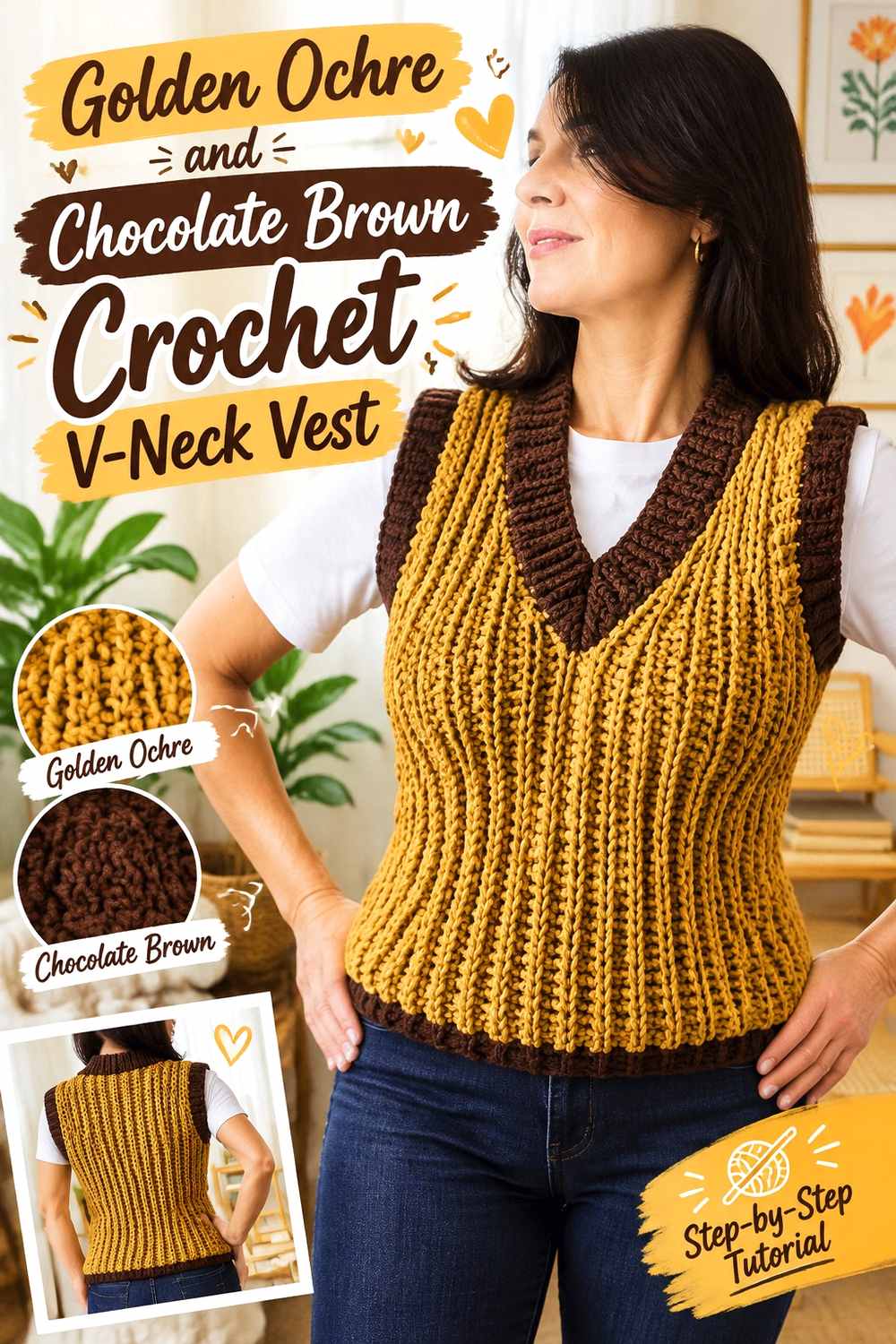
Chocolate brown gives golden ochre a darker earthy partner and can make a V-neck especially distinct. Golden ochre can cover most of the torso while brown defines the neckline, hem, or armhole ribbing.
Golden Ochre Needs Enough Space Around a Chocolate Brown Crochet V-Neck
A dark brown V-band becomes a strong focal point, so leave enough golden ochre around the upper chest to frame it. Adding large brown shoulder blocks as well can shift the balance toward brown.
For a clearly ochre-led vest, keep brown concentrated around the structural edges.
Golden Ochre and Chocolate Brown Crochet Ribbing Need a Consistent Role
If brown defines the V-neck, decide whether it should repeat at the hem or armholes. Repeating it in one additional location often provides enough connection.
Golden ochre armhole bands are another option when you want the neckline to remain the single strongest dark feature.
Creator Credit: By StellaM
3. Golden Ochre And Olive Crochet Checkerboard Vest

Olive gives golden ochre an earthy green contrast that suits checkerboard color blocking. Because both shades can sit in a similar middle-value range, the pattern should be tested before making a full panel.
Golden Ochre Should Outnumber Olive in a Crochet Checkerboard Vest
If the vest should read as golden ochre first, do not automatically alternate equal areas of both colors. Golden ochre can occupy more checks or extend beyond the checkerboard into solid ribbing.
Another approach is to keep the front graphic while making the back predominantly golden ochre.
Golden Ochre and Olive Crochet Checks Need Visible Value Separation
A muted olive and deep golden ochre may blend more than expected from a distance. Make a small two-color sample before committing to the entire checker pattern.
If the values are close, embrace a softer checkerboard or choose a lighter or darker olive when sharper geometry is important.
Creator Credit: HayHay Crochet
4. Golden Ochre Cream And Rust Crochet Argyle Vest
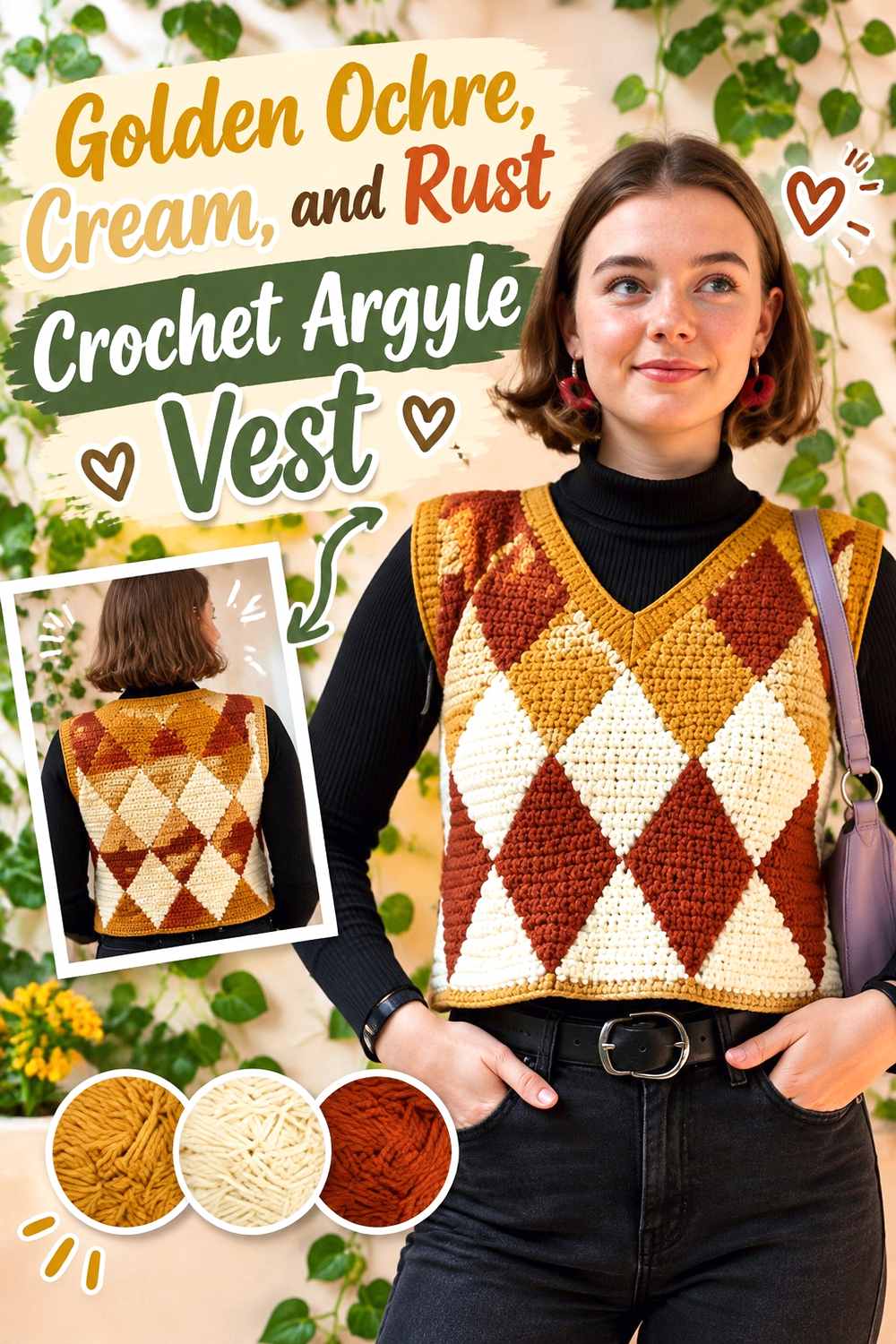
Argyle gives three colors specific jobs. Golden ochre can act as the main field, rust can fill selected diamond areas, and cream can supply the lightest lines or accents. The hierarchy matters because the front design is already visually detailed.
Golden Ochre Should Remain the Main Field Behind Rust Crochet Argyle
Keeping the background golden ochre ensures the vest still reads as ochre when the diamond pattern is viewed from a distance. Large rust diamonds add warmth without needing to cover the entire torso.
If rust becomes the background as well, the color emphasis shifts substantially.
Golden Ochre and Cream Can Keep Rust Crochet Argyle Separated
Cream provides useful value contrast where golden ochre and rust sit close together. Restrict it to narrow accents so the lightest shade clarifies the pattern rather than becoming another equal block color.
Before starting the full front panel, judge all three yarns together instead of comparing them in pairs.
Creator Credit: flotjetops
5. Golden Ochre And Oatmeal Crochet Cropped Vest
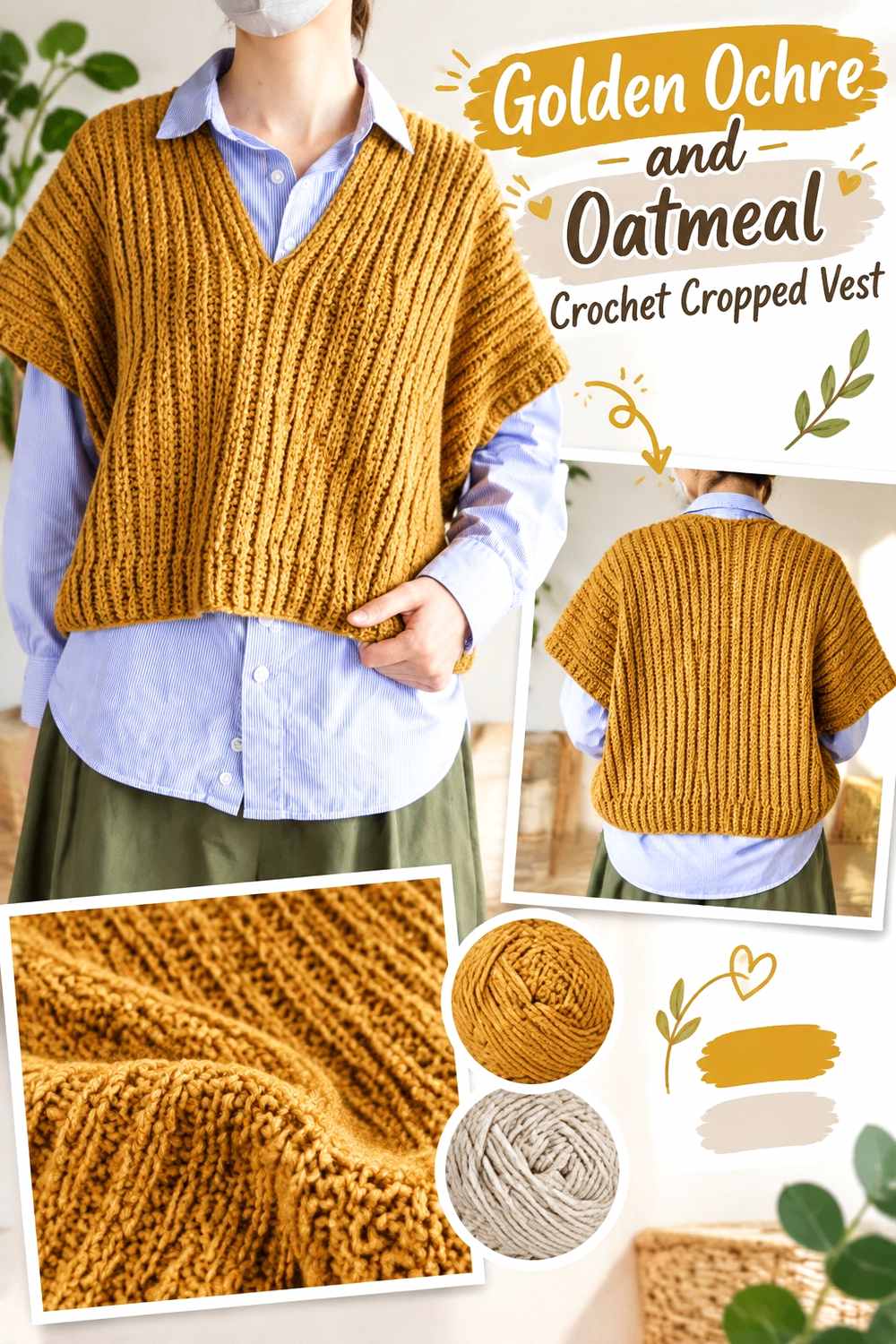
Oatmeal gives golden ochre soft contrast and works well on a cropped vest where large contrasting bands can quickly take over the shorter body. Keep golden ochre across most of the torso and use oatmeal strategically around the edges.
Golden Ochre Should Cover Most of the Cropped Crochet Vest Body
Because the vest is shorter, a wide oatmeal hem can occupy a surprisingly large proportion of the finished front. A narrower neutral band allows golden ochre to remain visually dominant.
The same applies to armhole edging: small amounts of oatmeal can still read clearly against the warmer body.
Golden Ochre and Oatmeal Crochet Necklines Create Softer Contrast
Oatmeal gives the neckline more separation than camel but less brightness than cream. That makes it useful when you want the V or crewneck to be visible without becoming the strongest feature.
Choose an oatmeal shade that remains distinctly lighter than golden ochre after both yarns are worked up.
Creator Credit: Orinam crochet
6. Golden Ochre And Charcoal Crochet Hooded Button Vest
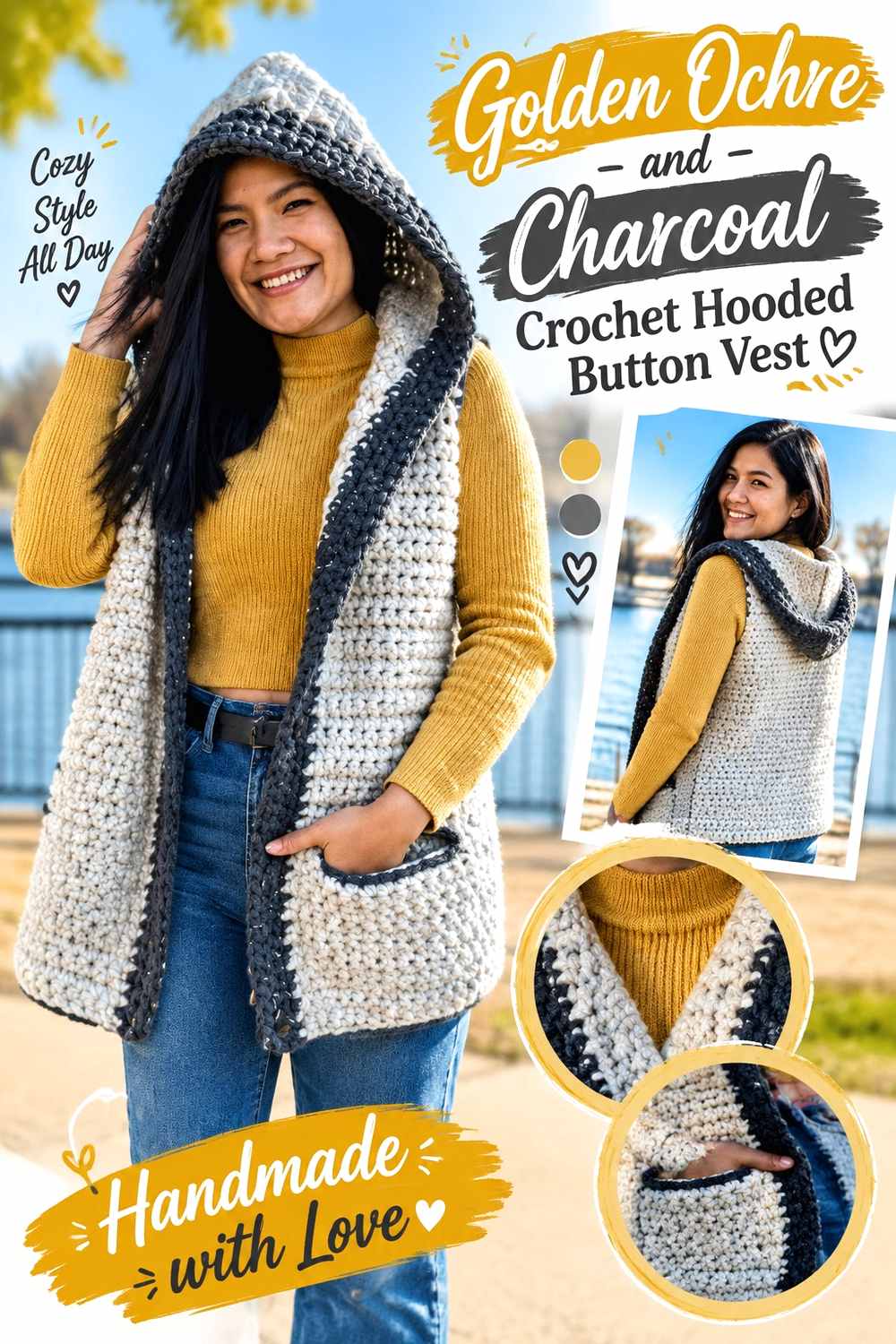
A hood, button band, and pockets provide several possible accent areas, so charcoal needs a controlled role. Golden ochre can cover the large vest body while charcoal defines selected functional details.
Golden Ochre Should Continue Into the Crochet Vest Hood
An entirely charcoal hood can create a large dark section that visually separates from a golden ochre body. Bringing golden ochre into the hood—or keeping it completely ochre—maintains continuity from front to back.
Charcoal can then appear around the hood opening rather than covering the entire feature.
Golden Ochre Can Balance Charcoal Crochet Pockets and Button Bands
Charcoal pockets against a golden ochre body create obvious blocks near the lower front. If you also use a charcoal button band, keep the armhole and hem finishing golden ochre to avoid dark framing on every edge.
Decide which charcoal detail deserves the most attention instead of emphasizing all of them equally.
Creator Credit: KnitcroAddict
7. Golden Ochre And Camel Crochet Collared Vest

Camel creates a tonal warm palette with golden ochre. A collar provides enough surface for the subtle color difference to show without requiring strong light-dark contrast.
Golden Ochre Needs a Lighter Camel Crochet Collar
If the camel is almost the same depth as golden ochre, the collar may merge into the body. Choose a visibly lighter camel when you want the collar shape to be obvious.
For a deliberately tonal vest, similar values can work well, but expect the construction rather than color contrast to define the neckline.
Golden Ochre Should Return Below the Camel Crochet Collar
Keep the shoulders and torso golden ochre so the camel stays concentrated at the neckline. A camel collar plus large camel armhole bands can give the neutral more visual weight than intended.
Narrow camel hem edging is enough if you want one additional repeat.
Creator Credit: Jennyandteddy crochet.
8. Golden Ochre And Navy Crochet Striped Vest

Navy gives golden ochre a dark cool contrast that makes stripe boundaries easy to notice. Stripe width determines whether the finished vest feels primarily ochre or evenly divided between the two colors.
Golden Ochre Should Use Wider Crochet Vest Stripes Than Navy
Broad golden ochre bands with narrower navy stripes preserve the main color while still creating strong rhythm. Equal-width stripes give both shades similar visual importance.
If you prefer minimal patterning, restrict navy stripes to the upper body and leave the lower vest solid golden ochre.
Golden Ochre Crochet Ribbing Can Contain Navy Stripes
When the body already has repeated navy bands, solid golden ochre ribbing around the neckline, armholes, and hem can simplify the finish.
Navy ribbing creates a stronger dark frame, so use it when you deliberately want the vest edges emphasized.
Creator Credit: TL Yarn Crafts
9. Golden Ochre And Burgundy Crochet Scallop Button Vest
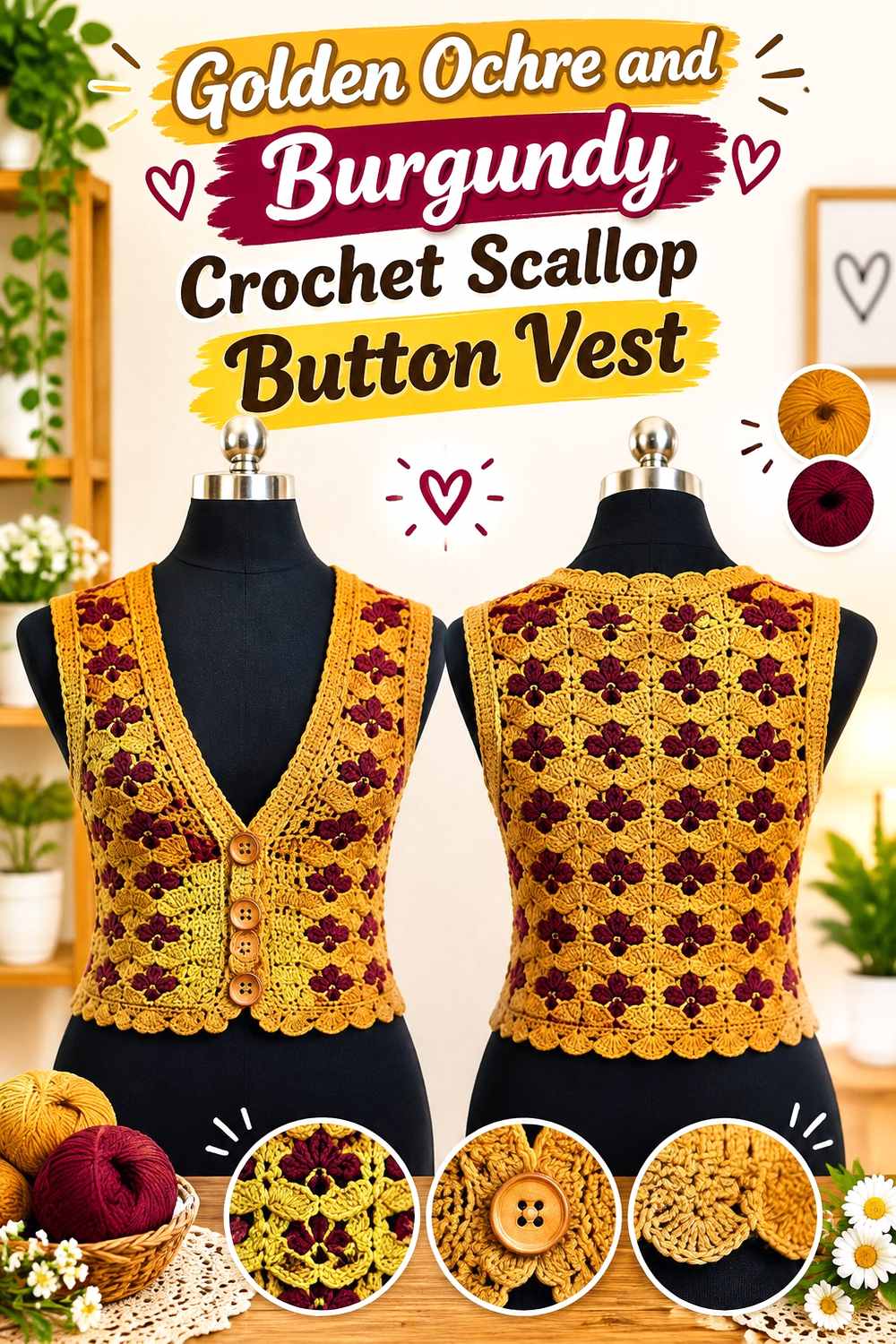
Burgundy adds a deep red-purple accent that works particularly well around a decorative front opening. Golden ochre can remain broad and warm while burgundy draws attention to buttons or scalloped edging.
Golden Ochre Should Frame Burgundy Crochet Scallop Edging
Scallops already attract attention through shape, so a burgundy version becomes even more prominent. Keep the surrounding front panels golden ochre to give the decorative edge a clear background.
Avoid adding equally wide burgundy sections at the hem unless you want the accent to become much stronger.
Golden Ochre and Burgundy Crochet Buttons Need Repetition
If burgundy appears only around the closure, a small repetition at the armholes can connect the palette. Keep that second application narrower than the front edging if the scallops should remain the focal point.
Golden ochre hem finishing can then anchor the bottom of the vest.
Creator Credit: Ler Crochet
10. Golden Ochre And Sage Crochet Granny Square Tie Vest

Sage softens golden ochre with muted green, while granny squares allow the two colors to change roles across individual motifs. A consistent outer round or joining color can keep the vest from looking scattered.
Golden Ochre Should Repeat Across Every Major Crochet Granny Square Area
Golden ochre does not have to occupy exactly the same round in every square, but it should appear consistently across both fronts and the back.
If sage becomes dominant in several motifs, use golden ochre joins or outer rounds to reconnect them to the main color direction.
Golden Ochre Crochet Ties Can Unite Sage Granny Squares
Golden ochre ties bring the title color directly to the front opening and are especially useful if the nearby squares contain a substantial amount of sage.
Alternatively, sage ties can work when the vest body is overwhelmingly golden ochre and needs a small green accent near the center.
Creator Credit: The Crocheting
11. Golden Ochre And Warm White Crochet Simple Vest

Warm white creates clear contrast without adding another saturated hue. On a simple vest construction, that contrast can be concentrated around the neckline and armholes while golden ochre supplies the large uninterrupted surface.
Golden Ochre Should Remain Continuous Across the Simple Crochet Vest Body
The advantage of a straightforward vest is that golden ochre can cover a large area without interruption. That gives stitch texture room to show and keeps the garment easy to coordinate with different underlayers.
Use warm white where the body naturally ends rather than inserting multiple decorative blocks.
Golden Ochre Needs Only Small Warm White Crochet Details
Warm white is light enough that narrow bands stay visible. A neckline and slim armhole trim may provide all the contrast the vest needs.
If those three edges are already white, keep the hem golden ochre unless you deliberately want the vest fully framed in the lighter shade.
Creator Credit: Elena’s Magic hook
12. Golden Ochre And Deep Teal Crochet Layering Vest

Deep teal provides a strong warm-cool contrast with golden ochre. Since both colors can be fairly saturated, one should have a clearly larger role.
Golden Ochre Should Anchor the Main Crochet Vest Panels
Let golden ochre cover most of the front and back, then introduce deep teal around the neckline, armholes, or a selected lower band.
Large teal side sections can work, but they make the vest feel closer to a balanced two-color garment than an ochre-led layer.
Golden Ochre and Deep Teal Crochet Edges Need Controlled Repetition
If teal defines the neckline, repeat it at either the hem or armholes rather than automatically using it everywhere.
Golden ochre finishing on the remaining edges prevents the cool accent from becoming a continuous dark frame around the vest.
Creator Credit: Sirin’s Crochet
13. Golden Ochre And Dusty Rose Crochet Boxy Sweater Vest
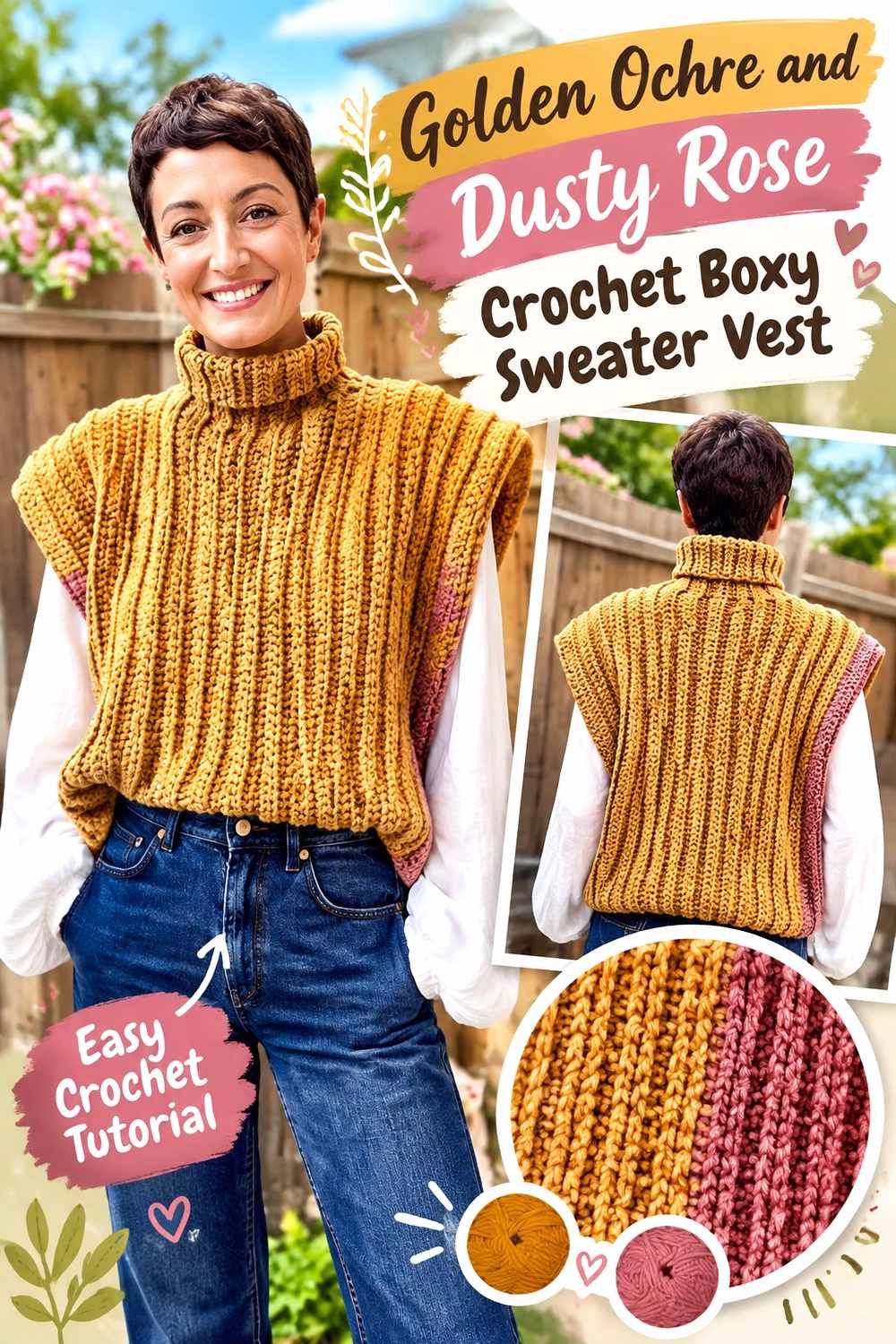
Dusty rose gives golden ochre softer warm contrast and works well with a boxier vest where broad panels provide plenty of uninterrupted color area.
Golden Ochre Should Lead the Boxy Crochet Sweater Vest
Use golden ochre through most of the torso so the loose shape does not become divided into equally large pink and ochre blocks.
Dusty rose can instead occupy the neckband, armhole ribbing, or one deliberate stripe across the body.
Golden Ochre and Dusty Rose Crochet Ribbing Need Value Separation
A muted rose that is noticeably lighter than golden ochre makes narrow ribbing easy to distinguish. A darker dusty rose creates a more blended result.
Swatch the exact pairing if the armhole or neckline trim is important, because those narrow areas show subtle contrast less clearly than large panels.
Creator Credit: JeggoCrochet
14. Golden Ochre And Plum Crochet Classic Sweater Vest

Plum brings a deeper purple contrast that makes golden ochre look warmer by comparison. The combination can work on a straightforward vest because the colors provide interest without requiring complicated motif placement.
Golden Ochre Should Surround Plum Crochet Neckline Details
Use plum around a V-neck or crewneck when you want a dark focal point near the upper body. Keeping the shoulders and chest golden ochre gives the neckline enough surrounding space to remain distinct.
A broad plum yoke would shift the visual balance much further toward the darker shade.
Golden Ochre Can Return at Plum Crochet Armhole Edges
If plum already defines the neckline, golden ochre armhole bands keep the sides of the vest connected to the torso.
For more plum repetition, use narrow armhole edging rather than broad bands so the supporting shade remains controlled.
Creator Credit: passtschon
15. Golden Ochre And Stone Crochet Open V Neck Vest

Stone gives golden ochre a muted neutral partner that sits between cream and gray. An open V-neck creates a long visual line at the front, so even a restrained stone border can noticeably change the vest.
Golden Ochre Should Stay Broad Around the Open Crochet V-Neck
Keep the front panels golden ochre and use stone as a narrow boundary around the V if you want the neckline defined without becoming stark.
A very wide stone border can reduce the visible golden ochre area substantially, especially near the shoulders.
Golden Ochre and Stone Crochet Armholes Can Stay Quiet
Stone armhole edging creates another subtle neutral repetition, but it does not need to match the V in width. Narrower armhole bands allow the neckline to remain the main contrasting feature.
If the stone is close to golden ochre in value, a slightly broader V-border will help the neutral remain visible.
Creator Credit: DIY Crochet y Más
Comparing the Golden Ochre Crochet Vest Color Directions
For a lighter vest, cream, oatmeal, and warm white create the clearest separation from golden ochre. Cream gives a softer warm contrast than bright white, while oatmeal produces the most subdued effect.
For an earthy palette, chocolate brown, olive, camel, sage, and rust keep the vest grounded in warm or muted colors. Camel is the most tonal partner, while olive and sage introduce green without moving too far from the earthy direction.
Navy, charcoal, deep teal, plum, and burgundy create darker accents. Navy and teal give golden ochre a cool contrast, while burgundy and plum add richer red-purple tones.
Patterned vests need an additional decision: which shade creates the repeated structure. In checkerboard, argyle, granny-square, and striped designs, golden ochre should appear frequently enough across the complete front and back that the supporting colors do not become the dominant visual pattern.
Conclusion
Golden ochre can work as anything from a soft neutral-adjacent vest color to the center of a much stronger multicolor design. Pair it with cream, oatmeal, or warm white when you want lighter edging and clear neckline definition. Camel, brown, olive, sage, and rust create warmer or earthier combinations, while navy, teal, plum, burgundy, and charcoal add deeper contrast.
For simple vests, keep golden ochre across the broad body and place the secondary shade around ribbing, armholes, collars, or hems. For checkerboard, argyle, stripes, and granny squares, judge the palette at full-panel scale rather than looking at one small repeat. A color that seems secondary in a single motif can become surprisingly dominant once it appears dozens of times.
Frequently Asked Questions
What colors work well with golden ochre in a crochet vest?
Cream, oatmeal, warm white, camel, chocolate brown, olive, sage, rust, charcoal, navy, deep teal, burgundy, plum, dusty rose, and stone can all create useful palettes. The choice depends on whether you want tonal warmth, earthy contrast, a light neutral, or a darker accent.
How do I keep golden ochre dominant in a crochet vest?
Use golden ochre across the largest visual areas. On a solid vest, that usually means the main body panels. On patterned vests, give golden ochre wider stripes, more checks, repeated motif borders, or the dominant background area.
What color ribbing works with a golden ochre crochet vest?
Cream or warm white gives clear contrast, camel creates a softer tonal edge, and brown or charcoal provides darker framing. Golden ochre ribbing itself is useful when the body already contains several contrasting colors and needs a simpler finish.
How can I tell whether golden ochre and another earthy color have enough contrast?
Compare the yarns next to each other and make a small sample in the planned stitch. A grayscale photo can help reveal their light-dark values. If both become almost the same gray, expect a softer blended relationship rather than crisp detail.
Can golden ochre work in a granny square crochet vest?
Yes. Golden ochre can appear in motif centers, larger rounds, outer borders, joins, or finishing bands. Repeating it consistently across both fronts and the back helps separate squares feel like one coordinated vest.
How should I use golden ochre in a striped crochet vest?
Make golden ochre the widest or most frequently repeated stripe when it should remain dominant. Dark navy or teal stripes can usually be narrower because their contrast makes them noticeable with less surface area.
Is golden ochre suitable for an argyle or checkerboard crochet vest?
Yes. Golden ochre can function as the background or one of the repeating block colors. Check its value against the other shades first, because similarly dark earthy colors may make small checks or argyle details less distinct than expected.