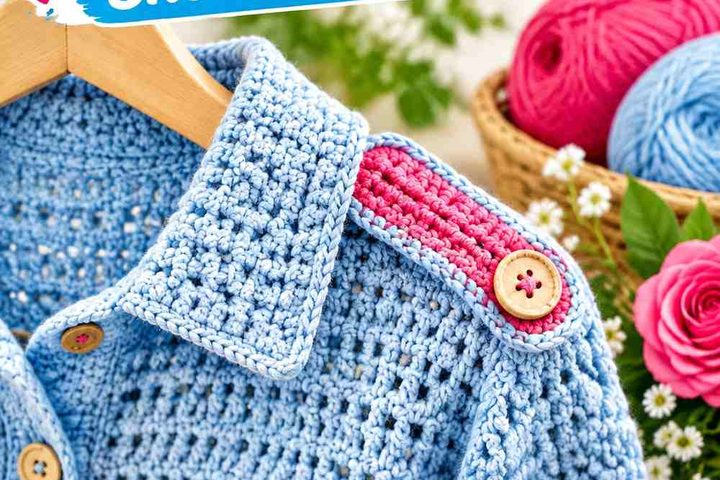
Icy blue gives a crochet cardigan a light, cool base that can move in several directions depending on the colors placed beside it. Cream keeps the result soft, navy gives pale blue a stronger frame, silver gray creates a restrained tonal effect, and blush or lavender can introduce gentle color without overpowering the blue.

Cardigan construction also changes how the palette should be handled. A narrow contrast band can define an open front, darker cuffs can finish wide sleeves, and a granny or patchwork construction needs repeated icy blue placement rather than one uninterrupted main panel. The tutorial linked with each idea supports the cardigan construction, while the suggested palettes are independent color adaptations.
Quick List
- Icy Blue And Cream Collared Crochet Cardigan
- Icy Blue And White Mesh Crochet Cardigan
- Icy Blue And Camel Lightweight Crochet Cardigan
- Icy Blue And Silver Gray Long Ribbed Crochet Cardigan
- Icy Blue And Navy Oversized Crochet Cardigan
- Icy Blue Lavender And Cream Patchwork Crochet Cardigan
- Icy Blue And Charcoal Raglan Crochet Cardigan
- Icy Blue And Blush Pocket Crochet Cardigan
- Icy Blue And Soft Sage Granny Hexagon Crochet Cardigan
- Icy Blue And Oatmeal Scallop Edge Hexagon Crochet Cardigan
Let Icy Blue Lead Before Adding Cardigan Accent Colors
If the finished piece should clearly read as an icy blue cardigan, give icy blue either the largest uninterrupted surface or the most consistent repetition. On a paneled cardigan, that usually means the back, front panels, and most of the sleeves. On patchwork or hexagon construction, dominance can come from repeating icy blue more frequently than the supporting colors.
The front opening deserves particular attention. A dark contrasting band creates two strong vertical lines and can visually reduce the amount of icy blue seen from the front. A lighter border blends more gently into the body and lets the blue surface remain the main feature.
Use Icy Blue Contrast Where Crochet Cardigan Details Need Definition
Icy blue is already light, so white or cream may produce a subtler value difference than navy, charcoal, or another dark accent. That softer contrast can work well for broad borders and larger panels, while smaller motifs and narrow stripes may need stronger separation if you want their shapes to stay obvious.
Texture adds another variable. Ribbing, raised stitches, and dense cuffs produce natural shadows, so they may remain visible without a contrasting yarn. Mesh and lace behave differently because the clothing underneath becomes part of the visible color scheme.
1. Icy Blue And Cream Collared Crochet Cardigan
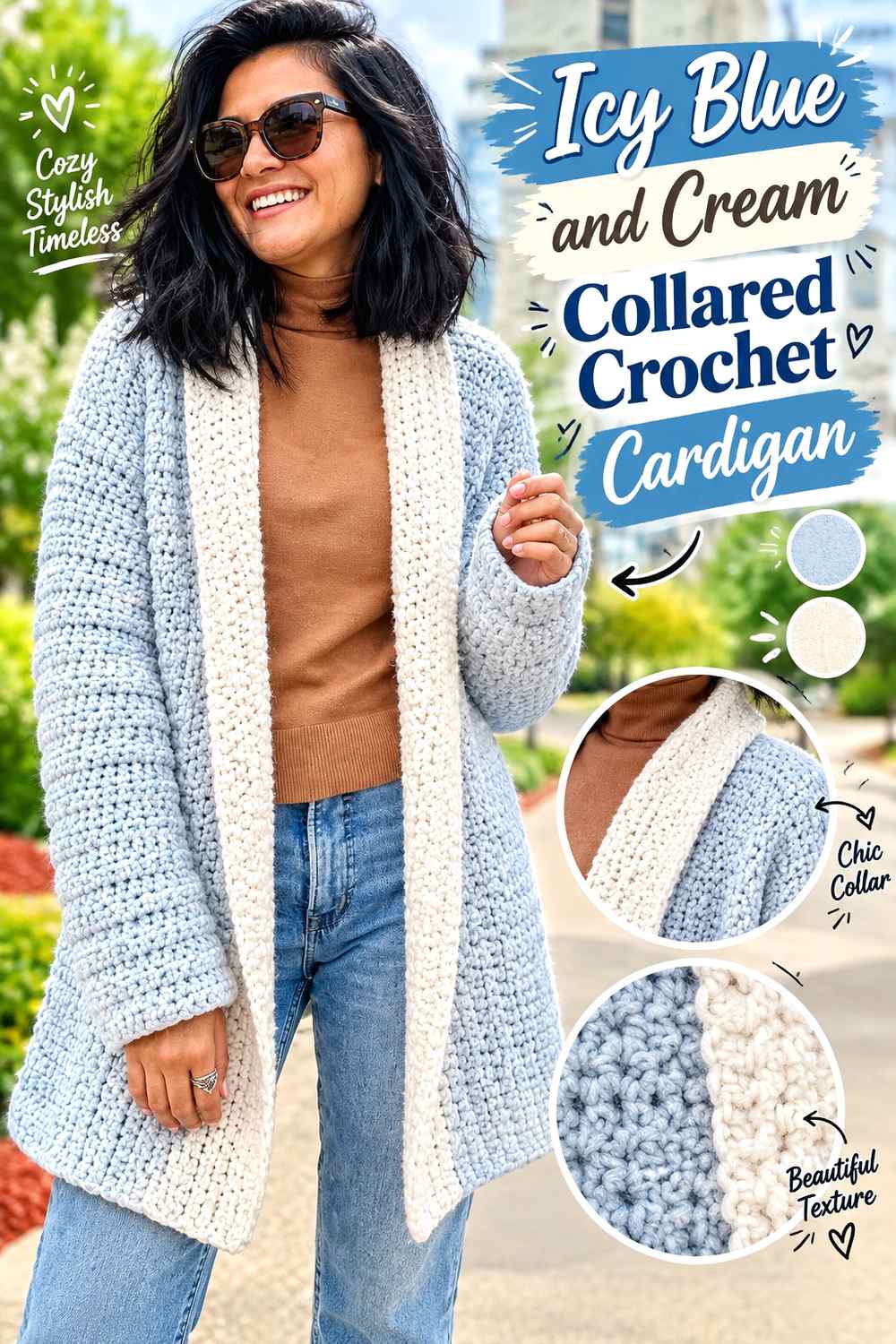
An icy blue body with a cream collar creates a low-to-moderate contrast cardigan where the neckline is defined without becoming dramatically dark. Keep icy blue across the main front, back, and sleeves, then use cream at the collar, front opening, or cuffs. This places the lightest neutral around structural edges while preserving blue as the garment’s main color.
Keep Icy Blue Continuous Below the Cream Cardigan Collar
A substantial collar already creates a noticeable color area near the shoulders. Leaving the torso mostly icy blue prevents the upper garment from becoming overly divided.
View the cardigan with the collar folded into its normal position before deciding whether cream should also extend down the entire front opening. The visible amount can change considerably once the collar turns over.
Use Cream to Give Icy Blue Cardigan Edges a Soft Boundary
Cream can separate an icy blue front edge from a white or blue shirt without creating the graphic outline that navy or black would produce. Repeating a small amount at the cuffs can connect the sleeves to the neckline.
If the cream and icy blue are extremely close in value, make the border wide enough to read as intentional rather than depending on a very thin line for contrast.
Creator Credit: KnitcroAddict
2. Icy Blue And White Mesh Crochet Cardigan

Mesh makes an icy blue cardigan visually lighter because the layer beneath the crochet remains visible. Use icy blue across most of the open body and let white define selected solid areas such as the front band, sleeve finish, or lower edge. The strongest visual contrast may actually come from the clothing underneath rather than the white yarn itself.
Test Icy Blue Mesh Over the Intended Underlayer
An icy blue mesh cardigan over white produces a soft, almost blended result. The same crochet over navy, charcoal, or black makes every opening far more obvious.
Check a sample over realistic outfit colors before adding extra contrast. You may find that the underlayer already provides enough definition for the icy blue mesh.
Keep White Narrow Around Icy Blue Mesh Cardigan Borders
A very broad white border can make the open icy blue center look smaller and more delicate than intended. Keep the edging proportional to the mesh so it frames the cardigan rather than becoming the main visual feature.
White can be particularly useful around sleeve ends or a button area where the fabric changes from openwork to a denser finish.
Let Icy Blue Mesh Remain the Main Cardigan Texture
Avoid placing white through every openwork repeat simply because two colors are available. The mesh itself supplies pattern and movement.
Larger uninterrupted icy blue sections allow the open stitch structure to stay visible instead of competing with frequent color changes.
Creator Credit: Brunaticality
3. Icy Blue And Camel Lightweight Crochet Cardigan
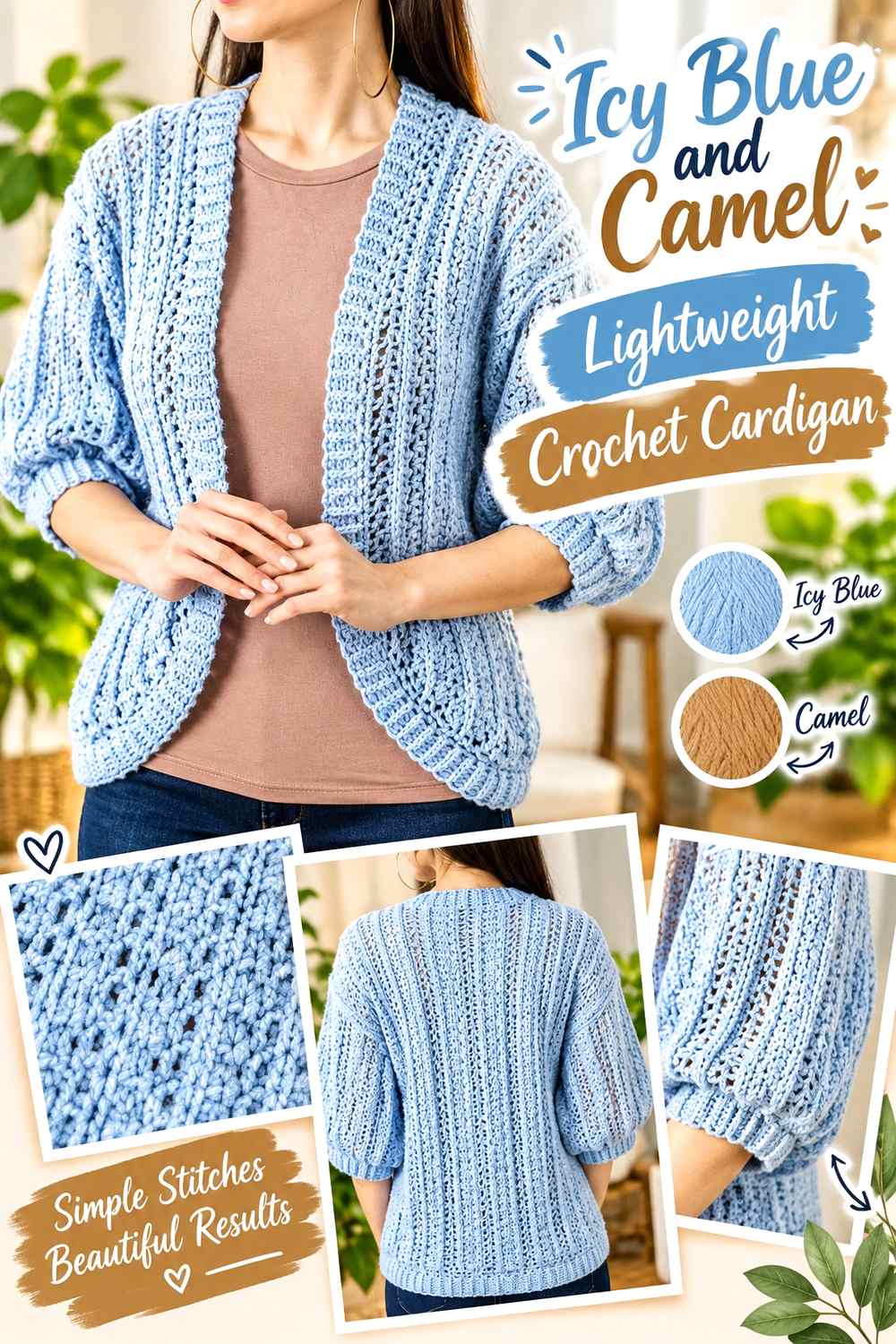
Camel gives icy blue a warmer supporting color while keeping the overall cardigan softer than a navy or charcoal pairing. Use icy blue throughout the lightweight body and introduce camel through narrow edging, cuffs, or a restrained front band.
Keep Icy Blue Broad Across a Lightweight Cardigan
A lighter cardigan often benefits from uncomplicated color placement because the thinner or more open-looking fabric already provides visual movement. Keeping the major panels icy blue allows that texture to remain easy to read.
Camel can then act as a warm finishing note rather than splitting the body into multiple blocks.
Use Camel to Warm Icy Blue Cardigan Cuffs and Edges
Camel works especially well in areas that visually finish the garment: sleeve ends, lower borders, or a front band. A small amount can change the palette without requiring large warm-colored panels.
If camel appears only at the cuffs, consider repeating a narrow amount near the front opening so the secondary color does not feel isolated at the wrists.
Creator Credit: TCDDIY
4. Icy Blue And Silver Gray Long Ribbed Crochet Cardigan
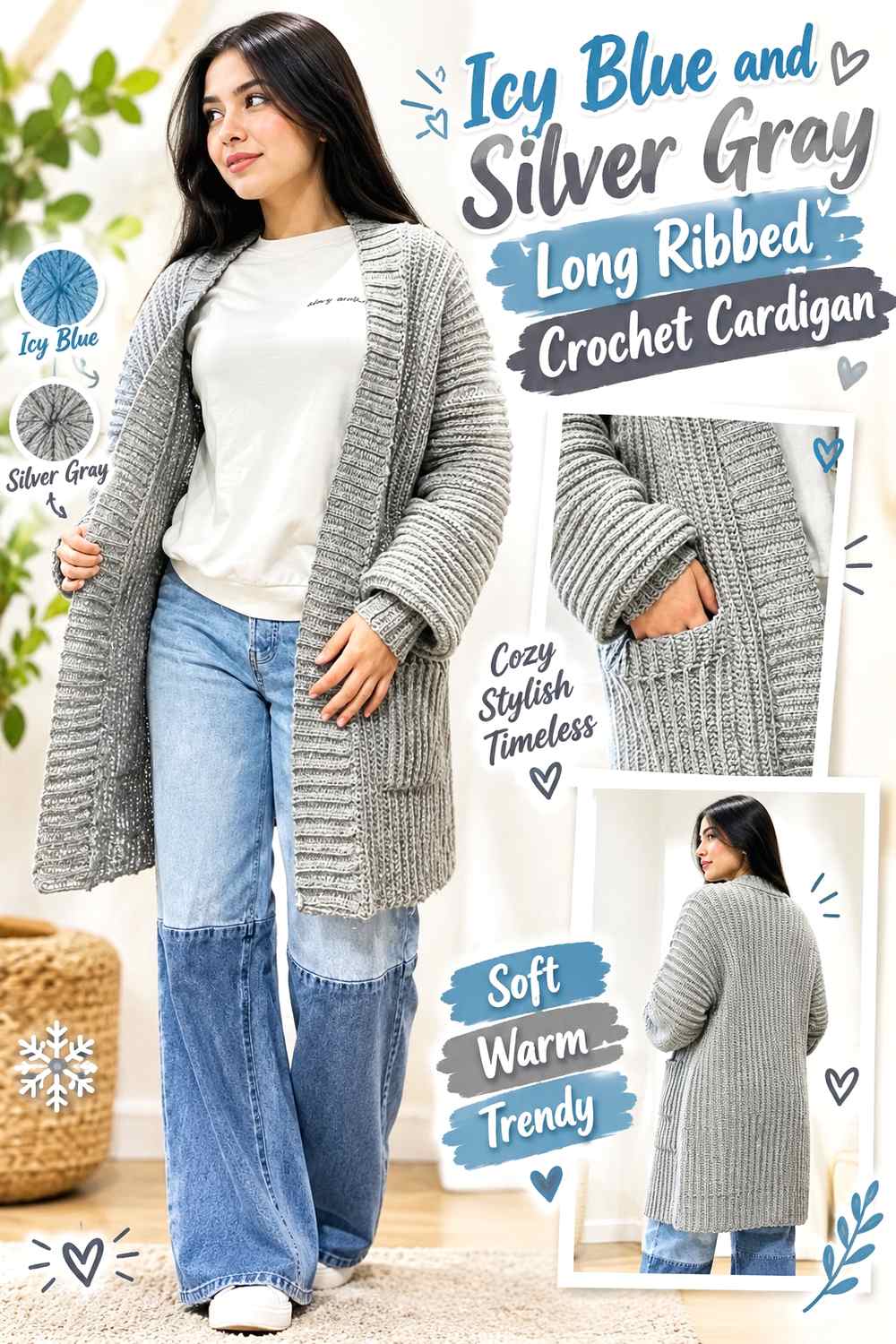
Silver gray keeps this palette cool and restrained. On a long ribbed cardigan, icy blue can dominate the extended body while silver gray appears at the lower hem, cuffs, front opening, or selected ribbed sections. Because both shades are relatively quiet, stitch direction becomes an important source of contrast.
Let Icy Blue Cover the Long Ribbed Cardigan Panels
A long cardigan provides a large vertical field, so uninterrupted icy blue can make ribbing and directional texture more noticeable. Frequent gray stripes would break that vertical flow and could shorten the garment visually.
Use silver gray where the construction already changes direction, such as a cuff or border.
Check Icy Blue and Silver Gray Value Before Using Narrow Trim
Some icy blues and pale grays can look extremely similar once crocheted. Place the yarns together before assigning silver gray to a narrow edge.
If the distinction nearly disappears, either choose a deeper gray or deliberately use the two shades tonally in broader sections where the subtle shift is easier to appreciate.
Repeat Silver Gray Without Reducing the Icy Blue Cardigan Body
A long gray front band plus gray cuffs may already create enough repetition. Adding a broad gray hem as well could make the accent occupy more visual space than expected.
Step back and evaluate the whole cardigan vertically before adding the final color section.
Creator Credit: Yarnalina
5. Icy Blue And Navy Oversized Crochet Cardigan
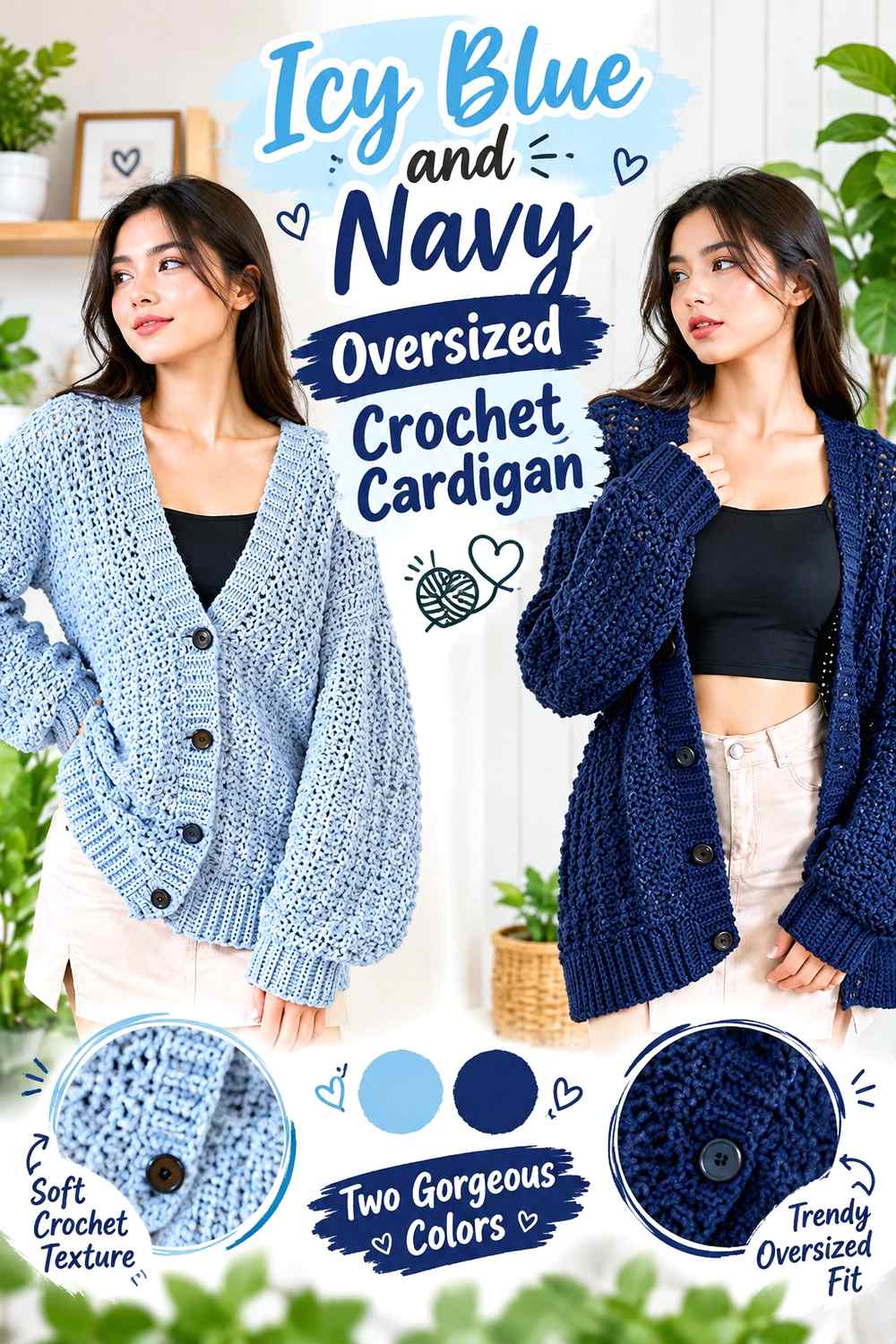
Navy provides one of the strongest contrasts for icy blue. An oversized cardigan can accommodate that darker shade without losing its blue-led identity, provided icy blue still covers the broad body and sleeve surfaces. Navy works best as an anchor at cuffs, edging, pockets, or selected lower sections.
Keep Icy Blue Dominant Across the Oversized Cardigan Body
Extra width already gives an oversized cardigan substantial visual presence. Large navy panels can make that roomy silhouette look considerably darker and heavier.
Use icy blue across the broadest areas and reserve navy for locations where strong definition adds something useful.
Anchor Icy Blue Sleeves With Navy Cardigan Cuffs
Dark cuffs can provide a clear endpoint to wide or relaxed icy blue sleeves. Because navy attracts attention beside pale blue, the cuffs do not need to be extremely deep.
Check their width on both sleeves before finishing. Wide navy cuffs can become one of the cardigan’s most visible design features.
Use Navy Around Icy Blue Cardigan Pockets With Restraint
If the cardigan includes pockets, a navy edge can help them stand out against an icy blue front. An entirely navy pocket creates a much larger dark block and can make the lower front visually heavy.
For a lighter result, keep the pocket body icy blue and use navy only around its opening or border.
Creator Credit: Chenda DIY
6. Icy Blue Lavender And Cream Patchwork Crochet Cardigan
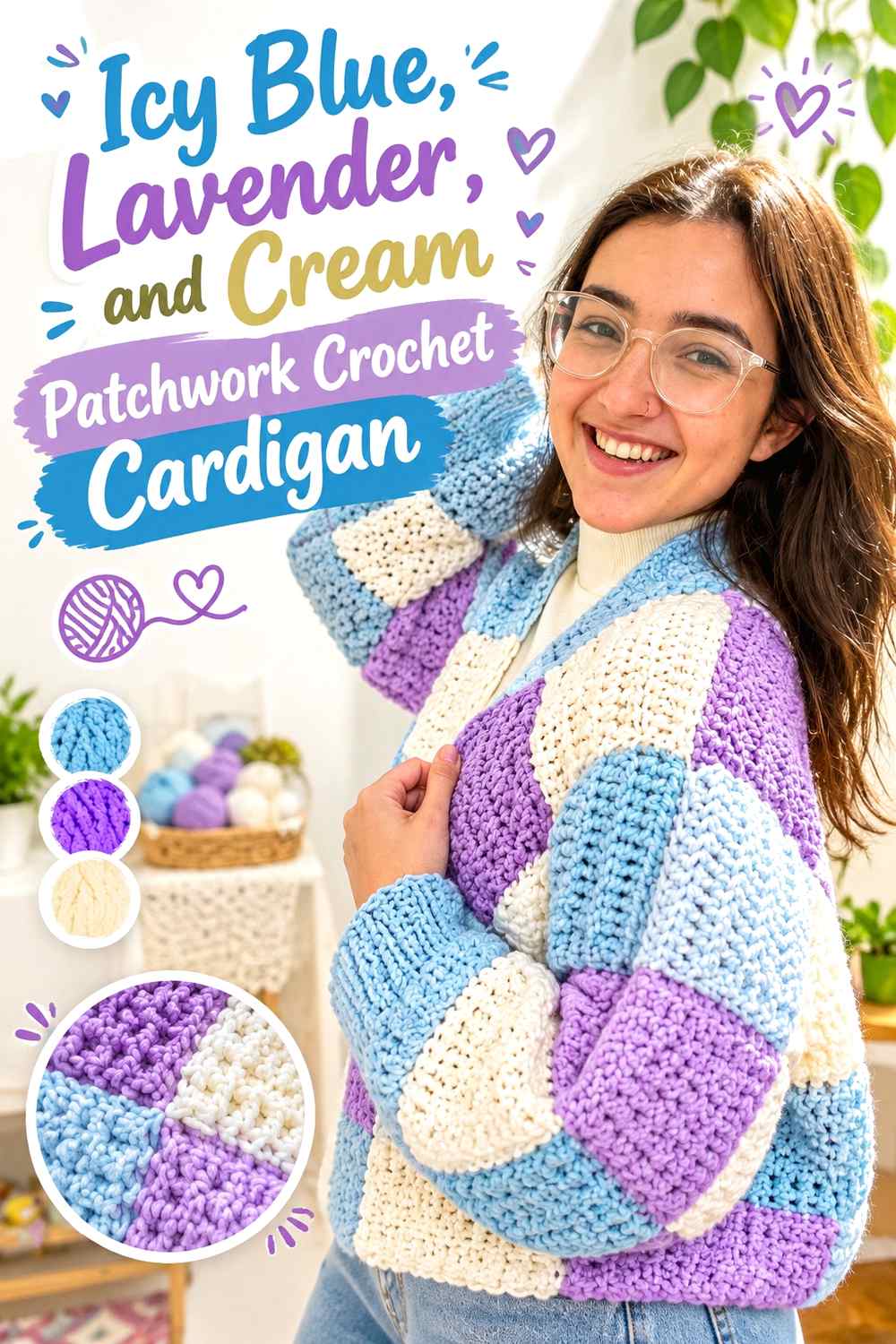
Patchwork allows icy blue to remain dominant through repetition rather than continuous coverage. Use icy blue in the largest number of blocks, lavender as the secondary color, and cream as a light separator. The goal is to prevent three pale shades from blending into an indistinct grid.
Repeat Icy Blue Across Several Patchwork Cardigan Areas
Do not cluster all the icy blue blocks on one side. Spread them across the fronts, back, and sleeves so the main color feels connected throughout the garment.
The blocks do not need a perfectly symmetrical arrangement, but the overall distribution should avoid creating one blue-heavy side and one cream-heavy side unintentionally.
Use Cream to Separate Icy Blue and Lavender Cardigan Blocks
Lavender and icy blue can be close in lightness even though their hues differ. Cream can create useful breathing room where the two would otherwise merge.
Avoid outlining every single patch automatically. Too much cream may turn the cardigan into a cream grid filled with pastel inserts rather than an icy blue-led piece.
Keep Icy Blue Stronger Than Lavender in the Patchwork Hierarchy
If the blue and lavender blocks occupy equal areas, the cardigan will read as a balanced pastel patchwork. For an icy blue cardigan, give blue more repeats or place it in more visually prominent areas such as the upper front and sleeves.
That hierarchy can stay clear even when all three shades remain relatively light.
Creator Credit: Crochet with Karu
7. Icy Blue And Charcoal Raglan Crochet Cardigan

Charcoal creates a strong frame for an icy blue raglan cardigan without the starkness of black. Icy blue can fill the textured body while charcoal emphasizes ribbed cuffs, the front opening, or selected raglan-related finishing. Because a raglan already has directional shaping around the shoulders, the accent color should support that structure rather than compete with it.
Keep Icy Blue Clear Across the Raglan Cardigan Yoke
The upper body contains multiple shaping lines, so large charcoal sections around the shoulders can make the yoke look busier. Preserve broad icy blue areas between any dark finishing.
This lets the construction remain readable through shape and stitch texture instead of relying on several competing color breaks.
Use Charcoal to Ground Icy Blue Cardigan Ribbing
Charcoal is useful for cuffs and lower ribbing because it gives the pale body a darker endpoint. If the front band is also charcoal, compare the total amount of dark trim before extending it around every edge.
A narrow charcoal repeat may be enough to connect the cuffs to the body.
Check Icy Blue Texture Before Adding More Charcoal
If the cardigan uses a visibly textured stitch, icy blue may already show that texture through shadow. Adding frequent charcoal stripes could distract from it.
Use the darker shade where it defines construction—such as a cuff or opening—rather than automatically threading it through the main stitch pattern.
Creator Credit: MJ’s Off The Hook Designs
8. Icy Blue And Blush Pocket Crochet Cardigan
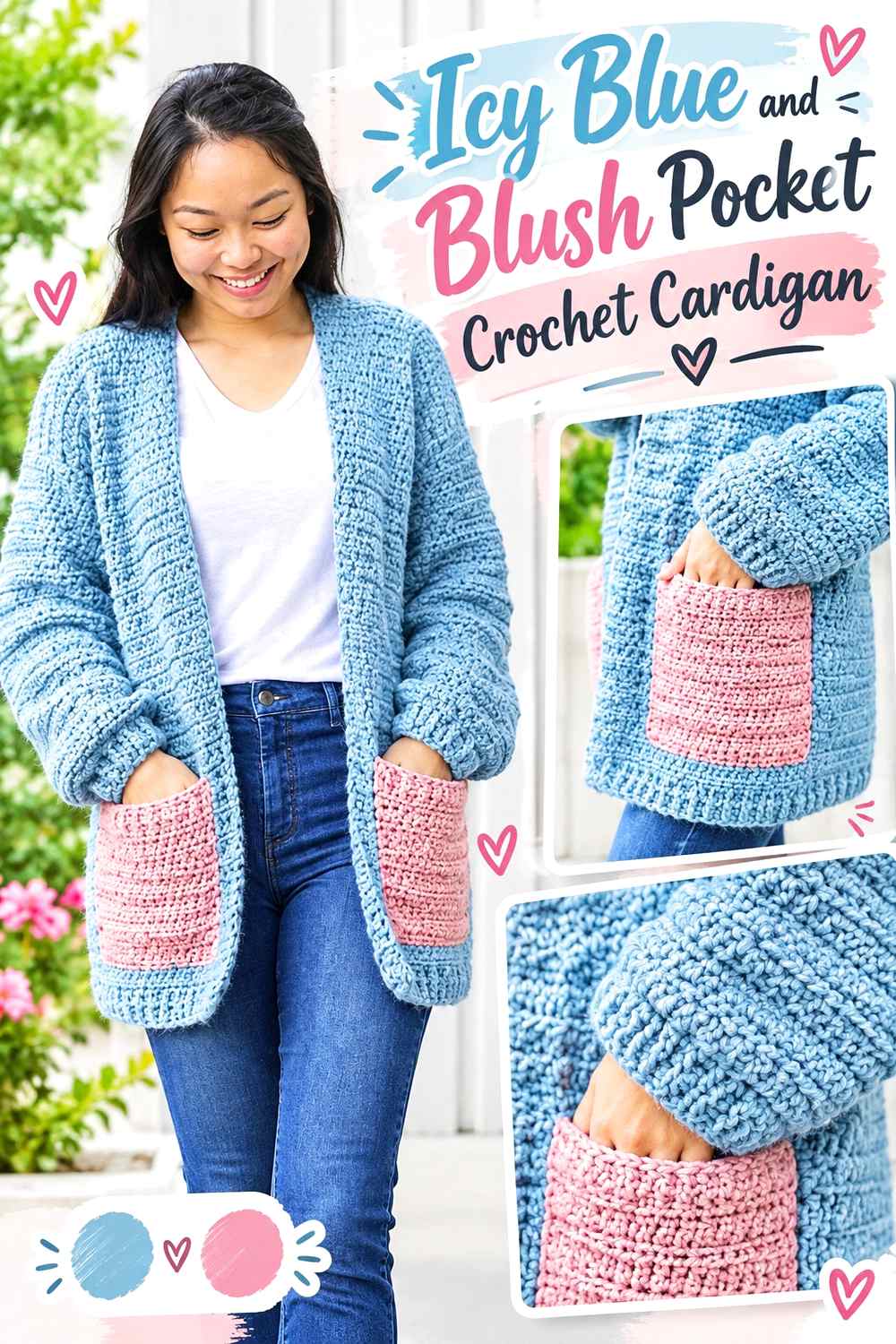
Blush introduces gentle warmth without giving an icy blue cardigan a strong dark outline. On a relaxed cardigan with pockets, icy blue can cover the major garment panels while blush appears on pocket edges, ribbing, cuffs, or a narrow front border.
Keep Icy Blue Behind Blush Cardigan Pockets
An icy blue front provides a clean background for blush pocket details. If the entire pockets are blush, position them temporarily before attaching them so you can judge how much warm color they add to the lower body.
For a quieter palette, make the pockets icy blue and use blush only along their upper edges.
Repeat Blush Sparingly Across the Icy Blue Cardigan
Blush can appear again at the cuffs or hem to connect the pockets with the rest of the garment. Avoid giving every edge the same broad blush treatment unless a more balanced two-color cardigan is the goal.
A small repeat often looks more intentional than introducing a third shade to solve an isolated accent.
Keep Icy Blue and Blush Distinct Enough for Pocket Definition
Very pale blush and icy blue may have similar values. That produces a soft pastel effect but can make narrow pocket borders difficult to see.
If pocket definition matters, choose a blush that remains noticeably warmer or darker than the blue while preserving the gentle palette.
Creator Credit: forthefrills
9. Icy Blue And Soft Sage Granny Hexagon Crochet Cardigan
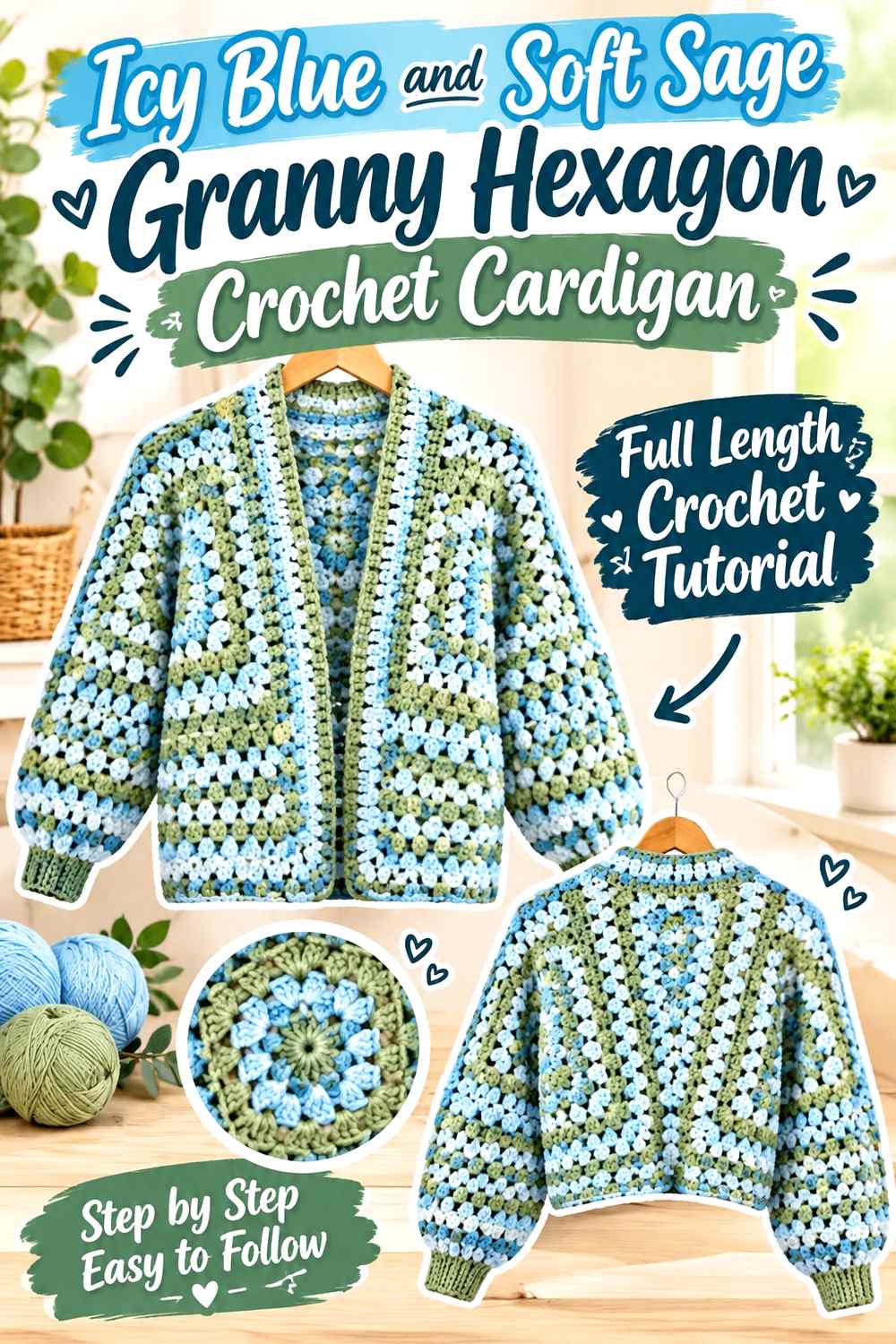
A granny hexagon cardigan naturally creates repeated rounds that later fold into body and sleeve sections. Icy blue can appear more frequently, while soft sage interrupts selected rounds. Because the colors move into different positions after folding, evaluate the palette on the cardigan shape rather than only on a flat hexagon.
Repeat Icy Blue More Often Than Sage in the Hexagon Cardigan
Equal-width alternating rounds will create a balanced two-color cardigan. If icy blue should remain dominant, give it additional rounds or wider visual sections.
The exact sequence matters less than maintaining a clear hierarchy once both cardigan halves are complete.
Fold the Icy Blue Hexagons Before Judging Sage Placement
A sage stripe that looks minor on a flat hexagon may end up across a sleeve, shoulder, or front opening after the piece is folded.
Preview both halves in their garment orientation before finishing the color sequence. This is particularly important if you want icy blue to appear prominently at the center front.
Keep Icy Blue Consistent Across Both Hexagon Cardigan Halves
The two hexagons do not need identical color sequences, but their visual weight should relate. If one side contains much more sage, the completed cardigan may feel unintentionally mismatched.
Place the halves next to each other periodically and compare the amount of icy blue around the sleeves and opening.
Creator Credit: Craft and a Cuppa
10. Icy Blue And Oatmeal Scallop Edge Hexagon Crochet Cardigan

Oatmeal gives icy blue a warmer neutral partner than bright white. On a granny hexagon cardigan with scalloped edging, keep most of the folded body icy blue and use oatmeal for selected rounds or the decorative outer edge. The scallops already add texture, so their color does not need to be very dark to remain noticeable.
Let Icy Blue Lead the Granny Hexagon Cardigan Body
Large icy blue sections make the folded geometry easier to read and prevent the oatmeal from turning the garment into an evenly striped neutral-and-blue piece.
If using multiple oatmeal rounds, spread them deliberately rather than placing most of them near one sleeve or one front panel.
Use Oatmeal to Define the Icy Blue Scallop Edge
A lighter neutral scallop can give the cardigan opening a softer outline than navy or charcoal would. Because the edge has its own shape, it can remain visible even with moderate color contrast.
Repeat oatmeal at the sleeve edges only if that repetition improves the balance; the main opening may already contain enough of the neutral.
Check Icy Blue Placement After the Hexagon Cardigan Is Folded
As with any hexagon construction, the visible location of a round changes dramatically when the crochet is folded. Make sure the areas closest to the center opening still contain enough icy blue for the cardigan to retain its main color.
If oatmeal dominates the opening, return to icy blue for the finishing section or keep the scalloped neutral edge narrow.
Creator Credit: HayHay Crochet
How These Icy Blue Crochet Cardigan Palettes Compare
For a soft, light result, icy blue with cream, white, oatmeal, blush, or silver gray keeps the cardigan within a relatively pale range. These combinations work especially well when stitch texture, mesh, ribbing, or scalloped edging should provide much of the visual detail.
Icy blue with navy or charcoal gives the garment a stronger frame. These darker shades are useful on cuffs, pocket openings, front bands, and ribbing where a small amount of contrast can define construction. Because they carry more visual weight, they usually need less surface area than icy blue.
Camel and soft sage create a different type of contrast. Instead of moving simply from light to dark, they introduce a warmer or earthier color beside the cool blue. Lavender stays closer to the pastel direction and works especially well when repeated through patchwork rather than added as one isolated block.
Conclusion
Choose the palette according to which part of the cardigan you want readers to notice first. If icy blue itself should remain the focus, use cream, oatmeal, silver gray, or another restrained supporting shade around the edges. If the cuffs, collar, pockets, or opening need stronger definition, navy or charcoal can establish a clearer frame.
Blush, lavender, camel, and sage create more obvious color relationships while still allowing icy blue to lead. On patchwork and hexagon cardigans, plan repetition before joining or folding the pieces because color placement can shift dramatically once the flat crochet becomes a garment.
For every option, check the cardigan in its assembled orientation before deciding that the palette needs another stripe or accent. Use the credited tutorial for exact construction details and treat the icy blue color placement as a separate design choice.
Frequently Asked Questions
What colors work well with an icy blue crochet cardigan?
Cream, white, oatmeal, silver gray, navy, charcoal, blush, lavender, camel, and muted green can all support icy blue in different ways. Light neutrals create softer transitions, while navy and charcoal provide stronger definition around cardigan edges and cuffs.
How do I keep an icy blue crochet cardigan from looking washed out?
Give the palette enough separation where important details need to remain visible. A darker cuff, border, pocket edge, or front band can provide definition without changing the entire cardigan. If you prefer an all-light palette, rely on stitch texture and use a supporting shade that remains visibly different from the icy blue.
Should icy blue be the cardigan body color or the trim color?
Use icy blue across the body when you want the finished garment to read clearly as an icy blue cardigan. If it appears only at the trim, the larger body color will usually become the visual anchor instead.
How can I use icy blue in a granny hexagon crochet cardigan?
Repeat icy blue more often than the secondary shade, or give it broader sections. Fold the hexagons periodically while working because rounds that appear in one position when flat can move to the sleeve, front, shoulder, or back in the completed cardigan.
Does icy blue work well for mesh crochet cardigans?
Yes, but the underlayer becomes part of the visible palette. An icy blue mesh cardigan over white looks soft and low contrast, while the same cardigan over navy or black looks much more graphic. Test the open crochet over clothing before deciding how much additional contrast yarn to use.
How do I choose a substitute for icy blue yarn?
Preserve the characteristics that matter to the palette: a light blue appearance, a cool or neutral direction, and enough value difference from the supporting colors. After substituting, compare all yarns again because a darker blue may reduce contrast with navy or charcoal and increase contrast with cream or white.