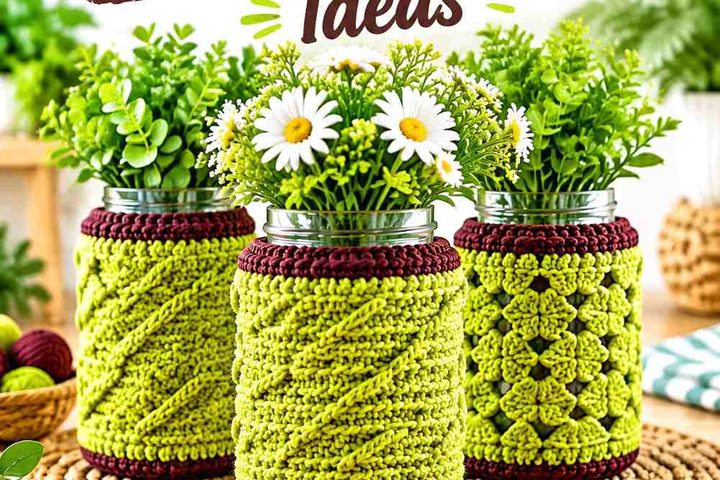
Malachite Green and Rosewater can shift a trench coat cuff from understated tailoring to a deliberately layered textile detail. The biggest difference between these ideas is not color but structure. A narrow V-stitch or crossed-stitch band adds relatively little volume, while cables, puffs, Aran texture, scallops, and ruffles make the wrist area much more prominent.
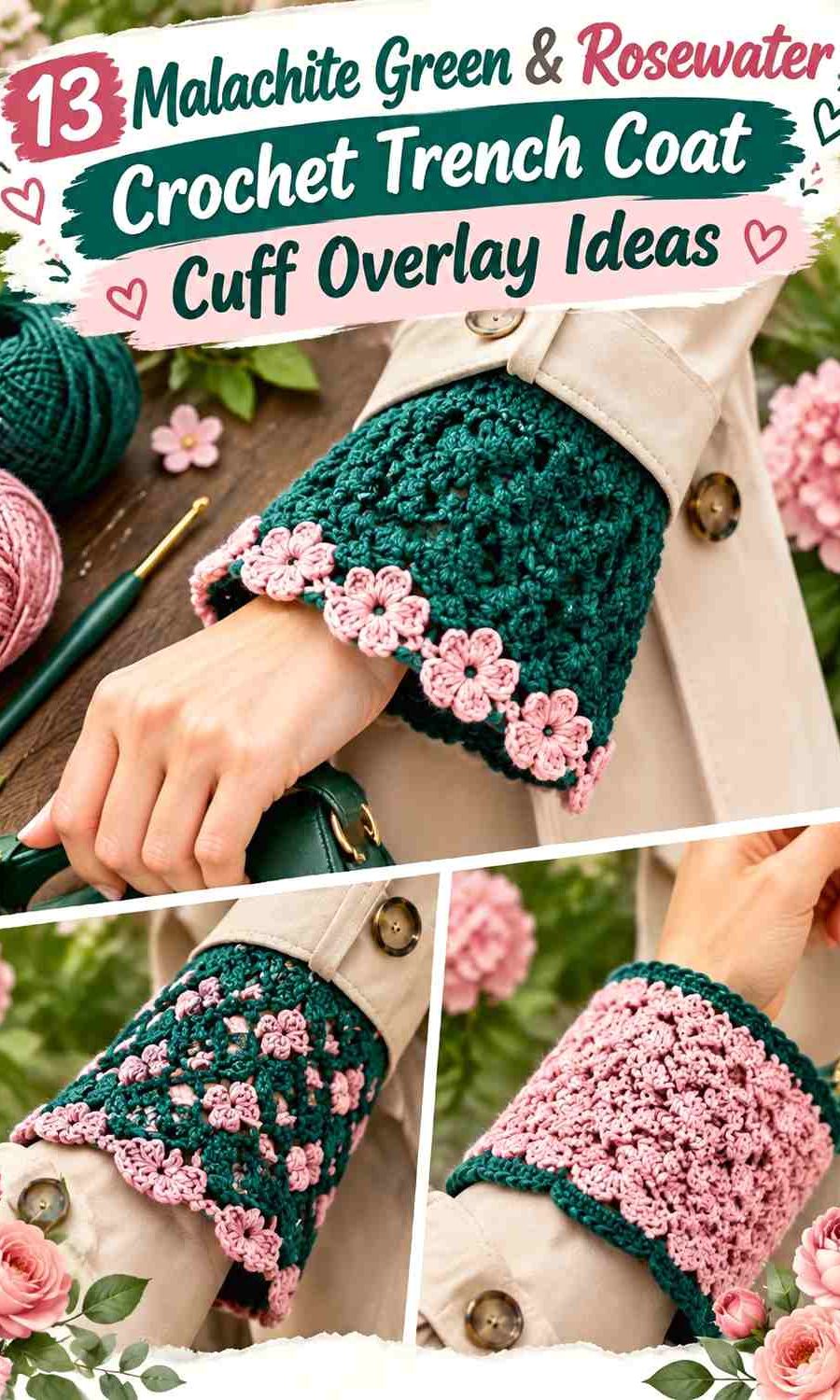
A trench sleeve also imposes practical limits that a bracelet or boot cuff does not. The overlay has to coexist with the existing cuff tab, buttons, vent, lining, and hand opening. A snug continuous band behaves differently from a buttoned strip that can open completely, and a wide sleevelet may cover more of the coat’s original detailing.
The credited sources teach wrist warmers, cuff bracelets, or boot cuffs. Use them for the original crochet constructions, then independently size and position the overlay for your particular trench-coat sleeve.
Quick List
- Crochet Rosewater Ruffle-Edge Trench Coat Cuff Overlay
- Crochet Malachite V-Stitch Button-Band Trench Coat Cuff Overlay
- Crochet Rosewater Alternating-Rib Trench Coat Cuff Overlay
- Crochet Malachite Crossed-Stitch Tab Trench Coat Cuff Overlay
- Crochet Rosewater Scalloped Trench Coat Cuff Overlay
- Crochet Two-Tone Reversible Lemon-Peel Trench Coat Cuff Overlay
- Crochet Malachite Cable-Spine Trench Coat Cuff Overlay
- Crochet Two-Tone Aran-Panel Trench Coat Cuff Overlay
- Crochet Rosewater Post-Rib Trench Coat Cuff Overlay
- Crochet Malachite Eyelet-Texture Trench Coat Cuff Overlay
- Crochet Two-Tone Buttoned Texture Trench Coat Cuff Overlay
Decide Whether the Overlay Should Open or Stretch
A closed crochet cuff has the cleanest uninterrupted surface, but it still has to pass over the hand or stretch enough to sit around the sleeve. That requirement becomes more important when the trench already has a shaped cuff, button tab, or substantial lining.
Buttoned constructions are easier to place around an existing sleeve because they can open completely. They also let the overlay avoid covering functional coat hardware. The trade-off is extra visual detail and a more obvious fastening point.
Before choosing either style, measure the sleeve where the crochet will actually sit—not your bare wrist. Then check the widest part the overlay must pass over if it will be a closed ring. A fitted wrist-warmer pattern cannot automatically be transferred to the outside of a coat without accounting for the fabric underneath.
Keep the Trench’s Existing Cuff Details Functional
Many trench coats already use buttons, adjustable tabs, sleeve straps, vents, or stitched cuff facings. Decide whether your crochet should frame those features, cover them temporarily, or stop before reaching them. A wide overlay placed directly over a working tab may defeat the reason the tab is there.
A removable crochet band offers the least commitment, particularly if you do not want to sew through the coat. If you do plan a permanent attachment, first consider the outer fabric, lining, and any special finish rather than assuming a garment-safe method for one coat is suitable for another.
Width changes the interaction too. A narrow cuff can sit below a strap, while a deep cable or Aran sleevelet may need to start above the original cuff. Mock up the width in paper or spare fabric before making the final crochet piece.
Use Malachite Green and Rosewater to Separate Structure From Edge Detail
Malachite Green has enough depth to emphasize cables, puff stitches, crossed stitches, and raised ribs. Rosewater works particularly well where you want a lighter ruffle, scallop, lace band, or border to soften the transition into the coat.
They do not need equal surface area. A green structural band with a narrow Rosewater edge usually reads more tailored than alternating every row. Reversing that balance makes the cuff lighter and lets small green accents appear more graphic.
Consider the trench color as a third part of the palette. Beige, camel, navy, black, olive, and stone coats will change how strongly each yarn color appears. Hold a finished swatch around the actual sleeve and view both arms together. A cuff that looks balanced in your hand can feel much more prominent once repeated on both wrists.
1. Crochet Rosewater Ruffle-Edge Trench Coat Cuff Overlay
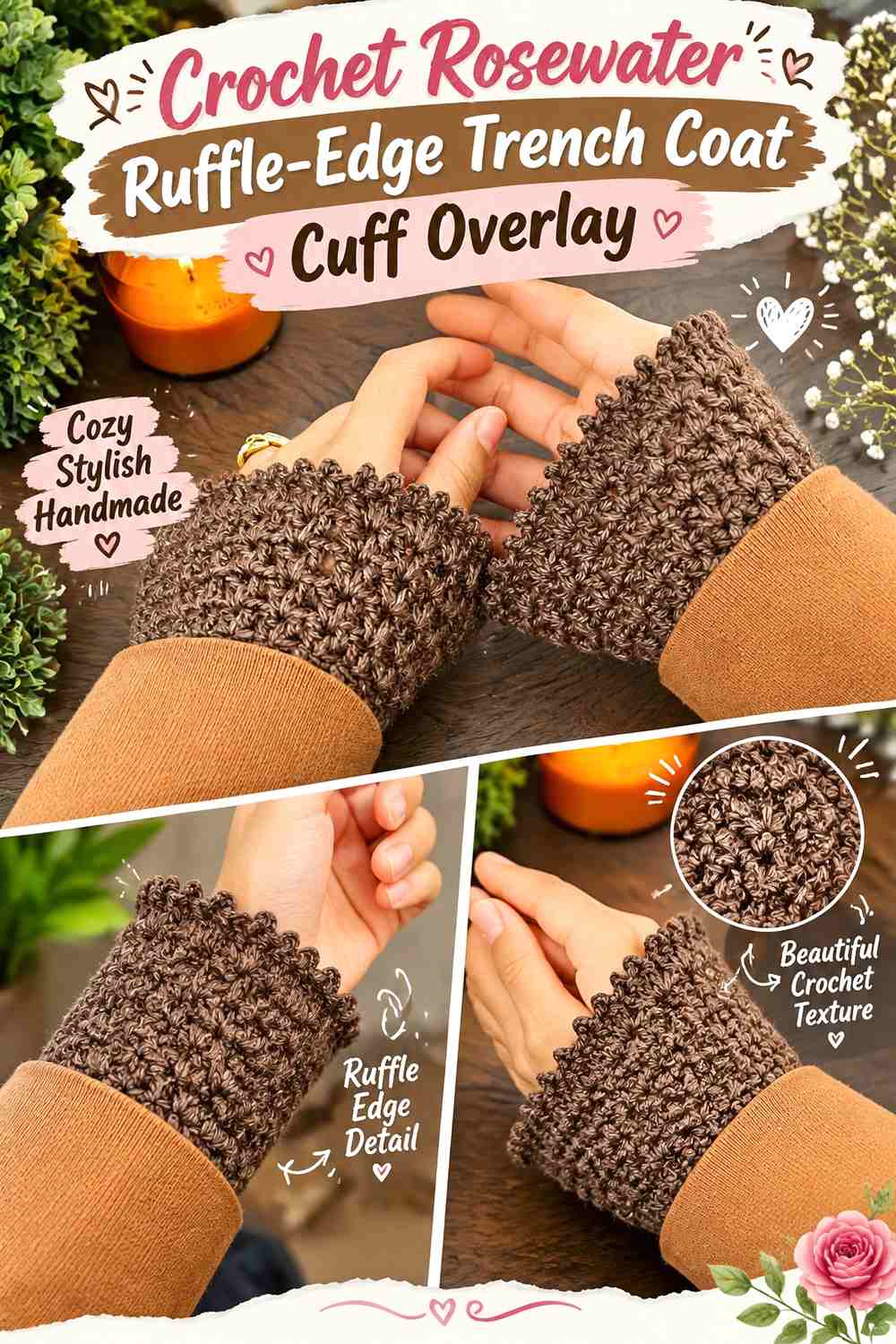
A Rosewater ruffle gives the sleeve a soft outer edge while keeping the main cuff relatively structured. KnitcroAddict’s wrist-warmer tutorial combines back-loop ribbing with an open V-stitch section and finishes with a fan-style ruffled edge, so it provides a useful reference for a cuff that moves from firm foundation to lighter decorative flare.
For a trench overlay, shorten the concept visually rather than reproducing a full hand warmer. The ribbed portion can sit around the sleeve while the Rosewater ruffle extends just beyond the coat cuff. Malachite Green can appear in the foundation band if you want a sharper division between coat and ruffle. This option is best when the existing cuff is fairly plain, because a ruffle layered over straps, buckles, or large buttons can make the wrist area overly busy.
Keep the Ruffle Beyond the Fold Line
The decorative flare should sit where it can open naturally. If it begins directly over a stiff cuff tab or sleeve vent, the underlying structure may push some sections outward more than others.
Place a temporary paper or yarn mock-up around the sleeve first. Check where the coat naturally folds when you bend the wrist, then keep the most dimensional part of the crochet away from that crease.
Let Malachite Anchor the Lighter Edge
A narrow Malachite Green ribbed band beneath the Rosewater ruffle gives the soft outer section a visual base. This is useful on pale trench fabric where an all-Rosewater cuff could lose definition.
Avoid making the green foundation excessively wide if the objective is a light ruffled finish. The darker band should support the edge rather than become a second full cuff competing with the coat.
Creator Credit: KnitcroAddict
2. Crochet Malachite V-Stitch Button-Band Trench Coat Cuff Overlay

A V-stitch cuff creates an open band with clear diagonal lines and less visual weight than dense ribbing. My Merry Messy Life’s cuff bracelet uses repeated V-stitches and closes with a crochet button loop, with a small rosette offered as one possible fastening detail.
That openable construction translates well to a coat because the overlay does not have to stretch over the hand or sleeve. Work the main band in Malachite Green and use Rosewater for the button loop, fastening motif, or narrow finishing edge. The V-shaped openings allow glimpses of the trench fabric beneath, making this an effective choice when the coat color should remain visible. Because the band is relatively narrow, it can also sit between the sleeve end and an existing trench tab more easily than a deep textured sleevelet.
Size the Band With the Coat Fastened Normally
Measure the sleeve after adjusting its original cuff tab or buttons to the setting you usually wear. If you measure with the trench opened wide and later tighten the tab, the overlay may become loose.
A buttoned crochet band gives some fitting flexibility, but it should not depend on extreme overlap to stay in place. The two ends should meet naturally around the finished sleeve.
Use the Open V Shapes as Negative Space
The coat fabric showing through the V-stitches becomes part of the color scheme. On a beige trench, the openings may look warm and soft; on navy or black they will become much more graphic.
Keep Rosewater accents restrained if the background already creates strong contrast. One small fastening detail can be enough to introduce the second yarn color.
Creator Credit: My Merry Messy Life
3. Crochet Rosewater Alternating-Rib Trench Coat Cuff Overlay
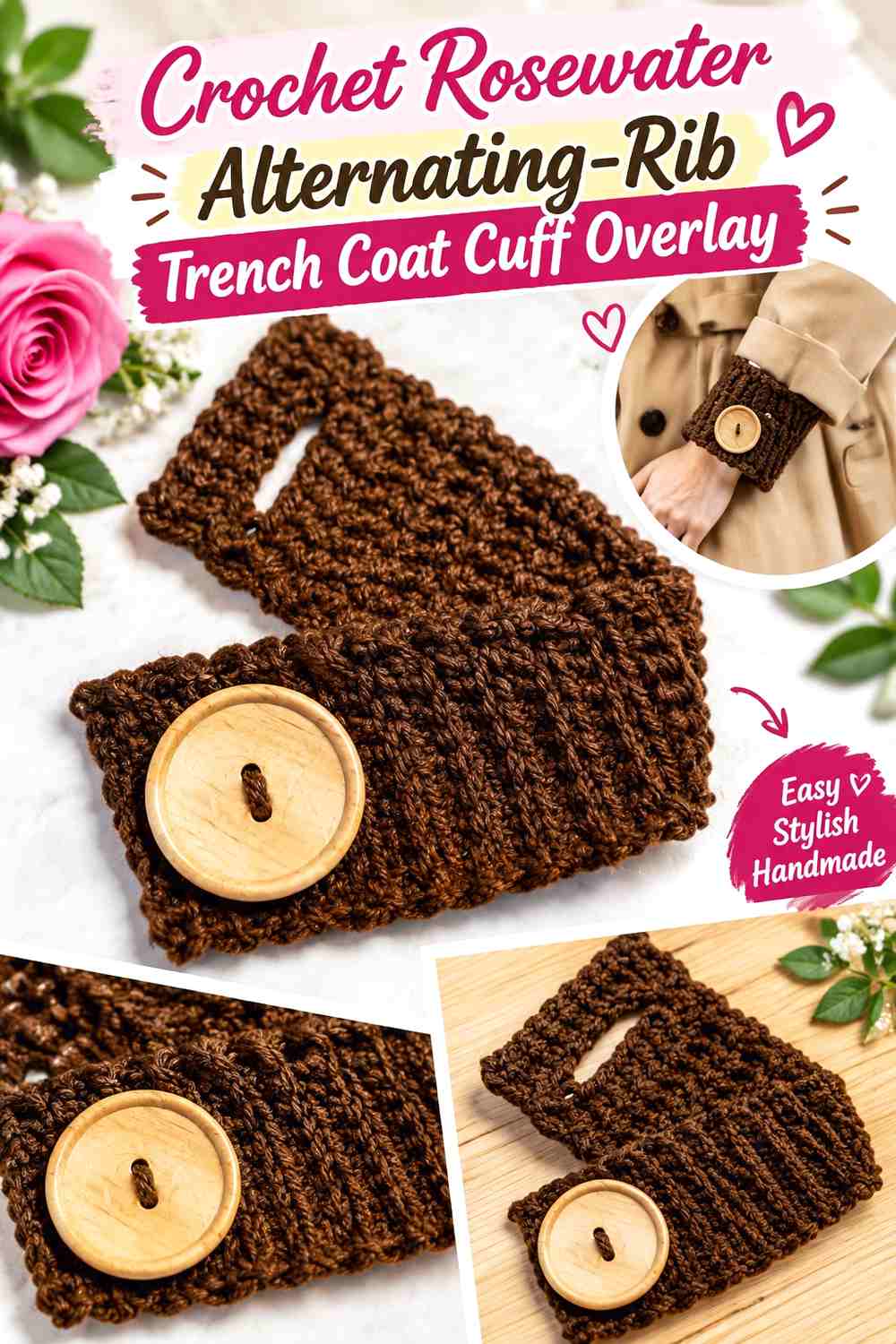
A low-profile ribbed band is useful when you want crochet texture without changing the sleeve silhouette dramatically. Crochet Spot’s button cuff bracelet is worked flat with rows alternating between back-loop and front-loop single crochet, then finished with a buttonhole at one end.
For a trench version, Rosewater can form the whole textured band while Malachite Green appears only as a button or narrow edge accent. The alternating loop placement produces surface ridges without the deep projection of cables or puffs, making it more compatible with sleeves that already have substantial tailoring. An openable flat band also lets you position the fastening away from a coat’s own buttons. Before choosing the width, decide whether the crochet should look like a slim bracelet over the cuff or cover most of the trench’s original wrist section.
Put the Closure Away From the Coat Hardware
If the trench already has a buckle or buttoned cuff tab, adding another fastening immediately on top can make that area crowded and harder to use.
Rotate the crochet closure toward the inner wrist or another clear section of sleeve. Check both arms because the original coat hardware may not sit identically in relation to your hands.
Use Rosewater for Texture Rather Than Volume
A pale band can make the alternating ribs visible through shadow without needing extra decoration. This is useful if you want Rosewater to occupy more surface area while still keeping the overlay restrained.
Malachite Green can be reserved for one small fastening accent. That asymmetry gives the darker shade emphasis without turning a narrow cuff into a strongly striped piece.
Creator Credit: Crochet Spot
5. Crochet Malachite Crossed-Stitch Tab Trench Coat Cuff Overlay

Crossed stitches create small X-shaped details that suit the linear construction of a trench coat. Doriyumi’s button cuff bracelet uses crossed double crochet within a narrow flat band and incorporates the closure into the crochet structure.
Work the main band in Malachite Green so the crossed stitches remain crisp and use Rosewater for the final fastening area or one slim border. Because this is a relatively narrow openwork design, it can echo a trench cuff strap without completely covering the original sleeve. That makes it useful when you want an overlay to read almost like an extra textile tab. The diagonal X texture is the important feature, so avoid adding several competing embellishments. One button or fastening point is enough to finish the band.
Align the Crosses With the Sleeve
A narrow band can rotate around a smooth coat sleeve during wear. If the crossed-stitch section has an obvious “front,” that rotation becomes easy to notice.
Fit the band snugly enough to remain positioned without compressing the sleeve underneath. If you plan a removable overlay, test it while walking and bending your arms before deciding the final closure point.
Keep Rosewater at One End
Putting the lighter shade only near the fastening creates an asymmetric accent that resembles a deliberate cuff tab rather than an evenly striped bracelet.
This can work particularly well on coats with existing Malachite-adjacent tones such as olive or dark green. Rosewater then becomes the small detail that separates the crochet from the garment.
Creator Credit: Doriyumi
6. Crochet Rosewater Scalloped Trench Coat Cuff Overlay
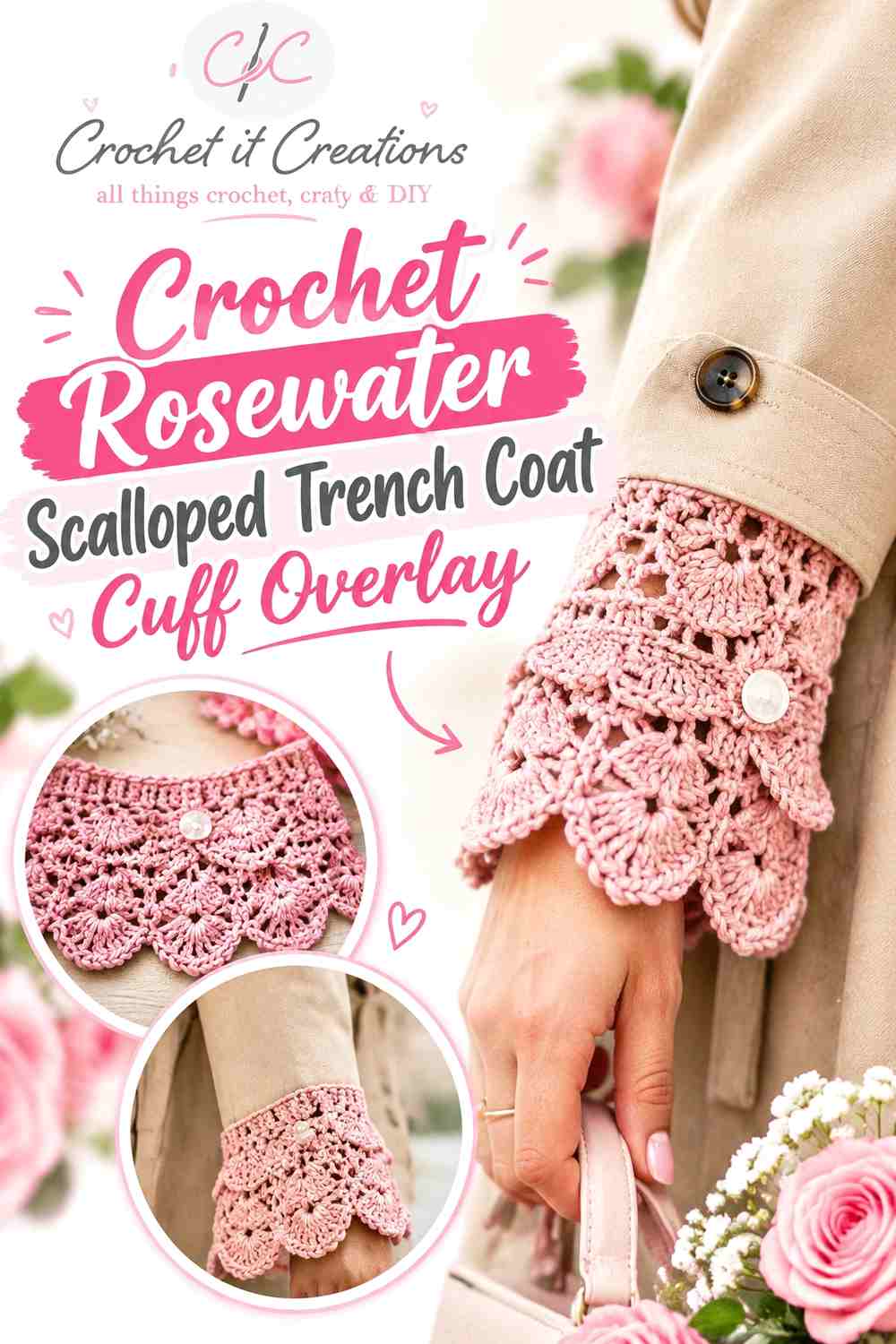
A scalloped edge creates a decorative silhouette without requiring a full ruffle. Crochet It Creations’ boot-cuff tutorial combines back-loop ribbing with a repeating scallop worked around the edge and also shows optional button details.
Adapted for a trench sleeve, the ribbed portion can remain Malachite Green while the scallops are worked in Rosewater so the lighter shade appears only beyond the coat cuff. This is a useful compromise when a ruffle feels too full but a straight band looks too plain. The curved edge will be most visible when it projects slightly past the sleeve. If the overlay sits entirely on top of the coat fabric, some of that shape may disappear, especially against a similarly colored trench.
Match the Scallop Scale to the Sleeve
Large scallops can look elegant on a wide coat sleeve but oversized on a narrow wrist opening. A small circumference may also accommodate only a few complete repeats.
Use the source construction as your stitch reference, then sample enough of the edge to see how the curves relate to your coat. Avoid squeezing partial scallops into the final gap merely to complete the circumference.
Put the Decorative Edge Where It Can Be Seen
If Rosewater scallops are the reason for choosing the design, let them sit at the actual sleeve end or above a clearly contrasting band.
Placing them under an existing trench strap may flatten the curves and obscure their outline. The coat’s working details should determine where the crochet begins and ends.
Keep the Ribbed Foundation Understated
A Malachite foundation provides enough structure and contrast without needing additional bobbles, flowers, or cables.
The scallops already alter the edge silhouette. A quieter base lets the eye read the transition from dark band to pale curved finish rather than several unrelated textures at once.
Creator Credit: Crochet It Creations
8. Crochet Two-Tone Reversible Lemon-Peel Trench Coat Cuff Overlay

A reversible cuff is useful when you want two distinct visual treatments from one piece. Heart Hook Home’s boot-cuff pattern starts with a flat strip joined into a ring and develops another textured section using alternating single and double crochet, with the finished cuff designed to be wearable in more than one orientation.
For a trench overlay, work the firmer lower strip in Malachite Green and the lemon-peel-textured area in Rosewater. Worn one way, the pink texture can extend beyond the sleeve; flipped, the darker structural band can become more prominent. This adaptability suits coats with adjustable cuff tabs because you can change which section is exposed without making an entirely new accessory. The main consideration is bulk at the fold: if you actually turn part of the crochet over itself, check that the doubled fabric still sits comfortably around the coat sleeve.
Use Reversibility to Change the Color Balance
One orientation can show mostly Malachite Green with a narrow Rosewater accent; the other can expose a broader Rosewater section.
This gives the same trench two different cuff moods without changing the underlying construction. Keep the color boundary clean so the flipped version looks intentional rather than merely inside out.
Check the Fold Against Sleeve Thickness
A boot cuff has room to fold over footwear, but a trench sleeve already contains outer fabric and lining. Doubling crochet on top can become bulky quickly.
Wrap a representative swatch around the actual cuff and fold it before committing to the final width. If the layered section becomes too thick, use the reversible idea without physically folding the overlay.
Keep the Texture Continuous Around the Wrist
Lemon-peel-style texture is subtle enough that an obvious join or abrupt color mismatch can attract more attention than the stitch itself.
Plan the seam toward a less visible part of the sleeve and compare both cuffs side by side before finishing. A consistent orientation helps the pair read as designed accessories rather than separate experiments.
Creator Credit: Heart Hook Home
9. Crochet Malachite Cable-Spine Trench Coat Cuff Overlay
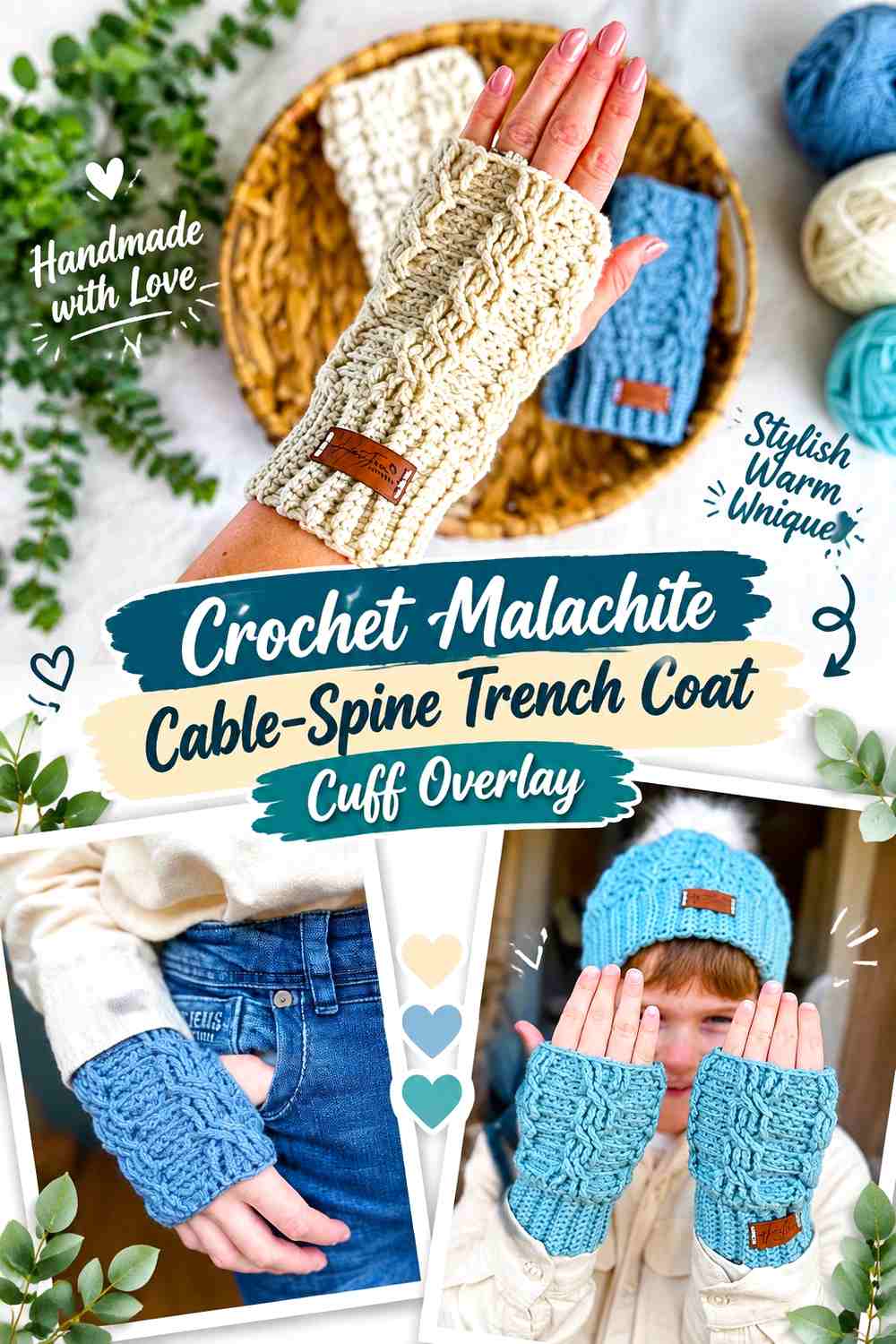
A central cable gives the cuff a tailored vertical feature that can echo the structured lines of a trench. HanJan Crochet’s wrist-warmer pattern combines a ribbed cuff foundation with a cable-textured body, using post-stitch techniques to create raised relief.
For this overlay, concentrate a Malachite Green cable on the outer wrist and keep the surrounding fabric the same shade or work a slim Rosewater border at each edge. The cable should remain the visual focus. This idea suits a relatively plain sleeve where one raised line can add detail without introducing a broad lace pattern. Because the cable has directional relief, placement matters more than it does with an all-over texture: if the overlay rotates, the main spine will no longer line up with the intended side of the arm.
Mark the Outer-Wrist Position
Fit the cuff around the coat and identify where the cable should sit when your arm hangs naturally. That may not correspond exactly to the sleeve seam.
Use a temporary marker before closing or fastening the overlay. Check both arms separately, since garment construction and your preferred cuff adjustment can shift the apparent center.
Leave Breathing Room Beside the Cable
A strong cable looks clearer when the surrounding fabric is quieter. Adding puffs, scallops, and multiple stripes alongside it can dilute the raised line.
If you want Rosewater, use it as a narrow edge or small framing detail. Malachite Green can then carry the structural relief uninterrupted.
Watch the Depth Near the Hand
Cable crossings create local areas of extra thickness. If the cuff sits very close to the hand, those sections may feel more noticeable when the wrist bends.
Move a sample slightly higher on the sleeve and compare comfort before deciding the final position. A trench overlay does not need to sit exactly at the sleeve edge.
Creator Credit: HanJan Crochet
10. Crochet Two-Tone Aran-Panel Trench Coat Cuff Overlay

An Aran-style cuff creates the richest all-over texture in this collection. My Hobby Is Crochet’s Chic Aran Boot Cuffs are worked sideways in one piece and use a repeating textured pattern built around crossed stitches, allowing the circumference to be customized through the number of repeats.
For a trench adaptation, use Malachite Green for the raised Aran sections and Rosewater for narrow separator rows or the outer finish. The effect is more substantial than a simple cable because texture occupies most of the band. It works best on a coat with clean sleeve construction and relatively little wrist ornament. On a trench with large buckles, layered tabs, or storm-cuff details, the combined textures may feel heavy. A shorter overlay can preserve the Aran character while leaving original coat hardware visible.
Fit by Whole Texture Panels
A repeating Aran design looks more resolved when the circumference ends after a complete pattern section rather than midway through one.
Make enough repeats to wrap comfortably around the coat sleeve, then judge whether the small remaining difference can be handled by the closure or seam. Avoid stretching incomplete texture to force an exact measurement.
Use Rosewater as Visual Separation
A little Rosewater between green raised areas can make the Aran construction easier to read, especially on a dark trench.
Keep those pale areas narrow. If Rosewater occupies too much of the band, the eye may read the cuff as stripes first and textured crochet second.
Choose a Smooth Section of Sleeve
All-over relief needs a relatively stable foundation. Placing the band across a buckle, tab, or bulky seam can distort the raised pattern and make one side sit higher.
Move the overlay slightly above the coat’s original cuff if necessary. The goal is to layer crochet onto the trench, not force the trench’s existing details flat.
Creator Credit: My Hobby Is Crochet
11. Crochet Rosewater Post-Rib Trench Coat Cuff Overlay

Post stitches create vertical ribs with more definition than ordinary back-loop crochet. Goddess Crochet’s wrist-warmer pattern works front-post and back-post double crochet around the cuff to establish a pronounced ribbed section before the rest of the hand warmer.
For a trench cuff overlay, isolate that visual idea as a Rosewater band and use Malachite Green only for one edge or a narrow center stripe. The vertical relief can complement the straight grain and seams of a tailored coat without introducing open lace. It is also less decorative in silhouette than scallops or ruffles, which makes it useful when you want the color combination to be noticeable but the overall cuff shape to remain straightforward. Post-stitch fabric can become fairly substantial, so sample the proposed width around the actual sleeve.
Run the Ribs Parallel to the Sleeve
Vertical ribs visually extend the line of the arm and make a wide cuff feel less blocky.
Check that the crochet has not twisted before completing the join. Even a slight spiral can become visible when the ribs sit beside straight sleeve seams or topstitching.
Give Rosewater Enough Surface to Show Shadow
A narrow pale cuff can still display post-stitch relief because the ridges create their own light and shade. You do not need additional motifs to make the texture visible.
Use Malachite Green sparingly if you want the rib structure to remain the main point. One dark finishing row can provide definition without interrupting every raised column.
Avoid Excessive Tightness
A structured ribbed band may have useful stretch, but it should not compress the trench sleeve so strongly that the fabric bunches above it.
Measure around the clothed sleeve and check the overlay in motion. If the coat wrinkles noticeably above the cuff, increase the relaxed circumference rather than relying on stretch alone.
Creator Credit: Goddess Crochet
12. Crochet Malachite Eyelet-Texture Trench Coat Cuff Overlay
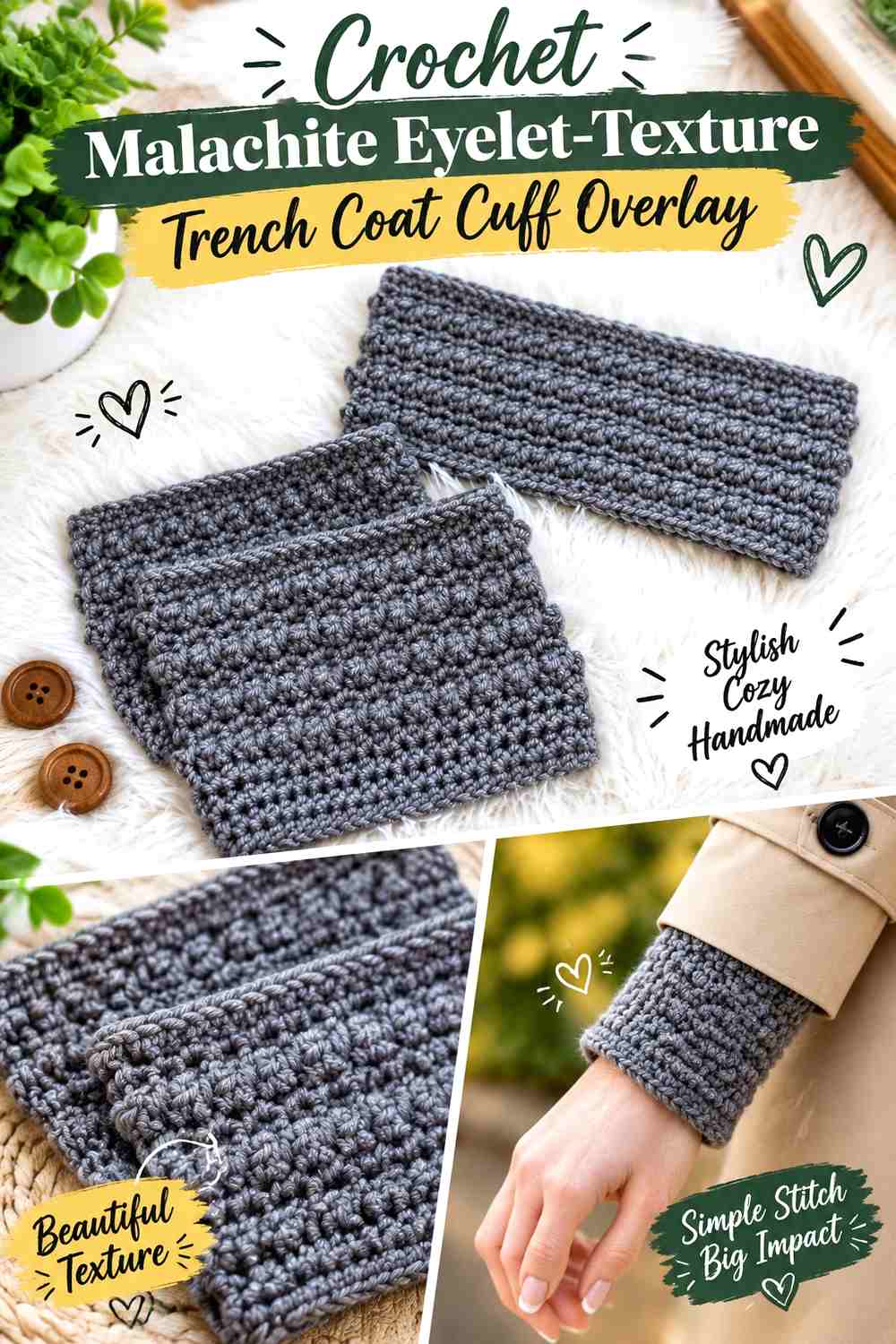
This option combines solid fabric with repeated small openings instead of using fully open lace. Two Brothers Blankets’ Little Textures boot cuff alternates solid rounds with chain-space and long-half-double-crochet sections, producing bands of changing density rather than one uniform stitch surface.
For a trench cuff, work the solid areas in Malachite Green and the open textured bands in Rosewater, or reverse the relationship so pale eyelets interrupt a darker ground. The result is more tailored than a granny or flower motif because the pattern runs horizontally around the wrist. It is also useful when you want some of the coat color to show through without creating large holes. Keep the overall depth moderate so several texture bands can be seen without extending too far up the sleeve.
Align the Open Bands on Both Arms
Horizontal texture makes mismatched placement easy to notice. If one cuff begins with a solid band at the sleeve edge and the other begins with eyelets, the pair may look unbalanced.
Work both overlays from the same color and texture sequence and compare them before joining or fastening. Small length differences are easier to correct before the final edge is finished.
Let the Coat Color Show Through Selectively
The chain spaces create small windows rather than broad mesh. Against camel or beige, they can soften Malachite Green; against black they become much more graphic.
Choose the color sequence after looking at the swatch on the actual trench. The same crochet can feel delicate or bold depending on what fills those openings visually.
Keep the Texture Bands Clear of the Fastening Zone
If you add a removable button or snap system to the overlay, position it through a stable section rather than a highly open band.
The original boot-cuff construction is not a trench attachment method, so treat closure planning separately. The crochet texture should remain intact rather than being distorted around improvised hardware.
Creator Credit: Two Brothers Blankets
13. Crochet Two-Tone Buttoned Texture Trench Coat Cuff Overlay
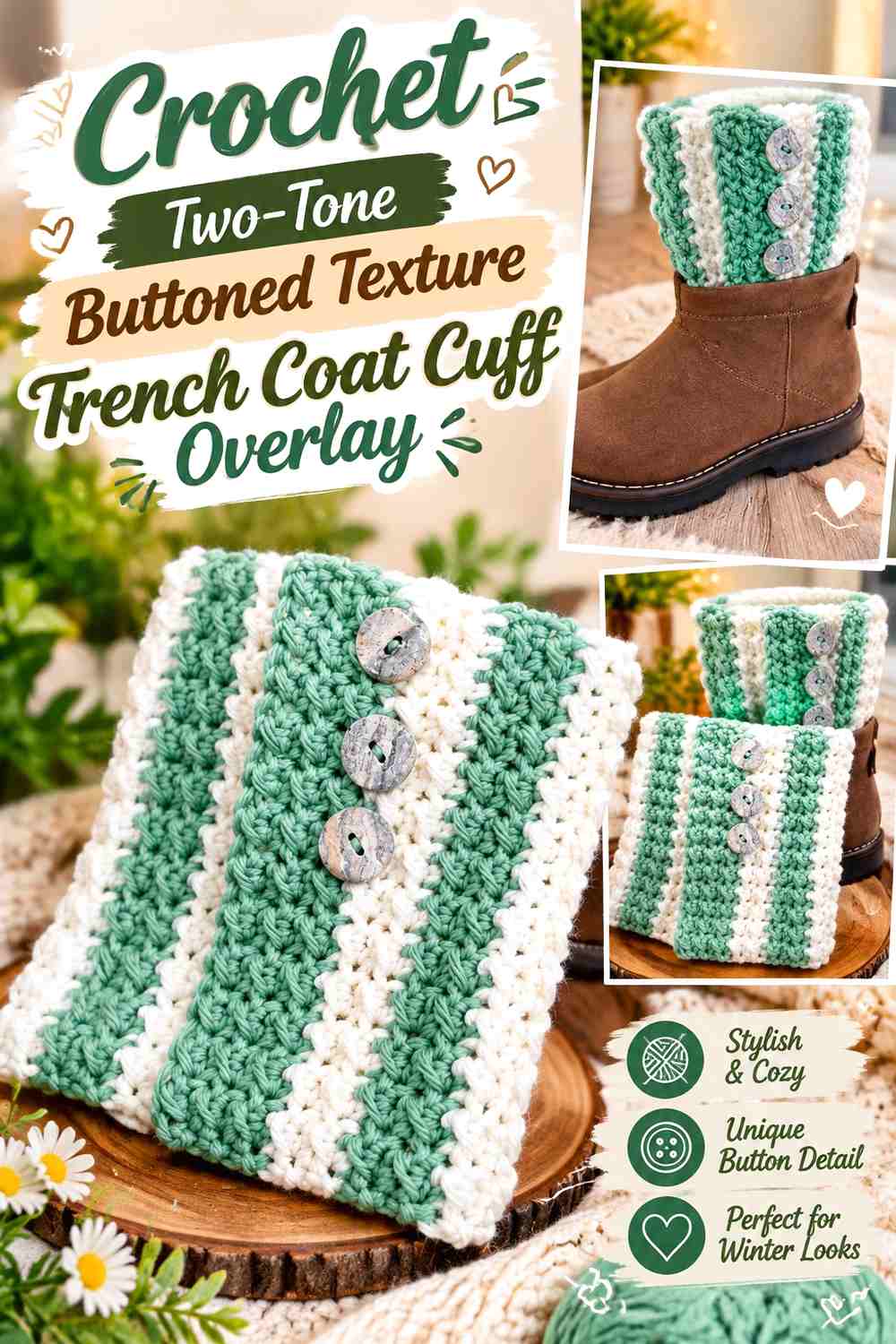
A multi-button band creates the clearest removable-overlay concept in the list. Crochet ‘n’ Create’s textured boot cuff is worked as a flat strip using alternating slip stitch and half double crochet, then incorporates several buttonholes along one end and matching buttons for closure. The source also notes color changes as an option for the cuff.
For a trench adaptation, work broad Malachite Green and Rosewater sections and let the buttoned edge sit along the inner wrist. Because the strip opens completely, it can wrap around a sleeve without stretching over the hand or forcing its way past the trench’s existing cuff. This makes it particularly useful when you want a substantial overlay but do not want to alter the coat permanently. The row texture remains relatively compact, so the buttons can provide most of the decorative emphasis.
Use the Button Side as an Adjustable Feature
Multiple fastening points can make the overlay easier to remove, but the button arrangement should remain simple enough to operate while wearing a coat.
Place the fastening edge where you can reach it without twisting the sleeve. Also ensure that the crochet buttons or chosen hardware do not sit directly on top of the trench’s own cuff buttons.
Block Colors in Wider Sections
The source construction can accommodate color changes, but a trench overlay does not need narrow stripes simply because two shades are available.
A broad Malachite section beside a smaller Rosewater section gives the cuff a more tailored appearance. You can reverse the proportions on another coat without changing the underlying texture.
Keep the Closure Edge Structurally Calm
Buttons already create repeated focal points. Avoid adding a ruffle, deep scallop, or large appliqué along the same edge.
A straightforward buttoned strip lets the texture and two-color blocking remain visible while making the removable function obvious. That restraint is especially useful on a trench coat, which may already have several pieces of visible hardware.
Creator Credit: Crochet ‘n’ Create
Comparing the 13 Trench Coat Cuff Overlay Styles
For the lowest-profile options, start with the alternating-rib, V-stitch button band, crossed-stitch tab, or post-rib overlay. They add color and crochet texture without changing the sleeve outline dramatically.
The scalloped, ruffled, granny, and eyelet versions introduce more visible edge or openwork detail. Puff dots, cables, and Aran panels make texture the dominant feature and therefore suit coats with simpler original cuffs.
Closure is another important dividing line. Granny, V-stitch, crossed-stitch, alternating-rib, and multi-button constructions can be adapted as openable bands, which makes them useful over structured sleeves. Continuous ribbed and textured rings offer a cleaner uninterrupted look but need enough circumference or stretch to pass over the coat cuff.
Conclusion
Malachite Green and Rosewater can make a trench coat cuff feel graphic, romantic, textural, or quietly tailored depending on how the crochet is structured. Rosewater ruffles and scallops soften the sleeve edge, while Malachite cables, puffs, and Aran texture add stronger relief. V-stitch, crossed-stitch, ribbed, and buttoned bands are useful when preserving the trench’s original silhouette matters more than creating volume.
Before committing to any version, finish a representative swatch and wrap it around the coat with the original cuff adjusted as you normally wear it. Check hand clearance, wrist movement, buttons, tabs, vents, and sleeve bunching. Follow the credited creator tutorial for the exact crochet construction, then handle trench-specific sizing, closure placement, and any permanent attachment as separate garment decisions.
Frequently Asked Questions
Should a crochet cuff overlay sit over or below the trench’s original cuff tab?
Either arrangement can work, but the existing hardware should remain functional. A narrow overlay may fit below the tab near the sleeve edge, while a deeper cable or Aran cuff may sit more cleanly above it. Avoid trapping an adjustable strap beneath thick crochet if you still want to use that adjustment. Mock up the proposed width around the actual sleeve before making the complete overlay.
Is a buttoned overlay better than a closed crochet ring?
A buttoned band is easier to place around an existing coat sleeve because it can open completely. A closed ring gives a cleaner uninterrupted appearance but must either stretch over the cuff or have enough circumference to pass over the widest sleeve section. The better option depends on the coat construction. If the sleeve has large buttons, buckles, or a substantial tab, an openable overlay often requires less maneuvering.
Which textures add the least bulk at the wrist?
Narrow V-stitch, alternating-rib, crossed-stitch, and modest post-rib bands generally keep a more controlled profile than ruffles, puff stitches, deep cables, or all-over Aran texture. Yarn thickness and tension still affect the actual result. Make a swatch and test it around the coat sleeve rather than judging bulk from the stitch name alone.
How should I divide Malachite Green and Rosewater between the two cuffs?
Repeat the same color sequence on both arms if you want a coordinated tailored effect. Mirroring the colors can also work, particularly with granny sections or asymmetric button bands, but compare both cuffs together before finishing. Malachite Green usually provides the stronger structural line, while Rosewater is effective on edges, openwork, or small highlights. The coat’s own color may change that balance considerably.
Can a crochet cuff overlay be removable?
Yes. Buttoned strips and other openable bands lend themselves naturally to removable styling because they do not require stitching into the coat. A closed band can also be removable if it comfortably passes over the sleeve. Whatever approach you choose, test whether the overlay stays positioned during normal arm movement without needing excessive tightness or interfering with the coat’s own closures.
Should I use the same yarn weight as the cuff or wrist-warmer tutorial?
Not automatically. A yarn that works for a wrist warmer worn directly on the body may create too much bulk when layered over a lined trench sleeve. Changing yarn weight also changes stitch scale, drape, stretch, and finished dimensions, so make a representative sample rather than simply changing hooks. Use the original tutorial as the construction reference and verify the new fabric directly against the coat.
How wide should a trench coat cuff overlay be?
There is no universal width because trench cuffs vary substantially. A slim decorative band may need only enough depth to show its stitch pattern, while an Aran or eyelet overlay requires more space for the repeat to be recognizable. Measure the usable sleeve area between the hand opening and any strap, vent, button, or seam. The overlay should look intentional without covering functional coat details merely to achieve a larger crochet surface.