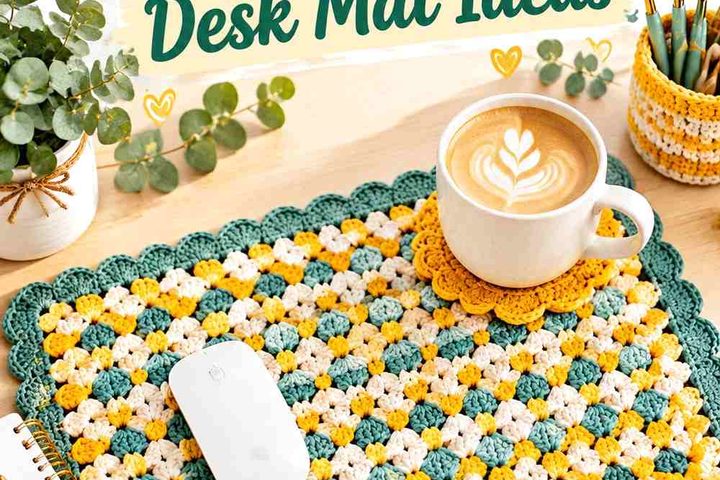
Vermilion Coral and Delft Mist can turn a jeans knee opening into anything from a small visible-mending detail to a large lace panel. The most important distinction is structural: a circular medallion, square motif, filet panel, and loose mesh do not respond to knee movement in the same way. Some hold a defined shape, while others stretch or distort more readily as the leg bends.

The amount of exposed lace matters too. A compact flower square can sit behind a controlled opening, while Solomon’s knots, diamond mesh, spiderwebs, and open fan lace reveal considerably more skin or backing fabric. Vermilion Coral creates the stronger focal point; Delft Mist can soften the transition into blue denim or provide quieter negative space around a brighter motif.
The credited tutorials teach the original lace, square, or motif constructions. Use them for exact crochet instructions, then plan the jeans opening, reinforcement, and attachment separately for your garment.
Quick List
- Crochet Vermilion Coral Doily-Medallion Jeans Knee Lace Insert
- Crochet Delft Mist Lace-Granny Jeans Knee Insert
- Crochet Two-Tone Flower-Square Jeans Knee Lace Insert
- Crochet Delft Mist Angel-Lace Jeans Knee Insert
- Crochet Vermilion Coral Fine-Grid Square Jeans Knee Insert
- Crochet Two-Tone Fan-Lace Jeans Knee Insert
- Crochet Delft Mist Solomon-Knot Jeans Knee Insert
- Crochet Two-Tone Spiderweb Jeans Knee Lace Insert
- Crochet Vermilion Coral Filet-Rose Jeans Knee Insert
- Crochet Delft Mist Filet-Heart Jeans Knee Insert
- Crochet Two-Tone Puff-Lace Granny Jeans Knee Insert
- Crochet Vermilion Coral Geometric-Screen Jeans Knee Insert
- Crochet Delft Mist Flower-Stripe Jeans Knee Insert
- Crochet Two-Tone V-Stitch Lace Jeans Knee Insert
- Crochet Vermilion Coral Openwork Geometric Jeans Knee Insert
- Crochet Delft Mist Pineapple-Lace Jeans Knee Insert
Decide Whether the Lace Is a Repair or a Deliberate Cutout
A knee insert can solve two very different jobs. If the jeans already have a worn hole, inspect the surrounding denim before treating the lace as decoration. Weak fabric beyond the visible tear may still need reinforcement. Make & Do Crew’s jeans-specific crochet-lace tutorial emphasizes fitting the crochet to the actual opening, while conventional visible-mending guidance also supports worn denim from beyond the immediate hole.
A deliberate cutout gives more control over shape, but do not size the opening from a flat pair of jeans alone. The knee expands and changes contour when the leg bends. Mark the proposed area while considering normal wear, then keep stable denim around the insert for attachment.
Avoid cutting through major construction seams unless you already understand how that seam contributes to the jeans. Decorative lace and garment structure should remain separate decisions.
Match Lace Density to Knee Movement
A knee panel needs more movement than a decorative insert on a pocket or jacket back. Dense squares can hold their shape well but may feel comparatively firm across a large opening. Very open meshes flex more freely, yet individual chains and connection points can carry more of the local tension.
Shape matters as much as density. Circular motifs distribute visual lines outward from a center; rectangular filet and lace panels can follow the grain of the jeans more predictably; square motifs create defined corners that need secure support.
Make a complete sample, then gently stretch it both vertically and horizontally. You are looking for how the fabric changes shape, not trying to test its breaking strength. If the motif opens dramatically in one direction, orient it intentionally. A lace insert should accommodate bending without depending on the damaged denim to restrain it.
Use the Two Colors to Control What the Eye Notices
Vermilion Coral naturally attracts attention, so it works well for central flowers, radiating medallion spokes, filet imagery, or narrow structural lines. Delft Mist can occupy broader mesh areas and outer rounds when you want a softer transition into blue denim.
Two-color placement can also clarify the lace structure. A coral flower inside a Delft square makes the motif readable from standing distance. Coral radial lines inside a mist spiderweb emphasize the geometry. In filet crochet, however, frequent color switching may distract from the open-versus-filled blocks that form the picture, so one main color plus a contrasting border can be more effective.
Place the finished swatch against the actual jeans. Dark indigo, pale stonewash, gray-blue, and heavily faded denim alter both colors significantly. Also check the inside view if the insert will be backed, because the backing becomes a third color visible through the lace.
1. Crochet Vermilion Coral Doily-Medallion Jeans Knee Lace Insert
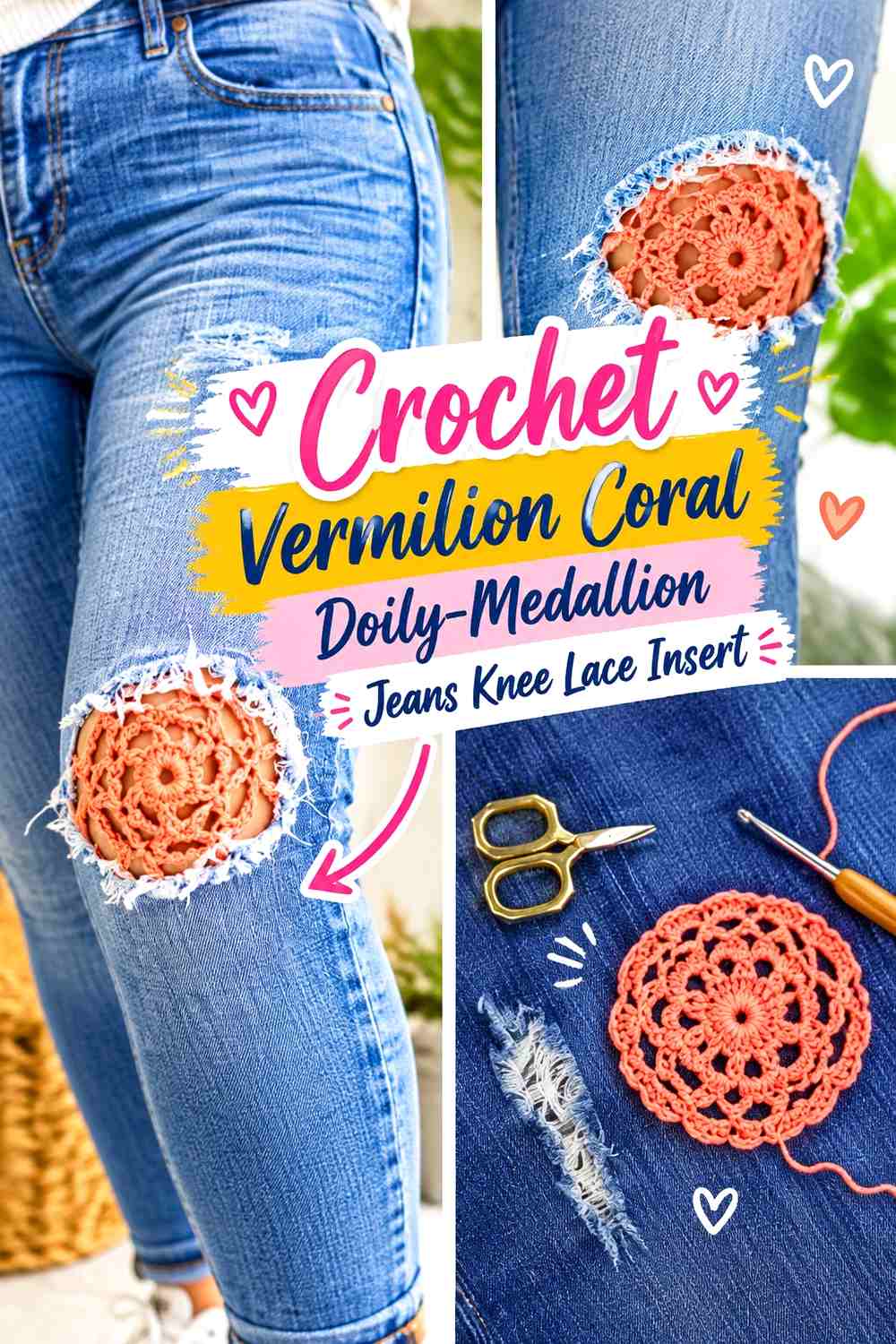
A circular doily-style insert is the most directly jeans-related idea in this collection. Make & Do Crew’s tutorial specifically demonstrates crochet lace used to patch openings in jeans and includes a simple expanding round medallion concept.
Worked in Vermilion Coral, the circular lace becomes a clear focal point against denim rather than trying to disappear as a repair. Delft Mist can be introduced only in the outermost round if you want a softer transition at the edge. This shape is especially useful for an irregular knee hole that can be refined into a rounded or oval opening without requiring four precise corners. Before choosing it, compare the finished medallion with the bent knee; a circle that fits neatly while the leg is straight may need more surrounding fabric when the knee flexes.
Let the Medallion Extend Beyond the Weak Area
If the insert is repairing a worn knee rather than decorating intact denim, base its coverage on the condition of the surrounding fabric, not solely on the visible opening.
A slightly larger crochet piece gives you a stable perimeter to work with. Avoid attaching only to frayed threads at the immediate edge. The decorative circle should sit against sound material or whatever supporting repair system you have chosen.
Keep the Outer Round Less Open
A very open center can provide the visual lace effect while a somewhat more substantial final round gives the insert a clearer attachment perimeter.
That does not mean rebuilding the source pattern arbitrarily. Use the creator’s construction and stop at a suitable complete round. Then determine whether the resulting edge gives you enough usable area for the planned attachment.
Check the Insert With the Knee Bent
Pin or baste the crochet temporarily and bend the leg before making the installation permanent. Watch for the medallion pulling vertically, buckling at the sides, or shifting upward.
This simple fitting check matters more at the knee than it does on a flat decorative patch because the garment surface changes shape during movement.
Creator Credit: Make & Do Crew
2. Crochet Delft Mist Lace-Granny Jeans Knee Insert

Fiber Fox Studios teaches a distinctly open lace granny square whose center and outer structure remain airy rather than forming the dense cluster field of a traditional granny. That square format makes it useful for a knee opening that you want to treat as a deliberate rectangular textile window.
Delft Mist can dominate the motif so the insert relates naturally to blue denim, while Vermilion Coral appears in one inner round or the final border. A square works particularly well when the jeans opening has already been stabilized into a controlled geometric shape. Its main limitation is the corners: they need enough surrounding denim to remain flat as the knee bends. If the opening is highly irregular, a round or freeform insert may require less alteration of the original tear.
Orient the Square Before Cutting or Trimming Denim
Decide whether the square should sit perfectly upright with the leg or rotate into a diamond. Those two orientations distribute the corners differently around the kneecap.
A diamond creates a strong vertical point above and below the knee but requires enough room at those locations. An upright square gives broader horizontal edges and may better suit a wide tear.
Keep Coral Concentrated
A small Vermilion Coral center can give the pale lace a clear focal point without visually turning the whole knee into a red-orange patch.
If you place coral at the outer edge instead, the border becomes the dominant feature. Compare both possibilities against the denim before settling on the color sequence.
Support the Corners Evenly
Four corners create four obvious stress points. If one is attached under more tension than the others, the motif can skew and its lace openings will no longer look symmetrical.
Block the square first and position it in its relaxed shape. The denim opening should accommodate the crochet rather than stretching the square into place.
Creator Credit: Fiber Fox Studios
3. Crochet Two-Tone Flower-Square Jeans Knee Lace Insert
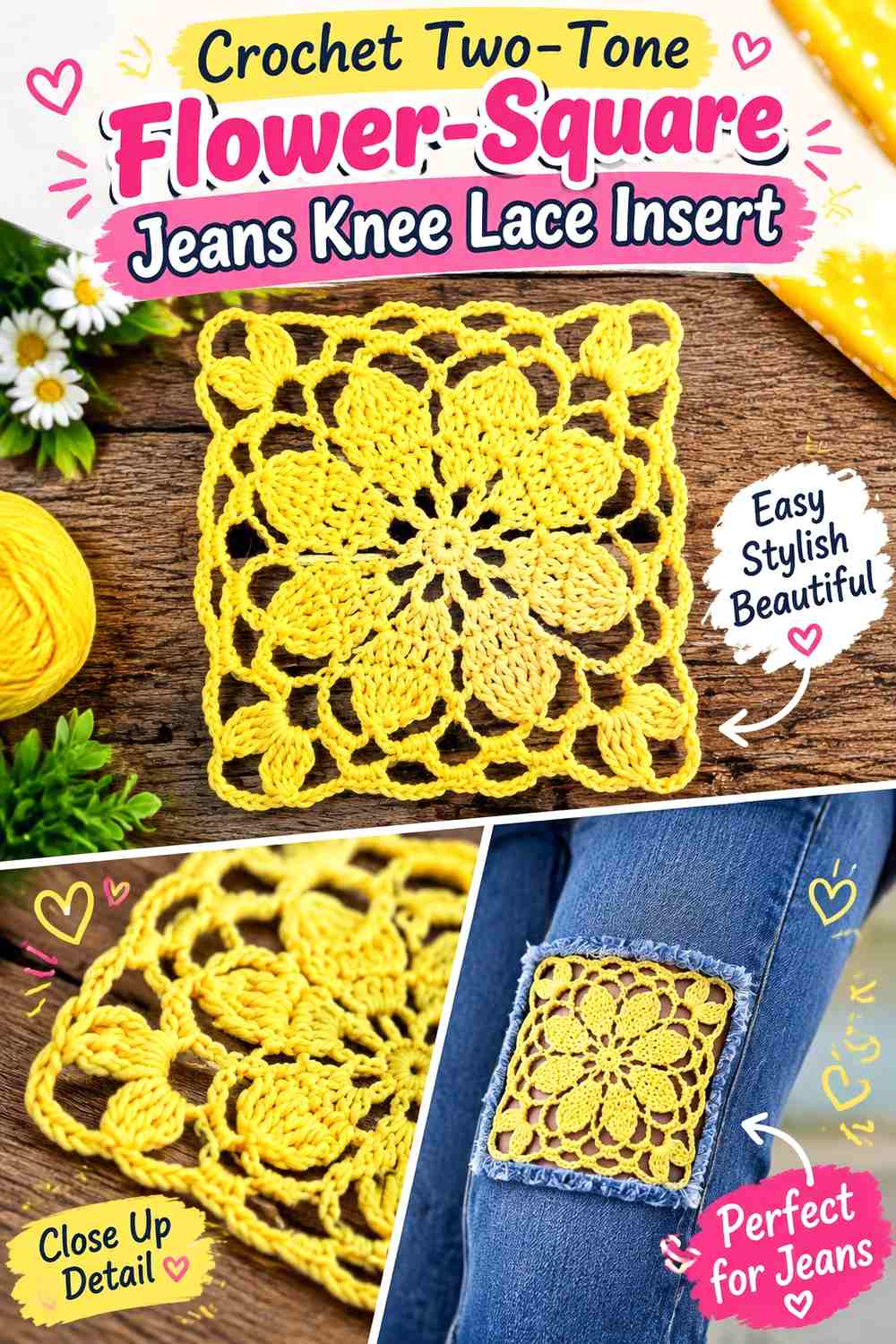
Kristines Crochets teaches a lace flower square with a pronounced floral center and an open framework that turns the round flower into a square motif. The design offers more recognizable imagery than a plain mesh while still leaving substantial negative space.
For a jeans knee, use Vermilion Coral through the flower and Delft Mist through the squaring rounds. That division lets coral provide the focal bloom while the cooler outer color mediates the transition into denim. The motif works particularly well behind a roughly square opening because its visual center remains obvious even when the leg is moving. The flower does need enough room to remain fully visible; a narrow slit or very shallow tear would crop the radial design and reduce the reason for choosing this motif.
Keep the Flower Center Near the Kneecap
The motif reads best when its radial center is intentionally placed. If it slides far toward one side, the square may look accidental even if it technically covers the opening.
Mark the visual center of the damaged area while the jeans are worn, then compare it with the center of the blocked crochet square before attaching.
Let Delft Mist Handle the Transition
A mist-colored outer framework gives you a calmer edge than carrying Vermilion Coral all the way to the denim.
This is useful on medium or faded blue jeans where a coral border would create a very strong hard line. The flower can remain vivid without every attachment stitch becoming visually dominant.
Do Not Crowd the Petals With a Small Opening
If the jeans opening hides much of the outer flower, the motif becomes difficult to read. A smaller motif or a simpler lace square would be a better choice than enlarging the hole purely to expose decorative crochet.
Match the motif to an opening you are already comfortable creating or repairing.
Creator Credit: Kristines Crochets
4. Crochet Delft Mist Angel-Lace Jeans Knee Insert
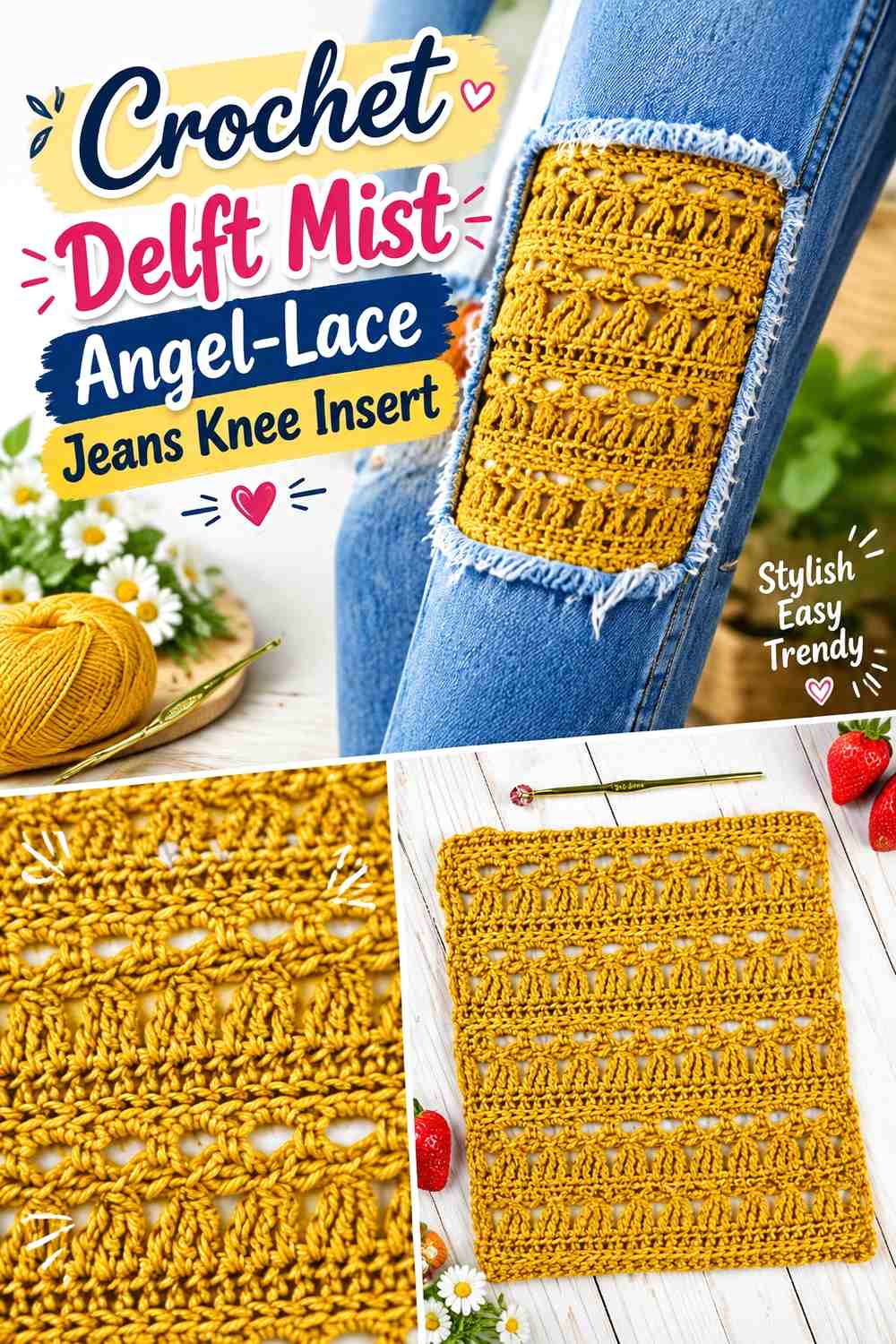
Desert Blossom Crafts’ Little Angel Square combines more solid horizontal sections with open clustered rows that form repeating angel-like shapes. Unlike a uniformly open mesh, the motif alternates areas of greater and lesser density.
That variation can be useful at a knee because the insert does not expose the same amount of backing or skin everywhere. Delft Mist suits the broad field, while a narrow Vermilion Coral line can emphasize one repeated lace row or the final perimeter. The rectangular row-based construction also makes it easier to compare width and height independently than with a center-out granny square. Consider this idea when the opening is wider than it is tall or when you want a lace panel rather than one centralized flower.
Place the Denser Rows Where More Coverage Helps
Because the fabric changes density across its height, orientation affects what is visible through the insert.
You may prefer a denser section directly over the kneecap and more open lace above and below, or the opposite. Hold the complete swatch behind the jeans opening before deciding which end is top.
Preserve the Row Rhythm
The alternating texture is what gives this panel its identity. Cropping it so severely that only one open row remains removes much of that effect.
Determine how many complete pattern sections fit the usable knee area. If the available height is too small, choose a simpler mesh rather than forcing this larger rhythm into a narrow opening.
Block Before Measuring the Final Panel
The source notes that the square benefits from blocking because its lace sections can change the apparent width.
For jeans adaptation, measure only after the fabric has settled into its intended shape. Otherwise, you may prepare an opening around dimensions that change substantially during finishing.
Creator Credit: Desert Blossom Crafts
5. Crochet Vermilion Coral Fine-Grid Square Jeans Knee Insert
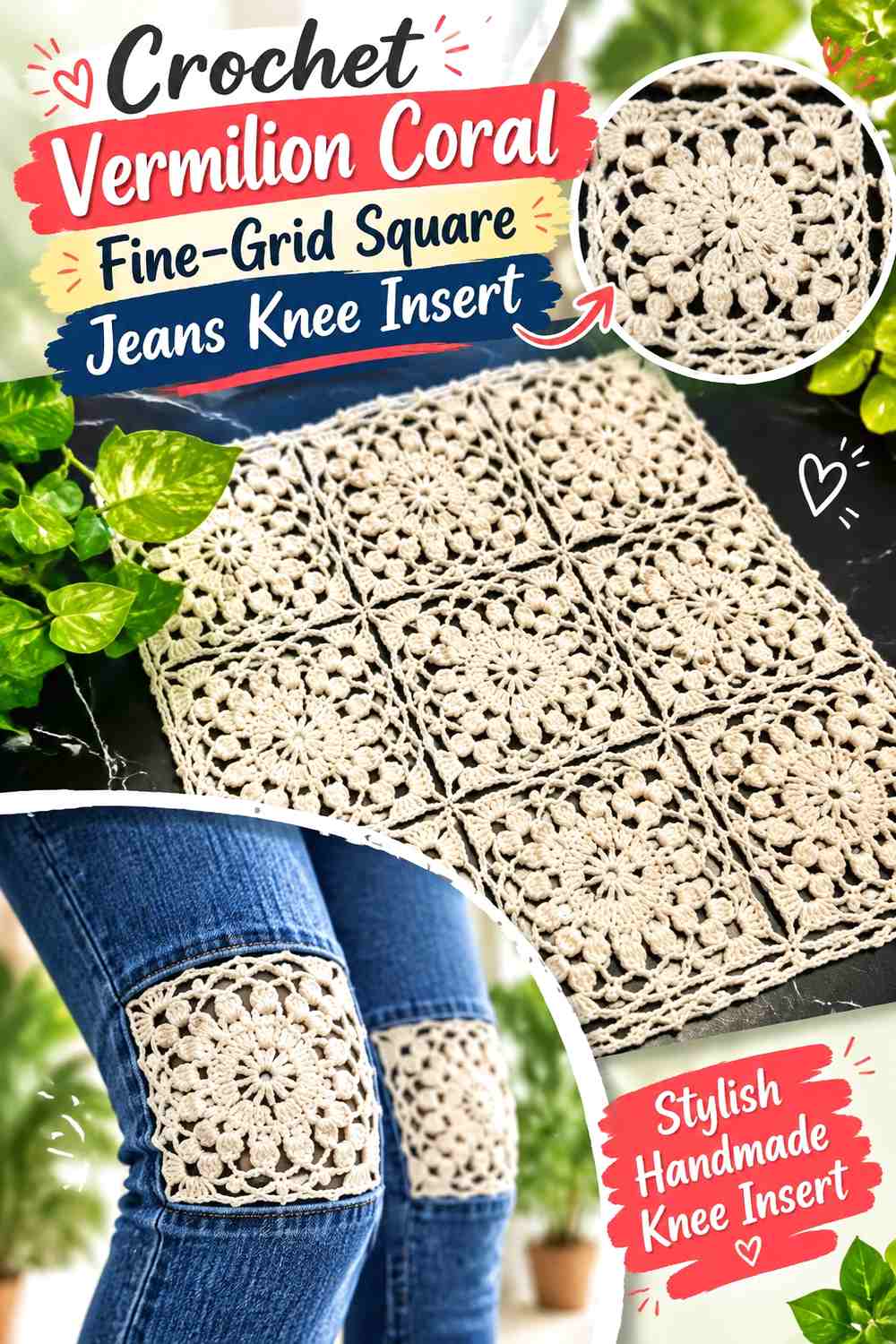
The Lazy Hobbyhopper’s lace square motif is a compact openwork square designed to be joined into larger projects, with a regular outer geometry that makes individual units useful on their own as well.
A single Vermilion Coral square can function as a small knee window, especially on slim or tapered jeans where a broad lace panel would overwhelm the leg. Delft Mist can be used in the final round if you want the boundary to blend more gently with blue denim. Because the motif is relatively fine and regular, the openings read as lace texture rather than one oversized graphic symbol. That makes this a useful middle ground between a dramatic rose or heart and a completely plain mesh.
Use One Complete Square When Possible
The balanced outer edge is one of this motif’s main advantages. Cropping it into an arbitrary rectangle would lose that structure.
If one blocked square is slightly smaller than the desired insert, consider leaving a denim margin rather than enlarging the opening. The visible border can make the lace look deliberately inset.
Keep Vermilion Coral From Becoming Visually Solid
A strong color can make a fine lace grid look denser than it actually is. Against dark denim, the coral stitches may dominate the openings.
Hold the motif over both bare skin and any proposed backing. The same crochet can look dramatically different depending on what is visible through it.
Use Delft Mist at the Attachment Edge
A cool outer round can reduce the contrast exactly where the insert meets the jeans. That gives the knee a coral center without surrounding it with a bright attachment line.
It also makes small irregularities in edge stitching less visually obvious than they might be against a high-contrast coral border.
Creator Credit: The Lazy Hobbyhopper
6. Crochet Two-Tone Fan-Lace Jeans Knee Insert
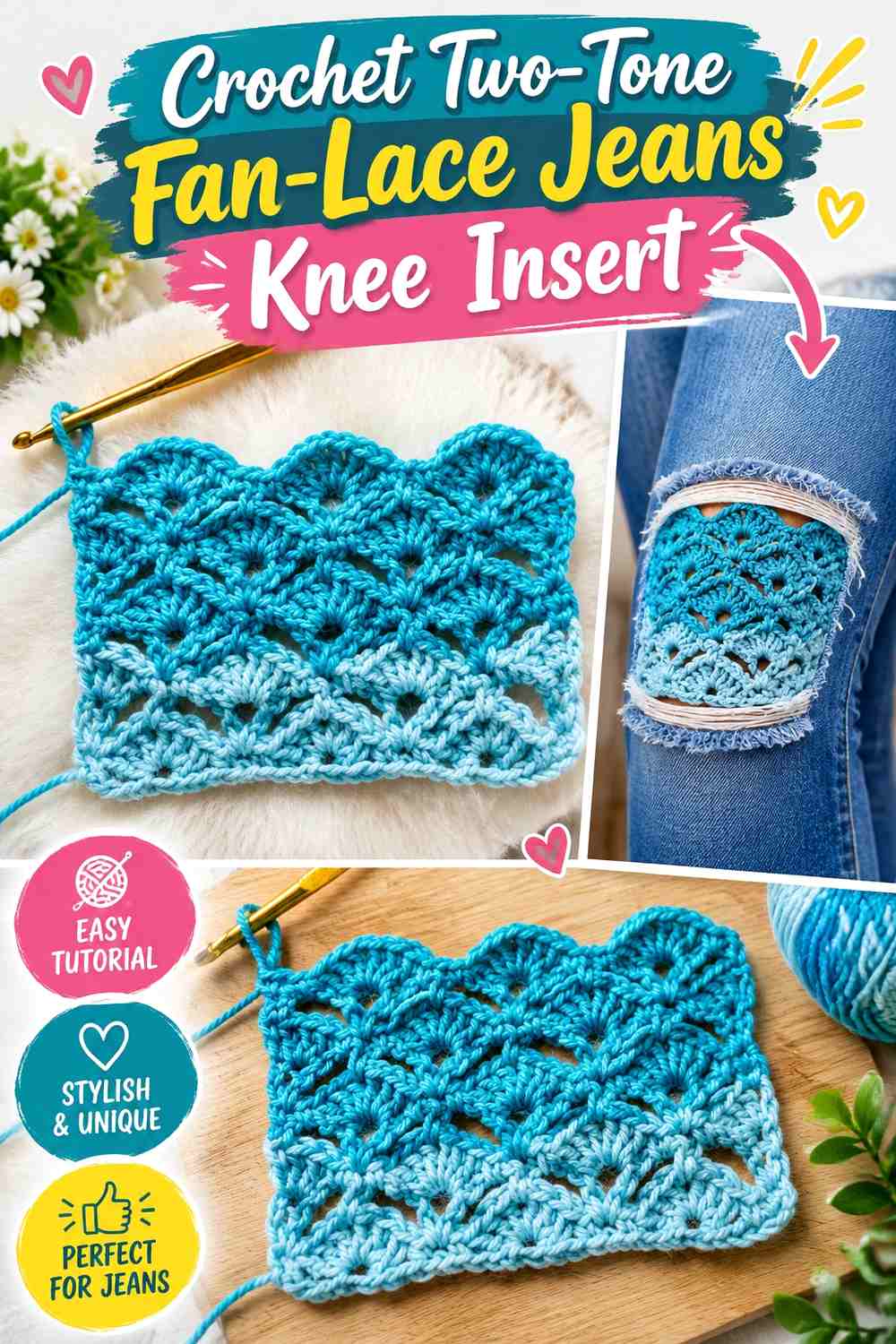
Interweave’s fan-lace tutorial combines shell-like fans, V-stitches, chain spaces, and alternating rows to create an open fabric with curved horizontal movement. Unlike a square motif, this lace can be worked as a panel sized around a rectangular opening.
Use Delft Mist for the majority of the mesh and introduce Vermilion Coral in selected fan rows. This places the stronger color in the rounded sections rather than across the whole knee. Fan lace is particularly useful for a wide knee opening because its repeated curves interrupt the rigid horizontal line of cut denim. The trade-off is repeat planning: the left and right edges look more intentional when equivalent parts of the fan repeat reach both sides.
Center a Full Fan Across the Knee
A complete fan near the center creates a clear focal structure. If the centerline falls between two fans, the insert can still work, but the pattern will feel more like continuous lace than a centered motif.
Choose the effect before determining the exact panel width.
Test Horizontal Stretch
Fan lace contains several types of open spaces, so its stretch may not be uniform in every direction.
Pull the blocked swatch gently across the width you expect it to span. If the fans flatten significantly, consider giving the panel slightly more relaxed room rather than mounting it under tension.
Make Color Changes Follow the Lace Structure
Changing to Vermilion Coral for complete fan rows looks more intentional than switching shades midway through individual motifs.
That approach also reduces extra ends at the knee, where bulky finishing can be noticeable against the inside of the garment.
Creator Credit: Interweave
7. Crochet Delft Mist Solomon-Knot Jeans Knee Insert
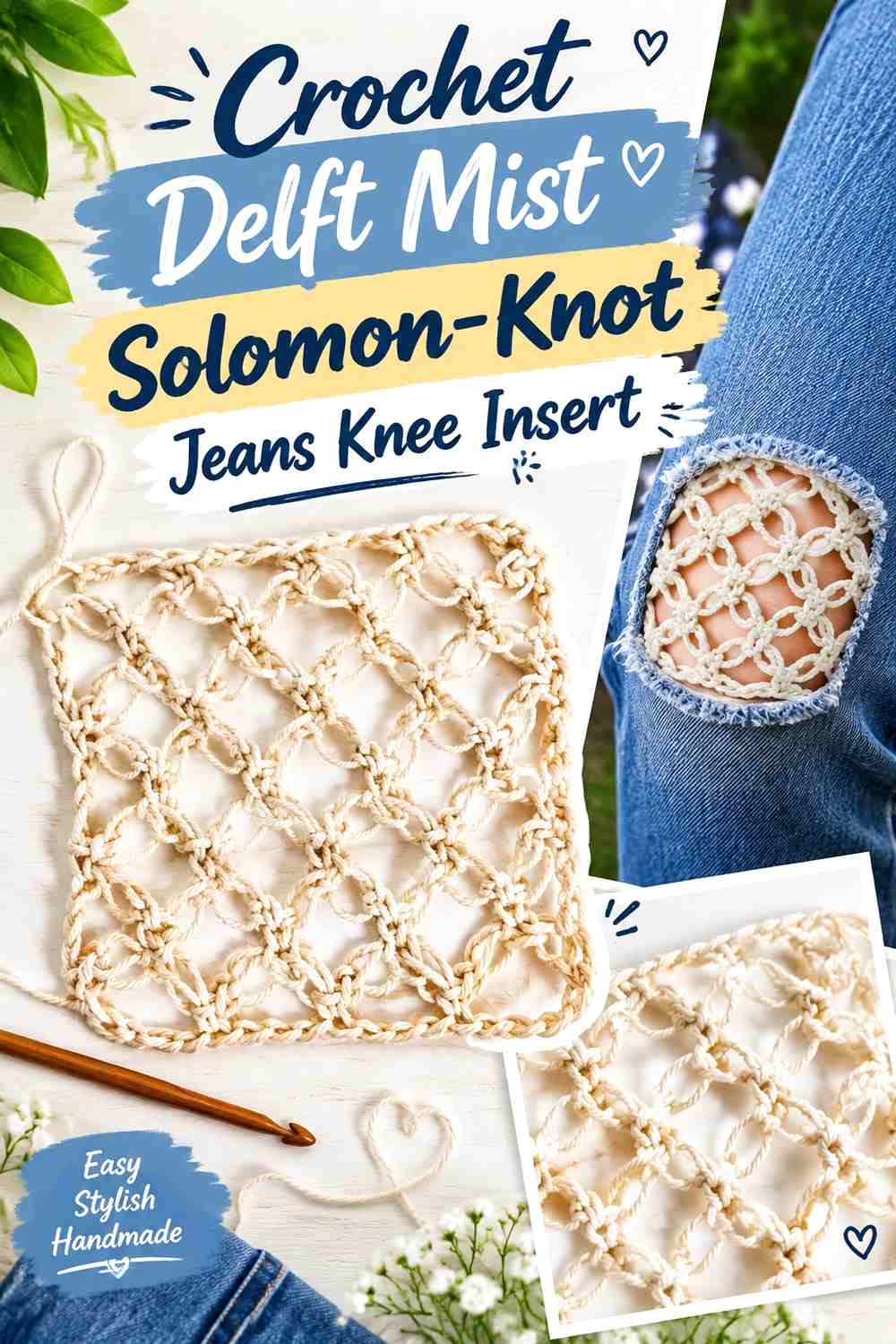
Solomon’s Knot creates one of the most open fabrics in the collection. Ned & Mimi’s tutorial shows the stitch as a mesh of elongated loops joined into interlocking diamond-like forms.
In Delft Mist, the loose mesh can look almost like a soft haze against denim, with a narrow Vermilion Coral perimeter giving it enough definition to register as a deliberate insert. This design is better for a fashion cutout than for containing a badly frayed opening because the lace itself has large negative spaces. It also changes shape more readily than a dense square. Choose it when openness and drape are the primary goals and when you can provide a stable surrounding edge or backing if needed.
Keep the Knot Loops Consistent
The visual effect depends heavily on repeated loop size. Uneven loops become obvious when the fabric is stretched across a defined jeans opening.
Work a large enough sample to establish your natural tension before deciding how many knots the finished insert should contain.
Do Not Mount the Mesh Under Heavy Tension
Solomon’s Knot already creates elongated spaces. Pulling it tightly across the knee can distort those diamonds and place disproportionate strain on the joining points.
Position the fabric in a relaxed state and test the knee bend. Movement should come from the lace structure rather than permanent stretching.
Consider a Backing for More Coverage
If the opening is too revealing for the intended use, a lightweight backing can change the effect without giving up the knot pattern.
Remember that the backing color will show strongly through such open crochet. Test Vermilion Coral, denim-toned, or neutral backing options before installation rather than treating the interior layer as invisible.
Creator Credit: Ned & Mimi
9. Crochet Two-Tone Spiderweb Jeans Knee Lace Insert
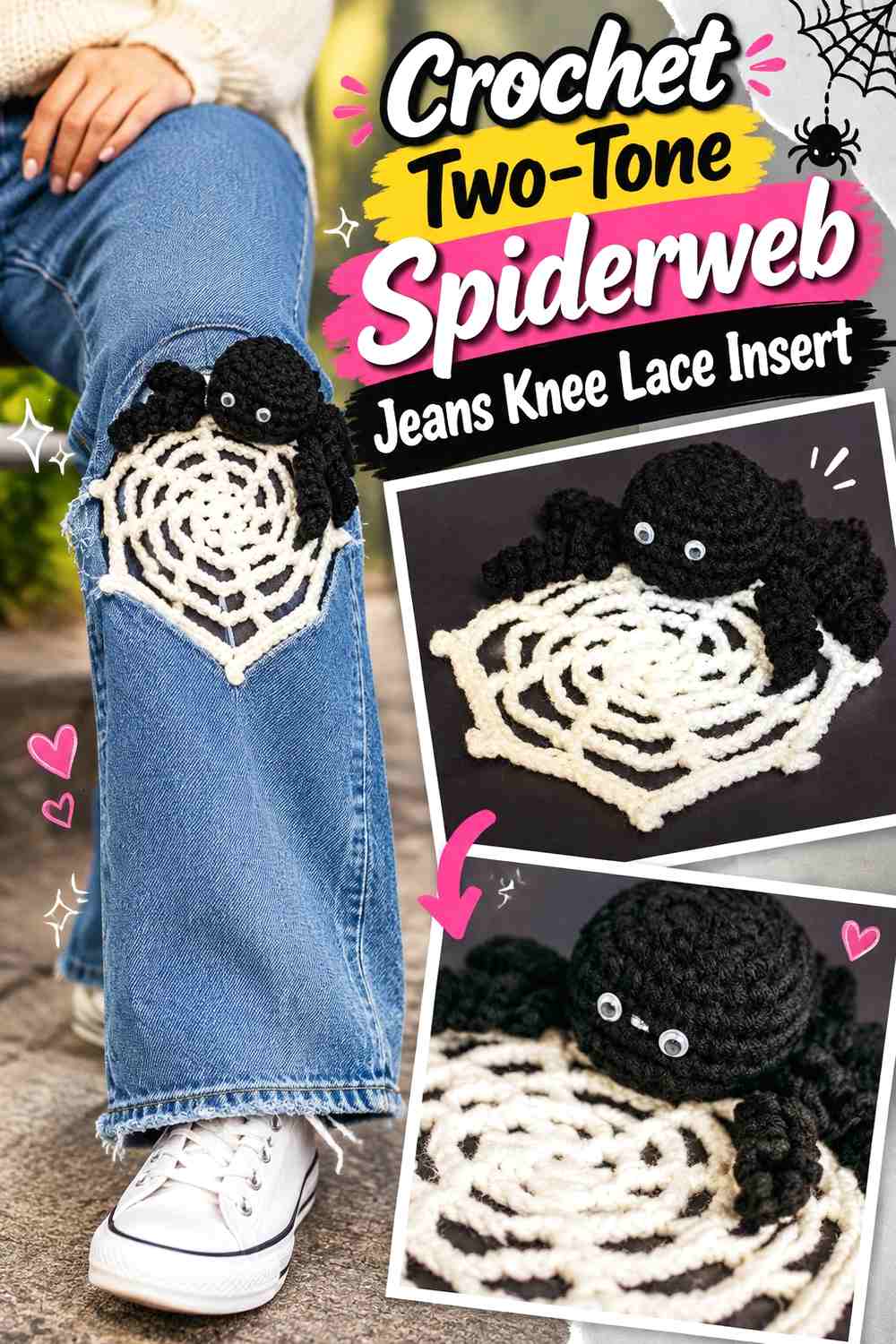
Petals to Picots’ spiderweb pattern builds a radial web from a central ring with increasingly large chain spaces, creating a very different geometry from floral doilies or square grids.
For jeans, make the center Vermilion Coral and transition to Delft Mist in the outer web rounds. That concentrates color at the visual center while allowing the web to soften as it reaches the denim. The motif is most convincing behind a round, oval, or deliberately irregular opening where the radial spokes remain visible. A strict rectangle can crop the outer web awkwardly. Because chain spaces become progressively larger, this is one of the most revealing options and works best when that openness is intentional.
Position the Hub Deliberately
The entire design radiates from one center point. Move that point slightly and every spoke makes the shift obvious.
Mark the center of the knee area on the worn jeans before shaping the opening. The visual center may not be exactly halfway between the side seams.
Use Delft Mist to Soften the Outer Web
A pale outer section can make the web appear to dissolve gradually into blue denim instead of ending with one strong Vermilion Coral circumference.
This two-color strategy is particularly effective when the opening itself has a soft oval shape rather than a hard square edge.
Avoid Cropping Too Many Spokes
A radial motif loses its identity if several major sections disappear behind the denim. Choose an opening large enough to show the structure or select a smaller completed version of the web.
Do not enlarge the hole solely to expose every decorative round if doing so removes more sound denim than you are comfortable altering.
Creator Credit: Petals to Picots
10. Crochet Vermilion Coral Filet-Rose Jeans Knee Insert
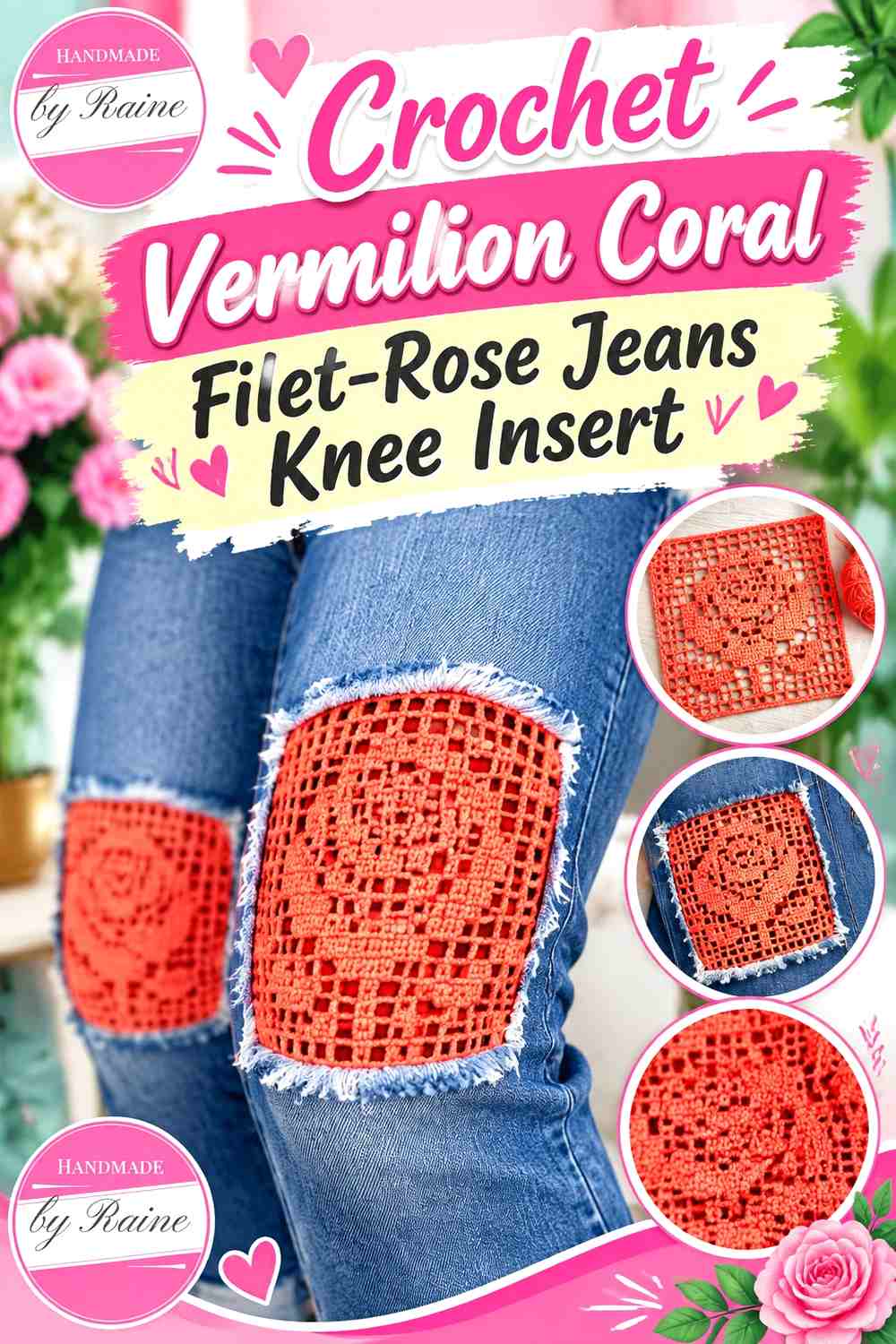
HandmadebyRaine’s Rose Curtain uses filet crochet, where open and filled grid blocks form recognizable rose imagery while keeping the fabric almost completely flat. That makes the technique especially interesting for jeans because it provides a picture without applied petals or raised texture.
A Vermilion Coral rose panel can become the focal point while a narrow Delft Mist border visually separates it from denim. Filet works best when the knee opening is large enough to reveal a complete rose repeat; cropping a charted flower can make the image difficult to recognize. It is also one of the more controlled choices for a backing fabric because the open grid exposes the backing evenly rather than through irregular motif spaces.
Preserve the Complete Rose
The relationship between open and filled blocks creates the flower. Randomly removing columns or rows to fit a smaller knee opening can destroy the image.
Use the creator’s chart and determine whether one complete rose section fits the space. If it does not, choose another lace idea rather than reconstructing the source pattern.
Keep the Border Narrow
A thick Delft Mist frame can reduce the visible area available for the rose and make a small knee panel feel crowded.
Use just enough contrast to define the transition into denim. The rose should remain the dominant visual feature.
Test the Picture on the Bent Knee
A filet image that looks perfectly rectangular while flat can compress horizontally when the knee bends.
Temporarily position the finished panel and check whether the rose remains readable during movement. A little distortion is expected in wearable fabric, but the central motif should not disappear entirely.
Creator Credit: HandmadebyRaine
11. Crochet Delft Mist Filet-Heart Jeans Knee Insert
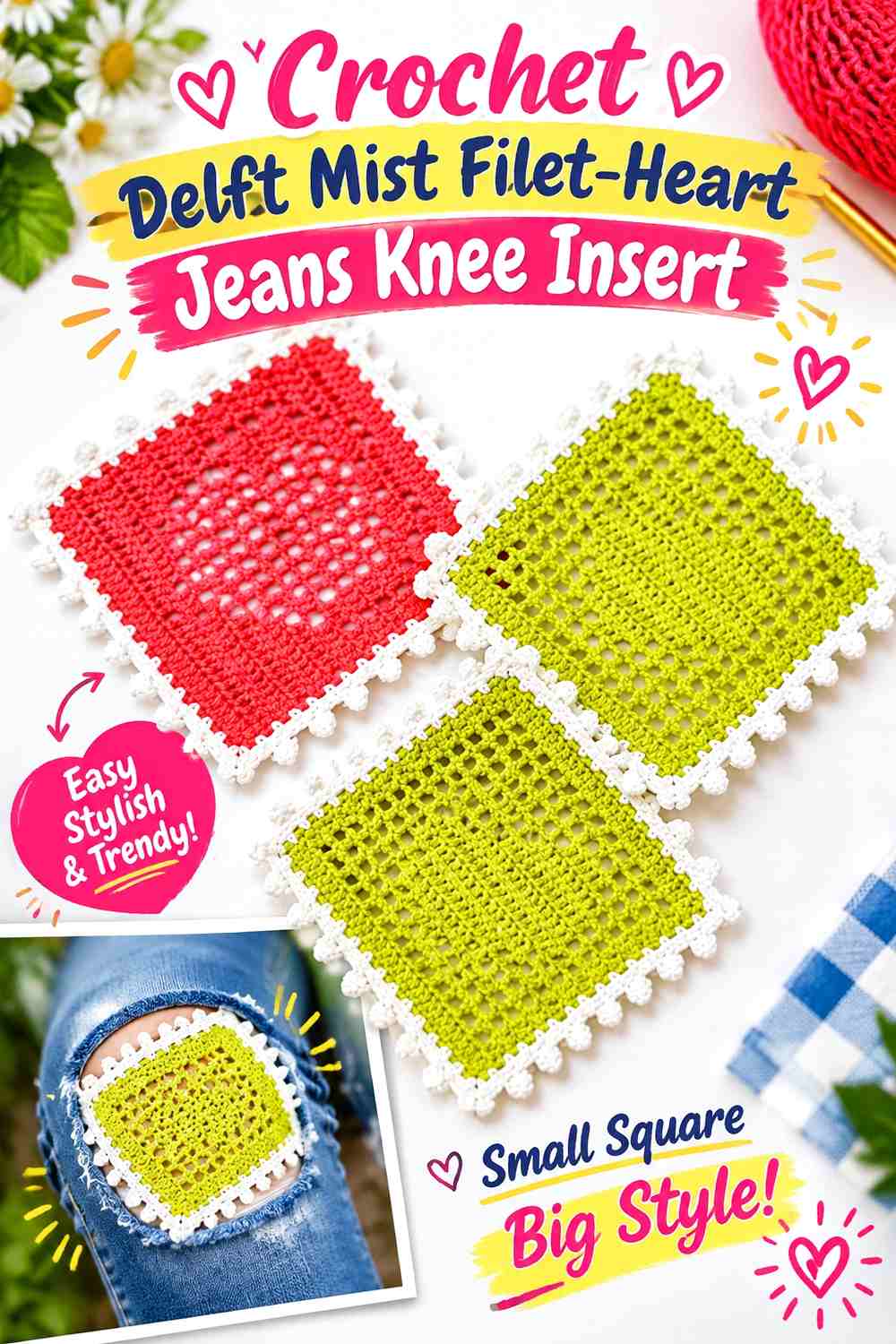
Anabelia Handmade’s filet heart squares provide both positive and negative heart treatments inside a compact square format. That gives this knee insert a clear symbol while keeping the surface flatter than a separate heart appliqué.
Use Delft Mist as the main square and Vermilion Coral only within the heart blocks, or reverse the relationship if you want the heart to appear through negative space. This idea works particularly well for a smaller controlled knee opening where a full rose would be too elaborate. The square geometry is also easy to align with a rectangular cutout, although the heart should remain centered after the fabric is bent.
Choose Positive or Negative Space First
A solid Vermilion Coral heart against open Delft Mist filet reads differently from a heart defined primarily by openings.
Decide which effect you want before planning the jeans backing. A contrasting backing can make negative-space imagery far more noticeable.
Keep the Optional Edge From Becoming Bulky
The source design includes an ornamental border treatment, but a jeans insert does not necessarily need every decorative finishing element from the original project.
Follow the creator for the heart square itself, then evaluate whether additional edge volume is appropriate at a bending knee. Do not copy a decorative border automatically when a flatter perimeter would integrate better with denim.
Align the Heart With the Worn Garment
Center the symbol while the jeans are on the body or accurately positioned as they would be worn. A heart that appears centered on flat jeans can shift visually when the knee area curves.
Temporary placement before permanent attachment prevents that mismatch.
Creator Credit: Anabelia Handmade
12. Crochet Two-Tone Puff-Lace Granny Jeans Knee Insert
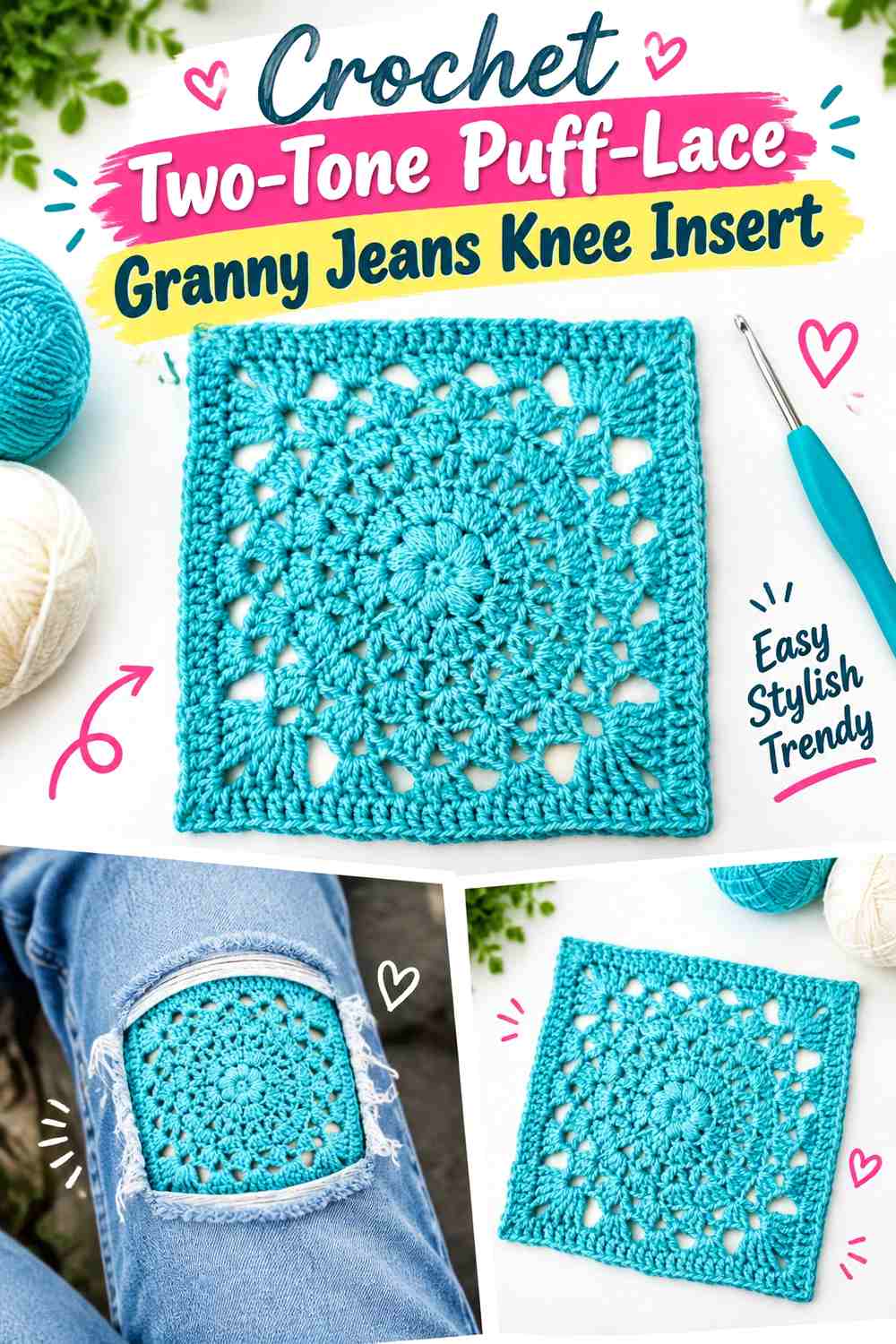
Blue Star Crochet’s lacy granny square combines open chain spaces with puff stitches, V-stitches, and taller stitches, creating a square that has both lace and small areas of raised texture. It therefore sits between a flat lace motif and a dimensional crochet patch.
Use Delft Mist for the broad open framework and Vermilion Coral for selected puff details. This concentrates the warmer color into small raised points rather than large blocks. The square works well when you want the knee insert to look unmistakably handmade but not as bulky as a full puff-flower motif. Because the texture is distributed around the square, check how it feels when kneeling or when the jeans contact furniture; even modest raised stitches become more noticeable at this location.
Use Coral on the Raised Details
Color and relief can reinforce one another. A few Vermilion Coral puffs will stand out both physically and visually against Delft Mist.
Avoid switching every stitch family into a different color. Too many transitions can make the openwork harder to read and create extra ends around a high-movement garment area.
Keep the Square Relaxed
The lace portions and puff portions may respond differently to stretching. Pulling the square across an opening can flatten some sections while leaving others raised.
Block it first and install it without intentional stretch. The jeans opening should be prepared to suit the finished crochet dimensions.
Consider Everyday Contact
A decorative knee insert is not viewed only while standing. Sitting, kneeling, crossing the legs, and brushing against objects all put the surface in different positions.
If the raised puffs feel too pronounced in your sample, reserve the color concept for a flatter lacy granny instead.
Creator Credit: Blue Star Crochet
13. Crochet Vermilion Coral Geometric-Screen Jeans Knee Insert
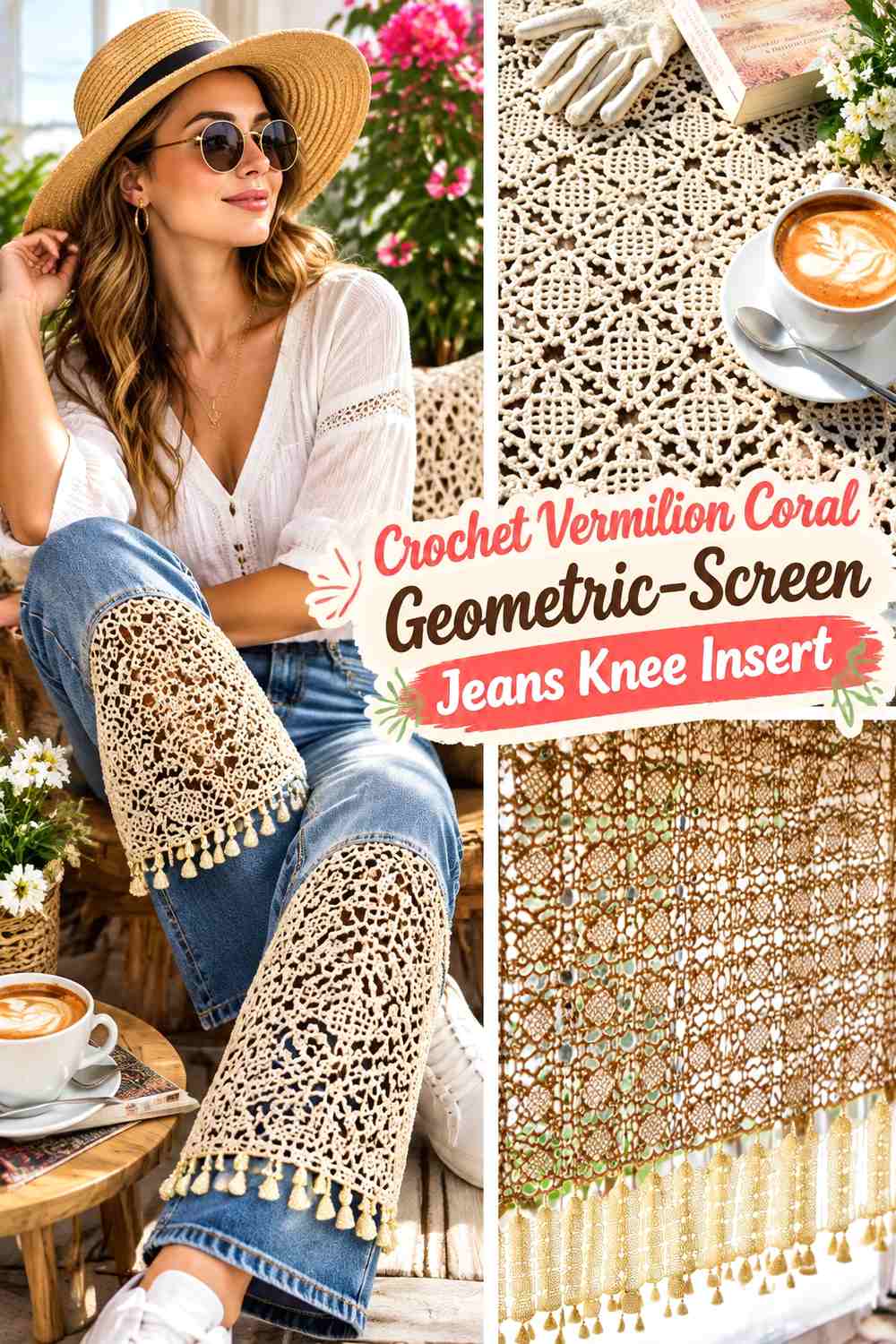
Concept Creative’s Mashrabiya crochet design builds an open surface from repeated ornamental geometric motifs, giving the fabric an architectural screen quality rather than a floral or conventional granny appearance.
For jeans, one motif or a small joined section can become a highly structured Vermilion Coral insert, with Delft Mist reserved for joins or an outer transition. This suits a wide knee opening where the geometry has enough room to develop. Unlike continuous mesh, the design depends on clear motif boundaries, so it works best when the opening is intentionally shaped rather than highly ragged. It also offers a useful choice for jeans with otherwise minimal detailing because the lace itself provides substantial visual complexity.
Let One Motif Be the Main Unit
A knee insert does not need to reproduce the scale of a curtain panel. One complete geometric unit may be enough.
Make and block the motif first, then compare it with the intended opening. Adding partial neighboring units can make a small panel feel unresolved.
Keep Delft Mist at Connections
Using the cooler color for joins or a narrow perimeter can separate individual coral geometry without fragmenting the motif itself.
If every internal element alternates color, the intricate openwork may become harder to understand from normal viewing distance.
Respect the Jeans’ Vertical Axis
Architectural geometry often has clear directional lines. Align them with the leg unless a deliberate diagonal placement is part of the design.
A slightly accidental rotation will be obvious beside the straight grain and side seams of denim.
Creator Credit: Concept Creative
14. Crochet Delft Mist Flower-Stripe Jeans Knee Insert
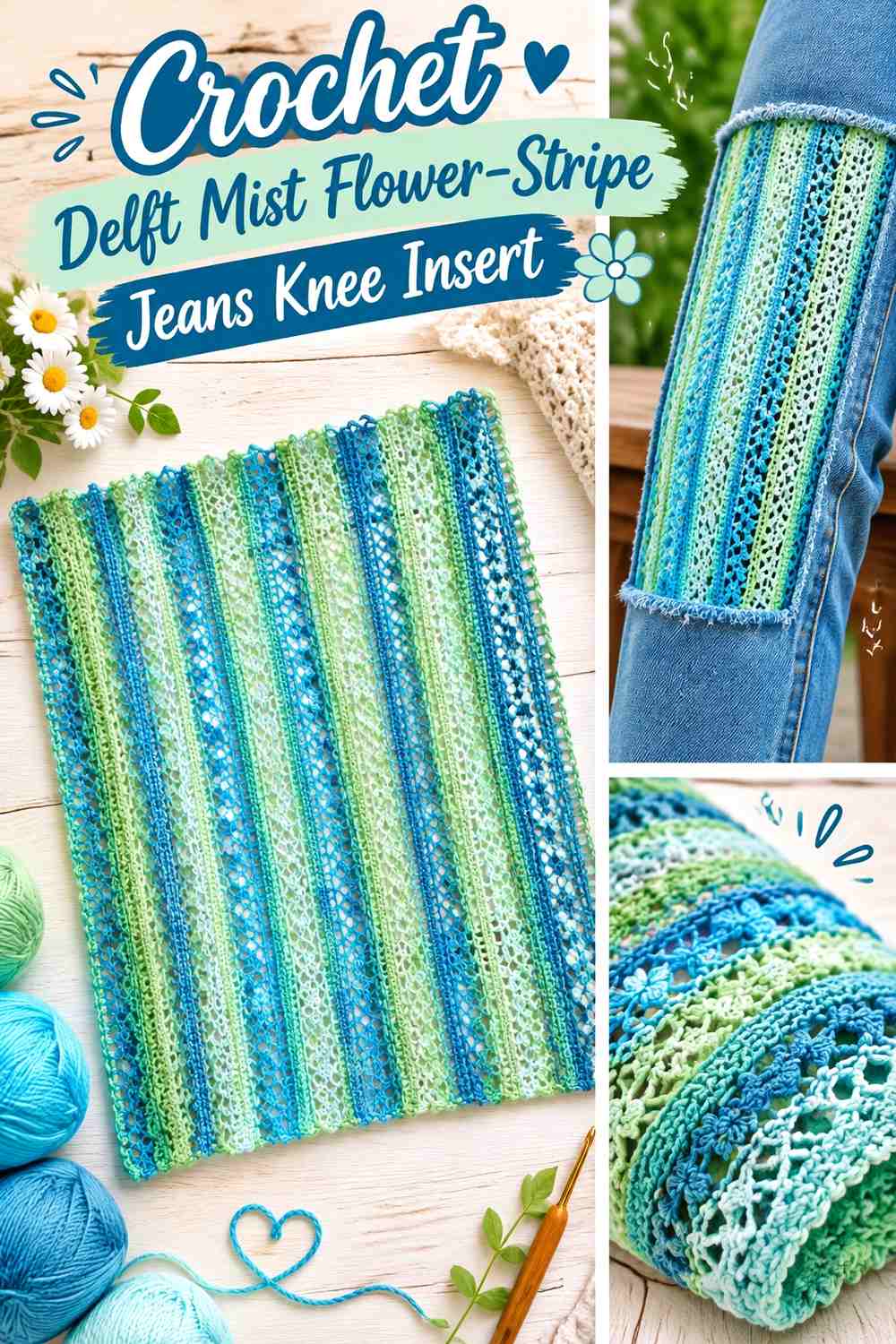
Silk & Wool’s lace flower stitch forms flowers inside a continuous open fabric worked sideways, so the finished pattern can create strong vertical bands. That directional quality makes it especially useful for a tall, narrow knee insert.
Work the main lace in Delft Mist and use Vermilion Coral as a narrow vertical stripe or occasional flower band. The vertical orientation can visually lengthen the knee area instead of emphasizing the width of a tear. Unlike a joined flower square, this is one continuous fabric, so you can plan the panel as a narrow rectangle. The sideways construction does mean that the direction you crochet and the direction the flowers finally appear are not the same; establish the required finished width and height before deciding how many repeats to work.
Use Vertical Direction to Narrow the Visual Effect
Wide horizontal tears can make the knee look visually broader. Vertical flower columns counter that emphasis and draw the eye along the leg.
Keep the strongest coral accent in one or two columns rather than turning every repeat into a separate stripe.
Check the Working Orientation
Because the source stitch is worked sideways, adding more rows may alter the dimension you do not initially expect.
Make a small sample, rotate it into its final orientation, and label the top and side before calculating the finished knee panel.
Leave Enough Denim Beside the Lace
A narrow panel can look intentional when framed by visible denim on both sides. It does not need to span the entire width of the knee.
This also lets you preserve more sound fabric around an existing central tear.
Creator Credit: Silk & Wool
15. Crochet Two-Tone V-Stitch Lace Jeans Knee Insert
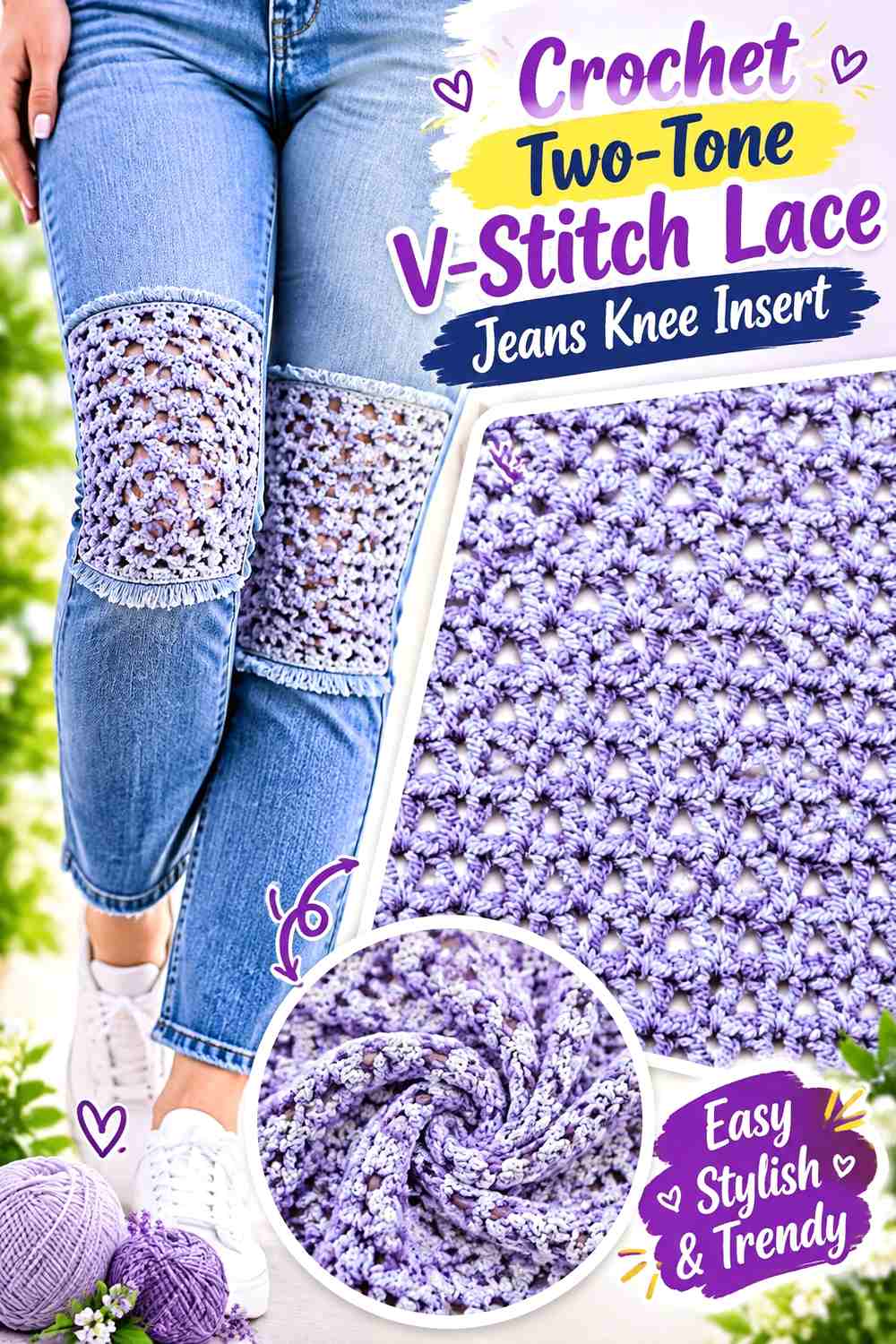
CrochetKim’s V-Stitch Lace uses repeating V-shaped stitch groups separated by chain spaces, creating a consistent open fabric that can be sized as a rectangular panel. It is visually simpler than fan lace and less open than very large Solomon’s knots.
For this jeans adaptation, alternate broader Delft Mist sections with narrow Vermilion Coral V-stitch bands. The V shapes introduce directional detail without requiring one central motif, making the pattern useful for a long irregular opening that has been stabilized into a rectangle or soft oval. Because the repeat is regular, edge alignment becomes important; a panel ending at different points in the repeat on each side can look unintentionally skewed.
Decide Whether the V Shapes Point Up or Down
Turning the finished panel changes the visual direction even though the fabric construction remains the same.
Upward-pointing Vs can draw attention toward the thigh, while the opposite orientation directs the eye toward the shin. Test both before final attachment.
Keep the Color Repeat Broader Than the Stitch Repeat
Alternating Vermilion Coral and Delft Mist every tiny section may create visual flicker at the knee.
Larger color zones let the lace geometry remain visible while still using both shades. A coral center band surrounded by mist is one restrained option.
Use the Regular Edge as a Fitting Advantage
A rectangular stitch repeat can be easier to compare with a paper opening template than a large radial motif.
Finish the panel to a complete repeat, block it, and then refine the jeans opening around the actual lace dimensions rather than estimating from an unfinished swatch.
Creator Credit: CrochetKim
16. Crochet Vermilion Coral Openwork Geometric Jeans Knee Insert
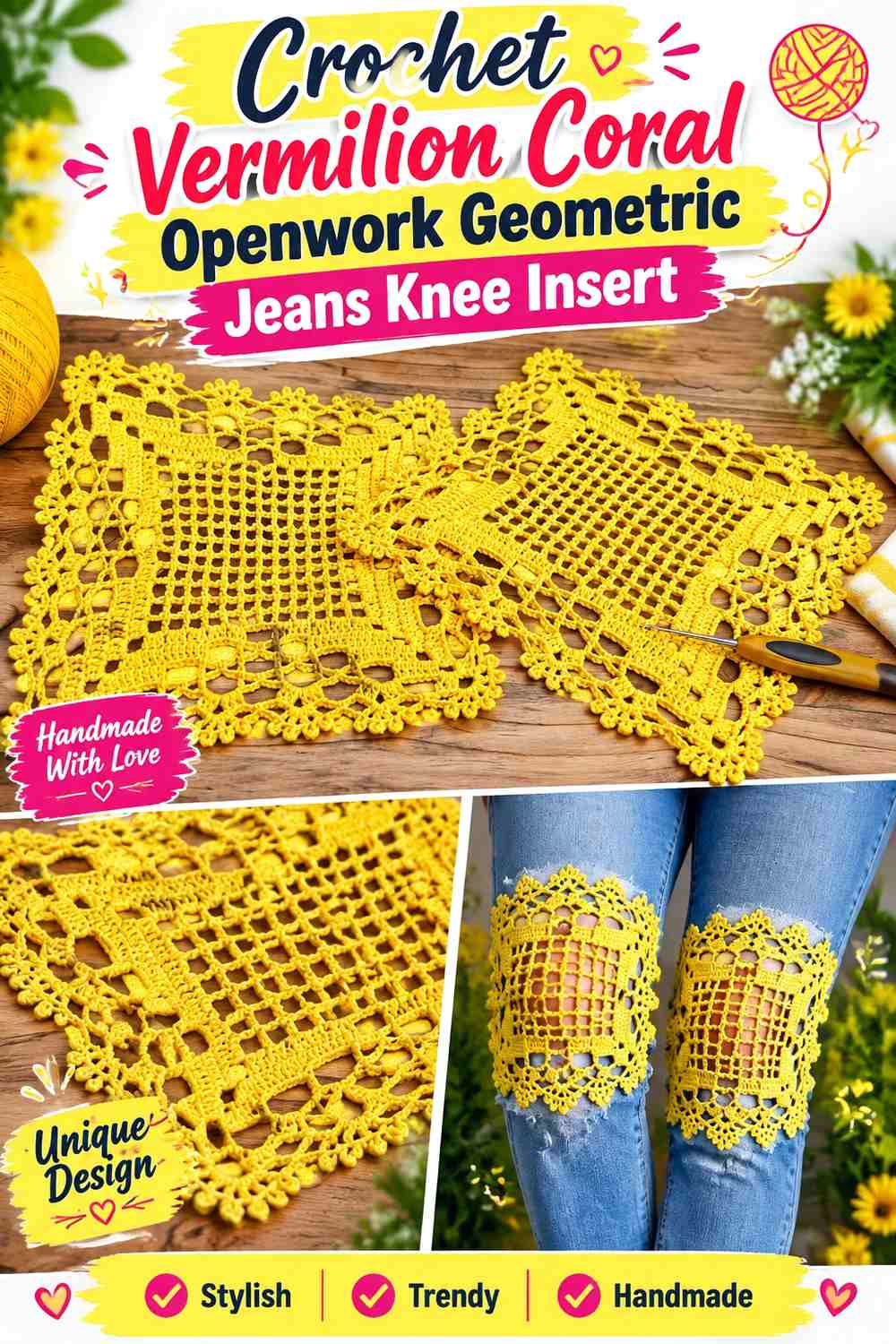
Tatyana Litke’s lace-square tutorial demonstrates a highly open geometric square with a defined mesh framework and decorative outer structure. The motif is less floral than many lace grannies, making it useful when the jeans should feel graphic rather than romantic.
Vermilion Coral can carry the complete geometric motif while Delft Mist appears only at the attachment edge. On dark denim, this creates a pronounced lace window with sharp internal lines. The square is especially suitable for an intentionally cut or carefully stabilized knee opening because the geometry benefits from a clean boundary. Compared with diamond mesh, it gives you one self-contained composition instead of an all-over repeat, so you can position it precisely over the center of the knee.
Keep All Four Sides Visible
The square framework is part of the motif, not just excess edging. Hiding one side behind denim can make the internal geometry appear off-center.
Prepare the opening only after the finished, blocked square is available for direct comparison.
Use Delft Mist as a Narrow Transition
A cooler edge can visually separate vivid coral from the jeans and provide a calm perimeter around an intricate center.
Keep that mist section restrained so it does not reduce the visible proportions of the geometric lace.
Avoid Overstretching the Mesh
An open square may look flexible, but stretching changes the relative size of its center, side spaces, and corners.
Fit the motif in its blocked proportions. If it is too small, select a larger completed version or another source rather than attaching it under permanent tension.
Creator Credit: Уроки ВЯЗАНИЯ Литке Татьяны
17. Crochet Delft Mist Pineapple-Lace Jeans Knee Insert
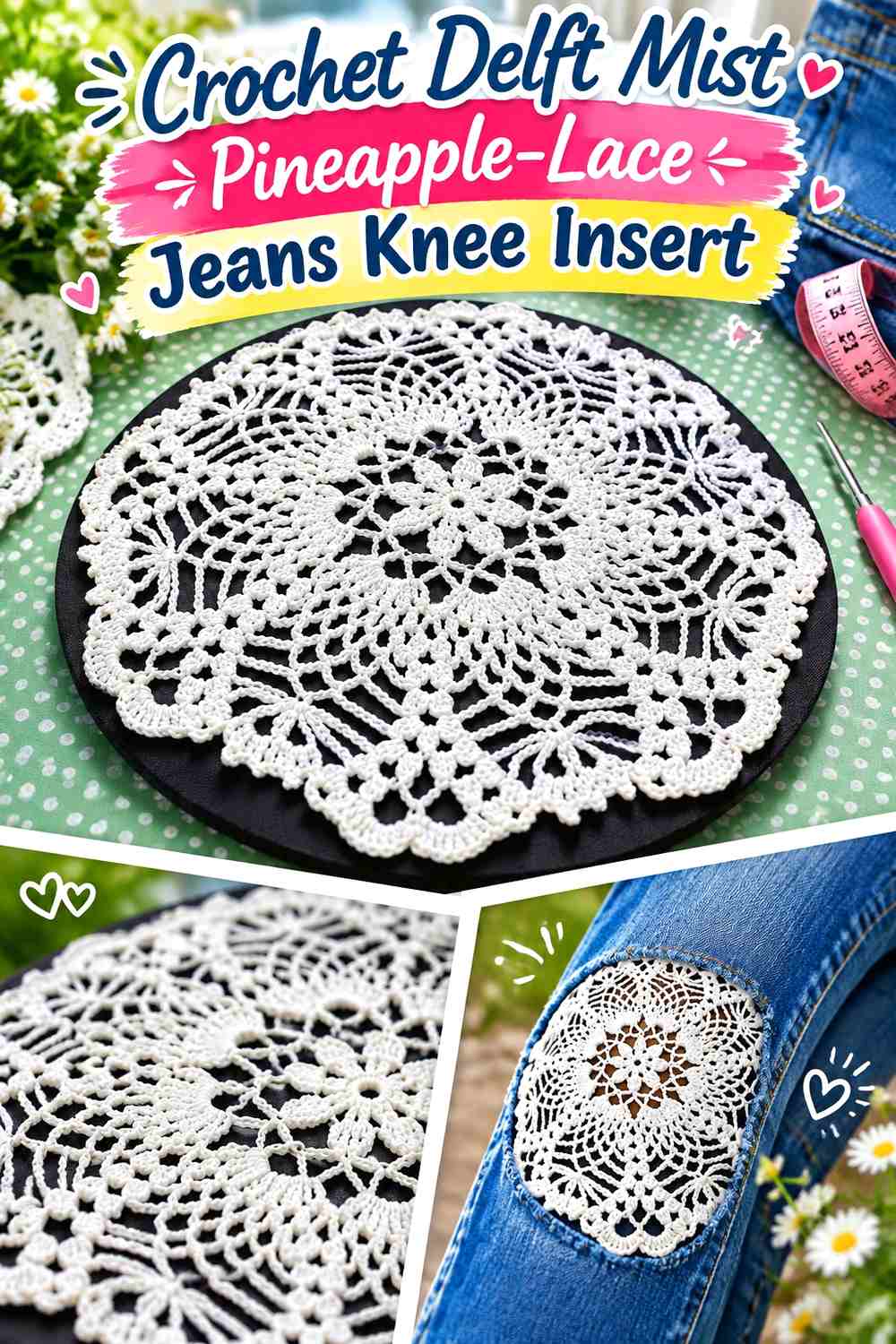
Giani Art’s pineapple lace doily tutorial builds a radial lace piece with the elongated leaf-like forms associated with pineapple crochet. This produces a more ornate circular composition than a simple chain-space doily.
Delft Mist can form the main pineapple shapes while Vermilion Coral is reserved for the center or final decorative round. The resulting insert suits a broad rounded knee opening where several complete lace sections can remain visible. Pineapple lace deserves its own place in the list because the negative space is structured into recognizable tapered motifs rather than simple grids or spokes. It is also visually detailed, so it pairs best with relatively plain denim rather than jeans already covered in embroidery, studs, or multiple distressed areas.
Give the Pineapple Shapes Enough Room
The elongated motifs need space to taper and open. If the jeans opening reveals only their centers, the distinctive pineapple structure may be lost.
Compare the finished doily with the intended knee opening before removing additional denim. A smaller completed round may suit the garment better than exposing the entire full-size source piece.
Let Delft Mist Carry the Detail
The intricate stitch structure already supplies considerable visual activity. A pale blue-gray main color keeps that detail visible without making the knee excessively saturated.
A small Vermilion Coral center is enough to give the medallion a focal point.
Block the Radial Motif Carefully
Round lace depends on even distribution around the center. If one section is stretched farther than another, the pineapple shapes can become uneven.
Finish and block the crochet before determining the final opening shape. Use the actual blocked circumference or outline as your fitting reference.
Creator Credit: Giani Art
Comparing the 17 Jeans Knee Lace Insert Styles
For the most controlled shapes, start with the lace granny, flower square, angel lace, fine-grid square, filet rose, filet heart, or geometric square. Their defined outer boundaries make it easier to plan a deliberate opening.
Fan lace, flower stripes, and V-stitch lace suit rectangular or elongated knee areas because the fabric can grow in repeated rows. Diamond mesh and Solomon’s Knot create greater openness and should be chosen when visible skin or backing is part of the intended look.
The doily, spiderweb, and pineapple options make the strongest radial statements. They are particularly effective on rounded knee openings but require careful centering. If the jeans are already badly worn, prioritize the condition of the surrounding denim before choosing a motif simply for its shape.
Conclusion
Vermilion Coral and Delft Mist support everything from bold circular knee medallions to restrained filet, flower lace, and geometric mesh. The best choice depends on the opening you have, how much transparency you want, and how the crochet behaves when the knee bends.
Choose squares and filet when a controlled perimeter matters; continuous fan, V-stitch, or flower lace when the opening is longer or wider; and radial doilies, spiderwebs, or pineapple motifs when the knee should become a clear focal feature. Finish and block the crochet before making permanent garment decisions, and check the insert with the jeans worn and the knee flexed. Follow the credited creator for the exact lace construction, then handle denim reinforcement and attachment as a separate garment-adaptation step.
Frequently Asked Questions
Should crochet lace sit behind the denim or replace the missing knee fabric completely?
Either approach can work visually, but they solve different problems. A lace piece positioned behind an existing opening lets the denim retain a visible frame and generally gives you more surrounding material for attachment. A true insert can create a cleaner edge-to-edge effect but requires more careful preparation of the opening. If the original denim is weak, the lace alone should not automatically be assumed to provide the same structural support as denim.
Which lace style works best when the knee needs a lot of flexibility?
Open repeating fabrics such as V-stitch lace, fan lace, diamond mesh, and Solomon’s Knot generally allow more visible movement than very dense motifs, but their individual loops may also distort more when stretched. The best choice depends on yarn, tension, panel size, and attachment. Make a complete sample and bend or stretch it gently in the directions the knee will move before committing it to the garment.
Should I use Vermilion Coral or Delft Mist around the outer edge?
Delft Mist usually gives a softer transition into blue denim, especially on faded or medium-wash jeans. Vermilion Coral creates a much stronger frame and works when the insert should look deliberately graphic. You can also separate the jobs: use coral for the central flower, heart, rose, or radial lines and Delft Mist for the structural edge. Compare both combinations against the actual denim because wash color changes their apparent contrast.
Can I use a lace insert over a very large ripped knee?
Possibly, but first inspect the condition of the fabric surrounding the rip. A large visible hole may be bordered by denim that has also become thin. The insert needs dependable material around its perimeter, or another appropriate reinforcement strategy, rather than attachment only to unstable frayed fibers. A large motif such as a doily, pineapple, or geometric screen may provide the visual coverage, but coverage and structural repair are separate considerations.
Do I need backing fabric behind open crochet lace?
Not necessarily. Leaving the lace unbacked produces the most transparent effect, while backing changes color contrast, coverage, and how much skin is visible. It may also affect how the knee feels when bent. Very open Solomon’s knots, diamond mesh, and spiderwebs reveal backing strongly, so choose its color deliberately. Any added layer should be tested with the jeans worn rather than selected only for its appearance on a flat work surface.
How do I keep a square crochet knee insert from pulling out of shape?
Block the completed square first, position it in its relaxed dimensions, and avoid stretching its corners merely to reach the jeans opening. Check all four sides and corners for comparable tension during temporary placement. The garment should accommodate the blocked motif rather than use attachment stitches to reshape it. Also test the jeans with the knee bent before finalizing the placement, because that movement can reveal tension that is not obvious while the leg is straight.