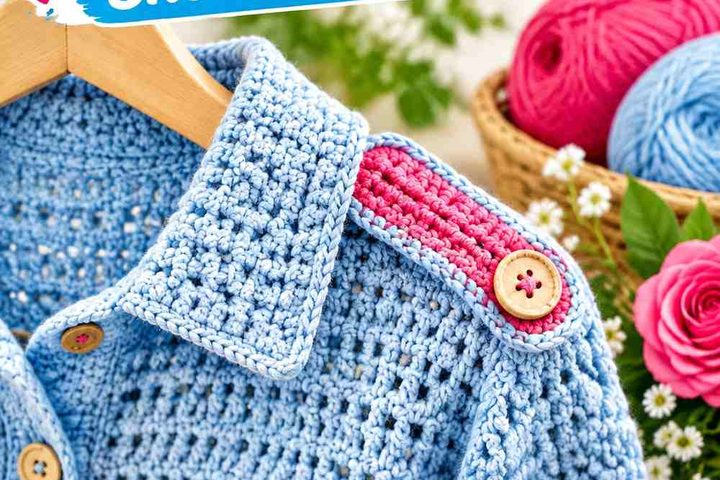
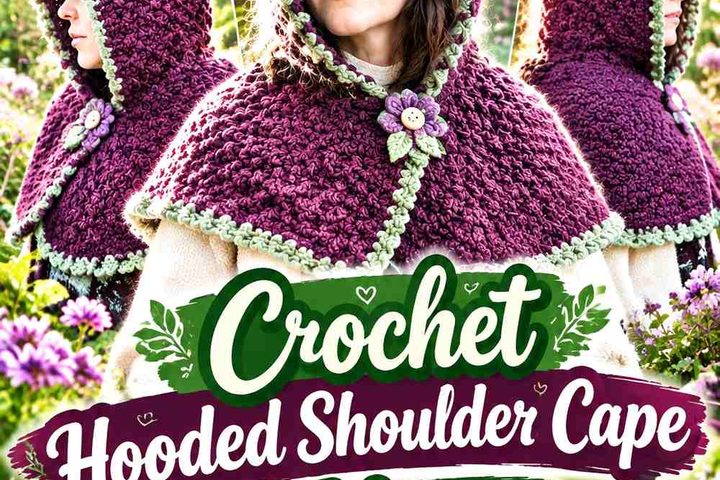
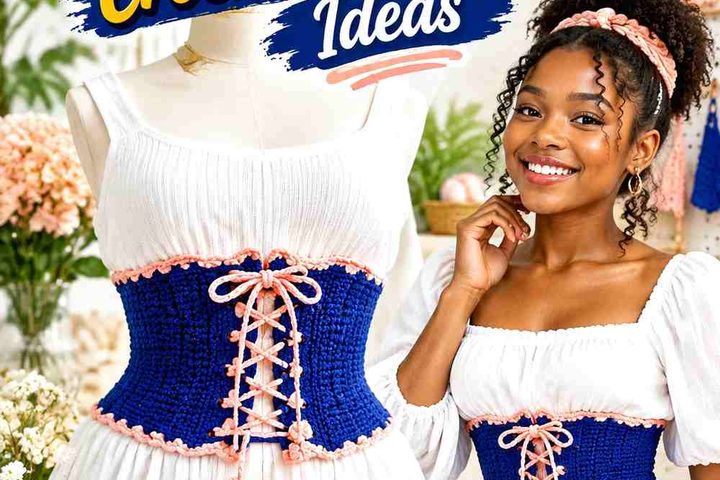
A crochet Christmas cardigan can range from an unmistakably festive statement piece to a winter cardigan that only hints at the season. Some of the tutorials in this collection build Christmas details directly into the garment through snowflake squares, holly, appliqués, or holiday colors. Others provide useful cardigan constructions that can be adapted without pretending the original tutorial is Christmas-specific.
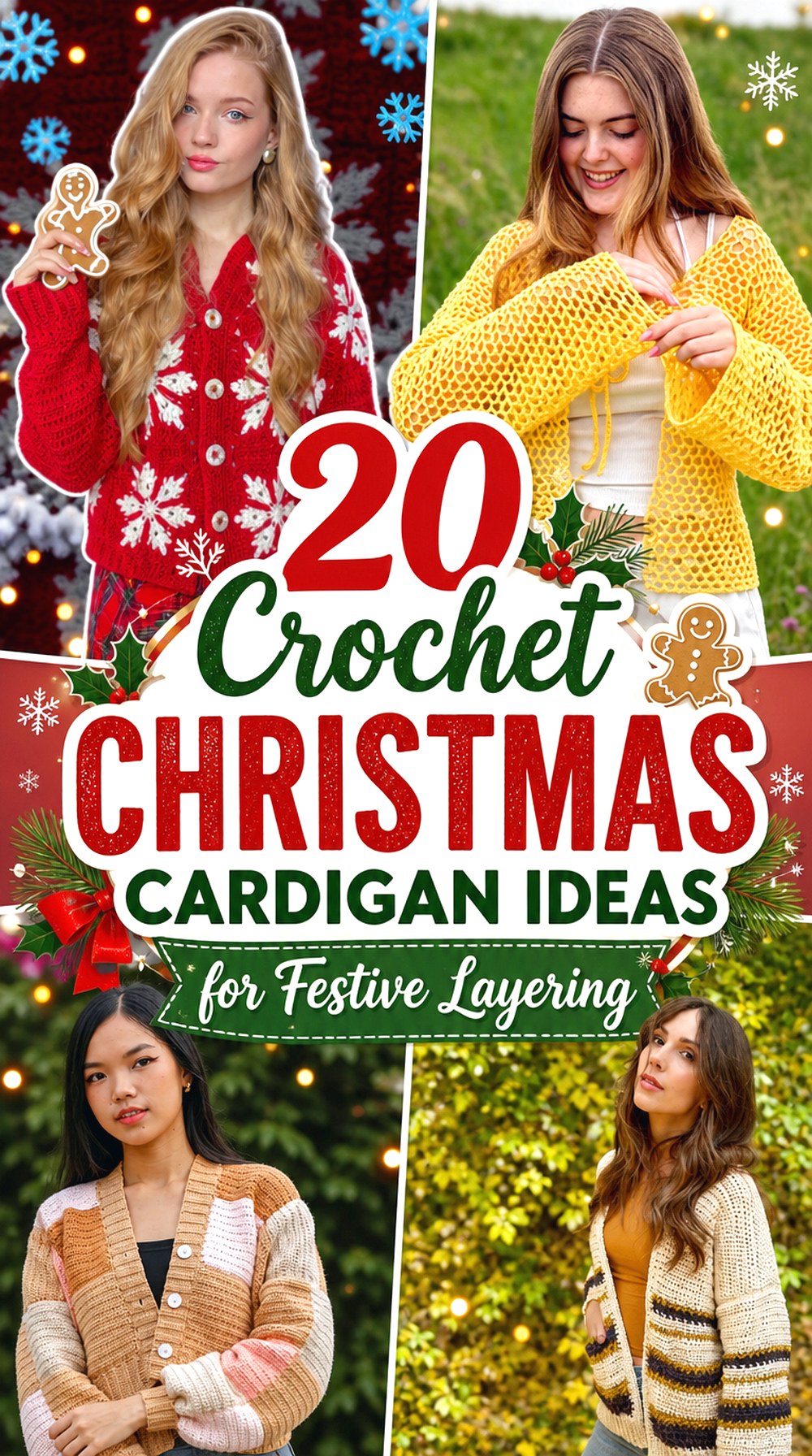
The real differences are bigger than color. These ideas include joined motifs, bottom-up bodies, top-down raglans, hexagons, cropped button cardigans, mesh layers, balloon sleeves, chunky pockets, cocoon shapes, and a long duster. Use the comparisons below to choose a construction and fit first, then decide how much Christmas decoration you actually want.
Quick List
Crochet Holly Appliqué Granny Square Christmas Cardigan
Crochet Mixed-Appliqué Christmas Patchwork Cardigan
Crochet Snowflake Granny Square Christmas Cardigan
Crochet Bottom-Up Christmas Appliqué Cardigan
Crochet Gift-Box Patchwork Christmas Cardigan
Crochet Candy-Cane Hexagon Christmas Cardigan
Crochet Nordic Raglan Christmas Cardigan
Crochet Starry Mesh Christmas Cardigan
Crochet Peppermint Granny Square Christmas Cardigan
Crochet Santa-Collar Christmas Cardigan
Crochet Christmas Bow Balloon-Sleeve Cardigan
Crochet Garland Granny-Stitch Christmas Cardigan
Crochet Holiday Stripe Cardigan
Crochet Wrapped-Gift Cocoon Christmas Cardigan
Crochet Cropped Ornament-Button Christmas Cardigan
Crochet Hooded Evergreen Christmas Cardigan
Crochet Chunky Fireplace Christmas Cardigan With Pockets
Crochet Ribbed Christmas Button Cardigan
Crochet Cranberry Texture Christmas Cardigan
Crochet Long Shell-Stitch Christmas Duster Cardigan
Choose the Cardigan Shape Before Planning Christmas Details
Holiday motifs can distract from the fit decisions that actually determine whether a cardigan gets worn. Start by deciding whether you want a cropped layer, a roomy overshirt, a buttoned sweater-like cardigan, or a longer outer layer. A hexagon cardigan naturally produces a relaxed silhouette, while a top-down raglan gives you different opportunities to assess the neckline and upper body as the garment develops. Joined-square cardigans depend heavily on the dimensions of the finished motifs.
For motif designs, block a representative square before planning the complete layout. As a simple planning example, four blocked squares measuring 5 inches each would span about 20 inches before joins, edging, and intended ease are considered. That is planning math rather than a universal sizing formula; always follow the source tutorial’s actual construction and measurement guidance.
Decide How Strongly You Want the Cardigan to Read as “Christmas”
There are three useful approaches. An integrated Christmas cardigan uses recognizable elements such as snowflakes, holly, trees, stockings, or multiple festive appliqués. It creates the strongest seasonal look but usually involves more color changes, ends, placement decisions, or small components.
A second option is to keep the cardigan construction neutral and add removable or selectively placed seasonal decorations. This makes the garment easier to restyle outside December. The third approach relies mainly on color blocking, stripes, buttons, or texture. Red, cream, green, icy blue, or metallic-look accents can suggest the holidays without covering the garment in motifs.
Before attaching an appliqué permanently, pin or baste it temporarily and try the cardigan on. A motif that looks centered on a flat panel can shift visually once the garment wraps around the body.
Yarn Weight, Drape, and Garment Weight Matter More on Decorated Cardigans
Christmas cardigans can become heavier than expected when dense motifs, appliqués, ribbing, buttons, pockets, and multiple seams are combined. A yarn substitution should therefore be judged by more than color. Compare the tutorial’s intended yarn category, your blocked gauge, fabric drape, and how much the swatch changes after handling.
Dense fabric can support appliqués clearly but may create a firmer cardigan. Open stitches produce a lighter-looking layer but give small sewn decorations fewer solid attachment points. Granny-square garments introduce another issue: every motif needs to finish close enough in size for the layout to join cleanly.
If you plan to mix motif designs, make sample squares first. Matching the outer dimensions and edge structure is more important than assuming two squares will be compatible simply because both are called granny squares.
Crochet Holly Appliqué Granny Square Christmas Cardigan
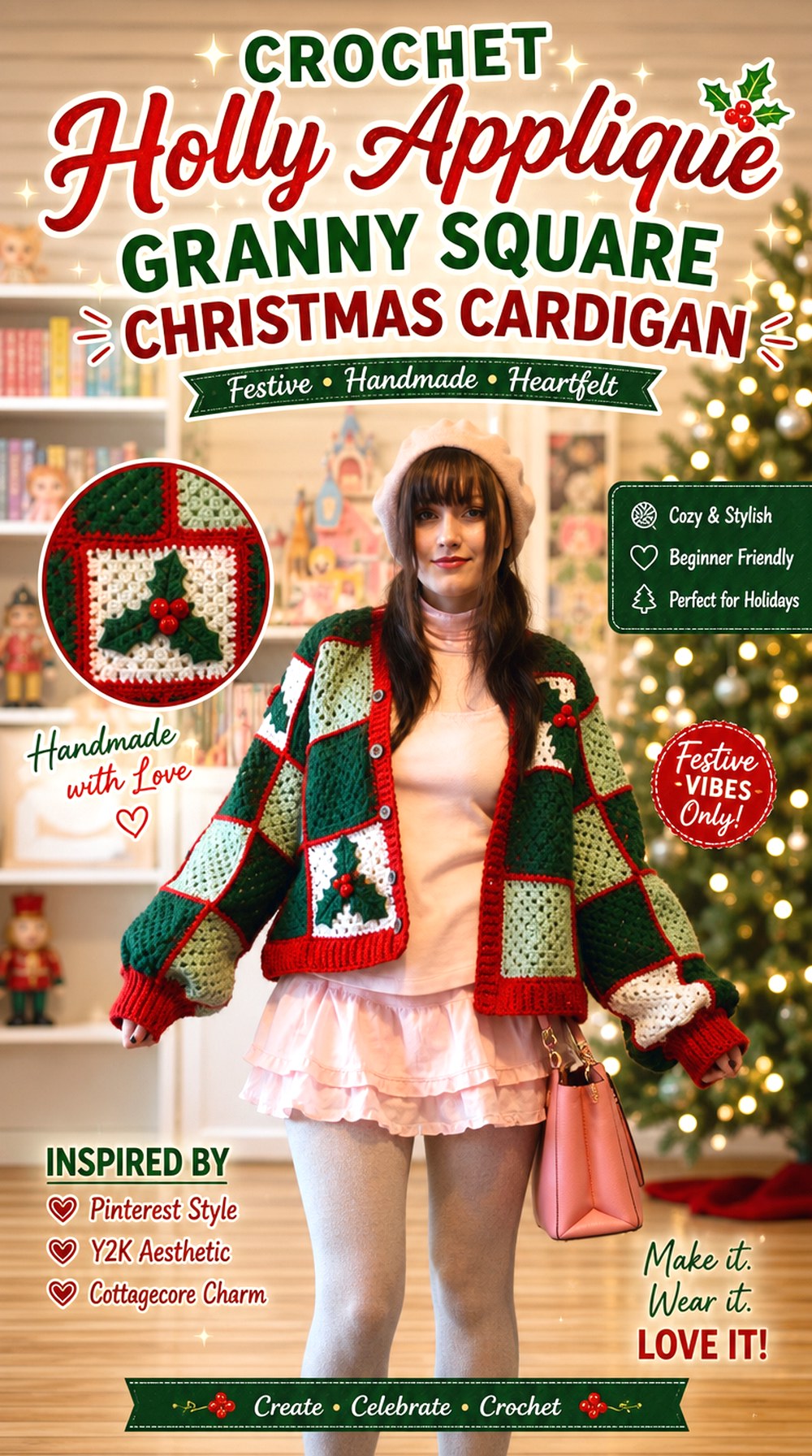
This is one of the most directly Christmas-specific options in the collection. The finished cardigan uses granny-square construction with holly leaves and berries placed over the garment, giving it a recognizable botanical holiday theme without covering every square in a complicated motif. The buttoned front also makes it feel closer to a traditional winter cardigan than a loose festival-style patchwork layer.
Shaiyeh’s tutorial includes the cardigan planning process as well as the squares, joining, ribbing, button band, appliqués, and final assembly, so it is particularly relevant for readers who want the Christmas treatment built into the same project rather than added to an unrelated cardigan later.
Block the Squares Before Committing to the Panel Layout
Square-based clothing magnifies small inconsistencies because several motifs must align across the front, back, and sleeves. Measure the blocked square rather than an unfinished motif pulled straight from the hook. If neighboring squares differ, correct that discrepancy before joining instead of hoping a tight seam will hide it. A forced join can create puckering and can also distort the button band later.
Holly Placement Works Better With Breathing Room
The holly is most effective when it reads as intentional decoration rather than another layer of visual clutter. Before sewing the leaves and berries permanently, arrange the finished cardigan flat and test several placements. Then try it on with the pieces temporarily secured. This reveals whether an apparently balanced flat layout becomes crowded near the neckline, button band, or underarm.
Crochet Mixed Appliqué Christmas Patchwork Cardigan
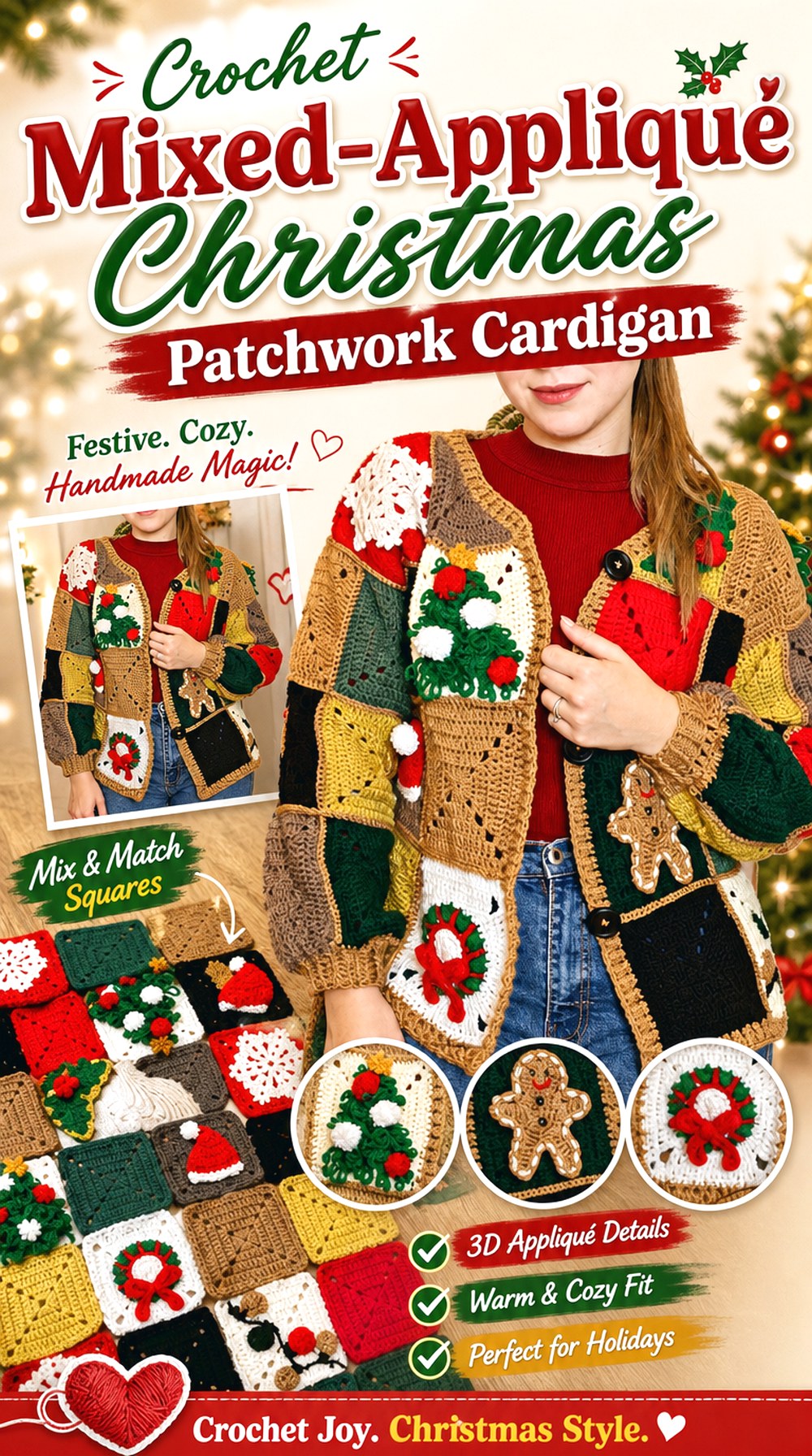
Instead of repeating one Christmas symbol, this cardigan treats the garment almost like a wearable holiday sampler. Brunaticality’s finished design combines crochet squares with a collection of seasonal appliqués, including motifs connected with Christmas lights, stockings, snowflakes, gingerbread, holly, trees, and a Santa hat. That variety makes it a stronger choice for someone who wants a deliberately playful statement cardigan rather than a restrained winter layer.
The concept also gives you more control over visual storytelling: the front can feature the most recognizable motifs while less detailed sections balance the back and sleeves.
Treat Each Front Panel as Its Own Composition
A mixed-motif cardigan can become front-heavy if every favorite appliqué is concentrated near the opening. Lay out both front panels side by side and compare motif size, shape, and visual density before attaching anything. A tall tree and a small snowflake do not occupy the same amount of visual space even if their yarn colors coordinate.
Keep Three-Dimensional Details Away From High-Friction Areas
Raised appliqués are more likely to catch or fold where a cardigan repeatedly bends or rubs. Shoulder seams, underarms, cuffs, and the immediate button area deserve particular attention. Flatter motifs are generally easier to place in these zones; save dimensional or more elaborate embellishment for stable sections of the front or back where it can remain visible.
Original Tutorial and Creator Credit
Creator: Brunaticality
Crochet Snowflake Granny Square Christmas Cardigan
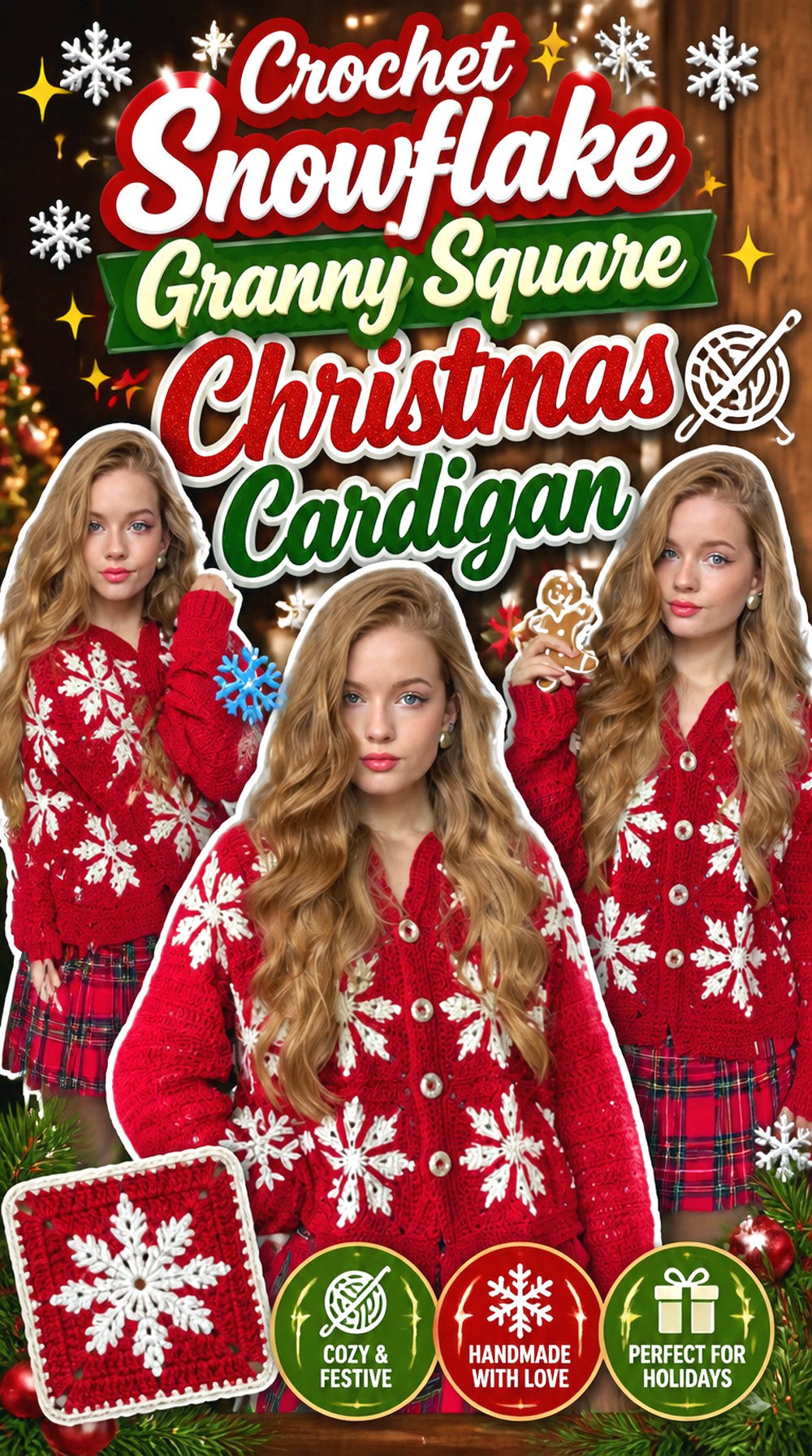
A snowflake cardigan offers a cleaner visual theme than a mixed-appliqué design. WONDER NETTING’s tutorial specifically shows a cardigan made with snowflake granny squares, combining the graphic snowflake centers with a buttoned cardigan shape. The repeated motif gives the finished garment cohesion while still producing a strong winter and Christmas association.
This design suits readers who enjoy modular crochet because the decorative work happens within repeatable units. It can also be easier to assess color balance before assembly: once several finished squares are laid out together, you can see whether the contrast makes the snowflakes clear enough.
Contrast Determines Whether the Snowflakes Stay Visible
A detailed snowflake loses impact when the motif and surrounding square are too similar in value. Before making a cardigan’s worth of motifs, place one sample at normal viewing distance rather than judging it only from a few inches away. If the snowflake disappears visually, changing the contrast early is far easier than replacing squares after joining.
Pay Attention to the Added Weight of Repeated Motifs
A motif cardigan has many joins and edges in addition to the crochet inside each square. The total garment can therefore feel different from a single swatch. When you evaluate your sample, consider not just softness but also how firmly the fabric hangs. A drapey square may suit a flowing cardigan, while a very dense square can produce a more jacket-like result.
Original Tutorial and Creator Credit
Creator: WONDER NETTING
Crochet Bottom Up Christmas Appliqué Cardigan
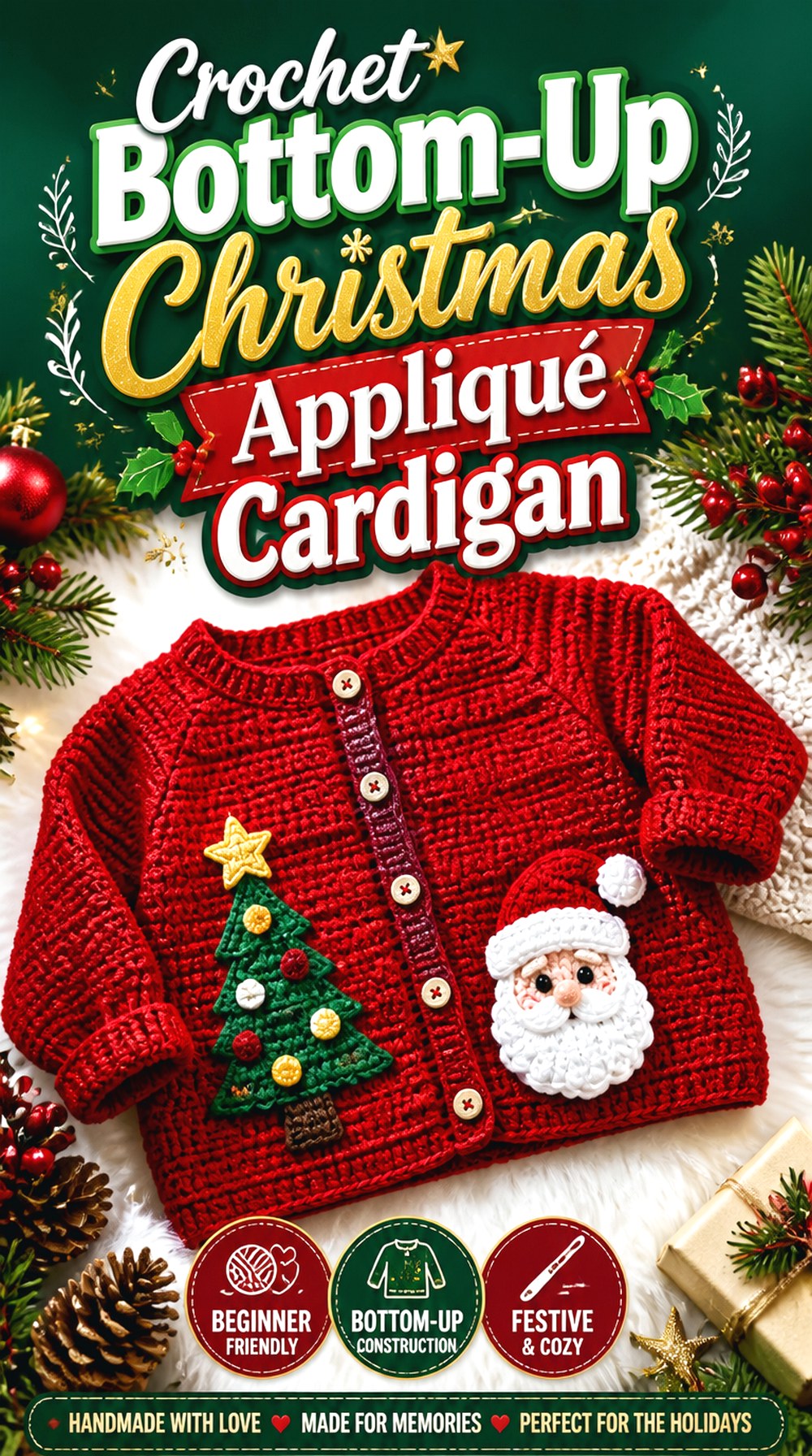
This option starts with cardigan structure rather than motif construction. The Stitch Sessions presents a Christmas cardigan series built from the bottom up, with the garment designed to be decorated with festive appliqués afterward. That separation is useful if you want a more continuous body instead of dozens of joined squares.
A bottom-up approach also changes how you plan decoration. Because the body can remain comparatively quiet, Christmas elements can function as accents rather than determining every panel dimension. This makes the idea suitable for readers who enjoy the look of appliqués but do not want their cardigan construction dictated by granny-square measurements.
Establish the Garment Fit Before Adding Decoration
Appliqués cannot correct a cardigan body that is already too narrow, too long, or uncomfortable around the armholes. Finish and assess the essential garment shape first. Try it over the type of layer you expect to wear underneath during the holidays. Only after the body sits properly should you decide where permanent seasonal decoration belongs.
A Bottom Trim Gives the Design a Visual Anchor
Because this construction begins from the lower edge, the bottom treatment becomes a useful place to establish the cardigan’s visual weight. If you later add bright motifs higher on the body, a defined lower edge can help the whole piece look intentional. Check that your trim tension does not pull the body inward or flare away from it before continuing.
Original Tutorial and Creator Credit
Creator: The Stitch Sessions – Crochet & Conversation
Crochet Gift Box Patchwork Christmas Cardigan
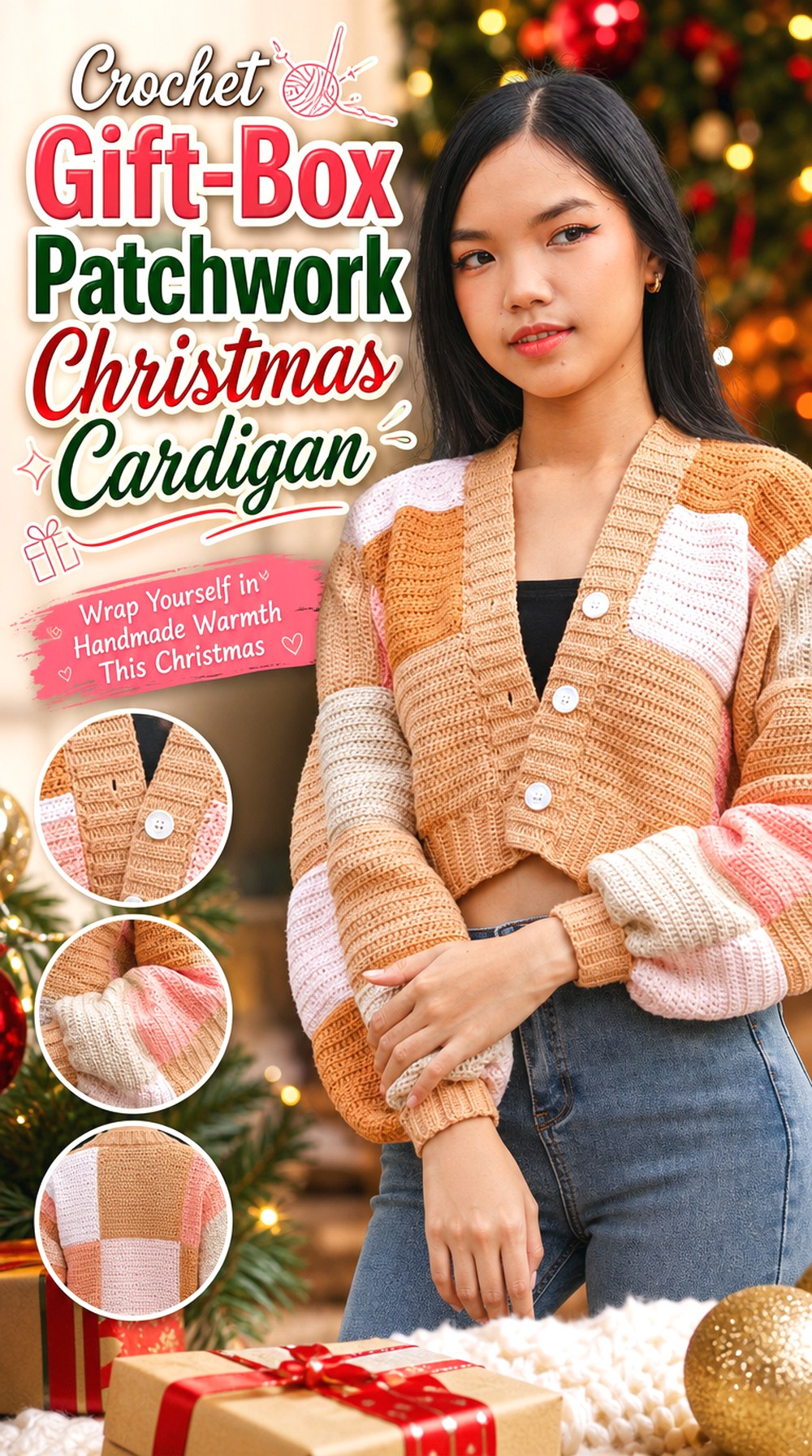
A patchwork cardigan gives you large geometric blocks that can be turned into a gift-wrap-inspired Christmas layout without changing the basic construction. Chenda DIY’s tutorial demonstrates a patchwork cardigan assembled from crocheted square sections with ribbing and buttons. The original tutorial is not a Christmas design; the holiday concept here is an adaptation using the block structure.
For a gift-box effect, think in terms of repeating blocks rather than adding literal presents everywhere. Red, evergreen, cream, or gold-tone yarn combinations can divide the garment into graphic “packages,” while a limited number of contrasting blocks keeps the finished piece wearable.
Keep the Patchwork Grid Consistent Before Playing With Color
Geometric cardigans look intentional when the block dimensions line up. Before assigning holiday colors, confirm that your square construction and joining tension are consistent. A crooked grid becomes more noticeable when high-contrast colors meet. Blocking individual pieces before final assembly can make it easier to detect a square that has gradually grown larger than the others.
Use the Ribbing as the Unifying Color
When several festive colors compete across the body, choosing one repeated color for the cuffs, waist, and front edging can visually pull the design together. Dark green, cream, or another dominant shade can serve that role. This is an editorial adaptation, so keep Chenda DIY’s tutorial as the source for the actual cardigan construction and assembly.
Original Tutorial and Creator Credit
Creator: Chenda DIY
Crochet Candy Cane Hexagon Christmas Cardigan
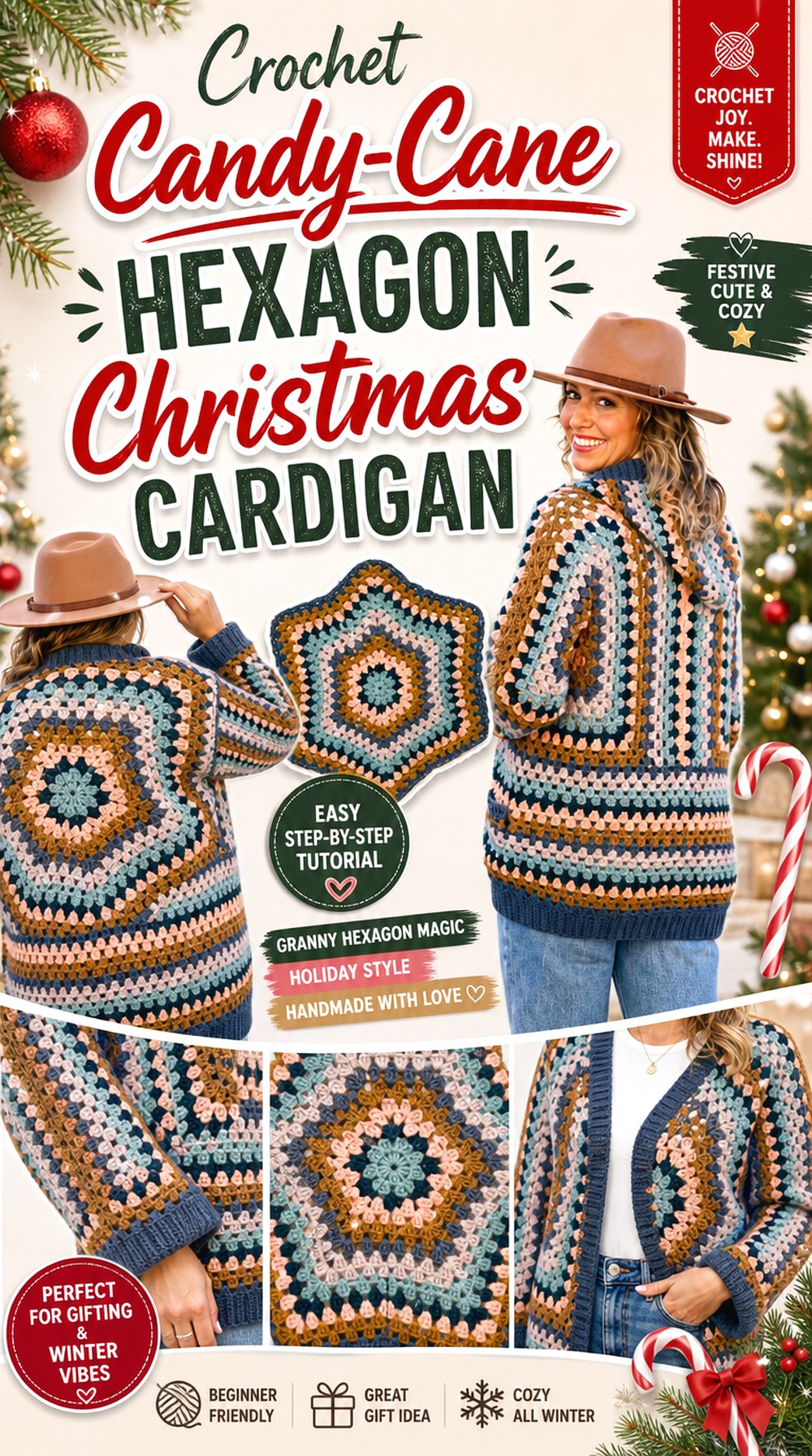
Hexagon construction creates a distinctly relaxed cardigan, making it a good counterpoint to square-panel and classic button-front designs. Make & Do Crew’s Campfire Cardigan tutorial shows how a granny hexagon forms the basis of the garment and includes fit and customization guidance. The source is not Christmas-specific; the candy-cane concept comes from adapting the color changes.
Alternating cream and red at selected stages can create curved bands that travel through the folded hexagon rather than straight horizontal stripes. That makes the finished holiday effect different from a conventional striped cardigan.
Map Color Changes Around the Folded Hexagon
A color band on a flat hexagon does not remain a simple stripe after folding. It can travel through the sleeve, body, or front edge depending on where it occurs. Fold a partly completed hexagon periodically to preview the placement before repeating a color sequence that may land somewhere unexpected.
Try the Two Main Pieces Together Before Final Seaming
One advantage of hexagon construction is that the major pieces can be held together to assess overall width and length. Pin or temporarily position them before committing to finishing. If you want a roomy Christmas layering cardigan, check the fit over an actual shirt or lightweight sweater rather than over bare arms.
Original Tutorial and Creator Credit
Creator: Make & Do Crew
Crochet Nordic Raglan Christmas Cardigan
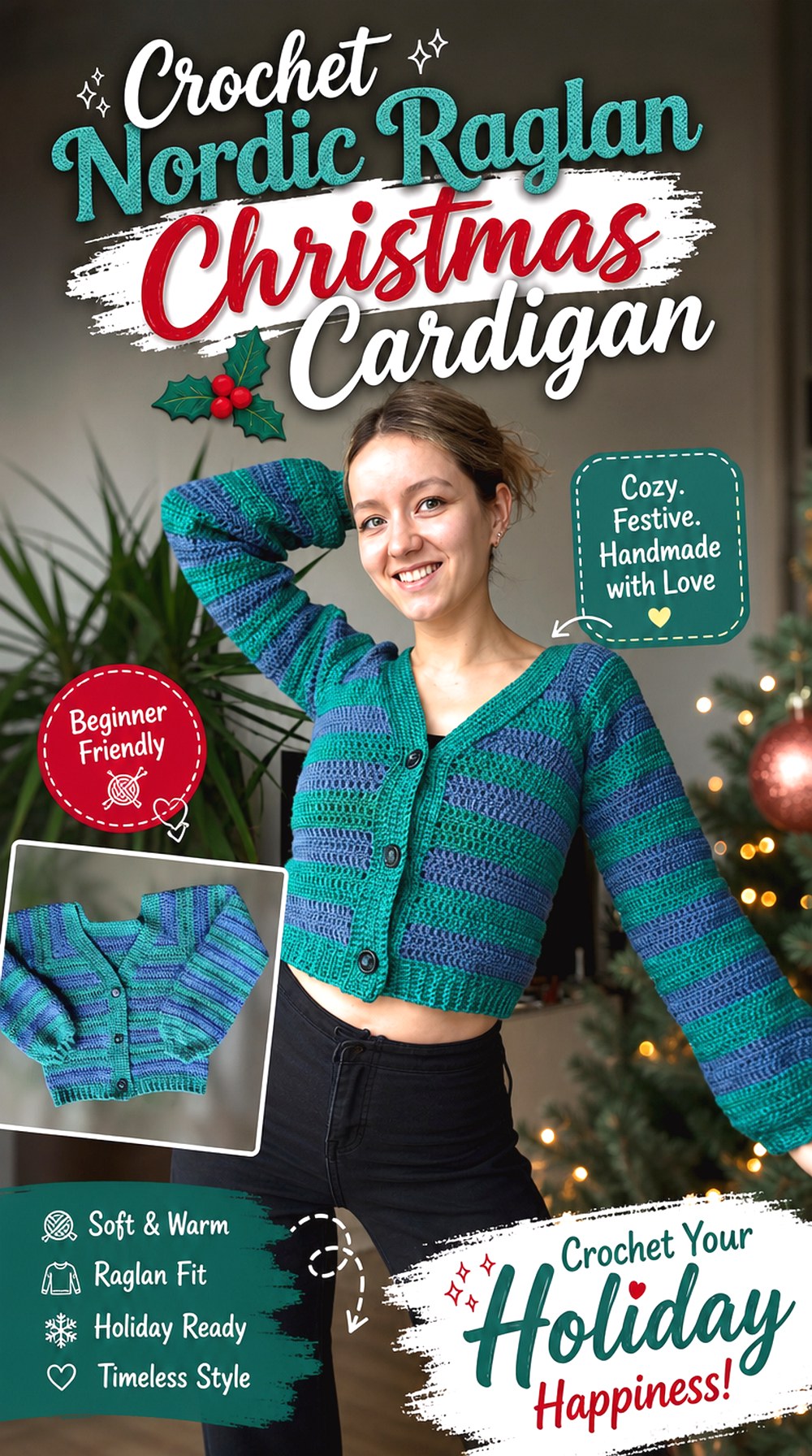
A top-down raglan provides a cleaner canvas for a Nordic-inspired holiday palette than a patchwork garment. The tutorial from by Kristine begins at the neckline and develops the raglan cardigan downward, with the body constructed without the same kind of panel seaming used in many traditional cardigans. It also includes buttonholes and finishing details.
The original design is not presented as a Christmas cardigan. For this adaptation, keep any Nordic influence simple—perhaps restrained bands of contrasting holiday colors—rather than attempting to invent complex stranded colorwork that the tutorial does not teach.
The Upper Body Is the Critical Raglan Checkpoint
Top-down construction gives you an opportunity to evaluate the neckline, shoulder area, and developing arm divisions before the whole body is finished. Do not focus so heavily on decorative color bands that you ignore whether the upper body sits comfortably. Holiday styling can always be adjusted later; an uncomfortable yoke is harder to fix.
Use Repeated Bands Instead of Unverified Motif Charts
A Nordic mood does not require copying an unfamiliar chart into a cardigan with different stitch counts. Simple repeated color sections around the yoke, cuffs, or hem can evoke winter knitwear while preserving the tutorial’s construction. If you do introduce separate colorwork, swatch it first because color changes can alter tension and therefore affect fit.
Original Tutorial and Creator Credit
Creator: by Kristine
Crochet Starry Mesh Christmas Cardigan
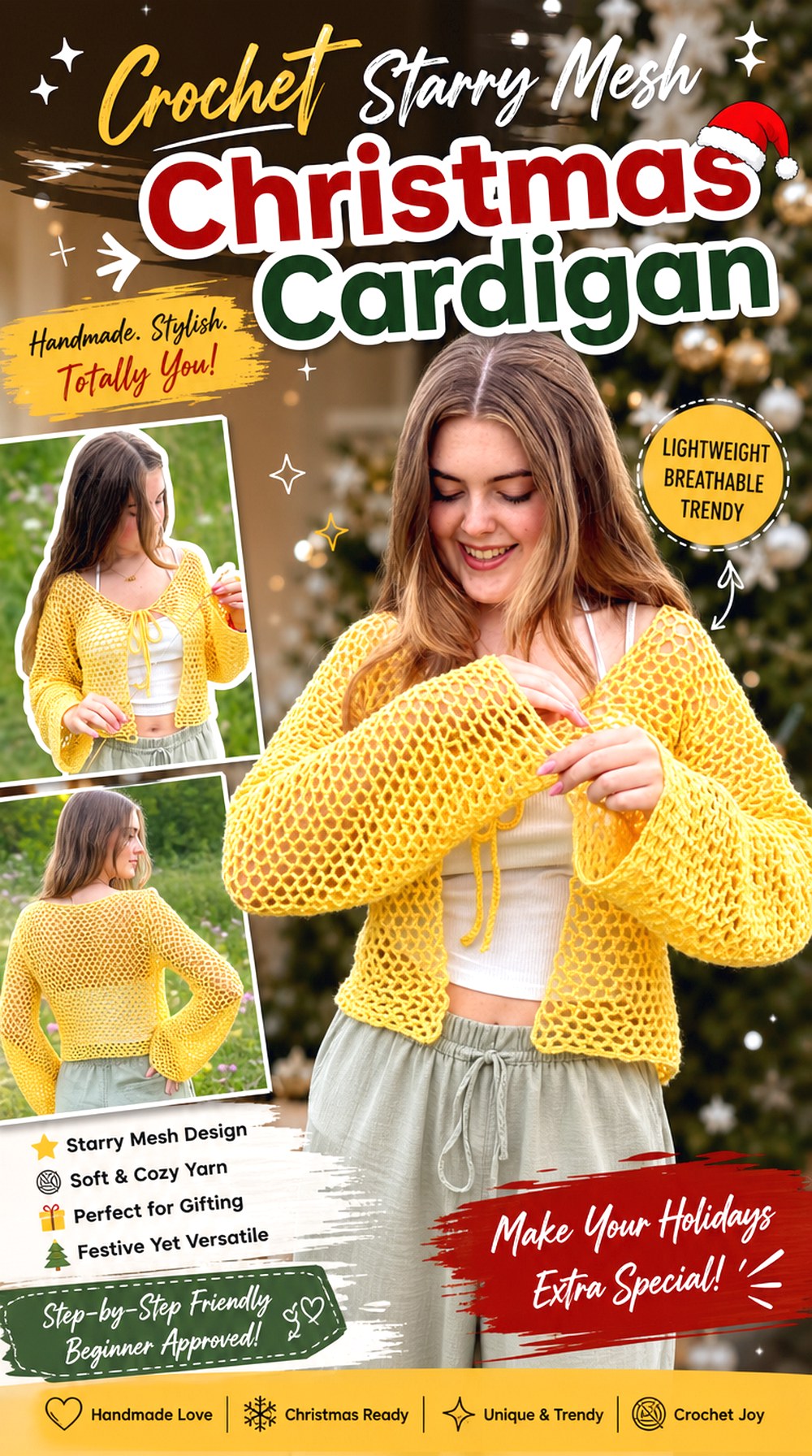
A mesh cardigan gives the Christmas-cardigan idea a lighter, less bulky direction. Crochet with Linni’s tutorial shows an airy cardigan with adjustable sizing, shaped panels, assembly, and front ties. The original design is not seasonal, so this idea uses its open structure as the base for a festive adaptation.
Instead of covering the mesh in many appliqués, a few lightweight stars or sparkle-inspired accents can be spaced across stable areas. The open fabric also works well when the garment is intended to layer over a contrasting holiday top, allowing the clothing underneath to become part of the color story.
Open Fabric Needs Lighter Decoration
Dense appliqués attached to airy mesh can pull individual spaces out of shape. If you add stars, keep them relatively light and attach them across enough surrounding structure to avoid concentrating all the weight on one open loop. Another option is to let the Christmas effect come mainly from the yarn palette and the layer worn underneath.
Check Front Ties With the Cardigan on Your Body
Ties change both styling and tension across an open front. Before fixing their final placement, wear the cardigan and see where the fronts naturally meet. A tie positioned from a flat measurement alone can pull the neckline oddly or sit above or below the point where you actually want the garment to close.
Original Tutorial and Creator Credit
Creator: Crochet with Linni
Crochet Peppermint Granny Square Christmas Cardigan
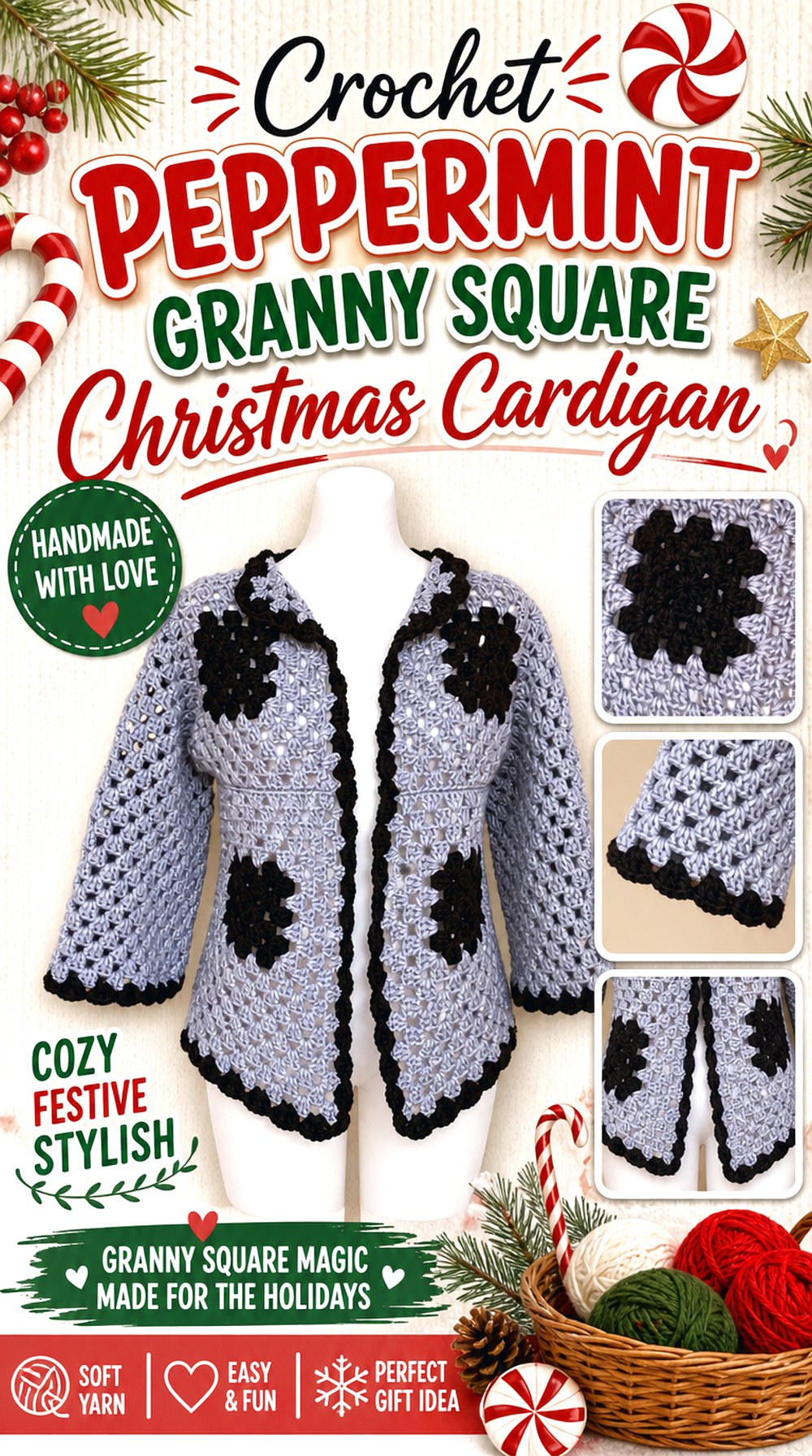
A classic granny-square cardigan provides an obvious place for peppermint-inspired color planning. Nati Crochet’s tutorial focuses on assembling a cardigan from granny squares, so the Christmas identity here comes from how the motifs are colored rather than from an existing peppermint pattern. Think alternating red, white, and softer neutral rings rather than trying to force every square into an identical candy motif.
Compared with the snowflake cardigan, this version is visually simpler and more geometric. It suits someone who wants festive color but does not want to sew separate appliqués onto the finished garment.
Make One Full Peppermint Color Sequence First
Color order can change how large or busy a granny square appears. Complete and block one representative square before multiplying it across the cardigan. Lay it beside your intended ribbing color and check whether the result reads as peppermint-inspired from a distance without becoming visually overwhelming.
Rotate or Alternate Squares Deliberately
Even simple granny motifs can look uneven when colors line up accidentally across seams. Before joining, arrange every square for a major panel and photograph the layout. The photo gives you a quick reference if pieces get moved. Alternating color emphasis can also keep the cardigan from forming unintended vertical stripes.
Original Tutorial and Creator Credit
Creator: Nati Crochet
Crochet Santa Collar Christmas Cardigan
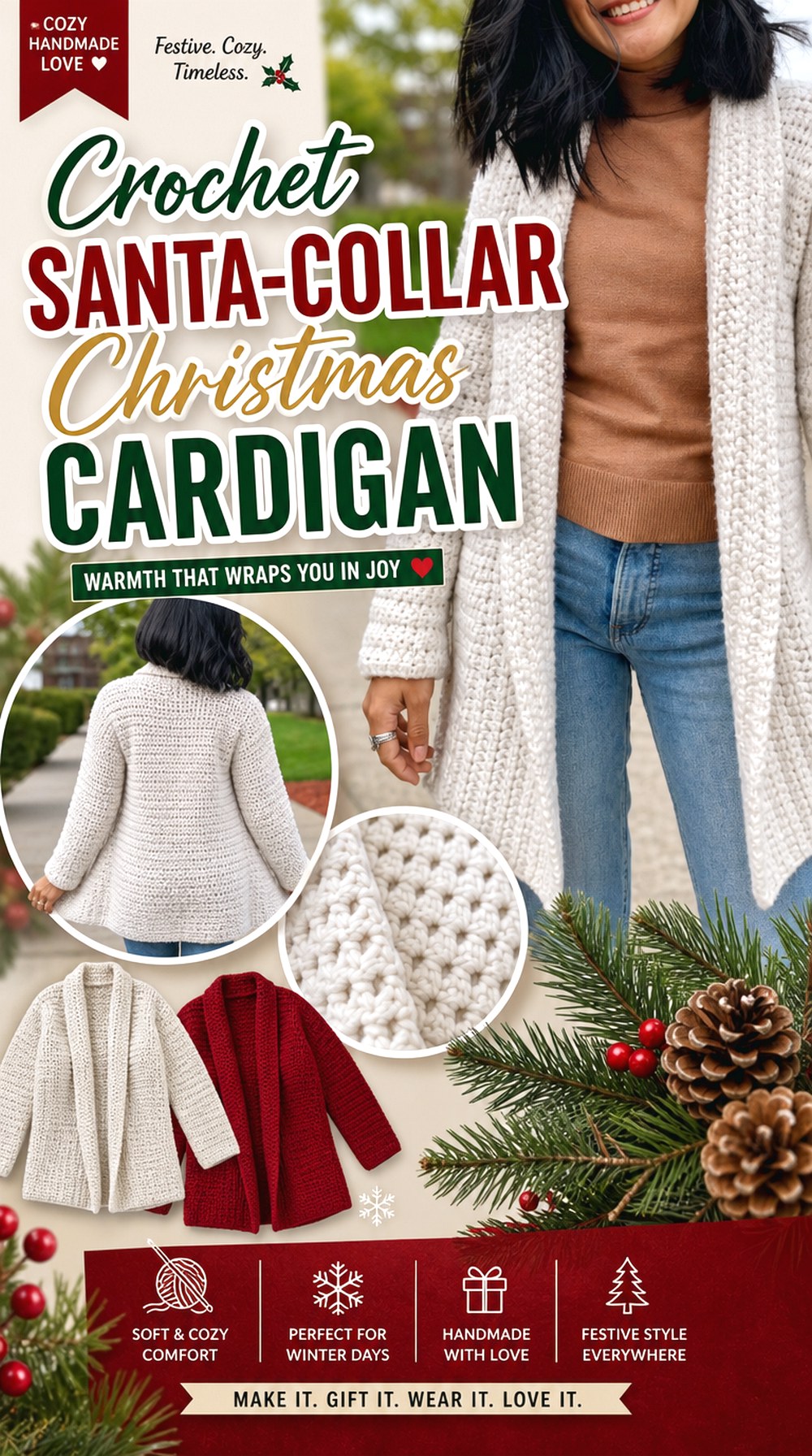
A substantial collar creates an easy route to a Santa-inspired cardigan without needing a literal Santa face or costume construction. KnitcroAddict’s classic cardigan tutorial produces a cozy cardigan assembled from separate pieces, with the collar added after the body is joined. The original is not a Christmas design, so the seasonal concept is an adaptation of its collar and color placement.
A deep red body with a contrasting light collar can create the reference immediately. Because the silhouette remains classic, the finished cardigan can feel more like winter clothing than novelty wear.
The Collar Fiber Should Behave With the Body Fabric
A contrasting collar may tempt you to switch to a very different novelty yarn. That can create problems if its thickness, stretch, or weight differs substantially from the cardigan fabric. Make a small compatibility swatch or compare yarn labels and worked fabric before committing. A collar that is much heavier can pull the neckline out of shape.
Use Buttons as Part of the Theme, Not an Afterthought
The button line occupies a prominent visual position on this classic shape. Test the buttons against both the body and collar yarn before sewing them on. Oversized or highly decorative buttons can shift the cardigan toward costume styling, while simpler contrasting buttons can keep it closer to a wearable winter piece.
Original Tutorial and Creator Credit
Creator: KnitcroAddict
Crochet Christmas Bow Balloon Sleeve Cardigan
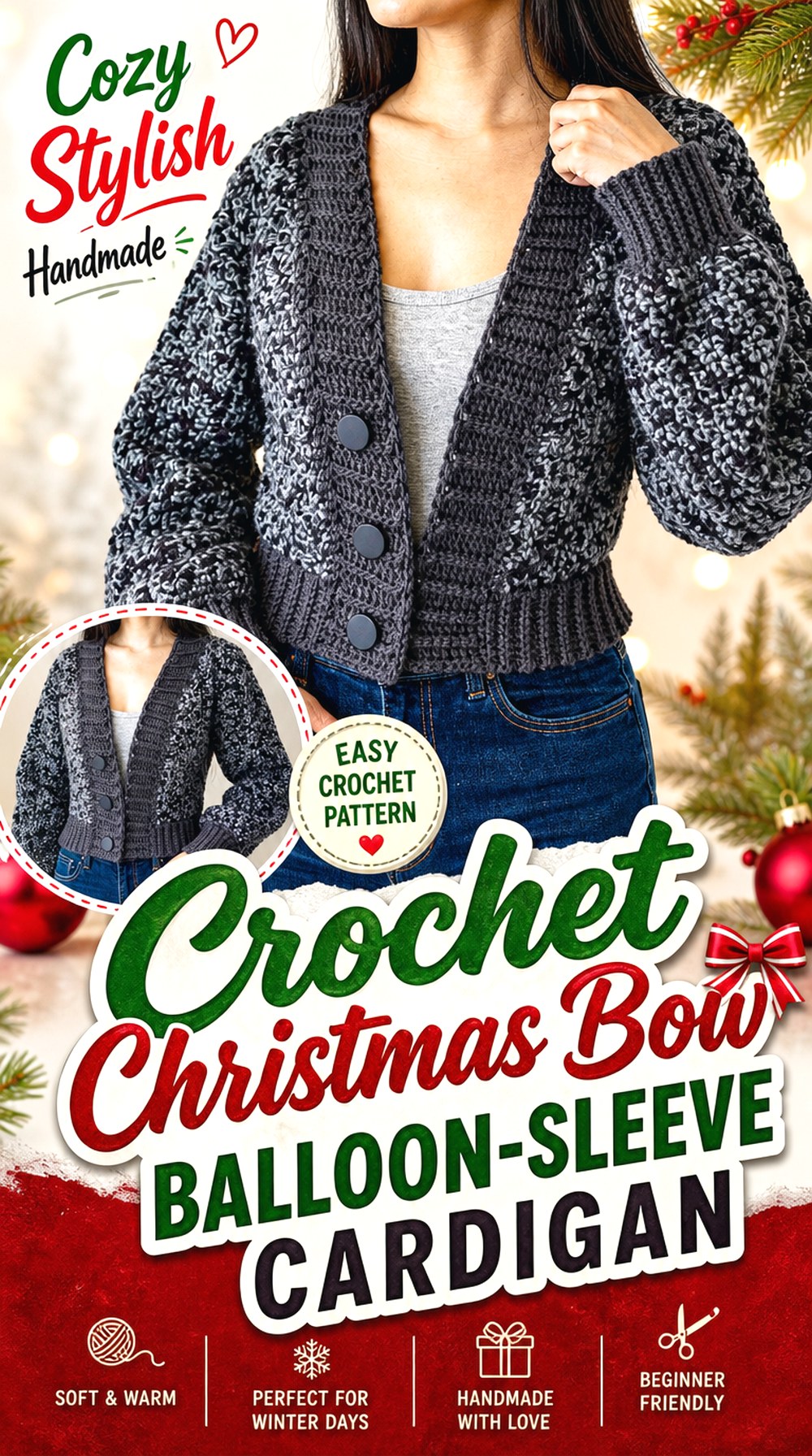
Balloon sleeves make this cardigan idea feel festive even before decoration is added. TCDDIY’s tutorial demonstrates a two-tone moss-stitch cardigan with functional buttons and pronounced balloon sleeves. Rather than adding motifs everywhere, the Christmas version can concentrate detail around the front with a removable bow, ribbon-like color blocking, or a contrasting border.
The sleeve volume gives this option a different silhouette from the boxy granny-square and classic collared cardigans. It is a better choice when shape itself should carry some of the drama.
Sleeve Volume Changes the Best Place for Embellishment
Large sleeves already attract attention, so covering them in additional appliqués can make the garment feel visually crowded. Keep decorative focal points closer to the front opening, neckline, or upper chest. If you do use sleeve accents, test them near the cuff where they will not interfere as much with the folds created by the balloon shape.
Check the Cuff Before Adding Ribbon-Like Details
A balloon sleeve depends on the transition from wider fabric to a narrower cuff. Make sure that transition feels comfortable and that the cuff sits where intended before introducing bows or decorative trim. Extra material at the wrist can obscure the shaping and can also become impractical when the wearer uses their hands.
Original Tutorial and Creator Credit
Creator: TCDDIY
Crochet Garland Granny Stitch Christmas Cardigan
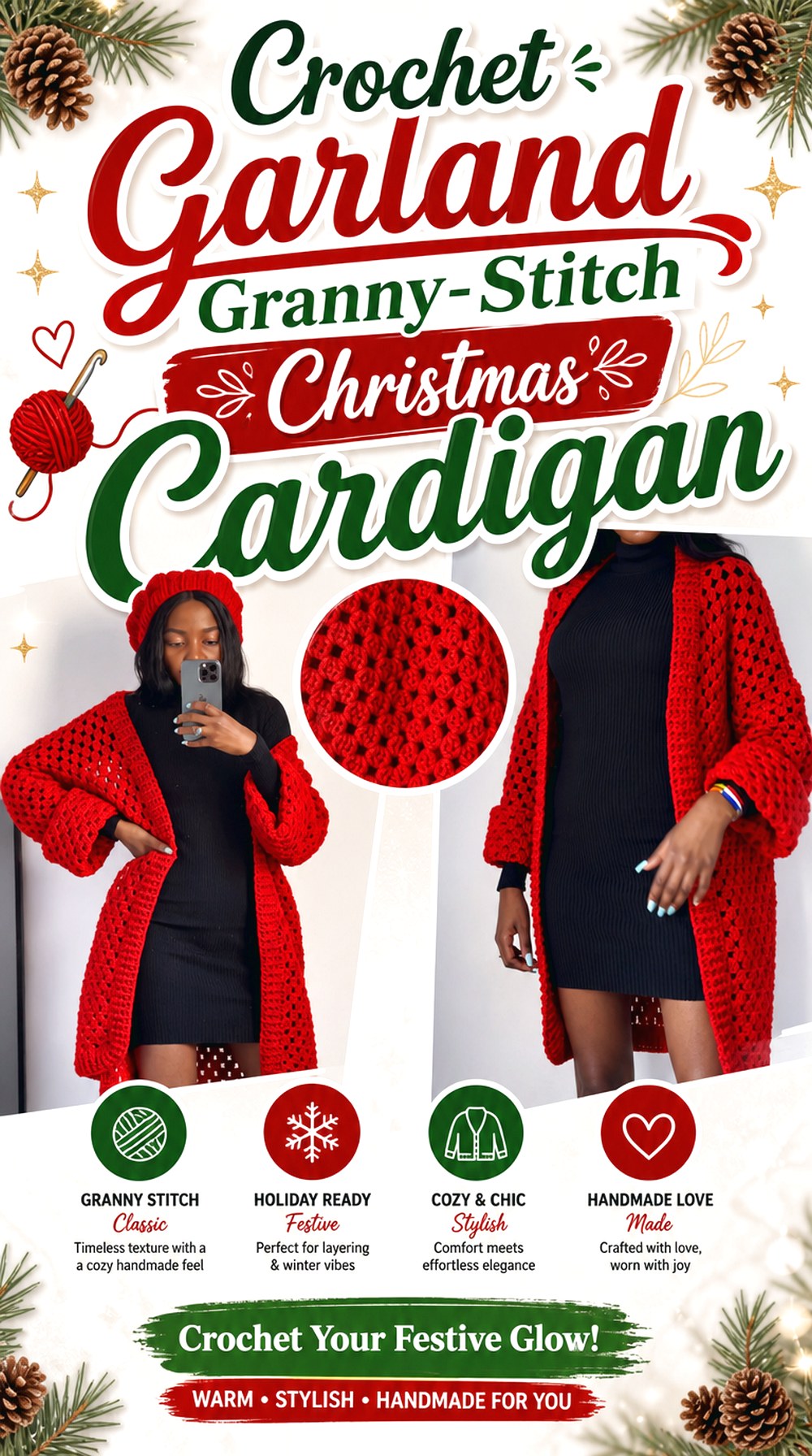
AC Crochets’ oversized granny-stitch cardigan offers broad rows of open cluster texture rather than separate square motifs. That continuous surface is useful for a garland-inspired adaptation because holiday colors can move across the cardigan in bands without creating dozens of individual joins.
The original tutorial is not Christmas-specific. For a festive version, use controlled color sections and consider a small number of removable ornaments or pompoms along one selected band rather than attaching decoration everywhere. The open texture and oversized shape already create plenty of visual movement.
Treat Color Changes Like Garland Lines
Before starting, decide whether bands should be balanced symmetrically or move more freely through the garment. A repeating sequence creates a traditional stripe effect; irregular color placement feels more like a draped garland. Whichever approach you use, record your choices so both sleeves look deliberately related rather than accidentally mismatched.
Avoid Overloading Open Granny-Stitch Fabric
Open cluster fabric can stretch differently from dense crochet, particularly once decoration is attached. Use lightweight accents and distribute attachment points rather than hanging heavy items from a single gap. If removable decorations are part of the plan, confirm that their fastenings do not snag the yarn when taken off after the holidays.
Original Tutorial and Creator Credit
Creator: AC Crochets
Crochet Holiday Stripe Cardigan
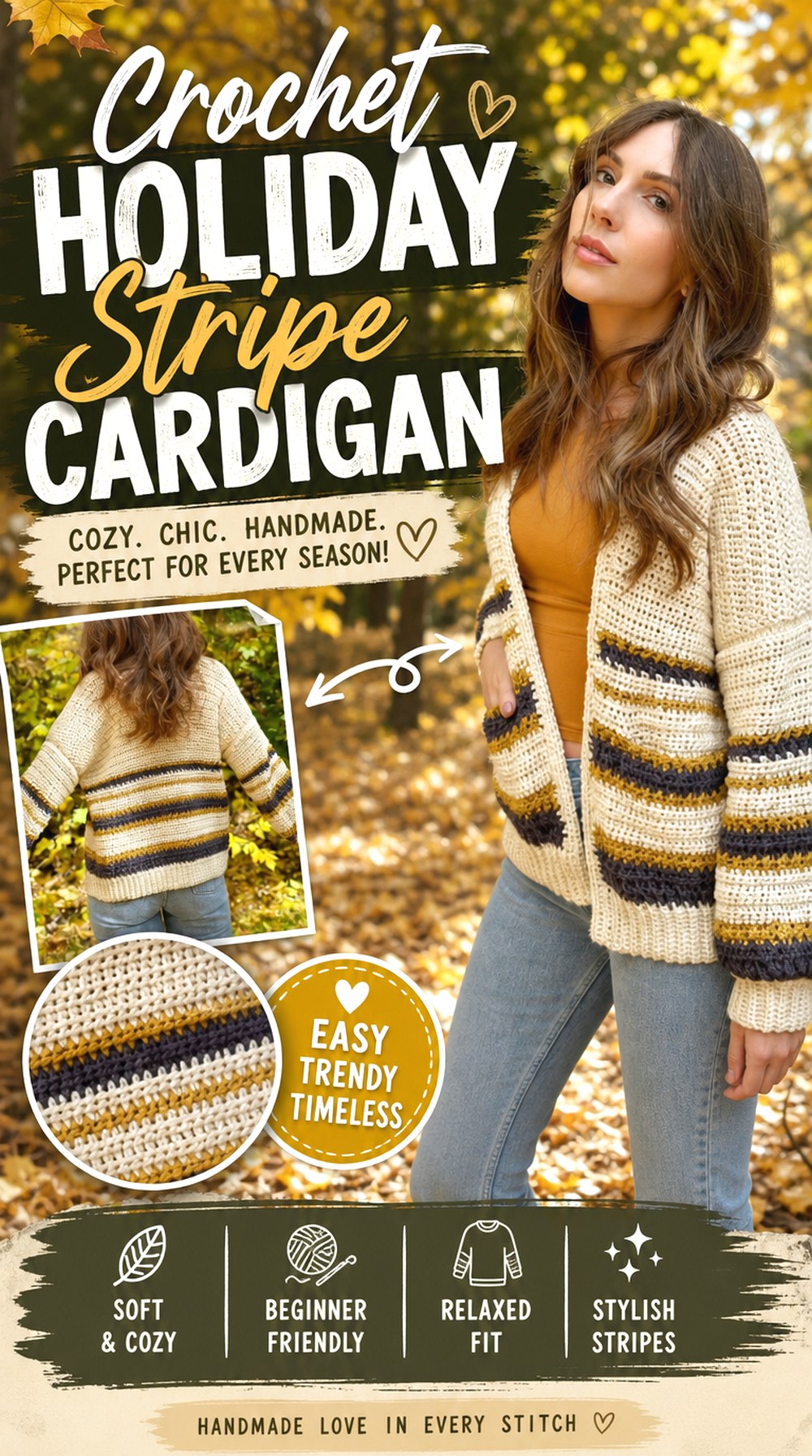
The Teatime Cardigan from Evelyn And Peter Crochet already uses stripes and textured stitch changes, making it a natural foundation for a holiday palette without needing added appliqués. The source design has a slightly oversized shape and balloon-style sleeves, so it reads differently from a plain horizontal stripe sweater.
For Christmas, the most straightforward adaptation is to limit the palette to a few coordinating shades rather than using every holiday color available. Deep green, cream, and muted red can keep the stripe pattern readable while allowing the stitch texture to remain visible.
Stripe Width Changes the Visual Scale of the Cardigan
Many narrow color changes create an energetic result, while wider sections feel calmer and allow stitch texture to show more clearly. Before substituting your palette, look at how the tutorial’s stripe sections relate to its construction. Do not assume every row can be recolored independently without changing the visual rhythm of the finished garment.
Carry the Palette Through the Sleeves Deliberately
Striped sleeves can make or break the sense of balance. Decide whether you want the sleeves to mirror the body, repeat only selected colors, or act as quieter framing. Exact visual symmetry is not always necessary, but a plan prevents the cardigan from looking as though leftover yarn was added randomly.
Original Tutorial and Creator Credit
Creator: Evelyn And Peter Crochet
Crochet Wrapped Gift Cocoon Christmas Cardigan
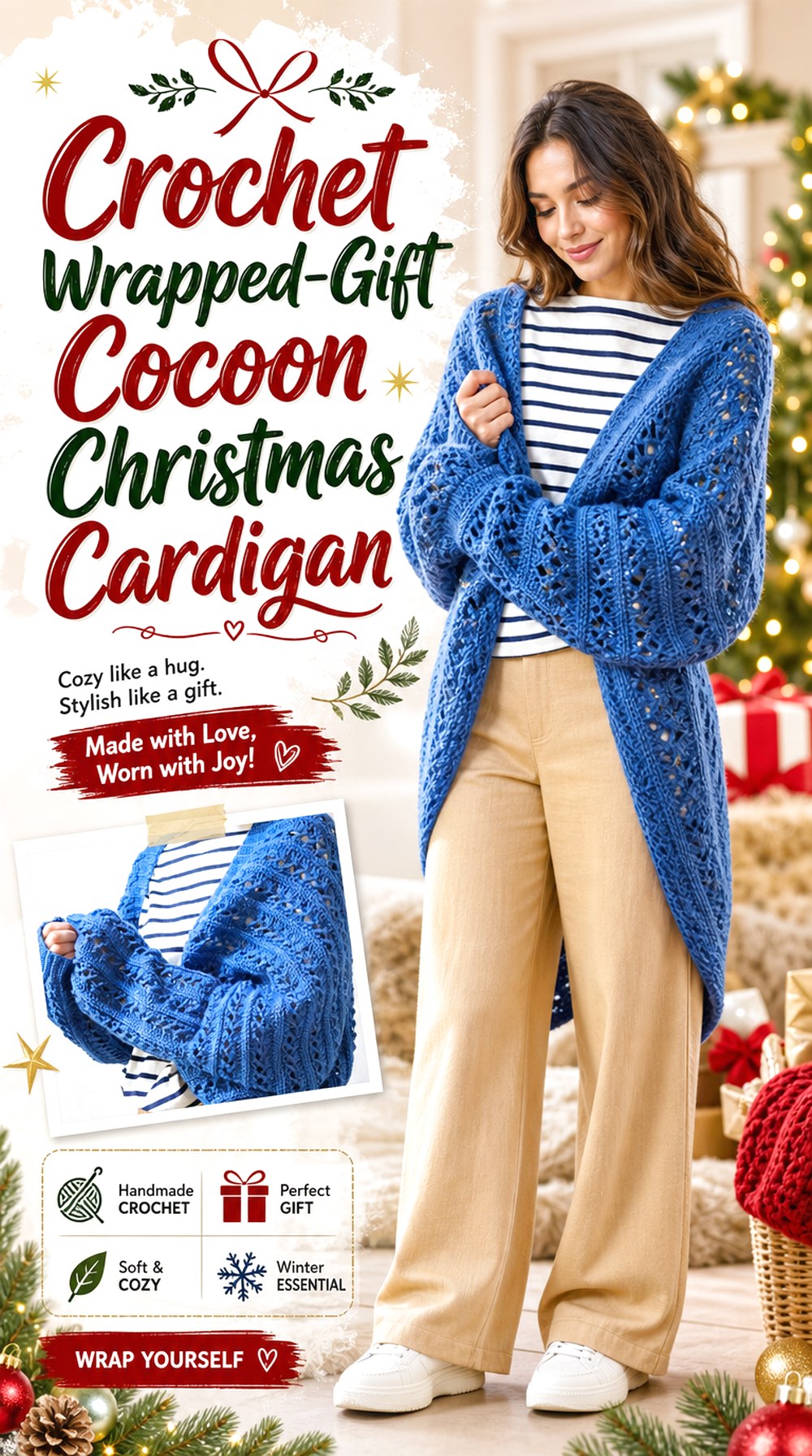
A cocoon cardigan is the outlier in this collection because the body wraps around the wearer rather than behaving like a conventional front-and-back sweater. Orinam crochet’s tutorial uses a compact three-part construction with ribbing along the front and wrists. The source is not Christmas-specific, so the wrapped-gift concept is a styling adaptation.
Broad blocks of contrasting holiday color can make the folded shape resemble layered wrapping without relying on appliqués. This is also an option for readers who prefer a more open front and do not need a traditional button closure.
Cocoon Width Matters More Than Decorative Placement
A cocoon needs enough width to drape comfortably across the back and around the arms. If it is too narrow, no amount of attractive color blocking will make the silhouette feel right. Assess the finished or developing body dimensions according to the source guidance before deciding where your strongest color contrast should fall.
Use the Front Ribbing to Frame the Holiday Colors
Because the open edge is prominent when worn, a consistent ribbing shade can outline the entire design. That makes it a useful place for a dark evergreen, cream, or another grounding color. If the body uses large red-and-green sections, a quieter border can prevent the front from becoming too visually fragmented.
Original Tutorial and Creator Credit
Creator: Orinam crochet
Crochet Cropped Ornament Button Christmas Cardigan
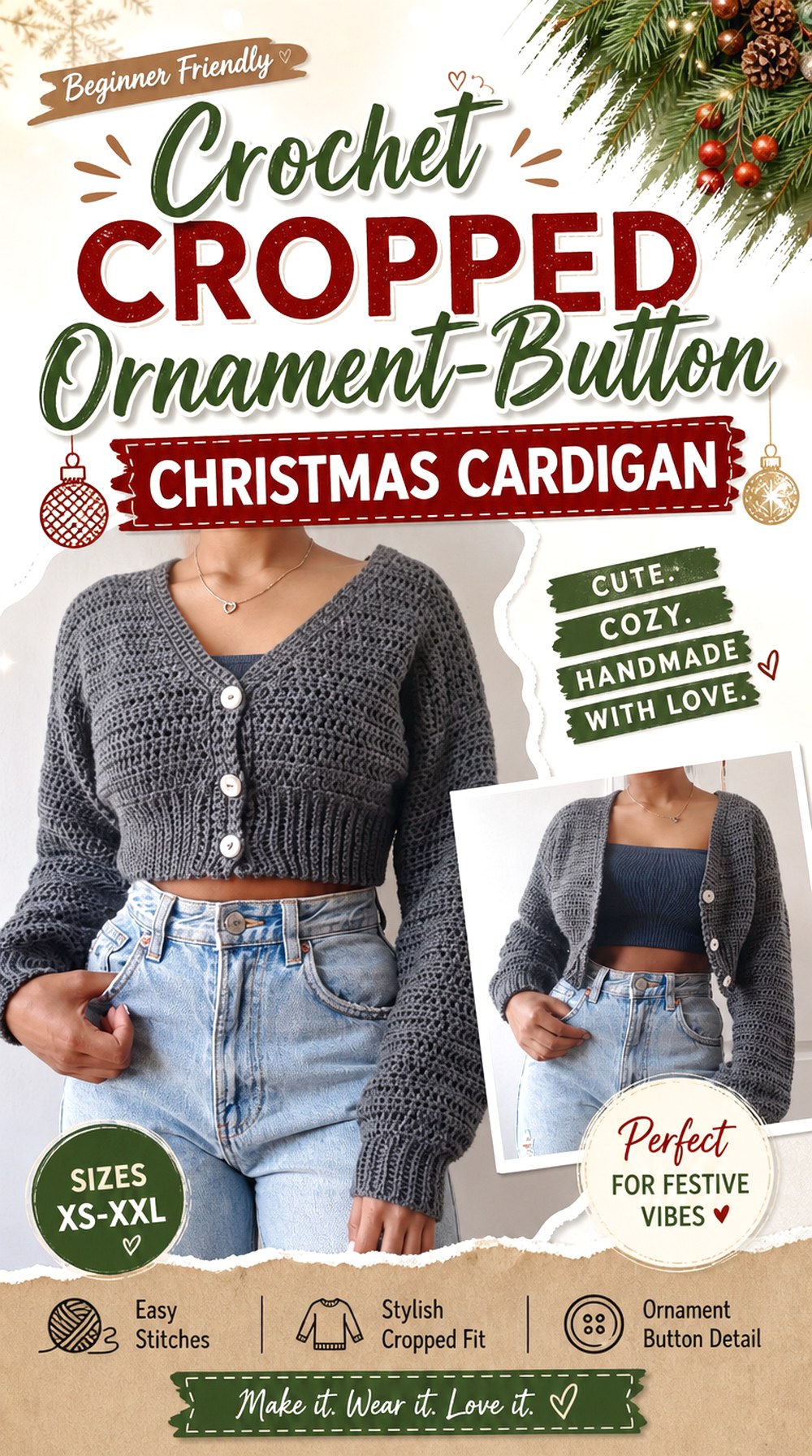
A cropped button cardigan gives the holiday theme a more compact, sweater-like shape. RosaFerns’ tutorial demonstrates a cropped cardigan with ribbing, separate front and back sections, sleeves, neckline finishing, and buttons. It is not a Christmas pattern; the seasonal idea comes from adapting its color and button treatment.
This silhouette works well with high-waisted skirts or pants and avoids the visual weight of a long Christmas cardigan. Small ornament-inspired buttons can become the main festive detail, allowing the rest of the garment to stay comparatively simple.
Cropped Length Needs to Be Chosen With the Intended Outfit
“Cropped” is not one universal measurement. Decide where you want the hem to meet the clothing you will wear underneath, then compare that with the construction demonstrated in the tutorial. A cardigan intended for a dress may need a different stopping point from one designed to meet high-rise jeans.
Test Decorative Buttons Through the Actual Buttonholes
A button that looks perfect on the yarn may still be impractical if its shape catches or its diameter does not suit the opening. Make at least one working buttonhole and physically test the chosen button before sewing on a complete set. Star, ornament, or novelty shapes can require more clearance than smooth round buttons.
Original Tutorial and Creator Credit
Creator: RosaFerns
Crochet Hooded Evergreen Christmas Cardigan
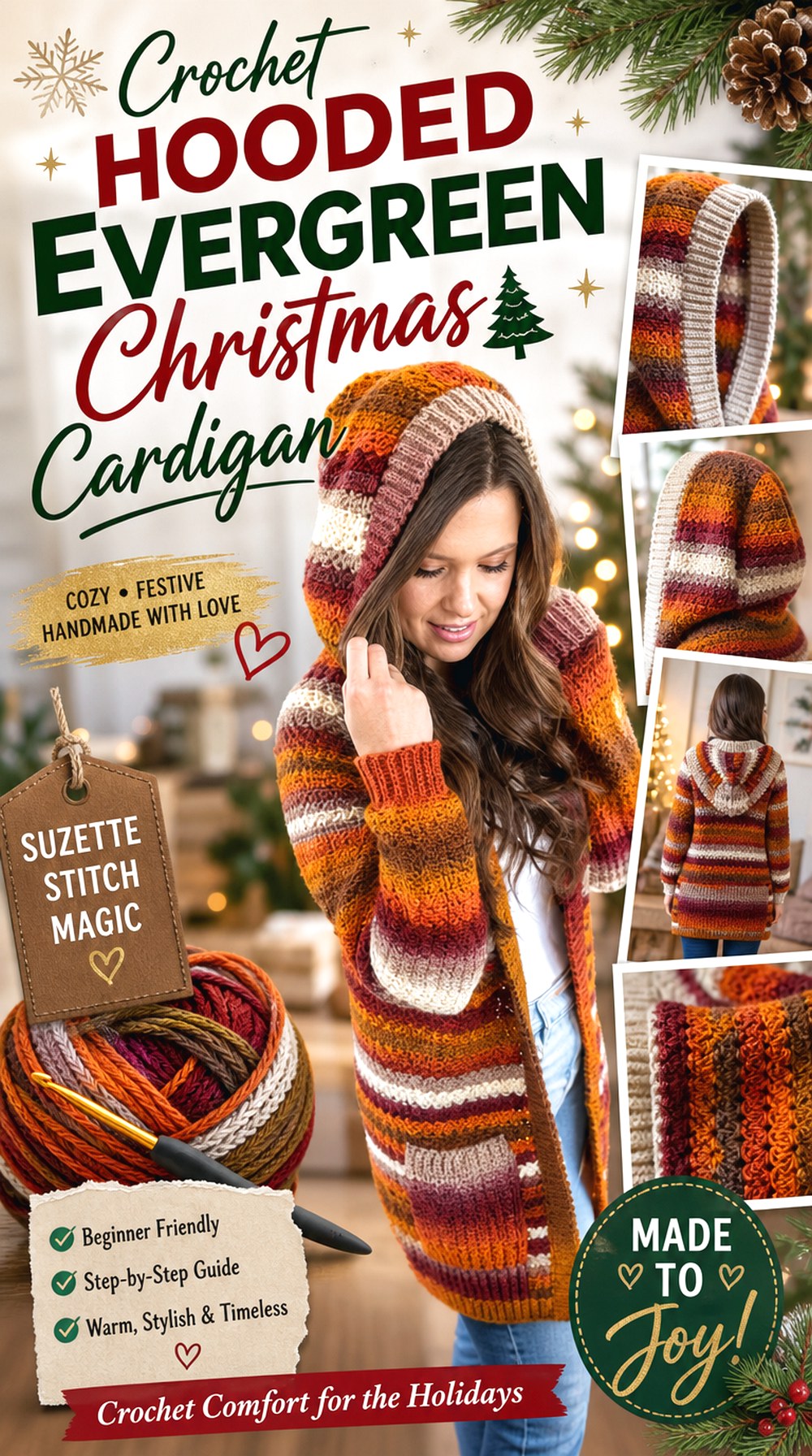
MJ’s Off The Hook Designs provides a textured top-down raglan cardigan tutorial with options that include a longer hooded version with pockets and a shorter buttoned version. That makes it one of the most adaptable constructions in this collection. For a Christmas interpretation, the long hooded option lends itself naturally to an evergreen winter palette rather than obvious novelty motifs.
The Suzette texture gives the fabric interest even in a mostly solid color, so a dark green body with restrained cream or red accents can feel seasonal without needing appliqués.
A Hood Adds Significant Fabric at the Neck and Back
If you choose the hooded version, include that extra fabric in your assessment of yarn weight and drape. A very heavy substitution can change how the upper cardigan hangs. The hood should complement the cardigan rather than continually pulling backward, so matching the pattern gauge and evaluating the worked fabric are especially important.
Pockets Can Carry the Festive Accent Instead
For a more restrained Christmas cardigan, keep the body largely evergreen and introduce contrast at the pockets, cuffs, or edging. This concentrates the holiday detail on components that are visually easy to control. It also avoids disturbing the textured stitch pattern with scattered motifs.
Original Tutorial and Creator Credit
Creator: MJ’s Off The Hook Designs
Crochet Chunky Fireplace Christmas Cardigan With Pockets
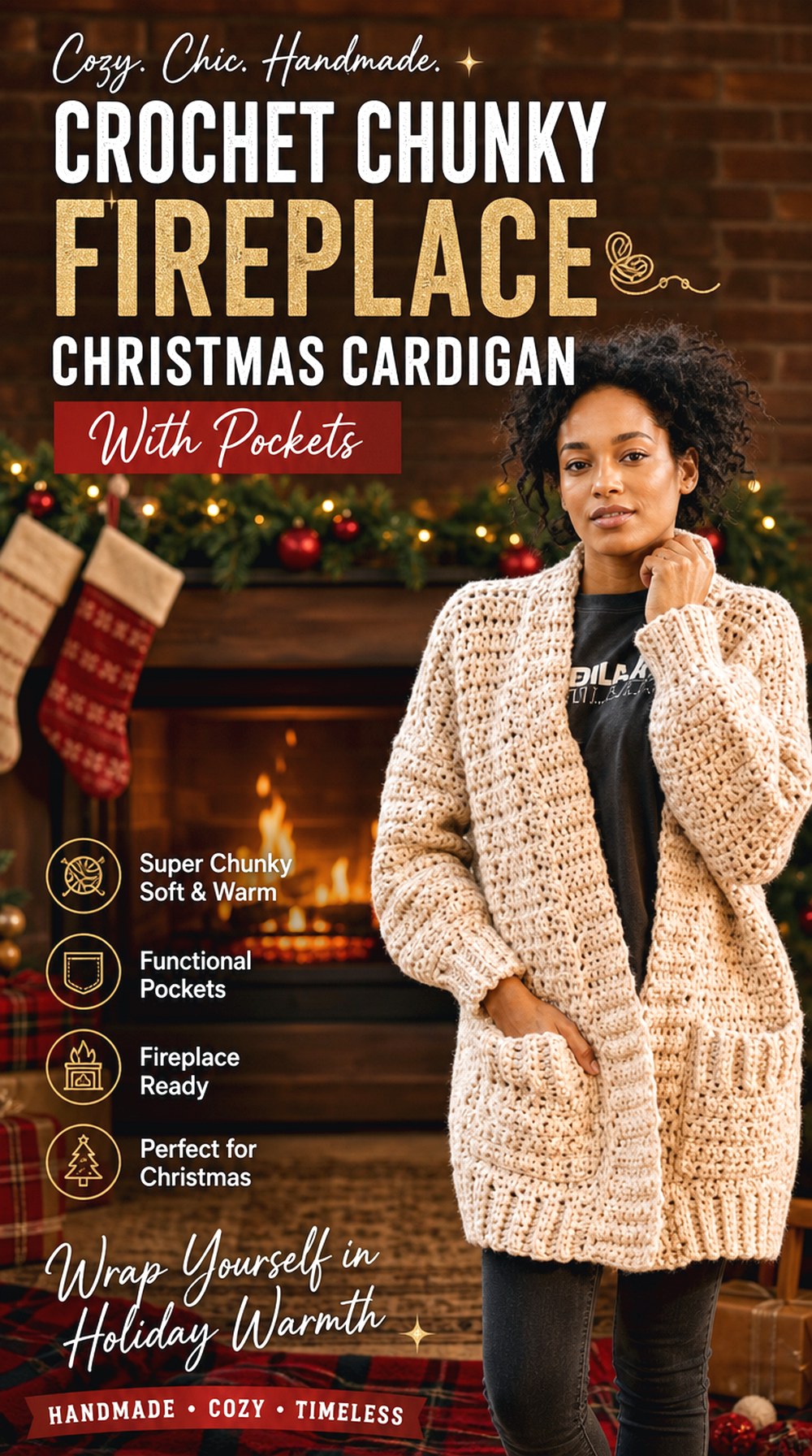
For a substantial winter layer, TL Yarn Crafts’ Kima Cardi tutorial provides a chunky open-front cardigan with deep pockets and pronounced ribbing. The original project is not Christmas-specific, but its heavier fabric and pocketed shape make it an obvious candidate for a cozy fireplace-inspired holiday version.
Rather than covering chunky texture with small motifs, use larger-scale color decisions. A warm cream body with cranberry pockets, evergreen ribbing, or a contrasting collar treatment will remain visible against the substantial stitches.
Chunky Yarn Makes Small Fit Errors Larger
Thick yarn builds fabric quickly, but each row and stitch also represents more physical space. Check measurements at the stages recommended by the pattern rather than assuming the cardigan will “settle” into the correct size. Heavy fabric can also lengthen differently when worn, which makes a finished swatch and careful gauge check worthwhile.
Deep Pockets Should Be Reinforced by Good Placement
A pocket changes both function and visual weight. Place both sides consistently and avoid hanging dense decorations directly from the pocket opening where hands repeatedly create friction. If the pocket itself carries a contrasting Christmas color, that may be enough decoration without an additional sewn motif.
Original Tutorial and Creator Credit
Creator: TL Yarn Crafts
Crochet Ribbed Christmas Button Cardigan
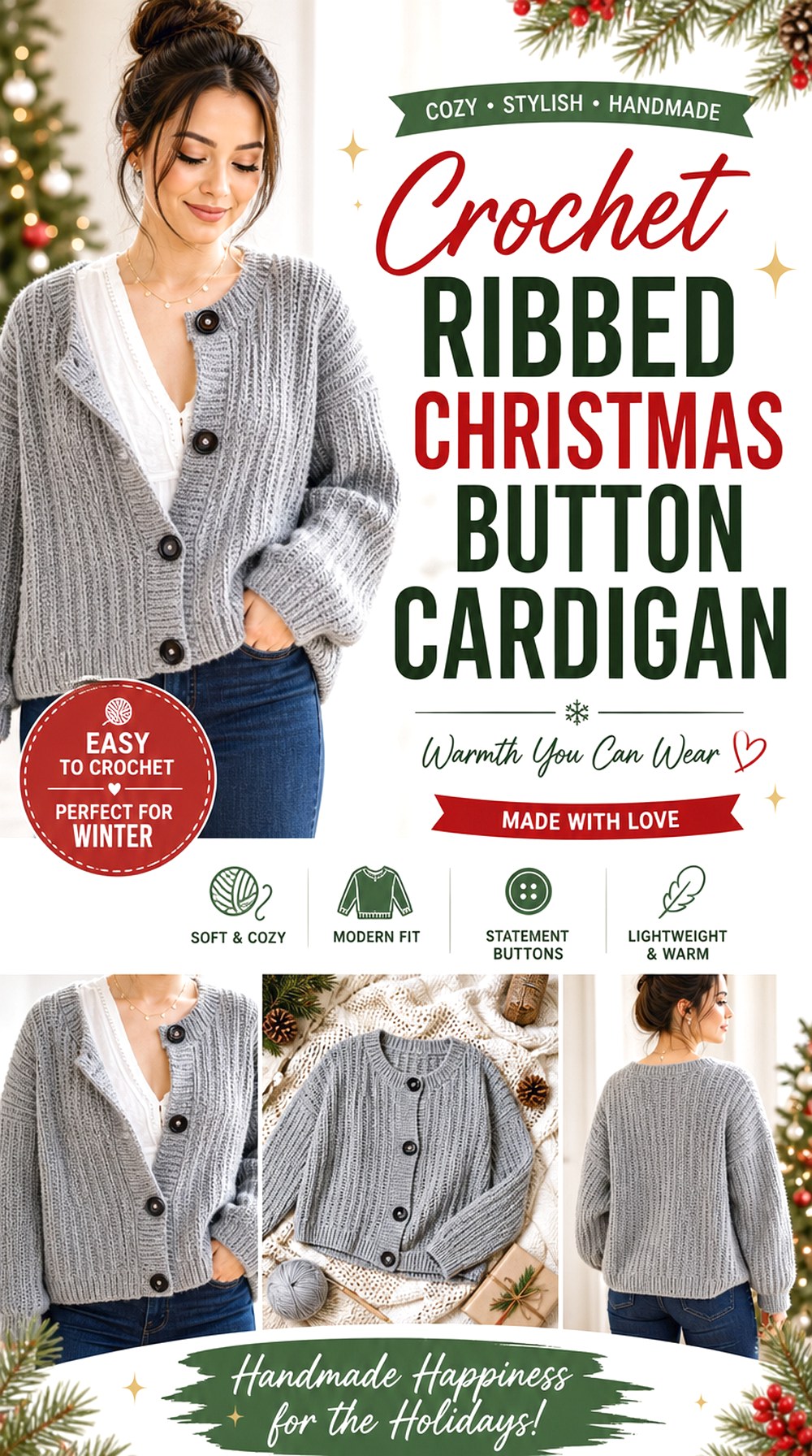
This idea uses a knit-look ribbed surface to create a Christmas cardigan that depends on texture and buttons rather than motifs. For The Frills’ Pompeii Cardigan is a boxy, oversized button-down design with broad ribbing, loose sleeves, a round neckline, and a side-to-side construction. The source design itself is not Christmas-themed.
A restrained festive palette works particularly well because the rib texture remains the main design feature. Consider a solid cranberry, forest green, winter cream, or a two-color treatment focused on the separate ribbing.
Ribbed Fabric Can Grow Differently From Flat Crochet
Stretchy ribbed textures deserve a careful swatch because their resting measurement may differ from how they behave on the body. Avoid deciding fit from an aggressively stretched sample. Follow the source gauge and sizing information, then consider the intended ease before adding seasonal adaptations.
Button Spacing Becomes a Major Design Detail
Large contrasting buttons can turn a simple ribbed cardigan into a strong holiday piece. Lay all buttons in position before sewing the first one permanently, then check that the opening remains smooth when closed. Uneven spacing or excessively tight closure points can make the front edge ripple even when the crocheted panels themselves are correct.
Original Tutorial and Creator Credit
Creator: For The Frills
Crochet Cranberry Texture Christmas Cardigan
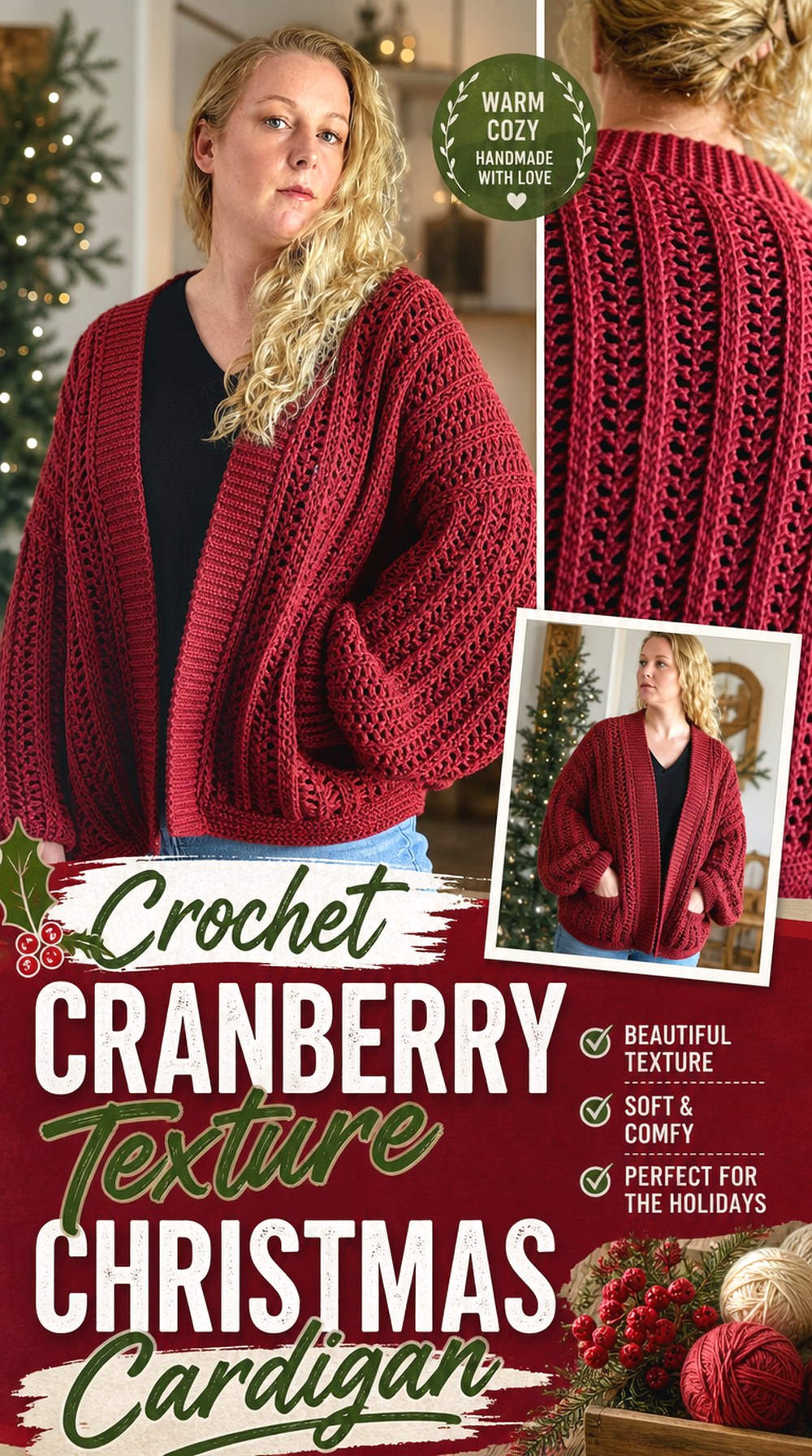
Hey Carrie’s texture-rib cardigan provides a quieter Christmas option for readers who care more about stitch surface than novelty decoration. The associated Acres Grove design works the cardigan body lengthways in one piece, with sleeves and ribbed finishing handled separately. The original project is not a Christmas cardigan.
A cranberry, wine, evergreen, or winter-neutral yarn can make the finished garment seasonal while letting its textured surface remain the main attraction. This is particularly useful if you want something suitable for December gatherings without looking like an “ugly Christmas sweater.”
Lengthwise Construction Changes Where You Make Adjustments
When the foundation direction controls garment length rather than width, alteration planning feels different from a bottom-up cardigan. Review the source’s construction carefully before adding or removing length. Do not assume that adding ordinary rows will lengthen the cardigan in the same way it would in a vertically worked body.
Let Texture Replace Extra Embellishment
Strong surface texture already catches light and creates visual depth. Before adding snowflakes or holly, look at the completed fabric from several feet away. A rich Christmas color plus the rib texture may be enough. Keeping decoration minimal also reduces the risk of obscuring the stitch pattern that makes this cardigan distinct.
Original Tutorial and Creator Credit
Creator: Hey Carrie
Crochet Long Shell Stitch Christmas Duster Cardigan
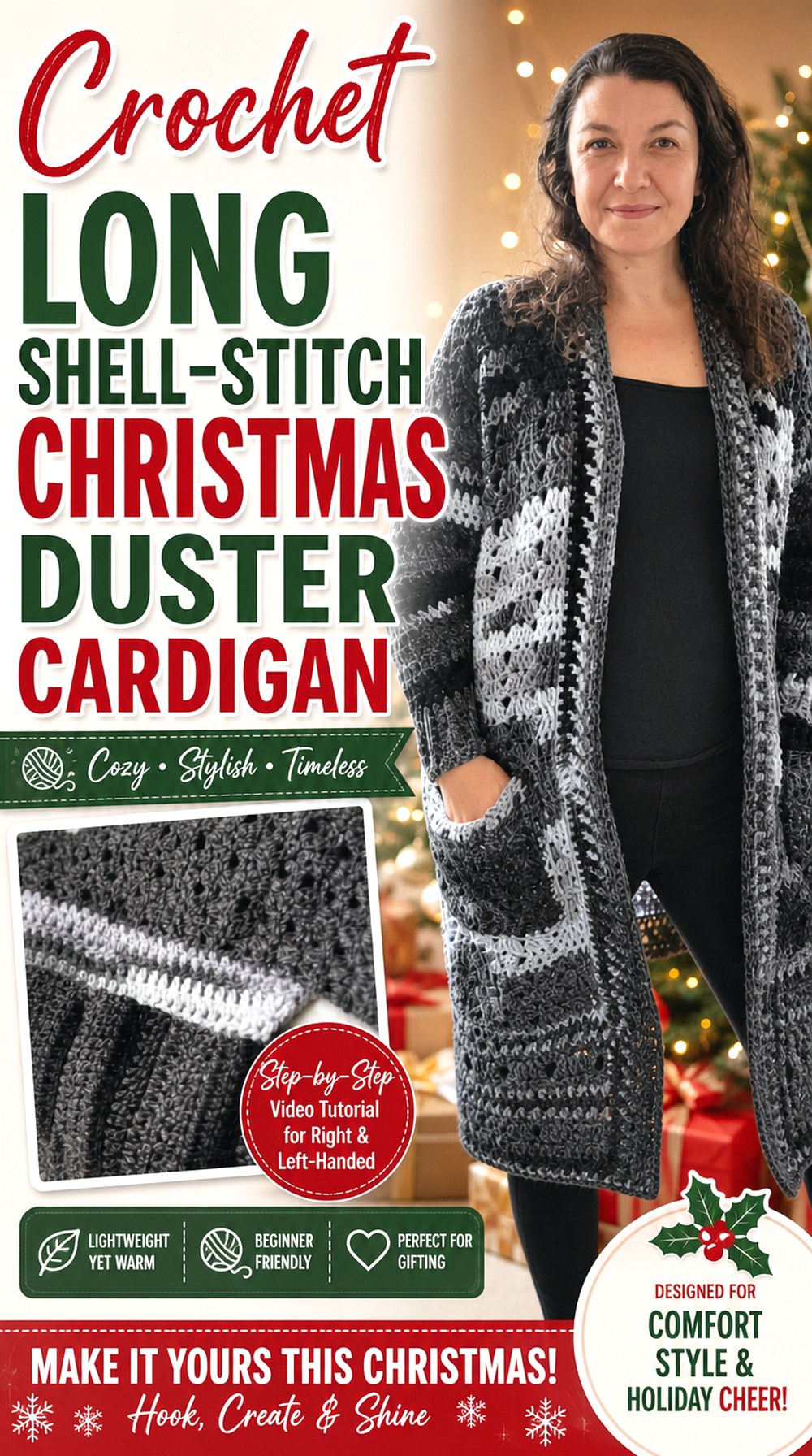
A long duster creates the most dramatic silhouette in the collection. Moogly’s Shell Stitch Crochet Duster uses an extended open-front shape with shell texture, tapered-sleeve options, and pockets. The original is a general cardigan design rather than a Christmas project, so the holiday version should be treated as a color and styling adaptation.
A long evergreen or winter-neutral body with a controlled red accent can feel almost coat-like and festive without relying on small motifs. Because gravity affects a longer garment more noticeably, drape deserves extra attention here.
Long Cardigans Need a Hanging-Drape Check
The longer the garment, the more its own weight can influence length and stitch appearance. A small swatch lying flat does not tell the entire story. After blocking, let the swatch hang for a period before evaluating it, especially if substituting a fiber with significantly different weight or stretch from the source yarn.
Place Pockets After Considering the Final Length
Pocket position can look correct on a flat panel but feel too low once the cardigan is worn and the body stretches vertically. Follow the source placement guidance, then check the proportions against your own finished garment. If you make approved length adjustments, reassess pocket location rather than copying a position mechanically.
Comparing the 20 Crochet Christmas Cardigan Directions
If you want the strongest built-in Christmas identity, start with the holly cardigan, mixed-appliqué patchwork cardigan, snowflake-square cardigan, or bottom-up appliqué cardigan. Those sources are already centered on festive garments.
For modular construction, compare the snowflake squares, peppermint granny squares, gift-box patchwork, and hexagon cardigan. The key difference is whether you want many individual units or two much larger folded hexagons.
Choose the raglan or textured continuous-body options when you want fewer visible joins. The cropped cardigan works well for a compact outfit, while the chunky pocket cardigan prioritizes heavier winter layering. At the opposite extreme, the mesh design creates the lightest-looking option.
The shell-stitch duster is the most dramatic in length, while the cocoon offers the loosest wraparound shape. For a Christmas cardigan you may still wear after the holidays, the ribbed button, cranberry texture, hooded evergreen, or holiday stripe options are the easiest to keep understated.
Conclusion
The most useful way to choose among these 20 crochet Christmas cardigan ideas is to start with the garment you actually want to wear. Pick granny squares or patchwork when motif placement is part of the fun, a raglan when top-down fit checks appeal to you, chunky pockets for a substantial winter layer, or a cropped, mesh, cocoon, or duster shape when silhouette matters more than decoration.
Then decide how permanent the Christmas theme should be. Snowflakes, holly, and mixed appliqués create unmistakable holiday pieces; strategic colors, buttons, stripes, and removable accents are easier to restyle. Use the original tutorials for the exact construction details, sizing instructions, and creator-specific techniques before adapting the festive elements.
Frequently Asked Questions
Can I turn any crochet cardigan tutorial into a Christmas cardigan?
You can give many cardigan designs a Christmas feel through color, buttons, appliqués, or compatible motifs, but that does not make the original tutorial a Christmas pattern. Construction still needs to follow the source. If you introduce a different granny square, stitch pattern, or heavy decoration, swatch first because the substitution may change dimensions, stretch, drape, or joining compatibility.
Should Christmas appliqués be attached before or after assembling the cardigan?
For most decorative placements, it is useful to evaluate the assembled or substantially assembled garment first. A motif centered on a flat panel may shift when the cardigan wraps around the body. Temporarily pin or baste appliqués, try the garment on, and check spacing around seams, buttons, underarms, and pockets before sewing them permanently.
How do I know whether two different granny-square motifs can be used in the same Christmas cardigan?
Compare the blocked dimensions, outside stitch structure, and fabric density rather than relying on the motif names. Two squares can have a similar appearance but finish at different sizes or with incompatible edges. Make one sample of each, block both consistently, and place them side by side. Any size correction is easier before you make an entire garment’s worth of motifs.
Is chunky yarn better for a crochet Christmas cardigan?
Not automatically. Chunky yarn can create a substantial winter cardigan and make large-scale holiday color blocking visible, but it also increases fabric thickness and may amplify fit differences. Lighter yarn can produce better drape and may suit detailed motifs or indoor layering. Follow the chosen tutorial’s yarn and gauge requirements unless you understand how a substitution will affect the garment.
How can I make a Christmas cardigan look festive without making it look like a costume?
Keep the construction classic and concentrate the seasonal theme in one or two elements. A cranberry ribbed cardigan with contrasting buttons, an evergreen hooded cardigan, or cream-and-red stripes can suggest Christmas without literal motifs. Limiting appliqués to one front panel, the pockets, or another controlled area also creates a clearer focal point than covering every available surface.
Should I block granny squares before joining a Christmas cardigan?
Blocking is particularly useful when several motifs must align in a wearable. It lets you compare finished dimensions, straighten edges, and identify squares that differ before those differences become puckered seams. Follow the fiber-appropriate blocking guidance for your yarn, and use the blocked measurements when planning the panel layout rather than assuming every unblocked square will settle to the same size.
Can I make the Christmas decorations removable?
Yes, removable accents can be useful when you want to wear the underlying cardigan beyond the holiday season. The fastening method should not damage or repeatedly snag the crochet fabric. Avoid heavy decorations hanging from delicate mesh or open stitches, and check that any pins, ties, buttons, or other attachment methods are appropriate for how and where the garment will be worn.