Plum Noir and burgundy create a deep crochet palette in which the differences can be subtle rather than immediately high-contrast. Think of Plum Noir as the darkest role in the scheme—a blackened or extremely deep plum direction—while burgundy brings a warmer red-wine note. Because shade names vary among yarn ranges, the relationship between your two actual yarns matters more than matching a standardized color.
This pairing is particularly effective when you want richness without introducing a pale neutral. The challenge is visibility. If Plum Noir and burgundy are both very dark, narrow stripes, small motifs, cables, and textured stitches can disappear into one another. Larger color blocks, controlled placement, and careful value checking become more important.
The tutorials paired with the ideas below support the crochet construction concepts. The Plum Noir and burgundy palettes are independent color adaptations, so follow each creator’s tutorial for the original construction details.
Quick List
- Plum Noir and Burgundy Striped Crochet Blanket
- Burgundy Crochet Cardigan with Plum Noir Ribbing
- Plum Noir Crochet Market Bag with Burgundy Handles
- Burgundy and Plum Noir Celtic Weave Crochet Pillow
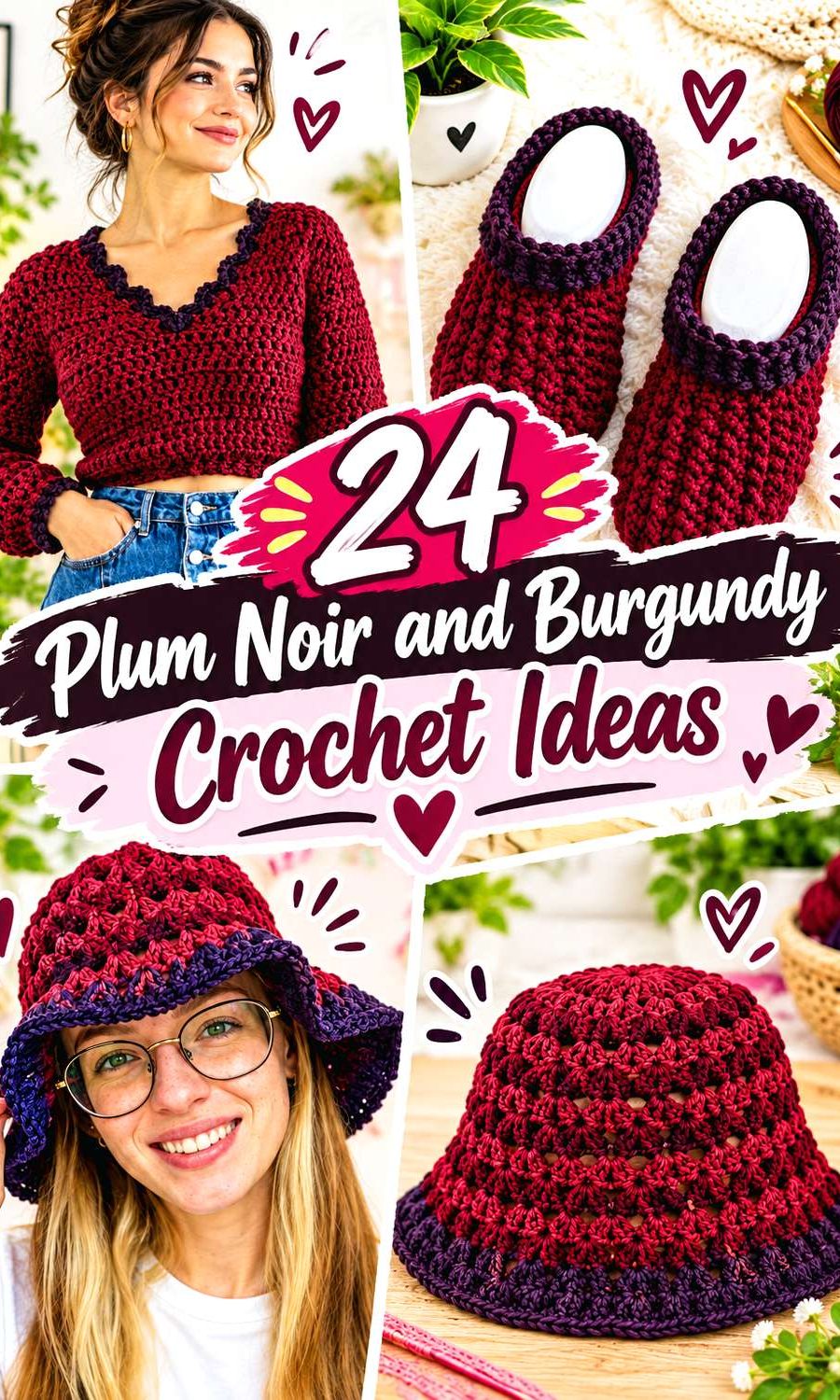
- Burgundy Crochet Textured Beanie with Plum Noir Brim
- Plum Noir Crochet Shawl with Burgundy Texture Bands
- Plum Noir and Burgundy Checkerboard Crochet Vest
- Burgundy Crochet Bucket Hat with Plum Noir Brim
- Burgundy Crochet Bandana with Plum Noir Edging
- Plum Noir Crochet Waffle Shoulder Bag with Burgundy Panels
- Burgundy Crochet Cardigan with Plum Noir Front Bands
- Plum Noir Crochet Storage Basket with Burgundy Stripe
- Plum Noir Crochet Poncho with Burgundy Border
- Burgundy Crochet Beanie with Plum Noir Crown
- Burgundy and Plum Noir Picot Crochet Beanie
- Plum Noir Crochet Chunky Cardigan with Burgundy Bands
- Burgundy Crochet Tote Bag with Plum Noir Base
- Plum Noir Crochet Handbag with Burgundy Accent Panel
- Burgundy Crochet Slippers with Plum Noir Cuffs
- Burgundy Crochet Oversized Cardigan with Plum Noir Edging
- Plum Noir Crochet Triangle Shawl with Burgundy Border
- Burgundy Crochet Cropped Sweater with Plum Noir Trim
- Plum Noir Crochet Oversized Basket with Burgundy Band
- Burgundy and Plum Noir Crochet Balaclava
Check Plum Noir and Burgundy for Light-Dark Contrast
Plum Noir and burgundy can look clearly different in the skein while becoming much closer once crocheted. Different hues do not automatically create different values. A very deep burgundy beside blackened plum may produce an intentionally blended result, but small motifs and detailed texture can lose definition.
Place the yarns side by side before choosing the color layout. A grayscale photo is a useful visual check: if the colors nearly merge, reserve the pairing for broad sections or introduce stronger separation through placement. You do not necessarily need a third color; simply increasing the size of each Plum Noir or burgundy area can make the distinction clearer.
Let Plum Noir Anchor Burgundy Crochet Projects
Because Plum Noir is intended to be the deepest shade in this palette, it can work particularly well around edges and structural areas. Borders, bag bases, cuffs, ribbing, straps, joins, brims, and garment openings provide natural places for the darkest color.
That does not mean Plum Noir always has to be the accent. Reversing the hierarchy creates a substantially different result. A mostly Plum Noir cardigan or shawl with controlled burgundy details feels much darker than a burgundy-led version with Plum Noir outlining the edges.
Protect Crochet Texture When Plum Noir and Burgundy Are Both Dark
Crochet texture relies partly on highlights and shadows. Cables, waffle stitches, post stitches, bobbles, and heavy ribbing may already contain deep shadow lines, so using Plum Noir across the most complex texture can reduce its visibility.
When texture is an important feature, consider putting burgundy across the detailed surface and moving Plum Noir to simpler surrounding sections. If you prefer Plum Noir on the texture, make a swatch and view it under ordinary room lighting before committing to the full project.
1. Plum Noir and Burgundy Striped Crochet Blanket
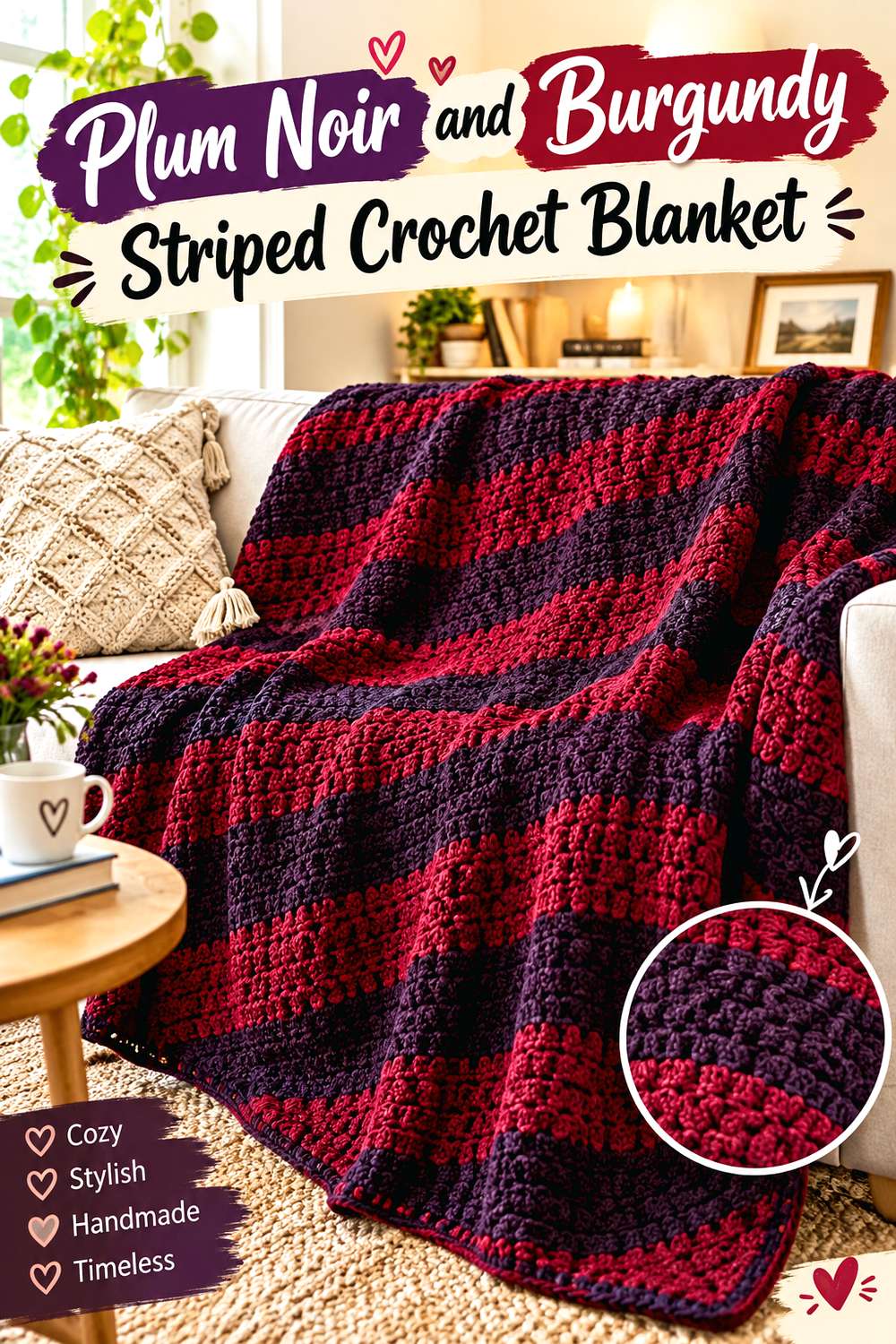
A striped blanket gives both deep colors enough surface area to remain distinct. Instead of using narrow alternating rows, give burgundy broad warm sections and let Plum Noir create darker interruptions. This arrangement preserves the two-color identity even when the yarns are relatively close in value.
Make Burgundy the Broader Crochet Blanket Color
Wider burgundy bands let the red undertone remain visible rather than allowing the entire blanket to read as nearly black from a distance. They also give stitch texture more uninterrupted space.
If your burgundy is almost as dark as Plum Noir, increase the stripe width rather than adding more frequent color changes.
Use Plum Noir to Frame Burgundy Crochet Blanket Stripes
Plum Noir can appear in repeated interior bands and return at the outer border. Repeating the darkest shade at the edge makes the border feel connected to the stripe sequence rather than newly introduced.
If Plum Noir already occupies a large percentage of the blanket, a burgundy finishing edge can reverse that emphasis and warm the perimeter.
Creator Credit: Daisy Farm Crafts
2. Burgundy Crochet Cardigan with Plum Noir Ribbing

A cardigan offers several structural areas for the darker shade, including cuffs, lower ribbing, pockets, neckline, and front opening. Keeping burgundy across the main body lets Plum Noir define those edges without dividing large panels unnecessarily.
Keep Burgundy Across the Main Crochet Cardigan Panels
Burgundy can carry the front, back, and sleeves so the cardigan has one continuous warm-dark field. That leaves the garment construction readable and prevents too many closely valued color blocks from competing.
If the cardigan includes pockets, keeping them burgundy allows them to blend into the body rather than becoming additional focal points.
Repeat Plum Noir Across Burgundy Crochet Cardigan Ribbing
Use Plum Noir consistently at several related edges. Cuffs plus lower ribbing create balanced dark anchors, while carrying Plum Noir into the front opening can connect the entire frame.
Avoid using Plum Noir on just one cuff or one isolated section unless deliberate asymmetry is the goal.
Creator Credit: Bella Coco
3. Plum Noir Crochet Market Bag with Burgundy Handles

An open market bag is a useful place for Plum Noir because the mesh prevents the dark shade from becoming a completely solid visual mass. Burgundy can warm the opening and handles while remaining clearly connected to the bag’s structure.
Let Plum Noir Cover the Crochet Market Bag Body
Keeping the mesh body Plum Noir creates a consistent dark foundation. Because the contents or background can remain visible through an open stitch pattern, the color will interact with whatever appears behind it.
Avoid frequent burgundy changes throughout the mesh when the stitch pattern already has plenty of visual movement.
Connect Burgundy Handles to the Plum Noir Crochet Bag
Carry burgundy from the handles into the upper edging or one repeated band. That prevents the handles from looking like a separate color decision pasted onto the Plum Noir body.
A narrow burgundy detail near the base can add further repetition without turning the bag into a striped design.
Creator Credit: The Crochet Crowd
4. Burgundy and Plum Noir Celtic Weave Crochet Pillow

Celtic-style cable texture creates strong shadows, making color placement particularly important. Burgundy is a useful candidate for the main textured face because it may show raised crossings more clearly than an almost-black Plum Noir.
Let Burgundy Reveal the Crochet Pillow’s Woven Texture
Use burgundy across the largest cable area when texture visibility is a priority. The warmer shade gives raised sections more opportunity to catch light while still maintaining the deep overall palette.
Before starting the full pillow, inspect a burgundy swatch under the lighting where the pillow will actually be displayed.
Reserve Plum Noir for the Burgundy Crochet Pillow Edge
Plum Noir can frame the textured face without filling every shadowed cable crossing. An outer edge or simpler back panel gives the darkest shade substantial presence while preserving the definition of the center.
For a stronger Plum Noir role, repeat it in a controlled central band rather than changing color inside every cable.
Creator Credit: MJ’s Off The Hook Designs
5. Burgundy Crochet Textured Beanie with Plum Noir Brim
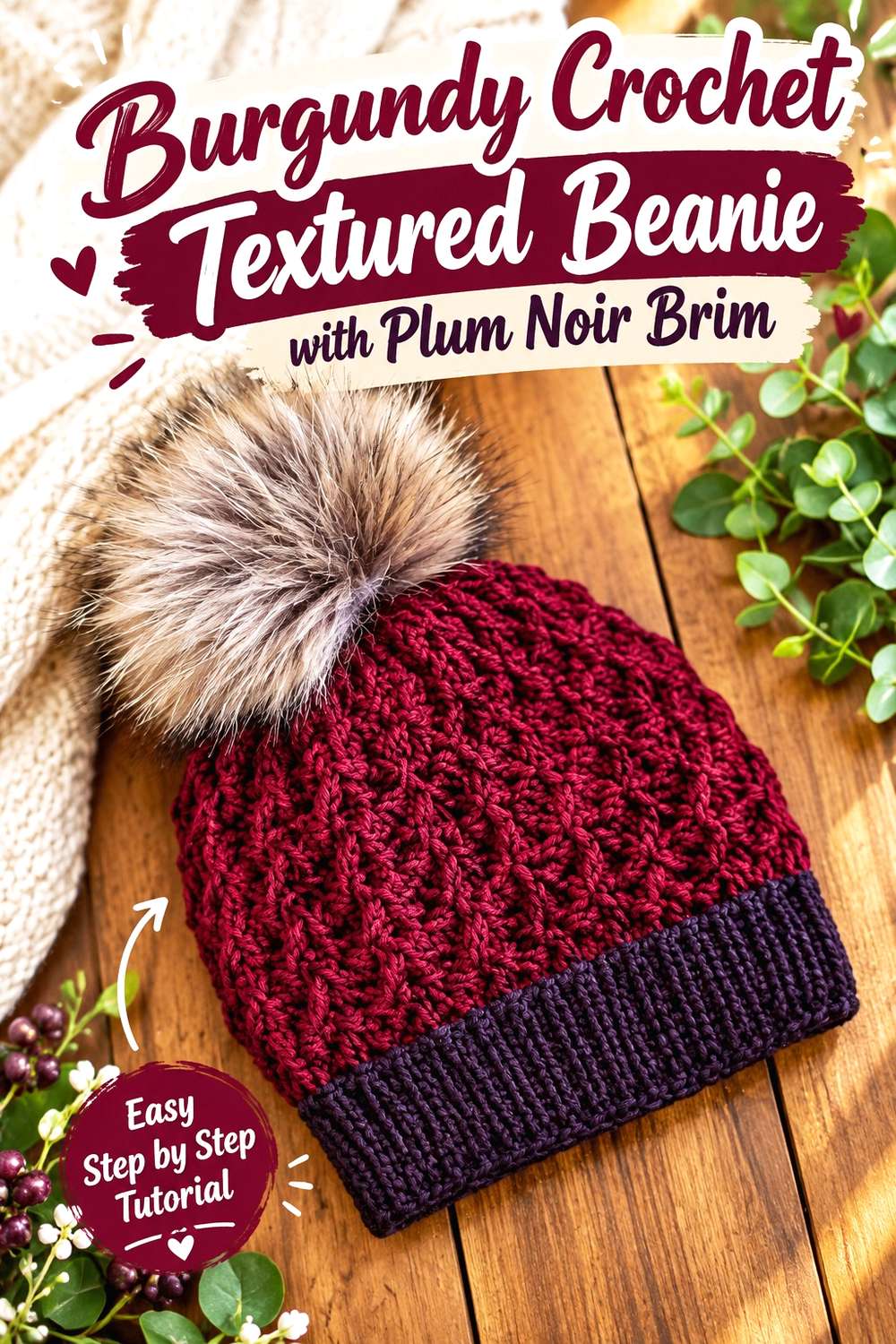
A textured beanie has limited surface area, so assigning each color a distinct region keeps the design from becoming crowded. Burgundy can carry the detailed crown while Plum Noir forms a strong lower frame.
Keep Burgundy Across the Crochet Beanie Texture
Let one burgundy field cover the textured portion so raised stitches remain continuous. Frequent Plum Noir interruptions can hide the repeat, particularly when both shades are dark.
A brighter or medium-deep burgundy will create stronger visibility than a nearly black wine shade.
Put Plum Noir on the Burgundy Crochet Beanie Brim
The brim already has a structural purpose, making it a logical location for Plum Noir. Its darker appearance can visually separate the ribbing from the burgundy crown.
If the brim feels too disconnected, repeat a narrow Plum Noir band once higher on the hat.
Creator Credit: Rich Textures Crochet
6. Plum Noir Crochet Shawl with Burgundy Texture Bands
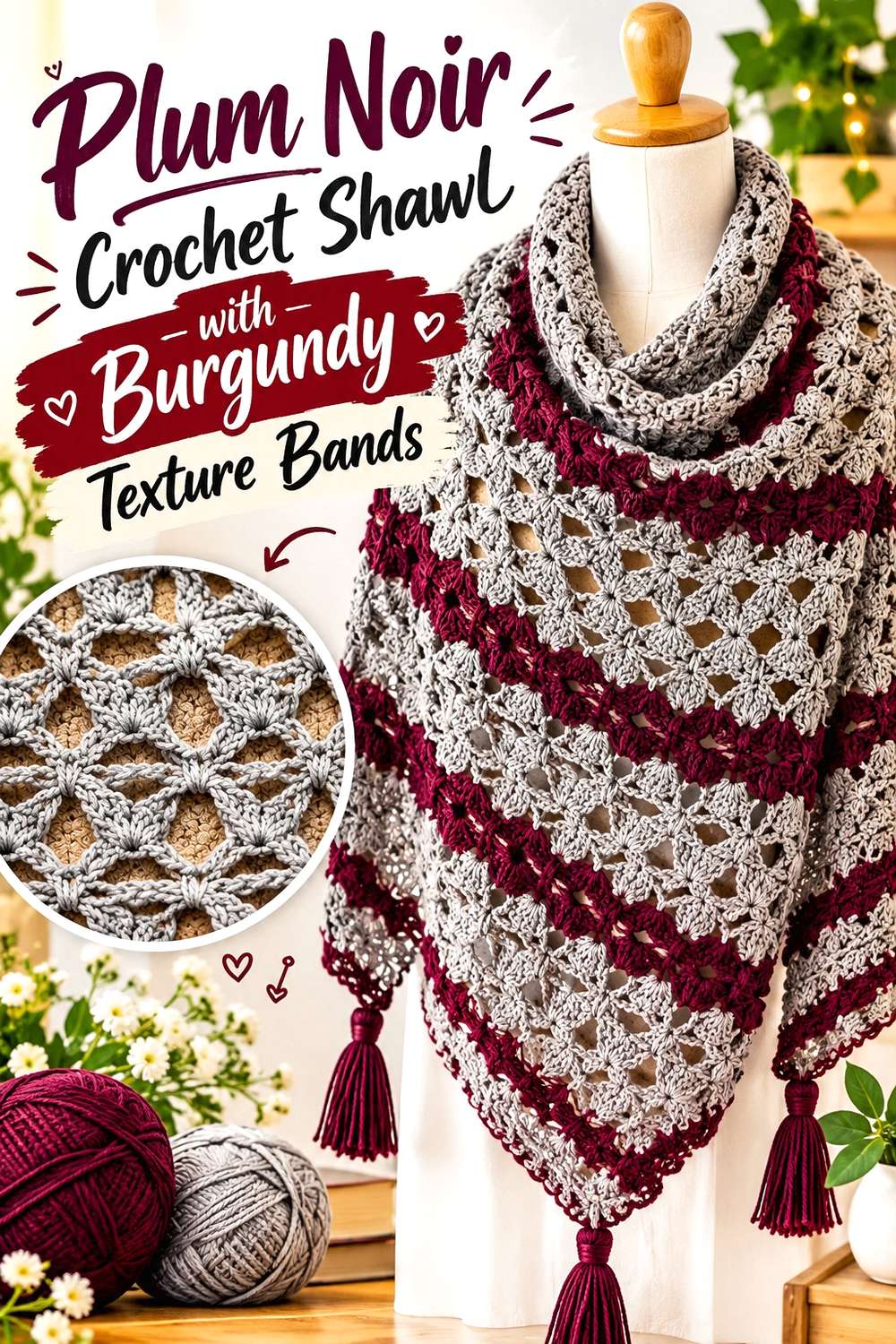
A shawl can handle a mostly Plum Noir palette because its broad surface gives the dark color room to develop. Burgundy bands are most useful when they correspond to noticeable texture changes rather than appearing at arbitrary intervals.
Give Plum Noir Wide Areas on the Crochet Shawl
Keep several sections continuously Plum Noir so the shawl maintains a dark, uninterrupted foundation. On openwork, the background behind the fabric will also contribute to the final appearance.
If Plum Noir makes the stitch pattern difficult to see, shift the most intricate rows into burgundy.
Place Burgundy Where the Plum Noir Crochet Shawl Changes Texture
Use burgundy to mark selected pattern transitions or broader decorative bands. The warmer shade can make those sections easier to recognize and creates a reason for every color change.
Keep enough Plum Noir between the burgundy areas to avoid an overly busy stripe effect.
Creator Credit: Fiber Spider
7. Plum Noir and Burgundy Checkerboard Crochet Vest
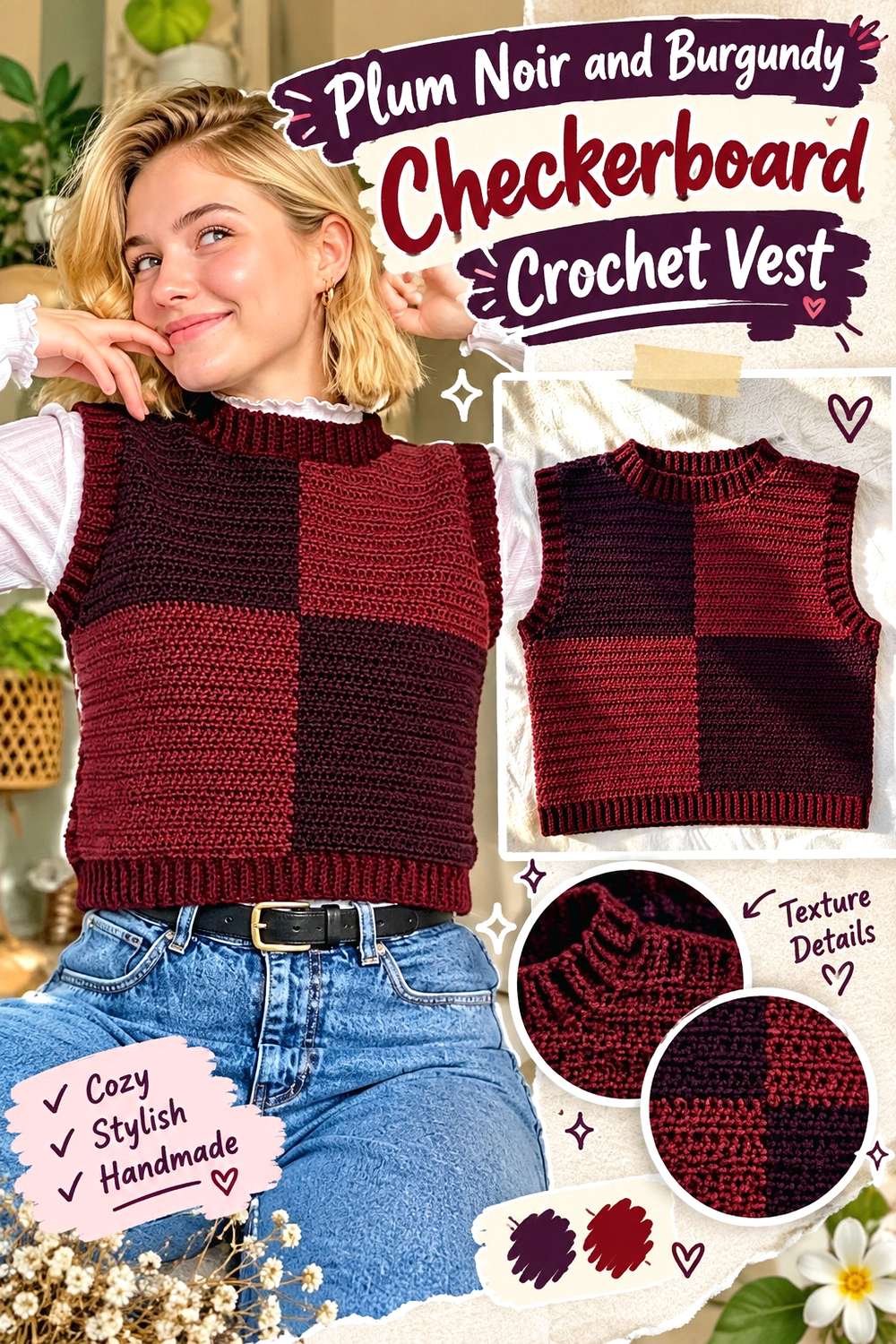
Checkerboard construction gives both colors comparable importance, making this one of the strongest graphic treatments in the collection. Because Plum Noir and burgundy are closely related dark colors, checking their values before starting is especially important.
Test Plum Noir and Burgundy Before Crocheting the Vest Blocks
A checkerboard relies on boundaries that remain visible from a normal viewing distance. If your burgundy becomes almost indistinguishable from Plum Noir in grayscale, the finished checkerboard may appear more tonal than graphic.
That can still be an intentional result, but it is better to know before making all the blocks.
Use Plum Noir to Frame Burgundy Crochet Vest Checks
A Plum Noir neckline, armhole edge, and lower trim can provide a consistent frame around equal burgundy-and-Plum-Noir blocks.
If you want the warmer shade to dominate instead, use burgundy for the trim. The edge choice can noticeably shift an otherwise balanced checkerboard.
Creator Credit: Hayhay Crochet
8. Burgundy Crochet Bucket Hat with Plum Noir Brim
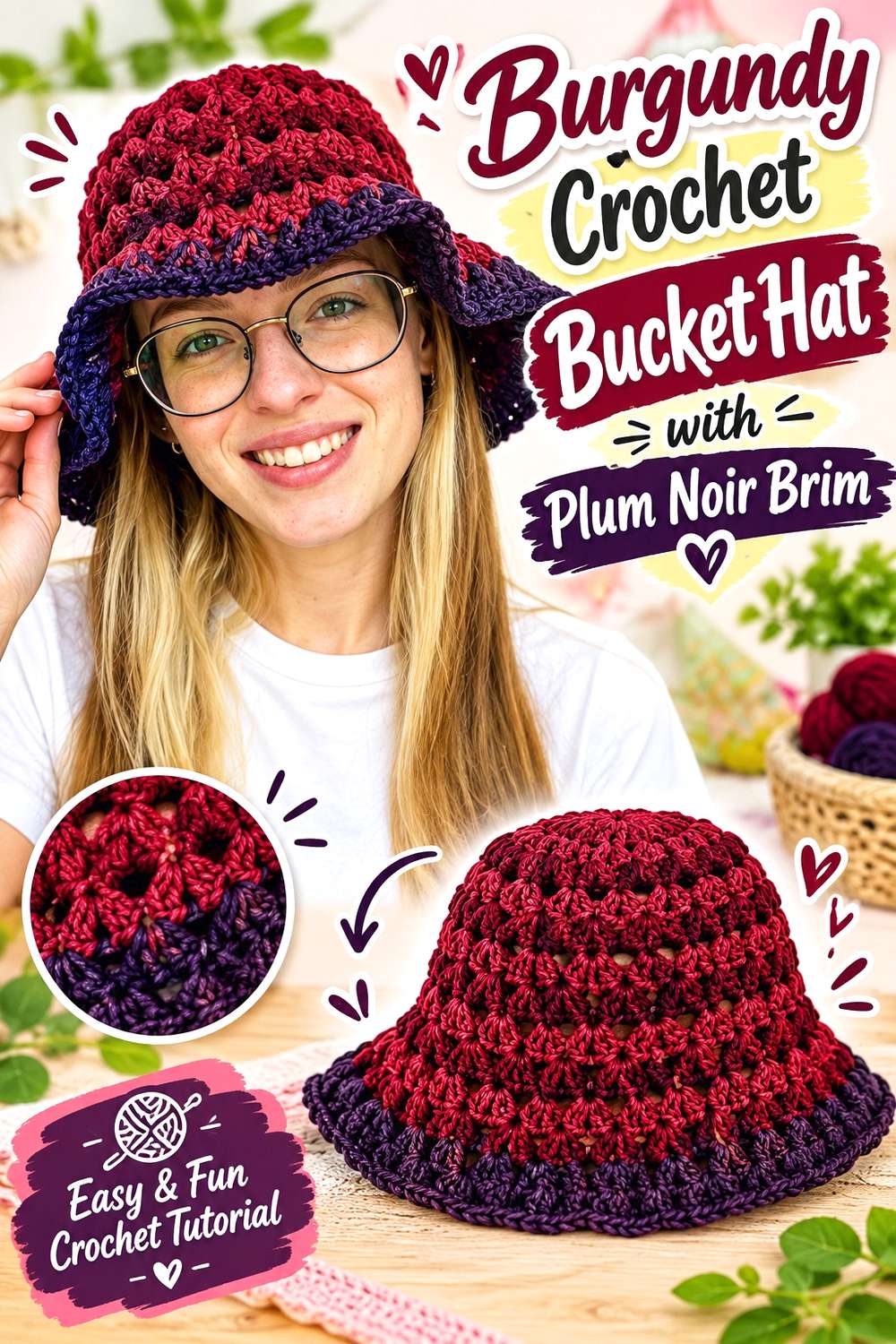
A bucket hat naturally separates into crown, sides, and brim. That allows you to create strong color blocking without forcing transitions into arbitrary points.
Carry Burgundy Through the Crochet Bucket Hat Crown
Use burgundy over the crown and most of the side section for a continuous warm field. This also keeps increases and shaping visually cohesive.
If you want more Plum Noir above the brim, one substantial side band will usually read more clearly than many thin rounds.
Start Plum Noir Where the Burgundy Crochet Bucket Hat Brim Flares
Switching to Plum Noir at the brim connects color placement with a visible change in shape. The darkest shade then forms a strong outline around the entire hat.
A final burgundy edge can be added conceptually if you want to bring the upper color back into the lower section.
Creator Credit: PassioKnit Kelsie
9. Burgundy Crochet Bandana with Plum Noir Edging

A bandana has a clearly defined central field, outer edge, and ties, so a two-color palette is straightforward to organize. Burgundy can fill the main triangular area while Plum Noir creates an uninterrupted outline.
Keep Burgundy Across the Crochet Bandana Center
A broad burgundy center lets decorative stitches or openwork remain the main detail. Adding Plum Noir throughout every small cluster could make a compact accessory unnecessarily busy.
If the burgundy itself is very dark, view the bandana against your hair or clothing before deciding how much Plum Noir to add.
Extend Plum Noir from the Burgundy Crochet Bandana Border into the Ties
Using the same dark shade for border and ties creates a continuous visual line around the accessory. Plum Noir then serves both decorative and structural areas.
If the edge is very narrow, make sure your burgundy is different enough in value for the outline to remain visible.
Creator Credit: VivCrochets
10. Plum Noir Crochet Waffle Shoulder Bag with Burgundy Panels
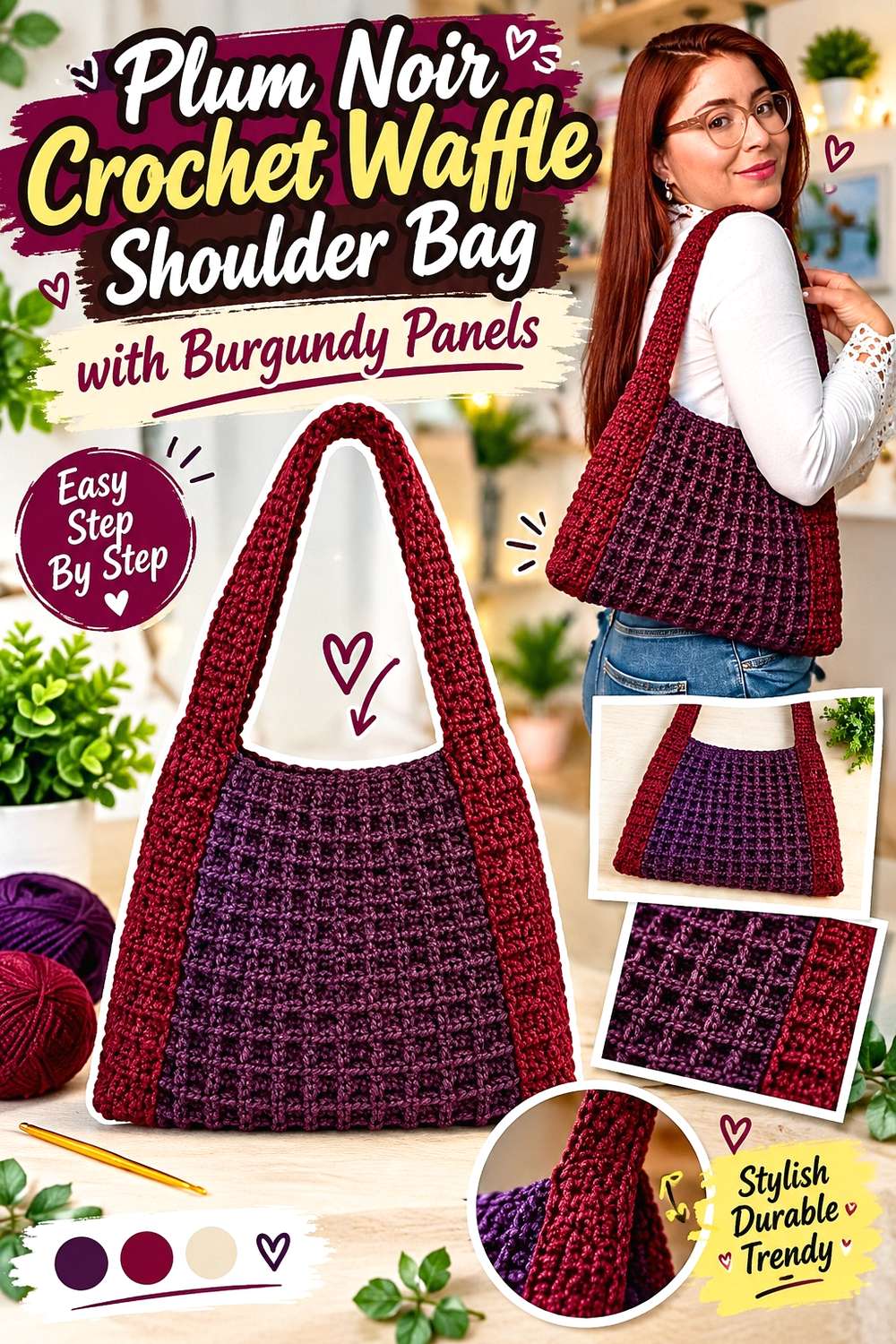
Waffle stitch already creates deep shadow pockets, so a fully Plum Noir surface may conceal some of the grid. Burgundy panels can protect texture visibility while Plum Noir handles the outer structure.
Use Burgundy Where the Plum Noir Crochet Bag Needs More Texture Visibility
Consider burgundy for the largest waffle-textured panels. The warmer color can reveal raised lines more clearly while still fitting the dark palette.
If you strongly prefer Plum Noir on the front, make a small waffle swatch first and examine it in ordinary indoor light.
Put Plum Noir Around Burgundy Crochet Bag Borders and Straps
A Plum Noir strap, side band, or outer frame can give the burgundy panels a defined boundary. Repeating the darkest shade at both the strap and base connects the bag vertically.
Keep the burgundy panel large enough that it does not look like a small decorative patch.
Creator Credit: Brunaticality
11. Burgundy Crochet Cardigan with Plum Noir Front Bands

This cardigan direction uses the darkest color to emphasize the opening rather than all of the ribbing. Burgundy remains broad across the panels and sleeves, while Plum Noir follows the front line and selected finishing areas.
Let Burgundy Keep the Crochet Cardigan Body Continuous
A continuous burgundy body makes the garment feel warmer and avoids excessive dark segmentation across the torso. It also allows stitch texture and shaping to remain easier to read.
Plum Noir can still occupy substantial space through broad finishing bands rather than interior stripes.
Use Plum Noir to Define the Burgundy Crochet Cardigan Opening
Running Plum Noir along both front edges creates strong vertical definition. Repeat it at the cuffs if you need another dark area to balance the opening.
Avoid introducing Plum Noir only at the neckline; carrying it farther down the front makes the placement feel more deliberate.
Creator Credit: TCDDIY
12. Plum Noir Crochet Storage Basket with Burgundy Stripe

A storage basket provides a stable cylindrical surface where one broad color band can be more effective than several small stripes. Plum Noir can cover most of the container while burgundy breaks up the dark walls.
Let Plum Noir Ground the Crochet Storage Basket
Use Plum Noir across the base and lower sides when you want the basket to read primarily as a very dark decor item. A continuous lower area gives the shape visual weight.
When displaying the basket against a dark shelf or wall, consider whether the Plum Noir outline will remain visible.
Make the Burgundy Crochet Basket Stripe Substantial
A thin burgundy stripe may disappear into Plum Noir at room distance. Give burgundy enough height to establish itself as a real color block.
Placing the stripe in the upper half can help it stay visible even when nearby objects partly obscure the basket base.
Creator Credit: Jayda InStitches
13. Plum Noir Crochet Poncho with Burgundy Border
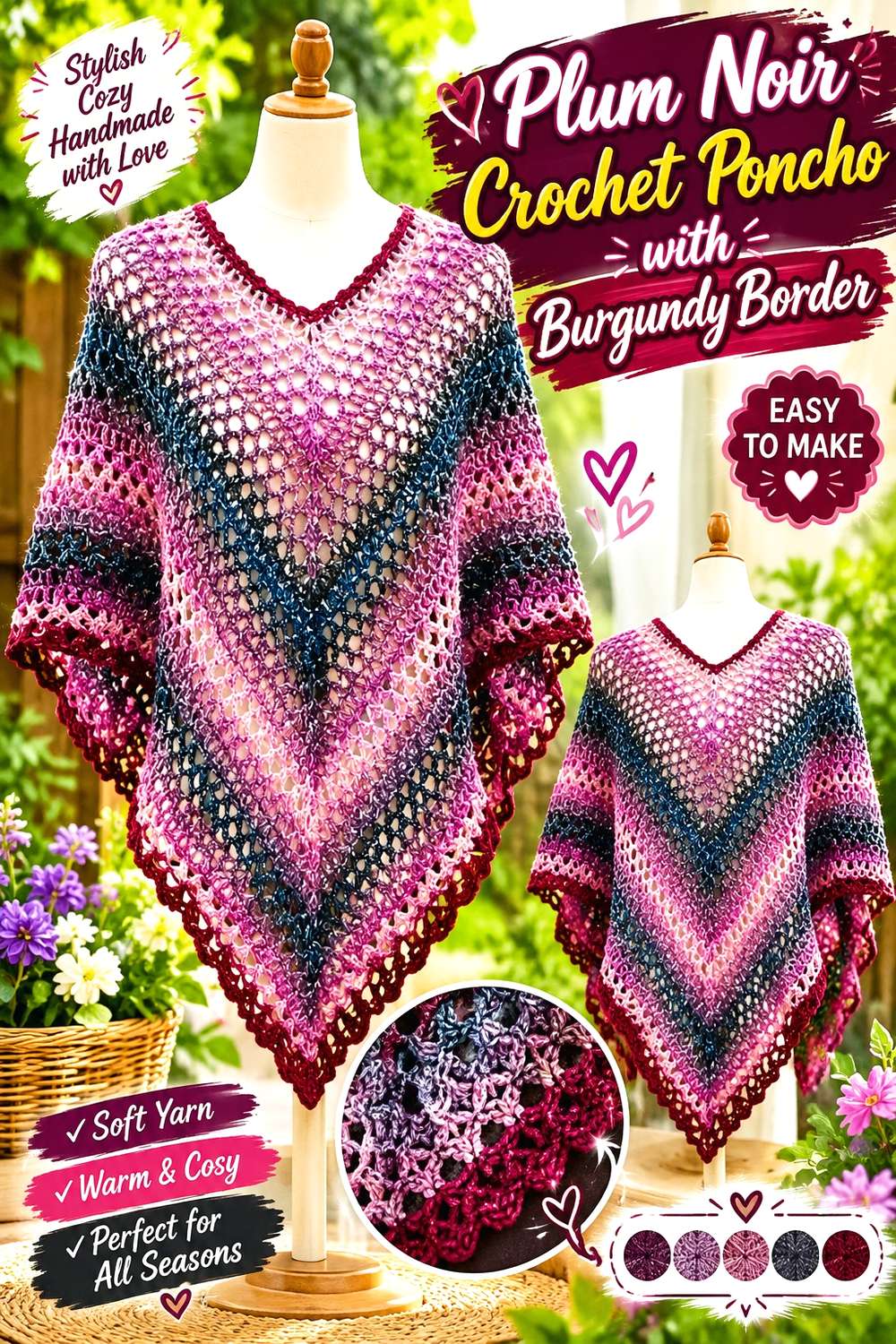
A poncho supplies a broad draped field suited to Plum Noir dominance. Burgundy can follow the neckline and lower edge, bringing warmth to the perimeter without dividing the main body.
Keep Plum Noir Across the Broad Crochet Poncho Surface
The large silhouette benefits from an uninterrupted dark field. Stitch pattern and drape can create visual variation without requiring repeated burgundy stripes.
If detailed texture disappears in Plum Noir, reserve selected textured bands for burgundy instead.
Carry Burgundy Around the Plum Noir Crochet Poncho Perimeter
A burgundy lower border creates a long, visible warm accent. Repeating burgundy around the neckline connects the top and bottom of the garment.
Keep the border width proportional to the main Plum Noir field so the overall hierarchy remains clear.
Creator Credit: Bag-O-Day Crochet
14. Burgundy Crochet Beanie with Plum Noir Crown

Instead of placing the darkest color at the brim, this version concentrates Plum Noir toward the top. Burgundy remains nearer the face and forms the main visible body when the hat is worn straight on.
Keep Burgundy Around the Crochet Beanie’s Lower Body
Burgundy around the lower hat allows the warmer red undertone to remain obvious. It can also help ribbing and lower texture read more clearly than an almost-black shade.
Use a broad burgundy section rather than making it only a thin edge.
Transition Plum Noir Across the Burgundy Crochet Beanie Crown
Plum Noir can begin above the main burgundy body and continue through the crown shaping. This produces a gradual shift toward the darkest part of the palette.
If the transition feels abrupt, introduce one medium-width alternating section rather than multiple tiny stripes.
Creator Credit: Briana K Designs
15. Burgundy and Plum Noir Picot Crochet Beanie

Picot texture already creates raised dots and shadows, making a restrained color plan preferable. Burgundy can carry the more detailed body while Plum Noir emphasizes selected textured bands or the ribbed edge.
Let Burgundy Show the Crochet Beanie Picot Texture
Using burgundy through the most dimensional sections gives small raised details a better chance of remaining visible. Closely alternating two dark shades around every picot would create more visual noise.
If your burgundy is exceptionally deep, swatch before deciding whether it can carry all of the texture.
Place Plum Noir Between Burgundy Crochet Beanie Texture Zones
Use Plum Noir as a deliberate separator between selected burgundy sections or reserve it for the brim. This allows the darkest shade to organize the texture rather than obscure it.
One or two strong Plum Noir areas are likely to be more effective than many thin dark rounds.
Creator Credit: The Turtle Trunk
16. Plum Noir Crochet Chunky Cardigan with Burgundy Bands

Chunky stitches increase the visual scale of a cardigan, so the color blocks can also be substantial. Plum Noir can dominate the broad body while burgundy forms wide sleeve or lower-body bands.
Give Plum Noir the Largest Crochet Cardigan Areas
A dark Plum Noir body creates a strong foundation and lets the chunky stitch scale remain uninterrupted. Burgundy does not need equal coverage to become noticeable.
If Plum Noir hides too much surface detail, shift the highest-texture section into burgundy.
Make Burgundy Bands Wide on the Plum Noir Crochet Cardigan
Very thin burgundy stripes can look undersized beside chunky stitches. Broader bands better match the garment’s visual scale and allow the warmer hue to register clearly.
Repeat a similar burgundy width on both sleeves or another related section for balance.
Creator Credit: TL Yarn Crafts
17. Burgundy Crochet Tote Bag with Plum Noir Base
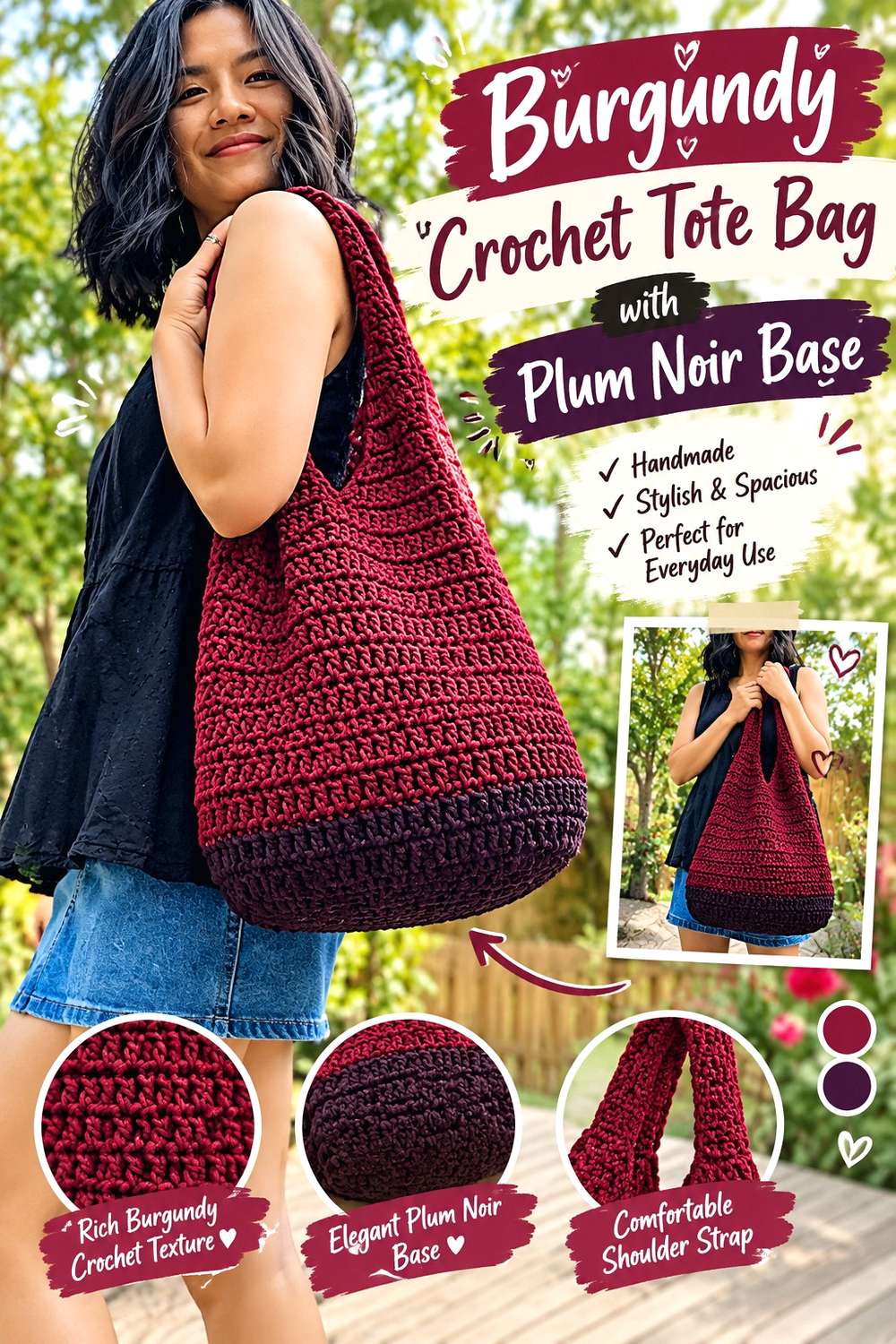
A tote allows the darkest shade to be placed where it visually grounds the shape. Plum Noir can cover the base and perhaps continue into the handles, while burgundy fills most of the tall bag body.
Let Burgundy Cover the Main Crochet Tote Walls
Broad burgundy panels keep the bag warmer than a Plum Noir-led version and provide enough space for stitch definition.
When planning color blocks, look at the tote from the sides as well as the front so the burgundy sections continue coherently around the bag.
Repeat Plum Noir from the Burgundy Crochet Tote Base into the Handles
Using Plum Noir at both bottom and top creates a dark framework around the burgundy body. Handles are especially useful for repetition because they naturally connect back into the opening.
If Plum Noir handles feel too visually heavy, keep the handles burgundy and repeat Plum Noir only around the upper edge.
Creator Credit: KnitcroAddict
18. Plum Noir Crochet Handbag with Burgundy Accent Panel

A smaller handbag benefits from controlled color placement. Plum Noir can cover the main structure while one substantial burgundy panel or band creates a warm focal section.
Keep Plum Noir Continuous Around the Crochet Handbag Structure
Use Plum Noir across the sides and much of the main body so the compact shape remains visually unified. Random burgundy changes can make a smaller bag appear more fragmented than a large tote.
Consider where seams and edges will fall before deciding the end point of each color block.
Give Burgundy Enough Space on the Plum Noir Crochet Handbag
A tiny burgundy detail may disappear against Plum Noir. A wider panel makes the relationship between the two colors clear without requiring several accents.
Repeating a narrow burgundy detail near the opening can connect the focal panel to the top of the bag.
Creator Credit: Sirin’s Crochet
19. Burgundy Crochet Slippers with Plum Noir Cuffs

Slippers have little surface area, so a two-zone palette is easier to control than complicated striping. Burgundy can cover the foot while Plum Noir defines the cuff or opening.
Keep Burgundy Placement Consistent Across Both Crochet Slippers
Treat the pair as one color composition. Make the burgundy-to-Plum-Noir transition at comparable places on both slippers so they look intentionally matched.
Checking the pair side by side during construction is more useful than waiting until both pieces are finished.
Let Plum Noir Frame the Burgundy Crochet Slipper Opening
A Plum Noir cuff or top edge provides strong dark definition around burgundy. The placement is also visually logical because it follows an existing structural boundary.
If there is no broad cuff, a controlled Plum Noir edging can create the same effect with less dark coverage.
Creator Credit: crochetdreamz
20. Burgundy Crochet Oversized Cardigan with Plum Noir Edging
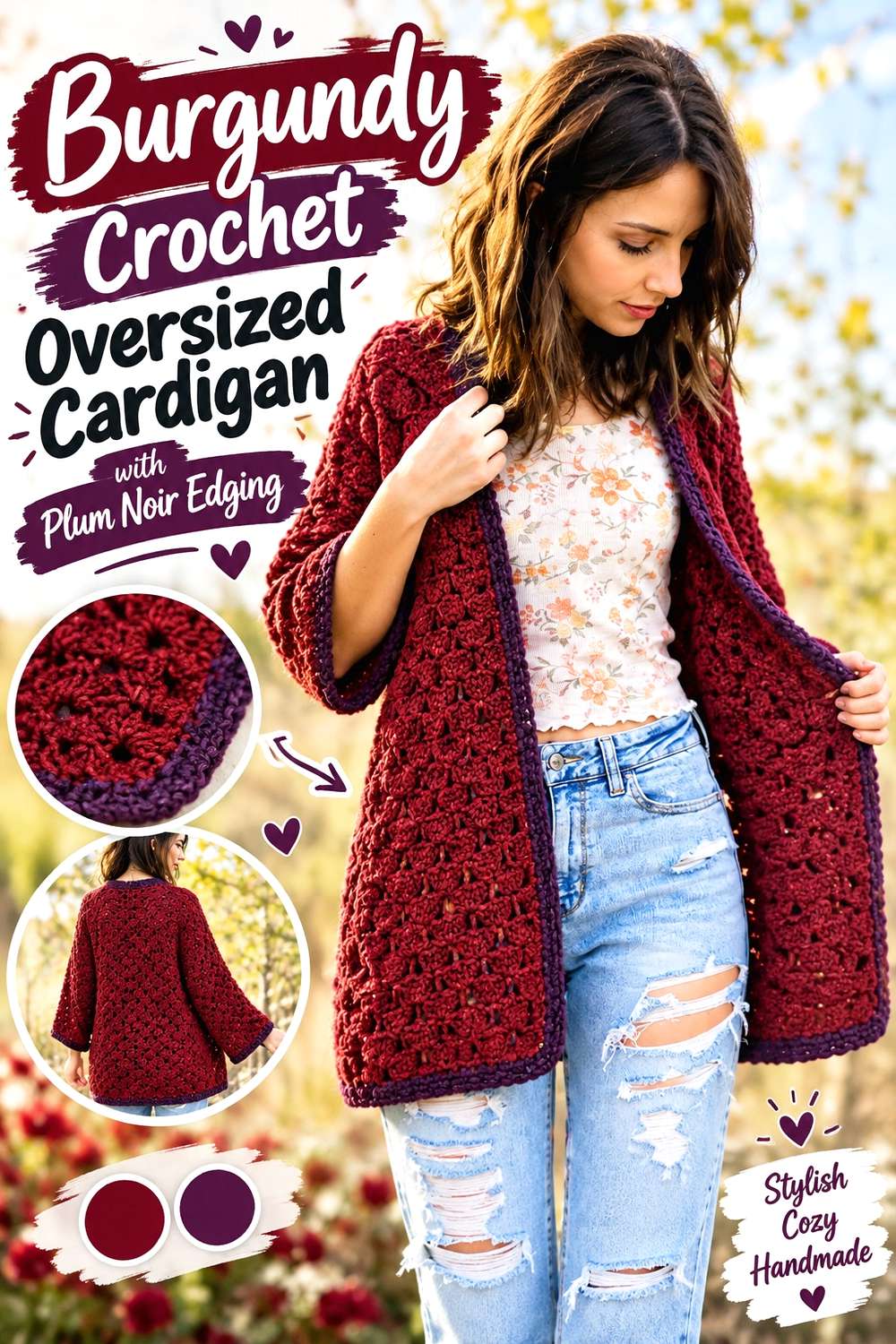
An oversized cardigan offers enough fabric for burgundy to remain dominant without becoming visually monotonous. Plum Noir can outline the garment and repeat around sleeve edges, creating contrast at the perimeter rather than through the center.
Let Burgundy Fill the Oversized Crochet Cardigan Panels
Keeping the large panels burgundy preserves the garment’s broad flowing shape. Numerous small Plum Noir sections would divide that silhouette into many competing areas.
If you want interior contrast, one substantial Plum Noir band is easier to integrate than scattered dark rows.
Repeat Plum Noir Around Burgundy Crochet Cardigan Openings
Use Plum Noir along the front opening, sleeve edges, or lower border so the darkest shade repeats at several structural boundaries.
This approach gives Plum Noir considerable visual length even though burgundy still covers most of the total fabric.
Creator Credit: Evelyn And Peter Crochet
21. Plum Noir Crochet Triangle Shawl with Burgundy Border
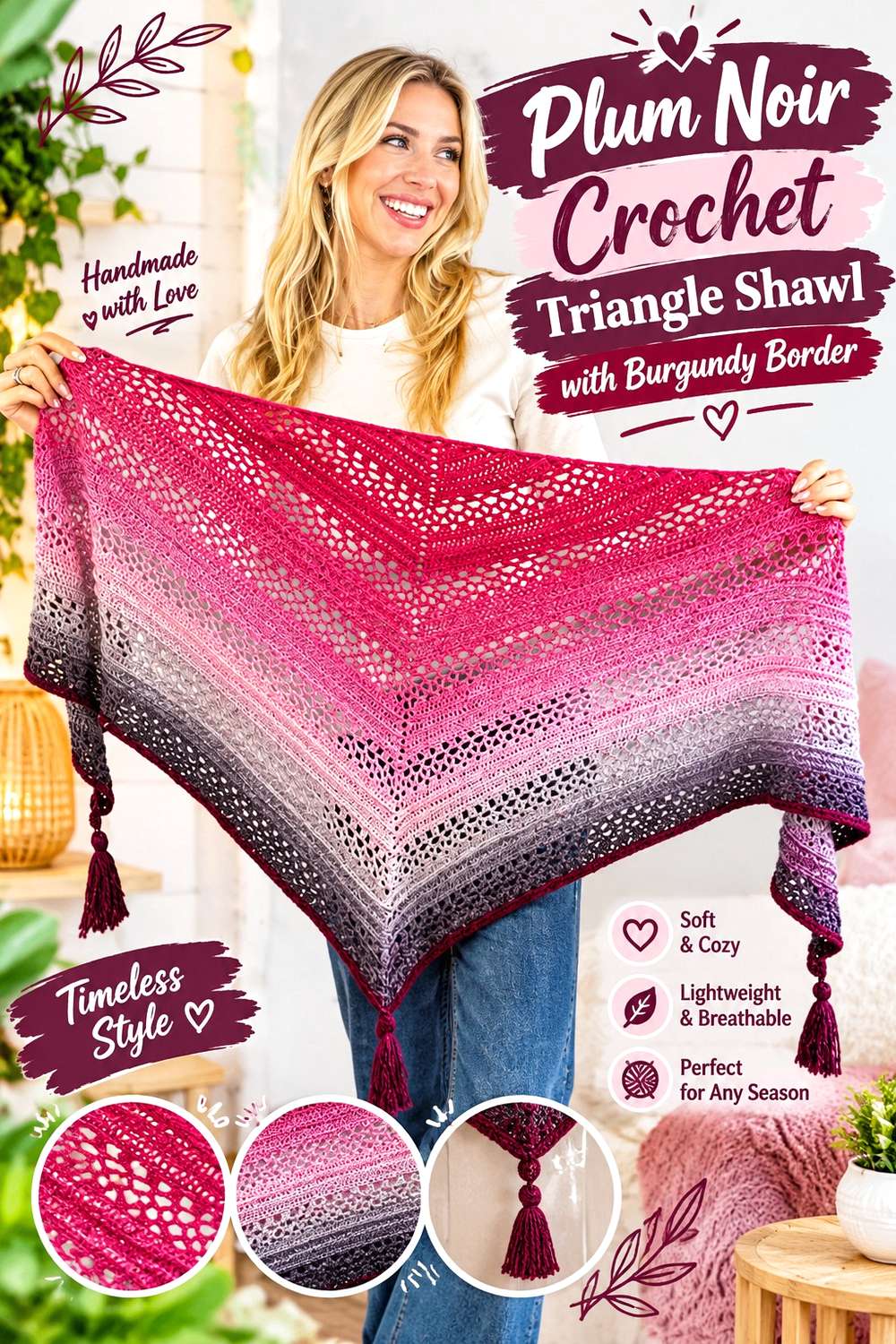
A triangular shawl concentrates attention toward its expanding lower edge, making that edge an effective place for burgundy. Plum Noir can remain uninterrupted through most of the center.
Keep Plum Noir Broad Through the Crochet Triangle Shawl
A largely Plum Noir center creates a dramatic dark field. On sections with openwork, remember that clothing underneath will remain visible and can affect how dark the shawl appears.
If detailed rows disappear, moving only those sections into burgundy can improve definition without changing the overall hierarchy.
Widen Burgundy Toward the Plum Noir Crochet Shawl Edge
Rather than adding a single narrow burgundy line, gradually give the warm shade more visual space close to the perimeter. This makes the lower portion distinct even when the shawl is folded or wrapped.
A final Plum Noir edge can be used conceptually when you want to contain the burgundy rather than ending on the warmer shade.
Creator Credit: Wilmade
22. Burgundy Crochet Cropped Sweater with Plum Noir Trim
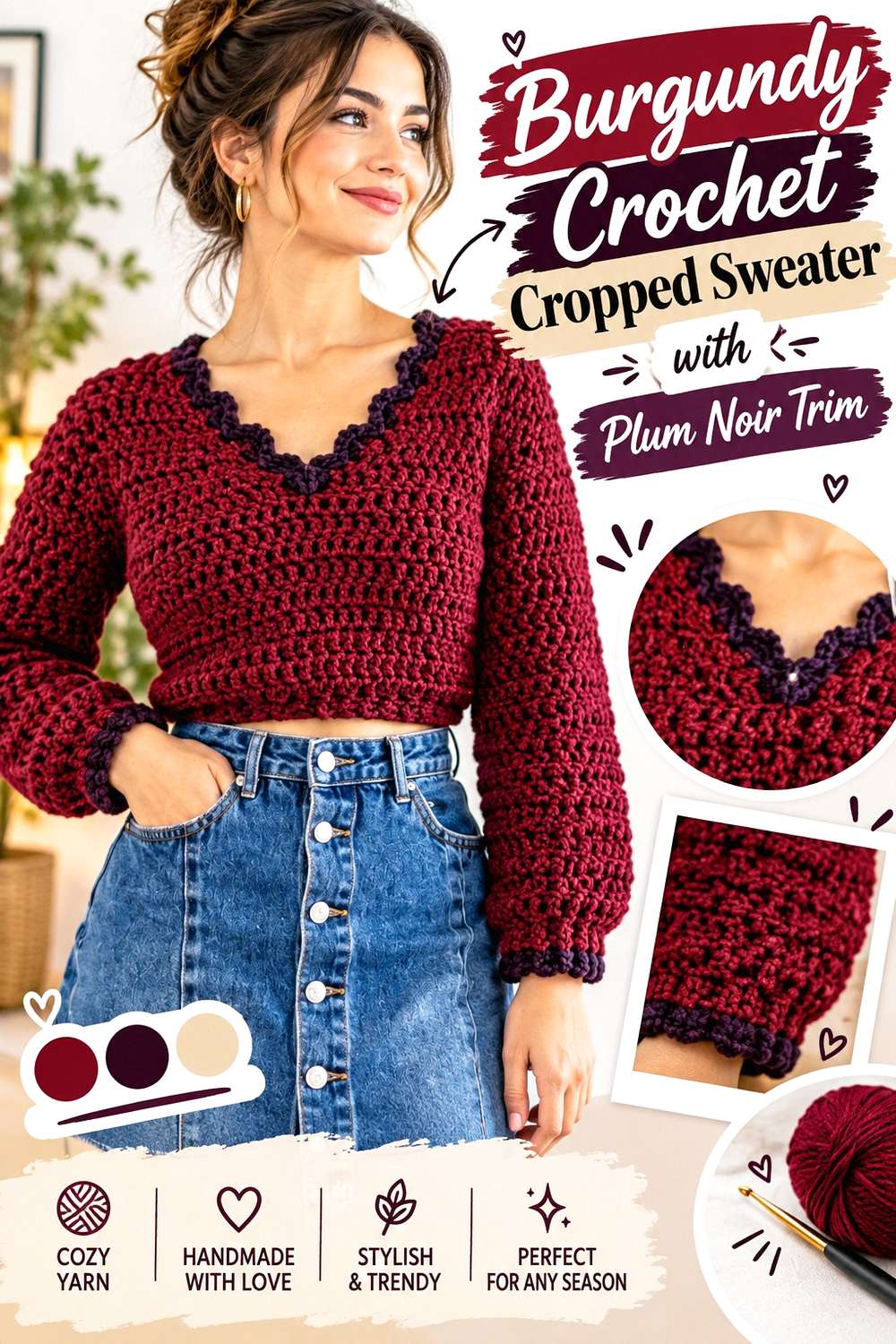
A cropped sweater has less torso length than a long pullover, so the edging represents a larger percentage of the visible garment. Burgundy can fill the body while Plum Noir defines the neckline, cuffs, and lower edge.
Use Burgundy Across the Main Crochet Sweater Body
A continuous burgundy torso keeps the shorter garment from becoming overly divided. This also gives any shell, textured, or shaped neckline details room to remain visible.
If Plum Noir is added inside the body, use one deliberate section rather than numerous thin stripes.
Connect Plum Noir Around Burgundy Crochet Sweater Edges
Repeating Plum Noir at the neckline and cuffs creates dark accents above and at the sides. Adding it at the lower edge completes a full framework around the burgundy body.
If that feels too dark for a cropped silhouette, leave one of those edges burgundy to reduce the Plum Noir share.
Creator Credit: forthefrills
23. Plum Noir Crochet Oversized Basket with Burgundy Band
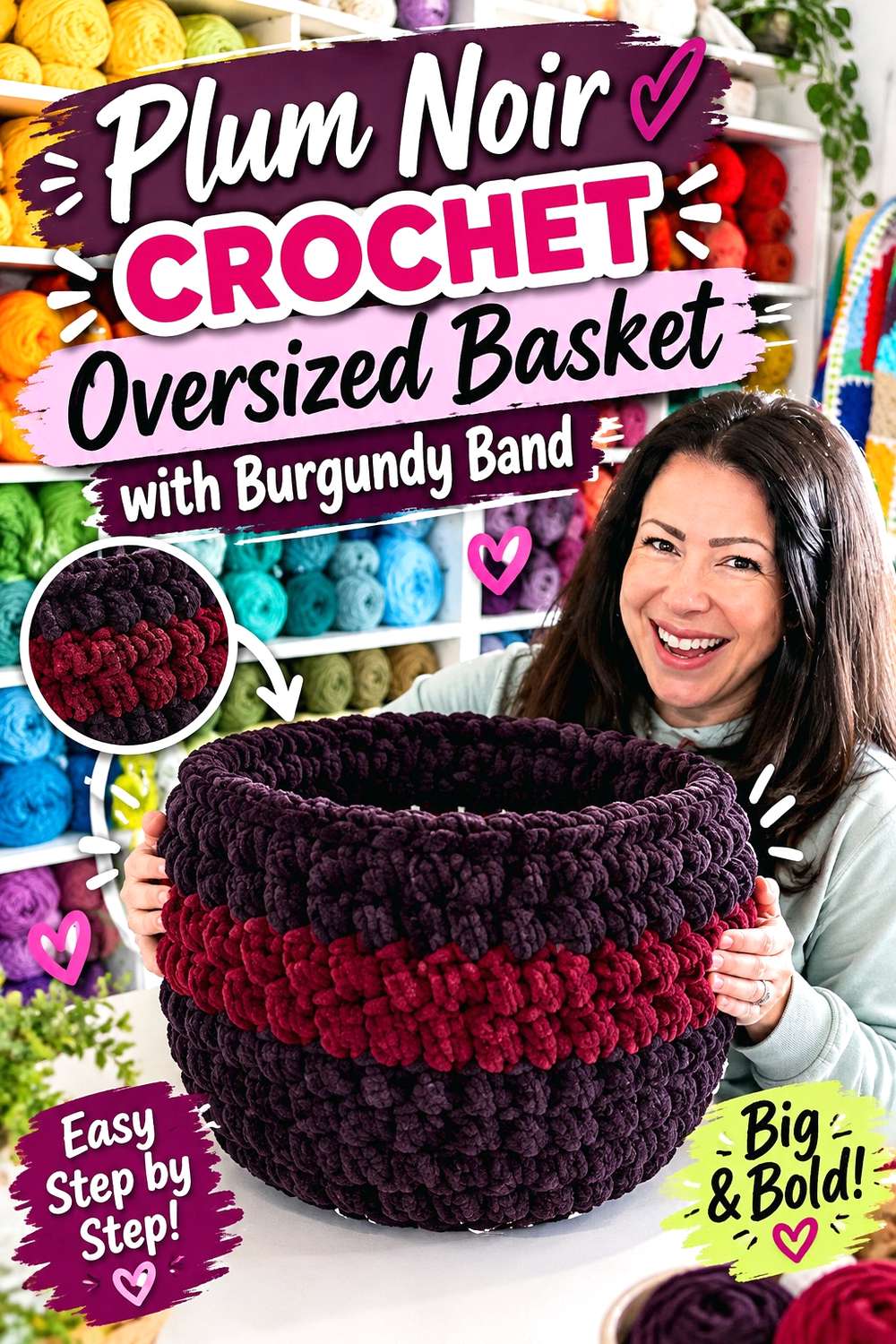
An oversized basket needs color elements that can be seen from across a room. Plum Noir can dominate the walls while one wide burgundy band interrupts the dark surface.
Use Plum Noir Across Most of the Oversized Crochet Basket
Large-scale storage can carry a dark color successfully because there is enough surface for the shade to read clearly. Keeping Plum Noir continuous also prevents a large decor piece from becoming excessively striped.
Check how Plum Noir looks against the floor, shelf, or wall where you expect to use the basket.
Scale Burgundy to Match the Plum Noir Crochet Basket
A narrow burgundy stripe that works on a beanie may appear insignificant on an oversized basket. Increase the visual width of the warm band so it suits the scale of the object.
Place it where it will remain visible after the basket is filled rather than hiding the main accent near the bottom.
Creator Credit: Repeat Crafter Me
24. Burgundy and Plum Noir Crochet Balaclava

A balaclava provides several natural color boundaries around the crown, face opening, ribbing, and lower portion. Those zones allow burgundy and Plum Noir to alternate without relying on arbitrary striping.
Keep Burgundy Around the Crochet Balaclava Face
Using burgundy around a substantial portion of the face opening keeps the warmer color prominent when the balaclava is worn. It can also provide clearer stitch visibility than Plum Noir where shaping details matter.
Use the same burgundy placement symmetrically on both sides unless an asymmetric design is intentional.
Carry Plum Noir Across the Burgundy Crochet Balaclava Crown
Plum Noir can occupy the crown and repeat again along the lower edge, giving the darkest color two separated but related areas.
If the transition between burgundy and Plum Noir looks too abrupt, use a wider intermediate color block rather than multiple tiny alternating rounds.
Creator Credit: made in the moment
Comparing Plum Noir and Burgundy Crochet Directions
If you want burgundy to remain clearly visible, start with projects where it covers the main surface: the cardigan, textured pillow, bucket hat, tote, slippers, or cropped sweater. Plum Noir can then act as an outline, base, cuff, brim, or structural accent.
For a darker Plum Noir-led result, the shawls, poncho, handbag, storage baskets, and chunky cardigan provide enough surface for the near-black plum direction to dominate. Burgundy becomes more effective when it appears in broad repeated areas instead of thin isolated lines.
For a balanced two-color treatment, the checkerboard vest and balaclava allow both shades to occupy substantial visual space. These designs make value contrast especially important because the viewer needs to distinguish adjacent areas repeatedly.
Texture should also influence the decision. Burgundy may be the more practical choice for cable-heavy, waffle, picot, or strongly ribbed sections when your Plum Noir yarn is dark enough to hide shadows. Plum Noir is particularly useful on simpler surfaces, borders, and structural details where clean definition matters more than displaying fine texture.
Conclusion
Plum Noir and burgundy work most effectively when each color has a clear visual role. If your Plum Noir is almost black, use it as a frame around burgundy through borders, cuffs, bases, straps, and ribbing. If you want the project to feel substantially darker, reverse those roles and let burgundy appear only in larger accents that remain visible against the Plum Noir field.
The striped blanket, checkerboard vest, chunky cardigan, and tote give the two shades enough space for obvious color blocking. The bandana, slippers, bucket hat, and beanies are useful when you prefer a more controlled two-zone approach. Textured projects such as the Celtic weave pillow and waffle bag deserve an extra swatch check because very dark yarn can reduce visible stitch definition.
Choose the actual yarns by relationship rather than by shade name alone. Maintaining the intended difference between the blackened-plum Plum Noir and warmer burgundy will have more impact on the finished crochet than finding one specific commercial interpretation of either color.
Frequently Asked Questions
What does Plum Noir mean in a crochet color palette?
For this palette, Plum Noir describes the darkest role: a very deep or blackened plum direction. It is more useful to think about that color relationship than to assume every yarn labeled with a similar name will look identical.
Do Plum Noir and burgundy have enough contrast for crochet?
They can, but the answer depends on the actual yarns. A medium-deep burgundy against an almost-black Plum Noir may separate clearly, while two equally dark shades can blend. Compare them side by side and use a grayscale photo if the difference is difficult to judge.
Should Plum Noir or burgundy dominate a crochet project?
Either can dominate. Plum Noir creates a darker overall result, while burgundy lets more of the red-wine warmth show. The strongest layouts usually give the secondary shade repeated, purposeful locations rather than dividing every surface evenly.
How can I stop Plum Noir crochet texture from disappearing?
Make a swatch under normal room lighting. If cables, waffle texture, ribbing, or raised stitches become difficult to see, use burgundy in the most detailed areas and move Plum Noir to simpler borders or structural sections.
Can I add a neutral to Plum Noir and burgundy crochet?
Yes. A lighter cream, oatmeal, taupe, or similar neutral can separate motifs when the two dark colors are too close in value. Use the neutral selectively if you want Plum Noir and burgundy to remain the obvious main palette.
Is Plum Noir suitable for crochet borders?
It can be especially useful for borders because a very dark shade creates a clear outer frame. On a burgundy-led blanket, pillow, shawl, or garment, repeating Plum Noir elsewhere prevents the border from feeling disconnected.
How do I substitute a different burgundy with Plum Noir?
Preserve the relationship between the colors. Look for a warm red-wine shade that is still visibly different from the Plum Noir yarn. If the replacement burgundy is equally dark, increase color-block size or adjust placement so the two shades do not depend on narrow contrast for visibility.