Camel is useful in a crochet sweater vest because it can act as either a quiet neutral or the warmest shade in a multicolor design. The result depends heavily on what sits beside it. Cream makes camel look softer and lighter, chocolate brown creates a deeper tonal range, sage and olive introduce muted green contrast, while black, navy, and charcoal give the vest a stronger outline.
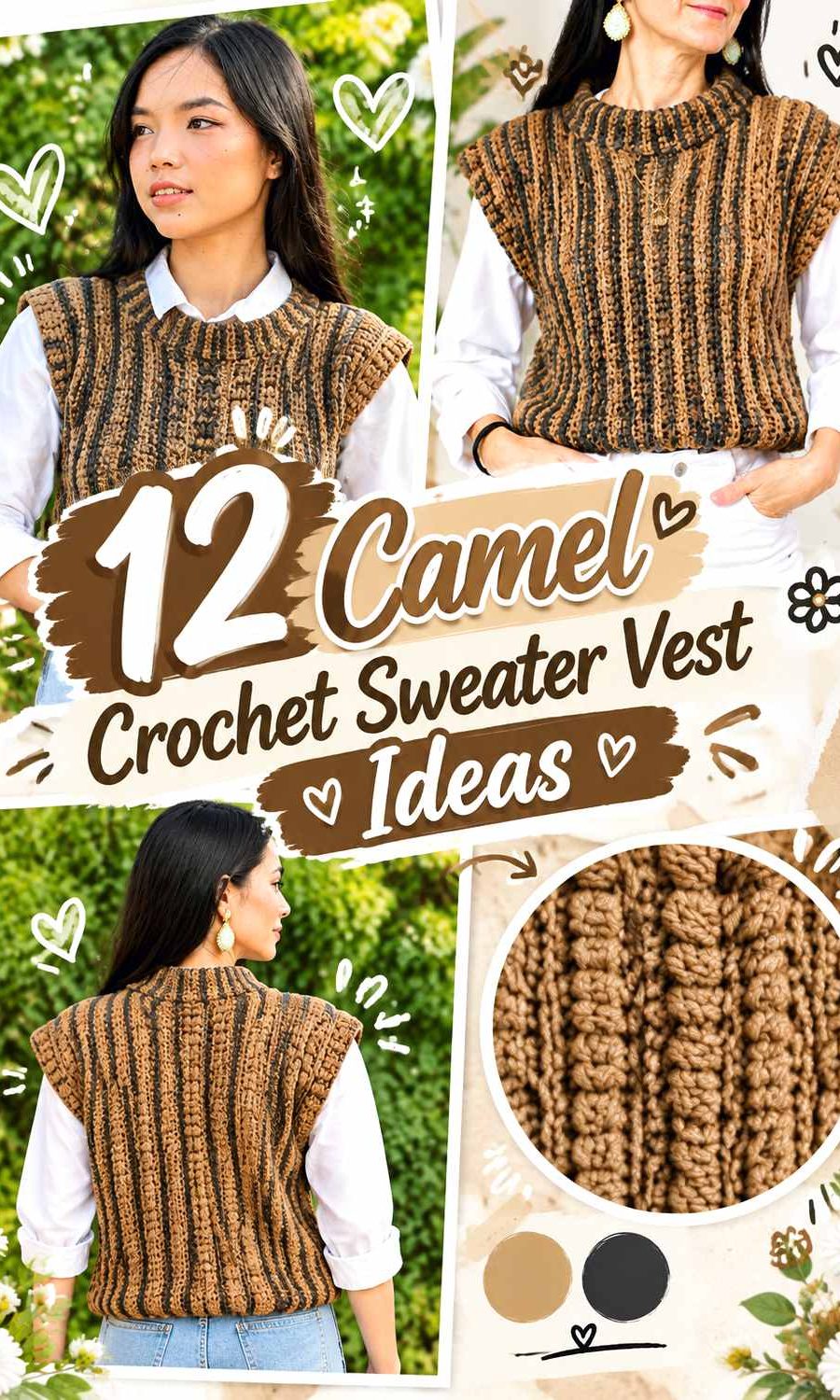
Color placement matters just as much as the combination itself. A sweater vest has several natural areas for distributing color: the front and back panels, V-neck or crewneck edging, armhole ribbing, hem, granny-square centers, checks, motifs, and joining areas. These 12 ideas keep camel as the main color while changing how the supporting shades work around the garment.
The linked tutorials support the vest constructions and finished-project concepts. The camel palettes below are independent color adaptations and should not be assumed to be the colors used by the original creators.
Quick List
- Camel And Cream V Neck Crochet Sweater Vest
- Camel And Chocolate Brown Textured Crochet Sweater Vest
- Camel And Sage Granny Square Crochet Sweater Vest
- Camel And Black Checkerboard Crochet Sweater Vest
- Camel And Rust Textured Crochet Sweater Vest
- Camel And Navy Grandpa Crochet Sweater Vest
- Camel And Oatmeal Open Front Crochet Sweater Vest
- Camel And Olive Diamond Crochet Sweater Vest
- Camel And Burgundy Granny Stitch Crochet Sweater Vest
- Camel And Charcoal Ribbed Crochet Sweater Vest
- Camel And Teal Flower Crochet Sweater Vest
- Camel And Dusty Rose Crochet Sweater Vest
Decide How Much of the Sweater Vest Should Stay Camel
For a camel-centered vest, the easiest color hierarchy is to give camel the largest uninterrupted area. That might mean using it across the front and back panels while reserving a second shade for ribbing, or keeping the main granny-square rounds camel while introducing smaller accent sections.
The amount of contrast changes how much of the supporting color you need. Black or navy can define a vest with relatively little surface area because they are much darker than camel. Sage or dusty rose can cover larger sections while creating a softer division.
Use Camel Contrast Where the Vest Already Has Structure
Necklines, armholes, hems, motif edges, and joins are natural places to introduce a second color because the garment already changes direction there. A cream V-neck border can separate camel from the shirt underneath, while a chocolate-brown hem can visually anchor a lighter camel body.
On patterned vests, color needs more planning. Checkerboards, diamonds, flowers, and granny squares already create strong visual repetition, so decide which color owns the pattern and which color simply frames it before starting the full garment.
1. Camel And Cream V Neck Crochet Sweater Vest
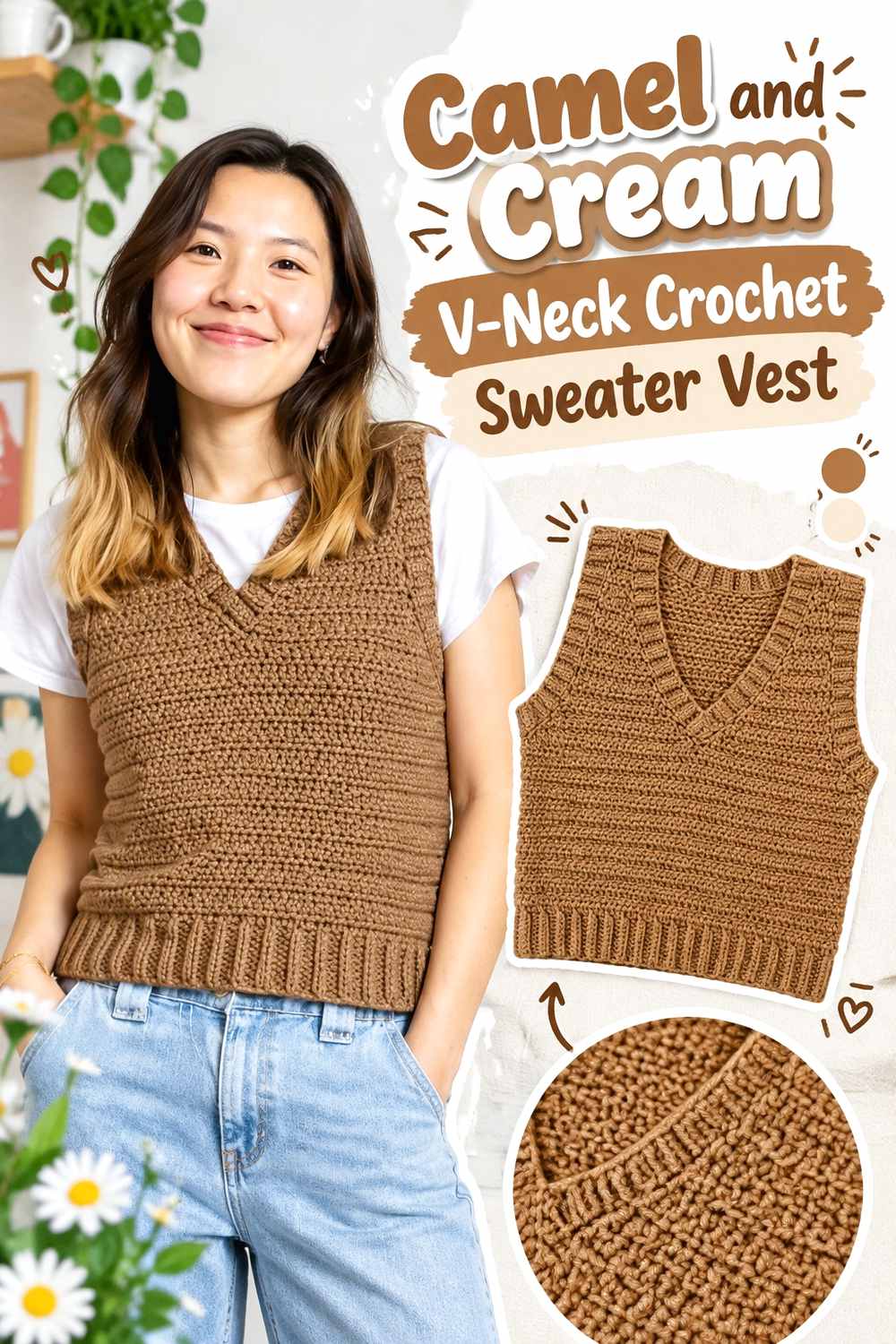
Camel and cream create a low-stress way to add contrast to a classic V-neck vest. Let camel cover most of the front and back so the garment still reads as a warm neutral layer, then use cream around the V-neck, armholes, or hem. The lighter edge can make the neckline more distinct without introducing another strong hue. The supporting tutorial demonstrates a classic V-neck sweater-vest construction.
Camel Should Cover the Main V-Neck Sweater Vest Panels
Use camel through the largest body sections if you want the vest to remain versatile as a layering piece. A continuous camel front also keeps attention on the V-shaped neckline rather than dividing the chest into several competing color blocks.
If more cream is wanted, expand it through the ribbed finishing before introducing broad cream body sections. This maintains a clear dominant-and-supporting relationship.
Cream Gives Camel V-Neck Edging More Separation
Cream can outline the V-neck clearly against camel while keeping the overall palette light. Repeating the same cream around the armholes can connect the finishing instead of making the neckline look like an isolated color addition.
If the cream is very close to the camel in lightness, compare the two yarns side by side before committing to narrow edging. A slightly clearer value difference will make small trim areas easier to see.
Creator Credit: VivCrochets
2. Camel And Chocolate Brown Textured Crochet Sweater Vest
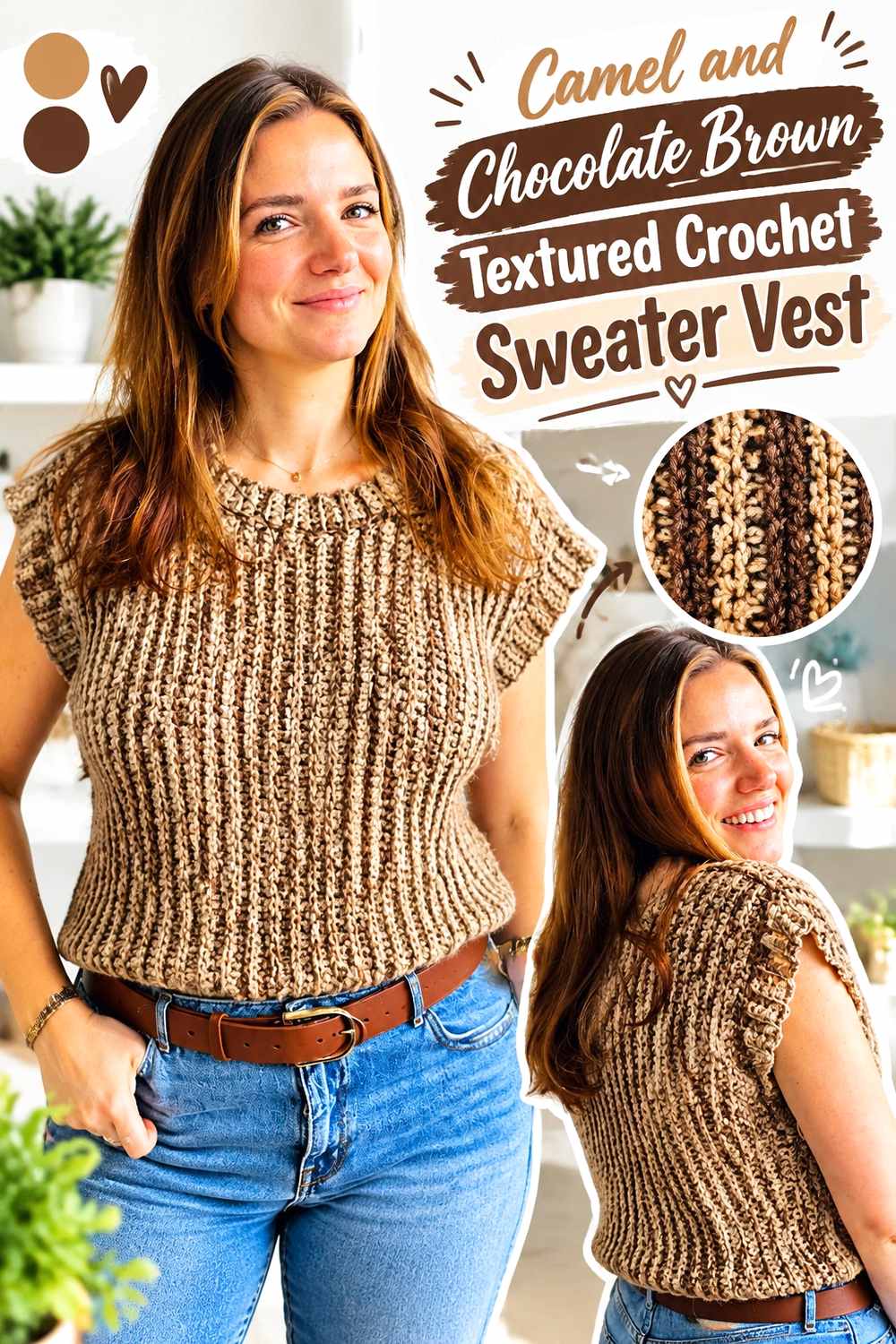
Chocolate brown deepens camel without moving the vest away from an earthy neutral palette. On a textured sweater vest, camel can carry the main surface while brown marks the collar, armholes, and lower edge. That placement keeps the stitch texture visible across a consistent body color while giving the perimeter stronger definition. The supporting tutorial produces a finished sweater vest with pronounced surface and finishing texture.
Camel Keeps the Textured Sweater Vest From Becoming Too Dark
Let camel occupy most of the torso so the texture has enough lighter surface area to remain visually open. Chocolate brown can feel much heavier than camel when both colors occupy equal space, especially around a compact sleeveless garment.
A useful starting point is to increase brown first around finishing areas rather than through the center of the front panel.
Chocolate Brown Can Frame Camel Ribbing and Armholes
Brown works particularly well where ribbing or edging already changes the texture. Using it consistently around the neckline and armholes creates a visual frame instead of scattering dark accents randomly across the body.
If that frame feels too strong, keep the hem camel and use brown only around the upper finishing. This reduces the amount of dark color without breaking the palette.
Creator Credit: Cat Kemble
3. Camel And Sage Granny Square Crochet Sweater Vest
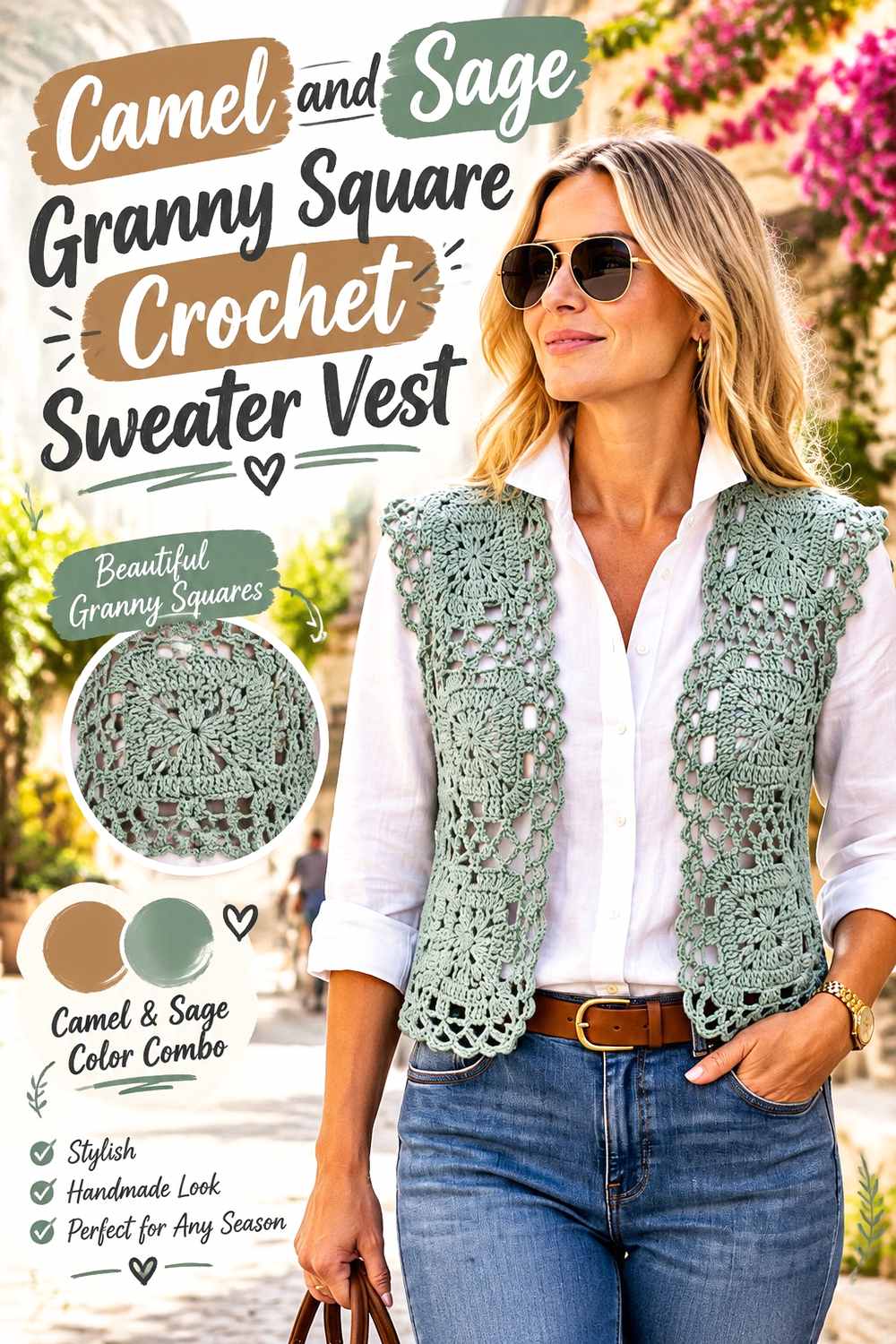
A camel-and-sage granny square vest uses color repetition differently from a solid-panel vest. Camel can establish continuity across the motif layout, while sage creates selected centers, outer rounds, or alternating square details. Keeping one shade consistent across most motifs prevents the vest from turning into an unrelated collection of blocks. The supporting tutorial shows a granny-square vest construction that can provide the base for this palette plan.
Camel Should Repeat Across Every Granny Square Vest Section
If camel is the defining color, repeat it predictably through the motifs rather than using it in only a few squares. It could appear in the same part of each motif or dominate the joining and outer areas.
That repetition matters on a vest because the front, back, and shoulders need to look connected once the squares become a garment.
Sage Should Support Camel Without Hiding the Granny Square Pattern
Use sage where it is large enough to register as a deliberate second shade but not so widely that the vest loses its camel base. Sage centers surrounded by camel, or camel centers followed by sage and another camel round, can create two distinctly different effects.
Before final joining, lay the motifs in their planned garment positions. This lets you catch a sage-heavy area on one side before it becomes part of the finished vest.
Creator Credit: Handwork diy
4. Camel And Black Checkerboard Crochet Sweater Vest

Camel and black create the strongest graphic contrast in this collection, making them especially suited to a checkerboard vest. Because the checks themselves are the main design feature, both colors need deliberate placement, but camel can still remain dominant through the ribbing, back, or larger visual share of the pattern. The supporting tutorial is specifically built around a checkerboard sweater-vest concept.
Camel Can Soften a Black Checkerboard Sweater Vest
Black checks create sharp visual stops, while camel makes the same pattern less stark than a pure black-and-white pairing. To keep camel leading, use it again in the neckline or hem rather than letting all finishing turn black.
Repeating camel along the outer structure helps the eye read the vest as camel-based even when the center contains a strong checkerboard.
Black Needs Controlled Placement Against Camel Checks
Black has more visual weight than camel, so equal-sized checks can still make the dark color feel dominant. If you want a warmer finished vest, consider limiting black to selected pattern areas while keeping camel around the neckline and garment outline.
Check the pattern layout before shaping the armholes and neckline so the remaining black-and-camel sections still look balanced after parts of the grid are interrupted.
Creator Credit: Hayhay Crochet
5. Camel And Rust Textured Crochet Sweater Vest
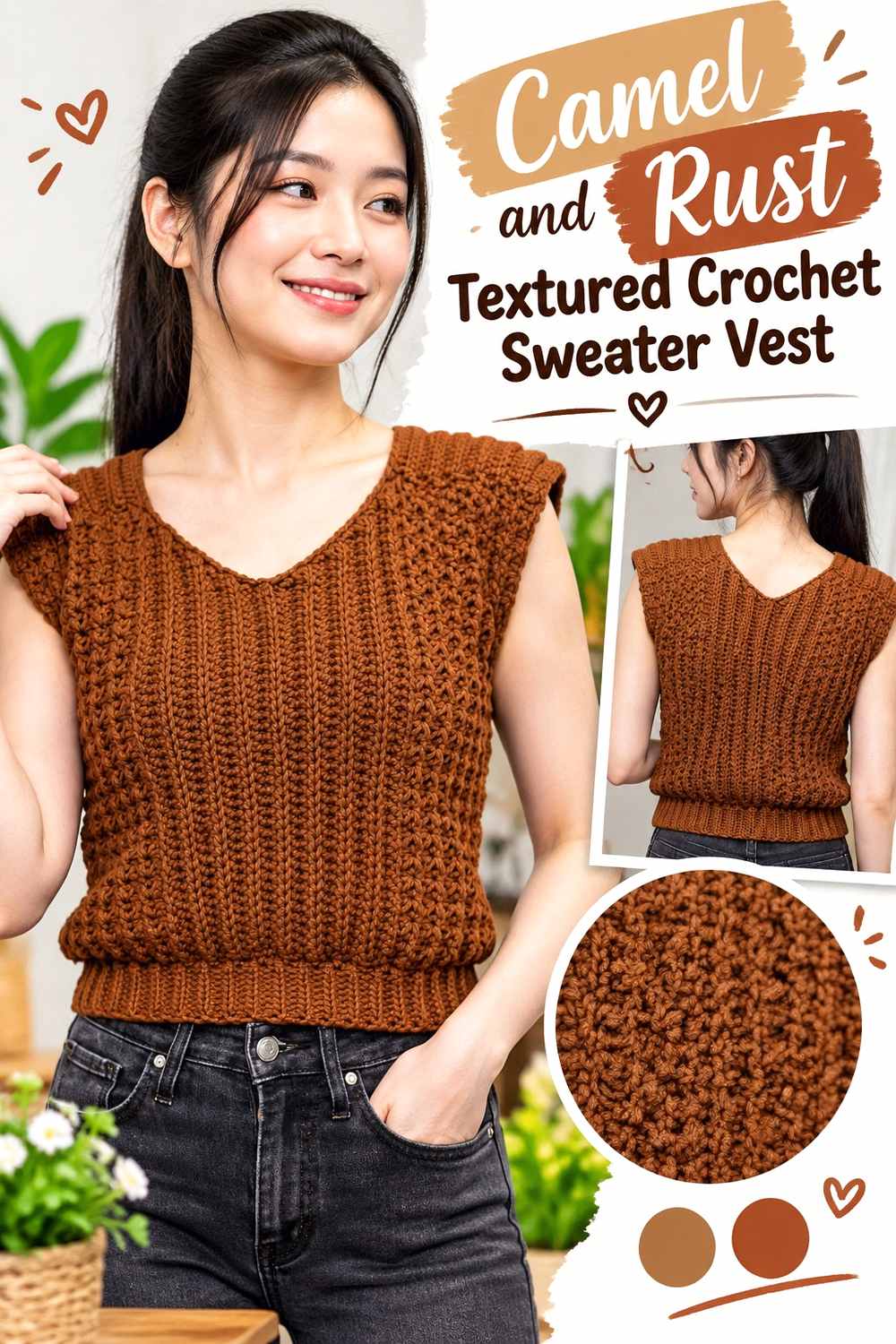
Camel and rust create a warm analogous direction rather than a strong contrasting one. That makes this combination useful for a textured vest where the stitch surface, neckline, and shaping should stay more noticeable than the color changes. Camel can remain the broader field while rust marks smaller structured sections. The supporting vest tutorial includes a defined textured panel concept that suits this kind of controlled color adaptation.
Camel Should Separate Rust From the Main Textured Vest Surface
Give camel enough uninterrupted space for the crochet texture to remain clear. If rust appears in too many small alternating sections, the color changes can compete with the texture instead of helping define it.
Rust works better here as a strategic warm accent around a center detail, lower band, or selected trim.
Rust Needs Enough Value Difference From Camel to Stay Visible
Camel and rust may be different in hue but still similar in lightness. If the two yarns merge when viewed from a distance, very narrow rust sections may disappear into the camel body.
Choose a deeper rust when you want clearly defined accents, or keep a similar-value rust for a more blended tonal sweater vest.
Creator Credit: TCDDIY
6. Camel And Navy Grandpa Crochet Sweater Vest
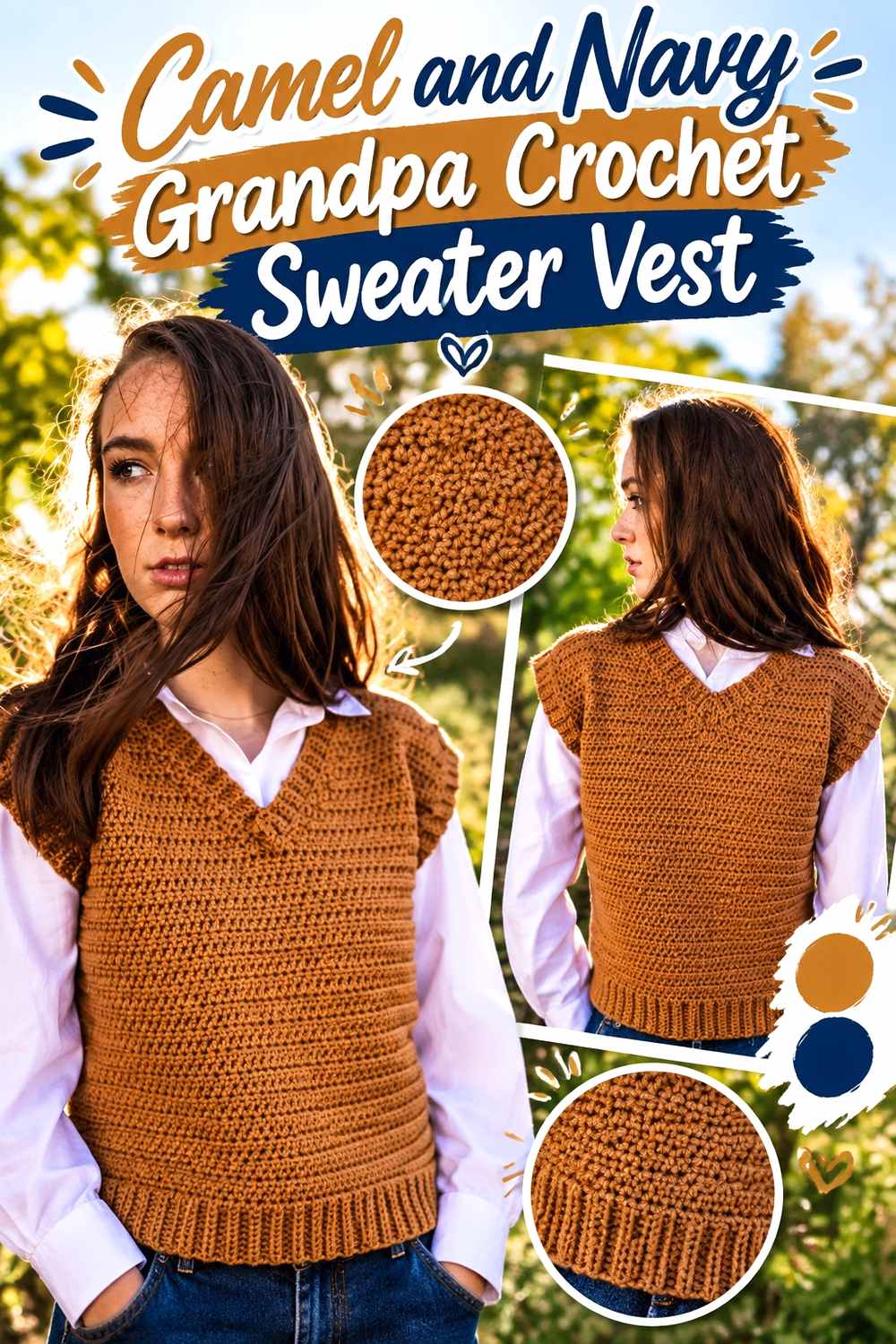
Navy gives a camel sweater vest dark, cool definition without the harder contrast of black. It suits a classic grandpa-style vest because it can emphasize the V-neck ribbing and armholes while camel carries the main body. The supporting tutorial demonstrates a traditional sweater-vest form with ribbed finishing.
Camel Should Remain Broad Across the Grandpa Sweater Vest
Use camel across the front and back if the goal is a warm traditional base. The uninterrupted neutral surface keeps the garment easy to layer while allowing the deeper navy finishing to become a controlled detail.
A navy-heavy front would shift the entire vest toward a much darker result, even if camel remains elsewhere.
Navy Can Give Camel V-Neck Ribbing Stronger Definition
A navy V-neck edge produces a much clearer outline than cream or oatmeal. Repeating navy around the armholes connects those dark lines across the upper part of the vest.
If the neckline becomes too dominant, keep the bottom ribbing camel. That prevents every edge of the garment from being enclosed by the darkest shade.
Creator Credit: Hey Carrie
7. Camel And Oatmeal Open Front Crochet Sweater Vest
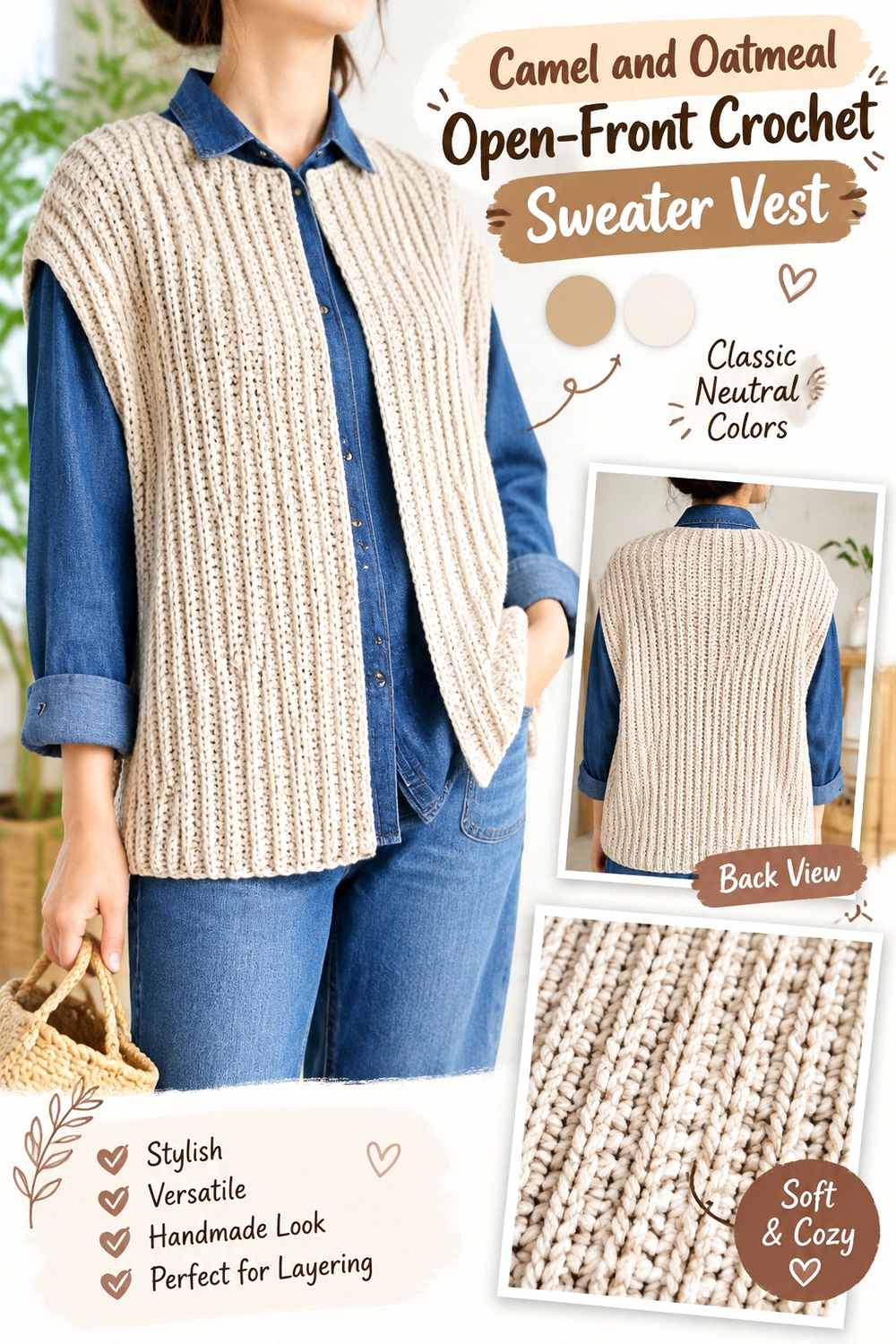
Camel and oatmeal create one of the softest neutral combinations in the group. An open-front vest makes the front edges especially visible, so oatmeal can be used there to gently separate the camel crochet fabric from whatever is worn underneath. The supporting tutorial demonstrates an open vest designed for layering over another garment.
Camel Should Connect the Open-Front Sweater Vest From Back to Front
Keep camel running across the back and major front sections so the two open sides still feel like parts of one garment. Because the front is divided naturally, too many additional color breaks can make the vest look more fragmented.
Oatmeal can then act as the finishing color rather than another large body panel.
Oatmeal Can Lighten Camel Along the Open Vest Edges
Use oatmeal around the front opening when you want a subtle outline rather than a dark frame. The light neutral can also be repeated near the armholes or hem so it does not appear only along one vertical edge.
If camel and oatmeal are extremely close in value, widen the oatmeal section slightly rather than expecting a very narrow stripe to create obvious contrast.
Creator Credit: Orinam crochet
8. Camel And Olive Diamond Crochet Sweater Vest
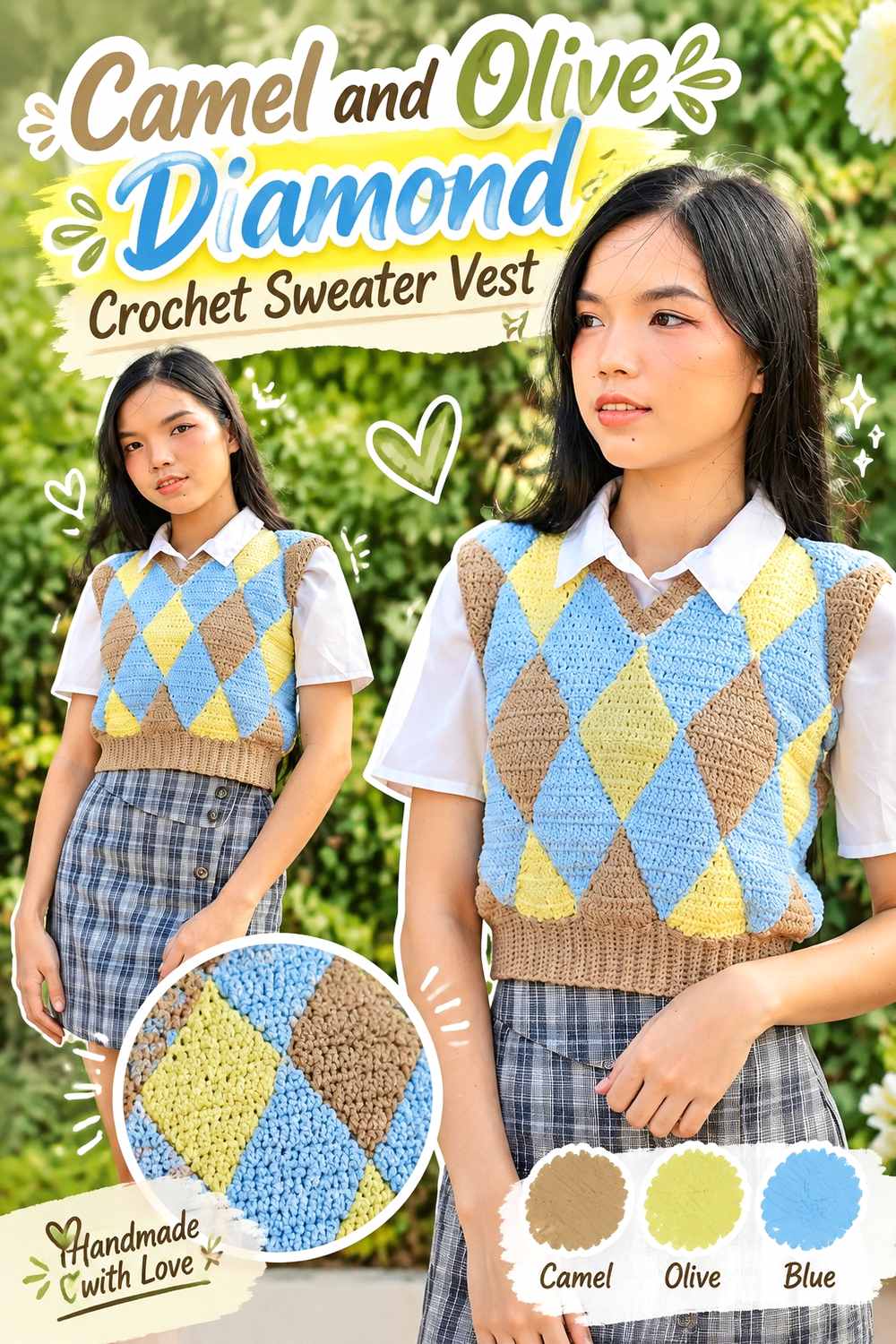
A diamond vest already has a clear graphic structure, so camel and olive work best when their roles are established before the pattern begins. Camel can function as the main background or dominant diamond shade, while olive creates selected contrasting areas. The supporting tutorial demonstrates a crochet diamond-vest concept suitable for this kind of palette planning.
Camel Should Keep the Diamond Sweater Vest Visually Connected
Repeat camel consistently through the patterned front so the eye has one shade linking the separate diamond areas. Changing the color relationship from one diamond to the next can make a structured design look unintentionally irregular.
Camel ribbing can also help frame the patterned body without introducing a third color.
Olive Needs Clear Separation From Camel Inside Diamond Details
Muted camel and muted olive can be fairly close in value, even though one is brown-beige and the other green. Check the yarns in grayscale if the diamond outline needs to remain obvious.
If contrast is weak, choose a deeper olive or restrict olive to larger diamond sections rather than thin lines that may disappear against camel.
Creator Credit: Chenda DIY
9. Camel And Burgundy Granny Stitch Crochet Sweater Vest
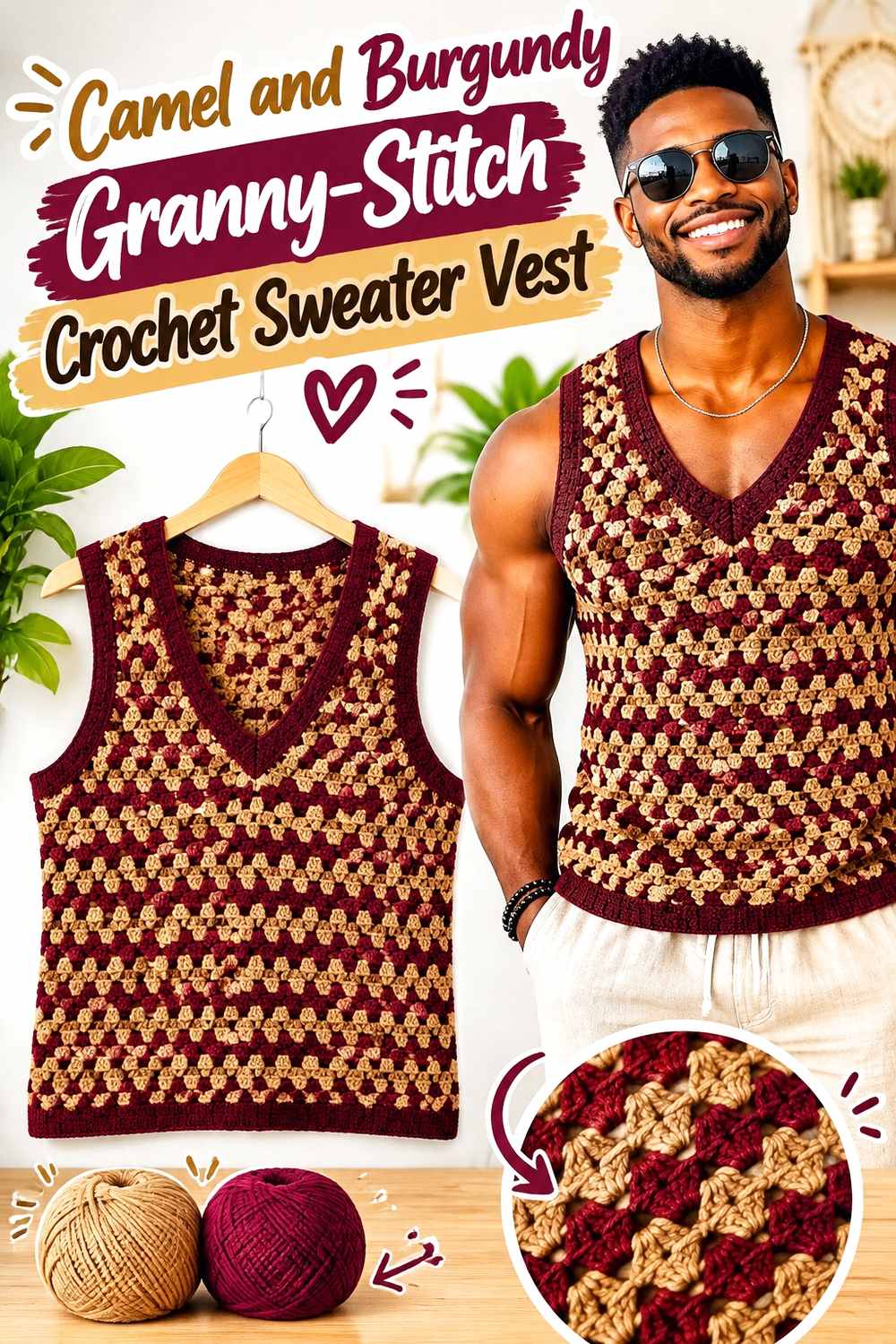
Camel and burgundy give a granny-stitch vest a richer, darker accent while keeping the base neutral. The repeated cluster structure gives you several ways to distribute color without turning the vest into random stripes. Camel can dominate the main field, with burgundy repeated at controlled intervals or reserved for edging. The supporting tutorial uses granny stitch in a wearable vest construction.
Camel Should Repeat More Often Than Burgundy in the Granny-Stitch Vest
Use camel for the majority of the repeated stitch sections so the garment has a consistent base. Burgundy can appear as a narrower stripe, occasional repeated band, or finishing shade.
This is more controlled than alternating camel and burgundy equally, which would make the vest read as a two-color striped garment rather than a camel vest with a dark accent.
Burgundy Can Anchor Camel Around the Sweater Vest Edges
A burgundy border around a camel body provides definition without becoming as neutral as brown or charcoal. It can work particularly well around the neckline where the dark red-brown shade will be noticeable in a relatively small area.
Repeat a small amount of burgundy at the hem if the neckline alone feels disconnected.
Creator Credit: Ascarcrochets
10. Camel And Charcoal Ribbed Crochet Sweater Vest
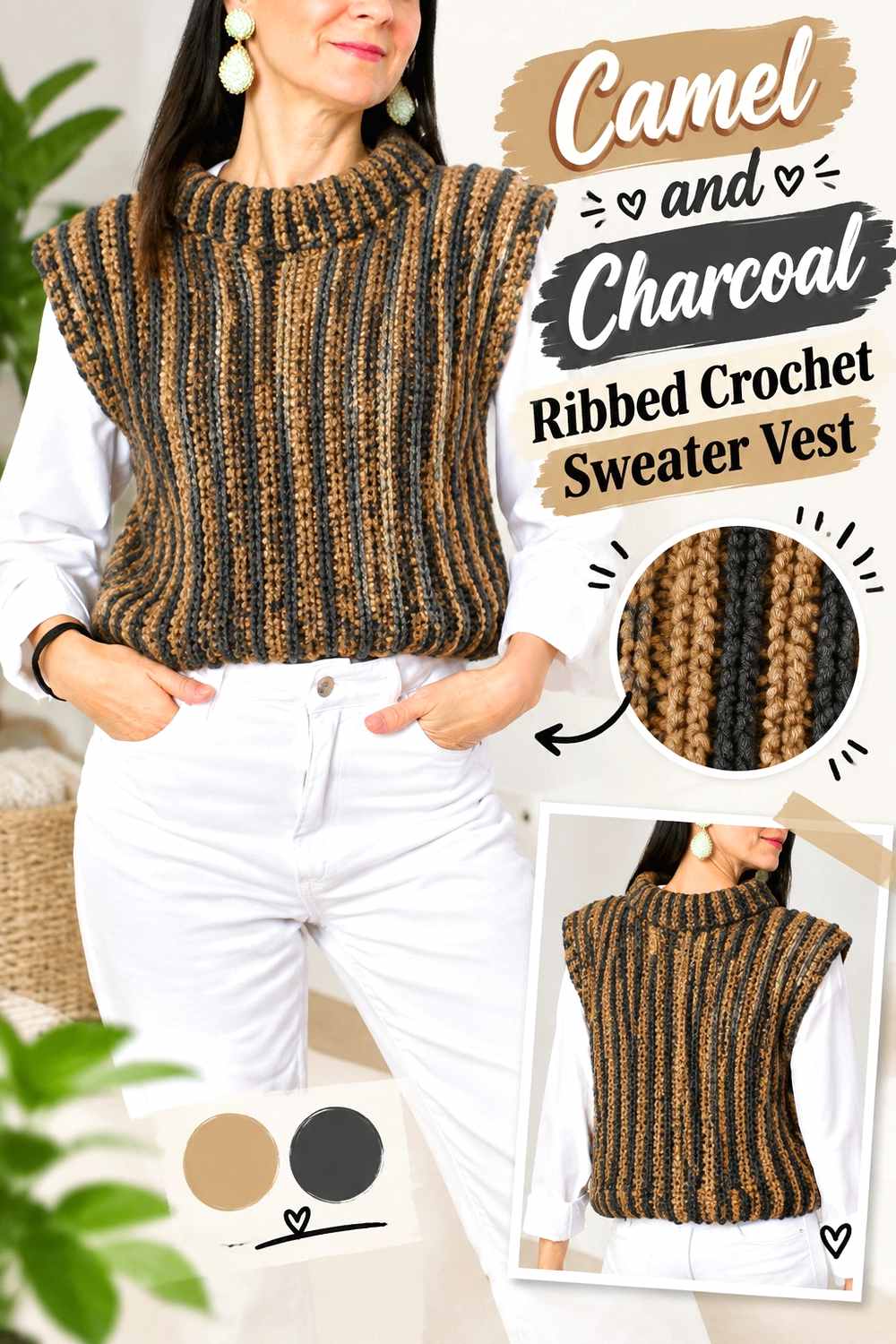
Charcoal creates strong value contrast while remaining a neutral, so the camel body can still coordinate easily with other layers. A ribbed-looking vest benefits from restrained color placement because the surface already provides directional texture. The supporting tutorial demonstrates a sweater vest with a pronounced knit-like ribbed appearance.
Camel Should Carry Most of the Ribbed Sweater Vest Texture
Keep the broad ribbed surface camel when the texture itself is meant to be the main feature. A single main color lets the vertical or horizontal stitch definition remain continuous across the body.
Charcoal can then mark specific structural areas instead of repeatedly interrupting that textured surface.
Charcoal Can Give Camel Armholes and Necklines a Dark Frame
Use charcoal around the neck and armholes when you want those openings to read clearly against the camel body. Because charcoal is much darker, relatively narrow finishing can provide enough contrast.
If the result starts to feel too outlined, return to camel for the hem. That leaves the dark color concentrated around the upper vest instead of enclosing the garment on every side.
Creator Credit: By StellaM
11. Camel And Teal Flower Crochet Sweater Vest

Camel creates a warm neutral background for teal floral or flower-like crochet details. This combination is more color-forward than camel with sage because teal is usually visually stronger, so the flower placement needs to be controlled. The supporting tutorial demonstrates a finished crochet flower vest and provides a useful construction concept for this palette direction.
Camel Should Give Teal Flowers Enough Background Space
Use camel around and between teal flower details instead of packing the accent motifs too closely together. The neutral spacing helps each floral section remain identifiable and stops the vest from becoming teal-dominant.
Camel can also continue through side areas or borders to connect separated motif sections.
Teal Should Repeat Predictably Across the Camel Flower Vest
A single teal flower can look disconnected if no related color appears elsewhere. Repeat teal through several planned motifs or in one small finishing area so the accent belongs to the whole garment.
Avoid automatically making the neckline teal if the floral motifs already supply plenty of cool color. Camel edging can keep the patterned body from feeling over-framed.
Creator Credit: CROCHET BY BEV
12. Camel And Dusty Rose Crochet Sweater Vest

Camel and dusty rose form a soft, warm palette that gives the sweater vest color without the strong separation of navy, black, or teal. Camel should remain the principal body shade, while dusty rose can soften the ribbing, hem, or selected panel areas. The supporting tutorial demonstrates a straightforward crochet sweater-vest construction that can serve as the base for this two-color plan.
Camel Needs More Visual Area Than Dusty Rose
If both shades occupy similar amounts of the garment, the finished vest may read as a camel-and-pink color-block design rather than a camel vest. Keep camel across the largest panel areas and use dusty rose in more limited finishing or accent sections.
This balance is especially helpful when the two yarns have similar lightness.
Dusty Rose Should Stay Distinct From Camel at the Sweater Vest Trim
Choose a dusty rose that remains visibly pink beside the camel rather than one so brown-toned that the colors merge. The difference does not need to be dramatic, but it should remain recognizable around narrower details.
For a softer result, keep both shades muted. For clearer definition, preserve the muted dusty-rose character but choose one noticeably lighter or darker than the camel.
Creator Credit: Sirin’s Crochet
Comparing the Camel Crochet Sweater Vest Color Schemes
For a light neutral vest, camel with cream or oatmeal keeps contrast gentle and makes the finishing feel less heavy. Camel with chocolate brown or rust stays warmer and more tonal, although the darker brown option provides much stronger definition.
Sage and olive both move camel toward an earthy green palette. Sage creates the quieter transition, while deeper olive can give motifs or graphic sections more weight. Dusty rose offers another muted direction without introducing a cool color.
Navy, charcoal, and black give camel the strongest dark framing. Navy adds cool color as well as value contrast, charcoal stays more neutral, and black creates the sharpest graphic division—especially in a checkerboard design.
Burgundy, teal, and patterned color placements work well when you want the supporting shade to become an obvious design feature. In those versions, keeping camel repeated around the garment prevents the accent color from taking over the sweater vest.
Conclusion
The most useful way to choose among these camel crochet sweater vest ideas is to decide what role the second color should play.
Choose cream or oatmeal when you want lighter edges and gentle contrast. Chocolate brown, rust, and olive keep the vest earthy, while sage and dusty rose create softer color shifts. Navy, charcoal, and black are stronger choices for defined necklines, armholes, checks, and borders. Burgundy and teal work when the accent itself should become a noticeable part of the design.
Once the palette is chosen, plan the placement around the actual vest construction. Plain panels can support restrained trim, while granny squares, checkerboards, diamonds, flowers, and granny stitch give you more opportunities for repeated color. Use the original creator tutorial for the exact garment construction and treat the camel color plan as a separate adaptation.
Frequently Asked Questions
What colors work well with a camel crochet sweater vest?
Cream, oatmeal, chocolate brown, rust, sage, olive, dusty rose, burgundy, navy, teal, charcoal, and black can all create useful combinations with camel. Choose based on whether you want soft tonal contrast, earthy color, cool contrast, or a stronger dark frame.
Should camel be the main color in a camel crochet sweater vest?
If you want the finished garment to read clearly as a camel sweater vest, give camel the largest visual area or repeat it consistently across the design. Secondary shades can then appear around ribbing, borders, motifs, checks, or selected panel sections.
How can I use camel in a granny square sweater vest?
Repeat camel consistently across the squares. It can form the centers, outer rounds, background sections, joins, or edging. The exact location matters less than making its role predictable enough to connect the separate motifs into one garment.
Does black overwhelm camel in a crochet sweater vest?
It can when black occupies large sections because the dark value gives it considerable visual weight. For a camel-led vest, use black selectively in checks, trim, neckline details, or other repeated accents.
Is cream or oatmeal better with camel?
Cream usually creates a clearer light contrast, while oatmeal tends to stay closer to camel and produce a softer tonal transition. The better choice depends on how clearly you want the vest edging or motifs to separate.
How do I know whether camel and another yarn color have enough contrast?
Compare the yarns side by side and look at them from a distance. A grayscale photo can also help reveal whether their light and dark values are distinct. Different hues can still visually merge when their values are very similar.
Can I use three colors in a camel crochet sweater vest?
Yes. Keep a clear hierarchy rather than automatically using equal amounts. Camel can dominate, a second shade can support larger details, and a third can be restricted to small accents, motif centers, borders, or repeated finishing.