Absinthe Green and Parchment can change a denim cargo pocket without hiding the utilitarian character that makes the pocket distinctive. A flat granny square or filet panel adds color while keeping the surface relatively low profile; waffle, cable, basketweave, and puff textures make the pocket face more dimensional. Smaller stars, leaves, and hearts can preserve much more visible denim.
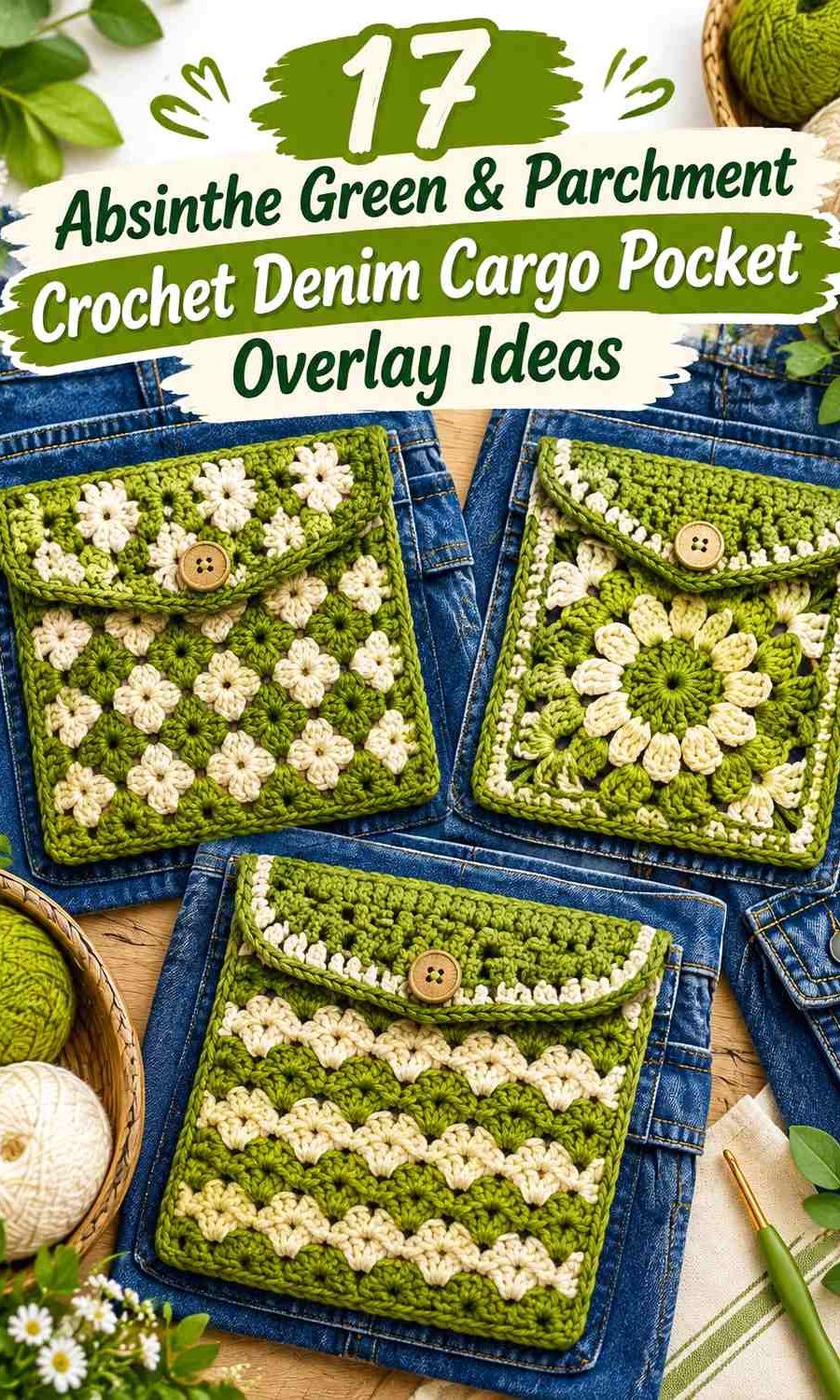
The important choice is where the crochet belongs. A cargo pocket may have a working flap, snap, gusset, pleat, or expandable side section, and an overlay should not casually bridge parts that need to move independently. A decorative panel on the flat pocket face behaves differently from crochet attached to the flap alone.
The tutorials below teach the individual motifs and crochet fabrics. Use those original sources for exact construction, then size and attach each overlay according to the dimensions, movement, and material of the particular denim pocket.
Quick List
- Crochet Parchment Classic-Granny Denim Cargo Pocket Overlay
- Crochet Absinthe Sunburst Denim Cargo Pocket Overlay
- Crochet Parchment Daisy Denim Cargo Pocket Overlay
- Crochet Absinthe Puff-Flower Denim Cargo Pocket Overlay
- Crochet Two-Tone Checkerboard Denim Cargo Pocket Overlay
- Crochet Absinthe Waffle-Grid Denim Cargo Pocket Overlay
- Crochet Parchment Cable-Spine Denim Cargo Pocket Overlay
- Crochet Two-Tone Basketweave Denim Cargo Pocket Overlay
- Crochet Parchment Mosaic-Square Denim Cargo Pocket Overlay
- Crochet Two-Tone C2C Pixel Denim Cargo Pocket Overlay
- Crochet Parchment Filet-Rose Denim Cargo Pocket Overlay
- Crochet Absinthe Surface-Line Denim Cargo Pocket Overlay
- Crochet Two-Tone Star-Scatter Denim Cargo Pocket Overlay
- Crochet Absinthe Leaf-Branch Denim Cargo Pocket Overlay
- Crochet Two-Tone Open-Lace Denim Cargo Pocket Overlay
Keep the Working Parts of the Cargo Pocket Free
Before sizing an overlay, identify which parts of the pocket actually move. A flat front panel may remain relatively stable, but a flap has to lift, a snap or button needs clearance, and a gusset or pleat may expand when the pocket is filled. Attaching one crochet panel across several of those areas can unintentionally restrict the pocket.
Trace only the surface you intend to cover. Leave room around closures and do not rely on the crochet to reinforce hardware unless the garment was specifically designed for that purpose.
Pocket location matters as well. Overlays on thigh or side cargo pockets may encounter chair edges, bags, doorways, and repeated hand contact. Low-profile granny, mosaic, filet, and surface-crochet options generally introduce less projection than bobbles, puff flowers, deep waffle stitches, or heavy cables. Choose the amount of relief according to how the garment will actually be worn.
Balance Absinthe Green and Parchment Against Denim
Denim acts as a third color, so Absinthe Green and Parchment do not need to divide the crochet surface equally. Leaving a denim margin around a predominantly Parchment motif can make the light crochet look almost framed, while an Absinthe Green panel creates stronger contrast on medium or pale blue denim.
Two-color techniques offer more control. Checkerboard and mosaic can distribute both shades throughout the overlay, while sunburst and daisy squares can give one color the center and the other the outer structure. Small appliqués leave the most denim exposed.
Test the palette directly on the garment rather than on a neutral table. Indigo, black, gray, stonewashed, and faded denim can shift how both yarn colors appear. Also examine the wrong side of the crochet. If an overlay will lift slightly during wear, carried yarn, knots, or unfinished ends may become visible along its edges.
Size and Finish the Crochet Before Attaching It
Crochet can change dimensions after blocking, washing, or prolonged handling, while denim is comparatively stable in shape. Finish the motif, weave in the ends, and follow the yarn’s appropriate care guidance before deciding where permanent attachment points should go.
Avoid stretching an undersized square across the pocket just to make the corners reach. Constant tension can distort the motif and pull on the denim. An oversized overlay is not ideal either, particularly if it folds around a gusset or protrudes beyond the pocket edge.
If the garment is washable, consider the care requirements of both materials together. Raised appliqués, multiple color ends, and loosely open lace may need more attention than a dense flat panel. Whatever attachment method you use should be compatible with the actual denim and should not obstruct closures, pocket openings, or expansion zones.
1. Crochet Parchment Classic-Granny Denim Cargo Pocket Overlay
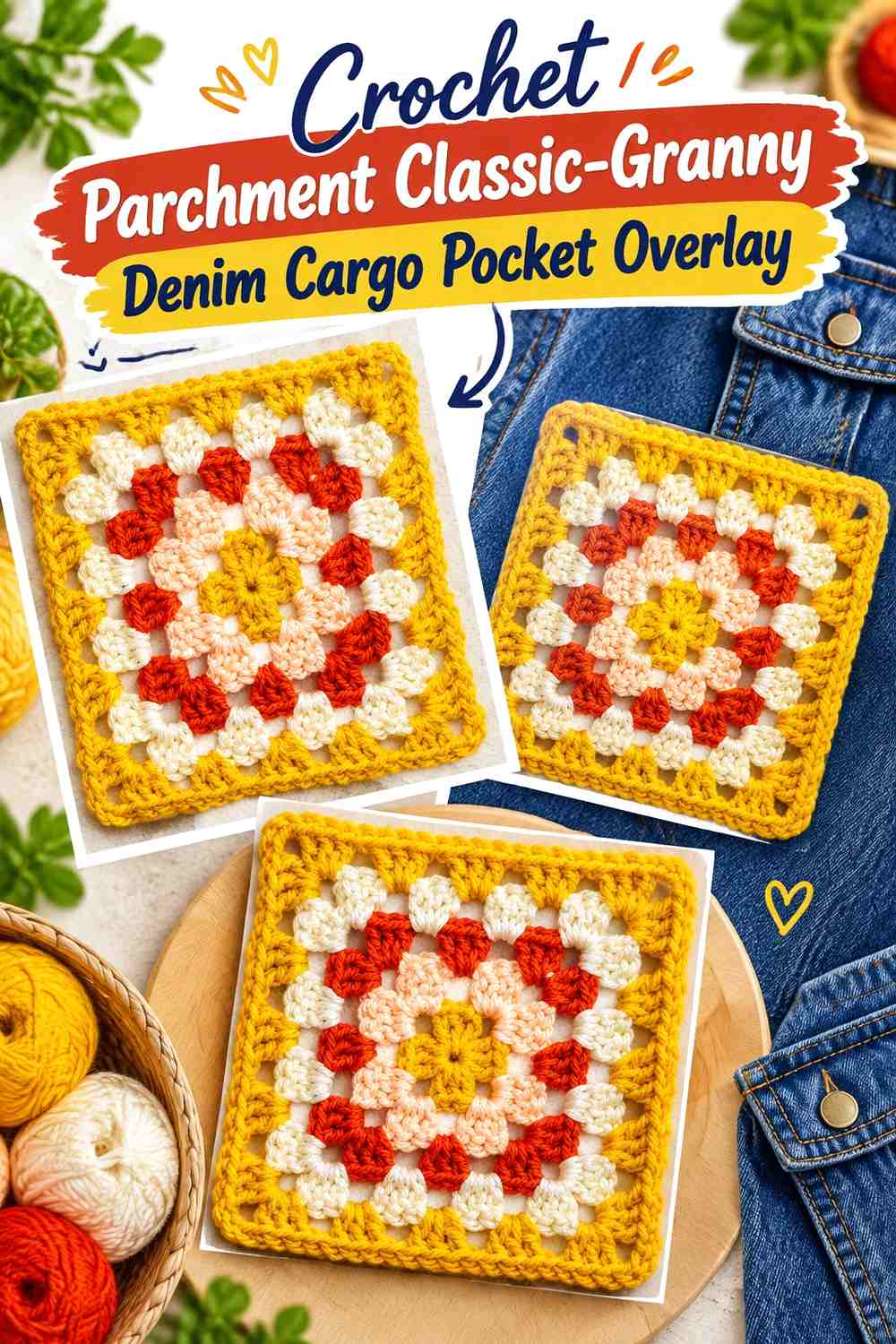
A classic granny square is one of the clearest ways to turn a rectangular cargo pocket into a framed crochet feature. Sarah Maker’s tutorial teaches the traditional square using granny clusters and chain spaces, including single-color and multicolor versions.
For this overlay, Parchment can occupy most of the square while one narrow Absinthe Green round defines the outer edge. Leaving a denim border around the finished motif prevents the crochet from visually swallowing the pocket and keeps the original workwear shape recognizable. The open cluster construction also reveals small areas of denim beneath it, which can help the overlay look integrated rather than pasted on. Before selecting the design, compare one blocked square with the flat face of the pocket and check whether the corners interfere with the flap or gussets.
Use the Denim as Part of the Granny Color Scheme
The chain spaces expose small pieces of the pocket underneath, so the denim effectively becomes part of the motif palette. On dark indigo, a Parchment granny can read especially clearly because every opening becomes a dark accent.
If the denim is pale or heavily faded, Absinthe Green may provide more useful outer definition. Test both arrangements before weaving in the final color round.
Avoid Stretching the Square to Match the Pocket
Granny squares can look surprisingly flexible in the hand, but pulling the corners outward changes the cluster spacing and can make the center appear distorted.
Block the motif first and compare its relaxed dimensions with the usable pocket face. If it is too small, follow the source guidance for enlarging the square rather than depending on attachment tension to supply the missing width.
Creator Credit: Sarah Maker
2. Crochet Absinthe Sunburst Denim Cargo Pocket Overlay

A sunburst square concentrates texture and color toward the center before transitioning into a square outer edge. Make & Do Crew’s tutorial develops its motif from a circular center through puff and cluster texture before squaring the shape in the outer round.
That construction works well when the cargo pocket needs one dominant focal point rather than an evenly repeated pattern. Use Absinthe Green through the center and textured inner rounds, then switch to Parchment for the square-forming perimeter. The pale outer area can visually separate the green center from blue denim and make the motif look more deliberate. Because the sunburst contains more relief than a classic granny, check whether the pocket sits where frequent friction occurs. A thigh pocket under a shoulder bag, for example, may benefit from a flatter option.
Center the Burst on the Pocket Face
The circular center is the visual anchor, so even a small placement shift can make the entire overlay look off-center.
Mark both the pocket center and motif center before attaching anything. Measure the usable area below the flap rather than the overall stitched pocket outline if part of the top edge is hidden when the flap is closed.
Keep the Outer Round Quieter Than the Center
The burst already includes several distinct textures. A highly contrasting multicolor border can compete with those inner rounds rather than framing them.
Parchment makes a useful outer transition because it creates visual breathing room around an Absinthe center. If you need additional size, extending the quieter square rounds generally preserves the focal hierarchy better than adding more complexity to the center.
Watch the Raised Inner Texture
Puff and cluster sections add more depth than ordinary granny clusters. That texture is attractive on a decorative pocket but may rub more readily against surrounding surfaces.
Place a finished sample on the garment and move normally—sit, walk, carry a bag, and put a hand into the pocket. If the burst catches or compresses repeatedly, reserve it for a pocket with less abrasion.
Creator Credit: Make & Do Crew
3. Crochet Parchment Daisy Denim Cargo Pocket Overlay

A daisy square introduces a recognizable flower without requiring a separately sewn appliqué. Just Be Crafty’s original Dainty Daisy Granny Square uses a flower center and petals enclosed within a square border.
For denim, a Parchment flower with an Absinthe Green outer round gives the motif a botanical connection without introducing additional colors. The square format keeps attachment simpler than a loose-petal flower because the perimeter remains easy to align with the pocket face. This idea works especially well when you want visible denim around the motif rather than full pocket coverage. One centered square can function like a textile badge; several small squares can create a tiled overlay if the pocket is unusually broad. Verify the blocked motif dimensions before deciding which approach suits the garment.
Keep the Petal Shape Readable
A daisy motif depends on visible separation between petals. Thick or fuzzy yarn can make those spaces less distinct and turn the flower into a generalized textured center.
Make one sample in the intended yarn and view it from standing distance. If the flower disappears visually, reducing yarn bulk may be more effective than increasing the motif size.
Let Absinthe Green Define the Square
Using green only for the outer square helps distinguish the Parchment flower from the denim while avoiding a multicolor petal area.
This also gives the overlay a clear perimeter for attachment. If the green round is too wide, however, it can turn the design into a green block with a small pale center, so compare the border proportion with the flower itself.
Leave the Flap Visually Separate
A centered floral square looks strongest when the cargo flap remains recognizably independent. Extending the daisy panel beneath or across a moving flap can make the pocket structure harder to read.
Consider keeping the flower entirely on the fixed pocket face, with the flap left as bare denim or receiving only a much smaller coordinating detail.
Creator Credit: Just Be Crafty
4. Crochet Absinthe Puff-Flower Denim Cargo Pocket Overlay
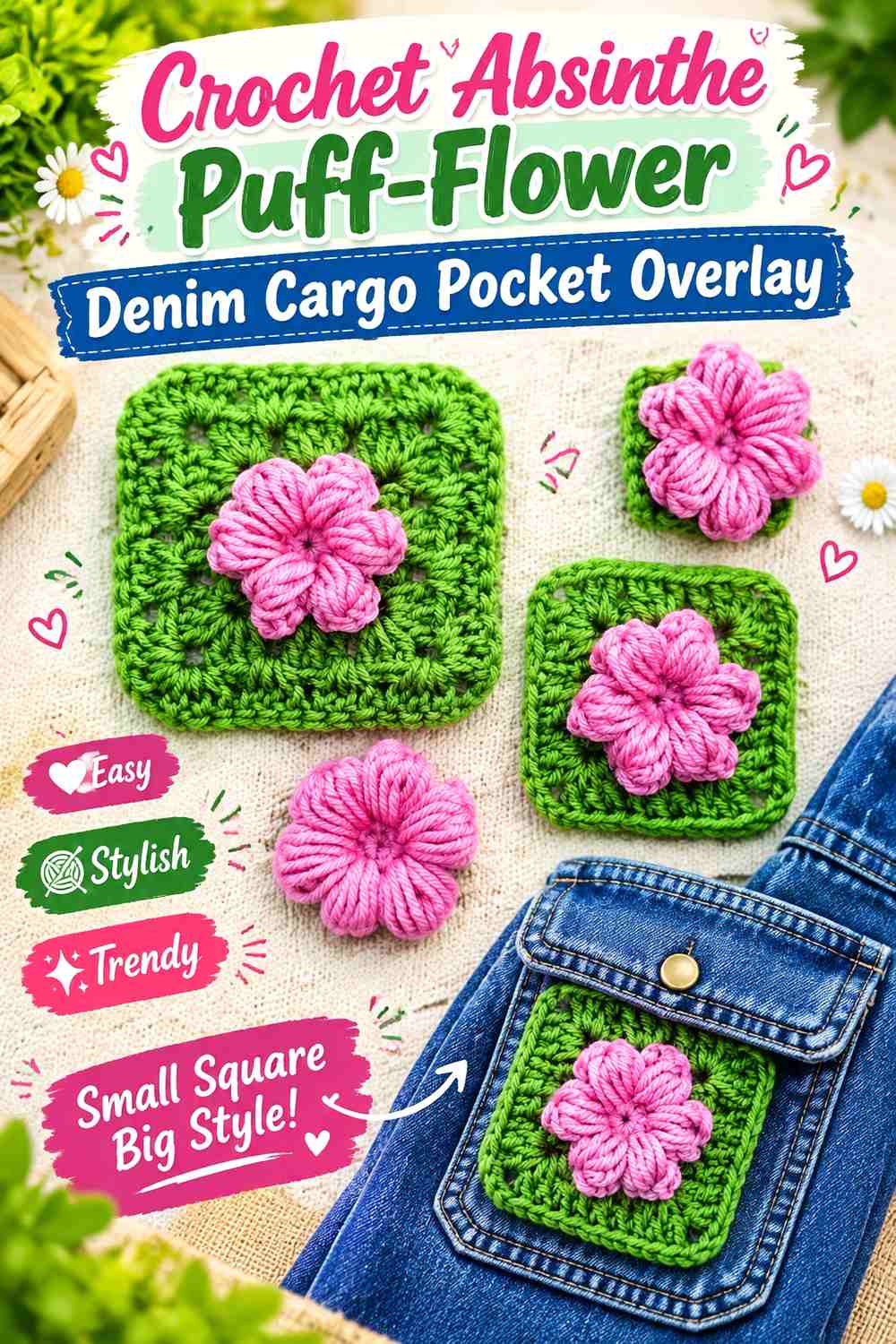
A puff-flower square increases the three-dimensional character of the pocket. Crafting Happiness teaches a raised puff flower and then shows how that flower is converted into a granny-style square with surrounding rounds.
An Absinthe Green flower against a Parchment square gives the pocket a pronounced central bloom while maintaining a pale rectangular edge. Unlike a flat daisy, the puffed center projects from the garment and creates stronger shadows. That makes this option more suitable for cargo pockets being used primarily as a style feature rather than those exposed to constant abrasion. It can work particularly well on an overshirt or denim jacket cargo pocket, where the overlay is less likely to rub against chairs or the opposite leg than on trousers.
Treat the Puff Flower as the High Point
Because the center already rises above the surrounding square, additional bobbles or thick edging can make the overlay unnecessarily bulky.
Keep the outer Parchment area comparatively restrained. The contrast between raised green flower and flatter pale frame is enough to create depth without adding another competing texture.
Check Projection Before Using It on Pants
A motif that seems modest on a work surface can feel much more prominent when worn on a thigh pocket. Sit down and check where the raised flower contacts chairs or other surfaces.
If the puff repeatedly compresses, the design may be better placed on a jacket or bag-style cargo pocket instead of a high-friction trouser location.
Secure the Square, Not Individual Petals
The square framework gives you a stable outer area for positioning the overlay. That is generally more orderly than treating every raised petal as an attachment point.
Keep the flower free to retain its dimensional appearance while ensuring the flatter perimeter lies where intended. Follow the source for the motif itself and plan garment attachment separately.
Creator Credit: Crafting Happiness
5. Crochet Two-Tone Checkerboard Denim Cargo Pocket Overlay
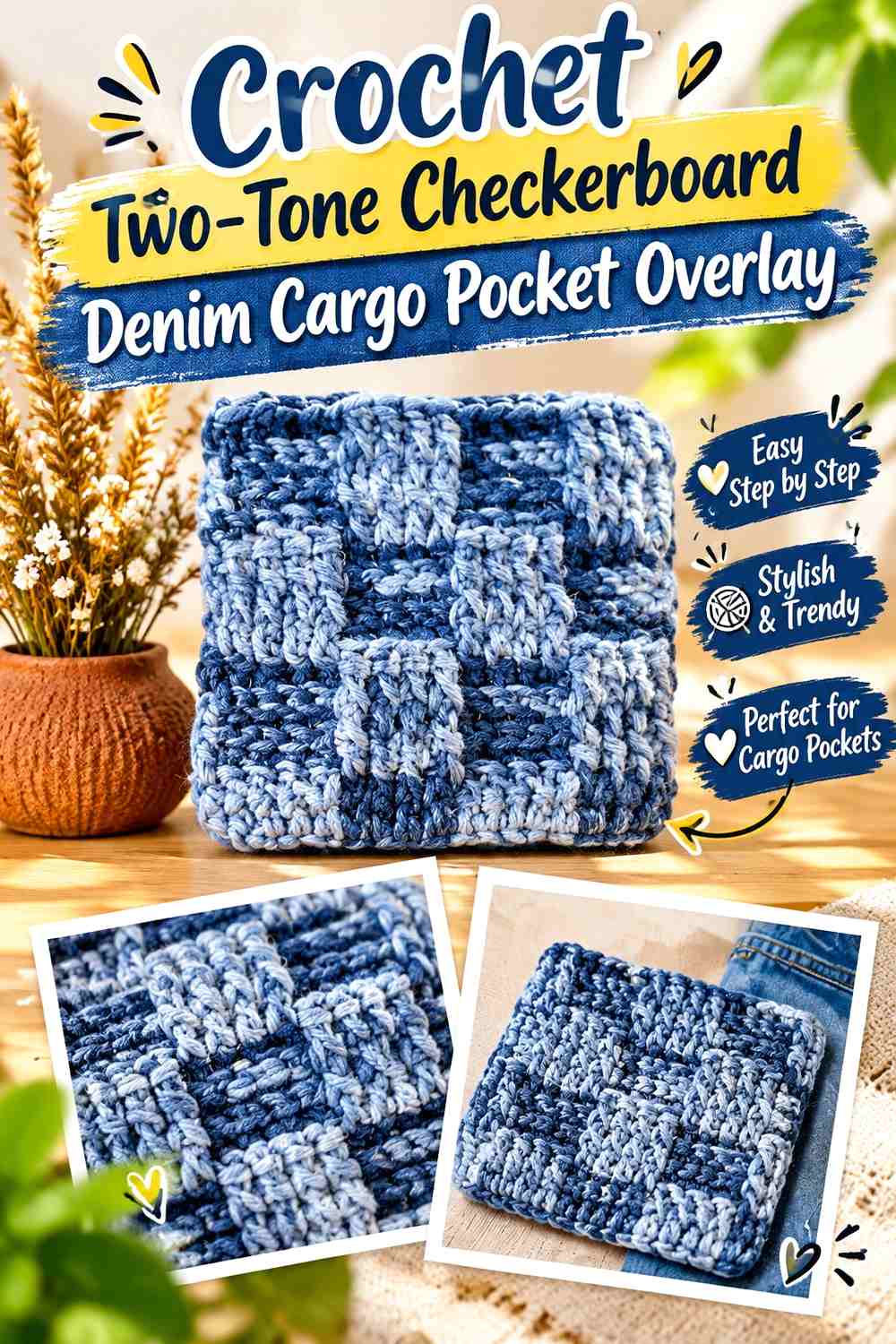
Checkerboard gives a cargo pocket a graphic, almost woven patch appearance. Alanya Crochet’s tutorial teaches an even square-based checkerboard stitch that can be used for bags, pouches, garments, and other crochet projects.
Alternating Absinthe Green and Parchment blocks turns the overlay into a true two-color surface rather than a motif with one accent shade. This option suits simple rectangular pockets because the geometry reinforces straight pocket edges. It is also effective when you want relatively uniform coverage instead of one central flower or symbol. The challenge is proportion: very large blocks may allow only a few checks across a small cargo pocket, while extremely tiny checks can create frequent color management and a visually busy surface. Sample several blocks before determining the final panel dimensions.
Align the Checks With the Pocket Corners
Checkerboard makes crooked placement conspicuous. The vertical and horizontal block boundaries should look intentional relative to the pocket seams.
Block the crochet panel into a true rectangle first, then use the denim topstitching as an alignment reference. Do not depend on stretching one side to make the grid appear square.
Decide Which Color Touches the Denim Edge
A Parchment outer row produces a lighter framed effect, while Absinthe Green creates a stronger boundary against faded blue denim.
On dark indigo, both can work, but their visual weight differs. Lay the completed checker section on the garment before adding the final perimeter so you can choose the color that gives the cleaner transition.
Protect the Pocket Opening From Excess Thickness
If the checkerboard panel reaches directly beneath a flap, accumulated fabric thickness may change how the flap lies.
Leave a small uncovered zone where needed rather than automatically extending the crochet to every stitched edge. The pocket should continue to close and expand as designed.
Creator Credit: Alanya Crochet
6. Crochet Absinthe Waffle-Grid Denim Cargo Pocket Overlay
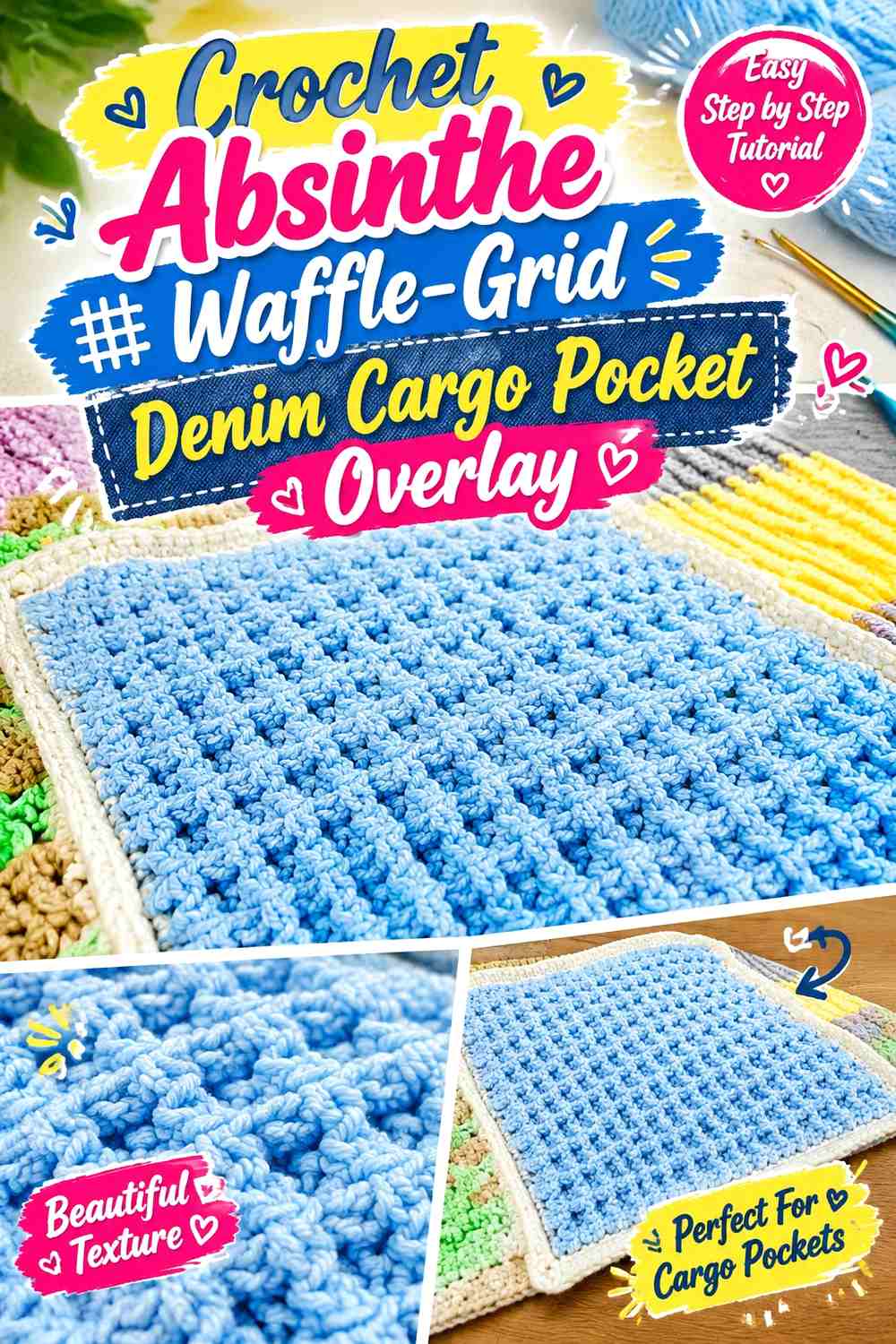
Waffle texture gives the cargo pocket a deeply structured grid without relying on multiple motifs. The Crochet Crowd’s waffle-square tutorial uses post-stitch texture to form recessed and raised sections across a square surface.
Worked mainly in Absinthe Green, the grid can create strong shadow against denim while a narrow Parchment border prevents the panel from appearing too heavy. This design is particularly useful on broad, flat cargo pockets where there is enough room for several complete waffle cells. Its thickness is the main trade-off. The recessed texture consumes more yarn and projects farther than a classic granny or filet overlay, so it is not the quietest choice for a pocket that frequently brushes against furniture, luggage, or another garment layer.
Give the Grid Enough Room to Repeat
Waffle texture reads best when several raised cells are visible. If the pocket only accommodates one or two oversized blocks, the fabric may look merely ridged rather than clearly gridded.
Adjust material choice only after making a sample. A finer yarn can reduce the overall scale while preserving more complete repeats across the pocket.
Keep Parchment at the Perimeter
Using Parchment only around the outside can brighten the panel without disrupting the continuous Absinthe waffle structure.
Frequent color changes inside each raised cell would shift attention from relief to striping. Let light and shadow do most of the work within the green center.
Consider Pocket Contents
A thick exterior overlay adds another layer over whatever is carried inside. On an already bulky cargo pocket, that can increase the overall visual and physical volume.
If the pocket regularly holds large items, compare the loaded garment with the sample overlay in place before deciding whether deep waffle texture is desirable.
Creator Credit: The Crochet Crowd
7. Crochet Parchment Cable-Spine Denim Cargo Pocket Overlay
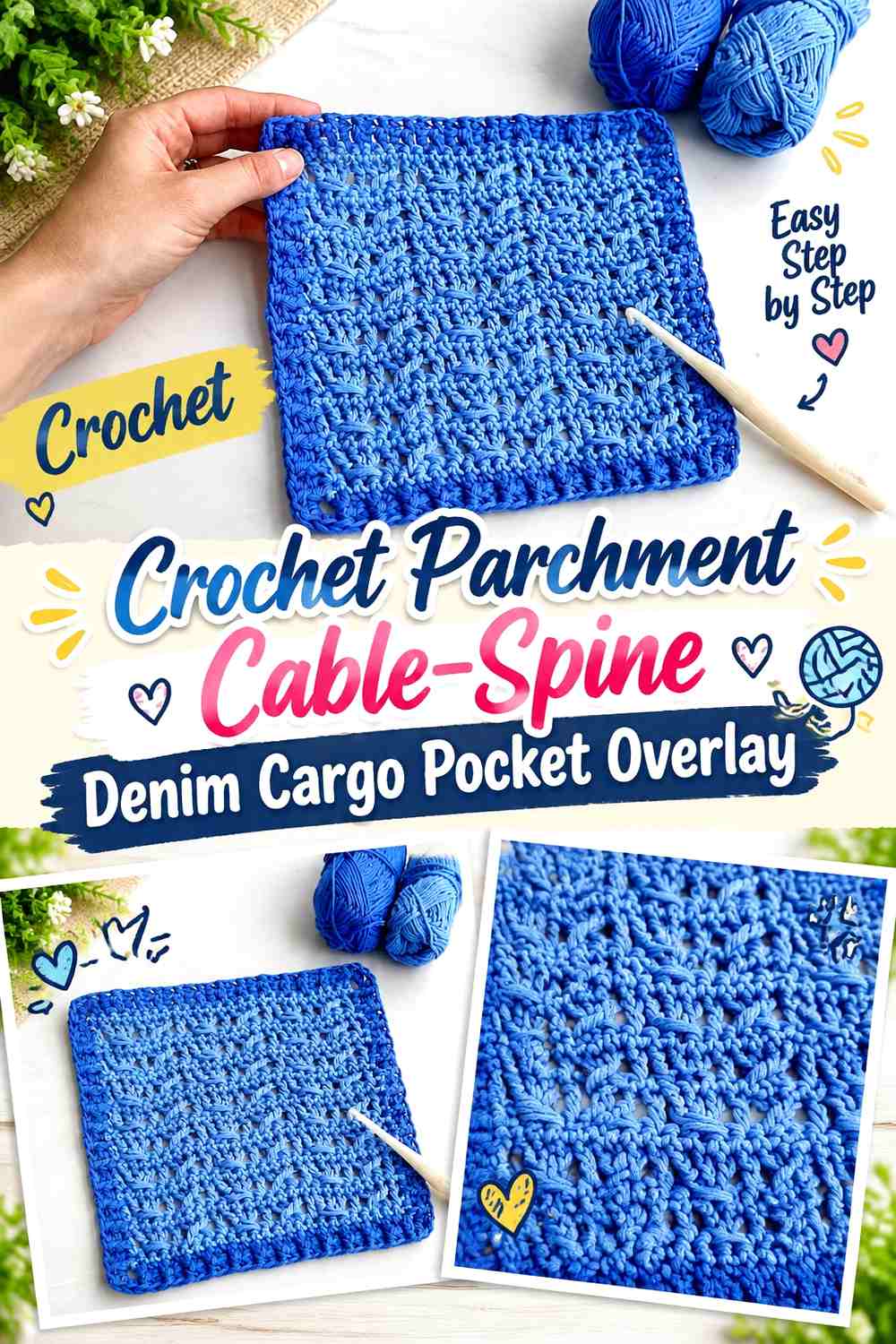
A single raised cable can turn a plain cargo pocket into a vertically structured feature. HanJan Crochet’s Rialto Cable Square teaches a textured square in which cable stitches cross across the surface and are contained within a defined motif.
For this adaptation, Parchment can form the main square while Absinthe Green appears as a narrow framing row or secondary accent. The cable naturally draws the eye up and down, making it useful on a taller pocket where a horizontal checker or chevron might emphasize width instead. Because the cable is raised, center placement matters considerably. A slightly skewed spine can make the entire overlay look crooked even when the outer edges are correctly aligned. This style also works best where pocket hardware does not occupy the same central line.
Align the Cable With the Pocket Center
Mark the pocket midpoint before positioning the motif. Do the same with the blocked cable square.
If the cargo pocket has a central pleat, snap, or stitch line, decide whether the crochet should align with that feature or stay entirely clear of it. Do not allow decorative symmetry to interfere with moving hardware.
Use the Cable to Add Length Visually
Vertical relief can make a short rectangular patch appear taller. That is useful when the pocket is broad and visually heavy.
Keep the side areas relatively plain so the eye follows the cable rather than being distracted by several unrelated textures. One strong raised line often creates more impact than multiple competing details.
Protect the Highest Crossing Points
Cable intersections tend to project more than the surrounding fabric. Check those areas for repeated abrasion when the garment is worn.
If the pocket sits beneath a bag strap or against a desk edge, a flatter texture may retain its appearance better over time. Choose the cable where its relief can remain part of the design rather than a frequent contact point.
Creator Credit: HanJan Crochet
8. Crochet Two-Tone Basketweave Denim Cargo Pocket Overlay
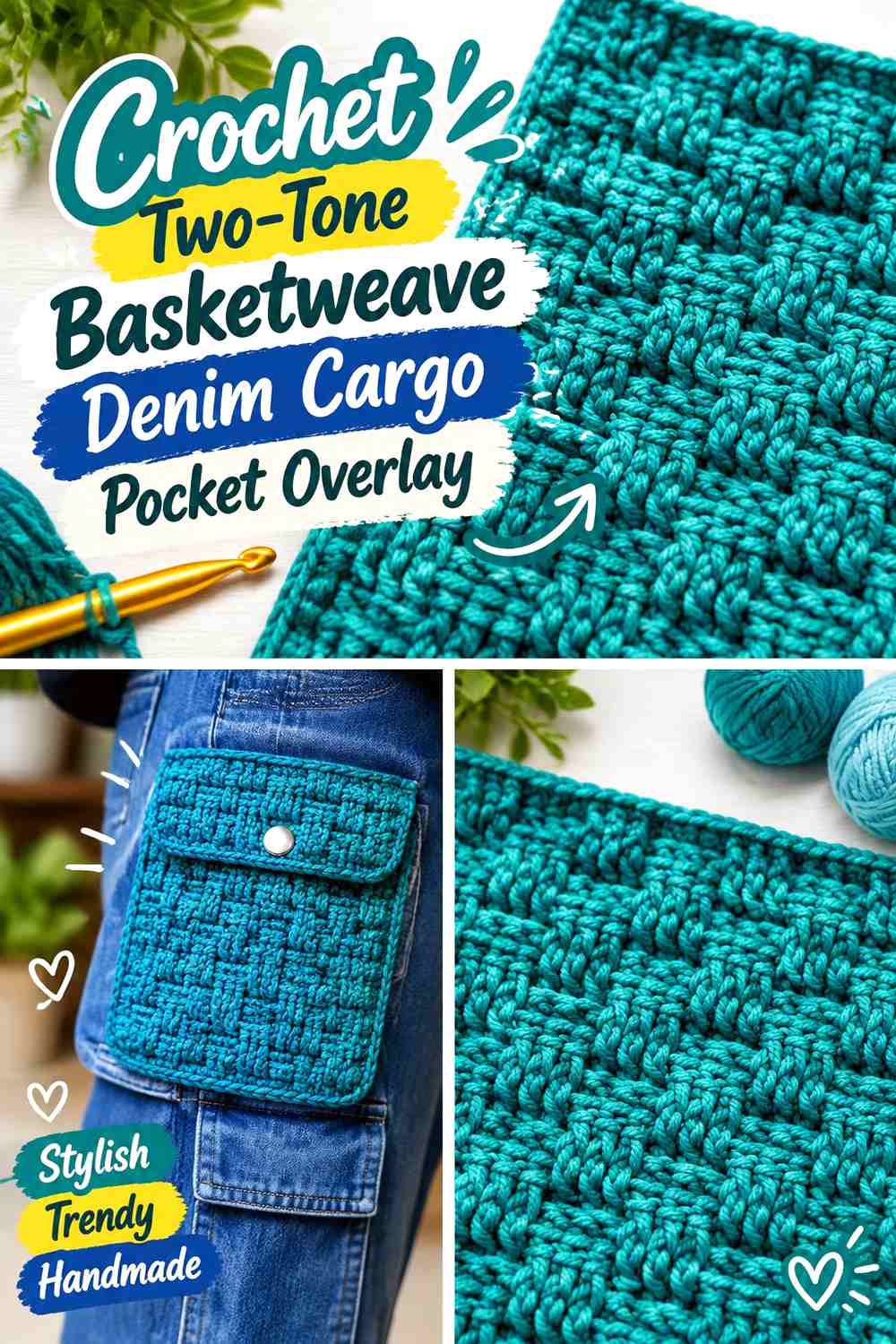
Basketweave gives the pocket a structured woven appearance through alternating groups of raised and recessed post stitches. The Unraveled Mitten’s tutorial explains the reversible basketweave stitch and provides a square version with a simple border.
Use Absinthe Green and Parchment in broad sections rather than changing shade inside every block. One approach is a green basketweave center with a Parchment border; another is a half-and-half panel divided along a block boundary. This overlay has more uniform texture than the cable option because the relief is distributed across the entire surface. That creates a substantial workwear look that suits denim well, but it also increases bulk. On expandable cargo pockets, keep the panel on the stable front face rather than wrapping it around pleated sides.
Preserve Complete Woven Blocks
Basketweave depends on repeated groups lining up across rows. Cropping the fabric at an awkward point can make one side appear unfinished.
Determine the useful stitch multiple from the original tutorial, then choose a blocked panel size that sits comfortably within the pocket instead of forcing the pattern to match every millimeter of denim.
Separate Color From Texture
The woven relief already creates a checker-like surface through shadow. Alternating Absinthe and Parchment in every textured block can make the result much busier.
Use larger color zones if you want the post-stitch pattern to remain the main feature. A contrasting border may supply all the second color you need.
Avoid Wrapping the Gussets
A basketweave panel is comparatively substantial. Folding it around an expandable side section could restrict how the cargo pocket opens.
Keep the overlay on the front plane and leave the pocket’s dimensional construction exposed. That also preserves the contrast between rugged denim gussets and crochet texture.
Creator Credit: The Unraveled Mitten
10. Crochet Parchment Mosaic-Square Denim Cargo Pocket Overlay
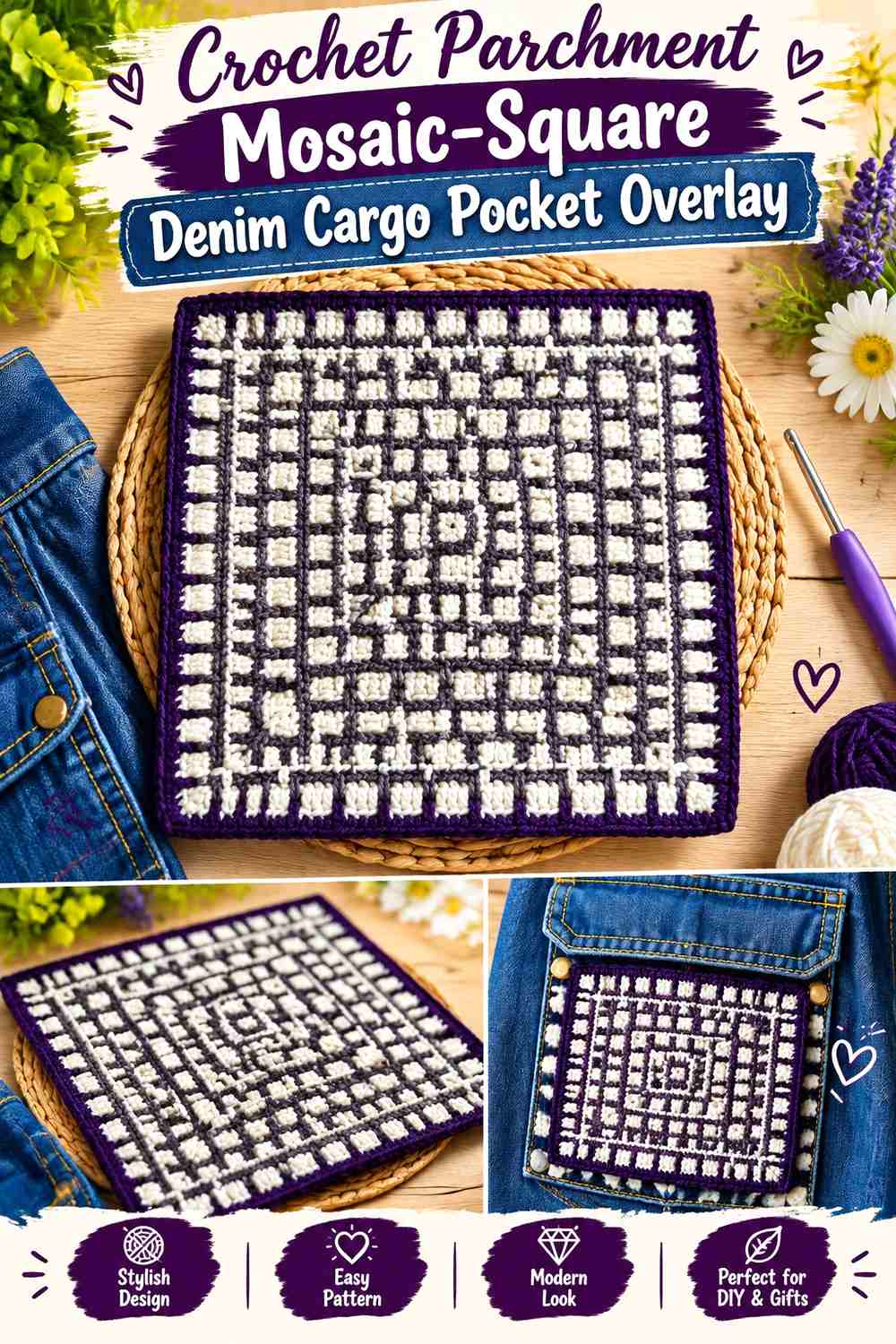
Overlay mosaic crochet produces crisp geometric lines by working selected stitches over earlier rounds. Juniper & Oakes’ Mosaic Squares pattern is worked from the center outward and uses two colors to build nested geometric forms within a square.
That structure makes it particularly suited to an Absinthe Green and Parchment palette. Use Parchment as the main ground and green for the drop-down geometric lines so the darker shade appears almost drawn onto the surface. Unlike a classic granny square, the motif has less open negative space, giving the cargo pocket more complete textile coverage. The graphic result suits modern utility clothing, but the square should be scaled carefully. If only an early portion of the motif fits the pocket, the design may not develop enough to show its intended geometry.
Let the Drop-Down Stitches Carry the Green
Assigning Absinthe Green to the most graphic overlay lines gives the darker color a structural purpose.
That is usually clearer than changing the color sequence arbitrarily. Parchment can remain the quieter field, allowing the mosaic geometry to stand out against both the pale yarn and surrounding denim.
Check the Square After Every Major Round
Center-out construction changes both width and height at the same time. Once the motif approaches the pocket dimensions, compare it regularly with your template.
Stopping at a visually complete round is preferable to adding one more round and ending up with a panel that overlaps gussets or interferes with the flap.
Keep the Pocket Hardware Outside the Motif
Mosaic designs depend on uninterrupted geometry. A snap or stud installed through the center can obscure the lines and introduce stress into raised stitches.
If hardware occupies the pocket face, consider placing the mosaic on the flap alone or selecting a smaller motif that remains clear of the closure.
Creator Credit: Juniper & Oakes
11. Crochet Two-Tone C2C Pixel Denim Cargo Pocket Overlay
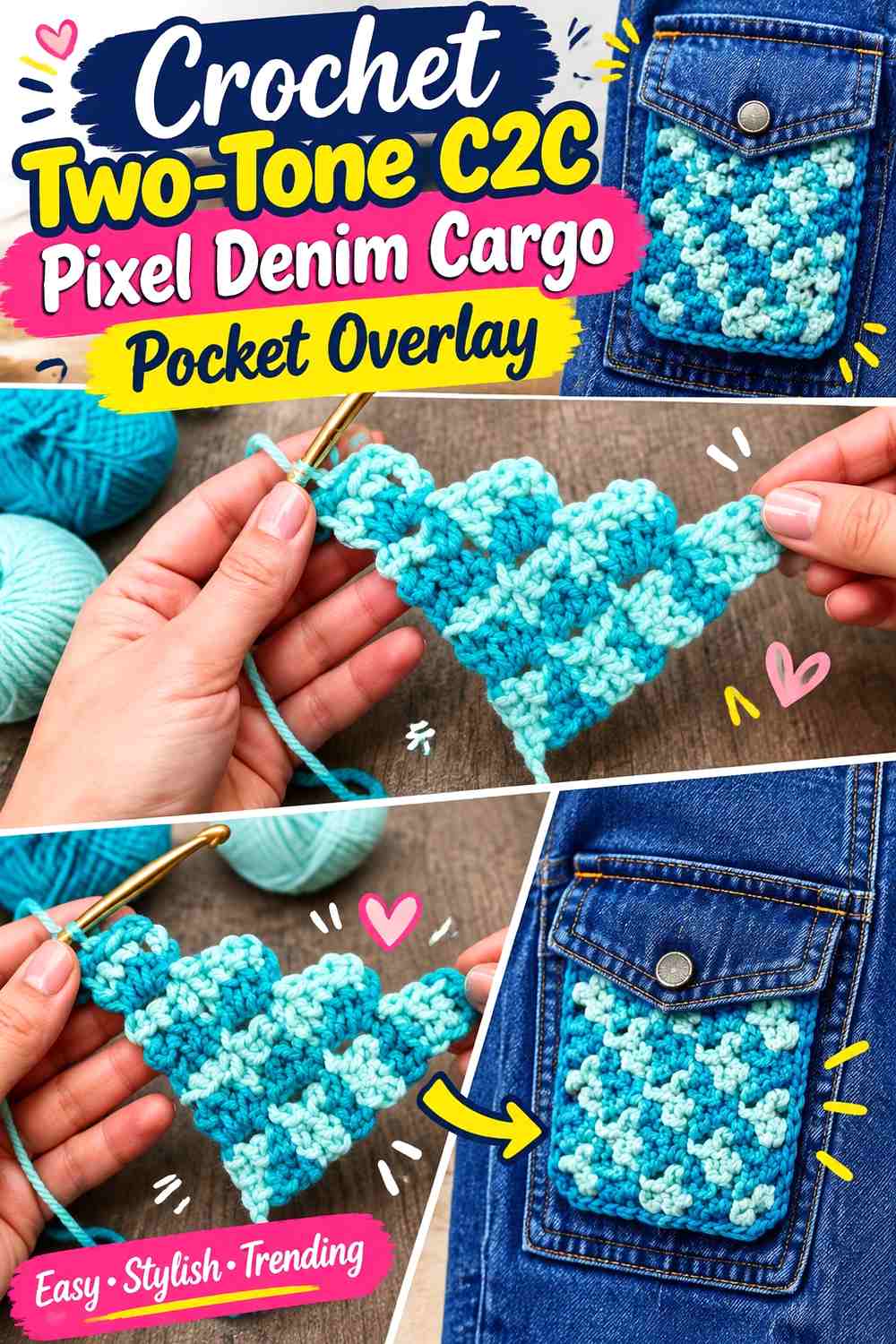
Corner-to-corner crochet builds a fabric diagonally from small blocks, creating a pixel-like surface that is naturally suited to color blocking. The Purple Poncho’s tutorial teaches the C2C method and includes color-changing guidance for square construction.
For a cargo-pocket overlay, Absinthe Green and Parchment can form diagonal halves, a stepped stripe, or a small block pattern without introducing rounded motifs. The diagonal working direction distinguishes it immediately from checkerboard even when both use square units. C2C fabric can also be made as a straightforward square and framed with a narrow finishing edge before attachment. Because the individual blocks have visible texture, a large yarn may make the pixel units too coarse for a small pocket. Sample enough blocks to judge the scale before planning the color arrangement.
Use the Diagonal Construction Visually
A simple division from one corner to the opposite can make the technique itself obvious without creating a complicated graph.
For example, use Absinthe Green through one triangular region and Parchment through the other. The strong diagonal contrasts effectively with the straight vertical and horizontal seams of a cargo pocket.
Keep the Pixel Scale Small Enough
Large C2C blocks can consume the usable pocket area quickly. If only a few tiles fit across the width, a detailed color design will have little room to develop.
Choose yarn and hook based on the desired block scale, then measure the sample rather than assuming the source project’s dimensions will translate to denim.
Finish the Stepped Edges Cleanly
C2C naturally creates small steps along its outside edge. Those can be attractive but may be awkward if the overlay needs a very smooth sewing line.
Consider a restrained finishing round if appropriate for your panel. Whatever edge you choose, block it before comparing it with the pocket template.
Creator Credit: The Purple Poncho
12. Crochet Parchment Filet-Rose Denim Cargo Pocket Overlay
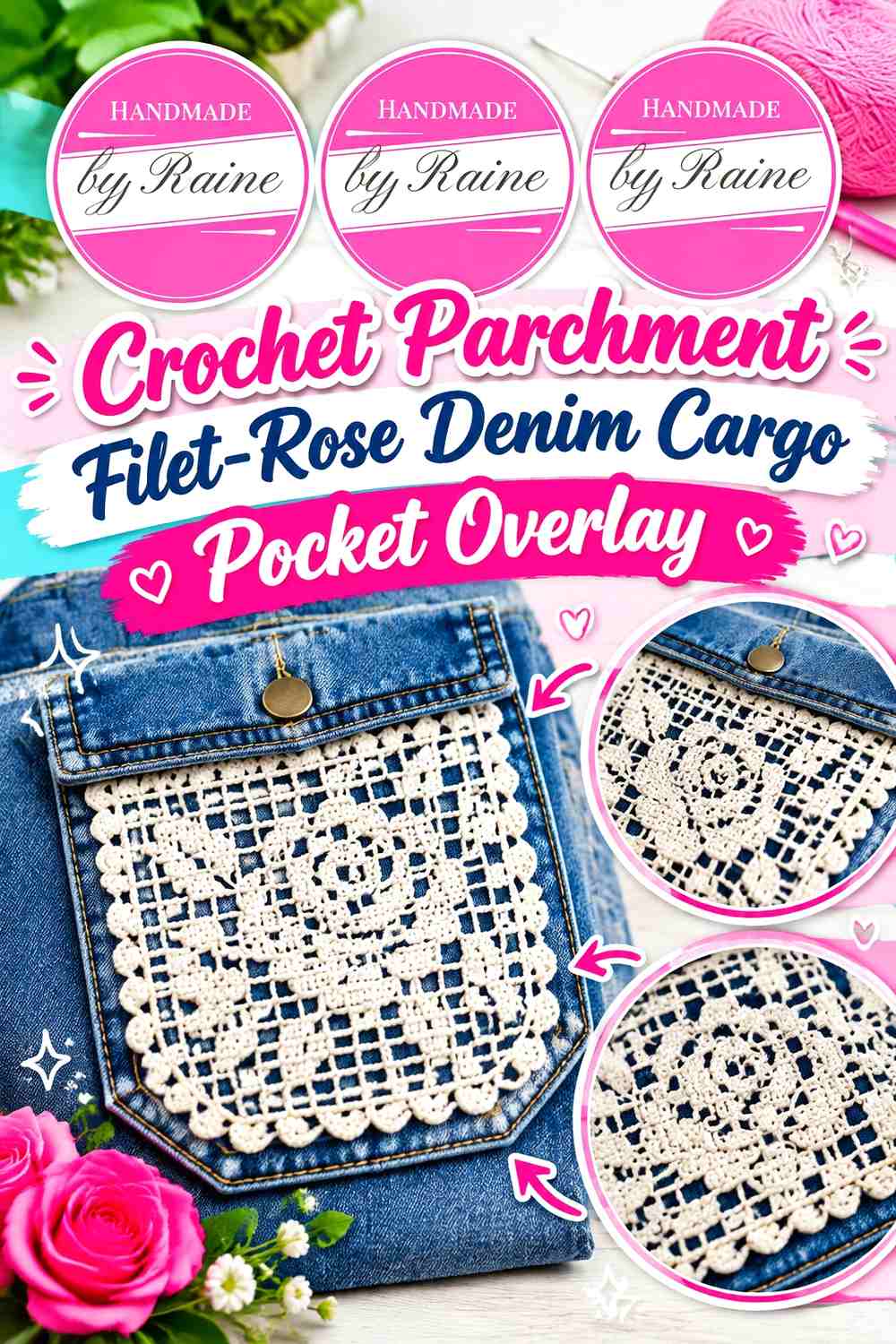
Filet crochet creates imagery by alternating open and filled blocks rather than attaching a separate flower. HandmadebyRaine’s Rose Curtain tutorial uses a filet grid to form repeating rose motifs and explains the open-versus-solid block structure that creates the image.
A single rose section can be adapted conceptually into a flat Parchment cargo-pocket overlay, with Absinthe Green reserved for a narrow edge. This is one of the least bulky motif options because the rose exists inside the fabric rather than sitting on top as petals or puffs. It works especially well when you want the blue denim to show through the open grid. The limitation is scale: the complete rose needs enough blocks to remain recognizable, so very small cargo pockets may not provide sufficient area without extremely fine material.
Preserve the Complete Rose Grid
A filet image cannot be resized simply by dropping random columns or rows. The relationship between filled and open blocks creates the rose.
Use the creator’s chart or instructions for the motif itself and determine whether a complete section can fit your intended pocket. If not, choose a simpler openwork design rather than distorting the image.
Let Denim Show Through the Mesh
Parchment filet over indigo denim gives the open blocks a strong blue background. That naturally produces a two-layer color effect even before Absinthe Green is introduced.
Consider keeping the green to the perimeter so the rose remains easy to read. Too many internal color changes may compete with the open-and-filled structure.
Keep the Filet Flat During Attachment
The appeal of this option is its low profile. Over-tight attachment can pucker the grid and turn square openings into irregular shapes.
Block the panel first and position it without stretch. The denim should support the lace, not reshape it.
Creator Credit: HandmadebyRaine
13. Crochet Absinthe Surface-Line Denim Cargo Pocket Overlay
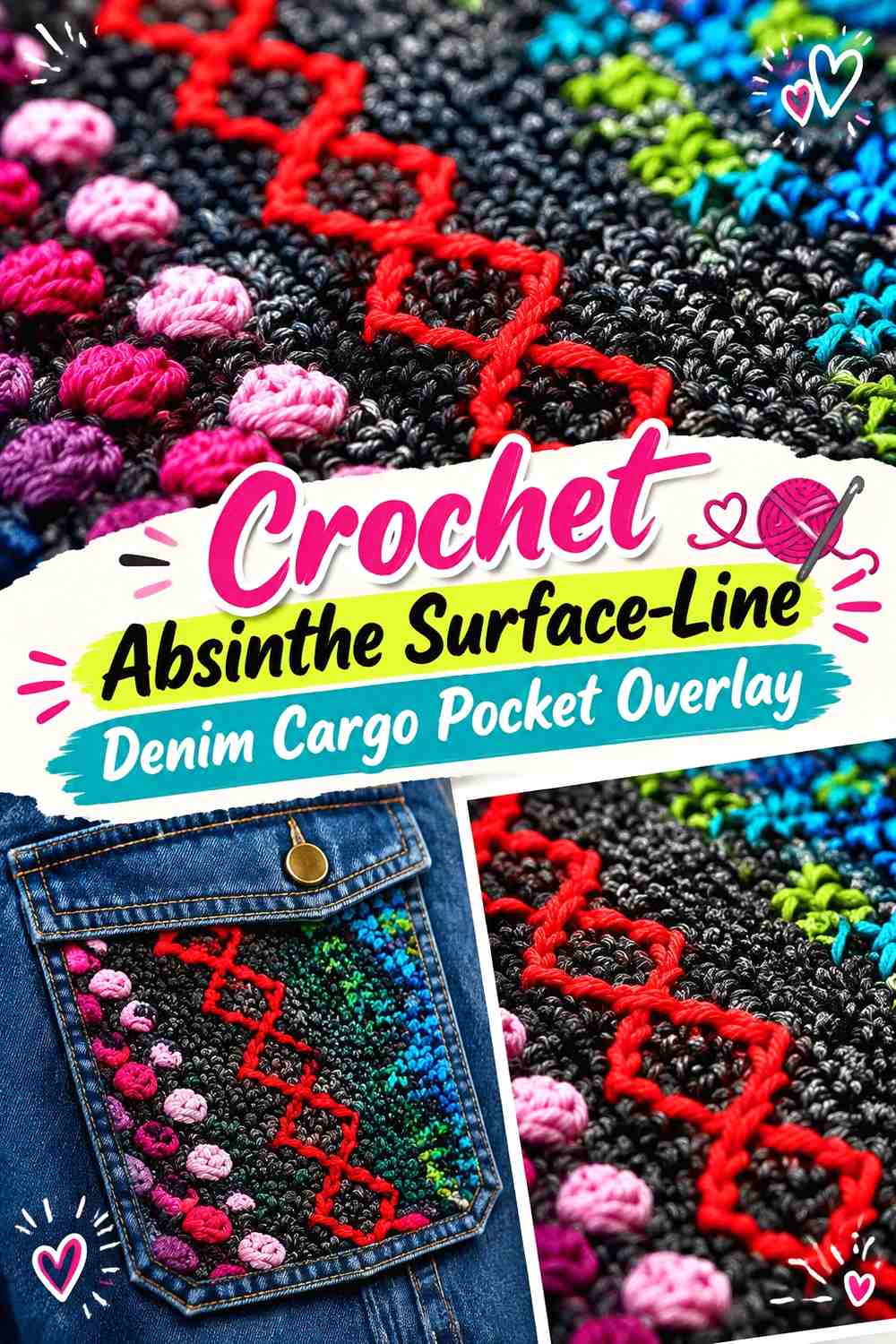
Surface crochet adds decorative lines on top of an already crocheted base. Haak Maar Raak’s tutorial teaches surface slip stitch as a technique worked across finished crochet fabric and discusses horizontal, vertical, and diagonal placement.
For a cargo overlay, begin with a simple Parchment crochet rectangle, then use Absinthe Green surface lines to mimic utility stitching, pocket maps, grids, or narrow stripes. This is distinct from two-color checkerboard because the green sits on the surface rather than being built into the fabric row by row. It is also easy to keep relatively flat. The success of the idea depends on line control: uneven surface tension can pucker the base, and overly dense lines may make a soft panel stiff. Plan the surface design before attaching the crochet rectangle to denim.
Echo the Denim Topstitching
Cargo pockets often contain visible straight seam lines. Absinthe surface crochet can deliberately echo that construction with parallel or right-angle lines across the Parchment base.
Keep the spacing related to the pocket rather than decorating the rectangle in isolation. A line that aligns with a flap edge or central seam can make the overlay feel integrated with the garment.
Test Vertical Lines on a Stable Base
The source notes that surface crochet behaves differently depending on direction. A firm, relatively even base makes it easier to keep vertical or diagonal lines controlled.
Make the surface design while the crochet panel is still loose and accessible. Working intricate lines after attachment to denim would make the wrong side harder to reach.
Avoid Pulling the Decorative Yarn Tight
Surface slip stitches can contract the fabric if they are worked with much tighter tension than the base.
Pause after a short section and lay the panel flat. If the Parchment rectangle begins to ripple around the green line, correct the tension before adding more decoration.
Creator Credit: Haak Maar Raak
14. Crochet Two-Tone Star-Scatter Denim Cargo Pocket Overlay

Separate stars allow the denim to remain the dominant surface. Naztazia’s star tutorial creates a star-shaped crochet appliqué with individually formed points around a central round.
Instead of covering the whole cargo pocket, place one larger Absinthe Green star with several smaller Parchment stars or use a controlled two-color scatter across the fixed pocket face. This approach adds less crochet fabric than a full square and allows you to work around snaps, pleats, and seams more easily. Spacing is the main design decision. Too many stars can create nearly the same visual coverage as a panel while introducing many separate attachment points; too few may look arbitrary. Arrange completed motifs on the garment before securing any of them.
Build the Layout Around the Closure
If a snap or button occupies the upper center, treat it as part of the composition rather than placing a star underneath it.
Arrange motifs around the hardware with enough clearance for fingers and normal opening. The crochet should decorate the pocket without making the closure harder to operate.
Mix Color Without Mixing Scale Excessively
Using two colors is already enough to create variation. If every star is also a drastically different size, the pocket can become visually chaotic.
Choose one principal scale and perhaps one smaller supporting size. Let Absinthe and Parchment provide most of the difference.
Leave Denim Between the Motifs
The advantage of a scatter is negative space. Preserve enough bare denim for each star outline to remain recognizable.
This also reduces the amount of crochet exposed to friction and keeps the cargo pocket’s original construction visible.
Creator Credit: Naztazia
15. Crochet Absinthe Leaf-Branch Denim Cargo Pocket Overlay
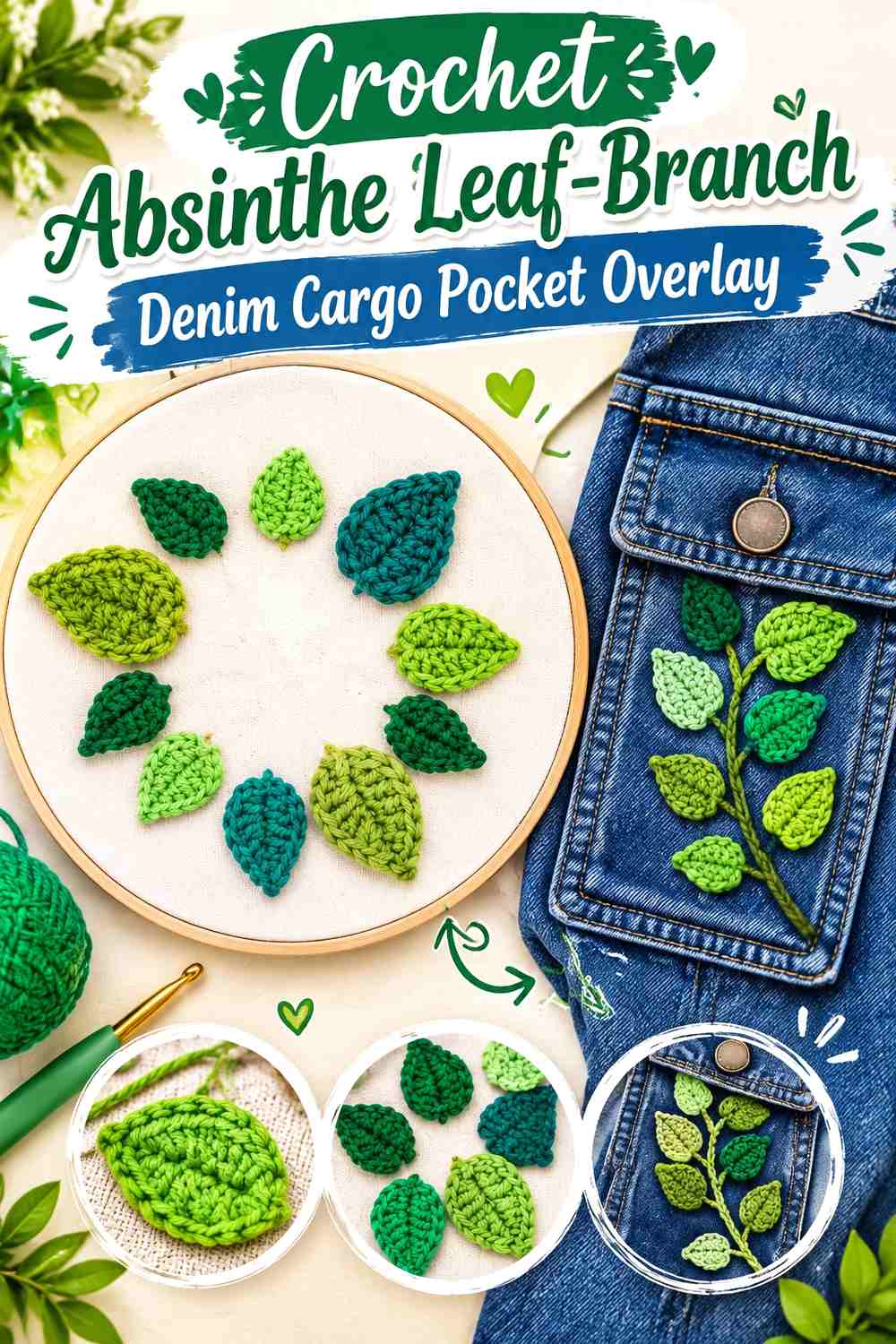
Individual leaves create an organic alternative to square and geometric overlays. RaffamusaDesigns provides an original small leaf appliqué tutorial designed specifically for embellishing larger crochet projects.
For a denim cargo pocket, several Absinthe Green leaves can be arranged along a diagonal or shallow branch-like path, with Parchment appearing only in a few smaller leaves or a narrow connecting crochet line. This layout keeps most of the denim exposed and can follow the pocket shape more flexibly than a rigid square. The leaves should remain away from moving pleats or edges that fold outward. Because each piece has its own perimeter, finishing and attachment quality are more visible than with a continuous panel.
Follow the Pocket Angle With the Leaves
A diagonal cluster can visually soften a broad rectangular cargo pocket without hiding its structure.
Lay the leaves on the worn garment rather than only on a flat table. The pocket may sit at an angle on the body, changing how a branch arrangement appears once the garment is upright.
Keep the Stem Concept Subtle
You do not need a thick crocheted branch connecting every leaf. A sparse arrangement can imply a botanical line through spacing alone.
If you add a Parchment or Absinthe connector, make sure it does not cross the pocket opening or a pleat that needs to expand.
Finish Every Motif Before Positioning
Loose ends are harder to conceal neatly after several appliqués have been attached close together.
Finish each leaf first, then arrange the entire composition. This also lets you reverse, rotate, or replace individual leaves until the pocket looks balanced.
Creator Credit: RaffamusaDesigns
17. Crochet Two-Tone Open-Lace Denim Cargo Pocket Overlay

An open lace square gives the pocket broad coverage without the visual mass of waffle, basketweave, or mosaic. Kristines Crochets’ tutorial teaches a fingering-weight lace square motif and demonstrates the motif as a distinct openwork square intended for joining into larger lace projects.
For a cargo overlay, one blocked square can function independently. Use Parchment across the most open rounds and Absinthe Green at selected structural points or the outer edge. The denim beneath will remain clearly visible through the lace, making this one of the most integrated-looking full-panel options. It is particularly suitable when you want the crochet to soften the industrial pocket shape rather than cover it with dense color. Open lace is also more vulnerable to snagging, however, so consider pocket location before choosing very large loops or projecting chains.
Let the Denim Fill the Negative Space
Open lace works almost like a stencil over the garment. The blue showing through the motif becomes an important part of the finished appearance.
For that reason, avoid placing a separate fabric backing beneath the crochet unless you specifically want to remove the denim contrast. The open spaces are what distinguish this treatment from a solid patch.
Block the Square Precisely
Lace benefits strongly from even shaping. A skewed corner is especially easy to see when it sits next to straight cargo-pocket topstitching.
Finish and block the motif before measuring its final relationship to the pocket. Do not expect attachment alone to correct uneven corners.
Choose the Pocket Location for Snag Resistance
Large open loops have less protection than compact stitches. A side pocket that repeatedly catches bag hardware or passes close to furniture may be a poor location for delicate lace.
Use this overlay where the motif can remain visible without constant abrasion, or select a denser square from the list for harder-wearing garment areas.
Creator Credit: Kristines Crochets
Comparing the 17 Cargo Pocket Overlay Styles
For the flattest full-coverage options, compare the classic granny, mosaic, C2C, filet rose, surface-line panel, and open-lace square. They add a distinct crochet layer without relying on deeply raised stitches. Checkerboard and chevron introduce stronger all-over color rhythm while remaining more graphic than floral.
Sunburst, puff flower, waffle, cable, and basketweave provide increasingly noticeable relief. They work best when texture is a priority and the pocket location is not subjected to constant rubbing.
The star, leaf, and heart options preserve the greatest amount of visible denim and make it easier to work around closures, pleats, and topstitching. Daisy and puff-flower squares sit between those extremes: they provide one recognizable motif while still giving the overlay a simple square perimeter.
Conclusion
Absinthe Green and Parchment can make a denim cargo pocket look botanical, graphic, textural, or almost lace-covered without changing the pocket’s basic utility aesthetic. Classic granny, mosaic, filet, and C2C panels are useful when you want controlled rectangular coverage, while cables, waffle stitches, basketweave, and puff flowers turn texture into the main feature. Stars, leaves, and hearts are better when the denim itself should remain dominant.
Before attaching any overlay, finish and block the crochet and test it on the garment with the pocket both empty and loaded. Make sure the flap, closure, gussets, and opening still operate freely. For the actual crochet construction, follow the credited creator tutorial; treat sizing and attachment to the specific denim garment as a separate adaptation.
Frequently Asked Questions
Should a crochet overlay cover the entire cargo pocket?
It does not have to. Full panels work well on broad, flat pocket faces, but leaving a denim margin can make the crochet look more deliberate and reduce interference with seams or gussets. Small stars, leaves, or hearts provide even less coverage. Before deciding, identify the moving parts of the pocket. An overlay should not casually bridge a flap, pleat, or expandable side simply because the full pocket outline is rectangular.
Which crochet textures are better for high-friction cargo pockets?
Flatter structures such as classic granny fabric, mosaic, filet, C2C, and simple surface-decorated panels generally project less than puff flowers, deep waffle texture, cables, or basketweave. Actual durability still depends on yarn, stitch density, attachment, and how the garment is used. A thigh pocket that repeatedly rubs against chairs or bags may benefit from lower relief than a decorative cargo pocket on a jacket.
Can I attach crochet directly over a snap or button?
It is usually better to preserve clear access to working hardware. A panel placed directly beneath or across a closure can make the pocket harder to open and can put stress on the crochet whenever the hardware is used. Design the overlay around the snap, button, zipper, or flap instead. A small motif arrangement often gives more flexibility than a full square when the pocket has prominent hardware.
How do I choose between Absinthe Green and Parchment as the dominant color?
Use Parchment as the larger area when you want stronger contrast on dark denim and a lighter textile effect. Use Absinthe Green when the overlay should feel richer and more graphic. You can also divide their roles: Parchment for a base square and Absinthe for mosaic lines, borders, leaves, or surface stitching. Test both shades against the actual denim because indigo, black, gray, and faded blue change their apparent contrast.
Can I resize a granny square or motif to fit a cargo pocket?
Many square motifs can be enlarged by continuing their established construction, but the method depends on the specific tutorial. Do not assume every motif can simply gain arbitrary extra rounds without changing its design. Make one motif, block it, and compare its relaxed measurements with a paper pocket template. If the pattern does not provide a suitable resizing method, leaving a denim margin may produce a cleaner result than forcing the crochet to cover the full face.
How can I keep an overlay from making the cargo pocket look bulky?
Choose finer yarn, flatter stitch structures, or partial appliqué coverage rather than assuming every pocket needs a full textured panel. Keep borders narrow and avoid stacking several raised techniques in the same area. Placement also matters: an overlay that stops below the flap can look much lighter than one extending from seam to seam. Check the garment from normal standing distance as well as close up before final attachment.
Should the overlay be washed or blocked before attaching it to denim?
Finishing the crochet first is a useful checkpoint because its dimensions can change during blocking or appropriate washing. Follow the yarn label and the creator’s care guidance for the crochet, then compare the finished motif with the denim pocket again. This reduces the risk of attaching a panel based on unfinished dimensions. Also consider the garment’s own care requirements so the finished denim-and-crochet combination remains practical to maintain.