Persian Rose and Graphite create an especially useful palette for crochet cabinet glass inserts because the two colors can separate solid motif areas from open lace without requiring a complicated multicolor design. The bigger decision is how much of the glass should remain visible. Fine filet and sheer grids preserve considerable transparency, while joined flowers, medallions, granny squares, and geometric motifs create more visual screening.

Construction matters too. A single rectangular panel is easier to size precisely to a cabinet opening, whereas modular motifs allow the insert to grow in measured units but require careful planning at the edges. Vertical lace can make a narrow door look taller; chevrons emphasize width; centered medallions behave more like decorative window panels.
The credited tutorials teach curtains, lace panels, or motif constructions rather than cabinet-specific installation. Use them for the original crochet methods, then size and mount the finished insert independently for your cabinet frame.
Quick List
- Crochet Persian Rose Chevron Cabinet Glass Lace Insert
- Crochet Graphite Flower-Lattice Cabinet Glass Lace Insert
- Crochet Two-Tone Rosette Mosaic Cabinet Glass Lace Insert
- Crochet Graphite Sheer-Grid Cabinet Glass Lace Insert
- Crochet Persian Rose Granny-Window Cabinet Glass Lace Insert
- Crochet Botanical Flower-and-Leaf Cabinet Glass Lace Insert
- Crochet Graphite Mini-Medallion Cabinet Glass Lace Insert
- Crochet Persian Rose Round-Motif Cabinet Glass Lace Insert
- Crochet Graphite Hexagon Honeycomb Cabinet Glass Lace Insert
- Crochet Two-Tone Geometric Screen Cabinet Glass Lace Insert
- Crochet Vertical Flower-Lace Cabinet Glass Lace Insert
- Crochet Ring-Center Square Cabinet Glass Lace Insert
- Crochet Persian Rose Filet-Rose Cabinet Glass Lace Insert
- Crochet Graphite Traditional Lace Cabinet Glass Lace Insert
Measure the Visible Glass, Not Just the Cabinet Door
A cabinet lace insert usually needs to relate to the visible glass opening rather than the full dimensions of the door. Measure the unobstructed glass area inside the surrounding frame and note whether the crochet will sit directly against the pane, behind an inner molding, or on another removable support. Even a small difference matters when a rectangular lace panel contains obvious grids, chevrons, or centered motifs.
Create a paper template before committing to the finished dimensions. It lets you test whether the insert should fill the complete opening or leave a narrow glass margin around all sides.
Modular designs need an additional calculation. Instead of stretching joined motifs to fit the last bit of space, determine whether a whole number of squares, flowers, circles, or hexagons can occupy the opening comfortably. A deliberate border can absorb remaining space more gracefully than distorted motifs.
Choose Opacity According to What Is Behind the Glass
Open crochet does not provide the same visual screening at every distance. A fine graphite grid against pale dishes may appear much more prominent than it does against a dark cabinet interior, while Persian Rose motifs can draw attention to individual objects visible behind the openings.
If you want the cabinet contents to remain part of the display, choose sheer mesh, narrow flower lace, or widely spaced filet. For stronger visual filtering, joined motifs and denser geometric panels interrupt the view more effectively without eliminating the translucent quality of the glass.
Two-color placement can also control opacity visually. Graphite outlines around Persian Rose motifs sharpen their boundaries, while a largely graphite insert with occasional rose centers produces a quieter effect. Test a swatch against the actual stocked cabinet. Empty-glass evaluation does not show how the lace will interact with dishes, glassware, shelves, and interior shadows.
Block the Lace Before Finalizing the Mounting Method
Blocking is particularly important when crochet sits against a rigid rectangular pane. Small waviness that looks acceptable in a hanging curtain becomes more obvious when straight cabinet rails provide an exact visual reference. Finish and block the complete insert before deciding whether its dimensions need correction.
Fine openwork may relax after washing, while motif joins and dense borders can behave differently from the center. Follow the original tutorial and yarn-care guidance rather than assuming every lace fabric should be blocked the same way.
For removable installation, choose a mounting approach appropriate to your particular cabinet without damaging the glass, finish, or door operation. Avoid positioning loose fibers where hinges or latches can catch them. In kitchens, also keep decorative crochet away from burners, hot appliance surfaces, and other heat sources.
1. Crochet Persian Rose Chevron Cabinet Glass Lace Insert
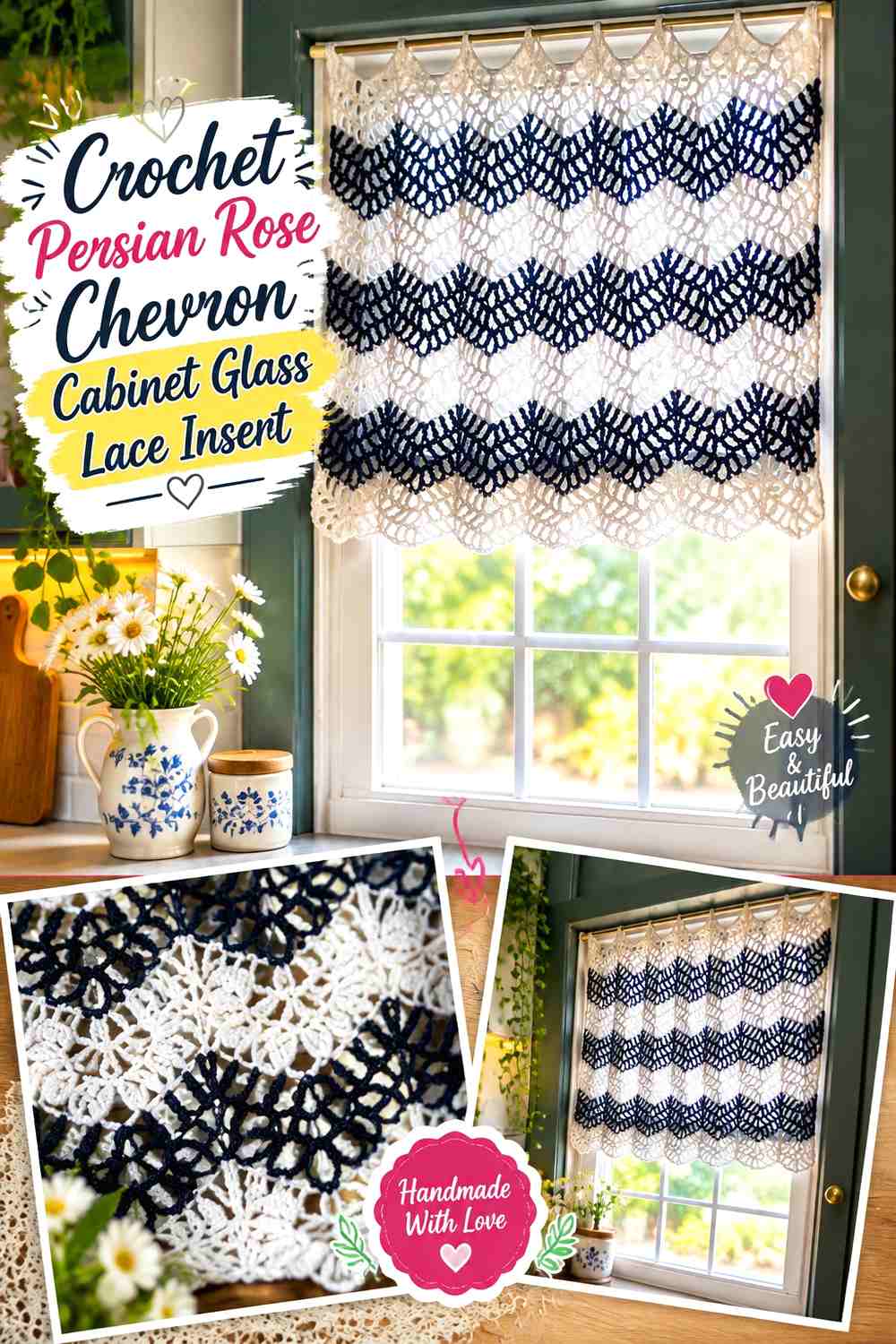
A chevron lace insert gives a rectangular cabinet pane a strong directional pattern without filling the glass with separate motifs. Moogly’s curtain tutorial teaches an open chevron construction in a continuous panel, making it a useful reference when the objective is a graphic zigzag surface rather than floral lace.
For this cabinet version, Persian Rose can carry the principal chevrons while Graphite appears in narrower alternating bands or around the perimeter. The pointed movement works especially well on a broad door because it breaks up a wide sheet of glass. It may be less suitable when the cabinet already has ornate muntins or carved framing, where another bold geometry could compete with the woodwork. Decide whether the chevrons should terminate symmetrically at both vertical edges before establishing the finished width.
Center the Peaks Before Adjusting the Border
Chevron fabric makes partial repeats conspicuous. A narrow leftover space at one side can make an otherwise balanced panel look shifted inside the cabinet.
Work from the center line of the paper template outward when planning repeat placement. If the lace repeat does not naturally match the glass width, use a restrained side border rather than stretching the fabric or squeezing in an incomplete-looking zigzag.
Keep Graphite From Becoming a Heavy Stripe
Graphite produces strong visual weight against illuminated glass. If every alternate chevron is equally wide, the insert can become more striped than lacy.
Consider using Graphite as an outline, narrow band, or framing row while Persian Rose occupies the larger open sections. That keeps the darker color useful for definition without obscuring the characteristic chevron movement.
Creator Credit: Moogly
2. Crochet Graphite Flower-Lattice Cabinet Glass Lace Insert
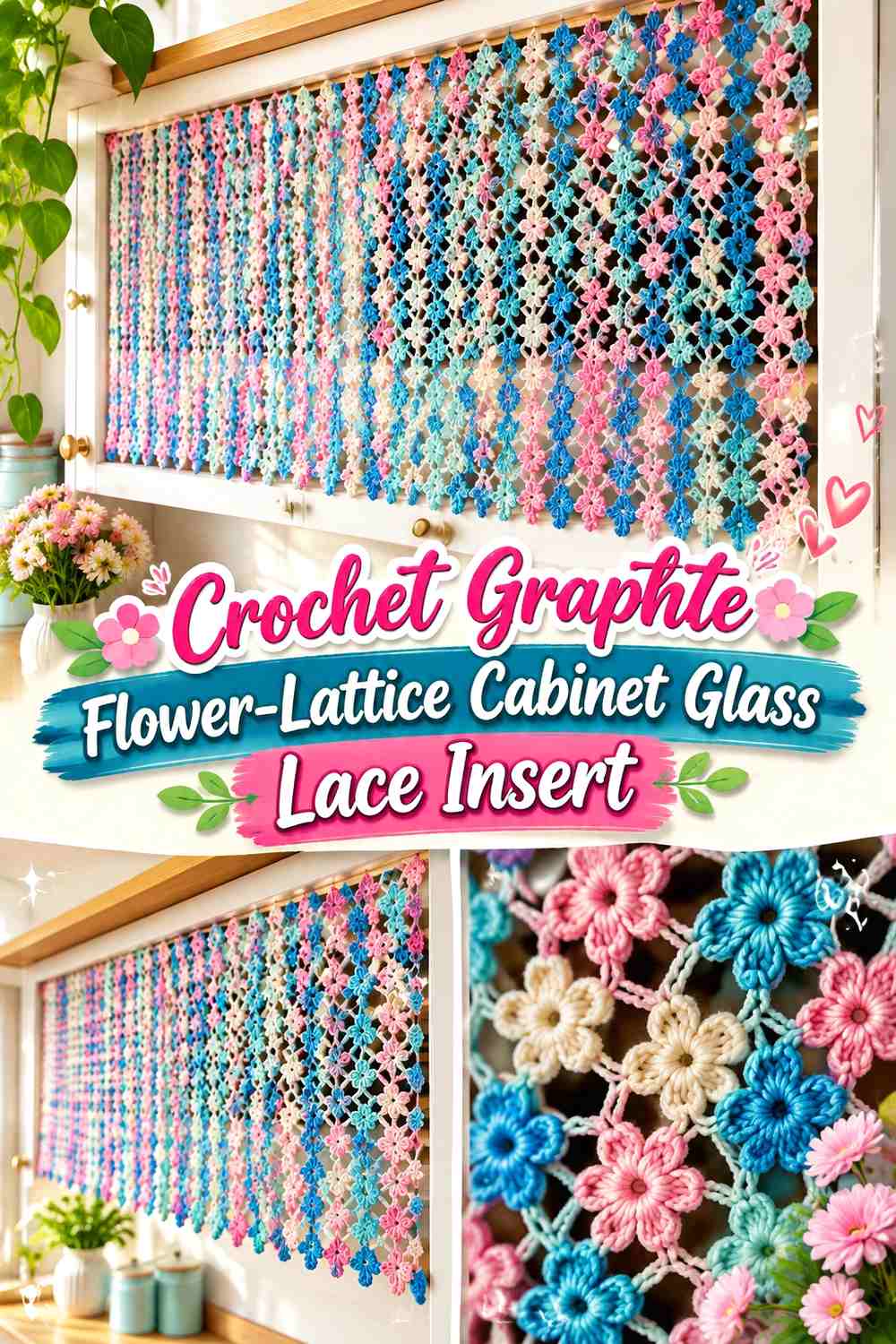
A flower lattice creates the impression of motifs without assembling separate finished flowers one by one. Dearest Debi’s curtain-valance tutorial uses connected floral units to build an open continuous field, providing a useful reference for a cabinet insert where negative space is as important as the flowers themselves.
Graphite is an interesting main color for this structure because the four-petal forms become almost silhouette-like against the glass. Persian Rose can be confined to selected flowers, an edge row, or a narrow perimeter. Compared with a dense floral mosaic, the lattice leaves more of the cabinet interior visible and suits doors where glassware or ceramics are intentionally displayed. The biggest planning issue is direction: the source discusses how the orientation of the lattice affects how the fabric hangs, so establish your cabinet dimensions before adapting the panel.
Use Rose Sparingly to Create a Focal Rhythm
A Graphite field can support occasional Persian Rose flowers without requiring every motif to alternate color. Spaced rose units draw the eye across the insert and make individual flowers easier to recognize.
Plan those positions on graph paper before beginning multiple color changes. Random color placement can work, but on two matching cabinet doors an intentional repeat is easier to mirror convincingly.
Check Flower Alignment Against the Door Rails
A floral lattice has diagonal visual lines even though the finished panel is rectangular. If those lines appear to slope differently from one cabinet door to the next, the pair can look mismatched.
Block both inserts to identical templates and compare the flower centers with the horizontal and vertical rails. Correct alignment before mounting rather than expecting attachment tension to straighten the lace.
Creator Credit: Dearest Debi Patterns
3. Crochet Two-Tone Rosette Mosaic Cabinet Glass Lace Insert
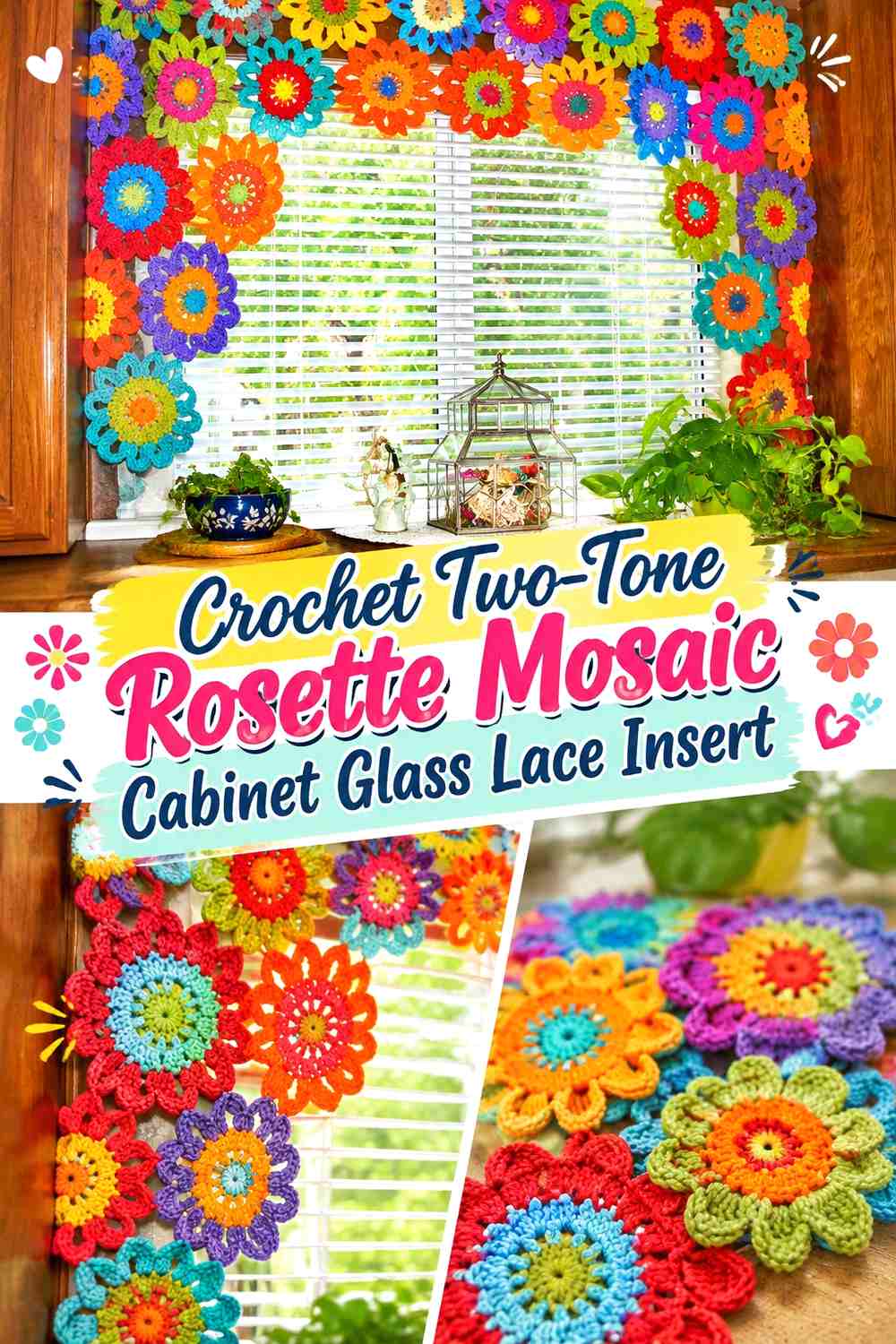
Joined full and partial flower motifs create a very different surface from a continuous flower stitch. Once Upon A Pink Moon’s Flower Power Valance tutorial builds the design from individual flowers joined into a larger arrangement, so it offers a practical source for a modular cabinet insert where motif count determines the dimensions.
Persian Rose flower centers with Graphite outer petals would create distinct dark-edged rosettes, while reversing the colors produces a more dramatic graphite field punctuated by rose centers. Because every flower is visually separate, this style suits a cabinet intended to become a decorative focal point rather than one where nearly transparent glass is the priority. The modular construction also makes width adjustment straightforward in concept, but the actual motif size must be checked after blocking before you calculate how many units can fit the opening.
Plan Full and Partial Motifs Around the Rectangle
Round flowers do not naturally form a perfectly filled rectangle without spaces or edge decisions. The source construction demonstrates how full and partial motifs can create a shaped valance, but a cabinet insert usually needs straighter boundaries.
Lay finished sample motifs on the paper template before committing to quantity. Decide whether the outer row should use partial forms, a plain border, or deliberate negative space.
Manage Color Ends Before Joining the Mosaic
Separate motifs give you excellent control over Persian Rose and Graphite placement, but frequent color changes can generate substantial finishing work.
Complete and secure each motif before the entire grid becomes difficult to handle. A cabinet insert is visible at close range, and stray ends or thick joining points may show through the glass from inside the door.
Use the Cabinet Contents as a Third Color
The open spaces between rosettes reveal whatever sits behind the pane. White dishes, warm wood shelves, or dark glassware can change how both yarn colors appear.
Test several finished flowers against the loaded cabinet before choosing the final arrangement. A combination that looks balanced against a white table may feel significantly darker once backed by the cabinet interior.
Creator Credit: Once Upon A Pink Moon
4. Crochet Graphite Sheer-Grid Cabinet Glass Lace Insert

For the lightest visual treatment, a continuous sheer panel keeps the stitch pattern secondary to the glass itself. Gemma Crochet’s window-curtain tutorial demonstrates an open curtain construction with a simple repeated structure and finished outline, providing a useful model for a cabinet insert that should read as a translucent textile layer rather than a collection of motifs.
Graphite works particularly well here because a small amount of dark yarn can define the grid clearly against glass. Add Persian Rose only at the perimeter or as one narrow central band if you want the geometry to remain calm. This idea suits cabinets containing coordinated dishes or glassware that should still be visible. Because an open grid exposes nearly everything behind it, however, it provides less visual screening for cluttered shelves than motif-heavy alternatives.
Keep the Outer Rectangle Firmer Than the Center
A highly open center can stretch more readily than a denser edge. For a cabinet insert, that difference can help if the border remains square enough to frame the lace.
Do not add an excessively heavy border simply to create stiffness. Too much weight around a delicate center may distort the grid instead of stabilizing it. Follow the tutorial’s finishing logic and judge the blocked sample as a complete fabric.
Use Rose Where the Eye Needs an Anchor
A full two-color grid can become visually busy because every crossing already creates a small geometric unit. One Persian Rose outline near the perimeter or center can provide enough color contrast.
Place the sample against the cabinet and step back several feet. Fine rose details that look prominent in your hand may nearly disappear once the insert sits behind reflective glass.
Creator Credit: Gemma Crochet
5. Crochet Persian Rose Granny-Window Cabinet Glass Lace Insert
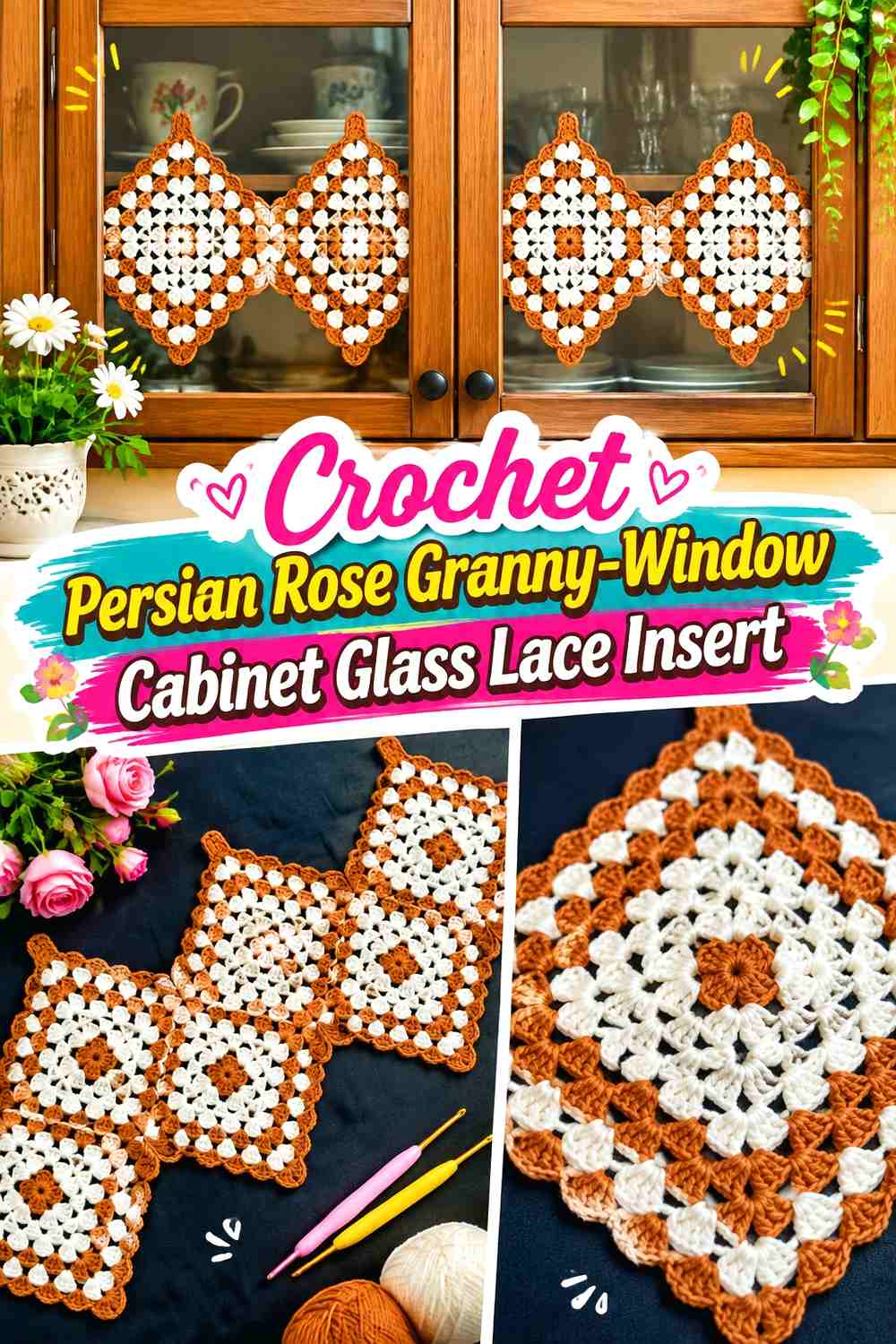
Granny squares give the cabinet glass a tiled appearance, with each motif acting like a small window inside the larger door. Suzanna Crochet’s curtain tutorial teaches a granny-square curtain, including motif construction, color transitions, joining, and a finished border, making it a strong reference for translating modular squares into a glass insert.
Persian Rose can dominate the centers while Graphite forms the final round of every square, visually turning the darker yarn into grout between rose-toned tiles. This design is easier to scale in modules than a continuous filet panel, but the number of whole squares may not match the glass proportions exactly. It therefore works best when the frame can accommodate a surrounding border or when the door dimensions already suit a neat grid of motifs.
Let Graphite Unify Different Rose Centers
If you want subtle variation within Persian Rose yarns or slightly different motif centers, a consistent Graphite final round can visually unify the grid.
That dark outer round also clarifies each square against the neighboring one. Keep the join itself tidy and consistent, because a high-contrast graphite seam will reveal uneven spacing more readily than a low-contrast join.
Decide Whether the Glass Should Show Through the Corners
Classic granny construction contains open corner and cluster spaces. Against cabinet glass, those openings become part of the design rather than simply ventilation between stitches.
If the cabinet contents are colorful, the background may compete with the rose-and-graphite squares. Test a single blocked motif against the stocked cabinet before committing to an entire door-sized grid.
Border Only After the Grid Is Measured
A modular panel can change dimensions during joining and blocking. Do not calculate a thick final border solely from the measurements of loose individual squares.
Join the complete central grid, block or relax it according to the tutorial and yarn guidance, then compare it with your cabinet template. The remaining gap can determine how much border is actually useful.
Creator Credit: Suzanna Crochet
6. Crochet Botanical Flower-and-Leaf Cabinet Glass Lace Insert
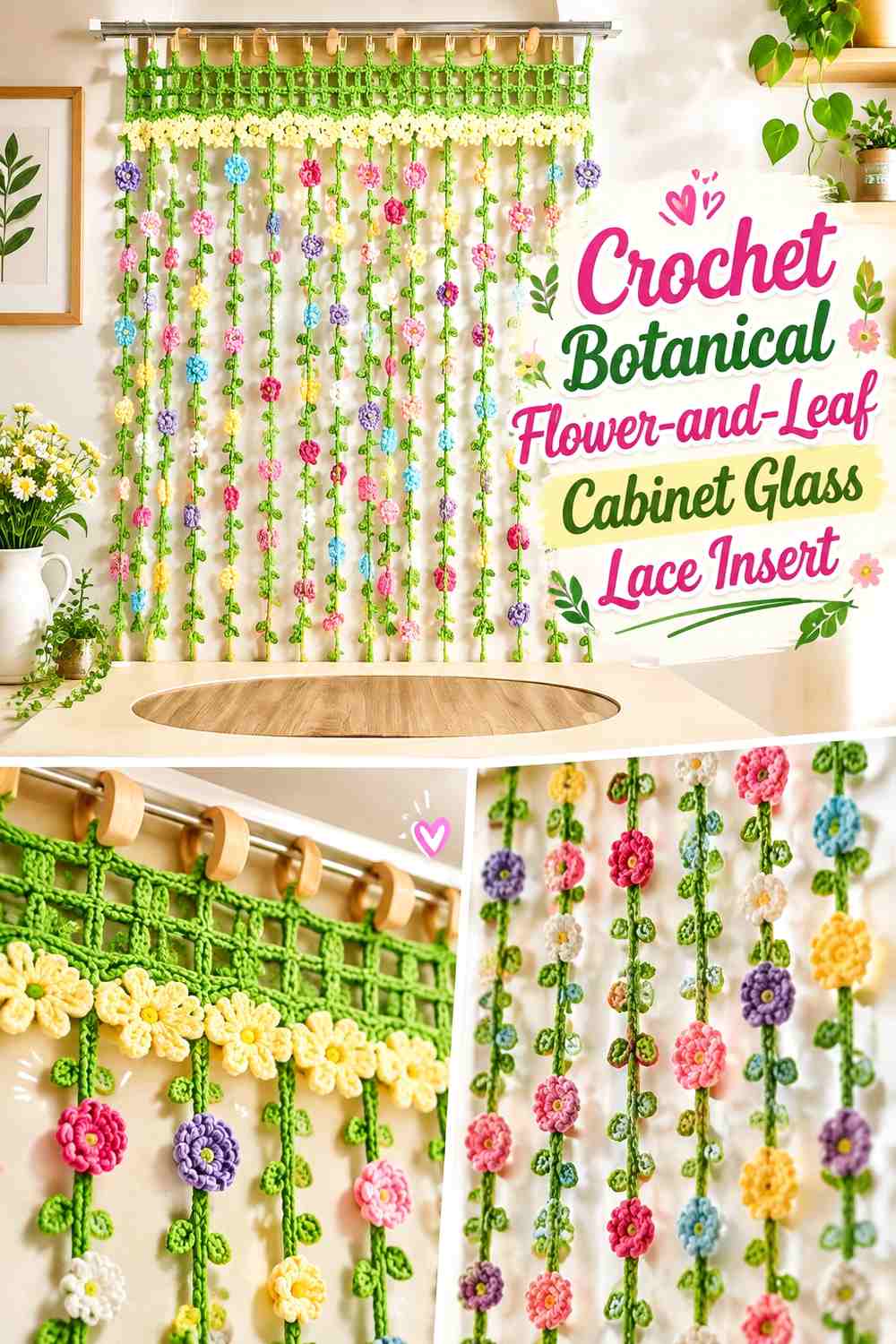
A flower-and-leaf curtain construction creates a more organic composition than a strict repeating lattice. Crochet Anne’s tutorial teaches flowers, leaves, and their assembly into a curtain arrangement, providing a useful source when the cabinet insert should resemble climbing botanical decoration instead of an evenly filled panel.
Persian Rose naturally suits the flower motifs, while Graphite can replace a conventional green for leaves, connectors, or the header area. The unusual dark foliage gives the palette a more graphic character and prevents the design from feeling overly pastel. Because separate botanical components can leave more open space than a full lace fabric, this idea is particularly effective when you want only partial screening. It also gives you freedom to concentrate decoration near the lower corners, center, or one side rather than filling every inch of glass.
Map the Botanical Arrangement Before Joining
Separate flowers and leaves make free placement tempting, but cabinet doors impose a strict rectangular boundary. Arrange completed sample motifs on the paper template before attaching them.
Look for awkward isolated gaps as well as overcrowded clusters. On paired doors, decide whether the compositions should mirror one another or repeat exactly; either can work, but an accidental near-match often looks less intentional.
Keep Raised Flowers Clear of Moving Hardware
Dimensional motifs can project more than flat filet or mesh. On a cabinet door, check the clearance near handles, hinges, shelves, and any inner frame components.
If a flower is thick enough to interfere with the door closing or rub against stored objects, move the motif inward or choose a flatter position. Decorative relief should not compromise normal cabinet operation.
Use Graphite Connectors to Control the Visual Weight
Dark connecting chains or leaves can visually organize scattered Persian Rose flowers. They create a framework that helps the eye read separate motifs as one insert.
Keep those connectors relatively consistent in scale. Very thick graphite sections can dominate the lighter blossoms and make the botanical idea feel more like a dark net with pink accents.
Creator Credit: Crochet Anne
7. Crochet Graphite Mini-Medallion Cabinet Glass Lace Insert
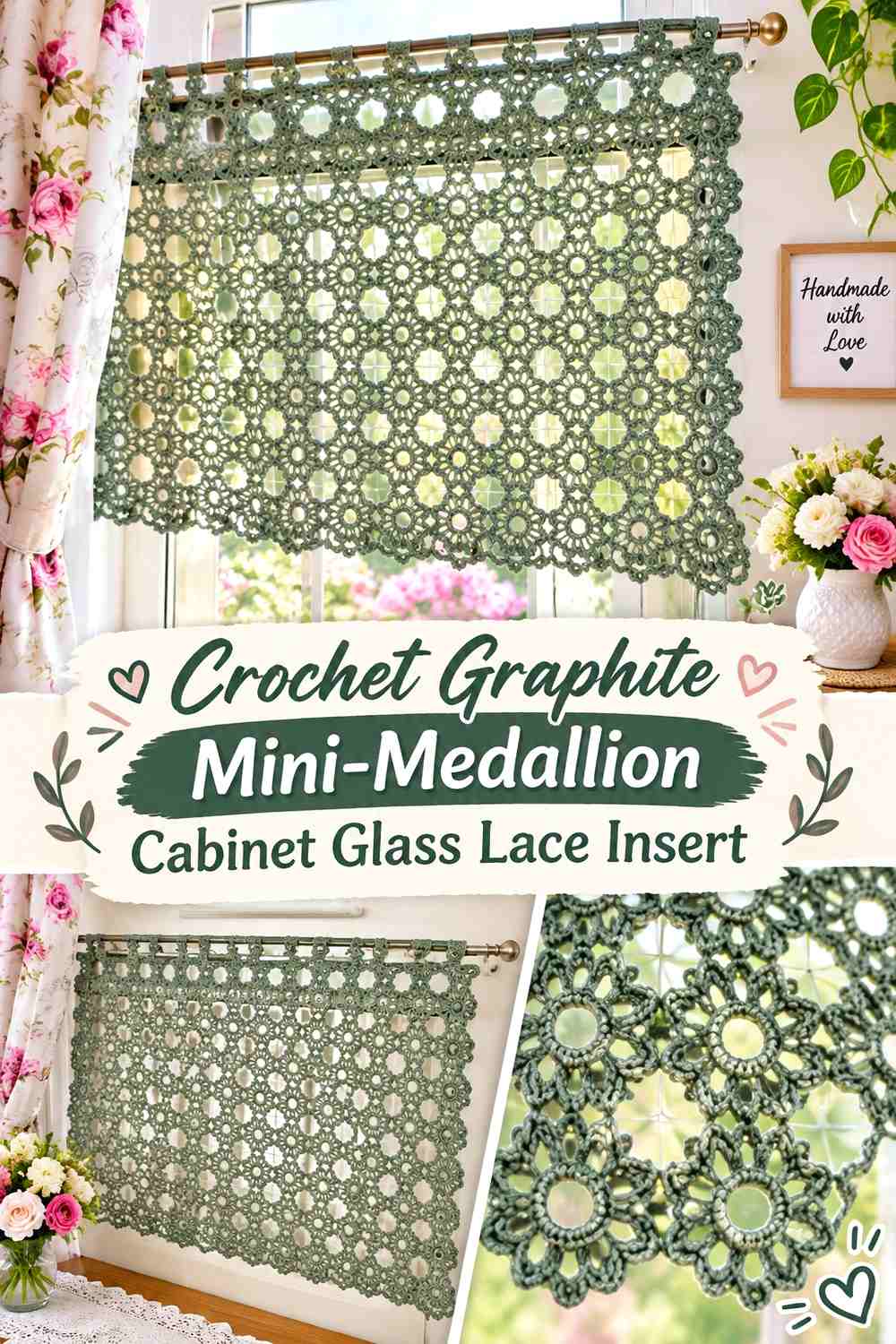
Small round motifs create a fine all-over texture that falls between granny squares and large floral medallions. Giani Art’s curtain tutorial demonstrates a panel assembled from small round motifs, along with the joining concept needed to expand the design across both width and length.
For cabinet glass, Graphite mini-medallions can form the main grid with Persian Rose appearing only in selected centers. Because each unit is relatively compact, the finished surface can look more intricate than a large-motif panel without requiring a dense continuous background. This makes it suitable for narrow cabinet doors where oversized flowers or hexagons would allow only one or two repeats. The main trade-off is finishing accuracy: many small units produce many connection points, and even a slight change in motif size can accumulate across a larger rectangle.
Use Motif Count to Control Privacy
More small medallions generally mean more yarn intersections across the glass, while the openings between them still preserve light.
Before making dozens of units, join a small test block and hold it against the cabinet contents. This gives a much better sense of visual screening than evaluating one medallion by itself.
Alternate Centers Instead of Entire Motifs
Rather than making half the circles pink and half graphite, consider keeping Graphite as the outer structure and changing only selected centers to Persian Rose.
The darker shared perimeter unifies the panel, while the rose centers create a measured rhythm. This also prevents the insert from breaking into large alternating color patches.
Watch Cumulative Size Across the Grid
A tiny difference between two individual medallions may seem irrelevant, but repeated across several columns it can produce an uneven edge.
Compare motifs as you work and block them consistently before final assembly if the source method permits. A rigid cabinet opening leaves less room to disguise accumulated variation than a softly hanging curtain does.
Creator Credit: Giani Art
8. Crochet Persian Rose Round-Motif Cabinet Glass Lace Insert
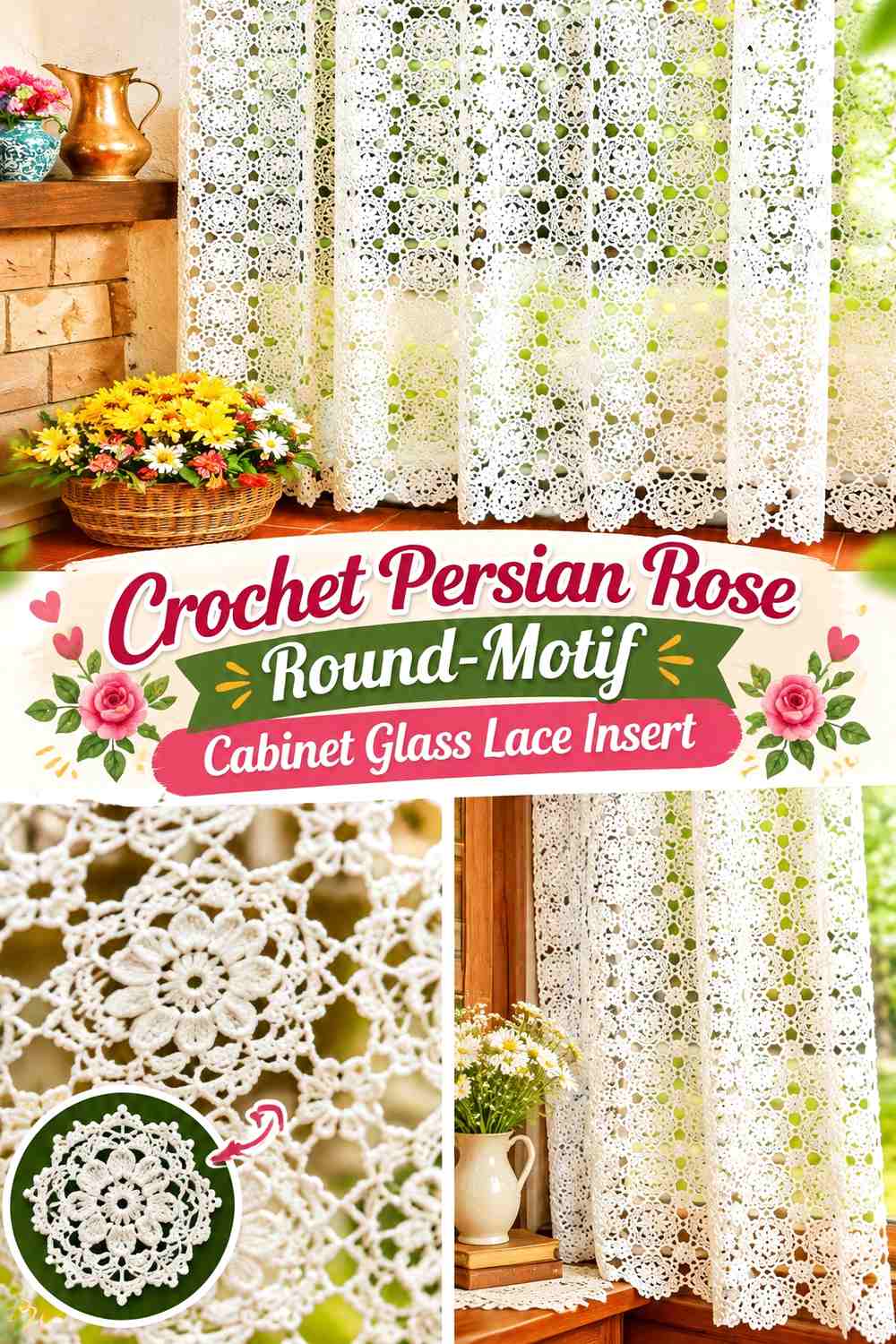
Larger circular motifs make the insert feel more like a collection of lace medallions than a continuous fabric. The tutorial from Вязание Крючком с Ольгой Смирновой teaches a curtain built from substantial round motifs with smaller intermediate floral elements, giving this idea a useful two-scale structure.
For a cabinet adaptation, Persian Rose can fill the dominant circles while Graphite occupies the smaller connectors and surrounding spaces. That creates obvious focal medallions without turning the entire pane pink. Large circles are especially effective on tall cabinet doors where there is enough room for several complete motifs to read clearly. They are less forgiving on very narrow glass because trimming or compressing a round motif destroys its geometry; verify the blocked diameter before selecting this construction.
Let the Filler Motifs Solve the Negative Space
Large circles cannot tile a rectangle without gaps. Smaller intermediate motifs can turn those gaps into deliberate lace rather than empty leftover areas.
Use Graphite for these connecting elements if you want the rose circles to remain dominant. The darker filler creates visual separation and can make each main medallion appear more distinct against the glass.
Avoid Cropping the Largest Motifs at the Frame
A large medallion gains much of its impact from seeing the complete circumference. If the cabinet opening cuts through several circles, the insert may look oversized rather than custom fitted.
Plan the number of complete motifs first. Then use border space or smaller connectors to reconcile the remaining dimensions instead of forcing a large motif into a narrow edge zone.
Creator Credit: Вязание Крючком с Ольгой Смирновой
9. Crochet Graphite Hexagon Honeycomb Cabinet Glass Lace Insert
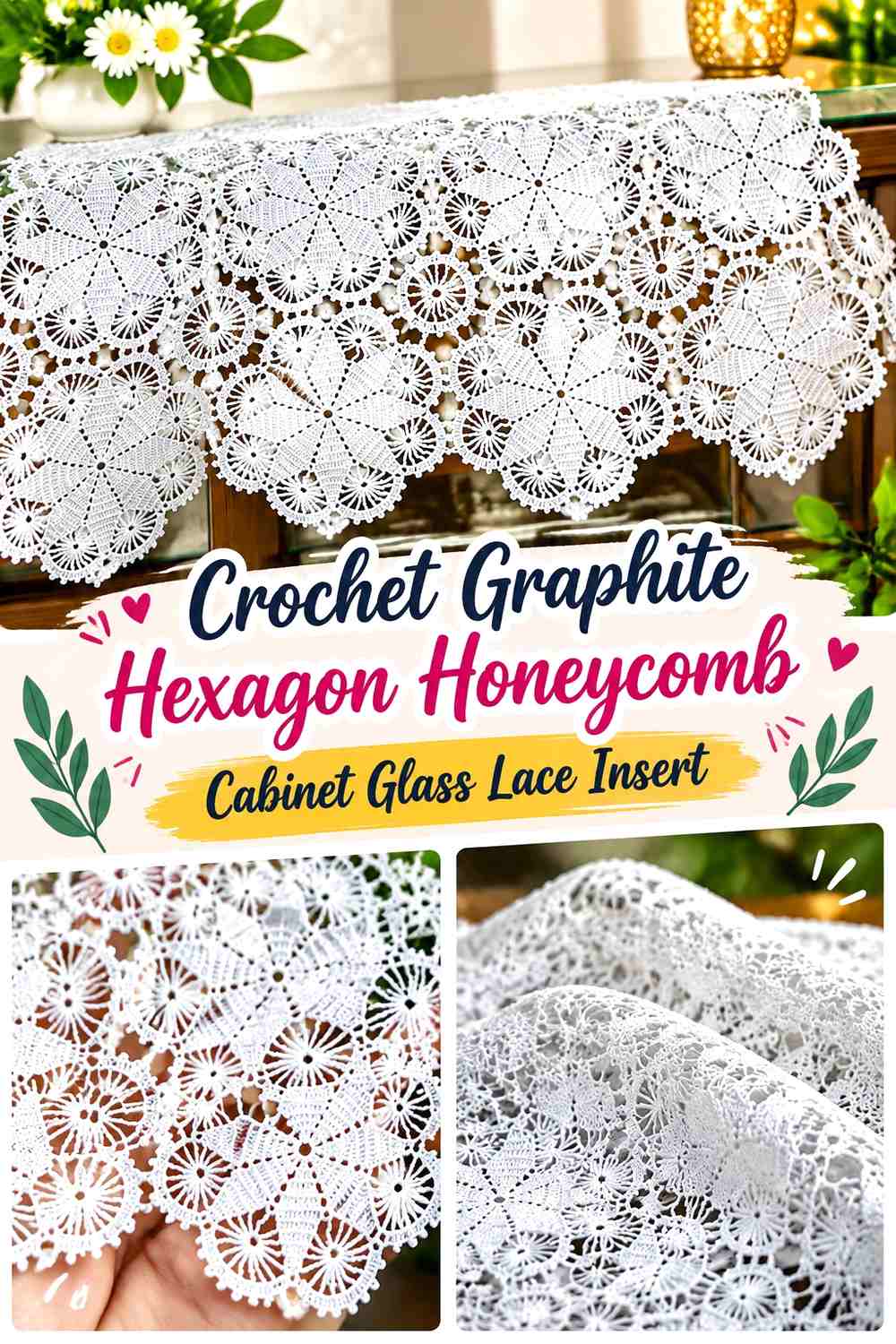
Hexagons introduce angled geometry without the strong directional pull of chevrons. Crochet Swan’s tutorial teaches an open lace hexagon motif and its joining, with the design presented as suitable for curtains and other larger decorative fabrics.
Graphite hexagons can form a dark honeycomb framework across the cabinet glass, while Persian Rose appears in the centers or in an occasional full motif. This construction suits modern cabinet doors particularly well because the repeated six-sided forms feel more architectural than traditional floral lace. The limitation is the rectangular boundary: hexagons naturally create offset rows, so the panel edges require planning. A border can regularize the outside dimensions, but it should complement rather than conceal the motif geometry.
Decide Whether Rose Follows Rows or Scatters
Persian Rose motifs can be arranged in diagonal lines, alternating rows, or isolated accents. Each option changes how strongly the hexagonal grid is perceived.
Sketch the color arrangement before crocheting the complete set. A random distribution can work beautifully, but on a small cabinet insert only a handful of motifs may be visible, making apparently random placement look unintentionally uneven.
Resolve the Side Edges Before Making Every Hexagon
Offset motifs often create stepped or partial-looking sides. Determine early whether you will accept that geometry inside a surrounding rectangular border or need a different edge solution.
Do not make a full batch assuming the last column will automatically fit. The cabinet template should dictate the useful number and arrangement of motifs.
Keep the Honeycomb Open Enough for Glass to Matter
Graphite can visually close an open pattern more than a pale yarn does. If the stitch scale is very small, a dark honeycomb may begin to resemble a solid screen.
Hold a joined sample against daylight and against the actual cabinet interior. The right density is the one that still lets the glass participate in the design at normal viewing distance.
Creator Credit: Crochet Swan
10. Crochet Two-Tone Geometric Screen Cabinet Glass Lace Insert
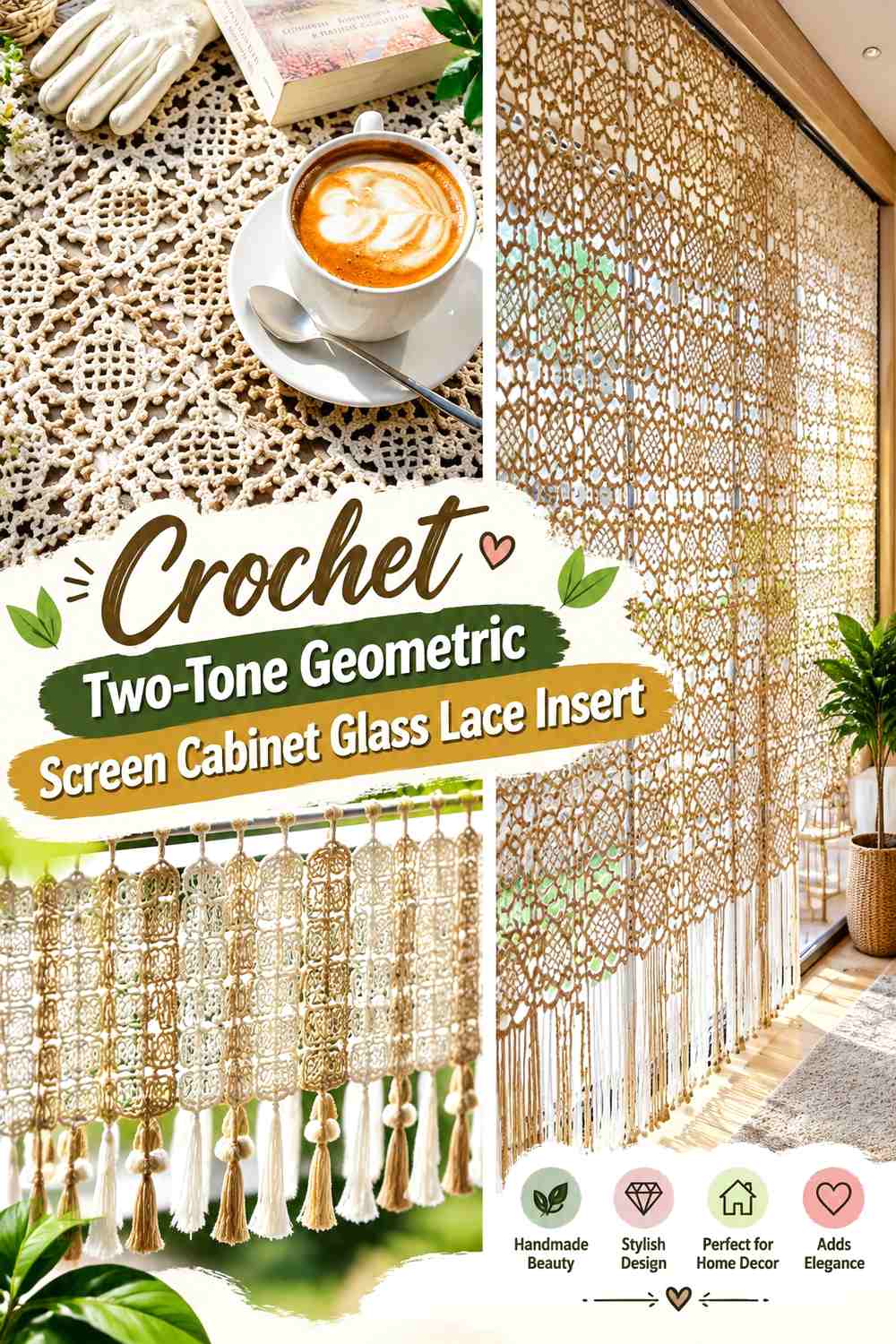
For a strongly architectural look, a repeating geometric motif can make the cabinet resemble a patterned screen rather than a curtained window. Concept Creative’s Mashrabiya curtain project uses joined ornamental motifs to create an open geometric surface, offering a particularly relevant reference for glass-front furniture.
Graphite can define the principal geometry while Persian Rose occupies selected inner details. This color arrangement gives the darker yarn the structural role and prevents the rose from overwhelming the repeated pattern. Compared with granny squares, the emphasis is less on individual modules and more on the continuous screen they produce together. This idea works well when the cabinet frame itself is simple and the insert can supply the decorative complexity. On highly carved doors, however, the combined pattern may become visually dense.
Repeat the Geometry Across Matching Doors
If two cabinet doors sit side by side, decide whether the motif grid should continue visually across the central gap or restart symmetrically on each pane.
A continuous visual rhythm can make separate doors read as one larger composition. Independent centered panels emphasize each door instead. Choose the arrangement before determining motif count so the most important shapes land intentionally.
Let Graphite Form the Structural Skeleton
Using the darker shade for joining points and outer motif lines can make the geometric construction easier to read through reflective glass.
Persian Rose can then highlight smaller internal areas rather than competing with the complete framework. This division of color roles is especially effective in intricate patterns where equal alternation would make the geometry harder to interpret.
Keep the Edge Treatment Simpler Than the Center
An ornate screen already carries substantial detail. Adding a heavily scalloped or floral border around it can create two competing design languages.
A narrow, stable rectangular finish is usually enough to separate the motif field from the cabinet frame. Check the original motif joining information before deciding how that outer finish should interact with the existing edge stitches.
Creator Credit: conceptcreative
11. Crochet Vertical Flower-Lace Cabinet Glass Lace Insert
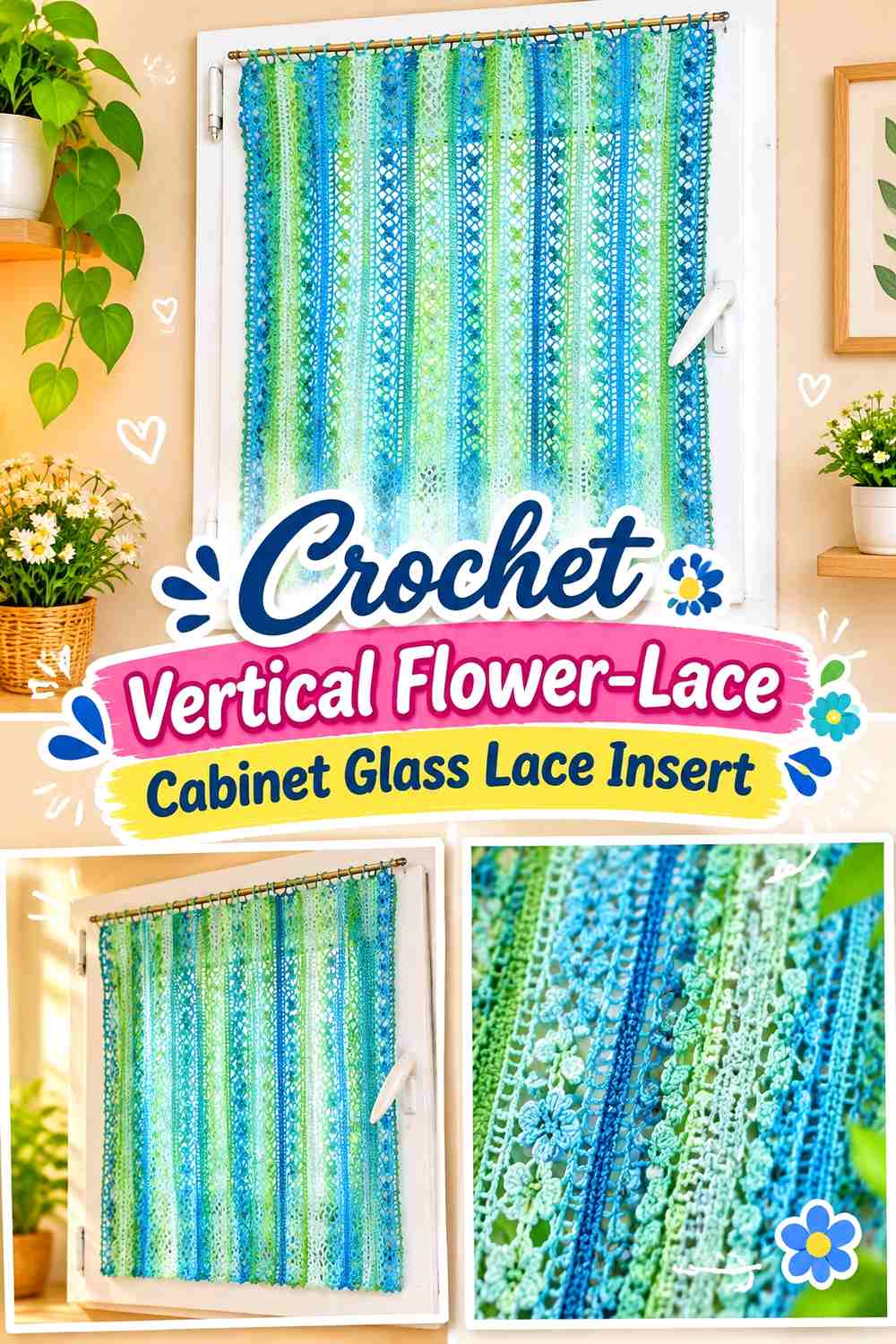
Vertical flower lace is useful when the cabinet door is tall and narrow. Silk & Wool’s curtain tutorial uses a flower-based lace stitch worked sideways so the pattern and color changes form vertical stripes once the curtain is hung. That orientation translates naturally to a glass insert where the objective is to emphasize height.
Work the floral lace primarily in Persian Rose and use Graphite for narrow vertical transitions, or reverse the colors for a darker, more graphic panel. Unlike joined flower motifs, the floral shapes belong to a continuous lace fabric, so there are fewer separate components to position. The stripe direction is the defining feature: if the cabinet is very wide and short, vertical lines may feel disproportionate, while a slender pantry or display door can benefit from the elongating effect.
Use Stripe Width to Control the Color Balance
You do not need equal-width Graphite and Persian Rose stripes. A narrow dark stripe between broader rose lace sections can define the repeat without cutting the door into many competing bands.
Swatch several repeats and view them behind the glass. Reflections can make fine graphite details more dominant than expected, particularly on dark cabinet interiors.
Check the Lace Direction Before Final Sizing
Sideways construction means the working direction and the final visual direction are different. Decide which measurement corresponds to the cabinet height before enlarging the piece.
This matters when adapting a curtain technique to a rigid opening. Adding more working rows may alter width rather than height depending on how the pattern is oriented.
Preserve the Floral Openings During Blocking
The value of this design comes from recognizable flowers within the open lace. Uneven blocking can compress one side of the repeat and make the vertical rhythm appear crooked against the cabinet rails.
Use straight reference lines on your blocking surface and compare the finished rectangle with the paper cabinet template before mounting.
Creator Credit: Silk & Wool
12. Crochet Ring-Center Square Cabinet Glass Lace Insert
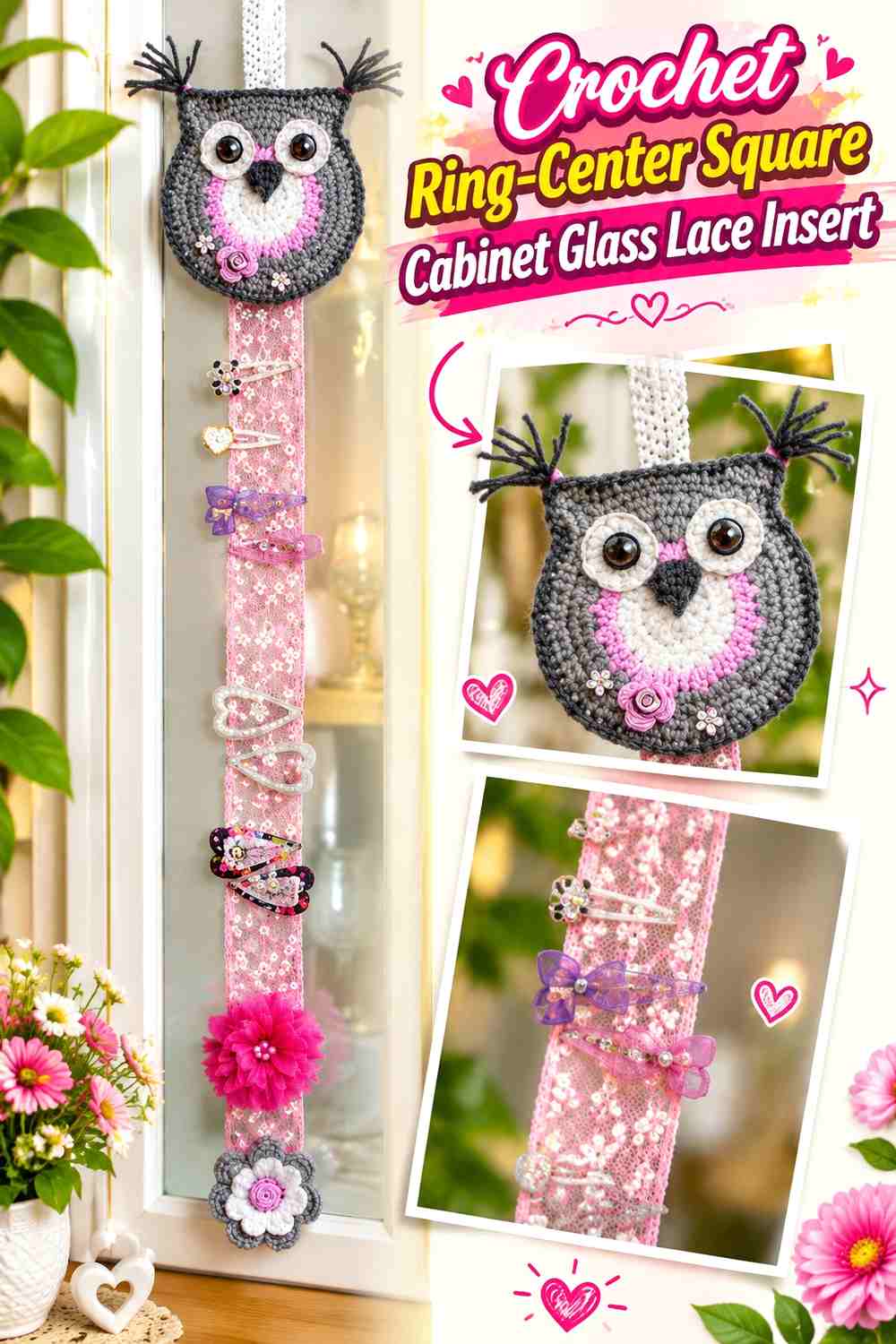
Ring-centered squares give the glass insert unusually crisp circular openings inside a square modular grid. EmmHouse’s curtain construction uses crocheted squares formed around round rings and then joined into a larger panel. That creates more structural definition than an all-yarn granny square.
For Persian Rose and Graphite, the rings can be surrounded in Graphite while the outer square sections use rose, producing a dark circular center inside each lighter tile. Reversing the colors makes the openings less visually dominant. This option is particularly distinctive for retro or playful cabinetry, but it introduces a non-yarn component that changes cleaning and care. Verify the ring material and finished construction for your intended environment rather than assuming any plastic ring is appropriate for long-term cabinet use.
Treat the Ring as Part of the Finished Material System
A mixed-material insert cannot be cared for exactly like plain crochet without considering the rings. Washing method, heat exposure, and long-term shape may depend on what those components are made from.
Follow the source construction and choose any substituted rings cautiously. If simple textile care is more important than the circular opening effect, an all-yarn motif may be the better cabinet option.
Use the Circular Centers to Reveal Selected Contents
The strong central openings can intentionally frame glimpses of dishes or glassware behind the panel. This creates a more punctuated view than conventional mesh.
Hold a sample square against different shelf heights before settling on the layout. Rows of circular openings can align attractively with objects inside—or unintentionally emphasize shelf edges if the vertical placement is poorly matched.
Keep the Outer Square Grid Precise
Because every circle sits inside a square, inconsistencies in joining are highly visible. If one column tilts, both the circular centers and square boundaries advertise the distortion.
Assemble a small block first and check it against a straight template. Correcting join tension early is easier than trying to square a large ring-based panel through aggressive blocking.
Creator Credit: EmmHouse
13. Crochet Persian Rose Filet-Rose Cabinet Glass Lace Insert
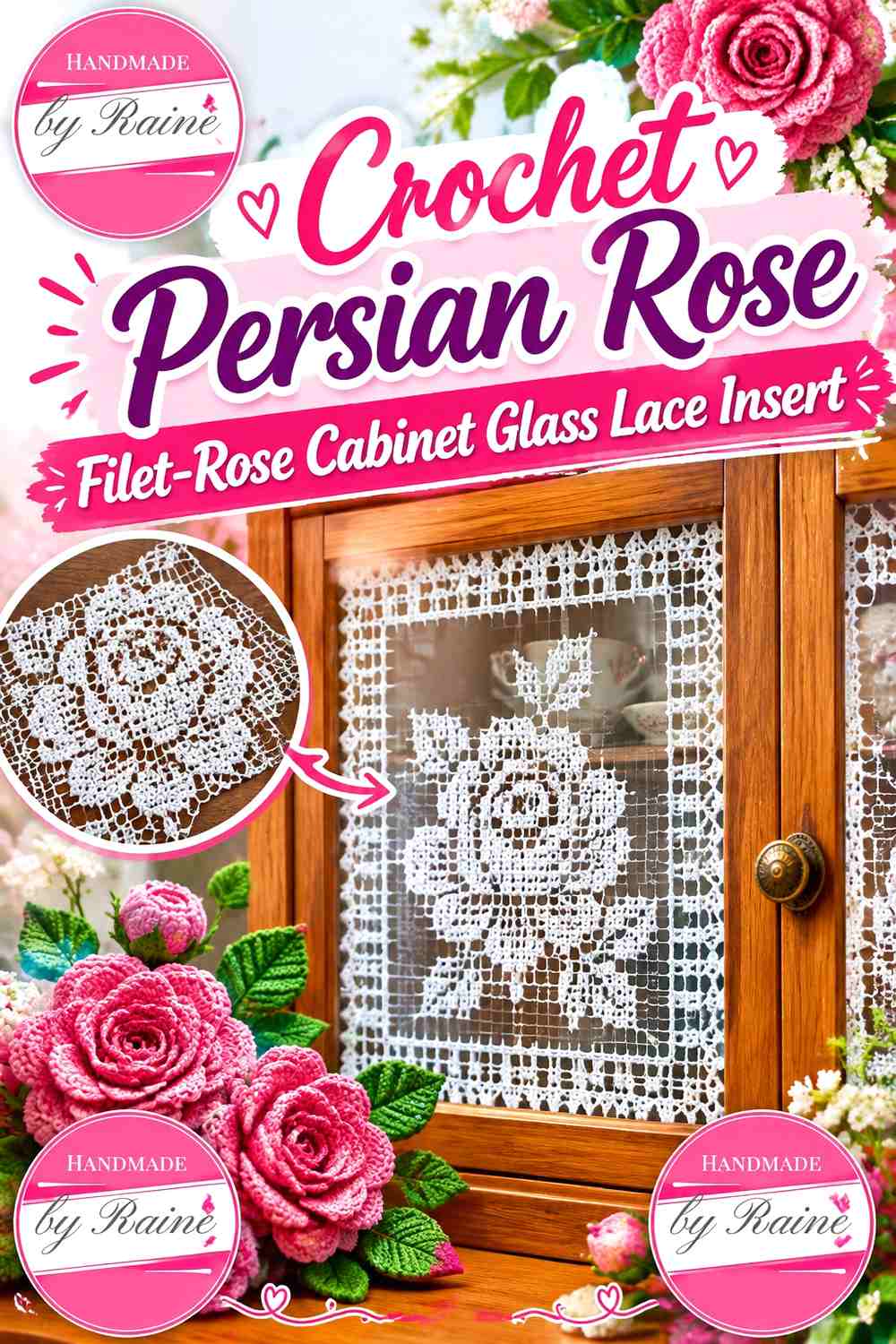
Filet crochet can create recognizable imagery while keeping the insert almost completely flat. HandmadebyRaine’s Rose Curtain uses open and filled filet blocks to form repeating rose motifs and includes an edging treatment, making it an especially natural source for a Persian Rose cabinet panel.
Use Persian Rose for the filet field and Graphite for a narrow edging or selected framing rows. Because the rose is created through changes in open and solid blocks rather than applied flowers, the finished surface stays lower-profile than dimensional botanical motifs. Filet also suits cabinets where the glass sits close to shelves or dishes because there are no projecting appliqués. The principal adaptation challenge is scale: a recognizable rose repeat needs enough grid cells to remain legible, so measure the cabinet opening before choosing how many motifs can fit.
Give the Rose Enough Width to Read Clearly
Reducing a filet image is not as simple as deleting arbitrary columns. The relationship between open and solid blocks creates the picture.
Use the source chart or tutorial for the actual rose construction and determine whether the complete motif fits your cabinet dimensions. If it does not, choose fewer complete roses rather than informally compressing the design.
Use Graphite as a Picture Frame
A narrow Graphite perimeter can make a rose-colored filet panel resemble a framed textile inside the larger wooden cabinet frame.
Keep that border proportional. A wide dark band reduces the available space for the filet image and may make a small glass opening feel noticeably smaller.
Consider the View From Inside the Cabinet
Filet is relatively flat and usually readable from either side, but color joins and finishing still deserve attention because the reverse may be visible whenever the door opens.
Secure ends neatly and check both faces before installation. A cabinet insert is viewed from more angles than a wall-hung lace panel, especially during everyday use.
Creator Credit: HandmadebyRaine
14. Crochet Graphite Traditional Lace Cabinet Glass Lace Insert
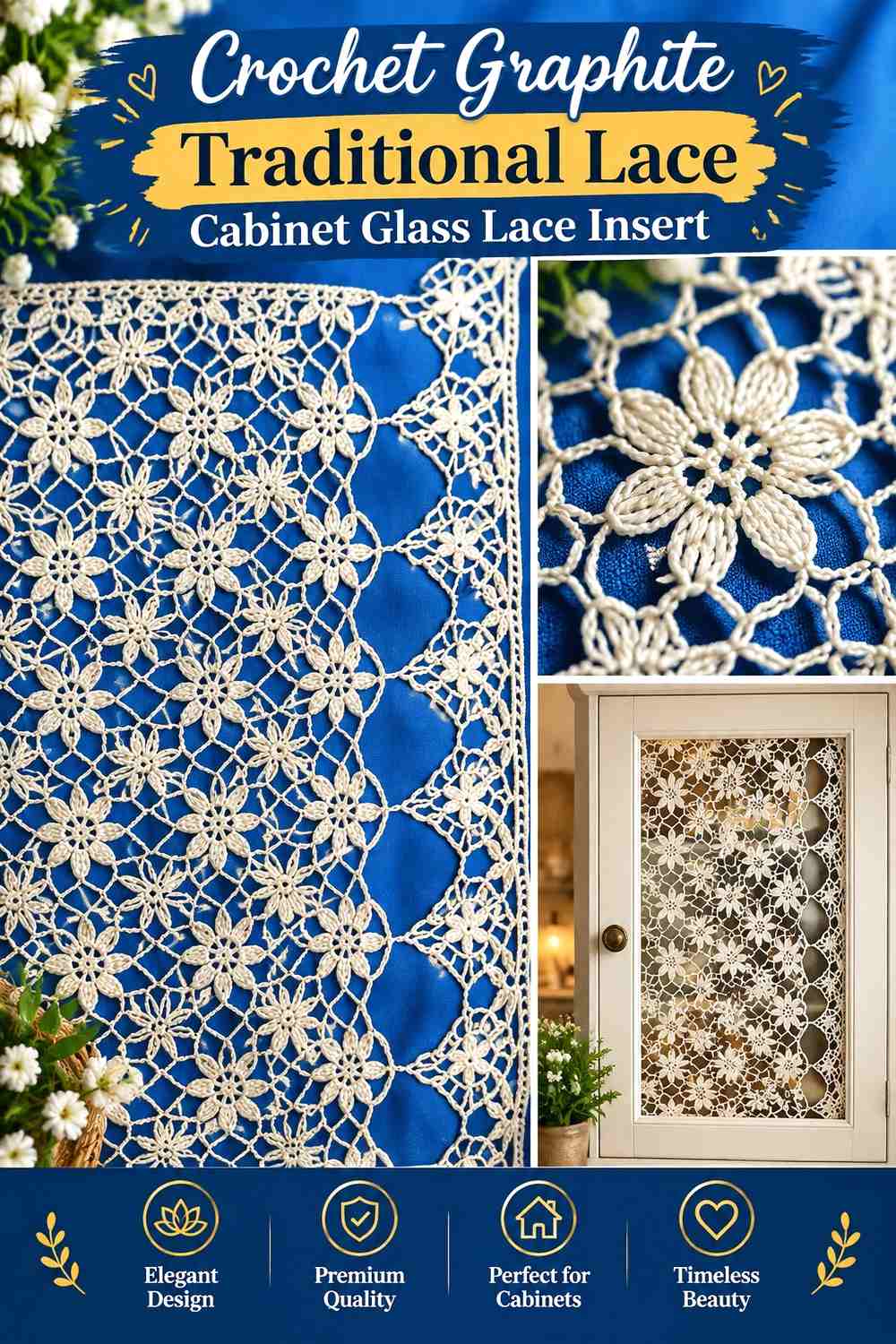
A continuous traditional lace panel is the most neutral choice when you want texture without a highly recognizable flower, square, or geometric module. The lacefromireland curtain tutorial demonstrates a crocheted lace curtain worked as a cohesive panel, making it useful inspiration for a cabinet insert that should look more like vintage textile lace than a motif mosaic.
Graphite gives traditional openwork a contemporary shift, particularly against pale painted cabinetry. Persian Rose can appear in a narrow outer row or a small repeating accent if you want to soften the dark surface. This style is most useful when the cabinet dimensions do not cooperate with modular motifs because a continuous panel can often be planned around a rectangular repeat more naturally. The final piece still needs careful blocking; fine irregularities become noticeable when lace sits immediately beside straight wood and glass edges.
Let the Stitch Pattern Provide the Decoration
Traditional lace already contains changes in density, chains, and shaped openings. Extensive two-color striping can obscure those details.
A mostly Graphite panel with one restrained Persian Rose feature lets the openwork remain the principal design. View a sample against both lit and unlit cabinet interiors because dark lace changes considerably with the background.
Prioritize a Square Finish Over Decorative Overhang
Curtains can tolerate scalloped or freely hanging edges that extend beyond their main rectangle. A cabinet insert generally benefits from a controlled outline that remains within the glass frame.
If the source lace includes a decorative edge, determine whether it fits comfortably inside your template. Do not allow protruding points to interfere with door seals, hinges, or the surrounding frame.
Compare Continuous Lace With Modular Alternatives
Choose this construction when you prefer one coherent fabric and want to avoid joining many motifs. Choose granny squares, medallions, or hexagons instead when precise modular color placement is part of the appeal.
Neither method is universally easier to size. Continuous lace depends on stitch-repeat mathematics, while motifs depend on the blocked dimensions of individual units and their joins.
Creator Credit: lacefromireland
Comparing the 14 Cabinet Glass Lace Insert Styles
For the greatest glass visibility, start with the sheer grid, vertical flower lace, traditional lace, or filet rose. They provide recognizable crochet texture without covering the pane with many separate motifs.
Chevron and geometric-screen designs create stronger architecture, making them useful with simple cabinet frames. Granny squares, hexagons, mini-medallions, and large round motifs are better when you want modular construction and deliberate color placement. Flower lattice, rosette mosaic, and botanical flower-and-leaf inserts introduce the strongest organic character.
The ring-center squares are the most structurally unusual because they introduce a non-yarn component. They deserve separate consideration for care and installation. Whichever style you choose, base the final dimensions on a blocked sample and the visible glass opening rather than the full cabinet door.
Conclusion
Persian Rose and Graphite can make crochet cabinet glass inserts range from delicate and nearly transparent to bold architectural screens. Filet roses and sheer grids keep the surface flat, while joined flowers, medallions, hexagons, and granny squares turn the glass into a modular display. Vertical flower lace emphasizes height; chevrons emphasize movement; geometric screens create the strongest structured effect.
Before selecting a design, decide how much of the cabinet contents should remain visible and whether whole motif repeats fit the available pane. Make and block a representative sample, then compare it directly with the stocked cabinet and surrounding frame. Use the credited creator tutorial for the original lace or curtain construction, and plan the cabinet-specific sizing and removable mounting separately.
Frequently Asked Questions
What yarn works well for a crochet cabinet glass lace insert?
A smooth yarn or crochet thread usually makes openwork easier to read, but the appropriate material depends on the selected tutorial and the scale of your cabinet. Fine thread creates smaller openings and more detailed motifs, while thicker yarn makes each repeat larger and visually heavier. Before substituting, crochet and block a sample. Follow both the creator’s guidance and the yarn label rather than assuming a fiber or weight will behave identically to the original.
Should the lace cover the entire glass pane?
Not necessarily. Full coverage creates a more textile-like cabinet front, while leaving a narrow clear-glass margin can emphasize the surrounding frame and make sizing less demanding. A centered medallion or botanical arrangement can cover even less. Decide based on how much of the cabinet contents you want visible and whether the design repeat can finish cleanly at the edges. A paper template is useful for comparing full and partial coverage before crocheting.
Which construction is easiest to adapt to an unusual cabinet size?
Both modular and continuous designs have advantages. Granny squares, flowers, medallions, and hexagons grow by adding whole motifs, but their blocked dimensions may leave an awkward remainder at the edge. Mesh and filet panels can be more flexible when their stitch repeats fit the target width, although image-based filet motifs cannot simply be cropped arbitrarily. Measure the opening and make one full repeat or motif before deciding which method offers the cleaner fit.
How do I keep a lace insert square against the glass?
Even tension helps, but blocking is the most important final checkpoint. Complete the panel, finish the ends, and block it according to the yarn and tutorial guidance before judging its dimensions. Use straight reference lines and compare all four sides with your cabinet template. Do not rely on stretching the insert during mounting to correct a noticeably skewed piece; that can distort motifs and put uneven tension on attachment points.
Should Persian Rose or Graphite be the dominant color?
Choose Graphite as the dominant shade when you want strong outlines, a contemporary screen effect, or contrast against light cabinetry. Persian Rose works well as the larger field when the insert should appear softer and more decorative. You can also separate their jobs: Graphite for borders, joins, and structural geometry; Persian Rose for flowers or filled filet areas. Test the combination against the cabinet interior because background color strongly affects how both shades appear through glass.
Can I make matching inserts for a pair of cabinet doors?
Yes, but decide whether they should be identical, mirrored, or visually continuous across the center gap. Motif placement and color distribution matter more on paired doors because small differences become easy to compare. Make both inserts from the same blocked gauge information and check them side by side before mounting. For image-based filet or directional lace, confirm that the orientation is correct on each door rather than automatically repeating the same starting direction.