Burnt orange is especially useful in a granny square cardigan because it can do more than cover the largest areas. It can repeat through motif centers, outer rounds, joins, cuffs, front bands, pockets, and ribbing, giving dozens of individual squares one recognizable color direction.
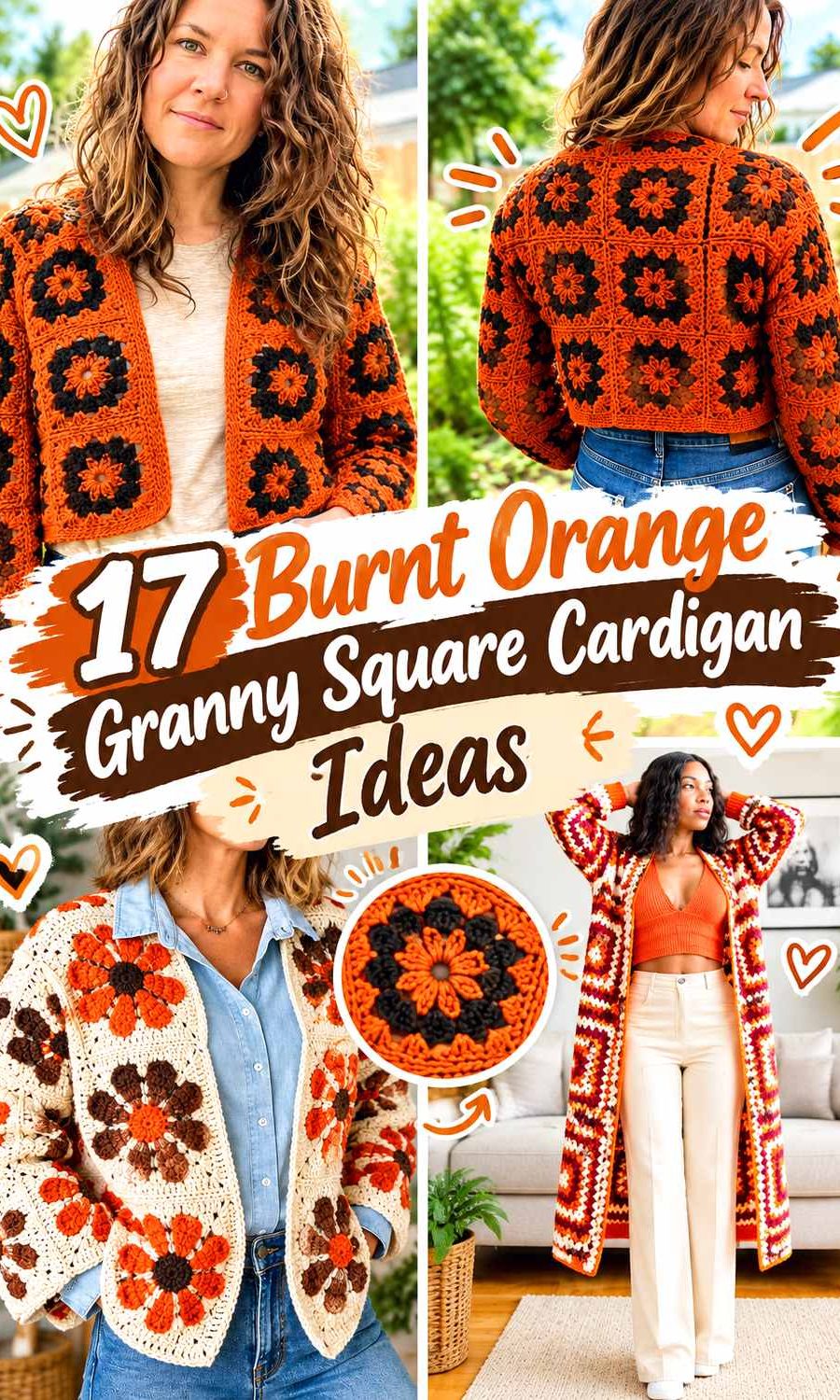
The supporting shade determines how those burnt orange squares read. Cream creates obvious separation, chocolate brown deepens the autumn palette, sage and olive add muted green contrast, teal and navy introduce cooler definition, while camel and oatmeal produce softer transitions.
The cardigan tutorials credited below support the construction concepts. The burnt orange palettes are independent color plans, so the creators are not being presented as using these exact combinations.
Quick List
- Burnt Orange And Cream Crochet Cropped Granny Square Cardigan
- Burnt Orange And Chocolate Brown Crochet Giant Granny Square Cardigan
- Burnt Orange And Oatmeal Crochet Classic Granny Square Cardigan
- Burnt Orange And Deep Teal Crochet Granny Square Cardigan
- Burnt Orange And Cream Crochet Daisy Granny Square Cardigan
- Burnt Orange And Sage Crochet Tie Front Granny Square Cardigan
- Burnt Orange And Charcoal Crochet Everyday Granny Square Cardigan
- Burnt Orange And Camel Crochet Vintage Granny Square Cardigan
- Burnt Orange And Warm White Crochet Granny Square Yoke Cardigan
- Burnt Orange And Navy Crochet Granny Square Cardigan
- Burnt Orange And Dusty Rose Crochet Granny Square Cardigan
- Burnt Orange And Burgundy Crochet Long Granny Square Cardigan
- Burnt Orange And Sunflower Yellow Crochet Floral Granny Square Cardigan
- Burnt Orange Cream And Brown Crochet Retro Daisy Granny Square Cardigan
- Burnt Orange And Black Crochet Cropped Granny Square Cardigan
- Burnt Orange And Moss Green Crochet Ribbed Granny Square Cardigan
- Burnt Orange And Olive Crochet Hooded Granny Square Cardigan
Use Burnt Orange to Connect Granny Square Cardigan Motifs
A granny square cardigan can contain many separate color decisions, so repetition matters. Burnt orange does not have to occupy the same round in every square, but it should appear frequently enough that the finished front, back, and sleeves feel related.
One useful approach is to keep burnt orange consistent in either the motif centers or outer rounds. Another is to vary the square interiors while repeating burnt orange in the joining yarn, cuffs, hem, or front band. Both approaches create a visual thread through the cardigan.
Check Burnt Orange Contrast Before Joining Granny Squares
Different hues do not automatically produce strong contrast. Burnt orange and another medium-value earthy shade can look distinct as yarn balls but merge once they are distributed across small granny-square rounds.
Compare the colors from a distance or photograph a sample in grayscale. If two shades become almost the same gray, use them in broader rounds for a blended effect rather than expecting one to define tiny motif details.
Plan Burnt Orange Borders, Joins, and Cuffs Together
The outer square round affects the entire cardigan because it repeats at every join. A cream outer round makes individual burnt orange motifs more obvious, while chocolate brown or charcoal creates a darker grid.
Consider the cuffs and front border before settling on the square edges. Repeating the same framing color in those finishing areas can make a busy motif layout feel far more connected.
1. Burnt Orange And Cream Crochet Cropped Granny Square Cardigan

Burnt orange and cream give a cropped granny square cardigan strong motif definition without requiring a complicated palette. Let burnt orange occupy the largest part of each square or repeat it consistently through the outer rounds, then use cream to separate details and lighten the shorter cardigan shape.
Burnt Orange Should Control the Main Crochet Granny Square Area
A cropped cardigan provides less body area than a long cardigan, so every motif occupies a relatively large share of the garment. Give burnt orange enough space within the squares to remain the first color noticed instead of reducing it to a narrow accent round.
Cream can sit in the centers or one intermediate round while burnt orange covers the broader outer section.
Burnt Orange Looks More Defined With Cream Crochet Joins
Cream joins create visible separation between burnt orange-heavy squares and emphasize the patchwork grid. If the cardigan already contains a large amount of cream inside the motifs, however, a burnt orange join may create a more cohesive result.
Lay several finished squares together before selecting the join color rather than judging one motif in isolation.
Creator Credit: HayHay Crochet
2. Burnt Orange And Chocolate Brown Crochet Giant Granny Square Cardigan

Large granny squares make every color band more noticeable. Chocolate brown gives burnt orange a deeper outer frame and keeps the palette strongly earthy without adding several competing colors.
Burnt Orange Needs Broad Rounds in a Giant Crochet Granny Square
Because a giant motif continues expanding, narrow early rounds occupy much less visual area than later rounds. If burnt orange should dominate, do not confine it only to the center.
Repeat burnt orange later in the motif or give it a substantial outer section so its share remains visible once the square reaches cardigan scale.
Burnt Orange and Chocolate Brown Need Clear Crochet Value Separation
A deep burnt orange and medium brown can become surprisingly close in value. If the distinction matters, choose a chocolate brown that is noticeably darker.
If the two shades deliberately sit close together, use their similarity for broad tonal bands and reserve any small details for a lighter accent.
Creator Credit: Nora Moon – handmade clothes with love
3. Burnt Orange And Oatmeal Crochet Classic Granny Square Cardigan

Oatmeal softens burnt orange without creating the bright contrast of white. This suits a traditional allover granny square layout where dozens of motif repeats already provide plenty of movement.
Burnt Orange Can Repeat in Every Crochet Granny Square Without Looking Identical
You do not need identical squares to maintain a consistent palette. Burnt orange might occupy the center in one motif and a later round in another, as long as it appears regularly across the layout.
Oatmeal can fill the remaining space and keep differently arranged squares visually related.
Burnt Orange Edging Can Ground an Oatmeal Crochet Cardigan Grid
If oatmeal occupies many square borders, finishing the cardigan with burnt orange cuffs and front edging restores the darker warm color around the garment silhouette.
This is particularly useful when the joined body looks lighter than expected after all the oatmeal rounds are placed together.
Creator Credit: Nati Crochet
4. Burnt Orange And Deep Teal Crochet Granny Square Cardigan

Deep teal brings a cool contrast that is much more distinct from burnt orange than beige or brown. The combination works well when each shade has a defined role rather than alternating unpredictably through every motif.
Burnt Orange Should Remain the Repeating Crochet Motif Anchor
Use burnt orange consistently in centers, outer rounds, or both so deep teal does not become the only recognizable repeating shade.
If teal fills large square borders, carry burnt orange into the joins or finishing bands to bring the main color back across the completed cardigan.
Burnt Orange and Deep Teal Crochet Squares Benefit From a Neutral Break
When both colors are saturated, placing them directly beside each other in every round creates a very strong pattern. A small cream, tan, or oatmeal separation can soften that transition if a third color fits your plan.
If you prefer a bolder two-color cardigan, keep only burnt orange and teal but vary their proportions rather than introducing more hues.
Creator Credit: The Fiber Diaries
5. Burnt Orange And Cream Crochet Daisy Granny Square Cardigan

A daisy motif gives you three useful color zones: flower center, petals, and square background. Burnt orange can define the background or centers while cream makes the floral shapes readable.
Burnt Orange Makes a Strong Crochet Daisy Square Background
Using burnt orange around cream petals allows the flower shape to separate clearly from the surrounding square. This also gives the cardigan broad areas of the main color once the motifs are joined.
If burnt orange is used only for tiny flower centers, it may not occupy enough finished surface to make the cardigan read as burnt orange overall.
Burnt Orange Cuffs Can Connect Cream Crochet Daisy Motifs
Repeated cream petals already distribute the light color throughout the garment, so the cuffs do not necessarily need to be cream as well.
Burnt orange cuffs and front edging can instead frame the floral layout and prevent the cardigan’s finishing areas from becoming disproportionately light.
Creator Credit: Cute Crochet
6. Burnt Orange And Sage Crochet Tie Front Granny Square Cardigan

Sage cools burnt orange gently rather than sharply. A tie-front cardigan gives the palette another small but noticeable decision: whether the ties should blend into the cardigan or act as contrasting accents.
Burnt Orange Should Stay Visible Beside Sage Crochet Granny Squares
Muted sage can cover centers or secondary rounds while burnt orange occupies larger motif sections. This preserves the warm main color without removing the botanical green contrast.
If both yarns are softened and medium in value, check a swatch to make sure the square pattern remains as distinct as you want.
Burnt Orange Crochet Ties Can Reconnect a Sage-Heavy Front
If sage appears prominently in the front motifs, burnt orange ties bring the main color directly to the cardigan opening.
You can reverse the effect with sage ties on a predominantly burnt orange body, but that gives the green a more noticeable focal role.
Creator Credit: Danielle Villanueva
7. Burnt Orange And Charcoal Crochet Everyday Granny Square Cardigan
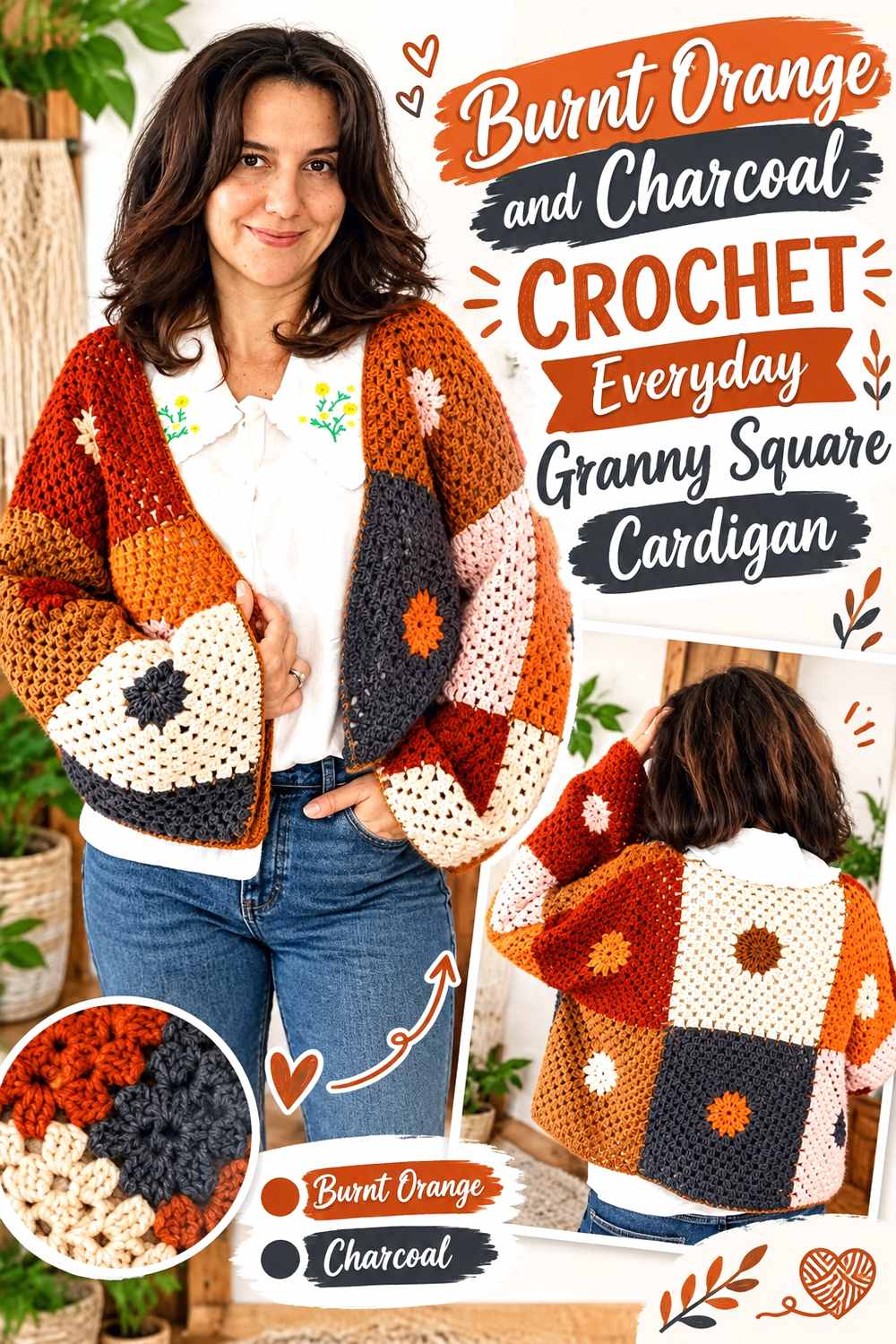
Charcoal gives burnt orange a dark neutral grid that can make even simple granny squares look strongly defined. Because charcoal carries considerable visual weight, it works best in controlled areas if burnt orange should remain dominant.
Burnt Orange Should Outweigh Charcoal in Crochet Granny Squares
Keep burnt orange across larger rounds or a greater number of motifs. If every square has a wide charcoal border, the combined grid can visually occupy much more of the cardigan than expected.
Arrange several completed motifs together to judge the proportions at garment scale.
Burnt Orange Crochet Cuffs Can Soften a Dark Charcoal Grid
When charcoal already outlines every square, matching charcoal cuffs and a charcoal front band can create a very dark frame.
Using burnt orange for those finishing sections reduces that effect and connects the edges back to the warmer motif interiors.
Creator Credit: Sirin’s Crochet
8. Burnt Orange And Camel Crochet Vintage Granny Square Cardigan

Camel and burnt orange create a low-to-medium contrast palette that emphasizes vintage warmth instead of a sharp patchwork grid. The key is preserving enough value difference for the square rounds to remain readable.
Burnt Orange Needs Enough Contrast Against Camel Crochet Rounds
Choose a camel that is noticeably lighter than burnt orange if you want individual rounds to show clearly. A deep camel can merge into burnt orange, particularly when both shades are muted.
That near-tonal effect can still work, but it is better suited to broad rounds than tiny center details.
Burnt Orange Crochet Edging Can Strengthen a Soft Camel Layout
A camel-heavy cardigan may look lighter once many squares are joined. Burnt orange front bands, cuffs, or hem finishing can restore the richer color at the garment boundaries.
This makes the finished cardigan read as intentionally tonal rather than simply beige-heavy.
Creator Credit: MJ’s Off The Hook Designs
9. Burnt Orange And Warm White Crochet Granny Square Yoke Cardigan

A granny-square yoke concentrates motif interest around the shoulders instead of spreading equal squares over the full cardigan. That makes the yoke palette especially important.
Burnt Orange Should Lead the Crochet Granny Square Yoke
Use burnt orange prominently across the yoke so the motif section connects immediately with the cardigan body.
If warm white dominates the squares while the lower cardigan is burnt orange, the yoke can appear like a separate piece rather than an integrated design.
Burnt Orange Can Continue From the Crochet Yoke Into the Body
Repeating burnt orange below the granny-square section creates a visual bridge between the motifs and the granny-stitch body.
Warm white can remain a smaller yoke accent or reappear at the cuffs so it supports the upper detail without dividing the cardigan in half.
Creator Credit: HanJan Crochet
10. Burnt Orange And Navy Crochet Granny Square Cardigan

Navy creates a dark cool contrast that can outline burnt orange motifs without the starkness of black. The two colors can still be fairly close in value, so narrow navy details deserve checking before the full layout is made.
Burnt Orange Needs Broad Crochet Areas Beside Navy
Use burnt orange for wider motif rounds or more squares so navy does not visually outweigh it.
A narrow navy outer border can be enough to make the granny-square grid obvious while preserving burnt orange through the larger inner sections.
Burnt Orange Crochet Front Edging Can Prevent Navy From Taking Over
If navy already appears around most square borders, a navy front band may create too much dark framing.
Burnt orange edging keeps the garment opening connected to the main palette and allows navy to remain a structural rather than dominant color.
Creator Credit: VIARA – tutoriales de crochet
11. Burnt Orange And Dusty Rose Crochet Granny Square Cardigan

Dusty rose creates a softer warm-on-warm relationship. It changes the cardigan without introducing the strong temperature shift of blue or green.
Burnt Orange Should Stay Darker Than Dusty Rose in Crochet Motifs
A noticeably lighter dusty rose helps the square rounds remain distinguishable. If the rose is too deep and orange-based, the two colors may blend into one warm field.
That can suit a tonal cardigan, but stronger motif definition requires clearer value separation.
Burnt Orange Crochet Joins Can Organize Dusty Rose Squares
Using burnt orange as the joining shade gives a mixed rose-and-orange motif layout a consistent framework.
This strategy is particularly useful if the location of dusty rose changes from square to square, because the repeated burnt orange grid provides continuity.
Creator Credit: rosa parlato
12. Burnt Orange And Burgundy Crochet Long Granny Square Cardigan

A long cardigan contains more rows of motifs, so dark colors can accumulate quickly. Burgundy gives burnt orange depth, but the proportions need attention to prevent the garment from becoming darker than intended.
Burnt Orange Should Repeat Down the Full Crochet Cardigan Length
Do not concentrate all the burnt orange squares around the shoulders and allow burgundy to dominate the lower body. Repeat orange from upper panels through the hem so the main color travels vertically through the garment.
That repetition is especially important when the cardigan is viewed open from the front.
Burnt Orange Crochet Borders Can Lighten a Burgundy-Heavy Layout
If burgundy occupies several large motif areas, burnt orange outer rounds can keep each square warmer and more visible.
A burnt orange hem and front band can also prevent the extra cardigan length from ending in one heavy dark block.
Creator Credit: Simply Angel Tiah
13. Burnt Orange And Sunflower Yellow Crochet Floral Granny Square Cardigan
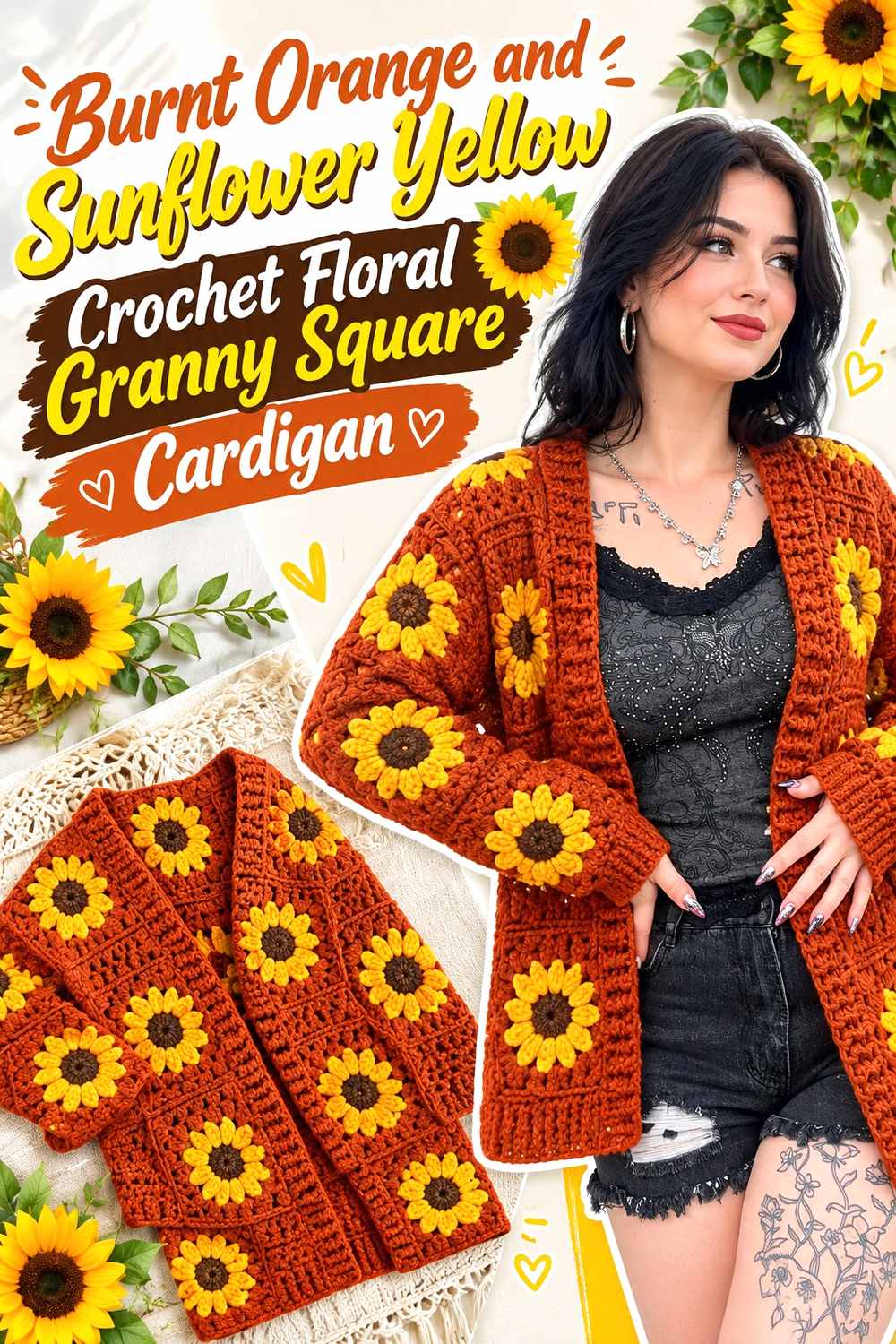
Sunflower yellow creates an analogous warm palette with burnt orange, making it useful for floral motifs. The challenge is preventing the yellow from becoming brighter and more dominant than the title color.
Burnt Orange Should Surround Sunflower Yellow Crochet Motifs
Use sunflower yellow in flower centers or petal areas and give burnt orange more of the square background or outer border.
That keeps the yellow recognizable as the floral accent while burnt orange builds the larger cardigan surface.
Burnt Orange Crochet Cuffs Can Calm Repeated Yellow Flowers
When yellow appears in every motif, it is already repeated many times. There is little need to repeat it again across broad cuffs and front bands.
Burnt orange finishing contains the flower pattern and returns attention to the cardigan’s main color.
Creator Credit: The Great Maddy Ride | Maddy B
14. Burnt Orange Cream And Brown Crochet Retro Daisy Granny Square Cardigan

A three-color daisy palette lets each shade take a specific role: cream for petals, brown for flower centers or definition, and burnt orange for the larger square background.
Burnt Orange Gives Cream Crochet Daisies a Warm Background
Surrounding cream petals with burnt orange produces clear floral separation without adding several background colors.
Chocolate or medium brown can remain restricted to the flower centers so the darkest shade adds definition without creating a heavy grid.
Burnt Orange Crochet Borders Keep Brown From Dominating the Daisies
If brown appears in both centers and outer motif rounds, it may become visually stronger than expected across dozens of squares.
Use burnt orange for the outer round or join so the finished cardigan has a continuous warm-orange framework around the cream flowers.
Creator Credit: Frisian Knitting tutorials
15. Burnt Orange And Black Crochet Cropped Granny Square Cardigan
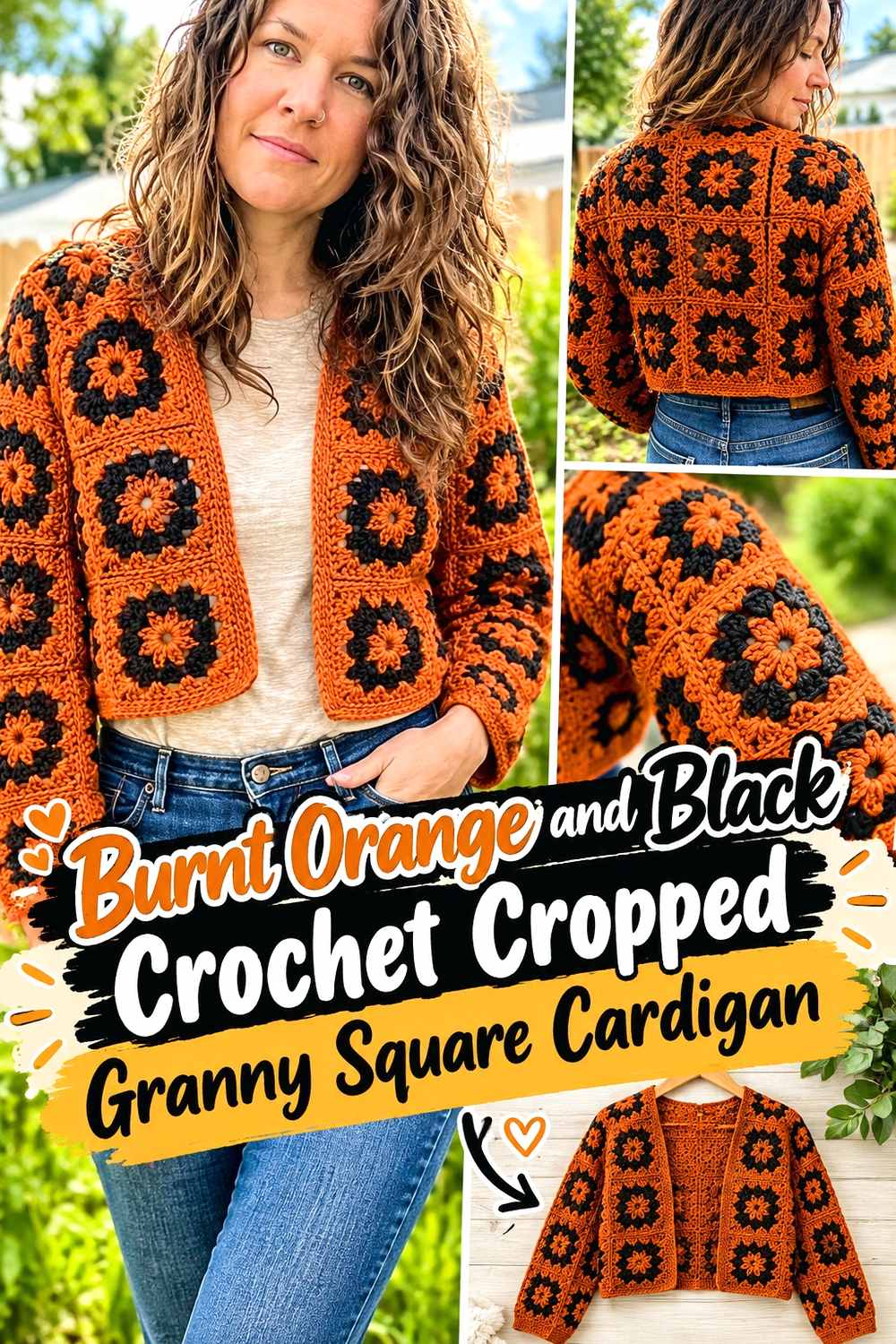
Black creates the sharpest contrast in this collection and can make each burnt orange square look highly graphic. On a cropped cardigan, even a relatively narrow black border occupies a noticeable share of the finished surface.
Burnt Orange Needs More Crochet Surface Than Black
Give burnt orange the wider motif rounds and use black as an outline, center detail, or joining color.
Equal quantities create a much darker two-color cardigan, which may be intentional but will no longer read as strongly burnt orange.
Burnt Orange Crochet Trim Can Balance Black Granny Square Joins
If black already creates the grid between motifs, consider burnt orange cuffs and front trim instead of continuing black around every edge.
This keeps the dark join visible while preventing the entire cardigan silhouette from being outlined in black.
Creator Credit: Off the Beaten Hook
16. Burnt Orange And Moss Green Crochet Ribbed Granny Square Cardigan

Moss green creates a deeper botanical palette than sage. Ribbed cuffs and hems provide clear locations to decide whether the green should frame the cardigan or remain inside the granny squares.
Burnt Orange Should Connect the Crochet Squares to the Ribbing
If moss green dominates the motifs, burnt orange ribbing can restore the main color around the wrists, hem, and neckline.
If burnt orange already covers most squares, moss ribbing creates a darker contrasting frame. Choose between those options after laying the cardigan panels together.
Burnt Orange and Moss Green Crochet Motifs Need Value Separation
Dark moss beside deep burnt orange can produce softer contrast than expected. Compare the yarns before using green for narrow motif outlines.
If their values are close, let moss cover broader rounds where its green hue is easier to recognize.
Creator Credit: Chenda DIY
17. Burnt Orange And Olive Crochet Hooded Granny Square Cardigan

A hood adds a large extra surface, so its color can noticeably shift the balance of the entire cardigan. Burnt orange and olive create an earthy palette, but the hood should connect to the body rather than look like a separate color block.
Burnt Orange Should Continue Into the Crochet Cardigan Hood
Include burnt orange prominently in the hood or its border if the body is already orange-led. Making the hood entirely olive can draw a strong visual division at the neckline.
Repeating the body motif arrangement or its dominant burnt orange border helps the hood feel integrated.
Burnt Orange Crochet Cuffs Can Balance an Olive Hood
If olive takes a substantial share of the hood, repeating olive across very wide cuffs may make the green too dominant.
Burnt orange cuffs and front edging can balance the larger olive section while allowing small olive rounds to continue through the body motifs.
Creator Credit: Cherilyn Q
Comparing the Burnt Orange Granny Square Cardigan Palettes
For the clearest motif separation, burnt orange with cream, warm white, black, charcoal, or navy produces stronger borders and more obvious granny-square geometry.
For an earthy autumn direction, chocolate brown, camel, oatmeal, sage, moss, olive, mustard, and burgundy keep the cardigan warm or muted. Camel and oatmeal produce softer transitions, while chocolate brown and burgundy create a deeper result.
For more noticeable color contrast, deep teal offers a cool counterpoint, while dusty rose creates a softer warm relationship. Sunflower yellow makes the cardigan brighter and works especially well when restricted to flower details so burnt orange can remain dominant.
Conclusion
The most effective burnt orange granny square cardigan palettes begin with the role of burnt orange rather than simply adding several coordinating colors. If you want a clearly orange-led garment, repeat burnt orange throughout the front, back, and sleeves and give it either the largest motif rounds or the most consistent borders.
Cream, oatmeal, and camel are useful when you want softer supporting shades. Chocolate brown, burgundy, charcoal, black, and navy add stronger framing. Sage, moss, olive, and teal introduce green or blue contrast, while dusty rose and sunflower yellow move the cardigan toward a more colorful direction.
Before joining the motifs, lay enough finished squares together to represent a real section of the cardigan. That larger view makes it much easier to judge whether burnt orange is truly dominant, whether the border color has become too strong, and whether the cuffs and front band should reinforce or reduce the secondary shade.
Frequently Asked Questions
What colors work well with burnt orange in a granny square cardigan?
Cream, oatmeal, camel, chocolate brown, sage, olive, moss green, deep teal, navy, charcoal, black, burgundy, dusty rose, warm white, and sunflower yellow can all create useful burnt orange palettes. Choose according to whether you want softer, earthier, darker, or more colorful contrast.
How do I keep burnt orange dominant in a granny square cardigan?
Give burnt orange the largest visual share. You can use it for broad motif rounds, repeat it in most squares, choose it as the joining color, or carry it through cuffs, hems, and front bands. It does not have to appear in exactly the same location in every square.
Should burnt orange be the center or border of a granny square?
Either can work. A burnt orange center creates repeated points of warm color, while an outer burnt orange round contributes much more surface once the motifs are joined. If the cardigan needs to read strongly as burnt orange, outer rounds or finishing bands usually give the shade more visual presence.
What joining color works with burnt orange granny squares?
Cream or oatmeal makes individual squares easier to distinguish. Chocolate brown, charcoal, navy, or black creates a darker grid. Using burnt orange itself as the join reduces contrast and can make a multicolor arrangement feel more unified.
How can I make burnt orange floral granny squares easier to see?
Create value separation between the flower, center, and background. For example, cream petals can stand out clearly against a burnt orange background, while a darker brown center adds definition. Avoid choosing three colors that are all very similar in lightness if clear floral shapes are important.
Can I mix several colors with burnt orange granny squares?
Yes, but assigning each color a role helps prevent visual clutter. Burnt orange can dominate, one neutral or earthy shade can support it, and a third color can appear in smaller centers or accents. Repeating the same outer round or join color also helps organize a multicolor cardigan.
How should I plan burnt orange squares before joining the cardigan?
Arrange the completed motifs in roughly the positions they will occupy on the front, back, and sleeves. Check whether burnt orange is distributed across the whole garment rather than concentrated in one area. Also look at the border colors together, because repeated outer rounds can create a much stronger grid than a single square suggests.