Pistachio green and oatmeal create a soft, natural palette that works especially well across the large surface area of a crochet granny square duster. Pistachio green can bring color into motif centers, sleeves, or long body panels, while oatmeal provides a quieter neutral for joins, borders, cuffs, and repeated outer rounds.

A duster requires different color planning from a cropped granny-square cardigan. More motifs are visible vertically from shoulder to hem, so a small color decision repeated through several rows can develop into a strong stripe or grid. The sleeves also contribute a large amount of visual color when they hang beside the long body panels.
Only some supporting tutorials below are specifically duster- or coat-length projects. Others demonstrate granny-square, granny-yoke, or granny-style cardigan construction that can serve as a base when planning a longer version. Follow each creator for their original construction and sizing; treat the pistachio green and oatmeal placement as a separate color adaptation.
Quick List
- Pistachio Green Crochet Granny Square Duster With Oatmeal Joining
- Oatmeal Crochet Granny Square Duster With Pistachio Green Centers
- Pistachio Green and Oatmeal Crochet Checker-Layout Granny Square Duster
- Pistachio Green Crochet Granny Square Duster With Oatmeal Front Bands
- Oatmeal Crochet Granny Square Duster With Pistachio Green Sleeves
- Pistachio Green Crochet Granny Square Duster With Oatmeal Motif Borders
- Oatmeal Crochet Granny Square Duster With Pistachio Green Motif Borders
- Pistachio Green Crochet Granny Square Duster With Oatmeal Sleeve Panels
- Oatmeal Crochet Granny Square Duster With Pistachio Green Side Panels
- Pistachio Green and Oatmeal Crochet Granny-Yoke Duster
- Pistachio Green Crochet Oversized Granny Duster With Oatmeal Edging
- Oatmeal Crochet Granny Square Duster With Pistachio Green Motif Centers
- Pistachio Green Crochet Granny Square Duster With Oatmeal Motif Centers
Plan Pistachio Green and Oatmeal Across the Full Duster Length
A color layout that seems balanced across three or four granny squares can look very different once repeated from shoulder to calf. Before joining the complete garment, arrange enough motifs to represent one full front or back panel.
Watch for accidental vertical stripes. If every pistachio green center falls into one uninterrupted column, that color can create a much stronger line than intended. Offset the motif emphasis or use oatmeal joins when you want the long duster to look more blended.
Use Oatmeal or Pistachio Green to Control Granny Square Joins
The joining color becomes unusually important on a duster because seams run across such a large garment. Oatmeal joins around pistachio-heavy motifs create a lighter grid, while pistachio green joins around oatmeal squares make the construction lines more visible.
Choose the join color before completing all the motifs. It affects how much of each shade is ultimately visible and can change whether the garment reads as a field of individual squares or a more continuous surface.
Balance Pistachio Green and Oatmeal Across Sleeves and Long Body Panels
Sleeves should be considered alongside the duster body rather than planned afterward. Two pistachio-heavy sleeves can substantially change an otherwise oatmeal-led garment because they create long color blocks on both sides.
Lay out the sleeve motifs beside the body motifs before permanent assembly. If the sleeves look too visually heavy, repeat more oatmeal toward the cuffs or outer motif rounds instead of introducing another color.
1. Pistachio Green Crochet Granny Square Duster With Oatmeal Joining

This is a strong pistachio-led direction for a classic long granny-square duster. Keep most of the visible motif area pistachio green and use oatmeal consistently around the outer rounds or joins. The neutral grid breaks up the green across the long garment and prevents the motifs from merging into one uninterrupted block.
Pistachio Green Should Carry the Main Crochet Duster Motif Surface
Let pistachio green occupy the larger interior areas of the squares when you want the garment to read as green first. Because a duster repeats many motifs vertically, there is no need to make every green section highly saturated or heavily contrasted.
Oatmeal Joining Separates Pistachio Green Down the Long Duster Panels
An oatmeal join creates a visible grid from shoulders to hem. This can help individual granny squares remain recognizable even when neighboring motifs use nearly identical pistachio placement.
Oatmeal Can Frame Pistachio Green at the Duster Hem
Continuing oatmeal into the lower finishing edge gives the long garment a clear endpoint. Keep the border proportionate to the motif borders so the hem does not suddenly become a large cream-colored block.
Creator Credit: Dreamcrochets
2. Oatmeal Crochet Granny Square Duster With Pistachio Green Centers

An oatmeal-led duster creates a quieter overall field while allowing small pistachio centers to repeat from top to bottom. The green becomes a rhythmic accent rather than a large panel color, which is useful when you want the granny construction to remain visible without making the long garment strongly multicolored.
Oatmeal Should Occupy the Largest Crochet Granny Square Rounds
Let oatmeal expand through the outer motif rounds and joining areas. Repeating this light neutral across the garment gives the many separate squares a consistent background.
Pistachio Green Centers Create Rhythm Across Oatmeal Duster Panels
Use pistachio green in a consistent central position so the eye can follow the motifs across the front, back, and sleeves. Avoid enlarging some green centers randomly unless an intentionally varied layout is the goal.
Pistachio Green Can Repeat at the Oatmeal Duster Cuffs
A narrow green cuff or sleeve finish can reconnect the small motif centers with another visible garment detail. Keep it controlled if oatmeal is supposed to dominate.
Creator Credit: Laral Crafts
3. Pistachio Green and Oatmeal Crochet Checker-Layout Granny Square Duster
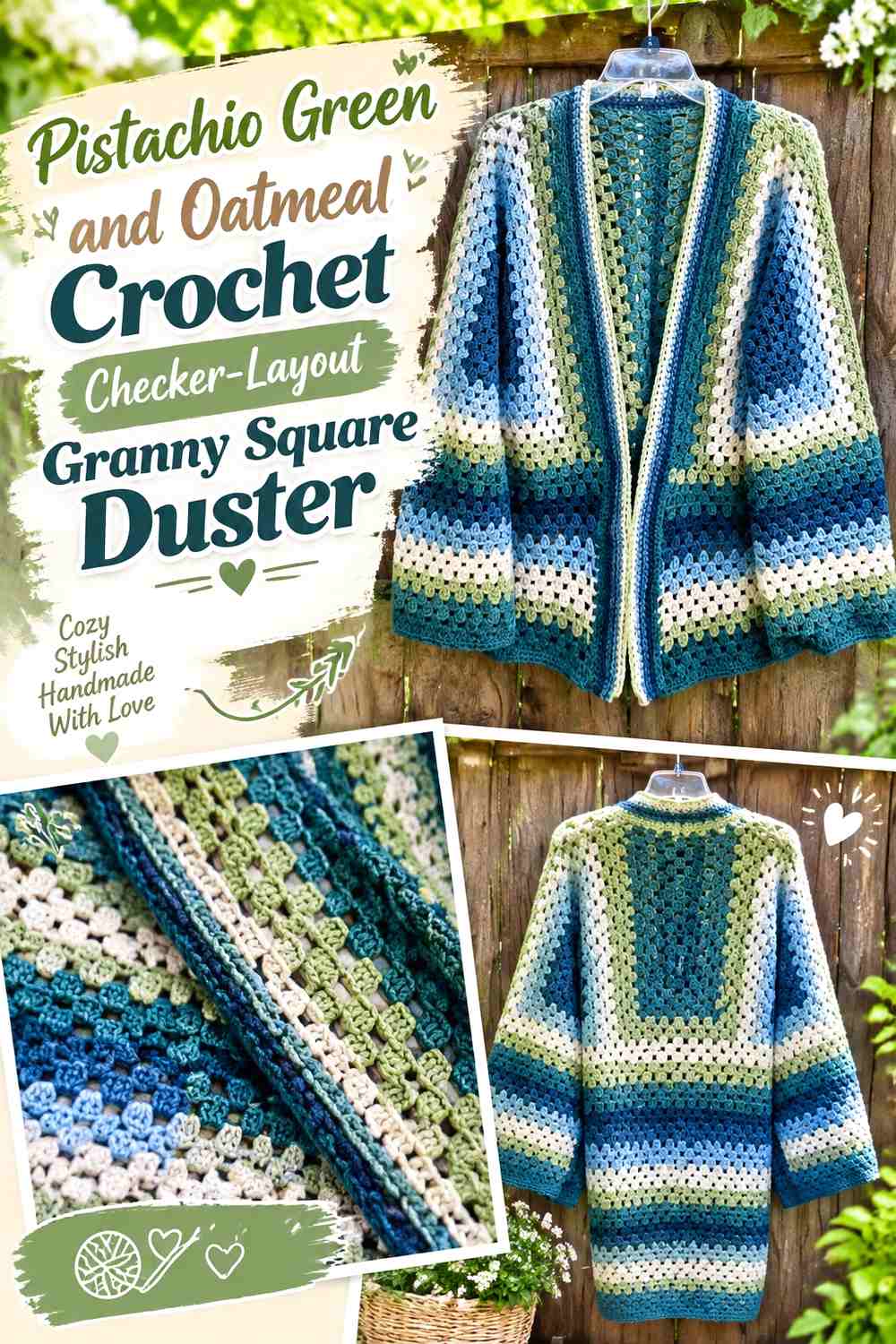
Instead of changing color inside every motif in the same way, alternate pistachio-led and oatmeal-led squares across the body. The resulting checker-like layout creates stronger color movement and makes both shades substantially visible.
Pistachio Green Squares Need Planned Placement Beside Oatmeal Squares
Lay out an entire back panel before joining. A small shift in the alternating sequence can create two green squares touching unexpectedly and interrupt the checker rhythm.
Oatmeal Squares Give Pistachio Green Duster Panels Breathing Room
Oatmeal helps prevent a long checker arrangement from becoming too visually dense. Keeping its motif treatment relatively simple also gives the green-led squares more definition.
Pistachio Green and Oatmeal Sleeves Can Simplify the Body Checker Pattern
You do not have to continue the exact alternating sequence through the sleeves. Using more oatmeal toward the cuffs or repeating a simpler pistachio-and-oatmeal arrangement can keep the long body as the main patterned area.
The supporting tutorial uses granny-hexagon cardigan construction rather than a square-by-square duster, so use it for garment shaping concepts and plan the extended motif layout separately.
Creator Credit: Maggie May Crochet
4. Pistachio Green Crochet Granny Square Duster With Oatmeal Front Bands

Keep the granny-square body predominantly pistachio green, then use oatmeal along the open fronts from neckline toward the hem. These long neutral bands create strong vertical lines that can visually organize an otherwise motif-heavy garment.
Pistachio Green Should Stay Continuous Beside the Oatmeal Front Bands
Avoid placing large oatmeal blocks immediately beside the opening if you want the front bands to remain distinct. A clear pistachio section on either side makes the vertical trim easier to recognize.
Oatmeal Front Bands Can Calm a Pistachio Green Granny Duster
Because the bands run nearly the full garment length, they contribute more neutral color than their width suggests. Start with a restrained band before deciding whether the hem also needs a broad oatmeal finish.
Oatmeal Can Connect the Pistachio Green Duster Neckline and Hem
If the front bands continue naturally around the neckline or into the lower edging, the neutral acts as one connected frame rather than several isolated details.
The tutorial supports an adjustable granny-hexagon cardigan construction with body-length extension; use its original instructions for construction rather than assuming the duster-length motif layout shown here is creator-specified.
Creator Credit: PassioKnit Kelsie
5. Oatmeal Crochet Granny Square Duster With Pistachio Green Sleeves

This layout concentrates pistachio green on the arms while keeping most of the long body oatmeal. It produces a light central garment with stronger color along each side when the arms hang naturally.
Oatmeal Should Dominate the Long Crochet Duster Panels
Keep the back and both front panels consistently oatmeal-led so the body remains a quiet vertical field. This gives the green sleeves enough contrast without requiring additional bright details.
Pistachio Green Sleeves Need Balance Against the Oatmeal Duster Body
Two green sleeves can carry considerable visual weight. Repeat a little pistachio in body motif centers or the hem if the sleeves seem disconnected, but avoid turning every oatmeal body square into a fifty-fifty motif.
Oatmeal Cuffs Can Soften Pistachio Green Sleeves
A light cuff can return the body color near the hands and prevent the arms from becoming solid green columns. The exact cuff construction should follow the selected tutorial rather than a color concept alone.
Creator Credit: TL Yarn Crafts
6. Pistachio Green Crochet Granny Square Duster With Oatmeal Motif Borders

Here, pistachio green fills most of each square while oatmeal appears as a consistent outer round before joining. The effect is softer than a strongly contrasting separate join because every motif carries its own neutral frame.
Pistachio Green Should Remain Broad Inside Each Oatmeal Granny Border
Give green enough interior space to read as the main color. If only the center is pistachio and several outer rounds are oatmeal, the hierarchy will reverse once dozens of motifs are assembled.
Oatmeal Borders Can Keep Pistachio Green Squares Distinct
The neutral perimeter creates separation before the squares are even joined. This is useful on a long duster because individual motifs remain readable across large body panels.
Oatmeal Should Stay Consistent Around Pistachio Green Sleeve Motifs
Changing the outer-round color on the sleeves can make them look like a separate garment component. Repeating the same oatmeal frame creates continuity from body to arms.
Creator Credit: MJ’s Off The Hook Designs
7. Oatmeal Crochet Granny Square Duster With Pistachio Green Motif Borders

Reverse the previous arrangement by filling the motifs primarily with oatmeal and placing pistachio green around their perimeters. Once joined, the green outer rounds can form a visible network across the garment.
Oatmeal Keeps the Crochet Duster Motifs Light Through the Center
Use oatmeal across most of each square to create a calm interior field. The long garment will still contain plenty of green because every motif repeats the contrasting boundary.
Pistachio Green Borders Create a Graphic Grid Around Oatmeal Squares
A darker or more colorful outer round can make every square easy to distinguish. Consider how strong that grid becomes over an entire back panel before adding another contrasting join.
Pistachio Green Edging Can Continue the Oatmeal Duster Grid
A green front or lower edge can connect naturally with the motif perimeters. Keep the width similar to the existing border if you want the green framework to remain consistent.
Creator Credit: Nati Crochet
8. Pistachio Green Crochet Granny Square Duster With Oatmeal Sleeve Panels

Make the body strongly pistachio green while moving oatmeal onto the sleeves. This reverses Idea 5 and keeps the greatest concentration of color through the long vertical garment rather than along the arms.
Pistachio Green Should Run Clearly From Duster Shoulder to Hem
A largely continuous green body emphasizes the garment’s length. Avoid broad oatmeal horizontal bands across the center if you want to preserve that long visual line.
Oatmeal Sleeves Lighten the Pistachio Green Duster Sides
The neutral sleeves create a softer frame around the stronger central body. Small pistachio centers inside oatmeal sleeve squares can keep the arms connected to the rest of the garment.
Pistachio Green Cuffs Can Reconnect Oatmeal Sleeves to the Duster Body
A narrow green finish near the hands provides a useful repeat of the main color. It is usually enough without adding several extra green stripes through the sleeves.
The supporting tutorial demonstrates a granny-stitch cardigan rather than a square-built duster, so use it for wearable proportions and continuous granny construction rather than as an exact motif layout.
Creator Credit: AC Crochets
9. Oatmeal Crochet Granny Square Duster With Pistachio Green Side Panels

Instead of concentrating green in the center, use it along the side columns or underarm-adjacent motif sections while keeping the front and back centers oatmeal. The resulting placement gives the duster a quieter face-on appearance with more color visible from an angle.
Oatmeal Should Keep the Crochet Duster Center Panels Broad
Use enough oatmeal squares down the center front and back for the neutral to remain the main field. A narrow center surrounded by green can reverse the balance.
Pistachio Green Side Panels Can Give Oatmeal More Definition
Green columns along the sides visually separate the front from the back and introduce color without breaking the center into stripes.
Oatmeal Sleeves Can Keep Pistachio Green Side Panels Controlled
If the sides are already strongly green, oatmeal-led sleeves prevent the accent from expanding across the entire outer silhouette.
The referenced tutorial demonstrates a V-neck granny-square cardigan. Use it as a modular garment reference and plan any extra duster length from your own measurements and compatible motif layout.
Creator Credit: Briana K Designs
10. Pistachio Green and Oatmeal Crochet Granny-Yoke Duster

A granny-square yoke provides a useful way to concentrate detailed colorwork near the shoulders while keeping the long lower portion simpler. Use pistachio green and oatmeal together in the upper motifs, then let one color take a clearer lead as the body extends downward.
Pistachio Green Can Anchor the Oatmeal Granny-Square Yoke
Place pistachio green consistently within the upper squares if you want the shoulder area to establish the garment’s main color direction.
Oatmeal Can Expand Below Pistachio Green Into the Long Duster Body
A more neutral lower body prevents the entire long garment from becoming motif-heavy. This creates a transition from detailed two-color yoke to quieter vertical length.
Pistachio Green Can Repeat at the Oatmeal Duster Hem
One narrow green lower finish can connect the distant hem back to the yoke. Avoid several extra stripes if the long oatmeal section is intended to provide visual rest.
HanJan Crochet’s tutorial specifically combines granny-square yoke construction with continued granny stitch and adjustable body length, making it a useful construction reference for this longer adaptation.
Creator Credit: HanJan Crochet
11. Pistachio Green Crochet Oversized Granny Duster With Oatmeal Edging
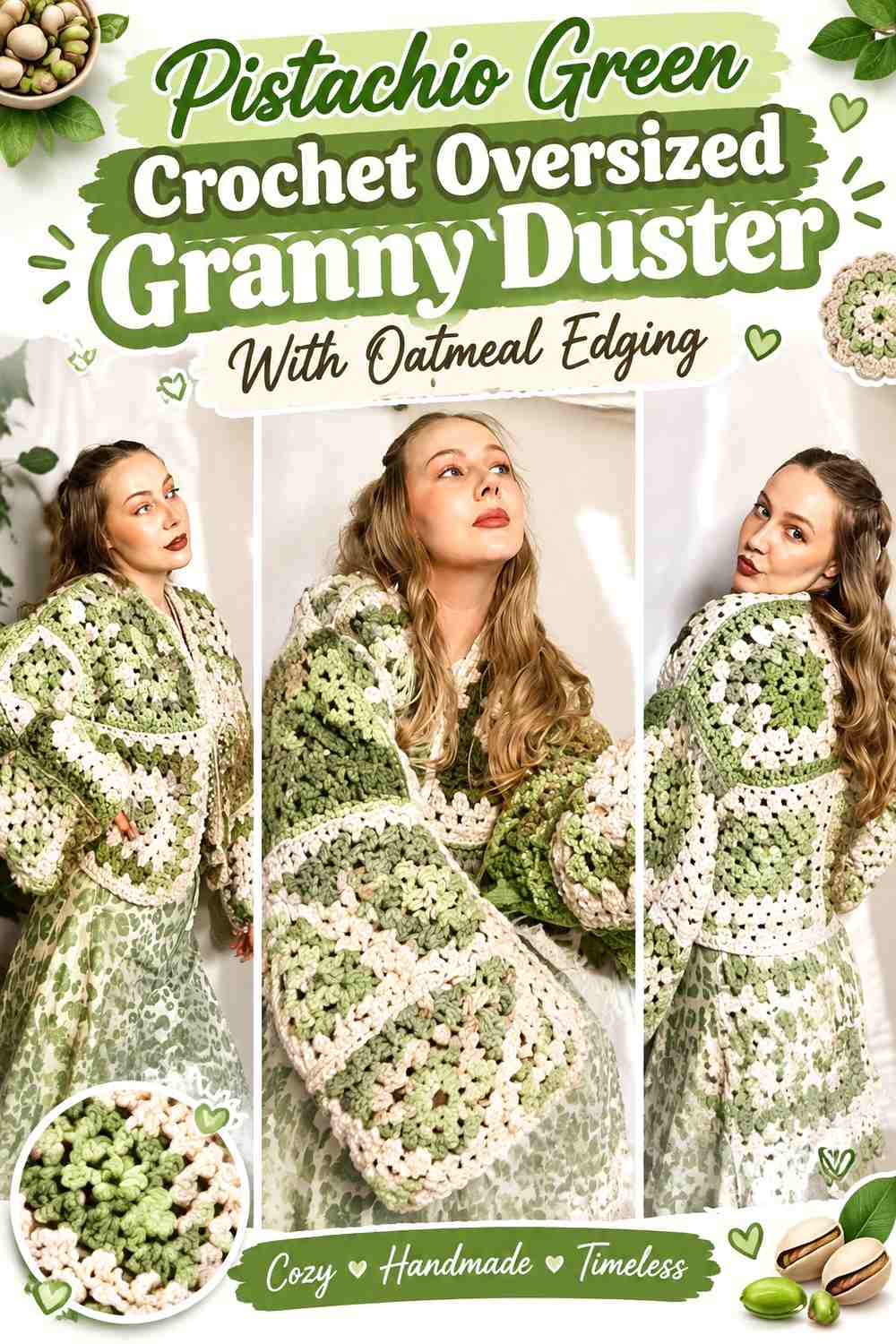
Larger granny squares create fewer seams and make each individual color decision more prominent. Use pistachio green as the main color within oversized motifs, then let oatmeal provide the garment’s finishing edges.
Pistachio Green Becomes More Prominent in Oversized Crochet Squares
A large green motif occupies much more uninterrupted visual space than several small squares with the same overall color ratio. Check one completed motif at garment scale before multiplying the palette.
Oatmeal Edging Can Restrain Large Pistachio Green Duster Motifs
A neutral finish around the front and hem provides a quiet boundary for bold, oversized squares. The long oatmeal lines can also help unify motifs whose interiors contain slightly different green distributions.
Oatmeal Cuffs Can Balance an Oversized Pistachio Green Body
Large motifs on the sleeves may create strong blocks near the wrists. A simple oatmeal cuff gives the sleeves a cleaner endpoint without introducing another shade.
The supporting project is a granny-square cardigan rather than a finished duster, so extend the long silhouette only through a garment plan compatible with your square dimensions and chosen construction.
Creator Credit: DIYGuru
12. Oatmeal Crochet Granny Square Duster With Pistachio Green Motif Centers

This variation emphasizes repetition through numerous small green centers against a predominantly oatmeal garment. It is one of the softer ways to use pistachio because the green never needs to form a large uninterrupted block.
Oatmeal Should Connect the Crochet Duster From Shoulder to Hem
Let oatmeal occupy the outer rounds and joining areas so it visually links each row of squares into a continuous long garment.
Pistachio Green Centers Need Consistency Across Oatmeal Motifs
Repeated small centers are most effective when they occupy comparable positions throughout the body. If some expand much farther than others, the duster can develop accidental patches of heavier green.
Pistachio Green Can Increase Slightly on Oatmeal Sleeve Motifs
If the body feels too neutral, give the sleeve centers a little more green rather than changing the entire front layout. This increases color at the sides while preserving the oatmeal-led body.
Creator Credit: Mom’s Crochet & Craft
13. Pistachio Green Crochet Granny Square Duster With Oatmeal Motif Centers

For the final direction, reverse the center-emphasis layout: use small oatmeal centers surrounded by increasingly pistachio-green rounds. Once many squares are assembled, the neutral centers appear as repeated points inside a predominantly green garment.
Pistachio Green Should Expand Around Each Oatmeal Crochet Center
Let green occupy the majority of every motif so the squares merge visually into a pistachio-led body once joined.
Oatmeal Centers Give Pistachio Green Duster Panels a Repeated Light Accent
Small neutral centers distribute light points across the long front and back without creating broad cream stripes. This works especially well when you want a colorful duster that still feels controlled.
Oatmeal Joining Can Soften Pistachio Green Without Enlarging the Centers
If the final layout looks greener than expected, use oatmeal for the joining or front finish rather than changing all the completed motif centers. The neutral grid introduces separation while preserving the planned square sequence.
HayHay Crochet’s tutorial demonstrates a granny-square cardigan rather than duster length, so use its modular construction as the reference and plan additional length according to your own finished motif dimensions and garment requirements.
Creator Credit: HayHay Crochet
Comparing the Pistachio Green and Oatmeal Granny Square Duster Directions
For the strongest pistachio-green presence, Ideas 1, 4, 6, 8, 11, and 13 keep the larger garment areas green and reserve oatmeal for joins, centers, sleeve sections, or finishing.
Ideas 2, 5, 7, 9, and 12 produce lighter oatmeal-led dusters. These work well when you want pistachio green to appear as repeated motif details or strategic garment panels rather than dominate the whole silhouette.
Idea 3 gives both shades more equal visual importance through alternating motif placement. Idea 10 is structurally different because it concentrates the granny-square colorwork around the yoke and allows the long lower body to become calmer.
Conclusion
Pistachio green and oatmeal can produce very different granny-square dusters depending on whether the contrast happens inside the motifs, between motifs, or across entire garment sections.
For a greener duster, use pistachio through the motif interiors and let oatmeal control the joins and edges. For a lighter result, make oatmeal the shared outer color and repeat pistachio in centers, sleeves, or side panels. If you want both colors to be equally noticeable, alternate motif emphasis—but arrange the complete panels before joining so unintended vertical or horizontal stripes do not appear.
The long silhouette makes color repetition more important than it is on a cropped cardigan. Always review several rows of motifs together, including the sleeves, before final assembly. Follow the linked creator tutorials for their original cardigan or duster construction details and apply the pistachio green and oatmeal placement independently.
Frequently Asked Questions
Should pistachio green or oatmeal dominate a crochet granny square duster?
Pistachio green works well as the dominant shade when you want the duster to have a clear soft-green identity. Oatmeal is useful as the main field when you prefer a lighter neutral garment with green concentrated in motif centers, borders, or selected panels.
Where should oatmeal go on a pistachio green granny square duster?
Oatmeal works especially well in outer motif rounds, joins, front bands, cuffs, and the lower border. These placements divide large pistachio areas while preserving green as the main color.
How can I keep a pistachio green and oatmeal duster from looking too busy?
Give each color a consistent role. For example, use pistachio green in every motif center and oatmeal in every outer round and join. A predictable hierarchy is easier to read across a long garment than frequently changing the color order.
Should the sleeves match the pistachio green and oatmeal body exactly?
They can, but they do not have to. A simpler sleeve palette can balance a highly patterned body. Lay the sleeve motifs beside the body before joining so you can judge the entire color distribution together.
Which color works well for joining pistachio green and oatmeal granny squares?
Oatmeal joining creates a lighter grid and separates green-heavy motifs, while pistachio green joining creates stronger colored framework around oatmeal-led squares. Choose according to whether you want the joins to blend or become a visible part of the design.
How can I avoid accidental stripes in a two-color granny square duster?
Arrange a complete front or back panel before permanent joining. Repeated centers or borders can line up into strong vertical and horizontal bands even when each individual square looks balanced.
Can I turn a shorter pistachio green and oatmeal granny cardigan into a duster?
A longer adaptation may be possible when the construction allows additional body length, but do not assume that simply adding squares will preserve fit and proportions. Check the original tutorial’s construction, your blocked motif dimensions, front-panel width, sleeve balance, and the added weight of the longer garment before planning the final layout.
What can I substitute for pistachio green?
Choose another light or medium muted green that stays clearly distinguishable from oatmeal, such as a softened spring green or pale earthy green. Preserve the gentle green-versus-neutral relationship rather than trying to match a specific commercial shade.