Plum Noir gives a crochet turtleneck a much deeper direction than standard purple. Think of it as a dark plum family rather than one standardized commercial yarn shade: the goal is a purple that sits close to black while still showing a recognizable plum undertone.
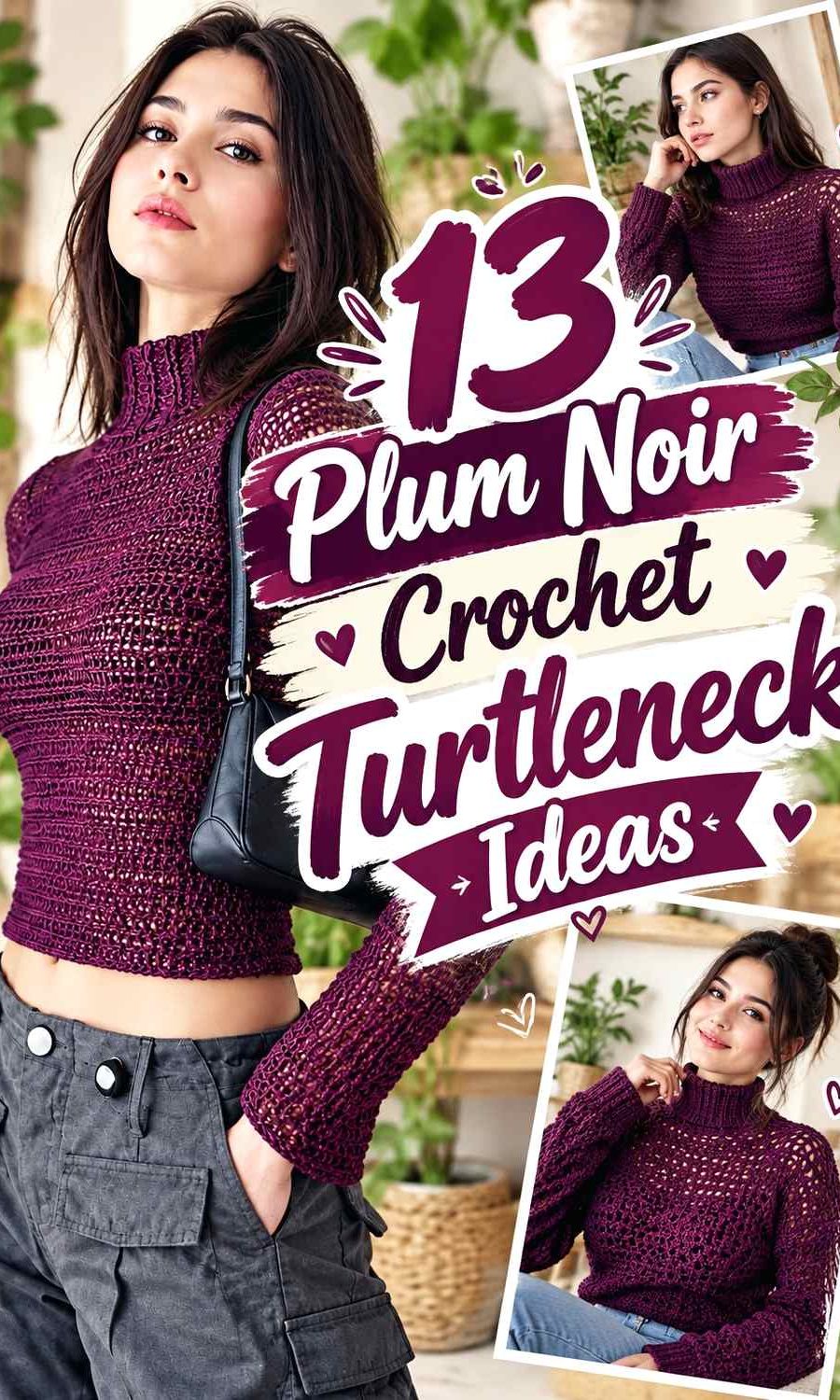
That depth makes color placement especially important. A Plum Noir turtleneck worked entirely in a dark shade can emphasize silhouette and texture, while a lighter collar edge, cuff, yoke, or motif border can reveal details that would otherwise blend into the garment.
The 13 ideas below approach Plum Noir differently. Some use pale neutrals for strong value contrast, others pair it with neighboring purples and reds for a tonal effect, and several use muted greens or blues to shift the sweater in a cooler direction. The linked tutorials support the turtleneck construction concepts; the Plum Noir palettes are independent color adaptations.
Quick List
- Plum Noir And Soft Ivory Classic Crochet Turtleneck
- Plum Noir And Smoke Gray Fluffy Roll Neck Crochet Turtleneck
- Plum Noir And Ochre Cable Crochet Turtleneck
- Plum Noir And Soft Black Clean Line Crochet Turtleneck
- Plum Noir And Camel Relaxed Crochet Turtleneck
- Plum Noir And Mushroom Taupe Paneled Crochet Turtleneck
- Plum Noir And Dusty Mauve Ribbed Crochet Turtleneck
- Plum Noir And Silver Gray Herringbone Crochet Turtleneck
- Plum Noir And Cranberry Berry Texture Crochet Turtleneck
- Plum Noir And Sage Textured Crochet Turtleneck
- Plum Noir And Deep Teal Raglan Crochet Turtleneck
- Plum Noir And Cream Granny Square Crochet Turtleneck
- Plum Noir And Ice Blue Full Rib Crochet Turtleneck
Keep Plum Noir Texture From Disappearing
Dark yarn can make a crochet turtleneck look wonderfully continuous, but it can also reduce the visibility of smaller stitch details. This matters more on a high-neck garment because Plum Noir may cover the collar, torso, sleeves, cuffs, and hem with very few visual breaks.
If cables, ribbing, raised berries, granny-square edges, or directional stitches are important to the design, make a useful swatch before committing to an all-dark surface. Look at it from several feet away as well as close up. A texture that is obvious under a bright work light may become much quieter in ordinary wear.
A lighter supporting shade can solve this without taking over the sweater. Narrow cuff bands, collar edges, motif borders, or a controlled yoke section can give Plum Noir enough separation for the garment structure to remain visible.
Decide Whether the Plum Noir Turtleneck Collar Should Blend or Contrast
The collar occupies more visual space on a turtleneck than on a crew-neck sweater, so its color has a large effect on the finished palette.
Keeping the collar Plum Noir creates one continuous dark line from the face into the body. This works especially well when ribbing or a roll-neck fold supplies enough texture to distinguish the neckline.
Using a lighter collar creates a stronger focal point. Ivory, gray, camel, cream, or ice blue can make the neck shape much more obvious. A third option is a near-tonal collar in black, mauve, cranberry, or another dark neighboring shade, which creates separation without turning the neckline into the brightest area of the sweater.
1. Plum Noir And Soft Ivory Classic Crochet Turtleneck

Soft ivory gives Plum Noir one of the strongest useful contrasts without creating the starkness of brilliant white. Keep Plum Noir across the torso and sleeves, then use ivory around the collar edge, cuffs, or lower ribbing. On a classic turtleneck silhouette, that limited pale framing makes the garment structure easier to read while leaving the dark plum body uninterrupted.
Soft Ivory Can Clarify a Plum Noir Crochet Turtleneck Collar
If the tall collar and body are both Plum Noir, the neckline can visually merge into the upper torso. A narrow ivory edge can mark where the collar ends without requiring an entirely ivory neck.
Repeat that ivory once at the cuffs if the collar accent feels isolated. Keeping the repetition narrow protects Plum Noir’s dominant role.
Plum Noir Should Stay Across the Main Turtleneck Panels
Use Plum Noir on the largest front, back, and sleeve areas if you want the finished sweater to retain its dark identity. Turning both the collar and major sleeve sections ivory can shift the garment toward a balanced two-color design.
For a Plum Noir-led result, let ivory define rather than divide.
Creator Credit: ABoC Studio
2. Plum Noir And Smoke Gray Fluffy Roll Neck Crochet Turtleneck

Smoke gray reduces the contrast against Plum Noir while still giving a fluffy roll neck some separation from the body. This softer neutral relationship suits a turtleneck where surface halo and volume already create visual movement.
Plum Noir Needs Larger Areas on a Fluffy Crochet Turtleneck
A fuzzy surface naturally softens the boundary between stitches. Keep broad body and sleeve sections Plum Noir rather than alternating small patches of plum and gray, which may look less defined once the halo spreads across the color changes.
Smoke gray works more effectively in larger, intentional finishing areas.
Smoke Gray Can Lighten a Plum Noir Roll Neck
Consider smoke gray for the folded outer portion of the collar while keeping its base Plum Noir. That gives the rolled neckline a visible change without putting the brightest color on the entire neck.
A similar gray cuff can echo the collar while leaving the sweater body dark.
Creator Credit: Lucky Platypus Crochet
3. Plum Noir And Ochre Cable Crochet Turtleneck
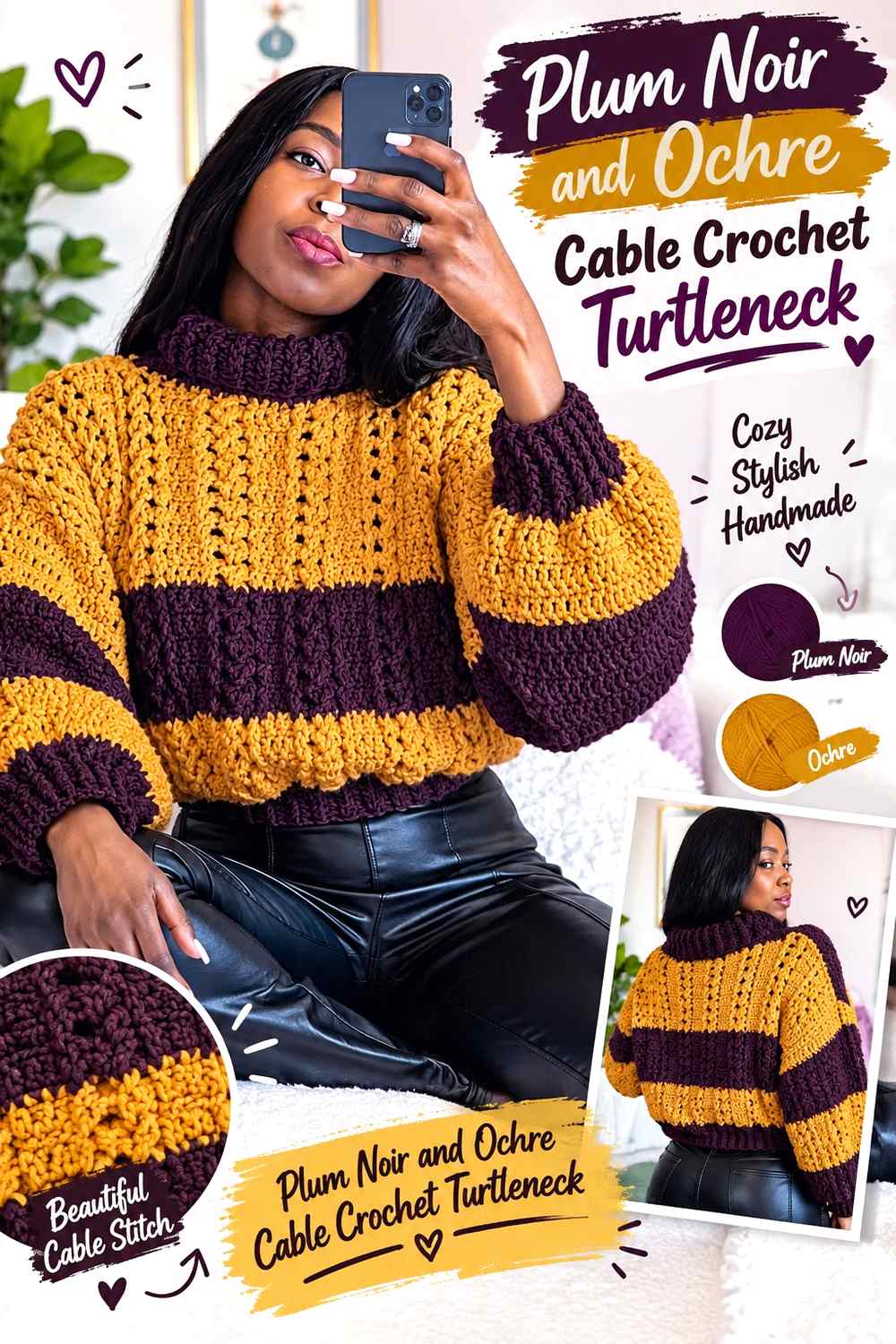
Ochre gives dark Plum Noir a warm accent that can help raised cable sections stand apart. Because cable texture already carries substantial visual weight, use ochre selectively instead of giving both colors equal coverage.
Plum Noir Creates a Strong Background for Ochre Crochet Cables
Keep most of the cable sweater Plum Noir and reserve ochre for one controlled cable panel, collar edge, or cuff detail. The color difference can make that selected area more noticeable without covering every raised stitch in a second shade.
If several cable panels are present, decide whether you want them all emphasized or only one focal section.
Ochre Should Repeat Sparingly Across a Plum Noir Turtleneck
An ochre neckline detail can look disconnected if it appears nowhere else. Repeat a smaller amount at the cuffs or hem rather than inserting unrelated ochre blocks through the torso.
That repetition creates a clear palette while allowing Plum Noir to remain the dominant dark field.
Creator Credit: AC Crochets
4. Plum Noir And Soft Black Clean Line Crochet Turtleneck
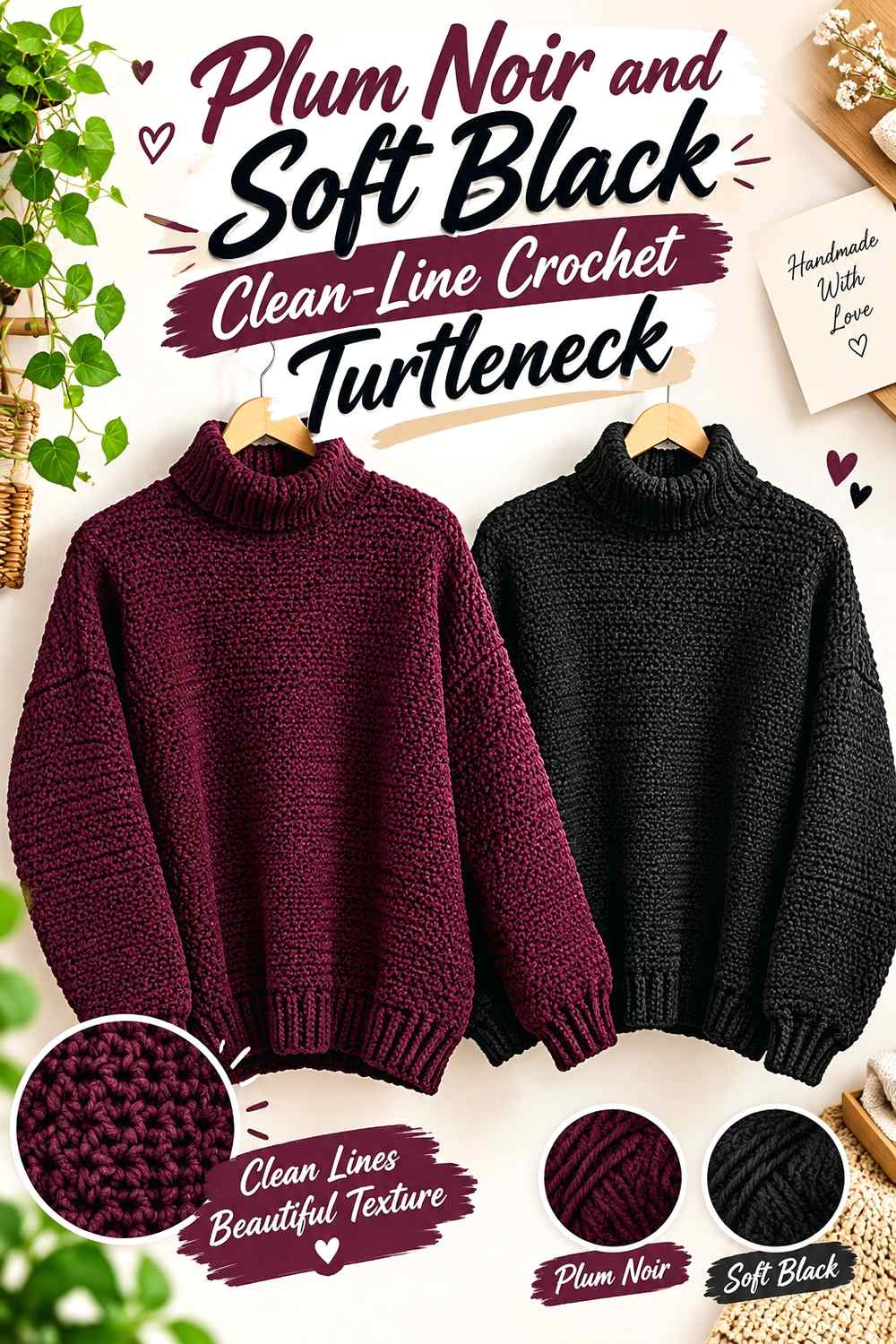
Plum Noir and soft black create a near-monochrome turtleneck where the color difference may only appear under certain lighting. This palette depends on texture and strategic placement rather than obvious value contrast.
Soft Black Can Deepen a Plum Noir Crochet Turtleneck Collar
Use black at the collar if you want the neckline to appear slightly darker than the Plum Noir torso. The difference should feel intentional but restrained.
Because both shades are dark, a strongly textured collar or ribbed edge can help make the transition easier to see.
Plum Noir Needs Clear Placement Against Soft Black
Avoid scattering black randomly through a Plum Noir body because the colors may be too close for small isolated patches to read clearly. Larger structural areas—such as the collar, cuffs, or lower band—give the subtle color difference enough space to register.
Creator Credit: Fully Crochet
5. Plum Noir And Camel Relaxed Crochet Turtleneck
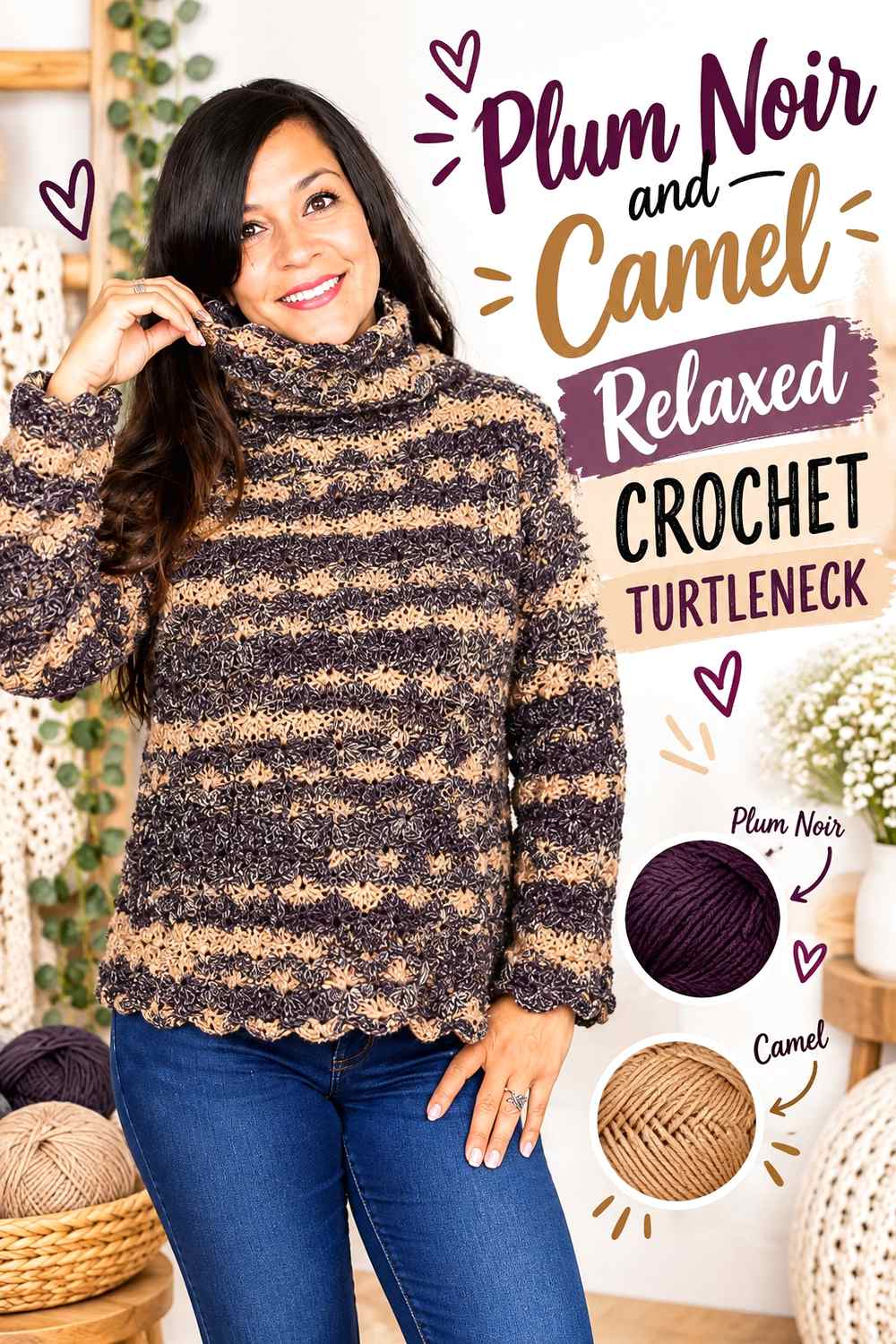
Camel introduces a warm neutral that is clearly lighter than Plum Noir without being as bright as ivory or cream. On a relaxed high-neck pullover, camel works well around edges that already have structural importance.
Camel Can Frame a Plum Noir Relaxed Turtleneck
Use camel on the collar edge, cuffs, or lower band rather than interrupting the broad Plum Noir torso. This places contrast where the sweater naturally begins and ends.
A camel collar can also make a relaxed fold easier to distinguish from the dark body underneath.
Plum Noir Should Balance Camel Across the Turtleneck Sleeves
If camel cuffs are fairly wide, keep the majority of each sleeve Plum Noir. Large camel sleeve blocks combined with a camel collar can quickly make the neutral shade feel equally dominant.
Think of camel as framing for the dark sweater rather than a second body color.
Creator Credit: Crochet Maniak
6. Plum Noir And Mushroom Taupe Paneled Crochet Turtleneck
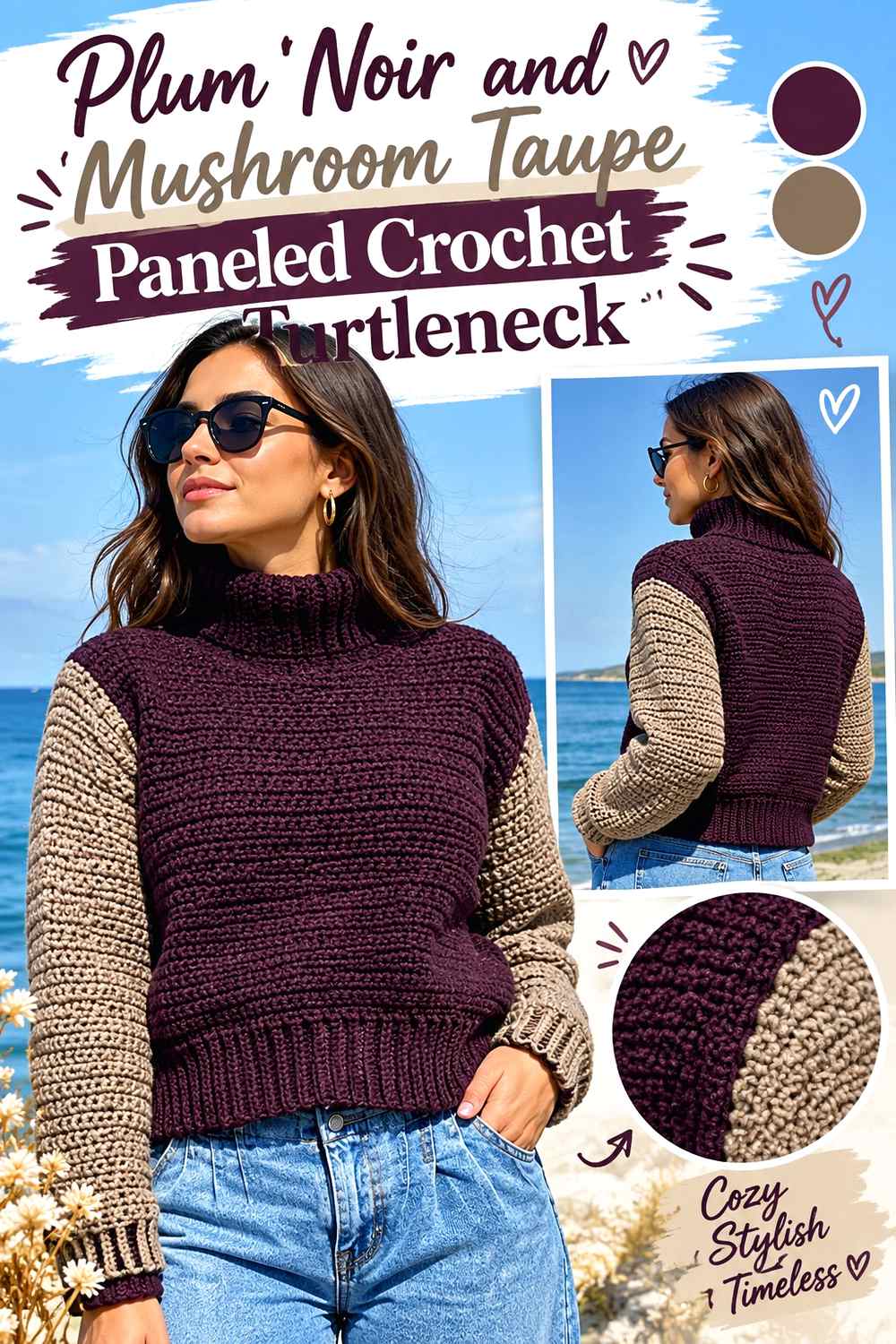
Mushroom taupe creates quieter contrast than camel and gives a paneled sweater a muted neutral break. It is especially useful around ribbed borders because the change in both texture and color can distinguish those areas from the Plum Noir panels.
Plum Noir Can Keep Paneled Crochet Turtleneck Sections Connected
Use Plum Noir consistently through the major front, back, and sleeve panels. Paneled construction already introduces seams and structural divisions, so multiple large color blocks may add more segmentation than you want.
A continuous Plum Noir body keeps those sections visually unified.
Mushroom Taupe Can Separate Plum Noir Ribbing From the Body
Place mushroom taupe at cuffs, hem ribbing, or the collar when those areas need clearer definition. Because taupe is softer than ivory, the border remains noticeable without becoming the brightest part of the garment.
Check that the taupe is actually lighter than your Plum Noir rather than selecting another extremely dark neutral.
Creator Credit: Loopy Mountain Crochet
7. Plum Noir And Dusty Mauve Ribbed Crochet Turtleneck

Dusty mauve creates a tonal purple family palette. Unlike ivory or camel, it does not rely on a large hue change, so the success of the combination depends on maintaining enough light-dark difference between mauve and Plum Noir.
Dusty Mauve Can Reveal Plum Noir Ribbing Without Leaving the Purple Family
Use dusty mauve for cuffs or a collar edge where it can expose the direction of the ribbing. Keeping both shades within a purple range produces a more blended result than pairing Plum Noir with a neutral.
The mauve should remain clearly lighter if you want narrow ribbed details to show.
Plum Noir Should Dominate the Ribbed Crochet Turtleneck Body
Cover the long vertical body and sleeve sections in Plum Noir so the ribbing itself creates the main surface movement. Too many alternating mauve bands can interrupt the strong vertical flow that makes an all-over ribbed sweater distinctive.
Creator Credit: Alona crochets
8. Plum Noir And Silver Gray Herringbone Crochet Turtleneck
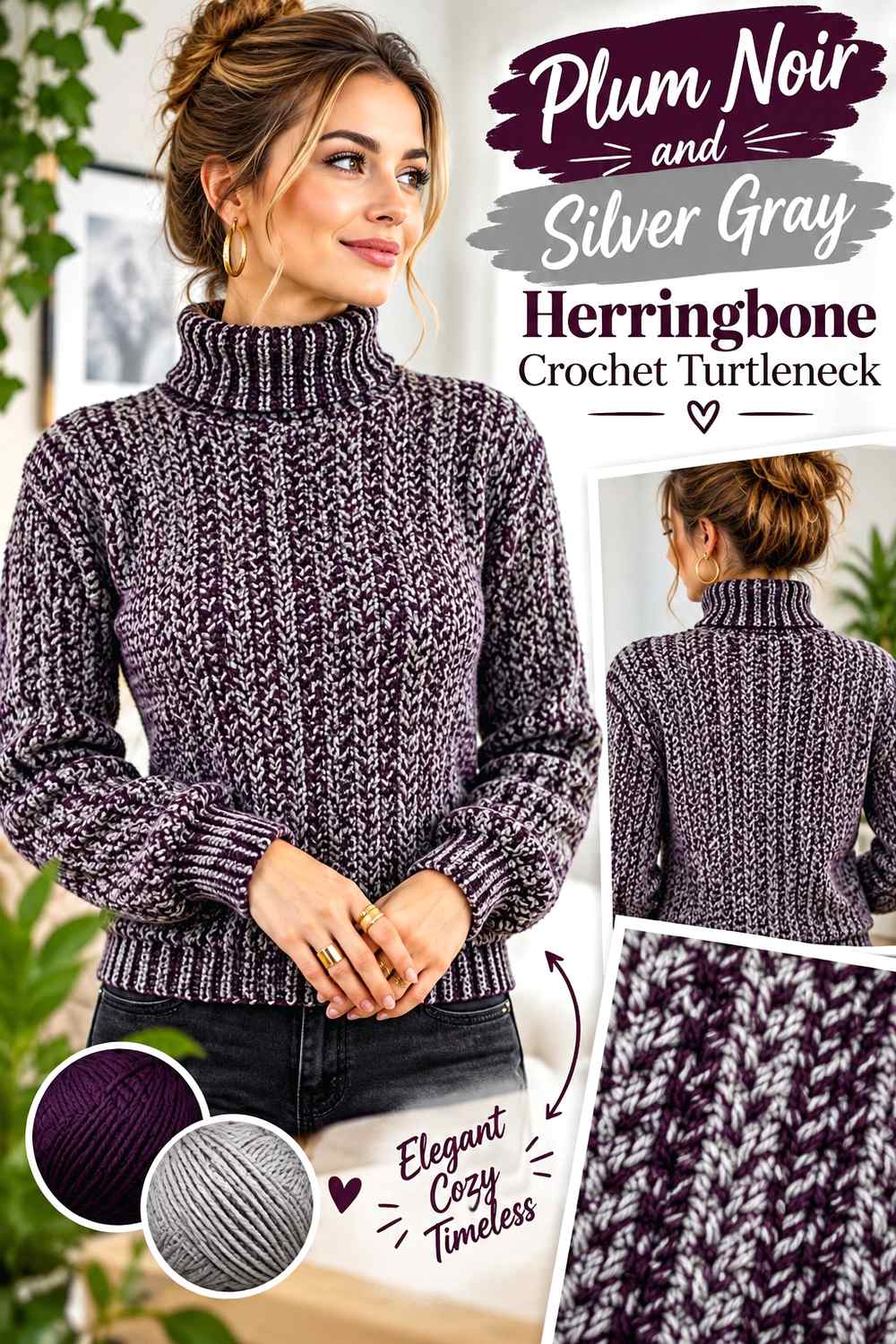
Silver gray gives Plum Noir a cool neutral partner that works well with directional herringbone texture. Use the gray where you want the angle or edge of the stitch pattern to become more apparent rather than distributing it evenly everywhere.
Silver Gray Can Highlight Plum Noir Herringbone Direction
A controlled silver-gray panel or border can reveal the transition between stitch directions more clearly than an entirely dark surface. This is useful when the texture itself is one of the main reasons for choosing the sweater.
Keep the largest herringbone areas Plum Noir if the dark color should remain the first impression.
Plum Noir Benefits From Silver Gray at the Turtleneck Edges
Silver gray cuffs and neckline edging can give the dark sweater cleaner stopping points. If both areas already provide enough contrast, adding a wide gray hem may be unnecessary.
Evaluate the sweater as a complete composition instead of automatically repeating gray on every border.
Creator Credit: TCDDIY
9. Plum Noir And Cranberry Berry Texture Crochet Turtleneck

Cranberry sits closer to Plum Noir than cream or gray but introduces a noticeably redder direction. The pairing works particularly well when raised berry details appear selectively across a darker background.
Cranberry Can Make Plum Noir Berry Texture More Visible
Consider cranberry for selected raised rows or a limited upper-body detail rather than covering every textured element. A smaller amount of the warmer red-purple can make those rows easy to locate against Plum Noir.
That contrast is useful when the texture is intentionally spaced rather than continuous.
Plum Noir Should Separate Cranberry Details Across the Turtleneck
Leave enough Plum Noir between cranberry textured sections so the accent rows do not merge into a broad red-purple block. The dark spacing allows each cranberry detail to act as a distinct part of the sweater surface.
Creator Credit: Cathérine Crochet
10. Plum Noir And Sage Textured Crochet Turtleneck

Sage moves Plum Noir into a muted purple-and-green direction. Because both colors can be subdued, this palette works best when one clearly dominates and the second is concentrated where the stitch texture needs contrast.
Sage Can Break Up a Plum Noir Textured Crochet Panel
Use sage at the collar, cuffs, or one selected textured section rather than alternating it frequently through the body. The green provides a clear hue change even when its value is not dramatically lighter.
For stronger texture visibility, choose a sage that remains visibly lighter than Plum Noir.
Plum Noir Should Surround Sage on a Textured Turtleneck
Keeping Plum Noir around a sage accent makes that accent look intentional. For example, a sage collar bordered by a Plum Noir body and Plum Noir sleeves creates a clear focal area.
Large sage body panels would produce a much more balanced two-color sweater, which may not suit a Plum Noir-led article direction.
Creator Credit: Mary K’s Designs
11. Plum Noir And Deep Teal Raglan Crochet Turtleneck

Deep teal gives Plum Noir a cool, dark companion. Because both shades carry substantial visual weight, raglan lines provide a useful place to separate them without requiring pale contrast.
Deep Teal Can Trace Plum Noir Raglan Structure
Use deep teal around the upper yoke or along a controlled raglan accent area while keeping the main torso Plum Noir. This uses the sweater’s existing construction lines to organize the color change.
Avoid spreading teal into unrelated patches across the body if the raglan structure is meant to be the main secondary feature.
Plum Noir Can Keep a Deep Teal Turtleneck Yoke Grounded
If teal occupies part of the upper sweater, repeat Plum Noir strongly below it and through most of the sleeves. That larger dark plum area prevents the two deep colors from competing equally.
A small teal cuff repeat can connect the sleeves to the yoke without requiring a second large teal block.
Creator Credit: divyne crochet
12. Plum Noir And Cream Granny Square Crochet Turtleneck

Granny squares give you more color-placement choices than a continuous sweater panel. Plum Noir can act as the repeated anchor shade across each motif, while cream creates lighter centers, outer rounds, or joining areas.
Cream Can Separate Plum Noir Granny-Square Motifs
Use cream consistently in the same part of several motifs if you want the sweater grid to feel organized. A cream outer round, for example, can separate dark Plum Noir sections from adjacent squares.
The important point is repetition: random cream placement can make an already graphic sweater feel unnecessarily scattered.
Plum Noir Should Repeat Across Every Granny-Square Turtleneck Area
Carry Plum Noir through the body motifs, sleeves, and collar so the garment stays connected even if individual squares vary. It does not need to occupy exactly the same amount in every motif, but repeating it gives the sweater a common color anchor.
Before joining, lay the Plum Noir and cream squares out together and check for accidental clusters of very light or very dark motifs.
Creator Credit: Beautiful Crochet Stuff
13. Plum Noir And Ice Blue Full Rib Crochet Turtleneck

Ice blue provides the coolest light contrast in the collection. Against Plum Noir, it can make ribbing and edge changes especially clear, but its pale value means even small sections may attract attention.
Ice Blue Can Define Plum Noir Full-Rib Turtleneck Edges
Use ice blue around the collar edge or narrow cuffs if you want the vertical Plum Noir ribbing to end with a distinct pale boundary. Because the contrast is strong, the accent does not need to be wide.
A thin repeat is often enough to connect the neckline and sleeves.
Plum Noir Should Carry the Vertical Ribbed Turtleneck Surface
Keep the long front, back, and sleeve ribs Plum Noir so the eye follows the dark vertical lines through most of the garment. Large ice-blue body sections would interrupt that continuous effect.
If you want more ice blue, consider the hem before adding stripes through the center of the body.
Creator Credit: Chenda DIY
How the Plum Noir Crochet Turtleneck Palettes Compare
For the clearest light-dark contrast, soft ivory, cream, ice blue, silver gray, and mushroom taupe make Plum Noir details easier to distinguish. These are useful choices when collars, ribbing, motifs, or textured borders need strong separation.
Soft black, dusty mauve, and cranberry create more tonal transitions. They keep the turtleneck darker overall and rely more heavily on stitch texture and placement to show where one color ends and another begins.
Camel and ochre bring warmth into Plum Noir, while sage and deep teal move the palette toward muted green and blue relationships. Those combinations are useful when you want the sweater to remain dark but do not want the supporting color to be another neutral.
Conclusion
Plum Noir can support several very different crochet turtleneck directions. Soft ivory and cream make the tall neckline and sweater edges immediately visible. Gray, mushroom taupe, and camel soften that contrast. Black and mauve create darker tonal versions, while ochre, cranberry, sage, teal, and ice blue introduce stronger color relationships.
For a sweater that still reads primarily as Plum Noir, keep the front, back, and most of the sleeves in the main shade. Add the secondary color where the turtleneck already has meaningful structure: the collar, raglan line, cuffs, hem, cable section, textured row, granny-square border, or ribbed finish.
With very dark palettes, swatching becomes especially useful because the color relationship and stitch visibility need to work together. The original tutorials can guide the construction while you adapt the palette to the amount of contrast and color distribution you want.
Frequently Asked Questions
What kind of color is Plum Noir for crochet?
Plum Noir is best treated as a very dark plum direction rather than one standardized yarn shade. Look for a purple that approaches black while retaining enough plum character to remain different from a plain neutral black.
What colors create the strongest contrast with a Plum Noir crochet turtleneck?
Soft ivory, cream, pale gray, and ice blue can create strong value contrast against Plum Noir. They are useful around collars, cuffs, motif edges, and ribbing when you want those details to remain easy to see.
How do I keep a Plum Noir crochet turtleneck from looking flat?
Use stitch texture and strategic contrast. Ribbing, cables, berry stitches, herringbone texture, and granny-square edges can create surface variation within Plum Noir. A lighter accent around one or two structural areas can add further definition without breaking up the entire sweater.
Should the turtleneck collar be Plum Noir or a contrasting color?
Keep it Plum Noir for a continuous, dark silhouette. Use a contrasting collar if you want the neckline to become more prominent. A narrow contrasting edge provides a middle option by defining the collar without replacing the main Plum Noir surface.
Can I combine Plum Noir with another purple?
Yes. Dusty mauve, muted berry, or another clearly different purple can create a tonal palette. Preserve enough difference in lightness or saturation if you want the two shades to remain visibly separate.
How can I tell whether two dark colors will show enough contrast?
Place the yarns directly beside each other under the same lighting and look at them from a distance. A grayscale photo can also help reveal their value difference. If the yarns almost merge in grayscale, expect a subtle tonal effect rather than clearly outlined details.
Where should I use a lighter accent on a Plum Noir crochet turtleneck?
Collar edges, cuffs, hems, raglan lines, motif borders, textured bands, and selected ribbing are useful locations. These areas already have structural importance, so adding color there usually feels more deliberate than scattering light accents randomly across the torso.