A crochet back panel can change a denim jacket without requiring the entire garment to be crocheted. Rhubarb Red and Sea Glass make an especially flexible two-color starting point because the warmer red and cooler blue-green can trade dominant and supporting roles depending on how bold you want the jacket back to appear.
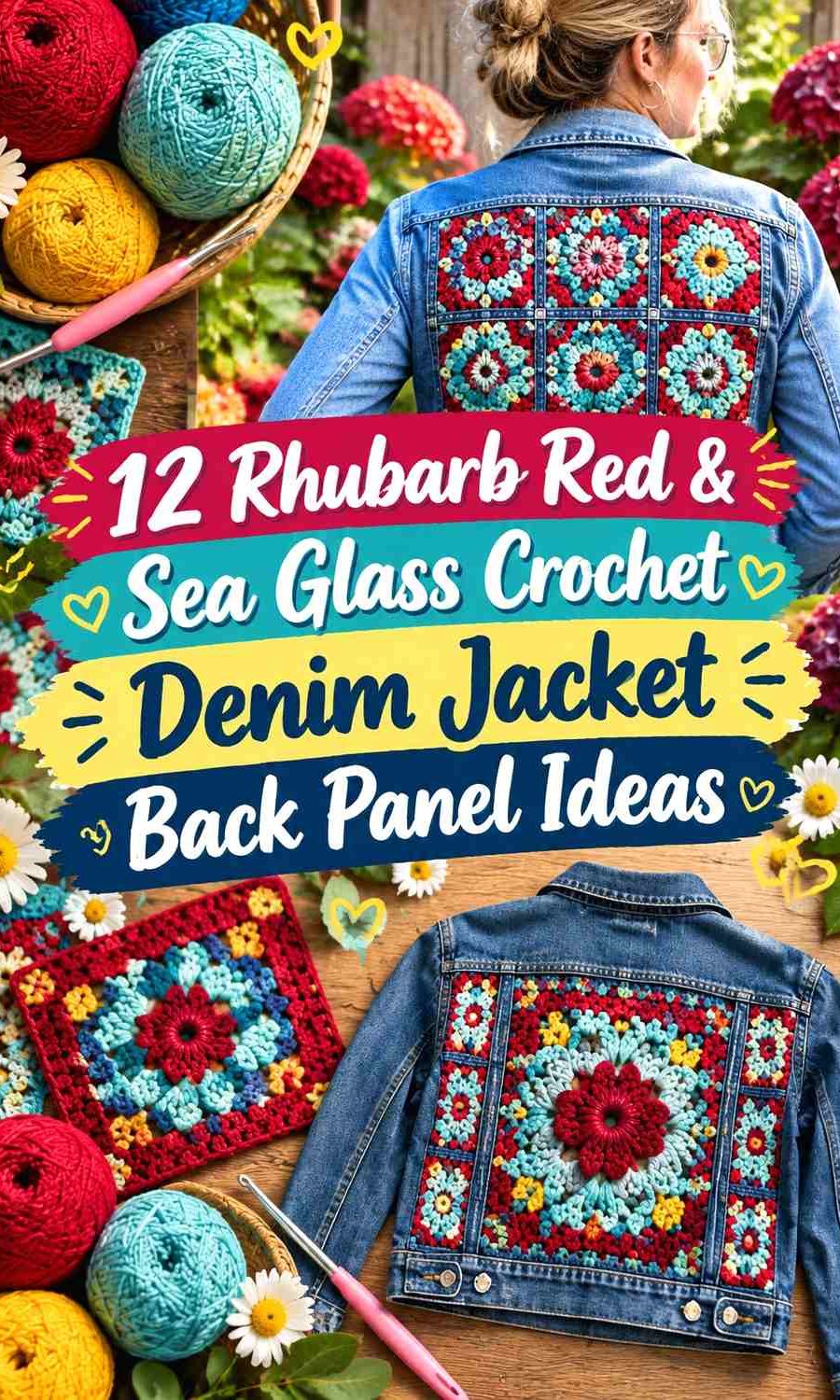
The important decision is not simply which two yarn colors to use. Placement matters. Rhubarb Red can command the center of the back panel, mark individual motifs, form a strong outer frame, or appear only as repeated accents. Sea Glass can cover a larger field, separate red motifs, define outer rounds, or provide a quieter transition into blue denim.
The tutorials credited below support the crochet construction, motif, or denim-jacket adaptation concept. The Rhubarb Red and Sea Glass arrangements are independent color plans, so you can apply them without assuming that the tutorial creator used this exact palette.
Quick List
- Rhubarb Red and Sea Glass Freeform Crochet Denim Jacket Back Panel
- Sea Glass and Rhubarb Red Sun-Square Crochet Denim Jacket Back Panel
- Rhubarb Red Heart and Sea Glass Crochet Denim Jacket Back Panel
- Rhubarb Red African Flower and Sea Glass Crochet Denim Jacket Back Panel
- Sea Glass African Flower and Rhubarb Red Frame Crochet Denim Jacket Back Panel
- Sea Glass Floral Square and Rhubarb Red Accent Crochet Denim Jacket Back Panel
- Sea Glass C2C and Rhubarb Red Diagonal Crochet Denim Jacket Back Panel
- Rhubarb Red Center and Sea Glass Granny-Square Crochet Denim Jacket Back Panel
- Sea Glass Granny Squares With Rhubarb Red Join Lines Crochet Denim Jacket Back Panel
- Rhubarb Red Tonal-Led and Sea Glass Accent Crochet Denim Jacket Back Panel
- Sea Glass Tonal-Led and Rhubarb Red Border Crochet Denim Jacket Back Panel
- Rhubarb Red and Sea Glass Checkerboard Crochet Denim Jacket Back Panel
Balance Rhubarb Red and Sea Glass Against the Denim
Treat the denim itself as part of the color composition rather than as a neutral background that can be ignored. A crochet panel surrounded by dark indigo denim may read differently from the same panel on faded or pale blue denim. Before committing to the full panel, place both yarn colors directly on the jacket and look at them together in ordinary light.
Also check light-and-dark value, not just hue. If Rhubarb Red and Sea Glass appear surprisingly similar when viewed in grayscale, small motifs or narrow stripes may lose definition. Increasing the amount of one color will not fix that problem by itself; placing a visibly lighter or darker area beside the detail can create clearer separation.
Plan Rhubarb Red and Sea Glass Around the Jacket Back Shape
The jacket determines the panel proportions. A crochet design that looks balanced as a square sample may need to be cropped, bordered, or rearranged when fitted between a denim yoke, side seams, and lower back edge.
Finish and measure the crochet fabric before permanently attaching it. Crochet can shift after blocking, while denim usually provides a firmer boundary. This matters especially when a Rhubarb Red border or Sea Glass outer round is supposed to create an even frame around the inserted panel.
1. Rhubarb Red and Sea Glass Freeform Crochet Denim Jacket Back Panel
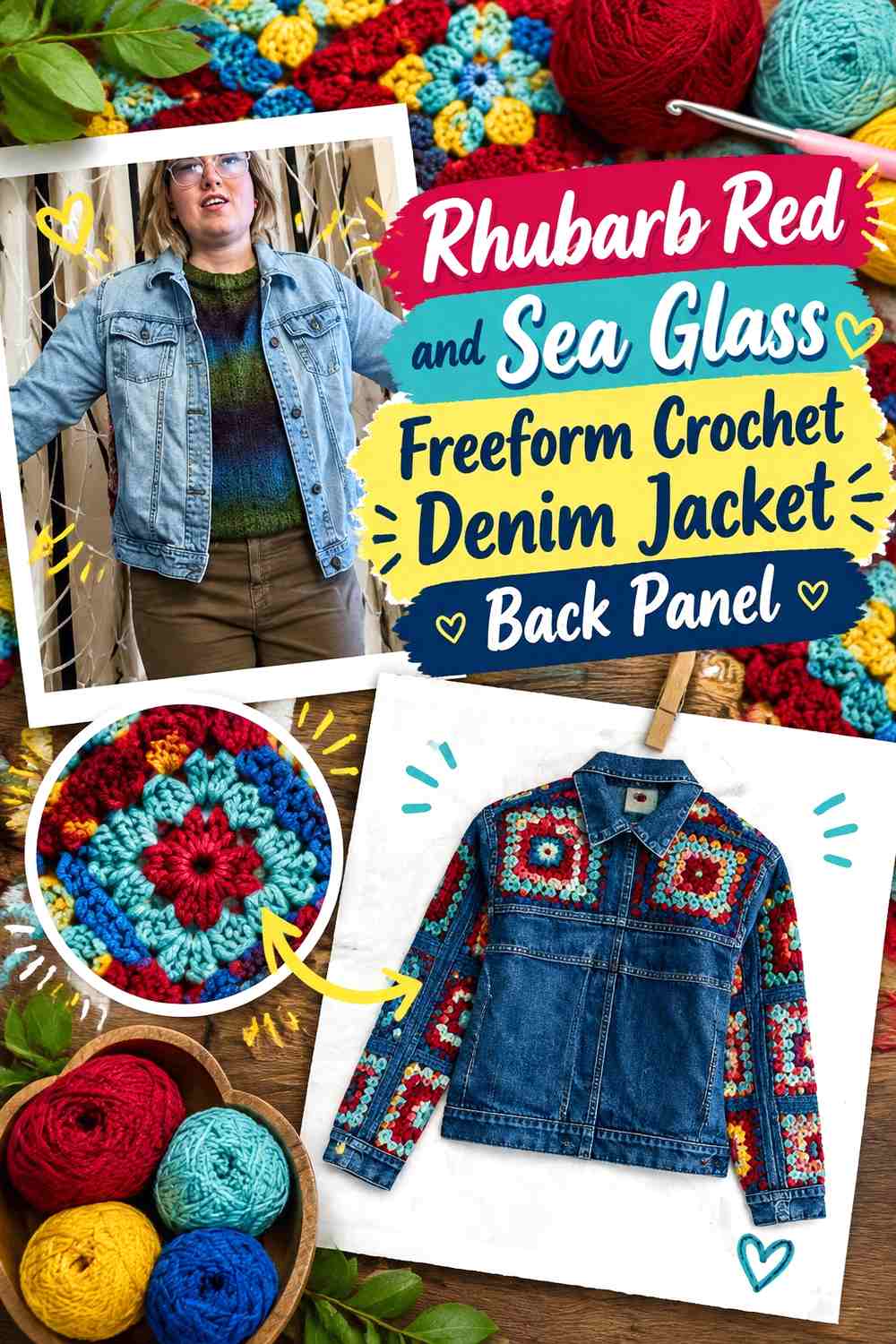
This direction makes Rhubarb Red the visual anchor while Sea Glass separates irregular crochet sections. Instead of distributing the two colors evenly, let larger Rhubarb Red areas form the main back-panel mass and use Sea Glass where the eye needs a pause between shapes. The irregular arrangement works particularly well when you want the crochet to feel intentionally different from the straight seams and structured shape of denim.
Let Rhubarb Red Form the Largest Freeform Crochet Areas
Use Rhubarb Red for several of the largest shapes rather than scattering tiny red pieces everywhere. A few substantial red areas create a clearer hierarchy across the jacket back and make the panel readable from farther away.
Keep some distance between major Rhubarb Red sections if the panel already has a lot of textural variation. Otherwise color and texture can compete for attention at the same time.
Use Sea Glass to Separate Rhubarb Red Freeform Sections
Sea Glass can work as connective space between stronger Rhubarb Red shapes. Repeating it between several areas gives the panel continuity even when the crochet forms are intentionally irregular.
Check the narrowest Sea Glass areas before attachment. If they become too thin, they may visually disappear against the surrounding colors and stop functioning as separators.
Let Rhubarb Red and Sea Glass Stop Before the Denim Takes Over
Avoid forcing crochet into every available inch simply because there is space. Leaving a visible denim boundary around the crochet allows the jacket material to act as the third visual field.
This is particularly useful when Rhubarb Red covers a large percentage of the panel. The denim perimeter gives the stronger color a defined stopping point rather than allowing the back to become one uninterrupted red mass.
Creator Credit: Coulee Craft
2. Sea Glass and Rhubarb Red Sun-Square Crochet Denim Jacket Back Panel
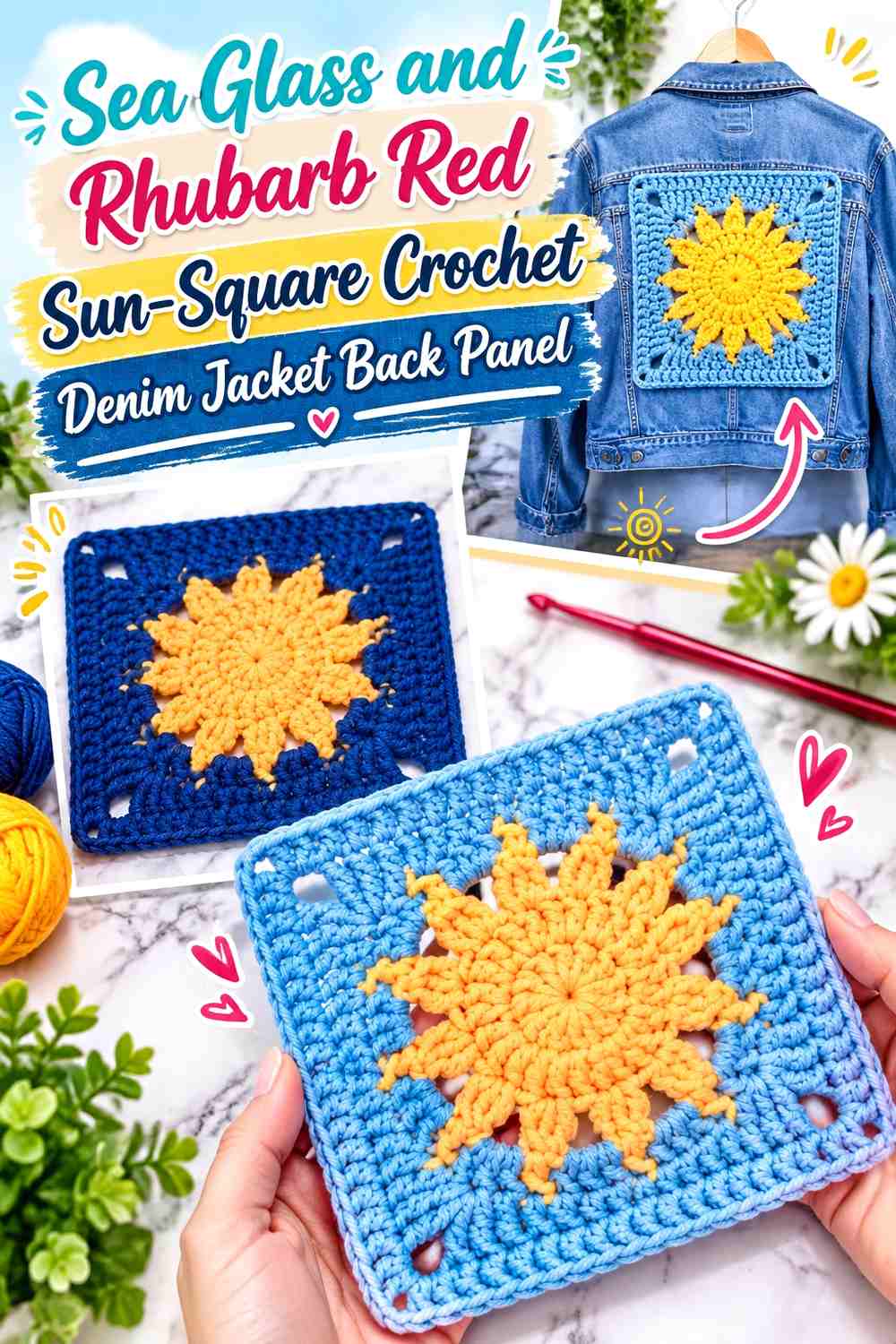
For this version, Sea Glass carries more of the square while Rhubarb Red concentrates attention in repeated sun centers. That reverses the visual weight of the first idea: instead of a predominantly red back, the jacket gets a cooler Sea Glass field punctuated by controlled Rhubarb Red focal points.
Keep Rhubarb Red in the Sun Centers for Stronger Repetition
Repeating Rhubarb Red in the same central position gives multiple sun motifs a common visual anchor. This works better than randomly moving the red between centers, edges, and background rounds if you want the jacket back to read as one coordinated panel.
The center placement also keeps Rhubarb Red away from the denim boundary, allowing Sea Glass to mediate between the warmer red and the blue jacket.
Let Sea Glass Surround the Rhubarb Red Sun Motifs
Use Sea Glass through a larger portion of each square so the red centers have visible breathing room. The surrounding cooler area helps individual motifs remain distinct when several squares are grouped closely together.
If your Sea Glass and denim are close in lightness, check the panel directly on the jacket. A subtle difference can be useful, but too little separation may make the outer parts of the motifs appear to fade into the garment.
Check Sea Glass Contrast Before Joining the Sun Squares
Do not rely on the color names alone. Place a finished or sample Sea Glass square against the actual jacket wash and step back from it.
If its edge disappears too much, a narrow Rhubarb Red or another already-used palette color at the perimeter can restore definition without changing the overall Sea Glass-led direction.
Creator Credit: Creggy’s Crochet
3. Rhubarb Red Heart and Sea Glass Crochet Denim Jacket Back Panel
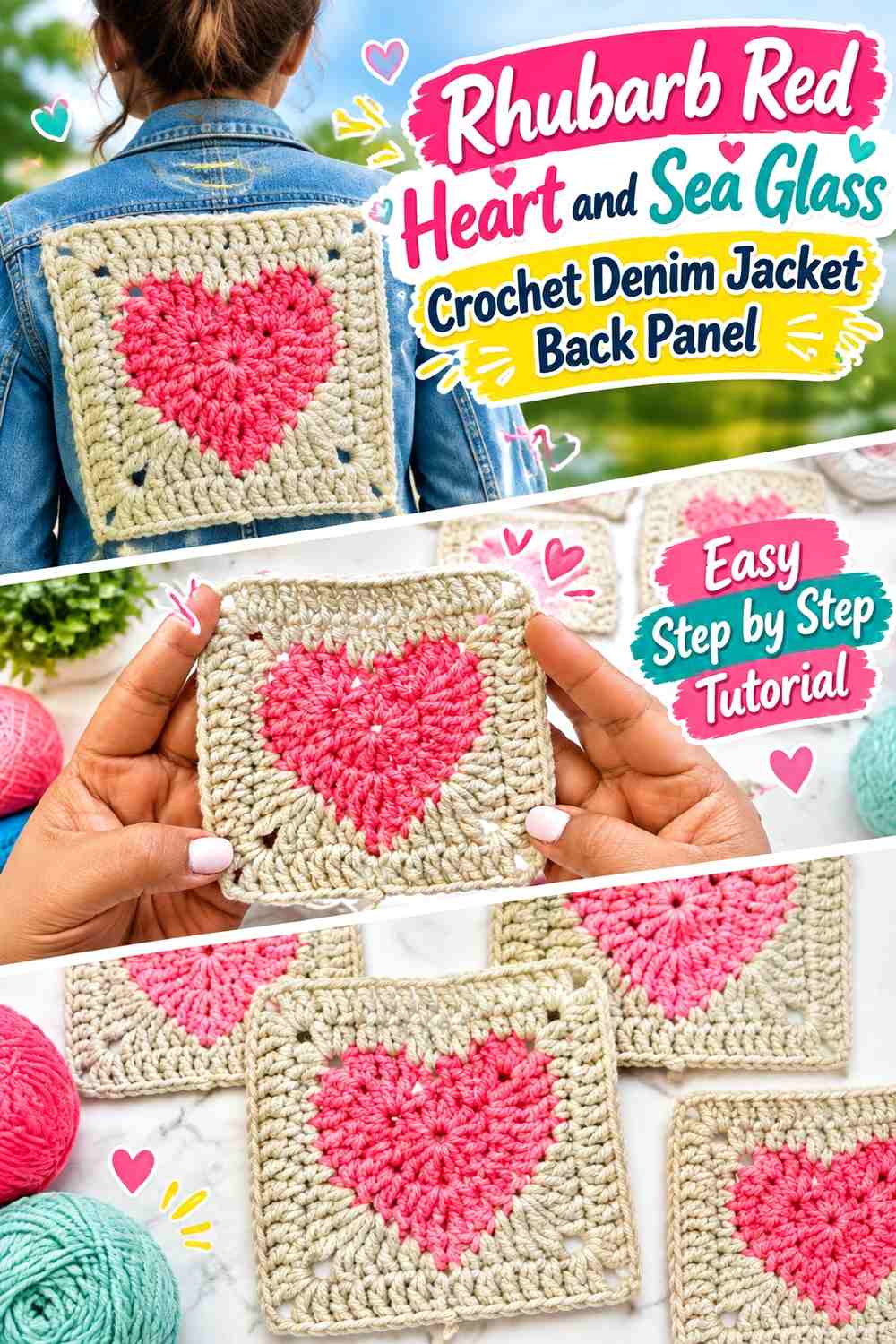
A heart-motif panel gives Rhubarb Red an obvious focal role without requiring red to cover most of the jacket. Work the hearts in Rhubarb Red and let Sea Glass occupy more of the surrounding square so each shape remains identifiable rather than merging into a large red block.
Keep Rhubarb Red Concentrated Inside the Heart Motifs
Rhubarb Red is most effective here when its placement remains consistent from square to square. Repeated red hearts give the panel a clear visual rhythm and make the motif—not merely the color—the focus of the jacket back.
Avoid introducing large unrelated Rhubarb Red areas around the hearts if you want their outlines to stay easy to read.
Give Rhubarb Red Hearts Enough Sea Glass Around Them
The surrounding Sea Glass space is functional. It separates one Rhubarb Red heart from the next and prevents adjacent motifs from becoming an indistinct red field once the squares are joined.
This is especially important near the center of the panel, where multiple motifs may sit close together.
Use Sea Glass at the Panel Edge to Meet the Denim More Quietly
Finishing the outermost area in Sea Glass can create a softer transition into a blue denim jacket than carrying Rhubarb Red all the way to the seam.
If the Sea Glass nearly matches the denim, however, check whether the edge still looks intentional. A boundary should be subtle because you chose it to be subtle, not because the crochet unintentionally disappears.
Creator Credit: Jesuecrochet
4. Rhubarb Red African Flower and Sea Glass Crochet Denim Jacket Back Panel
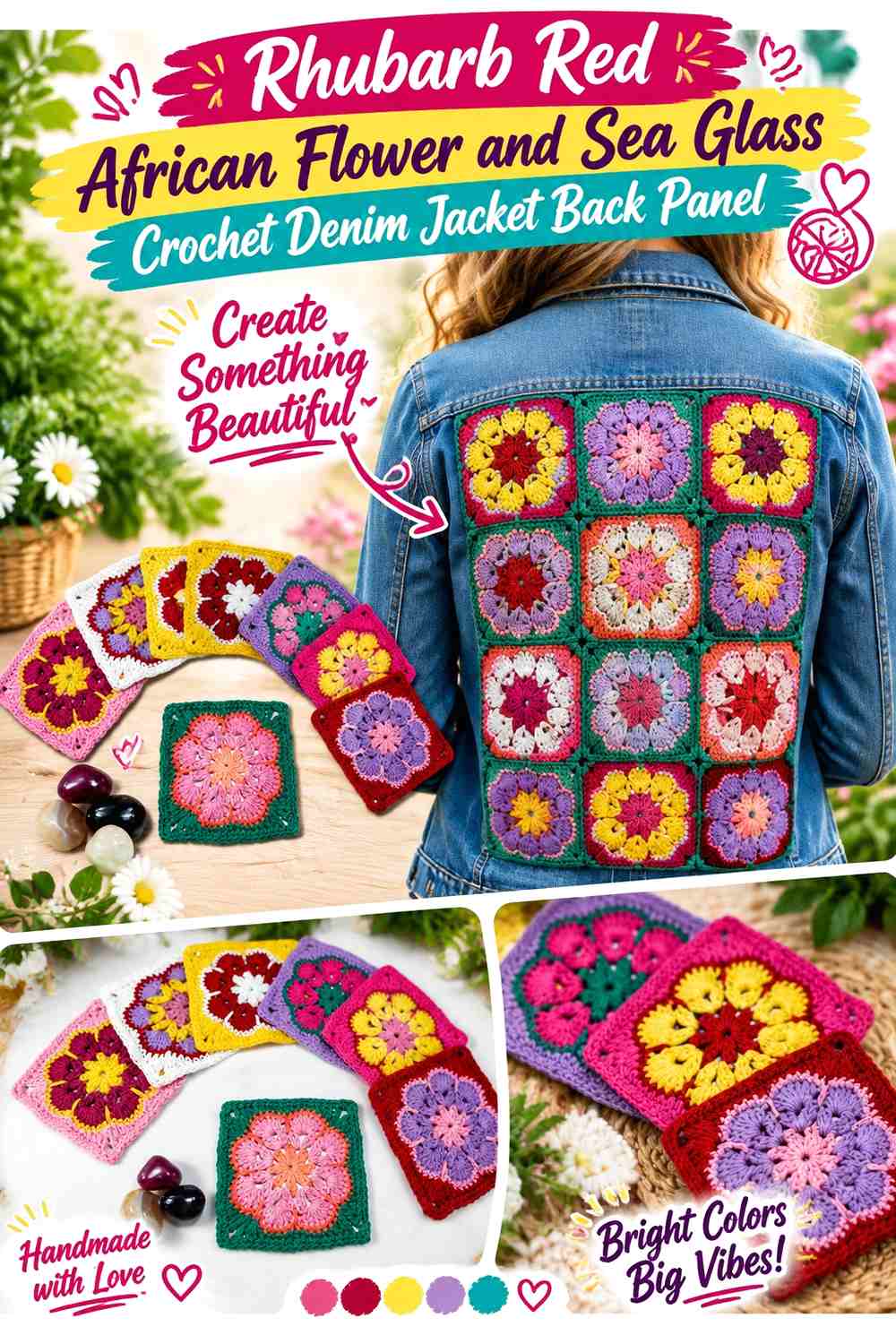
An African-flower-style motif gives you several color zones inside each unit, making it useful when you want Rhubarb Red and Sea Glass to interact rather than simply alternate. Rhubarb Red can define the petal area while Sea Glass carries the sections that square the motif and connect it visually to neighboring blocks.
Make Rhubarb Red Petals the Main Floral Feature
Keep the Rhubarb Red placement consistent across the petals so the flower remains recognizable when the jacket is viewed at a distance. Repetition matters more here than using equal quantities of both colors.
If every round changes color, the flower can become visually fragmented. A larger uninterrupted Rhubarb Red zone gives the motif a stronger identity.
Use Sea Glass to Square Off the Rhubarb Red Flowers
Sea Glass works well in the outer portions because it gives each red flower its own boundary. When several motifs form one rectangular back panel, consistent Sea Glass outer areas can make the individual flowers feel like parts of one larger composition.
It also provides a natural place to adjust the visual transition toward blue denim.
Keep Sea Glass Joins From Competing With Rhubarb Red Petals
If Sea Glass already fills the outer rounds, a highly noticeable joining treatment may add more lines than the panel needs. Compare a visible join with a quieter one before committing to the entire grid.
The goal is for Rhubarb Red flowers to remain the first feature you notice, with Sea Glass organizing the spaces around them.
Creator Credit: Rita M – Crochê e Afins
5. Sea Glass African Flower and Rhubarb Red Frame Crochet Denim Jacket Back Panel
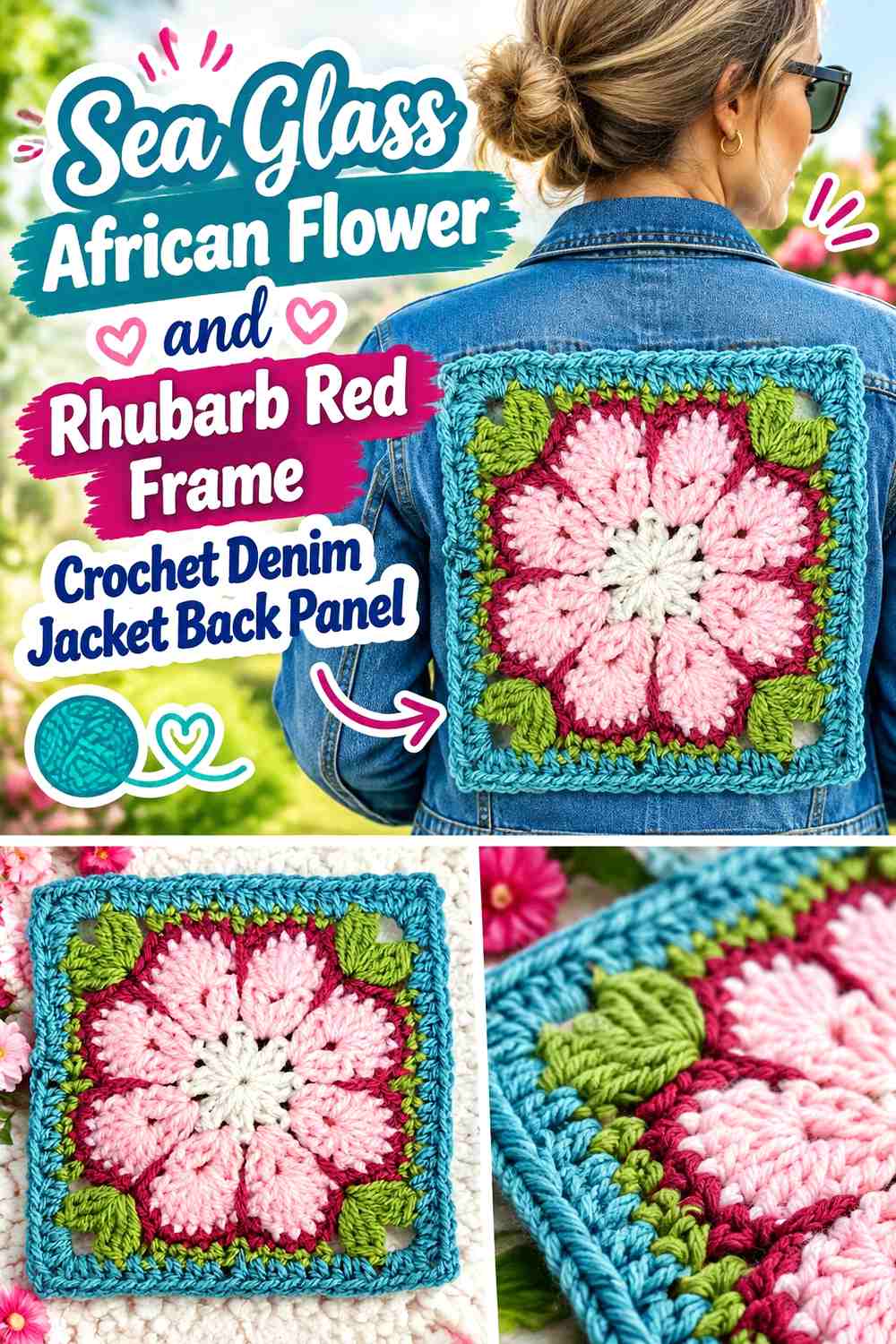
This reverses the previous flower balance. Sea Glass becomes the floral feature, while Rhubarb Red moves outward to frame individual motifs or the complete back panel. The result keeps the same two colors but changes which one attracts attention first.
Let Sea Glass Carry the Flower Petals
Using Sea Glass across the flower itself creates a cooler central field on the jacket. Keep the flower area visually continuous instead of interrupting every petal with Rhubarb Red unless a deliberately busier effect is wanted.
A repeated Sea Glass flower also relates naturally to the blue family already present in denim while remaining visibly crochet.
Move Rhubarb Red Toward the Outer Motif Rounds
Rhubarb Red becomes more graphic when placed around rather than inside the flower. It can define the square shape and produce repeated red frames throughout the back panel.
This placement is useful when you want more Rhubarb Red than a tiny accent provides but do not want it to cover the main floral surface.
Repeat Rhubarb Red at the Finished Panel Border
A final Rhubarb Red perimeter can connect all of those smaller red frames into one complete composition. It also creates a deliberate visual line between the crochet and denim.
Before adding a strong outer border, check how it sits below the jacket yoke. A heavy band directly beneath another strong denim seam may make the upper back feel more crowded than intended.
Creator Credit: Play Hooky with Me
6. Sea Glass Floral Square and Rhubarb Red Accent Crochet Denim Jacket Back Panel
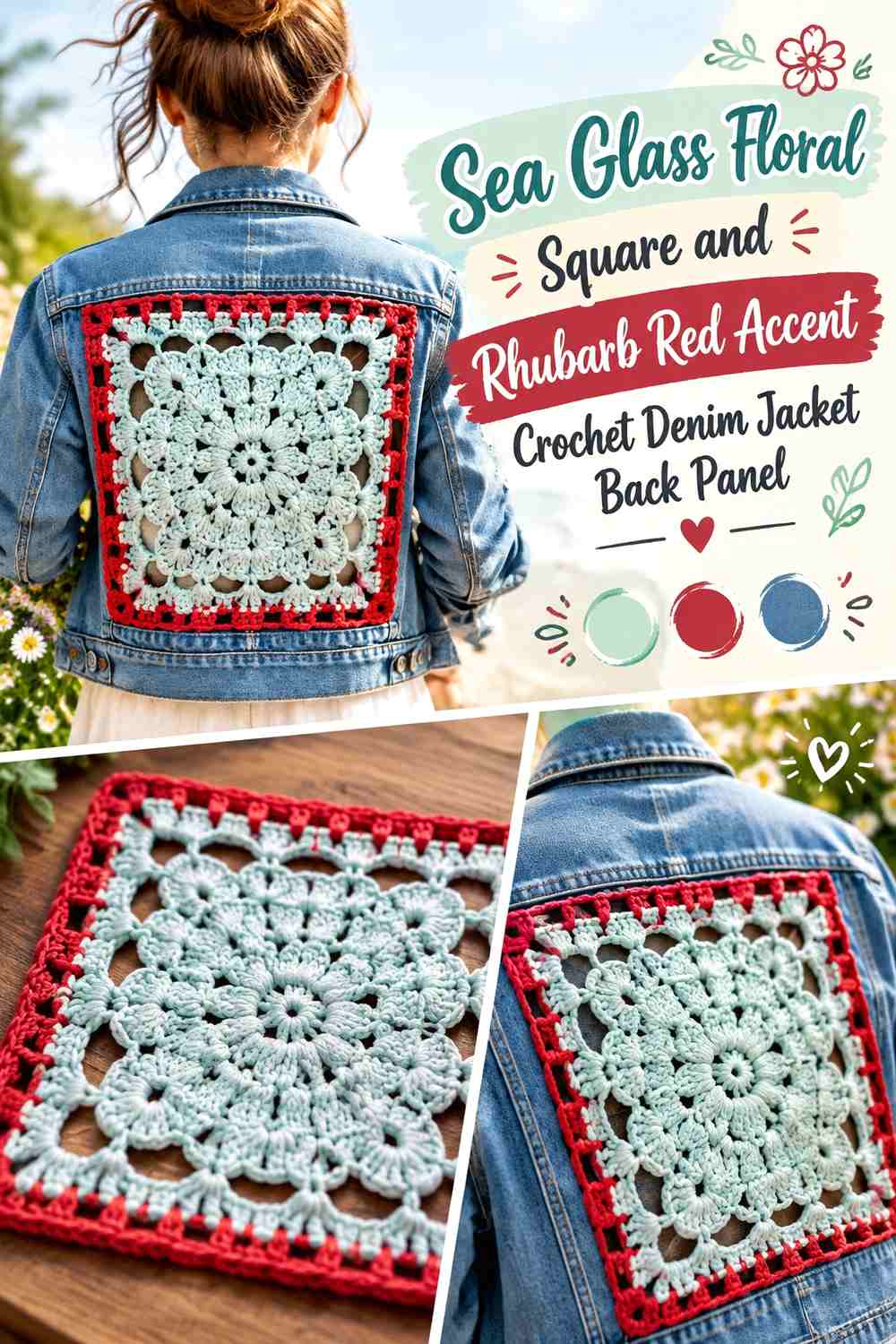
This version keeps Sea Glass dominant across floral squares while using Rhubarb Red only in carefully repeated details. It is a useful option when you want the panel to coordinate closely with denim without losing the warmer red accent promised by the palette.
Give Sea Glass Most of the Floral Crochet Surface
Allowing Sea Glass to cover the larger visual area keeps the panel cohesive when several flower squares are joined. Because the motif already creates texture and shape variation, the color plan does not need to be equally complicated.
A Sea Glass-led arrangement can also make the crochet read as a unified inset rather than a collection of unrelated multicolor patches.
Place Rhubarb Red in the Same Floral Detail Each Time
Choose one repeated location—such as a center or surrounding accent area—and keep Rhubarb Red there across the panel. Consistent placement is more effective than randomly adding red wherever an individual square seems empty.
This repetition helps the jacket look deliberately planned even if the crochet motifs themselves contain detailed texture.
Keep Rhubarb Red Away From Every Edge
Rhubarb Red does not need to appear in the join, motif edge, and final border simultaneously. If it occupies every boundary, the accent can become more dominant than intended.
For a Sea Glass-led jacket back, choose one or two strategic red locations and let the cooler main field remain visible.
Creator Credit: Yarnspirations
7. Sea Glass C2C and Rhubarb Red Diagonal Crochet Denim Jacket Back Panel

A corner-to-corner square gives the two-color scheme a directional quality. Rather than organizing Rhubarb Red and Sea Glass around motif centers, use their placement to create a diagonal movement across the jacket back.
Let Sea Glass Occupy the Larger C2C Field
Keeping most of the panel Sea Glass allows the diagonal construction to remain readable without too many color changes competing with it. The cooler field also leaves room for a Rhubarb Red stripe or block to become the unmistakable focal element.
This is useful when the back panel is relatively large and a repeated small motif would feel too busy.
Use Rhubarb Red as One Controlled Diagonal Band
A Rhubarb Red band running through the Sea Glass field creates direction without requiring half of the panel to be red. Make the band wide enough to look intentional from several feet away.
A very thin red diagonal may become visually broken by the crochet texture, especially when viewed over a moving garment.
Check the Rhubarb Red Diagonal Against the Jacket Yoke
Before fixing the panel in place, hold it on the jacket and check the angle relative to the upper-back yoke and side seams. Strong diagonal color placement can look different once surrounded by straight denim construction lines.
Rotate or reposition the panel while it is still easy to change.
Creator Credit: Bella Coco
8. Rhubarb Red Center and Sea Glass Granny-Square Crochet Denim Jacket Back Panel

Traditional granny squares make it easy to assign a clear job to each shade. Use Rhubarb Red in the centers, expand outward in Sea Glass, and repeat that hierarchy across the whole back panel.
Repeat Rhubarb Red at Every Granny-Square Center
Consistent red centers create small focal points across the jacket without allowing Rhubarb Red to dominate the entire surface. This is particularly effective in a larger grid where repeated placement matters more than any single square.
If the centers are too small to register clearly, consider giving Rhubarb Red a little more visual area rather than introducing more colors.
Give Sea Glass the Larger Outer Granny-Square Area
Sea Glass can occupy the later parts of each square so adjacent motifs begin to connect visually. As the outer areas repeat, the panel develops a larger Sea Glass field with Rhubarb Red embedded inside it.
This prevents every square from looking like an isolated patch.
Test Rhubarb Red and Sea Glass From a Distance Before Joining
Lay several squares together and move a few steps away. A pair of colors that looks clearly separated in your hand may blend more once the motifs are repeated across a garment-sized panel.
If the Rhubarb Red centers disappear, adjusting their size or surrounding value contrast may be more effective than simply adding additional shades.
Creator Credit: Hooked by Robin
9. Sea Glass Granny Squares With Rhubarb Red Join Lines Crochet Denim Jacket Back Panel
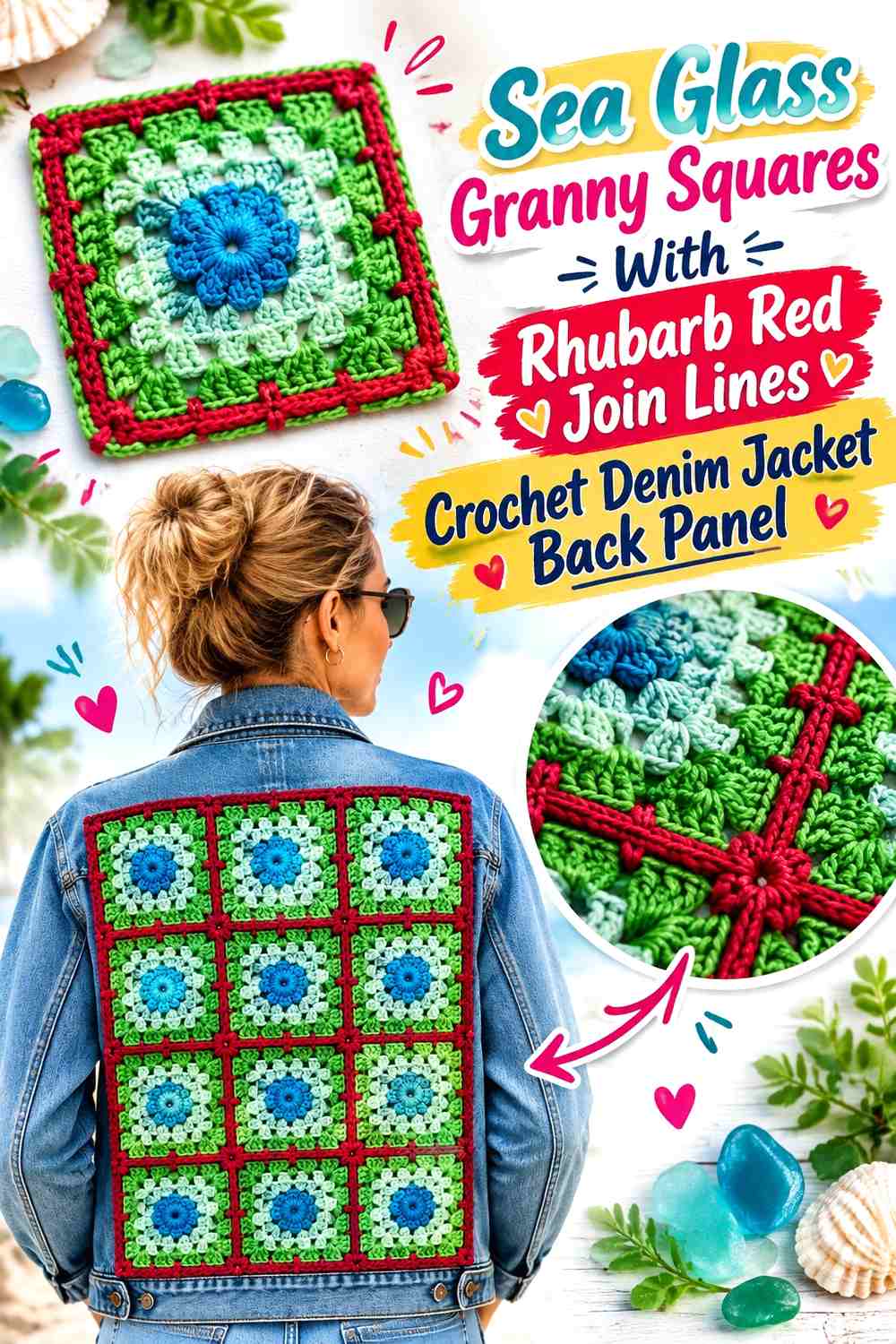
Instead of putting Rhubarb Red inside each motif, make Sea Glass the square color and let the red appear where the squares meet. This turns construction lines into the main color feature.
Let Sea Glass Create the Main Crochet Back Field
Keeping most squares predominantly Sea Glass gives the jacket one calm, continuous crochet surface. The texture of the granny construction still provides variation, so the main color does not need to change constantly.
This approach is especially effective when the denim itself already contains fading, seams, pockets, or other visual detail.
Use Rhubarb Red Joining Lines as a Visible Grid
A Rhubarb Red joining color can make the square layout part of the design rather than hiding it. The red grid divides the Sea Glass surface into clear units and distributes the warmer color evenly across the back.
Keep the width of those visible lines in proportion to the motifs. Too much red between small squares can make the join more noticeable than the squares themselves.
Echo Rhubarb Red Once at the Panel Perimeter
If the red appears only inside the grid, a small repeat around the panel edge can help the color feel resolved. It connects the internal structure to the outer silhouette without converting the whole panel into a red-framed design.
Compare that option with a Sea Glass perimeter before choosing; the stronger border is not automatically the better one.
Creator Credit: Jayda InStitches
10. Rhubarb Red Tonal-Led and Sea Glass Accent Crochet Denim Jacket Back Panel
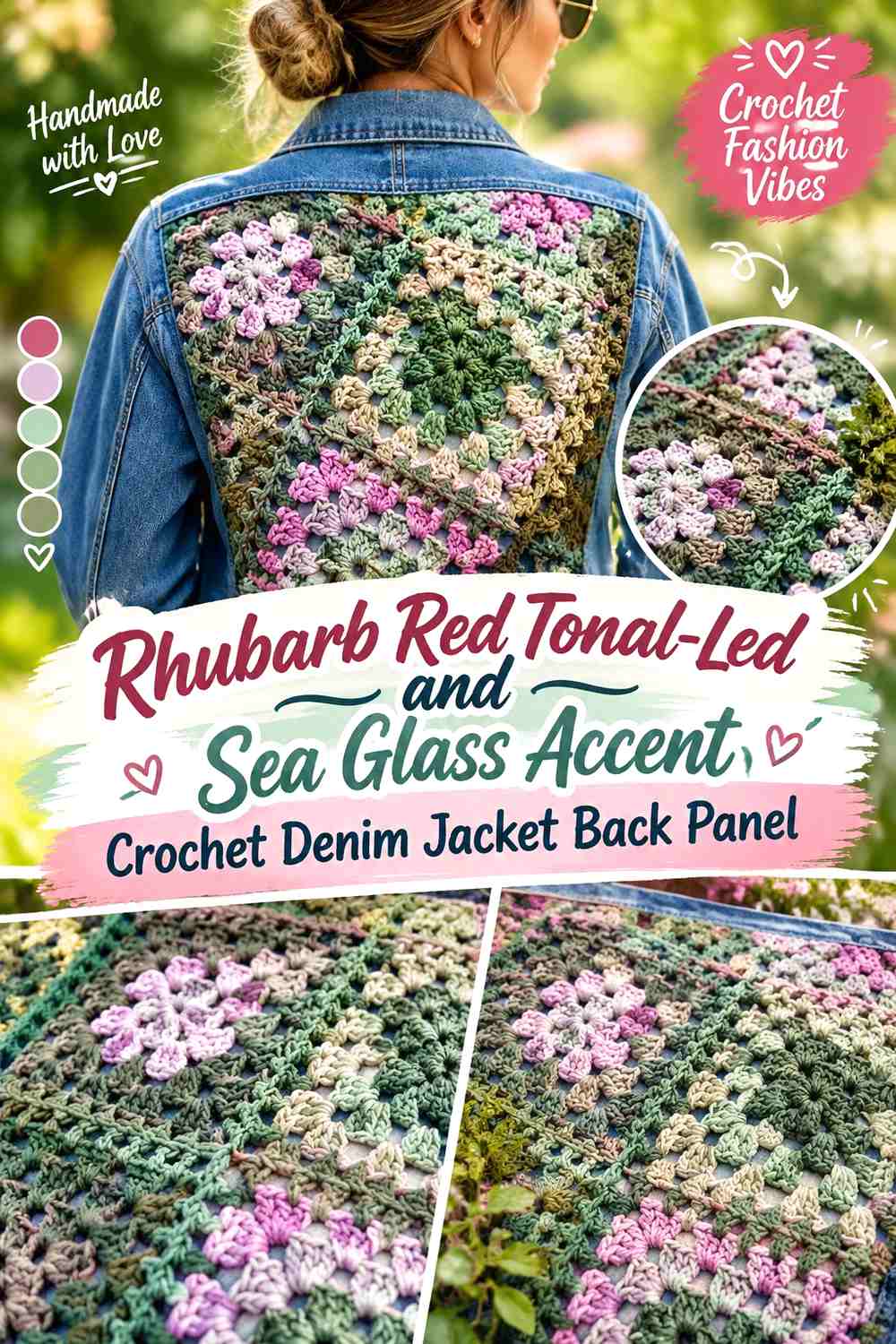
This idea gives Rhubarb Red the largest visual share and reduces Sea Glass to carefully positioned accents. It suits a jacket where you want the crochet insert to contrast clearly with blue denim rather than blend into it.
Let Rhubarb Red Dominate the Crochet Back Panel
Covering most of the panel in Rhubarb Red immediately separates the crochet area from the blue jacket. With that much red present, the stitch texture and motif layout should do some of the visual work so the color plan does not need several competing accent shades.
The denim around the panel already provides substantial color contrast.
Keep Sea Glass Accents Narrow and Repeated
Use Sea Glass as a recurring ring, center, or narrow dividing section rather than giving it random patches. Small but consistent placement makes the supporting color intentional.
If the Sea Glass sections become too tiny, they may disappear into the texture. Test one completed repeat before producing the full panel.
Use Sea Glass to Break Up Large Rhubarb Red Areas
When a broad Rhubarb Red surface begins to look visually heavy, a Sea Glass break can separate sections without changing the dominant color.
Place those breaks where they reinforce the panel design—around a motif, between grouped squares, or along a deliberate stripe—rather than inserting them merely to reduce the amount of red.
Creator Credit: The Crochet Crowd
11. Sea Glass Tonal-Led and Rhubarb Red Border Crochet Denim Jacket Back Panel
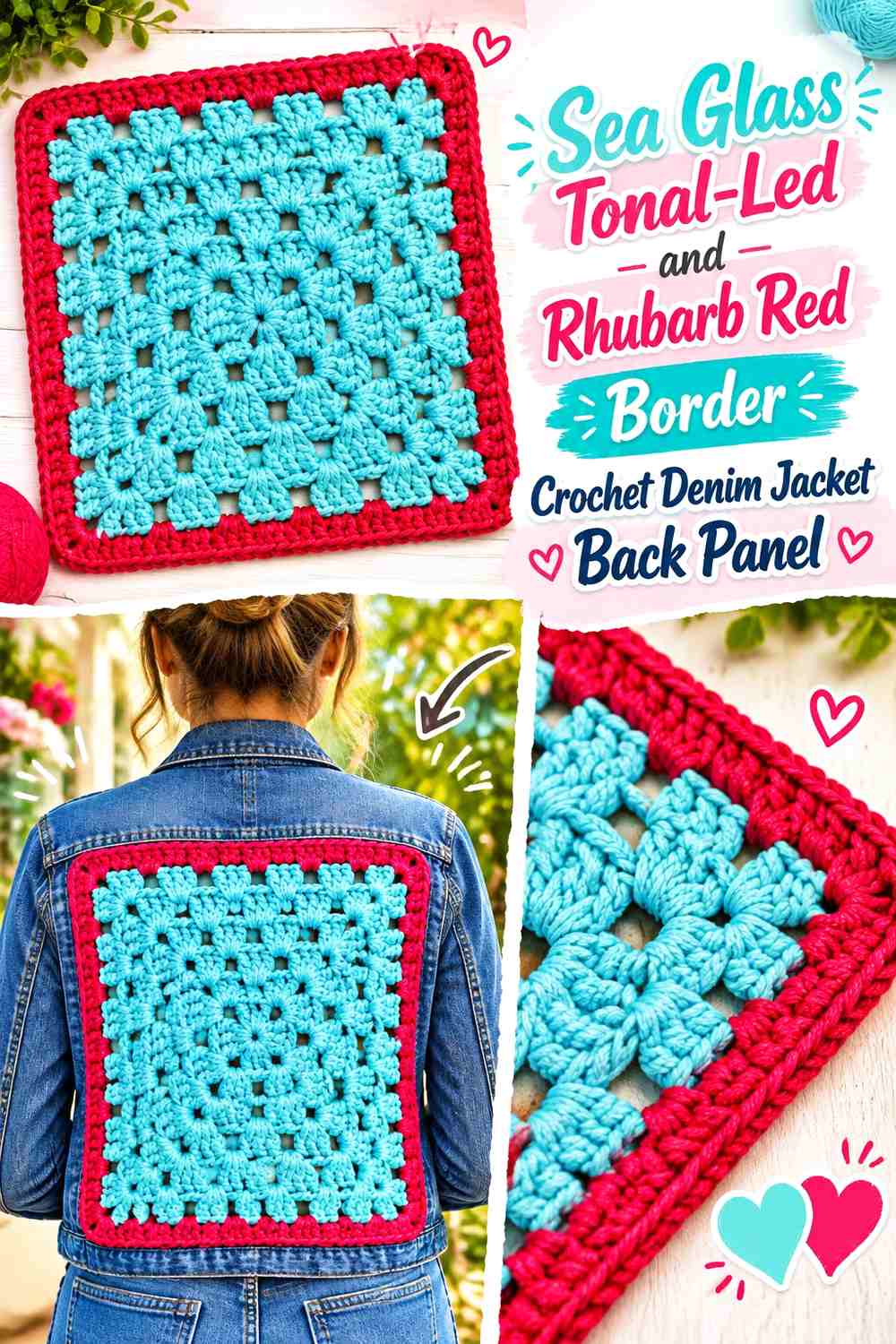
This is the cooler counterpart to the previous idea. Sea Glass fills most of the crochet surface, while Rhubarb Red is saved for the final frame. Because the red appears in one concentrated location, even a relatively small amount can have a strong structural effect.
Keep Sea Glass Continuous Across the Main Back Panel
Use Sea Glass through most of the center so the stitch texture remains the focus. A largely single-color field can be especially useful when the crochet pattern already has visible clusters, openings, or raised texture.
The uninterrupted color also prevents the back panel from competing with denim seams and hardware.
Let Rhubarb Red Define the Sea Glass Panel Edge
A Rhubarb Red border gives the Sea Glass field a clear endpoint before the denim begins. This can be particularly effective when the Sea Glass yarn and jacket are related in hue or lightness.
The red line acts as separation rather than as a competing center motif.
Adjust the Rhubarb Red Border Before It Becomes Too Heavy
Border width changes how much Rhubarb Red you perceive. A narrow outline can simply define the crochet, while a broad band begins to become a major part of the design.
Pin or lay the unfinished panel on the jacket while deciding how much red framing you want; judging the border away from the denim removes an important part of the color context.
Creator Credit: Secret Yarnery
12. Rhubarb Red and Sea Glass Checkerboard Crochet Denim Jacket Back Panel
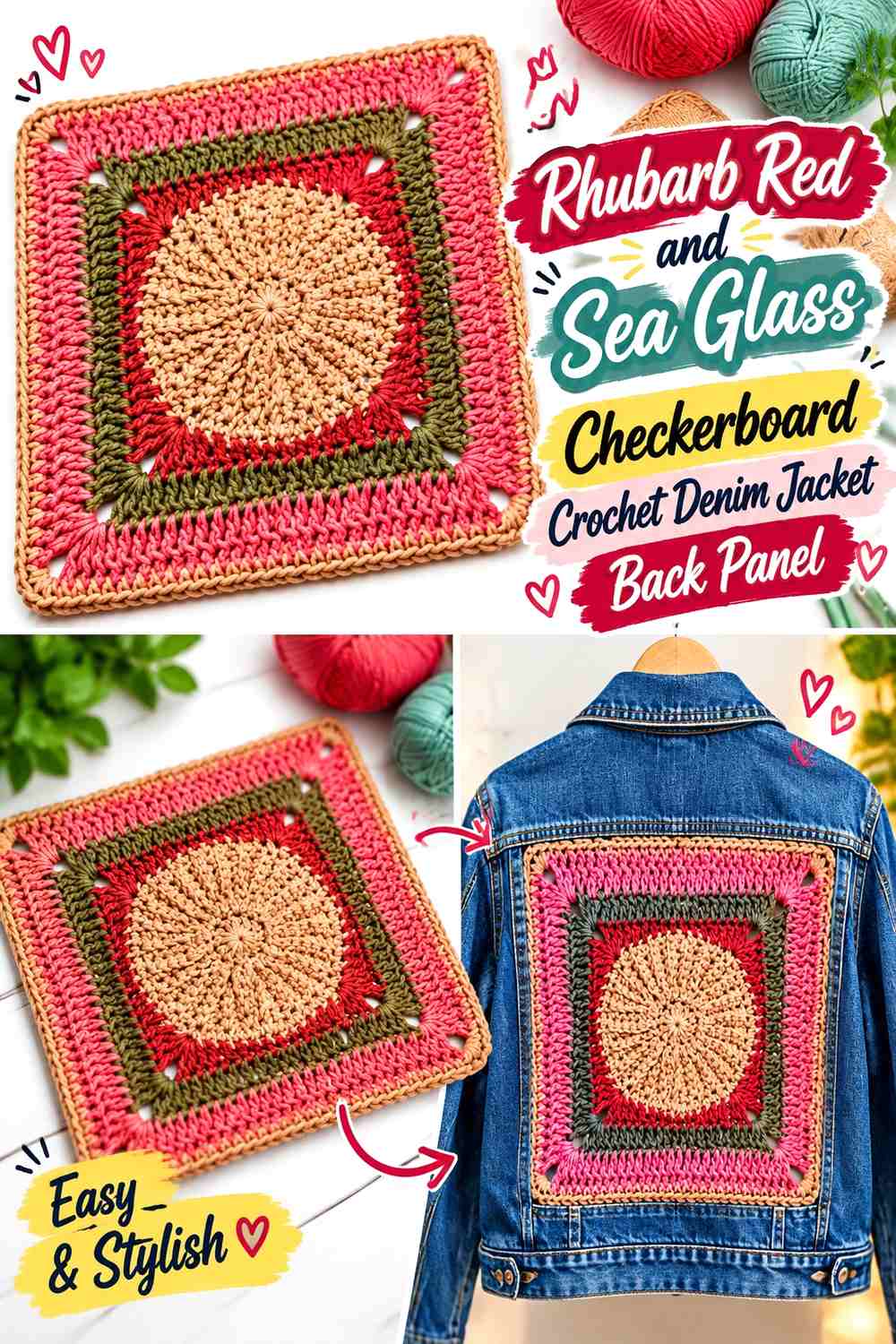
A checkerboard gives both colors equal opportunities to appear without mixing them inside every individual square. Alternating Rhubarb Red and Sea Glass creates a graphic back panel that depends on repetition and clean placement more than complicated color changes.
Alternate Rhubarb Red and Sea Glass Instead of Mixing Every Square
Using one main color per square makes the overall arrangement easier to read. Rhubarb Red squares supply warm blocks while Sea Glass squares provide cooler breaks between them.
Lay out the full grid before joining so identical colors do not accidentally cluster in a way that disrupts the intended alternation.
Compare Rhubarb Red and Sea Glass Values Before Committing to the Checkerboard
Checkerboards depend on adjacent blocks remaining distinguishable. Different hues can still be similar in lightness, so check the yarns side by side and, if useful, look at a grayscale photo.
If the values are very close, the effect will become softer and less graphic. That can still work, but it should be a deliberate choice.
Keep the Rhubarb Red and Sea Glass Outer Edge Simple
The checkerboard already creates substantial movement. A complicated multicolor border can compete with the alternating squares.
Try an outer edge in whichever of Rhubarb Red or Sea Glass gives clearer separation from your particular denim wash, then judge the entire jacket rather than the crochet panel alone.
Creator Credit: Bag-O-Day Crochet
Choosing Between These Rhubarb Red and Sea Glass Back Panel Ideas
For the strongest Rhubarb Red presence, start with the freeform panel or the Rhubarb Red tonal-led design. Both create an obvious visual break from blue denim while giving Sea Glass a supporting role.
For a cooler overall jacket back, the Sea Glass sun motifs, Sea Glass floral panel, or Sea Glass tonal-led panel keep more of the blue-green family visible. They are useful when you want the crochet to relate more closely to denim while retaining Rhubarb Red as a deliberate contrast.
If motifs are the priority, the heart, sun, and African-flower approaches give each color a specific job inside repeated units. For a more geometric result, the diagonal C2C, red-join grid, checkerboard, and granny-square arrangements place greater emphasis on lines, repetition, and color distribution.
The final choice should also depend on the actual jacket. Compare the yarn against its denim wash, check the panel dimensions after finishing, and evaluate the complete color arrangement on the garment before permanent attachment.
Conclusion
Rhubarb Red and Sea Glass can produce very different denim-jacket back panels without changing the core two-color palette. Rhubarb Red can lead the entire surface, mark small motif centers, form a joining grid, or act only as a border. Sea Glass can perform the same roles in reverse.
The most useful way to choose between these 12 ideas is to decide what you want to notice first. Choose a red-led arrangement when you want the crochet panel to separate strongly from the denim. Choose a Sea Glass-led version when you want a cooler transition into the jacket. Choose a motif-based layout when the flowers, hearts, or sun shapes should receive the attention, and use a geometric arrangement when the overall back-panel structure matters more.
Before attaching the finished crochet, compare its final dimensions with the actual jacket area and return to the original tutorial for the construction details relevant to the chosen motif or panel.
Frequently Asked Questions
Should Rhubarb Red or Sea Glass dominate a crochet denim jacket back panel?
Either can dominate. Rhubarb Red gives the crochet a stronger warm contrast against blue denim, while a Sea Glass-led panel generally keeps more of the jacket in a related cool color direction. Choose according to whether you want the insert to separate strongly from or coordinate more closely with the denim.
How can I tell whether Rhubarb Red and Sea Glass have enough contrast?
Place the yarns side by side and look at them from a short distance. A grayscale photo can also help reveal whether they differ enough in light-and-dark value. If they become nearly identical in grayscale, small motifs and thin stripes may have softer definition even though the hues are different.
Should Rhubarb Red or Sea Glass be used around the crochet panel border?
Choose the border based on the jacket rather than following a universal rule. Rhubarb Red usually creates a more noticeable frame around a Sea Glass panel, while Sea Glass can create a quieter transition when Rhubarb Red dominates the center. Test both directly against the denim before finishing the edge.
Can I add another neutral to Rhubarb Red and Sea Glass?
Yes, but give the third color a specific purpose. A light neutral can separate closely placed red and Sea Glass details, while a darker neutral can create definition in selected areas. Avoid giving all three colors equal visual weight unless that is the intended design, because the original two-color relationship can become less clear.
How do I keep a Rhubarb Red and Sea Glass panel from looking too busy?
Reduce the number of places where the colors switch. You might keep Rhubarb Red consistently in motif centers and Sea Glass on the outside, use one color for all joins, or reserve one shade for the border. A predictable color role often creates more order than simply reducing the number of crochet motifs.
Should I finish the Rhubarb Red and Sea Glass crochet panel before attaching it to denim?
Complete enough of the panel to know its finished dimensions and shape before permanent attachment. Crochet fabric can change with finishing or blocking, and the jacket opening provides a comparatively fixed boundary. Checking the finished panel against the actual jacket also lets you correct border width and color placement before attachment.
Can one large Rhubarb Red and Sea Glass granny square work as a denim jacket back panel?
It can, provided its finished shape and dimensions suit the jacket area. Alternating Rhubarb Red and Sea Glass in larger concentric sections creates a different effect from joining many small squares: the eye follows the color outward from one center rather than scanning a grid. Measure the completed crochet against the jacket rather than assuming a square panel will automatically fit the available back space.