Saffron and Slate Blue create a useful contrast for crochet pan protectors because the two colors can take very different visual roles within a cookware stack. Saffron can draw attention to centers, wings, petals, or outer edges, while Slate Blue can provide a quieter field that keeps the warmer color controlled. Reverse the balance, and the same palette becomes cooler and more subdued.

Pan protectors also present a different color-planning problem from decorative crochet. Much of the center can disappear once another pan is stacked on top. The parts that extend past or climb toward the sides of the cookware may remain much more visible, making wings, petals, borders, and outer rounds useful places for the color you want to notice first.
The tutorials credited below support the pan-protector or closely related pot-protector construction concepts. The Saffron and Slate Blue arrangements are independent color adaptations rather than claims about the colors used by the original creators.
Quick List
- Saffron Center And Slate Blue Wing Crochet Pan Protector
- Slate Blue Center And Saffron Wing Crochet Pan Protector
- Saffron And Slate Blue Alternating Wing Crochet Pan Protector
- Saffron Petal And Slate Blue Center Crochet Pan Protector
- Slate Blue Body And Saffron Border Crochet Pan Protector
- Saffron Center And Slate Blue Five Section Crochet Pan Protector
- Slate Blue Overlay And Saffron Accent Crochet Pan Protector
- Saffron Round And Slate Blue Edge Crochet Pan Protector
- Slate Blue Dominant And Saffron Accent Crochet Pan Protector
- Saffron Leaf Style And Slate Blue Center Crochet Pan Protector
- Saffron Sunflower And Slate Blue Center Crochet Pan Protector
- Slate Blue Stacked Petal And Saffron Edge Crochet Pan Protector
- Saffron And Slate Blue Hexagon Flower Crochet Pan Protector
Plan Saffron and Slate Blue Where the Pan Stack Can Still Show Them
The center of a pan protector may be almost completely hidden in storage. If you want Saffron to be the identifying color for a particular protector or pan size, putting all of it in the center can reduce its visual impact once the cookware is stacked.
Instead, repeat Saffron on a wing, petal, tip, or border that can remain visible around the pan. Slate Blue can then occupy the central contact area. Reverse the arrangement when you want the stack to look cooler overall, with only small Saffron markers showing between pans.
This also gives you a practical way to coordinate a set. You might keep the same two colors throughout while changing which shade dominates different protectors.
Use Saffron and Slate Blue Contrast Without Losing a Flat Crochet Surface
Color can provide most of the decoration on a pan protector without requiring bulky applied embellishments. A flat Saffron center surrounded by Slate Blue wings, for example, creates a strong visual difference while keeping the color change within the protector itself.
Compare your actual yarns before starting. If Saffron and Slate Blue are close in lightness, extremely narrow stripes may merge visually. Larger color blocks—such as an entire center, wing, petal group, or outer border—will usually communicate the two-color scheme more clearly.
Also compare the finished protector with the cookware it will separate. The important checkpoint is whether its overall shape and coverage suit the actual stack, rather than assuming one universal protector size works for every pan.
Keep Crochet Pan Protectors in Their Storage Role
Treat a pan protector as a separator for stored cookware unless a specific pattern and material are explicitly designed and verified for another purpose. Remove the protector before putting a pan on a burner, into an oven, or into another heated cooking situation.
This distinction matters when choosing tutorials as well. A storage separator and a hot pad may look similar, but appearance alone does not establish heat protection. Follow the source tutorial’s material guidance and intended use rather than assuming the finished crochet piece can perform both jobs.
1. Saffron Center And Slate Blue Wing Crochet Pan Protector

This color arrangement puts Saffron where the protector begins and Slate Blue across the outward-reaching sections. The Saffron center creates a warm focal point when the protector is viewed by itself, while the Slate Blue wings become more visible once a pan covers the middle. It is a practical division when you want the cooler shade to dominate the appearance of the stored stack.
Keep Saffron Concentrated in the Crochet Pan Protector Center
Use Saffron across the central field rather than breaking it into several small alternating sections. A continuous center gives the warm color enough area to remain visually deliberate and creates a clear transition when the Slate Blue outer sections begin.
Because another pan may hide much of this area, think of Saffron as the color revealed when you lift cookware from the stack rather than the color that must always remain visible.
Let Slate Blue Carry the Crochet Pan Protector Wings
Slate Blue can run through the outward-reaching wings and around their edges. This places the muted color where it can remain visible between stacked pans while also visually connecting all of the extensions.
If the protector has an outer finishing edge, keeping that edge Slate Blue can make the separate wings read as one coordinated shape.
Creator Credit: Off the Beaten Hook
2. Slate Blue Center And Saffron Wing Crochet Pan Protector
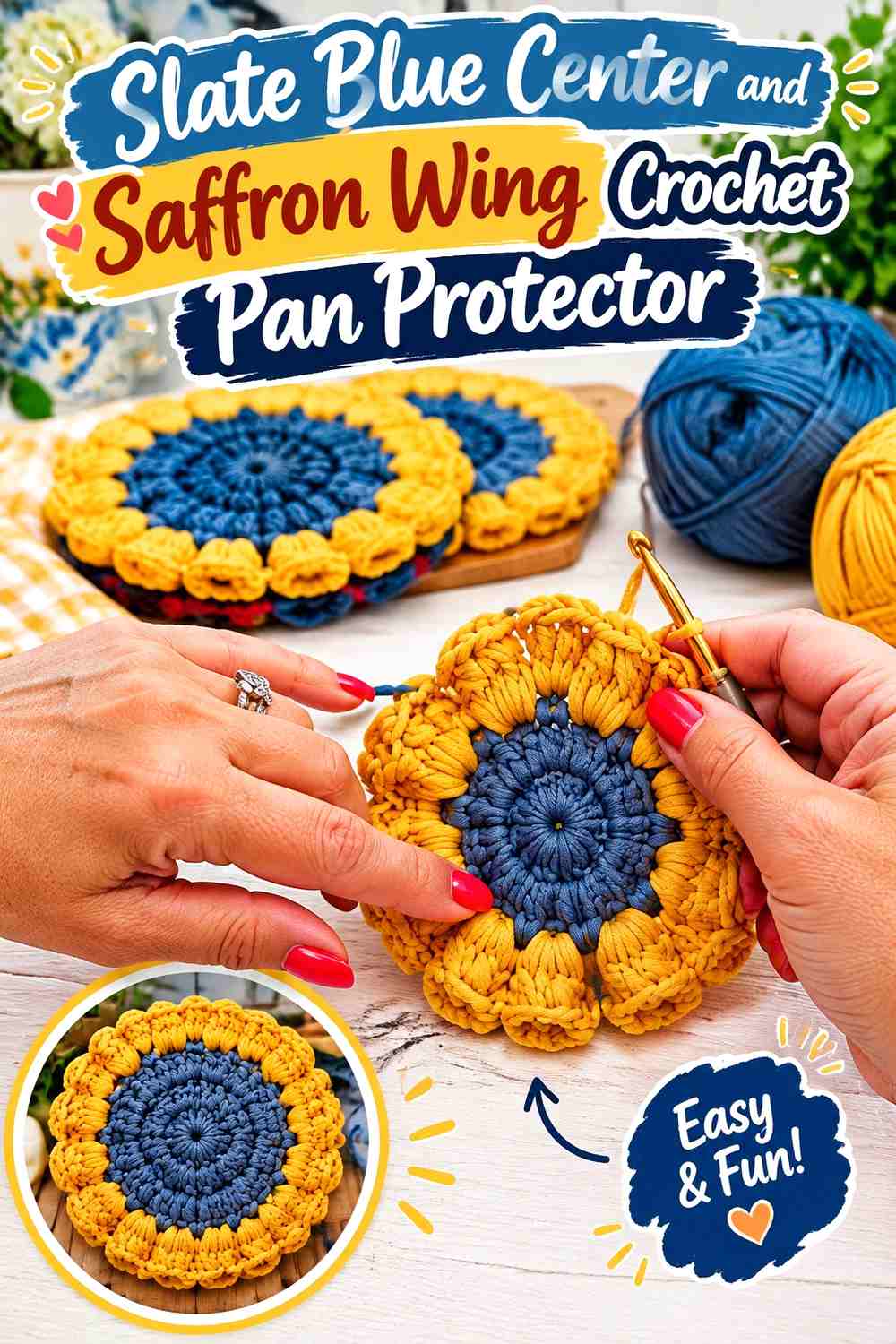
Reversing the first palette changes what remains visible in a cookware stack. Slate Blue can cover the center while Saffron moves outward, allowing warmer sections to appear around the pan edges. This is useful when you want Saffron to serve as the visual identifier even though it does not occupy the central field.
Use Slate Blue as the Calm Crochet Pan Protector Base
A broad Slate Blue center creates a quieter foundation for the protector. Keeping it uninterrupted also prevents the main area beneath the pan from becoming unnecessarily busy.
If your cookware stack already contains several decorative kitchen colors, this muted center can keep the protector from feeling overly colorful while still leaving room for Saffron around the perimeter.
Put Saffron Where the Slate Blue Pan Protector Extends Outward
Use Saffron across the outer sections or the most visible portions of the wings. When the protector is sandwiched between pans, those warm areas have a better chance of remaining visible than a Saffron center would.
For a coordinated set, repeat the same Saffron placement from protector to protector even when their overall dimensions differ.
Creator Credit: Mindy Whitlow
3. Saffron And Slate Blue Alternating Wing Crochet Pan Protector

An alternating-wing scheme distributes both colors around the whole protector rather than assigning one shade exclusively to the center or edge. It gives Saffron and Slate Blue similar importance while still using large enough sections for the colors to remain recognizable.
Alternate Saffron and Slate Blue Across Complete Crochet Wings
Assign each outward section to one color instead of changing yarn repeatedly within the same wing. Complete Saffron and Slate Blue blocks are easier to distinguish and preserve the shape of each extension.
Keep the sequence consistent around the protector. A predictable Saffron–Slate Blue rhythm makes the color plan look intentional when several tips remain visible outside a pan.
Repeat Saffron and Slate Blue in the Crochet Pan Protector Center Carefully
If the outer wings already alternate strongly, the center does not need an equally complex treatment. Choose either Saffron or Slate Blue as the central anchor, or use a broad two-color division rather than numerous narrow stripes.
This keeps the most visually active part of the palette at the perimeter, where it can still be appreciated in a stacked set.
Creator Credit: Hook & Loop Crochet Tutorials
4. Saffron Petal And Slate Blue Center Crochet Pan Protector
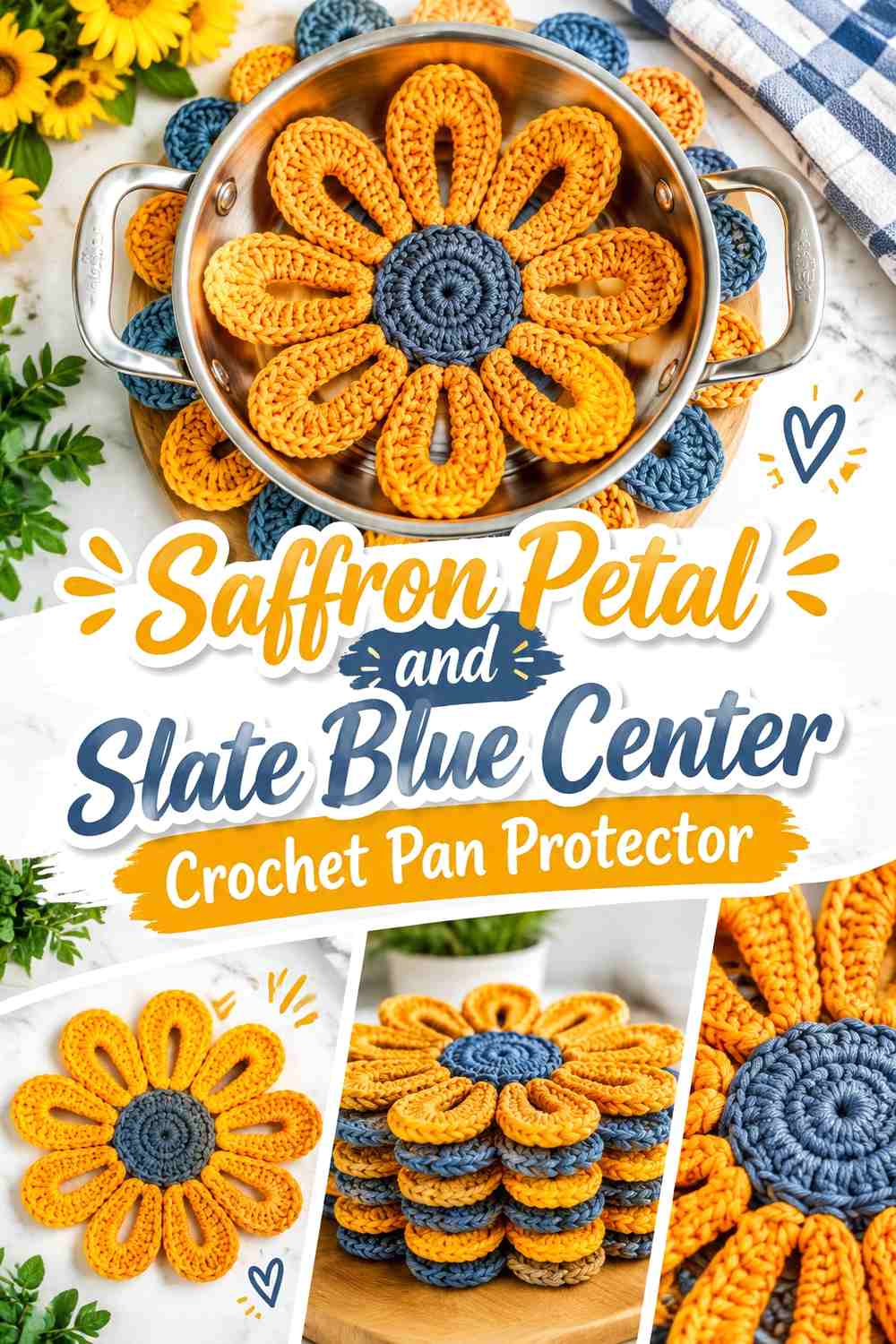
A flower-shaped protector gives the palette an obvious hierarchy. Saffron can spread across the petals while Slate Blue stays concentrated in the center, turning the warm shade into the part most likely to peek beyond the cookware.
Repeat Saffron Across the Crochet Pan Protector Petals
Keep the petals consistently Saffron if you want the flower outline to remain unified. Alternating every petal with Slate Blue would create a different rhythm, but a full Saffron petal ring gives the warm color a stronger perimeter presence.
The repeated Saffron sections can also make it easier to identify the protector when only the outer edges are visible in storage.
Use Slate Blue to Anchor the Saffron Crochet Flower Center
Slate Blue can occupy the central portion beneath the pan, giving the bright petal ring a quieter visual starting point. This creates a simple center-versus-edge relationship rather than scattering blue through every petal.
If your particular Saffron and Slate Blue yarns have limited value contrast, keep the transition between center and petals broad and obvious.
Creator Credit: Nana’s Crafty Home | Tonya Bush
5. Slate Blue Body And Saffron Border Crochet Pan Protector
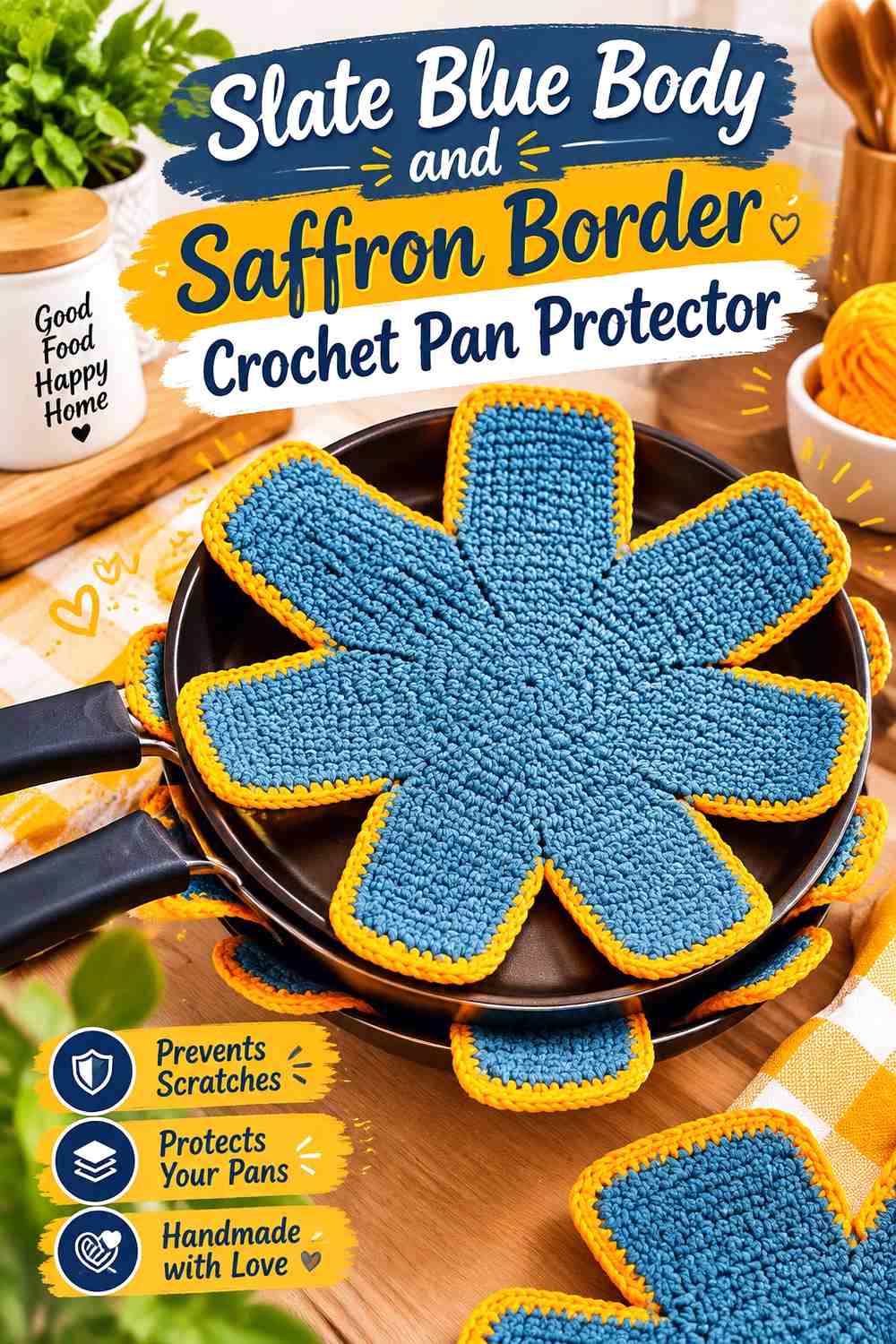
This idea relies less on separate color blocks and more on perimeter definition. Slate Blue can dominate almost the entire protector while Saffron traces the outer edge. The result is especially useful when you want the set to look primarily blue but still have a warm line visible around stacked cookware.
Give Slate Blue Most of the Crochet Pan Protector Surface
Use Slate Blue throughout the primary field so the stitch texture and overall protector shape are not interrupted by frequent color changes. This produces one of the most muted options in the collection.
Because Slate Blue covers so much area, Saffron does not need equal coverage to have an effect.
Use Saffron Where the Slate Blue Crochet Protector Meets the Edge
A Saffron border can frame the complete protector and make the outer silhouette easier to distinguish. It also places the warm color in a naturally visible area when the center is covered by another pan.
Keep the Saffron border reasonably consistent around the piece. Randomly widening and narrowing the accent can make a simple two-color design feel less controlled.
Creator Credit: Círculo Ltda
6. Saffron Center And Slate Blue Five Section Crochet Pan Protector

A protector with several distinct outward sections makes it possible to separate the color roles structurally. Saffron can remain concentrated in the central round area, while Slate Blue carries the sections that reach toward the sides of the pan.
Keep Saffron Broad Enough in the Crochet Pan Protector Center
Give Saffron a substantial central field before transitioning to Slate Blue. A tiny center can look more like an incidental accent than one of the two main palette colors.
The center may be covered during storage, but it becomes a strong visual reveal when the pan above is removed.
Let Slate Blue Extend Beyond the Saffron Crochet Center
Use Slate Blue across the outward sections so the cooler color provides the visible coverage around the pan. This arrangement makes the exterior of the stored stack more subdued than a Saffron-wing design.
Before making a full set, compare the first finished protector with its intended pan and confirm that the outward sections reach the areas you actually want separated.
Creator Credit: Patronarte
7. Slate Blue Overlay And Saffron Accent Crochet Pan Protector
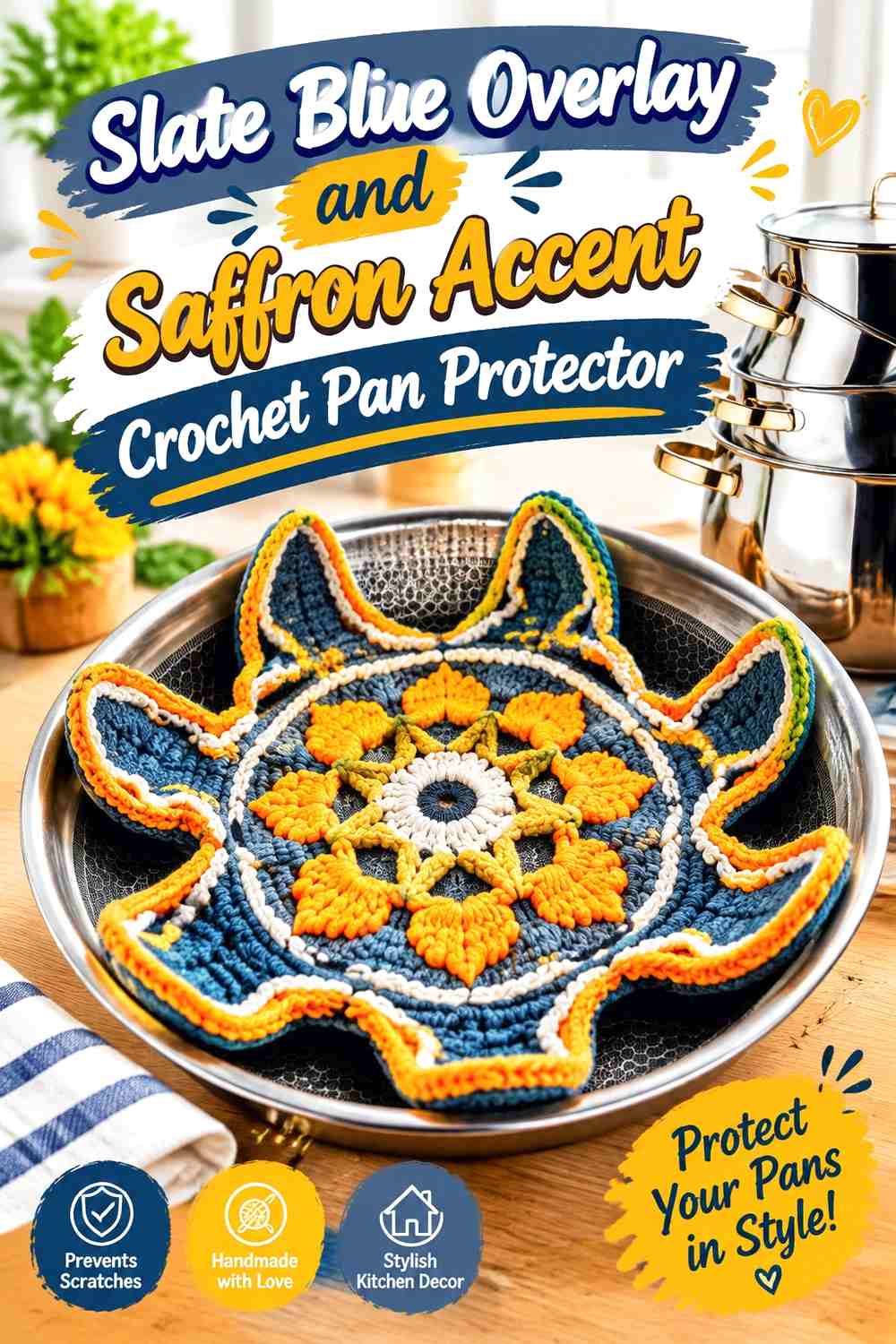
A more decorative protector can use color to separate surface details rather than relying only on broad center-and-wing divisions. Slate Blue can carry the main shape and overlay work, while Saffron appears selectively underneath or around key details.
Keep Slate Blue Consistent Across the Crochet Surface Overlay
If a protector already has visible surface texture, one consistent Slate Blue shade can help those details remain readable. Changing color at every raised or decorative section risks making texture and color compete for attention.
Let the crochet structure create the pattern while Slate Blue provides continuity.
Use Saffron to Clarify Selected Slate Blue Crochet Details
Reserve Saffron for a center, outer line, or a few repeated structural areas rather than inserting it into every overlay section. A restrained warm accent can provide separation without making the protector look overly segmented.
When several protectors are stacked, consider repeating Saffron near the edge so at least part of the accent remains visible.
Creator Credit: The Crochet Crowd
8. Saffron Round And Slate Blue Edge Crochet Pan Protector

A predominantly round protector offers a simpler canvas for two-color planning. Saffron can cover the expanding central area, while Slate Blue is reserved for the final border. This keeps the warm shade dominant without losing a defined perimeter.
Let Saffron Fill the Main Crochet Pan Protector Round
Using Saffron continuously through the broad central surface creates a straightforward color field. This is useful when you want the protector itself to look strongly Saffron whenever it is removed from the stack.
Avoid adding narrow Slate Blue rings throughout unless you specifically want a striped effect. One uninterrupted Saffron field provides clearer hierarchy.
Frame the Saffron Crochet Pan Protector With Slate Blue
A Slate Blue outer border cools the palette at the perimeter and gives the round protector a visual stopping point. That border may also remain partially visible between stacked pans even when most of the Saffron field is hidden.
For a matching set, keep Slate Blue as the shared edge color and vary the amount of Saffron according to the protector’s size.
Creator Credit: Lisa HELLOhappy
9. Slate Blue Dominant And Saffron Accent Crochet Pan Protector
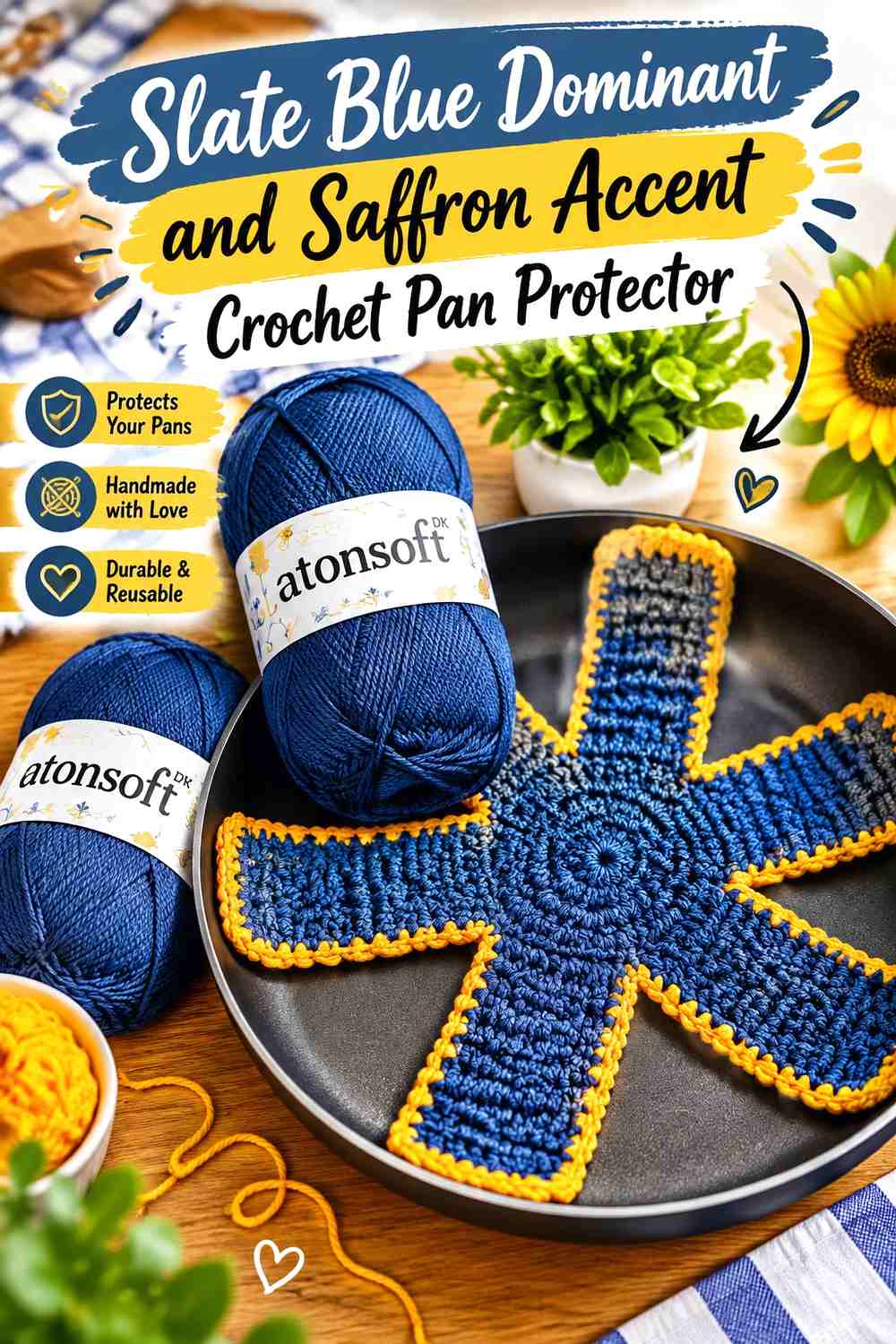
This is the most restrained Saffron option in the collection. Slate Blue can cover nearly the complete protector, while Saffron is confined to one central area, a finishing edge, or a small repeated marker. The approach works when you want a coordinated blue stack with just enough warmth to prevent the palette from becoming one-note.
Let Slate Blue Control the Crochet Pan Protector Surface
Use Slate Blue across the largest uninterrupted areas and allow the protector’s shape to create most of the variation. A strong dominant color is especially useful when several protectors will be seen together in one cabinet.
Repeat Saffron Once or Twice Against Slate Blue
Instead of scattering many tiny Saffron details, place the warm shade where it has a clear purpose. A center plus a narrow outer repeat can connect the middle and edge without competing with the dominant Slate Blue field.
If only one Saffron section is visible after stacking, make sure that placement still looks intentional rather than accidental.
Creator Credit: Woolhouse – Stricken, Häkeln & mehr
10. Saffron Leaf Style And Slate Blue Center Crochet Pan Protector

A leaf-influenced or pointed protector lets Saffron travel along outward shapes instead of sitting in a simple round border. Slate Blue can remain near the middle, creating a cooler hub from which the warmer sections extend.
Use Saffron Along the Crochet Pan Protector’s Outward Shapes
Saffron works well where elongated or pointed sections need to remain visually separate from the center. Keeping each outward shape mainly one color preserves its silhouette and allows the warm shade to remain visible around stored cookware.
Keep Slate Blue Central Against the Saffron Crochet Sections
A Slate Blue center gives the repeated Saffron extensions a common anchor. Avoid allowing the blue to creep unevenly into individual outer sections unless the construction naturally calls for that division.
This is also a useful palette for a nested set: the central Slate Blue can stay consistent while different amounts of Saffron remain visible around different pan sizes.
Creator Credit: Uncinetto e poi
11. Saffron Sunflower And Slate Blue Center Crochet Pan Protector

A sunflower-shaped pan saver creates one of the clearest uses for Saffron in this palette. The broad petal sections can carry Saffron around the perimeter, while Slate Blue deliberately replaces a traditional dark floral center for a more coordinated kitchen color scheme.
Let Saffron Lead Every Crochet Sunflower Petal
Keeping the full petal ring Saffron gives the protector a strong radial rhythm. It also puts the warm color exactly where the flower extends beyond a pan, making the palette more noticeable in storage.
Avoid alternating the petals unless you want to weaken the sunflower-like color concentration and create a more general two-tone flower instead.
Use Slate Blue as the Saffron Sunflower’s Crochet Center
Slate Blue gives the Saffron petals a cooler central anchor without introducing another neutral or brown. A broad blue center creates more substantial contrast than a tiny dot and makes both colors feel necessary to the design.
When planning multiple sizes, preserve the center-to-petal relationship rather than trying to keep one fixed amount of each color.
Creator Credit: Uncinetto, gomitoli e tanta fantasia
12. Slate Blue Stacked Petal And Saffron Edge Crochet Pan Protector

A scalloped or petal-edged round protector can use Slate Blue through the central rounds and Saffron only across the decorative outer shell. Because the outer edge is the part most likely to remain visible, a relatively small amount of Saffron can have a strong effect.
Keep Slate Blue Across the Main Crochet Pan Protector Rounds
Use Slate Blue through the broad central area to establish a cool, consistent field. This prevents the repeated outer texture from competing with additional color changes in the middle.
The result is especially effective if you want a set that looks mostly Slate Blue when each protector is viewed flat.
Put Saffron on the Slate Blue Crochet Petal Edge
Changing to Saffron for the final petal or shell treatment highlights the shape of the perimeter. The warm edge also becomes an easy visual cue when the protector is partly concealed inside a cookware stack.
For a subtler version, use Saffron only on selected edge repeats while keeping most of the outer round Slate Blue.
Creator Credit: MJ’s Off The Hook Designs
13. Saffron And Slate Blue Hexagon Flower Crochet Pan Protector

A flower assembled from hexagonal components gives Saffron and Slate Blue separate modular areas rather than forcing both shades into the same continuous round. One color can dominate the central module while the other repeats around it, or the two can alternate across the flower.
Use Saffron and Slate Blue to Separate the Crochet Hexagon Modules
Assign complete hexagons to Saffron or Slate Blue rather than switching shades several times inside each small component. Whole-color modules make the flower structure easier to see and keep the two-color pattern organized.
For a Saffron-led version, place Saffron in the central area and repeat it in selected outer modules rather than surrounding one isolated Saffron piece with nothing but blue.
Repeat Slate Blue Around Saffron for a Connected Crochet Pan Saver
Slate Blue can act as the recurring color that visually joins the separate pieces into one protector. If the outer modules alternate, make sure the sequence remains balanced around the center.
Because this construction is more visually segmented than a simple round protector, keep the palette limited to Saffron and Slate Blue unless another color serves a specific purpose.
Creator Credit: Stitch and Hound Crochet
Comparing the Saffron and Slate Blue Crochet Pan Protector Directions
For a Saffron-forward cookware stack, look at the Saffron-wing, flower-petal, sunflower, leaf-style, or Saffron-edged designs. These keep the warm shade near the perimeter, where it has a better chance of remaining visible between pans.
For a cooler Slate Blue look, choose a protector with a Slate Blue body, center, overlay, or dominant surface. A small Saffron border or accent can then provide definition without changing the overall blue direction.
If you want simple color blocking, the center-and-wing and round-with-border ideas are the clearest choices. For more visual repetition, the flower, stacked-petal, alternating-wing, sunflower, and hexagon-flower approaches give the two colors more opportunities to interact while still keeping their roles organized.
Conclusion
Saffron and Slate Blue can change the appearance of a crochet pan protector set simply by moving the colors to different structural areas. Saffron at the perimeter creates a warmer stack because wings, petals, and borders can remain visible between pans. Slate Blue around the outside produces a more subdued effect, especially when Saffron is hidden mainly in the center.
Think about the protectors both flat and in use. A dramatic Saffron center may become almost invisible beneath the next pan, while one narrow Saffron border can become the most noticeable feature in the cabinet. Planning color according to what remains exposed can make the two-color scheme more intentional.
Use the credited tutorials for their exact construction instructions, compare each finished protector with the cookware it will separate, and keep these pieces in their intended storage role rather than assuming they are suitable for heat protection.
Frequently Asked Questions
Should Saffron or Slate Blue dominate a crochet pan protector?
Either can dominate. Saffron creates a warmer visual direction and is especially noticeable on outer wings, petals, or borders. Slate Blue creates a quieter main field and works well when you want Saffron restricted to smaller focal areas.
Where should Saffron go if I want it visible between stacked pans?
Use Saffron toward the perimeter rather than only in the center. Wings, petals, tips, scalloped edges, or an outer border have a better chance of remaining visible after another pan covers the middle of the protector.
Can I use a Slate Blue center with Saffron crochet pan protector arms?
Yes. That division gives each color a clear structural role. Slate Blue can cover the central area beneath the cookware while Saffron extends outward and becomes the more visible color around the stack.
How can I use Saffron and Slate Blue to distinguish pan protector sizes?
Keep the palette consistent but change the dominant color or edge treatment. For example, one protector could have Saffron wings with a Slate Blue center, while another reverses those roles. The color arrangement can provide an additional visual cue, but you should still check each protector directly against the cookware it is intended to separate.
What if my Saffron and Slate Blue yarns do not have much light-and-dark contrast?
Use larger color areas rather than narrow alternating stripes. A complete Saffron wing beside a Slate Blue center will remain easier to distinguish than several tiny color changes when the two yarns have similar value.
Can a crochet pan protector also be used as a hot pad?
Do not assume so. Pan protectors in this article are discussed as separators for stored cookware. Remove them before cooking or heating, and only use a crochet piece for heat-related purposes when its specific pattern, materials, and intended use explicitly support that function.