Vintage crochet brooches do not need to reproduce an antique accessory stitch for stitch. The effect can come from scale, silhouette, layered petals, muted color, threadlike detail, compact corsage arrangements, and carefully chosen centers. A restrained rose on a coat lapel suggests something very different from a broad sunflower pin, while lavender and lily-of-the-valley create the narrow floral lines associated with older botanical jewelry.

The 17 ideas below use tutorials from different crochet creators. Some sources teach the complete brooch or flower pin. Others teach a finished crochet flower that can be converted into a brooch with separately selected backing hardware; those adaptations are identified rather than presented as part of the original tutorial.
For a convincing vintage-inspired result, make construction the first decision and color the second. An elaborate pile of pearls, ribbons, lace, and buttons cannot compensate for a brooch whose proportions or backing do not suit the garment.
Quick List
- Crochet Vintage Sunflower Brooch
- Crochet Ruffled Carnation Corsage Brooch
- Crochet Botanical Poppy Lapel Brooch
- Crochet Vintage Pansy Brooch
- Crochet Lily-of-the-Valley Spray Brooch
- Crochet Orchid Statement Brooch
- Crochet Lavender Sprig Brooch
- Crochet Daffodil Trumpet Brooch
- Crochet Full Peony Corsage Brooch
- Crochet Layered Vintage Flower Brooch
- Crochet Rolled Rose Lapel Brooch
- Crochet Petite Five-Petal Brooch
- Crochet Sculpted Cotton Flower Brooch
- Crochet Marigold Corsage Brooch
- Crochet Layered Zinnia Brooch
- Crochet Airy Cosmos Brooch
- Crochet Textured Chrysanthemum Brooch
What Makes a Crochet Brooch Feel Vintage?
Shape usually does more than color. A compact flower worked with crisp stitches can resemble small textile jewelry, while a full carnation or peony behaves more like an old-fashioned corsage. Pansies, roses, chrysanthemums, and floral sprays also have recognizable silhouettes that can carry a nostalgic mood without needing decorative extras.
Palette can reinforce that structure. Dusty rose, claret, cream, faded lilac, tobacco brown, old gold, sage, moss, navy, plum, and muted coral can feel quieter than bright novelty colors, but there is no requirement to make every “vintage” brooch beige. Contrast still matters. Petals, centers, leaves, and borders should remain distinct enough for a small accessory to read clearly.
Buttons, beads, and embroidery can help, but add them selectively. One well-scaled center usually looks more intentional than several unrelated trims competing on a flower only a few inches across.
Plan the Backing Around the Flower, Not the Other Way Around
A brooch is judged vertically when it is worn, and that changes how crochet behaves. A flower that lies perfectly flat on a table may tilt forward once its weight hangs from a narrow pin. Dimensional roses, carnations, peonies, and chrysanthemums create more leverage than flatter pansies and poppies.
Finish or nearly finish the crochet before settling on hardware whenever possible. Hold the pin temporarily against the back, then place the brooch on fabric comparable to its intended garment. Look for rotation, forward tipping, visible metal around the edges, and fabric sagging.
Direction matters too. A circular sunflower can tolerate several orientations, while a pansy, daffodil, orchid, or long flower spray has an obvious top. Mark that direction before attaching the clasp so the hardware supports the design you actually want to wear.
1. Crochet Vintage Sunflower Brooch

A sunflower gives a vintage collection a strong, graphic floral pin rather than a soft ruffled corsage. Lilyrosycrafts teaches the project specifically as a sunflower brooch, including the flower-pin purpose rather than leaving the final accessory conversion unresolved. The broad ring of petals surrounding a contrasting center makes the flower readable from farther away than many tiny botanical designs.
For vintage-inspired styling, consider ochre, mustard, antique gold, cream, rust, or muted brown instead of relying only on bright yellow. The important feature is the relationship between the center and the radiating petals. A dark center surrounded by aged-gold tones can create a distinctly retro textile-jewelry feel while retaining the sunflower structure taught in the tutorial.
Because this brooch spreads outward, it works particularly well where it has enough uninterrupted fabric around it: a plain coat lapel, felt hat, structured cardigan, or cloth bag.
Keep the Radial Shape Balanced
Repeated petals make uneven spacing easy to notice. Before securing the final backing, place the flower flat and look at the entire circumference rather than correcting individual petals in isolation.
Then hold it vertically. A sunflower that appears centered on the table can still hang slightly to one side if the pin is off balance. Position the hardware around the visual center of the complete flower, not merely whichever stitches are easiest to sew through.
Let Color Suggest Age Without Muddying the Flower
Muted colors work best when the center and petals still separate visibly. Mustard and medium brown can become surprisingly similar once worked into a compact crochet surface.
Test short strands together first. If you want an especially subdued palette, create contrast through light and dark values rather than adding another bright shade. That keeps the old-fashioned effect while preserving the clear sunflower face.
Creator: Lilyrosycrafts
2. Crochet Ruffled Carnation Corsage Brooch

A carnation brings concentrated ruffling to the collection, making it closer to a small textile corsage than a flat pin. Pembe Düğme’s source is specifically presented as a crochet carnation brooch, so the wearable flower concept comes from the tutorial rather than from a separate conversion proposed here.
This structure suits vintage styling especially well because much of its visual character comes from shadow between folds. Wine, faded coral, brick, dusty pink, cream, or deep red can all emphasize that texture without requiring several colors. Unlike the sunflower, the carnation does not depend on a large central disc; the ruffled mass itself becomes the focal point.
That depth also changes where the piece works best. A firm jacket, hat, substantial cardigan, or bag can support a pronounced flower more comfortably than a very fine blouse whose fabric bends under the brooch.
Judge the Carnation From the Side
Front diameter does not tell you how substantial a ruffled flower will feel when worn. Check the side profile before choosing hardware.
If the bloom projects far from its backing area, mounting the pin too low may allow the top to lean away from the garment. Temporarily test several positions while holding the flower vertically. The most visually centered position on the back is not always the position that supports the weight most effectively.
Use One Color to Emphasize Texture
A carnation already contains plenty of visual movement. A tonal or single-color version can feel more convincingly vintage than dividing every ruffle into contrasting bands.
If you do introduce a second shade, use it to clarify depth rather than to create stripes that compete with the petal structure. Closely related claret and faded rose, for example, can highlight folds while keeping the brooch cohesive.
Creator: Pembe Düğme
3. Crochet Botanical Poppy Lapel Brooch

The poppy offers a flatter botanical profile than a carnation or peony. Crafting Happiness Crochet’s tutorial teaches a complete remembrance poppy brooch, including the petals, leaf, assembly, and brooch finishing, making it one of the most direct source matches in this collection.
A deep red flower with a contrasting dark center already has an old-fashioned lapel-pin quality, though the design can also be interpreted in other botanical colors when a remembrance association is not intended. Its comparatively open face allows the flower to sit closer to a garment, which can make it suitable for a blazer or cardigan where a heavy corsage would look disproportionate.
The leaf adds direction to the otherwise rounded flower. That small asymmetry is useful for vintage styling because it lets the brooch follow a lapel line instead of behaving like a centered circular badge.
Preserve the Flower Center
The dark center anchors the petals visually. If you change the original palette, retain enough value contrast that the middle does not disappear into the surrounding crochet.
Look at the brooch from normal wearing distance rather than only from a few inches away. Tiny details that are obvious during construction can blend together once the flower is viewed on a coat or scarf.
Treat the Leaf as an Orientation Guide
Before sewing the hardware permanently, rotate the complete brooch against the intended garment. A leaf angled gently along the lapel often produces a more deliberate result than attaching the pin horizontally first and accepting whatever flower angle follows.
Mark the chosen top edge on the reverse. This simple step is particularly useful for floral brooches whose asymmetry is part of their character.
Creator: Crafting Happiness Crochet
4. Crochet Vintage Pansy Brooch

Pansies naturally suit vintage-inspired accessories because their broad, face-like petal arrangement feels botanical without becoming bulky. Naztazia’s tutorial teaches the complete pansy flower rather than a finished brooch; adding a suitable pin backing is therefore a separate adaptation. The source builds the flower through distinct color areas and decorative central stitching.
That color structure creates plenty of room for period-inspired combinations. Plum with faded gold, cream with violet, burgundy with mauve, or navy with muted lilac can produce a more subdued effect while preserving the characteristic pansy face. Because the flower remains comparatively flat, it can work well on a cardigan collar, scarf, coat lapel, or fabric handbag.
Avoid treating this as a perfectly radial bloom. The upper and lower petals have different visual roles, so the completed flower needs a deliberate orientation before hardware is added.
Use Color Placement as Structure
On a pansy, changing color is not merely decorative. The different areas help define the floral face.
If all selected yarns are similarly dark or similarly pale, the shape can lose depth. Arrange the proposed colors side by side before crocheting the final version, then decide which section should be visually dominant. A vintage palette can still contain strong contrast; muted does not have to mean indistinct.
Mark the Top Before Adding the Pin
Lay the finished pansy against the intended garment and rotate it until the petal arrangement looks natural. Then mark that orientation on the reverse.
A brooch back attached without this check can leave the flower permanently tilted. Because this tutorial does not itself teach the conversion to a brooch, hardware choice and attachment remain your separate finishing responsibility.
Creator: naztazia
5. Crochet Lily-of-the-Valley Spray Brooch

Instead of one large circular flower, this idea creates a narrow botanical arrangement from several small bell-like blooms. Shelen Crochet’s tutorial teaches lily-of-the-valley flowers and foliage as a decorative floral project rather than a finished brooch, so shortening and mounting the arrangement for a wearable pin is an adaptation.
The elongated form is precisely what makes it valuable in a vintage collection. A cream-and-sage spray can resemble a miniature botanical corsage, sitting diagonally along a lapel rather than covering one circular patch of fabric. It is also a useful choice for readers who find large ruffled flowers too theatrical.
Do not simply reproduce a long bouquet stem and attach a pin to it. Brooch proportions are more compact. Arrange the flower bells and leaves over the actual area where the piece will be worn, then determine how much of the original stemmed composition makes sense to retain.
Shorten the Arrangement Deliberately
A bouquet can extend far beyond the practical dimensions of a lapel pin. Before final assembly, place the crocheted floral components on a paper outline roughly matching the intended garment area.
This lets you decide whether the spray should remain vertical, become diagonal, or lose one section entirely. The goal is not to reproduce the display flower at miniature scale but to preserve its recognizable bell-and-leaf rhythm within wearable proportions.
Keep the Small Bells Visible
The bell-like flowers can disappear if leaves, stems, and neighboring blossoms collapse into one dense cluster. Hold the proposed arrangement vertically, because gravity can change overlaps that looked attractive on a table.
A restrained cream, faded green, and soft brown palette can strengthen the antique-botanical mood, but silhouette should remain the first priority.
Creator: Shelen Crochet
6. Crochet Orchid Statement Brooch

An orchid gives this collection a distinctly asymmetrical statement flower. Chubbiesbyash teaches a complete crocheted orchid flower and suggests several accessory uses, but the tutorial does not specifically construct a brooch backing. Converting the finished bloom to a pin therefore requires separate hardware and placement planning.
Unlike a daisy or sunflower, an orchid gains much of its identity from uneven petal placement and a prominent center. That sculptural arrangement can make one flower sufficient for an entire lapel. Dusty mauve, faded violet, cream, old rose, or muted blue can shift the modern flower tutorial toward a softer keepsake look without altering its construction.
Because this bloom has an obvious orientation, do not assume that the geometric middle of the back is the correct location for the pin. The flower should first be positioned as you want it to appear on the garment.
Let Asymmetry Remain Visible
Trying to make every orchid petal sit symmetrically can work against the flower’s character. Instead, evaluate the overall visual balance.
Hold the bloom upright and notice which side feels heavier. Then position the brooch hardware so the desired orientation remains stable rather than rotating downward. This check matters more than on a radial flower because the orchid has no neutral “any side up” position.
Keep the Center From Being Buried
The central detail provides much of the flower’s visual focus. If you add pearls, beads, vintage buttons, or other embellishment, keep them small enough that the crochet construction is still readable.
A brooch this sculptural rarely needs several extra trims. One restrained center treatment or a nuanced color shift can create the vintage mood without turning the flower into a mixed collection of unrelated materials.
Creator: chubbiesbyash
7. Crochet Lavender Sprig Brooch

Lavender replaces the large flower head with repeated texture along a slender stem. Brunaticality’s tutorial teaches crochet lavender with supporting stem materials and leaves rather than a finished brooch, so a shorter wearable sprig and its backing would be your adaptation. The source provides a dedicated video tutorial for the flower.
This narrow silhouette can look particularly effective on a long lapel, hatband, scarf edge, or cloth handbag. Muted violet, heather, gray-purple, dusty blue, and sage already sit comfortably within a vintage-inspired palette. Because the flower is linear, it offers a very different visual effect from all the circular corsage brooches around it.
A full display stem may be too long for clothing. Keep the most recognizable floral section and enough leaf structure to explain the form, then judge the length against the intended garment before creating the final backing.
Reduce Length Before Increasing Detail
A long sprig can bend, twist, or catch on surrounding fabric when worn. Instead of adding more flowers to make it impressive, first find a length that sits comfortably within the lapel or bag panel.
The more compact arrangement will usually read more clearly as jewelry. Once that proportion is established, decide whether a small leaf or secondary floral section improves the silhouette.
Treat Stem Materials as a Separate Wearability Decision
The flower tutorial uses structural materials appropriate to a stemmed botanical project. A wearable brooch has different demands.
If any rigid material is retained, make sure cut ends are securely contained and cannot work through the crochet or contact the wearer. Alternatively, use the tutorial primarily for the floral component and devise the brooch-specific support independently.
Creator: Brunaticality
8. Crochet Daffodil Trumpet Brooch
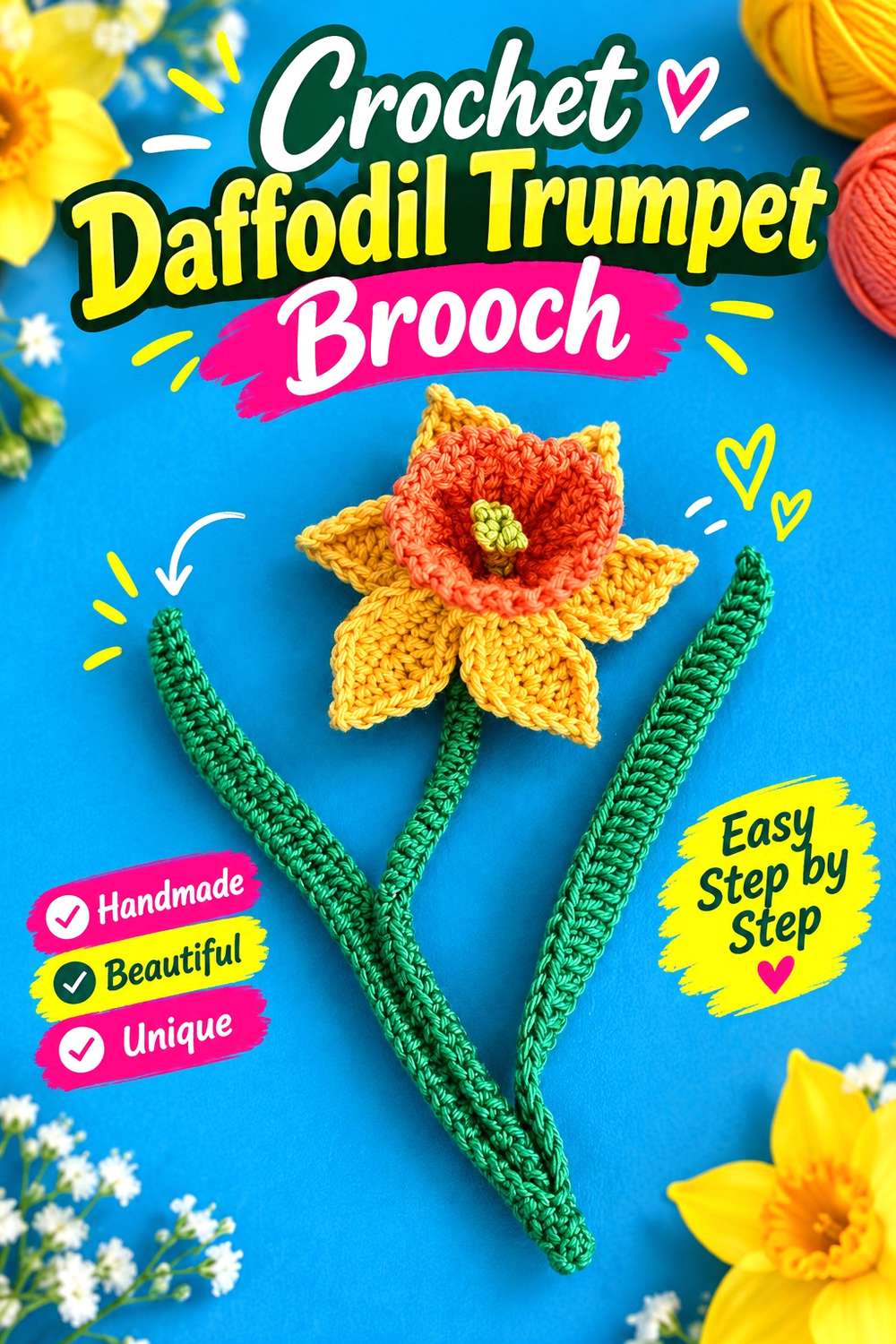
The projecting trumpet at the center of a daffodil makes this flower noticeably different from layered roses and radial daisies. Kerri’s Crochet teaches the center, petals, stamen, stem, leaves, and joining for a complete decorative daffodil. Using the flower head as a brooch requires a separate backing adaptation.
That central projection makes the daffodil attractive for vintage-inspired statement jewelry because it has dimension without requiring many stacked ruffles. Mustard, old gold, cream, rust, or faded apricot can move it away from a bright spring palette while retaining the flower’s characteristic architecture.
For a brooch, you may not need the tutorial’s full stem-and-leaf presentation. A single flower head can produce a clean lapel pin, while one small leaf can make the composition directional. Decide which silhouette suits the garment before carrying every botanical component into the adaptation.
Protect the Trumpet Shape
The center should project visibly when the brooch is worn. Avoid placing it where a tightly wrapped scarf, bag strap, or coat edge will continually flatten it.
Check the completed flower from the side before adding hardware. If the brooch tilts, the projecting center can exaggerate that movement, so backing position deserves more attention than it would on a flat applique.
Separate Outer Petals From the Center With Color
The daffodil naturally contains two major visual zones. You can emphasize that distinction with related vintage colors rather than high-saturation contrast.
Cream petals with ochre, faded yellow with rust, or old gold with brown-orange can all preserve the recognizable center. Lay the yarns together first; on a small brooch, colors closer in value may merge more than expected.
Creator: Kerri’s Crochet
9. Crochet Full Peony Corsage Brooch

A peony is the choice for readers who want their vintage brooch to behave like a miniature corsage. Crochet Bits teaches a full rolled and layered peony flower. The original project is presented as a decorative flower rather than specifically as jewelry, so attaching appropriate brooch hardware is a separate adaptation.
Its density makes the flower particularly suited to burgundy, dried rose, cream, muted coral, dusty plum, or old-fashioned pink. One bloom can carry enough volume that leaves, beads, ribbons, and secondary flowers are optional rather than necessary.
The main consideration is support. A full peony can look visually compact from the front while projecting considerably from the garment. It therefore makes more sense on substantial outerwear, a cloth bag, or a firm hat than on a blouse that cannot comfortably support the flower.
Check the Base Before Adding the Pin
The decorative front can be irregular and full, but the reverse needs a stable area where hardware can sit.
Before choosing a brooch clasp, inspect how the rolled flower is secured. An uneven mound on the back can push the pin away from the garment and make the bloom lean outward. Stabilize the flower construction itself before trying to solve balance with a larger backing.
Let the Petals Supply the Ornament
A peony already has plenty of surface detail. If you want a stronger vintage feeling, explore subtle tonal variation instead of adding several unrelated embellishments.
A faded rose center moving into cream or a wine bloom with slightly lighter outer folds can create depth while keeping the flower unmistakably crochet. This preserves the softness that makes a corsage-style brooch appealing.
Creator: Crochet Bits
10. Crochet Layered Vintage Flower Brooch

This is the most direct stylistic match in the collection. Loopy Mabel Crochet’s project is presented as a vintage-style crochet flower brooch rather than requiring a modern flower to be reinterpreted after the fact. The layered construction creates a decorative textile flower that does not need to imitate one particular botanical species.
That freedom makes the design especially useful for experimenting with old-fashioned palettes. Tobacco and cream, plum and dusty rose, moss and ochre, navy and camel, or burgundy with faded gold can each produce a different mood while preserving the layered structure.
The center also gives you a natural place for one carefully chosen embellishment. A button or bead can strengthen the period-inspired character, but it should be treated as a focal point rather than an excuse to cover the crochet.
Offset the Layers Before Securing Them
If each flower layer sits directly over the one below it, some petal edges can disappear. Rotate the sections before final assembly and compare several positions.
A slight offset often creates more depth than introducing another yarn color. Look from both straight on and at a slight angle so you can see whether the individual layers remain distinct once the flower is worn vertically.
Make the Center Earn Its Place
A decorative button can immediately change the character of the brooch, but scale matters. Place the proposed center on the flower before sewing.
If it conceals too much of the upper petal layer, choose a smaller option. The strongest vintage result usually comes from one coherent detail working with the textile rather than a large collection of lace, pearls, ribbon, charms, and beads fighting for the same small area.
Creator: Loopy Mabel Crochet
11. Crochet Rolled Rose Lapel Brooch

A rolled rose is a classic way to bring concentrated depth to a small lapel pin. MAMA HUMAM’s tutorial is specifically presented as a crochet rose brooch, so the finished wearable purpose is part of the source rather than an adaptation added afterward.
The spiral formation creates a center that naturally draws the eye inward. That suits traditional brooch styling particularly well, especially in oxblood, antique pink, cream, faded mauve, terracotta, or deep plum. A single rose can look finished on its own, while one small leaf can extend the composition along a coat lapel.
Do not assume a compact rose is necessarily lightweight. Overlapping petals create thickness around the center, so the brooch deserves the same vertical balance check as larger flowers even when its diameter appears modest.
Look at the Spiral Before Closing the Back
The central coil is the main focal point. Before the flower is completely secured, inspect it from the front and make sure the spiral feels deliberate rather than leaning to one side.
Small irregularity is natural, but a visibly off-center roll can make the whole flower appear tilted once the brooch hardware establishes a fixed top.
Add Leaves Only When They Improve the Outline
A leaf can give the rose direction and make it resemble a miniature corsage. It also increases the overall width and changes where the pin needs to sit.
Test the rose alone first. On a narrow collar or small lapel, the single bloom may be more convincing. A leaf becomes more useful on broad coat fronts, hats, bags, or scarves with enough surrounding room.
Creator: MAMA HUMAM
12. Crochet Petite Five-Petal Brooch
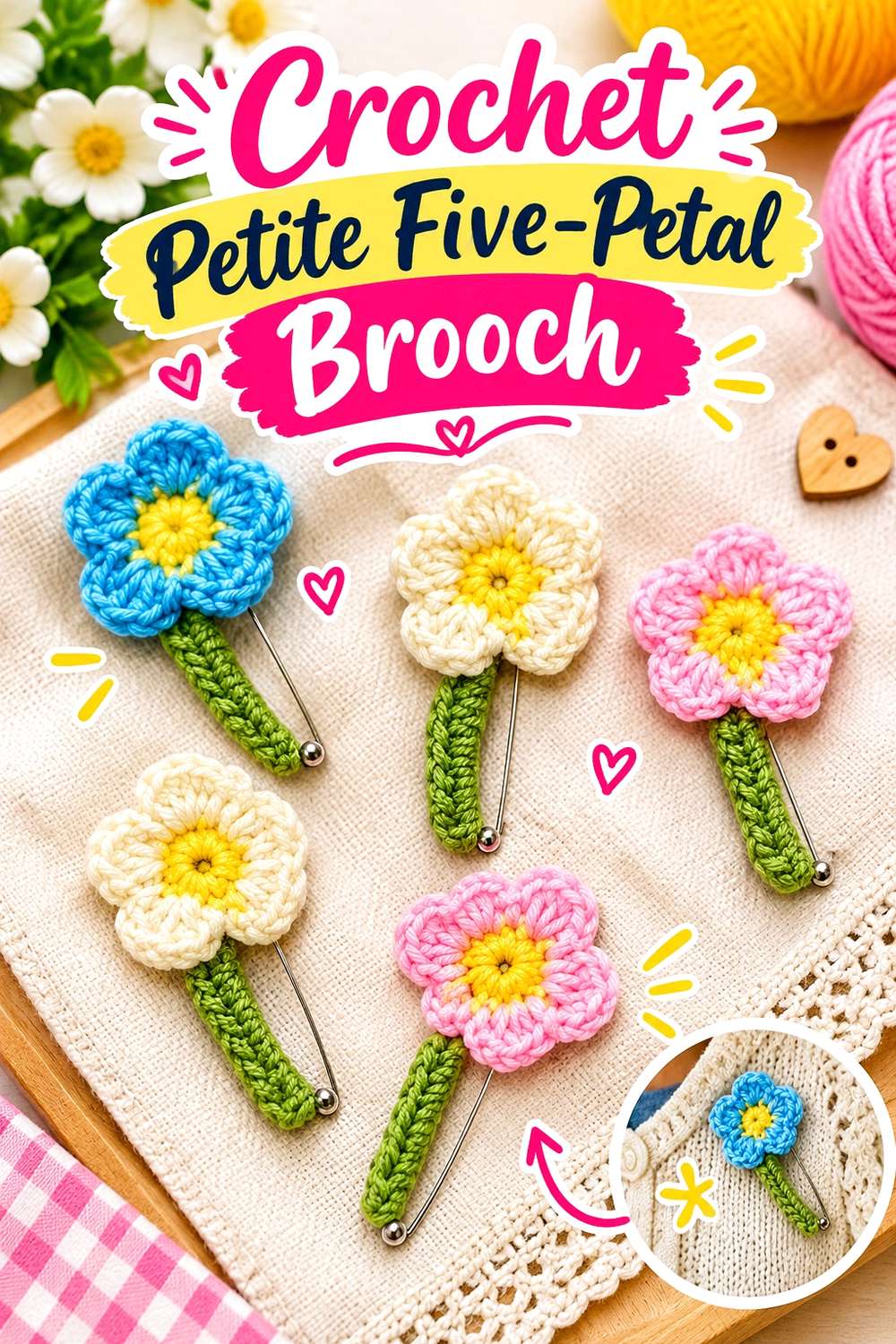
Not every vintage brooch needs to be a large corsage. Creative Asra’s tutorial focuses on small crochet flower pins, giving this collection a compact design that can sit on a collar, beret, scarf, cardigan, or project bag without dominating the surface.
The five-petal form is deliberately simple, which means scale, color, and finishing become more noticeable. Cream with burgundy, faded blue with mustard, dusty pink with brown, or moss with old gold can create tiny textile accents that feel more like old-fashioned dress pins than contemporary oversized appliqués.
Small brooches are also useful when you want several coordinated accessories rather than one permanent statement piece. The important practical issue is keeping the hardware proportionate: a large finding can protrude around the flower and visually overwhelm it.
Keep the Pin Inside the Flower
Finish one complete flower before selecting or attaching the backing. Place the hardware behind it and view the piece from several angles.
No part of the clasp should become a distracting outline around the petals. The moving section also needs enough clearance to open easily, so the smallest possible pin is not automatically the best one.
Let Simplicity Highlight Neat Finishing
A small five-petal motif has nowhere for untidy joins or uneven petal sizing to hide. Look at the full flower after each major step rather than judging only the stitch currently on the hook.
For vintage styling, resist overdecorating. One contrasting center or tiny button can be sufficient; several trims may make a miniature flower feel crowded instead of delicate.
Creator: Creative Asra
13. Crochet Sculpted Cotton Flower Brooch
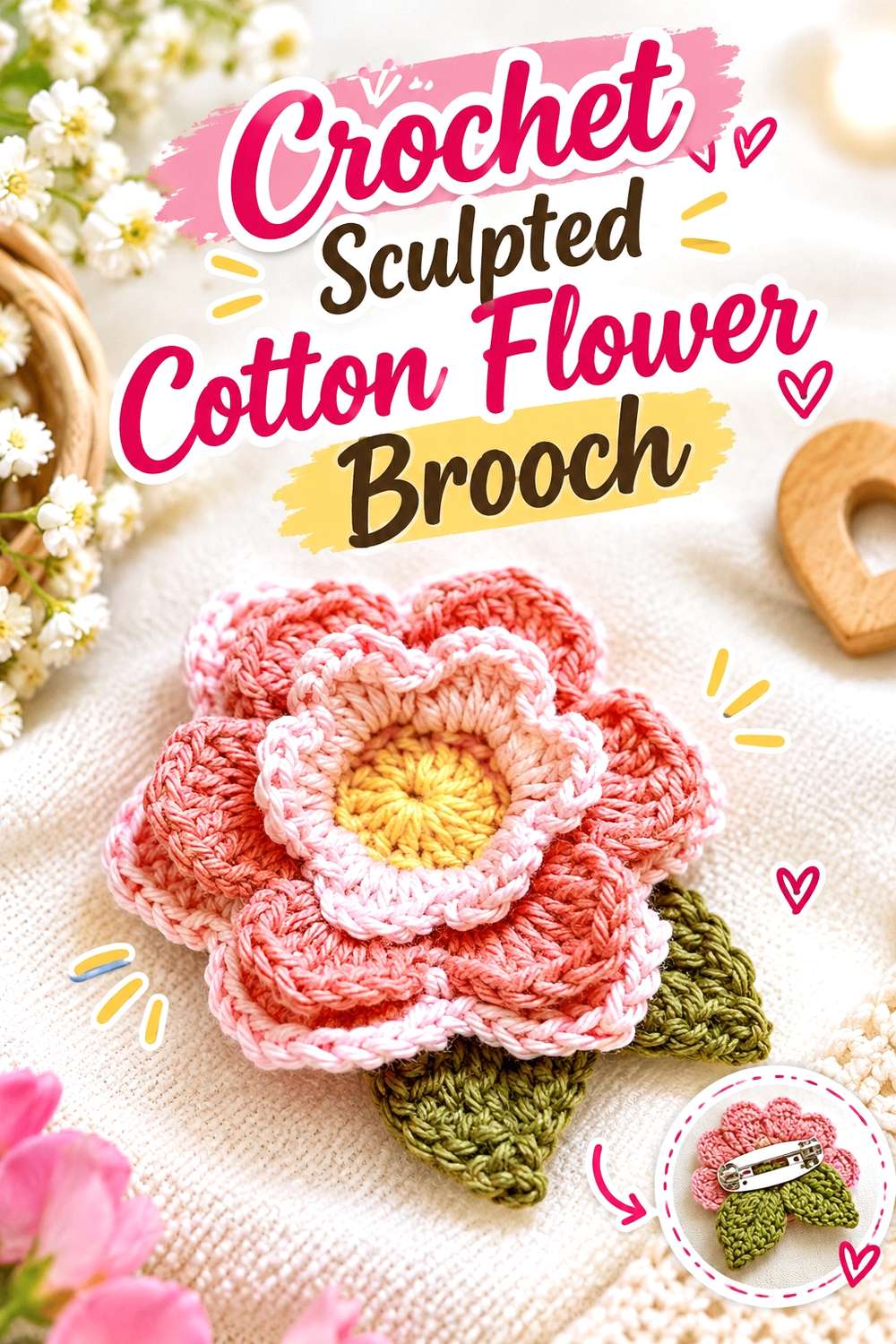
Mi’s Handmade Hobbies teaches this project specifically as a crochet flower brooch using a compact flower format and fine-looking cotton construction. That controlled scale makes it useful when you want a wearable floral accent rather than the fullness of a peony or carnation corsage.
The shape can take on a vintage character through tonal color rather than extra ornament. Brick with terracotta, cream with camel, plum with mauve, or faded green with mustard can emphasize the petal sections while keeping the accessory quiet enough for everyday clothing.
Because the flower is relatively compact, stitch definition has a larger visual role. A smooth surface keeps the petal edges clear, whereas a much fuzzier substitute could soften the outline and change the character considerably. Treat a dramatic fiber change as a new design decision rather than assuming only the color is changing.
Rotate Before Fixing the Hardware
Even a flower that appears approximately circular can settle more attractively at one angle. Place it on the intended garment and rotate it slowly.
Once you identify the best orientation, mark the reverse. Attaching the brooch pin first can force an otherwise attractive flower into a position where one petal points awkwardly downward or the center appears visually off balance.
Use Tonal Colors for Quiet Depth
You do not need strong contrast between every section. Closely related shades can make the flower feel softly aged while the stitch texture supplies separation.
Compare the selected yarns while touching rather than viewing the skeins independently. Once small amounts of color sit beside each other inside a compact brooch, differences can become either stronger or weaker than expected.
Creator: Mi’s Handmade Hobbies
14. Crochet Marigold Corsage Brooch
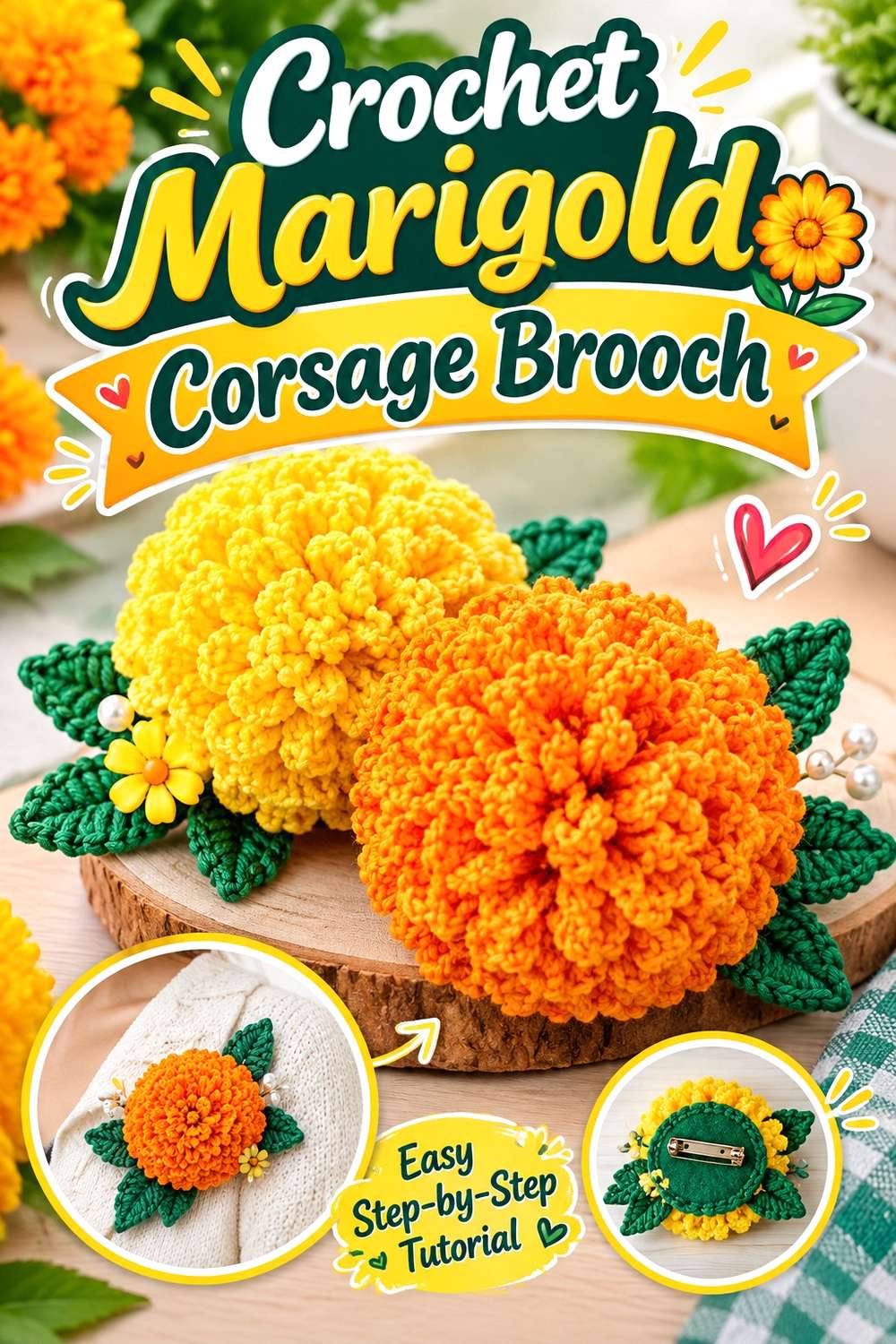
A marigold provides dense, rounded petal texture without the broad frill of a carnation. Crafetaria’s tutorial teaches a complete realistic crochet marigold flower for decorative uses rather than specifically for a brooch, so the wearable backing described here is an adaptation.
The flower naturally suits mustard, saffron, burnt orange, paprika, rust, and faded gold, making it easy to move into an autumnal vintage palette. Its tightly concentrated shape also works well when you want a brooch that feels substantial without extending across a wide area of the garment.
For jewelry, you probably do not need to reproduce every display-oriented component. Focus first on the flower head and then decide whether a small leaf contributes anything to the composition. A clean rounded marigold can already provide enough texture to stand alone.
Control the Dome
Dense petals can create significant depth quickly. Check the bloom from the side before assuming that additional fullness will improve it.
A controlled dome is often easier to support as a brooch than the fullest possible bouquet flower. If the bloom already projects strongly, keep the reverse compact instead of adding more material beneath it.
Let Warm Color Carry the Vintage Mood
Marigolds naturally invite strong oranges and yellows, but slightly softened versions can feel more wearable with older-style clothing.
Try old gold, rust, mustard, or brown-orange rather than introducing many contrasting colors. The petal texture already creates light and shadow, so a nearly monochrome flower can still have plenty of visual depth.
Creator: Crafetaria
15. Crochet Layered Zinnia Brooch

A zinnia gives the brooch an orderly layered structure with a distinct progression from center to outer petals. Crochet Everyday’s tutorial teaches a complete decorative zinnia flower rather than a finished pin, so mounting the flower as a brooch requires separately chosen backing hardware.
This form is useful when you want the richness of a layered bloom but prefer clearer organization than the loose folds of a peony. Rust with gold, faded coral with mustard, plum with cream, or burgundy with old rose can reinforce those visual rings.
The tutorial’s display flower includes more than the head alone, but a wearable brooch can be simplified. Decide whether the zinnia itself provides enough character before carrying stem-oriented elements into the piece. The layered face is already the main attraction.
Make Color Support the Layering
If every petal level changes to an unrelated color, the flower can become a set of separate rings rather than one bloom.
A tonal progression often works especially well for vintage styling. Move gradually from a darker center toward softer outer petals, or keep most layers similar and allow one contrasting center to anchor them.
Align the Flower Before Mounting
Look at the complete bloom directly from the front. Repeated layers make an off-center middle particularly noticeable.
If one section has shifted during assembly, make any gentle shaping adjustments before the pin establishes a permanent top edge. Also inspect the side profile so the backing does not exaggerate an already uneven tilt.
Creator: Crochet Everyday
16. Crochet Airy Cosmos Brooch

A cosmos offers one of the lightest-looking flower faces in this collection. Natagor Finlayson teaches realistic three-dimensional crochet flowers through detailed video tutorials, and the cosmos source provides the open petal structure used for this brooch adaptation. The creator’s work is presented as decorative botanical crochet rather than specifically as brooch construction.
The relatively open petals are useful when the peony, marigold, and chrysanthemum styles feel too dense. Dusty pink, cream, faded wine, muted mauve, or soft rust can emphasize the airy silhouette while retaining a vintage botanical quality.
A brooch version should focus on the flower head and avoid automatically reproducing a full stemmed arrangement. The visible gaps between petals are part of what distinguishes the cosmos, so mounting and embellishment should preserve rather than fill those openings.
Protect the Negative Space
The charm of a cosmos depends partly on seeing separate petals rather than one continuous flower disc.
During finishing, check that the edges have not been compressed together. An extra bead border, heavy backing, or crowded leaf arrangement can undermine the open quality that makes this flower different from the denser options.
Keep Display Structure Separate From Brooch Structure
Realistic flower tutorials may employ support suitable to a stemmed display. A garment pin has a different job.
Use only the components that make sense for the final wearable form, and ensure any retained structural materials cannot expose sharp ends or snag fabric. The flower-head tutorial can remain your construction reference while the brooch backing is planned independently.
Creator: Natagor Finlayson
17. Crochet Textured Chrysanthemum Brooch

The chrysanthemum closes the collection with dense, narrow-petal texture. Crochet Craftsman teaches a full crochet chrysanthemum as a decorative flower, including the flower form and additional botanical components; converting the flower head into a brooch is the adaptation here. The creator maintains an extensive tutorial catalog of crochet flowers.
This bloom can create strong vintage-corsage character without needing a wide outer diameter. Aubergine, bronze-inspired gold, claret, mustard, muted lilac, rust, or cream all work with the concentrated petal structure because shadows between the narrow sections provide additional definition.
The main practical issue is depth. A chrysanthemum can look compact when viewed straight on yet project substantially from the garment. Treat side profile and backing stability as equal parts of the design rather than concentrating only on the front.
Let Texture Replace Extra Embellishment
Dozens of narrow petal edges already create a complex surface. Beads, bows, lace, and several leaves can easily obscure that quality.
For a vintage interpretation, consider using neighboring shades instead. Plum and aubergine or rust and old gold can create subtle variation while allowing the crochet texture to remain the principal decoration.
Keep the Reverse Much Simpler Than the Front
A dense flower needs a calm backing area. Check for bulky joins, long yarn tails, stem structures, or uneven assembly points before adding the clasp.
The goal is not to flatten the flower itself; it is to give the brooch hardware a stable platform so the chrysanthemum can sit as close to the garment as its dimensional form reasonably allows.
Creator: Crochet Craftsman
Conclusion
For the most recognizably vintage brooch style, the Layered Vintage Flower, Rolled Rose, Carnation Corsage, and Peony Corsage put dimensional textile petals at the center of the design. The Poppy, Pansy, Sunflower, and Sculpted Cotton Flower are better choices when you want a flatter pin that stays closer to a cardigan or lapel.
Lily-of-the-Valley and Lavender are useful when a round flower feels too conventional, while the Orchid, Daffodil, Cosmos, Zinnia, Marigold, and Chrysanthemum offer increasingly different approaches to sculptural botanical jewelry.
Choose the silhouette first, then decide how strongly to push the vintage mood through color, scale, buttons, beads, or other restrained details. For exact flower construction, use each creator’s original tutorial; treat the brooch conversions described for flower-only sources as separate finishing decisions.
Frequently Asked Questions
How can I make a crochet brooch look vintage without making it look costume-like?
Use one or two consistent cues instead of every vintage-associated decoration at once. A muted palette plus a small button can be enough. Fine thread with simple embroidery is another approach, while a full rose or carnation may need no added embellishment at all. Consider the garment too: a cream flower on tweed or a deep-plum rose on a plain coat can feel naturally nostalgic without lace, pearls, ribbon, and metallic trim all appearing together.
Which of these brooch styles works best on lightweight clothing?
Flatter flowers generally create less forward leverage than heavily dimensional corsages. The Poppy, Pansy, Petite Five-Petal Flower, and some compact cotton brooches are the first styles to consider when you want a quieter profile. Even then, the metal pin itself may mark delicate fabric. Test the finished accessory on comparable material before relying on it for a fine blouse, loosely knitted cardigan, or easily snagged scarf.
Can I turn any crochet flower tutorial into a brooch?
Many can provide a useful flower base, but not every bouquet construction translates directly into wearable jewelry. Long stems, exposed support wire, oversized leaves, or heavy flower heads may need to be omitted or redesigned. First make the floral component, then evaluate its scale, reverse surface, orientation, and weight. Brooch hardware should be chosen for the actual finished flower rather than assumed from an unrelated pin pattern.
Should I put felt on the back of every crochet brooch?
No. Felt can provide a clean surface for hardware and conceal assembly on a layered flower, but it can also make a small thread brooch unnecessarily thick. Check whether the crochet itself already provides a stable place for the pin. If a backing layer is useful, trim it so it remains hidden from the front and does not obstruct the clasp mechanism.
What colors work well for vintage-inspired crochet brooches?
Useful directions include dusty rose, cream, claret, aubergine, old gold, tobacco, faded coral, moss, sage, muted blue, navy, plum, rust, and soft brown. These are options rather than rules. Contrast is more important than simply choosing muted yarn. If a pansy face, sunflower center, daffodil trumpet, or layered zinnia becomes visually indistinct, introduce a clearer light-dark difference even if both colors remain subdued.
Can I resize a brooch by changing yarn and hook size?
You can change the scale, but the consequences extend beyond width. A thicker version may become heavier, deeper, softer at the edges, and harder for the same pin backing to support. Decorative buttons, beads, leaves, and embroidery may also look disproportionately small after enlargement. Make one sample component with the proposed materials and compare it with the intended garment before committing to every part of a multi-component brooch.