Cranberry and forest green create a naturally festive crochet napkin-ring palette, but the most useful designs do more than simply alternate red and green. On such a small table accessory, assigning each shade a clear role helps the crochet detail stay readable after the napkin is rolled, folded, or gathered through the ring.

Forest green works especially well for ring bands, leaves, stems, and darker framing details. Cranberry can take over flowers, bows, hearts, decorative wraps, or a contrasting main band. Reversing those roles produces a noticeably different result even when the same two yarn colors are used.
Napkin-ring scale also makes contrast important. A tiny forest-green motif can disappear against a dark green napkin, while a large cranberry flower can overpower a narrow ring band. Test the finished color placement with the actual napkins you plan to use rather than judging the ring only when it lies by itself.
The tutorials below support the napkin-ring construction and motif concepts. The cranberry-and-forest-green palettes are independent adaptations and do not imply that the creators used these exact colors.
Quick List
- Forest Green Ring And Cranberry Leaf Crochet Napkin Ring
- Forest Green Band And Cranberry Poinsettia Crochet Napkin Ring
- Cranberry Bow And Forest Green Crochet Napkin Ring
- Forest Green Band And Cranberry Flower Crochet Napkin Ring
- Cranberry Band And Forest Green Floral Crochet Napkin Ring
- Forest Green Loop And Cranberry Heart Crochet Napkin Ring
- Cranberry Ribbed And Forest Green Edged Crochet Napkin Ring
- Forest Green Band And Cranberry Scallop Crochet Napkin Ring
- Cranberry And Forest Green Striped Christmas Crochet Napkin Ring
- Forest Green Body And Cranberry Trim Crochet Napkin Ring
- Cranberry Bow With Forest Green Center Crochet Napkin Ring
- Forest Green And Cranberry Picot Crochet Napkin Ring
- Cranberry Ring With Forest Green Motif Crochet Napkin Ring
- Forest Green Wrap And Cranberry Tie Crochet Napkin Ring
- Cranberry Poinsettia And Forest Green Leaf Crochet Napkin Ring
- Forest Green Christmas Ring With Cranberry Border Crochet Napkin Ring
Decide Whether Cranberry or Forest Green Should Form the Ring Band
The ring band usually occupies the largest continuous area, so its color establishes the background for every decorative detail attached to it. A forest-green band makes cranberry flowers, hearts, and bows immediately noticeable. A cranberry band gives forest-green leaves and edging more contrast.
You do not need to divide the band evenly between the two colors. On a small napkin ring, one solid shade plus a contrasting motif often looks clearer than several narrow alternating bands.
Also consider the napkin itself. If the table linens are already forest green, a cranberry-dominant ring will separate more clearly. If the napkins are red, burgundy, or patterned with warm holiday colors, keeping more forest green in the ring may preserve the distinction.
Use Cranberry and Forest Green Where the Napkin Ring Stays Visible
Once a napkin passes through the ring, part of the crochet band may be covered. Decorative details on the front or upper surface usually remain more visible than stitches hidden underneath the rolled fabric.
Put the strongest cranberry-and-forest-green contrast where it can actually be seen. A cranberry flower on top of a forest-green band remains identifiable, while a color change placed only on the underside contributes much less to the finished table setting.
For dimensional flowers, bows, and leaves, step back and check the complete place setting. The motif should be large enough to register without obscuring most of the ring.
Keep Cranberry and Forest Green Motifs Distinct
Different hues can still have similar lightness. If your cranberry is very dark and the forest green is deep, tiny leaf veins, narrow borders, or small flower details may blend from a distance.
Larger blocks of color solve this more reliably than continually adding extra shades. Use a complete cranberry flower against a forest-green ring, for example, rather than trying to alternate both colors through every petal.
Repeating each shade also helps. If cranberry appears in the main motif, a small cranberry edge or center wrap can connect that focal point with the band without making the entire ring equally two-colored.
1. Forest Green Ring And Cranberry Leaf Crochet Napkin Ring
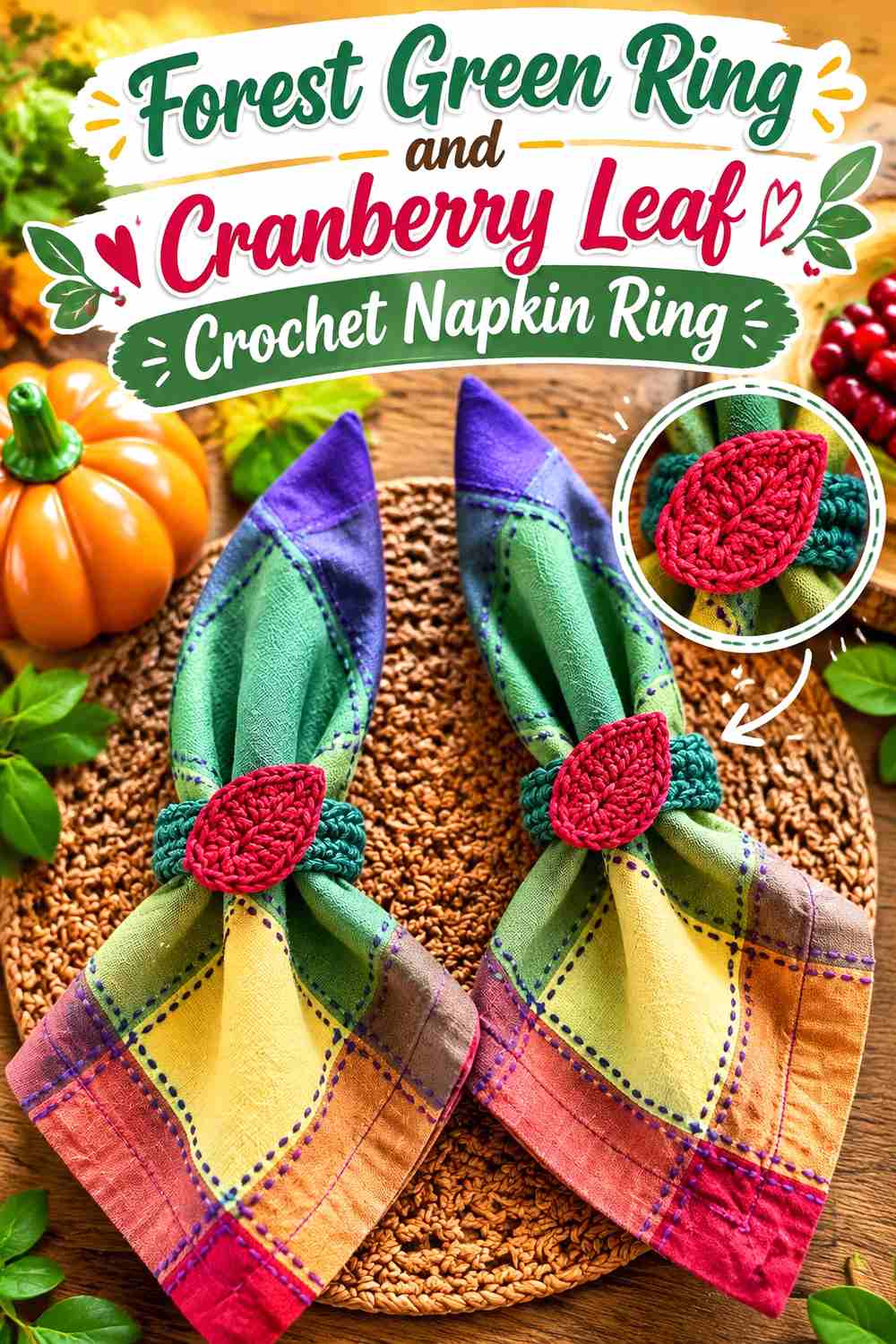
This version uses forest green for the simple ring band and adapts the leaf detail into cranberry for a less literal autumn-and-holiday look. The strong warm leaf becomes the focal point while the darker green band stays visually quiet around the napkin. If you want a more botanical result, reverse the leaf and band colors while preserving the same dominant-versus-accent relationship.
Keep Forest Green Broad Behind the Cranberry Leaf
A continuous forest-green band gives the leaf enough uninterrupted background to remain recognizable.
Avoid adding cranberry stripes through the entire band when the leaf already provides a substantial warm focal point. The simpler background keeps attention on the decorative front of the ring.
Let Cranberry Occupy the Main Forest Green Leaf Detail
Use cranberry across the complete leaf rather than restricting it to a tiny center detail. On a small napkin ring, a larger single-color motif reads more clearly from across the table.
If your cranberry and forest green are both very dark, check the combination against the actual napkin before committing to additional small details.
Creator Credit: Wind Rose Fiber Studio
2. Forest Green Band And Cranberry Poinsettia Crochet Napkin Ring

A poinsettia-style topper gives cranberry the obvious focal role while forest green keeps the ring itself darker and quieter. This arrangement works especially well for a Christmas table because the two colors are divided according to recognizable plant parts rather than appearing as unrelated stripes.
Let Cranberry Dominate the Forest Green Poinsettia Top
Keep the main flower cranberry so the petals remain visually connected and immediately identifiable.
A flower with alternating green and cranberry petals can become busier than necessary at napkin-ring scale. Use the second color on the band or leaf details instead.
Use Forest Green to Connect the Cranberry Flower to the Ring
Carry forest green from the ring into any leaf-like or attachment area beneath the flower. That creates a clear visual path from the darker band to the warm focal motif.
If most of the green is hidden behind the flower, repeat it around a visible ring edge rather than introducing another new color.
Creator Credit: SistersInStitch
3. Cranberry Bow And Forest Green Crochet Napkin Ring
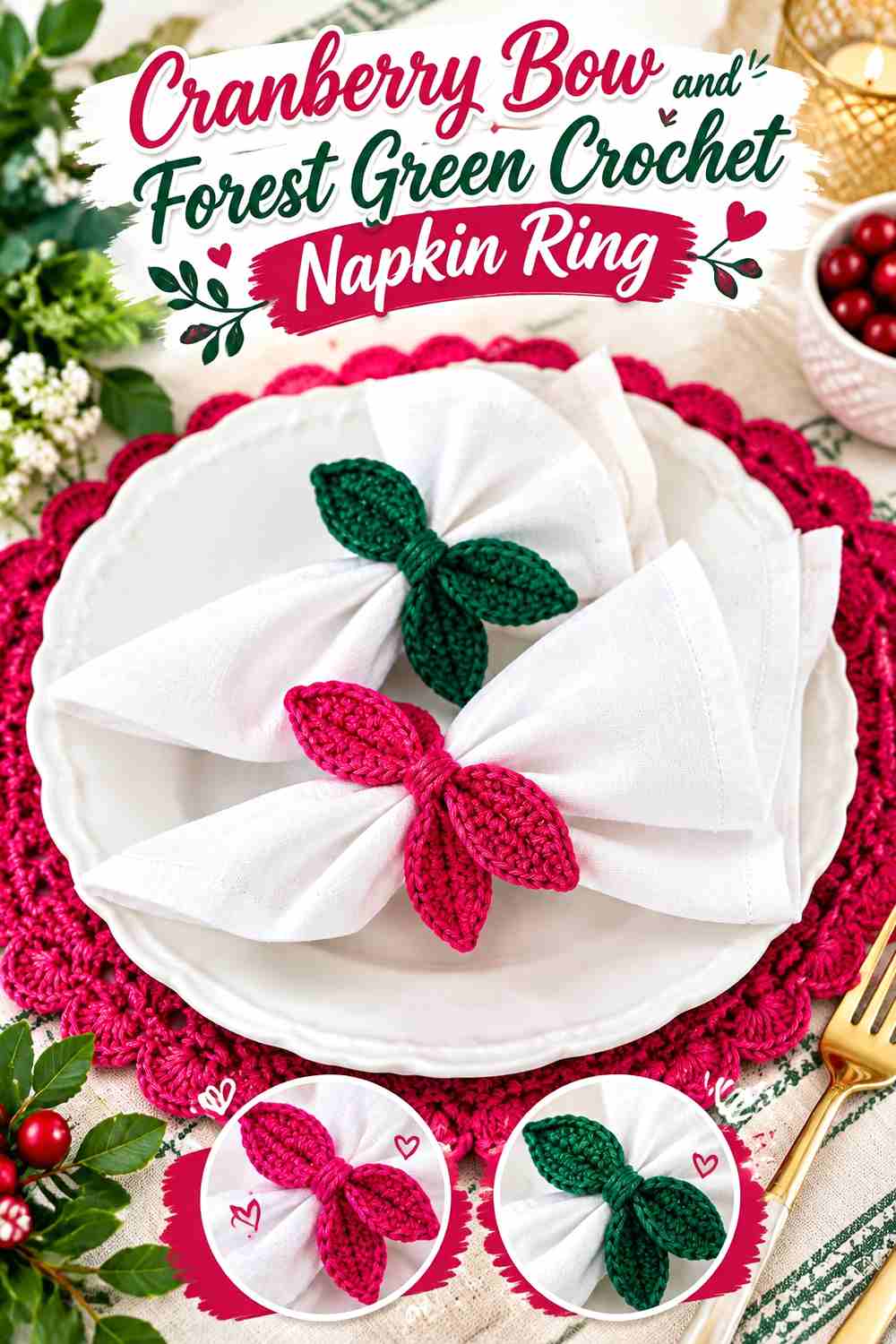
A bow provides two large loops plus a center wrap, so it offers more color-placement choices than a simple flower. Use cranberry for the bow loops and forest green for the ring and center wrap. The dark center visually pinches the cranberry bow together and connects it to the band underneath.
Make Cranberry the Main Bow Color Against Forest Green
Use cranberry across both bow loops so the decorative shape reads as one unit.
Changing one loop to green can make the bow feel asymmetrical unless that effect is deliberate. Keep the strongest color relationship between the whole cranberry bow and its green background.
Put Forest Green at the Center of the Cranberry Bow
A forest-green center wrap creates a small but noticeable dark interruption through the cranberry.
Repeating that same green through the ring band makes the center look integrated rather than like an unrelated third component.
Creator Credit: Rubi Crafts Artesanato
4. Forest Green Band And Cranberry Flower Crochet Napkin Ring

This is a straightforward floral color hierarchy: dark green ring, warm cranberry flower. Because the flower is dimensional, there is no need to add repeated stripes around the band. Let the form of the petals provide most of the visual complexity.
Keep Forest Green Simple Beneath the Cranberry Flower
A solid green ring prevents the narrow base from competing with the petal texture.
If the ring is partly hidden by the napkin, enough forest green should still remain visible at each side of the flower to establish the two-color pairing.
Use Cranberry Across the Full Forest Green Flower Motif
A single cranberry flower usually reads more clearly than a petal-by-petal red-and-green alternation.
For additional connection, repeat a tiny amount of forest green at the flower center or beneath the petals rather than adding another color.
Creator Credit: Jackie Fonseca Croche
5. Cranberry Band And Forest Green Floral Crochet Napkin Ring

Reverse the previous arrangement by letting cranberry form the band while forest green carries the floral or petal motif. This gives the ring a warmer overall appearance and makes the green decoration an unexpected focal point.
Let Cranberry Form the Main Forest Green Floral Background
Use cranberry continuously around the napkin rather than breaking the ring into tiny green stripes.
The broad warm band gives the smaller green motif enough contrast to remain visible and keeps the color hierarchy easy to understand.
Keep Forest Green Large Enough to Read Against Cranberry
If the floral feature is very small, forest green may look like an indistinct dark spot. Give the motif enough surface area to establish its petal or leaf shape.
A little forest green at the ring edge can repeat the motif color when stronger connection is needed.
Creator Credit: Home Handwork Diy
6. Forest Green Loop And Cranberry Heart Crochet Napkin Ring

A heart-shaped focal piece gives cranberry a clear decorative job while forest green forms the functional loop around the napkin. This is a useful alternative when you want a holiday palette without relying exclusively on Christmas-tree or poinsettia motifs.
Use Cranberry for the Main Forest Green Heart
Keep the complete heart cranberry so its outline remains recognizable.
On a small table accessory, dividing the heart into multiple colors can weaken the shape. The dark green loop already provides enough contrast.
Keep Forest Green Visible Around the Cranberry Heart
Allow the ring or loop to show clearly at both sides of the heart rather than letting the motif cover the entire base.
That visible green frame prevents the napkin ring from reading as a cranberry decoration with no obvious second color.
Creator Credit: beautifulcrochetproduct
7. Cranberry Ribbed And Forest Green Edged Crochet Napkin Ring
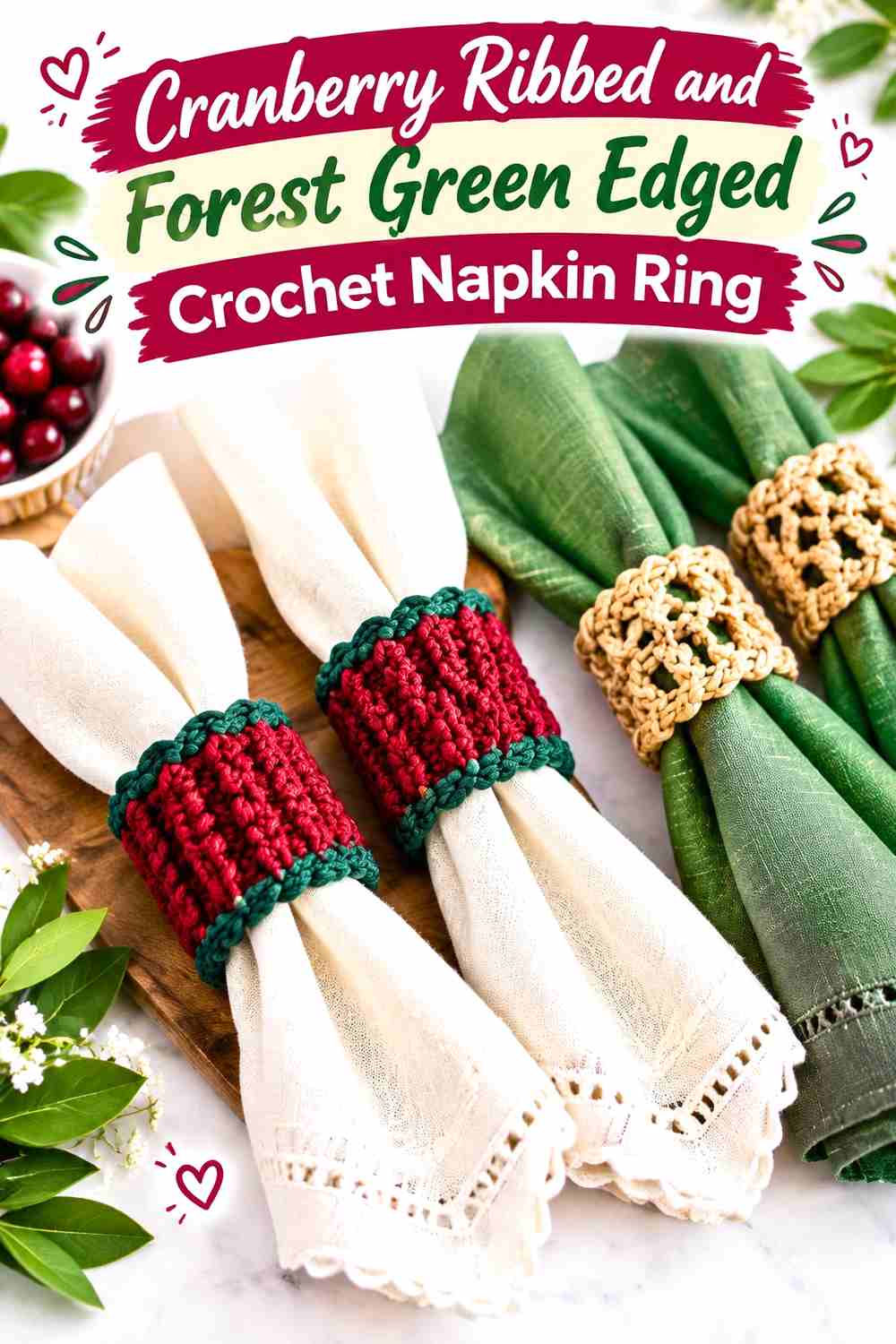
A simple ring without a large motif can rely on texture and edging instead. Make cranberry the broad body color and use forest green only at one or both outer edges. The narrow dark frame emphasizes the cylindrical shape without turning the ring into frequent holiday stripes.
Keep Cranberry Wider Than the Forest Green Edges
The central cranberry area should occupy most of the ring width if you want the warm shade to remain dominant.
Two very wide green borders could visually reduce the cranberry to a narrow center stripe, changing the balance completely.
Use Forest Green to Define the Cranberry Ring Borders
Forest-green edging can give both sides of the ring a clear stopping point and help the crochet stand apart from pale napkins.
If the napkins are already dark green, use less forest green and allow more cranberry to reach the outer edge.
Creator Credit: Pembe Düğme
8. Forest Green Band And Cranberry Scallop Crochet Napkin Ring

A scalloped border adds texture without requiring a separate attached motif. Keep the main band forest green and work the decorative edge in cranberry so the warm color traces the silhouette of the ring.
Let Forest Green Carry the Main Cranberry-Edged Ring
Use one solid green field through the functional wrap so the scallops remain the only major color change.
This keeps the ring from looking overly busy when paired with patterned holiday napkins.
Use Cranberry to Trace the Forest Green Scallops
Cranberry should remain continuous through the decorative edge so the curves read as one repeated feature.
If the scallops are small, a clear warm-versus-dark contrast is more useful than alternating individual scallops between green and red.
Creator Credit: Yarn Creation Ideas
9. Cranberry And Forest Green Striped Christmas Crochet Napkin Ring
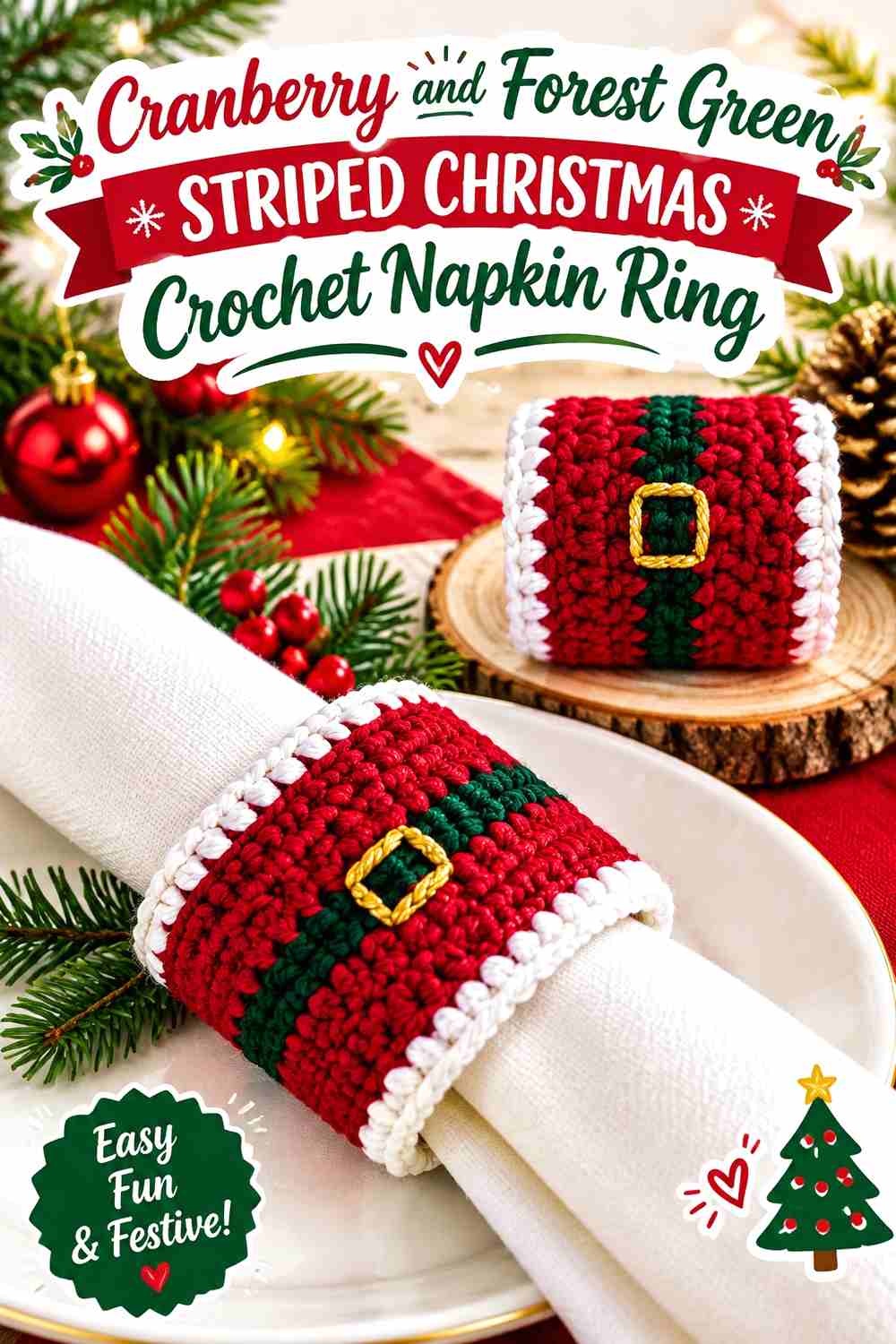
This project uses the two main colors more evenly. Alternate broad cranberry and forest-green sections around the ring, but keep the stripes substantial enough to remain visible once the napkin fills the center. The absence of a large motif allows the striping itself to become the focal feature.
Keep Cranberry and Forest Green Stripes Broad
Very narrow alternation can create visual noise on such a small accessory. Use fewer, more substantial bands so each color stays identifiable.
The visible width after the napkin is inserted matters more than how the ring looks lying flat.
Repeat Cranberry or Forest Green at the Outer Edge
Choose one of the two colors to finish both edges when you want stronger visual containment.
A forest-green edge makes the striped ring feel darker; cranberry gives the perimeter a warmer finish.
Creator Credit: lecrochetd.audrey
10. Forest Green Body And Cranberry Trim Crochet Napkin Ring
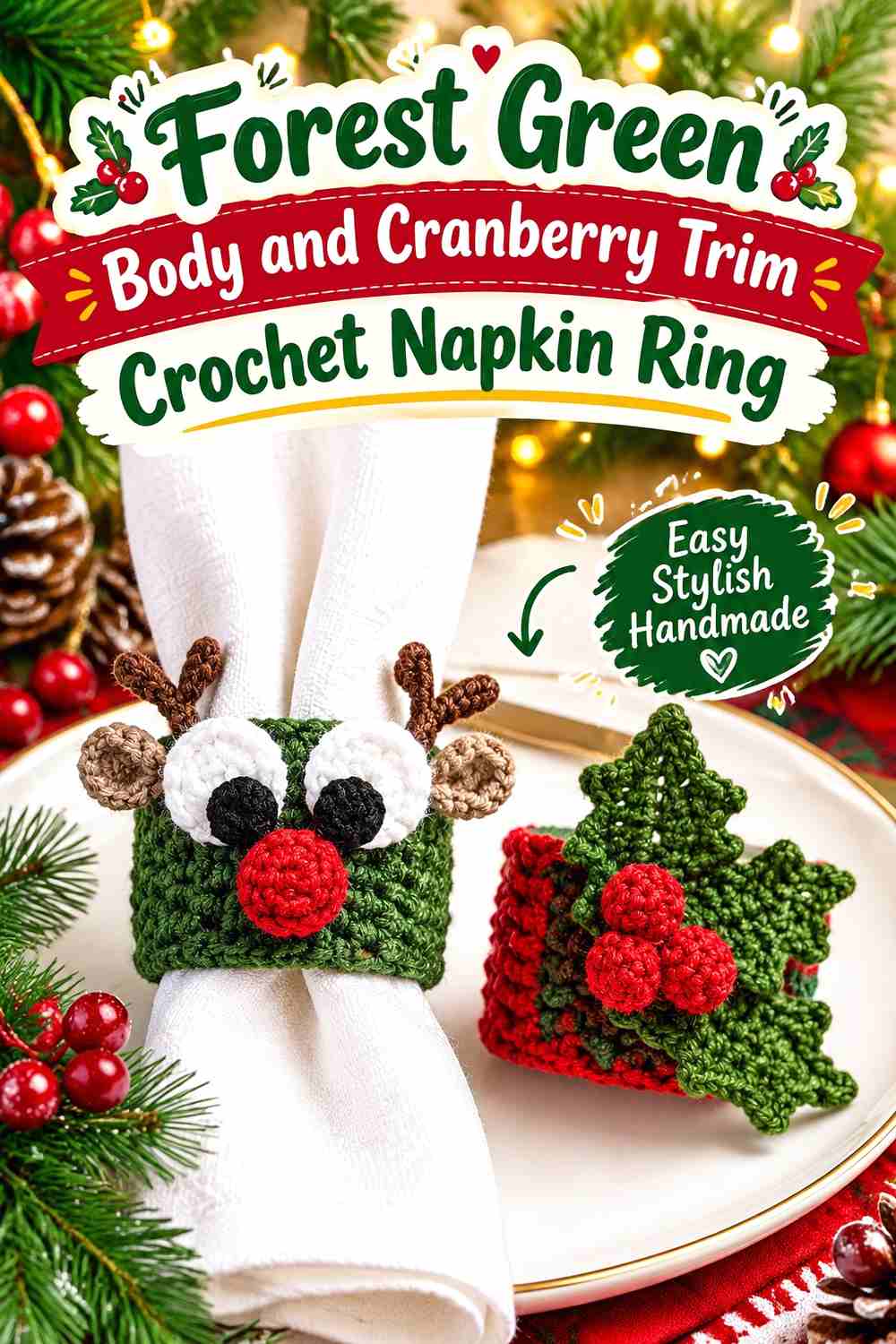
This restrained version keeps forest green across nearly the whole ring and limits cranberry to one narrow border or central line. It works well when the table already includes cranberry flowers, candles, or other red accents and the napkin rings need to support rather than duplicate them.
Let Forest Green Dominate the Cranberry-Trimmed Ring
Use green through the majority of the crochet surface and avoid extra motifs if the simple color blocking already suits the table setting.
The larger dark field also makes a relatively narrow cranberry detail more noticeable.
Keep Cranberry Focused on the Forest Green Trim
Choose one clear location for the cranberry—an outer edge, center band, or closure detail.
Repeating the warm shade everywhere can undermine the deliberately green-led direction of this design.
Creator Credit: Mamie Crochet
11. Cranberry Bow With Forest Green Center Crochet Napkin Ring
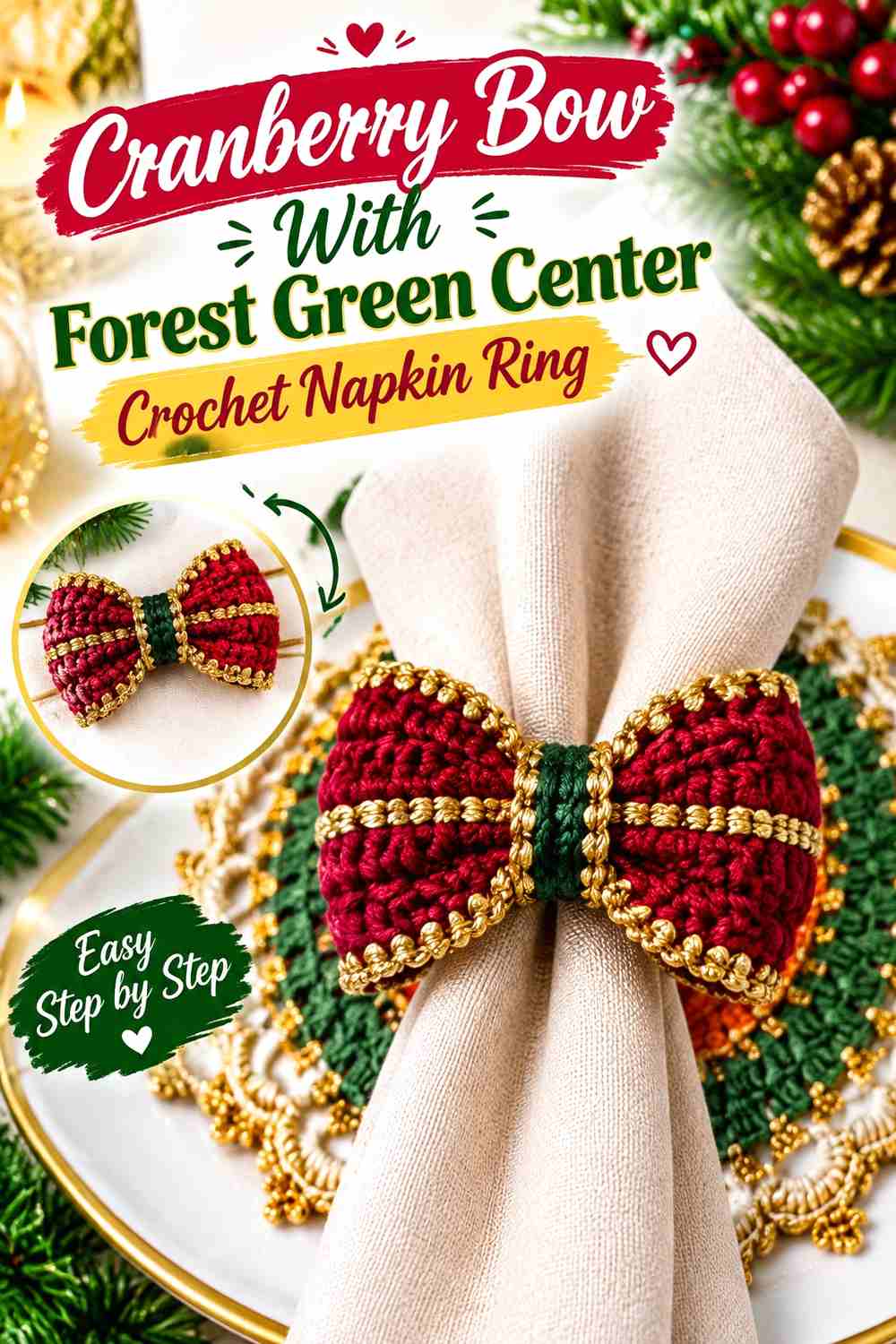
This bow variation lets cranberry occupy both the band and the main decorative loops, while forest green is restricted to the bow center and possibly one narrow ring edge. The result is warmer and more cranberry-dominant than the earlier bow idea.
Keep Cranberry Continuous From the Ring Into the Bow
Using the same cranberry across the band and bow makes the motif feel like an extension of the ring rather than a separate attached decoration.
Because most of the project is one color, the bow shape can supply the visual variation.
Use Forest Green Only Where the Cranberry Bow Needs Definition
A forest-green center wrap can divide the bow loops clearly and provide enough contrast to establish the second color.
If more green is needed, add a narrow lower edge rather than turning the whole band into stripes.
Creator Credit: Mirian Artes em Crochê
12. Forest Green And Cranberry Picot Crochet Napkin Ring
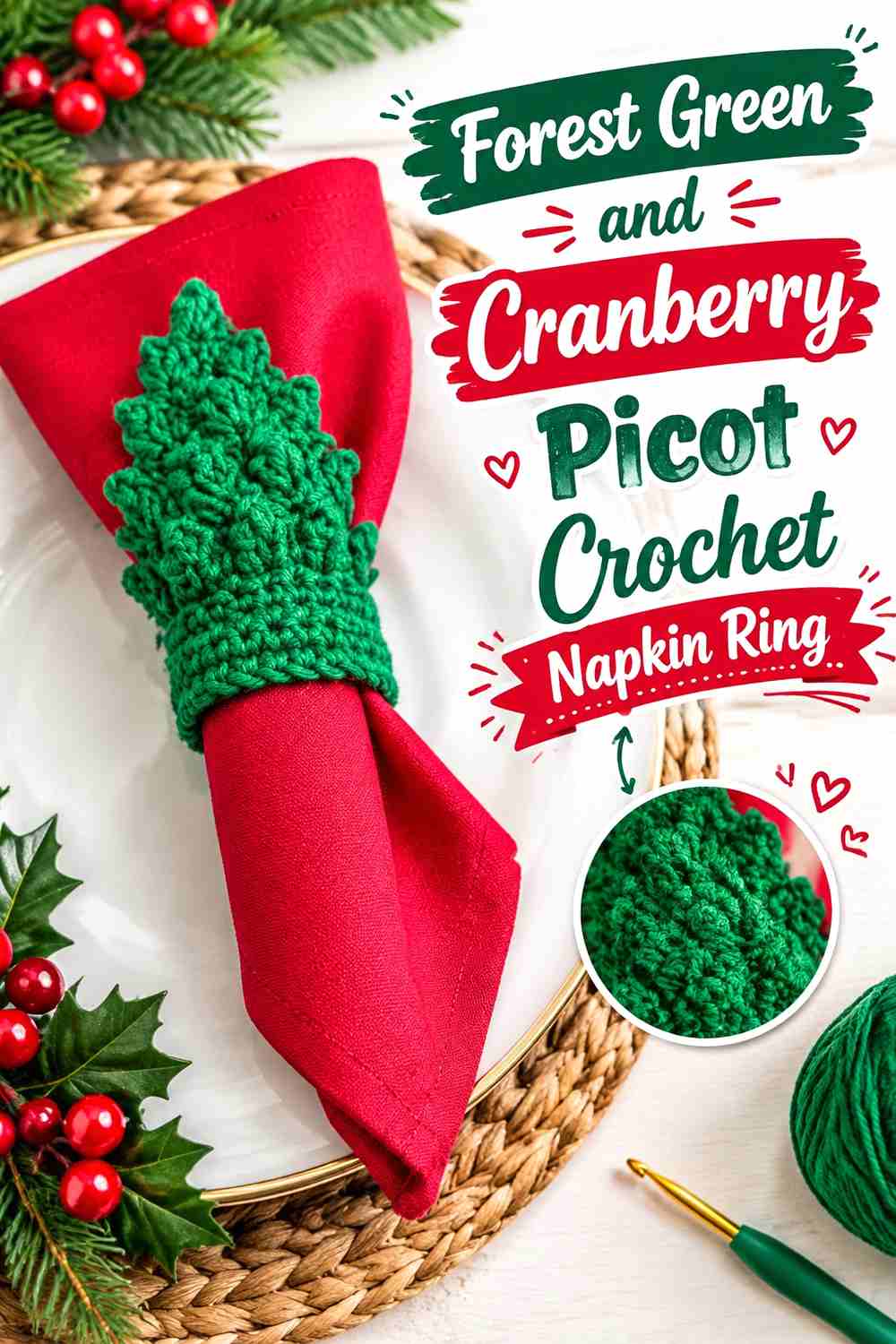
A picot-style or pointed edge suits a mostly solid forest-green ring because the small cranberry points can create decorative contrast without adding a large motif. This direction keeps the table accessory relatively flat, which can be useful when you want the napkin itself to remain the focus.
Keep Forest Green Broad Beneath Cranberry Picots
A wide green body provides enough background for the small warm points to register individually.
If the ring is too narrow, cranberry edging on both sides may occupy more area than expected, so judge the palette after finishing a sample section.
Let Cranberry Mark the Forest Green Outer Points
Use cranberry consistently through the visible pointed edge.
Avoid alternating green and cranberry from point to point unless you intentionally want a busier folk-style treatment.
Creator Credit: Atelie Eli Crochê
13. Cranberry Ring With Forest Green Motif Crochet Napkin Ring
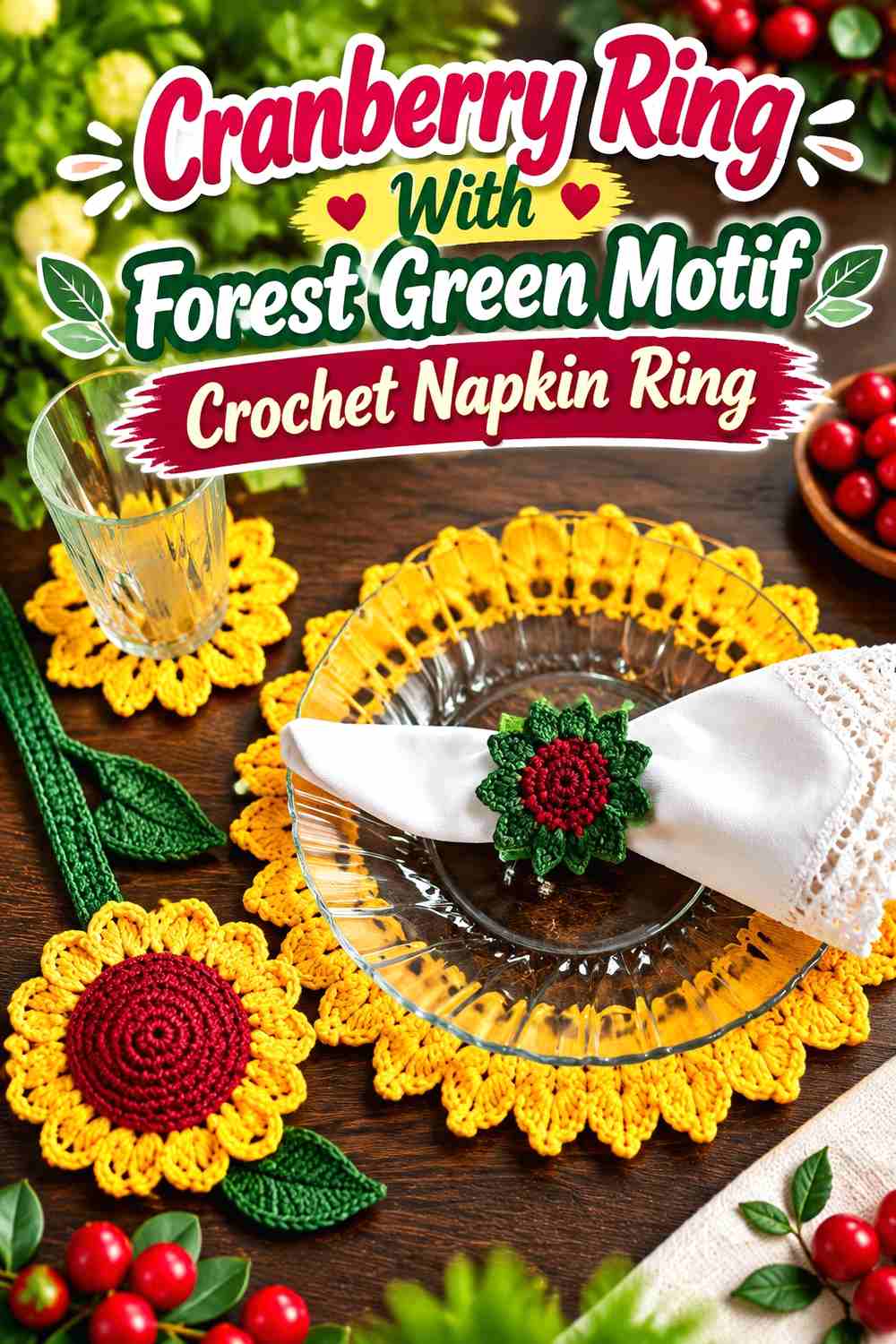
A simple ring construction can carry one compact forest-green motif on top without needing a flower or bow. This approach is useful when you want a cleaner holiday napkin ring that still includes both traditional colors.
Let Cranberry Remain the Main Forest Green Motif Background
Keep the base ring solid cranberry so the darker motif has a stable warm field.
This is particularly effective on light napkins, where the cranberry band will remain highly visible around the fabric.
Keep Forest Green Motifs Simple Against Cranberry
Use one recognizable green shape or compact decorative cluster instead of several tiny motifs.
The small scale of a napkin ring rewards clarity: one strong forest-green feature is often more readable than several separated green details.
Creator Credit: acrochet
14. Forest Green Wrap And Cranberry Tie Crochet Napkin Ring

A party-favor-style ring can use the closure or tied section as the contrasting color. Make the main wrap forest green and use cranberry where the crochet gathers, crosses, or forms the visible front fastening.
Keep Forest Green Broad Around the Cranberry Tie Area
Use forest green through the section that actually encircles the napkin so the darker shade forms a consistent base.
This makes the warm closure easier to identify and prevents the ring from becoming equally split into two unrelated halves.
Let Cranberry Identify the Forest Green Front Closure
Concentrate cranberry at the most visible front detail, whether it reads as a tie, crossing section, or decorative center.
Repeating a tiny amount of cranberry at the back is unnecessary if it will remain hidden once the ring is in use.
Creator Credit: LO QUE HACE MAYITA
15. Cranberry Poinsettia And Forest Green Leaf Crochet Napkin Ring

This version gives the full floral topper more color separation than the earlier poinsettia project. Keep the flower cranberry, use forest green for visible leaves, and choose either color for the underlying ring according to which shade you want to dominate overall.
Keep Cranberry Clear Above the Forest Green Leaves
The flower should remain visually distinct from the green sections underneath. Let the cranberry petals occupy the main top layer while forest-green leaves extend beyond them just enough to be visible.
If the leaves disappear completely beneath the flower, the ring loses much of its two-color botanical effect.
Use Forest Green to Support Rather Than Cover the Cranberry Poinsettia
Keep green concentrated in the leaves and ring structure instead of adding it through every petal.
That gives each shade a specific botanical role and makes the motif easier to understand at table-setting distance.
Creator Credit: Activa & Creativa
16. Forest Green Christmas Ring With Cranberry Border Crochet Napkin Ring
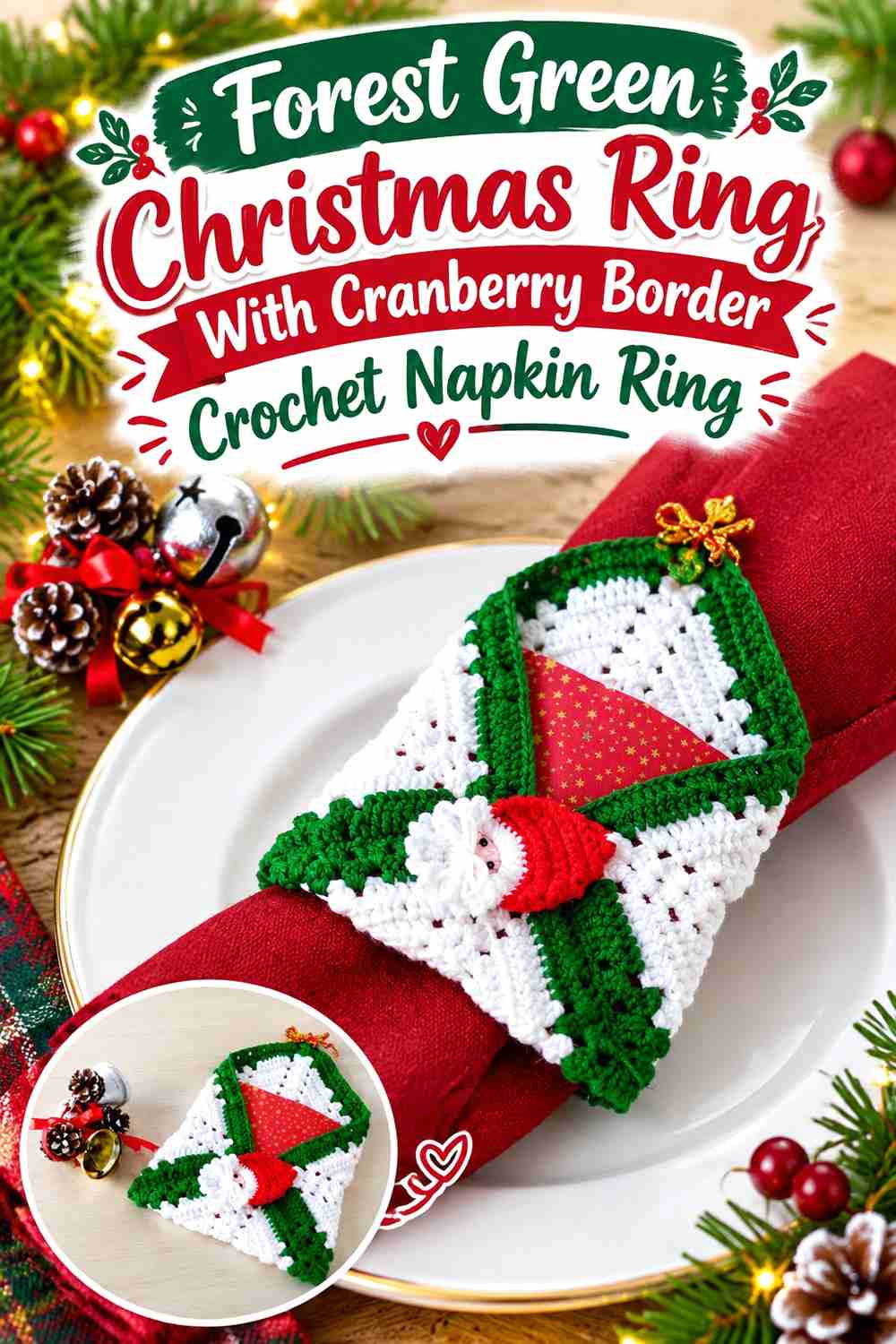
The final idea keeps the design deliberately simple: forest green through the central ring with cranberry defining one or both borders. This works particularly well as part of a larger coordinated table where centerpiece florals or patterned linens already provide plenty of decoration.
Let Forest Green Form the Main Cranberry-Bordered Christmas Ring
Give forest green the widest area so the ring feels grounded and clearly connected to the holiday palette.
A simple solid center also makes it easier to coordinate several identical rings across a full table without creating excessive visual detail.
Use Cranberry to Finish the Forest Green Ring Edge
A narrow cranberry border provides enough warm contrast to define the ring against white, cream, or pale neutral napkins.
If the napkins are already cranberry, reverse the border relationship and allow more forest green to reach the outer edge for clearer separation.
Creator Credit: aprender-crochet
Comparing the Cranberry and Forest Green Napkin Ring Directions
For the clearest traditional holiday look, the poinsettia, leaf, bow, flower, and Christmas-band versions give cranberry and forest green recognizable decorative roles. They work especially well when the rest of the table setting is relatively simple.
For a cleaner modern direction, choose the ribbed, scalloped, striped, picot, or bordered rings. These rely more on proportion and edging than on a large dimensional motif, so they can pair more easily with patterned napkins.
The floral and bow designs place most of the visual interest at the front of the ring. That can be useful when only a small part of the actual band remains visible after the napkin is inserted. Simpler striped and bordered rings distribute the palette more evenly around the napkin.
If the actual cranberry and forest-green yarns are both deep in value, favor larger motifs and broader color blocks. Small details need stronger contrast to remain readable from across a dining table.
Conclusion
Cranberry and forest green can create much more than one standard Christmas crochet napkin ring. Changing which shade forms the ring, motif, border, flower, bow, or leaf can make the same two-color palette feel graphic, botanical, traditional, or understated.
Use forest green for the main band when you want cranberry flowers, hearts, bows, or edging to become the focal point. Reverse the balance when you want a warmer ring with green leaves, centers, or borders providing definition.
Most importantly, check the color placement with a napkin actually inside the finished ring. Decorative details that look prominent on an empty ring may shift or become partly hidden once the table is set. Use the linked tutorials for their original construction methods and adapt the cranberry-and-forest-green distribution independently.
Frequently Asked Questions
Should cranberry or forest green dominate a crochet napkin ring?
Either can lead. Forest green creates a darker base that makes cranberry flowers, bows, and borders stand out, while a cranberry ring gives smaller forest-green leaves and motifs stronger contrast.
Where should cranberry go on a forest green crochet napkin ring?
Cranberry works especially well on poinsettias, flowers, bows, hearts, scallops, picots, or a narrow border. Concentrating it in a recognizable feature usually looks clearer than scattering tiny cranberry stitches throughout a dark green band.
How can I use forest green on a cranberry napkin ring?
Use forest green for leaves, motif centers, edging, closure wraps, or one compact decorative feature. A forest-green border can also visually contain a cranberry-dominant ring.
Do cranberry and forest green always have enough contrast?
No. Very deep versions of both colors can be similar in lightness. Compare the actual yarns together and, if necessary, use larger color blocks so the hue difference has enough area to remain visible.
Should every cranberry and forest green napkin ring have a Christmas motif?
No. Simple bands, scallops, stripes, hearts, bows, and bordered rings can use the same festive palette without relying on trees or poinsettias. The color relationship alone can establish the seasonal direction.
Which color should form the main napkin-ring band?
Choose forest green when the front decoration is mainly cranberry, and cranberry when the decorative feature is mostly green. This gives the motif useful contrast and prevents the band and topper from visually merging.
How do I keep cranberry and forest green napkin rings from looking too busy?
Limit each shade to a few clear functions. One color can form the ring while the other handles the motif or border. Because flowers, bows, leaves, and picots already add texture, frequent additional color changes are rarely necessary.