Apricot Cream gives a crochet flower keychain a warm, softened base that sits between pale peach and a creamy neutral direction. On small flowers, it can cover the petals, appear in the center, or connect several stronger colors without making the finished charm look overly busy.

Color placement matters more on a keychain than on a large crochet flower because every detail is compressed into a small area. A flower center needs enough separation from the petals, leaves need to remain visible beneath the bloom, and the attachment loop should feel connected to the motif instead of looking like an unrelated extension.
Apricot Cream works particularly well as the dominant petal shade because darker or cooler centers can give the flower definition without taking up much surface. It can also serve as the lighter color in layered flowers, where a deeper back layer or contrasting center helps individual petals remain readable.
The tutorials below include direct flower keychains, daisy and sunflower charms, mini flowers, flower bag charms, appliqués, layered blooms, and bouquet-style flower constructions. When a tutorial demonstrates a flower rather than a finished keychain, the ring attachment and Apricot Cream palette are independent adaptations rather than features attributed to the creator.
Quick List
- Apricot Cream And Honey Gold Crochet Daisy Flower Keychain
- Apricot Cream And Dusty Rose Crochet Double Color Flower Keychain
- Apricot Cream And Cocoa Brown Crochet Sunflower Keychain
- Apricot Cream And Sage Crochet Flower Pouch Keychain
- Apricot Cream And Coral Crochet Rounded Flower Keychain
- Apricot Cream And Olive Crochet Retro Flower Keychain
- Apricot Cream And Cranberry Crochet Layered Flower Keychain
- Apricot Cream Sage And Mustard Crochet Mini Bouquet Keychain
- Apricot Cream And Sea Glass Crochet Mini Flower Keychain
- Apricot Cream And Butter Yellow Crochet Daisy Bag Charm Keychain
- Apricot Cream And Terracotta Crochet Leaf Flower Keychain
- Apricot Cream And Dusty Lilac Crochet Plush Flower Keychain
- Apricot Cream And Rosewood Crochet Layered Petal Keychain
- Apricot Cream And Forest Green Crochet Flower Applique Keychain
- Apricot Cream And Soft Lavender Crochet Floral Cluster Keychain
- Apricot Cream And Blush Pink Crochet Cherry Blossom Keychain
- Apricot Cream And Charcoal Crochet Mini Flower Keychain
Let Apricot Cream Control the Flower Petals
The petals usually occupy the greatest visual area, so they are the clearest place to establish Apricot Cream. A darker center or leaf color can then provide definition without dividing every petal into multiple shades.
On layered flowers, keep at least one complete petal layer in Apricot Cream rather than alternating colors petal by petal. That broader repetition makes the main shade easier to recognize once the charm is attached to keys or a bag.
Protect Apricot Cream Petal Definition With Center Contrast
A flower center is small, which means it needs enough value contrast to remain visible. Honey, brown, rose, teal, plum, or green can all work, but compare the actual yarns rather than assuming different hue names will automatically separate.
A grayscale photo is a useful check when two colors seem distinct but have similar lightness. If the center nearly disappears in grayscale, use that pairing for broader petal layers and choose a lighter or darker center.
Connect Apricot Cream Flowers to the Keyring Color
The hanging loop, crocheted chain, leaf, or stem between the flower and metal ring becomes part of the finished composition. Repeating a palette color there helps the flower and keyring feel connected.
If the flower already contains several shades, keeping the attachment section Apricot Cream can simplify the design. If the bloom is nearly monochromatic, the attachment point is a useful place to repeat the darker center or leaf color.
1. Apricot Cream And Honey Gold Crochet Daisy Flower Keychain
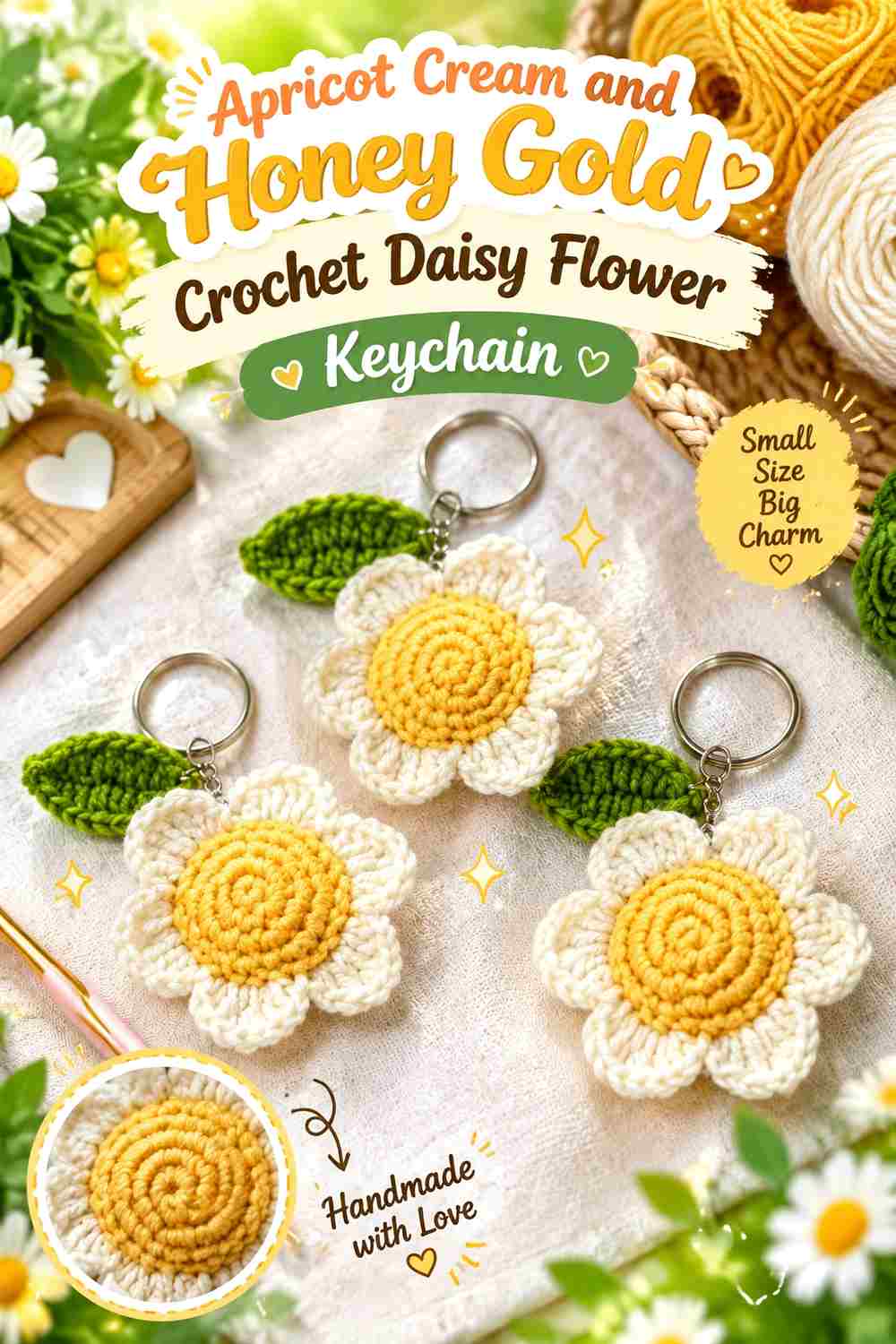
Apricot Cream petals with a honey-gold center create a warm daisy palette without relying on bright white. Let Apricot Cream cover the full petal ring so the flower has one continuous soft field, then use honey gold only where the center needs definition. A small green leaf can be added if the construction supports it, but the two main colors already create a clear flower shape.
Apricot Cream Should Cover the Full Daisy Petal Ring
Keep the petals consistently Apricot Cream instead of alternating cream and gold. A complete light petal ring allows the compact daisy silhouette to remain easy to recognize and keeps the center from competing with multiple accent areas.
If you want more gold, repeat it near the hanging connection rather than inserting it into every petal.
Apricot Cream Needs a Honey Gold Center With Enough Contrast
Some pale gold yarns can be surprisingly close to Apricot Cream in value. Compare the colors before finishing several flowers and choose a center that remains visibly deeper if you want the circular middle to be obvious.
When the gold is intentionally subtle, make the center broad enough for the color difference to register rather than relying on tiny stitches.
Creator Credit: The Yarnling
2. Apricot Cream And Dusty Rose Crochet Double Color Flower Keychain

Dusty Rose adds a soft warm-pink contrast while Apricot Cream keeps the petals light. Use Apricot Cream on the larger petal area and place rose in the flower center, a second petal layer, or a small leaf-adjacent detail. This makes the keychain colorful without distributing equal amounts of both shades across every part.
Apricot Cream Should Remain the Main Color Beside Dusty Rose
If Dusty Rose covers half the petals, the charm can start to look like an equal two-color flower. Keep Apricot Cream across the dominant petal layer and concentrate rose in one recognizable section.
That hierarchy also makes it easier to repeat rose once near the attachment loop without making the keychain visually crowded.
Apricot Cream Needs Dusty Rose in a Broad Enough Accent
Muted pink and Apricot Cream can be close in lightness. If a tiny rose center disappears, use the pink across a secondary petal layer or broader center where its warmer direction is easier to see.
Keep the finest petal edges Apricot Cream when stronger color separation is not necessary.
Creator Credit: Shelen Crochet
3. Apricot Cream And Cocoa Brown Crochet Sunflower Keychain

Cocoa Brown gives Apricot Cream a deep earthy center and turns the sunflower concept into a softer neutral version. Keep the petals Apricot Cream and concentrate Cocoa Brown in the middle, where the strong value difference can define the bloom with very little dark yarn.
Apricot Cream Should Stay Continuous Around the Cocoa Brown Sunflower Center
A full ring of Apricot Cream petals gives the flower a clean silhouette around the darker middle. Avoid adding brown edging to every petal unless you deliberately want a strongly outlined effect.
The dark center already provides enough contrast to separate individual color zones on a small charm.
Apricot Cream Can Keep Cocoa Brown Away From the Keychain Edge
If Cocoa Brown is also used in the attachment loop, the top of the charm may become visually heavy. Keeping the loop Apricot Cream or a muted green can preserve the light petal emphasis.
Repeat brown outside the center only when the palette needs another small dark anchor.
Creator Credit: ElyseCrochets 💌
4. Apricot Cream And Sage Crochet Flower Pouch Keychain

A flower-shaped pouch or fuller bag charm provides more surface than a flat flower, making Apricot Cream and sage useful as broader color blocks. Apricot Cream can cover the front petals while sage sits behind them, marks the back panel, or appears near the hanging connection.
Apricot Cream Should Lead the Flower Pouch Front
Keep the most visible flower face Apricot Cream so the main color remains obvious when the charm hangs from a bag. Sage is more useful on the backing or attachment area where it can give the soft cream petals a botanical frame.
Avoid alternating green and cream across every petal unless a deliberately multicolor flower is wanted.
Apricot Cream Needs Sage Around the Pouch Edge Only Where It Clarifies Shape
A sage outer edge can separate the flower silhouette from a pale handbag, but outlining the entire motif may shift attention away from Apricot Cream.
Test the charm against the bag where it will be used. Sometimes a small green attachment section provides enough contrast without a full border.
Creator Credit: Kukkacrochet By Putri
5. Apricot Cream And Coral Crochet Rounded Flower Keychain
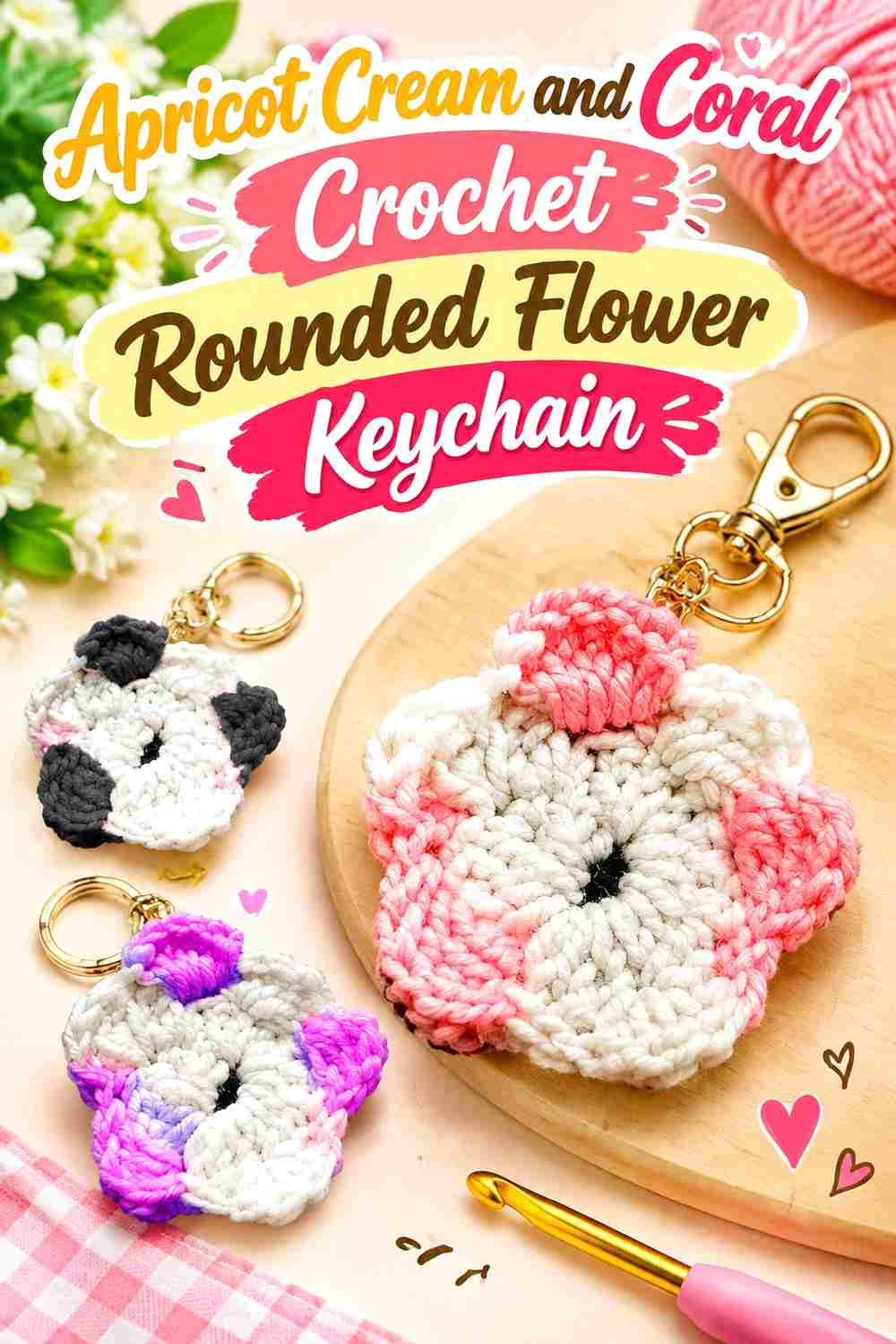
Coral introduces stronger warmth while keeping the palette close to Apricot Cream. On a rounded or fuller flower charm, use Apricot Cream across most of the body and place coral in the center or on a smaller petal layer.
Apricot Cream Should Cover More of the Rounded Flower Than Coral
Fuller flower charms already have a lot of visual volume. Keeping the broad body Apricot Cream prevents the additional coral from making the design look heavier than necessary.
Use coral where it identifies the center or another distinct component rather than scattering it across every surface.
Apricot Cream Needs Coral Repeated Near the Keyring Only Once
If the coral center looks isolated, repeat a small amount near the hanging loop or attachment point. One repeat is generally enough to connect the warm accent through a compact keychain.
Keep the main loop Apricot Cream if coral already occupies a substantial center area.
Creator Credit: Amazing Fashion and crochet
6. Apricot Cream And Olive Crochet Retro Flower Keychain
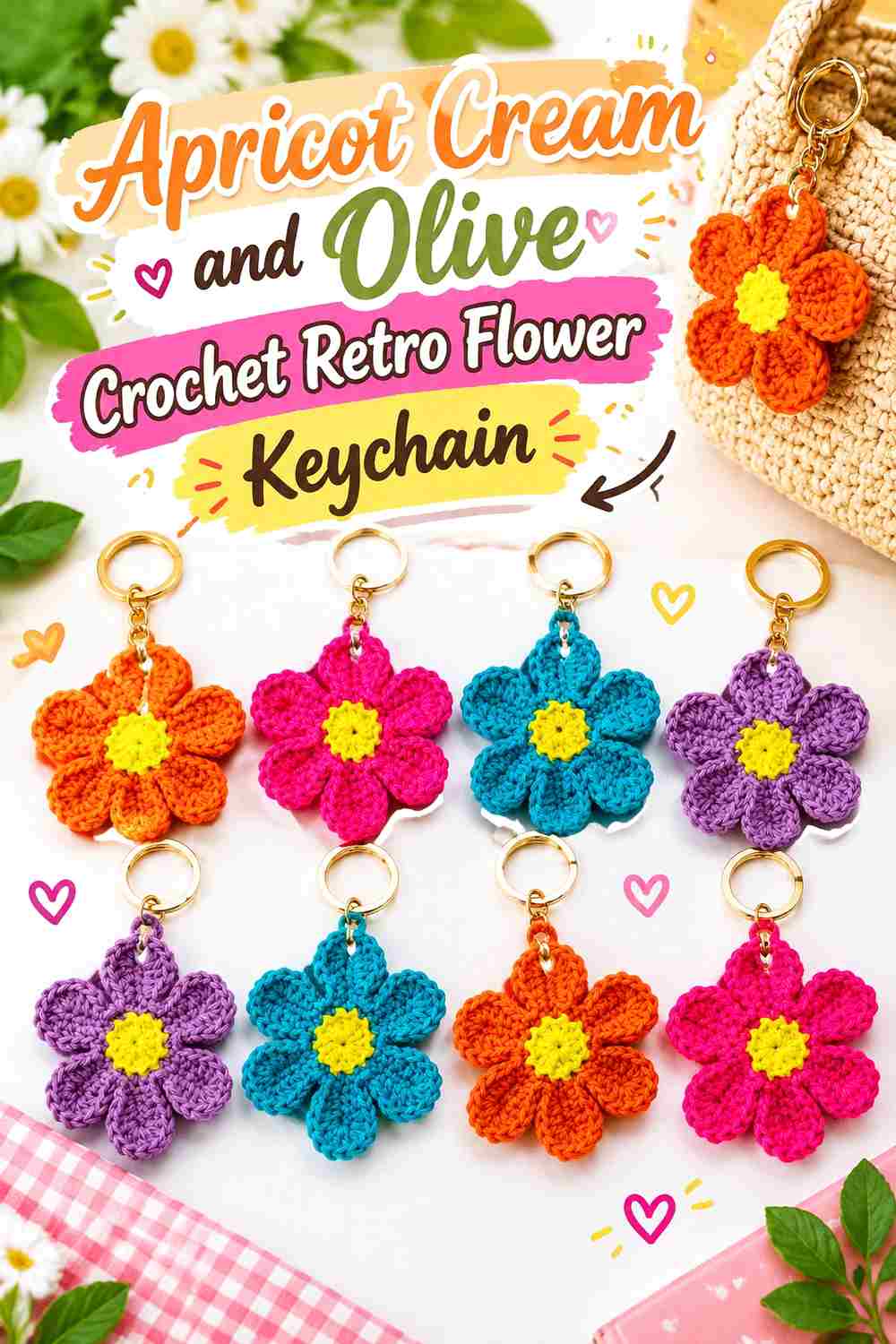
Olive gives Apricot Cream a muted green contrast that suits a rounded retro flower shape. Apricot Cream can form the petals while olive appears in the center, backing, or hanging section, creating a botanical palette without using a bright leaf green.
Apricot Cream Should Keep the Retro Petals Visually Unified
Use Apricot Cream across each major petal so the flower shape remains easy to read. Alternating every petal with olive can weaken the main-color effect and make the motif look more like a color wheel than one flower.
Let olive occupy the center or background where it has a clear supporting purpose.
Apricot Cream Needs Olive Behind the Petals for Stronger Depth
An olive backing or center can give Apricot Cream petals more separation, especially when the keychain hangs against a pale bag.
If the bag itself is dark green or brown, check the finished charm against that background before deciding whether the olive edge still provides useful contrast.
Creator Credit: naztazia
7. Apricot Cream And Cranberry Crochet Layered Flower Keychain

Cranberry creates a deeper warm accent that can define a layered flower without requiring black or brown. Use Apricot Cream on the front petal layer and cranberry behind it or in the center so the darker color appears through controlled gaps.
Apricot Cream Should Cover the Upper Petal Layer Above Cranberry
The front layer is the first part the eye reads, so keeping it Apricot Cream preserves the requested color direction. Cranberry underneath can give each petal more visual separation where the layers overlap.
Avoid repeating cranberry on every petal tip if the back layer already provides enough contrast.
Apricot Cream Needs Cranberry Kept Smaller Around the Keyring
A cranberry attachment loop plus a large cranberry underlayer may begin to dominate the charm. Keep the keyring connection Apricot Cream when the flower already contains a substantial dark accent.
If the underlayer is very small, a cranberry loop can instead provide the second repeat the palette needs.
Creator Credit: Crochet with Yarnhild
8. Apricot Cream Sage And Mustard Crochet Mini Bouquet Keychain
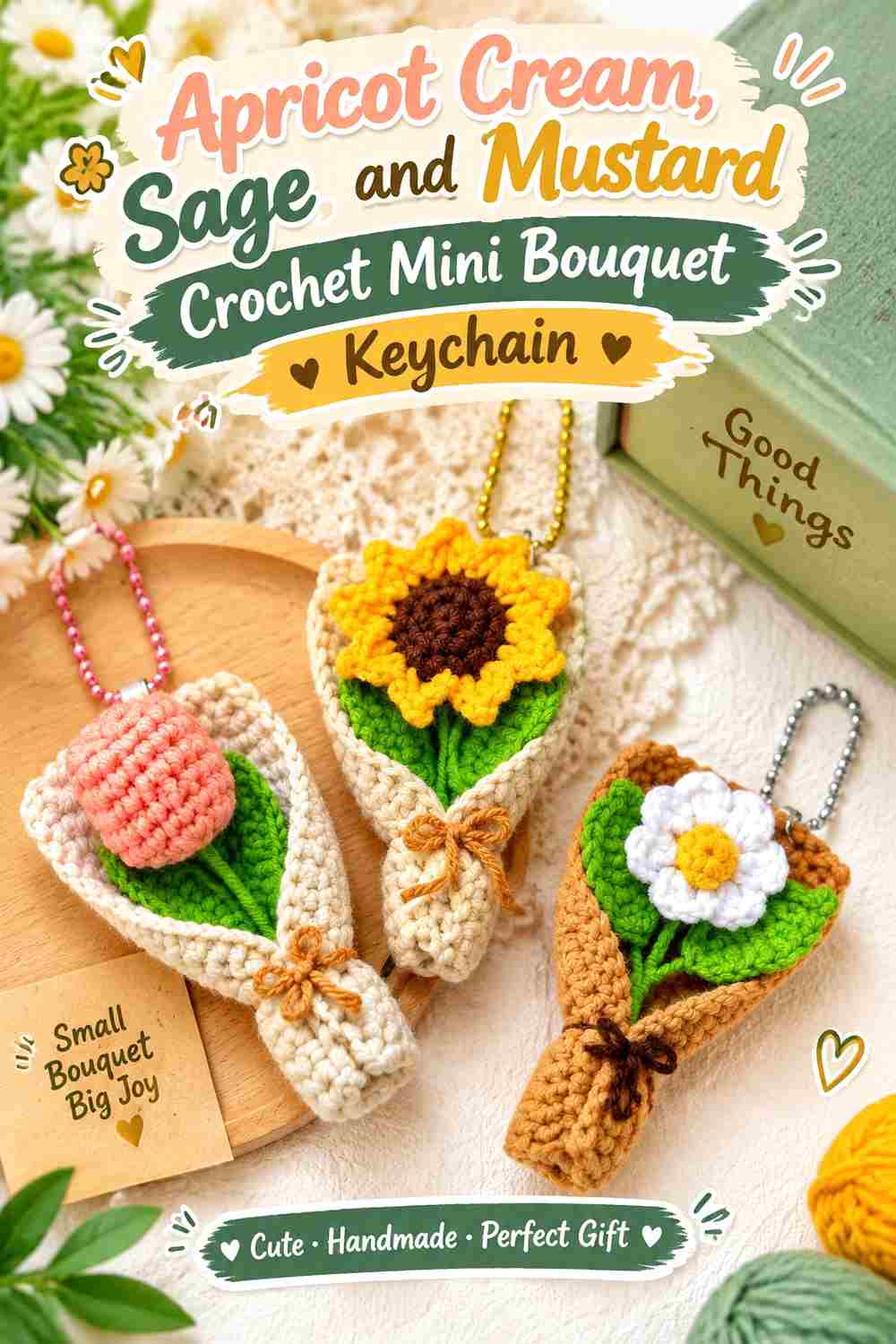
A bouquet keychain can support three colors because separate flowers naturally create different color zones. Let Apricot Cream remain the most repeated bloom, use sage for leaves and wrapping details, and reserve mustard for one smaller flower center or secondary blossom.
Apricot Cream Should Appear More Often Than Sage and Mustard
A tiny bouquet can become visually busy when every flower is a completely different color. Repeat Apricot Cream across the largest or most numerous blooms so the grouping still reads as one coordinated keychain.
Sage can connect the separate flowers through leaf details without competing with the petals.
Apricot Cream Needs Mustard as a Small Bouquet Accent
Mustard is warmer and visually stronger than Apricot Cream, so a small amount can influence the whole bouquet. Use it in selected centers or one smaller bloom rather than giving it equal coverage.
This leaves Apricot Cream responsible for the bouquet’s soft overall appearance.
Creator Credit: Chubby Cheeks
9. Apricot Cream And Sea Glass Crochet Mini Flower Keychain
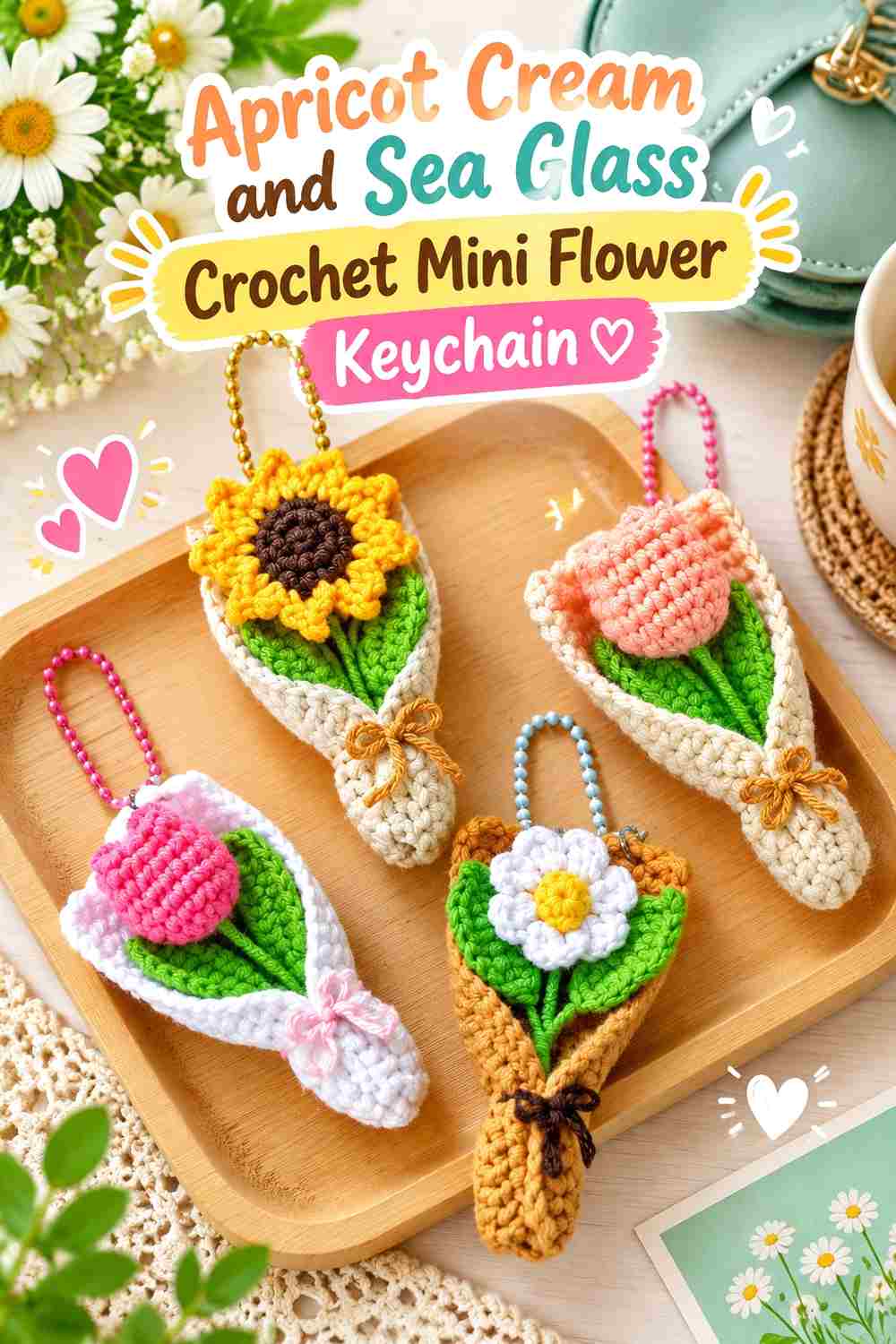
Sea Glass gives Apricot Cream a cool blue-green contrast and creates one of the freshest palettes in the collection. Apricot Cream should stay on the petals while Sea Glass works well in the center, leaf, or attachment loop.
Apricot Cream Should Stay Warmer Than the Sea Glass Accent
The interest comes from warm cream-peach petals beside a cool muted blue-green. Keep those roles distinct instead of mixing both colors equally through every petal.
A Sea Glass center can create enough cool contrast without requiring another large section.
Apricot Cream Needs Sea Glass Tested on Small Flower Details
Two muted colors can look closer once they are reduced to a tiny motif. Place Sea Glass against an Apricot Cream flower before committing to a fine outline.
If the difference is subtle, use Sea Glass on a broader center or leaf where its color remains easier to recognize.
Creator Credit: Knitting Love
10. Apricot Cream And Butter Yellow Crochet Daisy Bag Charm Keychain

Butter yellow creates a very soft daisy palette with Apricot Cream. Because both shades are light and warm, placement needs to make the center large enough to remain visible.
Apricot Cream Should Define the Daisy Petals Around Butter Yellow
Keep every main petal Apricot Cream and use butter yellow exclusively for the center. This simple division prevents two pale shades from becoming scattered across a very small motif.
If more yellow is wanted, repeat it near a small leaf junction or attachment detail rather than recoloring petal edges.
Apricot Cream Needs Enough Value Difference From Butter Yellow
A pale yellow may blend into Apricot Cream under warm lighting. Compare the completed center and petals from normal viewing distance before making a batch of matching keychains.
Choose a slightly deeper butter yellow when you want the center to remain obvious while preserving the gentle palette.
Creator Credit: Miyabi Crochet
11. Apricot Cream And Terracotta Crochet Leaf Flower Keychain
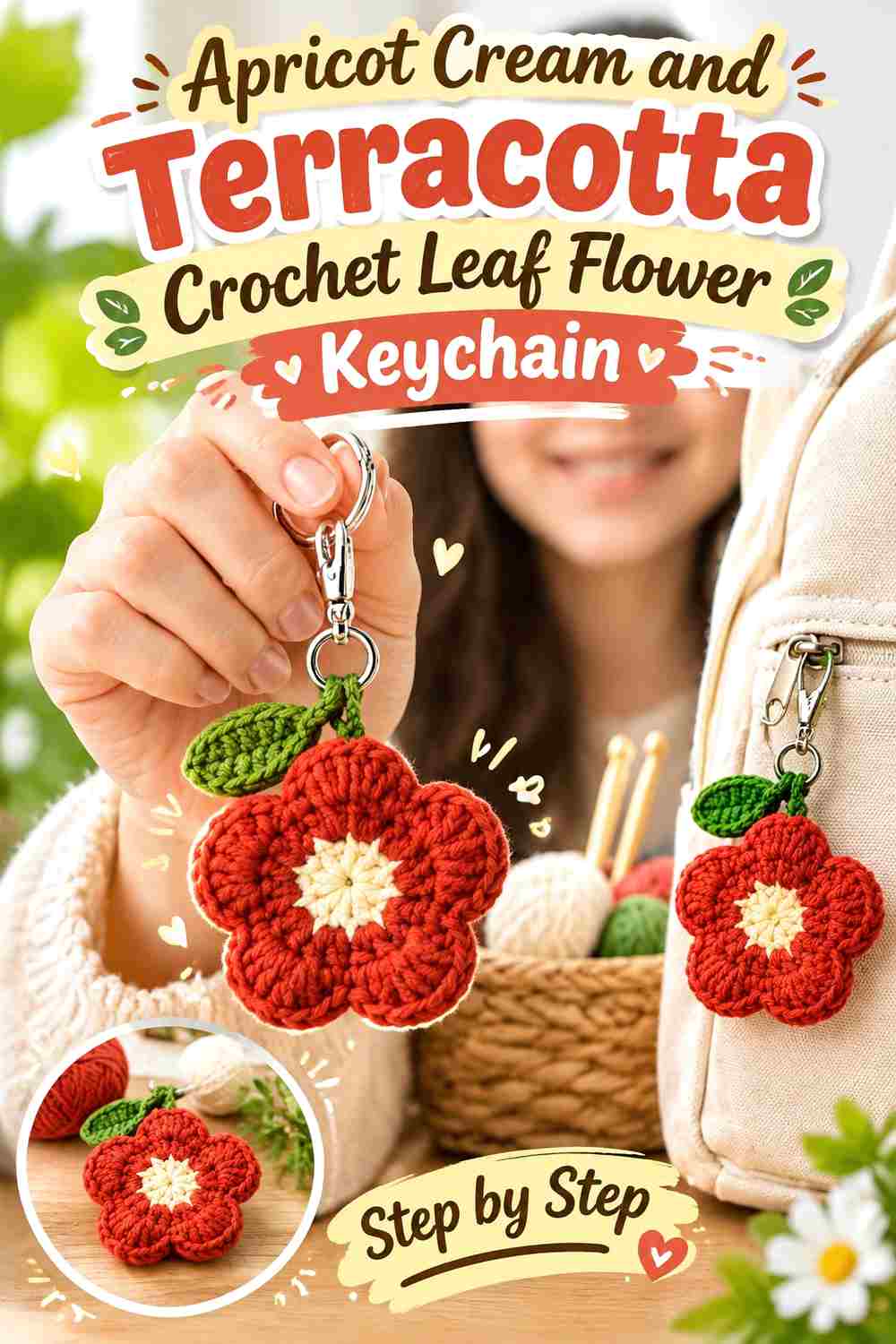
Terracotta gives Apricot Cream a richer earthy contrast while staying within a warm palette. Use Apricot Cream for petals and terracotta for a compact center or attachment accent, with green reserved only if a leaf is part of the construction.
Apricot Cream Should Keep Terracotta Concentrated in the Flower Center
A dark terracotta center gives the pale petals a strong anchor. Extending the same shade around every edge can reduce the soft Apricot Cream effect.
Let the center do most of the contrast work and keep the petal silhouettes simple.
Apricot Cream Can Repeat Above a Terracotta Hanging Detail
If terracotta appears at the attachment point, insert enough Apricot Cream between the flower center and the loop that the two dark accents do not visually merge into one continuous stripe.
This keeps the pale flower body responsible for connecting the complete keychain.
Creator Credit: Ngochan Crochet
12. Apricot Cream And Dusty Lilac Crochet Plush Flower Keychain

Dusty Lilac adds a cool purple contrast to a fuller plush-style flower. Apricot Cream can form the main body or broad petals, while lilac sits in the center or on one secondary petal layer.
Apricot Cream Should Control the Plush Flower Body
A dimensional charm has more surface than a flat appliqué, so keeping most of that volume Apricot Cream prevents Dusty Lilac from overtaking the design.
Use lilac at the center or another compact focal point where the contrasting hue remains obvious.
Apricot Cream Needs Dusty Lilac Away From Too Many Petal Tips
Coloring every tip lilac can break the rounded flower into numerous small sections. Keep the outer silhouette Apricot Cream and concentrate the purple nearer the center when you want the charm to remain visually soft.
A small lilac attachment detail can repeat the accent without changing the petal shape.
Creator Credit: sherrscrochet
13. Apricot Cream And Rosewood Crochet Layered Petal Keychain

Rosewood gives Apricot Cream a muted dark-red partner with enough depth to emphasize layered petals. Use Apricot Cream on the upper layer and Rosewood underneath so the darker color appears naturally between overlapping shapes.
Apricot Cream Should Remain the Top Layer Above Rosewood
Keeping the lighter shade in front ensures Apricot Cream remains the first color visible when the flower hangs from a keyring.
Rosewood underneath can create depth without requiring separate outlines around every petal.
Apricot Cream Needs Rosewood Limited Around the Outer Edge
If too much Rosewood extends beyond the upper petals, the darker back layer may become the apparent flower color.
Check the complete silhouette and reduce the visible dark edge when you want only subtle separation between Apricot Cream petals.
Creator Credit: The Crochet Crowd
14. Apricot Cream And Forest Green Crochet Flower Applique Keychain

Forest green gives a flat Apricot Cream flower a strong botanical frame. Because a flat appliqué has less dimensional shadow than a stuffed charm, the green is useful in a leaf, backing, or attachment area where it can strengthen the silhouette.
Apricot Cream Should Stay Clear Against Forest Green Backing
A small Forest Green leaf or backing section can make pale Apricot Cream petals easier to see against a light bag.
Keep the green behind the bloom rather than inserting it into every petal so the flower itself remains Apricot Cream.
Apricot Cream Needs Forest Green Repeated at the Keyring Connection
If the flower includes a green leaf, a matching green loop or short attachment section can connect that supporting shade to the hardware.
Keep the attachment compact so the green does not become more visually prominent than the Apricot Cream motif.
Creator Credit: Canal de Crochê
15. Apricot Cream And Soft Lavender Crochet Floral Cluster Keychain

Soft Lavender brings a cool purple note while Apricot Cream keeps the cluster warm and light. This palette works especially well when several small flowers are grouped together because the two shades can alternate by flower instead of being mixed within every tiny bloom.
Apricot Cream Should Be the Most Repeated Color in the Lavender Cluster
Use more Apricot Cream flowers than lavender ones if the keychain is intended to remain Apricot Cream-led. A few lavender blooms can provide noticeable variation without changing the overall balance.
Repeat the same center color across both flower shades if you want the cluster to feel more unified.
Apricot Cream Needs Soft Lavender Separated by Leaves or Centers
When flowers overlap tightly, neighboring pale petals can blend together. A darker center or small green leaf between Apricot Cream and lavender sections can clarify where one bloom ends and the next begins.
Use that separation selectively rather than outlining every petal.
Creator Credit: Tammy crochet & art
16. Apricot Cream And Blush Pink Crochet Cherry Blossom Keychain
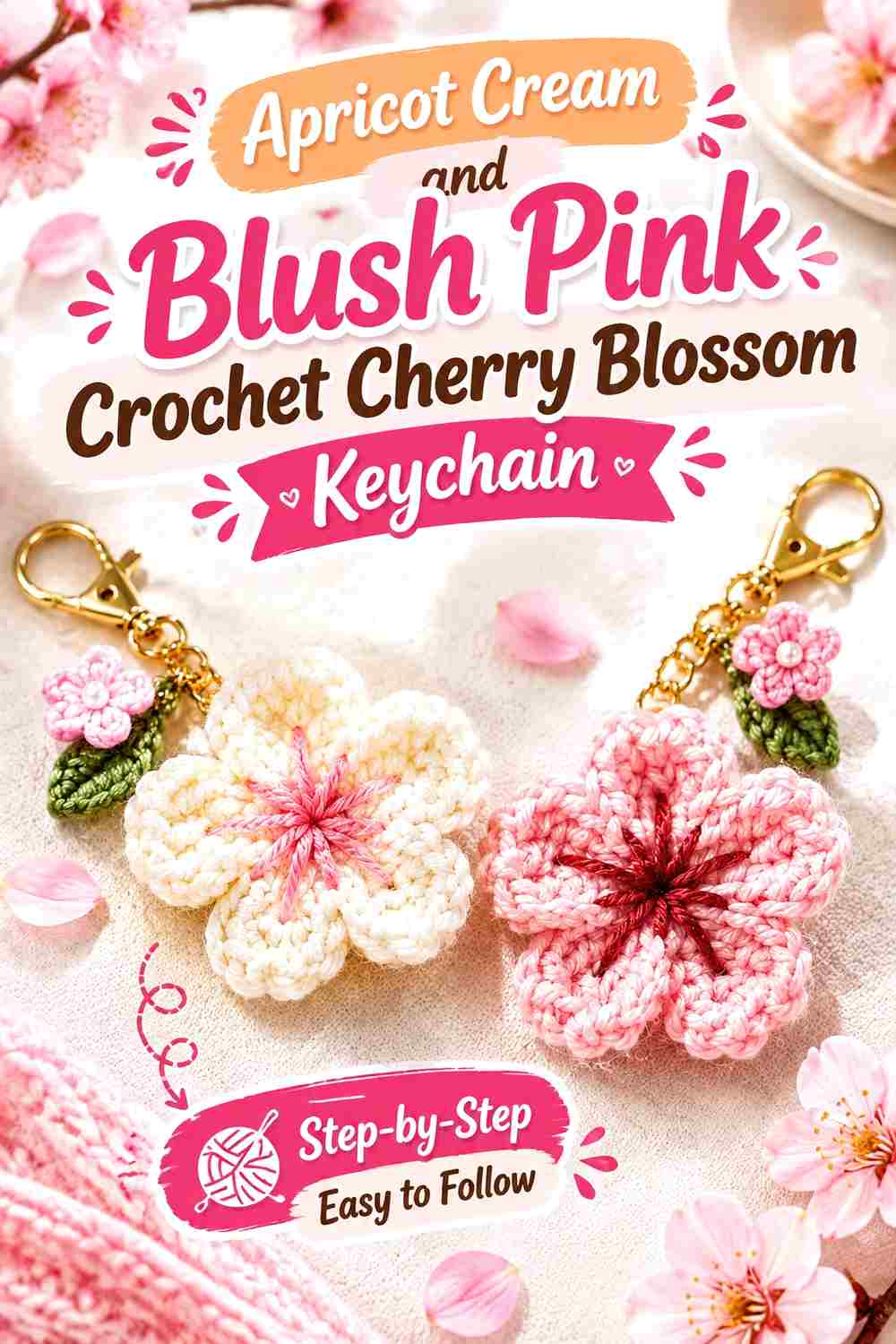
Blush pink creates a subtle floral transition that suits the delicate shape of cherry blossoms. Apricot Cream can cover the main petals while blush is concentrated nearer the center or used on selected blossoms in a small cluster.
Apricot Cream Should Stay Visible Across the Cherry Blossom Petals
Keep enough of each flower Apricot Cream that the pink does not become the dominant petal color. A small blush center or inner petal detail creates warmth without changing the main shade.
For multiple blossoms, alternate accent placement rather than recoloring entire flowers at random.
Apricot Cream Needs Blush Pink With Enough Contrast at Small Scale
Blush and Apricot Cream may be nearly identical in value. Test the pairing on a finished flower before assuming the center will remain visible.
If necessary, choose a slightly deeper blush or add a small contrasting center while keeping both pale shades in the petal area.
Creator Credit: Stitched by Sneha
17. Apricot Cream And Charcoal Crochet Mini Flower Keychain

Charcoal creates the strongest neutral contrast in this collection. On a very small flower, use it sparingly in the center, backing, or keyring connection so it defines Apricot Cream without overwhelming the petals.
Apricot Cream Should Cover Nearly the Whole Mini Flower
A tiny motif has limited visual area, so even a small charcoal section can appear prominent. Keep the petals Apricot Cream and concentrate the dark shade in one central point.
This allows the flower silhouette to remain soft while still having a clear focal center.
Apricot Cream Needs Charcoal Kept Small at the Keychain Loop
If both the center and hanging loop are charcoal, the dark color may visually run through the entire motif. Keep the loop Apricot Cream when the center already supplies enough contrast.
Alternatively, use charcoal only at the loop and keep the flower fully Apricot Cream for the simplest two-zone design.
Creator Credit: HappyBerry Crochet
Choosing Between These Apricot Cream Flower Keychain Palettes
For a soft, light keychain, pair Apricot Cream with butter yellow, blush pink, powder blue, Dusty Rose, or Soft Lavender. These combinations keep the flower delicate, but they need careful value checks because pale colors can visually merge on tiny petals.
For stronger definition, Cocoa Brown, Forest Green, Rosewood, Cranberry, or Charcoal can make centers, back layers, and attachment details much easier to distinguish. Use those deeper shades sparingly because a small amount carries considerable visual weight on a keychain.
Sage, olive, and Sea Glass create muted botanical or cool contrasts, while terracotta and coral keep the palette warm. For bouquet-style keychains, a third shade can work well when one color handles the petals, one handles greenery, and the third remains a small accent.
The best palette also depends on where the keychain will hang. An Apricot Cream flower may separate clearly from a dark handbag but need a deeper edge, center, or leaf when placed against beige, ivory, or another pale background.
Conclusion
Apricot Cream gives crochet flower keychains a warm neutral foundation that can support both delicate pastels and stronger botanical or earthy accents. Butter yellow and blush create the softest transitions, Sage and Sea Glass introduce cooler contrast, and Cocoa Brown, Rosewood, Forest Green, or Charcoal give small flower details stronger definition.
Keep Apricot Cream across enough petal surface to remain the dominant color, then give supporting shades clear jobs. A dark center can define the bloom, green can carry leaves or the hanging connection, and a second petal shade can create layering without forcing every flower into an equal multicolor arrangement.
For tutorials that demonstrate only the flower motif, check how the finished flower hangs before adding a keyring. Place the attachment where the bloom can remain visually balanced, and use the credited creator’s tutorial for the demonstrated flower construction while treating the Apricot Cream palette and keychain adaptation separately.
Frequently Asked Questions
What colors pair well with Apricot Cream crochet flower keychains?
Dusty Rose, blush, butter yellow, Sage, olive, Sea Glass, powder blue, lavender, coral, terracotta, Cocoa Brown, Rosewood, cranberry, Forest Green, and Charcoal can all work. Choose lighter combinations for subtle petals and darker shades when centers or leaves need stronger definition.
Should Apricot Cream be used for the petals or flower center?
Either is possible, but petals give Apricot Cream the largest visual area and make it easier to keep the keychain clearly Apricot Cream-led. A darker or more saturated center can then create useful contrast.
How can I make Apricot Cream petals stand out on a pale bag?
Use a deeper center, backing, leaf, or small outer detail to give the flower more separation. Forest Green, Cocoa Brown, Rosewood, olive, or Charcoal can provide contrast without recoloring the entire flower.
What center color works with an Apricot Cream crochet flower?
Honey gold gives a warm tonal result, brown and charcoal create stronger definition, pinks add a softer floral look, and green or teal can create a cooler contrast. Check the actual yarns together because lightness matters as much as hue.
How many colors should an Apricot Cream flower keychain use?
Two colors are often enough for a single flower: Apricot Cream for the petals and one supporting shade for the center or leaf. Three colors can work well when each has a distinct role, especially on a bouquet keychain with petals, centers, and greenery.
Can a crochet flower tutorial be turned into an Apricot Cream keychain?
A compatible flower motif can be adapted by adding an appropriate hanging connection and keyring, but check the flower’s size, thickness, and balance first. Use the original tutorial for its flower construction rather than assuming it includes keychain assembly when it does not.
How do I substitute another shade for Apricot Cream?
Choose another softened peach-cream or warm pale neutral that preserves the intended contrast with the center and leaf colors. Focus on keeping the same dominant, supporting, and accent relationship rather than matching a commercial yarn shade name exactly.