Cherry Lacquer and Celery Cream give cardigan pockets a useful light-and-dark contrast to work with. Cherry Lacquer can provide the stronger visual anchor, while Celery Cream can separate petals, outlines, borders, and small motifs from a darker pocket surface. Reverse the balance, and a Celery Cream pocket becomes a quieter field for a concentrated Cherry Lacquer appliqué.

Pocket appliqués need slightly different color planning from motifs placed on a large back panel or sleeve. The decoration has to share a relatively small surface with the pocket opening, outer edges, and the visual line where the pocket joins the cardigan. A motif that is too close in value to the pocket can disappear, while too many equally strong details can make the pocket face difficult to read.
The tutorials credited below provide appliqué, motif, or cardigan-pocket construction references. The Cherry Lacquer and Celery Cream arrangements are independent color adaptations, so the credited creators are not being represented as using these exact colors.
Quick List
- Celery Cream Daisy on Cherry Lacquer Crochet Cardigan Pocket
- Cherry Lacquer Heart on Celery Cream Crochet Cardigan Pocket
- Cherry Lacquer Mini-Daisy Cluster on Celery Cream Crochet Cardigan Pocket
- Celery Cream Sunburst on Cherry Lacquer Crochet Cardigan Pocket
- Cherry Lacquer Tulip on Celery Cream Crochet Cardigan Pocket
- Celery Cream Petal Flower with Cherry Lacquer Center Crochet Cardigan Pocket
- Cherry Lacquer Butterfly on Celery Cream Crochet Cardigan Pocket
- Celery Cream Butterfly with Cherry Lacquer Body Crochet Cardigan Pocket
- Cherry Lacquer Bow with Celery Cream Center Crochet Cardigan Pocket
- Celery Cream Leaf Sprig on Cherry Lacquer Crochet Cardigan Pocket
- Cherry Lacquer Flower Scatter on Celery Cream Crochet Cardigan Pocket
- Cherry Lacquer Framed Celery Cream Crochet Cardigan Pocket
- Cherry Lacquer Rose on Celery Cream Crochet Cardigan Pocket
- Cherry Lacquer Strawberry with Celery Cream Detail Crochet Cardigan Pocket
- Celery Cream Heart Pair on Cherry Lacquer Crochet Cardigan Pocket
Decide Whether Cherry Lacquer or Celery Cream Should Control the Pocket
Pocket appliqués become easier to read when one color clearly owns the larger area. A Cherry Lacquer pocket with a smaller Celery Cream motif produces a dark, concentrated foundation, while a Celery Cream pocket gives Cherry Lacquer more visual impact even when the appliqué occupies only part of the surface.
You can also let the cardigan body establish the dominant color. If the cardigan itself is mostly Cherry Lacquer, a Celery Cream pocket can create a larger color break before the appliqué is even added. On a Celery Cream cardigan, Cherry Lacquer pockets can create stronger front-panel anchors.
Keep Cherry Lacquer and Celery Cream Clear of the Pocket Opening
The upper pocket edge is functional as well as decorative. Large petals, leaves, wings, or heart lobes can visually interfere with that edge if they sit directly across the opening.
Before attaching an appliqué, pin or place it temporarily and check the cardigan while worn. A motif centered mathematically on the pocket may not be the most balanced position once the pocket opening, cardigan edge, and neighboring button band or front trim are considered.
Use Cherry Lacquer and Celery Cream Contrast to Protect Small Appliqué Details
Different hues do not automatically provide strong light-and-dark separation. Compare your actual Cherry Lacquer and Celery Cream yarns rather than relying only on their color names.
If the two yarns remain clearly separated at a distance, small centers, outlines, wing sections, and flower details can work well. If they appear closer in value, use broader areas of each color and reduce tiny alternating sections that could visually merge into the pocket texture.
1. Celery Cream Daisy on Cherry Lacquer Crochet Cardigan Pocket

A Cherry Lacquer pocket gives a Celery Cream daisy a broad darker field, making the petal silhouette the main feature. Instead of giving both colors equal space inside the flower, keep Celery Cream dominant through the petals and use Cherry Lacquer sparingly in the center or surrounding pocket. This arrangement works particularly well when you want the appliqué itself to be noticed before individual stitch details.
Celery Cream Petals Need Clear Space on the Cherry Lacquer Pocket
Leave some uninterrupted Cherry Lacquer around the outer ends of the Celery Cream petals. That negative space keeps the daisy outline readable and prevents the flower from visually colliding with the pocket seams.
If the motif nearly fills the entire pocket face, check whether its lower petals become lost against the pocket attachment edge. Moving the flower slightly upward or reducing its visual scale can give the Celery Cream shape a cleaner outline.
Cherry Lacquer Can Repeat Inside the Celery Cream Daisy Center
A small Cherry Lacquer center reconnects the flower with its pocket background without dividing every petal into two colors. The center should remain large enough to register as intentional, but it does not need to compete with the Celery Cream petals.
This is also a useful way to create a two-color motif without introducing a third shade solely for the flower center.
Creator Credit: Kerri’s Crochet
2. Cherry Lacquer Heart on Celery Cream Crochet Cardigan Pocket

A single Cherry Lacquer heart on a Celery Cream pocket makes the darker color the focal point while preserving plenty of lighter background around it. Because a heart already has a recognizable silhouette, it does not need complicated interior color changes to stand out.
Cherry Lacquer Works Well as One Solid Pocket Focal Point
Keeping most of the heart Cherry Lacquer allows its outline to do the visual work. Placing additional Celery Cream stripes inside the heart may reduce that clarity, especially if the surrounding pocket is already Celery Cream.
Instead, use the pocket itself as the light background and let the darker heart remain a concentrated block of color.
Celery Cream Should Remain Visible Around the Cherry Lacquer Heart
Check the gap between the heart and each pocket edge before attachment. Enough Celery Cream should remain visible to separate the appliqué from the pocket seams and opening.
If the heart feels oversized, shifting it toward the lower outside corner can sometimes create more breathing room than forcing a large motif into the exact center.
Creator Credit: VivCrochets
3. Cherry Lacquer Mini-Daisy Cluster on Celery Cream Crochet Cardigan Pocket

Instead of one large flower, use several smaller Cherry Lacquer floral shapes across a Celery Cream pocket. This changes the color balance because the light background remains visible between motifs, producing a scattered rather than centralized focal point.
Cherry Lacquer Daisies Need Deliberate Repetition Across Celery Cream
A cluster works better when the Cherry Lacquer shapes have an understandable relationship. They might follow one pocket corner, form a loose diagonal, or repeat with similar spacing.
Avoid filling every empty Celery Cream area simply because another flower will fit. Leaving open pocket surface prevents the arrangement from becoming a continuous red-toned texture.
Celery Cream Centers Can Break Up Larger Cherry Lacquer Flowers
If individual daisies appear too heavy, a Celery Cream center can open up each Cherry Lacquer shape while still matching the pocket background.
Check the flowers from normal viewing distance. If the Celery Cream centers disappear into the surrounding pocket, that can still work as a negative-space effect, but the Cherry Lacquer petal outlines need to remain recognizable.
Creator Credit: Just Be Crafty
4. Celery Cream Sunburst on Cherry Lacquer Crochet Cardigan Pocket

A radial flower or sunburst puts Celery Cream around a concentrated center and lets the petals spread over a Cherry Lacquer pocket. Compared with the softer daisy idea, this arrangement can emphasize repeated points or rays around the motif.
Celery Cream Rays Should Stay Distinct Against Cherry Lacquer
Give the outer Celery Cream sections enough width to remain visible over the darker pocket. Very narrow points may get lost if the pocket and appliqué both have pronounced stitch texture.
Look at the finished motif on the actual pocket before securing it. The contrast should make the radial shape recognizable without relying on an additional outline color.
Cherry Lacquer Can Connect the Sunburst Center to the Pocket
Using Cherry Lacquer in the middle lets the flower reference its background while Celery Cream provides the separating outer layer. If the center visually disappears into the pocket, a narrow Celery Cream transition around it can help preserve the circular structure.
The goal is not equal color coverage; it is a readable center-and-ray relationship.
Creator Credit: RaffamusaDesigns – Crochet Patterns and Tutorials
5. Cherry Lacquer Tulip on Celery Cream Crochet Cardigan Pocket
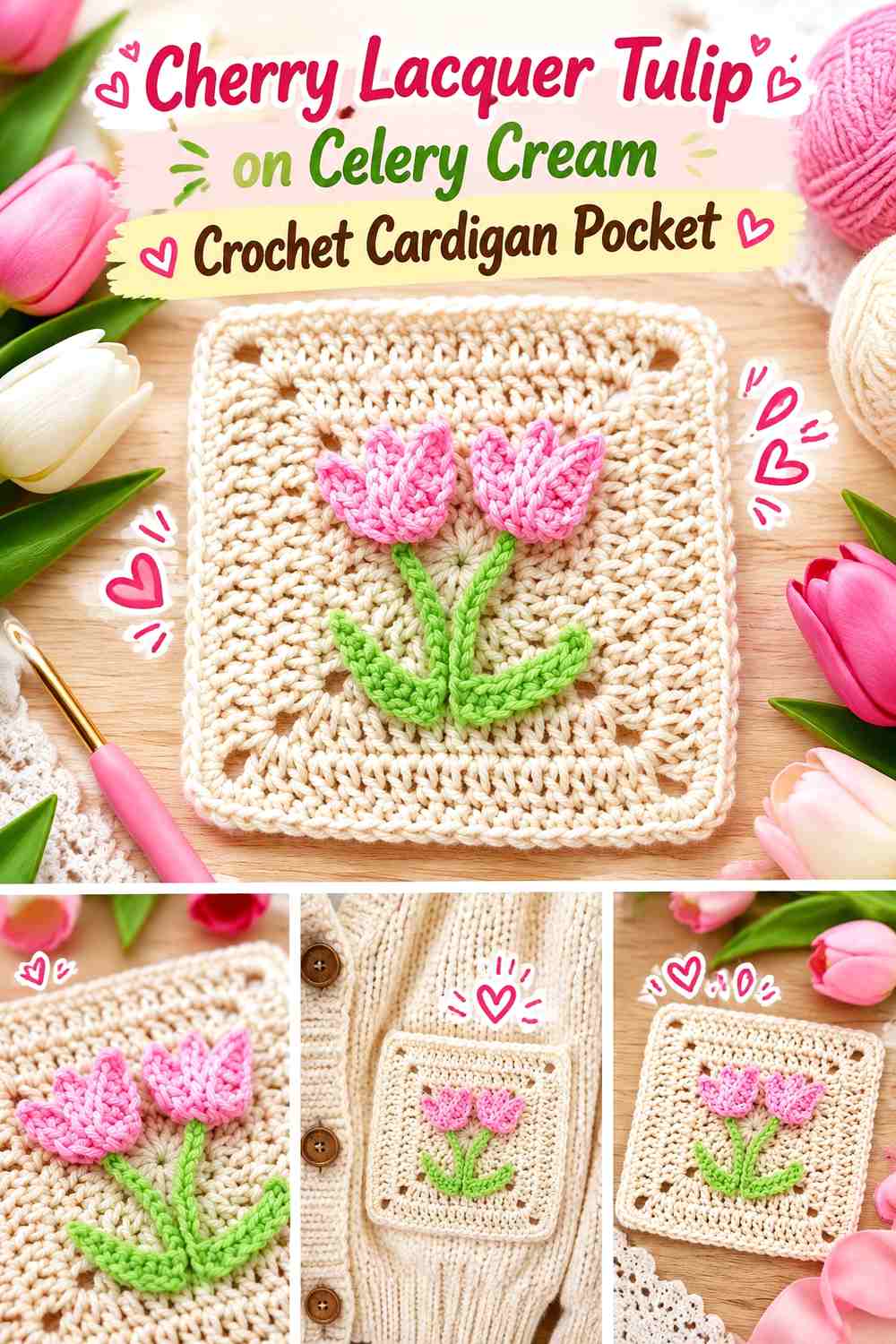
A vertically oriented tulip changes the pocket composition because it can use height without filling the entire width. Cherry Lacquer can carry the bloom and most of the silhouette while Celery Cream provides the clear background.
Cherry Lacquer Tulip Placement Can Follow the Pocket Height
Position the Cherry Lacquer motif so its vertical direction works with the shape of the pocket rather than sitting awkwardly against the opening. A slightly lower placement may leave more Celery Cream near the top edge and keep the functional pocket line visually clear.
If the tulip includes narrow stem or leaf sections, confirm that those parts still separate from the Celery Cream background.
Celery Cream Can Keep the Cherry Lacquer Tulip From Becoming Too Heavy
Because Cherry Lacquer is concentrated in one vertical shape, you do not necessarily need additional red-toned trim around the pocket. Letting Celery Cream remain uninterrupted around the flower makes the appliqué the clear source of contrast.
For paired cardigan pockets, you can mirror the tulip placement or deliberately place one motif on only one side for an asymmetric treatment.
Creator Credit: Maria’s Blue Crayon
6. Celery Cream Petal Flower with Cherry Lacquer Center Crochet Cardigan Pocket

This version separates the flower into two obvious color roles: Celery Cream controls the surrounding petals while Cherry Lacquer forms the center. A Cherry Lacquer pocket can then repeat the darker shade outside the motif while the light petal layer keeps the flower visible.
Celery Cream Petals Need Separation From the Cherry Lacquer Center
The strongest transition occurs where Celery Cream meets Cherry Lacquer inside the flower. Preserve that boundary instead of carrying small Cherry Lacquer details deep into every petal.
That keeps the flower easy to read and lets the two-color relationship remain simple enough for a small cardigan pocket.
Cherry Lacquer Should Not Swallow the Celery Cream Flower Edge
Because the center and pocket may both use Cherry Lacquer, the Celery Cream petal ring becomes the critical separating element. Check that it forms a sufficiently continuous light area around the center.
If large gaps expose too much of the Cherry Lacquer pocket, the center may appear to merge with the background rather than sit inside the flower.
Creator Credit: Simply Made by Erin Crochet
7. Cherry Lacquer Butterfly on Celery Cream Crochet Cardigan Pocket
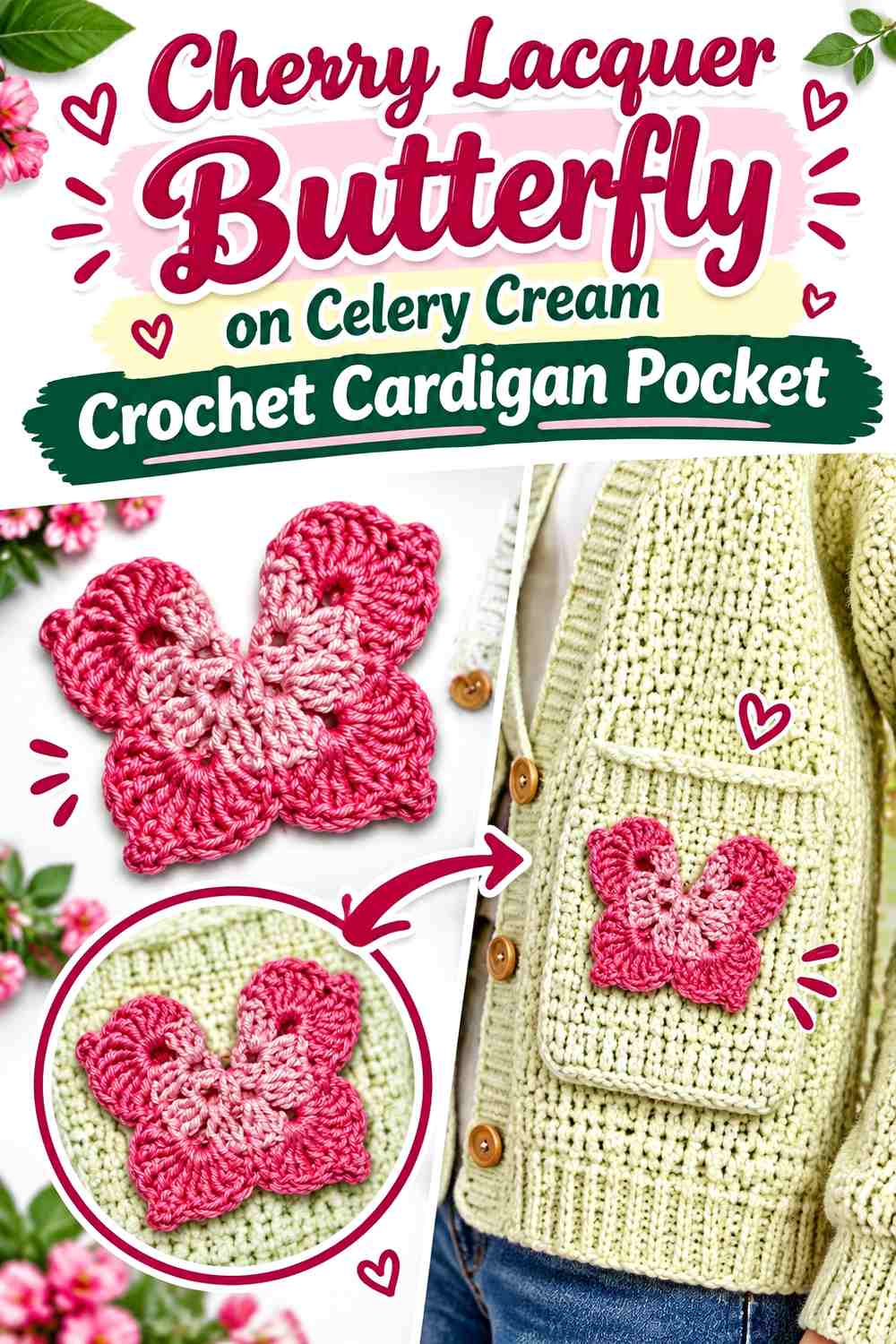
A butterfly gives the pocket a wider motif with obvious left-and-right balance. Using Cherry Lacquer for most of the wings makes the motif prominent against Celery Cream without requiring several additional colors to define each section.
Cherry Lacquer Wings Should Be Checked Against the Pocket Edges
Wide wings can approach the side seams faster than a flower or tulip. Leave enough Celery Cream around both sides so the butterfly remains a separate appliqué rather than appearing fused to the pocket border.
If the motif is intentionally off-center, give the asymmetry enough room to look purposeful.
Celery Cream Can Separate Cherry Lacquer Wing Sections
Small Celery Cream sections inside the butterfly can create openings between larger Cherry Lacquer areas. Use them selectively where they help clarify the wing structure.
Too many small cream interruptions can weaken the butterfly silhouette, so preserve larger continuous Cherry Lacquer shapes where the outline matters most.
Creator Credit: The Crochet Circle
8. Celery Cream Butterfly with Cherry Lacquer Body Crochet Cardigan Pocket

Reverse the butterfly palette by making Celery Cream the wing color and Cherry Lacquer the narrow center. On a Cherry Lacquer pocket, this creates a light horizontal shape with a darker line running through its middle.
Celery Cream Wings Can Brighten a Cherry Lacquer Pocket Without Filling It
Because butterfly wings naturally spread outward, Celery Cream can cover a noticeable portion of the pocket while still leaving Cherry Lacquer visible above, below, and around the motif.
Avoid adding a heavy Celery Cream pocket border at the same time unless you deliberately want the light color to dominate the entire pocket.
Cherry Lacquer Gives the Celery Cream Butterfly a Center Line
A Cherry Lacquer body helps visually reconnect two Celery Cream wings. This can be especially useful if the wing shapes contain open spaces or textured sections.
Check whether the body remains visible against the underlying Cherry Lacquer pocket. If it blends in, allow the Celery Cream wings to meet closely enough around it to define the center through contrast.
Creator Credit: Jess Crafting
9. Cherry Lacquer Bow with Celery Cream Center Crochet Cardigan Pocket

A bow creates a compact horizontal appliqué that can sit near the upper or lower area of the pocket without covering the entire face. Cherry Lacquer can form the loops and tails while Celery Cream marks the center wrap.
Cherry Lacquer Bow Loops Need Space Beside the Pocket Opening
If the bow sits near the top, keep its loops and tails clear enough from the opening that the decorative silhouette does not visually obscure where the pocket begins.
For a lower placement, compare the Cherry Lacquer tails with the bottom seam. Leaving a small area of pocket background between them can keep the bow from appearing attached to the pocket edge.
Celery Cream Can Define the Cherry Lacquer Bow Center
A narrow Celery Cream middle section divides the two Cherry Lacquer loops and gives the eye an obvious center point. That small accent may be enough to connect the bow with other Celery Cream details elsewhere on the cardigan.
There is little need to stripe the entire bow when one central contrast point already explains the two-color palette.
Creator Credit: Hectanooga1
10. Celery Cream Leaf Sprig on Cherry Lacquer Crochet Cardigan Pocket

A leaf motif offers a directional alternative to flowers and hearts. Celery Cream leaves can travel diagonally across part of a Cherry Lacquer pocket, creating movement without covering the full surface.
Celery Cream Leaves Can Follow One Cherry Lacquer Pocket Corner
Starting the sprig near a lower corner and directing it inward keeps the pocket center partially open. This is useful when you want the appliqué to decorate the pocket rather than become a large central badge.
Keep individual Celery Cream leaves separated enough that their points and edges remain visible against Cherry Lacquer.
Cherry Lacquer Negative Space Matters Between Celery Cream Leaves
The dark background between leaves helps define each part of the sprig. If the leaves overlap heavily, the design can turn into one broad Celery Cream patch.
Before sewing everything down, arrange the leaves temporarily and inspect the spaces between them as carefully as the motif itself.
Creator Credit: Made by Yuma
11. Cherry Lacquer Flower Scatter on Celery Cream Crochet Cardigan Pocket

Several compact Cherry Lacquer flowers can create a dotted pocket treatment without covering the entire Celery Cream field. This approach is useful when one large appliqué feels too formal or centered.
Cherry Lacquer Flowers Should Not Be Spread Randomly Across Celery Cream
Choose an intentional distribution, such as a corner cluster, loose diagonal, or graduated group. The Cherry Lacquer motifs should appear related even when they do not touch.
Keep some Celery Cream areas completely open so the pocket does not become visually similar to an allover floral fabric.
Celery Cream Can Remain the Main Pocket Color Between Cherry Lacquer Motifs
The spaces separating the flowers are part of the palette. Wider Celery Cream gaps create a quieter composition, while tightly grouped Cherry Lacquer motifs increase the apparent amount of the darker color.
Arrange all flowers at once before attachment so you can evaluate that balance across the entire pocket.
Creator Credit: Raji’s Craft Hobby
13. Cherry Lacquer Framed Celery Cream Crochet Cardigan Pocket

Instead of placing one recognizable flower or animal motif on the pocket, treat the pocket itself as the appliqué-like color feature. A Celery Cream pocket on the cardigan can be outlined with Cherry Lacquer so the border becomes the dominant graphic detail.
Cherry Lacquer Can Define the Celery Cream Pocket Perimeter
A Cherry Lacquer edge can separate a Celery Cream pocket from a similarly light cardigan front. Keep the border visually consistent around the sides and lower edge if a clean framed effect is the goal.
The upper opening can remain simpler so the border does not compete with the functional entry line.
Celery Cream Gives Small Cherry Lacquer Details Room to Read
Once the broad pocket field is Celery Cream, a tiny Cherry Lacquer motif or corner mark can be added without needing another strong color.
Keep that extra decoration secondary to the frame. A heavily decorated center plus a strong Cherry Lacquer perimeter may make the pocket feel crowded.
Creator Credit: Selina Veronique Crochet
14. Cherry Lacquer Rose on Celery Cream Crochet Cardigan Pocket

A rose introduces curved, layered-looking petal shapes rather than the radial symmetry of a daisy or sunflower. Cherry Lacquer makes those curves the darkest focal area, while Celery Cream can remain a quiet pocket field around them.
Cherry Lacquer Rose Layers Need Visible Outer Edges
When several petal sections sit close together, the shape can become visually dense. Preserve a clear Cherry Lacquer outer silhouette against Celery Cream before worrying about tiny internal separations.
A slightly off-center placement can give the rose room to expand without pushing every petal toward a pocket seam.
Celery Cream Should Surround the Cherry Lacquer Rose Rather Than Compete With It
If the pocket is already Celery Cream, additional cream-colored embellishments around the rose may add texture without adding useful contrast. Let the lighter surface function as the negative space.
If you want to repeat Celery Cream inside the motif, use it only where the lighter interruption helps distinguish a specific petal layer.
Creator Credit: Loopara
15. Cherry Lacquer Strawberry with Celery Cream Detail Crochet Cardigan Pocket

A strawberry-shaped appliqué gives Cherry Lacquer a natural opportunity to dominate the motif, while Celery Cream can be used for the top detail, small surface accents, or an outline. The palette does not need to imitate realistic fruit colors to make the silhouette recognizable.
Cherry Lacquer Should Carry Most of the Strawberry Shape
Keeping the main body Cherry Lacquer protects the recognizable triangular or rounded fruit silhouette. Too many Celery Cream interruptions can make the motif look spotted rather than clearly shaped.
On a Celery Cream pocket, the large Cherry Lacquer body already has enough contrast to become a strong focal point.
Celery Cream Details Should Stay Secondary to Cherry Lacquer
Use Celery Cream where it clarifies the top edge or introduces a few controlled accents. Because the background is also Celery Cream, small details that extend beyond the Cherry Lacquer body may visually disappear.
Check that the important light sections are enclosed by or directly attached to enough Cherry Lacquer to remain understandable.
Creator Credit: Crochet Jewel
16. Celery Cream Heart Pair on Cherry Lacquer Crochet Cardigan Pocket

Two smaller hearts create a different pocket rhythm from one large central heart. Celery Cream hearts can sit on a Cherry Lacquer pocket with enough space between them for each silhouette to remain distinct.
Celery Cream Hearts Can Create an Intentional Pair on Cherry Lacquer
Try a vertical, diagonal, or slightly offset relationship rather than placing the two motifs wherever space remains. Their connection should be visually obvious even though they are separate appliqués.
Keep enough Cherry Lacquer between the hearts to stop their edges from merging into one irregular light shape.
Cherry Lacquer Space Can Make the Celery Cream Pair Feel Less Busy
The background between and around the hearts is what controls the overall density. More exposed Cherry Lacquer gives each heart stronger definition and prevents the pocket from becoming predominantly cream.
If you use the design on both cardigan pockets, consider reversing the diagonal rather than duplicating the exact orientation so the pair can relate across the cardigan front.
Creator Credit: Craft and a Cuppa
Choosing Between the Cherry Lacquer and Celery Cream Pocket Directions
For a single strong focal motif, the Cherry Lacquer heart, tulip, rose, or strawberry ideas keep the pocket easy to read from a distance. They use Celery Cream mostly as surrounding space rather than dividing the focal shape into many sections.
For a lighter motif against a darker pocket, the Celery Cream daisy, butterfly, leaf sprig, and textured flower place more emphasis on the contrast between the appliqué edge and Cherry Lacquer background.
The mini-daisy and flower-scatter ideas work differently because repetition becomes part of the palette. They leave more background visible between separate motifs, so spacing is as important as the colors themselves.
If you prefer less representational decoration, the Cherry Lacquer-framed Celery Cream pocket treats the pocket face and border as the main color feature without requiring a large flower, heart, or fruit appliqué.
Conclusion
Cherry Lacquer and Celery Cream can produce very different cardigan pockets depending on which color controls the surface. For the strongest dark focal point, place a Cherry Lacquer heart, tulip, rose, butterfly, or strawberry on a Celery Cream pocket. For a lighter appliqué effect, reverse the relationship and let Celery Cream petals, wings, or leaves sit over Cherry Lacquer.
Also consider how much of the pocket you actually want to decorate. One large motif gives the clearest focal point, while small repeated flowers create a more scattered effect. A border-led pocket is useful when you want the color scheme to be noticeable without covering the pocket with a recognizable motif.
Before permanently attaching an appliqué, position it on the finished or nearly finished pocket and check the cardigan while worn. Pay attention to the pocket opening, surrounding seams, and distance between the motif and pocket edges. Use the credited tutorials for their actual crochet construction while adapting the Cherry Lacquer and Celery Cream distribution to your own cardigan.
Frequently Asked Questions
Should Cherry Lacquer or Celery Cream be the main cardigan pocket color?
Choose according to the amount of contrast you want. A Cherry Lacquer pocket creates a darker field for Celery Cream motifs, while a Celery Cream pocket lets a smaller amount of Cherry Lacquer become the focal point. You do not need to divide the two colors equally.
How can I check whether Cherry Lacquer and Celery Cream have enough contrast?
Compare the actual yarns side by side and in a small crochet sample. Viewing a photo in grayscale can also help you judge light-and-dark separation. If the yarns are closer in value than expected, use larger color blocks instead of relying on tiny outlines or centers.
Should Cherry Lacquer appliqués be centered on Celery Cream cardigan pockets?
Not necessarily. A centered heart or flower creates a formal focal point, but tulips, leaves, roses, and small clusters can work well in a lower or outside corner. Check placement while wearing the cardigan because the surrounding front panel changes how the pocket is perceived.
Can I put different Cherry Lacquer and Celery Cream appliqués on the two pockets?
Yes. Keep some element consistent so the two pockets still feel related. For example, one pocket could carry a Cherry Lacquer flower and the other a Cherry Lacquer heart while both use the same Celery Cream background. Repeating the color hierarchy can connect two different motifs.
How do I keep Cherry Lacquer and Celery Cream pocket appliqués from looking too busy?
Give one color the dominant role and limit competing motif features. If you use several small Cherry Lacquer flowers, leave enough Celery Cream visible between them. If one large motif already fills much of the pocket, simpler edging usually gives the focal shape more room.
Should a Celery Cream appliqué match Celery Cream used elsewhere on the cardigan?
It can, especially when you want the pockets to connect with cuffs, edging, or a neckline detail. The repeated color does not need to occupy the same amount of space everywhere. A small Celery Cream cuff repeat can be enough to connect a larger pocket appliqué to the rest of the garment.
What should I preserve when substituting Cherry Lacquer or Celery Cream with another shade?
Preserve the color relationship that makes your selected pocket idea readable. If Cherry Lacquer is acting as the dark focal color, choose a substitute that remains sufficiently distinct from Celery Cream. If Celery Cream is providing a light background or outline, keep it light enough for the motif edges and details to remain visible.