Forest green is a natural foundation for a crochet Christmas tree skirt, but its placement matters because the skirt sits directly beneath another large area of green. Instead of covering every visible section with the same shade, you can use cream, white, oatmeal, cranberry, gold, gray, camel, or red to separate the crochet surface from the tree and make its texture easier to see.

The outer portion of a tree skirt deserves particular attention. Once presents are arranged around the trunk, the center may be partly hidden while the border, points, scallops, pom-poms, or outer motifs remain highly visible. That makes the edge an effective place to repeat forest green, introduce a contrasting neutral, or add a restrained festive accent.
These 18 ideas keep forest green central while changing the balance, motif style, texture emphasis, and supporting colors. The linked tutorials support the underlying Christmas tree skirt construction or design concept; the forest-green palettes described here are independent color adaptations.
Quick List
- Forest Green And Cream Round Crochet Christmas Tree Skirt
- Forest Green And Ivory Striped Crochet Christmas Tree Skirt
- Forest Green And White Split Front Crochet Christmas Tree Skirt
- Forest Green And Cranberry Banded Crochet Christmas Tree Skirt
- Forest Green And Oatmeal Farmhouse Crochet Christmas Tree Skirt
- Forest Green And Snow White Bobble Crochet Christmas Tree Skirt
- Forest Green And Antique Gold Pom Pom Crochet Christmas Tree Skirt
- Forest Green And Frosted Cream Plush Crochet Christmas Tree Skirt
- Forest Green And Camel Textured Wreath Crochet Christmas Tree Skirt
- Forest Green And Soft Gray Textured Crochet Christmas Tree Skirt
- Forest Green And Natural Beige Knit Look Crochet Christmas Tree Skirt
- Forest Green Cream And Rust Woodland Crochet Christmas Tree Skirt
- Forest Green And Winter White Mosaic Crochet Christmas Tree Skirt
- Forest Green Cream And Red Granny Square Crochet Christmas Tree Skirt
- Forest Green And Ecru Hexagon Crochet Christmas Tree Skirt
- Forest Green And Cranberry Ripple Crochet Christmas Tree Skirt
- Forest Green And Cream Minimal Crochet Christmas Tree Skirt
- Forest Green And Silver Snowflake Crochet Christmas Tree Skirt
Keep Forest Green Visible Beneath the Christmas Tree
A dark forest green tree skirt can visually merge with low evergreen branches, especially around the center opening. That does not mean forest green needs to be replaced. Instead, give it larger uninterrupted areas and place a lighter color beside the sections where you most want the crochet work to remain visible.
Cream, ivory, white, oatmeal, and light beige can define radial sections, textured stitches, or the outer border. A small amount of cranberry, red, or antique gold can create another point of separation without taking the design away from its forest-green focus.
Consider the tree skirt from standing height rather than only looking at it flat on a work surface. The color relationships that matter most are the ones visible around the tree once the skirt is in use.
Put Forest Green Where the Tree Skirt Will Stay Visible
The outer rows often remain visible even when gifts cover the center. If forest green is your priority color, repeat it near the perimeter rather than concentrating all of it close to the trunk opening.
For a lighter overall design, place cream or oatmeal through the central or middle sections and return to forest green at the border. For a darker result, reverse the arrangement and let forest green dominate the field while a light outer edge separates it from the floor.
Star points, scallops, pom-poms, granny-square corners, and mosaic borders are especially useful places for intentional color placement because they define the silhouette of the finished skirt.
Use Light Colors to Protect Forest Green Crochet Texture
Forest green can make raised texture look rich and substantial, but very dark yarn can also hide smaller stitch details in softer room lighting. Bobbles, ridges, mosaic lines, and dimensional motifs become easier to distinguish when at least some lighter yarn sits beside the darker green.
Before committing to the full skirt, place the selected colors together under the lighting normally used around the Christmas tree. If forest green and its supporting color look too similar in value, choose a lighter or darker substitute rather than relying only on a difference in hue.
1. Forest Green And Cream Round Crochet Christmas Tree Skirt
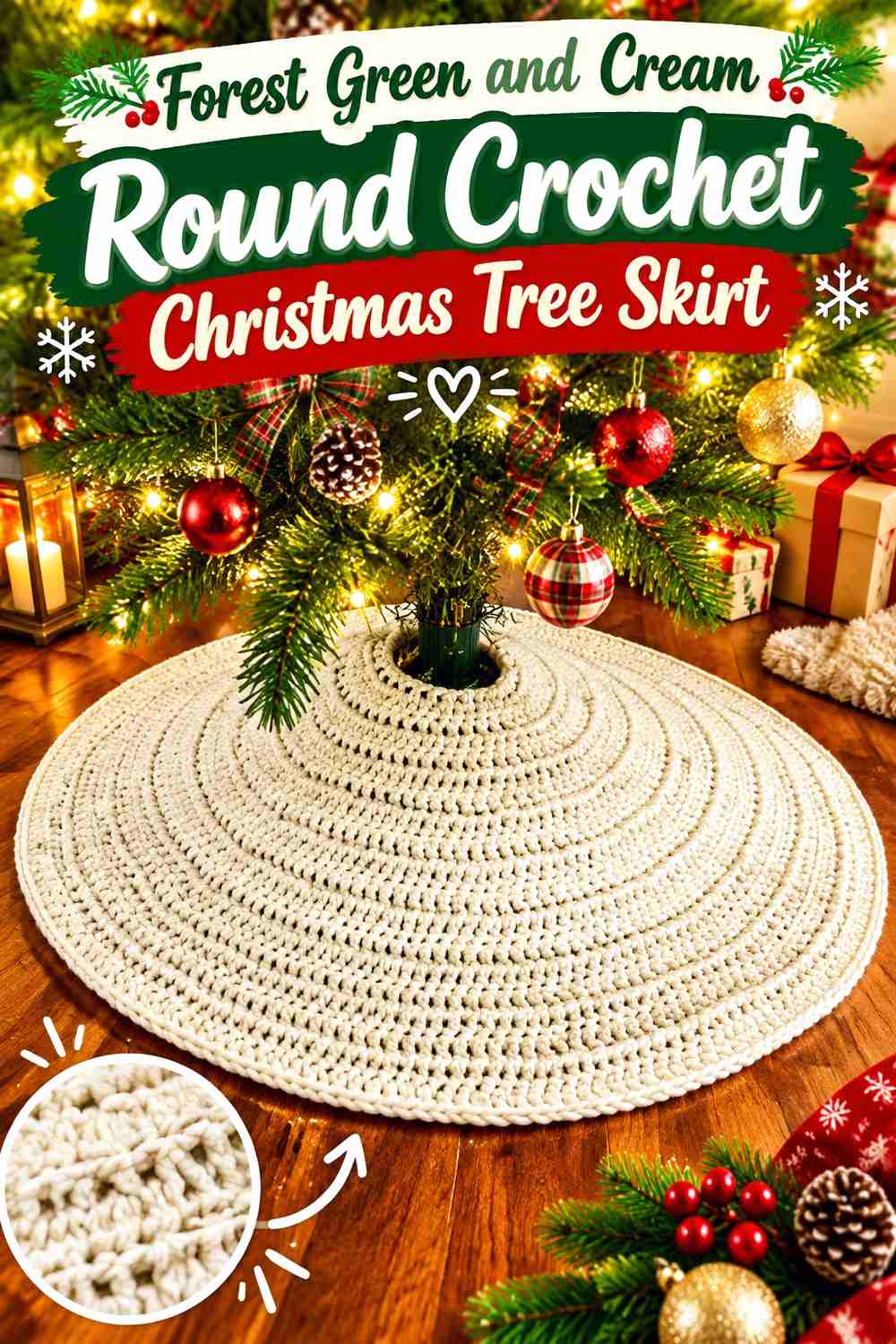
This is the simplest way to make forest green the unmistakable lead color. Use it across most of the round skirt and introduce cream through selected radial sections, narrow bands, or the outer edge. Cream gives the dark green enough light-value contrast to remain distinct from the tree while preserving a classic two-color palette.
Let Forest Green Cover the Main Round Tree Skirt
Keep the broadest areas forest green so the finished skirt reads green even after presents cover part of the surface. Large uninterrupted sections also allow the circular construction to remain visually calm rather than breaking it into many small alternating stripes.
If the tree has branches that hang close to the floor, place more cream near the inner opening so the skirt does not visually disappear directly beneath the foliage.
Use Cream to Separate the Forest Green Outer Edge
A cream border can define the circumference and make the forest green surface easier to see against dark flooring or shadows under the tree.
For a greener finish, reverse that arrangement: use cream in one middle band and return to forest green for the final edge. Repeating green at the perimeter keeps the requested color prominent where the skirt is most visible.
Creator Credit: Katia Creates
2. Forest Green And Ivory Striped Crochet Christmas Tree Skirt
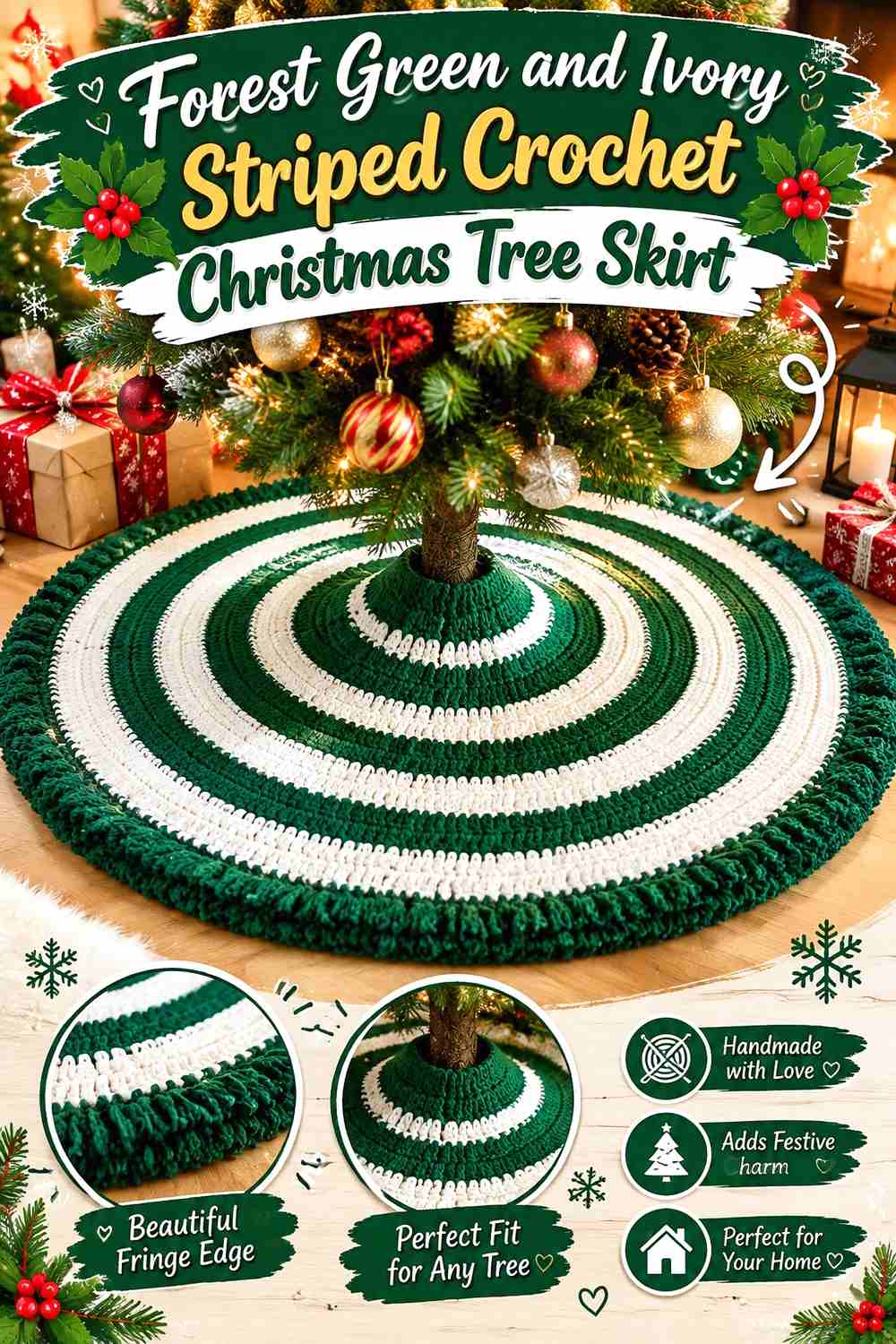
Alternating forest green and ivory in controlled bands creates more movement than a mostly solid skirt without introducing several festive colors. Make forest green bands broader or more frequent if you want it to remain dominant, and reserve ivory for the rows that need to reveal changes in texture or shaping.
Make Forest Green Stripes Wider Than Ivory Stripes
Equal-width stripes create a balanced two-color result, but wider forest green sections keep the skirt clearly green-led. This is particularly useful when ivory is very bright and naturally draws attention.
Instead of adding more green shades, vary the placement of the two existing colors. A wider forest green outer band can visually contain narrower stripes closer to the tree.
Use Ivory to Break Up Dark Forest Green Near the Tree
Ivory works well close to the center opening because it provides separation between forest green crochet and evergreen branches.
If bright white feels too sharp for the room, choose an ivory that remains clearly lighter than the green. The important characteristic is the value difference, not a specific commercial shade name.
Creator Credit: Secret Yarnery
3. Forest Green And White Split Front Crochet Christmas Tree Skirt
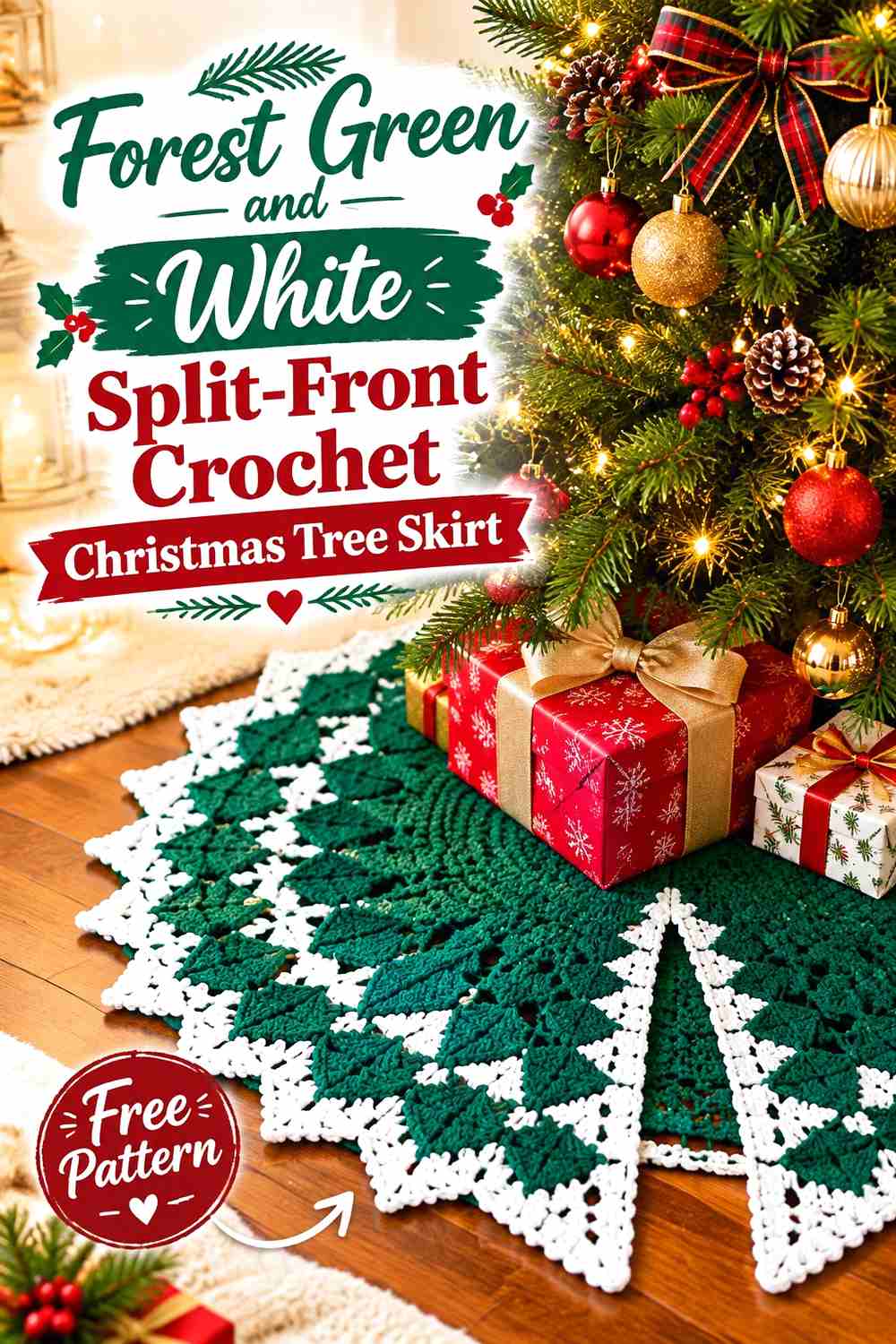
A split-front tree skirt already has a strong directional line from the trunk opening to the outer edge. Forest green can fill most of the surface while white highlights selected radial sections or the border. Keeping the white placement symmetrical around the opening helps the slit look intentional rather than like a break in the color plan.
Keep Forest Green Continuous Beside the Tree Skirt Opening
Use forest green on both sides of the split so the skirt remains visually connected when it wraps around the tree base.
If you place white directly against the opening, repeat it evenly on both sides. Uneven placement can make one side of the tree skirt appear visually heavier.
Let White Clarify Forest Green Radial Shaping
White bands can emphasize the outward expansion of the skirt because each light section makes the surrounding forest green easier to distinguish.
Keep those light areas controlled. Too many narrow white bands can turn the design into a high-contrast striped skirt rather than a forest-green tree skirt with white support.
Creator Credit: Yarnspirations
4. Forest Green And Cranberry Banded Crochet Christmas Tree Skirt

Cranberry adds a traditional holiday contrast without competing as sharply as a bright primary red. Let forest green cover most of the skirt and use cranberry in a few repeated bands, especially toward the outer half where they will remain visible around gifts.
Keep Forest Green Dominant Between Cranberry Bands
Give forest green enough uninterrupted space that the red does not visually divide the entire skirt into equal stripes. One or two well-placed cranberry sections can provide plenty of festive contrast.
This is particularly useful when the yarns are both deep in value. Larger color areas are easier to distinguish than many narrow alternating bands.
Repeat Cranberry Sparingly Across the Forest Green Edge
A cranberry detail near the perimeter connects the warm accent to the part of the skirt that stays visible after gifts are added.
If the outermost row is cranberry, consider repeating forest green immediately inside it. The dark green buffer keeps the warm border from appearing detached from the main field.
Creator Credit: Bag-O-Day Crochet
5. Forest Green And Oatmeal Farmhouse Crochet Christmas Tree Skirt

Oatmeal gives forest green a softer contrast than white and suits a restrained farmhouse palette. Let oatmeal occupy textured bands or the outer trim while forest green covers the larger radial sections. The muted neutral also works well when the surrounding room contains natural wood, beige, or other warm neutrals.
Let Forest Green Lead the Farmhouse Tree Skirt
Use forest green for the broad body so the rustic neutral remains supporting rather than becoming the main color.
Because oatmeal is quieter than bright white, you can use a slightly larger amount without overwhelming the green. Still, keep forest green repeated through the visible outer portion of the skirt.
Use Oatmeal to Reveal Forest Green Texture
Place oatmeal next to raised or ribbed forest green sections when the dark yarn makes those details difficult to see.
An oatmeal outer border can also soften the transition from green crochet to a light floor or rug, while a forest-green final edge creates a darker, more defined silhouette.
Creator Credit: You Should Craft
6. Forest Green And Snow White Bobble Crochet Christmas Tree Skirt

Bobbles add visible texture, so the palette should help rather than compete with that surface detail. Forest green can form the main background while snow white marks selected bobble sections or a plush outer edge. The light color makes raised elements easier to notice against the darker field.
Keep Forest Green Solid Behind White Bobbles
A continuous forest green background gives white bobble texture a clear visual base. Avoid adding several extra colors around the same raised areas, because the combination of color and dimensional texture already creates a strong focal point.
If you prefer green bobbles, place them against a white or cream section so their outline remains visible.
Let Snow White Separate Forest Green Texture at the Border
A white outer band can create a clean visual stop after a heavily textured forest-green center.
When the skirt has several decorative features, keep the border color treatment simple. The edge should frame the bobble field rather than add another competing pattern.
Creator Credit: MJ’s Off The Hook Designs
7. Forest Green And Antique Gold Pom Pom Crochet Christmas Tree Skirt
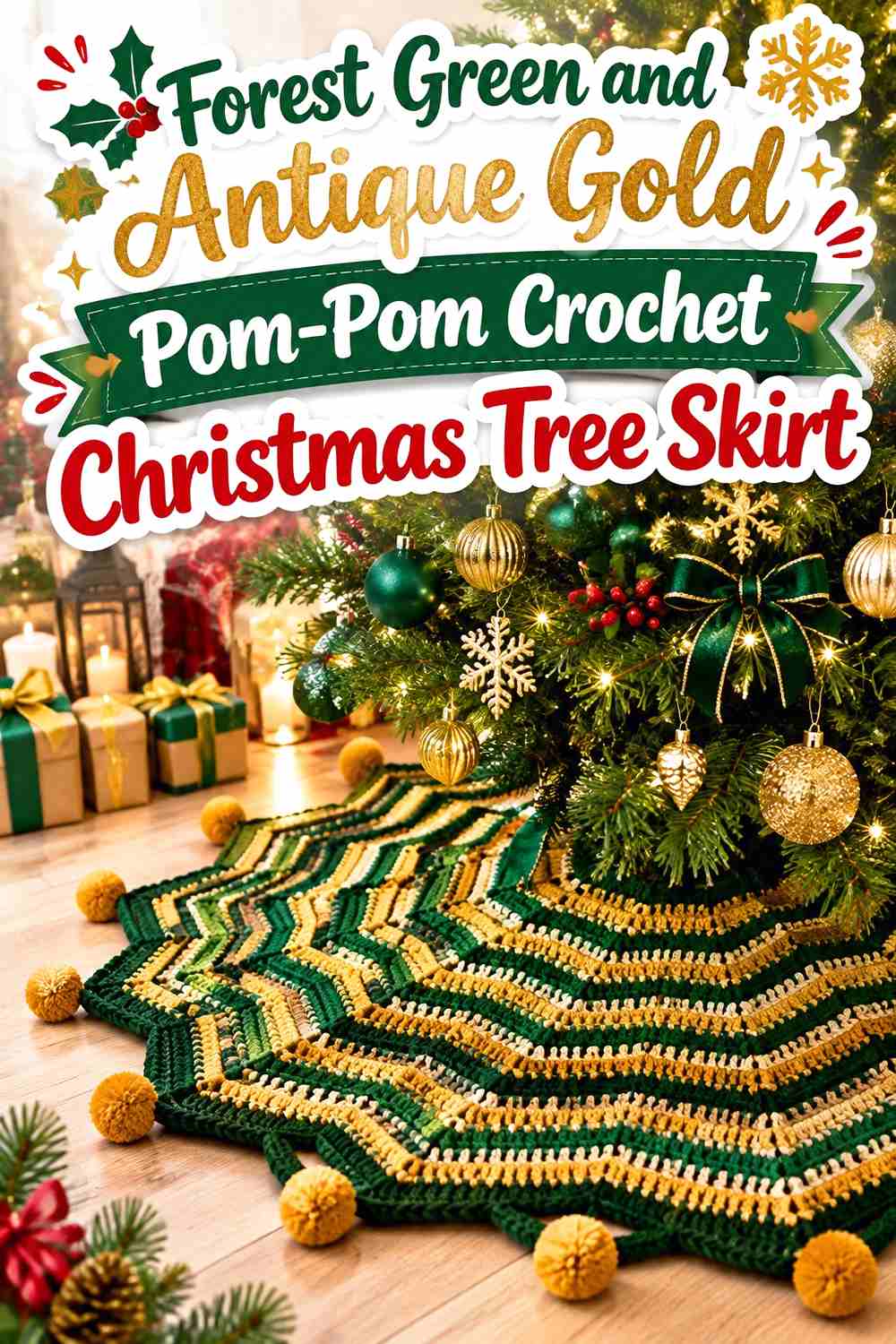
Antique gold adds warmth without requiring large areas of metallic-looking color. Keep the body forest green and use the gold tone for a narrow border or restrained pom-pom accents. Because pom-poms project beyond the skirt edge, even a small amount of the accent becomes highly visible.
Let Forest Green Fill the Area Behind Gold Pom-Poms
A solid or lightly striped forest-green body gives the outer pom-pom trim enough contrast to become noticeable without turning the entire skirt into a two-color pattern.
This also protects the main green theme when ornaments and wrapped gifts introduce several other colors nearby.
Keep Antique Gold Small Against Forest Green
Use antique gold where it can repeat clearly but remain secondary: the pom-poms, a thin preceding band, or another small edge detail.
If the gold color starts appearing in wide stripes as well as the trim, it may compete with forest green. Reducing its surface area is usually more effective than muting the green.
Creator Credit: The Crochet Crowd
8. Forest Green And Frosted Cream Plush Crochet Christmas Tree Skirt
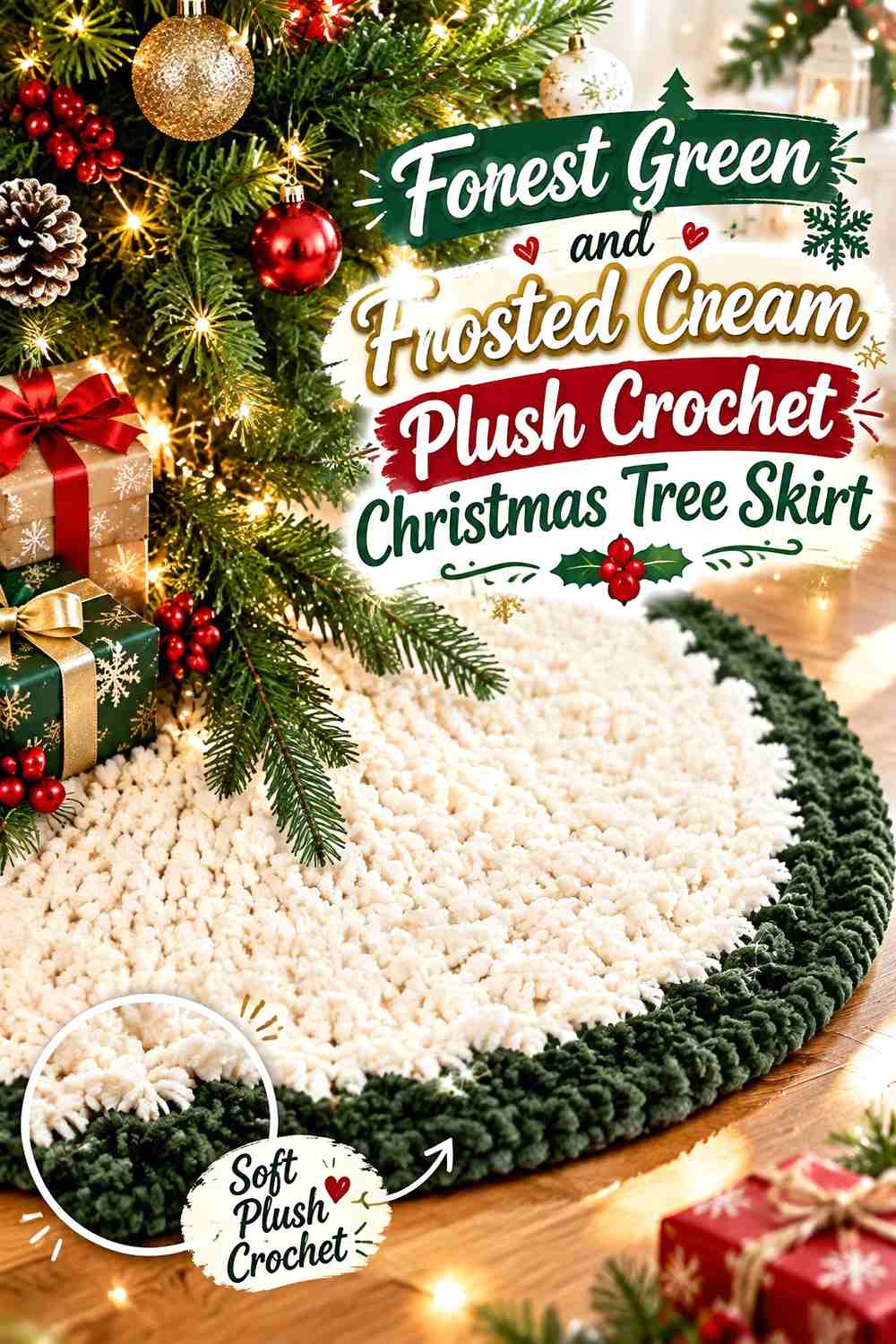
A plush or furry edge changes how color is perceived because the soft texture creates shadows and blends boundaries. Forest green can carry the smoother main surface while frosted cream provides the plush outer finish. Keeping each texture mostly in one color makes the contrast easier to read.
Keep Forest Green Clear of the Plush Cream Edge
Give forest green a substantial smooth area before the cream texture begins. That separation allows the eye to read both the color change and the material change.
If the green itself is also very fuzzy, choose a cream with enough value difference to prevent the two sections from visually merging.
Use Frosted Cream to Frame the Forest Green Skirt
A soft cream edge can brighten the floor-level silhouette and create a snow-like visual direction without requiring the entire skirt to be pale.
Keep cream concentrated at the perimeter if forest green is the intended focus. A large cream center plus a cream border would substantially reduce the green presence.
Creator Credit: Bella Coco
9. Forest Green And Camel Textured Wreath Crochet Christmas Tree Skirt
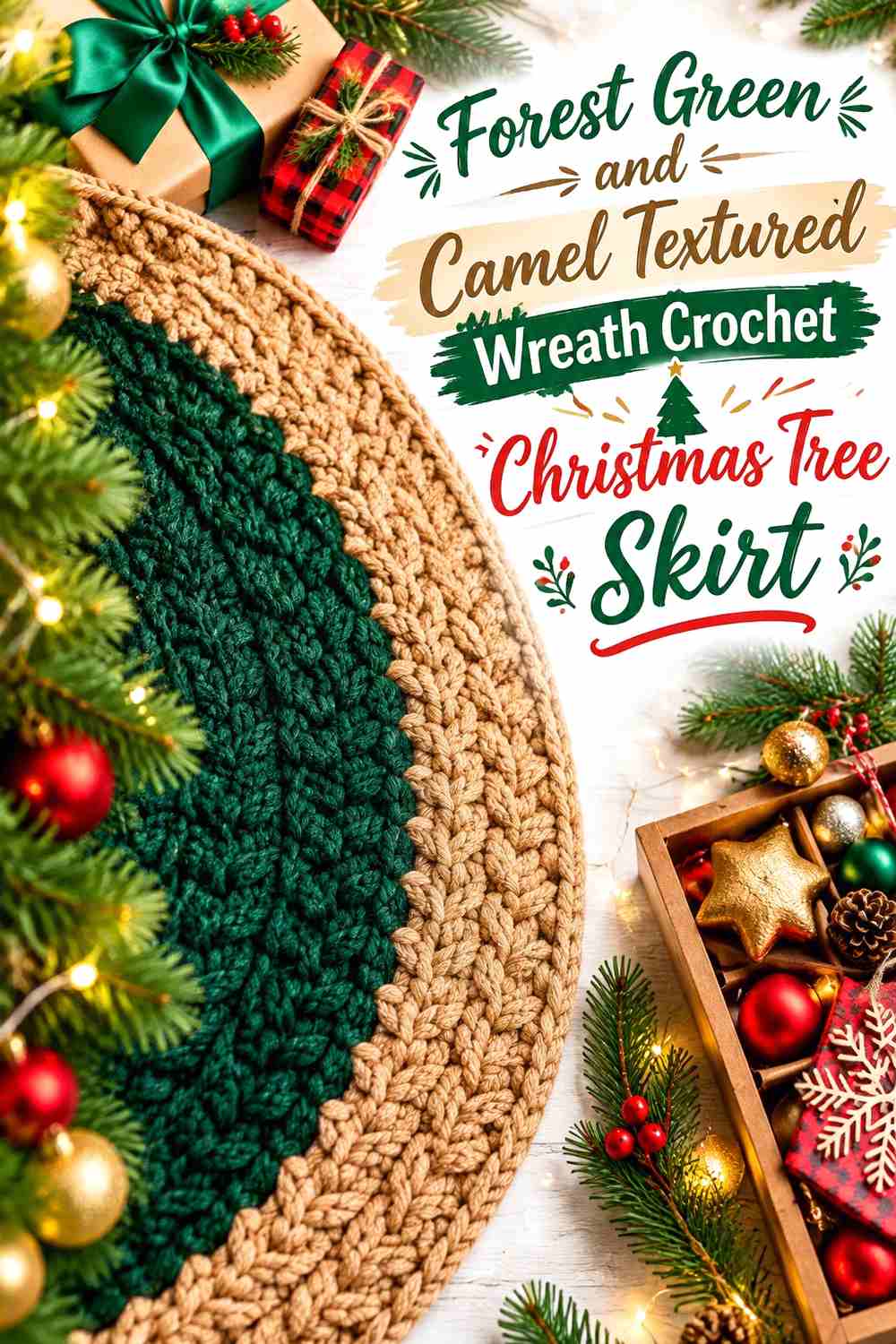
Camel introduces a warm earthy neutral that feels less winter-white than cream. Use forest green as the main textured field and camel around selected ridges, a center band, or the outer edge. This palette can coordinate naturally with wood-toned ornaments and kraft-paper gift wrapping without requiring a bright holiday accent.
Let Forest Green Carry the Main Wreath Texture
Keep textured sections predominantly forest green so shadows and raised stitches add depth within one color rather than being interrupted by frequent changes.
If the texture becomes difficult to distinguish in the dark green, use camel beside the most important raised sections rather than changing every textured row.
Place Camel Where Forest Green Needs Warm Separation
Camel works well between forest green bands or around the perimeter because it provides a clear hue change without the sharpness of white.
Check its lightness against the green before committing. A very dark camel may not provide enough contrast for smaller texture details.
Creator Credit: Briana K
10. Forest Green And Soft Gray Textured Crochet Christmas Tree Skirt
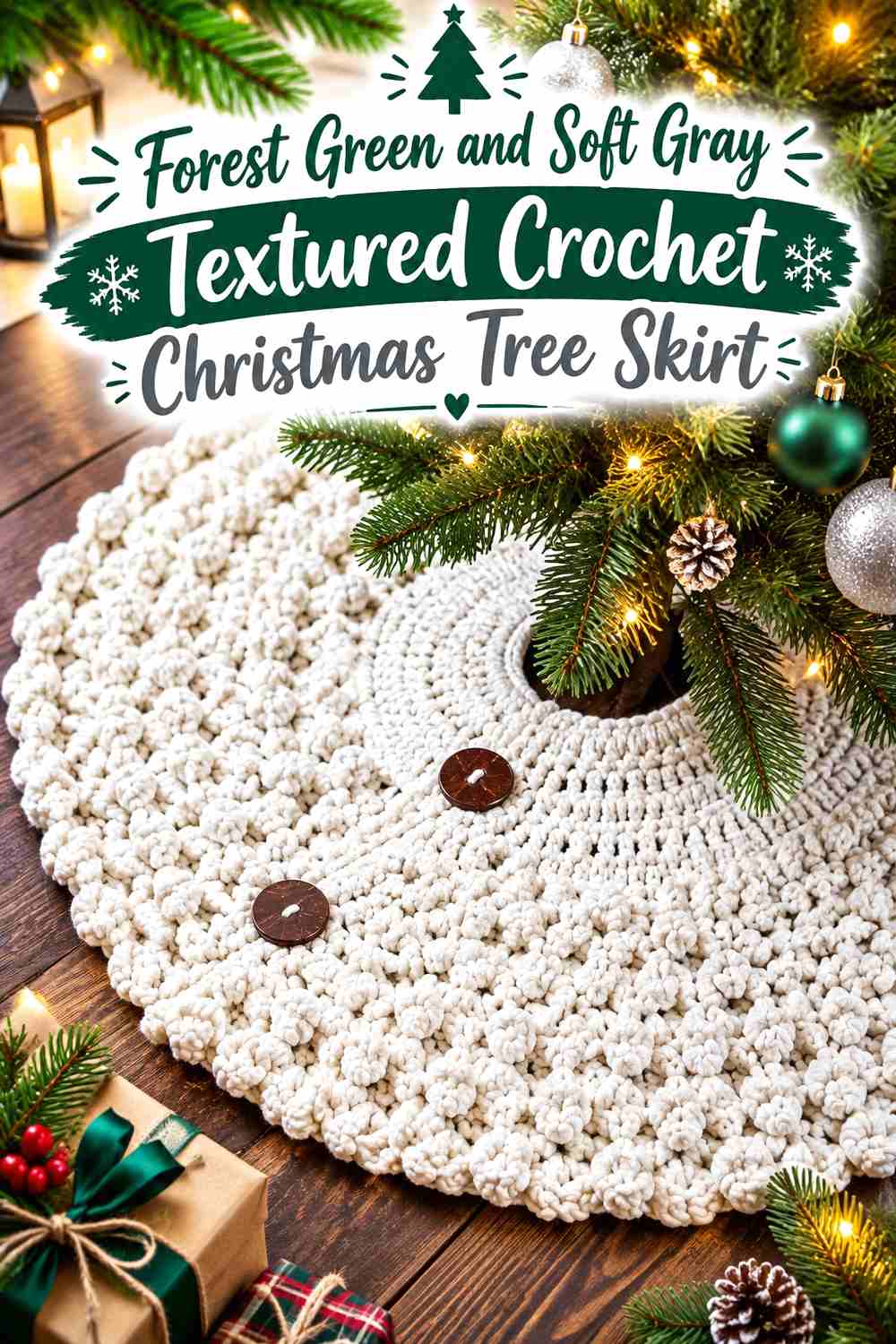
Soft gray creates a cooler neutral pairing that keeps attention on texture instead of adding another overtly festive hue. Forest green should remain the larger color area, while gray can break up raised bands or lighten the outermost section.
Keep Forest Green as the Strongest Textured Color
Use green through the areas with the most pronounced stitch relief so the tree skirt remains visibly forest green even in a neutral room.
Soft gray can sit beside those sections to increase separation, especially where dark green shadows make individual ridges less obvious.
Let Soft Gray Quietly Separate Forest Green Bands
Gray is useful when cream would create too much contrast. It can distinguish bands while keeping the overall palette restrained.
Choose a gray that is clearly lighter than the forest green. If both colors are similarly dark, the textural sections may merge when viewed from standing height.
Creator Credit: Rich Textures Crochet
11. Forest Green And Natural Beige Knit Look Crochet Christmas Tree Skirt
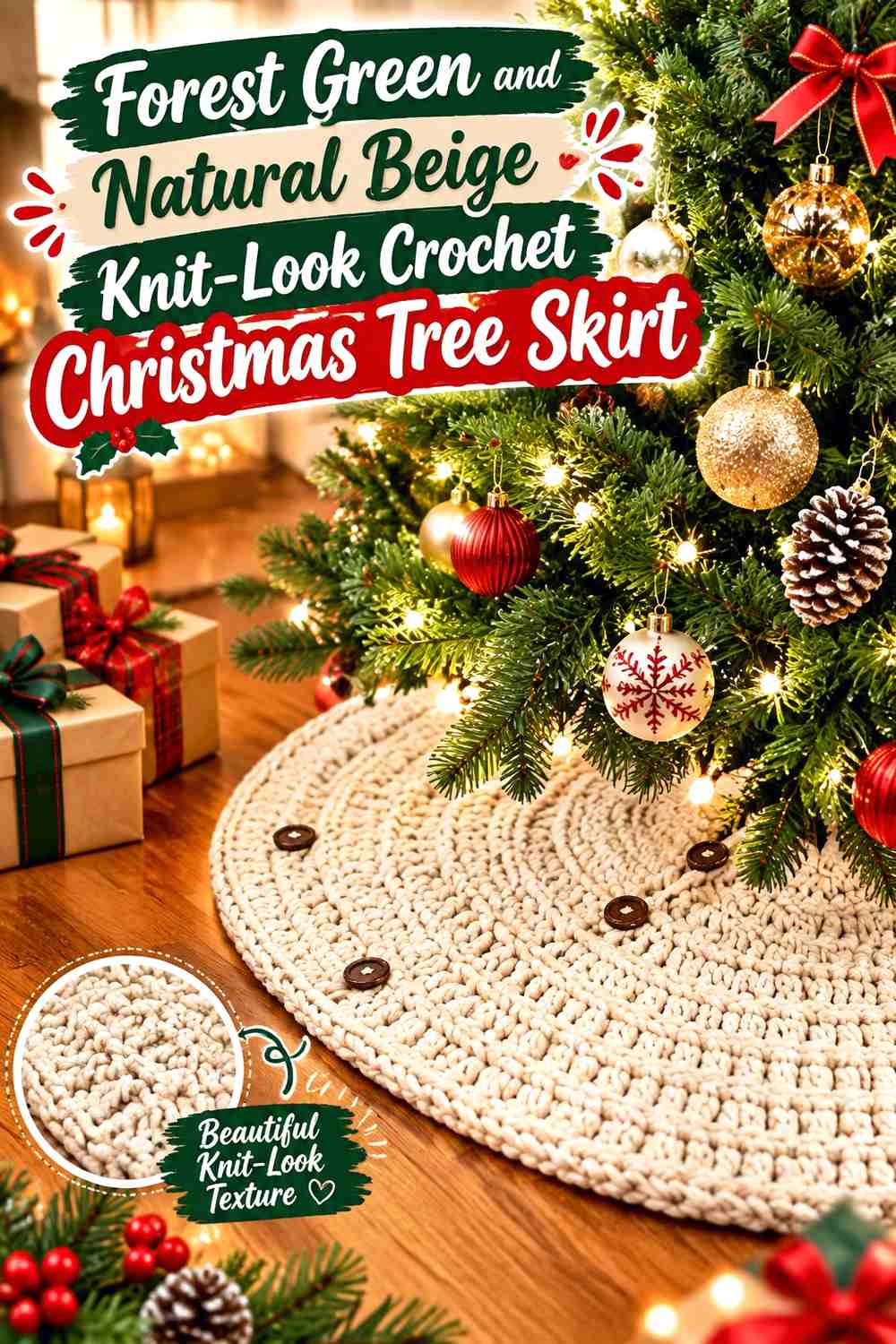
A knit-look crochet surface already provides strong linear texture, so the color scheme can remain simple. Let forest green dominate and use natural beige at the opening, in one broad stripe, or around the perimeter. The warmer neutral keeps the design understated while still defining the darker green fabric.
Use Forest Green Across the Knit-Look Texture
Long sections of forest green allow the ribbed or knit-like surface to become the visual feature instead of frequent color changes.
If you want stripes, make them broad enough that the linear texture remains readable within each color block.
Keep Natural Beige Secondary to Forest Green
Natural beige can lighten the outer edge or emphasize one major band, but avoid distributing it through every small textural change.
A simple beige-and-green hierarchy suits a skirt where construction texture already supplies enough detail.
Creator Credit: Cozy Nooks Designs
12. Forest Green Cream And Rust Woodland Crochet Christmas Tree Skirt
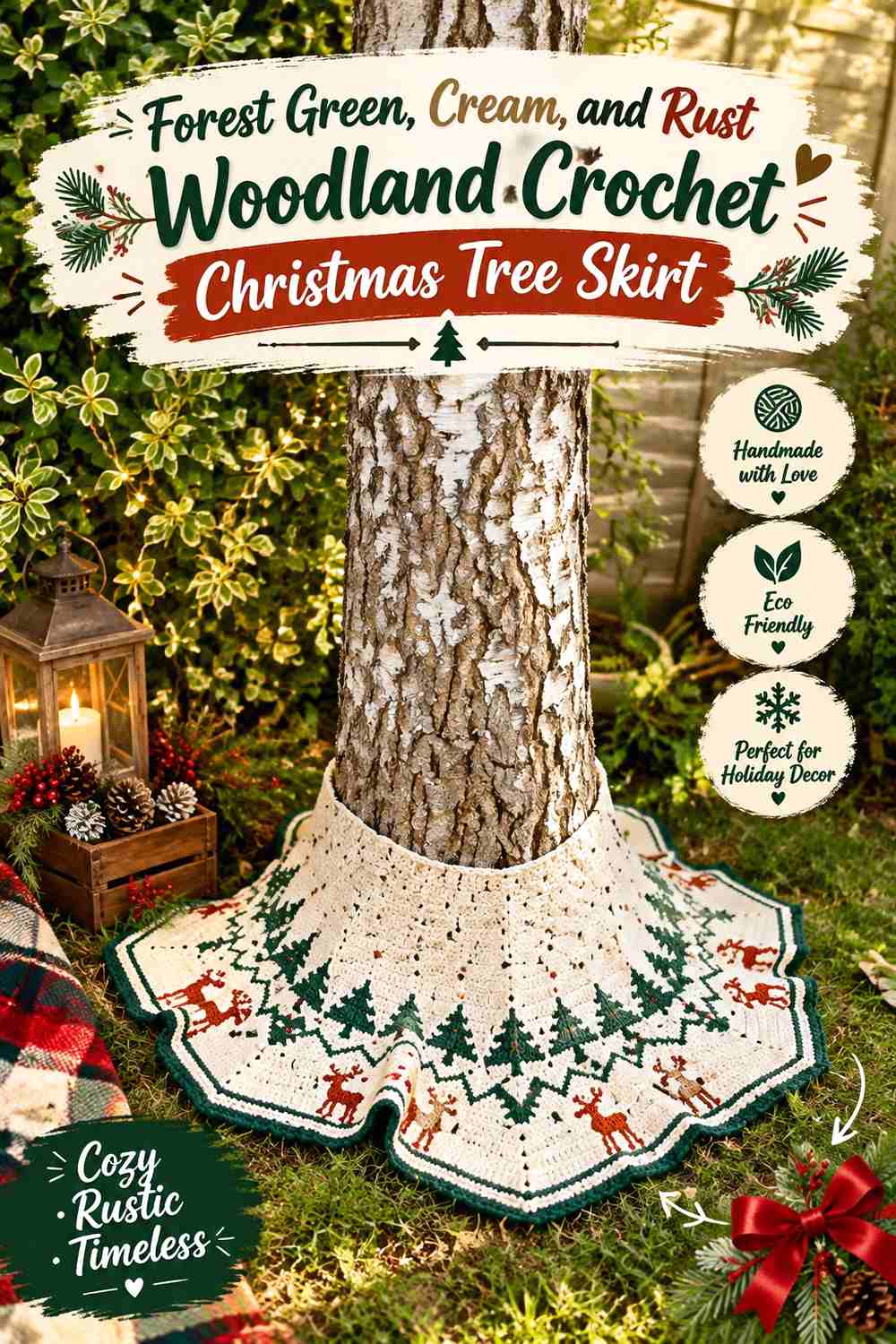
A woodland palette gives each color a recognizable role: forest green for trees and broad background areas, cream for snow or separating space, and rust for small cabin-like or earthy accents. Keep rust limited so it adds warmth without competing with the green.
Let Forest Green Build the Woodland Tree Skirt Base
Use forest green across the largest visual areas and repeat it through important motifs so the skirt remains connected to the evergreen tree above it.
Cream can then carve out lighter areas around the motifs, giving dark green shapes more separation.
Use Cream and Rust to Clarify Forest Green Motifs
Cream is the stronger separator and should occupy more space than rust when detailed motifs need to remain readable.
Place rust in smaller repeated features rather than large blocks. Its warmth is noticeable even in limited amounts, so a small repeat can connect the palette effectively.
Creator Credit: Concrete Gems Crochet
13. Forest Green And Winter White Mosaic Crochet Christmas Tree Skirt

Mosaic designs depend heavily on value contrast because small lines and repeated shapes need to remain legible. Forest green and winter white create a clear dark-light pairing that can support tree, geometric, or border motifs without requiring additional colors.
Keep Forest Green and White Mosaic Contrast Strong
Use forest green for the darker continuous areas and white where the motif needs to break through clearly.
Before beginning a large skirt, compare the yarns in grayscale. Strong value separation is especially important for narrow mosaic details viewed from several feet away.
Repeat Forest Green Around the White Mosaic Border
A forest-green outer band can contain a busy white-and-green motif field and reconnect the pattern to the dominant color.
If the final motif row already contains substantial green, a white border can create a lighter alternative. Judge the complete outer section rather than deciding on the edge color in isolation.
Creator Credit: HanJan Crochet
14. Forest Green Cream And Red Granny Square Crochet Christmas Tree Skirt

Granny squares let the three colors trade positions while keeping a consistent modular structure. Make forest green the recurring outer color, use cream to separate motifs, and reserve red for selected centers or repeated accents. That hierarchy prevents the skirt from turning into equally weighted red, green, and white patchwork.
Repeat Forest Green Around the Granny-Square Edges
Using forest green on the outer portion of many squares creates continuity once the motifs are joined.
This is particularly useful around the perimeter, where separate squares need to read as one tree skirt rather than a collection of unrelated blocks.
Keep Red Smaller Than Forest Green and Cream
Red becomes noticeable quickly, so it can remain concentrated in centers or a limited number of repeated sections.
Cream should provide breathing room between red and forest green, especially when both saturated colors are dark enough to compete visually.
Creator Credit: Maggies Crochet Maggie Weldon
15. Forest Green And Ecru Hexagon Crochet Christmas Tree Skirt

Hexagonal construction creates its own geometric rhythm, so a simple two-color palette keeps the skirt from becoming overly busy. Alternate forest-green and ecru motifs or use forest green around the outside of ecru-centered hexagons.
Keep Forest Green Repeating Across the Hexagon Layout
Distribute forest green evenly around the circular arrangement before joining the motifs. Clustering too many dark hexagons on one side can make the finished skirt look unbalanced around the tree.
A planned flat layout is particularly helpful when the skirt includes an intentional opening.
Use Ecru to Separate Forest Green Hexagons
Ecru creates a softer break than bright white while still keeping individual green motifs visible.
If the yarn is too close to forest green in value, choose a lighter ecru rather than adding a third neutral. The two-color geometry is strongest when each hexagon remains easy to distinguish.
Creator Credit: The Turtle Trunk
16. Forest Green And Cranberry Ripple Crochet Christmas Tree Skirt
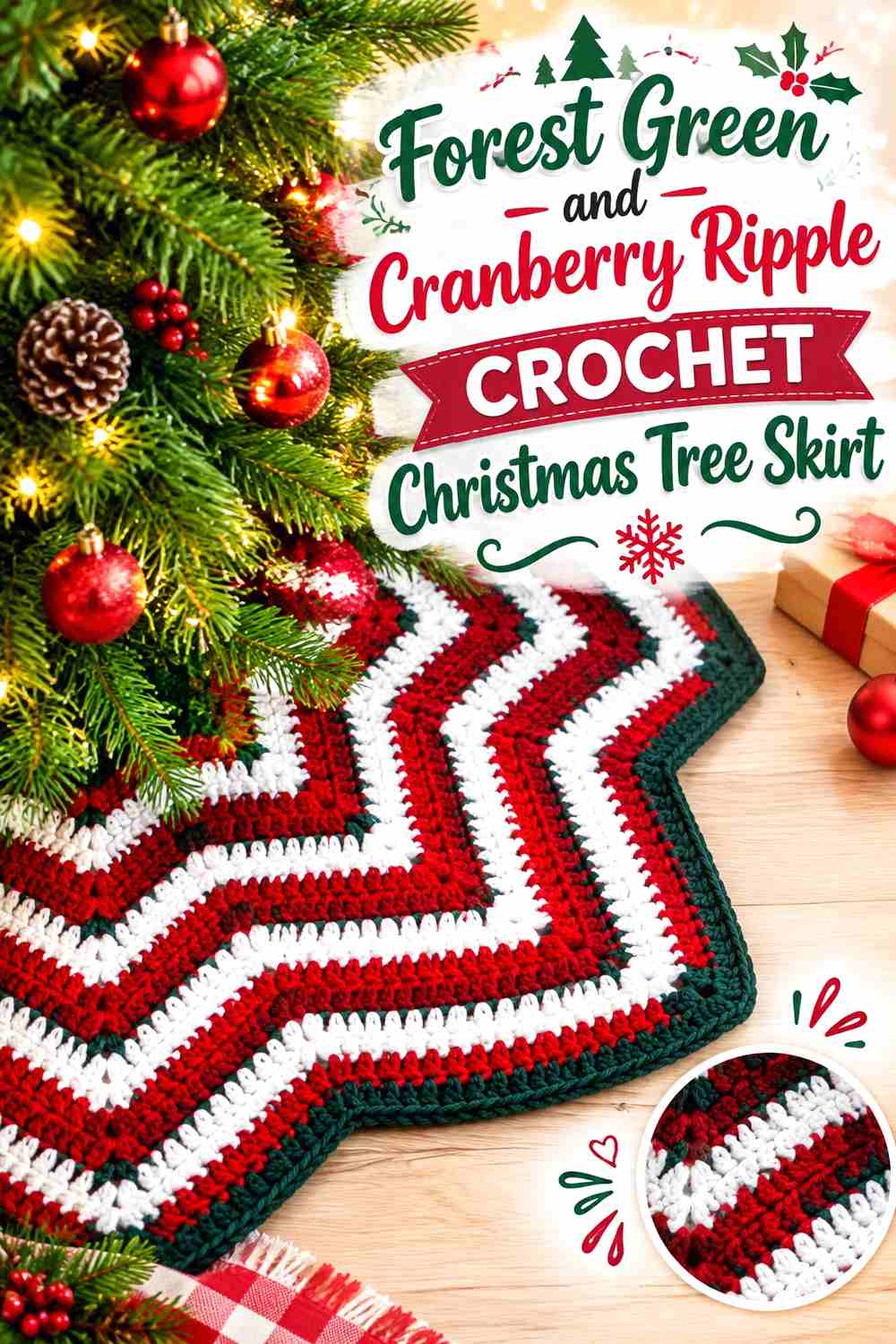
A ripple or pointed outer edge naturally creates alternating peaks and valleys. Forest green can dominate the body while cranberry highlights selected ripple bands or the final points. Because the silhouette already has movement, the color plan should remain relatively simple.
Let Forest Green Fill Most Ripple Sections
Broad forest-green areas keep the skirt connected visually even when the outer edge changes direction repeatedly.
Avoid alternating every narrow section between green and cranberry unless you intentionally want a strongly striped finish. Larger green areas allow the ripple shape itself to remain the main feature.
Put Cranberry Near the Forest Green Outer Points
Cranberry is especially effective near the perimeter because the pointed edge remains visible beneath gifts.
Repeat it in one controlled band or around selected outer details. A small warm accent along the silhouette can be more noticeable than a larger amount placed close to the trunk.
Creator Credit: Cosy Rosie Crochet
17. Forest Green And Cream Minimal Crochet Christmas Tree Skirt
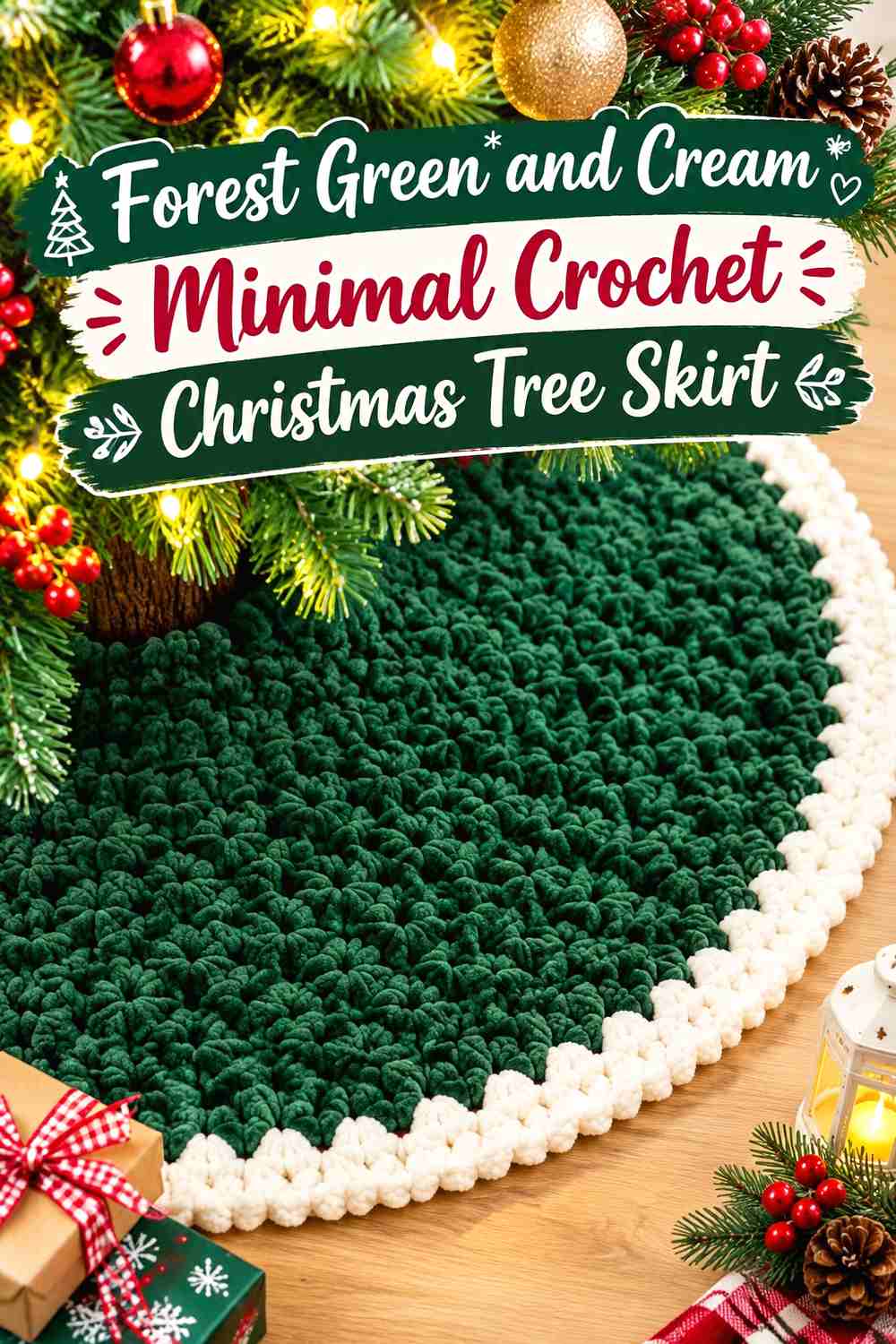
A minimal two-color skirt relies on proportion rather than complex motifs. Keep most of the surface forest green and introduce cream only through a broad border, one central band, or a simple opening edge. This direction works well when the surrounding tree already has numerous ornaments and colorful packages.
Give Forest Green Large Uninterrupted Sections
Avoid breaking the main field into small stripes. Large forest-green areas create a calmer visual foundation beneath a decorated Christmas tree.
The simplicity also allows stitch texture to remain visible without being overshadowed by frequent color changes.
Use Cream Once or Twice Against Forest Green
Choose one major place for cream—such as the outer edge—and perhaps repeat it narrowly near the center opening.
Restricting the light color makes each cream section feel deliberate and preserves forest green as the unmistakable dominant shade.
Creator Credit: Play Hooky with Me
18. Forest Green And Silver Snowflake Crochet Christmas Tree Skirt
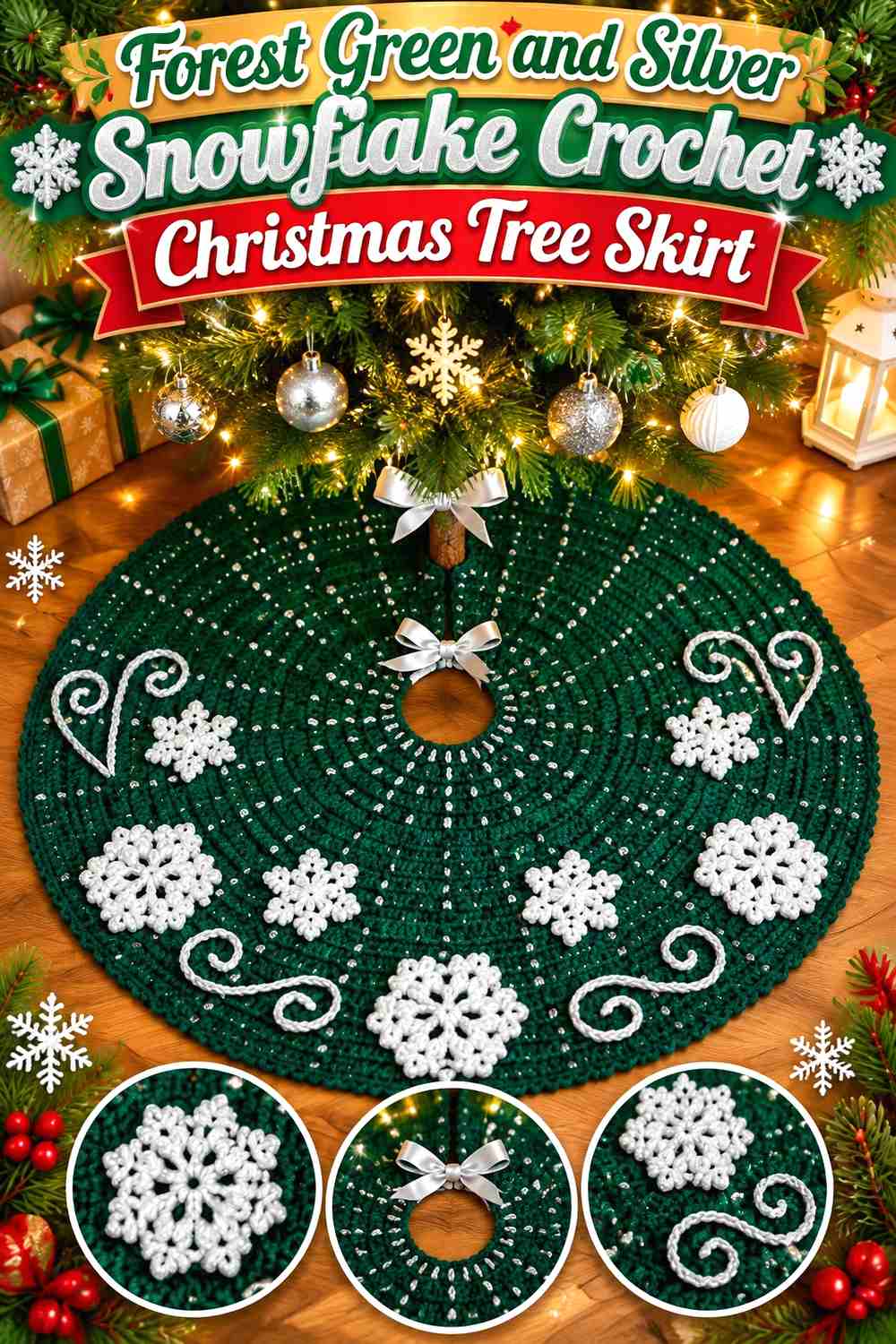
The final scheme combines dark evergreen color with cool snowflake accents. Forest green can cover the primary skirt while silver-gray or a soft silvery neutral appears in snowflake motifs and selected border details. Keep the accent moderate so the motifs look deliberate rather than turning the entire surface gray.
Keep Forest Green Behind the Silver Snowflakes
A continuous dark green field gives light snowflake shapes enough contrast to remain visible.
Spacing the motifs with generous forest-green areas between them also prevents the skirt from becoming visually crowded when ornaments, lights, and gifts are added above it.
Repeat Silver Sparingly Around the Forest Green Border
A narrow silver-toned border can connect separate snowflake accents and give the outer edge a cooler winter finish.
If the accent yarn is close to forest green in value, switch to a lighter silver-gray rather than increasing the quantity. Visibility is more useful here than additional accent coverage.
Creator Credit: Fuad Azmat / YARNutopia by Nadia
Comparing the Forest Green Christmas Tree Skirt Palettes
For the strongest light-and-dark contrast, the forest-green-and-white mosaic, snow-white bobble, ivory stripe, and cream round versions create the clearest separation. They are useful when you want stitchwork or motifs to remain visible under soft tree lighting.
For a warmer neutral direction, oatmeal, camel, natural beige, and ecru soften forest green without creating the sharper look of bright white. These palettes also keep the tree skirt adaptable to rooms that use wood tones or earthy holiday decor.
Cranberry and red create a more traditional festive contrast, while antique gold and silver work better as restrained accents. The woodland palette introduces the most narrative color variation, whereas the minimal forest-green-and-cream version keeps the greatest amount of uninterrupted green.
Construction should influence the color decision too. Mosaic, granny-square, woodland, and snowflake designs benefit from strong motif separation. Bobbles, plush trim, knit-look texture, and ripples already provide physical variation, so their palettes can remain simpler.
Conclusion
Forest green can function as much more than a single solid Christmas tree skirt color. It can anchor stripes, frame granny squares, define mosaic motifs, support bobbles, carry a farmhouse texture, or provide a dark background for snowflakes and woodland details.
If you want the green to remain prominent after gifts are placed under the tree, repeat it through the outer half or final border instead of concentrating it only around the trunk. Pair it with cream, ivory, white, oatmeal, or ecru when texture needs more separation. Use cranberry, red, antique gold, rust, or silver in smaller amounts when you want a more distinct seasonal accent.
Before choosing the final palette, view the actual yarns together beneath the kind of lighting used around your tree. Forest green can look considerably darker in that setting, so enough value contrast is important when small motifs or raised textures need to stay visible.
Frequently Asked Questions
What colors work with forest green on a crochet Christmas tree skirt?
Cream, ivory, white, oatmeal, beige, camel, soft gray, ecru, cranberry, red, antique gold, rust, and silver can all play useful supporting roles. Choose the second color according to whether you want lighter contrast, warmer contrast, or a small festive accent.
Can a forest green crochet tree skirt disappear under a green Christmas tree?
It can visually blend with low branches when the green shades and values are similar. Using cream or another lighter shade near the inner opening, in motifs, or along major bands can create separation while keeping forest green dominant.
Should forest green go on the border of a Christmas tree skirt?
A forest-green border works well when you want the dominant color visible around presents. A cream or white border is useful when a dark green body already occupies most of the surface and the edge needs more separation from the floor.
Is cream or bright white better with forest green?
Cream produces a softer, warmer contrast, while bright white generally creates a sharper light-dark separation. Compare both against the actual forest-green yarn and the room decor rather than treating one as universally better.
How can I make forest green crochet texture easier to see?
Place a lighter color beside important bobbles, ridges, mosaic lines, granny-square edges, or raised motifs. Also check the yarn under normal room and tree lighting, because very dark green can hide subtle texture in low light.
Can I use red with a forest green crochet Christmas tree skirt without making it too busy?
Yes. Keep forest green across most of the skirt and restrict red or cranberry to selected stripes, motif centers, borders, or other repeated accents. A clear dominant-supporting relationship keeps the palette more controlled.
How many colors should I use in a forest green Christmas tree skirt?
Two colors are enough for stripes, texture, and high-contrast motifs. Three can be useful for granny squares, woodland scenes, or layered geometric designs. When adding a third color, give it a specific role so forest green remains the dominant visual thread.