Holly Green gives a granny square cardigan a deep, recognizable anchor that can work in several different places. It can fill square centers, form broad outer rounds, create the joining grid, or return around cuffs and front bands. Each placement changes how green the finished cardigan looks even when the same supporting colors are used.

The biggest decision is hierarchy. Pairing Holly Green with cream produces clear light-dark separation, while sage creates a much quieter tonal transition. Camel, rust, and mustard move the palette toward an earthy direction; blush creates a softer contrast; and charcoal or navy can make the overall cardigan considerably darker.
Granny square construction also means color has to be considered across the complete garment. A square that looks balanced alone may become overwhelmingly dark when repeated across the back, sleeves, and front panels. These 14 ideas use different motif layouts and color-placement strategies so Holly Green remains deliberate rather than simply appearing in every square.
Quick List
- Holly Green And Cream Cropped Crochet Granny Square Cardigan
- Holly Green Red And Ivory Daisy Crochet Granny Square Cardigan
- Holly Green And Camel Giant Crochet Granny Square Cardigan
- Holly Green Mustard And Oatmeal Chunky Patchwork Crochet Cardigan
- Holly Green And Charcoal Classic Crochet Granny Square Cardigan
- Holly Green And Blush Tie Front Crochet Granny Square Cardigan
- Holly Green And Ivory Hooded Crochet Granny Square Cardigan
- Holly Green And Espresso Ribbed Patchwork Crochet Granny Square Cardigan
- Holly Green Golden Yellow And Cream Sunflower Crochet Granny Square Cardigan
- Holly Green And Sage Modern Crochet Granny Square Cardigan
- Holly Green And Soft White Daisy Crochet Granny Square Cardigan
- Holly Green And Taupe Patchwork Crochet Granny Square Cardigan
- Holly Green Rust And Ecru Sunflower Crochet Granny Square Duster Cardigan
- Holly Green Navy And Light Gray Relaxed Crochet Granny Square Cardigan
Decide Whether Holly Green Belongs Inside or Around the Granny Squares
Holly Green centers create repeated dark focal points, especially when the surrounding rounds are pale. Using Holly Green on the outermost round has almost the opposite effect: neighboring motifs begin to visually connect, making the cardigan appear greener overall.
The joining color matters too. A Holly Green join around cream-heavy motifs produces an obvious green grid. A cream or oatmeal join around Holly Green-heavy squares preserves more separation between motifs.
Make several sample squares before choosing the final arrangement. Place them beside one another rather than judging a single motif, because repeated outer rounds and joins can dramatically change the proportion of Holly Green.
Balance Holly Green Across Cardigan Fronts, Sleeves, and Cuffs
An open cardigan is naturally divided into two front panels, so mismatched color weight is easy to notice. Before joining, lay out both fronts together and make sure one side has not accidentally collected most of the Holly Green-heavy motifs.
Sleeves need the same check. If the body already has a high percentage of Holly Green, lighter sleeve squares can provide relief. If the sleeves are pale, Holly Green cuffs can reconnect them to the body.
Front bands and lower ribbing are useful final adjustment points. They allow you to increase Holly Green without remaking motifs, or introduce a lighter supporting shade when the assembled cardigan looks darker than expected.
1. Holly Green And Cream Cropped Crochet Granny Square Cardigan
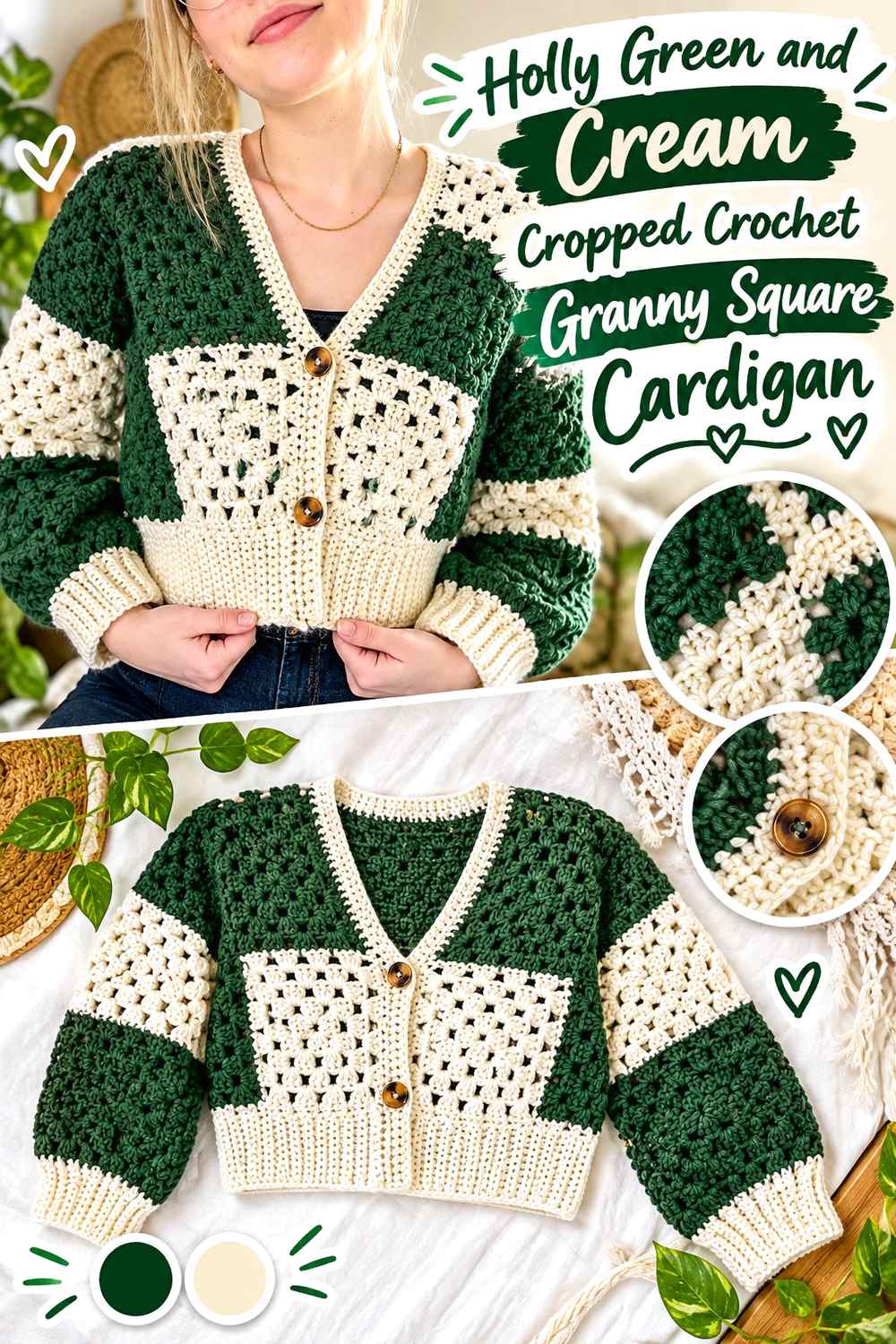
A cropped granny square cardigan gives every motif considerable visual importance because fewer rows of squares make up the torso. Let Holly Green appear consistently through the centers or broad middle rounds, while cream creates enough light space to keep the compact cardigan from becoming one dark block.
The cropped shape also puts more attention on the hem and front opening. Those edges are useful places to decide whether Holly Green should return strongly or whether cream should provide a lighter finish.
Holly Green Centers Can Anchor the Cropped Crochet Granny Squares
Use Holly Green in a consistent central position when you want every square to share the same dark focal point. Cream around those centers makes the geometry visible even when several motifs meet across the back.
Check the two front panels before joining. Because the cardigan is short, even one extra Holly Green-heavy square can noticeably change the balance between the left and right sides.
Holly Green Ribbing Can Reconnect Cream-Heavy Crochet Cardigan Edges
If cream occupies the outside of most squares, Holly Green ribbing around the cuffs or lower edge can restore the main color to the cardigan perimeter.
Keep the ribbing proportionate to the cropped body. A very broad dark hem can visually reduce the amount of cream and make the cardigan look heavier than the motif layout suggests.
Creator Credit: HayHay Crochet
2. Holly Green Red And Ivory Daisy Crochet Granny Square Cardigan
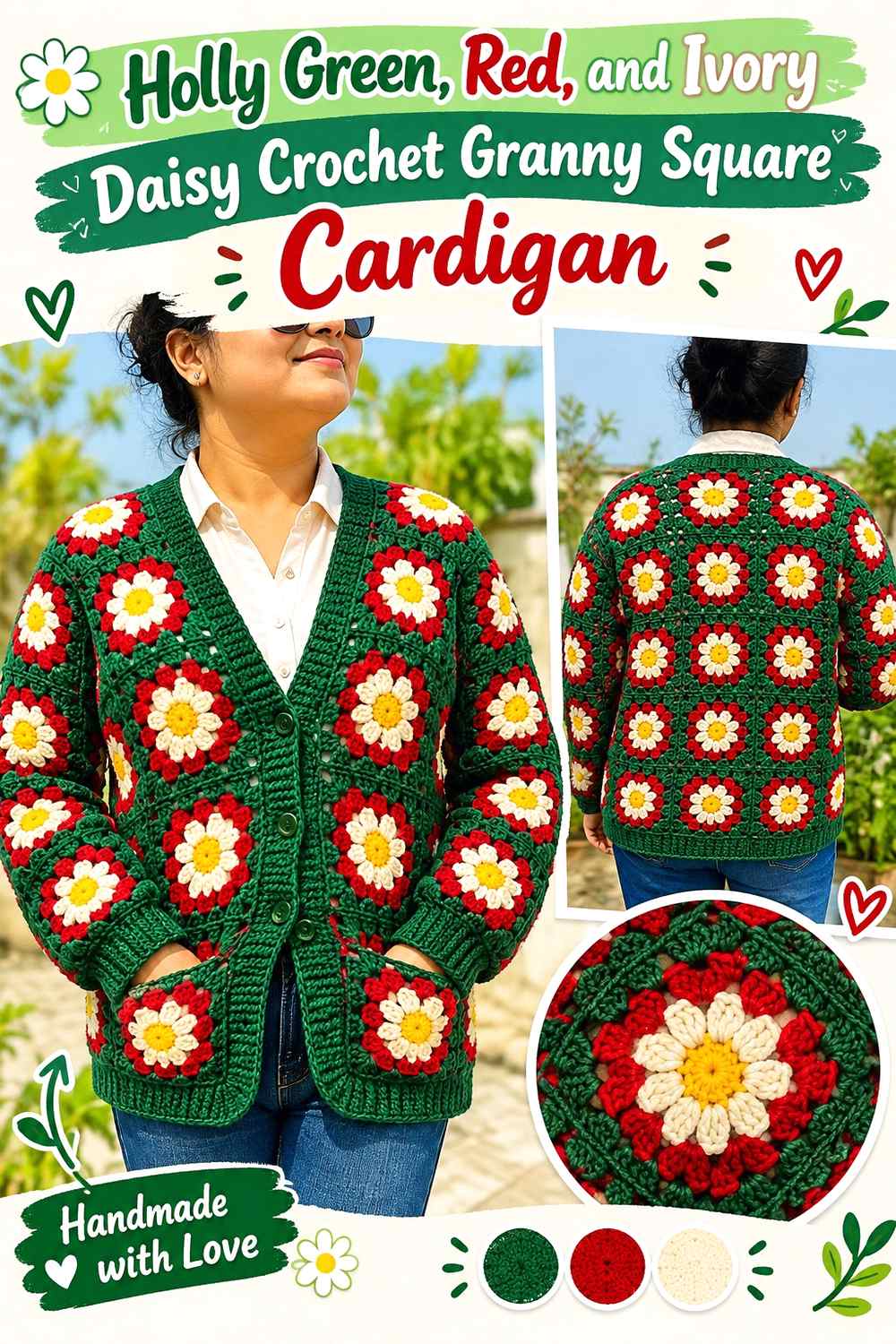
Daisy motifs give each color a defined role. Holly Green can provide the square background or selected outer rounds, red can concentrate in the flower centers, and Ivory can keep the petals or surrounding areas light enough to remain distinct.
Because red and Holly Green are both strong colors, Ivory should have a real separating function. Equal amounts of green and red across every square can make the floral details compete with the cardigan layout.
Holly Green Backgrounds Can Ground the Daisy Crochet Granny Squares
Use Holly Green around lighter daisy sections when you want the floral motifs to remain obvious against the cardigan body. A repeated green background also connects squares even when their flower centers vary slightly.
Look at several motifs together before deciding how dark the background should be. Repeated Holly Green corners can visually merge once the squares are joined.
Holly Green Needs Ivory Space Around Strong Red Crochet Daisy Details
Ivory can prevent red flower details from sitting directly against Holly Green everywhere. That lighter break preserves the floral shape and stops two saturated shades from competing within a small motif.
If the finished squares already contain plenty of Ivory, return to Holly Green for the cuffs or front band rather than adding even more pale edging.
Creator Credit: Cute Crochet
3. Holly Green And Camel Giant Crochet Granny Square Cardigan
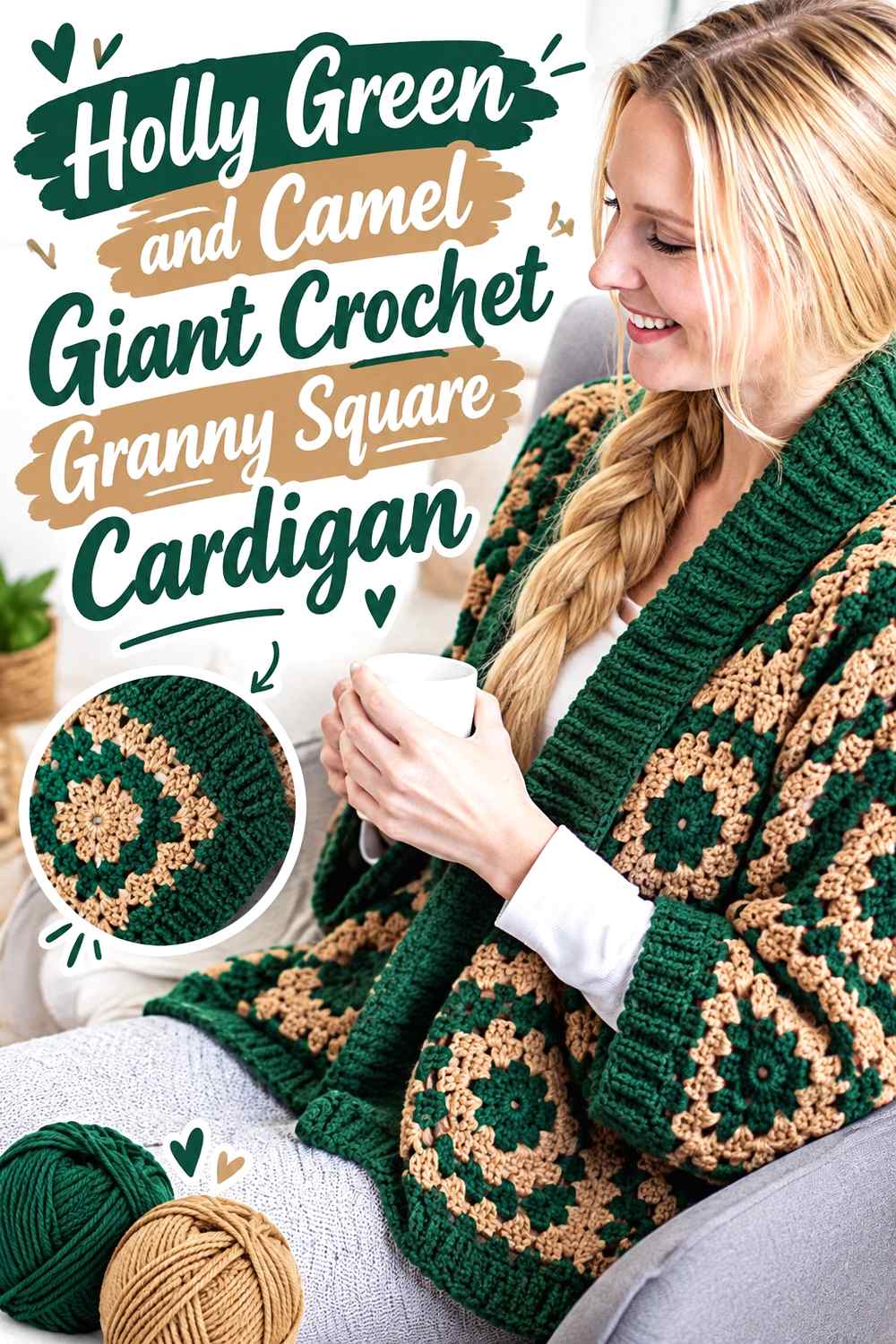
Giant granny squares enlarge every color band, so Holly Green and Camel need a clear proportion before the motifs become too large to judge easily. Holly Green can form the broadest or most frequently repeated rounds while Camel warms the spaces between darker sections.
With only a few oversized motifs, each square effectively becomes a major cardigan panel. Color placement therefore affects the complete garment more strongly than it would in a cardigan made from dozens of small squares.
Holly Green Should Occupy the Strongest Giant Crochet Granny Square Bands
Give Holly Green enough width to remain dominant when the large square is viewed from across a room. Narrow green rounds can be overwhelmed once wider Camel sections are added.
As the square grows, step back periodically. The outer rounds occupy increasingly more surface area, so a late Camel section can alter the balance more than an early one.
Holly Green and Camel Need Consistent Placement Across the Giant Cardigan Panels
Repeat the main Holly Green-Camel relationship across the oversized squares so one panel does not look unrelated to another.
The sequence does not have to be identical, but Holly Green should retain a similar visual role. If one square ends in a broad green round and another in Camel, check how those outer edges meet before assembly.
Creator Credit: Yarnspirations
4. Holly Green Mustard And Oatmeal Chunky Patchwork Crochet Cardigan
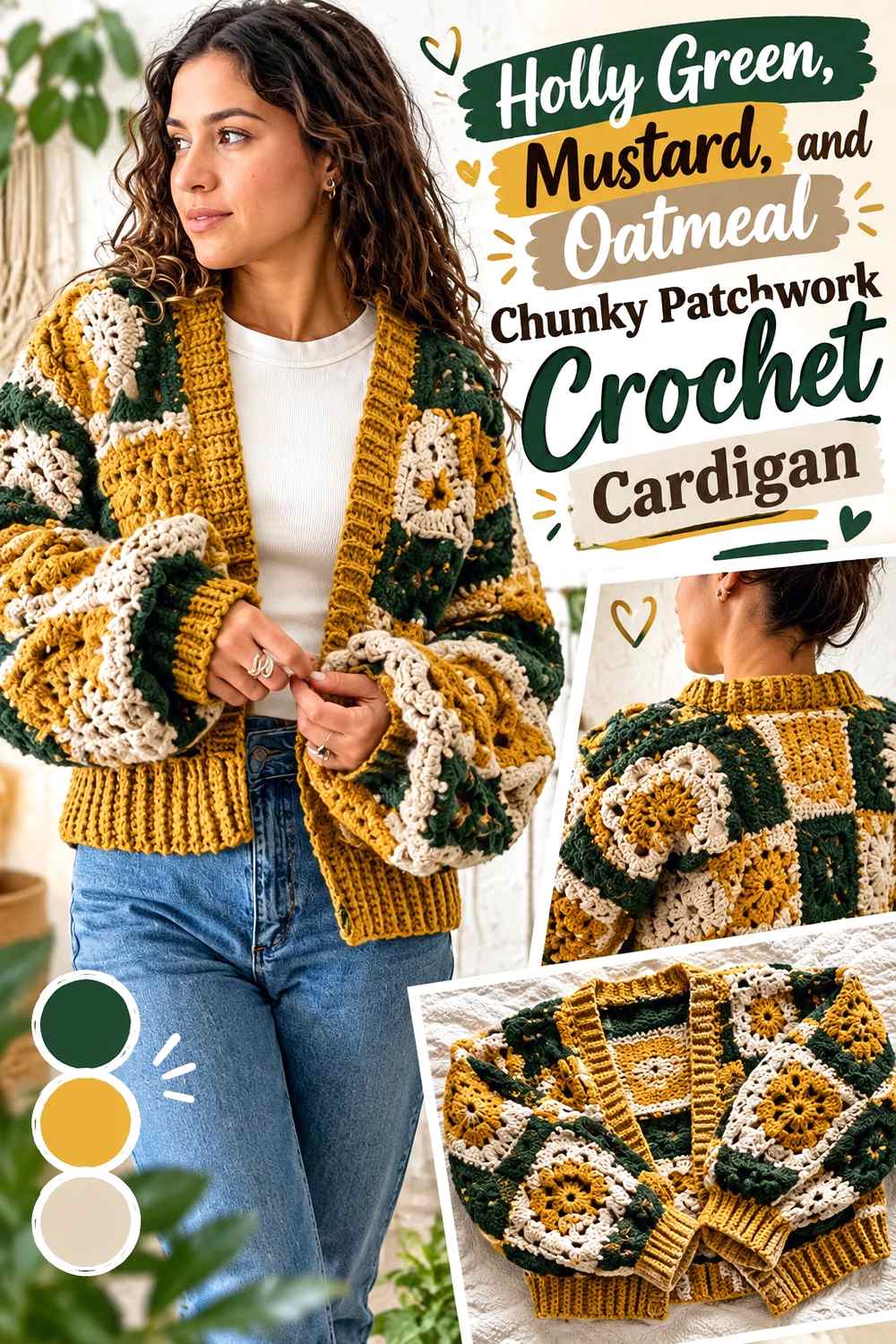
Chunky granny squares magnify both stitch texture and color blocks. Holly Green should remain the darkest visual anchor, Mustard can provide a strong warm accent, and Oatmeal can separate the two saturated colors when the patchwork starts to feel dense.
Because each patch occupies substantial space, avoid placing all the Holly Green-heavy squares on the back and all the Mustard-heavy ones on the sleeves. Spread the visual weight across the garment.
Holly Green Should Repeat Across Every Chunky Crochet Cardigan Section
Place Holly Green in both front panels, the back, and sleeves so the main color travels around the complete cardigan. Chunky motifs make missing color especially obvious because each square covers more area.
Lay out all major panels before joining. Moving one Holly Green square from the back to a sleeve may improve the complete balance more than altering individual motifs.
Holly Green and Mustard Benefit From Oatmeal Crochet Separation
Oatmeal can sit between Holly Green and Mustard where a lighter transition is needed. This keeps both stronger colors distinct and gives chunky stitches more visual space.
Do not force Oatmeal into every square. A few direct Holly Green-and-Mustard boundaries can preserve variety while the neutral controls the busiest sections.
Creator Credit: Emma Warrender
5. Holly Green And Charcoal Classic Crochet Granny Square Cardigan
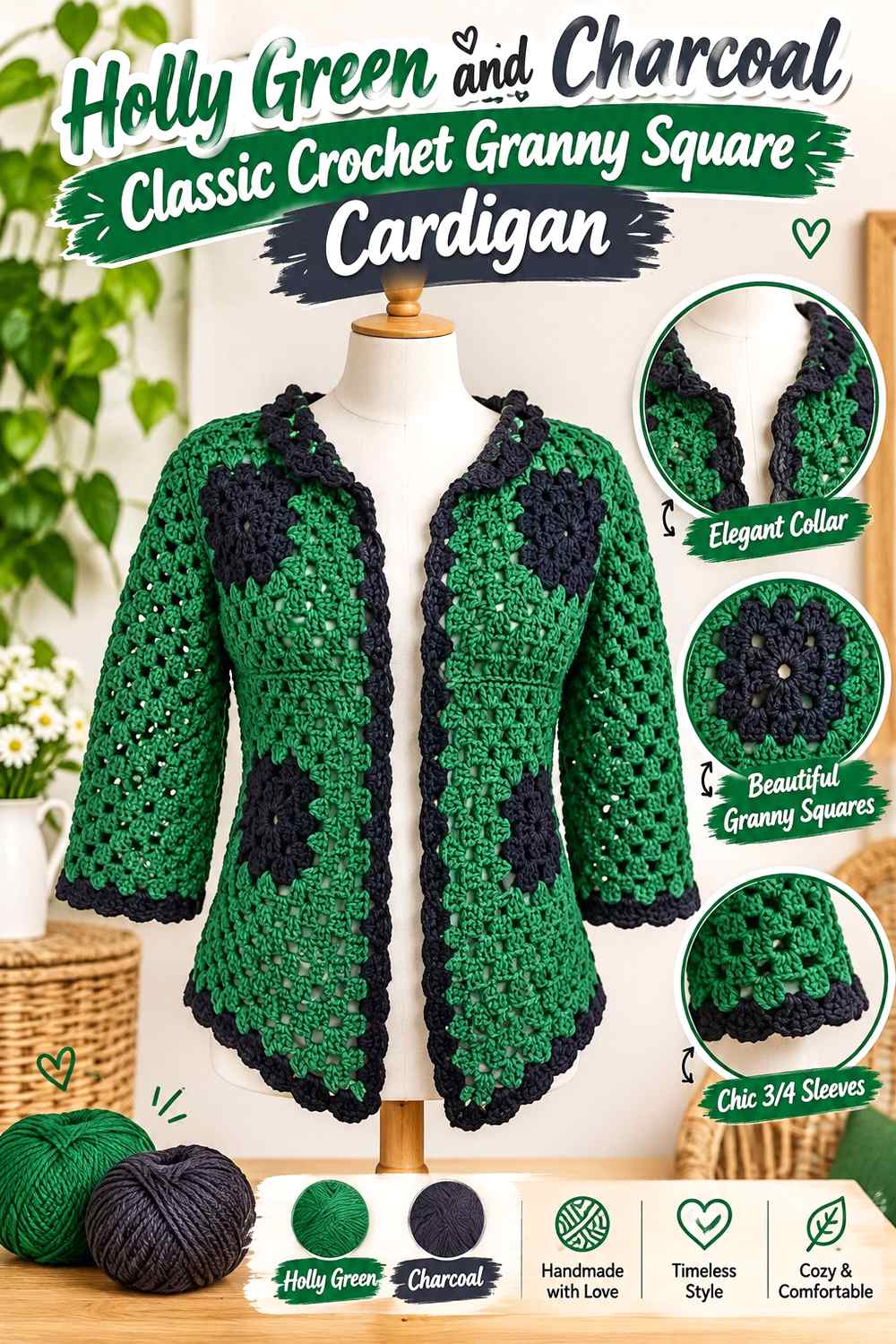
Charcoal produces a dark, restrained partner for Holly Green. This combination works best when the square structure rather than high contrast is meant to provide most of the visual interest.
Since both shades can have similar light-dark value, use broader sections rather than tiny alternating rounds when you want the color change to remain noticeable.
Holly Green Needs Enough Area to Stay Distinct From Charcoal Crochet Squares
Keep Holly Green in substantial centers or outer sections instead of reducing it to narrow lines between Charcoal rounds. The green hue may remain obvious up close but become much subtler from a distance.
A grayscale photo can help show how close the yarns are in value. If they nearly merge, treat the palette as tonal rather than expecting crisp square boundaries.
Holly Green Can Keep Charcoal Crochet Cardigan Edging From Becoming Too Heavy
If Charcoal appears strongly within the motifs, finish the cardigan with Holly Green cuffs or a green front band. Returning the main color at the edges prevents the darkest neutral from framing the whole garment.
If the motifs are mostly Holly Green instead, a narrow Charcoal band can provide enough finishing contrast without needing another color.
Creator Credit: Nati Crochet
6. Holly Green And Blush Tie Front Crochet Granny Square Cardigan
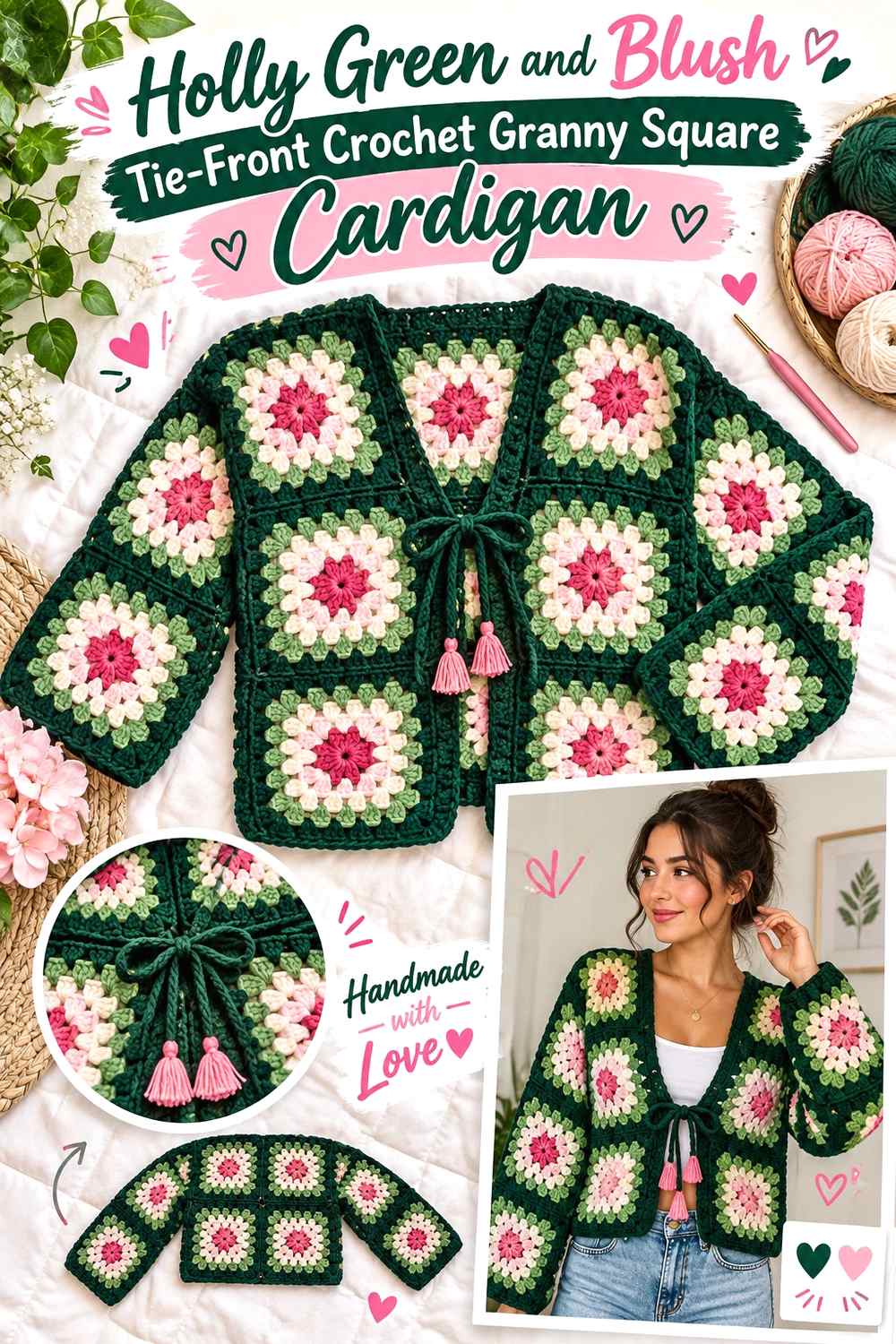
Blush gives Holly Green a soft contrasting hue without requiring a third color. On a tie-front cardigan, the ties and front edges become particularly noticeable, so Blush can be concentrated there while Holly Green continues across the granny-square body.
Keep the green dominant through the motifs if you want the cardigan to read clearly as Holly Green rather than as a balanced pink-and-green patchwork piece.
Holly Green Should Lead Both Front Crochet Granny Square Panels
Distribute Holly Green similarly across both sides of the opening so the tie-front structure remains visually balanced. One blush-heavy front panel can make the cardigan look asymmetrical even if the square count is identical.
Lay the fronts side by side before assembly and exchange motifs if one side has noticeably more Holly Green.
Holly Green Can Balance Blush Crochet Ties and Front Edging
If Blush appears on the ties, repeat a controlled amount around the front opening or cuffs so the pink detail feels connected.
Keep Holly Green close to the tie area rather than creating a broad Blush front band. The stronger green field gives the softer accent a clear boundary and protects the main color hierarchy.
Creator Credit: Danielle Villanueva
7. Holly Green And Ivory Hooded Crochet Granny Square Cardigan
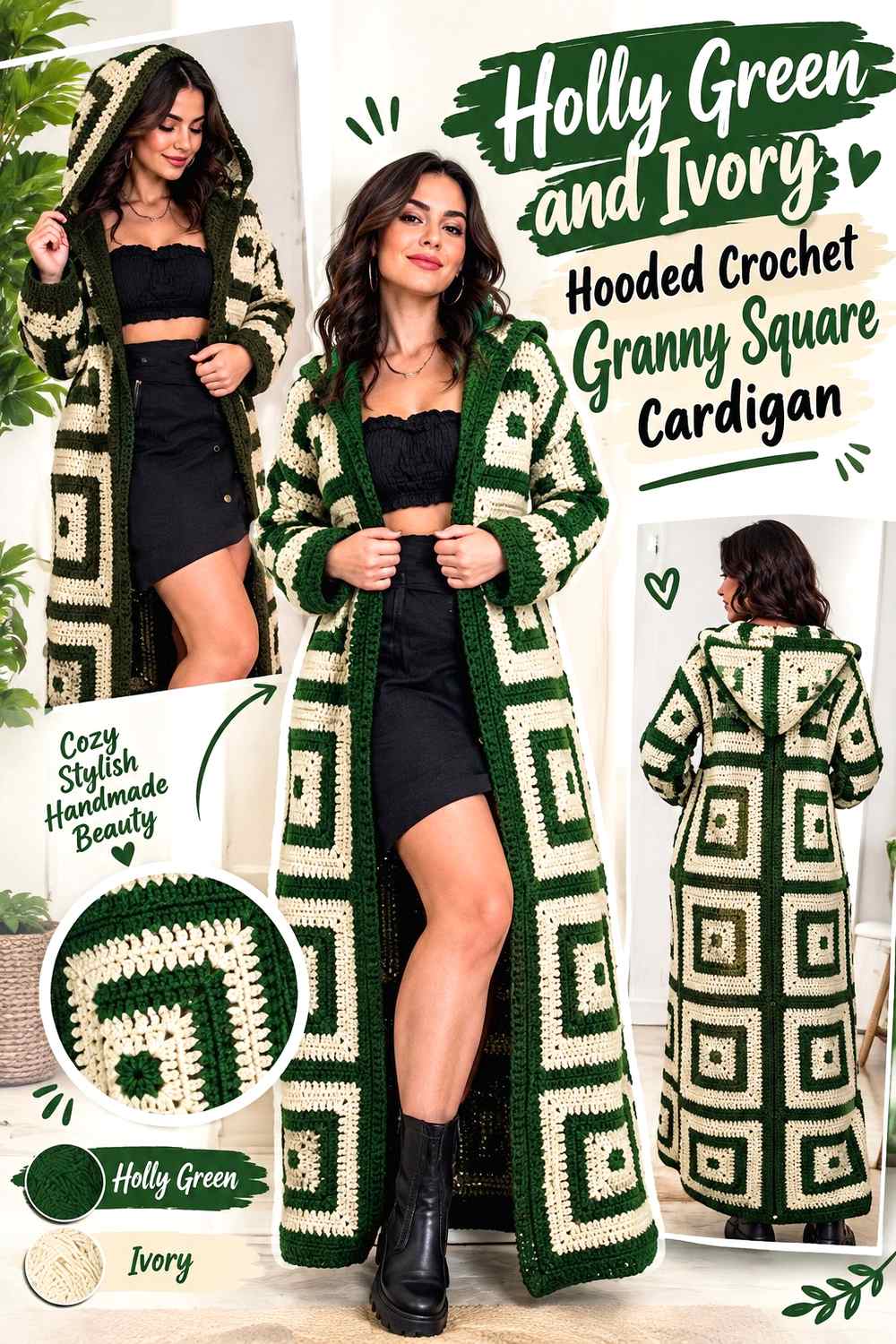
A hood adds another large color area that standard granny cardigans do not have. Holly Green can lead the body and sleeves while Ivory lightens either the hood interior, its edging, or selected motif rounds.
Decide whether the hood should blend into the body or stand apart before distributing Ivory. A predominantly Ivory hood becomes a major light focal point near the face.
Holly Green Should Continue From the Crochet Cardigan Body Into the Hood
Using Holly Green through at least part of the hood keeps that extra section connected to the granny-square body. This is especially useful when Ivory already appears frequently inside the motifs.
If the hood is built mainly in a solid or simpler stitch, Holly Green can also give the eye a quiet area after the busier square pattern.
Holly Green and Ivory Can Clarify the Crochet Hood Edge
A narrow Ivory edge against Holly Green makes the hood opening easier to see without turning the entire hood pale.
Repeat Ivory at the cuffs if another connection point is needed, but avoid outlining every cardigan edge automatically. Too much light trim can shift attention away from the Holly Green granny squares.
Creator Credit: Cherilyn Q
8. Holly Green And Espresso Ribbed Patchwork Crochet Granny Square Cardigan
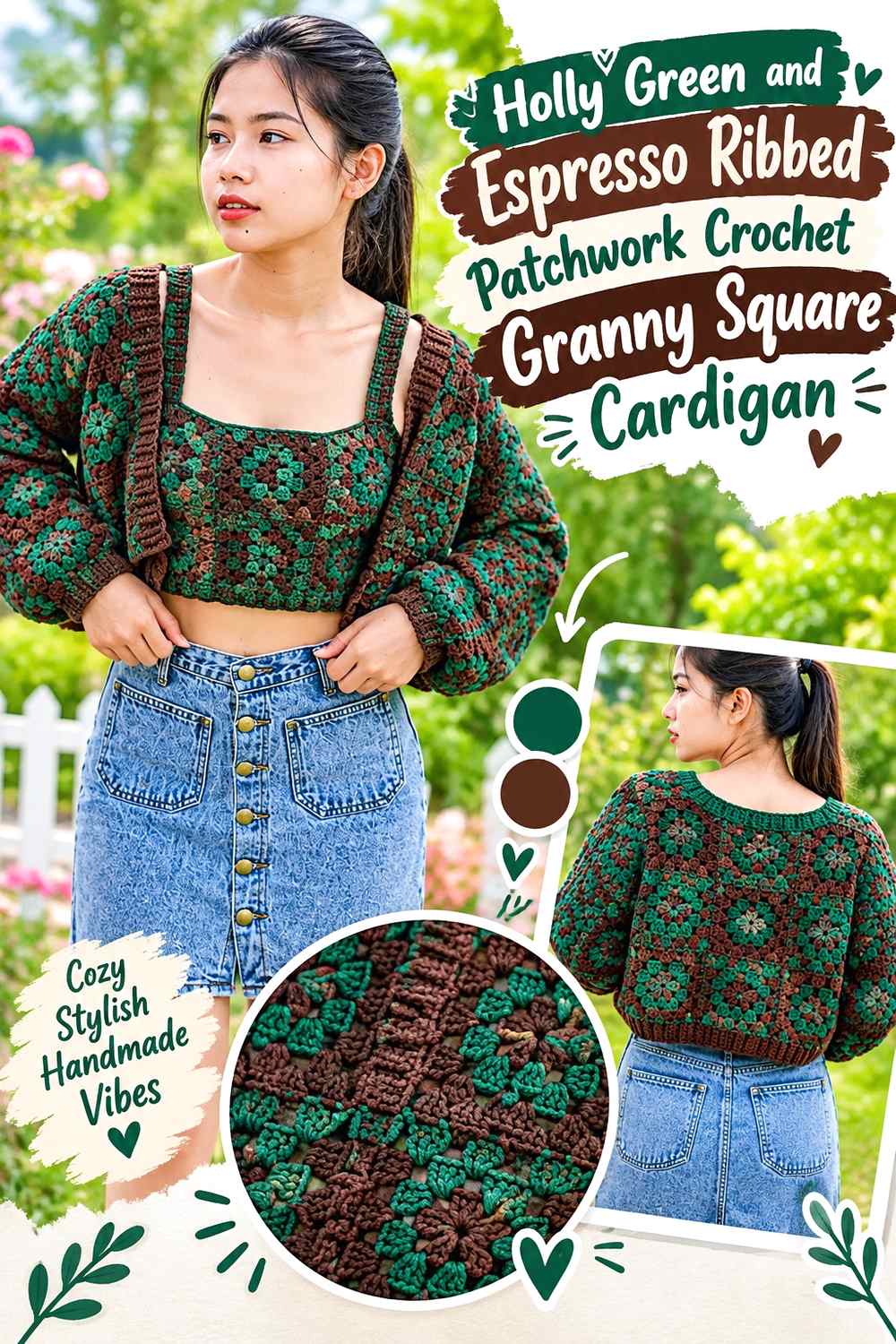
Espresso gives Holly Green a warm dark partner and works especially well in ribbing because the texture change already separates cuffs and bands from the granny-square field.
Keep Holly Green more prominent in the square panels. Espresso should define the cardigan structure rather than fill so many motifs that the entire garment becomes equally brown and green.
Holly Green Should Control the Patchwork Crochet Cardigan Body
Use Holly Green consistently across front, back, and sleeves so the patchwork still has one dominant color. Espresso can appear within a smaller number of rounds or squares where extra depth is useful.
Because both shades are dark, include enough area in each block for the color change to remain recognizable.
Holly Green Can Transition Into Espresso Crochet Cardigan Ribbing
Espresso cuffs, hem ribbing, or front bands create a strong finishing frame. Let Holly Green extend right up to those edges so the transition is deliberate rather than separated by another competing color.
If all the Espresso ribbing makes the cardigan feel too dark, keep only the cuffs Espresso and return the front and lower bands to Holly Green.
Creator Credit: Chenda DIY
9. Holly Green Golden Yellow And Cream Sunflower Crochet Granny Square Cardigan
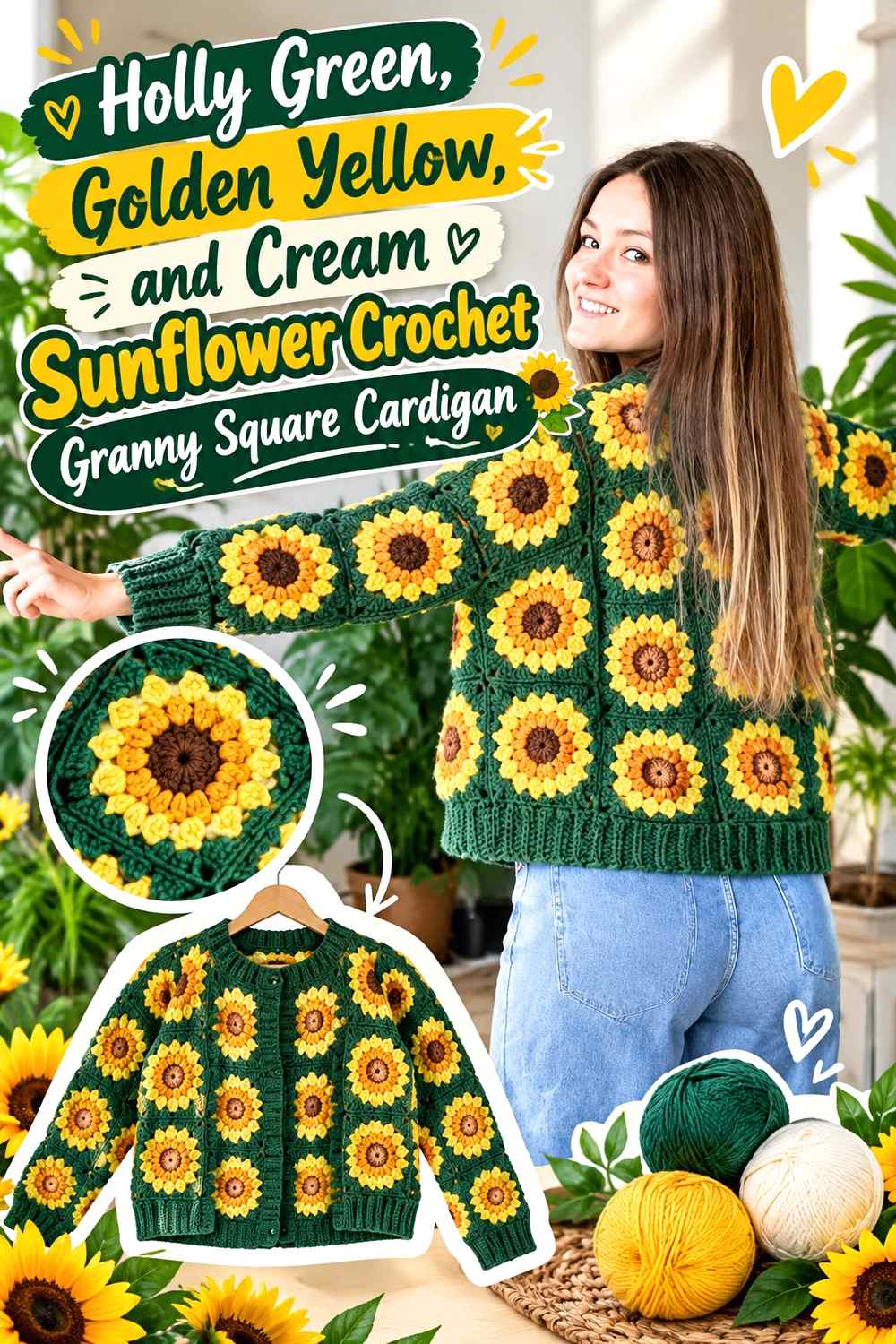
Sunflower motifs provide an obvious three-color structure. A darker center can lead into Golden Yellow petals, while Holly Green creates the square background and Cream supplies a lighter separator or finishing color.
For a Holly Green-focused cardigan, the green needs to extend beyond small leaves or corners. Use it generously around the floral motifs, joins, or cardigan bands.
Holly Green Backgrounds Can Make Sunflower Crochet Granny Squares Cohesive
Repeating Holly Green around the outside of each floral square creates a common field behind the Golden Yellow flowers. Once joined, those green outer areas can visually connect into a larger cardigan surface.
Check whether the flowers remain individually readable after several green-background squares are placed together. Cream can provide additional separation if needed.
Holly Green Needs Cream Relief Around Golden Yellow Crochet Flowers
Cream can lighten selected joins, borders, or motif sections when Holly Green and Golden Yellow occupy most of the visual area.
Use it strategically rather than evenly dividing the square into thirds. Holly Green should remain the primary background, Golden Yellow the floral accent, and Cream the light supporting shade.
Creator Credit: by Kristine
10. Holly Green And Sage Modern Crochet Granny Square Cardigan
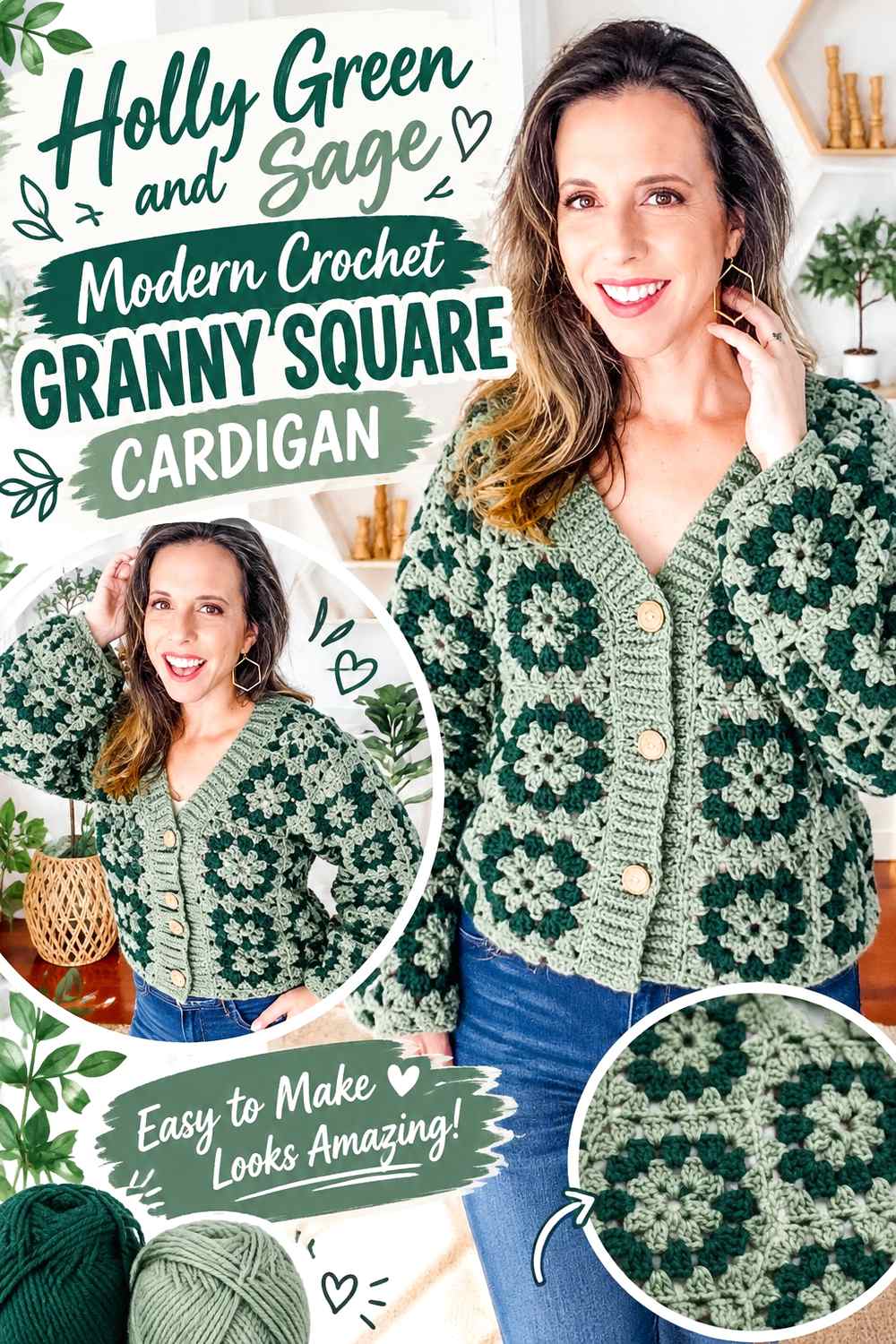
Holly Green and Sage create a tonal green cardigan where contrast comes mainly from lightness rather than hue. This works particularly well with a modern granny square because the motif structure stays recognizable without introducing an unrelated accent color.
Choose a Sage that is noticeably lighter than Holly Green. If both shades are too close, small alternating details can disappear once the motifs are assembled.
Holly Green Should Provide the Dark Anchor in Modern Crochet Granny Squares
Use Holly Green for the center, outer round, or another repeated section that needs to remain visually stable across every motif.
Sage can then occupy larger light areas without changing the cardigan away from a green color story. The two shades should have distinct roles rather than being swapped randomly in every square.
Holly Green Joins Can Strengthen a Sage-Heavy Crochet Cardigan
If individual squares contain substantial Sage, a Holly Green joining color can bring the darker green back between every motif and make the cardigan read more clearly as Holly Green.
If the squares are already dark, reverse the approach and use Sage for the join. The goal is to balance total color area rather than automatically choosing the darkest shade for assembly.
Creator Credit: Briana K Designs
11. Holly Green And Soft White Daisy Crochet Granny Square Cardigan

Soft White creates stronger value separation than Sage or Taupe, making it useful for daisy motifs where small floral details need to remain visible. Holly Green can form the surrounding square area while Soft White petals provide the lightest repeated feature.
Keep the flowers consistent enough that the cardigan does not become visually chaotic when dozens of motifs meet.
Holly Green Can Give Soft White Crochet Daisies a Clear Background
A Holly Green square field provides a dark base that makes pale petals easy to see. This works particularly well when the flower centers use another small accent or a deeper version of green.
Check the corners of the completed motifs. If every square ends in Holly Green, those corners may merge after joining and create a larger continuous green field.
Holly Green Edging Can Reconnect a Soft White Crochet Daisy Cardigan
If the floral motifs contain a large amount of Soft White, use Holly Green on the cuffs, lower band, or front opening to restore the dominant shade at the cardigan perimeter.
This is often more effective than forcing extra green into the flower itself, where it could reduce motif clarity.
Creator Credit: CBH Academy
12. Holly Green And Taupe Patchwork Crochet Granny Square Cardigan
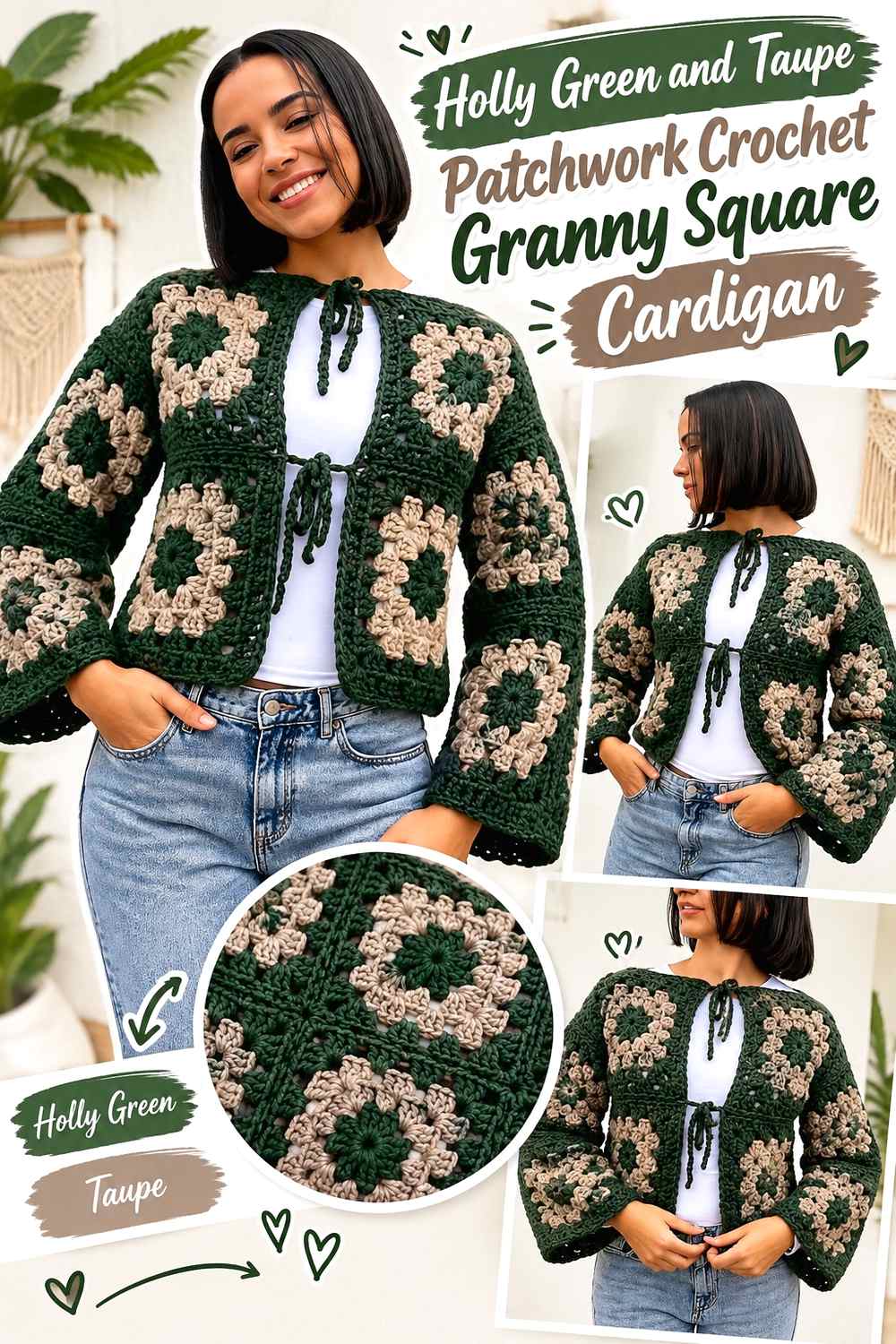
Taupe produces a quieter neutral relationship with Holly Green than Cream or Soft White. It can occupy backgrounds, alternating square rounds, or finishing areas without creating a bright checkerboard effect.
Because the contrast is moderate, placement should be broad enough to remain deliberate. Very narrow Taupe details may disappear beside textured Holly Green clusters.
Holly Green Should Repeat Through Every Patchwork Crochet Cardigan Panel
Make sure Holly Green appears in both front panels, the back, and sleeves rather than concentrating the dark motifs in one region.
Patchwork can look intentionally varied without being random. Repeat the same Holly Green role often enough—such as centers or outer rounds—to give different motifs a shared visual structure.
Holly Green Can Keep Taupe Crochet Cardigan Finishing From Looking Flat
If Taupe appears strongly through the body, use Holly Green around cuffs or the front opening to add depth at the edges.
Conversely, if the body is already Holly Green-heavy, Taupe ribbing can lighten the finish. Choose the edge color after arranging the complete square layout rather than committing before assembly.
Creator Credit: VIARA – tutoriales de crochet
13. Holly Green Rust And Ecru Sunflower Crochet Granny Square Duster Cardigan
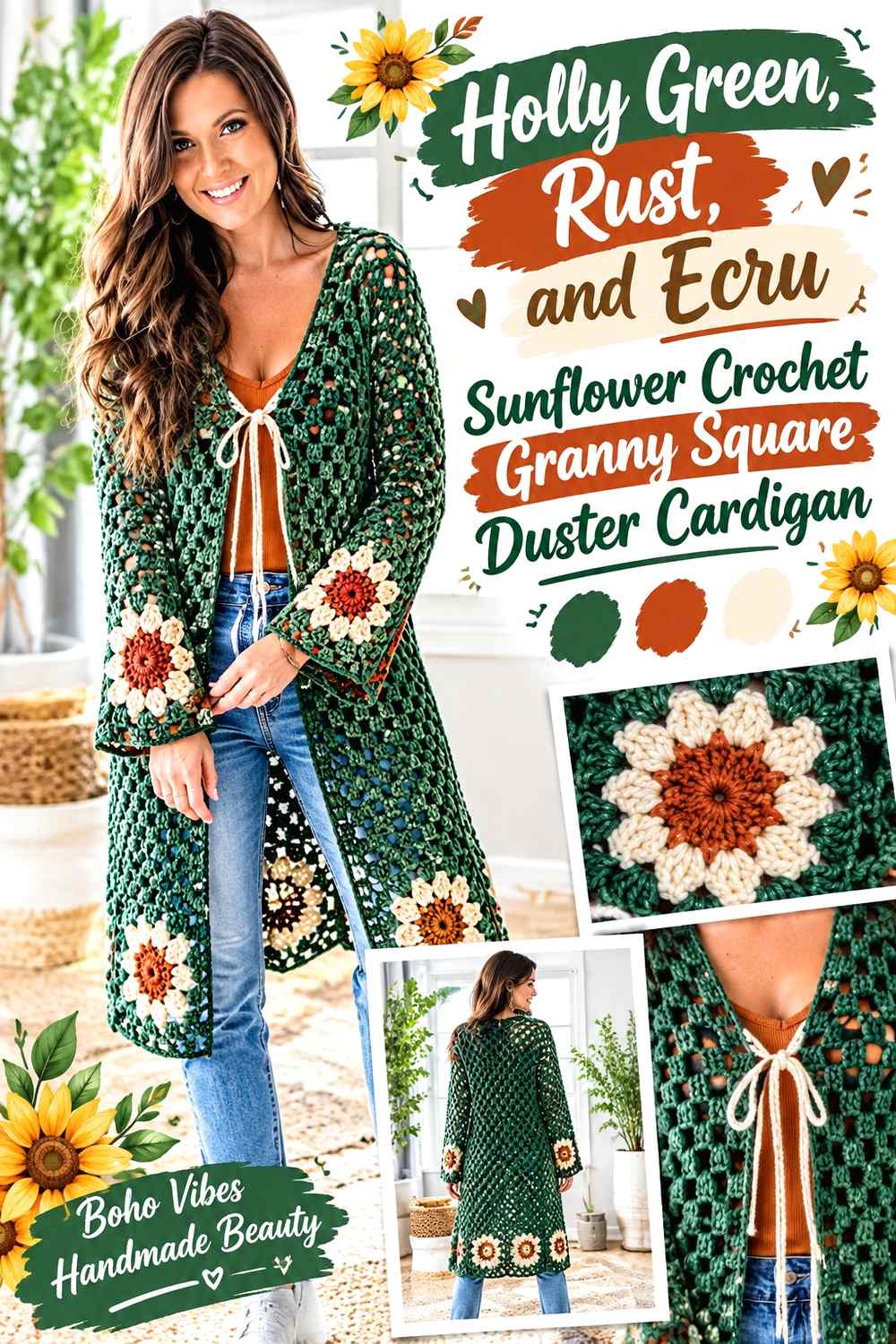
A longer cardigan gives color repetition more vertical space. Holly Green can cover the granny-stitch body or square backgrounds, Rust can introduce a deeper warm floral accent, and Ecru can prevent the lower motif area from becoming overly dark.
The extra length makes horizontal color boundaries more noticeable. Keep Holly Green continuous through enough of the body that the duster does not visually break into several unrelated sections.
Holly Green Should Connect the Crochet Granny Square Hem to the Long Cardigan Body
If floral squares sit near the lower portion of the cardigan, carry Holly Green from the main body into their backgrounds or outer rounds. This makes the motifs feel integrated instead of attached as a separate decorative band.
Repeat the same relationship at the cuffs if floral motifs appear there as well.
Holly Green Needs Ecru Space Around Rust Crochet Sunflower Details
Rust and Holly Green can both carry substantial visual weight. Ecru around or between them provides the lightest point in the palette and keeps smaller motif details easier to read.
Use Ecru primarily as separation rather than allowing it to dominate the full cardigan body. The long silhouette should still read as Holly Green from a distance.
Creator Credit: MJ’s Off The Hook Designs
14. Holly Green Navy And Light Gray Relaxed Crochet Granny Square Cardigan
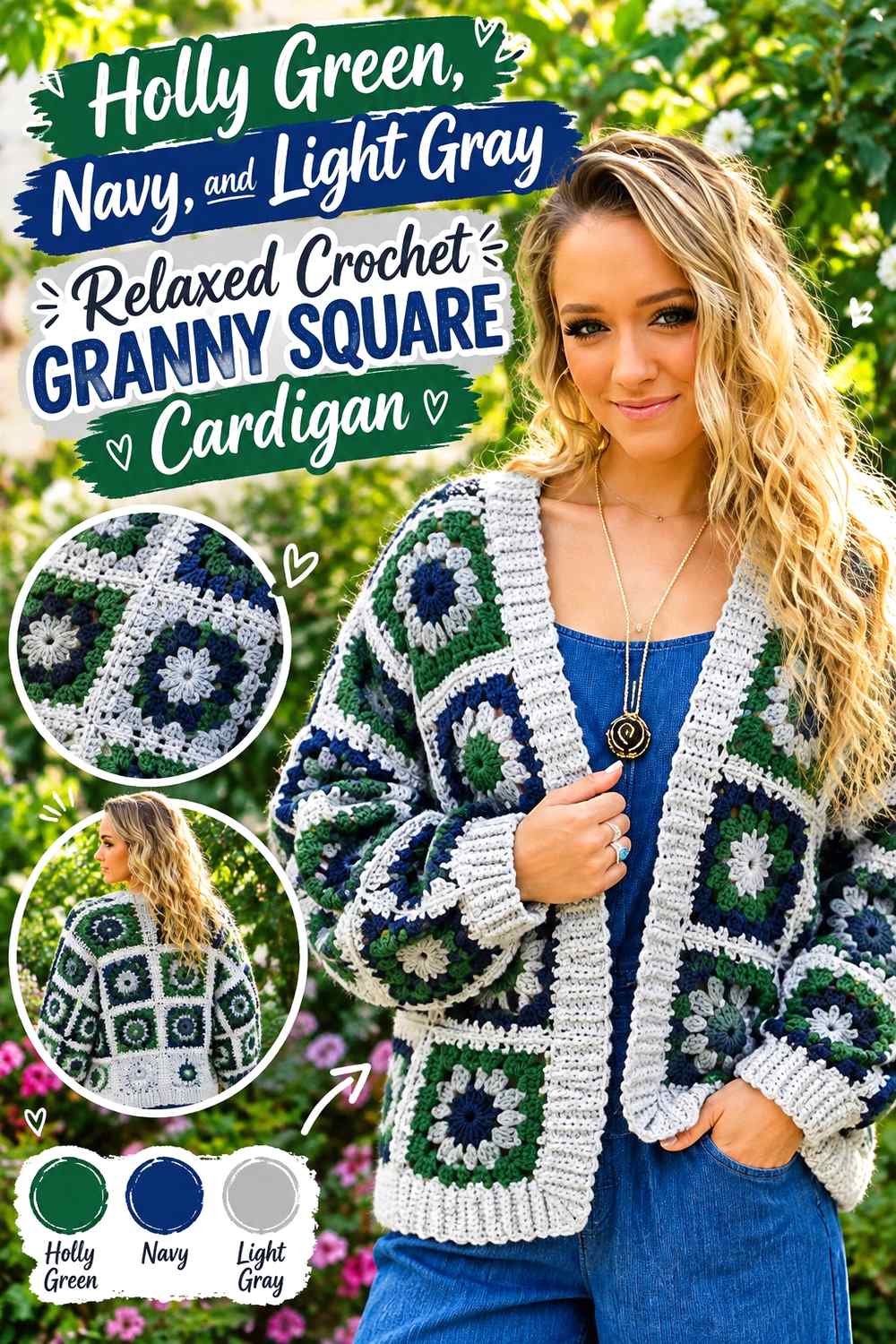
Navy creates a cool dark partner for Holly Green, while Light Gray provides the value separation the two deeper hues may lack. This works well on a relaxed cardigan because the larger surface gives each color enough room to appear in defined sections.
Avoid alternating Holly Green and Navy in tiny rounds without a lighter break if you want the square construction to stay obvious from a distance.
Holly Green and Navy Crochet Granny Squares Need Light Gray Separation
Use Light Gray between selected Holly Green and Navy sections when the two dark colors begin to visually merge. The neutral can sit in middle rounds, backgrounds, or joins depending on where the square needs the clearest boundary.
A grayscale photo is particularly useful for this palette because it shows whether the green and blue are similar in value.
Holly Green Should Reappear Across Relaxed Crochet Cardigan Sleeves
Do not allow Navy-heavy sleeve squares to make the arms look disconnected from a Holly Green torso. Repeat Holly Green through sleeve centers, outer rounds, or cuffs.
Light Gray can remain the connecting neutral across both body and sleeves, giving the two dark colors a consistent separator throughout the garment.
Creator Credit: Emily Ann Roberts
Comparing the Holly Green Granny Square Cardigan Palettes
For the strongest contrast, pair Holly Green with Cream, Ivory, Soft White, Ecru, or Oatmeal. These shades make individual square rounds, floral motifs, joins, and edging easier to distinguish.
Sage creates the most tonal direction because it stays within the green family. Taupe and Camel also give softer transitions, but they add a warmer neutral quality instead of another green.
Charcoal, Espresso, and Navy make the overall cardigan darker. With those palettes, value checking matters because two different dark hues can still merge visually when crocheted into small granny clusters.
Blush provides the clearest soft-color contrast, while Mustard, Golden Yellow, Rust, and red produce stronger multicolor schemes. Those brighter palettes benefit from giving Holly Green the largest or most consistently repeated role rather than distributing every saturated shade equally.
Construction also changes the color plan. Giant squares magnify each round, cropped cardigans make every motif count more, hoods introduce another large area, and long dusters require enough Holly Green repetition to connect the full length of the garment.
Conclusion
Holly Green can shape a granny square cardigan in several ways. Putting it in motif centers creates repeated dark anchors, using it on outer rounds visually connects neighboring squares, and choosing it for joins or ribbing can turn lighter motifs into a clearly green cardigan.
For a high-contrast result, combine Holly Green with Cream, Ivory, Soft White, Oatmeal, or Ecru. Sage, Taupe, and Camel produce gentler transitions, while Charcoal, Espresso, and Navy keep the palette dark. Blush, Mustard, Rust, Golden Yellow, and red create stronger hue changes and therefore need clearer control of proportion.
Before joining the cardigan, arrange the motifs in their intended front, back, and sleeve positions. Look at the garment as sections rather than counting colors across individual squares. That makes it easier to spot one dark sleeve, an uneven front panel, or a joining color that is becoming more prominent than the Holly Green itself.
Frequently Asked Questions
What colors work well with Holly Green in a granny square cardigan?
Cream, Ivory, Soft White, Ecru, Oatmeal, Camel, Taupe, Sage, Blush, Mustard, Rust, red, Charcoal, Espresso, Navy, and Light Gray can all work with Holly Green. Pale neutrals create the clearest value contrast, while darker colors create subtler, richer combinations.
Should Holly Green go in the center or outer round of a granny square?
Both placements work differently. Holly Green centers create repeated dark focal points, while Holly Green outer rounds visually connect neighboring motifs and can make the complete cardigan appear more green.
What joining color works with Holly Green granny squares?
Use Holly Green when you want the join to become part of the green framework. Use Cream, Ivory, Oatmeal, Sage, or another lighter supporting shade when you want Holly Green-heavy squares to remain more individually defined.
How can I keep a Holly Green granny square cardigan from looking too dark?
Increase the light supporting color around motif backgrounds, outer rounds, joins, cuffs, or front edging. You can retain plenty of Holly Green while creating more separation between the darkest sections.
Can Holly Green and Sage be used in the same crochet cardigan?
Yes. They create a tonal green palette when Sage is noticeably lighter than Holly Green. Give Holly Green the dark anchor role and Sage the lighter supporting role so the two shades remain distinguishable once repeated across many squares.
How should I arrange Holly Green granny squares before joining a cardigan?
Lay out the complete front panels, back, and sleeves before assembly. Check where the darkest Holly Green-heavy motifs have accumulated and move squares if one sleeve, shoulder, or front panel looks noticeably heavier than the others.
Should Holly Green also be used for cardigan cuffs and edging?
It can be particularly useful when the granny squares contain a lot of pale or contrasting color. Holly Green cuffs, ribbing, or a front band can return the main shade to the garment perimeter. If the motifs are already heavily Holly Green, a lighter finishing color may create better balance.