Olive and cream can make a crochet tissue box cover feel coordinated without turning a small household item into an overly busy color project. Olive works especially well across the larger side walls, while cream can define the tissue opening, corners, borders, granny joins, flowers, or textured details.
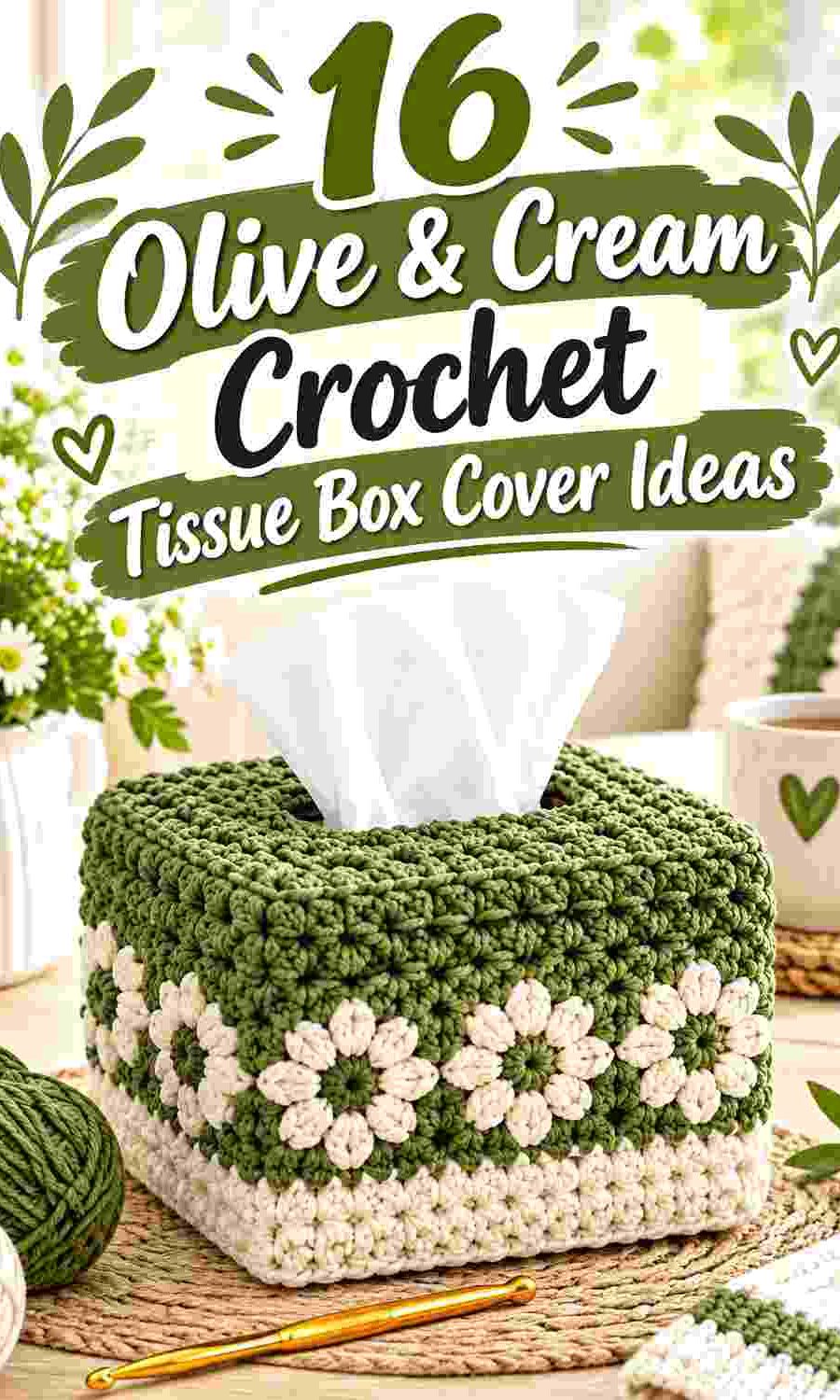
The proportions matter because a tissue box cover has several surfaces visible at once. Cream across the entire top creates a much stronger contrast than a narrow cream outline around the tissue slot. Likewise, cream side panels can divide an olive cube dramatically, while a cream lower edge simply frames it.
The tutorials below support different tissue-box-cover constructions, including rectangular sleeves, cube covers, granny-based designs, textured surfaces, floral treatments, and novelty forms. The olive-and-cream schemes are independent color adaptations, so follow each creator for the original construction details and check the actual tissue box you plan to cover before finalizing the fit.
Quick List
- Olive Textured And Cream Opening Crochet Tissue Box Cover
- Olive And Cream Banded Rectangular Crochet Tissue Box Cover
- Olive Shell Texture And Cream Top Crochet Tissue Box Cover
- Olive Cube And Cream Lower Edge Crochet Tissue Box Cover
- Olive Couch And Cream Cushion Crochet Tissue Box Cover
- Olive Vintage And Cream Border Crochet Tissue Box Cover
- Olive Body And Cream Flower Crochet Tissue Box Cover
- Olive And Cream Granny Round Crochet Tissue Box Cover
- Olive Granny Motif And Cream Join Crochet Tissue Box Cover
- Olive Lace Band And Cream Panel Crochet Tissue Box Cover
- Olive Raised Motif And Cream Detail Crochet Tissue Box Cover
- Olive Topper And Cream Edge Crochet Tissue Box Cover
- Olive Granny Square And Cream Frame Crochet Tissue Box Cover
- Olive Whale And Cream Accent Crochet Tissue Box Cover
- Olive Round And Cream Opening Crochet Tissue Box Cover
- Olive Panel And Cream Edging Crochet Tissue Box Cover
Let Olive Cover the Largest Tissue Box Surfaces
For the clearest olive-led palette, use olive across most of the vertical sides and treat cream as a structural accent. A cream tissue opening, lower edge, or corner line can provide enough contrast without cutting every side wall into several bands.
This works particularly well on rectangular boxes because the long sides already create substantial visual area. Keeping those panels olive gives the cover continuity from one end to the other.
On a cube cover, cream has more visual influence because all four sides are similar in size. A single full cream panel therefore changes the palette much more strongly than one narrow border.
Use Cream to Keep the Tissue Opening Clear Against Olive
The opening is both functional and visually central. Cream around an olive top can help define where tissues emerge while leaving the rest of the upper surface relatively quiet.
Keep the accent clear of the actual tissue path. A thick decorative edge that curls inward or adds excessive texture around the opening can make the top look crowded.
If the box itself has a pale top that shows through the crochet opening, assess the cover with the real box inside it. The exposed cardboard or plastic can effectively become another color in the finished piece.
Check Olive and Cream Placement on the Actual Tissue Box
Tissue boxes vary in proportions, so fit affects color placement. A cream lower border planned for the bottom edge can creep upward visually if the cover is too short, while an overly tall olive body can bunch around the base.
Try the cover on the intended box before finishing major contrasting bands. Also check all four sides rather than judging the piece only from the front.
For open granny or lace constructions, the printed tissue box can show through. A simple underlying box design—or enough crochet coverage—helps the olive-and-cream palette remain the main visual feature.
1. Olive Textured And Cream Opening Crochet Tissue Box Cover

This version uses olive across a modern textured rectangular body and saves cream for the top opening and a narrow lower finish. The large olive field keeps the cover suitable for everyday home decor, while cream draws attention to the functional top without breaking the long side panels into stripes.
Olive Should Carry the Main Textured Crochet Surface
Keep the repeating texture olive across the top and sides so the stitch pattern remains visually connected.
If cream is inserted into every texture repeat, the eye may follow the color changes rather than the raised or recessed surface. A continuous olive field gives texture more room to show.
Cream Can Outline the Olive Tissue Opening
Work cream only around the opening when you want a restrained contrast.
The lighter boundary makes the slot easier to distinguish while leaving most of the top olive. Keep the cream line narrow enough that the opening does not appear oversized.
Cream Can Repeat at the Bottom of the Olive Cover
A small cream base edge connects the lower and upper details.
Check the cover on the box first so the cream remains at the actual lower edge instead of sitting visibly above the bottom.
Creator Credit: Jo to the World Creations
2. Olive And Cream Banded Rectangular Crochet Tissue Box Cover
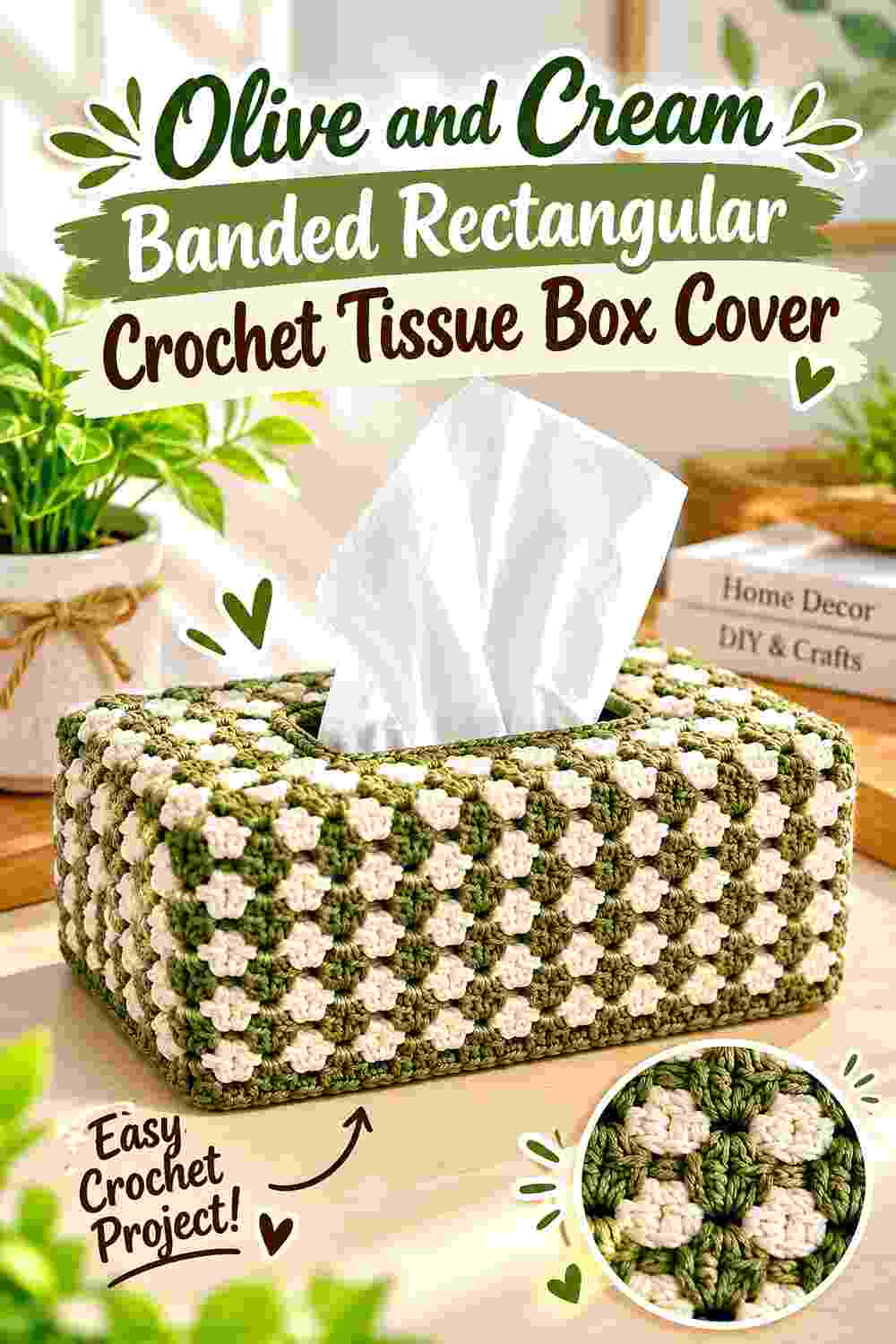
A rectangular cover has enough horizontal length for broader color blocking. Keep olive across most of the sides and introduce one cream band that wraps around the box, then return to olive before the lower edge. This creates a clear two-color treatment without producing numerous narrow stripes.
Olive Should Occupy More Height Than the Cream Band
Give olive enough uninterrupted depth above and below the cream section to remain dominant.
An equal succession of olive and cream bands produces a striped cover rather than an olive-led color-block design.
Cream Should Align Cleanly Around the Olive Rectangle
A wraparound band becomes very noticeable at corners.
Check that the cream transition sits at the same height on every side so the box does not appear visually tilted even when the crochet itself fits correctly.
Creator Credit: Ophelia Talks Crochet
3. Olive Shell Texture And Cream Top Crochet Tissue Box Cover

A shell-inspired textured cover already creates pronounced surface movement. Keep the side texture olive and make the upper section cream so the color break corresponds with the transition between the decorative sides and the tissue opening.
Olive Should Keep the Shell-Like Crochet Texture Connected
Use olive throughout the main dimensional surface.
Because the stitch pattern already changes light and shadow across the box, it usually needs fewer internal color changes than a plain single-crochet cover.
Cream Can Give the Olive Texture a Quiet Top Surface
Use cream across the upper area and let olive return only if a small opening edge needs definition.
A simpler cream top creates a useful visual pause above the more active olive sides.
Olive Can Reappear Around the Cream Tissue Slot
A narrow olive line directly around the opening can connect the top back to the body.
Keep it small so cream remains the clear upper color rather than becoming only a thin background.
Creator Credit: Crochet Arena
4. Olive Cube And Cream Lower Edge Crochet Tissue Box Cover
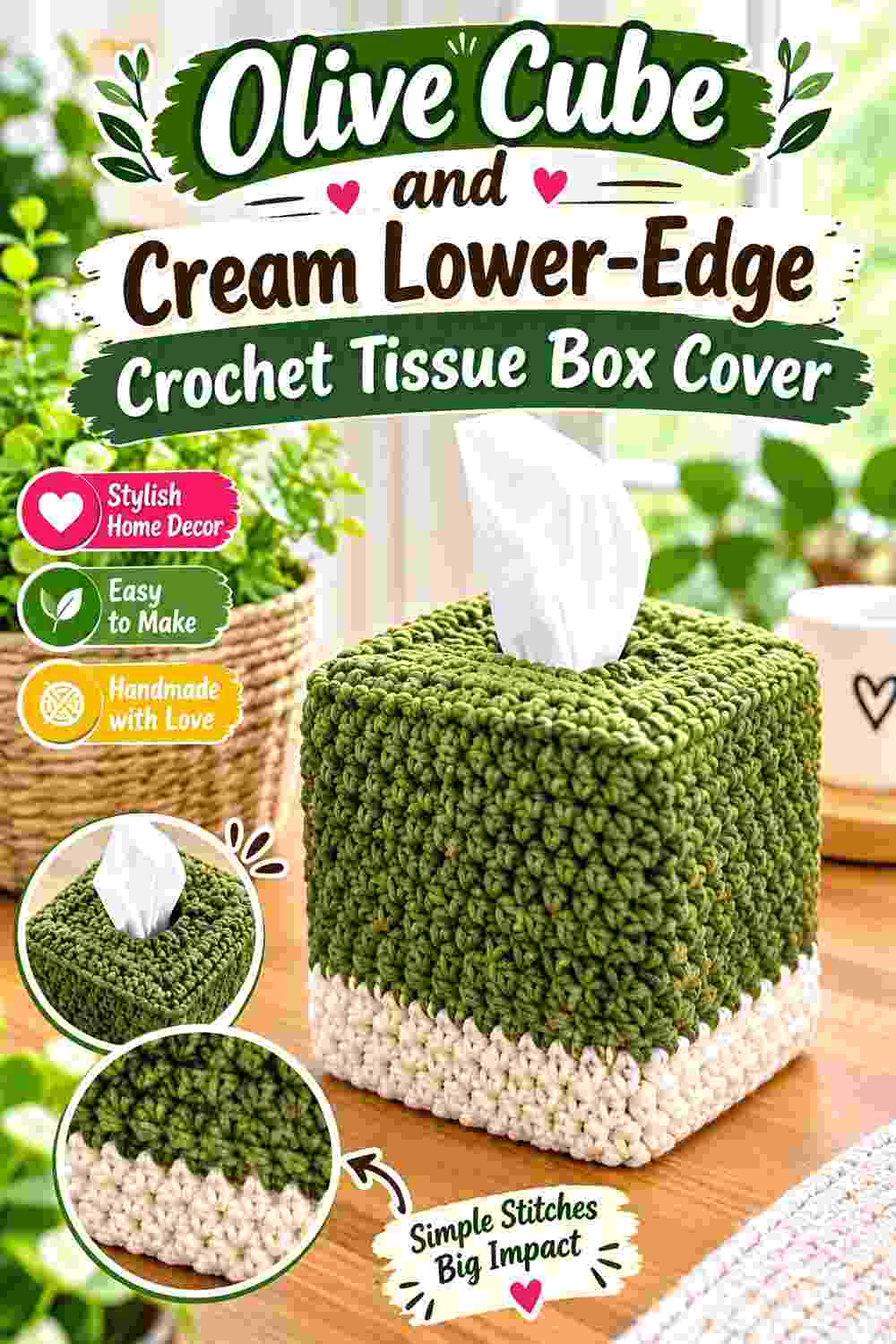
A basic cube construction is ideal for a restrained palette. Keep the top and four sides olive, then use cream only around the bottom edge and tissue opening. This gives the cover a finished frame while preserving one dominant surface color.
Olive Should Unify All Four Crochet Cube Sides
Continue olive around each side rather than assigning different colors to individual panels.
That consistency helps the tissue box read as one object instead of four separate crochet squares.
Cream Can Frame Both Ends of the Olive Cube
Use cream around the tissue opening and along the base.
Because the upper and lower boundaries repeat the same light shade, the olive center remains clearly contained without requiring a mid-body stripe.
Creator Credit: Ninja Bunny Crochet
5. Olive Couch And Cream Cushion Crochet Tissue Box Cover

A couch-shaped novelty cover creates several natural color zones. Use olive for the main upholstery-like body and cream for small cushion details or another limited soft-furnishing accent. The palette then follows the object rather than appearing as arbitrary stripes.
Olive Should Cover the Main Crochet Couch Structure
Keep the seat, sides, and major back area olive so the overall couch shape remains visually unified.
If every separate piece changes between olive and cream, the construction can start looking patchwork rather than like one upholstered form.
Cream Cushions Can Break Up a Large Olive Couch Surface
Small cream cushion details introduce contrast without covering the structural panels.
Because cushions are compact and sit on top of the main body, they can remain visually noticeable even when cream occupies very little total area.
Olive Should Still Surround the Cream Tissue Opening
If the tissue opening passes through an upper couch section, keep enough olive around it to connect that functional area to the rest of the body.
Avoid crowding the opening with cream cushions or other embellishments.
Creator Credit: Crochet Crafters 1
6. Olive Vintage And Cream Border Crochet Tissue Box Cover

A vintage-style square topper works well with a simple olive main field and cream finishing. Keep the repeated side fabric olive while cream outlines the top opening and lower edge, creating a classic framed treatment.
Olive Can Keep a Vintage Crochet Tissue Cover Grounded
Use olive through the largest repeated sections so any decorative edge remains secondary.
This is especially useful when the cover already contains visible stitch changes or optional embellishment areas.
Cream Can Give the Olive Vintage Cover a Lighter Frame
Place cream around the perimeter rather than through every side row.
The light border can make the outline more distinct without changing the vintage surface pattern itself.
Olive and Cream Should Leave Decorative Additions Optional
If the construction allows ribbons, buttons, or other seasonal details, decide whether the two-color crochet already provides enough decoration.
A strong olive-and-cream hierarchy may need no additional color.
Creator Credit: Sara Sach Crochet Designs
7. Olive Body And Cream Flower Crochet Tissue Box Cover

A flower treatment gives cream a clear focal job. Keep the tissue-box body olive and make the floral detail cream so the decoration remains visible without introducing several additional colors.
Olive Should Stay Simple Behind the Cream Crochet Flower
A solid olive side provides enough contrast for a pale flower to remain recognizable.
Avoid placing several cream stripes immediately behind the flower; the blossom needs surrounding olive space for its shape to read clearly.
Cream Flowers Should Not Crowd the Olive Tissue Opening
Keep floral embellishment away from the tissue path.
A flower attached near the side or corner can decorate the cover without competing with tissues being pulled from the top.
Olive Can Repeat in the Cream Flower Center
If you want the floral motif tied more closely to the body, use a small olive center.
This keeps the flower within the two-color palette while allowing cream petals to remain the main decorative element.
Creator Credit: Guidecentral English
8. Olive And Cream Granny Round Crochet Tissue Box Cover

A continuous granny-style construction provides regular openings and repeated cluster lines. Use several olive rounds for every cream round rather than alternating one-for-one so the cover retains a clear dominant shade.
Olive Granny Rounds Should Form the Largest Color Groups
Group multiple olive rounds together before inserting cream.
This creates broad color areas and avoids turning a small tissue cover into a rapid stripe sequence.
Cream Can Separate Large Olive Granny Sections
Use a cream round as a visual pause between olive groups.
Because granny stitches contain open spaces, even one pale round can become prominent against darker olive.
Olive Should Return Around the Cream Tissue Opening
Finish the opening with olive when you want the dominant color present at the top as well as the sides.
Alternatively, keep the opening cream if a lighter upper focal point is more useful for your room.
Creator Credit: Hilma Crochet
9. Olive Granny Motif And Cream Join Crochet Tissue Box Cover

Individual or motif-like granny sections allow cream to function as a connecting color. Keep the visible motif faces olive-heavy and use cream where pieces meet so the neutral forms a consistent framework around them.
Olive Should Repeat Across Every Granny Motif
Include olive prominently in all major visible motifs so the separate panels share one color identity.
A side with no olive can look detached from the rest of the cover even when the construction is consistent.
Cream Joins Can Organize Olive Crochet Motifs
Use cream between olive motifs instead of adding another contrasting round inside each one.
The lighter join creates visual space around the squares and can make their edges easier to distinguish.
Olive Can Finish the Cream-Framed Tissue Opening
If the joining network already makes cream highly visible, return to olive around the tissue slot.
This prevents every structural boundary from becoming cream.
Creator Credit: lobeho TV-레스홈
10. Olive Lace Band And Cream Panel Crochet Tissue Box Cover

A cover with a lace-like band gives the two shades a natural division. Keep the solid panels olive and make the decorative open section cream so the change in color also marks the change in stitch density.
Olive Should Anchor the Solid Crochet Tissue Box Panels
Use olive where the fabric needs the strongest visual continuity.
Solid side sections create a useful background for a lighter openwork band without requiring multiple extra motifs.
Cream Lace Can Break Up a Broad Olive Side Wall
A cream openwork band creates contrast through both color and negative space.
Keep it to one defined area rather than repeating several bands if you want the box to remain mostly olive.
Olive Should Border the Cream Lace on Both Sides
Returning to olive above and below the lace helps integrate the decorative section.
It also prevents the cream band from appearing as though it simply divides the cover into two unrelated pieces.
Creator Credit: 뜨개토리 Knitting tory
11. Olive Raised Motif And Cream Detail Crochet Tissue Box Cover

A raised stitch motif is an effective place to use both colors without broad striping. Keep the base fabric olive and use cream selectively on the dimensional motif or its surrounding accent area.
Olive Should Form the Background Behind Cream Raised Details
A continuous olive base allows the relief pattern to stand out through both texture and color.
If too much of the surrounding surface also becomes cream, the dimensional motif loses some separation.
Cream Can Highlight Selected Olive Crochet Relief
Use cream only on the raised feature you most want to emphasize.
This can produce more definition than alternating every raised section between both colors.
Olive Should Stay Visible Around the Cream Tissue Opening
If the motif reaches toward the top, keep enough olive between the decorative section and opening so the cover does not become overly concentrated with cream in one area.
Creator Credit: YeJin (예진)
12. Olive Topper And Cream Edge Crochet Tissue Box Cover
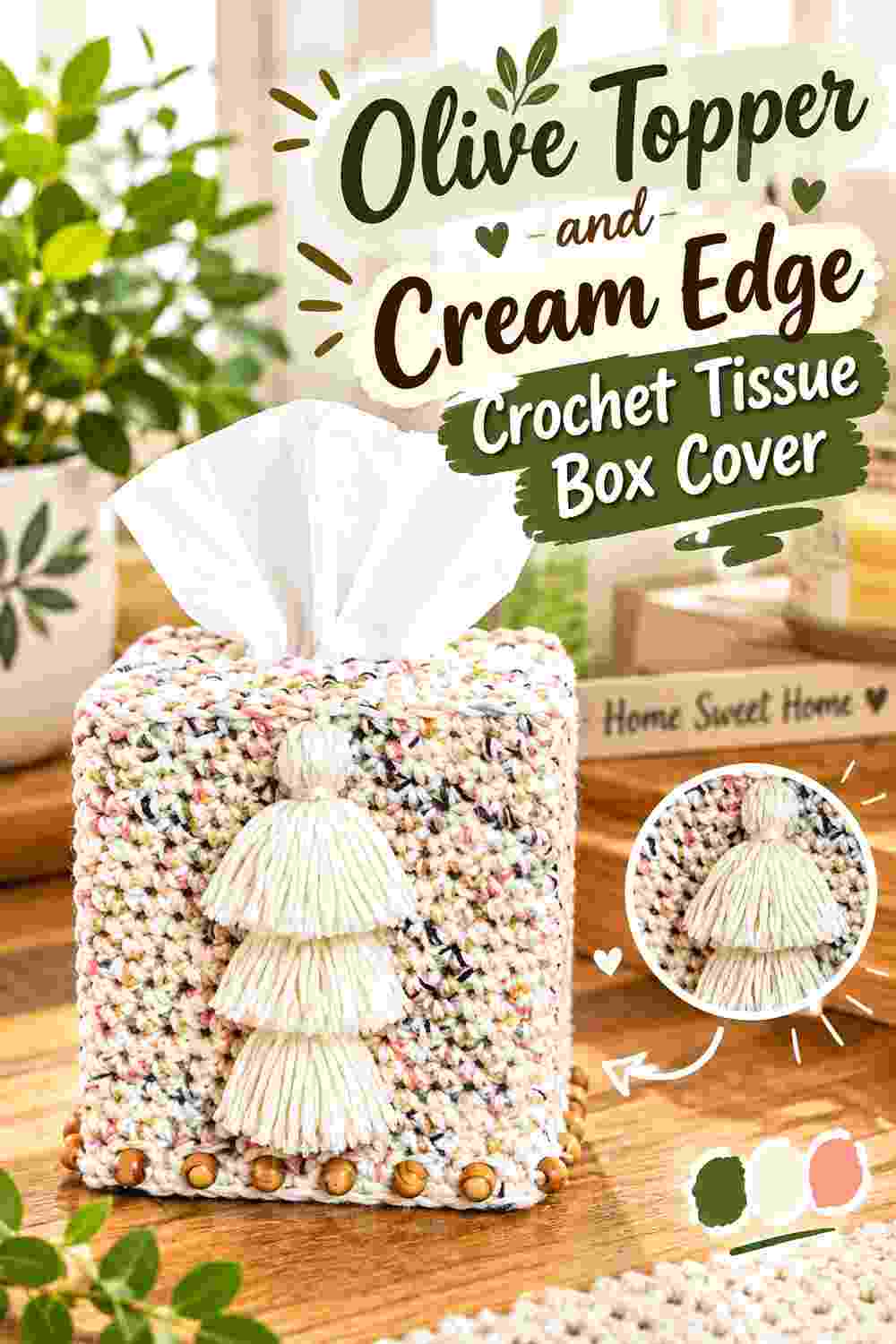
A topper-style cover can be kept particularly simple. Make the main surface olive and use cream at the upper and lower edges, allowing any optional embellishments to remain secondary to the two-color structure.
Olive Should Cover the Main Crochet Tissue Topper
Use olive across the principal surface so the topper stays visually cohesive from every side.
This also leaves room to add a small decorative element later without creating another major color block.
Cream Can Make the Olive Topper Edges More Distinct
A narrow cream border around the top or bottom creates a clean outline.
If both edges are cream, keep any additional cream embellishment small so the neutral does not become visually dominant.
Olive and Cream Should Be Judged With Any Beaded Detail in Place
If you use optional decorative beads or another added element from the construction concept, assess them as part of the overall surface.
A heavily embellished edge already creates visual movement and may need less cream contrast.
Creator Credit: Day’s Crochet NC
13. Olive Granny Square And Cream Frame Crochet Tissue Box Cover

A joined granny-square construction gives cream a stronger framing role than the continuous granny version. Use olive through most of each square and cream around the final motif edges or joins.
Olive Should Dominate Each Crochet Granny Square
Repeat olive in the same important location across the squares—such as the broad outer area or major center field.
Consistency helps the completed cover look planned rather than like unrelated leftover motifs.
Cream Frames Can Separate Olive Granny Squares
Use cream around the edges so each olive motif has visible breathing room.
On a small tissue box, keep the frames relatively restrained; wide cream rounds can occupy more total area than the olive centers.
Olive Can Define the Tissue Opening Above Cream Joins
Finish the top opening in olive if cream already surrounds every motif.
That returns the dominant color to the functional center of the cover.
Creator Credit: Hook Creation
14. Olive Whale And Cream Accent Crochet Tissue Box Cover

A whale-shaped tissue cover provides a playful alternative to straight-sided decor. Use olive for the main whale body and cream on a limited contrasting feature so the animal silhouette remains easy to recognize.
Olive Should Cover Most of the Crochet Whale Body
Keep the broad body and major shaping olive.
Large cream patches can visually divide the whale form, while a smaller accent allows olive to remain responsible for the overall silhouette.
Cream Can Highlight an Olive Whale Underside or Small Detail
Place cream where it follows the form rather than introducing an unrelated stripe.
A restrained underside, mouth-area accent, or other compact section can create enough contrast without making the cover look evenly split.
Olive Should Remain Clear Around the Tissue Opening
Because the tissue slot is incorporated into a novelty shape, avoid crowding it with several cream details.
The opening still needs to remain obvious and easy to use.
Creator Credit: Tan Handicraft
15. Olive Round And Cream Opening Crochet Tissue Box Cover
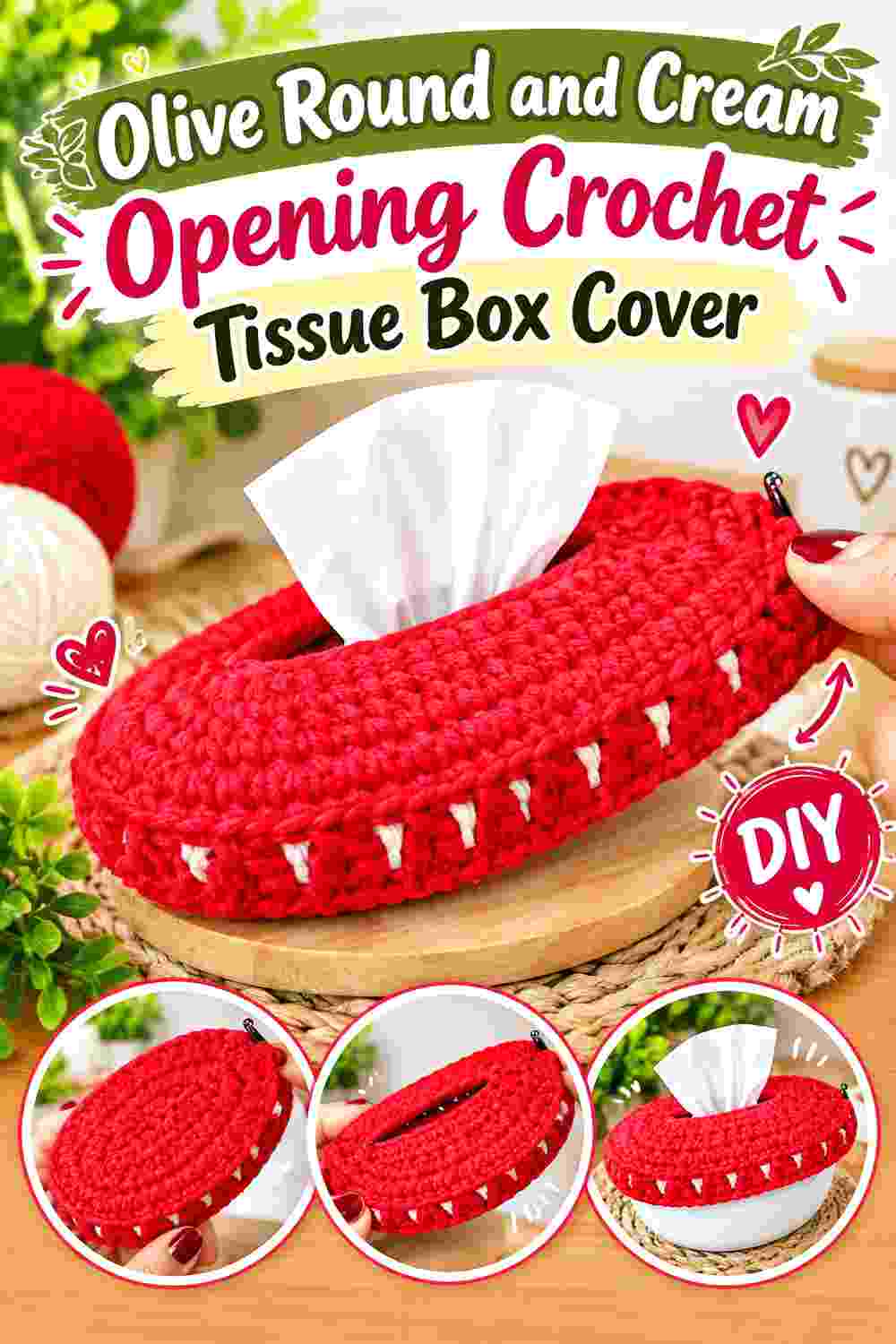
A round holder changes the usual rectangular color logic. Instead of emphasizing corners, use olive around the cylindrical body and cream as a ring around the upper opening or as one lower band.
Olive Should Wrap Continuously Around the Round Crochet Body
A single olive field reinforces the cylindrical shape.
Several narrow cream stripes can make the holder look horizontally segmented, so use broader uninterrupted olive space when a clean profile is preferred.
Cream Can Circle the Olive Tissue Opening
A cream ring naturally follows the round construction and creates an obvious upper boundary.
Keep the contrast symmetrical so the opening stays visually centered.
Olive Can Return Below a Cream Upper Band
If cream extends beyond the immediate opening, return to olive quickly enough that the main body remains dominant.
This creates a clear top accent rather than an evenly divided two-color cylinder.
Creator Credit: Crochet Design
16. Olive Panel And Cream Edging Crochet Tissue Box Cover
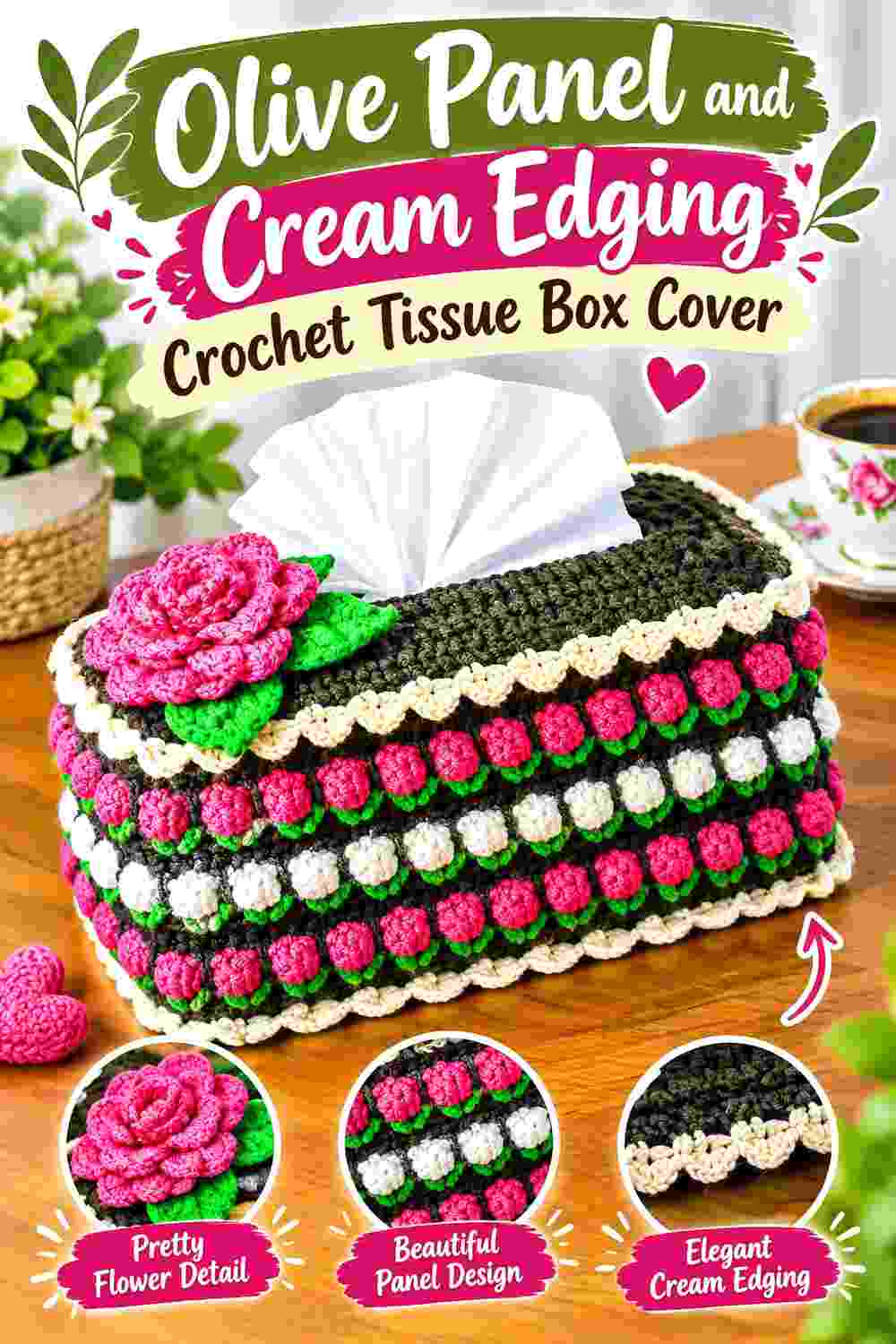
The final idea uses separate cover sections as the basis for a clean two-color plan. Work the main side and top panels olive, then use cream where panels join and along the final edging. The contrast can emphasize construction lines without turning an everyday tissue cover into a heavily patterned object.
Olive Should Keep the Separate Crochet Panels Visually Unified
Use the same olive across the main top and side pieces so assembly does not make the cover look fragmented.
The shape of the panels already provides visual structure; they do not each need their own color.
Cream Joins Can Define the Olive Panel Corners
Use cream at selected joining or edging lines where the box naturally turns.
This creates a subtle outlined effect and makes the cube or rectangle geometry clearer.
Cream Edging Should Leave the Olive Tissue Slot Functional
Finish the opening neatly but keep decorative depth under control.
The cream line should frame the slot rather than curl into the path of the tissues.
Creator Credit: صحبة الكروشيه – Crochet Company
Comparing Olive and Cream Tissue Box Cover Color Directions
For the quietest everyday decor, the textured rectangular, basic cube, topper, and panel versions keep large areas olive and restrict cream to functional boundaries. These work well when the tissue box should coordinate with a room without becoming a major decorative focal point.
For a stronger two-color result, choose the banded rectangular, granny-round, granny-square, lace-band, or cream-topped versions. Their construction provides natural spaces where cream can occupy more surface area without appearing randomly inserted.
The raised-motif and flower versions use cream as decoration rather than as broad color blocking. This is useful when you want the tissue cover to remain predominantly olive but still need one recognizable focal detail.
Novelty shapes such as the couch and whale require a different approach. Their silhouettes already supply substantial visual information, so a simpler olive-and-cream hierarchy usually keeps the finished object easier to read.
Conclusion
Olive and cream can change a crochet tissue box cover substantially depending on where the lighter shade appears. Cream around the tissue opening creates a functional focal point, cream along the bottom frames an olive body, and cream joins can organize granny motifs without requiring extra colors.
If texture is the main feature, keep most of that surface olive and move cream to the boundaries. If color blocking is the priority, give cream a full top, broad band, granny frame, or lace section while preserving enough olive to maintain a clear dominant color.
Most importantly, check the crochet against the tissue box you actually intend to use. The box height, footprint, and tissue opening affect where color boundaries sit once the cover is fitted. Follow the credited tutorials for their original construction details, then apply the olive-and-cream placement independently.
Frequently Asked Questions
Should Olive or Cream dominate a crochet tissue box cover?
Olive is a useful dominant choice when you want a grounded, earthy cover with cream providing definition. Cream can dominate instead, but the result will look substantially lighter and olive will behave more like trim or an accent.
Where should Cream go on a mostly Olive tissue box cover?
Useful locations include the tissue opening, lower edge, corners, motif joins, decorative flowers, raised details, or one broad side band. Give cream one or two clear roles rather than scattering small accents everywhere.
Can Olive and Cream work on a granny-square tissue box cover?
Yes. Use olive consistently in each major motif and cream for outer rounds or joins if you want the separate squares to look connected. Keep the proportions consistent across visible sides.
How can I keep an Olive and Cream tissue box cover from looking too busy?
Increase the amount of uninterrupted olive. Strong stitch textures, granny motifs, flowers, and novelty shapes already provide detail, so they often need fewer color changes than a simple flat cover.
Should the tissue opening be Cream on an Olive crochet cover?
It can be. Cream creates a clear visual frame around the opening. Keep the border neat and proportionate so it emphasizes the slot without overwhelming the top panel.
What should I check before adding a Cream bottom border to an Olive cover?
Fit the cover on the actual tissue box first. The cream section should sit where you intend at the lower edge rather than creeping upward because the olive body is too short or bunching because the cover is too tall.
Can I reverse the Olive and Cream palette?
Yes. A cream body with olive edging, motifs, or a top opening creates a lighter overall cover while preserving the same two-color relationship. Keep enough value contrast between the actual yarns for small olive details to remain visible.