Deep plum gives a granny square sweater enough depth to anchor multicolor motifs without requiring every square to look dark. Depending on what surrounds it, the same plum can feel softer beside dusty rose, more defined against cream, earthier with sage or camel, and almost tonal beside burgundy, wine, charcoal, or black.
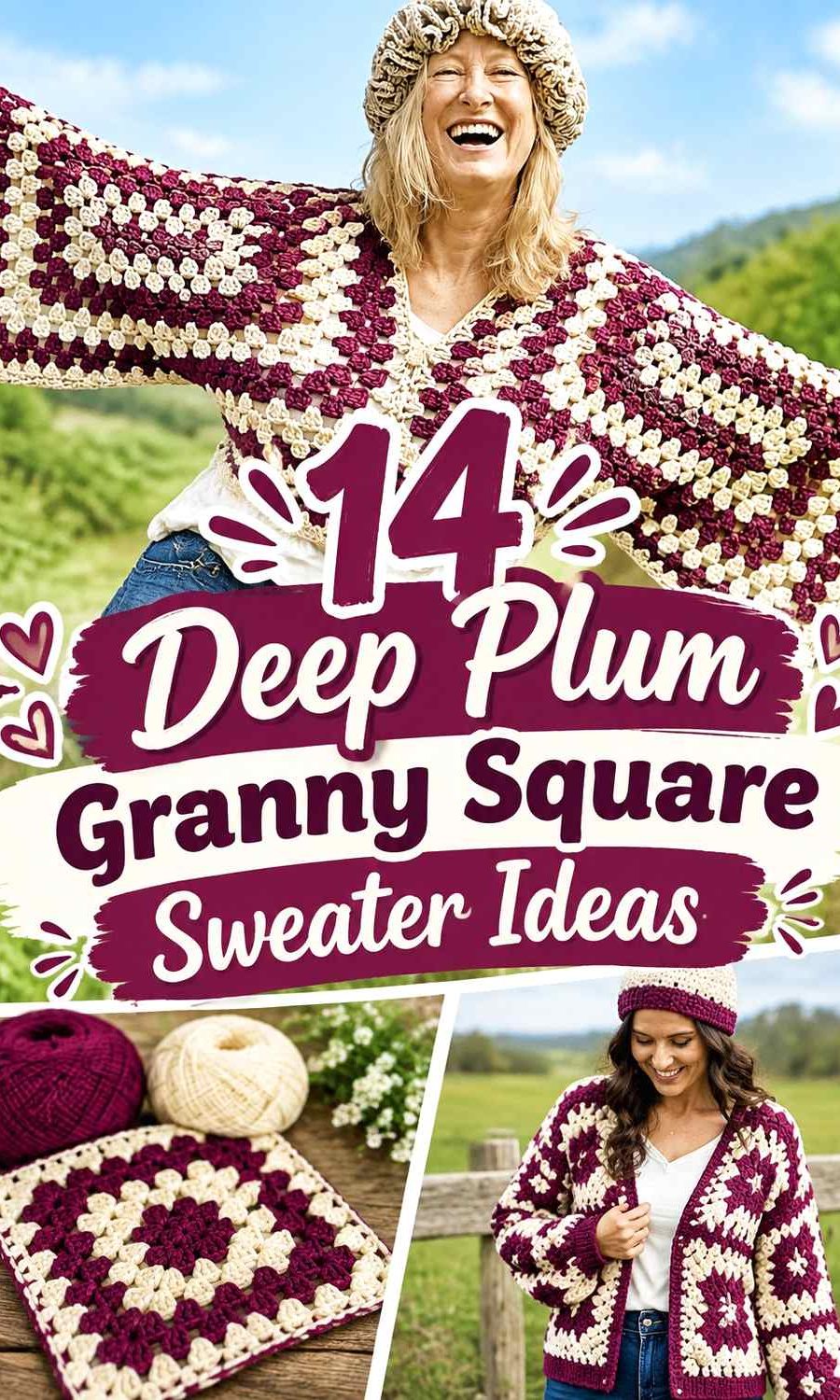
Granny square sweaters need more color planning than a plain-panel pullover because a shade can repeat dozens of times across motif centers, outer rounds, joins, sleeves, neckline sections, and cuffs. A small amount of cream in one square may become a major part of the finished sweater once that square is repeated across the garment.
The 14 ideas below keep deep plum at the center while changing motif hierarchy, contrast, joins, borders, and secondary-color placement. The tutorials support the granny-square sweater construction concepts; the proposed palettes are independent adaptations rather than claims about the colors used by the creators.
Quick List
- Deep Plum And Cream Two Square Crochet Granny Square Sweater
- Deep Plum And Dusty Rose Four Square Crochet Granny Square Sweater
- Deep Plum And Oatmeal Patchwork Crochet Granny Square Sweater
- Deep Plum And Camel Boho Crochet Granny Square Sweater
- Deep Plum And Sage Four Motif Crochet Granny Square Sweater
- Deep Plum Moss And Cream Cozy Crochet Granny Square Sweater
- Deep Plum And Ivory Classic Crochet Granny Square Sweater
- Deep Plum Blush And Rose Patchwork Crochet Granny Square Sweater
- Deep Plum And Charcoal Scrap Style Crochet Granny Square Sweater
- Deep Plum And Soft Gray Yoke Crochet Granny Square Sweater
- Deep Plum And Denim Blue Mixed Motif Crochet Granny Square Sweater
- Deep Plum And Mustard Circle In Square Crochet Sweater
- Deep Plum And Wine Ribbed Trim Crochet Granny Square Sweater
- Deep Plum And Black Open Front Crochet Granny Square Sweater
Decide Where Deep Plum Belongs Inside Each Granny Square
Deep plum can work as a motif center, middle round, outer border, or joining shade, but those positions do not produce the same finished sweater. Putting plum in the center creates repeated dark focal points, while using it for the widest outer rounds makes each square read as predominantly plum.
If the goal is clearly a deep plum sweater rather than a multicolor sweater with occasional plum, calculate the visual effect across several motifs rather than judging one square alone. Lay four or more completed squares together before making the full set. Repetition often changes the apparent color balance.
Use Deep Plum Joins and Borders to Connect Sweater Motifs
A joining color can become almost as important as the motif palette because it appears between every square. Deep plum joins can pull cream, rose, green, blue, or camel motifs into one darker framework and help the front, back, and sleeves look related.
The opposite strategy also works. If most motifs are already deep plum, a lighter joining shade can keep individual squares visible. The important decision is whether you want the seams to disappear into the motifs or act as part of the sweater’s graphic layout.
1. Deep Plum And Cream Two Square Crochet Granny Square Sweater
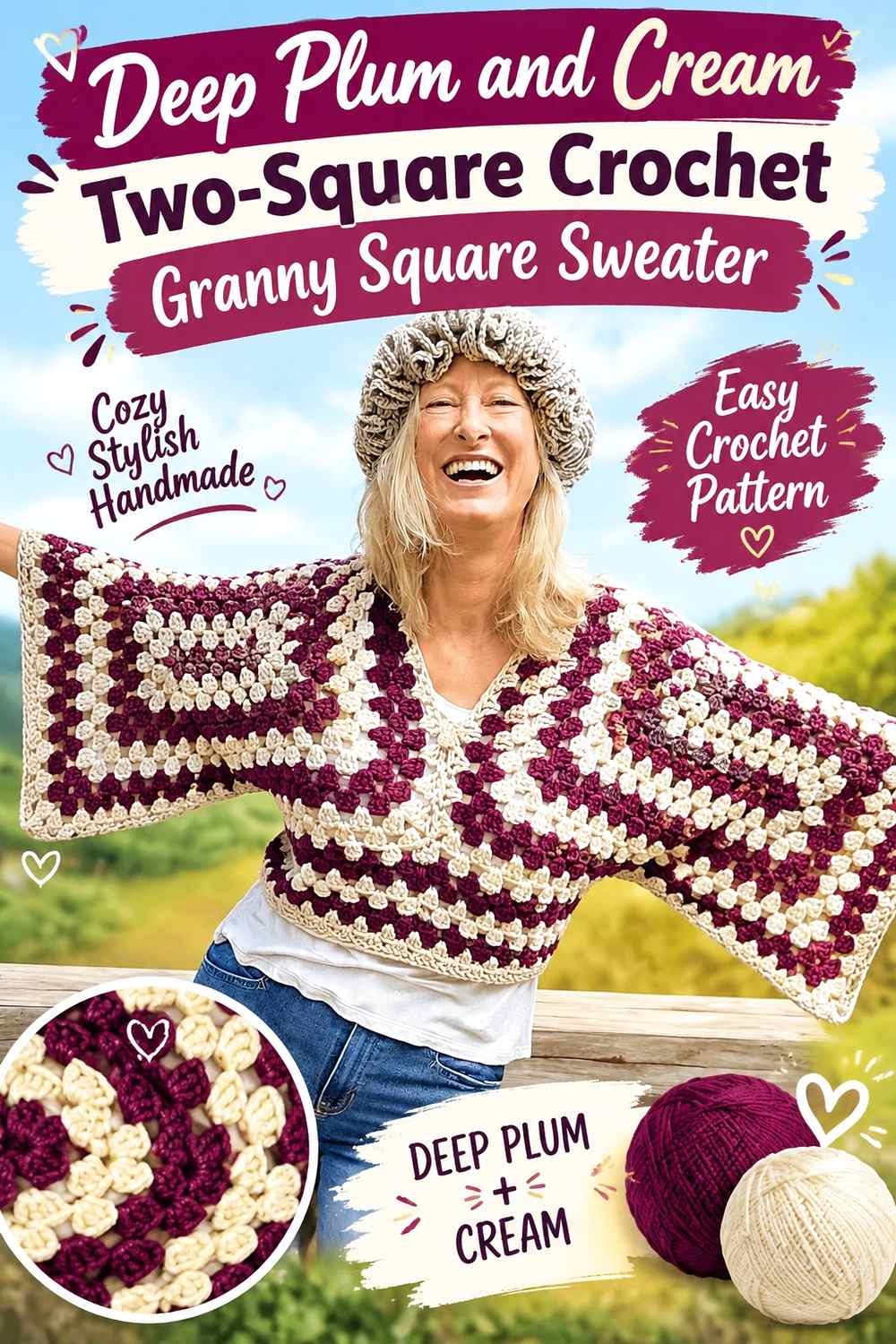
A two-large-square construction gives the colors unusually broad areas, so deep plum and cream should not be divided casually. Let deep plum dominate most expanding rounds and reserve cream for selected rings, neckline finishing, or sleeve details. That keeps the sweater recognizably plum while allowing the large granny geometry to remain visible.
Keep Deep Plum Dominant Across the Large Granny Square Panels
Because a single growing square can cover much of the front or back, every color round has significant visual weight. Use several deep plum rounds between cream interruptions rather than alternating both shades equally if plum should clearly lead.
Check the front and back squares together before finishing them. Matching the color hierarchy matters more than making every round sequence identical.
Use Cream to Separate Deep Plum Granny Square Rings
Cream can highlight the expanding geometry when placed between wider plum sections. It is especially useful when the darker rounds begin to visually merge from a distance.
If cream already appears strongly in the main squares, keep the neckline and hem predominantly deep plum so the lighter shade does not gradually become the dominant sweater color.
Creator Credit: Secret Yarnery
2. Deep Plum And Dusty Rose Four Square Crochet Granny Square Sweater
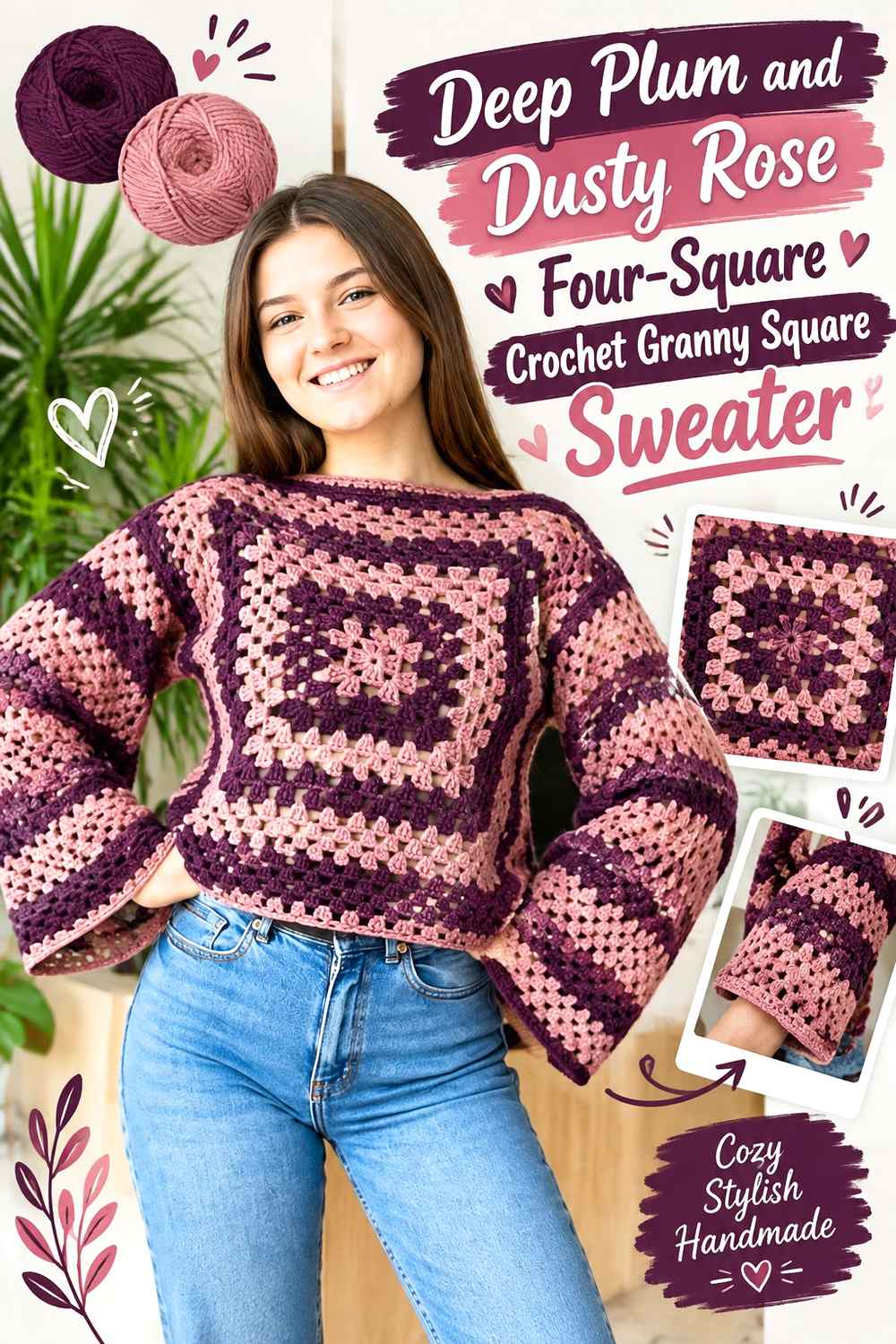
A sweater built around several oversized squares offers natural opportunities to vary the color balance between torso and sleeves. Deep plum can provide the common thread, while dusty rose softens individual rings without introducing a neutral.
Repeat Deep Plum in Every Large Granny Square
Give deep plum a consistent position in the front, back, and sleeve squares. Repeating it in the outer rounds is one way to make separate large motifs look like parts of the same sweater.
If dusty rose appears in different places from square to square, the repeated plum border can still maintain continuity.
Keep Dusty Rose Lighter Than Deep Plum Around Sleeve Squares
Sleeve motifs have less visual area than broad body squares, so their color changes can appear more concentrated. A clearly lighter dusty rose creates enough separation for the square structure to remain readable.
If the rose is almost as dark as the plum, use it in wider bands rather than narrow rounds that may disappear at normal viewing distance.
Creator Credit: by Kristine
3. Deep Plum And Oatmeal Patchwork Crochet Granny Square Sweater
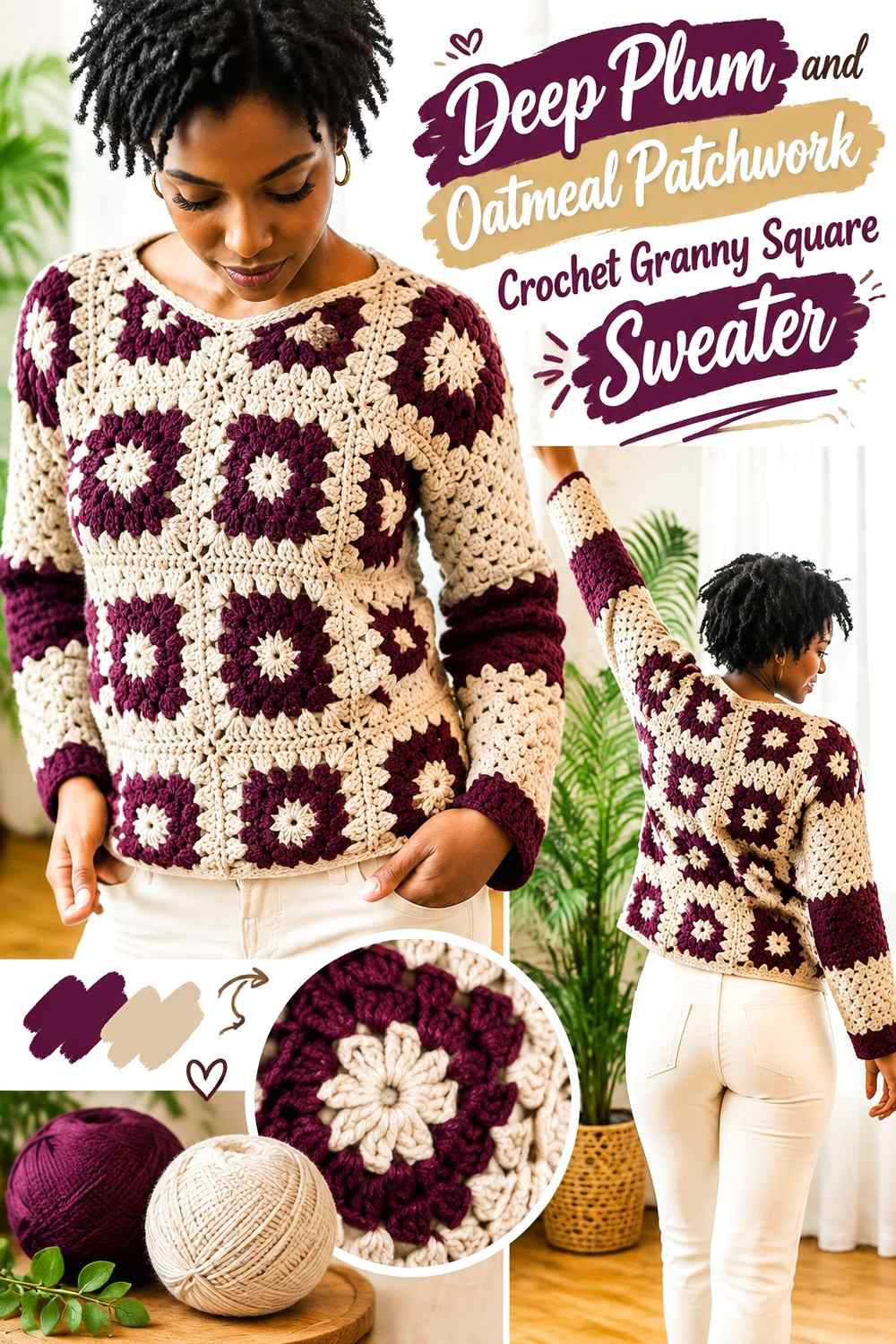
Oatmeal gives a patchwork sweater clear light-dark contrast without the sharper appearance of bright white. Use deep plum across the largest share of motif rounds and let oatmeal define selected centers, borders, or connecting sections.
Use Deep Plum to Anchor the Patchwork Granny Square Layout
When many individual squares cover the sweater, give plum a repeatable role. Deep plum outer rounds are particularly useful because they create a consistent boundary even when motif centers vary.
This also gives the sleeves, body, and shoulder area a common visual framework.
Reserve Oatmeal for Deep Plum Motifs That Need Separation
Oatmeal can prevent neighboring plum-heavy squares from merging into one dark surface. Place it around motif centers or between two deeper rounds where the geometry needs definition.
Avoid using oatmeal for every center, border, join, cuff, and neckline unless a much lighter finished sweater is intentional.
Creator Credit: TL Yarn Crafts
4. Deep Plum And Camel Boho Crochet Granny Square Sweater
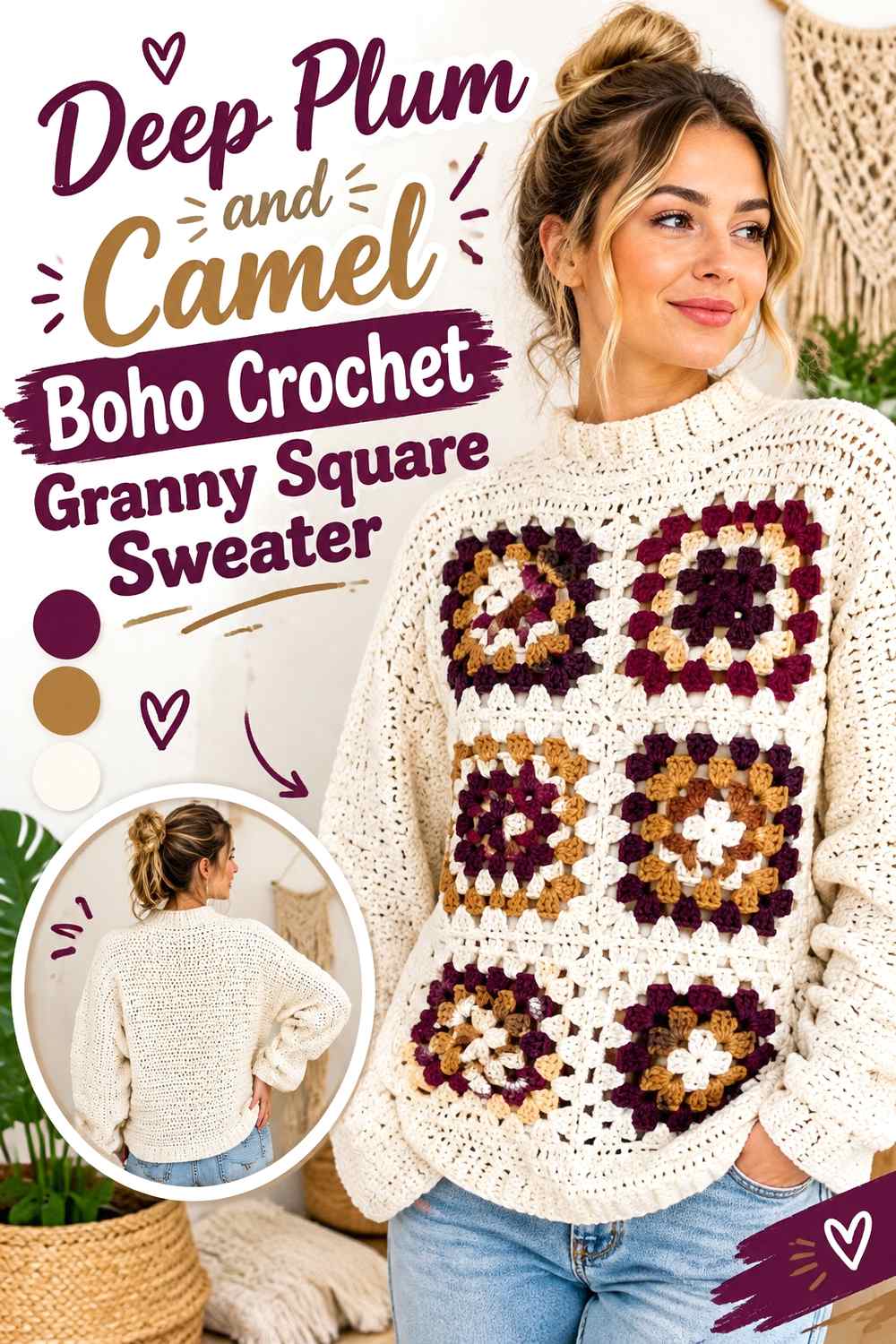
Camel brings warmth to deep plum while keeping the palette earthy and relatively restrained. On a granny square sweater with a strong handmade, boho-style surface, broad plum areas can ground the decorative geometry.
Let Deep Plum Control the Boho Granny Square Sweater Body
Use deep plum through the largest motif rounds or surrounding body sections so camel acts as support rather than competing for equal coverage.
This is especially useful around the torso, where too many equally sized warm and dark bands can make the granny structure feel fragmented.
Add Camel Around Deep Plum Granny Square Borders
Camel can work effectively as a middle or outer motif round because it provides visible separation without becoming extremely light.
If camel frames multiple body squares, consider returning to deep plum at the neckline, cuffs, and hem so those finishing areas reconnect with the dominant shade.
Creator Credit: TCDDIY
5. Deep Plum And Sage Four Motif Crochet Granny Square Sweater

Sage introduces a muted green that separates clearly by hue from deep plum without requiring a pale neutral. A construction centered on a small number of large squares gives both shades enough area to be recognized.
Make Deep Plum the Largest Color in Each Granny Square
Use broader plum rounds and narrower sage rounds if you want all four major sweater sections to remain visibly connected.
Giving each square the same dominant shade matters because the front, back, and sleeves can otherwise appear like separate color projects.
Use Sage to Break Up Deep Plum Granny Square Geometry
A sage ring between plum sections can emphasize the expanding square shape while reducing the visual heaviness of a mostly dark motif.
If sage already occupies substantial square rounds, keep cuffs or neckline finishing deep plum instead of adding more green at every edge.
Creator Credit: Fiber Flux
6. Deep Plum Moss And Cream Cozy Crochet Granny Square Sweater
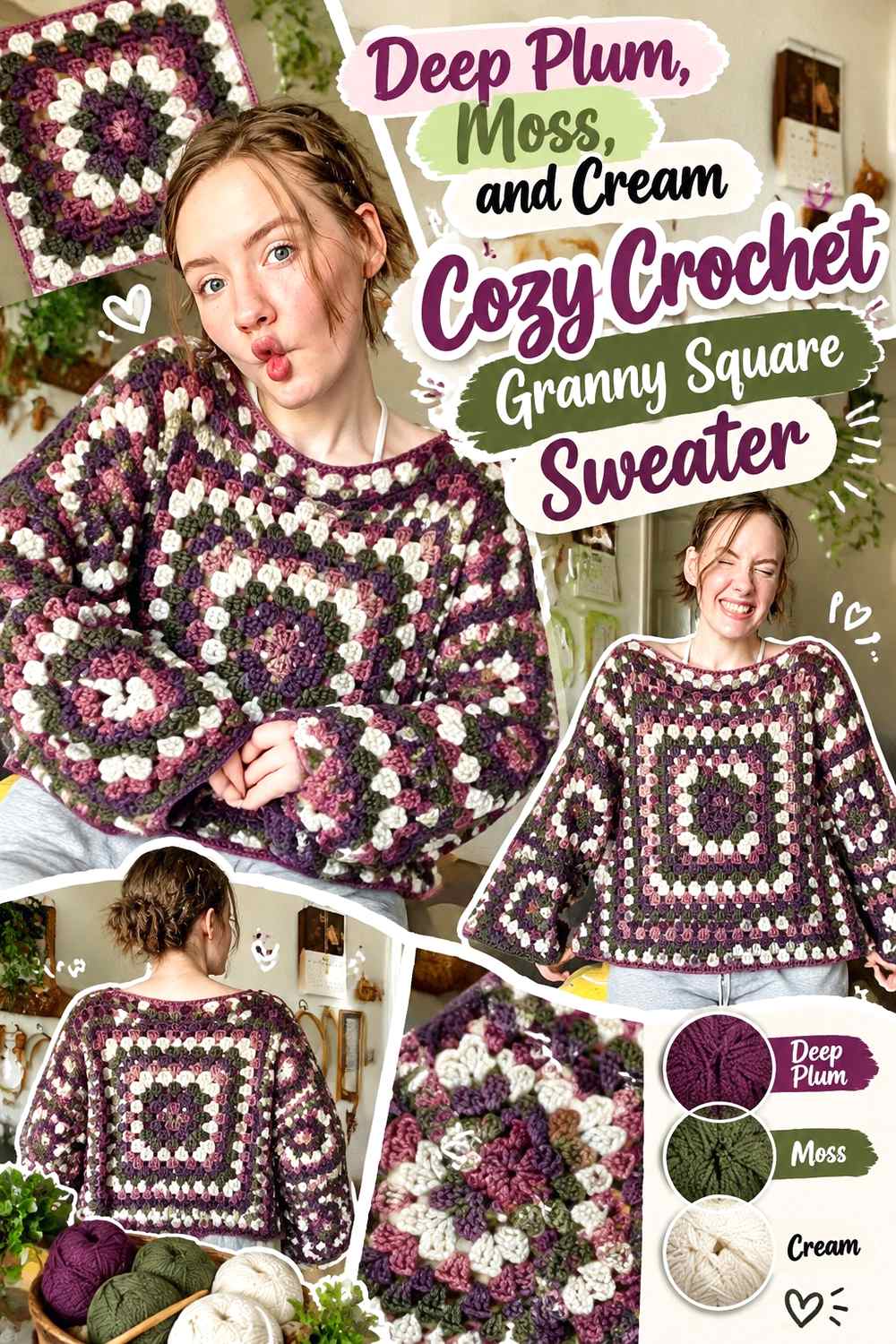
This three-color direction gives each shade a clear job: deep plum as the dark anchor, moss as the muted supporting hue, and cream as the lightest separator. The hierarchy becomes important once multiple squares repeat across the sleeves and body.
Give Deep Plum the Widest Repeated Granny Square Rounds
Let deep plum occupy the largest visual share rather than dividing all three colors equally. This makes it easier for the sweater to remain plum-led after many motifs are assembled.
Moss can occupy secondary rounds, while cream works best in narrower sections where its high contrast has more impact.
Use Cream Sparingly Between Deep Plum and Moss Motifs
Cream can create a useful visual pause where plum and moss would otherwise form a dark, earthy block. A cream round near the center or outer edge of selected motifs may be enough.
Because cream is much lighter than both other shades, check several squares together before increasing its use across sleeves or trim.
Creator Credit: HayHay Crochet
7. Deep Plum And Ivory Classic Crochet Granny Square Sweater
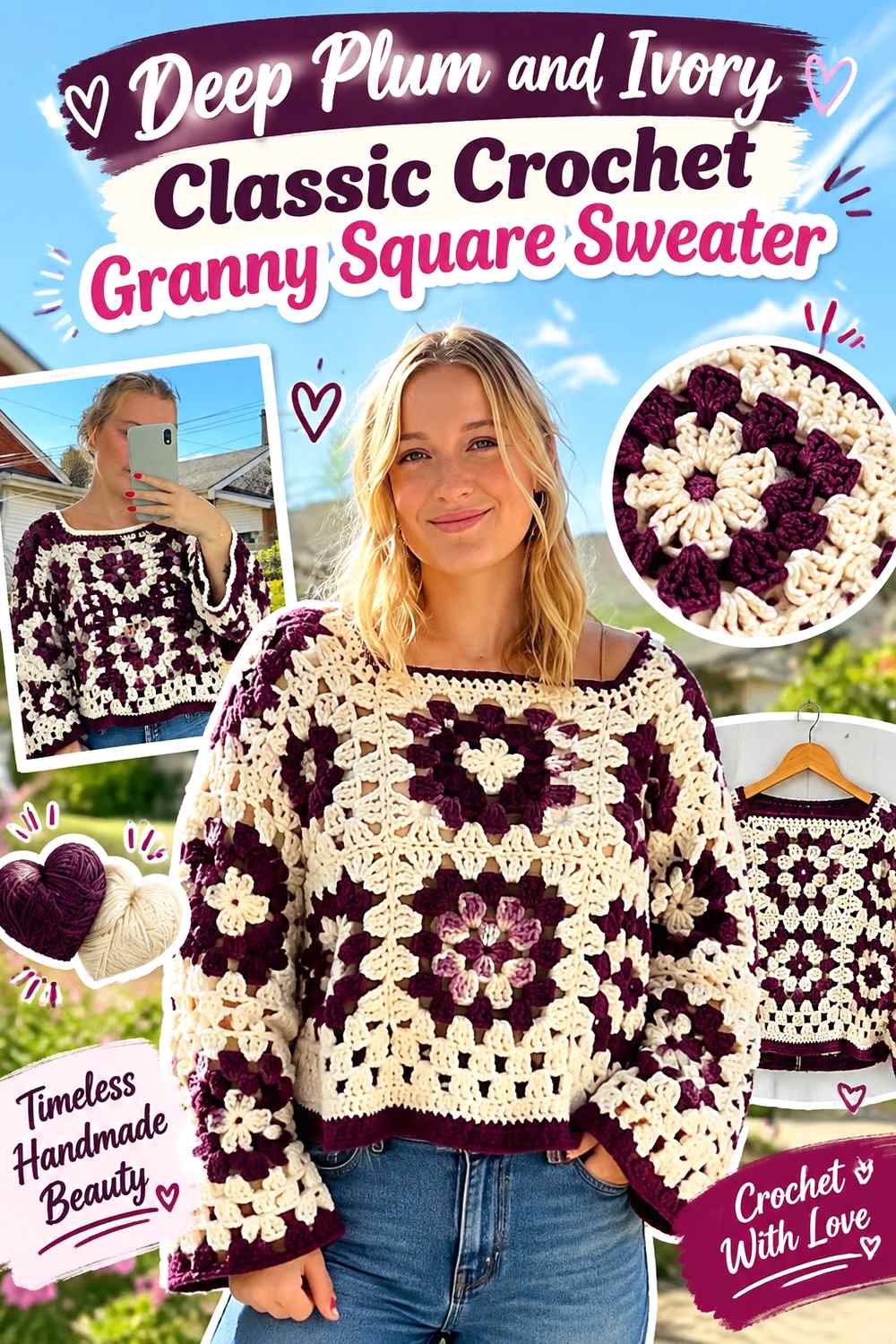
Ivory gives classic granny squares crisp definition against deep plum. This palette is particularly useful when you want the stitch clusters and square boundaries to remain obvious instead of blending into a dark continuous surface.
Place Deep Plum Consistently Across Classic Granny Square Motifs
Choose one plum placement rule and repeat it. Deep plum centers create dark focal points, while plum outer rounds make the overall sweater noticeably deeper.
For a stronger plum result, combine both approaches selectively rather than allowing ivory to occupy the broadest section of every square.
Use Ivory to Define Deep Plum Granny Square Edges
An ivory round can separate neighboring plum areas and help each motif retain its square outline once joined.
If ivory also becomes the joining color, consider reducing its use inside the motifs. Otherwise the cumulative light lines between every square may shift the entire garment toward an ivory-dominant appearance.
Creator Credit: Laura Crochets
8. Deep Plum Blush And Rose Patchwork Crochet Granny Square Sweater
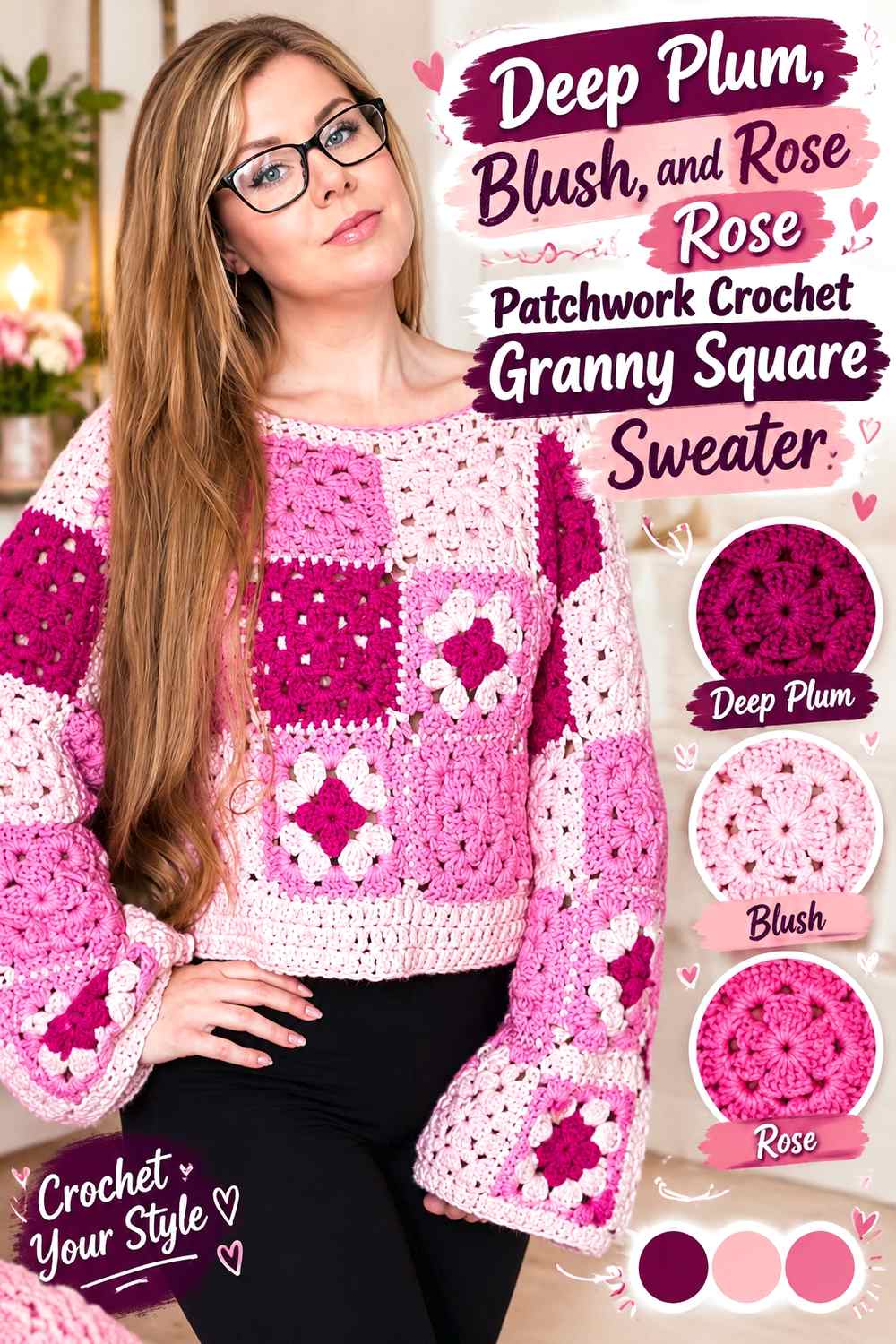
Blush and rose allow a deep plum sweater to stay within a red-purple family while creating several levels of lightness. This works well for patchwork because individual squares can change arrangement without introducing unrelated hues.
Keep Deep Plum as the Darkest Patchwork Granny Square Anchor
Use deep plum repeatedly on outer rounds or selected centers so every cluster of pink-toned squares has a dark reference point.
Without that repeated anchor, a large collection of blush and rose motifs can make deep plum look like a minor accent rather than the main sweater color.
Let Blush Separate Deep Plum and Rose Granny Square Rounds
Blush works well between deeper plum and medium rose because it creates a noticeable light break. You do not need all three colors in every motif.
Some squares can emphasize plum and blush while others use plum and rose, provided the overall layout repeats the colors enough to feel connected.
Creator Credit: Selina Veronique Crochet
9. Deep Plum And Charcoal Scrap Style Crochet Granny Square Sweater
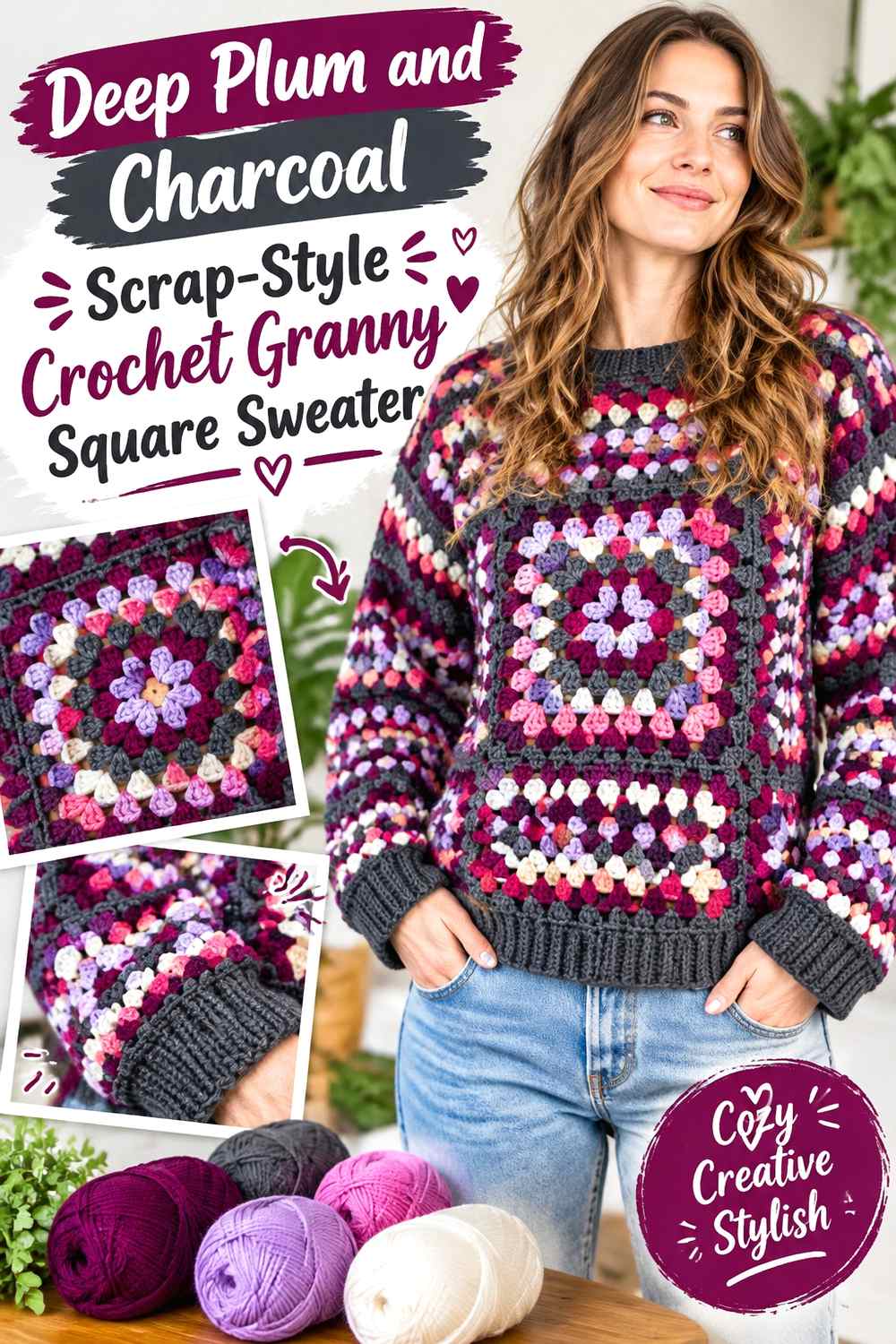
Deep plum and charcoal create one of the darkest combinations in the collection. Their subtle contrast makes this palette better suited to large motif sections than tiny alternating rounds.
Give Deep Plum More Surface Than Charcoal in Granny Squares
If charcoal appears around every square in equal or greater quantities, it can quickly become the dominant garment color. Use deep plum across broader center and middle rounds and reserve charcoal for selected outer boundaries.
This maintains the dark character without losing the plum identity.
Check Charcoal Against Deep Plum Before Using Dark Joins
Charcoal joins can almost disappear beside deep plum when both yarns have similar value. That may be desirable if you want the seams to recede.
If you want individual motifs clearly separated, choose a lighter charcoal or introduce a small lighter color elsewhere rather than relying on hue difference alone.
Creator Credit: Zeens And Roger Crochet
10. Deep Plum And Soft Gray Yoke Crochet Granny Square Sweater
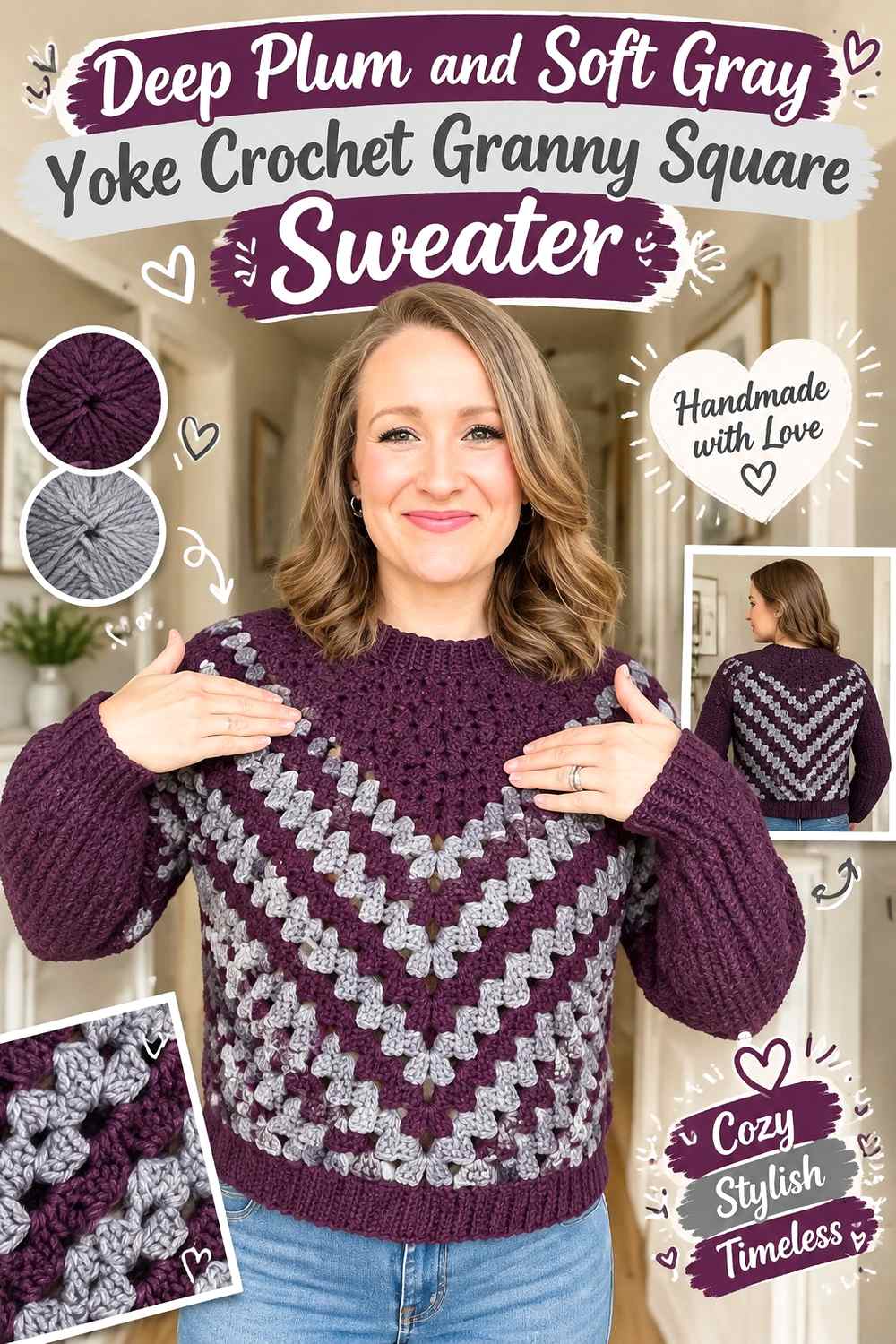
When granny squares concentrate around the yoke, their color distribution receives extra attention because the motifs sit near the neckline and shoulders. Deep plum can anchor that area while soft gray gives the individual shapes room to breathe.
Keep Deep Plum Repeating Across the Granny Square Yoke
Place deep plum in the same part of each yoke motif so the squares read as a coordinated neckline rather than unrelated patches.
Continuing plum into the body or cuffs also connects the decorative yoke with the rest of the sweater.
Use Soft Gray to Separate Deep Plum Yoke Motifs
Soft gray can provide a lighter boundary between adjacent plum-heavy squares without the stronger effect of cream.
If the lower sweater becomes mostly one color, consider keeping deep plum as that solid field so the patterned yoke transitions naturally into the body.
Creator Credit: HanJan Crochet
11. Deep Plum And Denim Blue Mixed Motif Crochet Granny Square Sweater
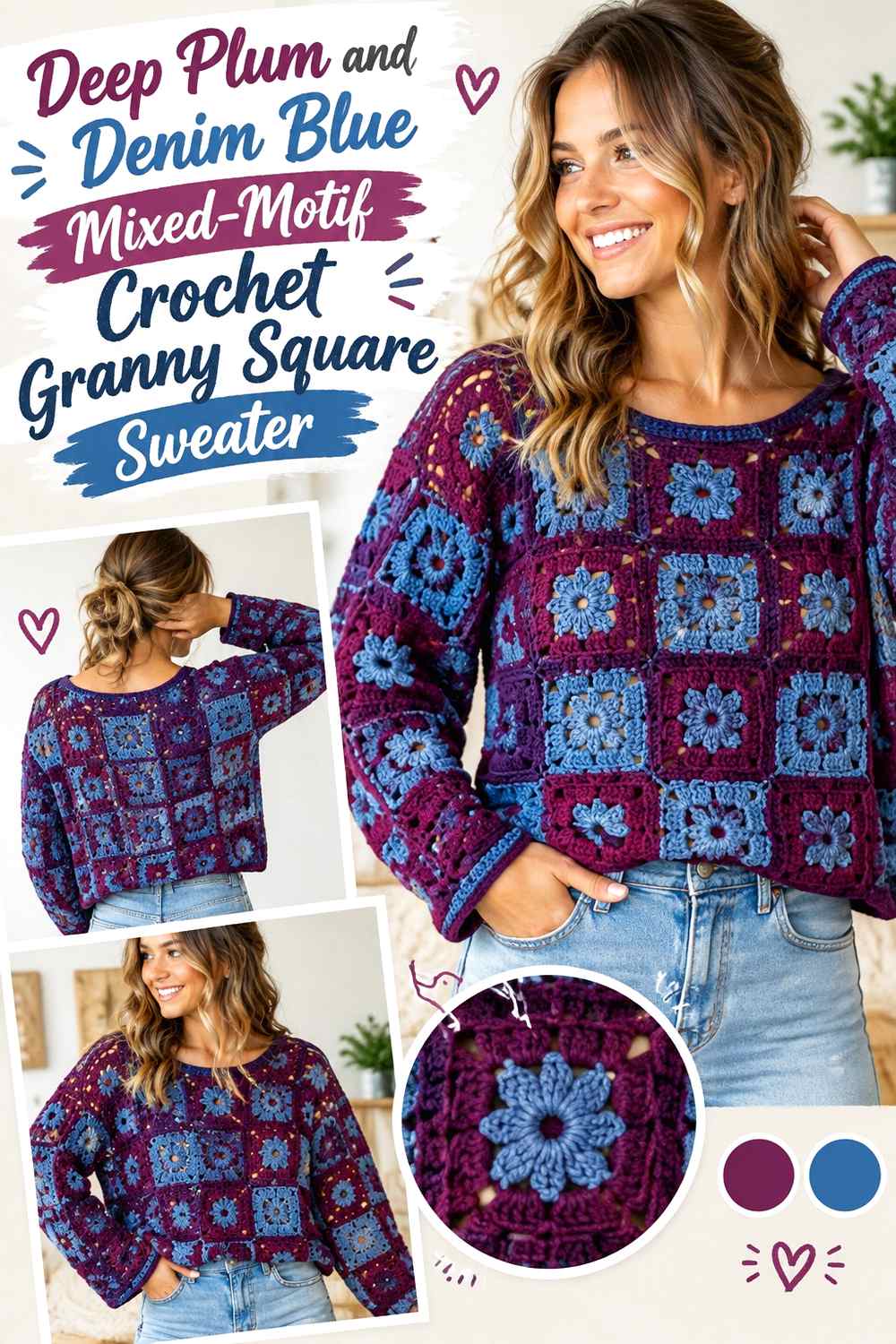
Denim blue cools the palette and works especially well when the sweater contains more than one square design. Deep plum can provide the repeated anchor that keeps differing motifs from looking disconnected.
Repeat Deep Plum Across Different Granny Square Designs
When two or more motif styles appear in the same garment, use deep plum in a consistent location such as the outer round. This creates a visual connection even when the centers or stitch arrangements differ.
The repeated plum edge can also simplify layout planning across body and sleeves.
Use Denim Blue Inside Deep Plum Motifs Rather Than Everywhere
Denim blue can become a strong supporting color when it appears in motif centers or selected middle rounds. Keeping it away from every join and border prevents it from competing with plum for dominance.
If the denim is very dark, compare it with deep plum in grayscale to make sure the two colors will remain distinct enough for the chosen placement.
Creator Credit: Lakeside Loops
12. Deep Plum And Mustard Circle In Square Crochet Sweater

A circle-in-square motif offers two visual layers: the rounded center and the square framework around it. Deep plum and mustard can use that structure deliberately instead of being distributed randomly.
Use Deep Plum Around Mustard Circle-in-Square Centers
A mustard center surrounded by deep plum immediately makes plum the framing shade. Repeating that relationship across the sweater produces recognizable motifs while maintaining a dark overall field.
If the mustard centers already feel prominent, avoid adding large mustard cuffs or neckline bands.
Keep Deep Plum on the Outer Granny Square Rounds
Deep plum outer rounds help neighboring circle-in-square motifs connect when they are joined. They also prevent the mustard centers from visually running into one another.
A matching plum join can make the square framework even more continuous across the torso and sleeves.
Creator Credit: Yarn Lane TV
13. Deep Plum And Wine Ribbed Trim Crochet Granny Square Sweater
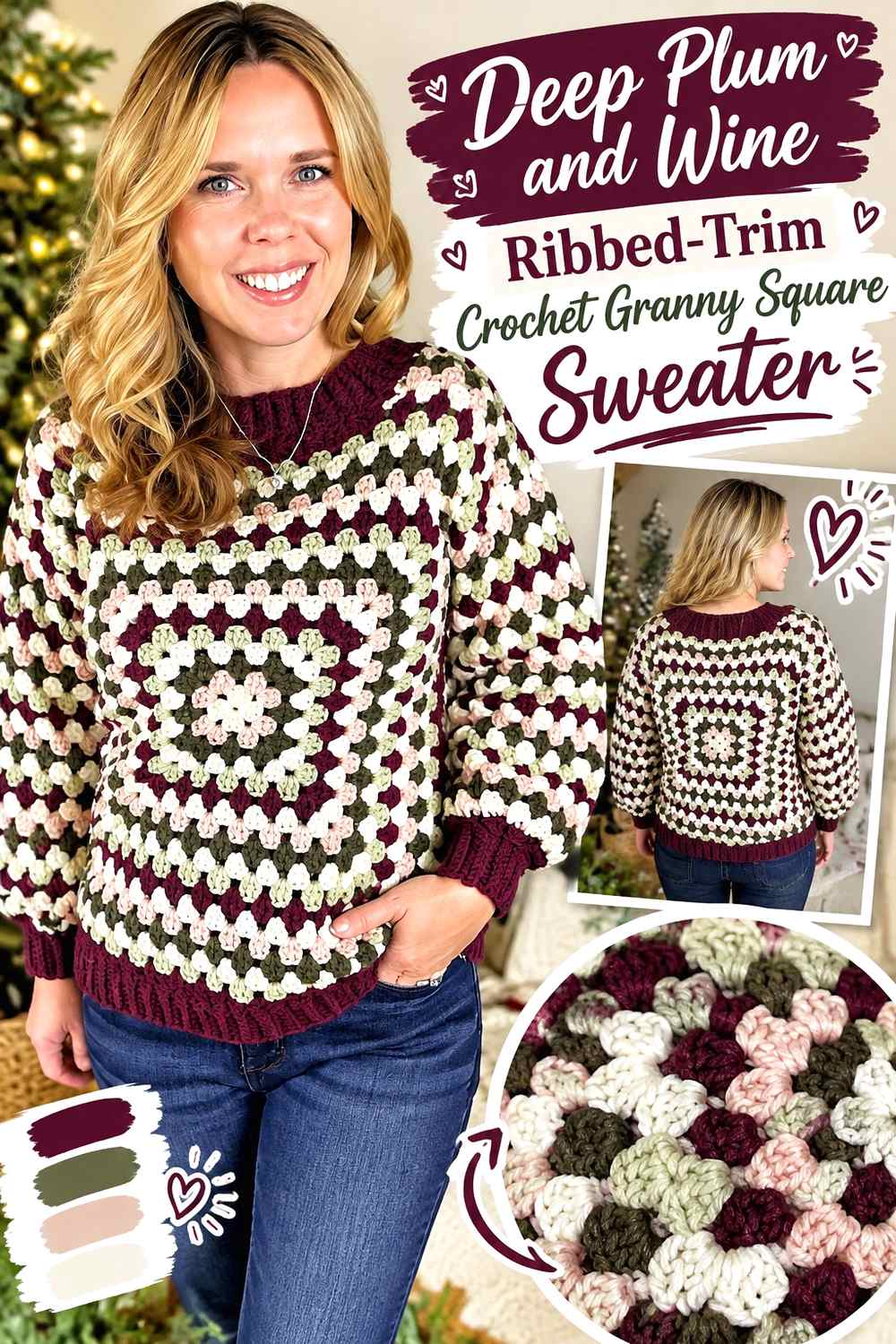
Wine creates a tonal transition rather than obvious contrast. The difference becomes particularly useful between open granny-square fabric and more solid-looking cuffs, neckline ribbing, or hem finishes.
Keep Deep Plum Across the Main Granny Square Panels
Use deep plum for most large-square or body sections so the granny pattern has one dominant base. Wine can then move to the edges where its subtle difference becomes a finishing detail.
This avoids trying to distinguish two similar dark reds inside very narrow motif rounds.
Use Wine to Finish Deep Plum Granny Square Cuffs and Necklines
A wine-colored cuff can separate subtly from a deep plum sleeve without creating a sharp light-dark boundary. The same shade can be repeated at the neckline or hem.
Compare the yarns first. If deep plum and wine are nearly identical, the result will behave more like tonal shading than conventional color blocking.
Creator Credit: Hooked on Homemade Happiness
14. Deep Plum And Black Open Front Crochet Granny Square Sweater

Black gives deep plum an especially dark frame and suits an open-front granny square sweater where the edges and joins can become part of the color design. Because both shades carry substantial visual weight, broad placement works better than numerous tiny changes.
Keep Deep Plum Across the Main Open-Front Granny Square Panels
Use deep plum for the majority of motif centers and rounds so the open-front construction still reads primarily as plum. Black can frame those motifs or define the front edges.
This division keeps the two sweater fronts connected visually even though they are separated by the opening.
Use Black to Frame Deep Plum Granny Square Edges
Black outer rounds and joins can create a continuous grid around deep plum motifs. That approach makes the sweater structure more visible without introducing another hue.
If the black grid becomes visually heavy, keep the cuffs or lower border deep plum instead of repeating black at every possible finishing point.
Creator Credit: Lallaulab
Comparing the 14 Deep Plum Granny Square Sweater Palettes
For the clearest motif definition, cream, ivory, and oatmeal provide the strongest light-dark separation from deep plum. They are particularly useful around small centers, outer motif rounds, or joins where individual square boundaries need to remain obvious.
Camel, sage, moss, soft gray, and denim blue provide medium contrast. These colors change the palette noticeably without creating the bright grid effect that a very light neutral can produce.
Dusty rose, blush, rose, and wine create more tonal relationships. They suit sweaters where the color transitions should feel connected rather than sharply divided. Make sure the shades remain different enough in value if individual rounds need to stay visible.
Charcoal and black produce the darkest results. These pairings can make seams and outer rounds recede, which is useful when you want the granny geometry to come primarily from stitch direction instead of strong color boundaries.
Conclusion
The most important choice in a deep plum granny square sweater is not simply which second color to add. Decide first where deep plum will repeat. Centers create dark focal points, wide middle rounds make plum occupy more of every motif, and outer rounds or joins can tie an entire patchwork layout together.
For strong square definition, pair deep plum with cream, ivory, or oatmeal. Sage, camel, gray, and denim give the sweater a softer contrasting direction, while dusty rose, blush, wine, charcoal, and black keep the palette closer and more tonal.
Before producing a complete stack of motifs, place several finished squares together in the intended arrangement. That small layout check reveals whether the sweater will remain deep-plum dominant and whether the joining, neckline, sleeves, and cuffs need more or less of the supporting color.
Frequently Asked Questions
What colors work well with deep plum in a granny square sweater?
Cream, ivory, oatmeal, camel, sage, moss, dusty rose, blush, soft gray, denim blue, charcoal, black, mustard, burgundy, and wine can all create useful palettes. The main difference is how much contrast you want between the plum and the surrounding motif rounds.
Should deep plum go in the center or outer round of a granny square?
Either can work. Deep plum centers create repeated dark focal points, while plum outer rounds make the whole sweater appear more plum-dominant and can connect differently colored centers. Choose the placement according to the finished garment rather than judging one isolated square.
How do I keep a deep plum granny square sweater from looking too dark?
Increase the visual share of a lighter supporting shade in selected motif rounds rather than changing every section. Cream, ivory, oatmeal, blush, or soft gray can create breaks around plum while still allowing the main color to dominate.
What joining color works with deep plum granny squares?
Deep plum itself can create a continuous dark framework, while cream or another lighter shade makes every square boundary more visible. Charcoal or black produces a subtler dark grid. Consider how much joining color will appear across the entire sweater before deciding.
How can I tell if two granny square colors have enough contrast?
Place the finished motifs side by side and look at them from several feet away. A grayscale photo can also reveal whether two different hues are actually close in light-dark value. If the sections merge, use wider color areas or choose a lighter or darker substitute.
Should every granny square in a deep plum sweater use the same colors?
Not necessarily. The motifs can vary as long as there is a clear repetition system. Keeping deep plum in a consistent position, repeating the same outer border, or limiting the supporting palette can connect squares that have different centers.
How do I substitute a deep plum yarn without changing the whole palette?
Choose another dark, muted purple with a similar depth relative to the supporting colors. If the original palette depends on high contrast with cream, preserve that value difference. For a tonal combination with wine or charcoal, maintaining the close dark relationship may be more important than matching the exact plum hue.