Aubergine gives a granny square cardigan a deep purple foundation without limiting the project to a dark, monochromatic look. Pair it with cream and the individual squares become more defined; combine it with dusty rose or lavender for a softer tonal direction; or introduce mustard, teal, sage, or burnt orange when you want stronger color separation.
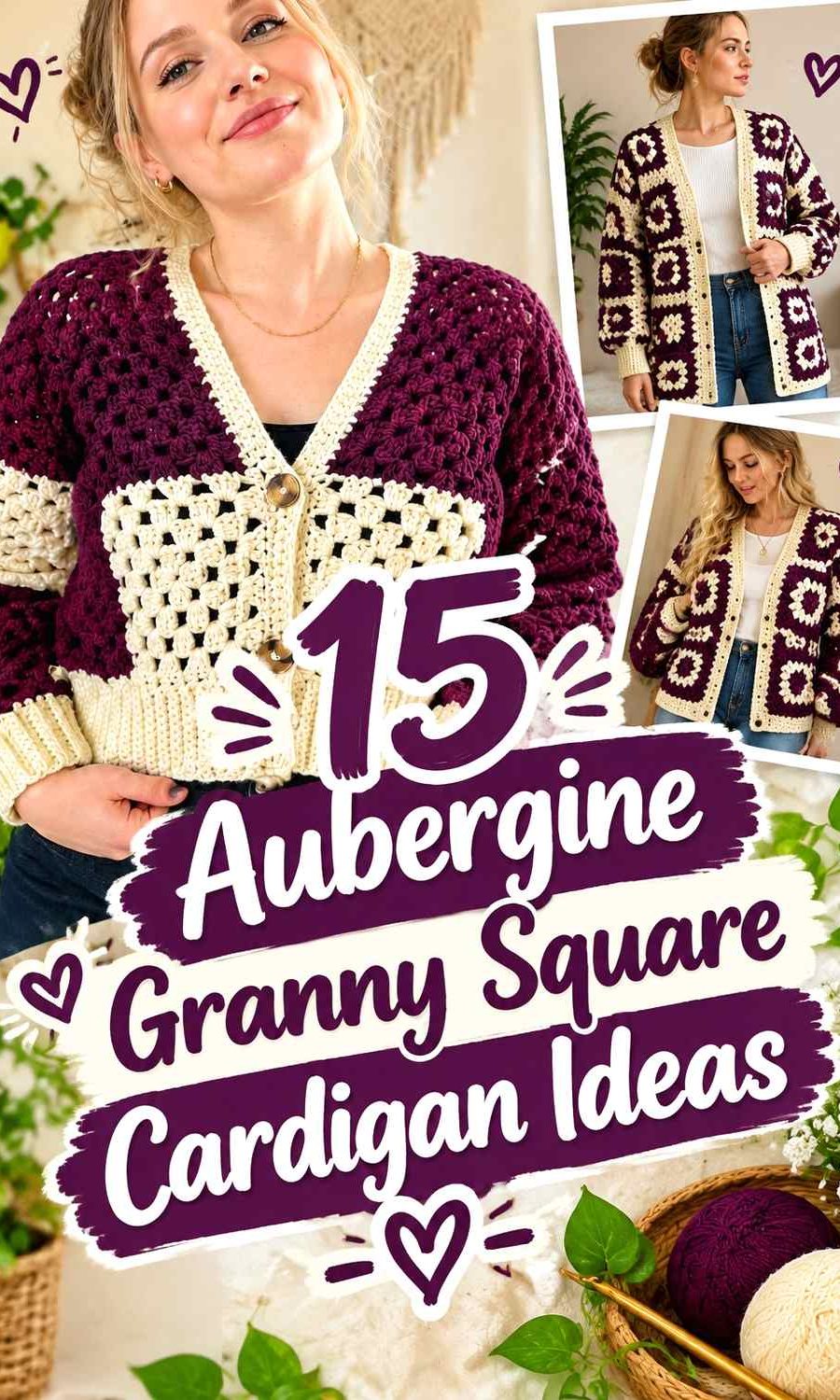
The important decision is not simply which colors sit beside aubergine. Granny square cardigans spread color across body panels, sleeves, cuffs, front bands, joins, and repeated motif rounds, so placement determines whether aubergine reads as the dominant color, a framing color, or a recurring accent.
The 15 palettes below use aubergine in different roles. Each idea is also paired with a crochet cardigan tutorial that can support the construction concept. The suggested aubergine palettes are independent adaptations and do not necessarily match the colors used by the tutorial creator.
Quick List
- Aubergine And Cream Crochet Granny Square Cardigan
- Aubergine And Dusty Rose Crochet Granny Square Cardigan
- Aubergine And Sage Crochet Granny Square Cardigan
- Aubergine And Mustard Crochet Granny Square Cardigan
- Aubergine And Charcoal Crochet Granny Square Cardigan
- Aubergine And Oatmeal Crochet Granny Square Cardigan
- Aubergine And Teal Crochet Granny Square Cardigan
- Aubergine And Terracotta Crochet Granny Square Cardigan
- Aubergine Blush And Cream Crochet Granny Square Cardigan
- Aubergine Olive And Camel Crochet Granny Square Cardigan
- Aubergine And Lavender Crochet Granny Square Cardigan
- Aubergine Black And Ivory Crochet Granny Square Cardigan
- Aubergine Burnt Orange And Cream Crochet Granny Square Cardigan
- Aubergine Denim Blue And Gray Crochet Granny Square Cardigan
- Aubergine Forest Green And Sand Crochet Granny Square Cardigan
Plan Aubergine as the Anchor Before Joining the Granny Squares
Decide what job aubergine will do before making a full set of squares. It can cover the largest share of each motif, form the final rounds around contrasting centers, alternate with another square color, or appear mainly in joins, cuffs, and front edging. Those choices produce very different cardigans even when the same colors are used.
For an aubergine-led cardigan, repeating the purple across both sleeves and the main body generally gives the garment a clearer visual anchor. If aubergine is only an accent, distribute it in several visible areas instead of concentrating every aubergine square on one front panel or sleeve.
Check Aubergine Contrast Across Granny Square Rounds
Aubergine is dark enough that another medium or dark shade can merge with it visually even when the hues are obviously different. Charcoal, deep teal, olive, and forest green therefore need more deliberate placement than cream or oatmeal.
Before committing to dozens of motifs, place the chosen yarns together and view them from farther away. A grayscale photo can also help reveal whether two colors that look different in hue are actually close in lightness. If the granny-square rounds disappear into each other, insert a lighter shade or increase the visual share of the lighter color.
Repeat Aubergine Around Cardigan Edges for a More Connected Palette
Granny square cardigans contain many separate motifs, so repetition can make a multicolor scheme feel more deliberate. When aubergine already appears inside the squares, repeating it at the cuffs, lower edge, neckline, front band, or joining areas can connect those motifs to the finished garment.
That does not mean every edge needs to be purple. A cream front band might be useful when the cardigan is already very dark, while an aubergine band can frame a lighter square layout. Choose the edge color after laying out the body and sleeves rather than treating finishing as a separate color decision.
1. Aubergine And Cream Crochet Granny Square Cardigan

Aubergine and cream create one of the clearest ways to show the geometry of a granny square cardigan. Let aubergine cover most of the motifs while cream separates selected rounds, centers, or edges. Because cream is much lighter, it can keep individual clusters and square boundaries visible even when aubergine dominates the garment.
This palette works particularly well when you want the cardigan to read as distinctly aubergine from across the room while still preserving plenty of granny-square definition.
Let Aubergine Dominate the Cardigan Body
Use aubergine across the largest sections of the front, back, and sleeves if the main goal is a deep-purple cardigan rather than an evenly split two-color piece. Cream can then appear in smaller repeated areas such as motif centers or one contrasting round.
Avoid alternating equal amounts automatically. Giving aubergine more surface area makes cream function as separation rather than allowing the lighter yarn to take over the whole patchwork effect.
Use Cream to Separate Aubergine Granny Square Details
Cream is useful around small motif details because it creates a visible break against aubergine. Try placing it near the center or immediately before an aubergine outer round when you want each square to remain easy to read.
If the cardigan already contains many cream-centered squares, consider keeping the joining or front band aubergine. That darker frame can prevent the finished garment from becoming lighter than intended.
Creator Credit: HayHay Crochet
2. Aubergine And Dusty Rose Crochet Granny Square Cardigan

Dusty rose gives aubergine a softer supporting color without producing the sharp light-dark division of cream. This makes the palette useful for a cardigan where you want noticeable color variation but still prefer the squares to flow into one another.
Aubergine can provide the darker outer rounds and garment edging, while dusty rose works well toward motif centers or in selected squares across the sleeves and fronts.
Keep Aubergine on the Outer Granny Square Rounds
Putting aubergine around the outside of dusty rose motifs gives each square a darker boundary. That can be particularly useful before joining, because the repeated aubergine edges establish a consistent color around squares whose centers may vary.
The same idea can continue into the cardigan cuffs or neckline so the darker purple does more than appear randomly inside the patchwork.
Keep Dusty Rose Lighter Than Aubergine for Clearer Motifs
If substituting the rose, preserve a noticeable lightness difference from aubergine. A very dark muted pink can become too close to aubergine once worked into small granny clusters, reducing the definition between rounds.
Compare the two yarns before making the full cardigan. The goal is not maximum contrast, but enough separation for dusty rose to remain recognizable inside an aubergine-led motif.
Creator Credit: Chenda DIY
3. Aubergine And Sage Crochet Granny Square Cardigan
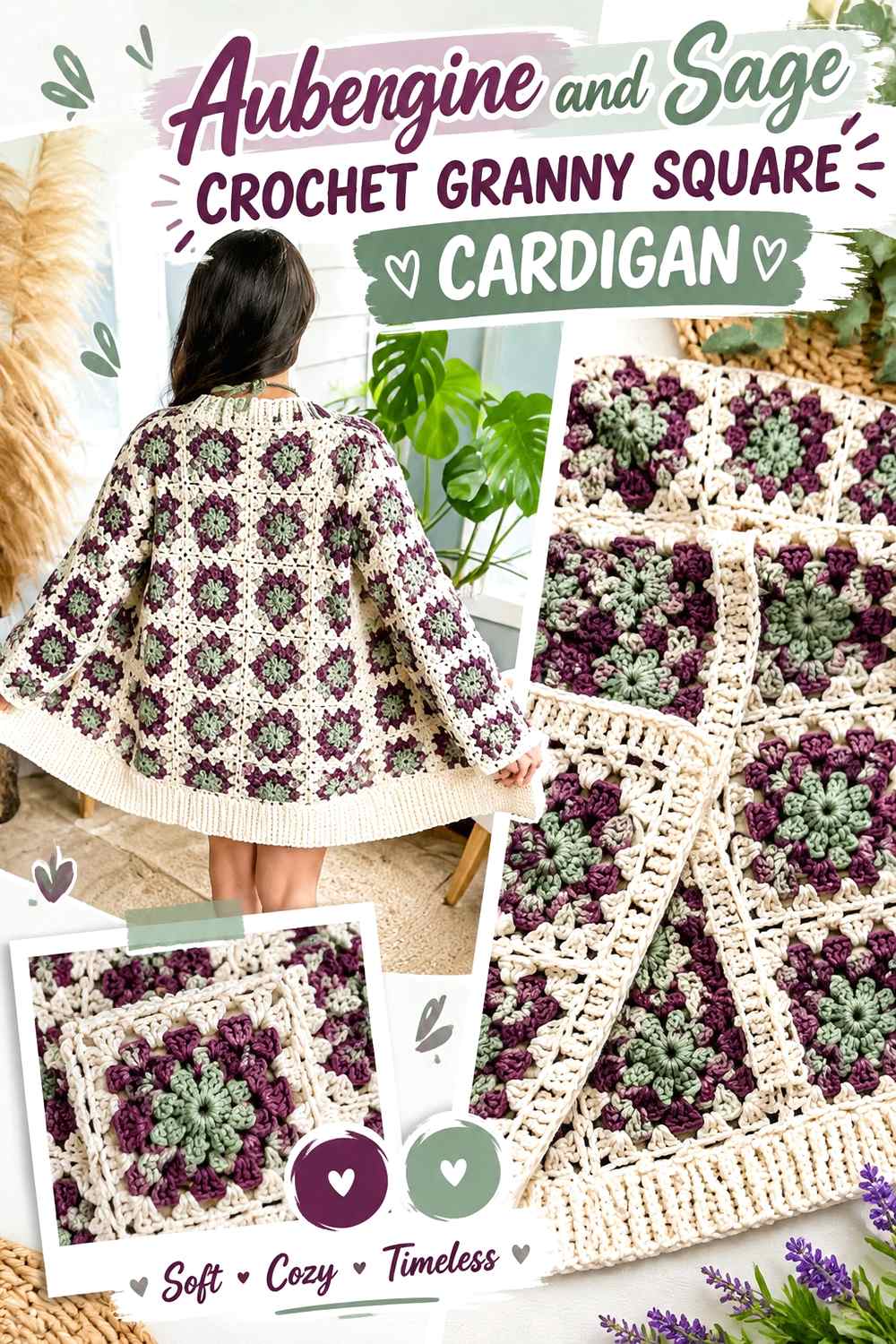
Aubergine with sage shifts the cardigan toward a muted botanical direction. The deep purple carries more visual weight, while a medium or light sage can keep the repeated granny-square pattern from feeling too dark.
This palette can work especially well when sage occupies selected centers or whole secondary squares and aubergine repeats through outer rounds, joins, or edging.
Let Aubergine Frame Sage Granny Square Centers
A sage center surrounded by aubergine creates a clearly structured motif without introducing a bright neutral. Repeating that order across the cardigan can make the squares feel related even if you occasionally reverse the colors.
For sleeves, check the arrangement before joining so sage does not collect in one large patch while aubergine dominates the opposite side.
Give Aubergine and Sage Enough Value Separation
Not every sage is light. A dark gray-green may sit surprisingly close to aubergine in value, particularly once both shades are broken into small crochet clusters.
If the two merge more than you want, choose a lighter sage rather than automatically adding another color. That preserves the two-color concept while giving the granny-square pattern more definition.
Creator Credit: MJ’s Off The Hook Designs
4. Aubergine And Mustard Crochet Granny Square Cardigan
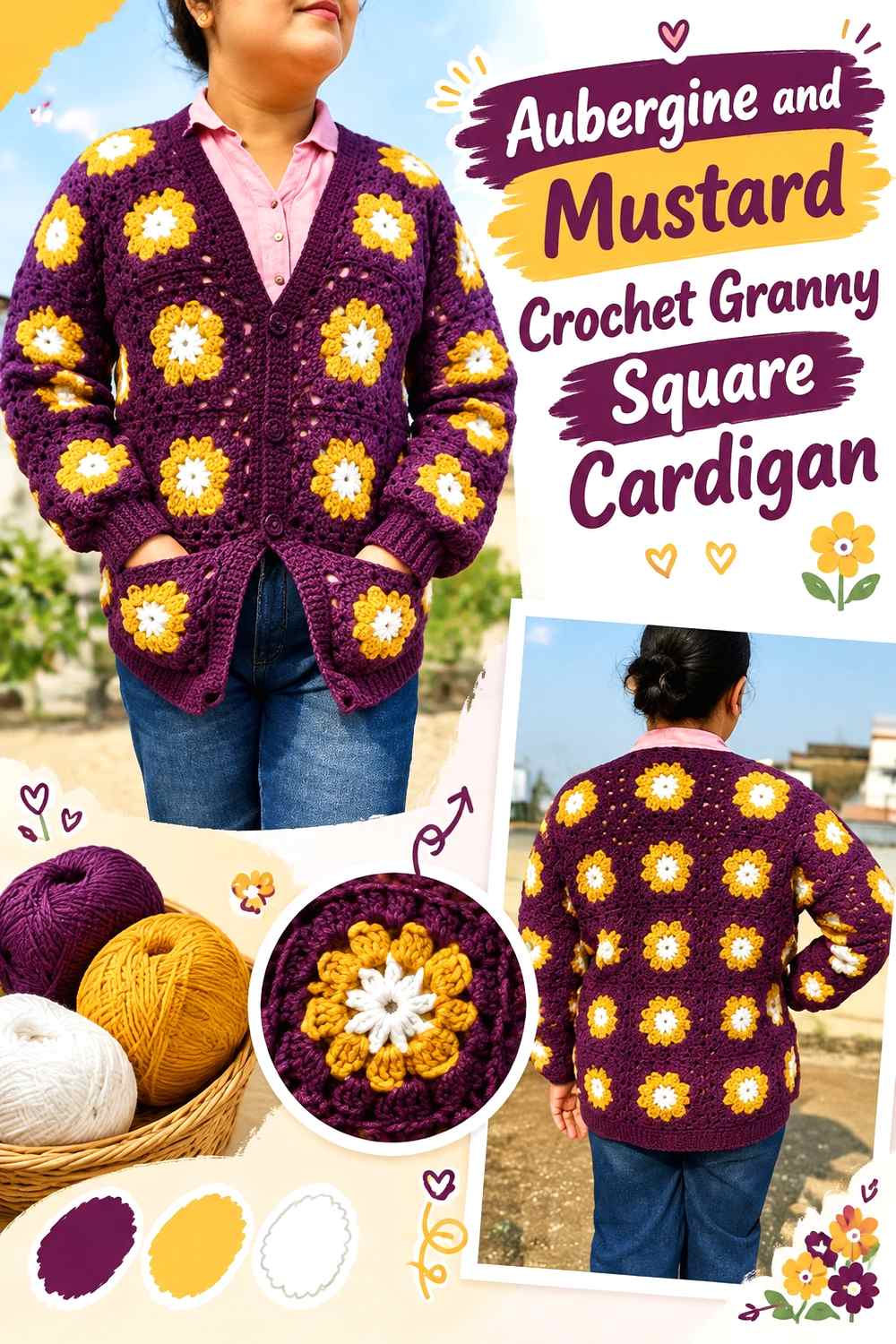
Mustard gives aubergine a stronger warm contrast and can make individual motifs much more noticeable. Because both colors have substantial visual presence, this palette benefits from an obvious hierarchy instead of splitting every square equally between them.
Aubergine can remain the dominant body color, with mustard restricted to centers, selected rounds, cuffs, or occasional statement squares.
Keep Aubergine Larger Than Mustard Across the Cardigan
If every mustard area is as large as every aubergine area, the cardigan can begin to read as an equal two-color checkerboard. That may be intentional, but it changes the impression of an aubergine-centered project.
For a clearer purple lead, keep mustard to smaller repeated areas and allow aubergine to occupy the final motif rounds, joins, or major body blocks.
Repeat Mustard Inside Aubergine Squares Instead of One Large Patch
Mustard can look disconnected when it appears only once on a sleeve or front panel. Repeat smaller mustard details across several aubergine squares so the warm accent travels through the cardigan.
You can also echo a small amount at the cuffs or lower edge, but avoid adding mustard everywhere simply for symmetry. Its stronger contrast means relatively small areas can still be very visible.
Creator Credit: Cute Crochet
5. Aubergine And Charcoal Crochet Granny Square Cardigan
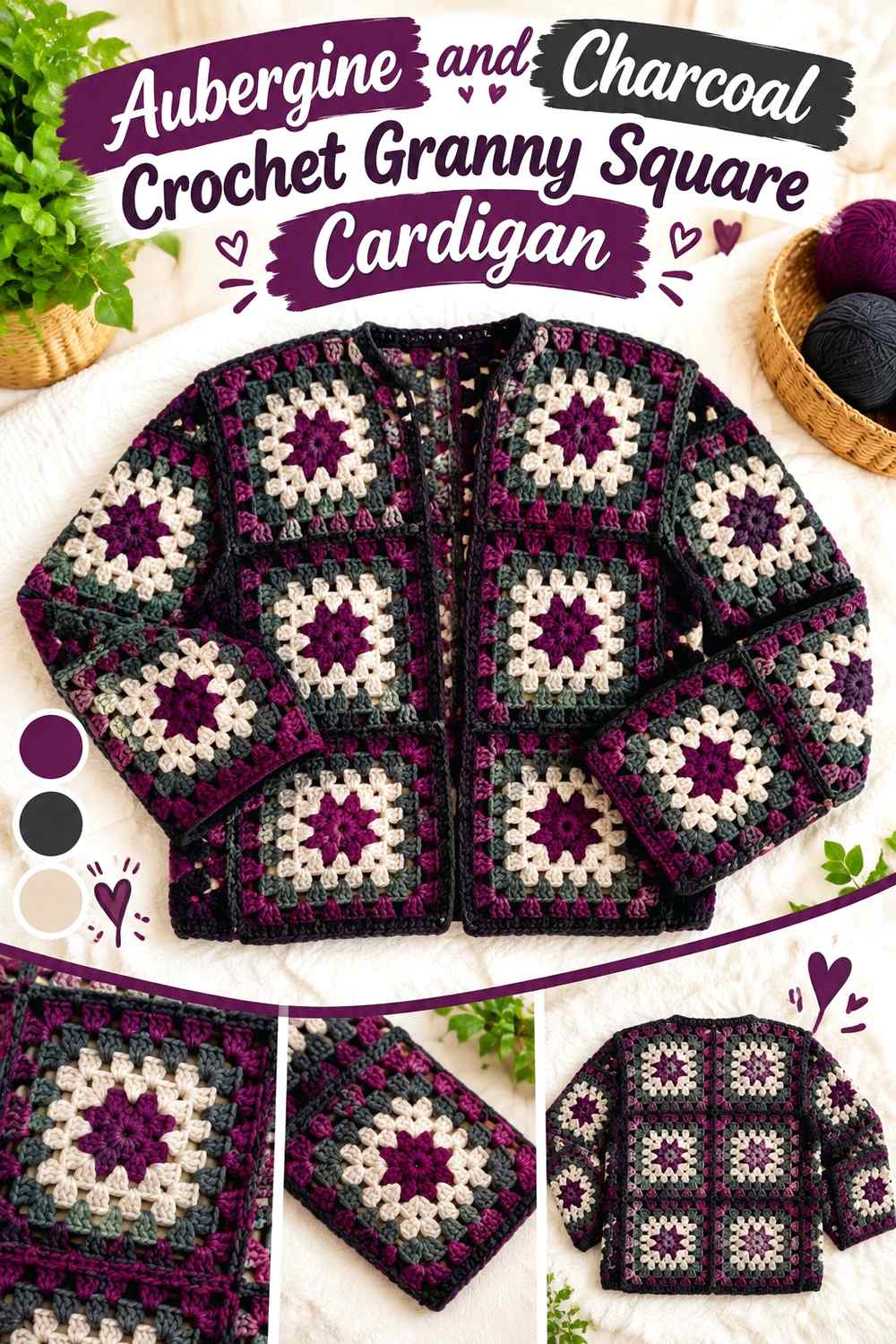
Aubergine and charcoal create a dark, restrained cardigan in which the granny-square structure can become subtler than the color itself. This is useful when you want patchwork texture without strong light-colored outlines.
Because the shades may be close in value, placement is more important here than in an aubergine-and-cream scheme. Consider alternating larger areas instead of relying on narrow charcoal rounds that may disappear against purple.
Use Aubergine as the Main Color When Charcoal Is Equally Dark
When charcoal and aubergine are close in lightness, simply changing yarn every granny-square round may not create obvious visual separation. A stronger approach is to make aubergine the clear main field and use charcoal for selected whole squares, joins, or finishing.
This keeps the garment recognizably aubergine while allowing charcoal to deepen the edges without muddying every motif.
Check Aubergine and Charcoal Before Choosing a Dark Join
A charcoal join between already-dark aubergine squares can make square boundaries subtle. If you want visible patchwork lines, test a joined pair before committing to the entire cardigan.
You may decide that aubergine joining creates better continuity, or that a lighter third shade is needed. Make that decision while the motifs can still be rearranged.
Creator Credit: Danielle Villanueva
6. Aubergine And Oatmeal Crochet Granny Square Cardigan

Oatmeal softens the contrast against aubergine compared with a bright white or very pale cream. That makes it useful for a cardigan that should still have clearly defined motifs but with a quieter neutral background.
Try oatmeal as the center or middle rounds of the granny squares, while aubergine forms outer rounds, front edging, and cuffs.
Use Aubergine Around Oatmeal to Define Each Granny Square
An aubergine outer round can give oatmeal-heavy squares a stronger boundary before they are joined. This is especially useful across the front panels, where the individual motifs remain highly visible when the cardigan is worn open.
Repeating aubergine on the sleeve cuffs can continue the same framing effect without requiring another accent color.
Let Oatmeal Lighten an Aubergine-Heavy Cardigan
If a fully aubergine body feels darker than you want, increase oatmeal within some squares rather than abandoning the palette. Larger oatmeal centers can create more light space while the aubergine outer rounds keep the cardigan color direction intact.
This also gives you a practical adjustment if the first few test squares appear heavier than expected.
Creator Credit: HanJan Crochet
7. Aubergine And Teal Crochet Granny Square Cardigan
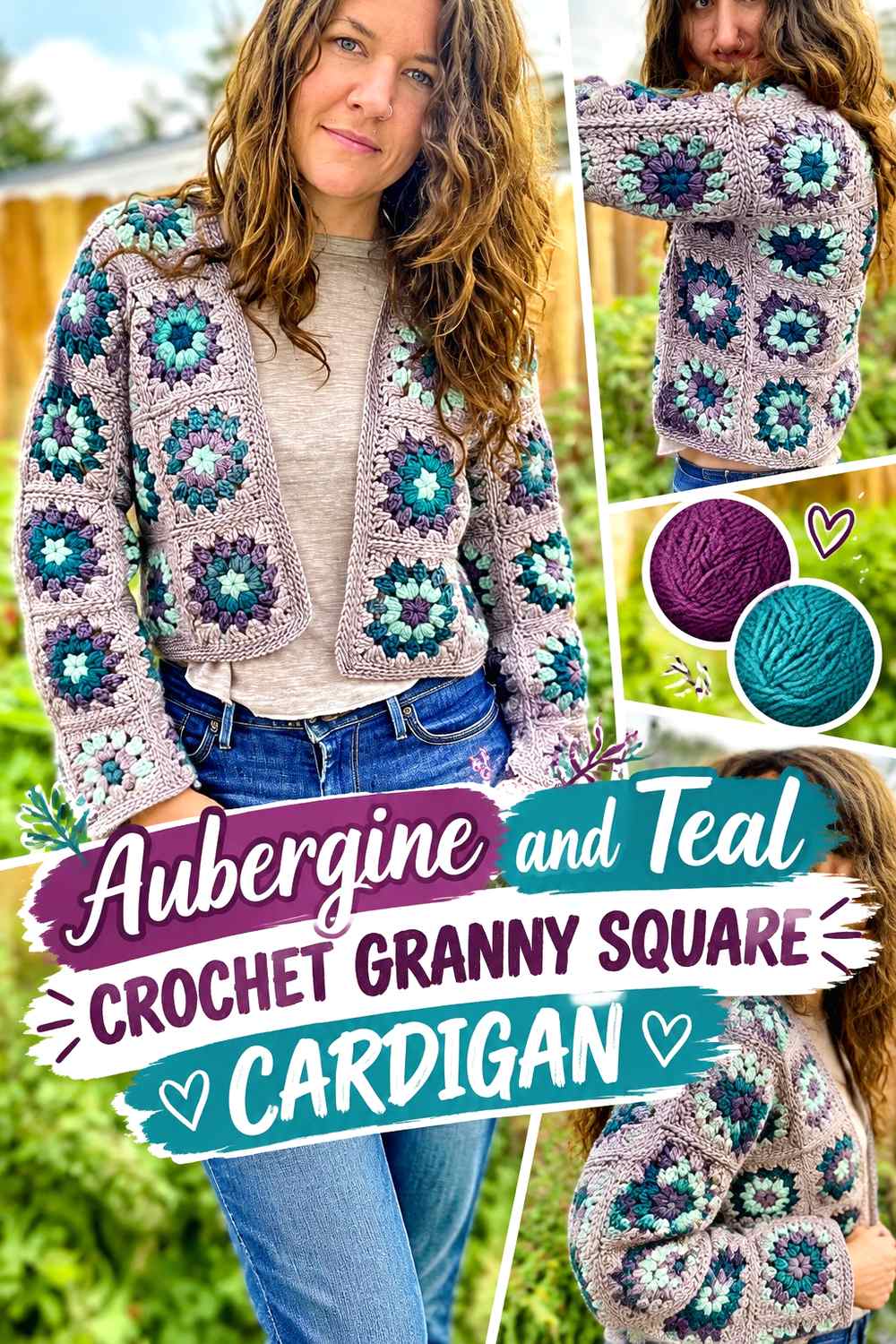
Aubergine and teal create a saturated jewel-toned combination with less reliance on neutrals. Both shades can hold substantial visual weight, so the cardigan benefits from a planned dominant color rather than random equal distribution.
Keep aubergine consistent through the garment while using teal in alternating centers, selected full squares, or repeated sleeve accents.
Keep Aubergine Repeating When Teal Becomes a Strong Accent
Teal can compete strongly with aubergine when both are saturated. To keep the cardigan anchored to aubergine, repeat purple in every motif or in a consistent structural location such as the outer round.
That repetition matters more than simply using a greater total quantity because the eye encounters aubergine throughout the whole garment.
Test Aubergine and Teal for Contrast Before Making Every Square
Dark teal can be close to aubergine in value even though the colors look very different side by side. Make one finished motif and look at it from several feet away before deciding that the rounds are distinct enough.
If they blend, a lighter teal or a small neutral separator can improve clarity without changing the overall jewel-toned direction.
Creator Credit: Off the Beaten Hook
8. Aubergine And Terracotta Crochet Granny Square Cardigan

Terracotta brings a warm earthy note to aubergine and produces less yellow contrast than mustard. It is particularly useful when you want the cardigan to feel warm and autumnal without turning the supporting color into a bright focal point.
Alternating terracotta centers with aubergine outer rounds can give repeated motifs a consistent rhythm across both the body and sleeves.
Let Aubergine Control the Cardigan Edges Around Terracotta
Use aubergine for the front edge, cuffs, or lower border when terracotta already occupies a substantial share of the square interiors. The dark purple edge gives the warm motifs a common finish and keeps the cardigan from shifting too far toward orange-brown.
Review the whole laid-out garment before choosing the border because terracotta may occupy more visual space than expected once every square is visible together.
Repeat Terracotta Inside Aubergine Squares in Small Areas
Terracotta does not need to fill every other square. Repeating it as centers or one motif round can provide enough warmth while leaving aubergine dominant.
If replacing the shade, choose another muted warm orange or clay-like tone that stays visibly distinct from aubergine rather than moving toward a very dark red-brown.
Creator Credit: Frisian Knitting tutorials
9. Aubergine Blush And Cream Crochet Granny Square Cardigan
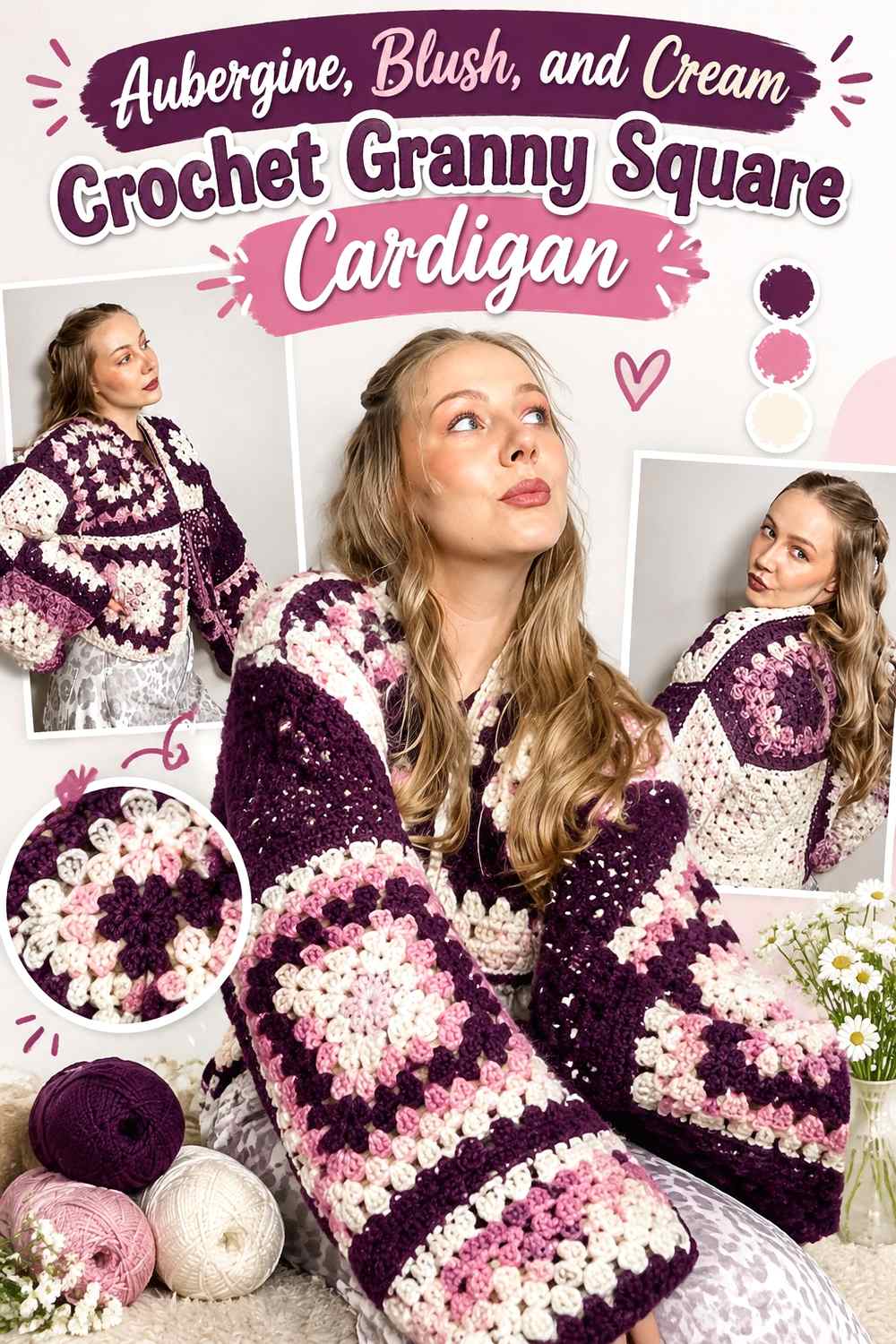
Blush and cream give aubergine two different levels of contrast. Blush can bridge the transition from deep purple to pale cream, while cream supplies the strongest definition around small granny-square details.
A useful sequence is blush toward the center, cream as a narrow separating area, and aubergine toward the outside. The exact order can vary, but each color should have a distinct role.
Use Aubergine as the Dark Anchor Between Blush and Cream
Aubergine prevents this light palette from becoming predominantly pastel. Repeat it through the outer motif rounds, joining areas, or cardigan edging so the deep purple remains visible across the entire garment.
On the sleeves, distribute aubergine motifs rather than reserving them only for the cuffs; otherwise the upper sleeve can look disconnected from the body.
Let Cream Separate Aubergine From Blush When Values Are Too Close
Some dusty blush shades can be darker than expected. If blush begins to merge with aubergine, a small cream section between them can restore the layered granny-square appearance.
That separator can be especially helpful around detailed motif centers, where narrow rounds need more contrast than larger color blocks.
Creator Credit: DIYGuru
10. Aubergine Olive And Camel Crochet Granny Square Cardigan

Olive and camel turn aubergine toward an earthy, muted palette with three clearly different color roles. Aubergine can provide depth, olive works as the secondary color, and camel can lighten smaller areas without introducing a pale cream.
This combination benefits from repetition because three medium-to-dark earthy colors can look scattered if every square uses them differently.
Repeat Aubergine in Every Olive and Camel Granny Square
One way to unify a three-color cardigan is to include aubergine somewhere in every motif while varying the amounts of olive and camel. Aubergine might form every outer round while the centers alternate between the other two colors.
That approach lets the cardigan look varied without losing the common purple frame that ties body and sleeves together.
Keep Camel Lighter Than Aubergine and Olive for Better Separation
Choose camel partly for its value role. If it is almost as dark as the olive and aubergine, the cardigan can lose much of the contrast that makes a three-color arrangement useful.
A lighter camel can be concentrated around centers or selected borders where you want granny-square texture to remain visible.
Creator Credit: Nati Crochet
11. Aubergine And Lavender Crochet Granny Square Cardigan
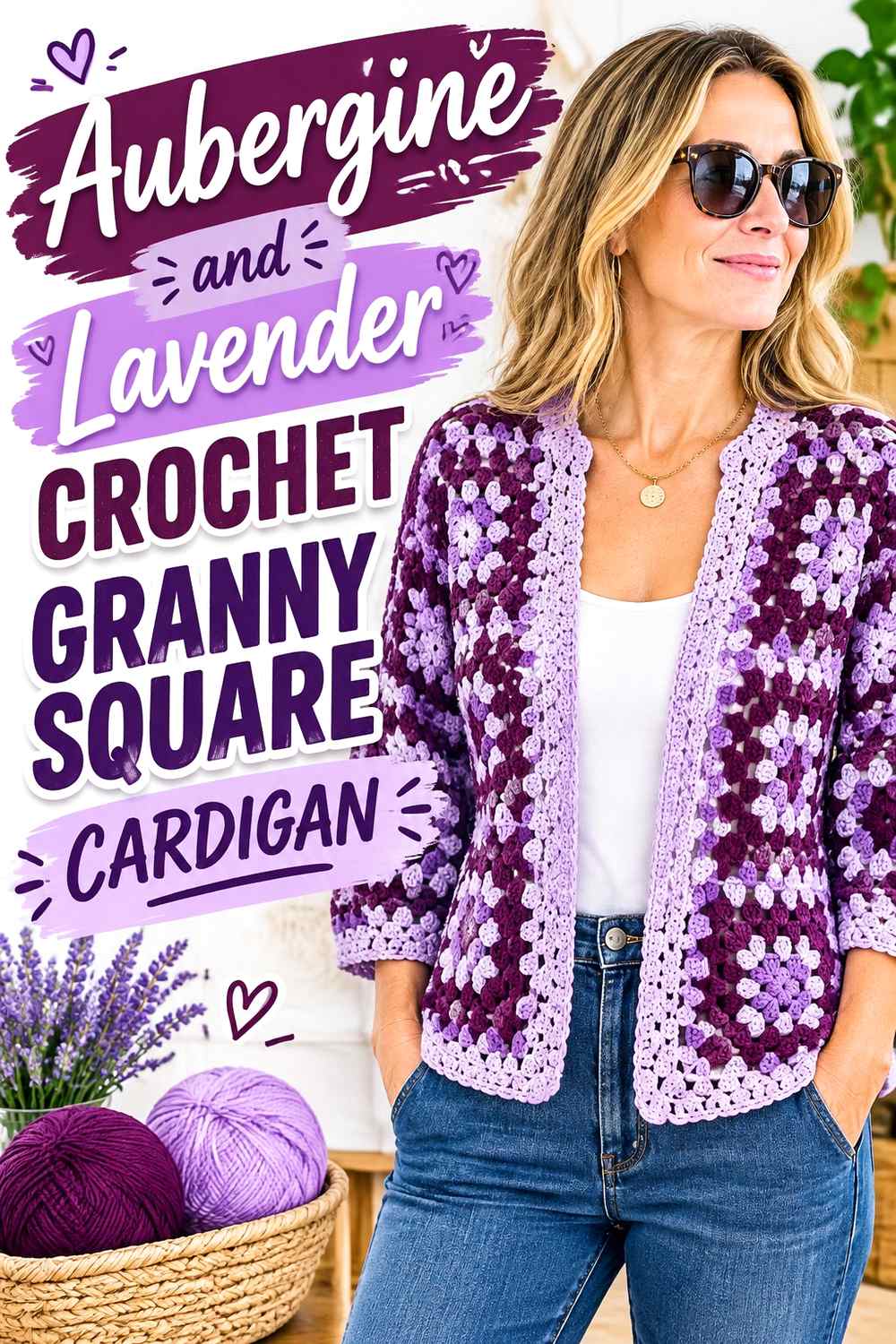
Lavender keeps the cardigan within the purple family while creating enough tonal variation to reveal the motif structure. This is a useful approach when you want a softer transition than cream but more definition than two similarly dark purples.
Aubergine can anchor outer rounds and finishing, while lavender opens up the centers and selected sleeve squares.
Use Aubergine to Give Lavender Granny Squares a Dark Frame
Placing aubergine around lavender-heavy motifs prevents the cardigan from drifting into an overall pale-purple look. The repeated dark border also creates a recognizable edge around every square before joining.
If you use lavender on the front edging instead, consider keeping the cuffs aubergine so the garment still has a visible dark anchor at the sleeve ends.
Preserve a Clear Lightness Gap Between Aubergine and Lavender
Tonal palettes rely on value differences more than dramatic hue differences. A very dark lavender may look almost indistinguishable from aubergine once crocheted.
Choose a lavender that remains visibly lighter, and test one complete granny square before planning dozens of identical motifs.
Creator Credit: Crochet Jewel
12. Aubergine Black And Ivory Crochet Granny Square Cardigan
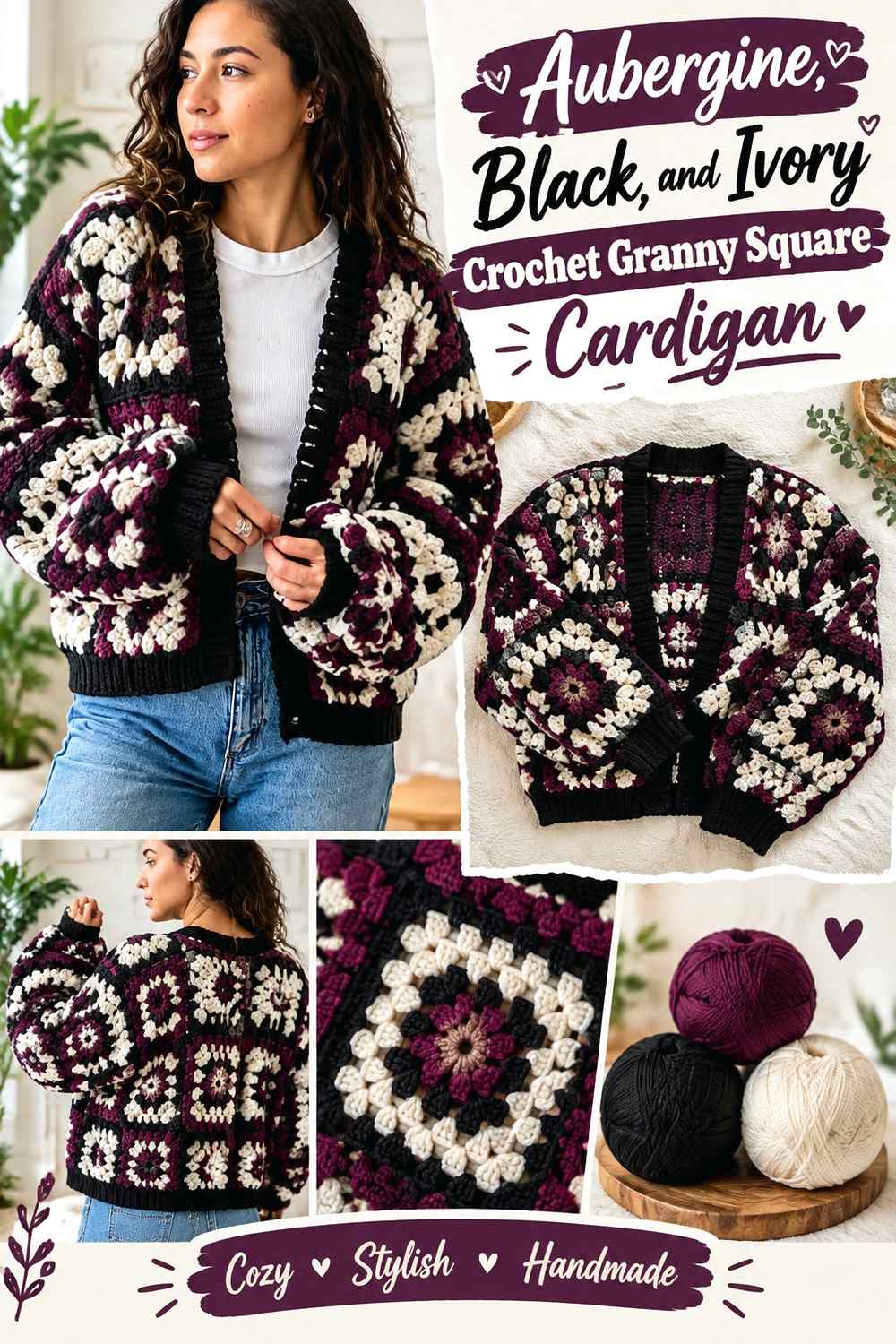
Black and ivory give aubergine a more graphic framework. Ivory can isolate small details, while black can create strong joins or outlines around motifs. The main risk is letting black become so dominant that aubergine stops reading as the cardigan’s central color.
Keep purple across large motif areas, then use black strategically and ivory in smaller high-contrast sections.
Give Aubergine More Surface Area Than Black
Both aubergine and black are dark, but black can visually overpower neighboring colors when used for every large section. Reserve it for selected outer rounds, joins, narrow edging, or occasional motifs rather than making it equal to the aubergine coverage.
That leaves the cardigan distinctly purple while still gaining the graphic definition of a black outline.
Use Ivory to Separate Aubergine From Black Details
An ivory round between aubergine and black can make the granny-square geometry easier to see. This is particularly useful when the two dark colors would otherwise sit directly beside each other.
Repeat the ivory in several areas instead of adding it only once. A small amount distributed through body and sleeves is usually more connected than one large pale block.
Creator Credit: Emma Warrender
13. Aubergine Burnt Orange And Cream Crochet Granny Square Cardigan

Burnt orange adds a warm autumn contrast to aubergine, while cream prevents the two saturated shades from becoming visually heavy together. This palette works well when cream has a functional job as a separator rather than occupying an equal third of the cardigan.
Consider burnt orange centers, a small cream transition, and aubergine outer rounds for a repeatable motif structure.
Keep Aubergine Outside Burnt Orange Granny Square Centers
Aubergine outer rounds give burnt orange centers a dark frame and make the purple repeat predictable across the cardigan. That consistency can be useful in a large patchwork garment where many warm centers might otherwise dominate the final look.
Carry aubergine into the cuffs or front band to reinforce the same framing role after assembly.
Use Cream Between Aubergine and Burnt Orange When More Definition Is Needed
Aubergine and burnt orange are clearly different hues, but both can have substantial visual weight. A narrow cream area gives them more separation when the granny-square rounds need to remain distinct.
If the first test square already has enough clarity, cream can be reduced rather than inserted mechanically into every motif.
Creator Credit: crochet-crosia
14. Aubergine Denim Blue And Gray Crochet Granny Square Cardigan
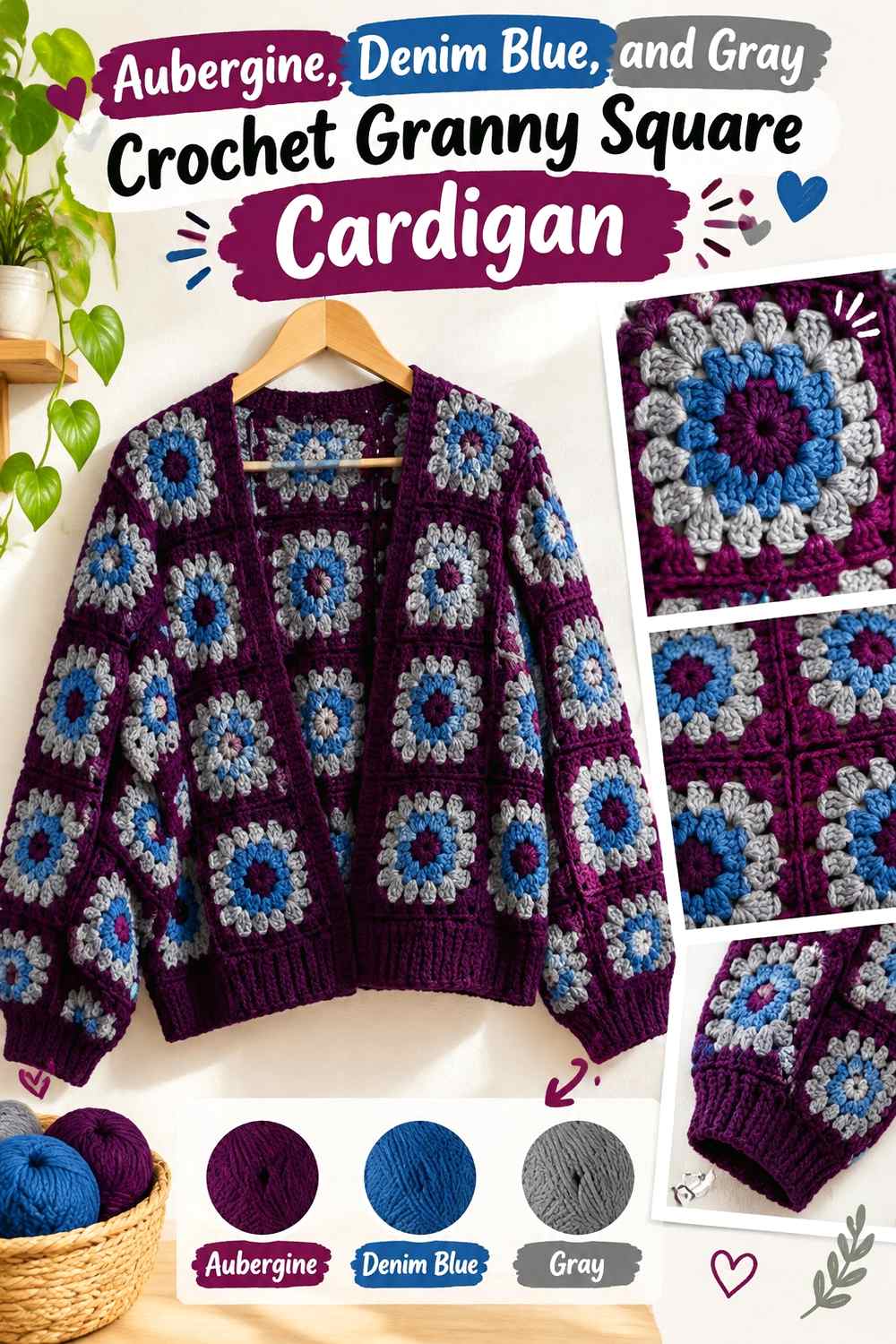
Denim blue and gray move aubergine toward a cooler, more understated palette. Gray can act as the visual resting point, while denim blue provides a secondary hue without creating the high contrast of mustard or cream.
Because all three shades can sit in a medium-to-dark range, pay special attention to lightness differences when choosing yarn.
Keep Aubergine Visible Across Denim Blue Cardigan Panels
Do not let aubergine disappear into a few isolated accent squares. Repeat it from front to back and through both sleeves, even if denim blue covers a substantial share of the motifs.
One consistent aubergine outer round is enough to establish continuity while allowing the interior colors to change.
Choose Gray That Separates Aubergine From Denim Blue
A medium-dark gray may make this entire palette visually compact. If you want clearer granny-square geometry, choose a noticeably lighter gray and place it near smaller details.
For a more blended cardigan, a mid-gray can work, but test the three yarns together before deciding whether the reduced contrast still shows enough of the motif structure.
Creator Credit: Crochet knit crafts
15. Aubergine Forest Green And Sand Crochet Granny Square Cardigan

Forest green gives aubergine another deep botanical partner, while sand supplies the light value needed to keep the two dark colors separate. This creates a richer three-color scheme than aubergine and sage because the green can carry nearly as much visual weight as the purple.
Let aubergine remain the repeated anchor, forest green fill selected centers or whole squares, and sand appear where contrast needs to be restored.
Separate Aubergine and Forest Green With Sand When Needed
Aubergine and forest green can both be very dark. When placed directly beside each other in narrow granny-square rounds, their boundaries may become less visible.
A sand-colored round can separate the two without introducing a bright white. Use it around centers or between major color transitions where the motif needs more definition.
Repeat Aubergine Across Forest Green Sleeves and Body Squares
If forest green fills several large areas, keep aubergine distributed across the cardigan rather than concentrating it around the front only. Repetition through sleeves, shoulder areas, and lower motifs helps the purple remain the visual anchor.
Finish by laying out all squares before joining and checking whether either dark shade has accidentally formed a large uninterrupted block.
Creator Credit: Crochet Crafts & Creations
How to Choose Between These Aubergine Granny Square Cardigan Palettes
For the clearest square definition, start with aubergine and cream, aubergine and oatmeal, or the black-and-ivory palette. Their lighter supporting shades create stronger separation around granny clusters and motif borders.
For softer color transitions, dusty rose, lavender, and blush keep the cardigan closer to a tonal purple family. Sage and oatmeal offer a quieter muted direction, while olive, camel, terracotta, burnt orange, and forest green push aubergine toward earthier palettes.
If you want more saturated contrast, compare mustard or teal. Both can compete strongly with aubergine, so using purple consistently around motif edges or cardigan finishing helps maintain a clear dominant color.
Conclusion
Aubergine can play several very different roles in a granny square cardigan. It can dominate the entire garment with cream used only for definition, frame dusty rose or lavender centers, balance earthy sage and terracotta, or share the cardigan with deeper jewel tones such as teal and forest green.
Start by deciding how dark you want the finished cardigan to feel. Cream, oatmeal, sand, and ivory create more visible separation. Lavender, blush, and dusty rose make the transition gentler. Charcoal, black, teal, forest green, and denim blue produce darker schemes that benefit from careful value checking.
Whichever palette you choose, arrange the finished squares across the body and sleeves before joining them. That final layout check is where you can correct a cluster of dark squares, repeat an underused accent, or move aubergine into a more balanced position. Use the original creator tutorials for their exact cardigan construction, sizing, joining, and finishing instructions.
Frequently Asked Questions
What colors work well with aubergine in a granny square cardigan?
Cream, oatmeal, dusty rose, lavender, sage, mustard, teal, terracotta, olive, camel, blush, black, ivory, denim blue, gray, forest green, and sand can all create distinct directions with aubergine. The more important question is what role each color plays. A light neutral improves separation, while another dark shade produces a more blended cardigan.
Should aubergine be the dominant color in an aubergine granny square cardigan?
It usually helps to give aubergine either the largest visual area or a highly consistent structural role. For example, aubergine can form every outer motif round even when other colors fill many centers. That repetition can establish it as the anchor without requiring every square to be predominantly purple.
How can I tell whether another color contrasts enough with aubergine?
Place the yarns together and look at them from a distance. You can also take a grayscale photo. If two different hues appear almost the same gray, their values are close and small crochet details may blend together. Use a lighter shade between them when stronger motif definition is wanted.
Should the joins on an aubergine granny square cardigan be aubergine?
They can be, particularly when you want the separate motifs to feel connected by one dark frame. A contrasting join may emphasize every square more strongly. Compare both effects on two or three sample motifs before joining the entire garment.
How do I substitute a color without changing the aubergine palette too much?
Preserve the substituted color’s job. If cream was providing light contrast, replace it with another noticeably light neutral. If sage was supplying a muted green, choose another softened green with similar lightness rather than switching to a highly saturated dark green.
How can I keep an aubergine granny square cardigan from looking too dark?
Increase the visual share of a lighter supporting shade in motif centers, selected rounds, or edging. Cream, oatmeal, ivory, sand, blush, and lighter lavender can create more open-looking areas while aubergine remains the dominant color. You do not necessarily need to remove aubergine; changing where the lighter color appears may be enough.