Crochet can create an embroidered look on denim when the motifs stay relatively flat, the flowers remain small, and narrow leaves or stems connect the design. Instead of covering a jacket with large dimensional flowers, think about the way floral embroidery usually occupies a pocket corner, follows a seam, crosses a repaired knee, or trails around a collar.

Denim color is part of the palette. White petals stand out sharply on dark indigo, while burgundy or rust can disappear on black denim without a cream outline. Pale-wash jeans give deeper flowers more contrast but may need darker leaves so green details remain visible.
These ideas use crochet appliqués and motifs as the construction base, then adapt them into denim-patch arrangements. The linked tutorials teach the original crochet flower or foliage concept; the palettes, placement, and embroidery-inspired compositions below are independent adaptations.
Quick List
- White, Butter Yellow, and Sage Daisy Crochet Denim Pocket Patch
- Golden Yellow, Brown, and Olive Sunflower Crochet Denim Knee Patch
- Burgundy, Blush, and Sage Rose Crochet Denim Jacket Patch
- Lavender, Plum, and Moss Floral Crochet Denim Cuff Patch
- Cherry Red, Black, and Leaf Green Poppy Crochet Denim Patch
- Cornflower Blue, Yellow, and Sage Forget-Me-Not Crochet Denim Pocket Patch
- Coral, Cream, and Olive Tulip Crochet Denim Patch
- Moss Green, Sage, and Cream Leaf-Vine Crochet Denim Patch
- Terracotta, Mustard, and Forest Green Folk Flower Crochet Denim Patch
- Cream, Rust, and Sage Wildflower Crochet Denim Patch
- Mustard, Chocolate, and Cream Sunflower Crochet White-Denim Patch
- Dusty Rose, Burgundy, and Olive Raised Rose Crochet Denim Patch
- Rust, Ivory, and Dusty Green Vintage Floral Crochet Denim Patch
Keep Crochet Flowers Flat for an Embroidered Look
The closer the crochet sits to the denim, the more the finished patch can resemble oversized textile embroidery. Flat daisies, tulips, leaves, poppies, and simple floral motifs usually support this look better than heavily layered flowers.
Dimensional flowers can still work, but reserve them for one focal bloom and surround them with flatter leaves or smaller motifs. This keeps the garment wearable and prevents the floral patch from becoming visually top-heavy.
Let the Denim Supply Part of the Color Scheme
You do not need to fill every space between crochet motifs. Leaving denim visible between flowers mimics the negative space found in embroidered designs and makes individual petals easier to distinguish.
Dark indigo can function almost like a navy background color. Faded blue can become the light supporting shade. Black denim provides such a strong neutral that the crochet may need more cream, yellow, pink, or another lighter value to stay visible.
Plan Floral Patches Around Existing Denim Features
Pocket corners, back yokes, knees, cuffs, collars, and side seams provide natural boundaries for embroidered-look arrangements. Follow those lines instead of placing motifs randomly across the garment.
For visible mending, position the crochet over a properly stabilized repair rather than depending on a delicate floral motif to carry all the structural stress. The flower can make the repair decorative while the underlying fabric remains responsible for stability.
1. White, Butter Yellow, and Sage Daisy Crochet Denim Pocket Patch
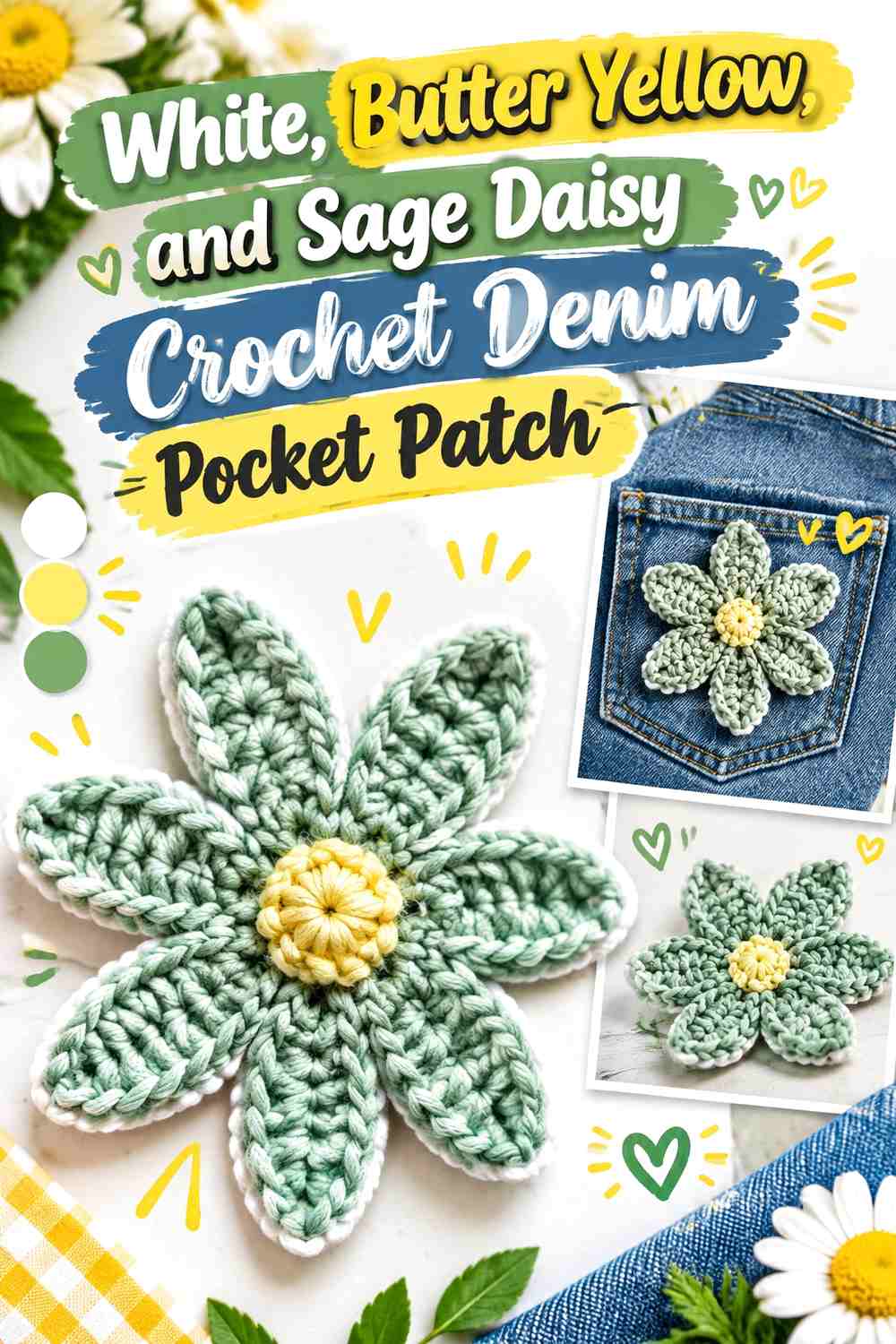
White daisies create one of the clearest embroidered-look effects on medium or dark denim because the petals contrast strongly without requiring a large patch. Use butter yellow in the flower centers and sage for two or three narrow leaf shapes. Leave plenty of denim showing between the motifs.
A pocket corner is particularly effective because the floral group can follow the existing seam. One larger daisy with two smaller companions feels more like stitched floral decoration than a row of equally sized appliqués.
White Daisy Petals Need Visible Indigo Denim Between Them
Avoid overlapping several white flowers until their petals become one continuous pale patch. A narrow strip of denim between blossoms keeps each flower recognizable.
On very pale denim, switch the outer edge of selected petals to sage or use a slightly deeper cream so the flowers do not disappear into the wash.
Sage Leaves Should Stay Smaller Than the White Daisies
Treat sage as a directional accent. A pair of leaves can lead the eye along the pocket seam without competing with the flowers.
Butter yellow should remain concentrated in the centers so the three-color hierarchy stays clear.
Creator Credit: Yarndrasil
2. Golden Yellow, Brown, and Olive Sunflower Crochet Denim Knee Patch
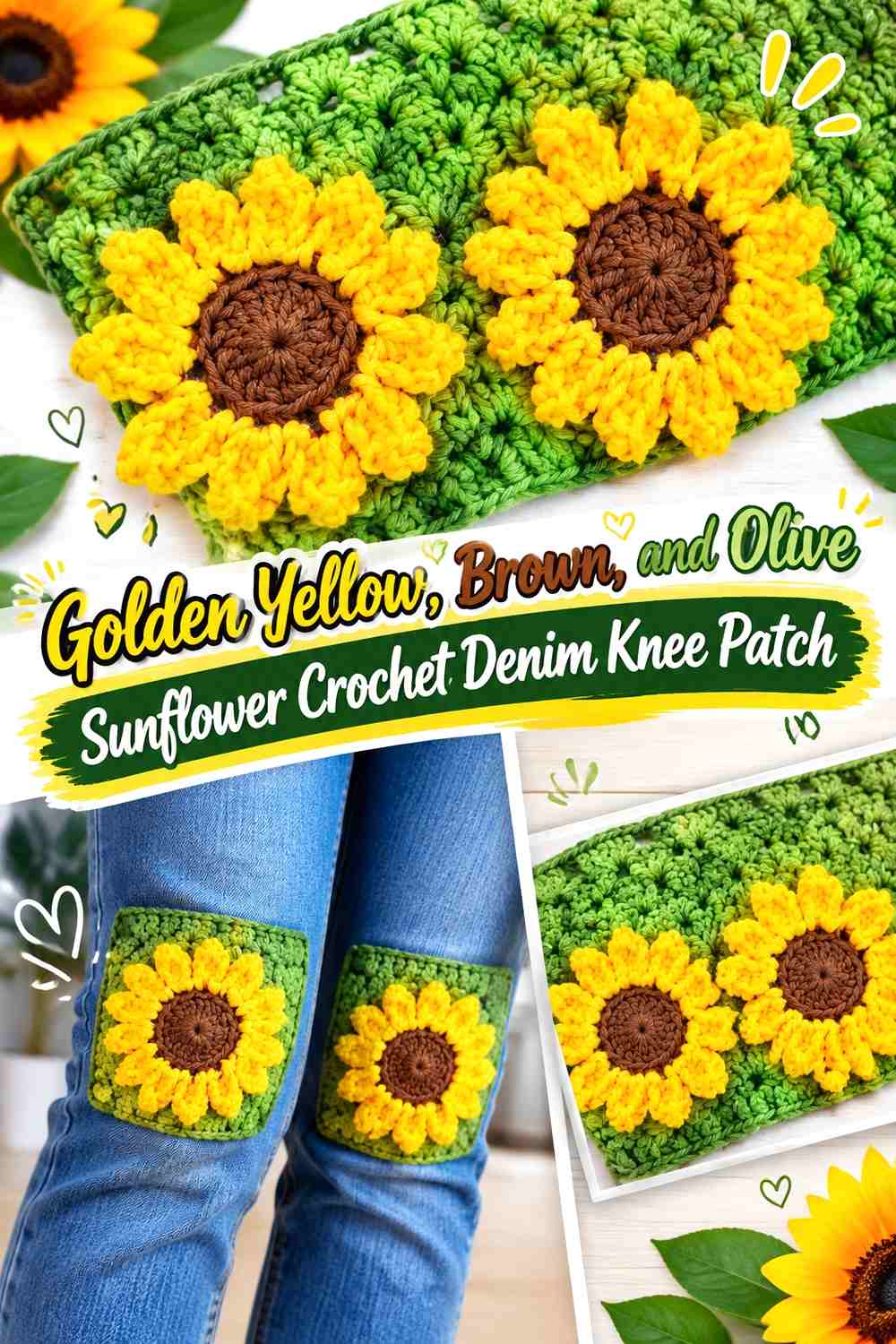
A sunflower makes a useful focal motif for a visible-mending knee patch because its circular center gives the repair a strong visual anchor. Golden yellow should dominate the petals, brown can define the center, and olive can extend into a few narrow leaves.
On faded blue jeans, these warm shades have enough contrast to remain visible without covering the whole knee in crochet.
Golden Yellow Should Extend Beyond the Brown Sunflower Center
Give the petals enough visual area that the patch reads as a flower instead of a brown repair circle with yellow edging.
If the denim is heavily faded, use a deeper golden yellow rather than adding another dark outline around every petal.
Olive Leaves Can Stretch the Golden Yellow Patch Along the Leg
Place one or two olive leaves slightly above or beside the sunflower. This elongates the composition and makes it resemble floral embroidery following the leg rather than a standalone round badge.
Keep the leaves flatter and smaller than the sunflower.
Creator Credit: RaffamusaDesigns – Crochet Patterns and Tutorials
3. Burgundy, Blush, and Sage Rose Crochet Denim Jacket Patch
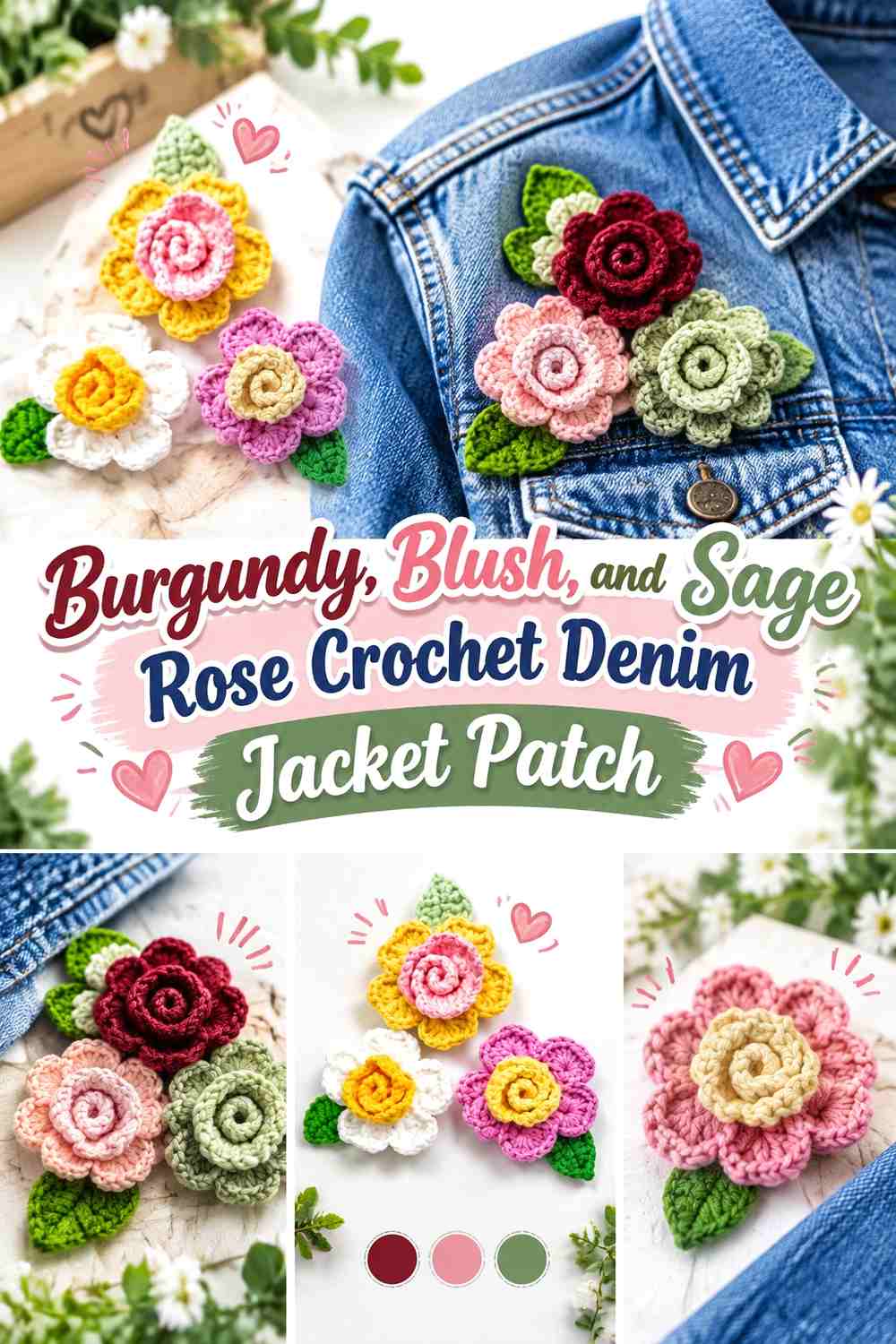
A rose arrangement works well on the back yoke or upper shoulder of a denim jacket. Burgundy can provide the deepest petals, blush can lighten smaller flowers or inner sections, and sage can create the leafy trail connecting the blooms.
On medium blue denim, the burgundy gives the composition visual weight while blush prevents the entire patch from looking too dark.
Burgundy Roses Need Blush Separation on Dark Denim
If the jacket is deep indigo, avoid placing a completely burgundy rose directly on the fabric without a lighter element. Blush petals or a pale inner section can preserve the layered flower shape.
A narrow cream accent can be introduced only if burgundy and denim remain too similar in value.
Sage Should Carry the Burgundy Rose Patch Across the Yoke
Use sage leaves to extend the arrangement horizontally along the jacket seam. The green creates direction without requiring additional flowers to fill the whole yoke.
Keep the foliage irregular rather than building a perfectly symmetrical vine.
Creator Credit: Loopara
4. Lavender, Plum, and Moss Floral Crochet Denim Cuff Patch
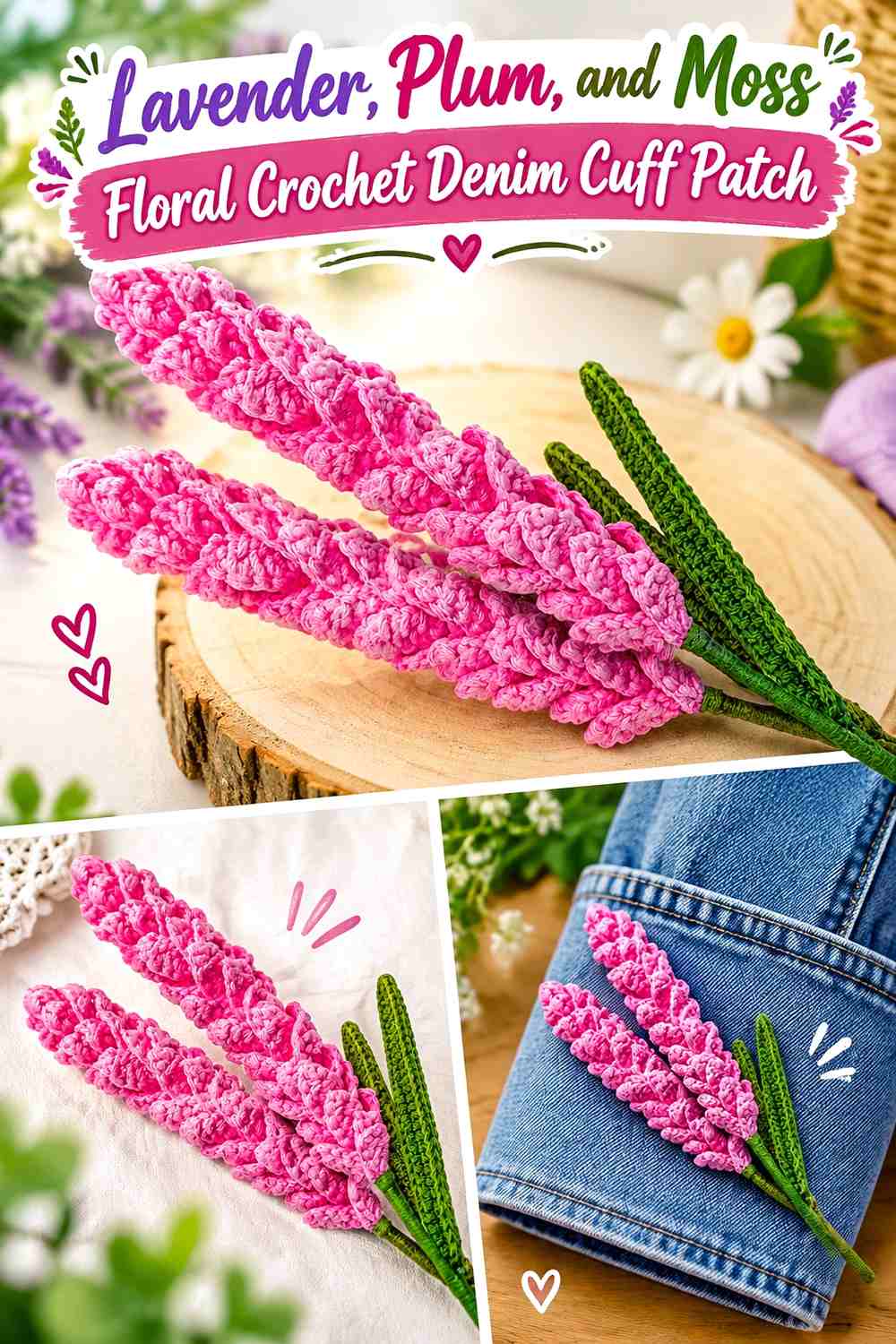
A lavender-inspired motif can create a narrow embroidered-look trail along a jacket cuff or the lower leg of jeans. Lavender should provide most of the floral color, plum can deepen selected buds, and moss green can form the stem and small leaves.
This placement benefits from a vertically oriented motif rather than a broad round flower.
Lavender Should Repeat in Small Crochet Details Along the Cuff
Several small lavender sections create more of an embroidered-sprig effect than one oversized purple flower.
Leave denim visible between the buds so the floral line remains light and elongated.
Plum Can Give Lavender Sprigs More Definition
Use plum selectively near the densest part of the flower cluster. The deeper shade prevents a pale lavender arrangement from disappearing on faded denim.
Keep moss stems narrow so green does not become the strongest element.
Creator Credit: KAQNIN KASIKAY
5. Cherry Red, Black, and Leaf Green Poppy Crochet Denim Patch

A poppy patch creates stronger contrast than the softer floral ideas. Cherry red should dominate the petals, black can remain concentrated in the center, and leaf green can extend the motif across a jacket pocket, jean thigh, or skirt panel.
Dark indigo denim suits this palette especially well because the red remains bright while the black center visually connects to the deep background.
Cherry Red Needs Enough Denim Space Around the Poppy
Do not surround the flower with a wide red crochet background. Let the actual denim form the negative space around the petals.
This keeps the patch closer to an embroidered floral motif instead of a conventional fabric badge.
Black Should Stay Concentrated Inside the Cherry Red Poppy
Black works best as a small center or tiny structural accent. A broad black border can disappear against dark denim and make the petal outline harder to follow.
Use leaf green to extend the shape beyond the red bloom.
Creator Credit: Crafting Happiness Crochet
6. Cornflower Blue, Yellow, and Sage Forget-Me-Not Crochet Denim Pocket Patch
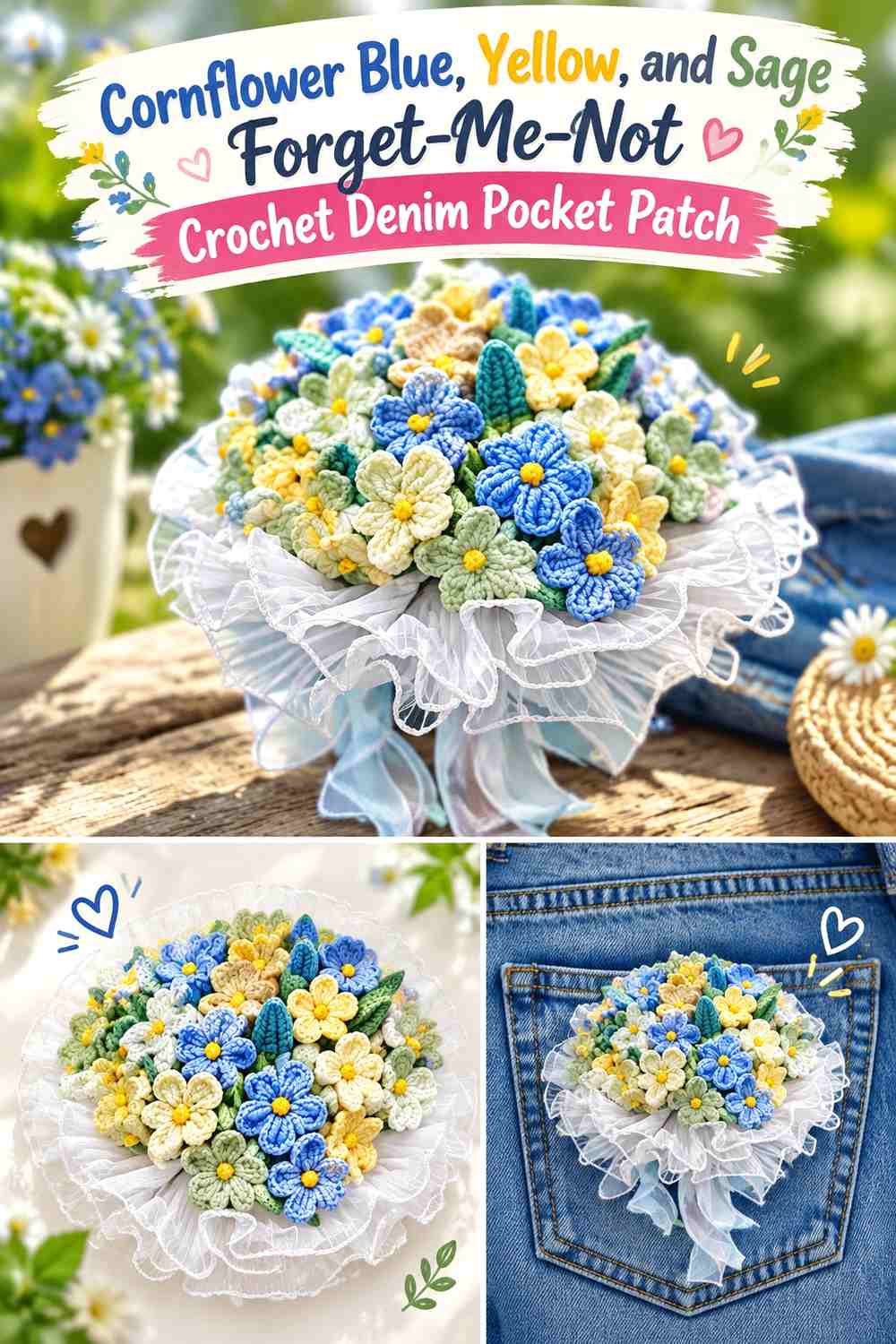
Tiny forget-me-not-style flowers can create a delicate embroidered effect when grouped around one pocket corner. Cornflower blue should lead the petals, yellow should stay in the centers, and sage can form a thin connecting leaf line.
On blue denim, value contrast becomes especially important because the flower and garment belong to the same general color family.
Cornflower Blue Needs a Different Value From the Denim
Choose a flower blue that is noticeably lighter or darker than the jeans. Two similar blues can cause the petals to disappear even when the hues are not identical.
Yellow centers can provide another point of separation, but they should not be responsible for defining the entire flower.
Sage Can Connect Several Cornflower Blue Flowers
Use small leaves between individual blossoms so they read as one botanical cluster.
Keep the yellow repeated consistently in the centers. That tiny repetition helps several blue flowers look intentional even if the petals use slightly different scrap shades.
Creator Credit: Tammy crochet & art
7. Coral, Cream, and Olive Tulip Crochet Denim Patch
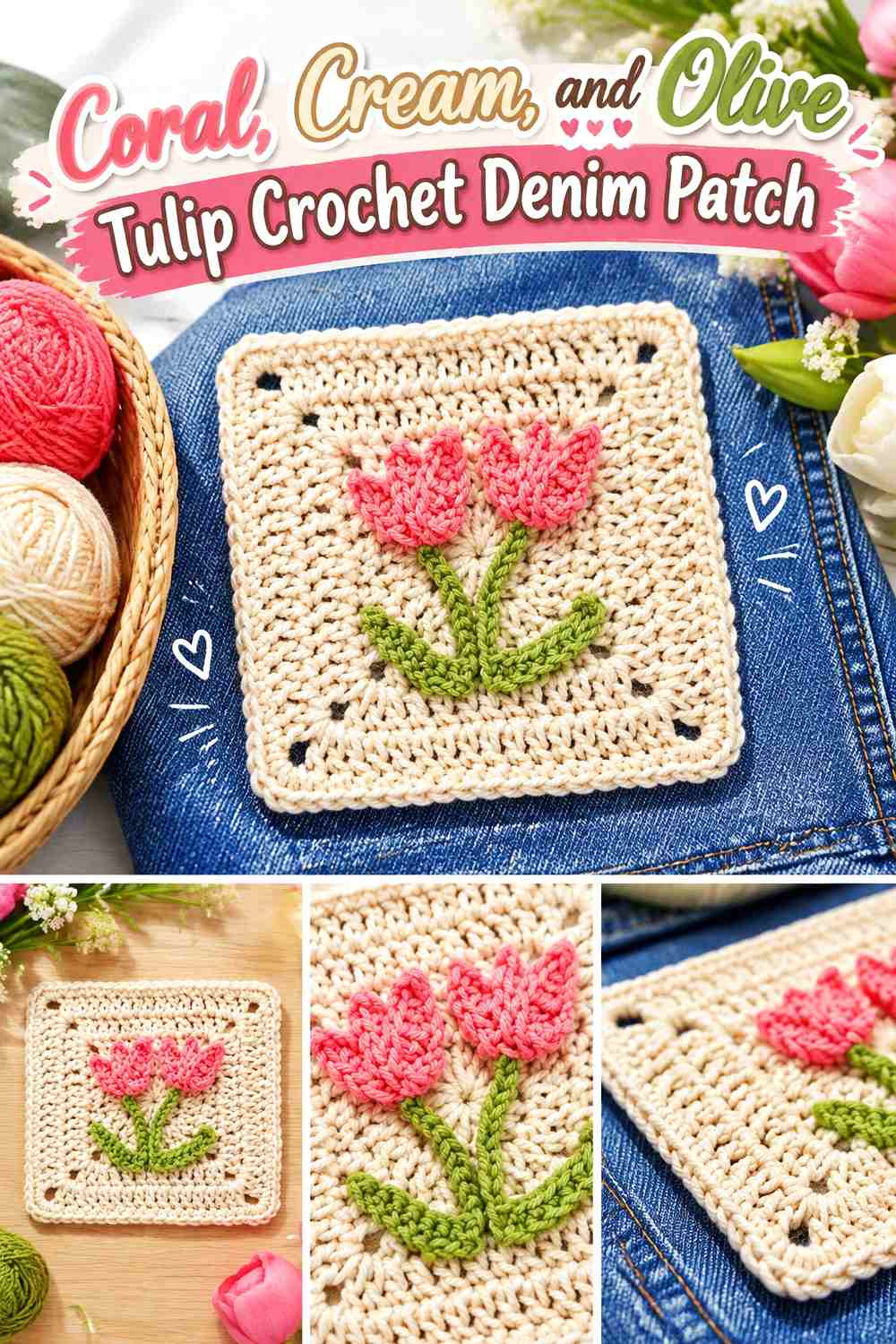
A tulip motif creates a taller, cleaner floral silhouette than a round daisy or sunflower. Coral can form the bloom, cream can provide a small highlight or neighboring flower, and olive should handle the stem and leaf.
This works especially well beside a jeans pocket opening or along a jacket front panel where the upright shape can follow the garment line.
Coral Should Remain the Main Crochet Tulip Color
Keep the tulip head predominantly coral so its shape reads clearly against blue denim. Dividing it into several warm shades can make the small blossom harder to recognize.
Cream works better as a secondary bloom or controlled highlight.
Olive Should Extend the Coral Tulip Vertically
A narrow olive stem and one elongated leaf can make the patch resemble stitched botanical embroidery.
Avoid surrounding the flower with a thick green border. The denim should remain visible around the stem.
Creator Credit: Maria’s Blue Crayon
8. Moss Green, Sage, and Cream Leaf-Vine Crochet Denim Patch
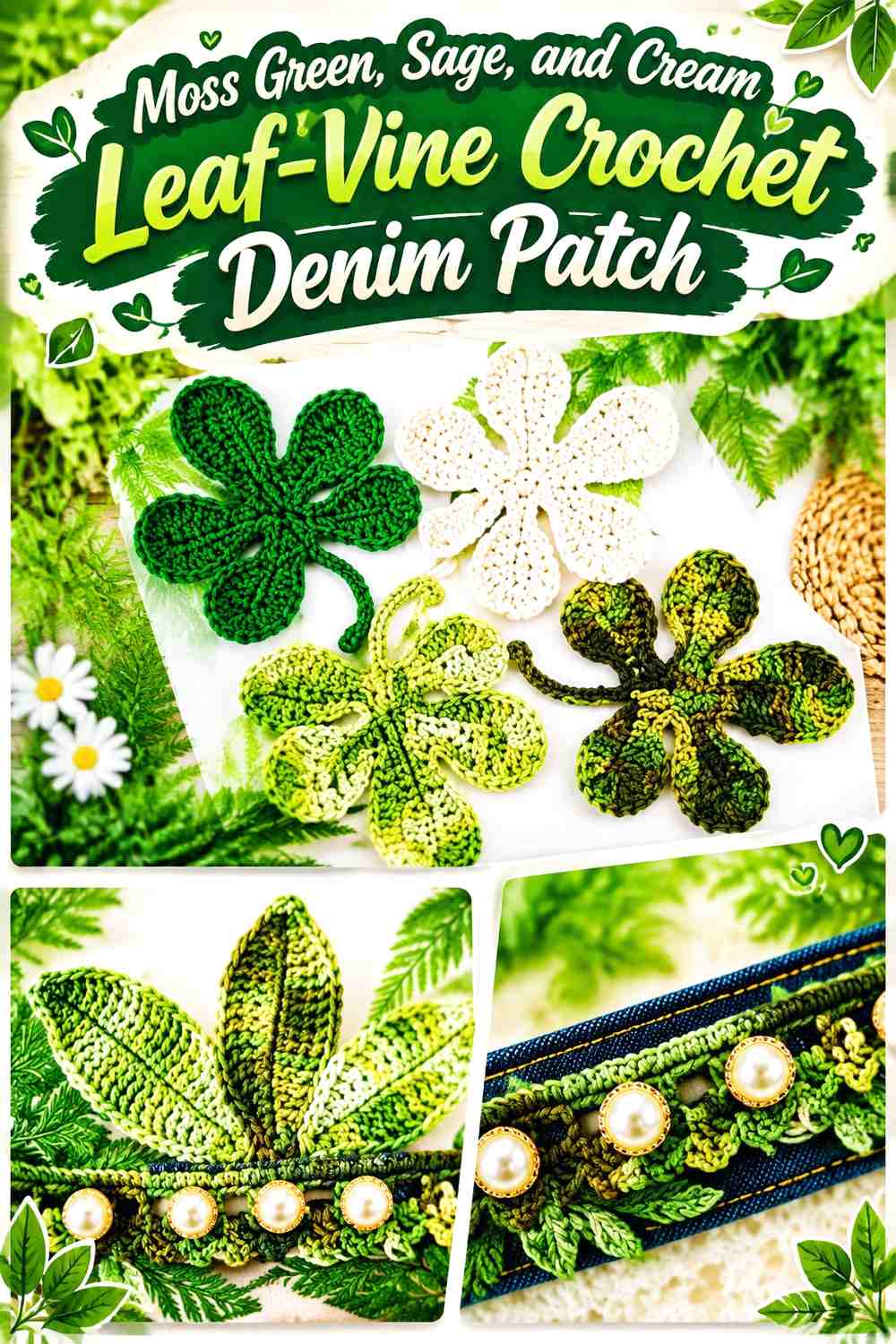
Not every embroidered-look patch needs a large flower. A foliage-only design can follow a seam, cover a narrow damaged area, or frame a pocket without adding much visual bulk.
Moss should provide the deepest leaves, sage can supply lighter foliage, and cream can appear in occasional tiny flowers or buds.
Moss Green Should Anchor the Crochet Leaf-Vine Pattern
Place the darkest leaves at important turns in the vine or near the repaired area. Sage can fill the smaller spaces between them.
Using two greens gives the foliage more depth than making every leaf identical.
Cream Should Stay Minimal Around Moss and Sage Leaves
A few cream buds can break up a long green trail, especially on very dark denim.
Do not scatter cream uniformly along every leaf. Small irregular accents give the arrangement more of a hand-embroidered character.
Creator Credit: Edinir Croche
9. Terracotta, Mustard, and Forest Green Folk Flower Crochet Denim Patch
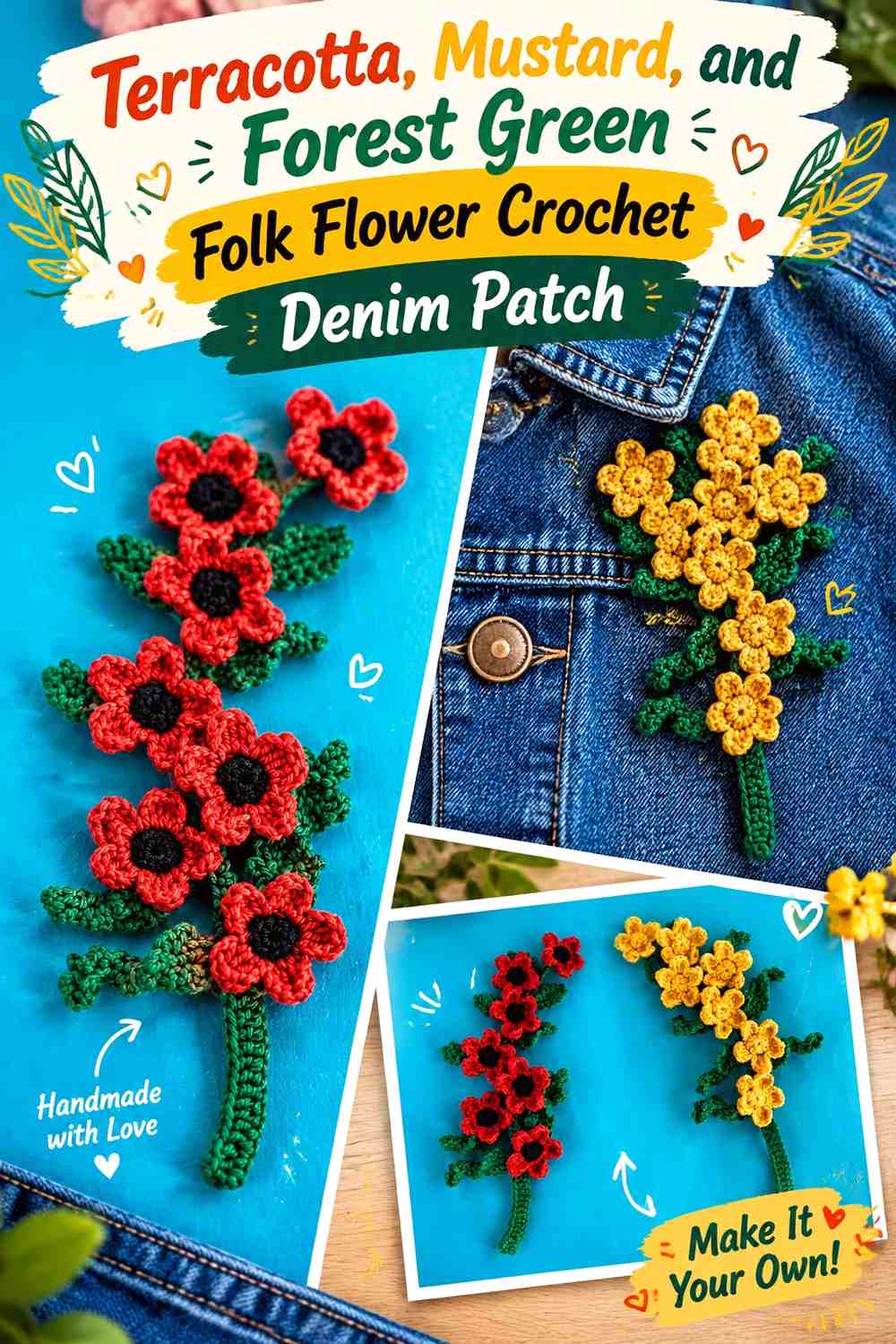
A stylized flower motif can create a folk-embroidery effect on a denim jacket back or skirt pocket. Terracotta should lead the petals, mustard can sit in the center or smaller surrounding flowers, and forest green can form leaves and stems.
This palette works particularly well on medium and faded denim because all three shades remain warmer than the blue background.
Terracotta Should Control the Folk Crochet Flower Shape
Use terracotta in the largest petals so the motif has one unmistakable dominant shade.
Mustard should remain concentrated enough that it reads as an accent rather than dividing the flower into two equally strong colors.
Forest Green Can Give Terracotta a Clear Denim Outline
Leaves or a short stem around the terracotta petals help separate the warm flower from medium blue fabric.
On black denim, use a slightly lighter forest green or include a cream detail so the foliage does not disappear.
Creator Credit: Kerri’s Crochet
10. Cream, Rust, and Sage Wildflower Crochet Denim Patch

A cream-led wildflower cluster creates a light embroidered effect on indigo jeans or a dark denim jacket. Cream can form the majority of the petals, rust can provide small centers or companion flowers, and sage can connect the group with restrained leaves.
This is a useful palette when you want the crochet to stay visible without using bright white.
Cream Flowers Need Rust Details on Deep Indigo Denim
Cream already creates strong contrast, so rust can remain small. Use it in centers or one secondary flower rather than outlining every cream petal.
That keeps the composition soft while preventing the flowers from looking unfinished.
Sage Should Connect Cream Wildflowers Without Filling the Denim
Use short sage leaves between blooms and preserve plenty of blue fabric around them.
The negative space is important here because a solid green background would turn the arrangement into a conventional crochet patch rather than embroidery-inspired decoration.
Creator Credit: NotikaLand crochet and knitting
11. Mustard, Chocolate, and Cream Sunflower Crochet White-Denim Patch

White or ecru denim reverses the usual contrast problem. Instead of needing pale flowers, the patch benefits from deeper colors. Mustard petals, a chocolate center, and a restrained cream highlight can provide enough definition against the light fabric.
Use the motif on a back pocket, knee repair, or lower jacket front where the circular flower can act as a clear focal point.
Mustard Needs Chocolate Contrast on White Denim
A chocolate center gives the sunflower enough visual depth to stand apart from the pale garment.
Avoid replacing too much brown with cream because cream may blend directly into white denim.
Cream Should Stay Inside the Mustard Crochet Sunflower
Use cream only for a small petal highlight or neighboring detail. The garment already provides a large amount of pale neutral color.
Let mustard and chocolate do most of the work of defining the patch.
Creator Credit: Alvenir Svagera
12. Dusty Rose, Burgundy, and Olive Raised Rose Crochet Denim Patch

A slightly dimensional rose can still fit the embroidered-look theme when it is used as a single focal flower rather than repeated across the whole garment. Dusty rose can form the visible petals, burgundy can deepen the center, and olive can extend into flatter leaves.
This works well at the corner of a jacket yoke or beside a pocket where the raised bloom will not sit directly on a high-friction area.
Dusty Rose Should Cover More of the Crochet Rose Than Burgundy
Let the lighter pink form most of the visible petals. Burgundy should remain concentrated toward the center so the layering can still be distinguished.
On faded denim, this value difference is usually more useful than adding several extra pink shades.
Olive Leaves Should Stay Flatter Than the Dusty Rose Bloom
Use foliage to transition from the dimensional flower back to the denim surface.
Keeping the leaves flatter also prevents the entire patch from becoming bulky and preserves the embroidered-look balance.
Creator Credit: Tania Skalozub
13. Rust, Ivory, and Dusty Green Vintage Floral Crochet Denim Patch

Rust and ivory create a vintage-inspired flower combination that works especially well on worn or medium-wash denim. Rust can dominate the petals, ivory can form a lighter center or companion bloom, and dusty green can provide narrow leaves.
Use this palette as a small cluster across a repaired thigh, pocket edge, or jacket shoulder rather than turning it into a large solid rectangle.
Rust Should Lead the Vintage Crochet Floral Patch
Give rust the broadest petal area and repeat it in more than one flower if the patch contains a cluster.
Ivory should create contrast without occupying so much space that the arrangement becomes pale-dominant.
Dusty Green Should Follow the Rust Flowers Along the Denim Seam
Arrange small green leaves in the same direction as a pocket edge, yoke seam, or repaired tear.
Following an existing garment line makes the crochet feel integrated with the denim rather than simply placed on top.
Creator Credit: Geovana Artes em Crochê
Which Floral Denim Patch Palette Gives the Strongest Embroidered Look?
For dark indigo denim, white daisies, cream wildflowers, cornflower blue with yellow centers, and blush-accented roses provide strong visibility without requiring thick borders. Black denim generally needs the lightest palettes because burgundy, forest green, or chocolate details can easily disappear.
Faded and medium-wash denim can handle earthy palettes particularly well. Rust, mustard, terracotta, olive, sage, and dusty rose remain distinct from the blue while still producing a softer vintage effect.
White denim works differently. Dark centers, mustard petals, burgundy flowers, or forest-green leaves provide more useful definition than large cream areas.
For the most embroidery-like result, use fewer motifs and more visible denim. A small flower cluster following a seam usually looks more deliberate than completely filling a rectangular patch with crochet.
Conclusion
An embroidered-look crochet denim patch depends as much on spacing and color placement as on the flower itself. Flat daisies, poppies, tulips, leaves, and forget-me-nots naturally suit smaller decorative arrangements, while roses and sunflowers can become focal motifs when the surrounding foliage stays restrained.
Choose light petals for dark indigo, deeper flowers for pale denim, and always compare the green leaves with the actual garment before attaching them. Similar-value foliage is one of the easiest details to lose against blue or black fabric.
Most importantly, let some denim remain visible. That negative space separates individual petals and leaves and gives the finished patch the lighter, stitched-on appearance associated with floral embroidery. Use each creator’s tutorial for the original crochet motif, then adapt its color, scale, and placement to your denim garment.
Frequently Asked Questions
How can crochet flowers look more like embroidery on denim?
Choose relatively flat motifs, keep individual flowers small, use narrow leaves or stems, and leave visible denim between the pieces. Concentrated floral clusters generally resemble embroidery more closely than large solid crochet backgrounds.
What crochet flower colors show up best on dark denim?
Cream, white, butter yellow, blush, lavender, coral, and other light or medium-value colors usually provide clearer separation from deep indigo. Dark burgundy, brown, or forest green may need a lighter neighboring color so their edges remain visible.
What colors work well on faded blue denim?
Rust, mustard, terracotta, burgundy, olive, sage, coral, and dusty rose can all create useful contrast. Check the actual garment, because denim washes vary considerably in lightness.
Can crochet floral patches be used for visible mending on jeans?
They can decorate a repaired area, but the damaged fabric should have appropriate structural support first. A delicate flower motif should not be expected to stabilize an enlarging tear by itself.
Where should I place an embroidered-look crochet floral patch on a denim jacket?
Pocket corners, shoulders, back yokes, collars, cuffs, and lower front sections provide natural placement lines. Following an existing seam can make the flower arrangement look more integrated with the jacket.
Should all the flowers in a crochet denim patch be the same color?
No. A cluster can use several shades, but repeating one dominant color or center color helps the arrangement stay connected. For example, different blue flowers can all share yellow centers and sage leaves.
How do I keep a multicolor crochet denim patch from looking too busy?
Give each color a clear role. Use one shade for the dominant petals, one for centers or secondary flowers, and one green family for foliage. Leave denim visible between the motifs rather than filling every gap with another crochet detail.