Crochet window suncatchers can take several forms, from airy mandala hoops that let daylight pass between stitches to bold suns, rainbows, flowers, celestial motifs, and narrow hanging strands. Crochet itself does not refract sunlight like glass or crystal, so the strongest yarn-only designs rely on openwork, color, movement, or a clear silhouette against a bright pane.
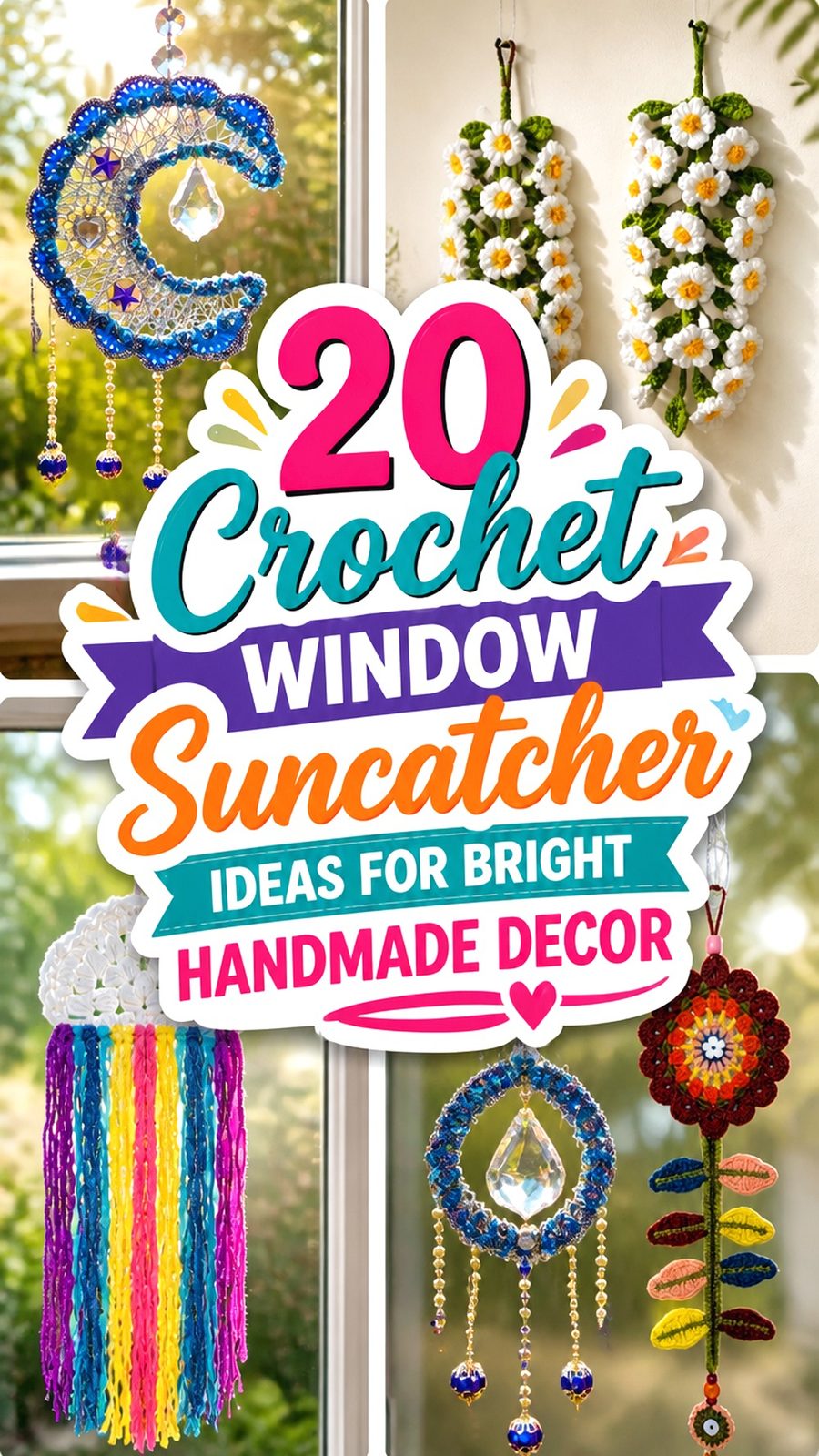
The 20 ideas below deliberately mix hoop pieces, flat hangings, vertical decorations, colorwork, fringe, garlands, and moving spirals. Some source tutorials are specifically suncatchers, while others are wall hangings or decorative motifs that can be adapted for indoor window display. The notes under each idea focus on what changes when the finished piece moves from a wall to a window: light transmission, support, shape retention, clearance, and visual balance.
Quick List
- Crochet Radiant Sun Panel Suncatcher
- Crochet Arched Rainbow Window Suncatcher
- Crochet Evil Eye Tassel Suncatcher
- Crochet Flower-and-Leaf Beaded Window Suncatcher
- Crochet Tree-of-Life Hoop Suncatcher
- Crochet Moon-Phase Window Suncatcher
- Crochet Multi-Hoop Mandala Suncatcher
- Crochet Doily-Center Dreamcatcher Suncatcher
- Crochet Open-Radial Mandala Suncatcher
- Crochet Framed Mandala Dreamcatcher Suncatcher
- Crochet Textured Hoop-and-Fringe Suncatcher
- Crochet Petite Floral Dreamcatcher Suncatcher
- Crochet Butterfly Window Suncatcher
- Crochet Daisy Stem Window Suncatcher
- Crochet Toadstool Colorwork Window Suncatcher
- Crochet Star Fringe Window Suncatcher
- Crochet Classic Window Suncatcher
- Crochet Spiral Wind-Spinner Suncatcher
- Crochet Leaf-Vine Window Suncatcher
- Crochet Cloud Window Suncatcher
How Crochet Behaves Differently From a Glass Suncatcher
A glass prism is chosen for reflected and refracted light. Crochet creates a different effect: the window becomes a bright background that emphasizes holes, edges, texture, and color. If that illuminated silhouette is what you want, an open mandala, tree in a hoop, lace center, or separated celestial motif can be more effective than a densely worked panel.
Dense crochet still has a place. A sun, mushroom, rainbow, or cloud can read as bold graphic window art even when little daylight passes through the stitches. Before choosing a tutorial, decide whether you want light through the crochet or a recognizable shape against the light. That distinction is more useful than simply choosing the most colorful project.
Choose the Hanging Structure Before the Motif
Window placement exposes the support system more clearly than wall display does. A hoop naturally maintains a round lace design, while a dowel suits flat colorwork and rectangular hangings. A vertical strand needs a secure top loop, and a longer garland may need support at more than one point so it does not sag across the glass.
Also check how the window operates before deciding on length. Tassels, vines, or hanging cords should not catch in latches, blinds, handles, or sliding sections. Keep long loops and dangling decorations out of reach of infants, small children, and pets. For any heavier embellishment, use hanging hardware appropriate for the finished piece rather than assuming a light-duty hook will hold it safely.
Keep Openwork Crisp Without Making the Piece Too Heavy
Fine, clearly defined crochet spaces tend to show particularly well when backlit, but the right material depends on the design. A firm yarn can help geometric motifs hold a readable outline; a softer yarn may create better drape for fringe or hanging strands. Very bulky fibers can obscure small lace openings, while very fine fibers may need more careful shaping to keep a large piece visually crisp.
Blocking can be particularly useful for mandalas, stars, snowflake-like shapes, leaves, and other motifs whose symmetry matters. Shape the crochet before committing to a hoop or final support whenever the construction allows it. If the piece will receive regular direct sun, also check the yarn manufacturer’s care guidance and consider whether gradual color change or fading would matter in your chosen location.
Crochet Radiant Sun Panel Suncatcher

A large sun motif makes an immediate window statement because the shape stays recognizable even when the crochet is fairly substantial. This version is based on a sun wall-hanging tutorial, so think of it as fiber-art suncatcher rather than a transparent lace piece. Against daylight, the circular center and projecting rays create the visual impact.
This idea suits a window where you want one dominant focal point rather than many small motifs. It can also work where a traditional round hoop would feel too delicate. Before adapting it, compare the finished hanging proportions shown in the tutorial with the unobstructed portion of your pane so the design does not overlap handles or blinds.
Dense Sun Shapes Read Clearly Against Bright Glass
A solid or textured sun does not need extensive openwork to function as window decor. The contrast between the outer rays and the brighter background can define the motif on its own. If your window receives very strong daylight, consider whether the chosen yarn colors still have enough contrast when viewed from inside rather than judging them only under indoor lighting.
Leave Clearance Below the Solar Panel
A flat hanging can look balanced on a wall yet become inconvenient if its lower edge sits over a window latch or operating handle. Decide where the support will sit first, then evaluate the finished depth of the piece. This is especially useful on vertically opening windows, where a decorative panel can otherwise interfere with normal use.
Crochet Arched Rainbow Window Suncatcher
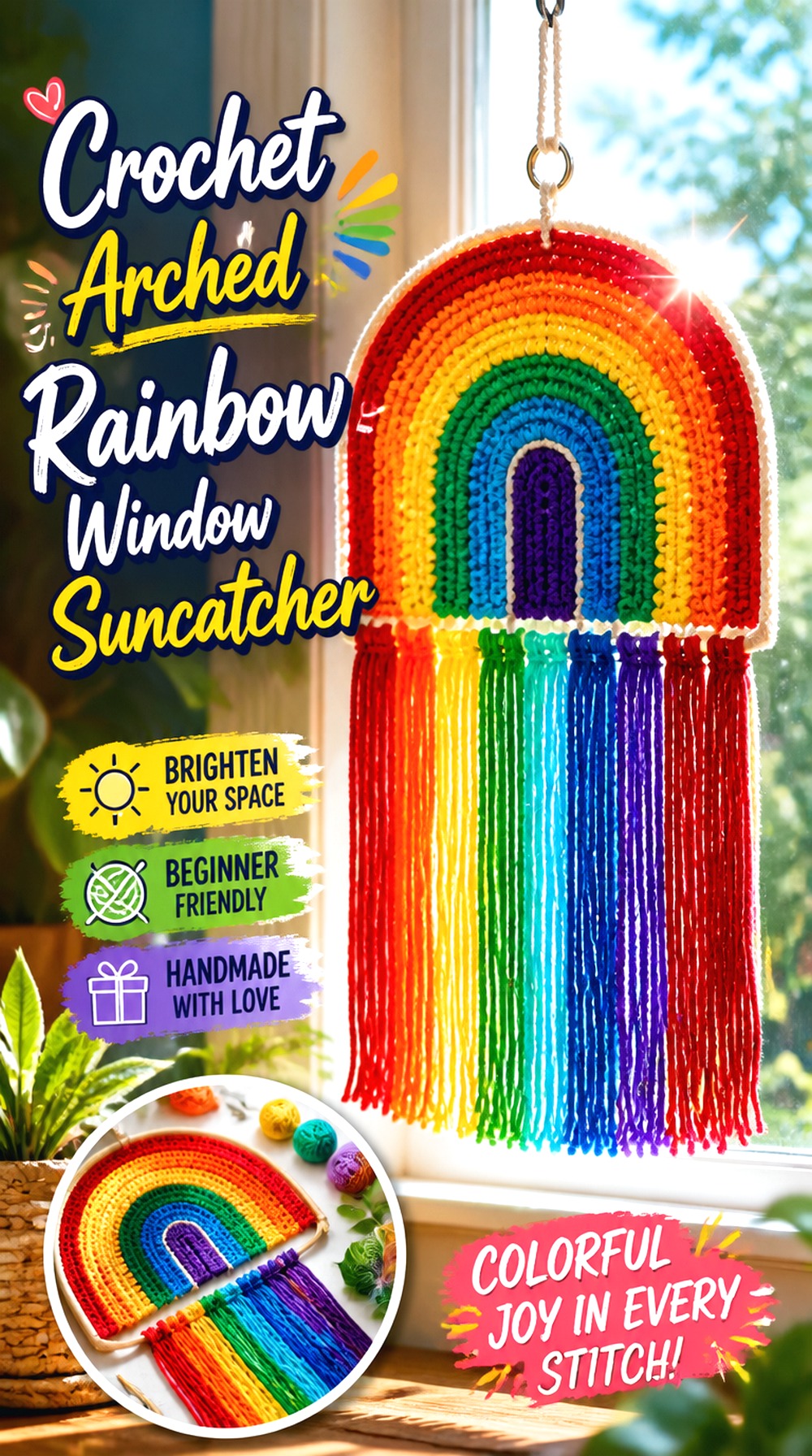
A crochet rainbow gives you a very different window silhouette from a circular mandala. Its stacked arch is easy to recognize from across a room, and curved bands allow several colors to share the design without relying on tiny details. Stella’s Yarn Universe specifically presents the source piece as a rainbow wall hanging and notes window display as one possible use.
This works especially well when you want cheerful color but not the visual complexity of lace. A narrow or medium-width pane can frame the rainbow naturally. Because the appeal comes from the arch itself, spend more time evaluating curvature, color separation, and hanging balance than adding extra ornament.
Keep the Color Bands Distinct in Backlight
Two yarn colors that look noticeably different in a skein can appear closer when strong daylight is behind them. Before committing to an entire rainbow palette, place your yarn choices near the intended window and look at them from normal viewing distance. Clear separation between adjacent bands helps preserve the layered arch instead of letting several stripes merge visually.
Support the Arch Without Pulling It Out of Shape
A rainbow should read as a clean curve rather than a stretched semicircle. Pay attention to the suspension point shown by the tutorial, then check the finished piece after it has hung for a while. If the top support pulls too narrowly toward the center, the outer edges can visually droop even when the crochet itself is correctly made.
Original Tutorial and Creator Credit
Creator: Stella’s Yarn Universe
Crochet Evil Eye Tassel Suncatcher
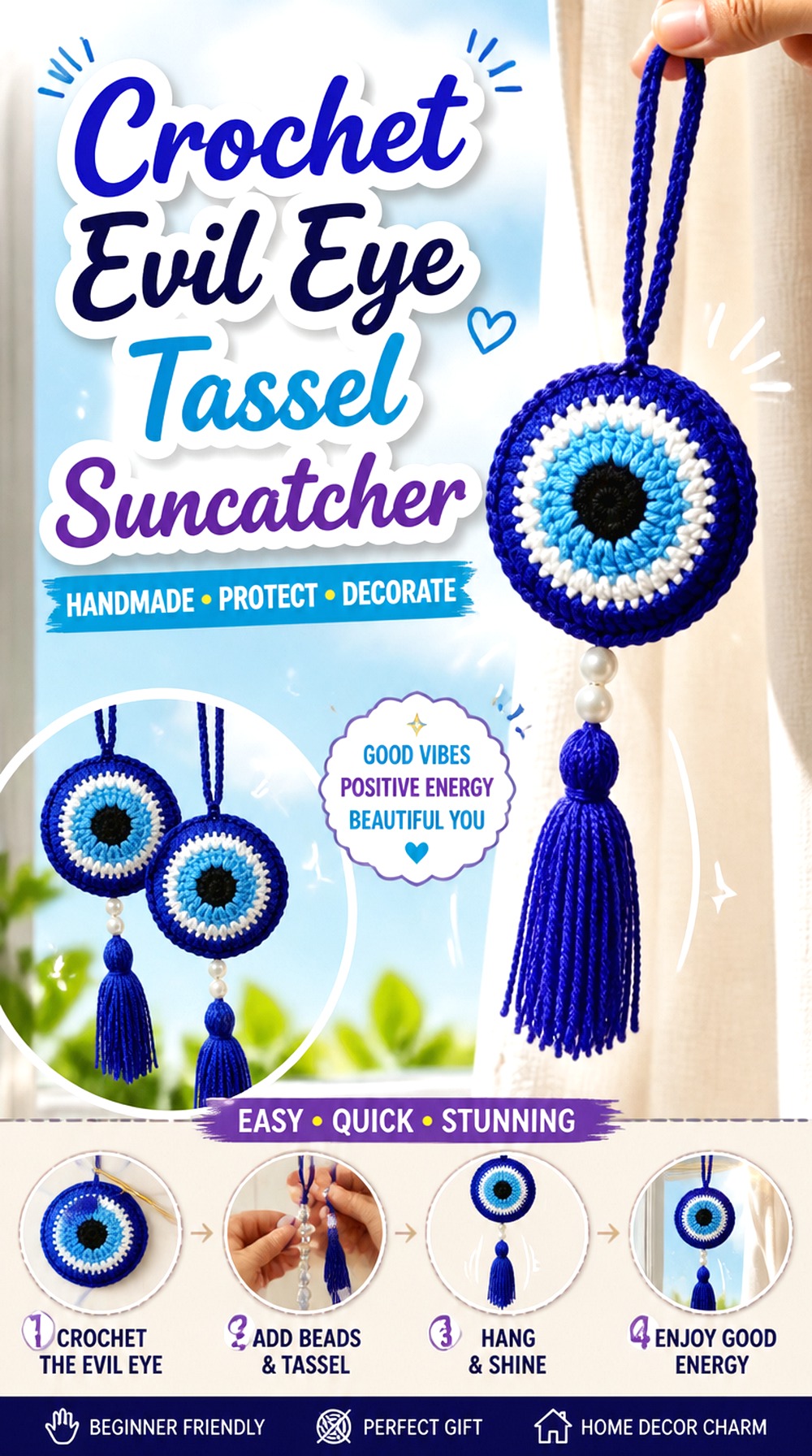
An evil-eye hanging brings a strong centered motif plus movement from the lower details. That combination makes it useful for a window where a purely circular lace piece would feel too static. The tutorial from Crochet with Ritu creates a complete hanging design rather than just an eye appliqué, giving you a ready reference for proportion and finishing.
For window use, the central eye should remain the first thing you notice. Tassels and other hanging elements can animate the design when air circulates nearby, but excessive length can compete with the motif or catch on window hardware. This is therefore a good project for readers who enjoy decorative detail but still want a clear focal point.
Center the Eye Before Judging the Lower Details
The eye motif carries most of the visual weight. Hang the central section temporarily and view it from several feet away before deciding whether additional lower decoration feels balanced. If the eye itself tilts or sits noticeably off center, extra tassels will not correct the composition; they can actually make the imbalance more obvious.
Give Tassels Room to Move Without Snagging
Movement is attractive only when the hanging has clear space around it. Check nearby blind cords, handles, sliding tracks, and curtain edges. A slightly shorter hanging may look cleaner and be easier to live with than one that extends across moving hardware. Keep dangling cords or trims where children and pets cannot reach them.
Original Tutorial and Creator Credit
Creator: Crochet with Ritu
Crochet Flower and Leaf Beaded Window Suncatcher
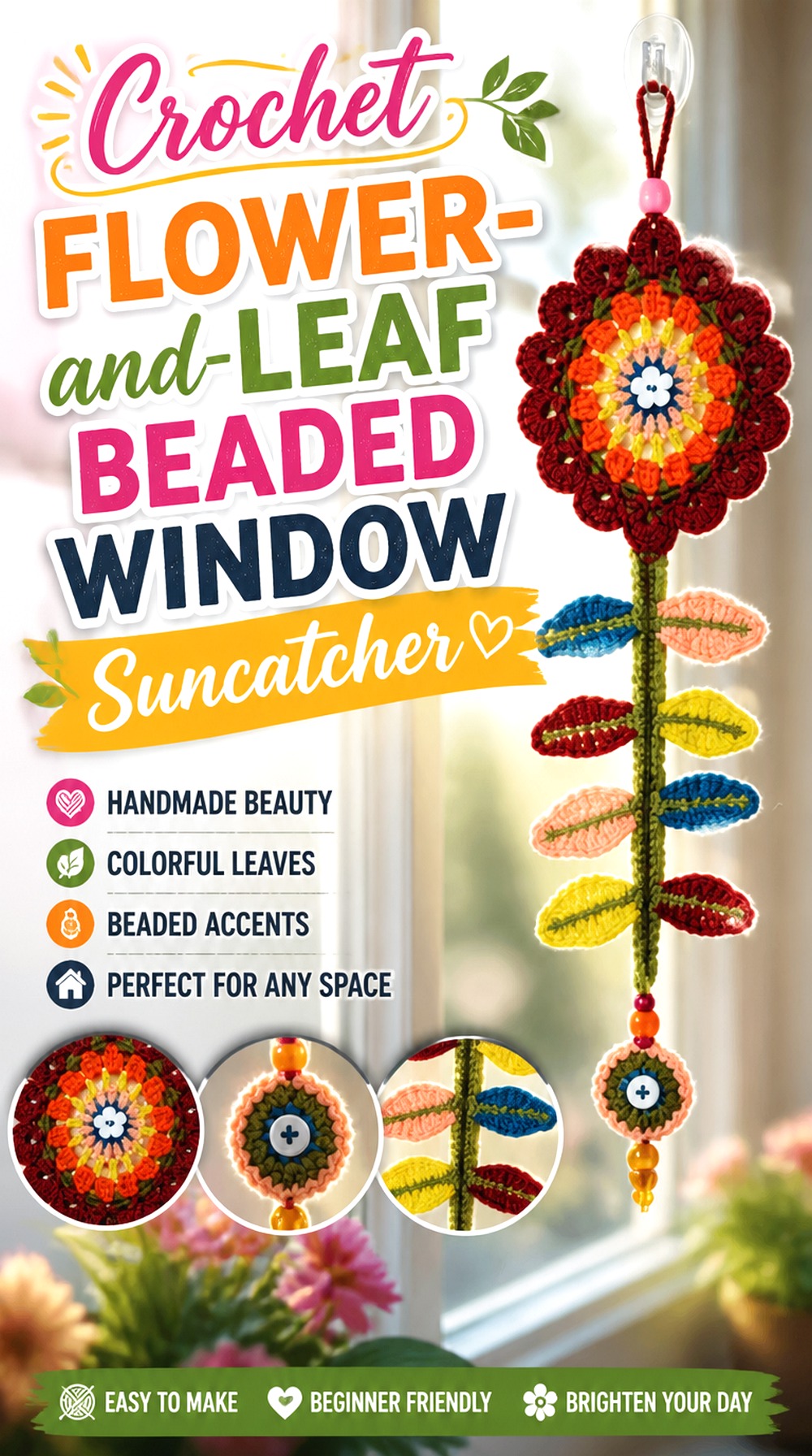
This flower hanging combines several visual layers: a focal bloom, leaf forms, hanging sections, and small decorative accents. It is less geometric than a mandala and therefore a good choice for a softer botanical window arrangement. Brunaticality’s tutorial includes flower, leaf, bottom detailing, and decorative bead or button options, providing a clear base for this style.
The composition can work especially well along a narrow pane or beside a larger central suncatcher because it does not need to fill the entire window. Rather than adding every possible embellishment, decide whether the flower, leaves, or dangling finish should dominate. A single strong hierarchy keeps a detailed design from becoming cluttered when viewed against outdoor scenery.
Use the Leaves to Balance a Narrow Composition
Leaves extending away from the central line can make a slim hanging feel wider without requiring a large hoop. Before final placement, hold the piece against the actual window and check whether the side elements disappear against a dark outdoor view or collide visually with a window frame. Small positional changes can make the botanical outline much clearer.
Decorative Beads Change Both Weight and Swing
Beads are not only visual accents; they can also change how a hanging settles and moves. If you substitute different beads or buttons from those demonstrated by the creator, confirm that the attachment method and support remain appropriate for the new materials. Heavier additions can pull a delicate lower section straighter than expected.
Original Tutorial and Creator Credit
Creator: Brunaticality
Crochet Tree of Life Hoop Suncatcher
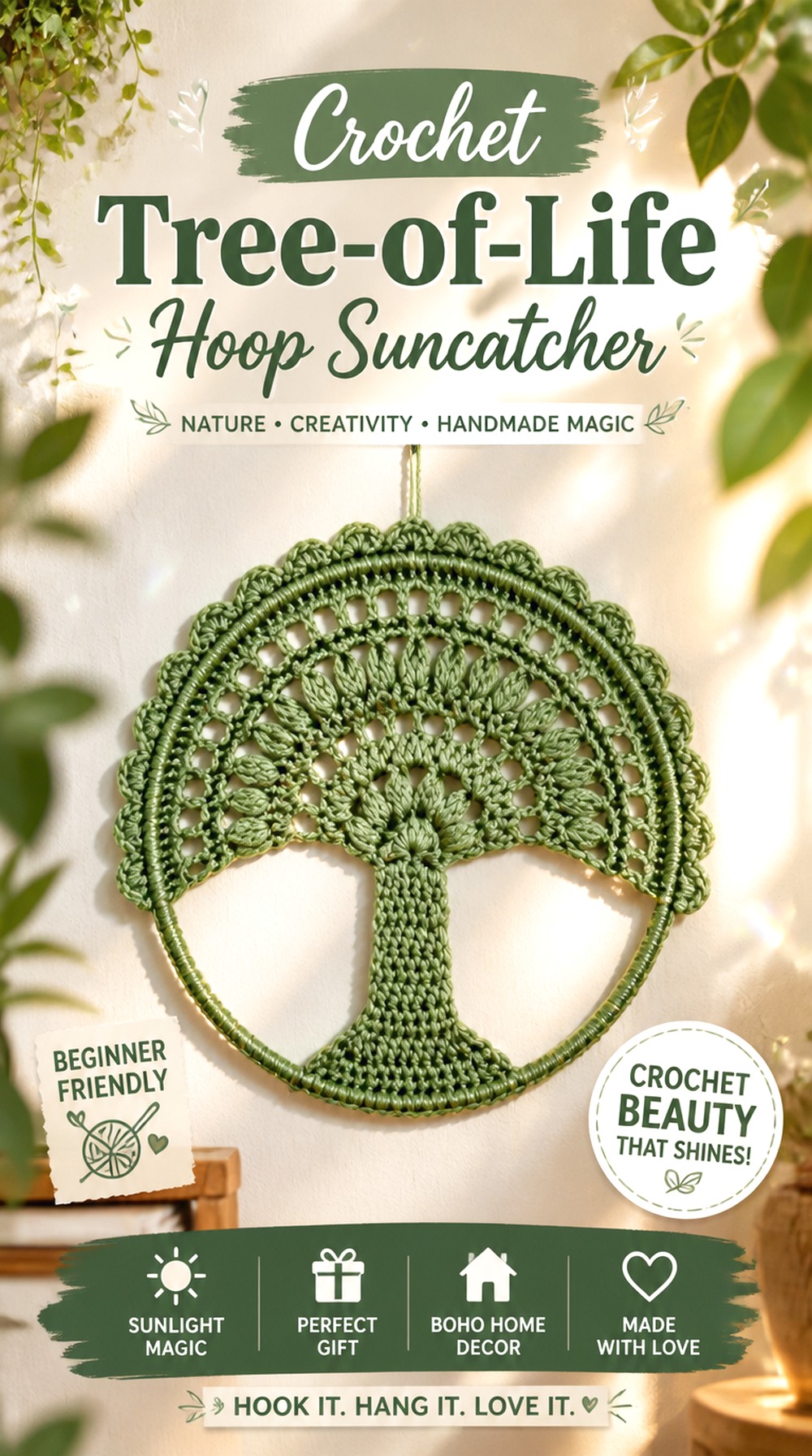
A tree inside a ring is naturally suited to window display because the hoop provides both structure and negative space. Instead of filling the opening with a regular radial repeat, the tree creates an organic branching silhouette through the center. The tutorial from mum2makes demonstrates a crochet tree-of-life wall decoration built around a metal ring.
This is a strong option for anyone who wants an open hoop piece that does not read as a conventional dreamcatcher. The shape also rewards careful positioning: branches and trunk connections are much easier to notice with daylight behind them. Neutral yarn can emphasize silhouette, while more colorful choices shift attention toward the crochet itself.
Hoop Tension Defines the Tree Silhouette
The outer ring is doing real structural work. If the crochet is attached unevenly, the tree may pull toward one side and the branches can lose their intended spread. Before treating any attachment as final, place the hoop upright and inspect the trunk, canopy, and open spaces together. Balanced negative space is as important as the stitched portions.
Branch Placement Becomes More Visible in Backlight
A wall can hide small irregularities because the background remains consistent. A bright pane exaggerates every gap. This makes the window an excellent visual checkpoint: hold the unfinished piece against daylight and look for branches that overlap unexpectedly or sections where the design becomes visually crowded before completing the finishing.
Original Tutorial and Creator Credit
Creator: mum2makes
Crochet Moon Phase Window Suncatcher

Moon phases create a horizontal or vertical rhythm rather than one central shape, which makes this idea useful when you want celestial decor with a quieter visual profile. Love & Stitch’s tutorial focuses on a small moon-phase wall hanging, giving this project a more graphic, repeated-motif character than the round dreamcatchers elsewhere in the list.
For a window adaptation, consider the sequence as one composition. The spacing between phases matters almost as much as each individual moon. Too little space can merge the shapes when backlit; too much can make the hanging feel disconnected. This approach fits readers who enjoy celestial imagery but prefer a restrained piece over long fringe or large hoops.
Phase Spacing Controls the Celestial Rhythm
Set the motifs out at their intended spacing before permanently finishing the display. Viewed against daylight, the gaps become part of the pattern. You want enough separation for each moon shape to read individually while still keeping the sequence visually related. This is particularly important if your yarn and outdoor background have similar values.
A Flat Support Needs to Stay Level
Moon-phase hangings often depend on alignment. If a support or top edge tilts, the whole sequence can look unintentionally uneven even when every individual motif is well made. Check the suspension method on the actual window or curtain support and correct the level before judging the spacing or length of the lower portion.
Color Contrast Can Matter More Than Extra Detail
Celestial motifs are usually recognized by outline first. A clear contrast between the moon shapes and their immediate surroundings can therefore be more effective than adding more surface decoration. Test your yarn near the window in both daytime and evening room light if the piece will remain displayed around the clock.
Original Tutorial and Creator Credit
Creator: Love & Stitch
Crochet Multi Hoop Mandala Suncatcher
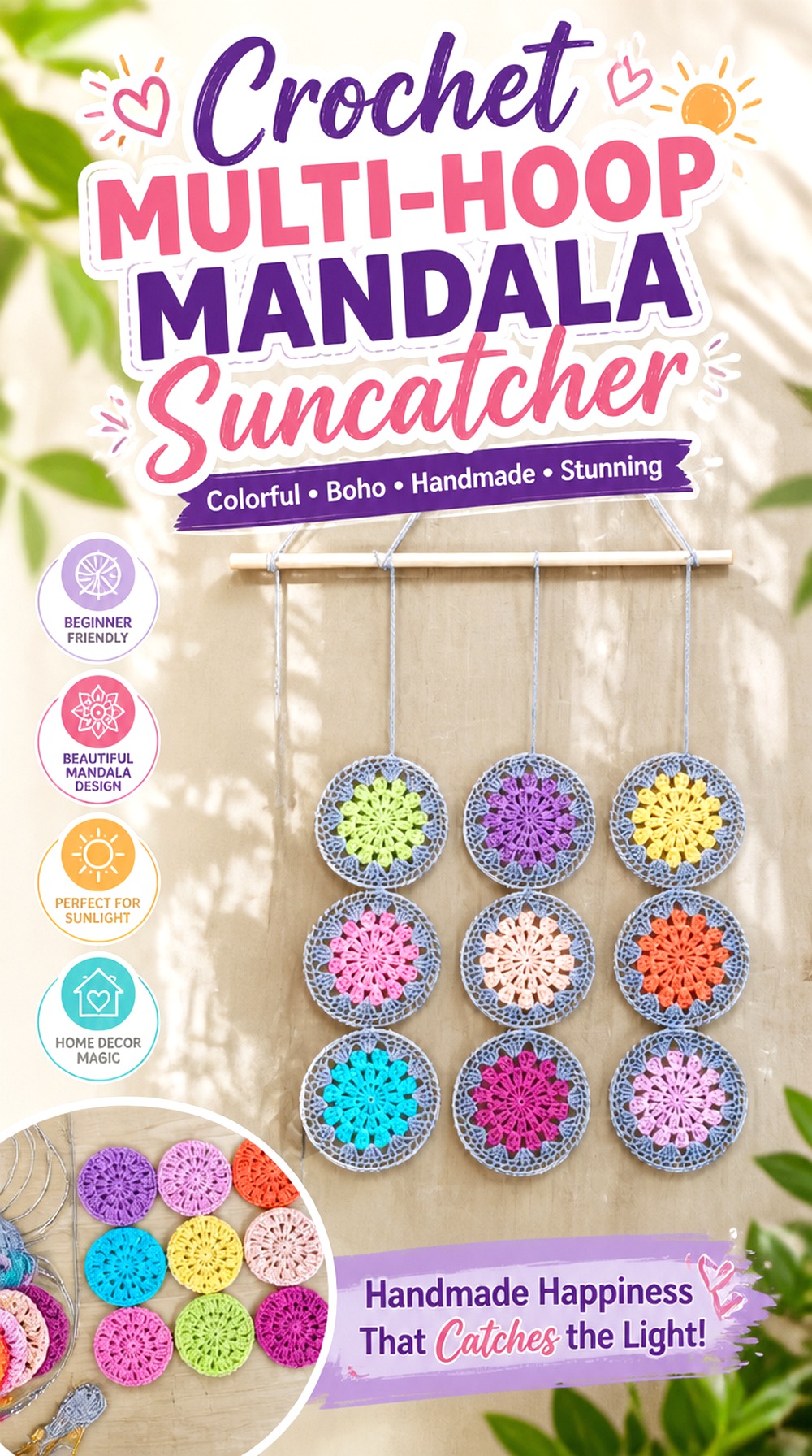
Instead of relying on one oversized circular motif, this idea uses multiple mandala hoops as a coordinated display. The Crochet Swirl’s tutorial demonstrates mandala wall hangings that can be made singly or grouped, making it a useful source when one large suncatcher would overwhelm the window.
A multi-hoop arrangement gives you flexibility around mullions, side panes, or asymmetrical window layouts. It also lets you vary pattern density without forcing every motif into one piece. The key is treating the hoops as a composition rather than several unrelated leftovers. Repeat at least one visual element—such as color family, ring finish, or spacing—to make the display look intentional.
Multiple Rings Need Visual Breathing Room
When hoops sit too close together, their circular outlines compete and the lace centers can merge visually. Test the arrangement directly against the window before choosing permanent hanging points. The gaps should be large enough to show that each mandala is separate, but not so wide that the group loses its relationship.
Treat Every Hoop as Part of One Composition
A useful way to plan a group is to choose one dominant hoop and let the others support it rather than making every circle equally busy. An open motif can sit beside a denser one, for example, without creating a mismatch. Compare the entire grouping from across the room rather than evaluating each mandala only at arm’s length.
Original Tutorial and Creator Credit
Creator: The Crochet Swirl
Crochet Doily Center Dreamcatcher Suncatcher
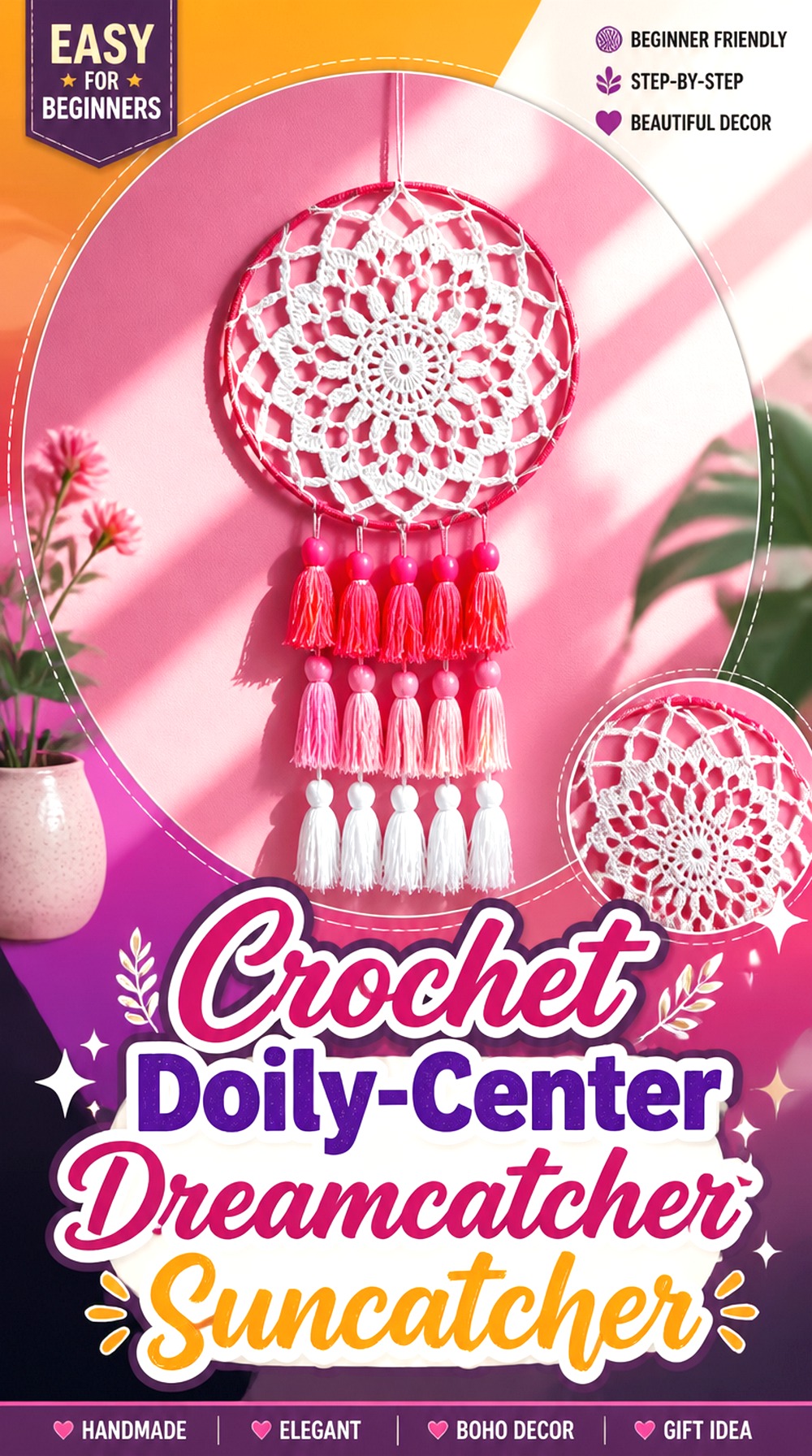
This approach puts an open crochet center inside a ring and finishes the lower half with hanging details. Cute Crochet’s tutorial demonstrates a complete dreamcatcher-style project with a doily center, ring, and tassels, making it a natural source for a window piece that combines lace and movement.
Its strongest feature in daylight is the contrast between the fixed circular center and the softer lower fringe. Choose this style when you want the window to remain visibly open rather than covered by a dense panel. The center is the technical focal point, while the lower details should frame it rather than visually outweigh it.
Open Lace Is the Main Light Feature
Before adding fringe, look at the completed center against a window. This reveals whether the holes and radial structure are clearly visible. If the lace itself already has strong visual presence, restrained lower decoration may produce a more balanced suncatcher than adding every possible strand or ornament.
Shape the Center Before Fixing It to the Ring
A circular lace motif that is uneven before mounting can become harder to correct after it is attached at multiple points. Shape or block it as appropriate for the materials, then compare opposite sides before securing it to the hoop. This helps keep the center from appearing stretched in one direction.
Original Tutorial and Creator Credit
Creator: Cute Crochet
Crochet Open Radial Mandala Suncatcher
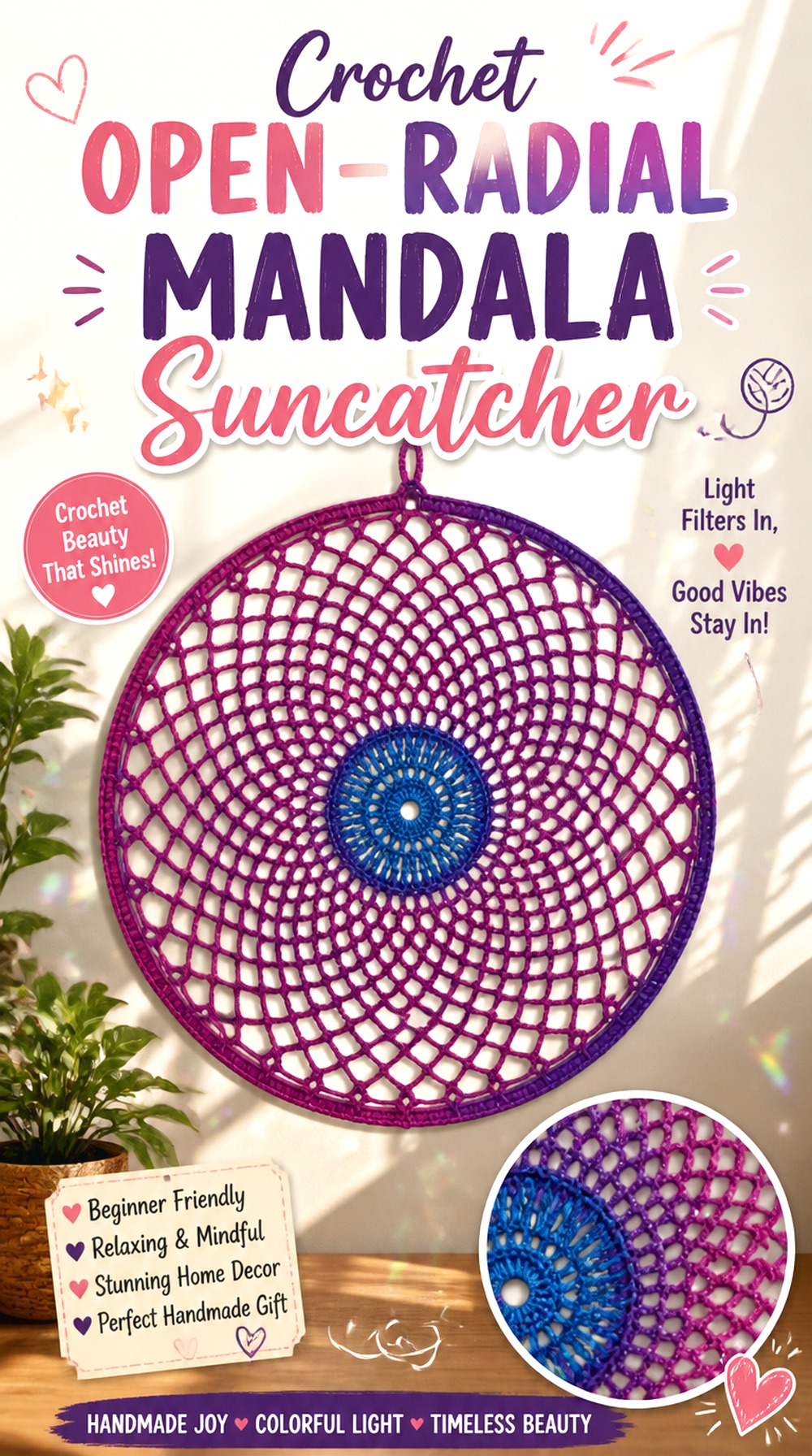
A radial mandala gives you one of the clearest ways to use crochet as a light-filtering window accent. Wizard of Loops demonstrates a crochet mandala and its dreamcatcher-style presentation, so the project can be approached primarily as a geometric center rather than a heavily embellished hanging.
This idea stands apart from the doily version because the radial pattern itself can become the visual statement. It works well when symmetry, circular repetition, and open spaces interest you more than floral motifs. Before choosing colors, look at how the sections divide the circle; strategic color placement can make those spokes more obvious or deliberately soften them.
Radial Symmetry Becomes Obvious Against Daylight
Backlighting exposes even small differences between opposite sections of a mandala. Use the window as a checking surface before final mounting. Rotate the motif and look for one side that appears noticeably fuller, tighter, or more compressed. Correcting the overall shape early is easier than trying to disguise an imbalance with fringe.
Color Changes Can Emphasize or Hide the Geometry
A strong color shift can make individual rings or spokes easier to read, while closely related colors create a quieter effect. Neither is automatically better. Decide whether you want viewers to notice the stitch architecture first or see the mandala as one unified disk, then choose color transitions accordingly.
Original Tutorial and Creator Credit
Creator: Wizard of Loops
Crochet Framed Mandala Dreamcatcher Suncatcher
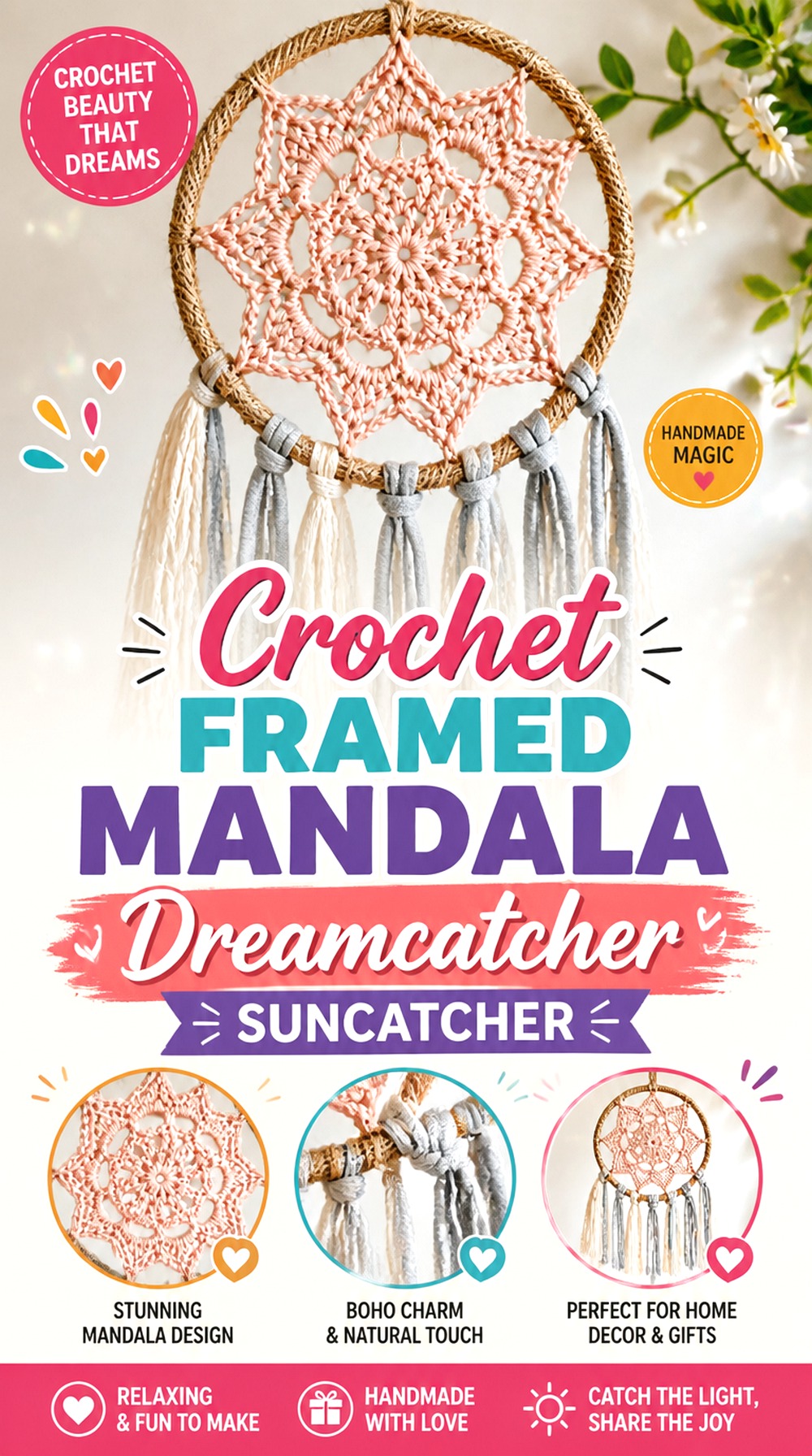
Ahuyama Crochet’s mandala dreamcatcher tutorial offers another circular route, but this idea is best treated as a complete framed hanging rather than only a motif mounted in a hoop. The balanced circular center makes it suitable for a prominent section of glass, especially where you want symmetrical decor rather than a vertical botanical or celestial strand.
For adaptation, focus on the relationship between the crochet and its frame. A mandala that nearly disappears into a large ring can feel under-scaled, while one stretched too aggressively can lose the softness of its stitch pattern. The finished proportions shown by the creator are therefore more useful than selecting a hoop based on an arbitrary size.
Let the Outer Ring Determine the Final Presence
Before committing to a frame, mock up the motif inside it. The amount of visible space between crochet and ring changes the overall style: more space feels airy, while tighter framing emphasizes the textile. Choose that relationship intentionally rather than using the first ring that happens to be available.
Keep Lower Decoration Secondary to the Mandala
When the circular center contains detailed stitch work, too many long hanging additions can shift attention away from it. View the project vertically before final trimming and decide where your eye lands first. If the fringe dominates, simplifying its length or density may restore the mandala as the focal element.
Original Tutorial and Creator Credit
Creator: Ahuyama Crochet
Crochet Textured Hoop and Fringe Suncatcher

This Pixie Creates’ dreamcatcher wall hanging places more emphasis on textured crochet and mixed hanging materials than a very delicate lace hoop. That makes it useful for a window where you want a substantial handmade presence without switching to a solid tapestry.
The circular center still allows some surrounding glass to remain open, while the lower materials create a softer, layered silhouette. This style works particularly well as a single feature piece rather than part of a crowded window collection. When adapting it, evaluate the center and lower edge separately: the hoop needs good shape, while the fringe needs an intentional outline.
Texture Gives a Quiet Hoop More Presence
A neutral or limited palette does not have to disappear against a bright pane if the crochet has enough raised or varied texture. Look at the finished center from a distance where individual stitches are no longer obvious. If the overall texture still creates clear light-and-shadow variation, the piece will have visual interest without relying on many colors.
Mixed Fringe Needs a Deliberate Bottom Silhouette
Different yarns or fabric strips can hang at different rates and thicknesses. Instead of trimming everything automatically to one rigid line, decide whether you want a tapered, curved, or deliberately irregular lower edge. Make that decision while the piece is hanging vertically, since loose materials behave differently on a worktable.
Check the Hoop Fit Before Final Finishing
The source design is made for an embroidery-hoop presentation, so the relationship between the center and frame matters. If you substitute another hoop, compare the crochet’s relaxed diameter with the opening before final attachment. Excessive stretching can change both texture and negative space.
Original Tutorial and Creator Credit
Creator: This Pixie Creates
Crochet Petite Floral Dreamcatcher Suncatcher
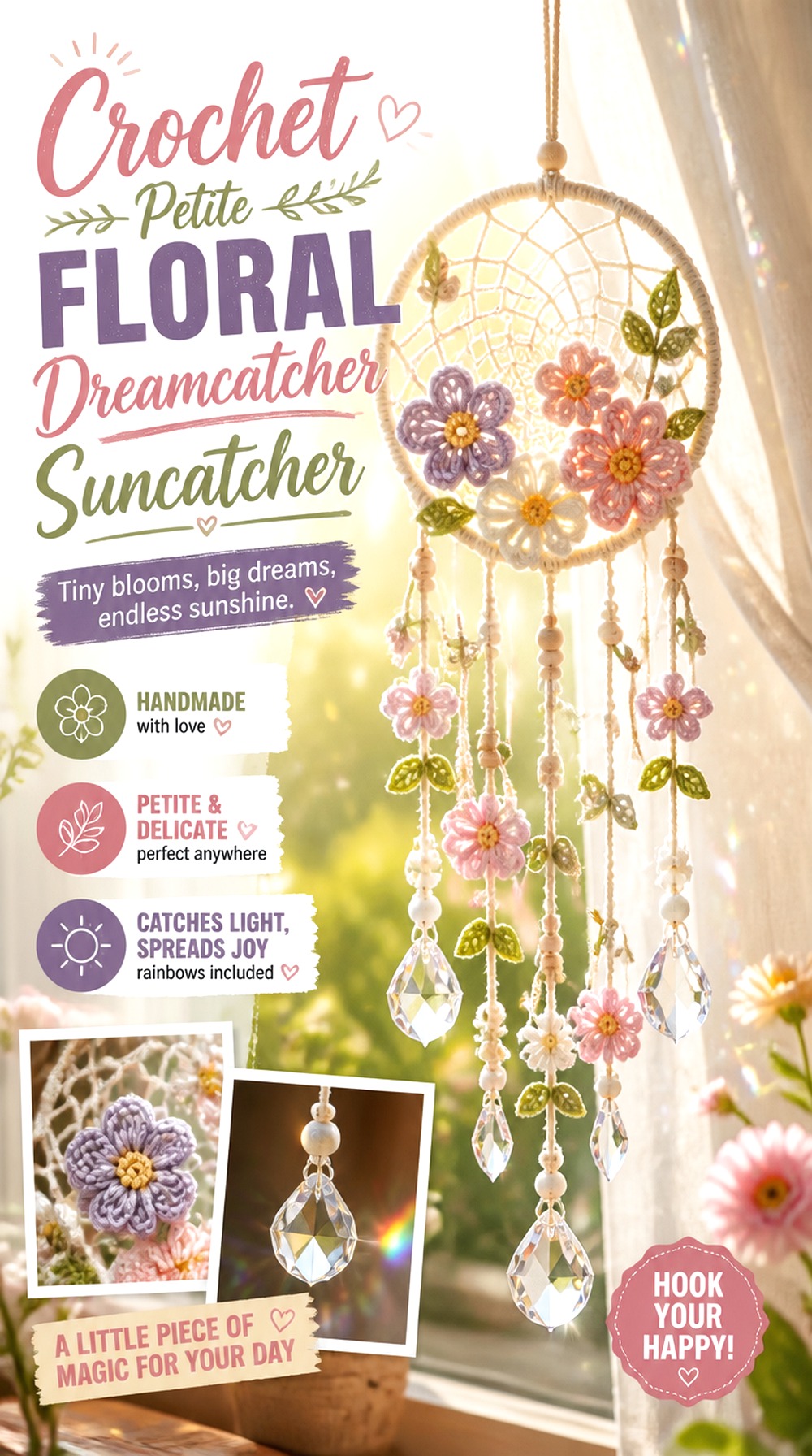
A small floral dreamcatcher gives you a more delicate focal point than the broad mandala hoops above. Sweet Softies’ tutorial centers the design around a flower and includes decorative bead details, making this a good source when you want a window accent that feels detailed without occupying a large visual area.
The flower gives the eye somewhere specific to land, while the surrounding ring creates open space. This is useful for narrow side panes, grouped window displays, or places where a larger hoop would block too much of the view. Treat the petite scale as an advantage rather than trying to enlarge every detail.
A Flower Center Creates One Clear Focal Point
If you introduce several additional colors, check that the center flower remains distinguishable from the surrounding crochet. A limited contrast at the focal point can be more effective than distributing equal color intensity around the entire ring. View it against the outdoors before deciding whether the flower needs stronger separation.
Small Beads Still Need Appropriate Attachment
Decorative pieces should be chosen for more than appearance. If you replace the beads shown in the tutorial, confirm that your chosen material can be attached securely and that its weight is reasonable for the surrounding crochet. Keep small detachable embellishments away from young children and pets.
Petite Scale Fits Awkward Window Sections
Small hoops can occupy spaces that a large central suncatcher cannot, such as narrow side panes or the area between a curtain edge and the center of the glass. Before making multiples, finish and hang one first. That gives you a real reference for how much visual space it occupies.
Original Tutorial and Creator Credit
Creator: Sweet Softies
Crochet Butterfly Window Suncatcher

A butterfly changes the visual language completely: instead of a circle or panel, the recognizable wing shape becomes the decoration. Shree Ji’s Corner provides a butterfly wall-hanging tutorial that can be adapted to an indoor window where the silhouette can be appreciated against daylight.
This option is especially suitable when you want a nature motif but prefer something lighter-looking than a flower-and-leaf arrangement. Butterfly designs depend heavily on bilateral balance. If the two wings read differently when the piece is hanging, that asymmetry becomes much more noticeable against a bright background. Position and suspension therefore deserve as much attention as color.
Wing Symmetry Is the First Visual Check
Before adding the final hanging support, hold the butterfly upright against the window and compare the outer edges of both wings. Small differences can be charming in handmade work, but one visibly drooping wing can make the entire piece appear tilted. Correct the display balance before assuming the crochet shape itself is the problem.
Suspend the Butterfly So It Does Not Turn Sideways
A shaped motif with a narrow body can rotate more easily than a broad hoop. Test the hanging point and observe whether the butterfly naturally faces the room or continually twists to an edge-on position. A balanced suspension can preserve the full wing silhouette without adding unnecessary weight.
Original Tutorial and Creator Credit
Creator: Shree Ji’s Corner
Crochet Daisy Stem Window Suncatcher
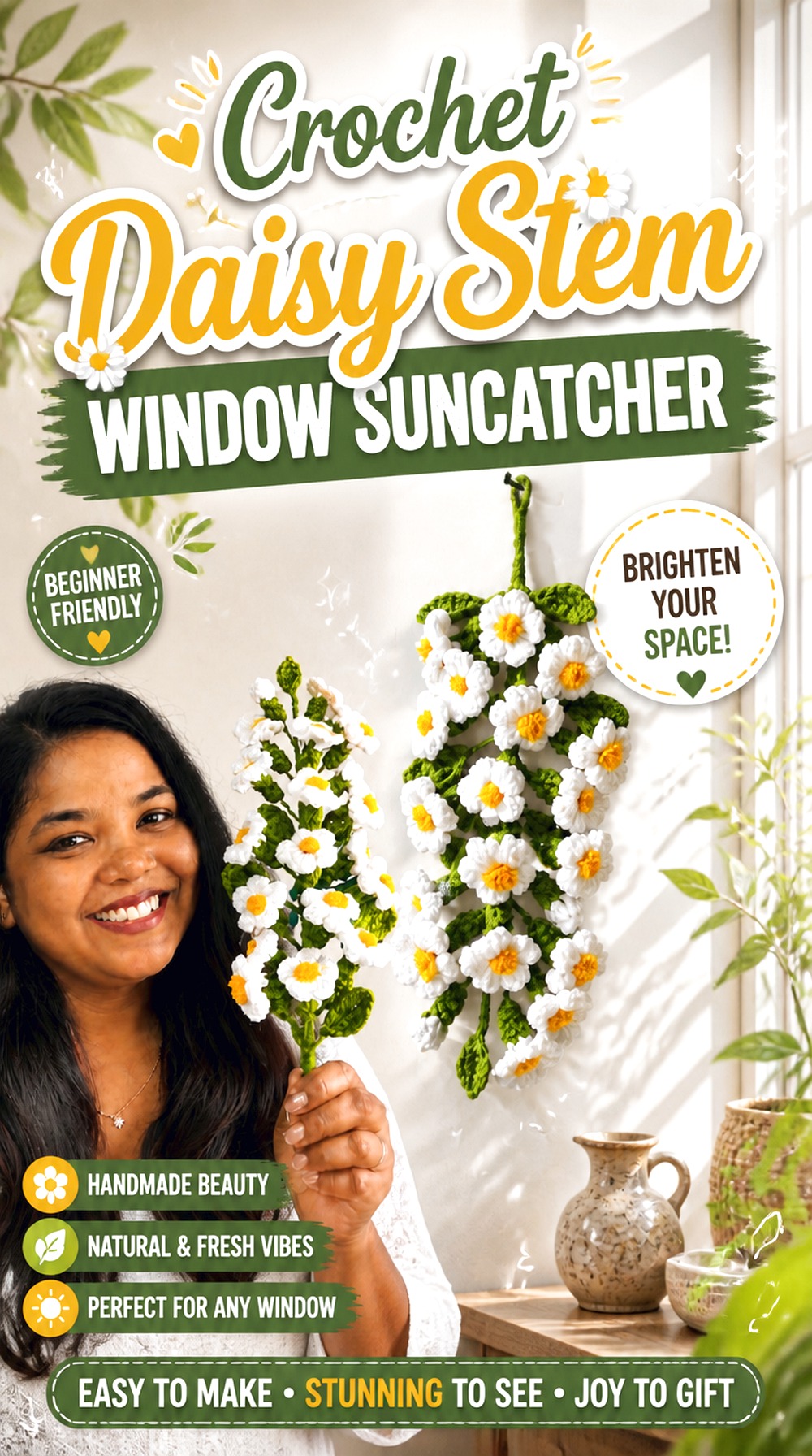
Oolioo Craft’s daisy wall-hanging tutorial combines a flower, bud, leaf, and vertical assembly. That makes it a particularly good reference for a tall, narrow window decoration instead of another broad circular piece. The finished form reads more like a hanging botanical stem than a traditional dreamcatcher.
The source uses additional construction materials, including wire and glue, so this is one project where you should check the creator’s material choices before making substitutions. For window display, the vertical profile can sit beside a pane edge without obscuring much of the view. It also gives you a clear top-to-bottom direction that works well in slim spaces.
A Vertical Stem Suits Tall, Narrow Panes
Rather than centering the daisy automatically, try positioning it near one side of the glass. A vertical botanical line can complement the window frame and leave the center open. Check the design from across the room, because a narrow piece may disappear if placed directly over a visually busy outdoor background.
Wire or Glue Changes How the Piece Should Be Handled
This tutorial uses more than yarn alone, so care should follow the actual materials used rather than generic crochet washing advice. If you adapt or substitute those structural materials, confirm how they affect flexibility, cleaning, and heat exposure. Do not assume a mixed-media hanging can be washed like an all-yarn project.
Original Tutorial and Creator Credit
Creator: Oolioo Craft
Crochet Toadstool Colorwork Window Suncatcher
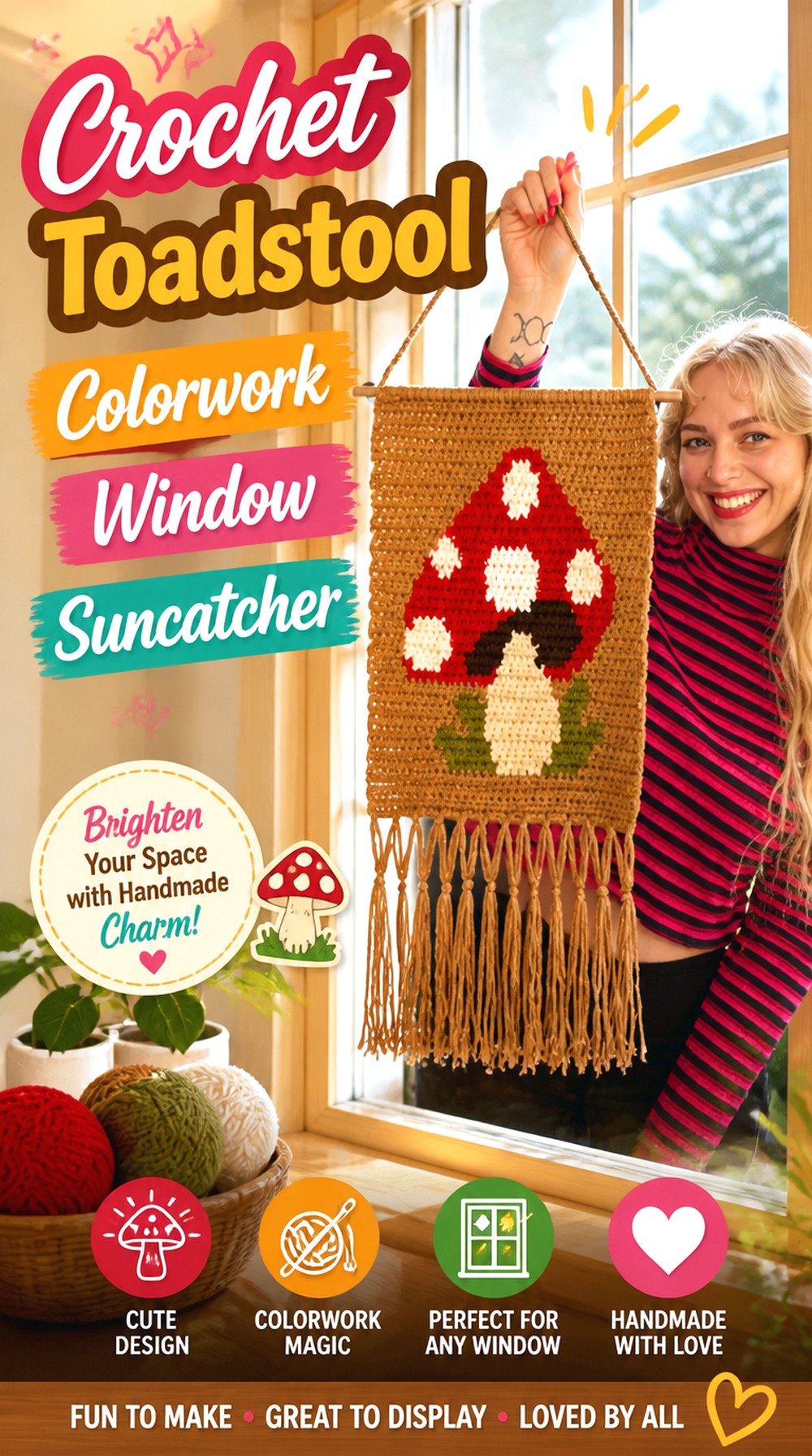
This mushroom design takes the opposite approach from lace: SugareeCo Crochet’s tutorial uses colorwork to create a graphic wall hanging with a recognizable toadstool image. When displayed against a window, it works more like a small textile panel than a transparent suncatcher.
That density can be an advantage if you want a strong motif that stays readable even when the outdoor scene is visually busy. It is also a useful option for retro or woodland styling without relying on hoops. Because the crochet itself forms a solid field, focus on color contrast, straight support, and the relationship between any fringe and the main image.
Dense Colorwork Creates Silhouette Rather Than Lace
Do not choose this project expecting large areas of sunlight to pass through it. Its appeal is graphic: the mushroom image becomes a colorful textile shape against the pane. This makes it better for a window where partial visual coverage is acceptable and the motif matters more than maximum transparency.
A Straight Support Keeps the Image From Collapsing
Graphic colorwork is easiest to read when its upper edge stays stable. If the display support bows or tilts, vertical and horizontal elements can look distorted even though the crochet is correct. Check the support after hanging the full piece, not only while it is empty.
Fringe Can Soften a Strong Toadstool Panel
The lower fringe creates a visual transition from the rectangular crochet to the open glass below. Decide whether you want the fringe to reinforce the main colors or act as a quieter neutral finish. Either approach can work, but it should support the mushroom image rather than become a separate competing focal point.
Original Tutorial and Creator Credit
Creator: SugareeCo Crochet
Crochet Star Fringe Window Suncatcher
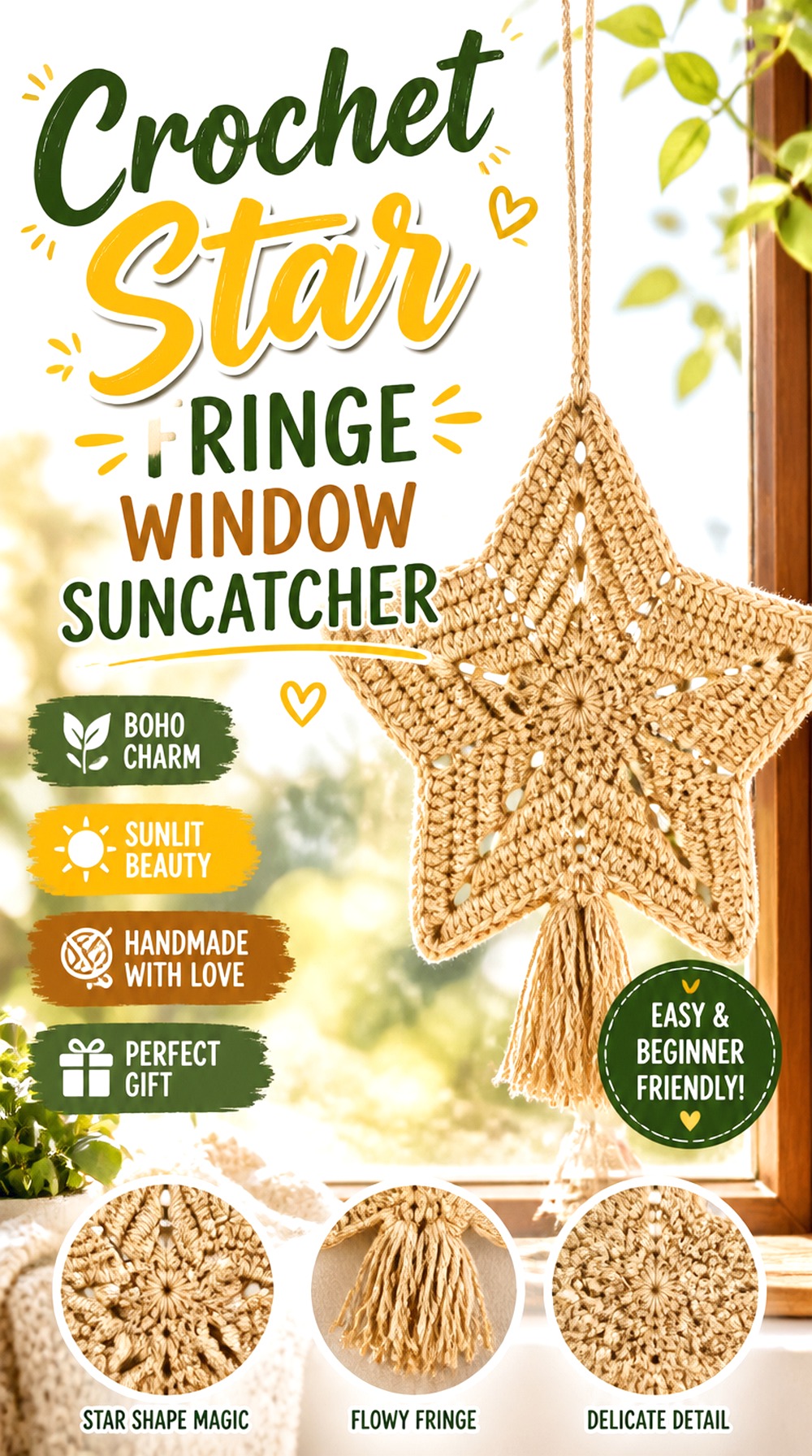
A single star gives you a bold celestial silhouette without the repeated elements of a moon-phase hanging. Natalie’s tutorial creates a star wall hanger with lower decoration, making it easy to reinterpret as indoor window art. The projecting points are what distinguish this project, so clean shaping should take priority over adding more embellishment.
This is a useful middle ground between a solid graphic panel and an open hoop. The star occupies a definite shape, while the surrounding pane remains uncovered. It can also bridge everyday celestial decor and seasonal display depending on the colors you choose, without changing the underlying construction.
Crisp Points Matter More Than Extra Embellishment
A star is recognized by its outer contour. Shape the main form and check all points before judging fringe, beads, or color. If one point folds inward or pulls downward, the star loses clarity quickly against a bright pane. Correcting that outline will usually improve the finished appearance more than adding another decorative element.
Trim Fringe Only After the Star Hangs Straight
Fringe length is difficult to judge accurately when the project lies flat. Hang the completed star in its intended orientation first, allow the strands to settle, and then assess the lower outline. This also reveals whether one side of the fringe is making the star appear visually off center.
Original Tutorial and Creator Credit
Creator: Natalie
Crochet Classic Window Suncatcher
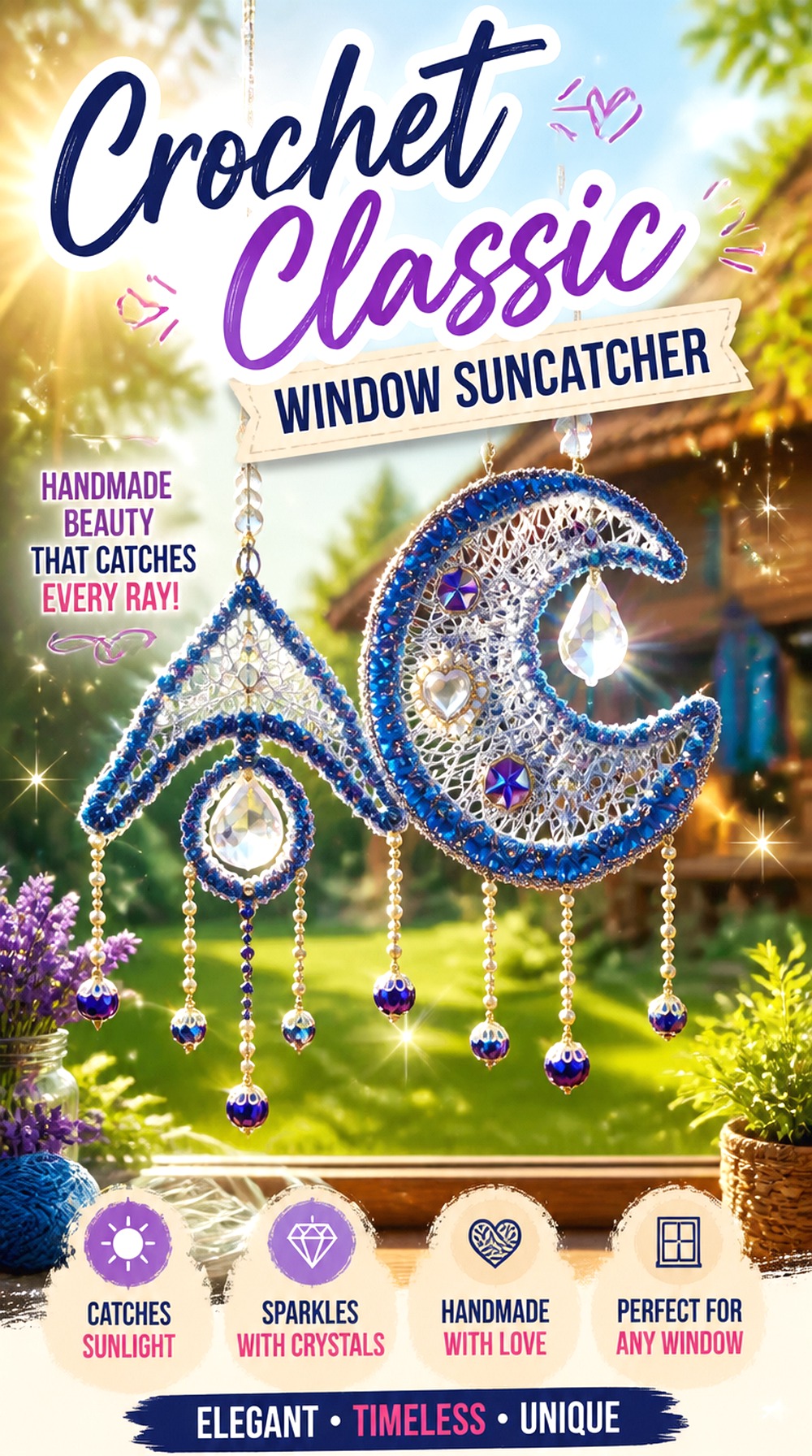
Most projects in this collection begin as wall hangings, dreamcatchers, or decorative motifs that can be moved to a window. Petra Perle’s source is different because the video itself is explicitly presented as a crochet suncatcher. That makes it useful as a reference point when you want to compare a purpose-labeled suncatcher with the adapted ideas elsewhere in the article.
Because the title and public information do not provide every finished specification, avoid guessing about measurements or substituting materials based only on appearance. Watch the complete tutorial before buying supplies, especially if decorative components beyond yarn are part of the finished object.
Use the Creator’s Finished Piece as Your Baseline
When a project is specifically called a suncatcher, it can be tempting to start customizing immediately. First watch how the original finished piece is assembled and displayed. That gives you a reliable reference for scale, balance, and component relationships before you decide which details can reasonably be changed.
Confirm Decorative Components Before Substitution
If the tutorial uses beads, rings, thread, or other non-yarn parts, confirm them from the creator’s instructions rather than assuming a visually similar substitute will behave the same way. Differences in weight or attachment holes can affect hanging balance even when the replacement looks almost identical.
Original Tutorial and Creator Credit
Creator: Petra Perle
Crochet Spiral Wind Spinner Suncatcher
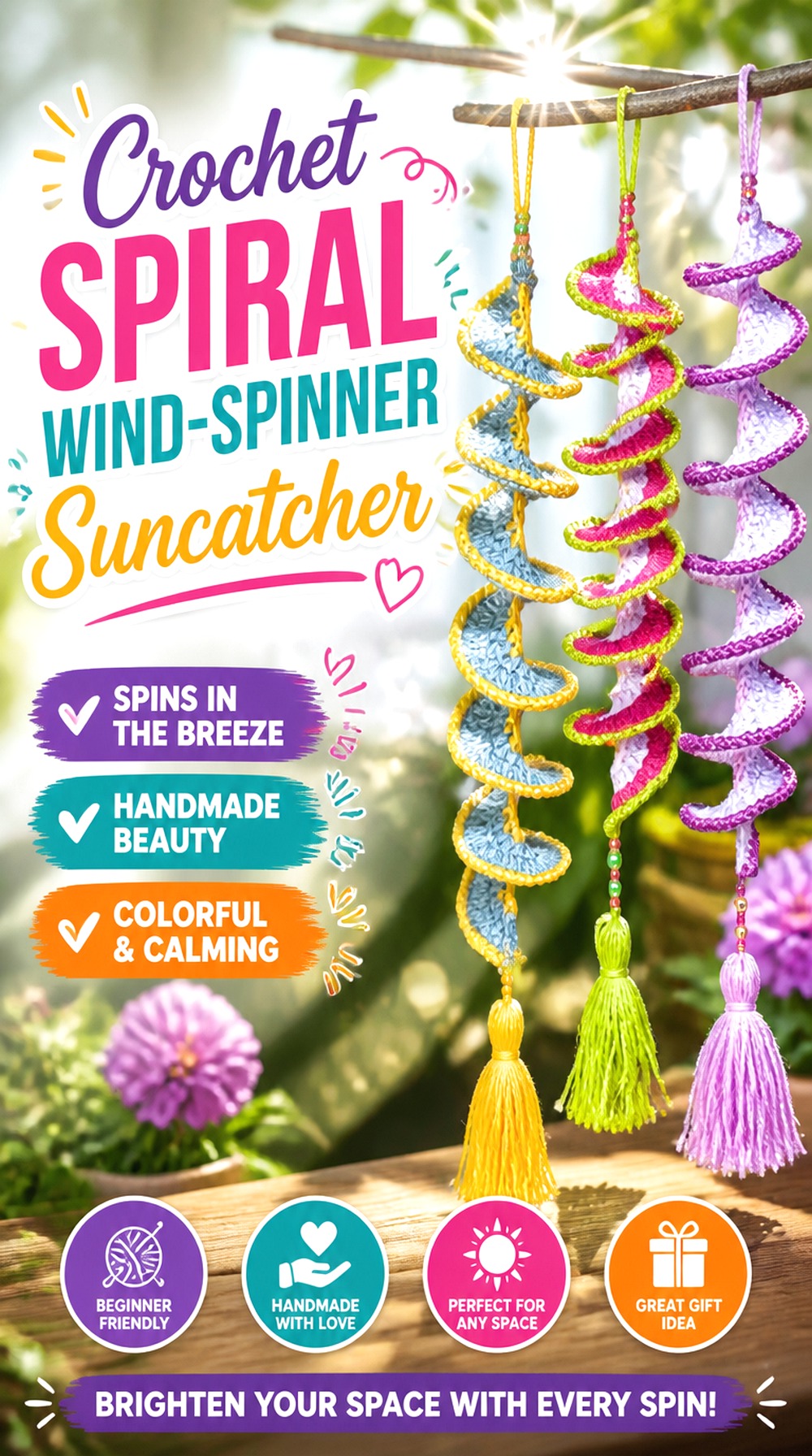
A hanging spiral offers movement instead of a fixed flat silhouette. Crochet con Sole’s tutorial teaches a wind spinner, and for this roundup it is best treated as an indoor window-hanging adaptation rather than relabeled as a traditional prism suncatcher. The turning or curling profile creates interest when air moves nearby.
This works well if your window already has enough static objects and you want something slender. The long spiral occupies less horizontal space than a hoop or tapestry, making it practical for side panes. Keep it indoors unless the yarn, attachment, and intended use are specifically suitable for outdoor conditions; the source tutorial should guide the construction itself.
A Spiral Uses Movement Instead of a Flat Picture
The project does not need a recognizable flower, sun, or celestial icon because its changing outline is the attraction. Hang it where the spiral has open space around it and observe the piece from several angles. If it is pressed against glass or a curtain, much of that three-dimensional effect disappears.
Keep the Spinner Clear of Moving Window Parts
A long spiral can catch more easily than a compact motif. Check its full hanging length against handles, blinds, curtains, screens, and opening sections before choosing the final support position. Indoors, a side location may preserve both movement and normal window operation better than the exact center.
Avoid Nearby Heat Sources
Yarn decorations should not hang over candles, heaters, hot lamps, or other heat sources simply because a sunny window seems like an attractive display location. Choose a clear area where the spinner can move without contacting anything hot or mechanically active.
Original Tutorial and Creator Credit
Creator: Crochet con Sole
Crochet Leaf Vine Window Suncatcher
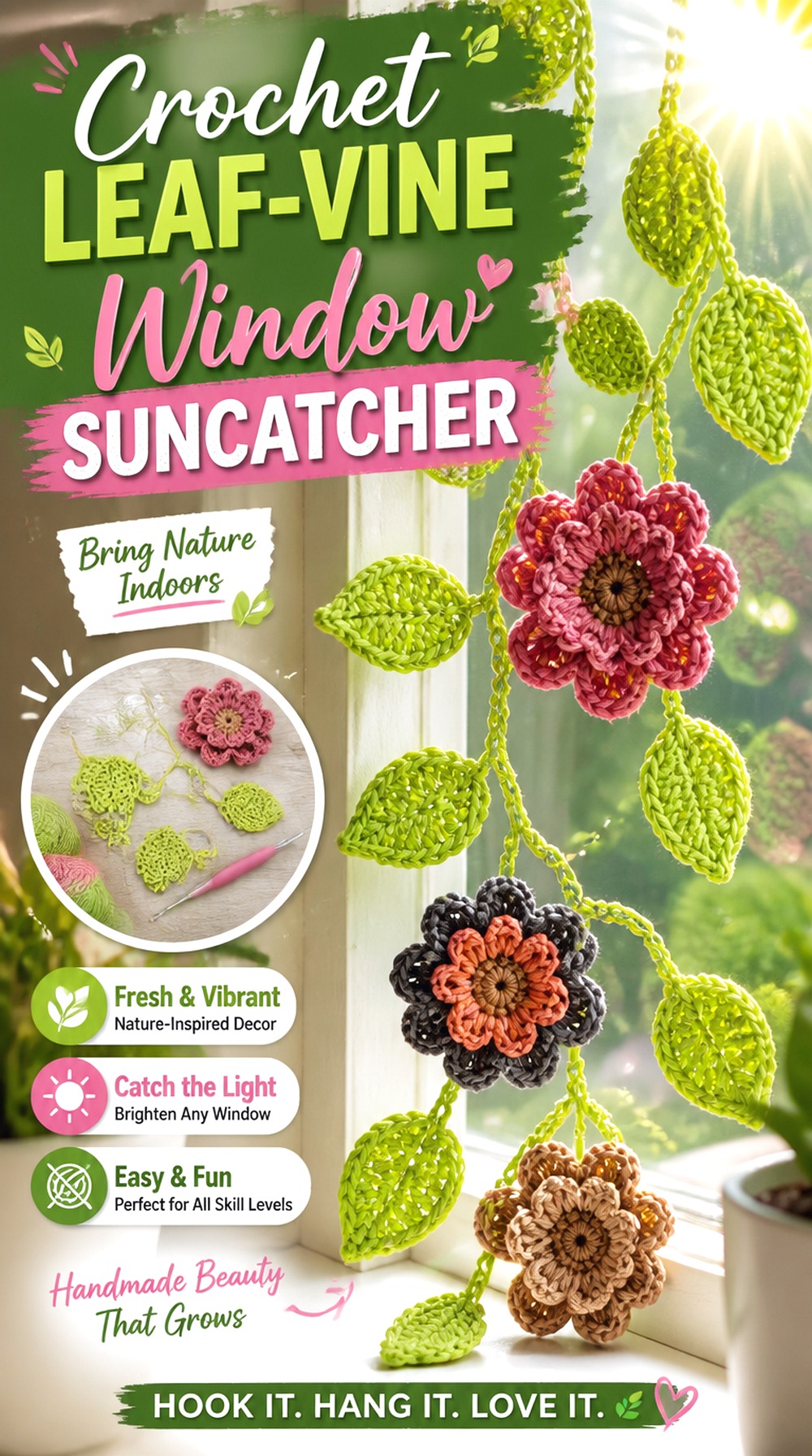
A leaf garland lets the decoration follow the architecture of the window instead of occupying its center. Hooked by Robin’s tutorial creates a continuous crochet leaf garland, which can be adapted along a top edge, down one side, or across a fixed pane as lightweight botanical window decor.
This is particularly useful when you want control over how much glass remains visible. Rather than making a predetermined circular diameter, you can plan the garland around the available display area. The source tutorial presents the garland as useful for multiple decorative purposes, so the window application should be considered a placement idea rather than the creator’s only intended use.
Let the Vine Follow the Window Instead of Fighting It
A garland can trace a frame, soften one vertical edge, or cross a stationary top section. Before choosing a route, temporarily position a length of yarn where you intend the vine to hang. This simple visual mock-up tells you whether a diagonal, vertical, or gently draped arrangement suits the window better.
Repeated Leaves Control Visual Density
Closer leaf spacing produces a fuller botanical line, while more open spacing makes the garland feel lighter against the glass. Follow the creator for the actual crochet method, but make your display decision based on how much of the outdoor view you want to preserve and how busy the surrounding window already looks.
Long Garlands May Need More Than One Support Point
A vine stretched across a wider window can sag or pull heavily from one end if supported only at a single location. Plan the support according to the finished arrangement and use hardware suited to the actual weight. Keep loops and long hanging sections out of reach of children and pets.
Original Tutorial and Creator Credit
Creator: Hooked by Robin
Crochet Cloud Window Suncatcher
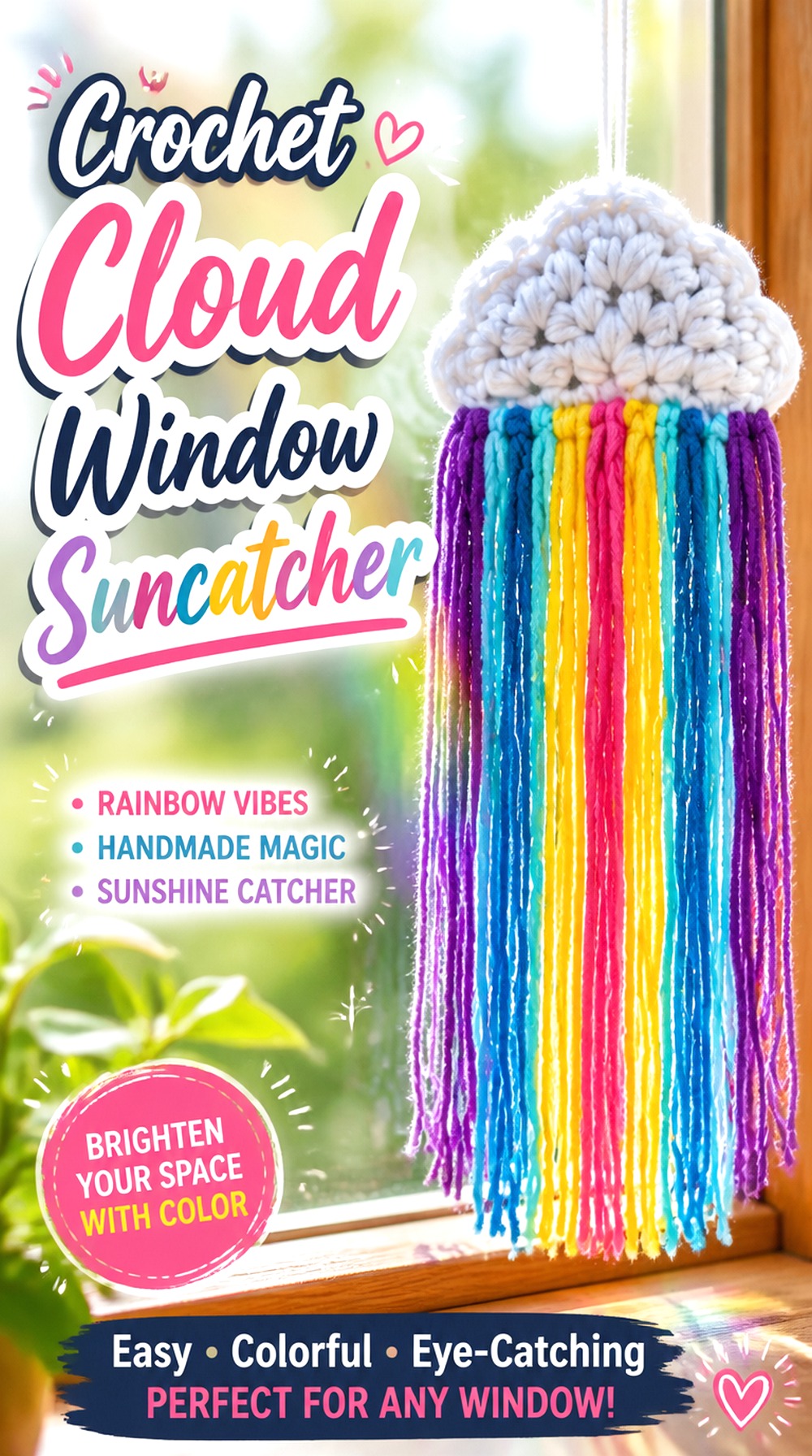
A cloud hanging brings a soft, rounded outline to a collection dominated by circles, stars, arches, and straight-edged tapestries. OmiCrochet’s tutorial specifically covers a crochet cloud wall hanging, giving you a clear source for a whimsical window adaptation without pretending the original was designed to refract sunlight.
The cloud works especially well when you want a recognizable shape with a gentler profile than a sun or star. It can sit in the upper part of a window, where the sky outside may even become part of the visual effect. If hanging strands are included or added, keep their scale appropriate to the cloud so the motif does not become visually top-heavy.
A Cloud Softens the Window’s Straight Lines
Window frames create many rigid vertical and horizontal edges. A rounded cloud introduces a contrasting organic contour without needing intricate lace. Try holding the finished form at different heights before fixing the support; higher placement can make the cloud feel lighter and leave the most useful viewing area of the pane open.
Pale Yarn Can Disappear Against a Bright Sky
White or very light yarn may look crisp indoors yet lose definition against an overcast or bright outdoor view. Test your chosen shade at the actual window. A contrasting border or a slightly different value can sometimes make the cloud outline easier to read without changing the overall soft palette.
Keep Any Hanging Strands in a Safe Zone
If the design includes long decorative elements, place them where they cannot become tangled with blind cords, window handles, or reachable play areas. A shorter finish can still preserve the floating-cloud effect while reducing interference with the window’s everyday function.
Which Crochet Window Suncatcher Style Fits Your Space?
| Style | Main Window Effect | Support Style | Choose It When |
|---|---|---|---|
| Mandala or dreamcatcher hoop | Openwork silhouette and circular geometry | Hoop or ring | You want daylight visible through the crochet |
| Sun, rainbow, cloud, butterfly, or star | Strong recognizable outline | Loop, dowel, or project-specific hanger | Shape matters more than lace transparency |
| Moon-phase or botanical strand | Repeated vertical or horizontal rhythm | Dowel, cord, or top support | You have a narrow or elongated display area |
| Colorwork mushroom or sun panel | Dense graphic textile art | Stable straight support | Partial window coverage is acceptable |
| Leaf garland | Flexible edge decoration | Multiple support points as needed | You want to preserve the middle of the pane |
| Spiral spinner | Moving three-dimensional accent | Single secure overhead point | You want motion rather than a flat image |
The biggest choice is not color. It is how much glass you want to cover. Hoop mandalas leave substantial negative space inside and around the crochet, while colorwork panels intentionally create a more solid block. Vines and vertical flowers preserve the center of the window, and a spiral gives movement without much width.
Conclusion
For the most light-through-stitches effect, start with the open mandala, doily-center, tree-of-life, or floral dreamcatcher ideas. Choose the sun, rainbow, butterfly, cloud, star, or mushroom when a recognizable silhouette matters more than transparency. Narrow windows are especially well suited to the daisy stem, leaf vine, moon phases, or spiral spinner, while a larger central pane can carry a stronger hoop or graphic panel.
Whatever style you choose, plan the hanging position before adding the final fringe or support. Check clearance around blinds, handles, and moving glass, and judge color against real daylight rather than only on a worktable. Use the original tutorials credited above for their exact construction details and creator-specific methods.
Frequently Asked Questions
Do crochet window suncatchers create rainbow light like glass prisms?
Not by themselves. Crochet yarn primarily creates color, texture, shadow, movement, and openwork silhouettes against daylight. A traditional glass or crystal prism can refract light into spectral colors, while an all-yarn crochet piece generally will not. If a particular tutorial includes reflective or transparent decorative components, follow that creator’s instructions and verify the materials before assuming another bead or ornament will produce the same effect.
Which crochet suncatcher styles let the most daylight through?
Open hoop designs usually preserve the most visible light because the motif contains deliberate spaces and is surrounded by uncovered glass. Mandalas, doily centers, tree-of-life hoops, and some dreamcatcher constructions fit this approach well. Dense colorwork panels, stuffed motifs, and substantial rainbows create more of a graphic silhouette. Neither style is inherently better; the choice depends on whether transparency or strong imagery matters more in your window.
Should I block a crochet motif before putting it in a hoop?
When the yarn and project are suitable for blocking, shaping the motif before final mounting can make it easier to assess symmetry, diameter, and openwork. This is particularly useful for radial mandalas, stars, leaves, or lace centers. Do not assume one blocking method is appropriate for every fiber, though. Check the yarn’s care information and the creator’s finishing guidance before applying heat, moisture, starch, glue, or another stiffening treatment.
How can I keep a crochet window hanging from twisting?
Start by checking the suspension point rather than adding weight immediately. A narrow butterfly, vertical flower, or lightweight motif may rotate if its top connection does not align with the finished center of balance. Temporarily hang the piece and adjust the support position before making it permanent. Also keep it away from curtains, vents, and frequently opened window sections that continually push it sideways.
Can I add crystals or beads to any crochet window suncatcher?
They can be an adaptation, but they should not be treated as universally interchangeable decorations. Additional components change weight, balance, attachment requirements, and potentially breakage risk. First check whether the original tutorial uses beads or similar additions. When making your own adaptation, choose components and fastening methods suitable for the crochet structure, and keep small or breakable pieces away from children and pets.
Where is the safest place to hang long crochet window decor?
Choose a location where the hanging stays clear of window latches, sliding tracks, blind cords, curtains, heaters, candles, and other heat sources. Long tassels, vines, and loops should also be kept out of reach of infants, young children, and pets. A fixed pane or an unused side section can often provide a cleaner display area than directly over the part of the window that is opened every day.