Olive green and cream suit crochet cable pillow covers because the palette can make raised texture easier to organize visually without competing with it. Olive can provide a grounded main surface, while cream can define a central braid, cable column, border, or contrasting panel. The arrangement can also be reversed when a lighter pillow face better suits the surrounding decor.

Cable pillows need more than two attractive yarn colors. The important decision is where the color boundary belongs. A cream cable running through an olive field emphasizes the raised braid itself, while olive cables on a cream background make the deeper shade follow the texture. Patchwork cable covers can distribute both colors square by square instead.
The tutorials below support cable, braid, cable-square, or closely related raised-texture constructions. The olive-and-cream palettes are independent adaptations, so the tutorial creators should not be assumed to have used these exact colors.
Quick List
- Olive And Cream All Over Cable Crochet Pillow Cover
- Olive And Cream Three Cable Crochet Pillow Cover
- Olive And Cream Braided Panel Crochet Pillow Cover
- Olive And Cream Cable And Bobble Crochet Pillow Cover
- Olive And Cream Button Back Braid Crochet Pillow Cover
- Olive And Cream Cross Cable Square Crochet Pillow Cover
- Olive And Cream Centered Cable Crochet Pillow Cover
- Olive And Cream Single Braid Crochet Pillow Cover
- Olive And Cream Full Braid Crochet Pillow Cover
- Olive And Cream Cable Stitch Crochet Throw Pillow Cover
- Olive And Cream Chain Link Cable Look Crochet Pillow Cover
- Olive And Cream Modern Braided Crochet Pillow Cover
- Olive And Cream Zippered Braid Crochet Pillow Cover
- Olive And Cream Cable Square Patchwork Crochet Pillow Cover
- Olive And Cream Cabled Granny Crochet Pillow Cover
- Olive And Cream Statement Cable Panel Crochet Pillow Cover
- Olive And Cream Repeated Six Stitch Cable Crochet Pillow Cover
- Olive And Cream Contrast Cable Crochet Pillow Cover
Use Cream to Keep Olive Crochet Cables Visually Separated
Cream can be useful around olive cable columns because the light-dark difference helps the raised sections stand apart from the surrounding pillow face. This matters most when several braids run close together or when a detailed cable needs to remain readable from across the room.
The reverse arrangement can work just as well. Cream cables over an olive field create a lighter raised feature, but the cable should occupy enough visual area to stay connected rather than appearing as scattered pale stitches.
Place Olive and Cream Around the Cable Structure
Cable crossings, straight side fields, borders, granny-square frames, and closure panels are natural places to change color. Following those boundaries generally looks more deliberate than switching from olive to cream in the middle of an unrelated cable repeat.
When the front already contains several braided columns, keep the back quieter. A mostly solid olive or cream back can balance a heavily textured front, while a small repeat of the accent color at an envelope overlap, button band, or zipper edge can connect both sides when the source construction includes those features.
Check Olive and Cream Contrast Before Crocheting the Full Pillow Front
Some olives are deep and muted, while others are considerably lighter. Cream can also range from pale ivory-like tones to deeper oatmeal directions. Compare the actual yarns before relying on tiny two-color cable details.
A grayscale photo can help reveal whether the values are sufficiently different. If olive and cream become surprisingly similar, use wider panels or full cable columns in each shade instead of expecting small crossing stitches to remain distinct.
1. Olive And Cream All Over Cable Crochet Pillow Cover

Use cream as the main pillow face and olive through selected cable columns for a clearly textured two-color front. The supporting tutorial teaches a complete crochet cable pillow case, making an all-over cable field the natural starting point rather than adding unrelated motifs.
Cream Can Give Olive Crochet Cables More Visual Space
Let cream cover the recessed areas between the raised olive cables. The lighter field can help each braid remain distinct while preventing the whole pillow face from becoming one dense block of olive.
Keep the color changes aligned with complete cable sections whenever possible. Breaking a single braid into many alternating fragments can make the crossing pattern harder to follow.
Olive Can Repeat Across the Cream Crochet Pillow Front
Use olive on several evenly distributed cables instead of concentrating every dark feature on one side. Repetition helps the pillow look balanced when it sits upright on a sofa or chair.
If the cable front already carries substantial olive, keep the border or back predominantly cream to avoid making the accent color too heavy.
Creator Credit: Annoo and The Unruly Stitch
2. Olive And Cream Three Cable Crochet Pillow Cover

Make olive the main field and use cream for three prominent cable columns. The supporting Cozy Cable Pillow uses three large cables across the front with a separate overlapping back construction, giving the palette a clear front-versus-back strategy.
Cream Can Turn Three Olive-Field Crochet Cables Into a Focal Panel
Use cream consistently through the raised cable columns so the eye reads them as one coordinated feature. Olive can remain visible in the channels between them, preserving separation between individual braids.
Avoid adding extra cream stripes beside the cables unless the side fields feel visually empty; the three raised columns already create a strong rhythm.
Olive Can Keep the Cream Cable Pillow Back Visually Calm
A mostly olive back can counterbalance the cream-heavy texture on the front. If the construction uses overlapping back panels, keeping those areas one color also prevents the closure from competing with the decorative face.
A narrow cream edge at the overlap can be added only when it helps connect the back to the front palette.
Creator Credit: MJ’s Off The Hook Designs
3. Olive And Cream Braided Panel Crochet Pillow Cover

This version centers one broad olive braid on a cream pillow face. The supporting tutorial demonstrates a crochet pillow cover built around a pronounced braid texture, making the center panel the logical place for the deeper color.
Olive Can Make the Cream Crochet Pillow’s Main Braid Easy to Follow
Use olive through the full braid rather than changing color at every crossing. A continuous dark braid lets the cable path remain readable from top to bottom.
Cream side fields give the braid enough negative space to act as the main feature instead of one texture among several.
Cream Can Keep the Olive Crochet Braid From Feeling Too Wide
Leave generous cream areas on both sides of the center panel. This balances a substantial olive cable and keeps the pillow face from reading almost entirely green.
If you add a border, cream can continue around the edge so the background visually surrounds the braid.
Creator Credit: Crochê Passo a Passo
4. Olive And Cream Cable And Bobble Crochet Pillow Cover

Cable and bobble texture already create two different raised effects, so color should clarify rather than multiply those details. The supporting pillow tutorial combines braid and bobble-style texture, giving olive and cream distinct roles within the same textured front.
Olive Can Anchor the Cream Crochet Bobbles and Cable Texture
Use olive across the broader background and major braid sections. The darker field lets cream bobbles or other small raised details remain visible without requiring another accent color.
Do not automatically color every raised stitch cream. Leaving some texture olive keeps the cable pattern visually connected to its background.
Cream Can Highlight Selected Olive Crochet Pillow Details
Reserve cream for repeated bobble groups, one cable column, or a finishing border. A controlled light accent can guide the eye across the pillow instead of making every textured feature compete equally.
View the pillow from several feet away before adding more cream; small raised details often become more prominent once the cover is on an insert.
Creator Credit: Artes da Nonna
5. Olive And Cream Button Back Braid Crochet Pillow Cover
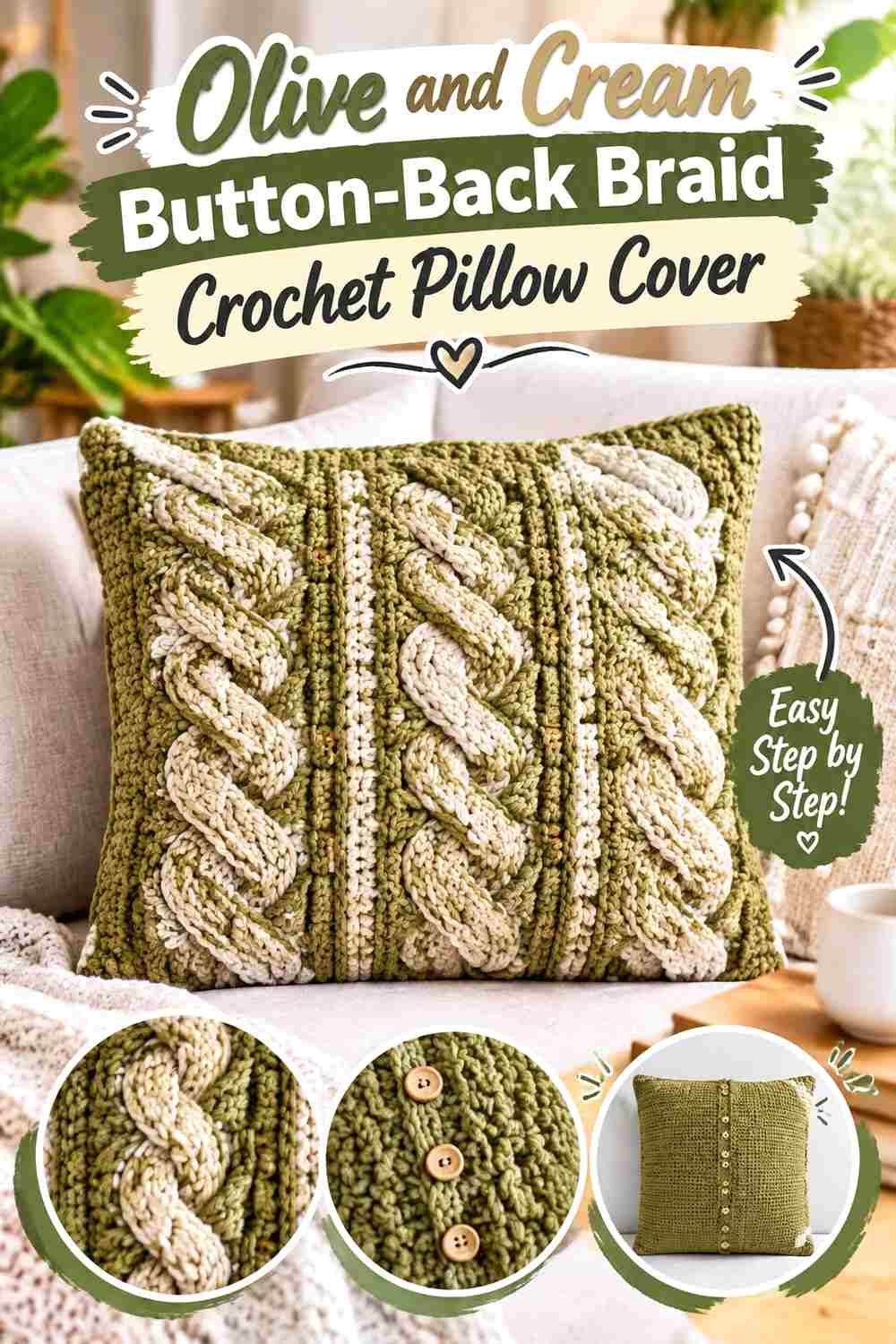
Use olive across the main front and cream for the central braid, then repeat cream near the buttoned back area if the finished construction leaves that detail visible. The supporting tutorial combines a braided pillow face with a button closure, giving the second color useful roles on both sides.
Cream Can Define the Olive Crochet Pillow’s Central Braid
A single cream braid against an olive field creates a straightforward focal point. Keep the surrounding olive area broad so the cable does not compete with additional stripes.
The lighter braid also gives the pillow a vertical center line that can be useful when coordinating it with solid cushions nearby.
Olive and Cream Can Connect the Crochet Front to the Buttoned Back
If the button band is visible, repeat a small amount of cream there while leaving the majority of the back olive. This connects the closure to the front without duplicating the entire cable design.
Consider the button’s existing appearance before adding more contrast; the closure itself may already act as a strong visual detail.
Creator Credit: ESTEFANIA DOMENES
6. Olive And Cream Cross Cable Square Crochet Pillow Cover

This design distributes the palette square by square. The supporting Cross Cable Pillow is built from cable squares, so olive-dominant and cream-dominant motifs can alternate without inventing a stripe pattern across the finished cushion.
Olive Cable Squares Can Ground the Cream Crochet Pillow Layout
Use olive as the background on some squares and repeat that arrangement symmetrically across the pillow face. This gives the deeper shade enough visual weight to connect the separate motifs.
Before joining, arrange all squares on a flat surface and check whether too many olive sections cluster in one corner.
Cream Cable Squares Can Lighten the Olive Crochet Patchwork
Reverse the color roles on selected squares so cream becomes the field and olive carries the crossing cable. This creates variety while preserving the same two-color system.
Keep the joining color consistent if you want the eight-square construction to read as one pillow rather than a collection of unrelated blocks.
Creator Credit: HanJan Crochet
7. Olive And Cream Centered Cable Crochet Pillow Cover

Make cream the dominant surface and place one strong olive cable through the center. The supporting cable-cushion tutorial focuses on a raised central texture, which suits a high-contrast panel without requiring several competing cable colors.
Olive Can Create a Strong Center on the Cream Crochet Pillow
Use olive continuously through the main cable so the crossing path remains easy to see. Cream on either side acts as a quiet field rather than another decorative feature.
If the cable is particularly wide, leave enough cream margin at both sides to stop the front from looking almost entirely olive.
Cream Can Continue Around the Olive Crochet Cable Border
A cream perimeter keeps the central cable visually contained. This is especially useful when the pillow will sit beside other olive decor, because the lighter frame prevents the entire cushion from blending into surrounding green surfaces.
Avoid adding a second olive border unless you specifically want a framed, more graphic look.
Creator Credit: Su Schotborgh
8. Olive And Cream Single Braid Crochet Pillow Cover

The supporting Jessica Pillow uses a centered cable braid with an envelope-style back, making it ideal for a cream body with a single olive statement braid.
Olive Can Turn the Cream Crochet Pillow Braid Into the Main Feature
Keep the braid entirely olive so its crossings remain connected from the top of the pillow face to the bottom. The cream field can then emphasize both the raised texture and the negative space beside it.
This is a good direction when you want cable texture without covering every inch of the pillow front.
Cream Can Keep the Olive Crochet Envelope Back Quiet
Continue cream across most or all of the back when you want the front braid to remain the only major olive feature. Alternatively, a mostly olive back can make the cover feel more green when viewed from the side.
Whichever direction you choose, avoid recreating the full front braid on the back unless the decorative effect is genuinely useful there.
Creator Credit: Yarn Hook Needles
9. Olive And Cream Full Braid Crochet Pillow Cover

For a denser cable look, make the front predominantly cream but run several substantial olive braids across it. The supporting tutorial teaches a fully braided crochet pillow, so multiple raised columns can carry the color contrast.
Olive Braids Can Repeat Across the Cream Crochet Pillow Face
Use olive consistently on each major braid rather than changing one braid to cream midway through its crossings. Repetition creates a deliberate textured grid.
Cream can remain visible in the recessed channels, keeping neighboring braids separated.
Cream Can Prevent the Olive Crochet Braids From Merging Visually
Make the spaces between olive cables wide enough to remain visible at normal room distance. If the cream channels become too narrow, several dark braids can appear like one broad olive panel.
Check the pillow after inserting the cushion because stretching can alter how much background shows between raised sections.
Creator Credit: Professor Neddy Ghusmam
10. Olive And Cream Cable Stitch Crochet Throw Pillow Cover

This idea uses olive as the primary front color and cream only on selected cable sections. The supporting Bag-O-Day tutorial is specifically a cable-stitch throw pillow project, making the cable surface itself the main place to vary the palette.
Olive Can Carry Most of the Crochet Throw Pillow Texture
Use olive through several cable repeats and surrounding stitches so the pillow has a strong green presence. Texture will still create light and shadow even when much of the front remains one color.
This prevents the cover from turning into a stripe project when cables are supposed to be the main feature.
Cream Can Mark Selected Olive Crochet Cable Columns
Choose one or two cable columns for cream rather than highlighting every raised section. The lighter color can create a focal rhythm while preserving the olive majority.
If the front already contains several cream cables, keep the border solid olive to give the design a clear outer frame.
Creator Credit: Bag-O-Day Crochet
11. Olive And Cream Chain Link Cable Look Crochet Pillow Cover

A chain-link or Jacob’s-Ladder-style surface creates a cable-like raised pattern that needs a slightly different color strategy. The supporting tutorial demonstrates a Chain Links Pillow using linked raised texture rather than a conventional single braid.
Cream Can Keep Olive Crochet Chain Links Distinct
Use cream behind olive linked sections so the dimensional loops remain easy to identify. A contrasting background is particularly useful where one raised link overlaps another.
Avoid frequent color changes inside individual links because the construction itself already creates a strong visual sequence.
Olive Can Repeat Through the Cream Crochet Pillow in Vertical Paths
Let olive follow the linked columns consistently from one end of the pillow front to the other. This produces a stronger cable-like effect than isolated olive links.
A cream outer border can visually contain those darker vertical paths and keep the pillow edges quieter.
Creator Credit: The Crochet Crowd
12. Olive And Cream Modern Braided Crochet Pillow Cover

For a cleaner contemporary direction, place broad olive braids over a mostly cream background and limit extra edging. The supporting tutorial demonstrates an Anthropologie-inspired modern braided cushion cover with pronounced raised texture.
Olive Can Make the Cream Crochet Braid Look More Sculptural
Use olive for the main braided elements and cream for flatter surrounding areas. The value change reinforces the difference between raised and recessed surfaces.
Keep each braid one color so the dimensional crossings remain visually continuous.
Cream Can Give the Olive Crochet Pillow More Open Surface
Allow cream to occupy substantial flat areas around the braids. This keeps the front from becoming visually dense and makes the olive texture easier to appreciate from across the room.
If the surrounding decor already contains a lot of cream, an olive border can provide a stronger outer edge without changing the cable layout.
Creator Credit: Hermione Chantal
13. Olive And Cream Zippered Braid Crochet Pillow Cover
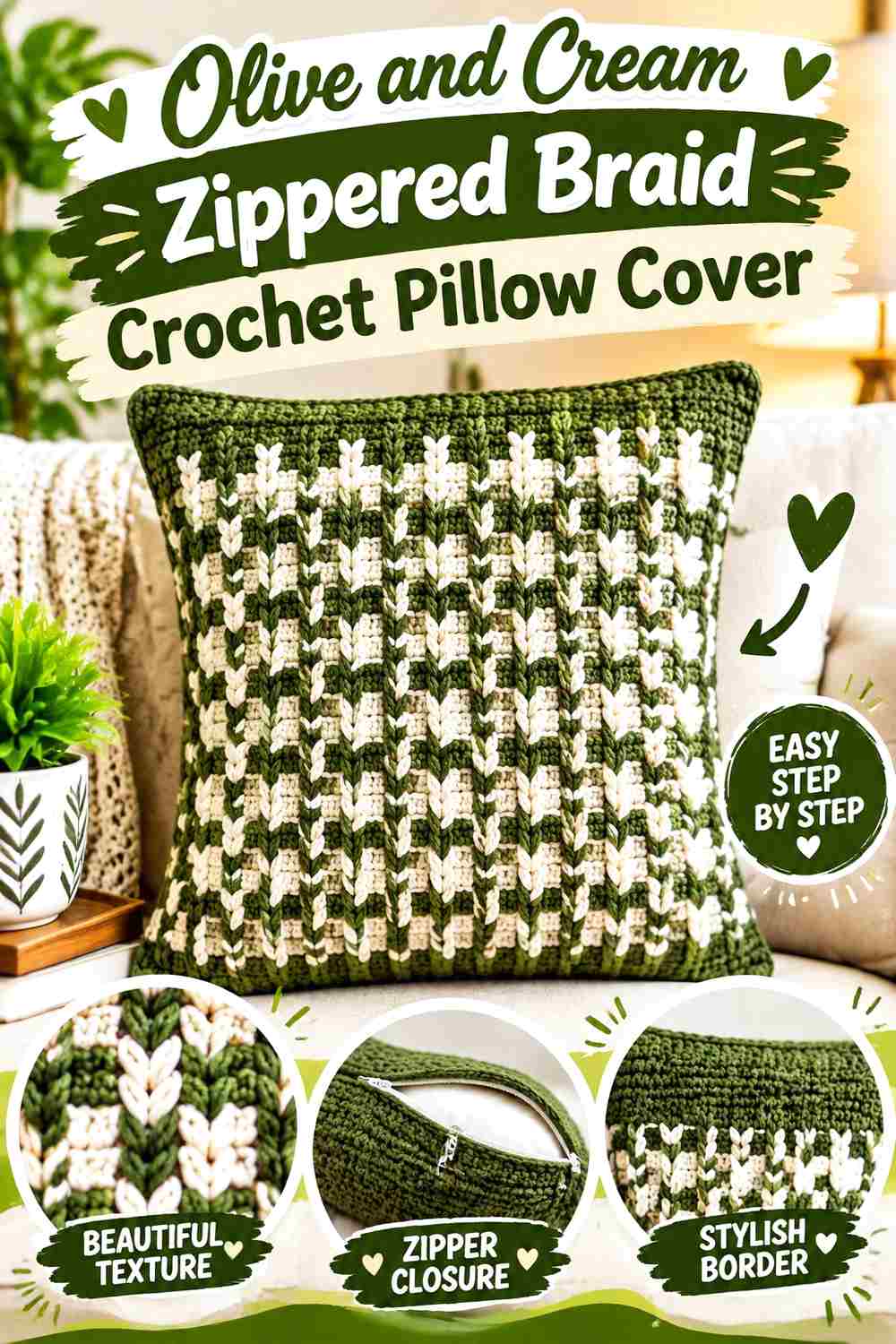
This version pairs a cream braid with an olive body and repeats cream near the zipper edge. The supporting tutorial teaches a braided crochet pillowcase with a zipper closure, so the closure provides another legitimate color-placement zone.
Cream Can Center the Olive Crochet Braid Panel
Use cream through the main braid while olive covers the adjacent front sections. The lighter cable becomes an immediate focal point without requiring several additional cream stripes.
Keep the cream panel aligned with the strongest part of the braid rather than widening it into unrelated side areas.
Olive and Cream Can Connect the Crochet Front to the Zipper Edge
Repeat a restrained amount of cream near the zipper if that helps connect the closure to the front cable. Keep the remainder olive so the back does not become equally decorative.
Check the zipper’s own color before deciding whether another contrast line is needed.
Creator Credit: Amo Fazer Crochê
14. Olive And Cream Cable Square Patchwork Crochet Pillow Cover

Use olive on the cable squares and cream on neighboring textured squares for a patchwork pillow where color identifies different stitch families. The supporting Cushion CAL includes a dedicated cable square within a larger cushion assembled from several square types.
Olive Cable Squares Can Become the Cream Crochet Patchwork Anchors
Place olive on the squares with the most pronounced cable texture. The deeper shade can help those motifs act as visual anchors among lighter cream sections.
Arrange the olive squares before joining so they are distributed evenly rather than unintentionally concentrated along one edge.
Cream Can Separate Olive Crochet Cable Squares From Other Textures
Use cream on quieter or differently textured squares to provide visual breaks between the darker cable blocks.
A consistent joining color can unify the patchwork. Choose olive for stronger framing or cream for a softer grid, but avoid changing the join color randomly between squares.
Creator Credit: Anna Nikipirowicz
15. Olive And Cream Cabled Granny Crochet Pillow Cover

A cabled granny motif combines radial square structure with raised cable texture. The supporting tutorial teaches the Cabled Granny Square used for a pillow project, allowing olive and cream to change roles from the motif center to its outer framing.
Olive Can Carry the Cable Detail Inside Cream Crochet Granny Squares
Use cream as the larger granny-square field and olive on the raised cable portions. This lets the deeper shade follow the dimensional feature rather than simply forming another square border.
Repeat the same olive placement across the motifs if you want the finished pillow to look coordinated rather than scrappy.
Cream Can Join the Olive Crochet Cabled Granny Motifs
A cream join can visually connect the lighter portions of adjacent squares and leave olive concentrated inside the texture.
If the cable sections already contain substantial cream, reverse the join to olive for a stronger grid around each motif.
Creator Credit: Juniper & Oakes
16. Olive And Cream Statement Cable Panel Crochet Pillow Cover
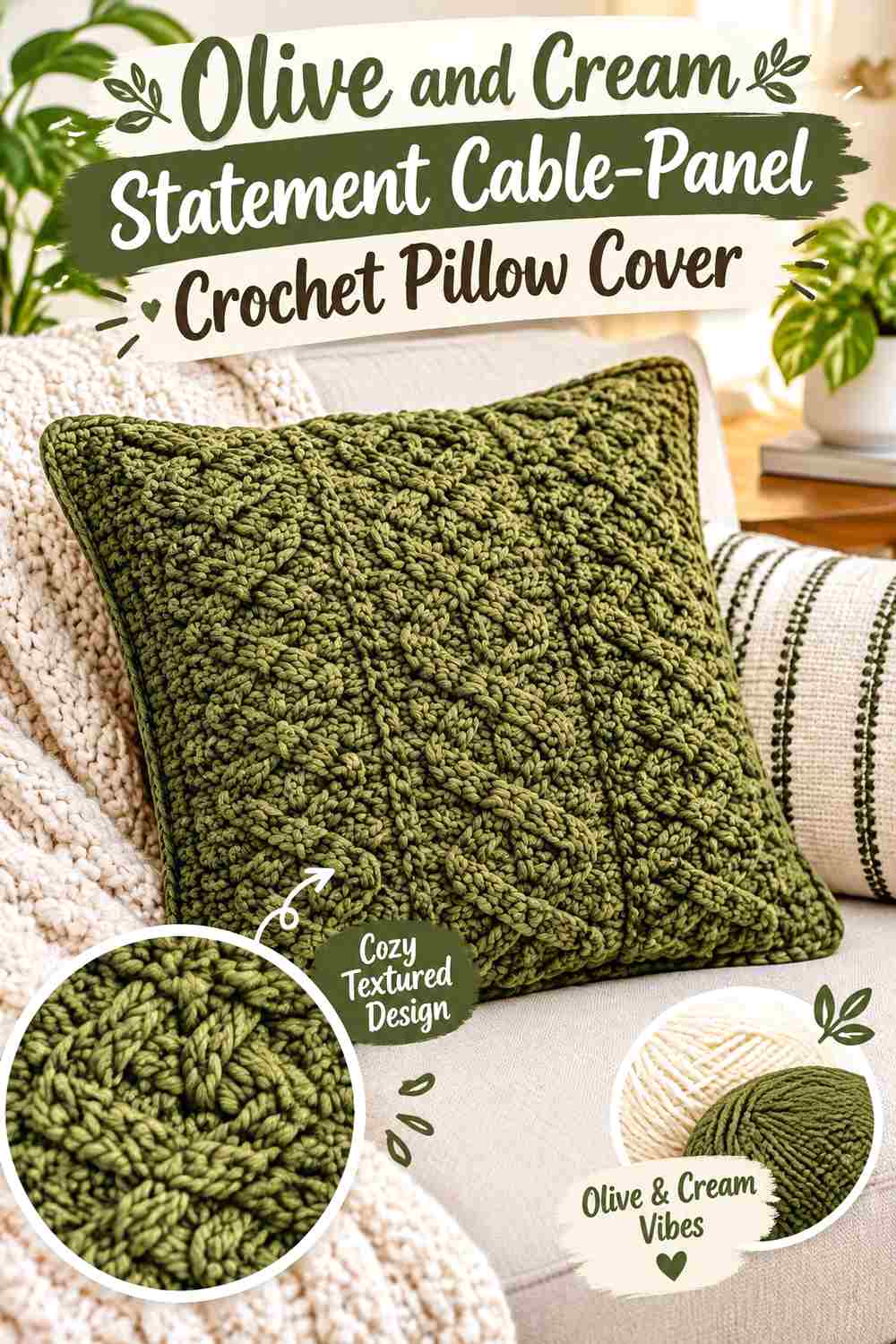
This idea begins with a dedicated cable panel rather than an all-over pillow tutorial. Sewrella’s cable tutorial shows the cable technique, and its accompanying guidance explicitly notes that the swatch can be developed into a pillow-sized piece, making it a suitable construction reference for a statement cable front.
Olive Can Turn the Cream Crochet Cable Panel Into a Statement Feature
Use cream across most of the pillow face and olive through the central cable section. Keeping the deeper color confined to one substantial panel lets the braid become the visual center.
This is especially useful when you want an olive accent pillow without covering the entire surface in dark green.
Cream Can Continue Around the Olive Crochet Panel and Pillow Back
Use cream on the side fields and a simple back to keep attention on the front cable adaptation.
If you want more olive elsewhere, repeat it in a narrow border rather than creating another competing cable panel.
Creator Credit: Sewrella
17. Olive And Cream Repeated Six Stitch Cable Crochet Pillow Cover
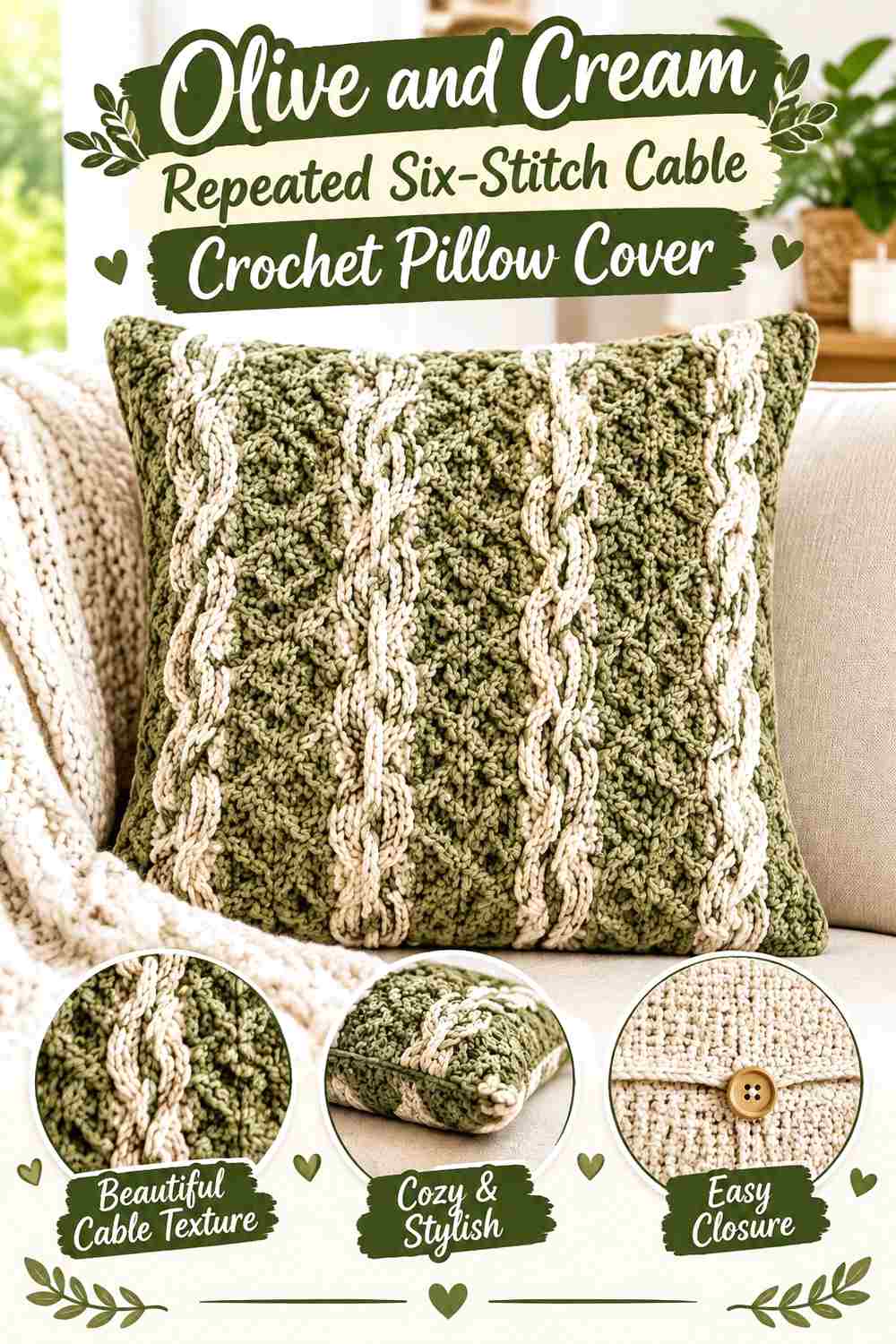
Repeated six-stitch cables can support a column-based palette. Leelee Knits’ cable tutorial is tied to a crochet throw-pillow design built around repeated cable sections, making it useful for an olive-and-cream cable grid.
Olive Can Repeat in Cable Columns Across the Cream Crochet Pillow
Use olive on alternating cable columns while cream fills the separating sections. This creates a regular rhythm without changing color inside each crossing.
Keep the olive columns equally distributed if the goal is a balanced front rather than an intentionally asymmetrical layout.
Cream Can Preserve Space Between the Olive Crochet Cables
Allow enough cream to remain visible between adjacent olive columns. If every cable sits too close to the next dark section, the repeated texture can collapse into one large green field.
A cream border can reinforce those lighter channels and visually finish the pillow.
Creator Credit: Leelee Knits
18. Olive And Cream Contrast Cable Crochet Pillow Cover
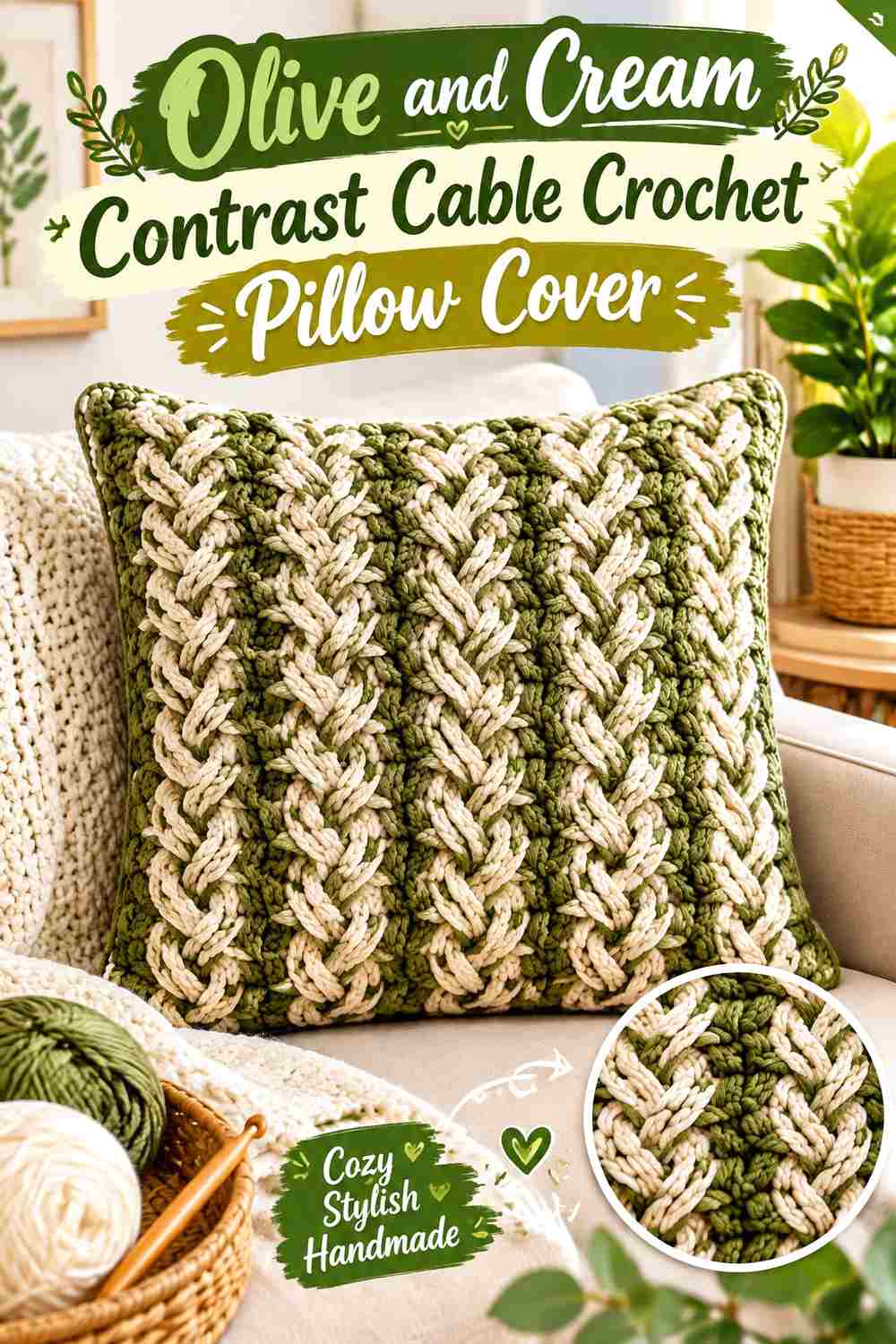
Finish with the most deliberately two-color cable direction. A contrast-cable pillow concept can use olive and cream in substantial neighboring areas so the crossing texture and background are separated by color as well as relief. The supporting pillow design uses contrasting colors and is paired with a four-cross cable tutorial.
Cream Can Give Olive Crochet Crossed Cables Clear Definition
Use cream in the field surrounding olive crossings so the changing cable direction remains visible. This works particularly well when the raised sections are broad enough to carry olive continuously.
Avoid changing a single crossing back and forth between both shades unless the design specifically benefits from that fragmentation.
Olive Can Frame the Cream Crochet Cable Pillow Surface
Repeat olive in the outer border or another substantial edge after using it inside the cable feature. This connects the center texture to the perimeter and prevents the dark color from feeling isolated.
If olive already occupies a large portion of the crossed cables, keep the back mostly cream for a quieter reverse side.
Creator Credit: Noelle Stiles
Choosing Between Olive-Led and Cream-Led Cable Pillow Covers
For an olive-led pillow, use cream primarily on the raised cable, center braid, border, or selected texture. The three-cable, button-back, cable-stitch, and zippered-braid versions suit this direction because the lighter color can be concentrated without taking over the entire cover.
For a lighter cream-led result, use olive directly on the cables. The centered-braid, modern braided, chain-link, cabled-granny, and statement-panel ideas let the deeper shade trace the most dimensional parts of the pillow.
Patchwork and square-based constructions provide the most balanced two-color treatment. Alternating olive-dominant and cream-dominant cable squares lets both colors occupy substantial areas while the repeated motif structure keeps the cover organized.
The back does not have to duplicate the front. A simpler solid or mostly solid back can provide visual relief when the cable face already contains several raised elements and two-color changes.
Conclusion
Olive and cream are especially useful on crochet cable pillow covers because the palette can reinforce the same raised-and-recessed structure created by the stitches. Olive can trace a braid, cable column, granny-square detail, or outer frame, while cream can provide lighter negative space around those features.
For the strongest cable definition, give the raised feature one continuous color and the surrounding field another. For a softer result, keep the entire cable surface olive or cream and restrict the second shade to the border, closure, or back. Patchwork covers can alternate those roles square by square.
Before committing to a full pillow face, compare the actual olive and cream yarns for value contrast and make sure the cable remains visible from normal room distance. Use the linked tutorials for exact cable construction, joining, and closure details, then adapt the color placement without reconstructing the creators’ patterns.
Frequently Asked Questions
Should Olive or Cream Be the Main Color in a Crochet Cable Pillow Cover?
Either can lead. Olive creates a deeper, grounded pillow surface, while cream produces a lighter overall look. If cable visibility is the priority, choose the color arrangement that gives the raised stitches enough contrast from their background.
Does Cream Make Olive Crochet Cables Easier to See?
It can when the cream is clearly lighter than the olive. A cream background around olive cables increases value separation, which can make the raised path easier to follow. The actual result depends on the specific yarn shades and texture.
Can the Crochet Cables Be a Different Color From the Pillow Background?
Yes. Using one color for the cable and another for the surrounding field is a useful way to emphasize the raised structure. Keep each major cable section visually continuous so the crossings do not become fragmented.
Where Should Cream Go on an Olive Cable Pillow if the Front Is Already Busy?
Use cream around one central braid, selected cable columns, the outer border, or a closure detail. If the front has extensive texture, a mostly cream or mostly olive back can also provide balance without adding more detail to the face.
Should an Olive and Cream Crochet Pillow Back Match the Cable Front?
Not necessarily. A highly textured cable front can pair well with a simpler back. You can repeat the dominant color, use the supporting shade, or carry a small accent into an existing envelope, button, or zipper area when the chosen construction includes one.
How Can I Substitute Different Olive and Cream Yarn Shades?
Preserve the relationship between the two colors. If the design relies on a dark olive cable against light cream, choose substitutes that maintain that value difference. If the goal is a softer tonal pillow, closer values can work, but small cable details may become less distinct.
How Can I Check Olive and Cream Contrast Before Making the Full Pillow?
Place the yarns side by side, make a small cable sample if practical, and view it from several feet away. A grayscale photo can also help reveal whether the raised olive and cream sections have enough light-dark separation for the planned design.