Olive and Burgundy give a crochet patchwork blanket two colors with enough depth to create a rich, grounded look without automatically producing sharp contrast. Olive brings the green side of the palette, while Burgundy adds a deeper red-wine direction. Because both can sit in the middle-to-dark value range, the most important design choice is deciding how each color will be distributed across the blanket.

Patchwork construction gives you several ways to control that balance. Olive can dominate the square backgrounds while Burgundy marks the centers, or the arrangement can be reversed. You can alternate whole squares, use half-and-half motifs, make Burgundy the joining color, frame Olive motifs with dark Burgundy, or reserve one color for the border.
These 18 ideas explore different ways to organize the same core palette through star layouts, classic granny squares, textured blocks, strips, mixed-size motifs, raised seams, sunbursts, and larger color sections. The linked tutorials support the crochet blanket or square-construction concepts; the Olive and Burgundy palettes are independent color adaptations.
Quick List
- Olive And Burgundy Star Patchwork Crochet Blanket
- Olive And Burgundy Alpine Texture Crochet Patchwork Blanket
- Burgundy And Olive Join As You Go Crochet Patchwork Blanket
- Olive And Burgundy Vintage Grid Crochet Patchwork Blanket
- Burgundy Centered And Olive Framed Crochet Patchwork Blanket
- Olive And Burgundy Circle Center Crochet Patchwork Blanket
- Olive And Burgundy Checkerboard Granny Crochet Patchwork Blanket
- Burgundy And Olive Square Upon Square Crochet Patchwork Blanket
- Olive And Burgundy Classic Granny Crochet Patchwork Blanket
- Olive And Burgundy Strip Patch Crochet Blanket
- Burgundy And Olive Cable Square Crochet Patchwork Blanket
- Olive And Burgundy Oversized Granny Crochet Patchwork Blanket
- Olive And Burgundy Mixed Scale Crochet Patchwork Blanket
- Burgundy Sunburst And Olive Frame Crochet Patchwork Blanket
- Olive And Burgundy Raised Join Crochet Patchwork Blanket
- Olive And Burgundy Picot Edge Crochet Patchwork Blanket
- Olive Sunburst And Burgundy Center Crochet Patchwork Blanket
- Olive And Burgundy Giant Block Crochet Patchwork Blanket
Give Olive and Burgundy Different Patchwork Roles
A two-color patchwork blanket does not need equal amounts of both shades. In fact, assigning different jobs often makes the layout easier to read. Olive might cover most square backgrounds while Burgundy appears in motif centers, outer rounds, or joining lines. Reverse those roles and the blanket immediately takes on a darker, more Burgundy-led direction.
Decide on the hierarchy before making a large stack of motifs. If every square changes color differently without a repeated rule, the blanket can begin to look random even though it contains only two colors.
Check Olive and Burgundy Contrast Before Making the Full Blanket
Olive and Burgundy are different hues, but that does not guarantee strong light-dark contrast. A deep forest-leaning olive and a dark burgundy may become surprisingly similar from across a room.
Place the yarns side by side and take a grayscale photo if motif definition matters. If both become almost the same gray, use larger color blocks rather than tiny alternating details, or choose a somewhat lighter Olive or Burgundy while preserving the overall palette.
Let Olive or Burgundy Joins Become Part of the Patchwork Design
Joining color can change the whole blanket. Burgundy seams around Olive-dominant squares create a strong grid, while Olive joining around Burgundy motifs produces a softer botanical-looking framework.
Consider the border at the same time. Repeating the joining color around the outer edge can visually connect the interior grid to the blanket perimeter, while switching colors at the border can create a separate frame.
1. Olive And Burgundy Star Patchwork Crochet Blanket
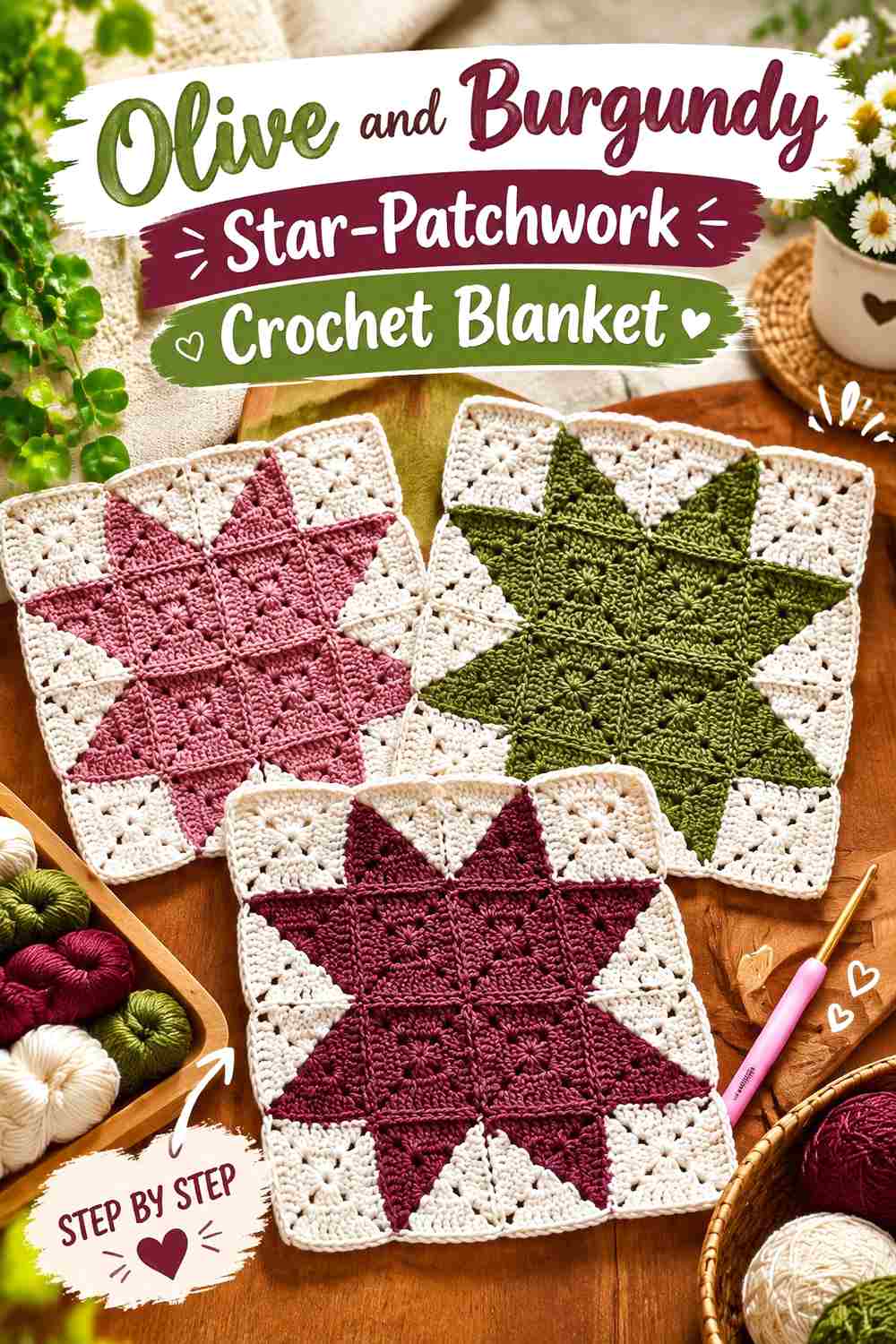
Build the color plan around a large geometric star created from solid and split-color blocks. Olive can form the quieter surrounding field while Burgundy concentrates inside the star, giving the blanket a recognizable focal motif without requiring several unrelated shades.
Burgundy Can Define the Star Against Olive Patchwork Squares
Keep Burgundy concentrated through the squares that create the central star points. The repeated dark wine tone gives the geometric motif continuity from block to block, while Olive surrounding squares stop the focal shape from dissolving into the rest of the blanket.
Olive Can Keep Burgundy Half-and-Half Blocks Connected
Where a square contains both colors, repeat Olive on the side that faces the outer field whenever the layout allows. That creates a smoother transition from the Burgundy star into the Olive background instead of making every split square look independent.
Repeat Burgundy at the Olive Blanket Border
A relatively narrow Burgundy border can reconnect the center star to the blanket perimeter. If the central motif already uses a large amount of Burgundy, avoid making the outer frame excessively wide or the Olive field may appear squeezed between two dark areas.
Creator Credit: Moara Crochet
2. Olive And Burgundy Alpine Texture Crochet Patchwork Blanket
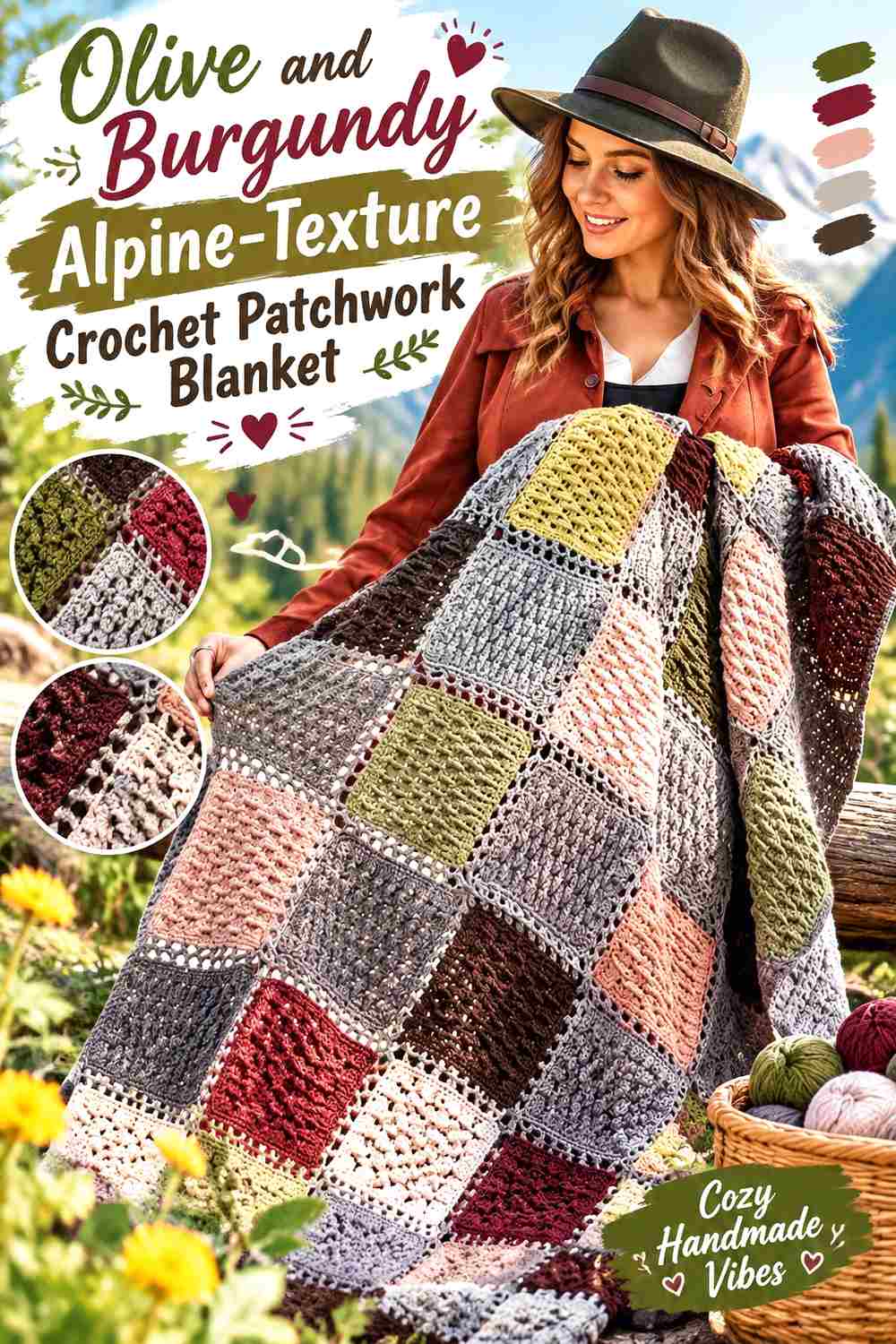
Textured squares provide a different problem from open granny squares: shadow already creates contrast across the stitch surface. Let Olive dominate many of the raised-texture blocks and use Burgundy on selected neighboring squares so the color layout remains readable without interrupting the texture inside every motif.
Olive Lets Raised Crochet Texture Carry More of the Blanket Detail
Use Olive as a full-square color when the stitch pattern already has pronounced ridges or raised sections. Keeping one color across the entire block allows light and shadow to reveal the texture instead of dividing it with additional color changes.
Burgundy Can Break Up Large Olive Patchwork Areas
Scatter Burgundy blocks at planned intervals rather than grouping all of them on one side. A simple repeating distribution—such as Burgundy appearing consistently within each section of the grid—can prevent the blanket from becoming visually Olive-heavy.
Compare Burgundy and Olive After the Textured Squares Are Worked
Raised stitches can make both yarn colors look deeper because recessed areas create shadow. Check finished sample blocks together before finalizing the entire layout, particularly when both shades are already dark in the skein.
Creator Credit: Life and Yarn
3. Burgundy And Olive Join As You Go Crochet Patchwork Blanket
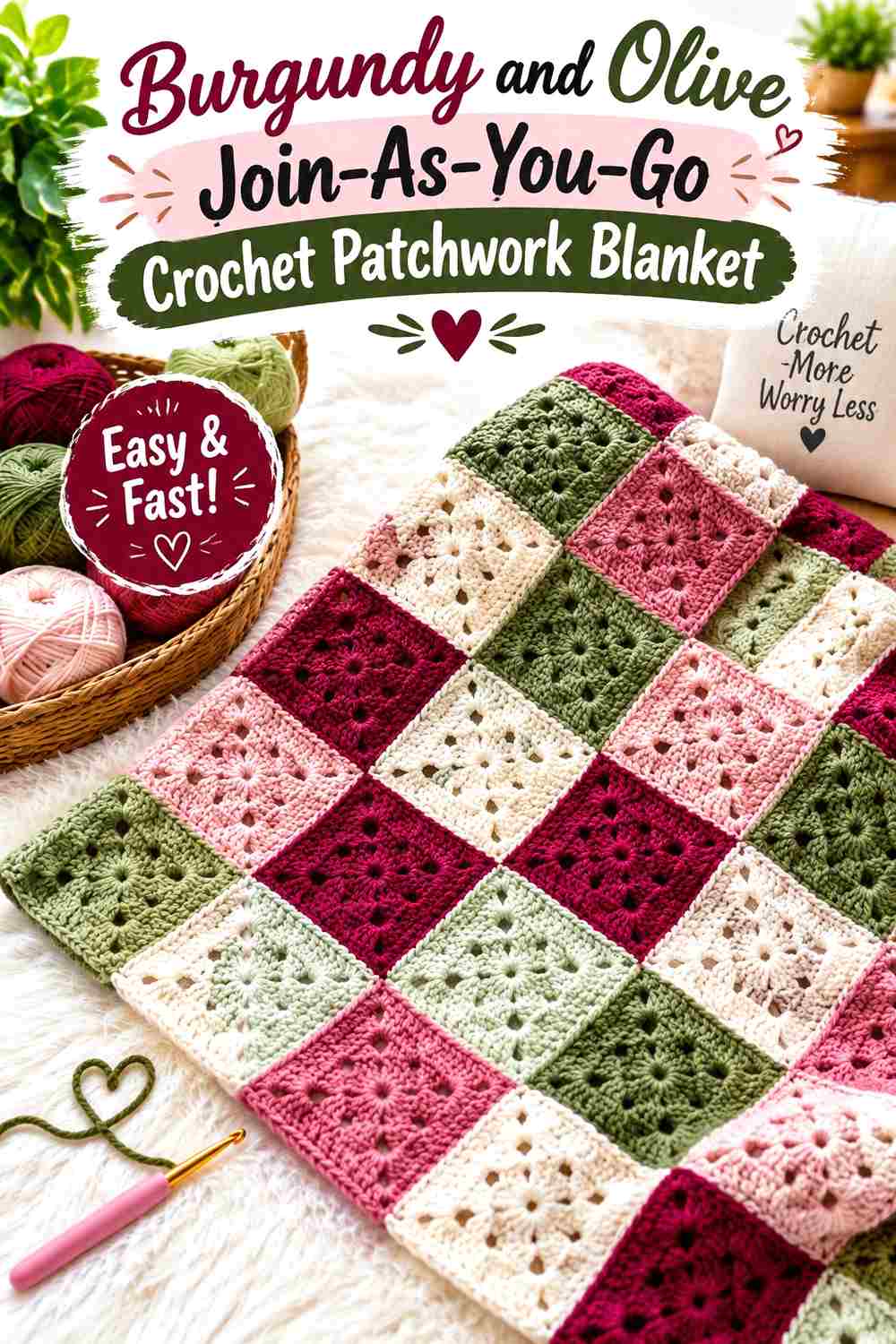
Use Burgundy as the dominant square color and Olive as the repeated joining or outer-round shade. This creates a dark patchwork field broken by a continuous green grid, making the method of assembly part of the color design.
Burgundy Can Lead Across the Main Crochet Squares
Keeping the central portions Burgundy gives the blanket a consistent wine-colored base even when individual granny squares have visible open spaces. You can vary the amount of Burgundy inside a motif without losing the overall direction as long as it remains the most repeated field color.
Olive Join-As-You-Go Edges Can Separate Burgundy Blocks
An Olive outer round or joining area prevents adjacent Burgundy motifs from merging into one dark mass. The grid becomes especially useful when your two shades are close in value because the repeated placement gives Olive a structural role even if the light-dark contrast is modest.
Carry Olive From the Burgundy Grid Into the Border
Using Olive again around the completed blanket can make the joins feel connected to the perimeter. If you want a darker finish, add a final Burgundy accent after the Olive border rather than abandoning the interior color logic completely.
Creator Credit: Emma C Makes
4. Olive And Burgundy Vintage Grid Crochet Patchwork Blanket

For a more traditional patchwork appearance, alternate Olive-led and Burgundy-led granny squares through a regular grid. Instead of making every square identical, reverse the placement of the two colors while keeping the same limited palette.
Olive-Led Squares Can Balance Burgundy-Led Squares
On one motif, place Olive through the broader outer area with Burgundy nearer the center. On the neighboring motif, reverse those roles. The repeated inversion creates variety while preserving a predictable rule across the blanket.
Burgundy Should Repeat Evenly Across the Olive Grid
Before joining, lay the squares out and look for accidental Burgundy clusters. Several dark motifs touching in one corner can make that part of the blanket visually heavier than an area containing mostly Olive.
Olive Joining Can Soften the Burgundy Patchwork Transitions
If the reversed squares already create strong visual movement, use Olive for the joining area to give the grid a consistent framework. Burgundy joining would produce a darker and more pronounced checker effect, so choose the seam color according to how graphic you want the final patchwork to appear.
Creator Credit: Madebyanita
5. Burgundy Centered And Olive Framed Crochet Patchwork Blanket
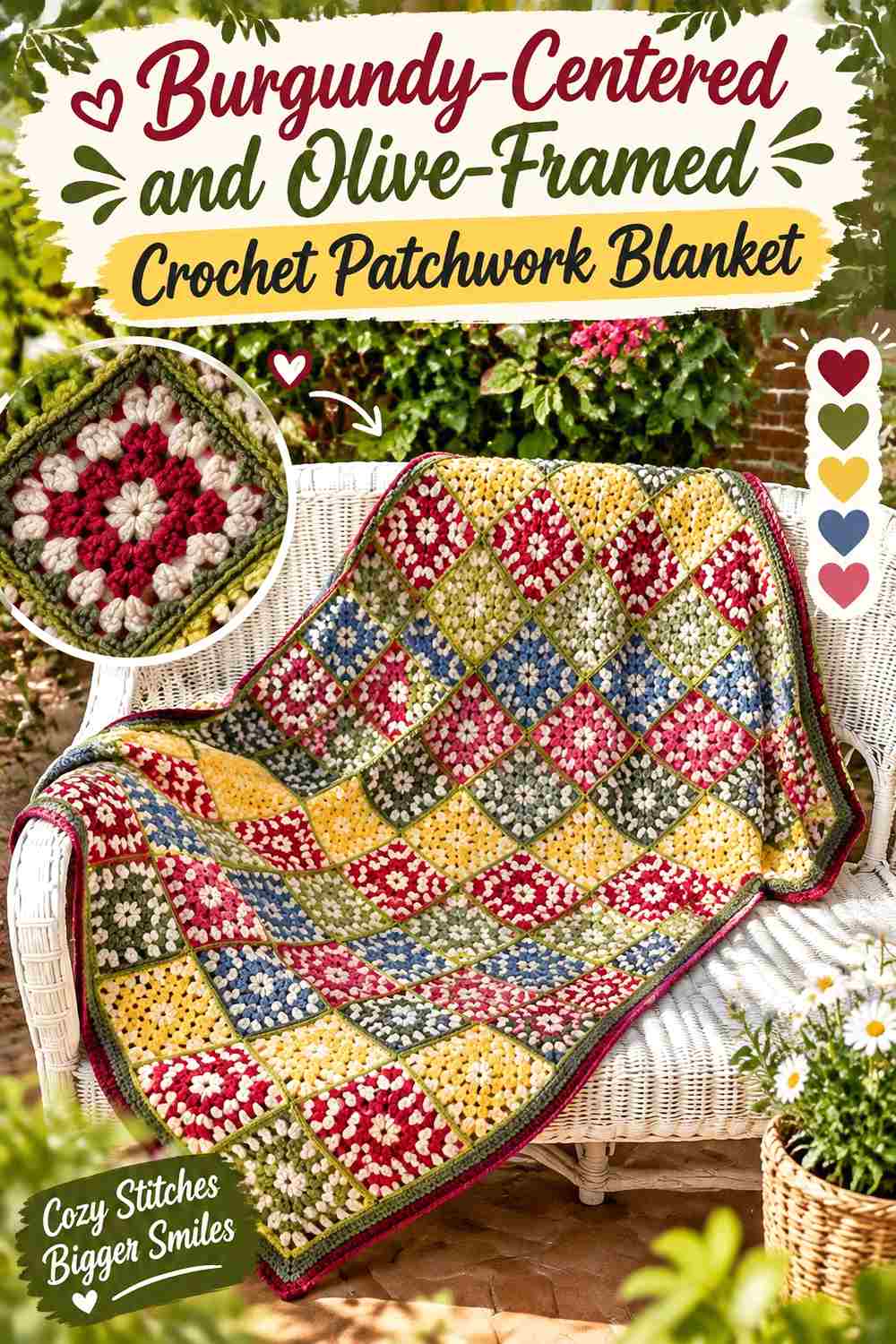
Give every granny square a Burgundy focal center and expand outward into Olive. Repeating the same center-to-frame relationship across the blanket creates strong cohesion while still allowing the patchwork grid to remain visible.
Burgundy Centers Give Olive Crochet Squares a Repeated Focal Point
A consistent Burgundy center provides a small dark anchor inside every block. This approach works particularly well when you want Burgundy distributed throughout the blanket without letting it cover half of the total surface.
Olive Frames Can Give Burgundy Centers More Breathing Room
Allow Olive to occupy several visible outer sections rather than surrounding Burgundy with only a very thin ring. More Olive space separates neighboring centers and keeps the blanket from becoming a field of closely packed dark spots.
Use Burgundy Carefully Around the Olive Blanket Border
Because Burgundy is already repeated in every motif center, the final border does not need to be heavily Burgundy. A narrow repeat can be enough to connect the edge to the interior focal points while Olive continues to lead the overall blanket.
Creator Credit: Ophelia Talks Crochet
6. Olive And Burgundy Circle Center Crochet Patchwork Blanket
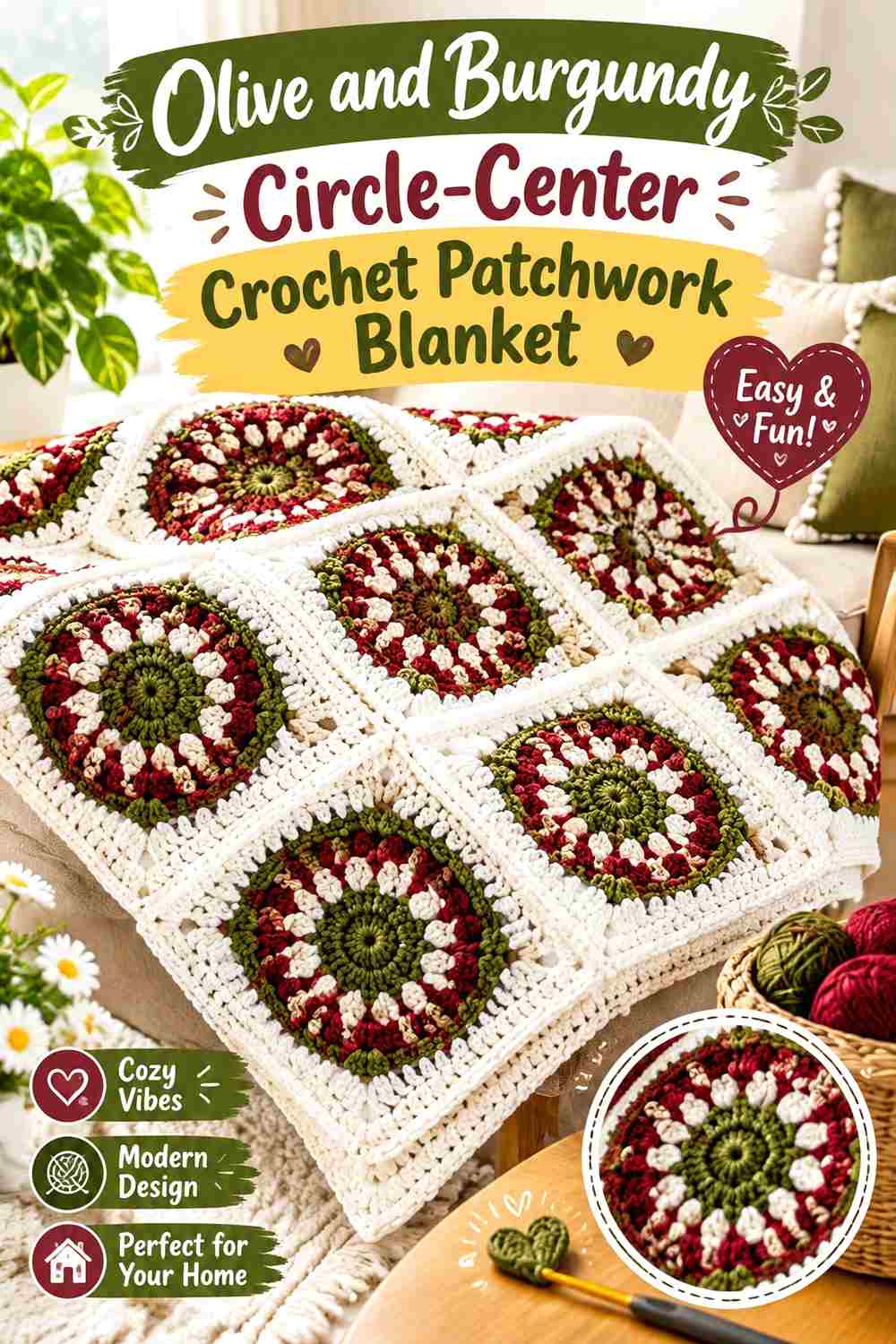
Use circular or rounded granny centers to soften the geometry of the square grid. Burgundy can fill the rounded centers while Olive squares off each motif, creating a repeating contrast between curved inner shapes and straight outer edges.
Burgundy Circular Centers Can Stand Out Inside Olive Squares
Keep Burgundy concentrated where the motif is most rounded. Once the square begins taking shape, switch to Olive so the color change reinforces the change in geometry rather than occurring at an unrelated point.
Olive Outer Rounds Can Unify Burgundy Motif Variations
If some Burgundy centers look slightly more open or textured than others, a consistent Olive outer area can still give every finished square a common visual frame. This is useful when you want patchwork character without losing order.
Burgundy Joining Can Add Definition Between Olive Frames
If the Olive outer rounds touch and begin to look like one continuous field, a restrained Burgundy join can redraw the square boundaries. Avoid making the join much wider than the Burgundy centers unless a strongly gridded look is intentional.
Creator Credit: Sirin’s Crochet
7. Olive And Burgundy Checkerboard Granny Crochet Patchwork Blanket

Turn whole granny squares into the color units by alternating solid Olive and solid Burgundy blocks. The simplicity shifts attention away from complicated motif coloring and toward the rhythm of the overall blanket layout.
Olive Squares Need a Consistent Rhythm Between Burgundy Blocks
A regular checkerboard arrangement gives both colors comparable visual importance. Lay out a full section before joining so that Olive and Burgundy alternate correctly across both rows and columns rather than creating accidental same-color pairs.
Burgundy Squares Can Look Heavier Than Olive Squares
If your Burgundy is substantially darker, equal numbers of squares may not appear visually equal. You can keep the checkerboard intact but select an Olive with enough depth to hold its own, or use Burgundy as the border so its weight feels intentionally connected around the perimeter.
Choose an Olive or Burgundy Join That Does Not Blur the Checkerboard
A join matching one set of squares can make those motifs visually expand into the seams. Decide whether that is desirable before assembly. A Burgundy join deepens the dark grid, while an Olive join allows the greener blocks to connect more strongly.
Creator Credit: justMiko
8. Burgundy And Olive Square Upon Square Crochet Patchwork Blanket
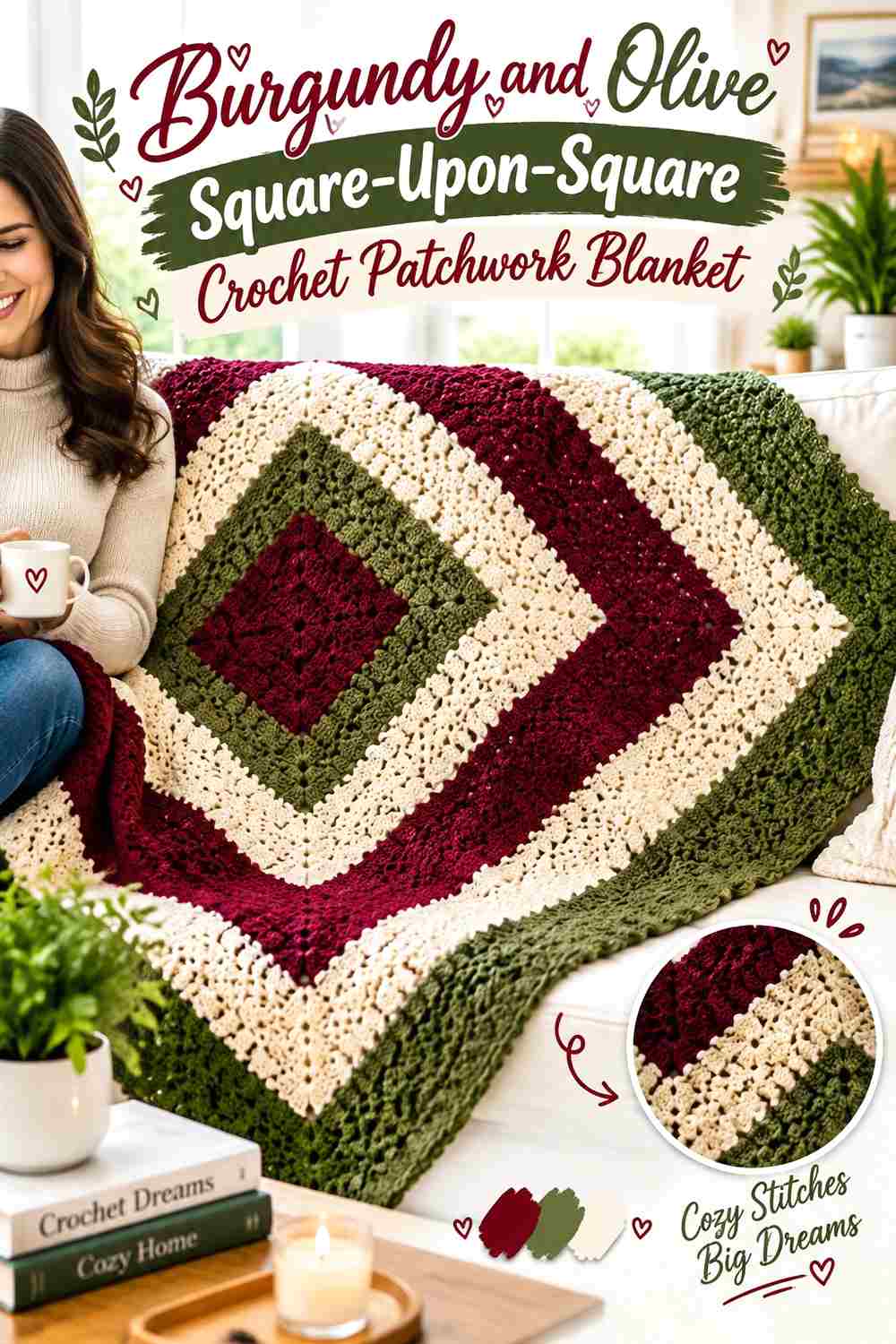
Use nested square color changes to create blocks that seem to contain smaller squares inside larger ones. Burgundy can form the inner shape while Olive expands the motif outward, then the placement can reverse in selected blocks for controlled variation.
Burgundy Inner Squares Can Anchor the Olive Outer Sections
A clearly defined Burgundy center gives each larger Olive block a visual core. Keep the point of color transition consistent from motif to motif if you want the blanket to read as an orderly repeated design.
Olive Can Take Over Before Burgundy Becomes Too Dominant
Because each round expands, a color used later occupies much more surface area. If Olive should lead overall, introduce it early enough that the outer portion of every motif carries a meaningful amount of green.
Reverse Olive and Burgundy in Selected Crochet Blocks
A few Olive-centered, Burgundy-framed squares can break the repetition without adding a third color. Place those reversed motifs according to a deliberate pattern—such as corners, diagonals, or a central cluster—rather than scattering them without a plan.
Creator Credit: The Crochet Crowd
9. Olive And Burgundy Classic Granny Crochet Patchwork Blanket

Classic granny squares let the palette do most of the editorial work. Alternate Olive and Burgundy by rounds, but change which color starts each square so the finished blanket contains two related motif types rather than dozens of identical blocks.
Olive-First Granny Squares Can Keep the Blanket Green-Led
When Olive begins the majority of motifs and returns through their broader outer rounds, it remains the dominant color even if Burgundy appears inside every square. This is a practical choice when you want the finished blanket to read Olive from a distance.
Burgundy-First Squares Add Darker Points Across the Olive Layout
Place the Burgundy-led squares at measured intervals. They can form a diagonal, central grouping, or repeated rhythm through the grid, giving the blanket direction without introducing a new motif construction.
Keep Olive and Burgundy Round Sequences Easy to Recognize
Too many one-off variations can make a two-color granny blanket appear more random than intended. Limit the project to a small set of repeatable color arrangements and decide their positions before the final joining stage.
Creator Credit: Berlin Crochet
10. Olive And Burgundy Strip Patch Crochet Blanket
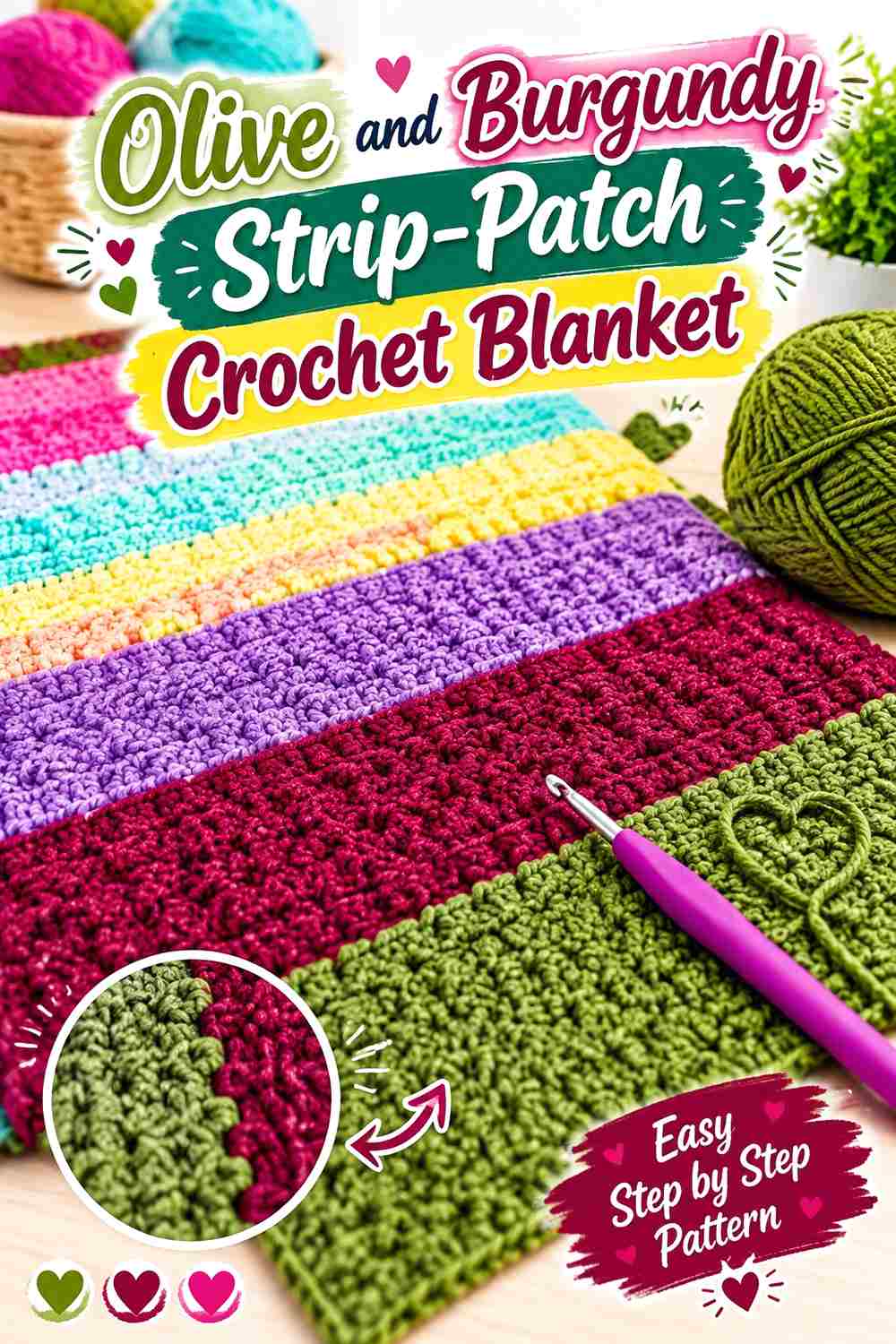
Patchwork does not have to rely entirely on individual squares. Use crocheted strips or panels as larger color units, alternating Olive-dominant and Burgundy-dominant sections to create a broader, more contemporary patchwork rhythm.
Olive Strips Can Create Longer Visual Lines Through the Blanket
A continuous Olive panel gives the eye a path across the blanket that is very different from a small-square grid. Use wider Olive strips if you want the green shade to dominate rather than alternating both colors at exactly the same width.
Burgundy Panels Can Break the Olive Blanket Into Clear Sections
Burgundy works well as the darker interruption between broader Olive areas. If the strips already contain texture, keep the Burgundy color placement relatively simple so the panel construction remains visible.
Repeat Olive and Burgundy at the Strip Joins
When the joining line itself can be seen, decide whether it should merge with one panel or create additional contrast. Using Burgundy between Olive-heavy strips creates stronger division, while Olive joining gives the overall blanket a softer green framework.
Creator Credit: Hooked by Robin
11. Burgundy And Olive Cable Square Crochet Patchwork Blanket
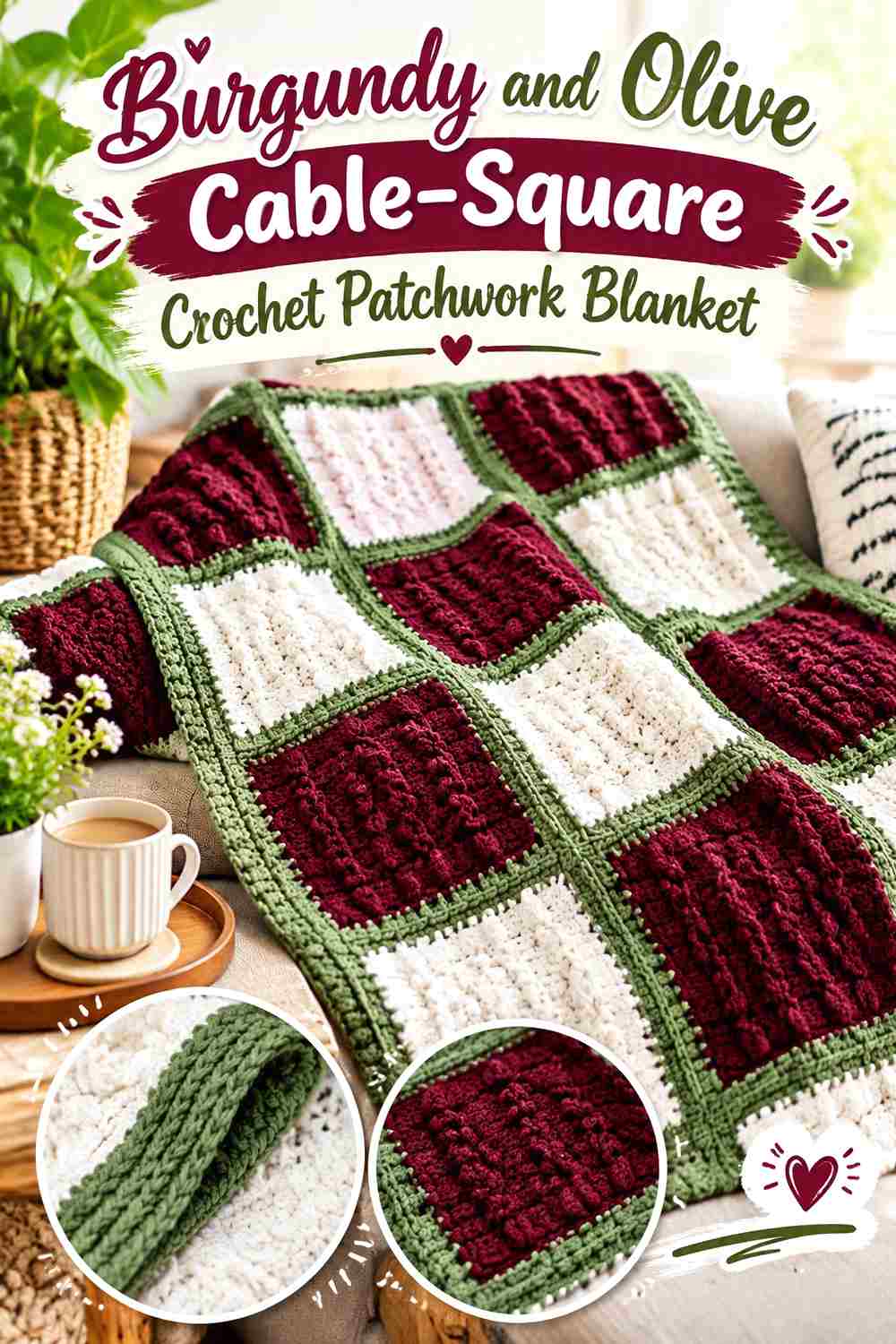
Cabled or strongly textured squares can carry the darker Burgundy especially well when Olive is used around flatter blocks or at the joins. The key is not to let dark color and heavy texture combine so completely that the cable shapes become hard to distinguish.
Burgundy Cable Squares Need Enough Light to Show Their Texture
Before making every textured block in Burgundy, work a sample and examine it in typical room lighting. Very dark Burgundy can conceal small raised details, so a slightly lighter wine shade may preserve the palette while revealing more of the cable surface.
Olive Can Give Burgundy Textured Squares Visual Space
Use Olive on neighboring blocks or around the outer portion of selected motifs. The change in both color and texture gives Burgundy cable squares clearer separation instead of placing one dark raised block directly against another.
An Olive Join Can Organize the Burgundy Cable Patchwork
A consistent Olive seam creates a visible framework around texturally busy blocks. If the join is meant to stay understated, choose an Olive value that is not dramatically lighter than the Burgundy.
Creator Credit: Rich Textures Crochet
12. Olive And Burgundy Oversized Granny Crochet Patchwork Blanket
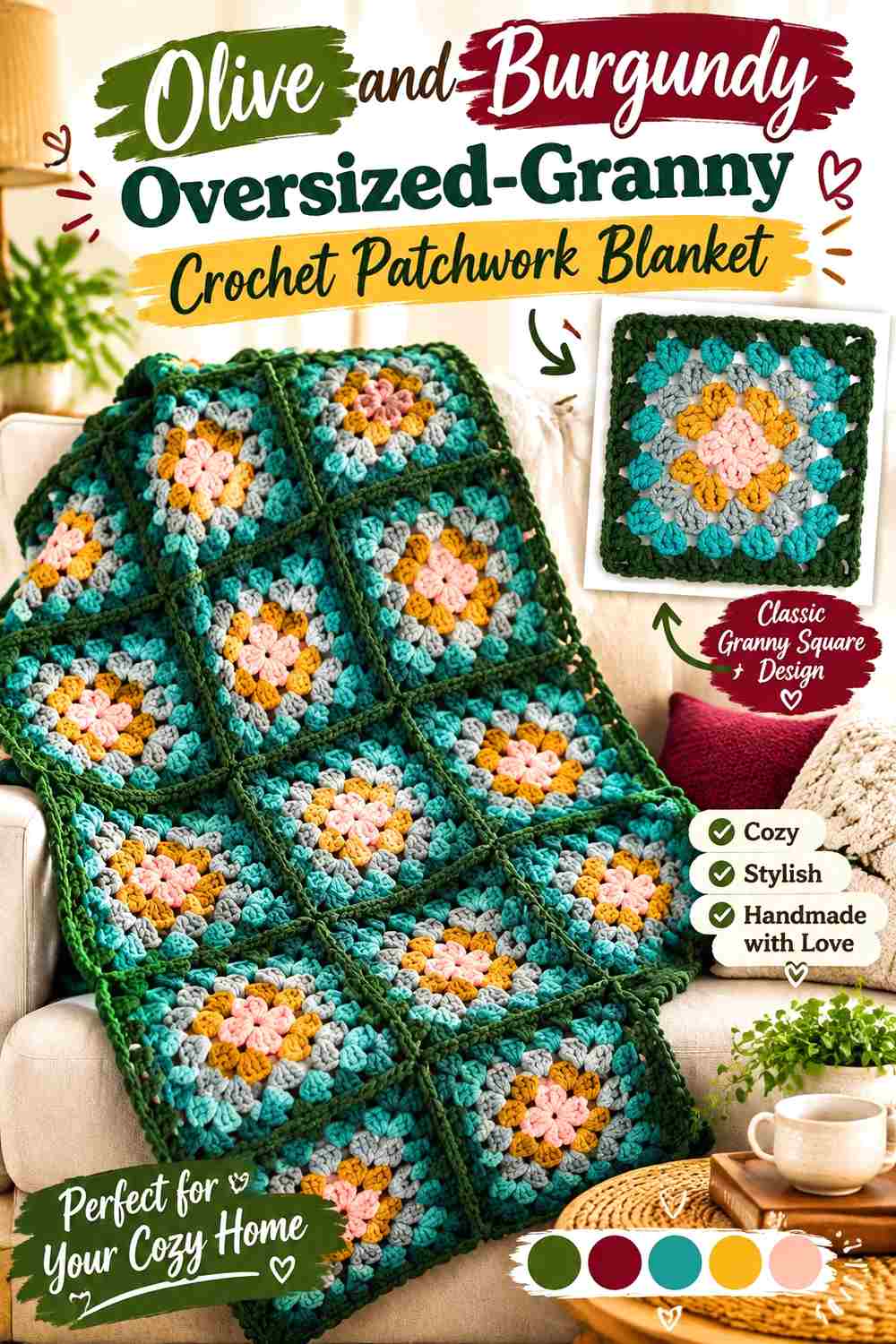
Larger granny squares reduce the number of color transitions across the blanket and make each Olive-and-Burgundy decision more noticeable. Use one oversized motif type with Olive dominating and another with Burgundy dominating, then alternate them across the layout.
Olive Needs Enough Area in Oversized Crochet Squares
Large motifs magnify color proportions. If Olive appears only in an early center round, it may occupy very little of the completed square. Use it in one of the broader outer areas if Olive should remain a major blanket color.
Burgundy Outer Sections Can Frame Olive Oversized Blocks
A Burgundy outer portion makes each Olive-centered motif look more self-contained once the squares are joined. This is effective when you want clearly visible patchwork boundaries without relying on a separate joining color.
Alternate Burgundy-Framed and Olive-Framed Crochet Squares
Reversing the frame on neighboring oversized blocks creates a large-scale checker effect. Preview several motifs together before producing the full set because big squares make any imbalance in the two-color layout much more noticeable.
Creator Credit: Daisy Farm Crafts
13. Olive And Burgundy Mixed Scale Crochet Patchwork Blanket

Mixing larger and smaller squares gives the blanket a quilt-like structure even with only two yarn colors. Use Burgundy to mark selected large focal motifs and let Olive appear more frequently across the smaller filler blocks.
Burgundy Can Identify the Largest Crochet Patchwork Squares
Placing Burgundy prominently in the larger motifs immediately establishes focal points. Because those blocks occupy more surface area, you may need fewer Burgundy-led motifs than Olive-led fillers to achieve a balanced visual result.
Olive Smaller Squares Can Connect Burgundy Focal Blocks
Use Olive repeatedly across the pieces that fit between or around the large motifs. The green sections act as visual pathways between Burgundy focal points and keep the layout from becoming a collection of isolated dark blocks.
Check Olive and Burgundy Balance by Surface Area, Not Square Count
Ten small Olive squares do not necessarily occupy more space than four much larger Burgundy squares. Lay the full arrangement out before joining and judge the actual visible area of each color rather than counting motifs alone.
Creator Credit: HanJan Crochet
14. Burgundy Sunburst And Olive Frame Crochet Patchwork Blanket
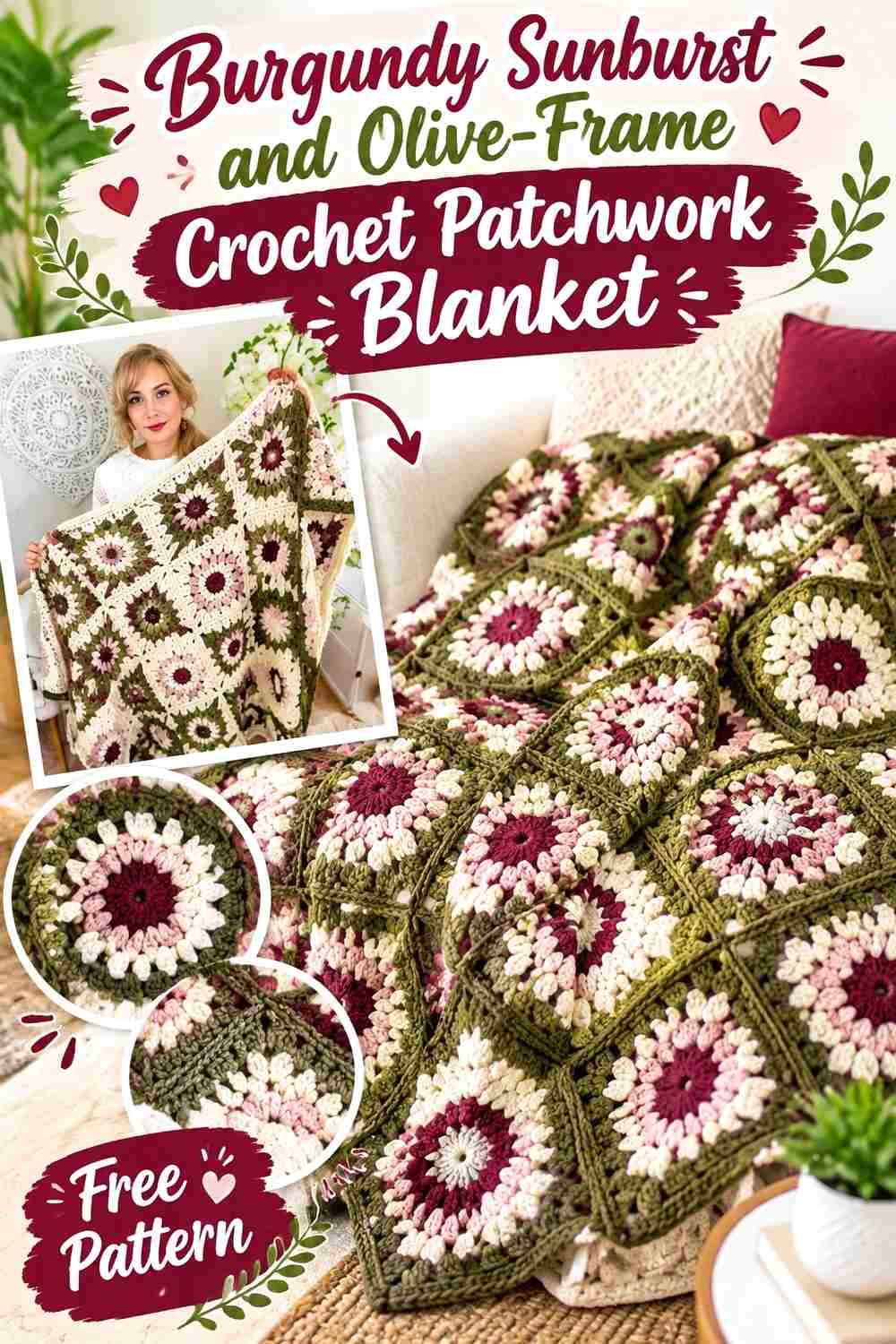
A sunburst motif naturally provides a strong center-to-edge color structure. Keep Burgundy around the radiating center and transition into Olive as the circular motif becomes a square, allowing the color placement to reinforce the motif’s geometry.
Burgundy Can Concentrate Color in the Sunburst Centers
Using Burgundy through the rounded inner area creates repeated dark focal points across the blanket. Keep the role consistent so the eye recognizes Burgundy centers as a recurring design feature rather than a random color change.
Olive Can Square Off the Burgundy Sunbursts
Shift to Olive as the motif reaches its squarer outer section. This creates a shared green framework around every Burgundy center and gives adjacent motifs a visual connection after joining.
Keep Burgundy From Crowding the Olive Frames
If the Burgundy center expands too far, the Olive outer area may become a very thin line. Decide whether you want a Burgundy-dominant flower effect or a more balanced two-color square before making the full set.
Creator Credit: TREASURIE
15. Olive And Burgundy Raised Join Crochet Patchwork Blanket

Make the seam itself a visible part of the design. Olive squares joined with Burgundy can create a raised dark grid, while reversing the relationship produces an Olive network around wine-colored blocks.
Burgundy Raised Joins Can Outline Olive Crochet Squares
Use Burgundy when you want every Olive square boundary to remain visible after assembly. The darker line can emphasize the handmade patchwork structure rather than trying to disguise where one block ends and another begins.
Olive Squares Should Stay Simple Around Burgundy Seams
If the joining method creates strong surface texture, avoid making every Olive motif equally complicated. A quieter square design allows the Burgundy grid to contribute texture without making the full blanket visually crowded.
Repeat Burgundy From the Olive Grid Into the Outer Edge
A Burgundy finishing border can close the raised grid neatly at the perimeter. If that looks too dark, return to Olive for the widest border section and keep Burgundy as a narrow connecting line.
Creator Credit: Frizzy Bee
16. Olive And Burgundy Picot Edge Crochet Patchwork Blanket
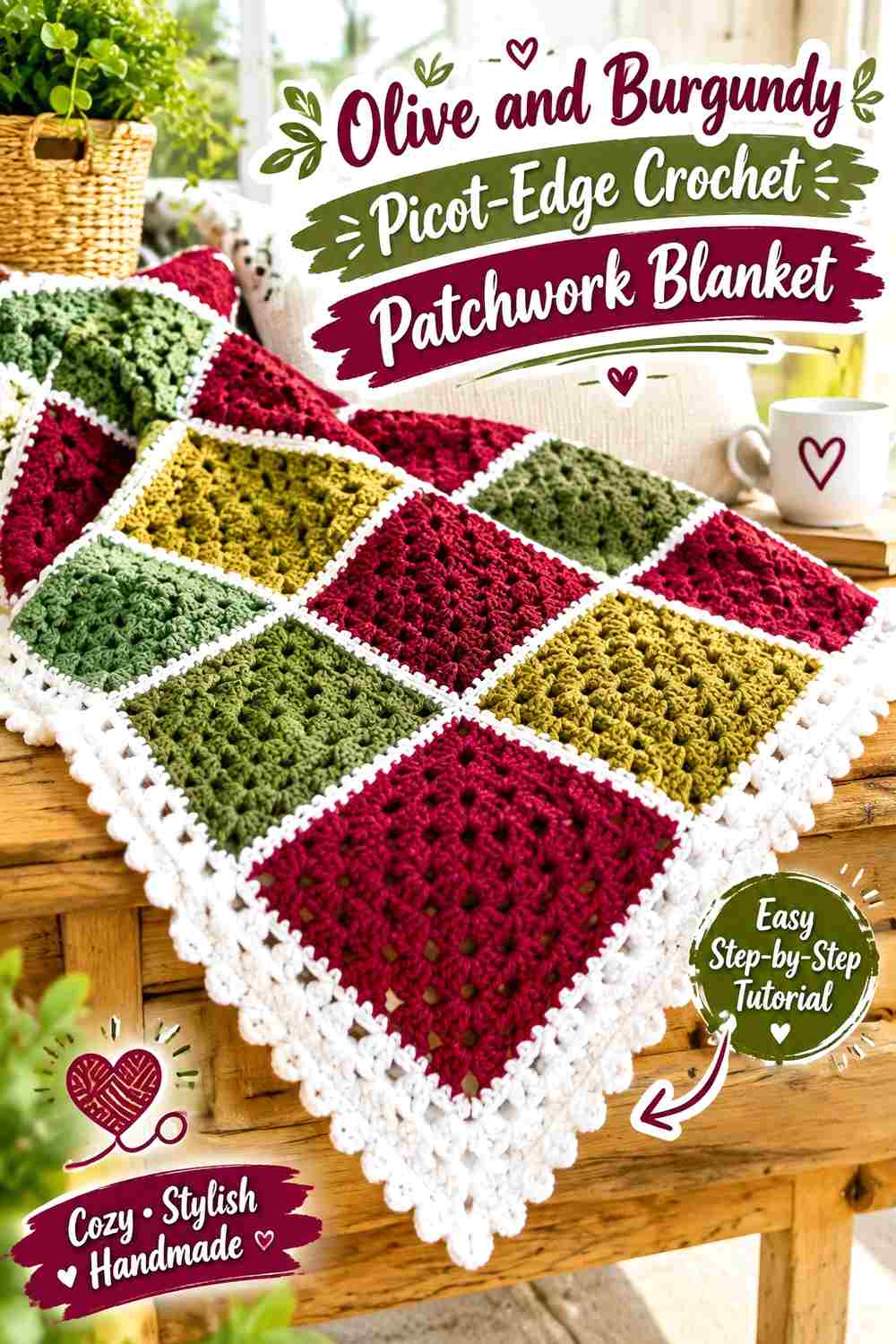
Keep the interior grid relatively structured and use the final edge to introduce smaller decorative details. Olive can dominate the square faces while Burgundy creates a narrow frame and picot-like points around the completed blanket.
Olive Can Keep the Crochet Patchwork Interior Calm
A mainly Olive interior provides enough repeated color for the blanket to feel cohesive even when square centers vary. This gives you room to use Burgundy selectively rather than dividing every motif into equal halves.
Burgundy Can Give the Olive Blanket a More Visible Perimeter
A Burgundy outer edge separates the Olive field from whatever surface the blanket rests on. When the edging contains small points or decorative details, check that Burgundy differs enough from Olive for those shapes to remain easy to see.
Repeat Burgundy Inside the Olive Patchwork Before the Border
Include Burgundy in selected motif centers, outer rounds, or joins so the final border does not introduce the color only at the last moment. Repetition makes the decorative edge feel connected to the blanket interior.
Creator Credit: BananaMoonStudio
17. Olive Sunburst And Burgundy Center Crochet Patchwork Blanket

Reverse the previous sunburst balance by keeping Burgundy tightly concentrated in the center and allowing Olive to occupy more of the expanding motif. The result is greener overall, with Burgundy appearing as a repeated point rather than a broad circular field.
Burgundy Centers Can Punctuate a Mostly Olive Crochet Blanket
Small Burgundy centers repeated across the grid create rhythm without taking over the entire surface. This is a useful approach when you want Burgundy clearly present but Olive to remain the first color noticed from a distance.
Olive Can Expand Through the Sunburst and Square Frame
Allow Olive to move beyond a thin final round and occupy a meaningful portion of each motif. The larger green area connects neighboring squares once assembled and prevents the Burgundy centers from looking too densely packed.
A Burgundy Border Can Echo the Olive Sunburst Centers
After keeping Burgundy relatively small inside each motif, a narrow Burgundy outer border can bring the dark color back at a larger scale. Keep the frame restrained if you want the Olive field to continue dominating.
Creator Credit: Maisie and Ruth
18. Olive And Burgundy Giant Block Crochet Patchwork Blanket
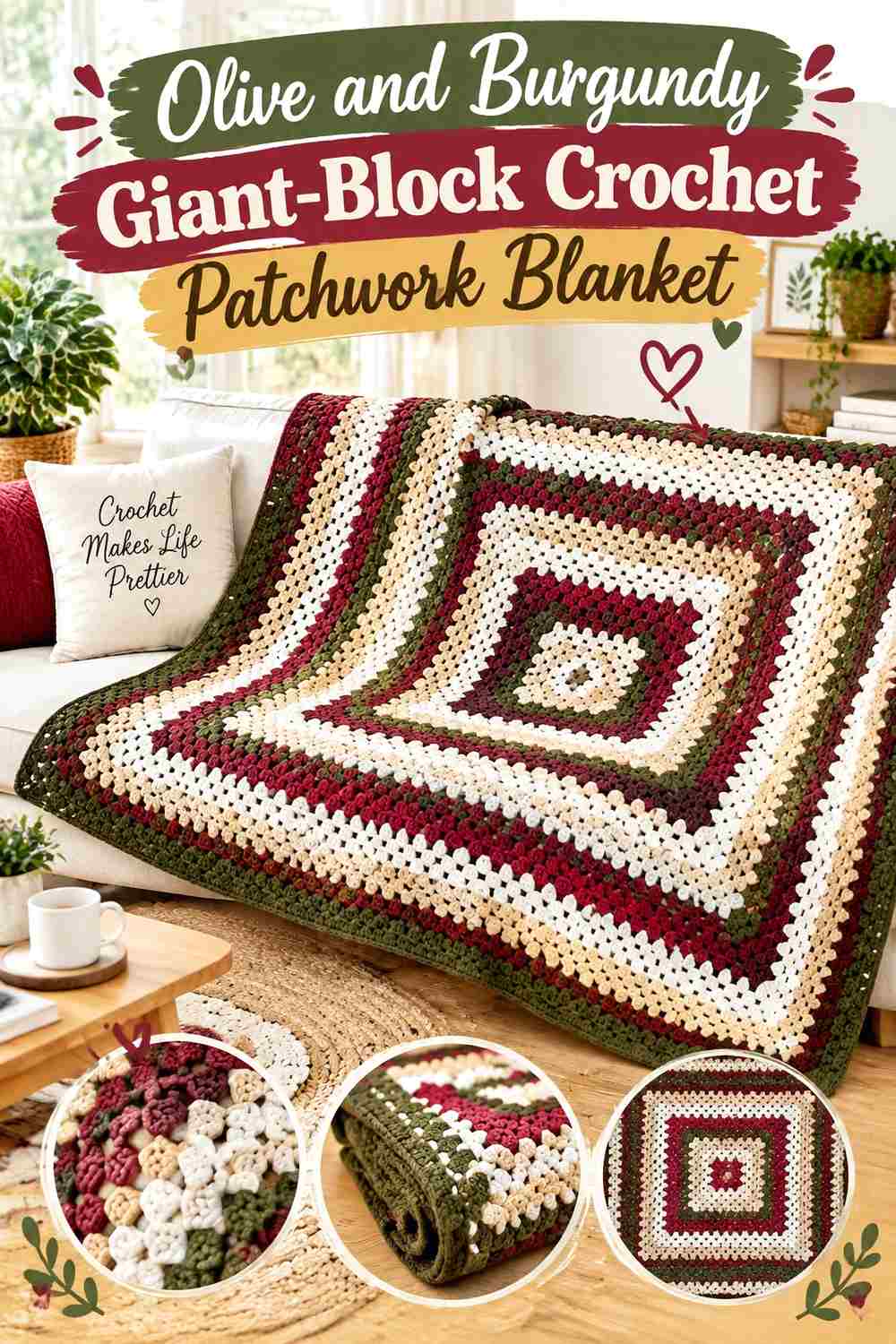
For the broadest color treatment, think of Olive and Burgundy as large blocks rather than small motif details. Expanding granny-style sections can create substantial zones of each color, giving the blanket a patchwork-inspired appearance without constant color switching.
Olive Blocks Can Occupy the Largest Crochet Blanket Areas
Use Olive across broad sections when you want a calmer main field. Large uninterrupted areas allow the green to establish the overall color direction and prevent the blanket from becoming dominated by frequent Burgundy transitions.
Burgundy Can Mark Major Changes Between Olive Sections
Introduce Burgundy in substantial bands or block-like zones rather than single narrow lines. Because the scale is larger, each color transition becomes an important part of the overall blanket composition.
Keep Olive and Burgundy Proportions Consistent at Large Scale
A small difference in row width becomes much more noticeable as the blanket expands. Step back periodically and check how much visible area each shade occupies instead of judging the balance only while working close to the fabric.
Creator Credit: Secret Yarnery
How to Choose an Olive and Burgundy Patchwork Direction
If you want the patchwork geometry to be the strongest feature, start with the star, checkerboard, square-upon-square, raised-join, or mixed-scale layouts. These approaches use Olive and Burgundy to emphasize where motifs begin, end, and connect.
For more motif detail, the Burgundy-centered, circle-center, cable-square, and sunburst options let color interact directly with stitch texture. They benefit from careful value checking because small centers and raised details can lose definition when both yarns are similarly dark.
The strip-patch, oversized-granny, and giant-block directions use larger areas of Olive and Burgundy. Those are useful when you want fewer small color changes and prefer the palette to be read in broad sections.
For an Olive-led blanket, give the green shade the outer rounds, filler squares, or widest panels. For a Burgundy-led result, reverse those roles and let Olive become the framing, joining, or accent color.
Conclusion
Olive and Burgundy work particularly well for patchwork when each shade has a recognizable role. The blanket can be Olive-led with Burgundy centers, Burgundy-led with Olive frames, evenly checkerboarded, organized around a large star, or divided into wider strips and blocks.
The main issue to watch is value contrast. If your Olive and Burgundy are both very deep, use them in larger areas or give each one a consistent structural position rather than depending on tiny color changes to define the motifs. When the shades separate more clearly, smaller centers, seams, and alternating rounds become easier to read.
Choose the layout first, decide which color dominates second, and plan the joining and border before producing the full stack of squares. Use the linked creator tutorials for their exact construction guidance, then apply the Olive and Burgundy arrangement that suits the patchwork effect you want.
Frequently Asked Questions
Should Olive or Burgundy dominate a crochet patchwork blanket?
Either can lead. Olive dominance gives the blanket a greener overall field, while Burgundy dominance produces a darker wine-toned result. Decide which color should occupy the outer rounds, larger squares, or broadest panels, because those areas usually influence the finished color balance more than small motif centers.
How can I make Olive and Burgundy crochet squares easier to distinguish?
Check their light-dark values before making the complete set. If the colors look almost identical in grayscale, choose a somewhat lighter version of one shade or separate them through larger blocks, consistent outer rounds, or clearly defined joining lines.
Should I use Olive or Burgundy for joining granny squares?
Burgundy joins make Olive squares look more distinctly outlined and can create a strong dark grid. Olive joins can soften Burgundy-heavy motifs and spread the green more evenly throughout the blanket. Choose the join according to which color needs more repetition.
Can every Olive and Burgundy patchwork square use a different color arrangement?
It can, but a limited number of repeatable arrangements usually gives the blanket stronger cohesion. For example, make one Olive-centered design and one Burgundy-centered reverse, then repeat those two layouts across the grid rather than improvising every square independently.
Do I need a third neutral with Olive and Burgundy?
Not necessarily. Olive and Burgundy can carry the full blanket when their placement provides enough separation. If you decide to add a neutral, give it a defined role such as a narrow join or border rather than allowing it to compete equally with the two main colors.
Should the crochet blanket border be Olive or Burgundy?
Use Burgundy when you want a darker, more defined frame around an Olive-heavy interior. Choose Olive when the central patchwork already contains substantial Burgundy and you want the edge to feel lighter. Repeating whichever color appears in the joins can also make the border feel connected to the grid.
How can I substitute different Olive or Burgundy yarn colors?
Preserve the relationship between the two shades rather than trying to match a specific commercial name. If your design depends on Burgundy centers standing out from Olive frames, choose replacements that retain that difference in lightness. For a softer tonal blanket, select two muted shades with closer values while keeping one recognizably green and the other recognizably wine-red.