A button closure gives a crochet winter dog coat another useful place to plan color. Instead of treating the coat as one uninterrupted surface, you can let the back panel carry the dominant shade while a belly strap, side flap, placket, collar, or button band introduces a supporting color.
That arrangement is especially useful with winter palettes. Navy can cover most of the back while oatmeal makes the buttoned underside easier to distinguish. Burgundy can lead while cream defines a side closure. Forest green can stay visually dominant while camel appears only at the collar and button band.
The tutorials credited below provide crochet dog coat or sweater construction references. Some already use buttoned components, while others provide a garment base that should only be adapted to a button closure when the construction allows it. Follow the original tutorial for fit and construction rather than adding an opening where it would compromise the garment.
Quick List:
- Navy and Oatmeal Crochet Winter Dog Coat With Buttoned Belly Band
- Charcoal and Cranberry Crochet Winter Dog Coat With Side Buttons
- Forest Green and Camel Crochet Winter Dog Coat With Contrast Button Strap
- Burgundy and Cream Crochet Winter Dog Coat With Buttoned Chest Flap
- Slate Blue and Soft Gray Crochet Winter Dog Coat With Tonal Button Band
- Chocolate Brown and Rust Crochet Winter Dog Coat With Side-Flap Closure
- Deep Teal and Oatmeal Crochet Winter Dog Coat With Buttoned Underside
- Plum and Dusty Rose Crochet Winter Dog Coat With Contrast Button Placket
- Black and Mustard Crochet Winter Dog Coat With Buttoned Belly Strap
- Moss Green and Cream Crochet Winter Dog Coat With Light Button Band
- Denim Blue and Burgundy Crochet Winter Dog Coat With Two-Tone Closure
- Taupe and Sage Crochet Winter Dog Coat With Muted Button Strap
- Winter White and Deep Red Crochet Winter Dog Coat With Red Button Trim
Use Color Contrast to Make a Crochet Dog Coat Button Closure Easy to Read
A button closure can become part of the coat’s color structure instead of disappearing into the body. If the main back panel is dark, a noticeably lighter belly strap or button band creates a clear visual boundary. On a lighter coat, a darker closing section can provide the same definition.
The colors do not need to be opposites. Navy and oatmeal create strong light-and-dark separation, while taupe and sage produce a much quieter distinction. Decide whether you want the closure to become a visible design feature or blend into the coat before assigning its color.
This is also useful when several elements meet in a small area. If the collar, chest section, strap, and edging all use different colors, the front of a small dog coat can become unnecessarily busy. Repeating one supporting color across two of those areas usually creates a more connected result.
Let the Main Winter Color Stay Continuous Across the Dog Coat Back
The back is normally the largest visible area of a dog coat, making it the clearest place for a dominant winter shade. Keeping that area mostly one color also allows crochet texture to remain visible instead of breaking it into many small contrasting sections.
Move the second color to parts that already have a structural reason to look different: a collar, buttoned belly band, side flap, chest strap, or edging. That lets color reinforce the coat’s construction.
When two dark winter shades are paired, check their values before using one for a narrow closure. Burgundy against charcoal or deep teal against navy may look different in the skein but merge when used in small areas. Increase the size of the contrasting section or introduce a light neutral when clearer separation is important.
Plan Button Color and Placement With Dog-Coat Safety in Mind
Buttons should function as closures before they function as decoration. Positioning and quantity should follow the coat construction and the dog’s fit rather than a desire to fill an empty-looking area with more buttons.
Any button or other detachable component should be secured carefully and checked regularly. If a dog tends to chew, pull at clothing, or object to wearing garments, a buttoned coat may not be an appropriate unsupervised option.
Color can still help without adding extra embellishments. A contrasting crochet strap, border, or placket can draw attention to the closure while keeping the number of attached pieces limited.
1. Navy and Oatmeal Crochet Winter Dog Coat With Buttoned Belly Band

Navy works well as the dominant color across a broad winter dog-coat back, while oatmeal gives the underside closure enough lightness to remain clearly separate. Keep navy across the main panel and let oatmeal appear at the belly band, collar edge, or another small finishing area. This creates a dark winter palette without allowing the closure to disappear into the body.
Navy Keeps the Crochet Dog Coat Back Visually Continuous
Use navy across the largest back section if stitch texture is an important part of the coat. A broad single-color field gives raised or ribbed details more room to show than frequent oatmeal stripes would.
Avoid interrupting the navy every time the garment changes direction. Saving oatmeal for the closure and one repeated trim area produces a stronger hierarchy.
Oatmeal Makes the Navy Buttoned Belly Band Easier to Identify
An oatmeal belly band creates a clear light section beneath the navy body. That contrast can make the closing component feel intentional rather than looking like an extension of the main panel.
Repeat a restrained amount of oatmeal near the neckline if you want the lower closure to connect visually with the top of the coat.
Navy and Oatmeal Should Not Compete Around Every Edge
Outlining the collar, legs, back, belly band, and tail edge in oatmeal can gradually make the supporting neutral too prominent. Choose two or three places where the contrast contributes to the coat’s shape.
If the buttoned belly band is already a major oatmeal feature, navy edging around nearby areas can keep the lower part of the coat from becoming overly light.
Creator Credit: Marly Bird
2. Charcoal and Cranberry Crochet Winter Dog Coat With Side Buttons

Charcoal creates a neutral winter base that gives cranberry room to act as a concentrated accent. Rather than dividing the back equally between both colors, keep the large coat panel charcoal and introduce cranberry around a side closure, neckline, or lower border. This makes the button area a noticeable feature without turning the coat into a striped design.
Charcoal Gives Cranberry a Stable Crochet Dog Coat Background
A mostly charcoal back allows cranberry to appear stronger even when it covers much less surface. This is useful on a buttoned side flap because the closure can be visually important without requiring a large red section.
Keep textured back stitches charcoal when you want the surface pattern to remain uninterrupted.
Cranberry Can Define the Charcoal Side-Button Closure
Place cranberry along the closing flap or narrow placket when the buttons sit on the coat’s side. The color shift signals that this area has a different function from the main back.
Repeating cranberry at the collar creates a second reference point and prevents the side accent from looking isolated.
Creator Credit: Heart Hook Home
3. Forest Green and Camel Crochet Winter Dog Coat With Contrast Button Strap

Forest green gives this coat an earthy dark base, while camel provides a warmer supporting color around the closure. The combination works best when green occupies most of the back and camel is concentrated in defined structural sections rather than scattered through tiny stitches.
Forest Green Should Lead Across the Crochet Winter Dog Coat
Use forest green from the shoulders through most of the back to establish a clear main field. That continuous section also keeps the coat visually calmer if the crochet fabric has pronounced texture.
Camel can then be introduced where the coat opens or fastens rather than appearing as repeated narrow stripes.
Camel Can Highlight the Forest Green Button Strap
A camel strap against forest green is large enough to register as a deliberate supporting color. This is more effective than using camel only around individual buttons, where the yarn color may be too minor to influence the overall palette.
If the coat includes a collar, a narrow camel repeat there can connect the closure to the neckline.
Forest Green Can Return Around a Camel Closure Edge
If the camel button section begins to look too separate from the coat, edge part of it in forest green. Repeating the dominant color within the closing area helps integrate the strap without reducing its contrast.
Creator Credit: Last Minute Laura
4. Burgundy and Cream Crochet Winter Dog Coat With Buttoned Chest Flap
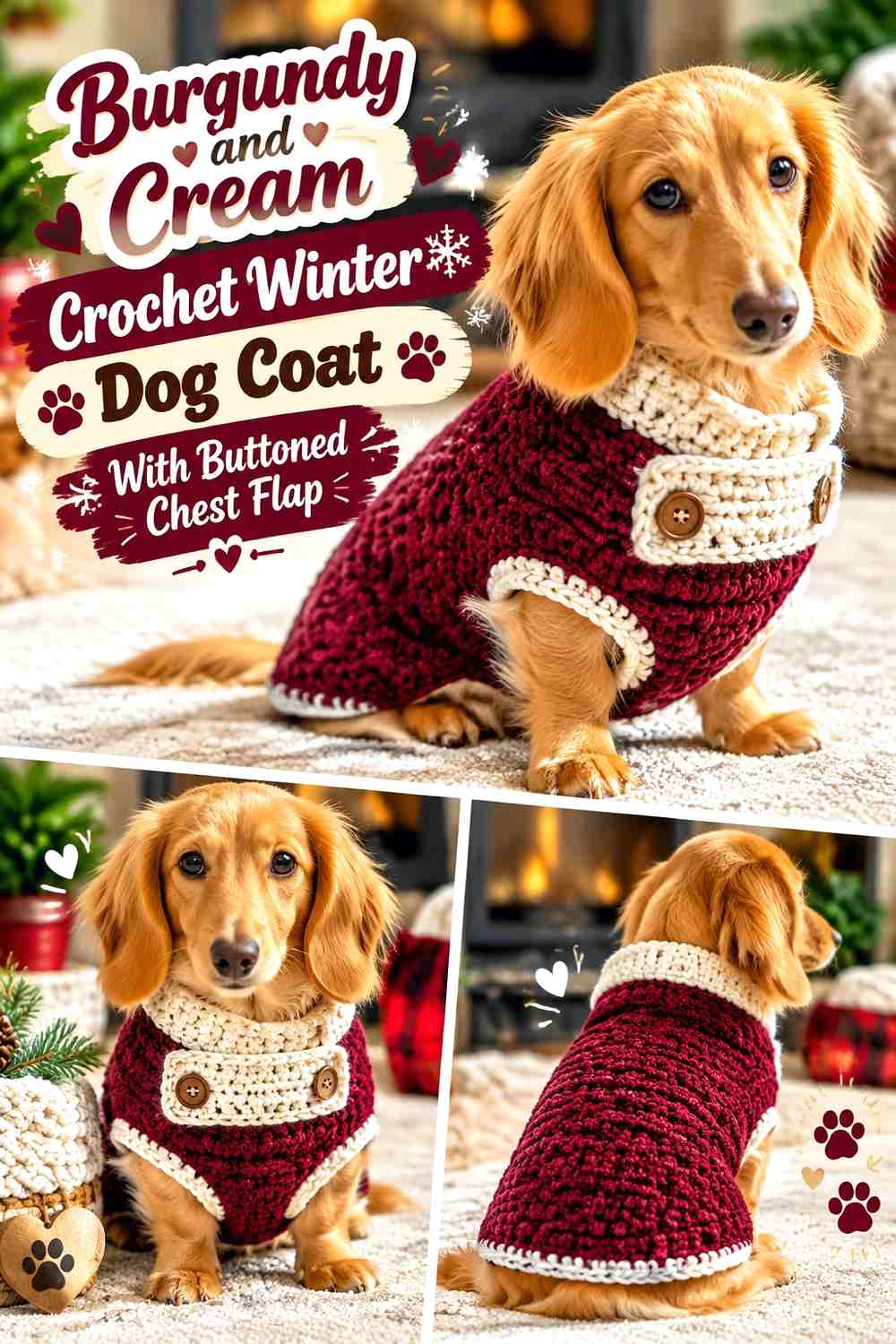
Burgundy and cream provide clear value separation without relying on a bright palette. Burgundy can cover the back and shoulders while cream defines the chest flap or another buttoned lower section. The lighter closure is especially useful when you want the coat’s construction to remain visually obvious from the side.
Burgundy Gives the Crochet Dog Coat a Strong Main Field
Let burgundy carry the largest sections instead of alternating it evenly with cream. A solid burgundy back creates enough visual weight for the color to remain dominant after a cream closure is added.
Keep detailed back texture in burgundy if frequent color changes would distract from it.
Cream Clearly Separates the Burgundy Buttoned Chest Flap
Cream can mark the transition between the back and fastening section. Because it is much lighter than burgundy, it does not need a large amount of surface to become noticeable.
Use cream strategically around the actual closing component rather than tracing every coat edge.
Burgundy Can Repeat at the Cream Flap Edge
A narrow burgundy edge around a cream closure reconnects the light section with the main body. This is useful if a large cream flap otherwise appears visually detached.
Creator Credit: Crochet with Tiffany
5. Slate Blue and Soft Gray Crochet Winter Dog Coat With Tonal Button Band
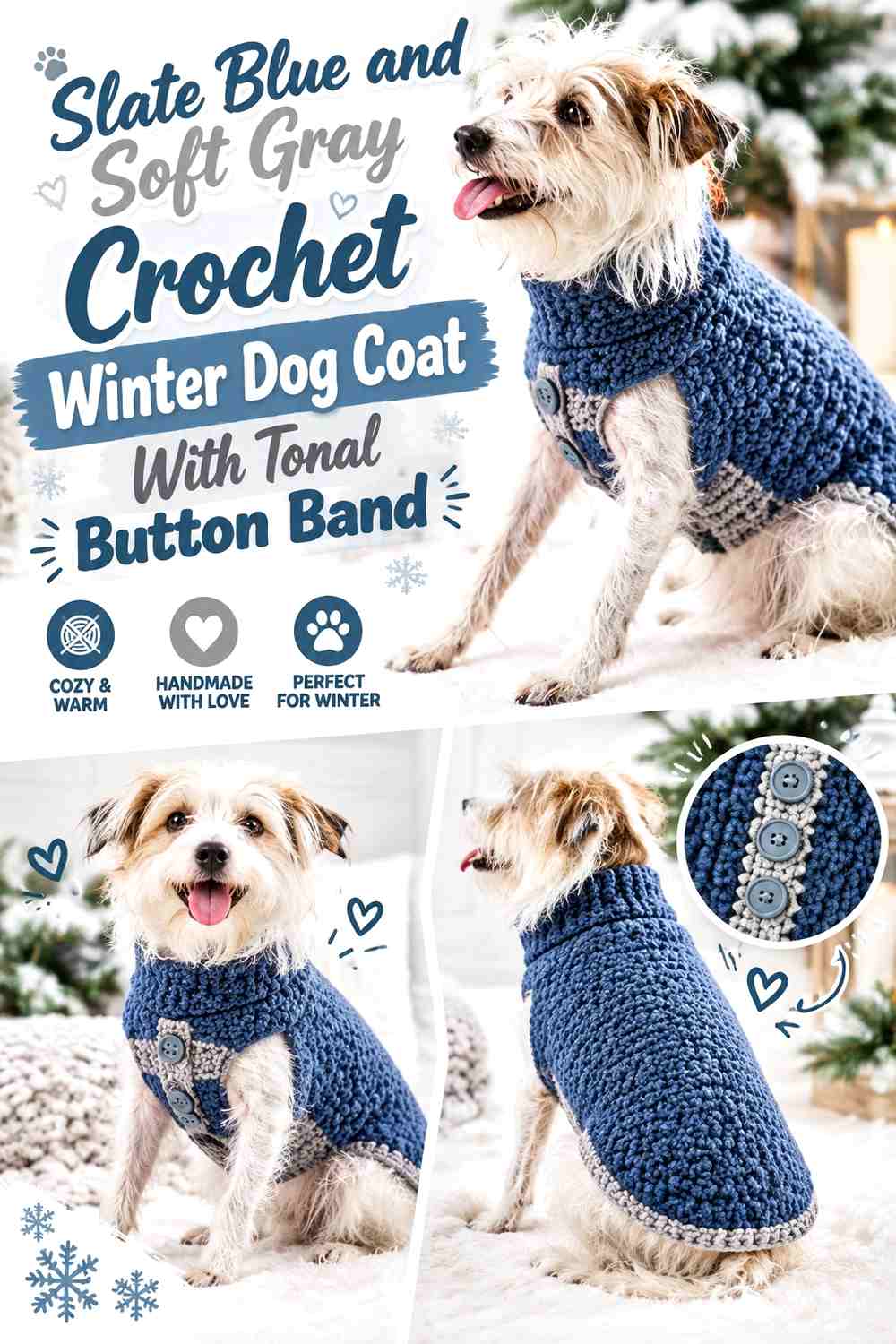
Slate blue and soft gray create a lower-contrast winter palette for readers who do not want the button closure to become the strongest visual element. Make slate blue dominant and place soft gray around the button band, collar, or selected edging.
Slate Blue Keeps the Crochet Dog Coat Calm and Unified
A broad slate-blue back keeps the garment largely monochromatic from above. This is a useful approach when the coat has visible stitch texture and you want the texture to carry more attention than the color changes.
Use gray in specific areas instead of alternating it across the whole body.
Soft Gray Gives the Slate Blue Button Band Subtle Separation
Soft gray can distinguish a button band without creating the sharp outline that white might produce. It works especially well on a side or underside closure where you want a visible but restrained transition.
If the blue and gray are extremely similar in value, broaden the gray area rather than adding another unrelated color.
Creator Credit: Yarnspirations
6. Chocolate Brown and Rust Crochet Winter Dog Coat With Side-Flap Closure

Chocolate brown and rust create a warm, earthy winter direction. Chocolate can anchor the back panel while rust brings more visibility to a side flap or buttoned strap. Because both shades are warm and relatively deep, their placement should be simple enough for the coat structure to remain readable.
Chocolate Brown Can Ground the Crochet Dog Coat Back
Keep chocolate brown across most of the upper coat so the darkest color provides a stable background. This also leaves enough uninterrupted area for crochet texture to show.
A large brown surface makes a smaller rust closure more noticeable without requiring a third color.
Rust Brings Attention to the Chocolate Brown Side Flap
Use rust on a whole closing flap or strap rather than in tiny scattered details. A substantial section gives the warmer accent enough presence to distinguish the button area.
If rust is also used at the collar, keep the lower edge mostly chocolate so the supporting color does not begin outlining every boundary.
Chocolate Brown Can Frame a Rust Button Section
A chocolate edge around the rust closure can visually connect it back to the main panel. This is particularly helpful on broad button flaps, where an unbroken rust section may otherwise feel separate from the coat.
Creator Credit: Left Hand Crochet & Knit Tutorials
7. Deep Teal and Oatmeal Crochet Winter Dog Coat With Buttoned Underside
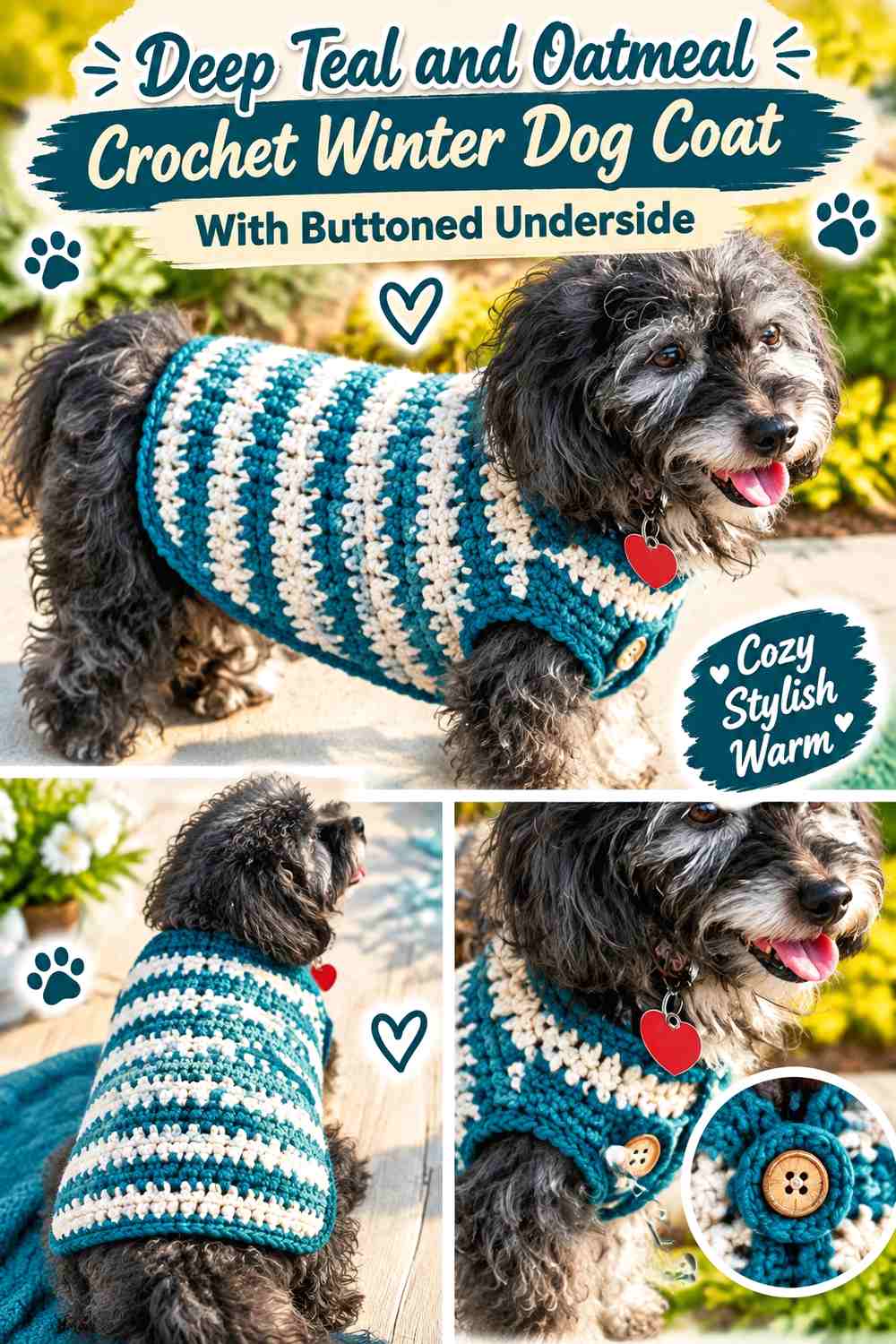
Deep teal provides a rich main color while oatmeal gives the underside closure much stronger value contrast. Keep teal across the visible upper body and use oatmeal where the coat fastens beneath the chest or belly. The result remains dark from above while the construction has a clearly defined lighter component.
Deep Teal Should Dominate the Crochet Dog Coat Back
A continuous teal panel helps the coat maintain a strong single-color identity. Avoid bringing oatmeal repeatedly through the center if the back contains raised or patterned stitches you want to preserve visually.
Teal can also remain at the collar to create an uninterrupted upper silhouette.
Oatmeal Can Clarify the Deep Teal Buttoned Underside
A light belly or chest strap is easy to distinguish from a dark teal body. The color change follows an actual functional part of the garment instead of creating decoration without a structural purpose.
Repeat oatmeal once near the top if the underside feels disconnected, but keep the repetition narrow.
Creator Credit: The Crochet Crowd
8. Plum and Dusty Rose Crochet Winter Dog Coat With Contrast Button Placket
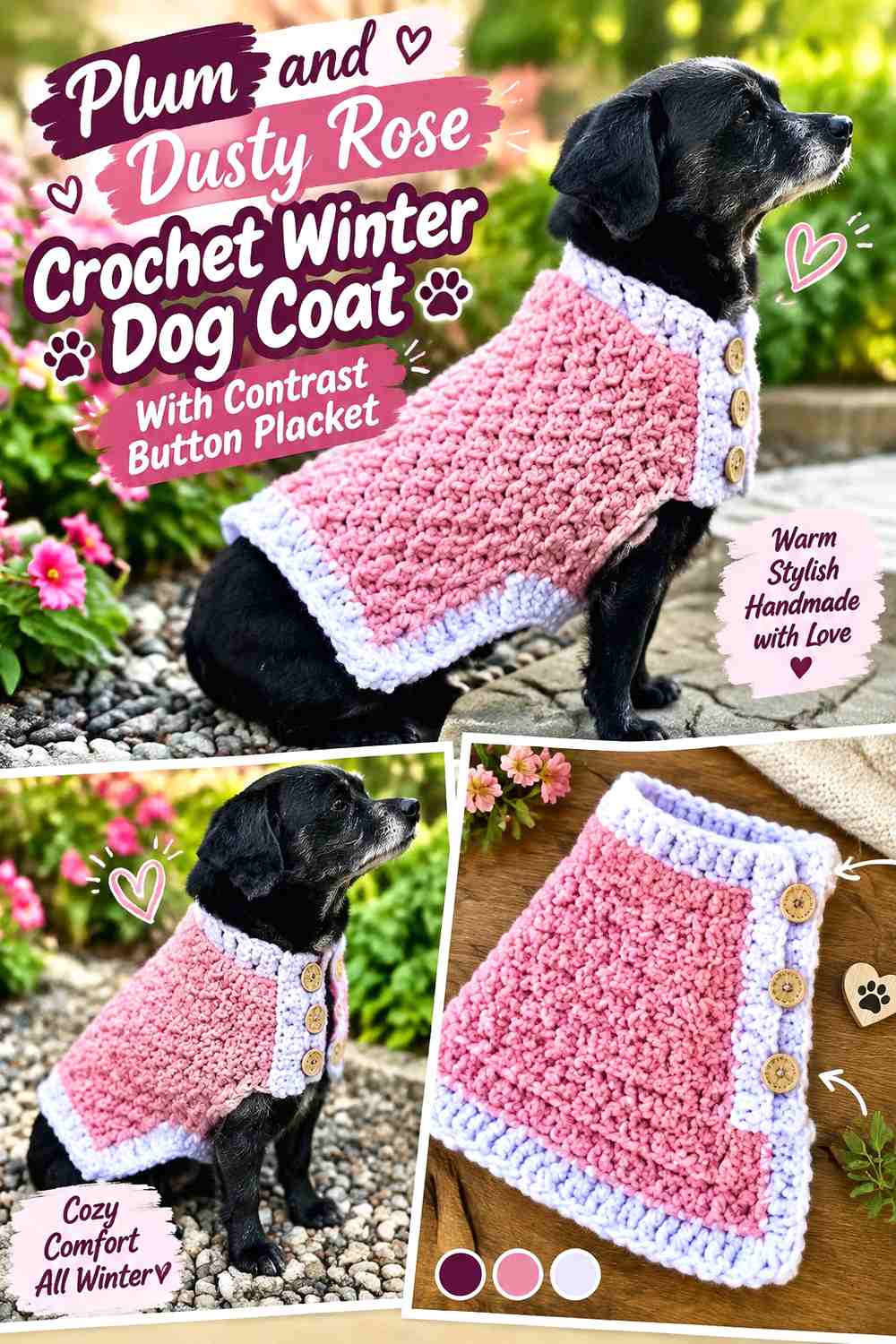
Plum and dusty rose stay within the same broad color family but offer different visual depths. Plum can cover the body, while dusty rose softens the button placket and selected trim. This gives the coat a tonal appearance with more differentiation than a single-color version.
Plum Gives the Crochet Winter Dog Coat Its Darkest Anchor
Use plum across the large back panel and shoulders. Its deeper value can establish the main coat shape while dusty rose remains secondary.
Keeping the main texture plum also prevents the coat from becoming visually fragmented by too many tonal changes.
Dusty Rose Softens the Plum Button Placket
Dusty rose works well along a side or chest placket because it provides contrast without leaving the plum family completely. Give the rose enough width to be recognized rather than reducing it to an almost invisible line.
If the exact dusty rose is unavailable, preserve the relationship by choosing a softened pink that remains noticeably lighter than the plum.
Plum Can Repeat Around Dusty Rose Closure Edging
Return to plum at the outer edge of a dusty-rose button section if you want a more defined frame. The darker outline keeps the supporting pastel-looking shade connected to the main winter palette.
Creator Credit: Crochet Cuties Creations by Esther
9. Black and Mustard Crochet Winter Dog Coat With Buttoned Belly Strap

Black and mustard offer the strongest light-dark and saturation contrast in this collection. Because mustard is visually assertive, it works better as a controlled closure color than as an equal partner across the entire coat. Use black for the body and let mustard identify the belly strap, collar accent, or narrow border.
Black Gives the Mustard Crochet Button Strap Maximum Separation
A mustard closure will be immediately distinct against a black body, so it does not need to cover a large part of the coat. Concentrate the color around the functional strap instead of adding mustard everywhere.
This keeps the coat predominantly dark while preserving a clear visual cue around the fastening area.
Mustard Should Repeat Sparingly on the Black Dog Coat
A small mustard repeat at the collar can make the palette feel connected, but adding the same strong contrast around every leg opening and edge may make the garment look overoutlined.
Let black return between mustard details so each accent has space.
Creator Credit: Maria’s Blue Crayon
10. Moss Green and Cream Crochet Winter Dog Coat With Light Button Band
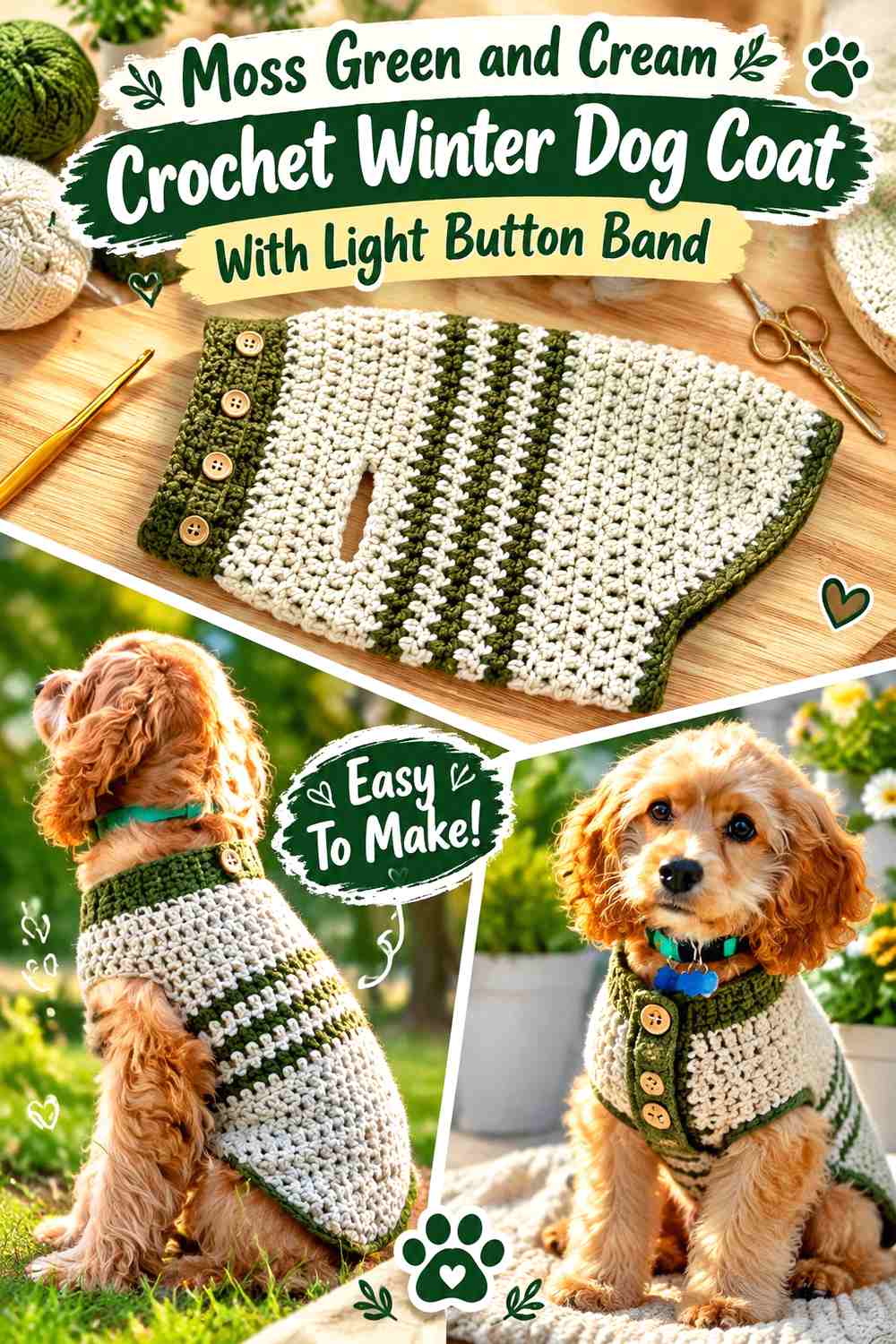
Moss green creates a muted winter base while cream lightens the button area. Compared with forest green and camel, this combination has a softer overall appearance. Use moss across the back and cream on one purposeful closure section rather than spreading the neutral evenly through the entire coat.
Moss Green Works Best Across a Broad Crochet Dog Coat Surface
A larger moss field makes the muted green recognizable and gives textured crochet room to show. If cream interrupts it too often, the coat can lose its quiet, earthy direction.
Keep the main back and most outer edging green when you want moss to remain dominant.
Cream Can Separate the Moss Green Button Band
Use cream where the fastening section meets the body. The lighter value helps readers see the band as a deliberate component without introducing a brighter hue.
A small cream collar edge can echo the closure if additional repetition is needed.
Moss Green Can Control How Much Cream Appears
If the light band starts to dominate a small coat, bring moss back around the lower edge or outer side of the strap. The dominant green should still occupy noticeably more visual space than cream.
Creator Credit: it’s erin b.
11. Denim Blue and Burgundy Crochet Winter Dog Coat With Two-Tone Closure

Denim blue and burgundy create a two-color winter coat without relying on a neutral. Because both colors can sit in a medium-to-dark range, assign them clearly different jobs. Denim can cover the back while burgundy identifies the collar and buttoned closure.
Denim Blue Should Hold the Largest Crochet Dog Coat Area
Use denim across the back and main body so it becomes the clear visual base. A substantial solid section is particularly useful if the coat has a textured stitch pattern.
Avoid alternating denim and burgundy in equal-width stripes unless you specifically want the button closure to become less distinct.
Burgundy Can Connect the Denim Button Closure to the Collar
Use burgundy on the button strap or side flap and repeat it at the neckline. Those two separated placements create a deliberate relationship between the top and lower parts of the coat.
Because denim and burgundy can be similar in darkness, check them side by side before using burgundy in very narrow details.
Creator Credit: Crochet It
12. Taupe and Sage Crochet Winter Dog Coat With Muted Button Strap
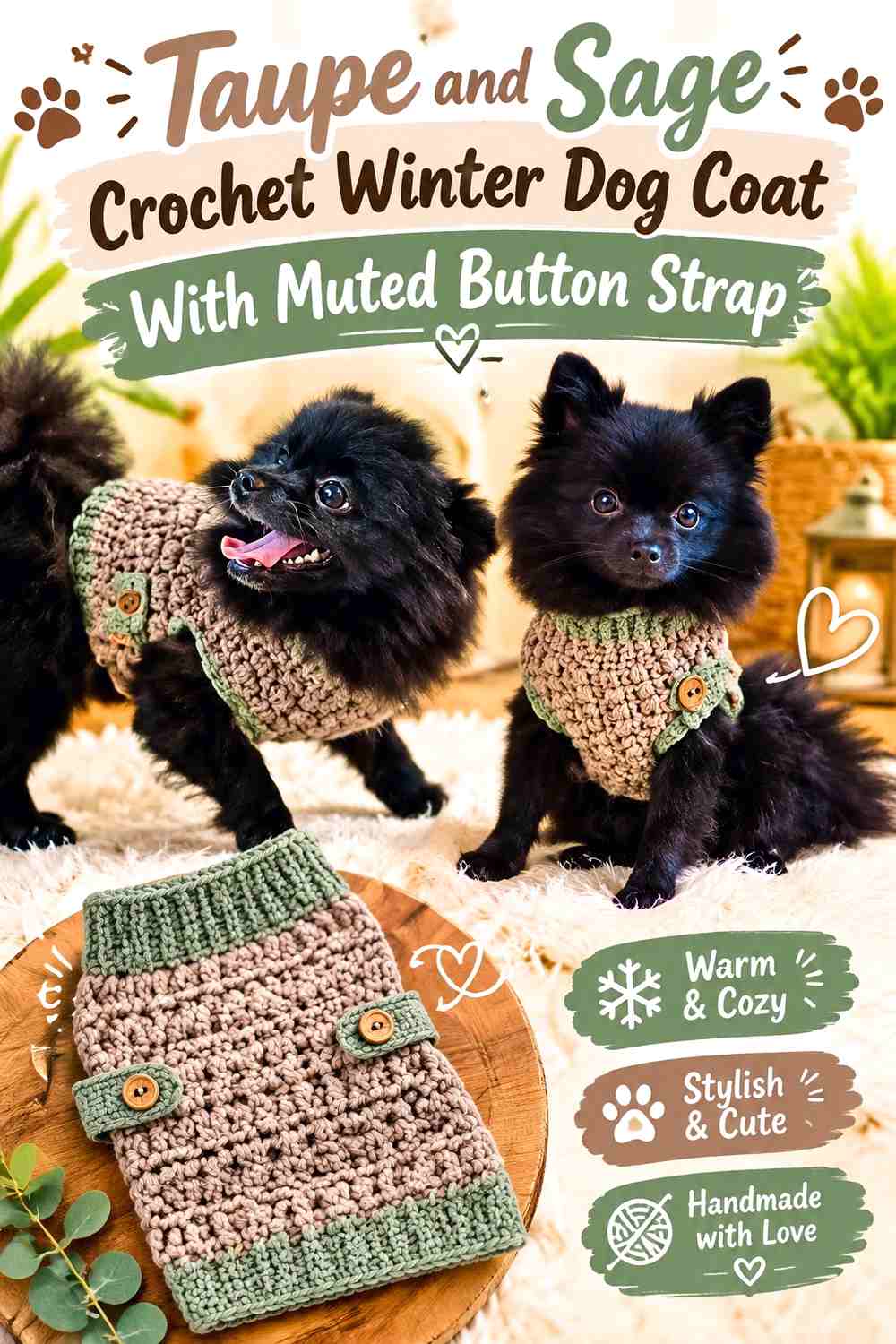
Taupe and sage create the most understated palette in the collection. Neither color needs to become a sharp accent. Instead, taupe can form the main coat while sage identifies the button strap, collar, or selected edging through a gentle hue change.
Taupe Keeps the Crochet Dog Coat Neutral-Led
Make taupe the largest surface if you want the coat to remain neutral at first glance. A broad back panel gives sage room to function as a quiet secondary color rather than turning the coat into an equal two-color design.
This arrangement also gives textured stitches a relatively consistent background.
Sage Can Mark the Taupe Button Strap Without Strong Contrast
Give sage a reasonably broad section because the subtle color difference may not read clearly as a very thin line. A full belly strap or side flap gives the green enough visual area to register.
If the two yarns are extremely close in value, decide whether you prefer the blended effect or need a slightly lighter sage for clearer separation.
Taupe Can Return Around the Sage Closure Edge
A taupe border around part of the sage strap helps link the closure back to the coat body. It also prevents the green from becoming an isolated block below an otherwise neutral garment.
Creator Credit: SheiLa Teré
13. Winter White and Deep Red Crochet Winter Dog Coat With Red Button Trim
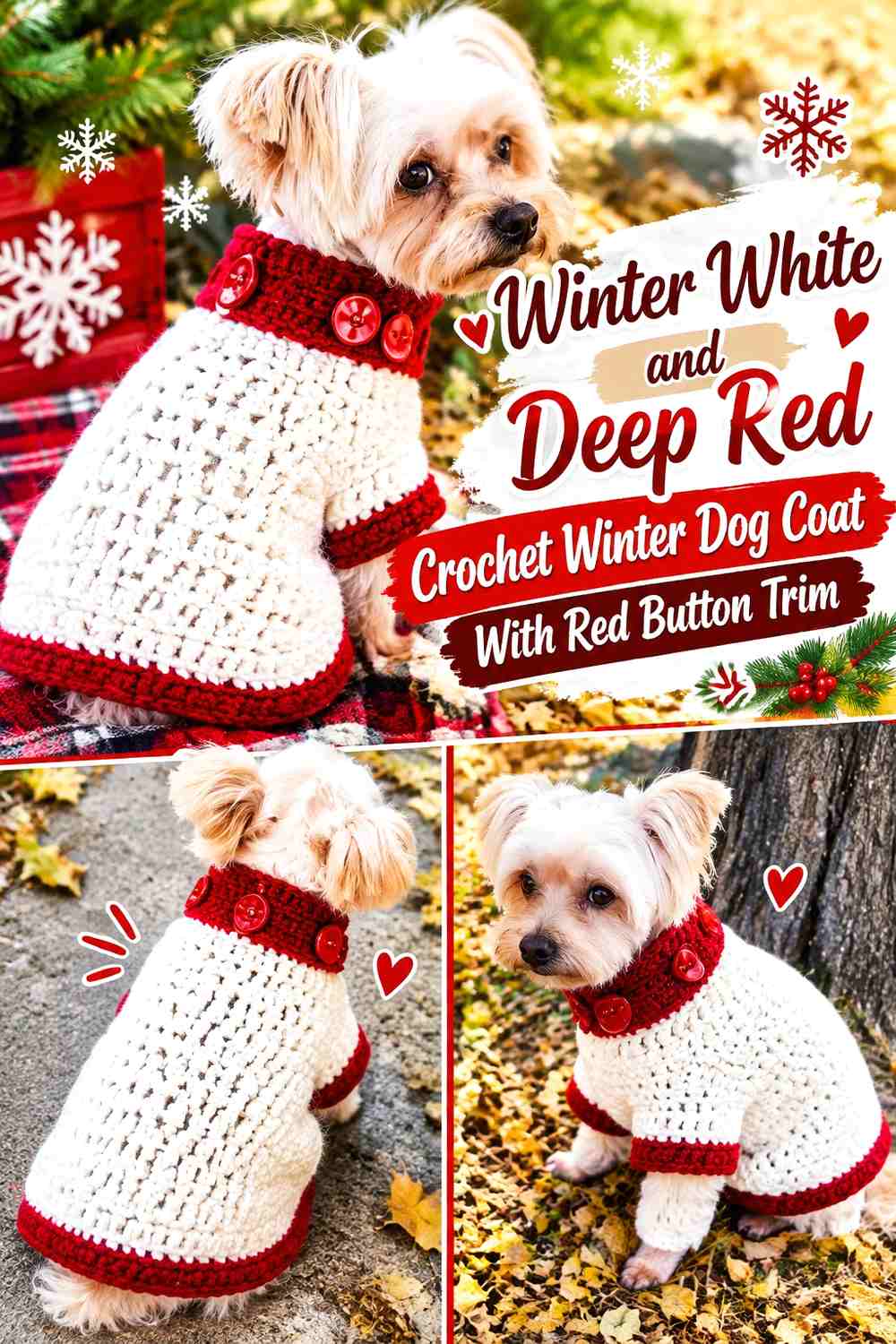
Winter white and deep red reverse the usual dark-body formula. White can cover most of the coat while deep red provides the visual structure around the collar and button closure. Because red stands out strongly against the pale body, it should be repeated with restraint.
Winter White Gives Deep Red Crochet Details Plenty of Contrast
A broad winter-white back lets deep red appear clearly even in relatively small areas. Keep the body largely light rather than adding repeated red stripes that would change the palette from trim-led to evenly multicolored.
This approach is particularly useful when you want the button closure to be one of the first details noticed.
Deep Red Can Define the Winter White Button Closure
Use deep red along the actual closing band, side flap, or belly strap. Connecting that color to the collar can give the coat a clear top-and-bottom relationship.
Avoid placing deep red around every opening. A few deliberate locations create stronger organization than outlining the entire coat.
Winter White Can Break Up a Large Deep Red Closure
If the buttoned section occupies substantial surface area, bring a narrow winter-white edge back into it. That keeps the red from becoming a second dominant body color and reinforces the light main field.
Creator Credit: Vibes with Dani
How These Winter Dog Coat Colors Change the Button Closure
For the clearest button-area contrast, navy with oatmeal, deep teal with oatmeal, black with mustard, and winter white with deep red create obvious separation between the coat body and fastening section.
For a quieter closure, slate blue with gray or taupe with sage keeps the button band closer to the main body in value. These palettes are useful when you want the closure to remain visible without becoming the coat’s strongest feature.
Burgundy and cream or moss and cream sit between those extremes. The light neutral provides clear definition, but the darker main shades remain dominant as long as cream is limited to the closure and a few repeated details.
Tonal combinations such as plum with dusty rose depend more heavily on shade selection. Make sure the supporting color remains different enough in lightness to show where the button placket or strap begins.
Conclusion
A button closure gives a crochet winter dog coat a natural place to use a second color without covering the whole garment in stripes or blocks. Start with the shade you want to dominate the back, then decide whether the buttoned strap, flap, or placket should create strong contrast or blend more quietly with the body.
Choose navy and oatmeal, teal and oatmeal, or black and mustard when the closure should be easy to distinguish. Burgundy and cream or winter white and deep red create another strong contrast direction, while slate blue and gray, plum and dusty rose, or taupe and sage keep the palette more restrained.
Whatever palette you choose, let the coat construction determine where color changes belong. A contrast band works best when it reinforces a real collar, strap, flap, placket, or edge rather than dividing the coat arbitrarily. Follow the credited tutorial for the actual garment construction, and only add or modify a button closure where that construction can accommodate it safely.
Frequently Asked Questions
What colors work well for a crochet winter dog coat with buttons?
Dark winter shades such as navy, charcoal, forest green, burgundy, teal, chocolate, and plum can provide a strong main field. Cream, oatmeal, camel, gray, sage, dusty rose, or another clearly different supporting shade can then define the button area. The exact choice matters less than creating the contrast level you want.
Should the button band be lighter or darker than the crochet dog coat?
Either can work. A lighter oatmeal or cream band is easy to distinguish against navy, burgundy, or teal. A darker red closure can also work against a winter-white body. Choose the direction that keeps the closure visually clear without competing with the whole back panel.
How do I know whether two winter yarn colors have enough contrast?
Compare them side by side and pay attention to lightness as well as hue. A grayscale photo can reveal whether two colors that look different—such as burgundy and deep green—are actually very similar in value. If they merge, adjust one shade or use a light neutral around the closure.
Should the crochet dog coat buttons match the button band?
They do not have to. The yarn color can define the closure even when the buttons themselves are understated. If the buttons are meant to be decorative as well as functional, make sure additional visual contrast does not make an already busy closing area feel crowded.
Where should a second color be repeated on a buttoned dog coat?
The collar is often a useful place to repeat a closure color because it creates a second intentional accent away from the strap or flap. A lower border can also work. Avoid automatically repeating the accent around every leg opening, edge, and seam.
Can I add buttons to any crochet dog sweater tutorial?
Not automatically. A pull-on sweater may depend on continuous construction, and cutting or separating it for a closure could change its structure. Use button closures only with a construction that already includes an opening or can accommodate one without compromising fit. Otherwise, follow the tutorial as designed.
What should I consider when using buttons on a crochet dog coat?
The closure should fit without restricting movement, and buttons should be firmly secured and checked for loosening. Dogs that chew or pull at garments should be supervised, and loose or damaged buttons should be addressed before the coat is worn again.