Crochet star garlands suit Nordic-inspired winter decorating particularly well because the motifs can stay simple while the color palette does most of the visual work. Crisp red-and-white stars can create a traditional festive direction, while blue, gray, oatmeal, forest green, and muted ochre shift the same basic idea toward a quieter winter look.
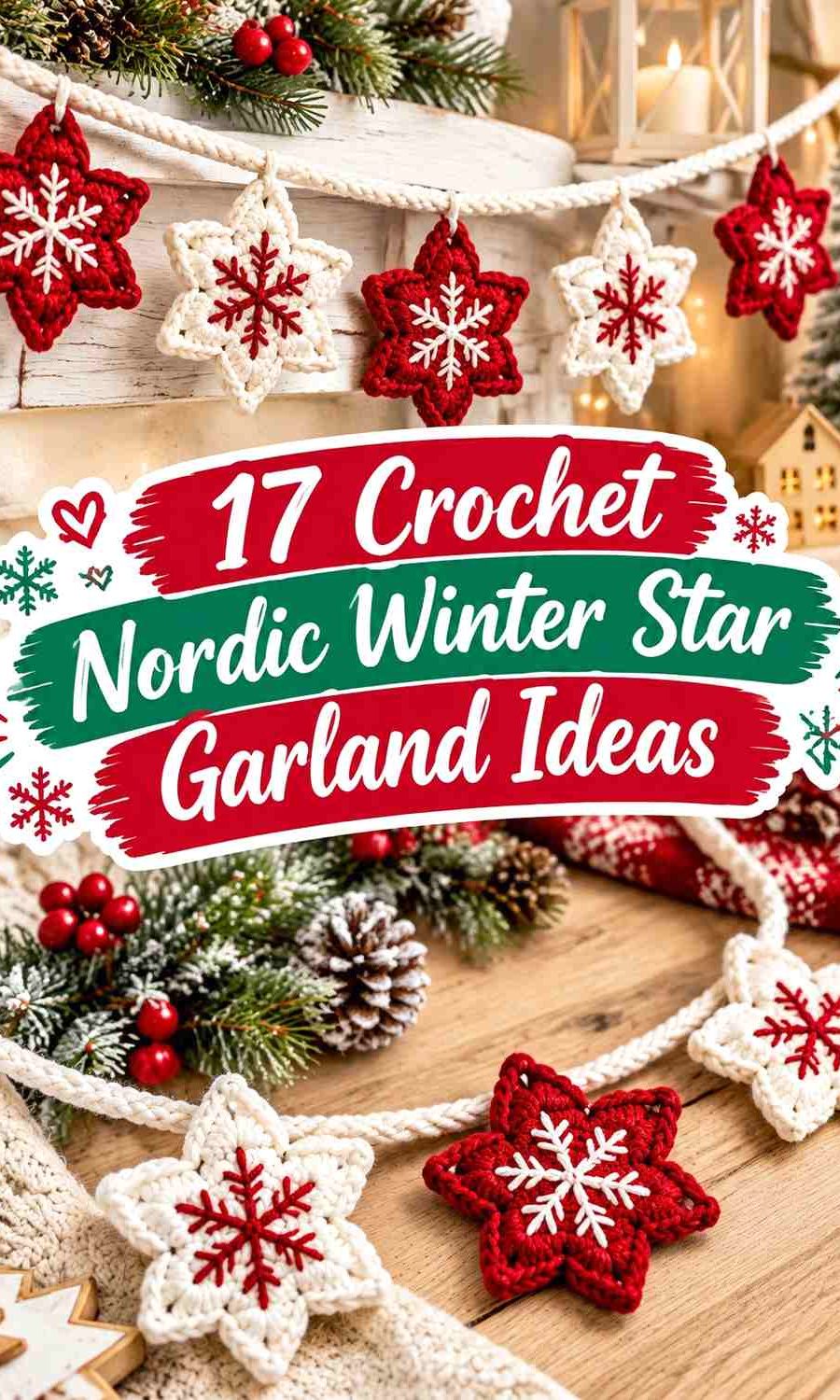
Color placement matters just as much as the shades themselves. Alternating three unrelated colors star by star can make a garland feel segmented, while repeating one dominant neutral through every second or third motif creates continuity. Borders, star centers, connecting cords, and tassel details also provide places to repeat accent colors without making every star identical.
The tutorials credited below support crochet stars, star ornaments, snowflake-like motifs, or related hanging decorations. The Nordic-inspired palettes, star arrangements, and garland color plans are independent adaptations rather than claims that the creators used these exact color combinations.
Quick List
- Cranberry Red and Snow White Crochet Nordic Star Garland
- Fjord Blue, Snow White, and Silver Gray Crochet Nordic Star Garland
- Forest Green and Oatmeal Crochet Nordic Star Garland
- Charcoal and Warm Ivory Crochet Nordic Star Garland
- Burgundy, Muted Mustard, and Cream Crochet Nordic Star Garland
- Ice Blue, White, and Soft Gray Crochet Nordic Star Garland
- Dusty Rose, Cranberry, and Cream Crochet Nordic Star Garland
- Navy, Warm White, and Camel Crochet Nordic Star Garland
- Sage Green, Brick Red, and Oatmeal Crochet Nordic Star Garland
- Deep Teal, Cream, and Rust Crochet Nordic Star Garland
- Pale Gray, Scandinavian Red, and White Crochet Nordic Star Garland
- Black, Warm White, and Deep Red Crochet Nordic Star Garland
- Cinnamon, Beige, and Forest Green Crochet Nordic Star Garland
- Plum, Dusty Pink, and Ivory Crochet Nordic Star Garland
- Slate Blue, Ochre, and Cream Crochet Nordic Star Garland
- Espresso Brown, Cream, and Muted Blue Crochet Nordic Star Garland
- Cobalt Blue, Snow White, and Red Crochet Nordic Star Garland
Give One Color a Repeating Role Across the Star Garland
A long garland is viewed as one horizontal composition, so repetition matters. Instead of making every star a completely different color, decide which shade will recur regularly. That might be snow white between stronger colors, a dark connecting cord, or one center color repeated through otherwise different stars.
The repeated shade gives the eye a visual path along the garland. This becomes especially useful when the motifs vary slightly in shape or size, because color can keep the full strand connected even when individual stars are not identical.
Use Light and Dark Contrast to Keep Crochet Star Points Visible
Star motifs rely on their outer silhouette. If a dark green star hangs against dark greenery or a gray wall, the points can become less obvious even when the crochet texture is attractive.
Check the intended display location before finishing an entire set. A cream edge, lighter neighboring star, or contrasting connecting cord can restore definition without changing the dominant color of every motif. A grayscale photo is also useful for checking whether two different hues are actually too similar in value.
1. Cranberry Red and Snow White Crochet Nordic Star Garland
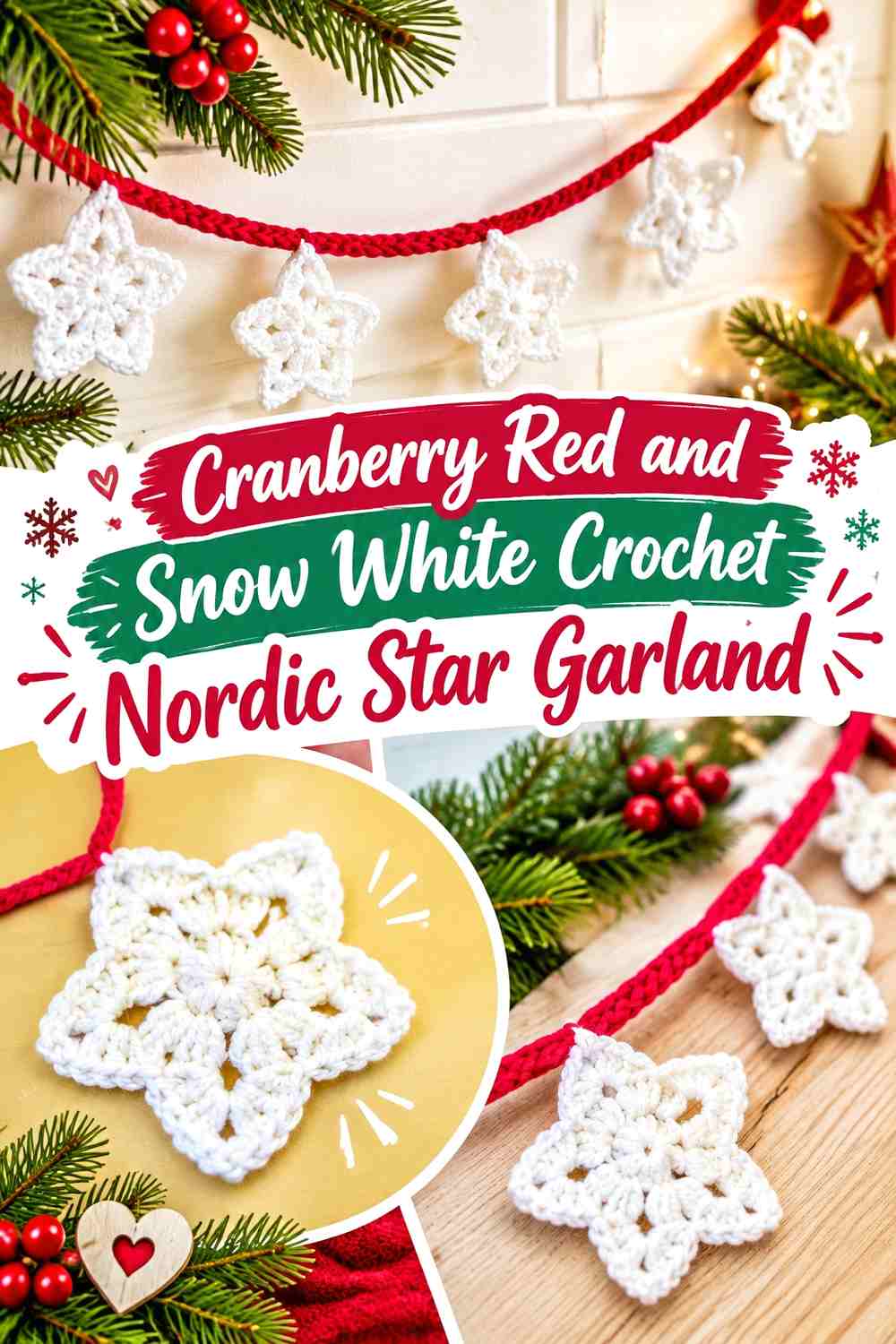
Cranberry red and snow white create one of the clearest Nordic-inspired winter palettes. Rather than alternating the colors in rigid equal quantities, let snow white provide visual pauses between groups of stronger cranberry stars. This arrangement works especially well when the garland crosses greenery, wood tones, or another darker background.
Cranberry Red Should Create the Main Crochet Star Rhythm
Use cranberry for the motifs you want noticed first, then repeat it at predictable points along the strand. A sequence such as several red focal stars separated by white motifs feels more intentional than clustering all of the cranberry at one end.
If the connecting cord is also red, make sure enough white remains between stars so the entire garland does not become one uninterrupted dark line.
Snow White Gives Cranberry Red Star Points More Separation
Snow white can occupy complete stars rather than appearing only as tiny red-star borders. Larger areas of white provide useful breathing room and make neighboring cranberry silhouettes easier to see.
Against a pale wall, consider using cranberry for the connecting cord so the white stars still have a visible horizontal structure.
Creator Credit: Bella Coco
2. Fjord Blue, Snow White, and Silver Gray Crochet Nordic Star Garland
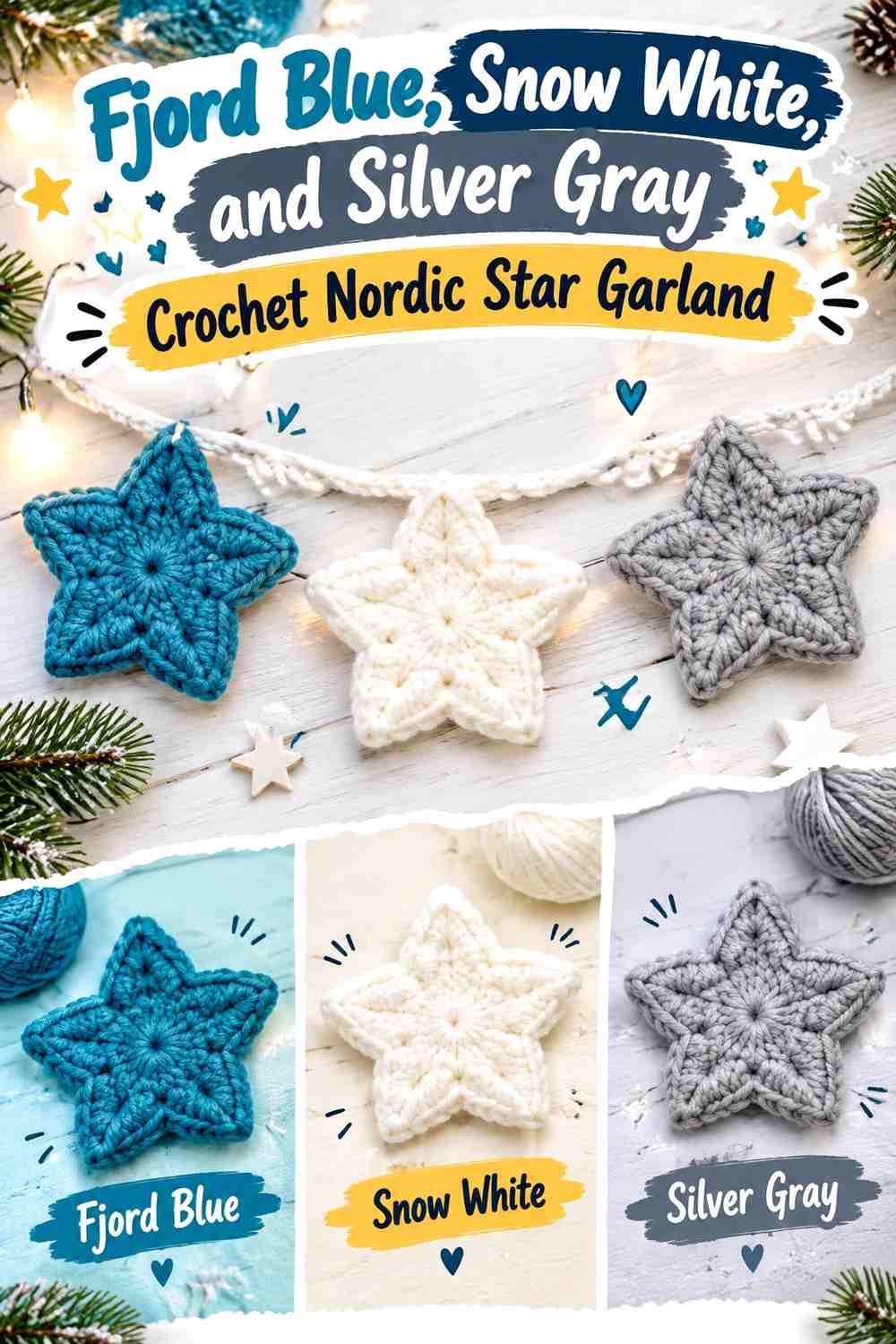
Fjord blue creates the strongest color field, silver gray acts as a quieter supporting tone, and snow white supplies the lightest contrast. This palette works well when you want an unmistakably wintry garland without relying on red or green.
Fjord Blue Should Lead the Crochet Star Garland
Use fjord blue on the larger or more frequently repeated stars. Giving the medium-to-dark blue the main role prevents the garland from becoming a mostly white strand with occasional color.
A white connecting cord can soften the overall result, while a blue cord makes the winter color more continuous.
Silver Gray Should Bridge Fjord Blue and Snow White
Place silver-gray stars between blue and white motifs when a direct dark-to-light alternation feels too sharp. Gray can also repeat in centers or narrow borders if the star construction allows color changes without disrupting the silhouette.
Keep snow white as the lightest shade so the three colors retain a clear visual hierarchy.
Creator Credit: VivCrochets
3. Forest Green and Oatmeal Crochet Nordic Star Garland
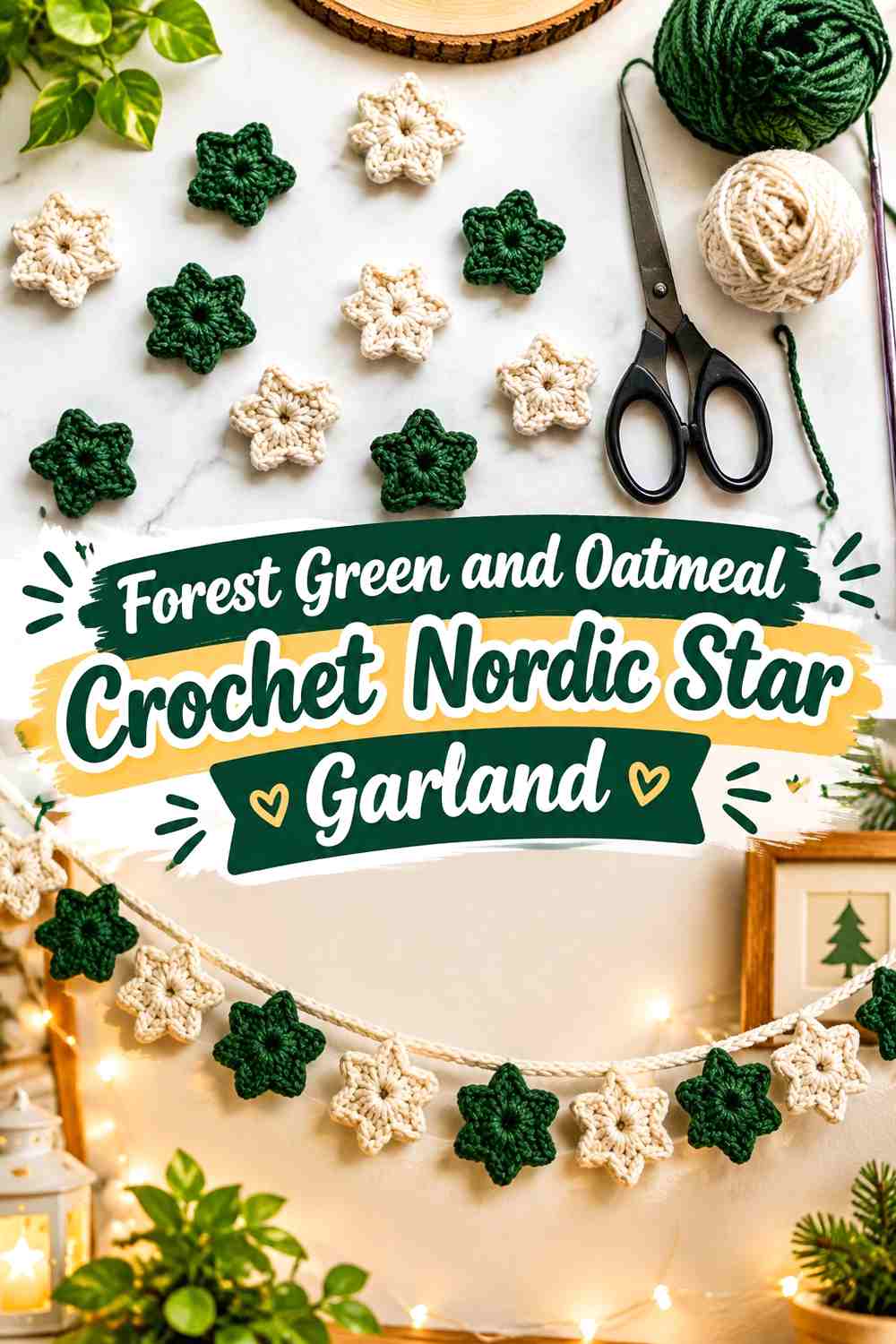
Forest green brings a strong evergreen direction, while oatmeal is softer than bright white and keeps the palette warm. Because only two colors are involved, variation can come from changing which shade dominates each section of the garland.
Forest Green Stars Need Oatmeal Space Between Dark Motifs
Several dark green stars placed directly beside one another can visually merge when displayed near winter greenery. Insert oatmeal motifs at regular intervals to restore the individual star shapes.
If the garland will hang on a very pale wall, forest green can appear more frequently because the background already supplies strong contrast.
Oatmeal Keeps Forest Green Crochet Stars Warm and Neutral
Oatmeal works well as complete stars, not just edging. Repeating full neutral motifs gives the eye somewhere to rest and prevents the garland from becoming overwhelmingly green.
A forest-green connecting cord can keep those oatmeal stars tied visually to the darker motifs.
Creator Credit: Thread Maker Studio
4. Charcoal and Warm Ivory Crochet Nordic Star Garland
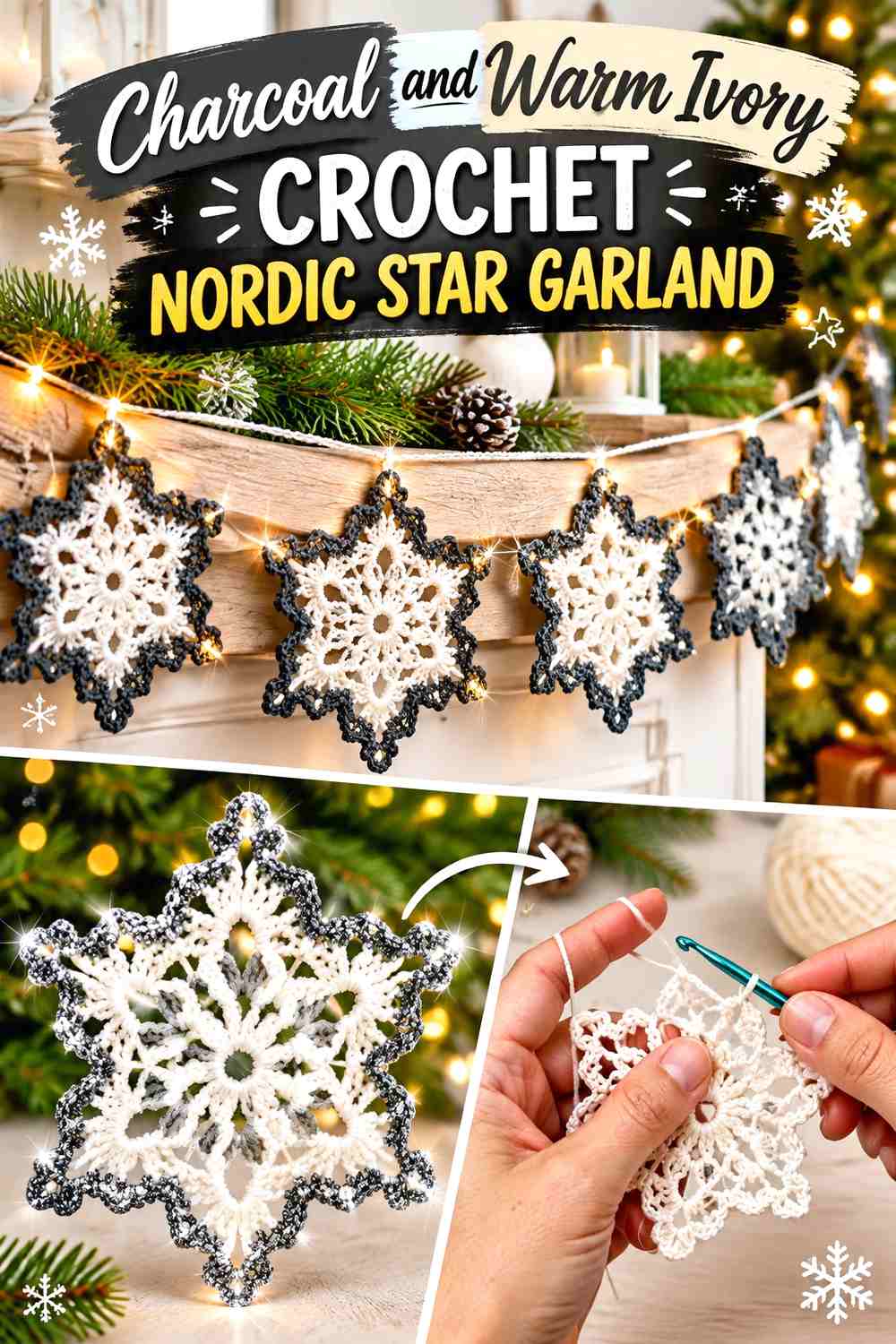
Charcoal and warm ivory create a minimalist two-color direction with strong value contrast. Let ivory occupy more of the open or delicate motifs and charcoal define selected stars or the connecting strand.
Warm Ivory Should Keep Charcoal Crochet Stars From Feeling Heavy
Use ivory frequently enough that there is visible light space across the whole garland. A charcoal-heavy strand can become visually dense, particularly when the stars hang close together.
Ivory stars are also useful around the center of a mantel or window display where you want the garland to appear lighter.
Charcoal Can Define Warm Ivory Stars Through the Connecting Cord
A charcoal cord or narrow join gives pale motifs a consistent framework without requiring every ivory star to have a dark border.
If the display background is already charcoal or black, reverse the emphasis and use an ivory cord so the strand itself remains visible.
Creator Credit: Crochet Craftsman
5. Burgundy, Muted Mustard, and Cream Crochet Nordic Star Garland
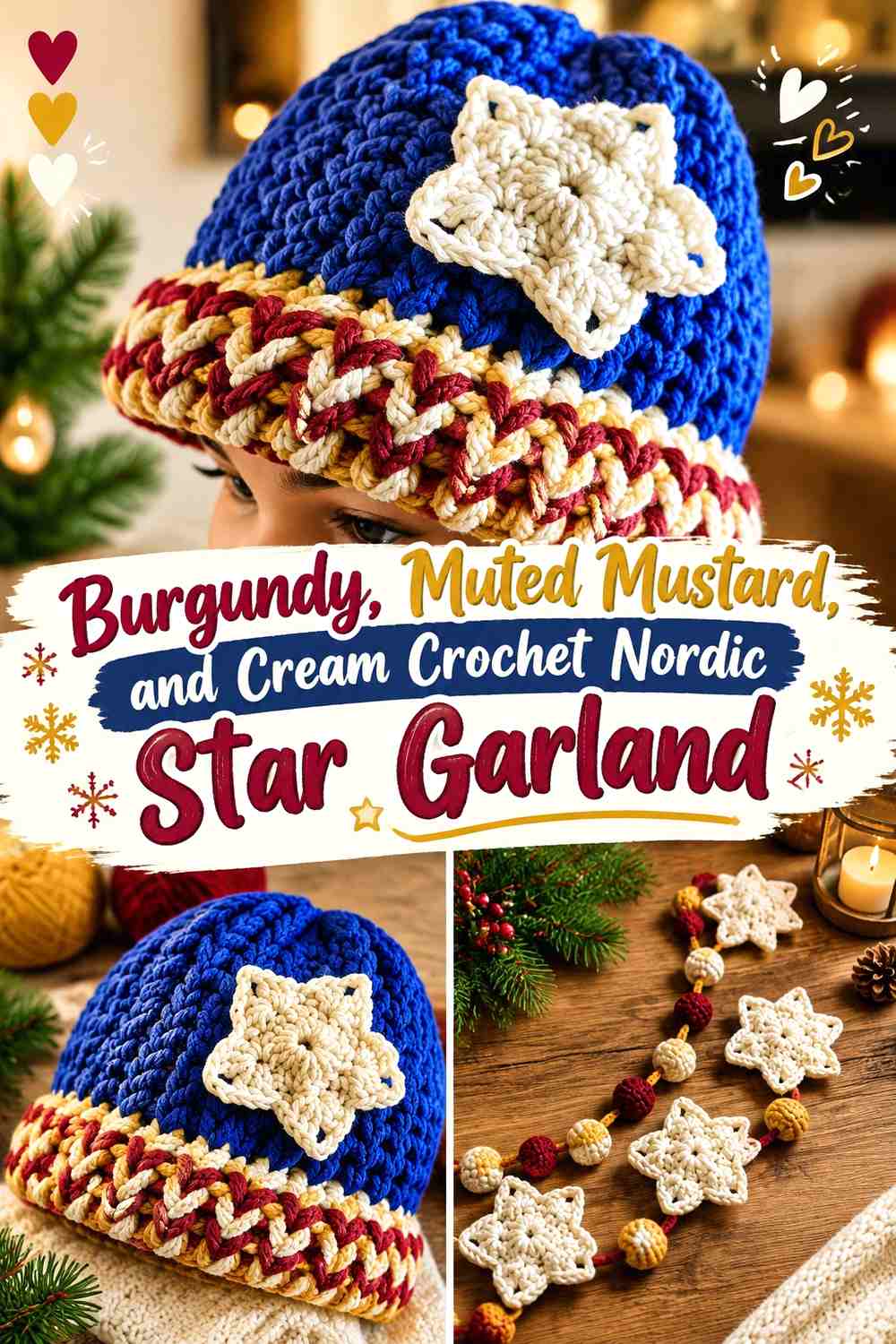
Burgundy provides depth, muted mustard adds controlled warmth, and cream keeps both stronger shades separated. The palette has more color than a red-and-white garland, so giving cream a repeating role is important.
Burgundy Should Anchor the Crochet Star Garland
Use burgundy for the most frequent dark motifs or for larger statement stars. Repeating it consistently along the strand creates a strong base for the smaller mustard accents.
Avoid placing every burgundy star directly beside mustard if you want cream to function as a genuine balancing neutral.
Muted Mustard Works Better as an Accent Beside Burgundy and Cream
Use mustard on fewer stars, in selected centers, or as a repeated smaller motif. Because it differs strongly from burgundy, even limited mustard can remain noticeable.
Cream between those stronger colors keeps the garland from becoming a sequence of equally dominant warm tones.
Creator Credit: The Crochet Crowd
6. Ice Blue, White, and Soft Gray Crochet Nordic Star Garland
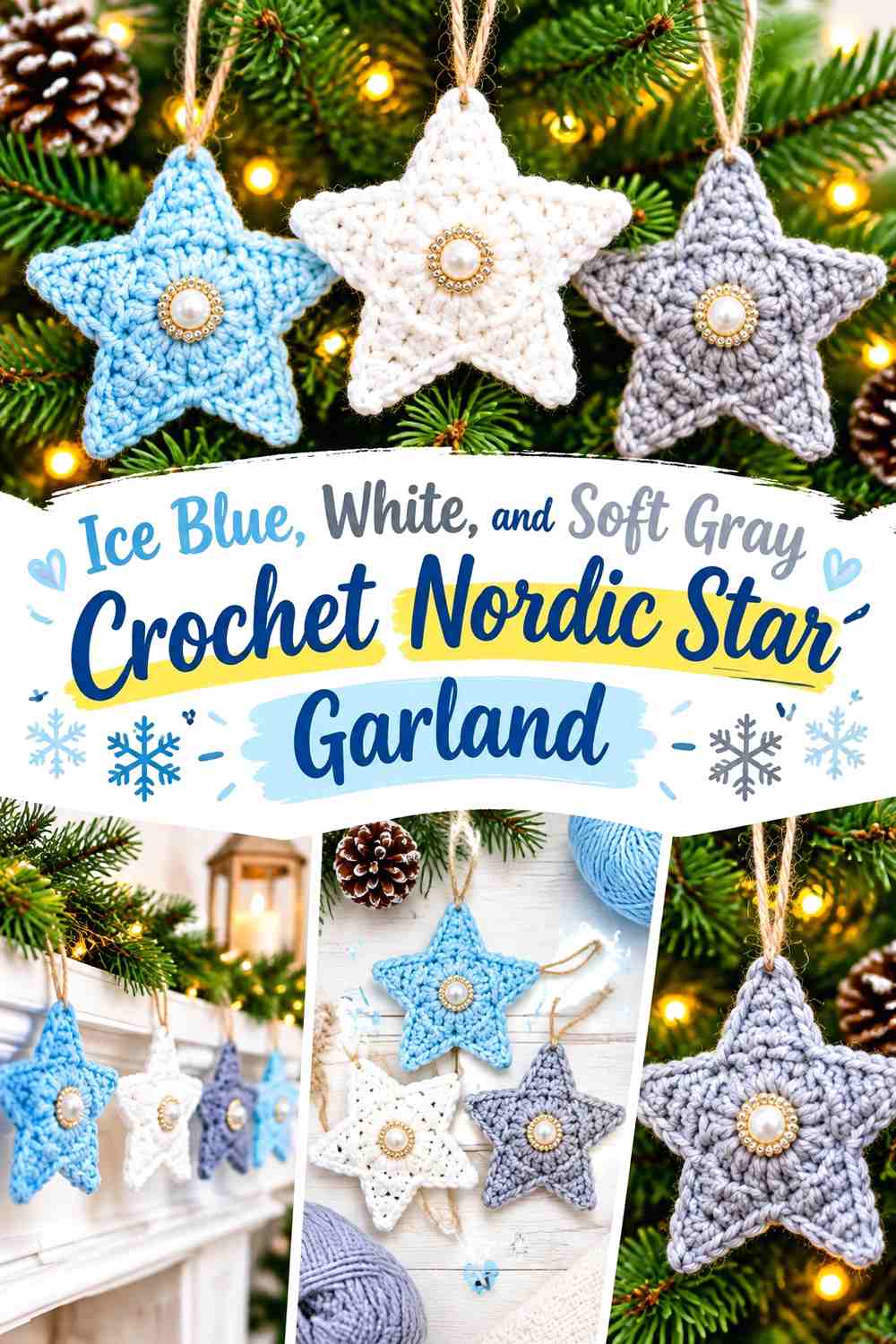
Ice blue, white, and soft gray create a very light winter palette. Since none of the colors is extremely dark, successful placement depends more on subtle value differences and spacing than dramatic contrast.
Ice Blue Needs Enough Crochet Star Surface to Remain Visible
Give ice blue entire motifs rather than restricting it to tiny centers. A pale blue accent can disappear quickly when surrounded by white and gray, especially across a long garland viewed from a distance.
Repeat blue consistently instead of adding many slightly different pale shades.
Soft Gray Can Define White and Ice Blue Crochet Stars
Use soft gray for selected stars or a connecting strand when white and ice blue begin to blend. The gray does not have to become the dominant color; it simply needs enough presence to organize the two lighter shades.
On a gray wall, increase the ice-blue and white areas instead.
Creator Credit: naztazia
7. Dusty Rose, Cranberry, and Cream Crochet Nordic Star Garland
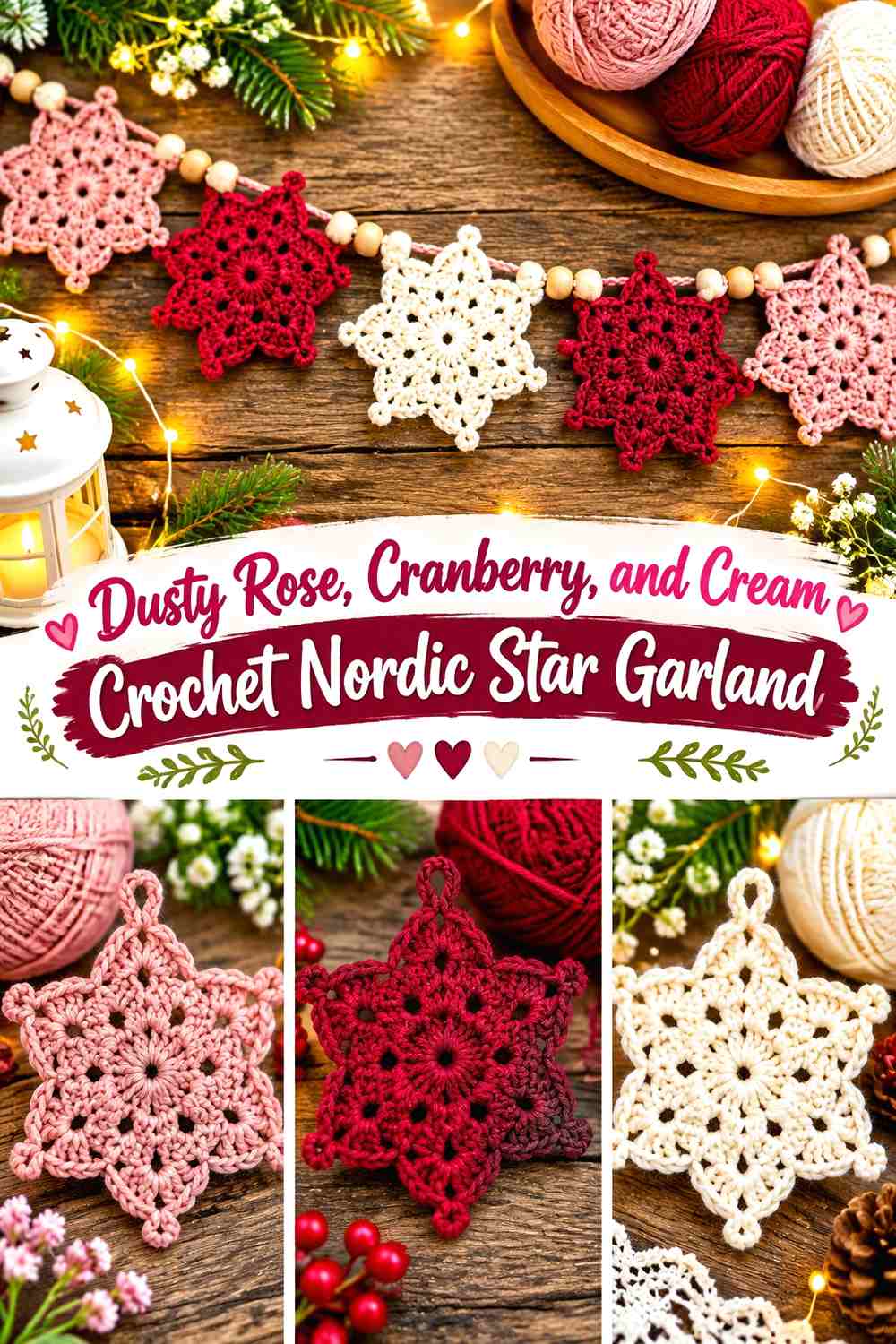
Dusty rose softens the stronger cranberry red, while cream acts as the light neutral. This palette gives traditional winter red a quieter companion color and works particularly well when you want the garland to coordinate with warm neutral decor.
Dusty Rose Should Cover More Crochet Stars Than Cranberry
Use dusty rose as the main colored star if you want the finished strand to stay muted. Cranberry can then appear at intervals as the stronger focal color.
This unequal distribution prevents the darker red from taking over the full garland.
Cream Should Separate Dusty Rose and Cranberry Star Clusters
Place cream where several warm-colored stars would otherwise sit directly together. The light break helps the two pink-red shades remain individually readable.
Cream can also be used on the connecting cord when you want the line between motifs to recede.
Creator Credit: Kristines Crochets
8. Navy, Warm White, and Camel Crochet Nordic Star Garland
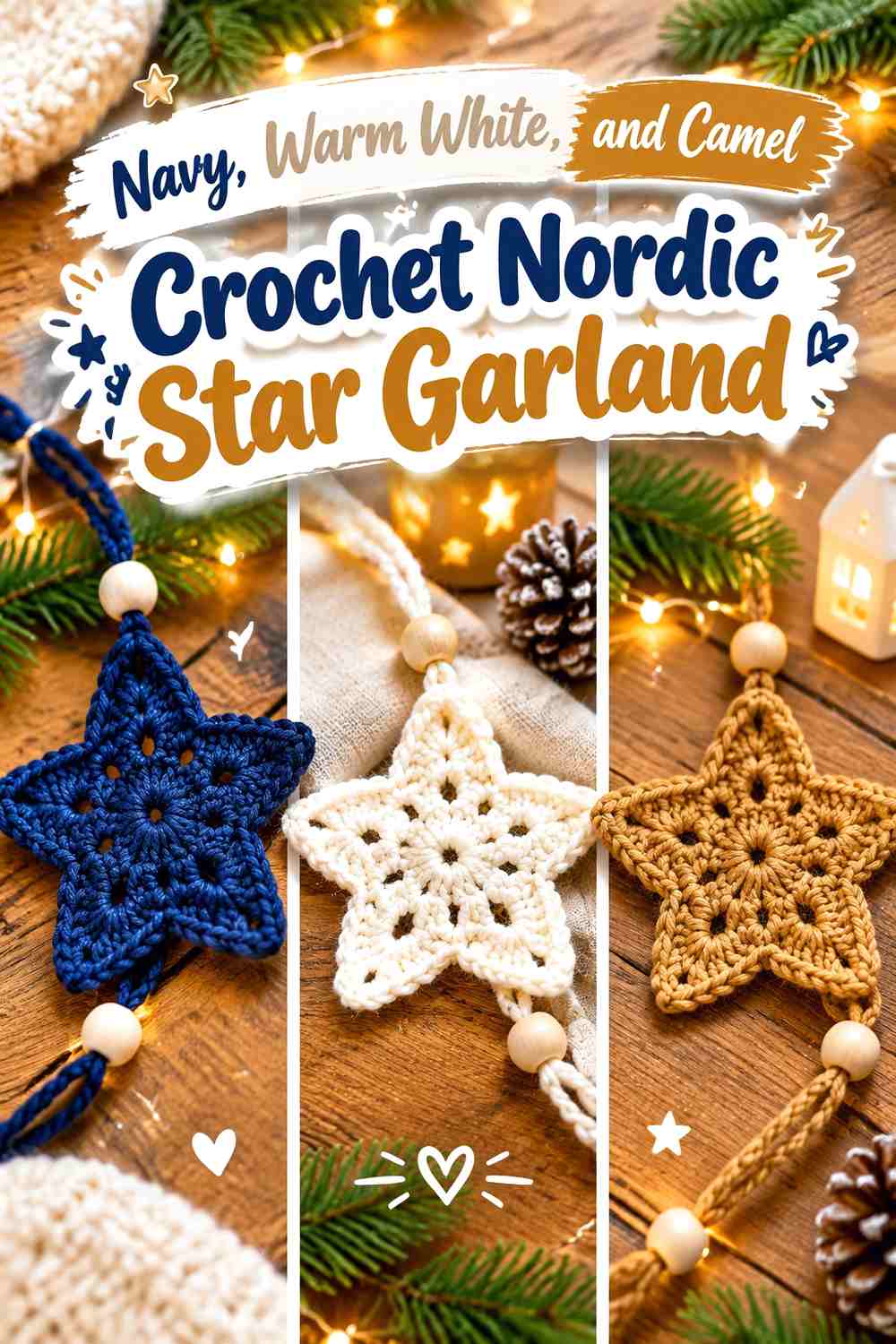
Navy provides the darkest value, warm white supplies strong contrast, and camel gives the palette an earthy transition. This combination feels less icy than blue-and-silver schemes and works well with wood-toned winter decor.
Navy Crochet Stars Should Be Repeated Rather Than Clustered
Spread navy motifs across the length so the darkest color anchors more than one section. If all navy appears together, the strand can look visually heavier on one side.
Warm white stars between navy motifs help preserve the five- or six-point silhouettes.
Camel Can Connect Navy and Warm White Without Competing
Use camel on selected stars or smaller motifs between the two extremes. It works best as a supporting tone rather than an equal third of every section.
If the garland hangs against natural wood, check whether camel still separates enough from the background before making the full set.
Creator Credit: Crochet and Knitting Japan
9. Sage Green, Brick Red, and Oatmeal Crochet Nordic Star Garland
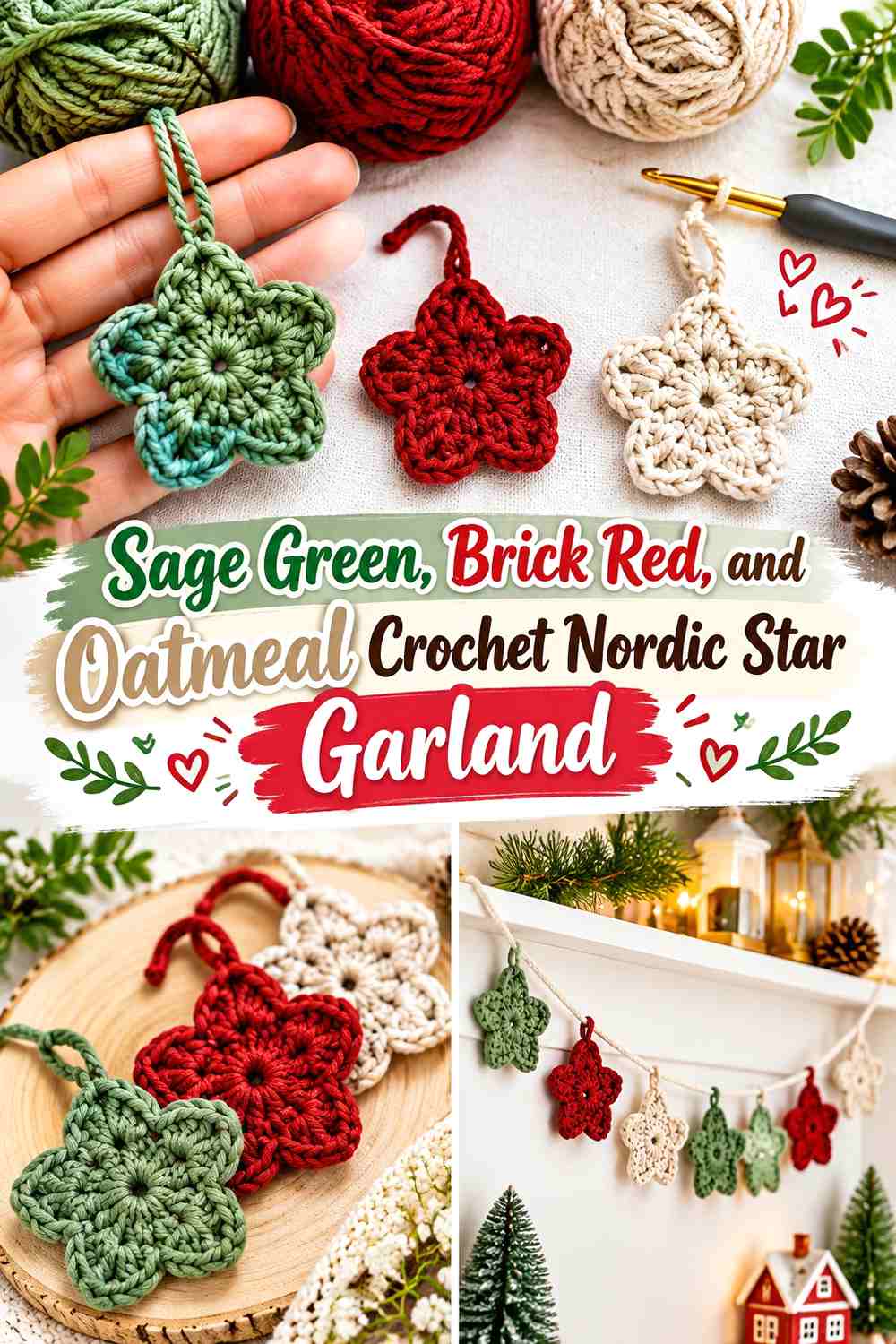
Sage green and brick red create a muted red-green winter palette, while oatmeal prevents the combination from becoming too dark or overly literal. The softer saturation makes this particularly useful for a long mantel or shelf garland.
Sage Green Can Lead the Crochet Star Garland More Quietly Than Forest Green
Use sage for the largest share of motifs if you want green to dominate without producing a very dark strand. Its softer appearance also gives brick red room to function as an accent.
Oatmeal can repeat between major color changes to keep the star sequence organized.
Brick Red Should Punctuate Sage and Oatmeal Crochet Stars
Place brick red every few motifs rather than alternating it with sage star for star. The less frequent warm color creates focal points along the line.
If the red feels disconnected, repeat a little brick color in tassels or end details rather than increasing the number of red stars.
Creator Credit: Thao’s Homemade Crochet
10. Deep Teal, Cream, and Rust Crochet Nordic Star Garland
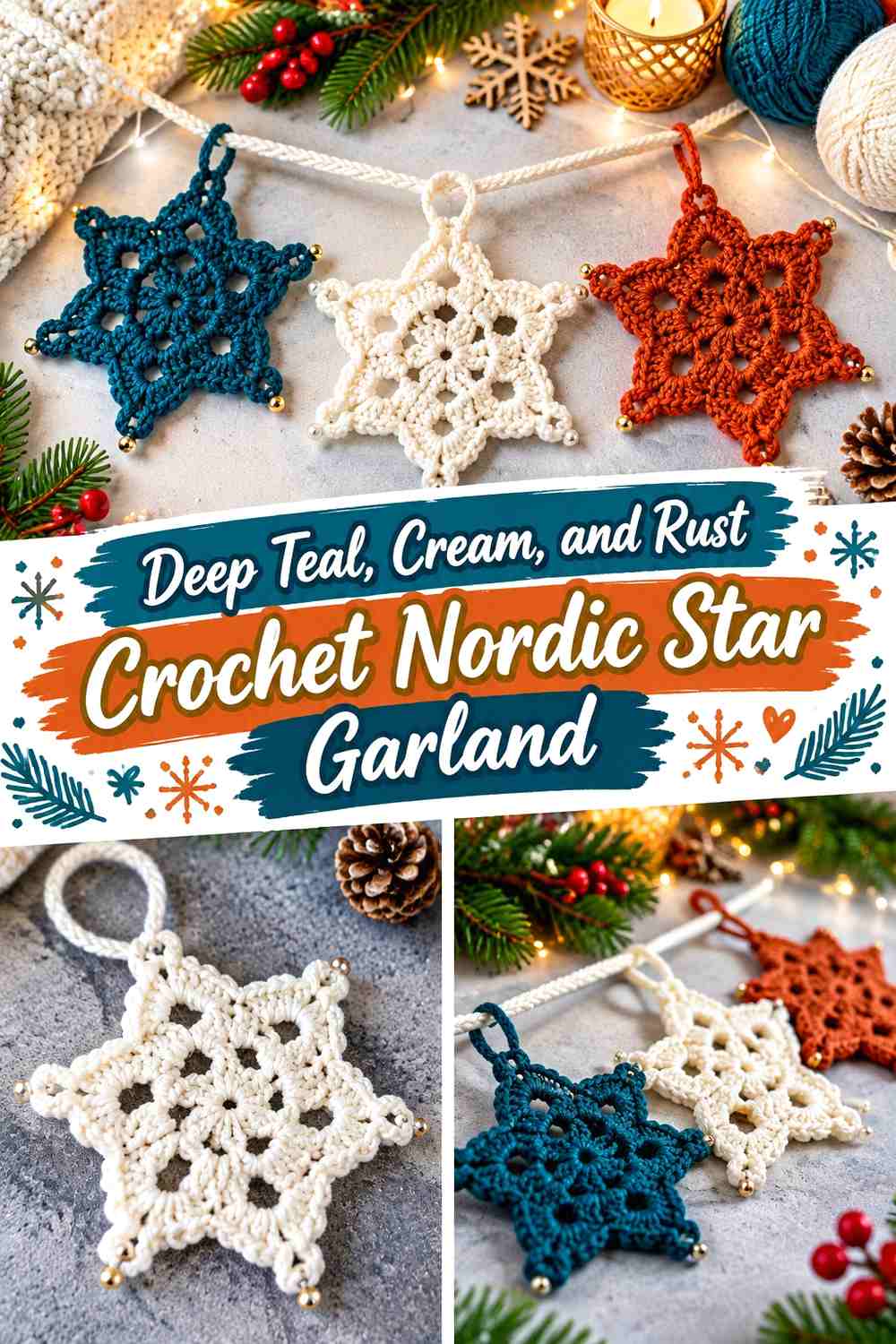
Deep teal provides a cool dark foundation, rust adds a warmer contrast, and cream creates the light break between them. This palette is useful when you want winter color without relying on the more familiar red-and-green pairing.
Deep Teal Should Form the Main Crochet Star Sequence
Keep teal visible across the full length by repeating it regularly. It can also work well on the connecting cord if the garland needs a stronger continuous line.
Against a dark wall, however, a cream cord may preserve the overall silhouette more effectively.
Rust Should Accent Deep Teal and Cream Crochet Stars
Use rust on fewer motifs or selected centers. Its warmth will remain noticeable even when it occupies much less area than teal.
Cream between teal and rust prevents the garland from looking like alternating blocks of two equally strong colors.
Creator Credit: by.gkdesign
11. Pale Gray, Scandinavian Red, and White Crochet Nordic Star Garland
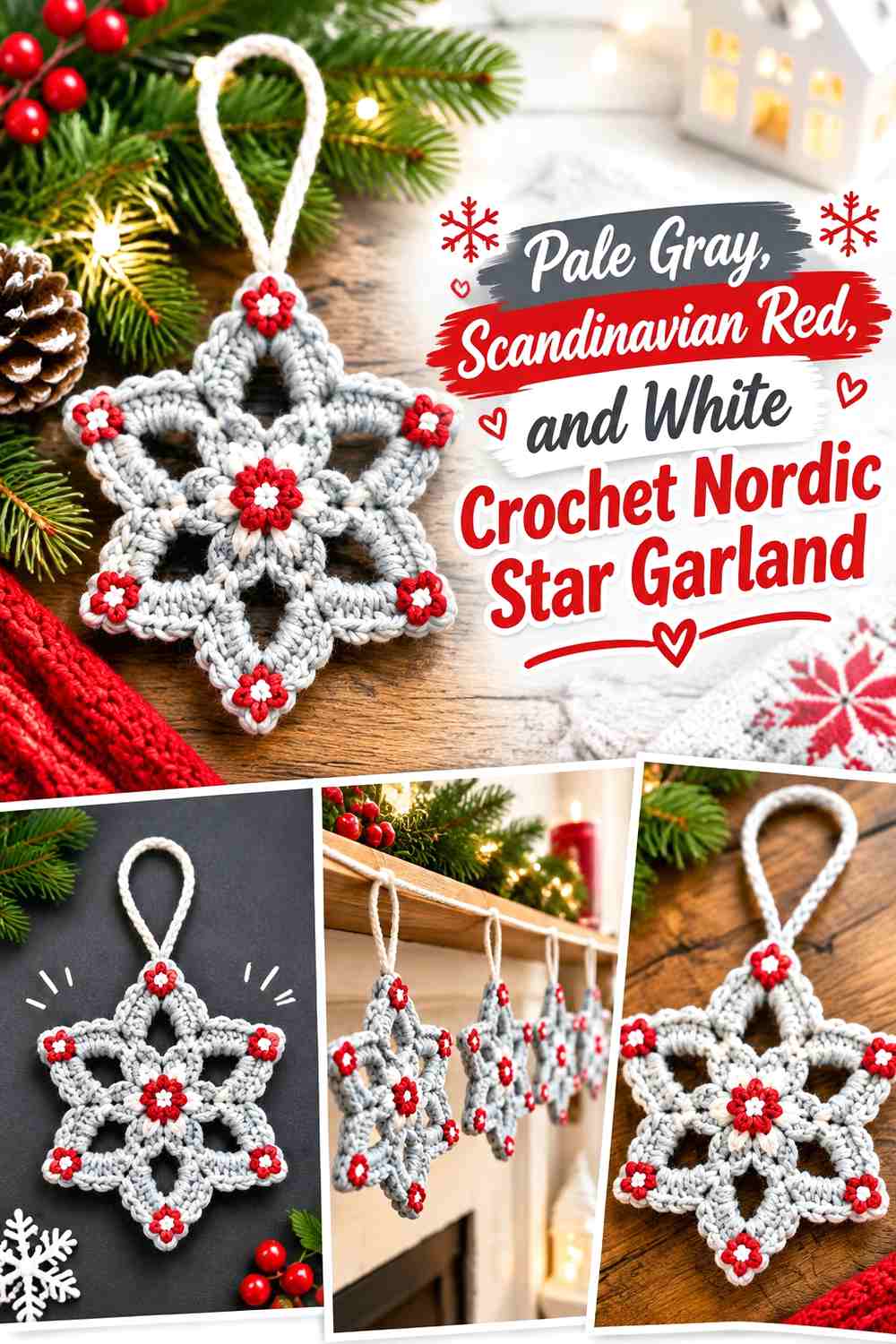
This palette keeps red as the festive focal color but uses pale gray to soften the transition into white. Red can form the strongest stars while gray and white create repeated winter neutrals around them.
Scandinavian Red Should Be the Focal Crochet Star Color
Use red at important visual points such as the center of the strand and balanced positions toward both ends. This gives the garland rhythm without requiring every second star to be red.
A less frequent red generally appears stronger than red used everywhere.
Pale Gray Can Keep White Crochet Stars Visible Between Red Motifs
White stars may disappear on a pale wall or window area. Pale gray neighboring motifs or a gray connecting cord can give the strand more definition while maintaining a light winter appearance.
Keep gray noticeably darker than white so the two neutrals do not collapse into one shade.
Creator Credit: Hectanooga1
12. Black, Warm White, and Deep Red Crochet Nordic Star Garland
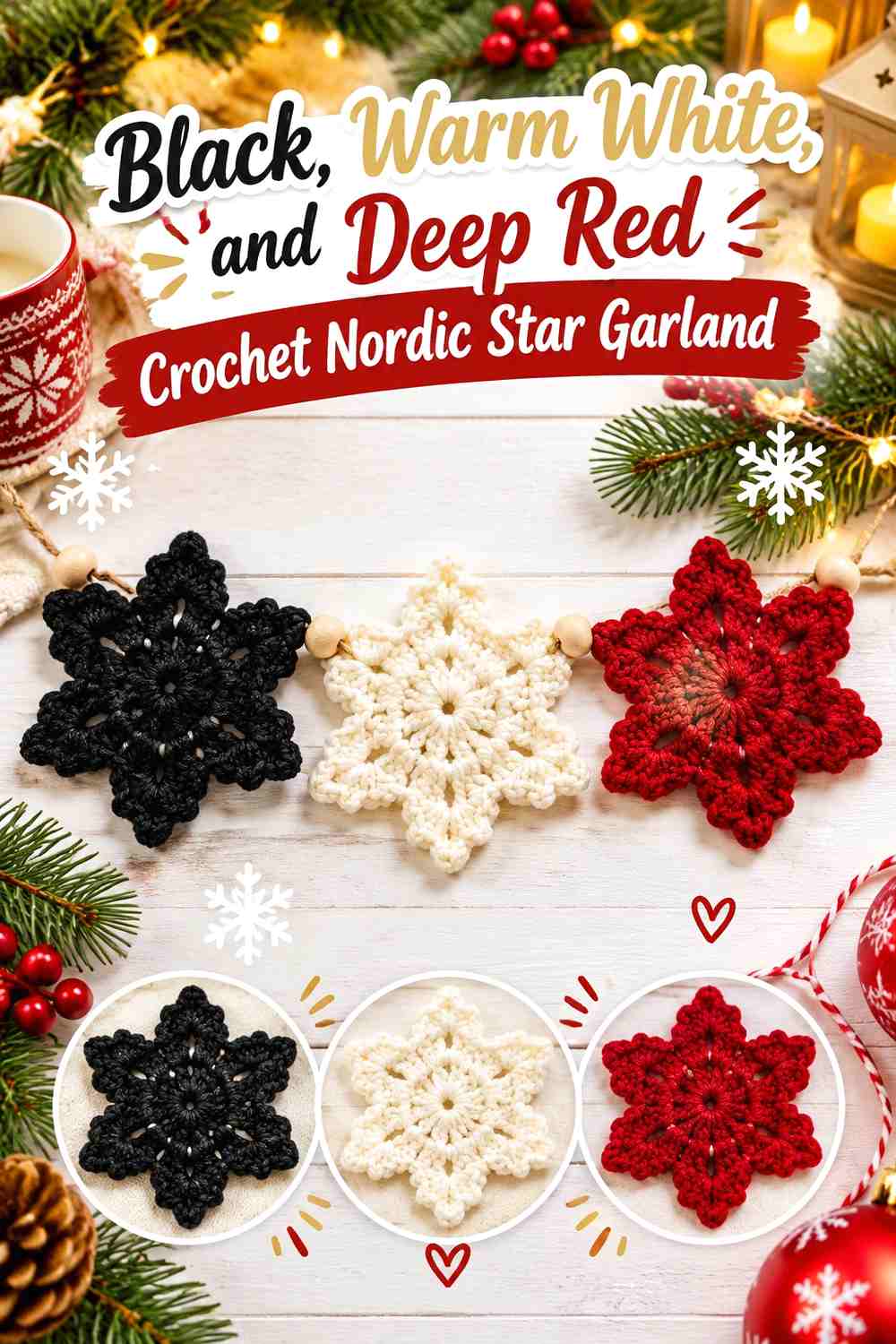
Black gives this garland a graphic outline, warm white supplies maximum contrast, and deep red adds a restrained winter focal color. The dark neutral should organize the palette rather than occupy every star.
Black Works Well as the Crochet Garland Cord and Selected Stars
Using black through the cord gives all of the motifs a clear horizontal anchor. A few complete black stars can repeat that structural color without turning the strand predominantly dark.
Against black or very dark walls, reverse the cord to warm white.
Deep Red Needs Warm White Space Away From Black
Place warm-white motifs around deep-red stars if black already appears heavily in the cord. The pale neutral gives the red enough surrounding space to remain distinct.
Avoid making every star three-colored; complete single-color stars can keep this high-contrast palette cleaner.
Creator Credit: Crochet Musings
13. Cinnamon, Beige, and Forest Green Crochet Nordic Star Garland
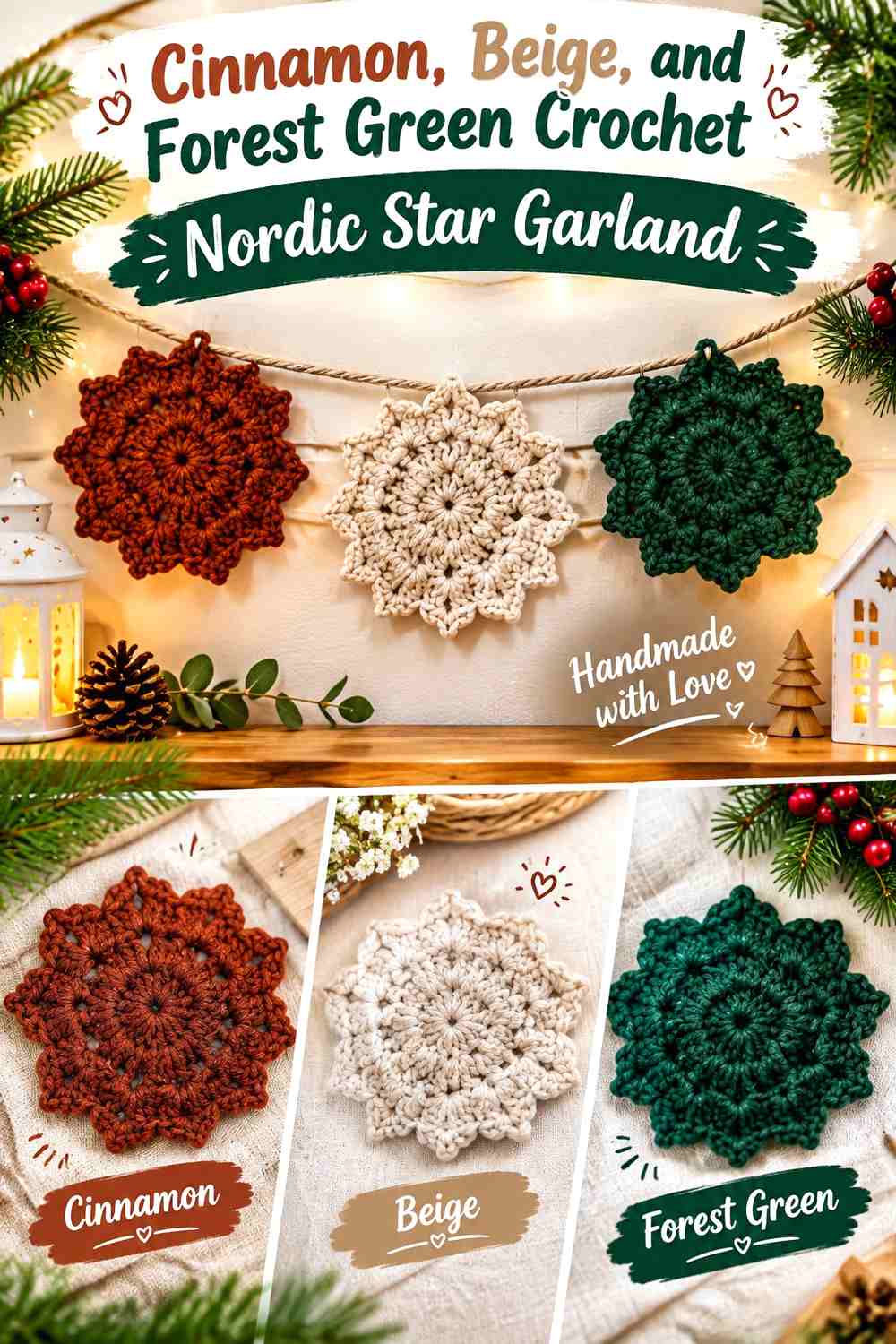
Cinnamon and beige provide a warm neutral base, while forest green introduces the deepest winter color. This palette suits a softer woodland interpretation of Nordic winter decor.
Cinnamon Can Lead the Crochet Stars Without Becoming Too Dark
Use cinnamon across several full motifs so the warm brown-orange shade remains recognizable. Beige stars can then lighten the sequence without introducing bright white.
Forest green should appear less often if cinnamon is intended to remain the dominant color.
Forest Green Gives Cinnamon and Beige Stars a Winter Anchor
Place forest green at balanced points across the garland or use it on the connecting cord. Its darker value can stabilize an otherwise very warm neutral palette.
If the garland sits near evergreen branches, beige edging or neighboring beige stars can help the green motifs remain visible.
Creator Credit: Crochet Bits
14. Plum, Dusty Pink, and Ivory Crochet Nordic Star Garland
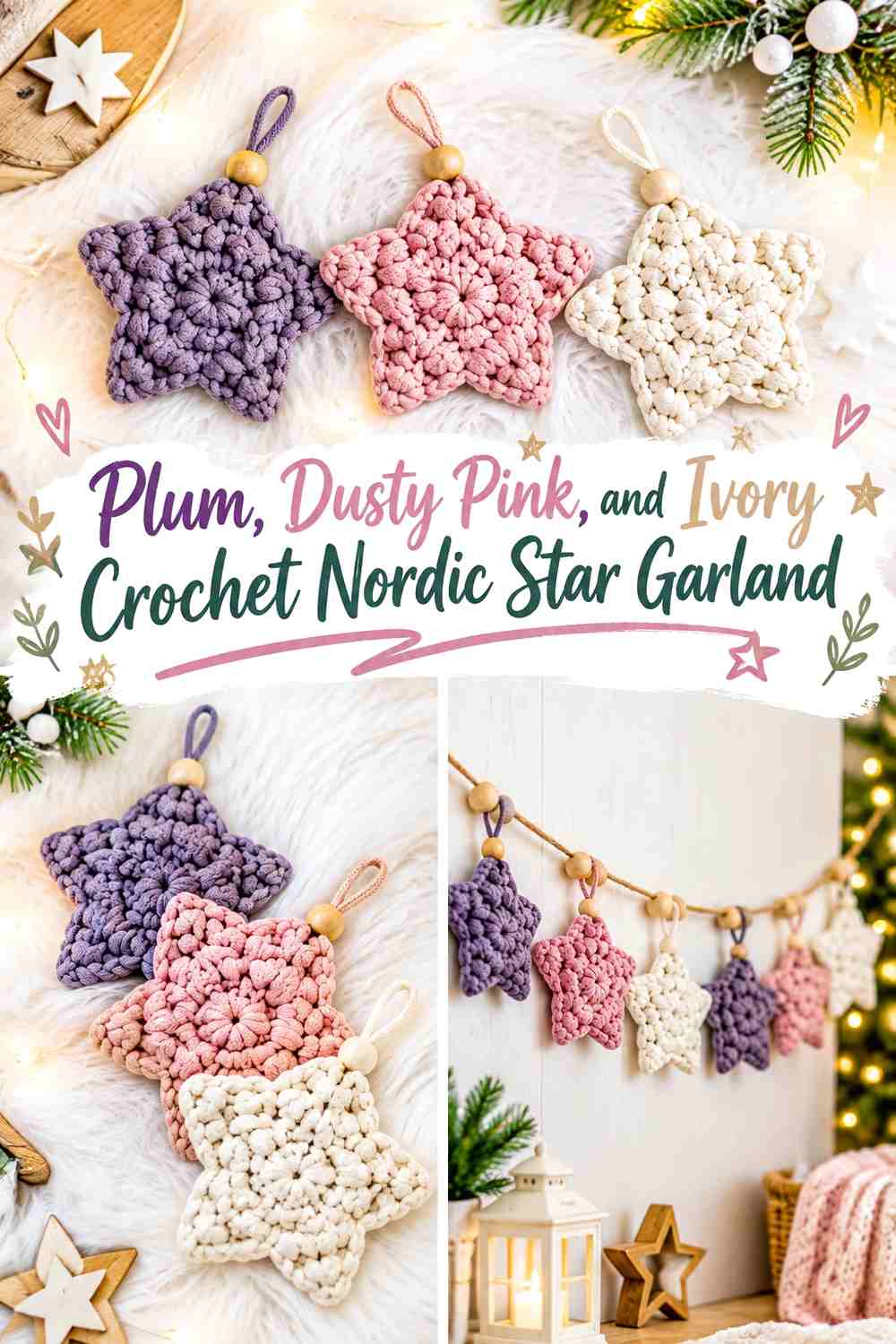
Plum provides the dark anchor, dusty pink creates a muted mid-tone, and ivory keeps the star points crisp. This is a less traditional winter palette but still feels cohesive when the colors remain softened rather than highly saturated.
Plum Should Repeat Through the Crochet Garland as the Darkest Star
Use plum at regular intervals rather than placing it only at one end. The repeated dark color gives the softer pink stars more structure.
Ivory can sit between plum sections where the value jump would otherwise feel abrupt.
Dusty Pink Should Bridge Plum and Ivory Crochet Stars
Dusty pink is most useful as the middle visual value. Give it more coverage than plum if you want the overall garland to stay light.
Avoid replacing dusty pink with a very bright pink unless a much stronger, less muted winter palette is intentional.
Creator Credit: KNITZNPURLZ
15. Slate Blue, Ochre, and Cream Crochet Nordic Star Garland
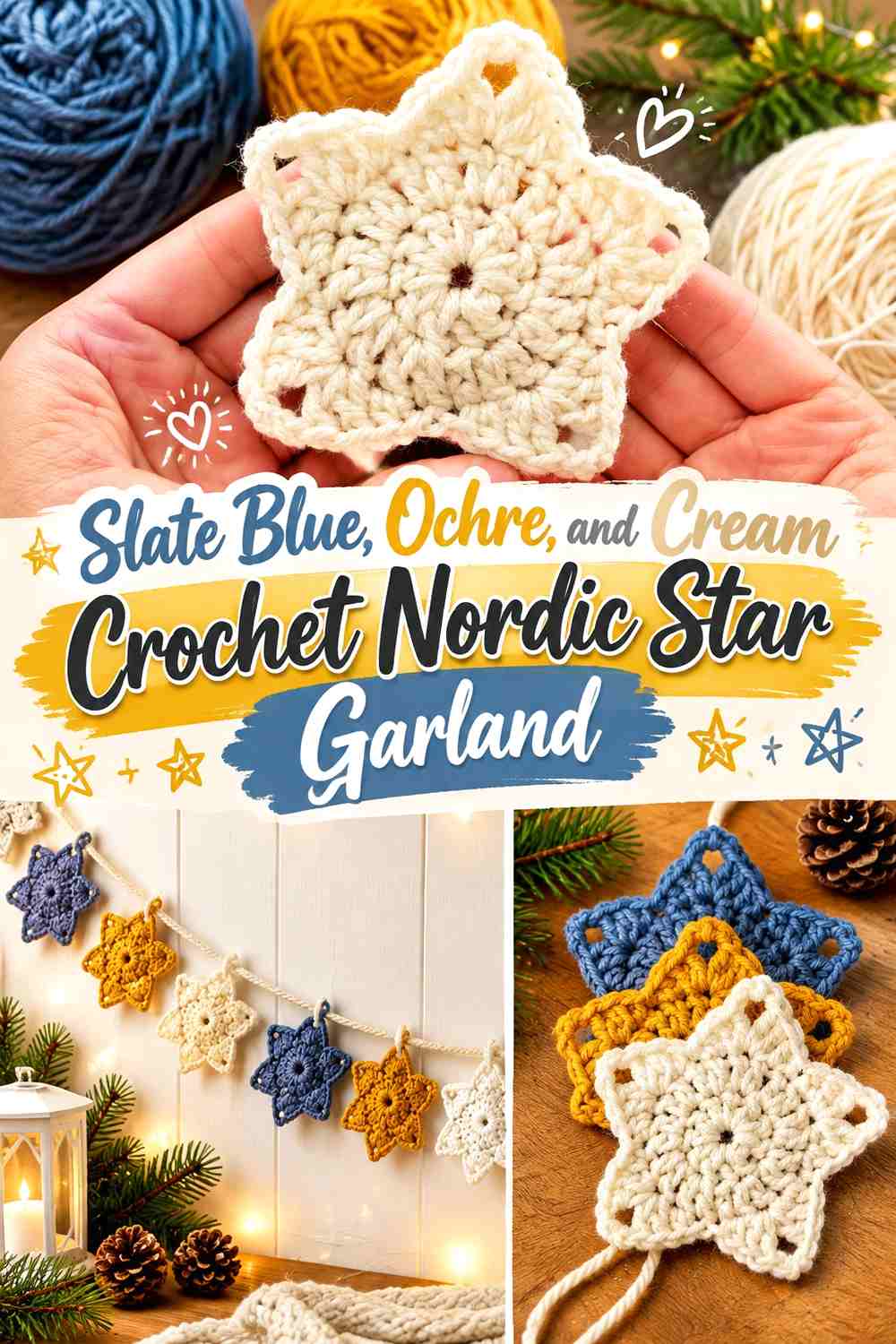
Slate blue provides a muted cool foundation, ochre supplies small warm focal points, and cream keeps the two separated. This palette works well when the stars themselves are simple and you want color rather than elaborate motif variation to create interest.
Slate Blue Should Carry Most of the Crochet Star Garland
Repeat slate blue through the main star sequence so the strand keeps a consistent cool direction. Cream can take the second-largest share.
Ochre works better when it appears less frequently because its warmth makes it naturally conspicuous beside blue.
Ochre Should Accent Slate Blue and Cream Stars at Intervals
Use complete ochre stars occasionally, or repeat the color through centers when the motif allows it. Avoid placing ochre in every star if you want slate blue to remain the main visual impression.
Cream should continue appearing between stronger blue-and-ochre transitions.
Creator Credit: roundthecauldron
16. Espresso Brown, Cream, and Muted Blue Crochet Nordic Star Garland
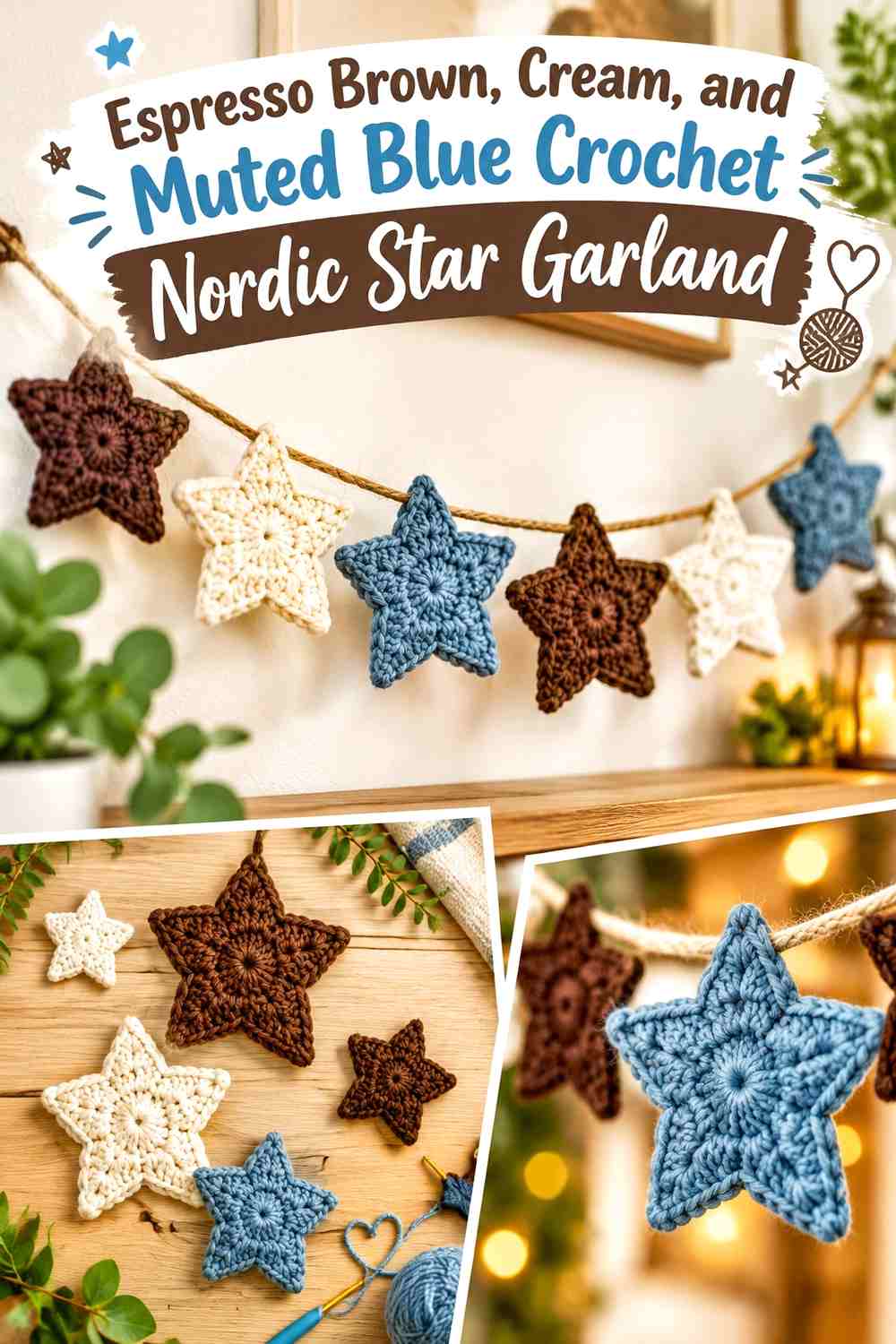
Espresso brown gives this garland a deep neutral foundation, cream provides strong value contrast, and muted blue introduces a cool winter accent. The palette pairs especially well with natural-looking interiors where bright holiday colors would feel too dominant.
Espresso Brown Can Define the Crochet Garland Without Filling Every Star
Use brown on the connecting cord and selected motifs to establish the darkest value. Let cream cover more of the star surface if you want the finished strand to remain visually light.
A brown-heavy strand can become dense when displayed against dark wood, so check the intended background first.
Muted Blue Can Cool Espresso Brown and Cream Crochet Stars
Place muted-blue stars at regular but less frequent intervals. The blue adds winter color without competing strongly with the brown-neutral foundation.
If substituting the blue, preserve its softened character so it does not suddenly become the most saturated color in the entire garland.
Creator Credit: Yarn Crafts | EyeLoveKnots | Cre8tion Crochet
17. Cobalt Blue, Snow White, and Red Crochet Nordic Star Garland
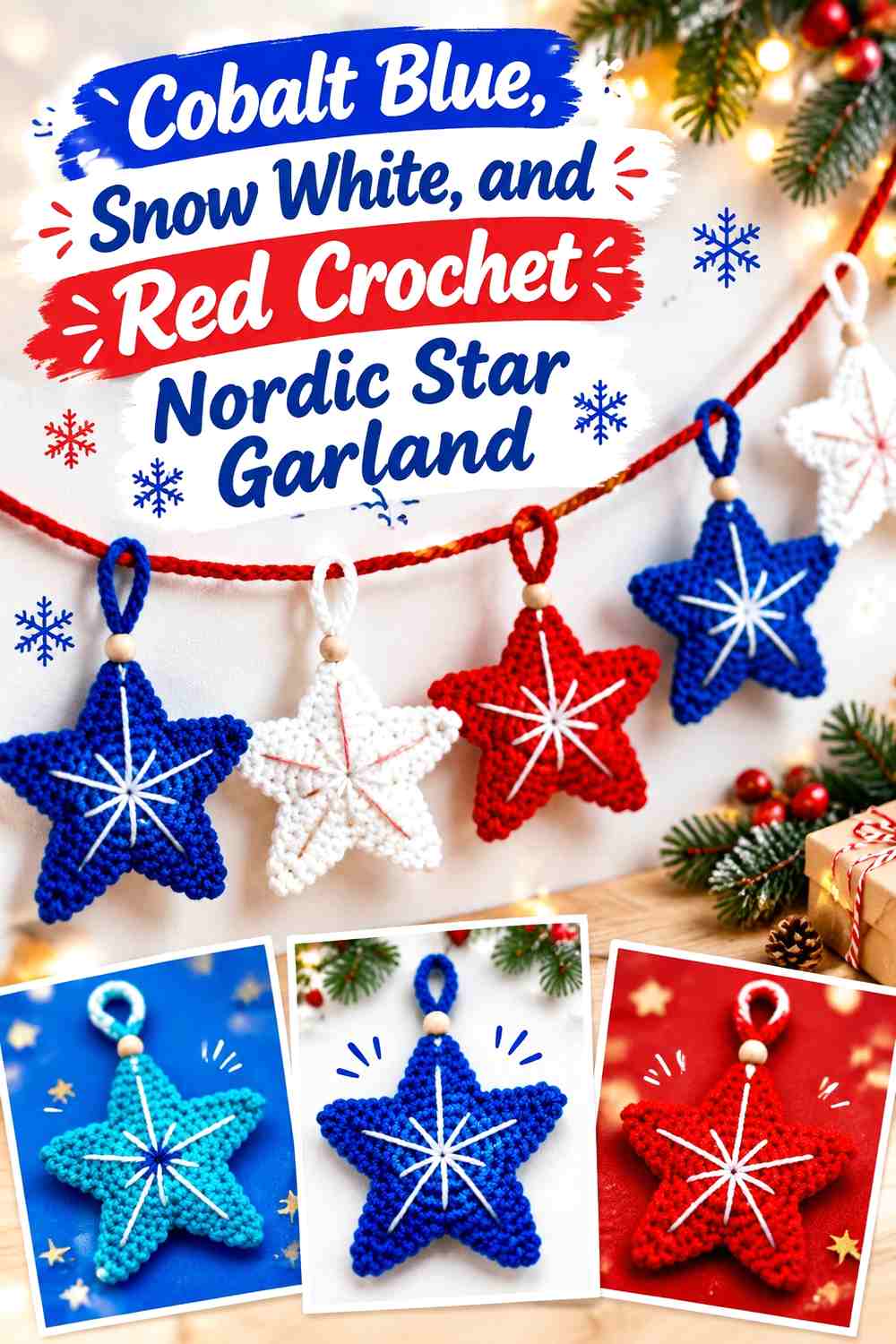
Cobalt, snow white, and red create the brightest palette in the collection. Because both cobalt and red are strong colors, snow white should occupy enough area to prevent the garland from becoming a continuous sequence of saturated motifs.
Cobalt Blue and Red Crochet Stars Need Unequal Visual Weight
Choose either cobalt or red as the primary strong color rather than using identical numbers of both. For a cooler winter direction, let cobalt dominate and use red every few stars.
For a warmer result, reverse those roles while keeping the white spacing consistent.
Snow White Should Separate Cobalt Blue and Red Star Groups
Use white between strongly colored motifs whenever the sequence starts feeling crowded. White can also form the connecting cord if you want that structural element to recede.
On a white wall, switch to cobalt or red for the cord so the overall garland line remains visible.
Creator Credit: Blue Star Crochet
Which Nordic Winter Crochet Star Garland Palette Should You Choose?
For a recognizable red-and-neutral winter direction, cranberry with snow white, pale gray with Scandinavian red and white, or black with deep red and warm white gives you strong star definition and an easy-to-follow color rhythm.
For cooler winter decor, fjord blue with gray, ice blue with white, navy with camel, or slate blue with ochre puts blue at the center of the palette while changing how soft or dramatic the garland feels.
Forest green with oatmeal, sage with brick red, and cinnamon with forest green move toward a warmer woodland direction. For something less expected, plum with dusty pink or espresso with muted blue keeps the winter mood while avoiding classic holiday color combinations.
Conclusion
A Nordic-inspired crochet star garland does not need many colors to look considered. The strongest designs usually establish one dominant shade, repeat a neutral at regular intervals, and reserve the third color for focal stars or small accents.
Also consider the wall, mantel, window, greenery, or shelving behind the garland. Dark stars need enough surrounding contrast for their points to remain visible, while white stars may need a darker cord or neighboring motifs on pale backgrounds. Arrange the full color sequence before permanently joining the stars so one end does not accidentally become heavier or brighter than the other.
Use the credited tutorials for their specific star or ornament constructions, then adapt the color balance, spacing, sequence, and joining approach independently for your own Nordic winter garland.
Frequently Asked Questions
What colors work well for a Nordic winter crochet star garland?
Cranberry red, warm white, forest green, oatmeal, muted blue, gray, navy, burgundy, ochre, and earthy neutrals can all support a Nordic-inspired winter palette. The strongest result usually comes from limiting the palette and repeating colors consistently.
Should every crochet star in a Nordic garland be the same color?
No. Alternating colors can create useful rhythm, but avoid making every star unrelated. Repeat one dominant or neutral color throughout the strand so individual motifs still feel like parts of one garland.
How many colors should I use in a crochet winter star garland?
Two or three colors are enough for many designs. A two-color garland gives strong repetition, while a three-color palette allows one dominant shade, one supporting neutral, and one smaller accent.
How can I keep white crochet stars visible on a pale wall?
Use a darker connecting cord, place darker stars beside the white ones, or choose a warmer cream that separates slightly from the background. Check the garland in its intended display location before joining every motif.
How can I make a multicolor crochet star garland look less busy?
Give the colors unequal roles. Let one shade appear most frequently, use a neutral regularly between stronger colors, and limit the brightest or darkest accent to fewer motifs.
Can snowflake motifs be mixed with crochet stars in a Nordic winter garland?
Yes, as long as the colors and spacing create continuity. Repeating the same neutral, border shade, or connecting cord across both motif types can keep the strand cohesive even when the silhouettes vary.