Icy blue works especially well for crochet winter window hangings because it suggests frost without requiring every decoration to be plain white. Against daylight, however, pale yarn can lose definition, so the strongest designs use icy blue with carefully placed white, navy, gray, teal, or silver-toned supporting colors.

A window also changes how crochet is viewed. Open snowflakes and stars may be strongly backlit during the day, while thicker ornaments become more visible after dark. That makes silhouette, color value, and the placement of darker edging particularly important.
These 15 ideas use different winter motifs and icy-blue color relationships. The credited tutorials support the underlying crochet ornament or motif concept; the icy-blue palettes and window-display arrangements are independent adaptations.
Quick List
- Icy Blue and Winter White Crochet Snowflake Window Hanging
- Icy Blue and Silver Gray Crochet Openwork Snowflake Window Hanging
- Icy Blue and Slate Crochet Rustic Star Window Hanging
- Icy Blue and Frost White Crochet Icicle Window Hanging
- Icy Blue and Pearl White Crochet Angel Window Hanging
- Icy Blue and Charcoal Crochet Celtic Snowflake Window Hanging
- Icy Blue and Soft Aqua Crochet Layered Snowflake Window Hanging
- Icy Blue and Antique White Crochet Classic Snowflake Window Hanging
- Icy Blue and Dove Gray Crochet Snowman Window Hanging
- Icy Blue and Deep Teal Crochet Quick Snowflake Window Hanging
- Icy Blue and Winter White Crochet Defined Snowflake Window Hanging
- Icy Blue and Navy Crochet Graphic Snowflake Window Hanging
- Icy Blue and Snow White Crochet Compact Snowflake Window Hanging
- Icy Blue and Silver Crochet Winterland Snowflake Window Hanging
- Icy Blue and Soft Gray Crochet Festive Snowflake Window Hanging
Check Icy Blue Against Daylight Before Making a Full Window Set
Hold the yarn or a completed motif directly in front of the intended window. Pale icy blue that looks clearly colored on a table may appear almost white against a bright sky, especially in open lace.
If the silhouette fades, you do not necessarily need to abandon icy blue. A darker hanging cord, center, border, or second motif color can provide enough definition while allowing icy blue to remain the dominant shade.
Let Icy Blue Lead While Supporting Colors Define Edges
For a coordinated winter display, repeat icy blue across every hanging but change how the supporting color is used. Winter white can brighten snowflake tips, navy can sharpen star points, and soft gray can separate openwork without making the display strongly high-contrast.
This approach creates variety without making the window look like a collection of unrelated decorations.
1. Icy Blue and Winter White Crochet Snowflake Window Hanging
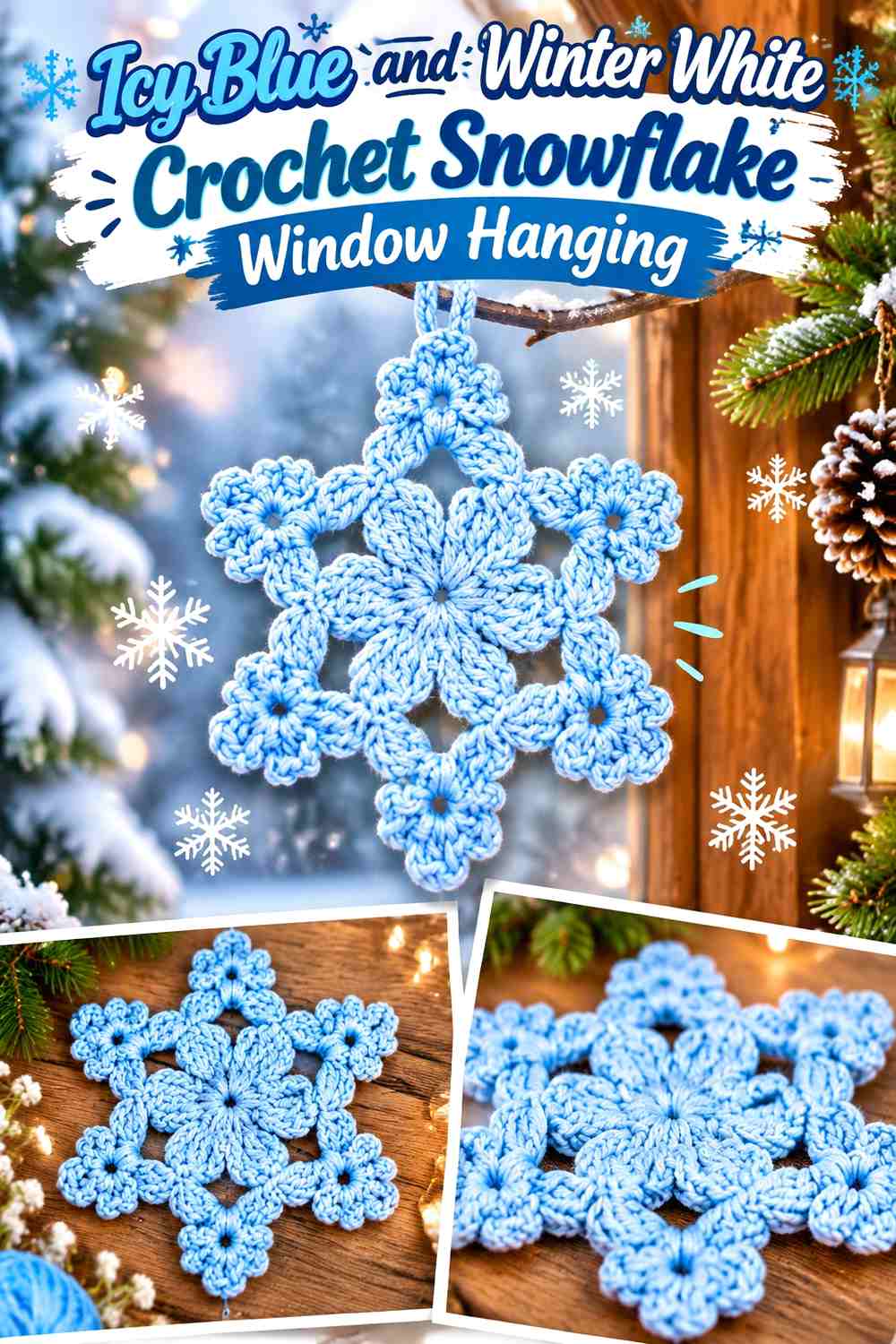
Icy blue can cover most of this snowflake so the motif retains a distinctly frosted color instead of reading as a conventional white ornament. Winter white works best around selected outer points or the hanging loop, where the lighter shade can emphasize the radial silhouette. When several snowflakes are grouped in one window, keep icy blue consistent and vary only the amount of white.
Icy Blue Should Cover Most of the Crochet Snowflake
Use uninterrupted icy blue through the center and most of the arms. Too many small white color changes can divide a six-sided snowflake into separate fragments and make its symmetry less obvious when viewed from across the room.
For a multi-snowflake window arrangement, repeat the same icy-blue center on every motif even if their outer accents vary.
Winter White Can Clarify Icy Blue Snowflake Points
Place winter white toward the outermost details when pale blue needs more separation against the view outside. This creates a lighter perimeter without turning the entire motif white.
If the window frame is also white, consider keeping the hanging loop icy blue so the decoration does not visually disappear at the top.
Creator Credit: naztazia
2. Icy Blue and Silver Gray Crochet Openwork Snowflake Window Hanging
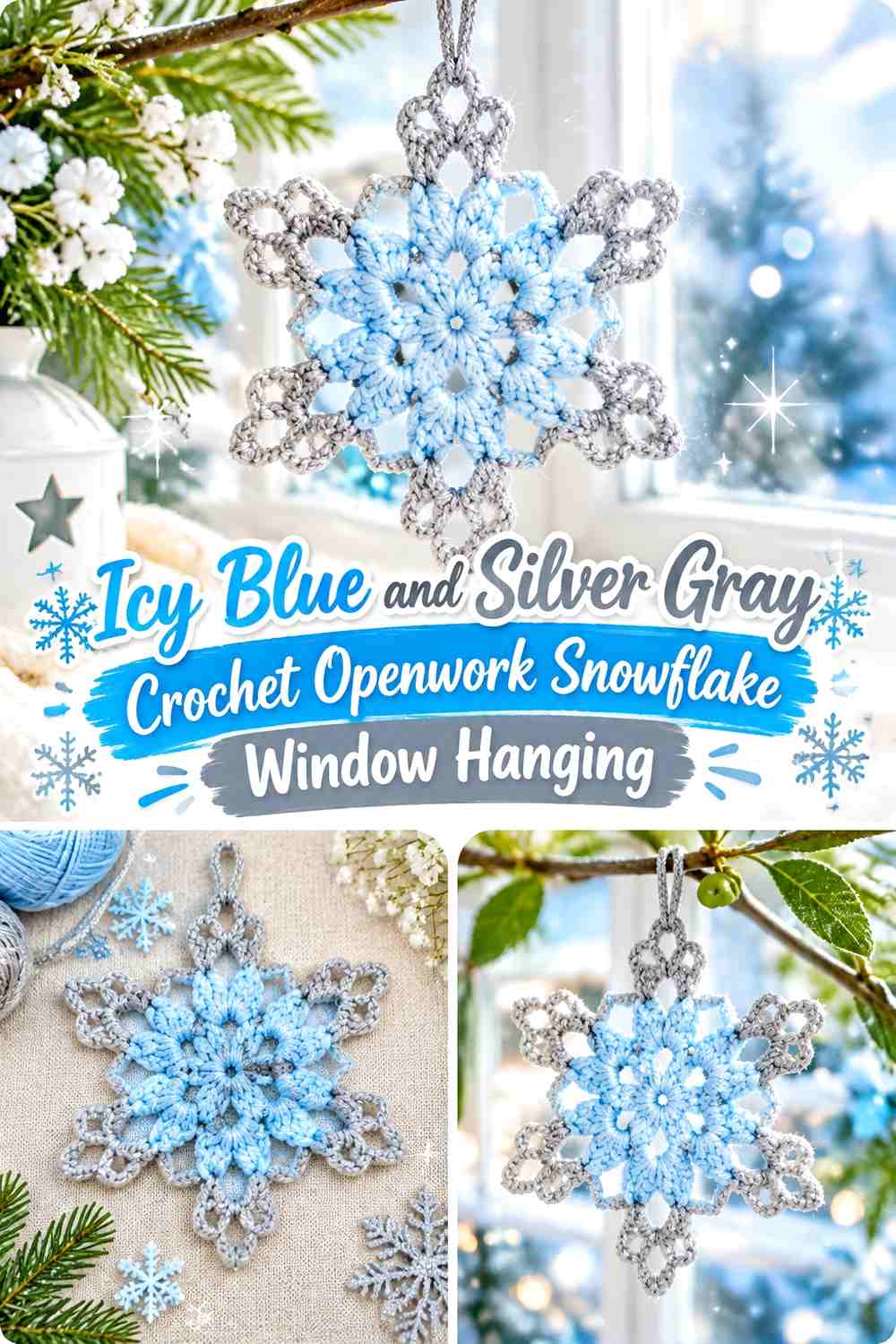
This palette keeps the entire piece cool while giving icy blue a slightly darker partner. Let icy blue dominate the broad openwork areas and place silver gray near the center, connecting spaces, or selected points. The gray should organize the motif rather than divide every arm into equal stripes.
Icy Blue Keeps the Open Crochet Snowflake Looking Frosted
Use icy blue through most of the repeated lace sections so the eye follows one continuous snowflake. Openwork already introduces visual complexity, so a stable main color helps the shape remain readable.
Against a dark nighttime window, icy blue may become more visible than it was during daylight, so check the hanging under both conditions.
Silver Gray Can Give Icy Blue Openwork More Depth
A small amount of gray near the center can make pale-blue outer details feel lighter by comparison. You can also repeat gray in the hanging loop to connect the accent color without adding more color changes to the snowflake itself.
Creator Credit: HappyBerry Crochet
3. Icy Blue and Slate Crochet Rustic Star Window Hanging

A thicker star introduces a more solid shape among delicate snowflakes. Let icy blue cover the broad star faces and reserve slate for the outer point definition or center. Because a star has only a few major points, uneven color placement is especially noticeable.
Icy Blue Should Keep the Crochet Star Points Connected
Run icy blue continuously from the center toward the points rather than breaking each arm into multiple shades. This preserves the geometric outline and lets the star remain recognizable even when strongly backlit.
If the star hangs against a pale winter sky, slate can be concentrated near the outer edge.
Slate Can Frame Icy Blue Without Making the Star Too Dark
Use slate narrowly around selected boundaries or as a center accent. A broad dark border can visually shrink the icy-blue field, so keep the darker shade secondary when blue is meant to define the winter palette.
Creator Credit: Rich Textures Crochet
4. Icy Blue and Frost White Crochet Icicle Window Hanging
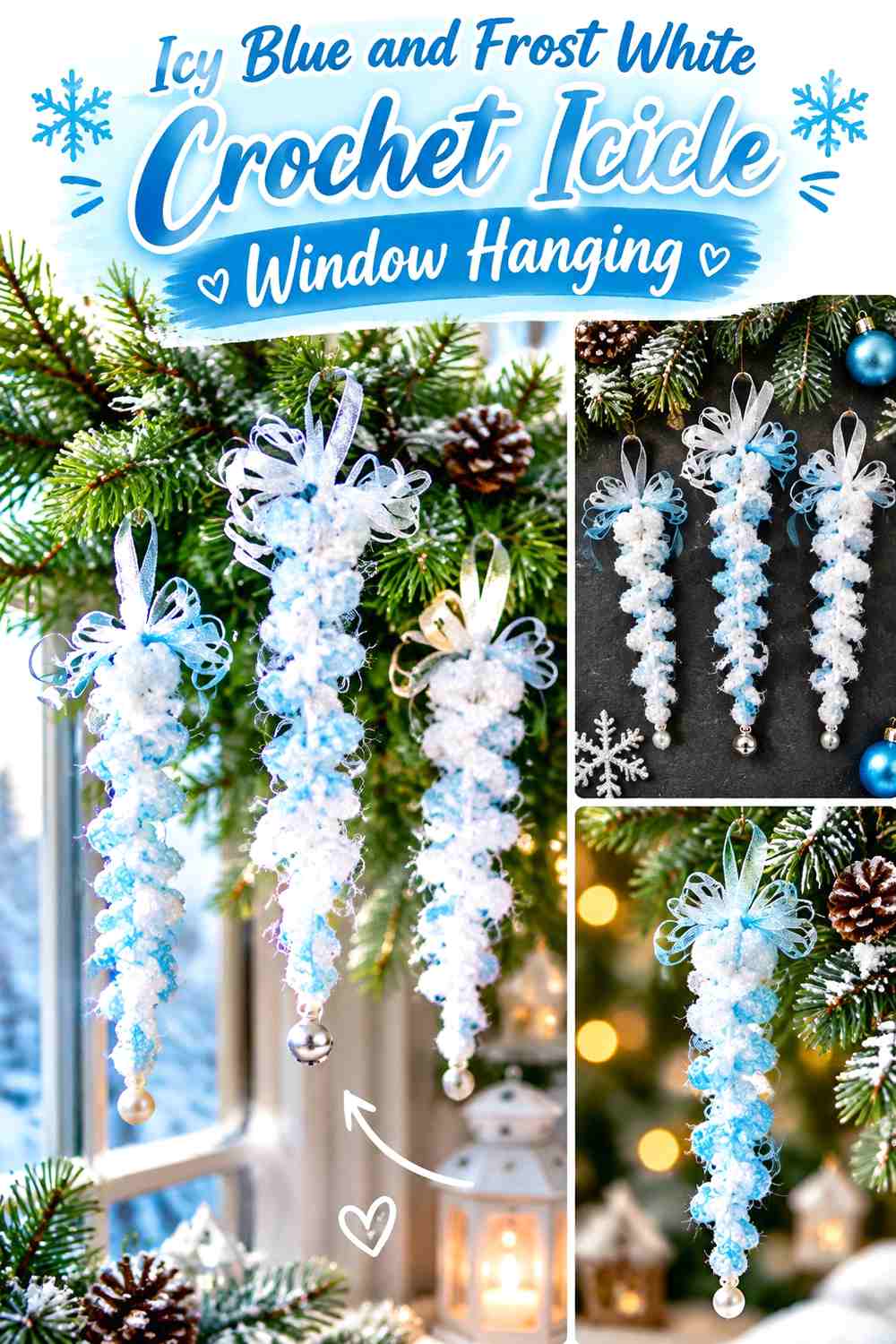
An icicle gives the window display a long vertical shape that contrasts with round snowflakes and wide stars. Icy blue can lead from top to bottom, while frost white can appear at the upper hanging area or in selected lighter details. Keeping most of the length one color helps the spiral or narrow silhouette remain continuous.
Icy Blue Should Run Through Most of the Crochet Icicle
Use icy blue along the main length instead of switching repeatedly between blue and white. Continuous color emphasizes the vertical fall of the ornament and makes a group of icicles easier to read as hanging winter shapes.
You can vary their hanging heights rather than relying on extra colors for variety.
Frost White Can Lighten the Top of an Icy Blue Icicle
A white hanging loop or small upper accent creates a visual transition between the window frame and the blue ornament. Keep the lower portion primarily icy blue so the narrow shape does not look segmented.
Creator Credit: Hectanooga1
5. Icy Blue and Pearl White Crochet Angel Window Hanging

An angel adds a recognizable figurative shape to a window filled with geometric winter motifs. Icy blue can dominate the dress or main body, while pearl white can distinguish wings or a smaller upper feature. The contrast should support the silhouette rather than create several equal color blocks.
Icy Blue Should Lead the Crochet Angel Body
Use icy blue across the largest section so the ornament belongs clearly with the rest of an icy-blue window collection. Keeping the body one main shade also makes the smaller white areas easier to identify.
Pearl White Can Separate Icy Blue Angel Wings
Use white where the wings need to stand apart from the central body. Because window light can pass through open crochet, the lighter wings may look especially subtle during the day, so make sure their outline remains distinct from the blue section.
Creator Credit: Crochet Jewel
6. Icy Blue and Charcoal Crochet Celtic Snowflake Window Hanging

Charcoal creates the strongest contrast in this collection and is particularly useful around a more intricate snowflake. Let icy blue remain the main visible color, while charcoal marks selected knot-like sections, the center, or the hanging point.
Icy Blue Should Remain Dominant in the Celtic Crochet Snowflake
Keep the majority of the interlaced or radiating form blue so the darker accent does not turn the motif into a mostly charcoal ornament. Strong dark yarn naturally attracts attention, so it usually needs less surface area.
Charcoal Can Sharpen Icy Blue Snowflake Intersections
Place charcoal where several icy-blue elements visually cross or meet. This can give complicated sections more definition without outlining every outer point.
Against very dark evening glass, check that the charcoal still contributes instead of disappearing completely.
Creator Credit: Celtic Knot Crochet
7. Icy Blue and Soft Aqua Crochet Layered Snowflake Window Hanging
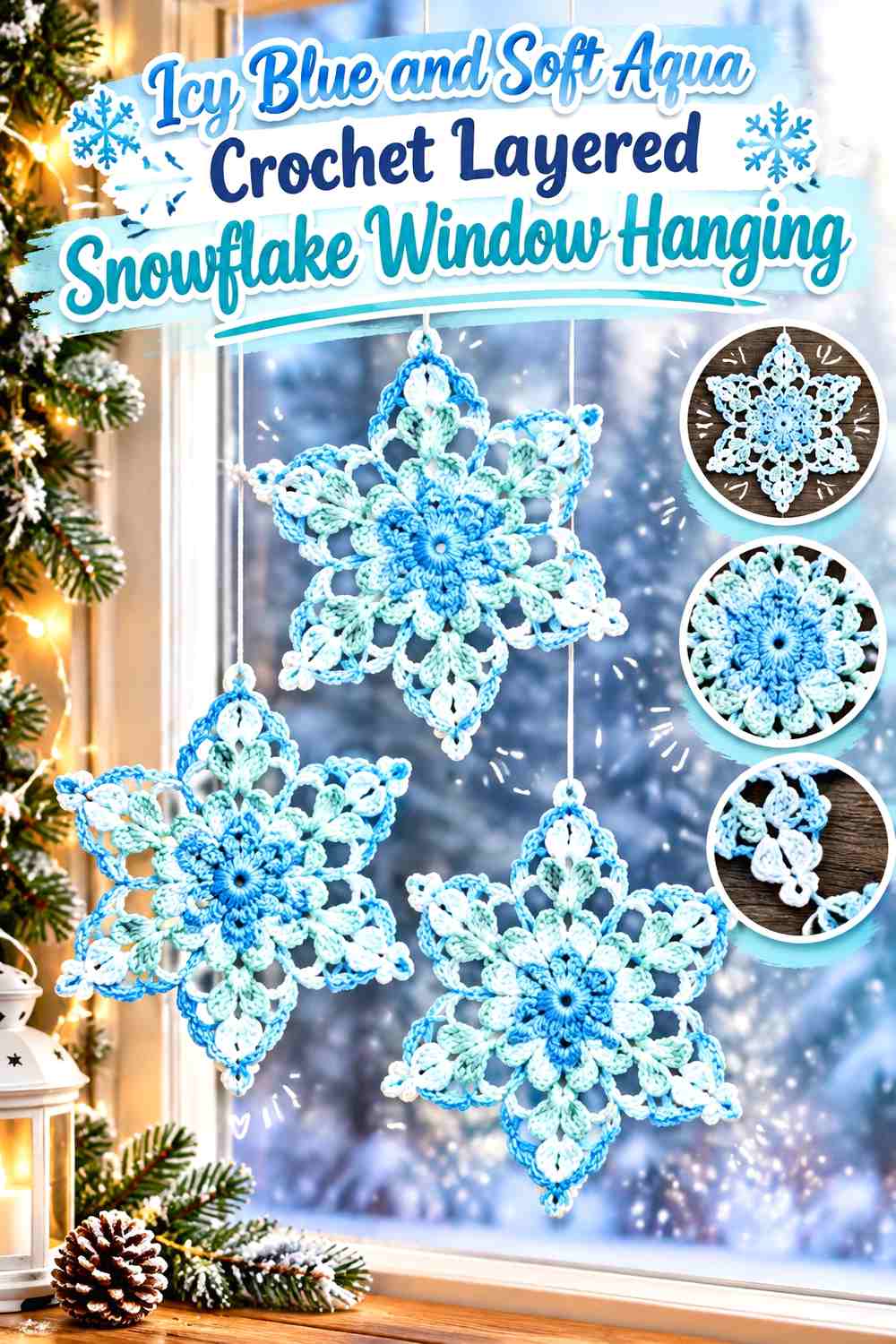
Icy blue and soft aqua create a tonal palette rather than strong contrast. The difference should come from giving icy blue the lighter, frostier role and using aqua in a more concentrated center or secondary layer.
Icy Blue Needs the Larger Share of the Crochet Snowflake
Cover most of the motif in icy blue so the hanging does not become an equal two-color blend. This keeps the palette clearly tied to the article’s main shade while aqua supplies a subtle variation.
Soft Aqua Can Deepen the Center of an Icy Blue Snowflake
Concentrate aqua inward and let icy blue expand toward the points. A center-to-edge progression is easier to read than frequent alternating color changes around a small radial motif.
If your aqua and icy blue are almost identical in value, compare them in grayscale before committing to the full hanging.
Creator Credit: Kristines Crochets
8. Icy Blue and Antique White Crochet Classic Snowflake Window Hanging
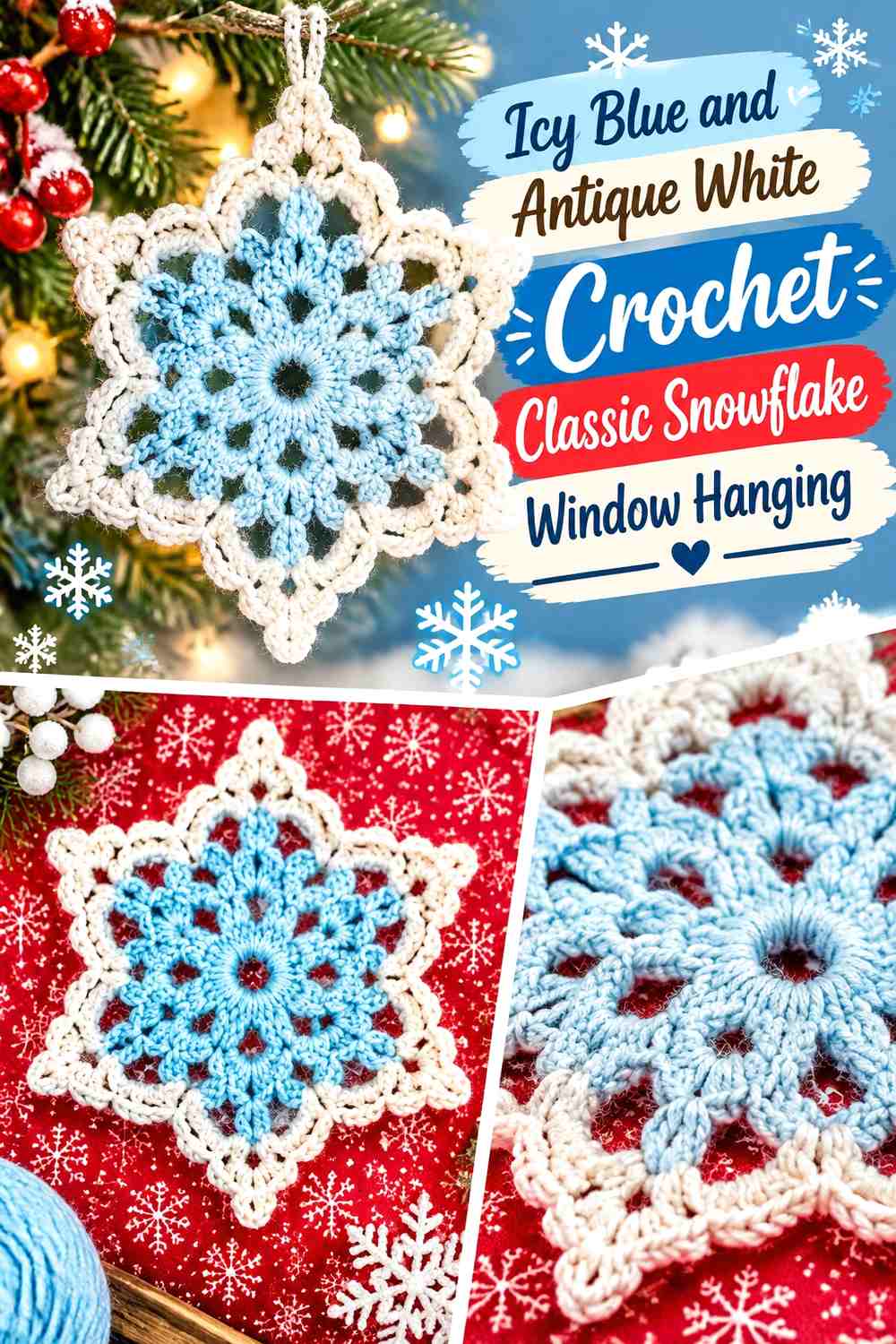
Antique white creates a warmer contrast than bright snow white, which can keep an icy-blue display from looking overly stark. Use icy blue across the main snowflake and antique white along selected outer details or the hanger.
Icy Blue Should Keep the Classic Crochet Snowflake Cohesive
A traditional radial snowflake already contains many small stitch changes, so broad sections of one icy-blue shade help maintain a strong overall shape.
If several snowflakes share the window, use antique white differently on each one while repeating the same dominant blue.
Antique White Can Soften an Icy Blue Window Palette
Place antique white on edges or small points where you want contrast without the crispness of bright white. This is especially useful near warm wood window trim, where stark white may feel more disconnected from the surroundings.
Creator Credit: Bella Coco
9. Icy Blue and Dove Gray Crochet Snowman Window Hanging
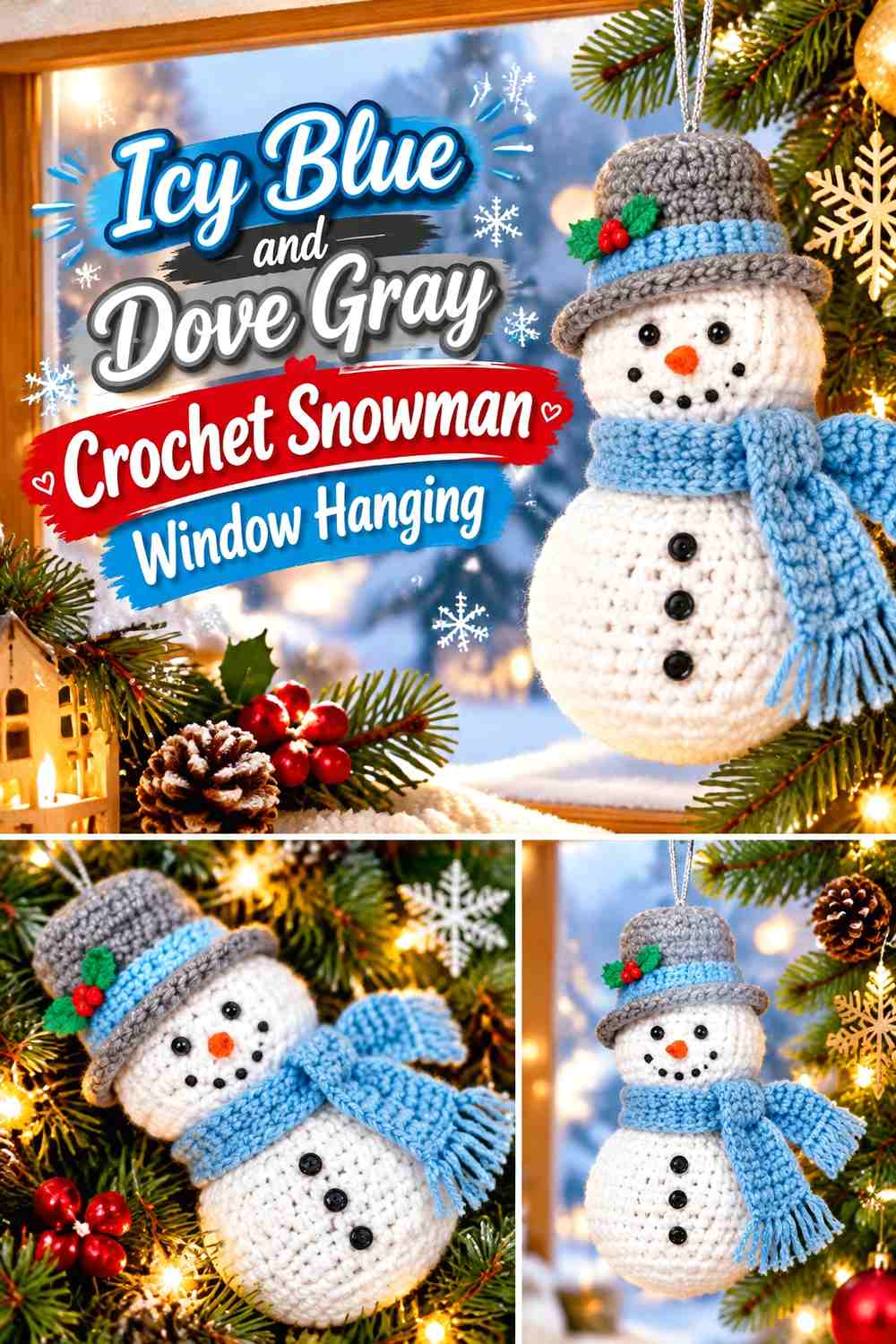
A snowman allows icy blue to become the colored winter component rather than the entire body. Use icy blue for the most visible accessory or surrounding detail and dove gray for quieter definition. A pale neutral body can remain subordinate to the article’s main blue palette by repeating icy blue prominently.
Icy Blue Should Be the Snowman’s Main Crochet Accent
Give icy blue enough surface area—such as a prominent scarf or hat concept—that the ornament still belongs to the coordinated window collection.
One tiny blue detail surrounded by several neutral colors would not provide enough visual connection to the other hangings.
Dove Gray Can Support Icy Blue Snowman Details Without Harsh Black
Use gray for small defining areas where a softer neutral is preferable. Keep it limited so icy blue remains the color that connects the snowman to the rest of the window display.
Creator Credit: Crouton Crafts
10. Icy Blue and Deep Teal Crochet Quick Snowflake Window Hanging

Deep teal gives icy blue a darker neighboring hue while keeping the palette completely cool. This is useful for windows where pale blue disappears during daylight. Icy blue should still cover most of the motif, with teal concentrated where definition is most needed.
Icy Blue Should Fill Most of the Quick Crochet Snowflake
Keep the fast repeated motif predominantly blue so several snowflakes can be made into a coordinated cluster. A consistent main color is especially valuable when you plan to hang different sizes together.
Deep Teal Can Sharpen Icy Blue Outer Snowflake Points
Use teal around selected tips or the hanging loop instead of placing it randomly throughout the center. The darker outer accent can preserve the silhouette against a bright window.
Creator Credit: Hooked by Robin
11. Icy Blue and Winter White Crochet Defined Snowflake Window Hanging
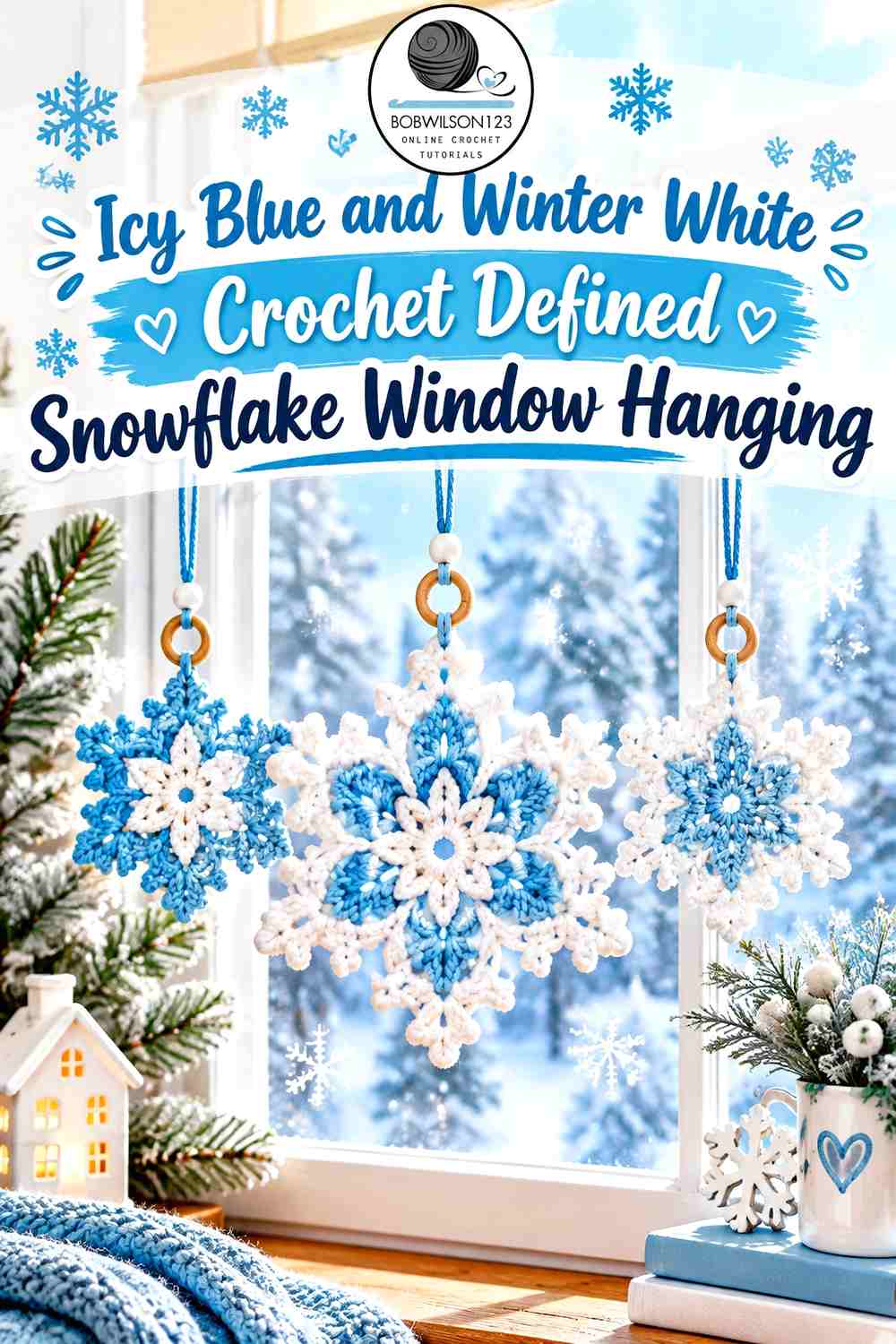
This variation uses winter white as a structural partner rather than merely a tiny accent. Let icy blue cover the main repeated areas, while white marks the center or a consistent outer section. The goal is still to keep icy blue visually dominant.
Icy Blue Should Create the Main Snowflake Field
Use icy blue over the broadest area and avoid splitting every arm exactly in half. The eye should recognize blue first and white second.
Winter White Can Give Icy Blue Lace a Cleaner Boundary
Place white where the pattern changes from a denser area into more open points. This helps the transition remain visible when the motif is backlit.
If the window trim is white, an icy-blue hanging loop can prevent the top edge from disappearing.
Creator Credit: Crochet with Clare
12. Icy Blue and Navy Crochet Graphic Snowflake Window Hanging
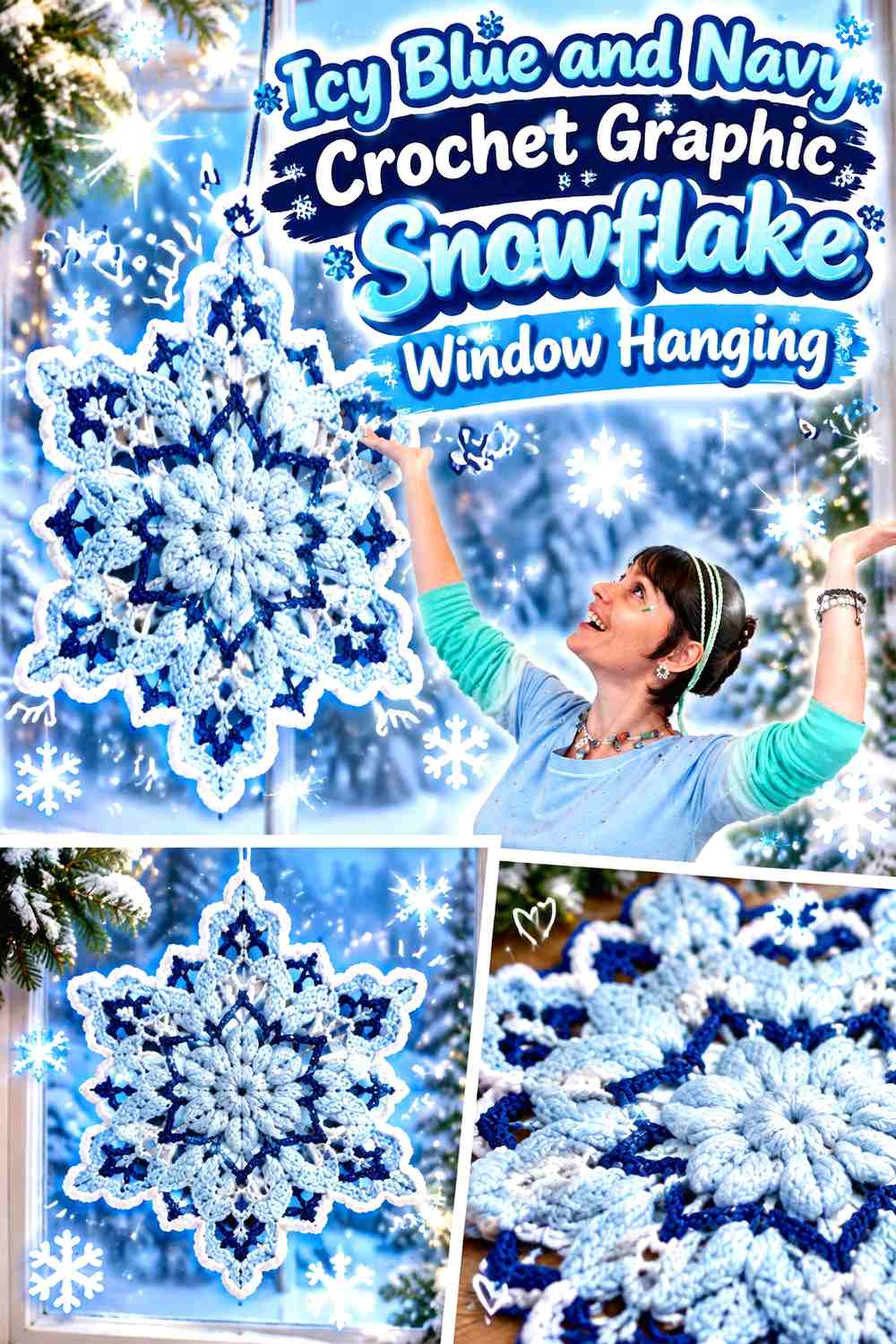
Navy gives icy blue its strongest blue-on-blue contrast. Use navy in a restrained center, edge, or hanging cord so the motif gains definition without losing the pale frosted appearance.
Icy Blue Should Occupy More of the Crochet Snowflake Than Navy
Because navy carries much more visual weight, even a relatively small amount can appear dominant. Keep icy blue across the arms and most of the center field.
Navy Can Make Icy Blue Snowflake Points Visible Against Daylight
A navy hanging cord or selected outer detail can help the ornament remain visible when the outside view is bright. Use the dark shade strategically rather than outlining every stitch.
Creator Credit: Jayda InStitches
13. Icy Blue and Snow White Crochet Compact Snowflake Window Hanging
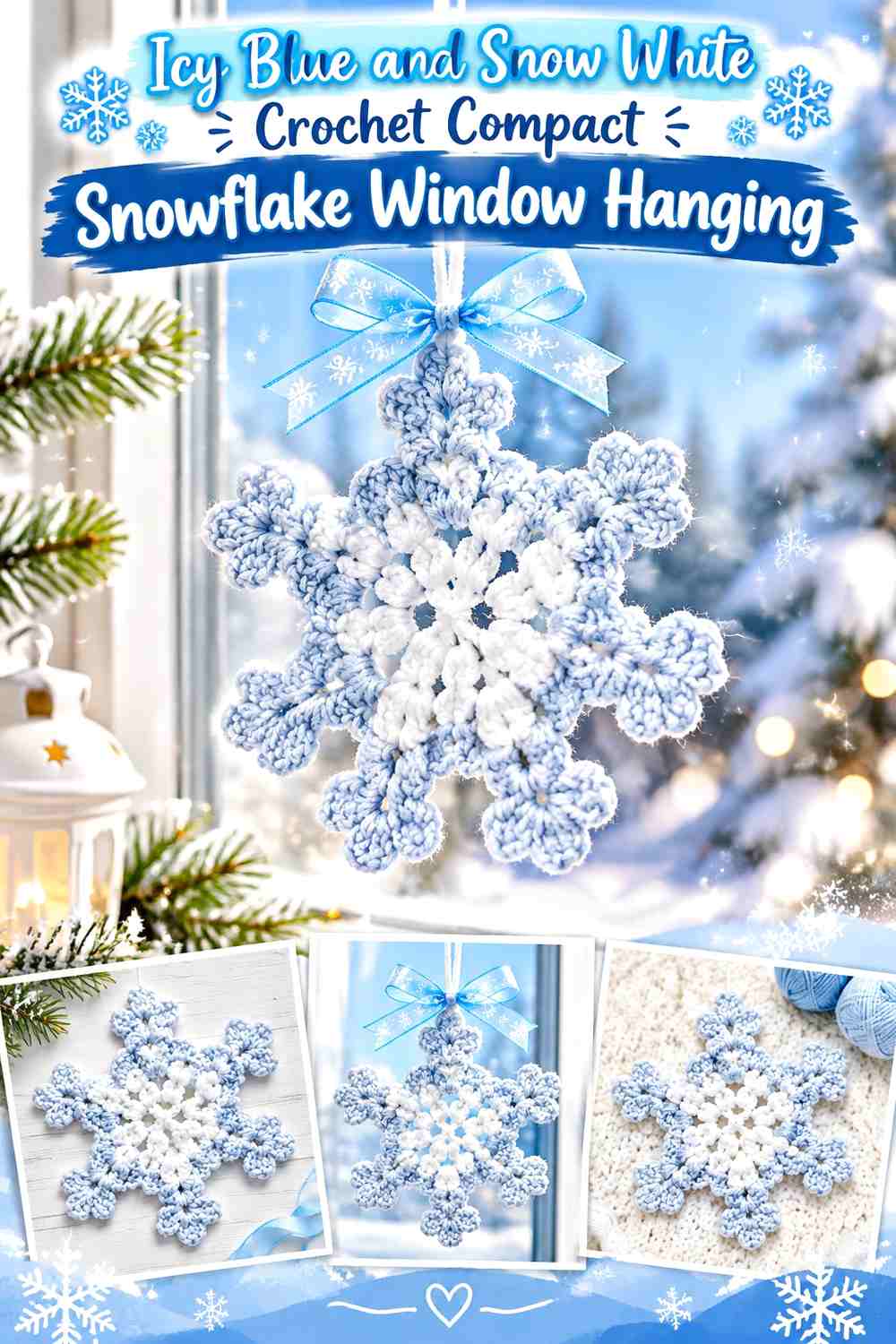
A compact snowflake works well in groups because it occupies less visual space than larger open motifs. Icy blue can cover the complete primary structure while snow white appears in alternating companion snowflakes or limited individual details.
Icy Blue Should Unify a Cluster of Compact Crochet Snowflakes
If you hang three or five small motifs together, repeat icy blue in every one rather than giving each snowflake an unrelated palette. This makes the cluster read as a single window feature.
Snow White Can Give Icy Blue Snowflake Clusters Visual Pauses
Use white more heavily on one or two motifs rather than sprinkling tiny white details throughout every snowflake. Alternating color emphasis provides variation while preserving each small silhouette.
Creator Credit: The Crochet Crowd
14. Icy Blue and Silver Crochet Winterland Snowflake Window Hanging

Silver-toned yarn can bring a sharper accent to icy blue, but it should stay controlled so the snowflake does not become visually dominated by the brighter detail. Let icy blue carry the entire central structure and use silver only around selected points or the hanging area.
Icy Blue Should Remain the Main Winterland Crochet Snowflake Color
Use icy blue across the broad radial structure so the motif stays visibly blue even when daylight catches the silver accent.
If the silver yarn has a noticeably different texture, keep it away from every small detail so the contrast in surface does not compete with the snowflake shape.
Silver Can Highlight Icy Blue Snowflake Tips Selectively
Repeat silver symmetrically around the outer edge. On a radial motif, an accent concentrated on only one side can make the hanging look visually unbalanced even when the crochet itself is symmetrical.
Creator Credit: Crochetpedia
15. Icy Blue and Soft Gray Crochet Festive Snowflake Window Hanging

Soft gray gives the final snowflake a restrained winter palette that works well when you want icy blue to remain pale without adding bright white. Use icy blue through most of the motif and gray where the lace needs additional visual weight.
Icy Blue Should Control the Festive Crochet Snowflake Palette
Let icy blue occupy the broadest sections so the motif coordinates with the rest of the window collection. Soft gray should remain supporting rather than becoming an equal alternating color on every arm.
Soft Gray Can Ground Icy Blue Around the Snowflake Center
A gray center can create enough depth to separate the lighter outer points from the window behind them. Repeat a small amount of gray in the hanging loop if you want the accent to feel connected from center to top.
Creator Credit: Michaels Stores
Which Icy Blue Winter Window Hanging Should You Choose?
For the lightest frosted look, choose icy blue with winter white, pearl white, antique white, or silver. These combinations emphasize pale color and open space, making them particularly suitable for snowflakes and angels.
For stronger daylight definition, pair icy blue with navy, deep teal, charcoal, or slate. The darker shade can be concentrated around centers, points, cords, or outer boundaries rather than replacing icy blue as the dominant color.
For a coordinated window collection, mix silhouettes instead of making every ornament identical. A few snowflakes can establish the winter theme, while one star, icicle, angel, or snowman interrupts the repeated radial shapes. Keep icy blue consistent across all of them to make the different constructions feel related.
Conclusion
Icy blue can unify an entire crochet winter window display while still leaving room for noticeably different ornaments. The key is changing the supporting color’s job: white can lighten snowflake points, navy can sharpen a pale silhouette, teal can add cool depth, and gray can define intricate openwork more quietly.
Evaluate each piece while it is actually hanging. Daylight can wash out subtle colors, overlapping motifs can merge into darker shapes, and pale cords may disappear against white frames. Give every ornament enough surrounding space to keep its outline visible and repeat icy blue across the collection so stars, snowflakes, icicles, and figurative motifs still look like one planned display.
Frequently Asked Questions
What colors pair well with icy blue for crochet winter window hangings?
Winter white, antique ivory, soft gray, silver, navy, slate, aqua, and deep teal can all work. Choose the supporting color according to whether you want softer tonal contrast or a more strongly defined silhouette.
How can I keep icy blue crochet visible against a bright window?
Add a darker color around selected points, centers, hanging cords, or borders. Navy, charcoal, slate, or teal can provide enough value contrast without replacing icy blue as the main shade.
Should every winter window hanging use exactly the same icy blue palette?
No. Keeping icy blue as the repeated dominant color is usually enough to create cohesion. One ornament can pair it with white, another with navy, and another with gray while still belonging to the same collection.
How should I arrange several icy blue crochet snowflakes in one window?
Vary their heights and leave enough horizontal space for individual outlines to remain visible. Overlapping openwork can merge into a darker visual mass when strongly backlit.
Can I mix icy blue crochet stars, snowflakes, and icicles?
Yes. Repeating icy blue across different silhouettes is an effective way to create variety without making the display visually disconnected. Use supporting colors in smaller, repeated roles to strengthen the relationship.
How do I replace icy blue if my exact shade is unavailable?
Choose another pale cool blue that remains clearly lighter than any navy, teal, charcoal, or slate accent in the palette. Preserving the dominant-versus-accent relationship matters more than matching an exact commercial shade.