Celestial crochet fashion can be bold enough to shape an entire garment or quiet enough to appear as a small detail at the wrist, neckline, or hairline. This collection moves through both ends of that range, from sweaters built around large stars and a cardigan covered in moon-and-star motifs to crescent bags, celestial jewelry, and narrower accessories that are easier to combine with an everyday wardrobe.
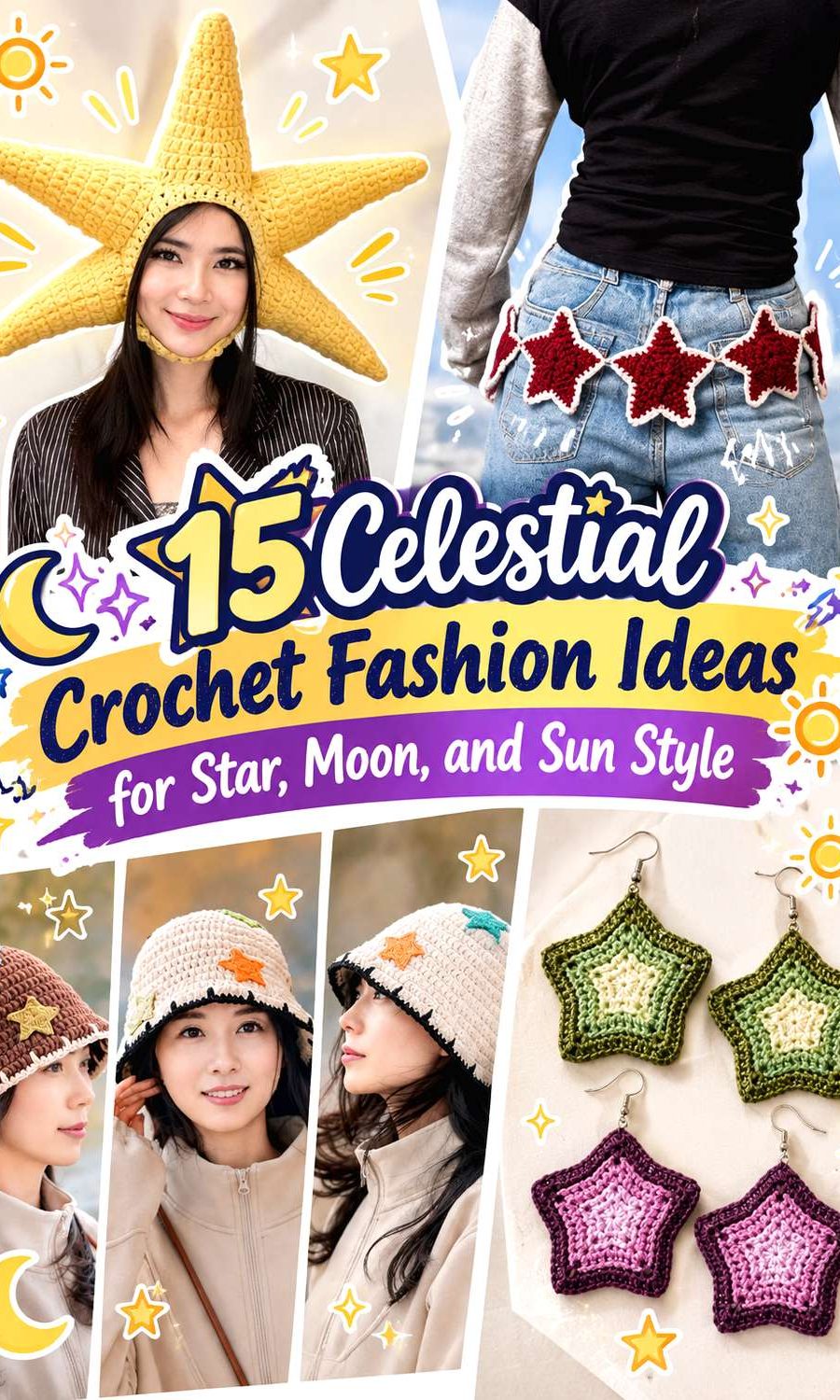
The projects also interpret the theme differently. Some use a literal celestial silhouette, such as a crescent bag or sculptural star hat. Others place stars, suns, and moons across otherwise familiar fashion shapes. The final scarf takes an even subtler route: its celestial connection comes from star-stitch texture rather than a separate five-point motif. That variety matters when choosing a project, because motif scale, fit, opening style, dimensional shaping, and placement can change the finished look as much as color.
Quick List
- Crochet Celestial Star-and-Moon Cardigan
- Crochet Oversized Star Sweater
- Crochet Star Crop Top
- Crochet Half-Moon Top
- Crochet Sculptural Star Bag
- Crochet Crescent Crossbody Bag
- Crochet Sun-and-Moon Granny Square Bag
- Crochet Star Bucket Hat
- Crochet Star Headband
- Crochet Festival Star Gloves
- Crochet Star Belt
- Crochet Star Earrings
- Crochet Crescent Moon Earrings
- Crochet Sculptural Star Hat
- Crochet Lacy Star-Stitch Scarf
Choose Between Celestial Motifs, Silhouettes, and Texture
The strongest decision is not necessarily which celestial object you prefer. First decide how visibly you want that object translated into crochet. A sweater made from giant star panels or a hat constructed as a three-dimensional star becomes the focal point of an outfit immediately. A conventional bucket hat carrying a star design keeps the overall silhouette familiar while letting the motif provide the theme.
Crescents occupy useful middle ground. A crescent bag is recognizable through its outline even in one color, so it does not require additional moon appliqués. Repeated granny squares work differently because their layout becomes part of the design. Finally, star-stitch texture can suggest the theme without showing a literal star from across the room. Thinking in terms of silhouette, surface motif, and texture makes it easier to choose a celestial project that fits the rest of your wardrobe.
Plan Fit Before Expanding the Celestial Detail
Garments and fitted accessories need more planning than decorative motifs alone. Enlarging a star panel for a sweater affects the body dimensions around it; changing a half-moon top alters coverage as well as the visual crescent. Headbands, belts, gloves, and jewelry have smaller working areas, so even a modest change in motif size can noticeably change fit.
Bags introduce a different set of decisions. Widening a crescent or star body can also change the opening, strap relationship, and way the accessory hangs. With jewelry, scaling a motif up changes more than appearance because the finished piece occupies more space beside the face or neckline. When the tutorial includes its own sizing or adjustment method, use that construction guidance rather than assuming that changing yarn or hook size will enlarge every part proportionally.
1. Crochet Celestial Star And Moon Cardigan
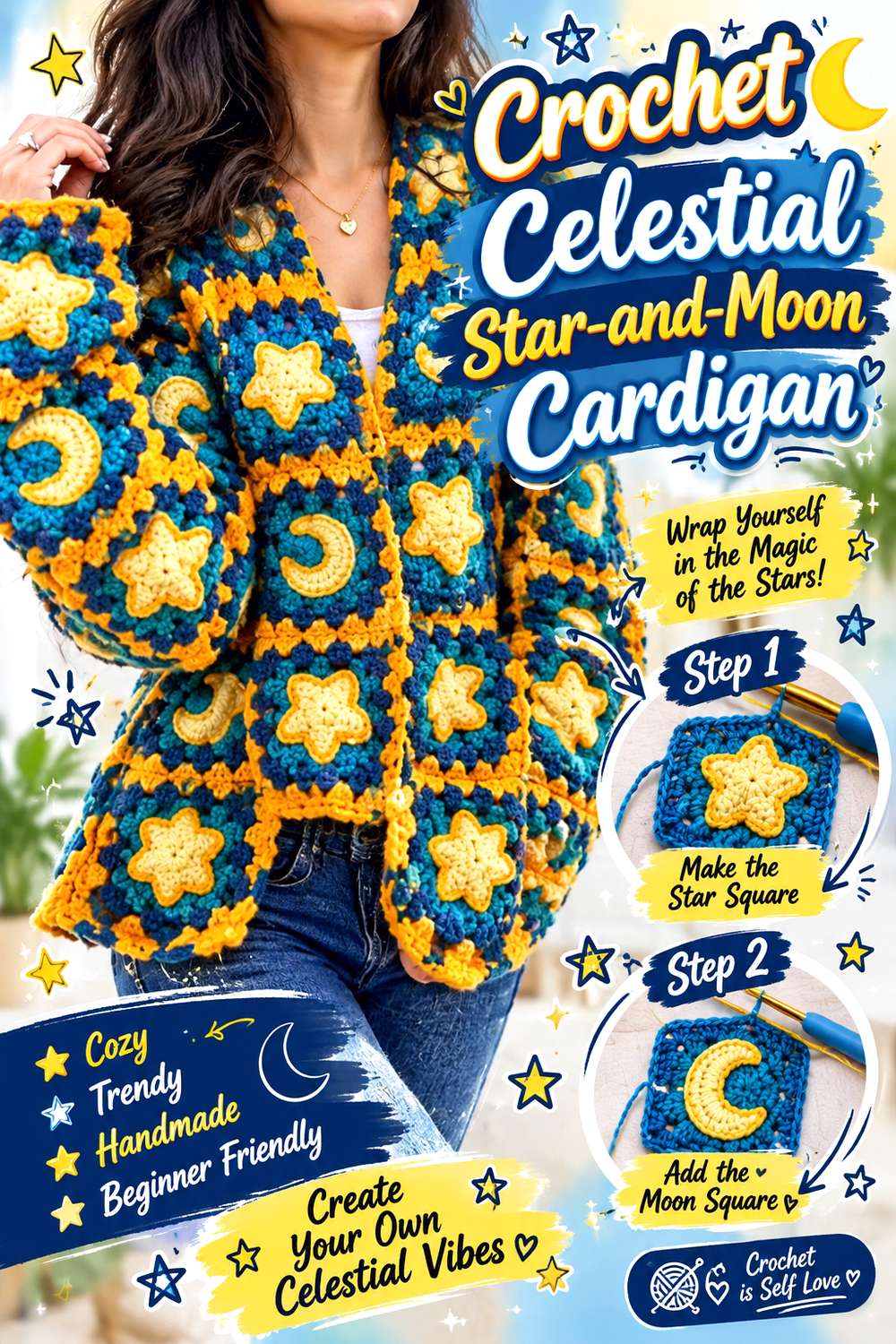
This cardigan places the night-sky theme across a full garment rather than isolating it in one decorative patch. Krystal Everdeen’s celestial cardigan project combines cardigan construction with star-and-moon designs, so different celestial elements can appear across the body and sleeves instead of forming one oversized central image. The creator also connects the project with separate cardigan and star-and-moon square guidance.
That source structure is worth understanding before starting: the celestial-cardigan video explains how the creator approached the finished piece and points toward supporting tutorials rather than packaging every construction detail into one uninterrupted standalone lesson. For a reader who likes planning patchwork layouts, that can be useful because motif placement becomes an intentional part of the garment. It is less suitable if you specifically want one linear video that carries every step from the first square through the final seam.
Arrange the Night Sky Before Joining
Stars and moons do not need to alternate mechanically. A slightly irregular layout can feel more like a scattered sky, but completely random placement can leave several visually heavy motifs clustered in one area.
Lay enough completed pieces together to represent a substantial section of the cardigan before joining. Photograph the arrangement and look at it from a distance. This makes it easier to notice whether one sleeve, shoulder, or front panel is receiving most of the strongest celestial shapes.
Keep Specialty Effects Compatible With the Main Fabric
Sparkle, metallic strands, and contrasting textures can strengthen the night-sky idea, but they are material changes rather than purely visual ones. A specialty yarn may create a different thickness, flexibility, or stitch definition from the yarn used for neighboring squares.
If you want shimmer, test it in a small sample before committing it to multiple motifs. The goal is for the celestial square to remain compatible with the surrounding fabric rather than becoming a noticeably different size or stiffness.
Creator: Krystal Everdeen
2. Crochet Oversized Star Sweater

Instead of distributing many small stars across a garment, this sweater makes the star itself part of the garment architecture. HopieDopeOfficial’s tutorial uses large star-shaped panels as the defining feature of the sweater, giving the front and back an immediately recognizable celestial geometry rather than placing a small appliqué on a conventional pullover. Supporting descriptions of the project also identify the star panels as central to its made-to-measure construction.
That construction makes color particularly influential. A single shade keeps attention on the outline and valleys of the star, while color changes can divide the expanding shape into visible bands. Because the motif is so large, this project does not need additional moons, planets, or appliqués to communicate the theme. Its strongest feature is already occupying most of the garment surface.
Judge the Star at Garment Scale
A star that looks balanced while partially worked can feel very different once it spans the torso. Check the developing panel against the body according to the creator’s fitting guidance rather than deciding its final size from the number of rounds alone.
Pay particular attention to where the points and valleys land. They influence more than decoration because the large motif forms the basis of the sweater. Increasing the panel simply to obtain a more dramatic star also changes the garment around it.
Decide How Much Contrast the Star Needs
Strong color changes make each stage of the star easy to see and can push the sweater toward a graphic look. Closely related colors make the same geometry feel quieter.
Before adding several colors, arrange the yarns in the sequence you are considering and think about which band will occupy the largest area. A narrow bright stripe and a broad bright stripe have very different effects even when they use the same palette.
Creator: HopieDopeOfficial
3. Crochet Star Crop Top

A star crop top brings the celestial shape closer to the body and concentrates the theme into a much smaller garment than the oversized sweater. Lady Katrina Crochet provides a public tutorial specifically for a crochet star crop top, making this a direct fashion project rather than an adaptation from a decorative star motif.
Because the star occupies the central visual area, its points naturally become part of how the top frames the torso. That is a different design problem from placing stars on a rectangular panel: here, the outline itself matters. A high-contrast two-color treatment can make the star unmistakable, while a single shade lets the shape rely more on its edge and stitch texture. This is a useful direction when you want celestial fashion to feel graphic and compact rather than layered or heavily embellished.
Treat Coverage as Part of the Design
With a shaped crop top, increasing the star is not merely equivalent to enlarging a printed motif. It can change where the points land, how much of the torso is covered, and how the supporting parts of the top need to relate to the center.
Follow the source’s construction and fit checks rather than scaling the star independently. If you want more coverage, first determine which part of the garment actually needs to increase instead of assuming every dimension should grow together.
Let One Star Do the Work
The central shape is already a strong celestial signal. Adding multiple dangling stars, moons, beads, and contrasting borders can quickly move attention away from the clean outline.
If you want customization, color blocking is a lower-risk visual change because it can alter the mood while preserving the underlying star construction. Decide whether you want the piece to read first as a star or first as a highly decorated crochet top.
Creator: Lady Katrina Crochet
4. Crochet Half Moon Top

ABoC Studio’s half-moon top interprets the celestial theme through curved garment shaping rather than an appliquéd moon. The creator presents the public project as a Half-Moon Top tutorial and separately provides pattern information covering multiple cup sizes.
That distinction makes this one of the most understated ideas in the collection. Someone looking from across the room may see a shaped crochet top before recognizing the lunar reference, which can make it easier to style with other celestial accessories. It also means fit deserves more attention than theme. The crescent-like cup shape forms a functional part of the garment rather than a motif added after construction, so changing its proportions affects how the top sits. If you want a celestial piece that does not depend on printed-looking stars and moons, this offers a more structural interpretation.
Compare the Two Sides as You Work
A pair of shaped garment sections draws attention to differences in curve and depth. Compare the developing pieces regularly rather than finishing one completely before assessing how it relates to the other.
This is especially useful if your tension changes over a long session. Small differences that are difficult to notice while the pieces are separate can become more visible once they sit side by side. Use the creator’s actual sizing method for construction rather than trying to correct fit through arbitrary edging later.
Keep the Lunar Reference Structural
Because the half-moon shape is already built into the top, additional moon appliqués are optional rather than necessary. A plain version can communicate the idea through contour alone.
If you want a stronger celestial result, consider color first. Deep blue, silver-gray, cream, or another night-sky-inspired palette can reinforce the theme without changing the garment structure. That is a simpler alteration than attaching raised motifs in areas where they could affect how the top lies against the body.
Creator: ABoC Studio
5. Crochet Sculptural Star Bag

Katy Handmade’s project turns a star into the actual bag body. The tutorial covers constructing the star sections, joining them into panels, assembling the bag, adding accessories, and discussing lining, so the five-point silhouette remains central from the beginning rather than appearing as surface decoration.
That makes this one of the clearest statement accessories in the collection. A star bag remains celestial even in a completely unexpected color because the shape does most of the visual work. It also gives the points a practical design role: they influence the outline and the area available inside the bag. Compared with a rectangular star-print tote, there is less uninterrupted internal space, so it makes sense to choose this project because you value the silhouette rather than because you are trying to maximize a conventional bag shape.
Check the Points Before Final Assembly
Five repeated points make unevenness easier to notice. Before joining the completed components permanently, place them in their finished star arrangement and compare point length, angle, and the spaces between them.
Minor handmade differences are normal, but a single dramatically different point can pull the whole outline to one side. This check is easier before the panels and hardware restrict your access to the edges.
Decide on Lining After Seeing the Finished Fabric
The source includes lining advice, which is particularly relevant for an unusually shaped bag. If you plan to line your version, wait until the crocheted panel makes the real interior shape clear.
A star is less straightforward to line than a simple rectangle. The fabric choice also affects appearance if any areas of the crochet allow the lining to show through. Treat lining as part of the finishing plan rather than assuming it will behave exactly like lining a standard tote.
Creator: Katy Handmade
6. Crochet Crescent Crossbody Bag

VivCrochets’ crescent bag uses the moon reference as the entire outline while keeping the surface comparatively simple. The tutorial covers the side panels, strap, assembly, and an optional button-flap treatment, and the finished design can be worn over the shoulder or across the body. The creator also provides guidance for changing its size.
This is a useful option if you want a lunar accessory without a literal moon face, embroidered stars, or contrasting appliqués. A solid color allows the curve to speak for itself; a high-contrast strap would make the carrying structure more noticeable. Because the bag hangs from a long strap, proportion matters as much as the crescent itself. The curve should still read clearly once the bag contains everyday items rather than only while lying empty for a photograph.
Resize the Crescent as a Whole
A crescent depends on the relationship between width, depth, and curvature. Extending only one area can make the bag look more like a generic curved pouch than a deliberate moon shape.
Use the creator’s adjustment notes if you want a different size. Then reconsider the strap and opening in relation to the new body. A larger shell does not automatically mean the original strap proportions or closure placement will remain visually balanced.
Decide Whether the Button Flap Belongs in Your Version
The tutorial includes a button-flap section rather than forcing one visual treatment on every version. That gives you a useful styling decision.
A visible flap and button create a central detail at the top of the crescent. Leaving the surface quieter places more attention on the outer curve. If you change the closure, do not assume another method can be substituted without affecting finishing; consult the source construction before altering the opening.
Creator: VivCrochets
7. Crochet Sun And Moon Granny Square Bag
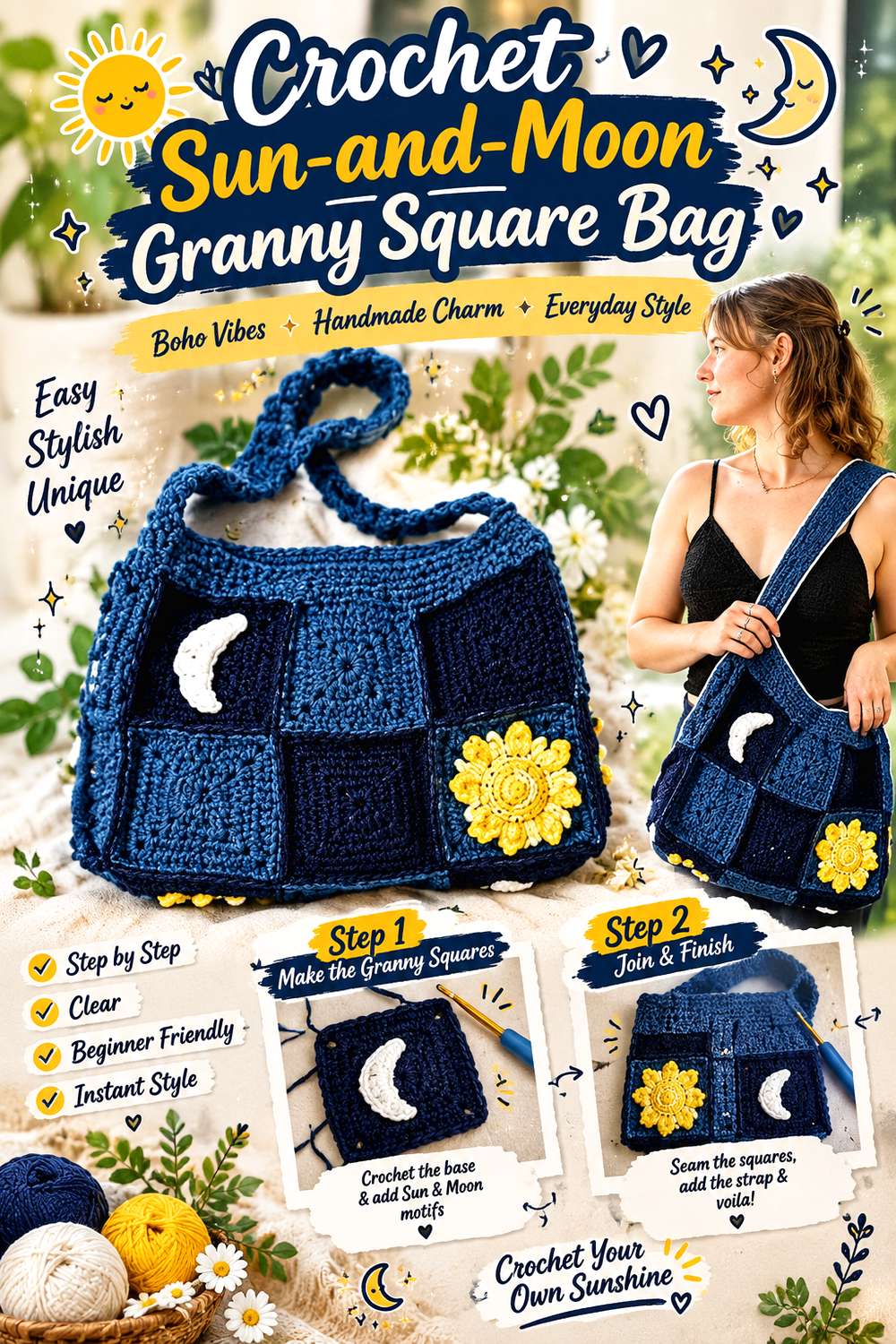
Thisfairymade takes the opposite approach from the plain crescent bag. The overall bag uses familiar joined crochet panels, while explicit sun-and-moon imagery supplies the celestial theme. The creator’s in-depth tutorial covers solid granny squares, joining, the sun and moon elements, panel assembly, shaping toward the top, and the strap.
Because the celestial imagery sits on square-based fabric, this design offers more layout flexibility than a bag whose whole body must remain moon-shaped. It can also carry both solar and lunar imagery at once without changing the functional outline. That makes palette planning important: background colors, motif colors, and joins all compete for attention in a relatively small area. Choose this project if you like visible artwork and patchwork rhythm more than a minimalist celestial silhouette.
Give the Sun and Moon Visual Space
A large motif can become harder to see when every neighboring square has equally strong contrast. Lay the pieces out before joining and step several feet away.
If your eye moves immediately to borders and joins instead of the sun or moon, consider simplifying the surrounding colors. The aim is not to remove variety, but to establish which part of the bag should be recognized first.
Respect the Top Shaping
The tutorial includes shaping after the main panels are assembled. That means changing the number or size of squares can have consequences above the patchwork field.
If you alter the layout, do not automatically copy the original finishing proportions. First assess the new panel dimensions, then return to the creator’s construction to understand how the upper section relates to them. Motif rearrangement is largely cosmetic; changing panel dimensions is structural.
Creator: thisfairymade
8. Crochet Star Bucket Hat
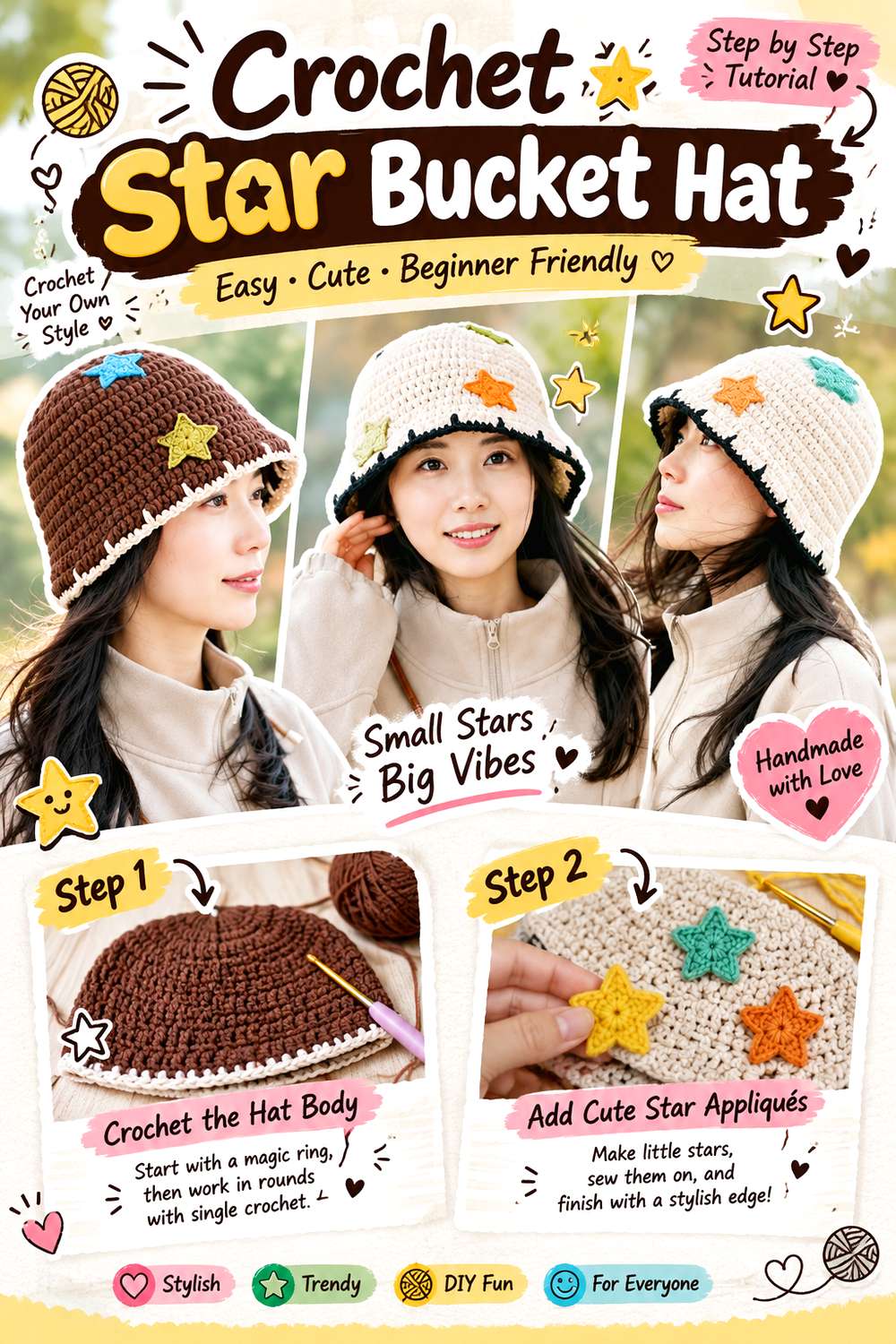
People Crochet’s tutorial keeps the recognizable bucket-hat silhouette and brings the celestial theme into the surface through a star design. The result is less sculptural than the star-shaped hat later in this collection, which makes this a useful choice when you want the accessory to remain familiar in profile.
The contrast between ordinary hat shape and graphic celestial motif gives you considerable freedom with styling. High-contrast star colors make the pattern the first thing people notice, while a tonal combination can make the stars appear more gradually. The brim also separates the motif area from the face, so you can decide how much attention should sit on the crown versus the lower outline. This project is better understood as a star-patterned bucket hat than as a novelty star costume piece.
Check Star Orientation While the Hat Curves
A motif viewed on a flat or partially formed surface can change once the fabric wraps around the head. Check the developing pattern from several angles instead of inspecting only the section facing you while crocheting.
This matters if you want one particular star area centered toward the front. A few centimeters of rotational difference can alter what appears most prominent when the hat is worn, even though the crochet itself is correct.
Let the Brim Balance a Busy Crown
A heavily contrasted crown already supplies strong visual information. Adding an equally complex brim can make the whole hat appear busier than intended.
Consider whether the brim should repeat the celestial pattern or provide a visual pause. A simpler lower section can frame the star work above it. If you alter the original patterning, keep any structural brim changes separate from purely decorative color decisions.
Creator: People Crochet
9. Crochet Star Headband

Ariel Tong’s headband condenses a star pattern into a narrow hair accessory. The tutorial covers the star-pattern section, tapered ends, straps, and finishing, and the creator specifically notes that color and thickness can be customized.
That makes it a useful celestial project for someone who likes graphic motifs but does not want a full hat. Because the band occupies a limited strip across the head, every change in width becomes conspicuous. A thicker band gives the stars more visual presence and covers more hair; a narrower interpretation feels closer to a decorative accent. The tied or tapered ends also keep the piece from reading like a rigid crown, which helps it combine with casual outfits. This is one of the easiest places in the collection to experiment with high-contrast color without covering a large area of the body.
Choose Width for the Hairstyle
A wider headband can hold more visual pattern, but it also changes how much hair is covered around the temples and crown. Before deciding that more star area is automatically better, compare the developing band with the way you normally wear your hair.
If it will sit with bangs, curls, or an updo, the same width may look different than it does with hair worn flat. Use the creator’s construction as the base and treat width changes as a fit decision.
Make the Star Read From Wearing Distance
Very closely related colors can create an attractive tonal fabric while making the star difficult to distinguish. That may be exactly what you want.
If you prefer a clearly graphic accessory, test your color pairing by putting a small sample at roughly head height and stepping back. A combination that looks strongly contrasted in the hand can blend more than expected once the headband becomes part of an entire outfit.
Creator: Ariel Tong
10. Crochet Festival Star Gloves
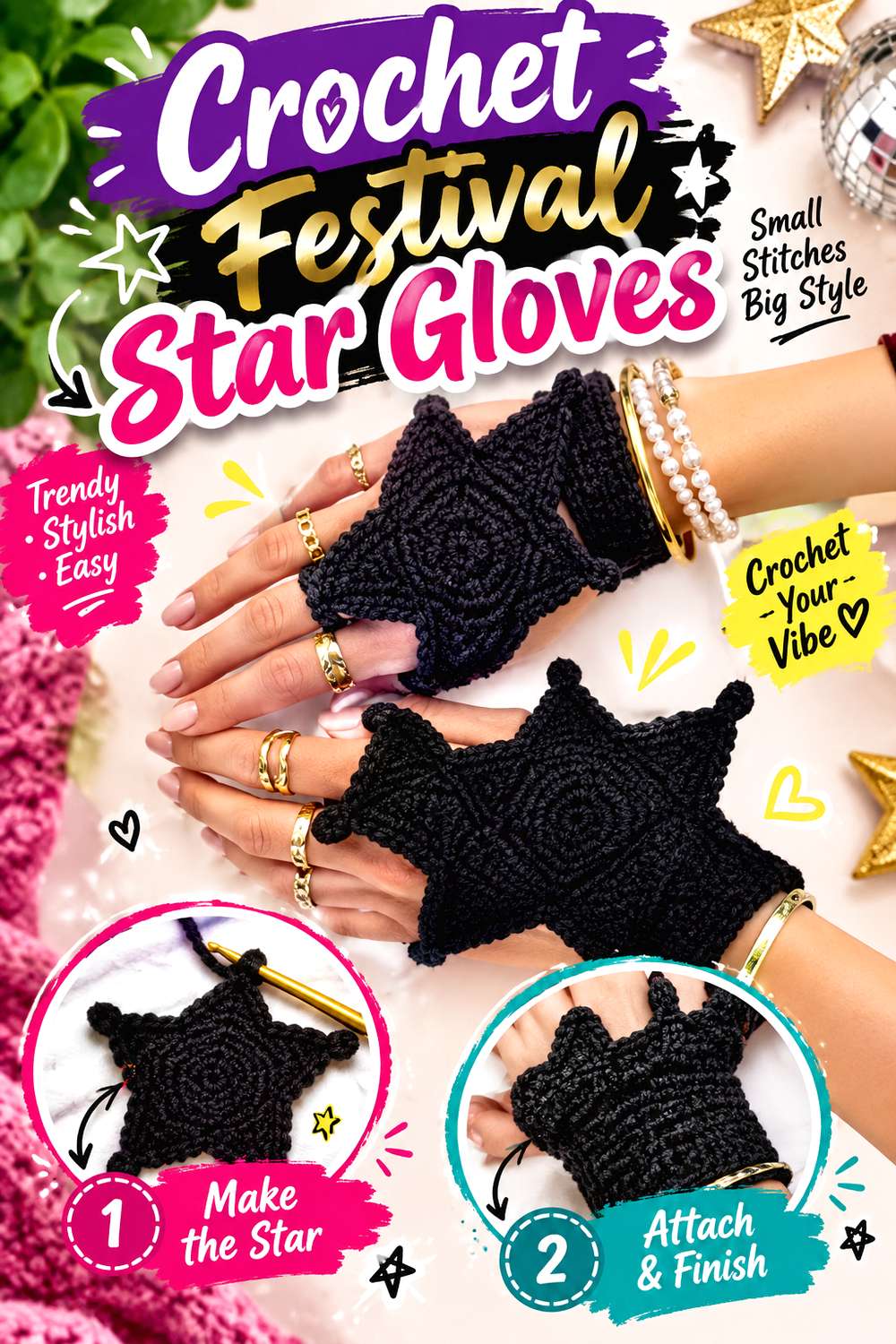
Sophie-Louise’s tutorial teaches a pair of crochet festival star gloves from start to finish, moving the celestial motif onto the hands rather than the torso or head. That placement makes the stars visible during movement, so the accessory can feel animated even when the rest of the outfit is plain.
A pair also creates a useful design choice that single accessories do not have: the two hands can mirror each other closely or deliberately use different celestial colors. Because the gloves sit beside rings, bracelets, sleeves, and bags, it is worth considering the surrounding accessories before adding more embellishment. If your sleeves already carry large star motifs, a quieter glove palette can keep the overall look from becoming repetitive. If the outfit is simple, the gloves have room to act as the principal celestial detail.
Compare Both Gloves Throughout the Project
Pairs invite side-by-side comparison. Differences in overall length, star placement, or edge tension may become more noticeable once both hands are visible together.
Alternate between the two pieces at sensible checkpoints rather than finishing one and beginning the other much later. That can help maintain more consistent tension and makes it easier to compare how corresponding sections are developing without trying to remember the feel of the first glove.
Consider Sleeve Interaction
Gloves do not exist in isolation. A long sleeve may overlap the wrist area, while a short or sleeveless top leaves the entire accessory visible.
Before adding optional decoration near the upper edge, try the glove with the type of sleeve you expect to wear. There is little value in concentrating your strongest celestial detail in an area that will usually be covered. Put visual emphasis where it will actually remain visible.
Creator: Sophie-Louise
11. Crochet Star Belt

Kai’s diary ౨ৎ provides a tutorial specifically for a crochet star belt, turning repeated celestial forms into a horizontal fashion accessory rather than using stars as decoration on a conventional solid band.
That difference makes the belt particularly useful for layering. Against a plain dress, skirt, or trousers, the stars can form a visible line around the waist or hips without introducing another full garment. The effect depends heavily on placement: worn higher, the belt visually divides the torso; worn lower, it behaves more like an accessory over the hip line. Because crocheted motifs are flexible, the belt will not behave exactly like a stiff leather belt. Choose it principally for styling and the repeated star effect rather than assuming the same function as structured waist hardware.
Decide Where You Want to Wear It First
Waist and hip placement require different finished lengths. Do not make the full belt and only afterward decide where it should sit.
Measure at the intended wearing position while wearing the type of clothing you expect to pair with it. A belt that fits neatly over a thin dress may need a different allowance over thicker layers. Follow the tutorial’s construction, then adapt length only with that real styling context in mind.
Keep Repeated Stars Consistent Enough to Form a Line
A single handmade star can tolerate noticeable individuality. Repeated stars in a belt are viewed together, so large differences in point length or overall size can interrupt the visual rhythm.
Place completed motifs side by side as you progress. You do not need machine-like uniformity, but checking them together can reveal tension drift early enough to address it before the entire sequence has been assembled.
Creator: Kai’s diary ౨ৎ
12. Crochet Star Earrings

Banoris Crafts’ tutorial focuses specifically on a pair of crochet star earrings, taking the celestial idea down to jewelry scale. The creator notes that the same star model could also be used for another accessory such as a pin, and the video includes short English subtitles while emphasizing that the process can also be followed visually.
At earring scale, silhouette becomes more important than elaborate surface decoration. Five clear points can carry the entire idea, especially if the yarn color contrasts strongly with the wearer’s hair or clothing. Because the earrings appear on both sides of the face, pair consistency deserves more attention than it would for a single bag charm. They also offer a useful way to wear celestial crochet with non-crochet clothing, allowing one very small handmade detail to supply the theme.
Match the Pair Before Final Finishing
Place the two stars together before completing their jewelry assembly. Compare point length, center shape, and overall width rather than looking at each one separately.
Small differences are part of handmade work, but one dramatically larger star can make the pair appear unbalanced once worn. Checking before the final hardware is attached gives you a clearer opportunity to decide which orientation looks best on each side.
Scale Changes Matter More in Jewelry
Moving to substantially thicker material can turn a small earring motif into a much larger object. That affects how much space the star occupies beside the face and can also change how clearly the points hang.
If you want a larger statement version, make one complete test star first. Hold it at the intended earring position before committing to the second. That is more informative than assuming a yarn substitution will produce a comfortable or visually balanced result.
Creator: Banoris Crafts
13. Crochet Crescent Moon Earrings
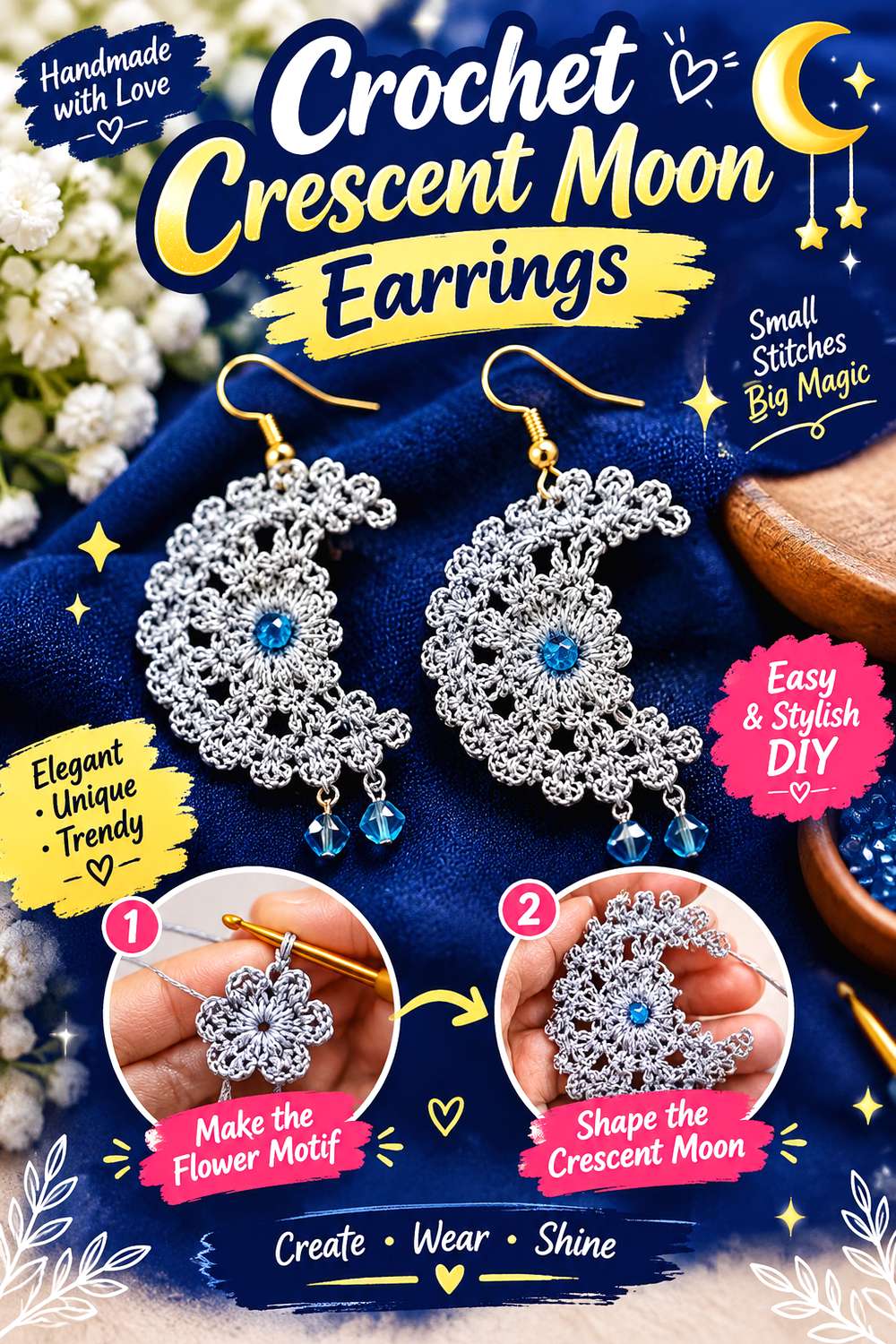
Grazia Bottazzoli’s public video is specifically presented as a crochet moon earrings tutorial, giving this collection a jewelry option based on lunar form rather than another five-point star.
The advantage of the crescent at this scale is instant asymmetry within each motif. Unlike a circular sun or symmetrical star, the curved moon has an open side that creates visible negative space. Orientation therefore becomes part of the design: two crescents can face the same direction, mirror one another, or be positioned according to the source construction. A restrained solid color keeps the crescent outline clean, while metallic-looking or high-contrast yarn can make a very small accessory more noticeable. Because the public source information is concise, use the tutorial itself for the creator’s exact construction and finishing rather than inferring material specifications from photographs or other moon-earring patterns.
Decide How the Pair Should Face
Crescents create direction. Before the final attachment, hold both pieces in the orientation they will have beside the face and compare the effect.
Mirrored moons can frame the face, while matching orientation creates a more deliberately repeated look. Follow the source where the construction determines placement; if orientation remains flexible at finishing, make the decision while viewing the pair together rather than one earring at a time.
Keep Additional Decoration Proportional
A small bead or dangling element can become visually larger than the crochet moon itself. If you plan to customize beyond the tutorial, temporarily place the proposed addition beside a finished crescent first.
Ask which component should remain the focal point. If the answer is the moon, any added element should support its curve rather than hiding the negative space that makes a crescent recognizable.
Creator: grazia bottazzoli
14. Crochet Sculptural Star Hat

Alexandria Masse’s star hat is much more literal than the bucket hat earlier in the collection. The creator’s own pattern page describes five separate triangular points that are stuffed and assembled with a hood and fastening strap, with a YouTube tutorial provided for additional construction clarification.
The resulting accessory treats the star as three-dimensional headwear rather than a flat surface motif. That means volume matters. The five points extend outward and create a silhouette that remains recognizable from multiple directions, making this a true statement piece. It is particularly different from simply attaching one star appliqué to a beanie. Because the project includes stuffed sections, changing yarn or point size can affect the physical proportions of the hat as well as the visual design. Use the creator’s gauge and assembly guidance when altering materials rather than assuming the points can be resized independently.
Balance All Five Points
The star depends on a consistent ring of triangular forms. Before final assembly, compare all five and arrange them around the hood in their intended order.
If one point differs slightly, rotating the arrangement may produce a more balanced final silhouette than placing the difference in the most prominent front position. Evaluate the hat in three dimensions rather than lining the triangles up only on a table.
Treat Stuffing as Shape Control
Stuffing gives the points their volume, but more filling does not automatically create a better star. Unevenly filled sections can make some points appear broader or firmer than others.
Compare the points while filling and stop periodically to view them as a group. Follow the creator’s finishing guidance for the real assembly. The aim is enough structure to establish the sculptural form without assuming maximum firmness is required.
Creator: Alexandria Masse
15. Crochet Lacy Star Stitch Scarf

Meladora’s Creations for Crochet provides a full right-handed tutorial for a lacy star-stitch scarf, including the stitch repeat and the developing scarf fabric. Unlike the previous projects, this one does not rely on a separate five-point star appliqué or a garment shaped like a celestial object. Its connection comes through the named star-stitch texture.
That makes it the quietest celestial option in the collection. From farther away, the scarf can read primarily as airy textured crochet; closer inspection reveals the repeated stitch structure. This approach works well when literal moons and stars feel too costume-like for your wardrobe. Color can strengthen or soften the association: deep midnight shades can push the fabric toward a night-sky mood, but the construction does not depend on that palette. The star texture remains the reason to choose the source.
Decide Whether Texture or Color Should Lead
A complicated multicolor sequence can compete with a lacy stitch pattern because the eye starts following color boundaries rather than the repeated structure.
If the star stitch is your main reason for choosing this scarf, consider working a sample in the intended palette first. View it in ordinary indoor and outdoor light. Some subtle textures become much easier to read in lighter colors, while dark shades can create a moodier but less clearly defined surface.
Think About Openness Before Changing the Scale
The tutorial is specifically for a lacy scarf, so open space is part of the visual result. Changing yarn thickness or hook size can alter both motif scale and the amount of visible mesh.
If you want a wider or denser accessory, use the creator’s repeat information rather than assuming a material substitution will create the exact change you want. Width and fabric density are separate decisions, even though both affect the scarf’s overall presence.
Creator: Meladora’s Creations for Crochet
Conclusion
The best celestial crochet idea depends on how much of the outfit you want the theme to control. The Crochet Oversized Star Sweater, Crochet Celestial Star-and-Moon Cardigan, and Crochet Sculptural Star Hat make celestial geometry impossible to miss. The Crochet Crescent Crossbody Bag and Crochet Sun-and-Moon Granny Square Bag keep the theme concentrated in one practical accessory.
For smaller accents, the Crochet Star Headband, Crochet Star Belt, Crochet Star Earrings, and Crochet Crescent Moon Earrings can sit beside ordinary clothing without turning the whole outfit into a theme. The Crochet Lacy Star-Stitch Scarf is the most understated choice because texture supplies the reference. Once you have chosen the scale and placement that suit your wardrobe, use the original tutorials for exact construction details.
Frequently Asked Questions
What colors work well for celestial crochet fashion?
Celestial crochet does not require navy, black, silver, or gold. Those colors immediately suggest a night sky, but a star remains a star in pink, rust, green, cream, or a bright multicolor palette. Silhouette-based pieces such as the crescent bag and sculptural star hat are especially independent of color.
Consider contrast instead. If the celestial element is worked into a surface pattern, enough separation between motif and background can make it easier to see. Tonal palettes are useful when you deliberately want a subtler result.
Should I start with a celestial motif or a complete wearable tutorial?
For fashion projects, a complete wearable tutorial is usually the clearer starting point because it addresses how the motif interacts with the garment or accessory. A decorative star alone does not establish how to construct a sweater, bag, hat, or fitted top around it.
Motif tutorials become more useful when you already have a proven base and are planning a clearly cosmetic addition. If the celestial element changes the shape, opening, fit, or support of the item, use a source that teaches the whole object whenever possible.
Can I add stars or moons to an ordinary crochet garment?
Yes, as a design idea, but the easiest additions are usually cosmetic rather than structural. Flat appliqués or surface details can often be planned after the main garment shape is established, provided their size and placement suit the fabric.
Large raised motifs require more thought because they add bulk and may change how an area drapes. Before attaching several, place them temporarily on the finished or nearly finished garment. Check how they look when the garment is worn, particularly near armholes, closures, pockets, and other moving areas.
How do I keep several celestial motifs from looking too busy?
Choose a visual hierarchy. One large moon, star, or sun can be the dominant feature while smaller details remain secondary. On patchwork pieces, repeating a background color or border treatment can help different motifs feel related even when their shapes vary.
Also compare the project from a distance. Individual squares may each look attractive close up but compete once assembled. Photographing a temporary layout is a useful way to notice accidental clusters, overly bright areas, or motifs that disappear against neighboring colors before you commit to joining.
Is a star-stitch project the same as a crochet star motif?
No. A star motif is a distinct shape that visibly forms a star and may function as a panel, appliqué, or complete object. Star stitch is a crochet texture created within fabric. Depending on the stitch pattern, the star-like structure may be much subtler than a five-point motif.
That difference is why the Crochet Lacy Star-Stitch Scarf reads more quietly than the Crochet Star Bag or Crochet Star Earrings. Choose the former for celestial texture and the latter when you want the celestial object itself to be immediately recognizable.