Burgundy and mustard already have the strong light-dark and warm-color relationship associated with classic varsity styling, but the sweater looks more intentional when those colors have different jobs. Burgundy can cover the main back panel while mustard marks the collar, cuffs, hem, or a back accent. Reverse the balance and a mustard body with burgundy trim creates a noticeably brighter sweater without changing the basic two-color palette.
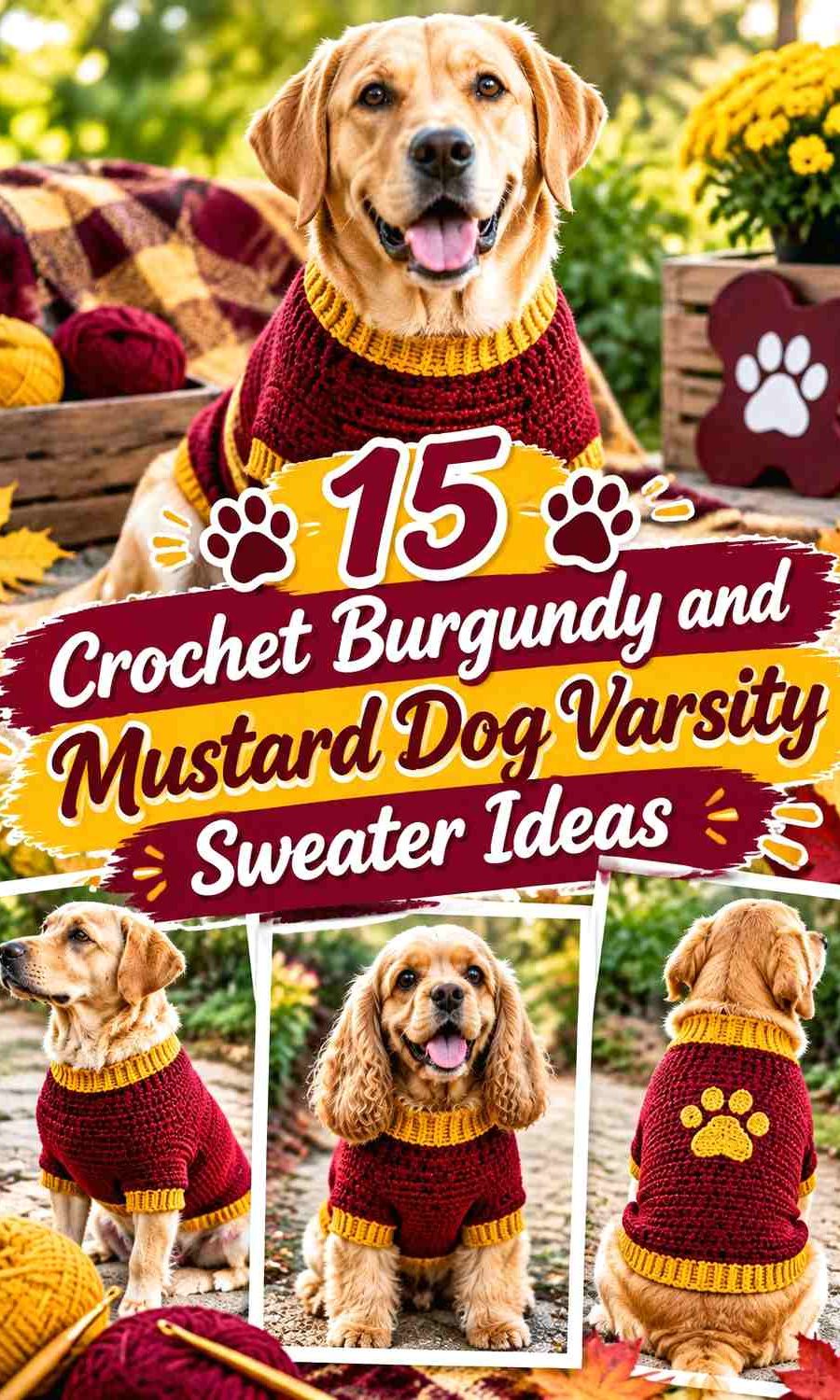
A dog sweater also has fewer large surfaces than a human varsity jacket, so color placement needs restraint. Putting mustard around the collar, both leg openings, hem, chest, and several stripes can leave very little uninterrupted burgundy. A clearer approach is to select two or three structural areas for the secondary color and let the dominant shade remain continuous across the back.
The credited tutorials below support the dog-sweater construction concepts. The burgundy-and-mustard varsity styling is an independent color adaptation, so the creators should not be assumed to have used these exact palettes or varsity treatments.
Quick List:
- Burgundy Body and Mustard Ribbing Crochet Dog Varsity Sweater
- Mustard Body and Burgundy Sleeve Crochet Dog Varsity Sweater
- Burgundy and Mustard Double-Stripe Crochet Dog Varsity Sweater
- Burgundy Body With Mustard Collar and Hem Crochet Dog Varsity Sweater
- Burgundy, Mustard, and Cream Yoke Crochet Dog Varsity Sweater
- Mustard Body With Burgundy Ribbed Trim Crochet Dog Varsity Sweater
- Burgundy Crochet Dog Varsity Sweater With Mustard Back Accent
- Burgundy and Mustard Granny-Panel Crochet Dog Varsity Sweater
- Burgundy Body With Mustard Turtleneck Crochet Dog Varsity Sweater
- Mustard Center and Burgundy Side-Panel Crochet Dog Varsity Sweater
- Burgundy and Mustard Wide-Stripe Crochet Dog Varsity Sweater
- Burgundy, Mustard, and Cream Collar-Stripe Crochet Dog Varsity Sweater
- Burgundy Crochet Dog Varsity Sweater With Mustard V-Shaped Yoke
- Burgundy Cable Crochet Dog Varsity Sweater With Mustard Trim
- Mustard Crochet Dog Varsity Sweater With Burgundy Colorwork
Let Burgundy and Mustard Have Different Varsity Roles
A varsity-inspired sweater usually reads more clearly when one color defines the body and the other marks structural details. Burgundy makes a useful dominant shade because it gives mustard plenty of visual separation even when the yellow appears only in narrow areas.
If mustard is the main body color, use burgundy more decisively around the collar, sleeves, or hem. A few tiny burgundy details can look accidental against a large mustard field; broader repeated accents make the relationship easier to understand.
You do not need equal amounts of both colors. In fact, unequal coverage is often what makes the sweater look organized rather than striped everywhere.
Use Mustard Where Burgundy Crochet Texture Needs a Boundary
Mustard can help identify the places where the garment changes shape: neckline, leg openings, lower back edge, or yoke. That makes it especially useful on a burgundy sweater with ribbing or other pronounced crochet texture.
Avoid running mustard through every raised stitch or cable merely to increase color. A solid burgundy textured section usually reads more clearly, with mustard acting as a frame outside it.
If your burgundy and mustard are unusually close in lightness, compare them in grayscale before planning narrow colorwork. Small stripes need more value separation than large color blocks.
Add Cream to Burgundy and Mustard Only When It Solves a Problem
Cream can make a varsity palette feel more layered, but it should have a specific purpose. A narrow cream stripe can separate burgundy from mustard at a collar or yoke, or a cream back accent can remain clearer against burgundy than mustard does.
Keep cream smaller than the two title colors. Once the collar, cuffs, hem, and body stripes all become cream-heavy, the sweater is no longer visually centered on burgundy and mustard.
1. Burgundy Body and Mustard Ribbing Crochet Dog Varsity Sweater
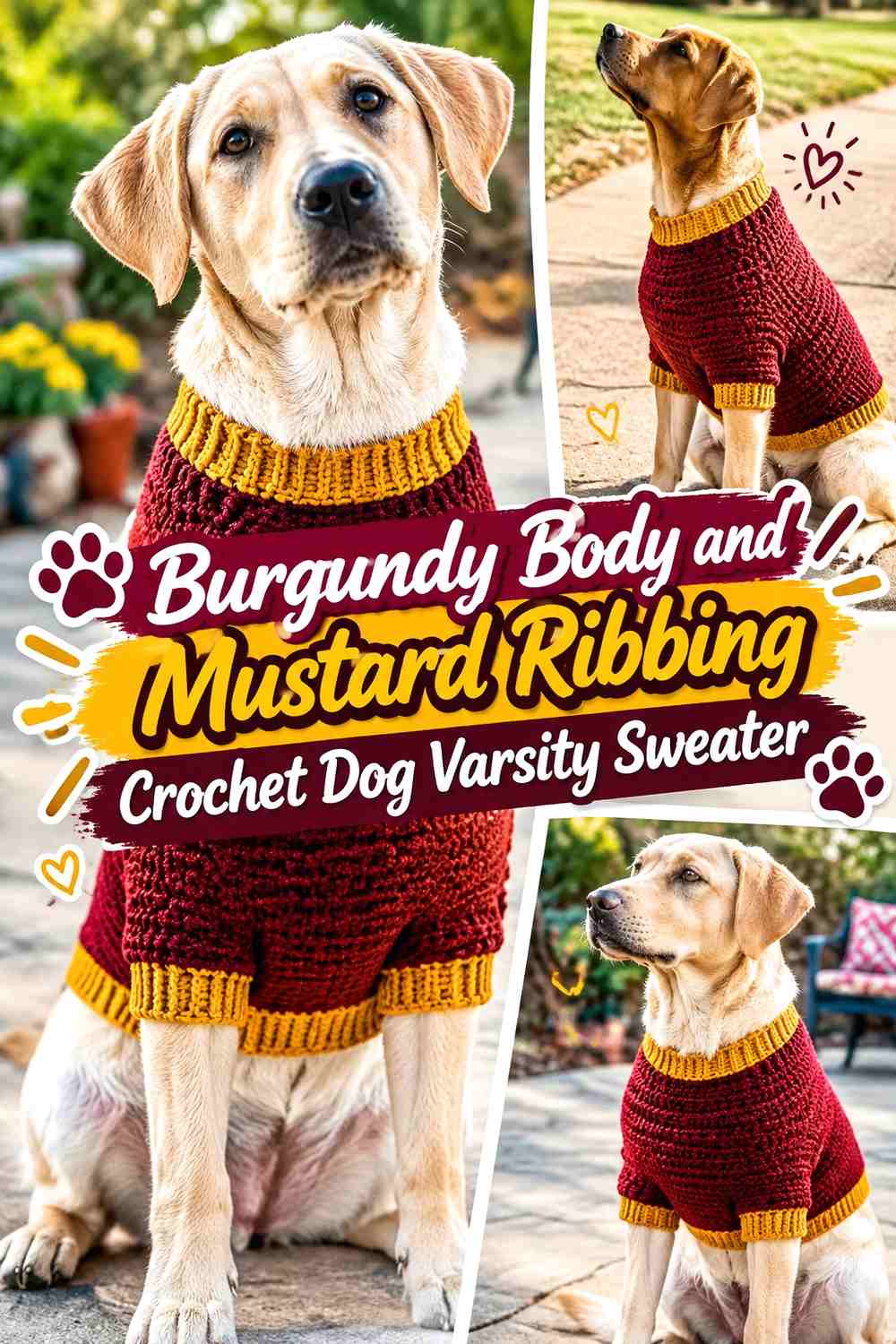
This is the most direct varsity interpretation: keep the main sweater body burgundy and use mustard on the ribbed neckline, leg openings, and selected lower edging. Burgundy remains dominant from above, while mustard identifies the structural edges without dividing the back into multiple blocks.
Mustard Ribbing Can Frame a Burgundy Crochet Dog Sweater
Use mustard where the sweater already has a ribbed or finished boundary. The color change then reinforces an existing construction detail instead of creating a random band across the garment.
You do not need mustard on every edge. A mustard collar and lower back trim may provide enough repetition while leaving the leg openings burgundy.
Burgundy Should Stay Continuous Between Mustard Varsity Details
Preserve a broad burgundy section across the back, especially if the crochet surface has noticeable texture. That uninterrupted area keeps the sweater from looking like a collection of narrow mustard outlines.
If you want an additional varsity reference, repeat mustard once in a small back accent rather than introducing more stripes.
Creator Credit: Heart Hook Home Heart Hook Home tutorial
2. Mustard Body and Burgundy Sleeve Crochet Dog Varsity Sweater
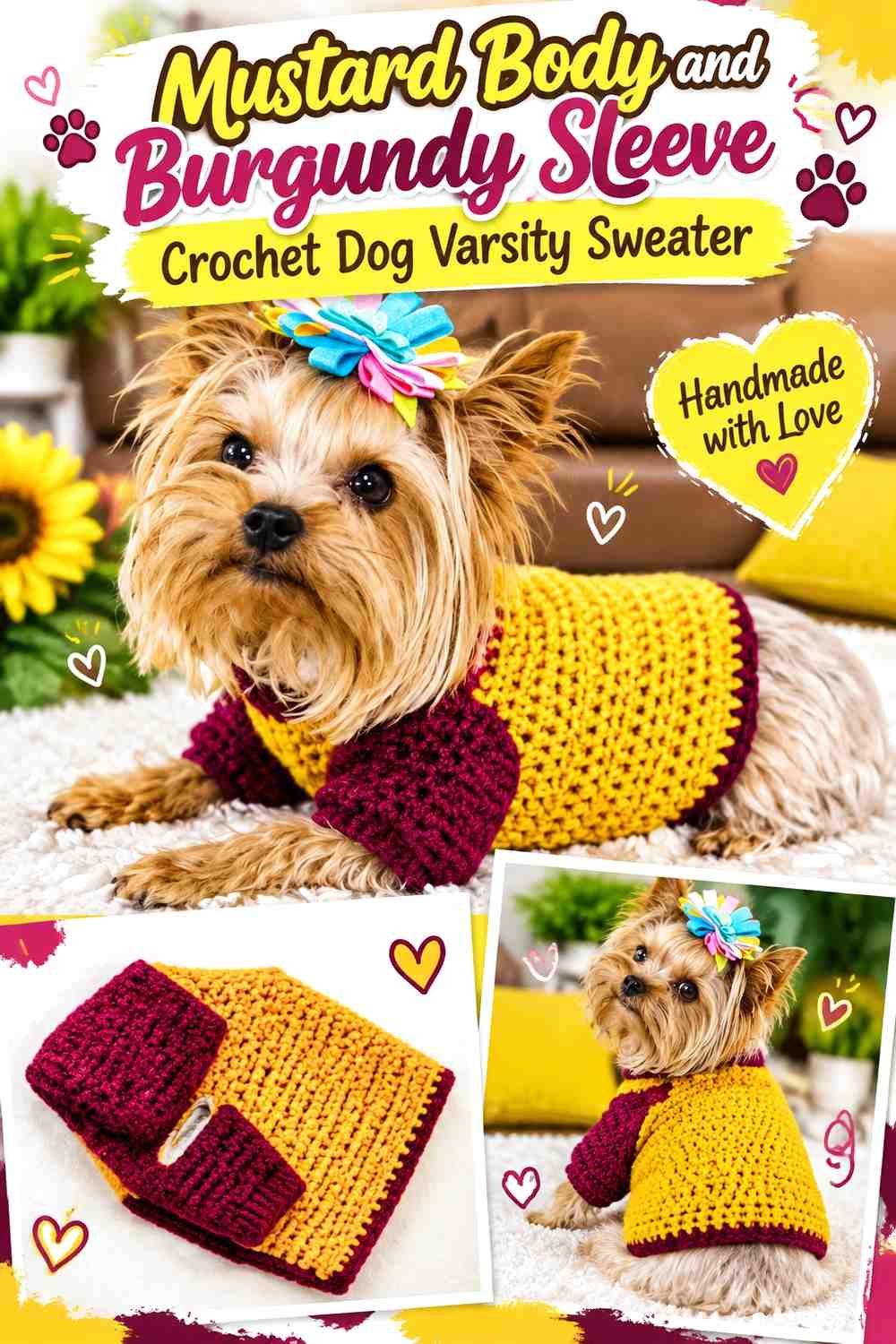
Reversing the hierarchy gives this sweater a brighter appearance. Mustard can cover the torso while burgundy appears on the front-leg sections or sleeve-like extensions, collar, and one finishing band. The repeated dark areas create a stronger frame around the lighter body.
Burgundy Sleeves Can Ground a Mustard Crochet Dog Varsity Sweater
Burgundy on the front-leg sections provides two repeated dark accents without breaking the mustard back. This is particularly useful when the sweater construction gives the legs enough visible coverage for the contrast to register.
Keep the burgundy treatment symmetrical unless the construction itself calls for something different.
Mustard Needs Enough Back-Panel Space Beside Burgundy
Let mustard remain continuous across the main back rather than interrupting it with several burgundy bands. Because burgundy is darker, even relatively small areas can carry substantial visual weight.
A mustard hem can help preserve the lighter dominant color if the collar and sleeves are already burgundy.
Creator Credit: Lanitas y colores Lanitas y colores tutorial
3. Burgundy and Mustard Double-Stripe Crochet Dog Varsity Sweater
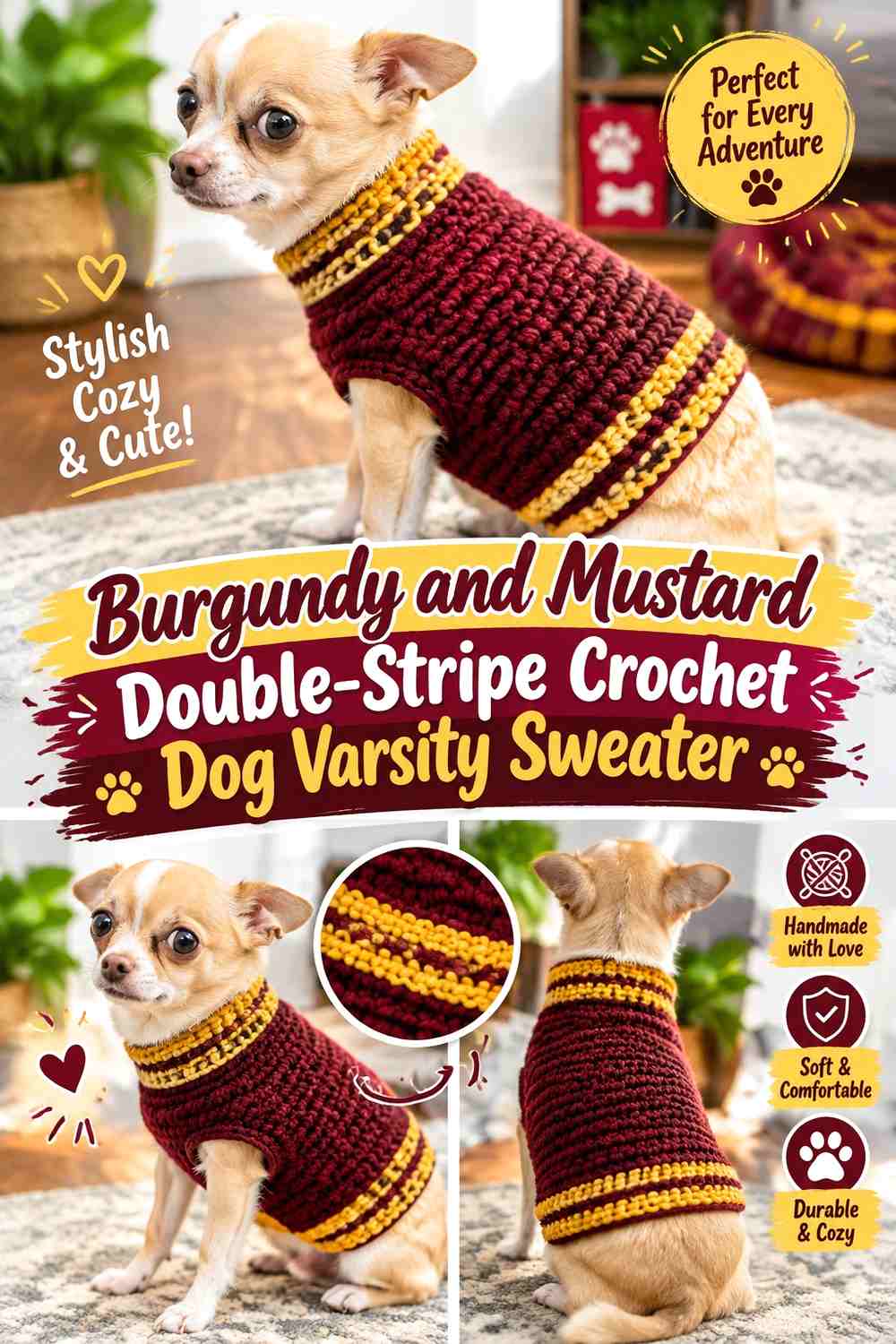
A pair of mustard stripes across a burgundy body creates a recognizable athletic treatment without turning the whole sweater into horizontal bands. Keep most of the torso burgundy and concentrate the stripes in one deliberate zone, such as the upper or middle back.
Mustard Stripes Need Burgundy Space Around Them
Two mustard bands look stronger when there is enough burgundy above, between, and below them. If the stripes sit too close to a mustard collar and hem, the entire sweater can become evenly divided.
Use the burgundy background as negative space around the varsity detail.
Burgundy Can Keep Mustard Stripes From Hiding Crochet Texture
If the body contains textured stitches, place the stripes where they will not interrupt every texture repeat. A substantial burgundy section lets the crochet surface remain visible separately from the color design.
For a quieter version, make one mustard stripe narrower than the other rather than adding a third color.
Creator Credit: Last Minute Laura Last Minute Laura tutorial
4. Burgundy Body With Mustard Collar and Hem Crochet Dog Varsity Sweater
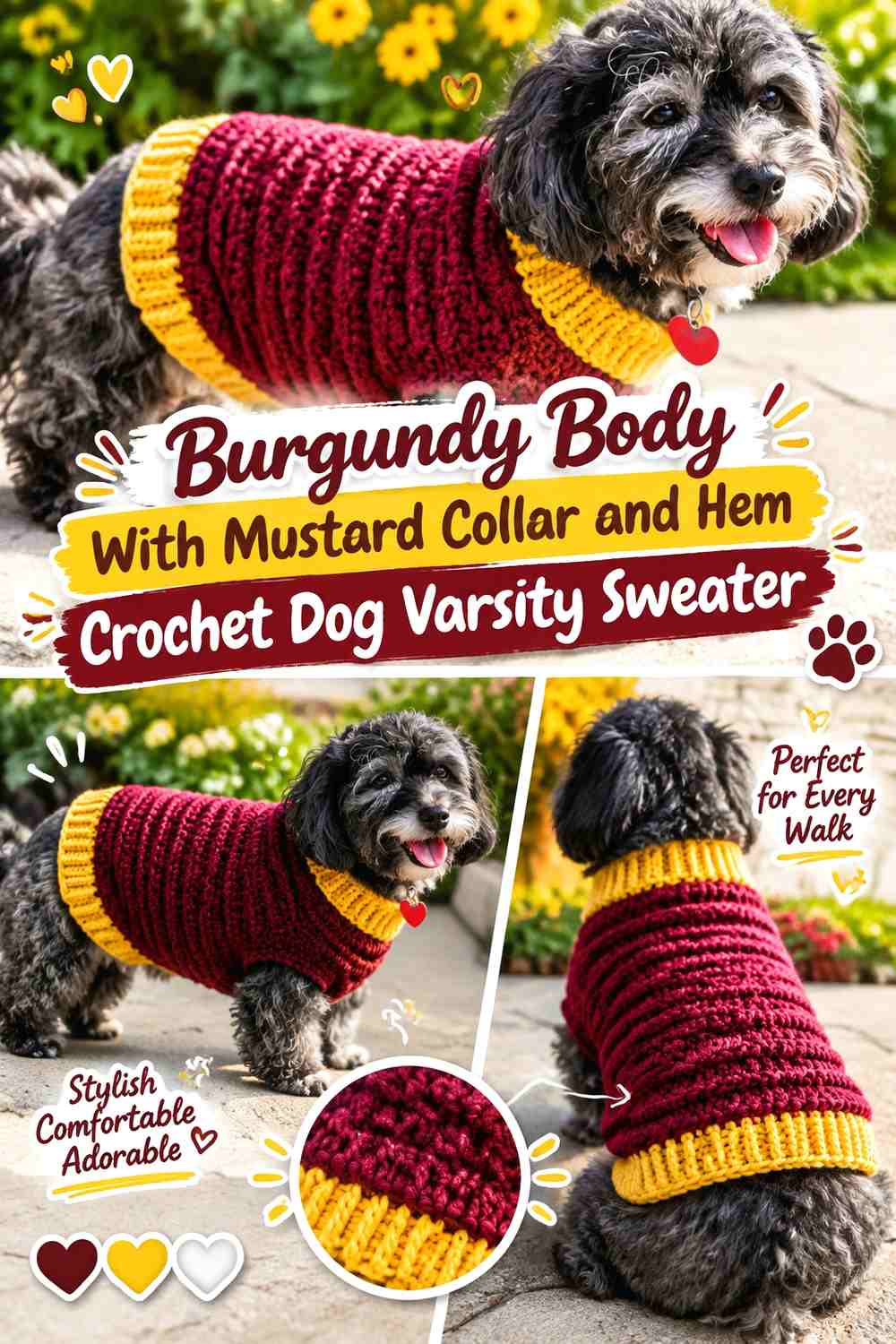
This idea keeps mustard at opposite ends of the garment. A burgundy body sits between a mustard neckline and mustard lower-back edge, giving the sweater a simple framed structure that works especially well when the center back has decorative texture.
Mustard Collar and Hem Can Bookend Burgundy
Repeating mustard at the top and bottom creates connection without placing extra color through the center. This makes the sweater easy to read from above and keeps burgundy unmistakably dominant.
The two mustard areas do not need to be the same width; the collar may naturally need more visual area than the hem.
Burgundy Works Best as the Uninterrupted Varsity Center
Leave the main torso burgundy if the collar and hem already provide strong yellow accents. Adding another mustard band through the center may reduce the clean framed effect.
This approach is particularly useful when the stitch texture itself is one of the sweater’s distinguishing features.
Creator Credit: The Crochet Crowd The Crochet Crowd tutorial
5. Burgundy, Mustard, and Cream Yoke Crochet Dog Varsity Sweater
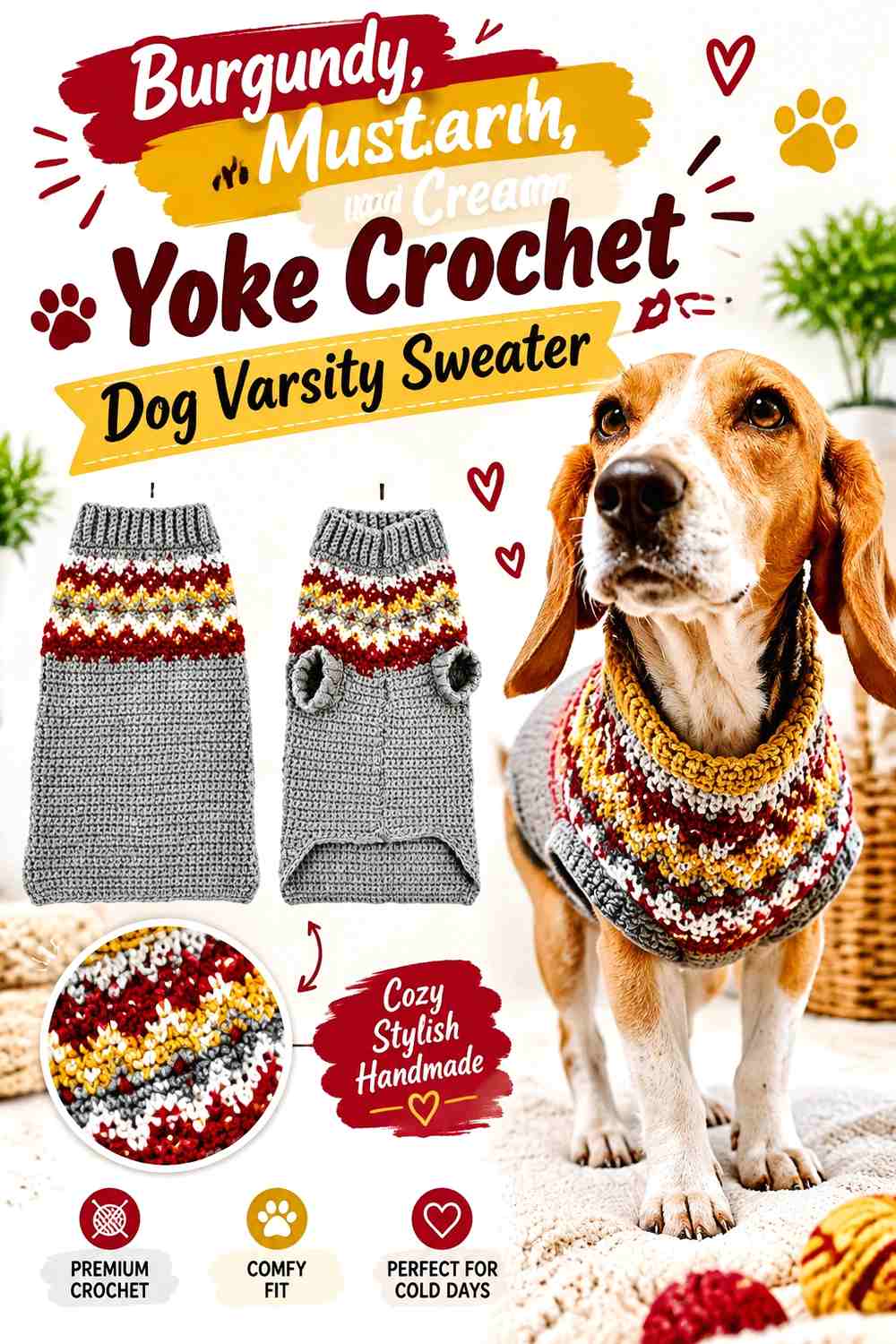
A colorwork yoke gives burgundy and mustard more interaction around the upper sweater while allowing the lower body to remain solid. Burgundy can dominate the torso, mustard can form the main yoke contrast, and cream can appear only as a narrow separator.
Mustard Can Carry the Main Contrast in a Burgundy Varsity Yoke
Let mustard take more of the yoke’s secondary color area than cream. That preserves the title palette and makes cream a supporting separator rather than a third equal shade.
Keep the lower back burgundy so the busier yoke has a calmer field beneath it.
Cream Should Separate Burgundy and Mustard Instead of Competing
Use cream where the two warm colors need more definition, especially in narrow colorwork. It can sit between burgundy and mustard bands or appear in a very small repeated element.
If cream starts appearing on the collar, cuffs, hem, and back, reduce it before reducing either main color.
Creator Credit: Marly Bird Marly Bird tutorial
6. Mustard Body With Burgundy Ribbed Trim Crochet Dog Varsity Sweater
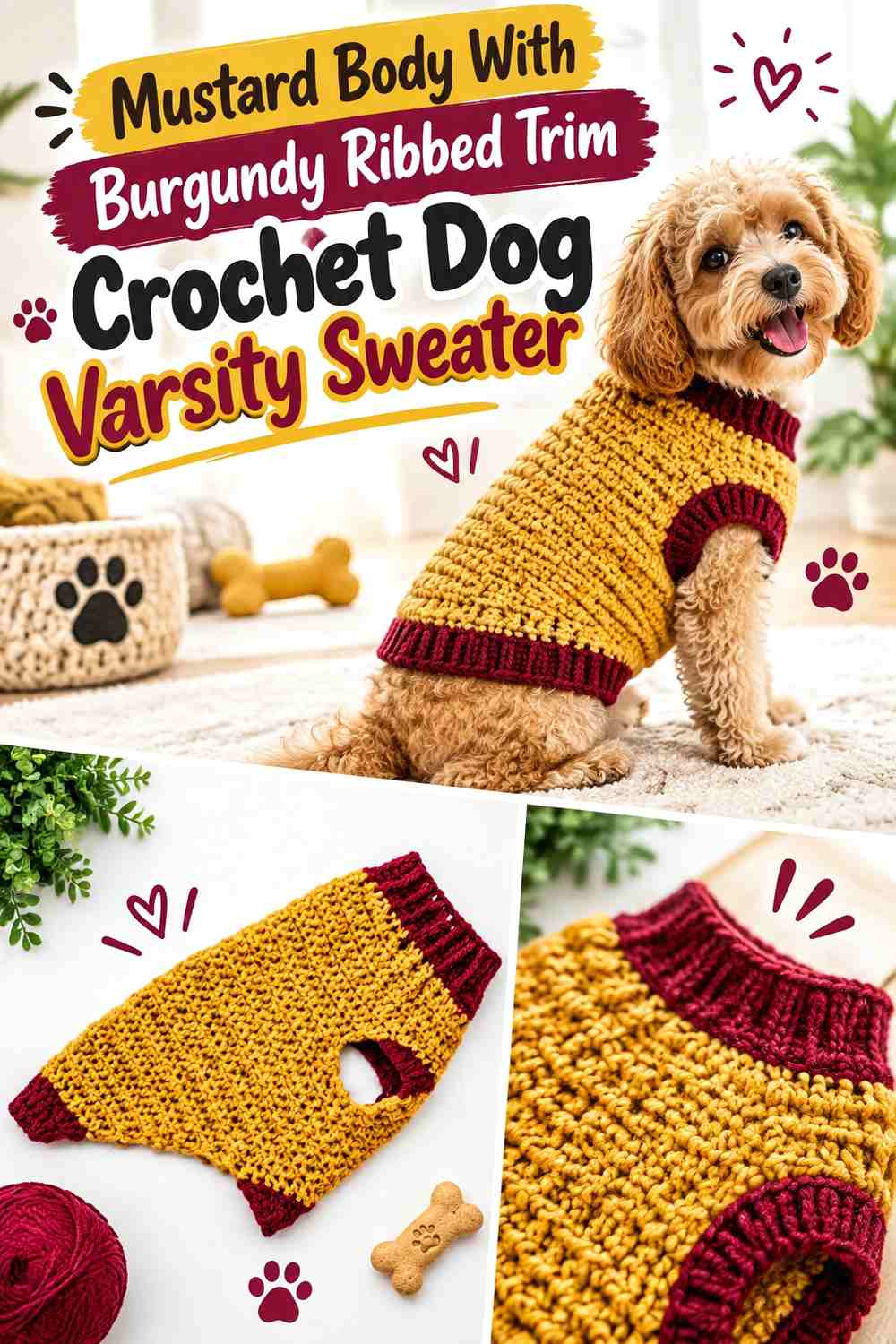
A mustard body with burgundy ribbing produces a lighter sweater with a dark varsity frame. Use burgundy at the neckline and lower edge first, then decide whether the front-leg trim also needs the same treatment.
Burgundy Ribbing Creates Strong Boundaries Around Mustard
Because burgundy is substantially darker than mustard, relatively narrow ribbing can define the garment shape clearly. This is useful when you want a sporty outline without introducing stripes through the body.
Do not automatically widen every burgundy edge; too much dark trim can visually shrink the mustard field.
Mustard Should Remain Visible Between Burgundy Borders
A continuous mustard torso gives the sweater its brighter identity. If the design includes shaping or decreases, keep those sections mustard rather than using every change in construction as another reason to switch color.
The simpler center allows the burgundy ribbing to look more deliberate.
Creator Credit: Loops Only Crochet Loops Only Crochet tutorial
7. Burgundy Crochet Dog Varsity Sweater With Mustard Back Accent
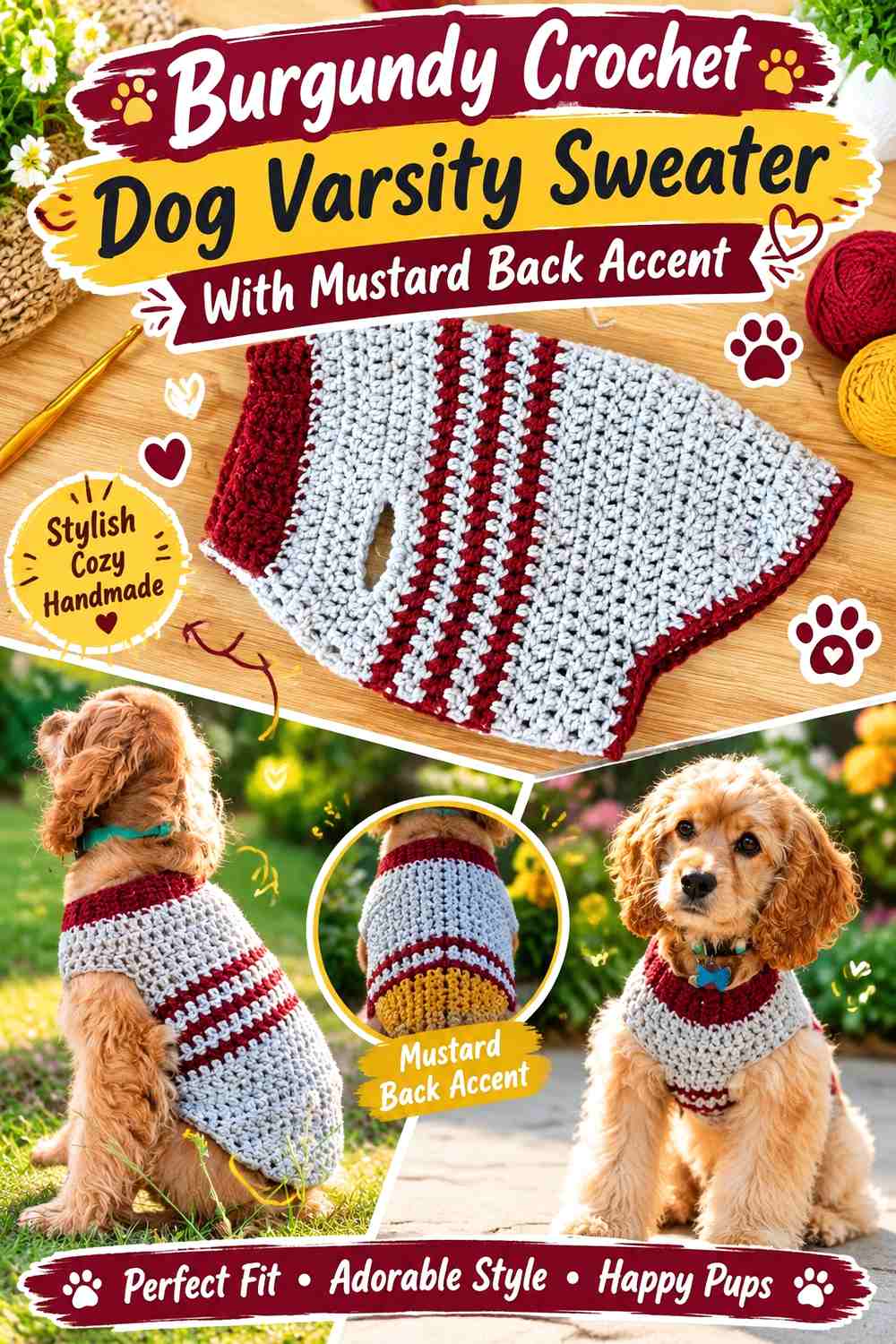
Instead of striping the garment, keep nearly the entire sweater burgundy and add one flat mustard back feature. That accent could be a simple geometric varsity-style element or another independently designed flat motif, provided it fits within the available back area.
Mustard Needs Enough Scale on a Burgundy Back
A tiny mustard detail may disappear visually, especially on a larger dog sweater. Give the accent enough surface to be recognized from above while leaving burgundy visible around every side.
Avoid pushing decoration into the leg openings or underside simply to enlarge it.
Burgundy Should Stay Quiet Around the Mustard Accent
Skip additional mustard stripes immediately above or below the focal element. The solid burgundy negative space is what gives a single back accent its impact.
A small mustard collar edge can provide one secondary repeat without crowding the center.
Creator Credit: it’s erin b. it’s erin b. tutorial
8. Burgundy and Mustard Granny-Panel Crochet Dog Varsity Sweater
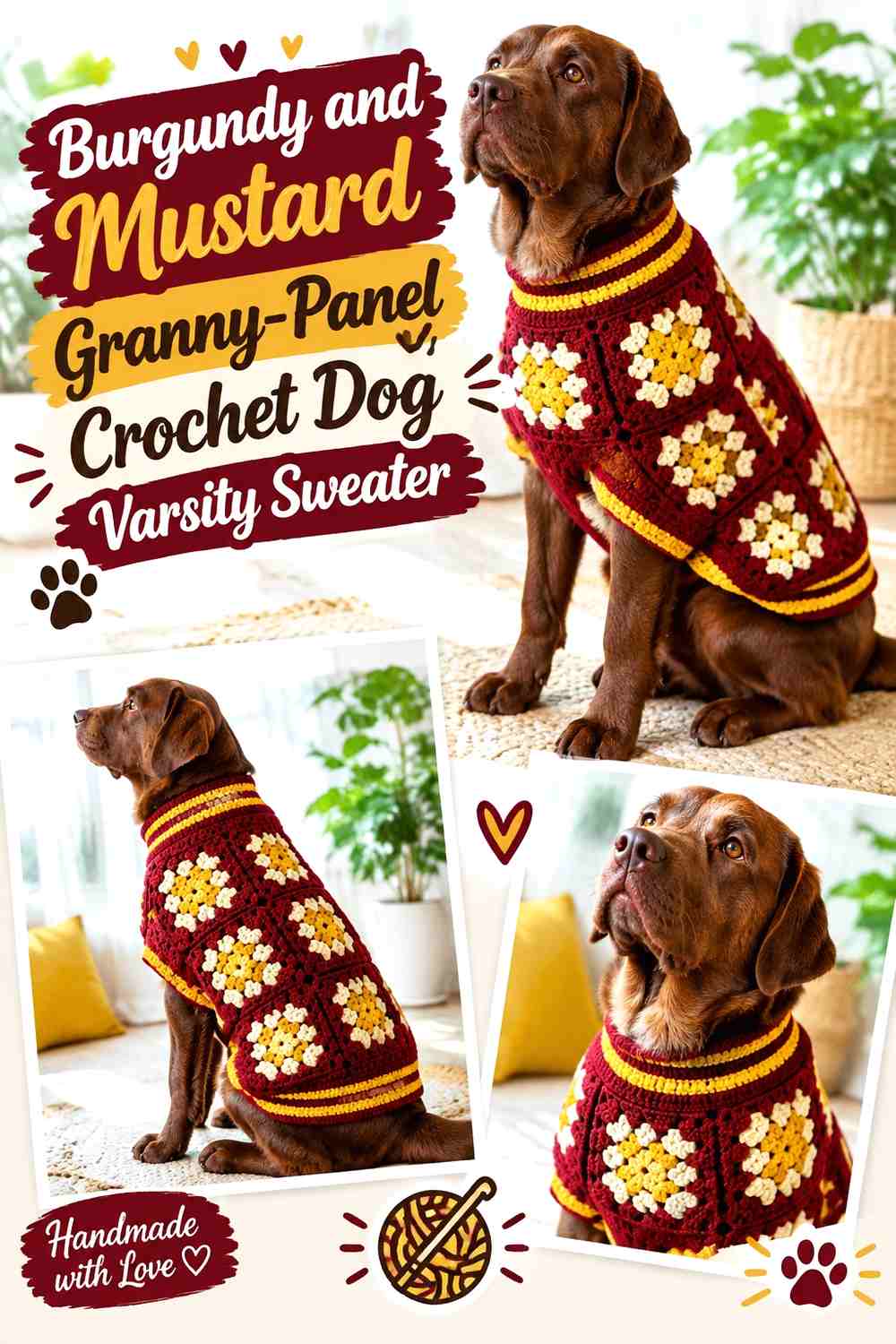
Granny-based construction creates several color zones, so burgundy and mustard need consistent repetition. Keep burgundy as the most frequent outer or connecting shade and use mustard in selected centers or alternating panels rather than changing every motif independently.
Burgundy Can Unify Mustard Granny Panels
Repeat burgundy in the same relative area across several motifs. A consistent burgundy outer section or joining treatment can make separate panels read as one sweater.
This is more effective than giving every granny element a different burgundy-mustard arrangement.
Mustard Should Repeat Predictably Across Burgundy Motifs
Place mustard at regular visual intervals instead of clustering all of it near one shoulder or side. Lay the panels out before final assembly so the distribution can be checked as a whole.
If the patchwork already looks busy, keep the collar and lower border mostly burgundy.
Creator Credit: Ahuyama Crochet Ahuyama Crochet tutorial
9. Burgundy Body With Mustard Turtleneck Crochet Dog Varsity Sweater
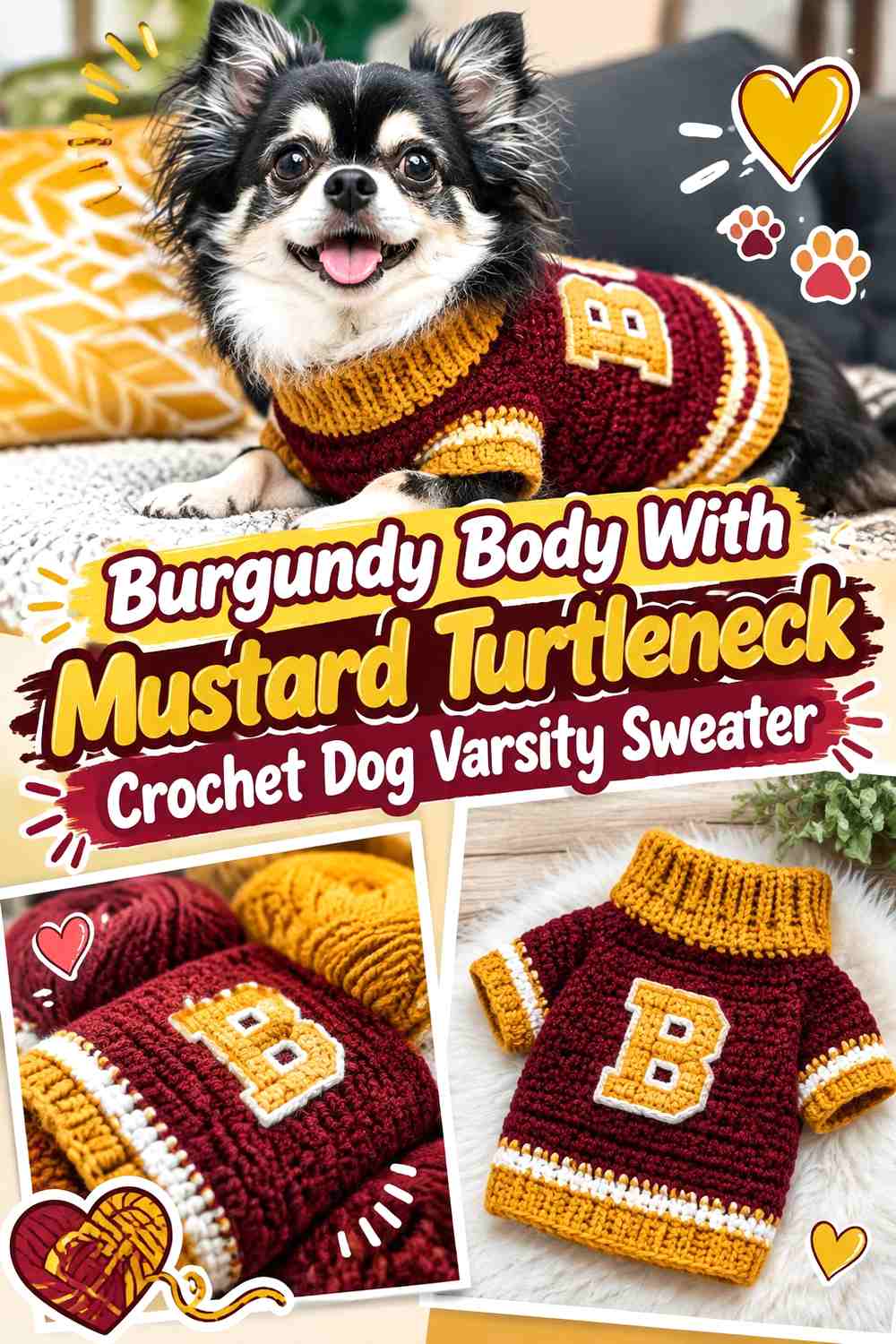
A taller mustard neckline gives the secondary color more presence without interrupting the back. Burgundy can run continuously from below the collar through the torso, while mustard returns once at the lower edge or leg trim.
Mustard Turtleneck Can Become the Main Varsity Accent
A substantial neckline already contains enough mustard to establish the two-color design. Avoid compensating by adding equally broad mustard bands through the torso.
One small mustard repeat farther down is usually enough to connect the neck with the rest of the sweater.
Burgundy Gives a Mustard Turtleneck a Dark Base
Keep the shoulders and back burgundy immediately below the collar. The darker surrounding field makes the mustard neckline visually distinct and creates a clear transition into the body.
If the neck is heavily textured, solid mustard can also help that texture read without additional color changes.
Creator Credit: Hi!Donkun Knitting&Japanese sweets Hi!Donkun Knitting&Japanese sweets tutorial
10. Mustard Center and Burgundy Side-Panel Crochet Dog Varsity Sweater
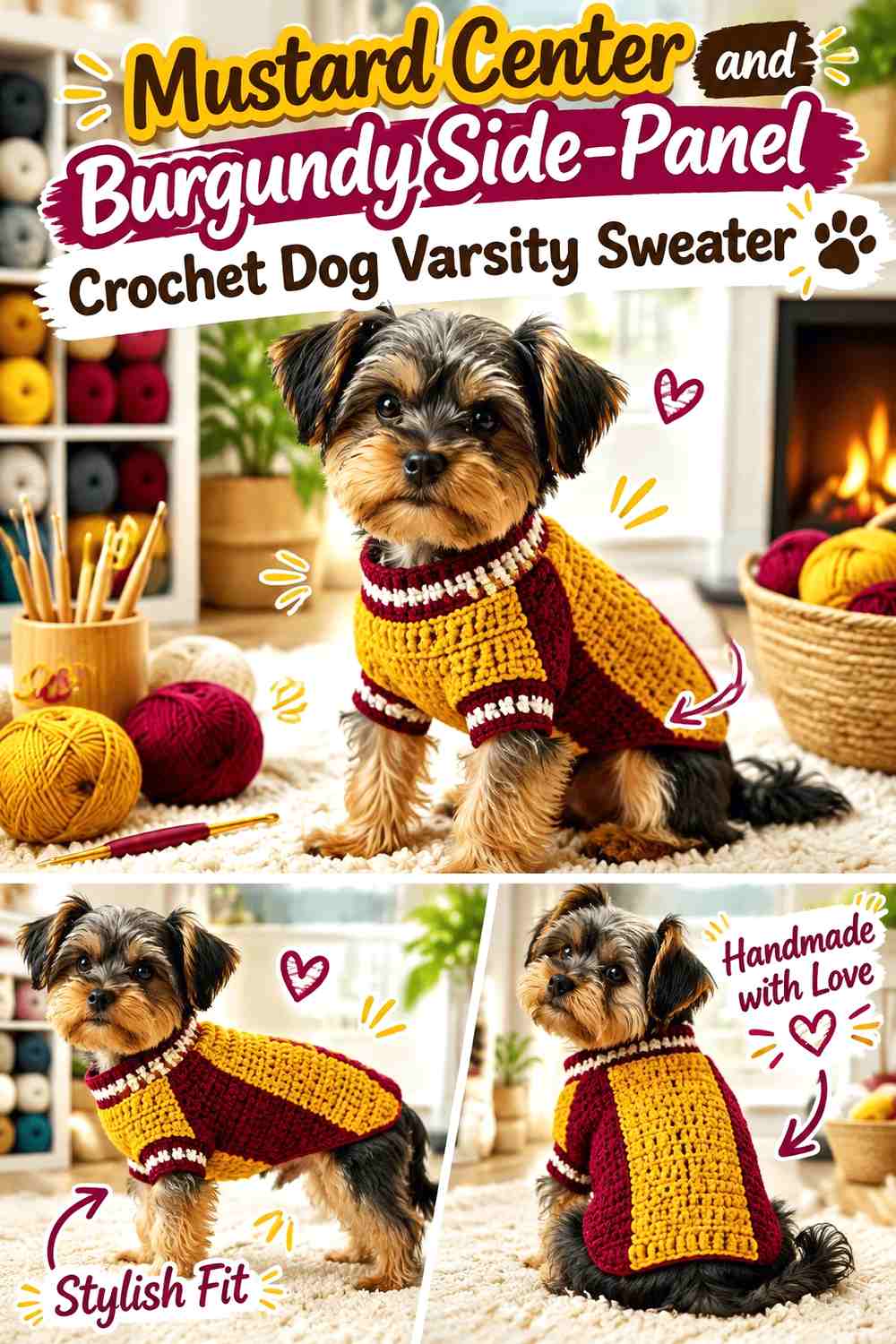
This color-block direction gives mustard the central back while burgundy runs along the sides or outer sections. It produces a longer-looking central color field and avoids the horizontal effect of varsity stripes.
Burgundy Side Areas Can Frame a Mustard Back Panel
Keep the side sections similar enough in visual weight that the mustard center appears intentional rather than shifted. The dark burgundy acts as a border around the brighter middle.
The exact boundaries should follow the sweater construction instead of forcing vertical divisions into awkward areas.
Mustard Should Stay Broad Between Burgundy Panels
A very narrow yellow center can look like a stripe rather than a body panel. Give mustard enough width to remain one of the major sweater surfaces.
Keep collars and edges restrained if the body already contains large-scale color blocking.
Creator Credit: Alextitia Tuto Crochet Alextitia Tuto Crochet tutorial
11. Burgundy and Mustard Wide-Stripe Crochet Dog Varsity Sweater
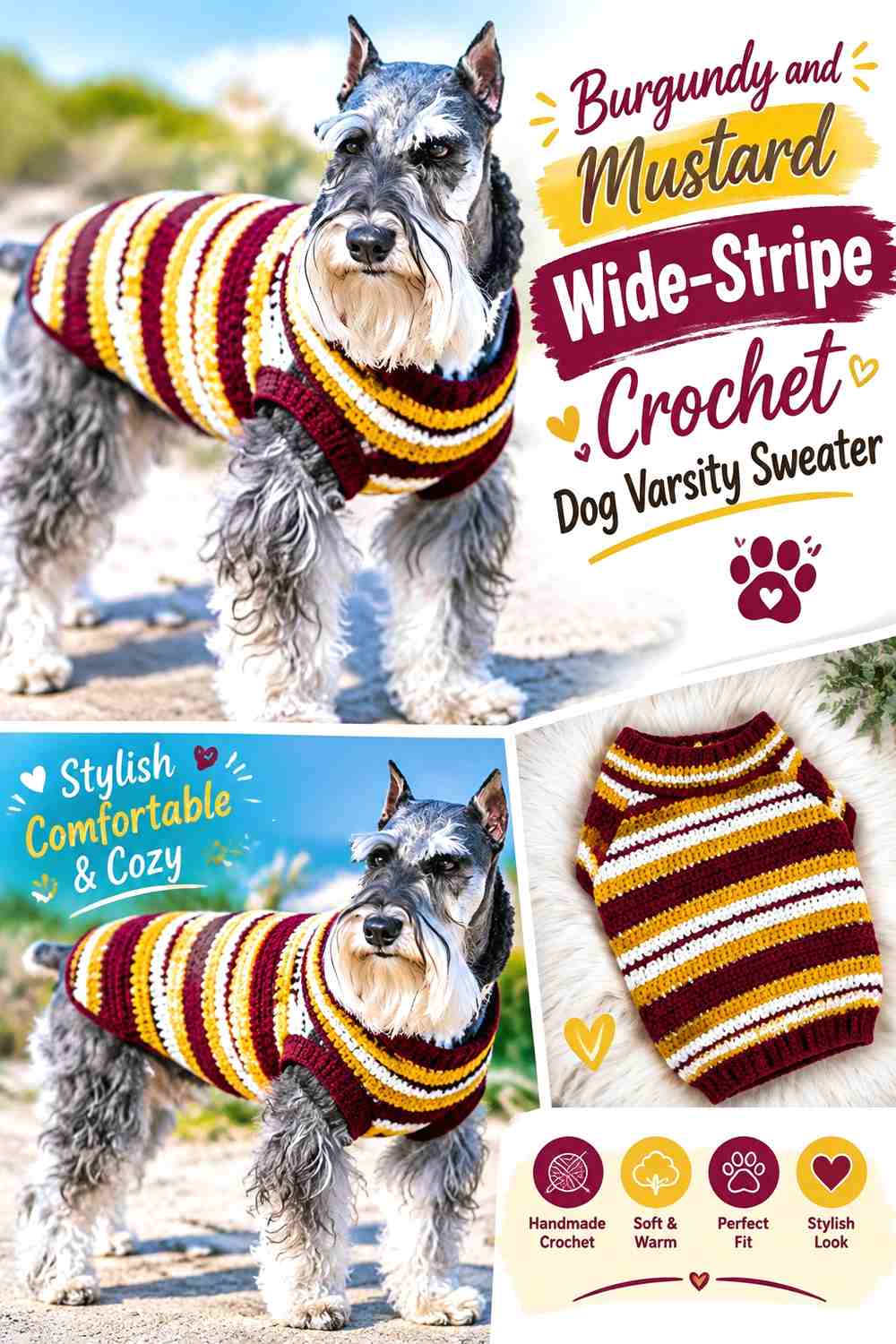
Wide bands create a bolder varsity direction than narrow pinstripes. Burgundy should still occupy more total surface if you want the sweater to remain dark-led, while mustard can take one or two substantial bands across the body.
Mustard Wide Stripes Need a Burgundy Hierarchy
Make the burgundy areas wider or more numerous than the mustard sections instead of alternating identical bands from collar to hem. This keeps the garment from becoming a simple two-color striped sweater.
A burgundy collar helps reinforce which shade is dominant.
Burgundy Can Separate Mustard Bands Clearly
Keep a meaningful burgundy interval between mustard sections. If two yellow bands sit too close together, they can visually merge into one oversized mustard area.
The darker separation also gives the stripes a stronger athletic rhythm.
Creator Credit: Left Hand Crochet & Knit Tutorials Left Hand Crochet & Knit Tutorials tutorial
12. Burgundy, Mustard, and Cream Collar-Stripe Crochet Dog Varsity Sweater
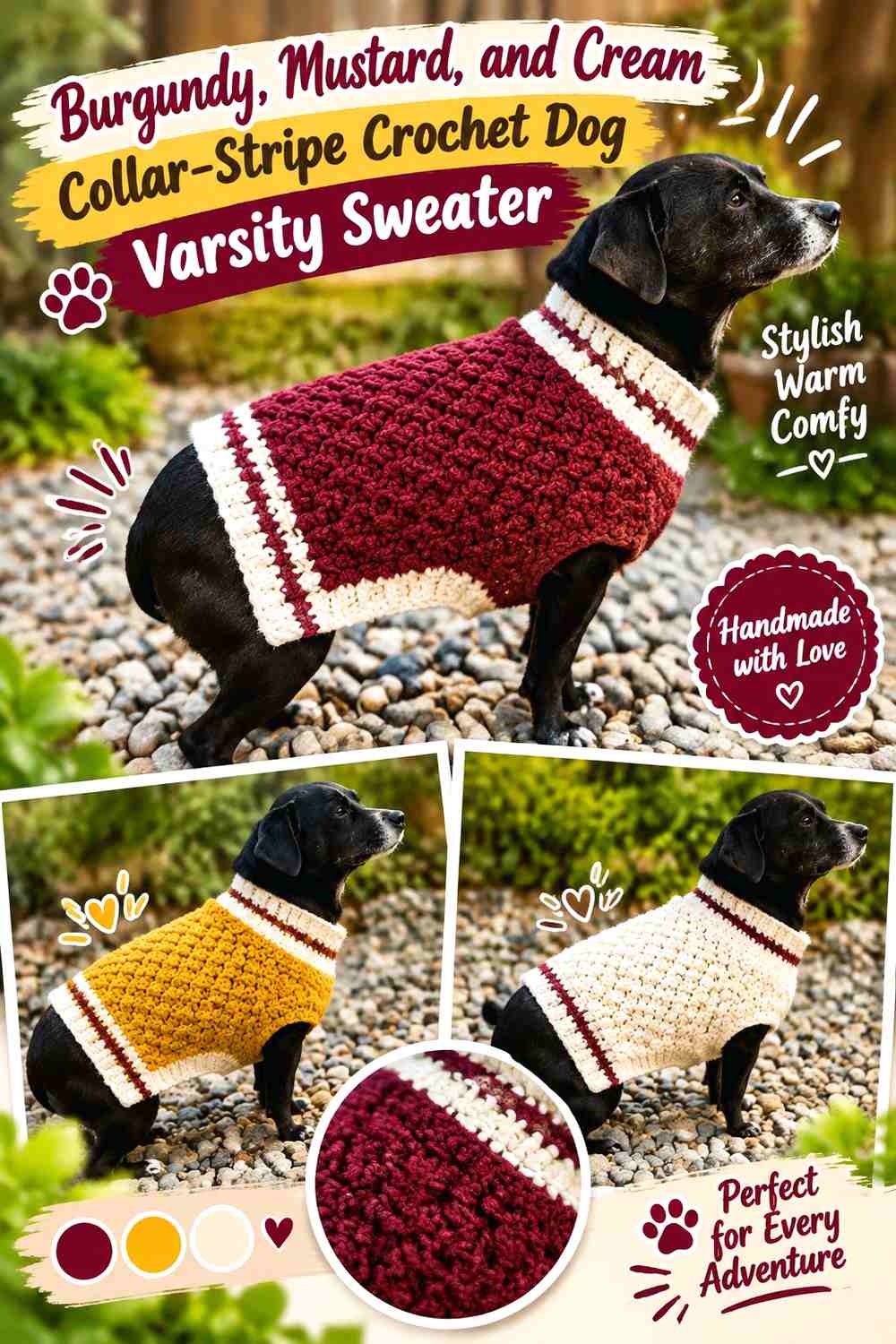
Concentrating all three colors at the collar creates a small varsity stripe detail while the rest of the body remains burgundy. Mustard should remain the main accent stripe, with cream used more narrowly for separation.
Mustard Should Be the Stronger Stripe Against Burgundy
Give mustard more width than cream if both sit beside a burgundy body. This keeps the recognizable burgundy-and-mustard relationship from being diluted by the neutral.
The lower sweater can remain solid burgundy or repeat only a narrow mustard edge.
Cream Can Sharpen Burgundy and Mustard Collar Stripes
A small cream interval can make two warm colors easier to distinguish around a narrow neckline. It is especially useful when the mustard is dark or muted.
Do not automatically add cream to the hem and leg openings; its job here is specifically to organize the collar treatment.
Creator Credit: Crochet Cuties Creations by Esther Crochet Cuties Creations by Esther tutorial
13. Burgundy Crochet Dog Varsity Sweater With Mustard V-Shaped Yoke
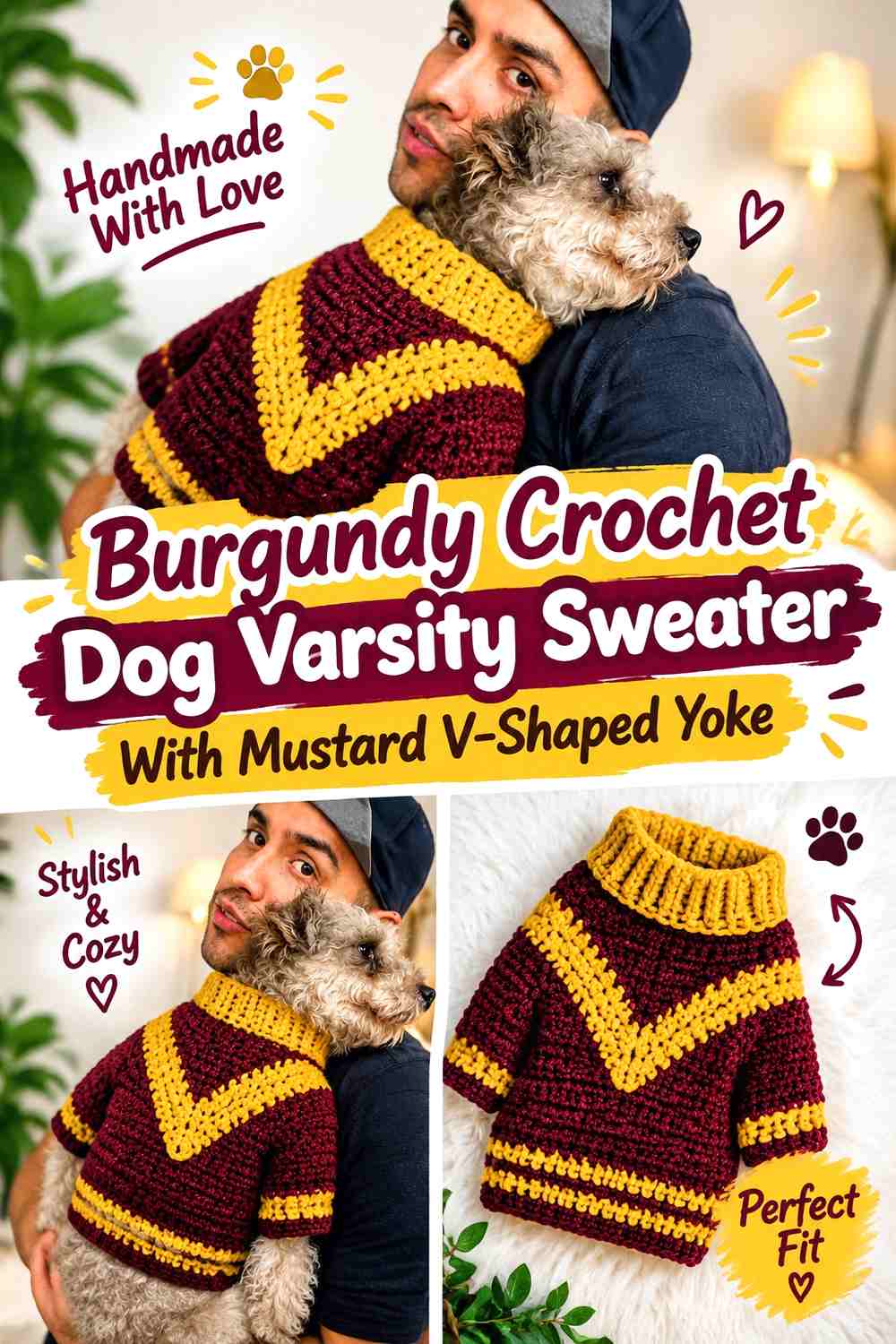
A mustard V-shaped or angled upper color zone can suggest varsity neckline geometry while leaving the lower sweater burgundy. Keep the color change concentrated around the shoulder and upper-back region rather than repeating several Vs through the body.
Mustard Can Define a V-Shaped Accent on Burgundy
The mustard section needs enough width to remain visible as an intentional angle rather than a jagged line. Keep burgundy above or below it according to the base construction so the shape has clear contrast.
A cream separator is optional, not required.
Burgundy Should Dominate Below the Mustard Yoke
Let the lower body remain largely burgundy. The solid section gives the angled mustard treatment space and prevents the sweater from becoming overly patterned.
If mustard repeats at the hem, keep that second accent much simpler than the yoke.
Creator Credit: CARLOS PERALTA CARLOS PERALTA tutorial
14. Burgundy Cable Crochet Dog Varsity Sweater With Mustard Trim
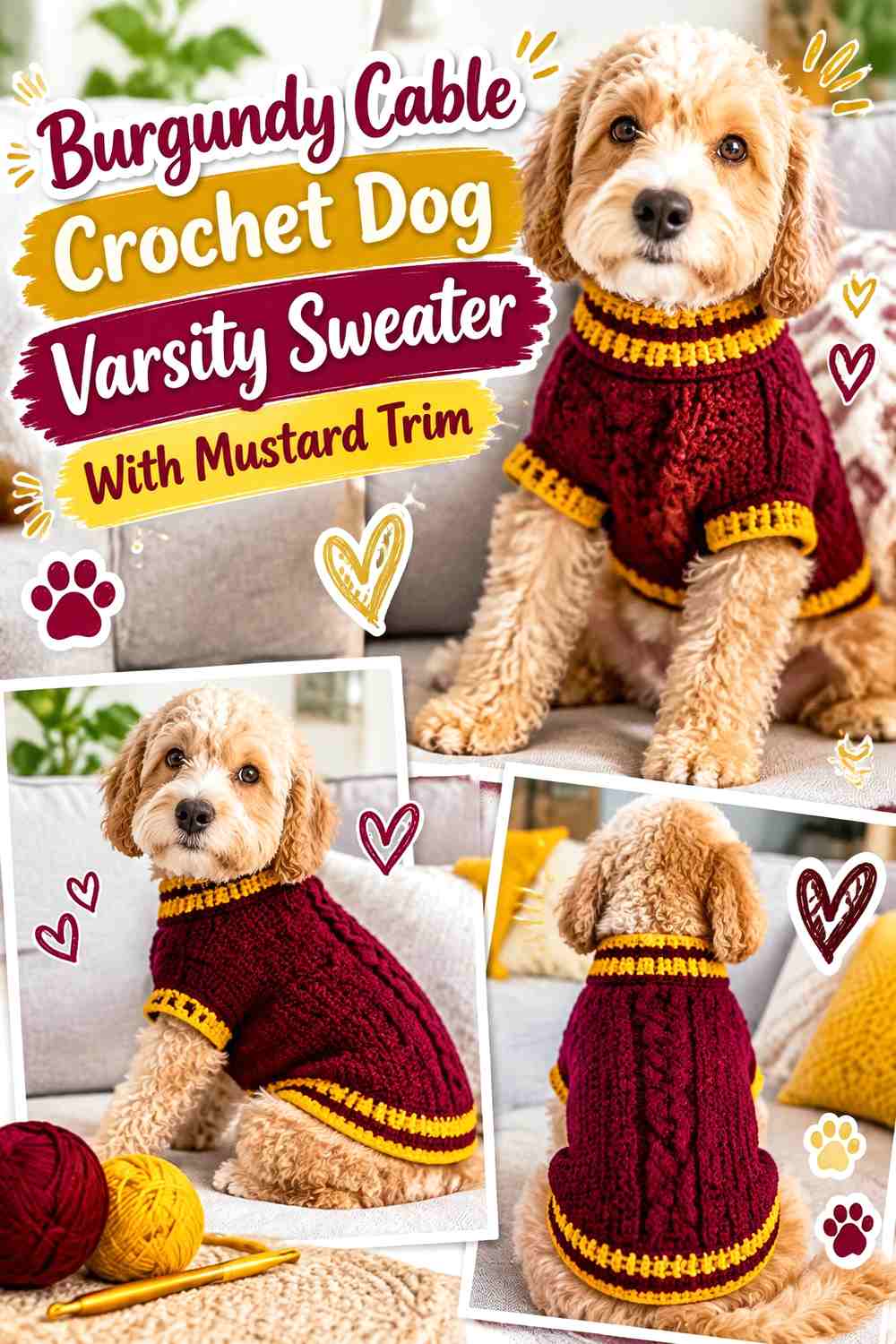
Cable texture already gives the back substantial visual detail, so burgundy should stay solid across the cabled area. Mustard can then define the collar, bottom border, or another smoother finishing section.
Burgundy Keeps Cable Texture Visible Without Mustard Interruptions
Work the main textured back in burgundy if the cable is meant to be easy to read. Frequent mustard changes through raised texture can make the viewer notice the color sequence before the stitch pattern.
A solid dark field lets highlights and shadows across the cable do more of the visual work.
Mustard Can Frame Burgundy Cables at the Sweater Edges
Place mustard outside the cable-heavy area, such as at the neckline or lower finish. The lighter color creates separation between the textured body and the garment edge.
If both collar and hem are mustard, consider leaving the leg openings burgundy to avoid framing every opening identically.
Creator Credit: Maria’s Blue Crayon Maria’s Blue Crayon tutorial
15. Mustard Crochet Dog Varsity Sweater With Burgundy Colorwork
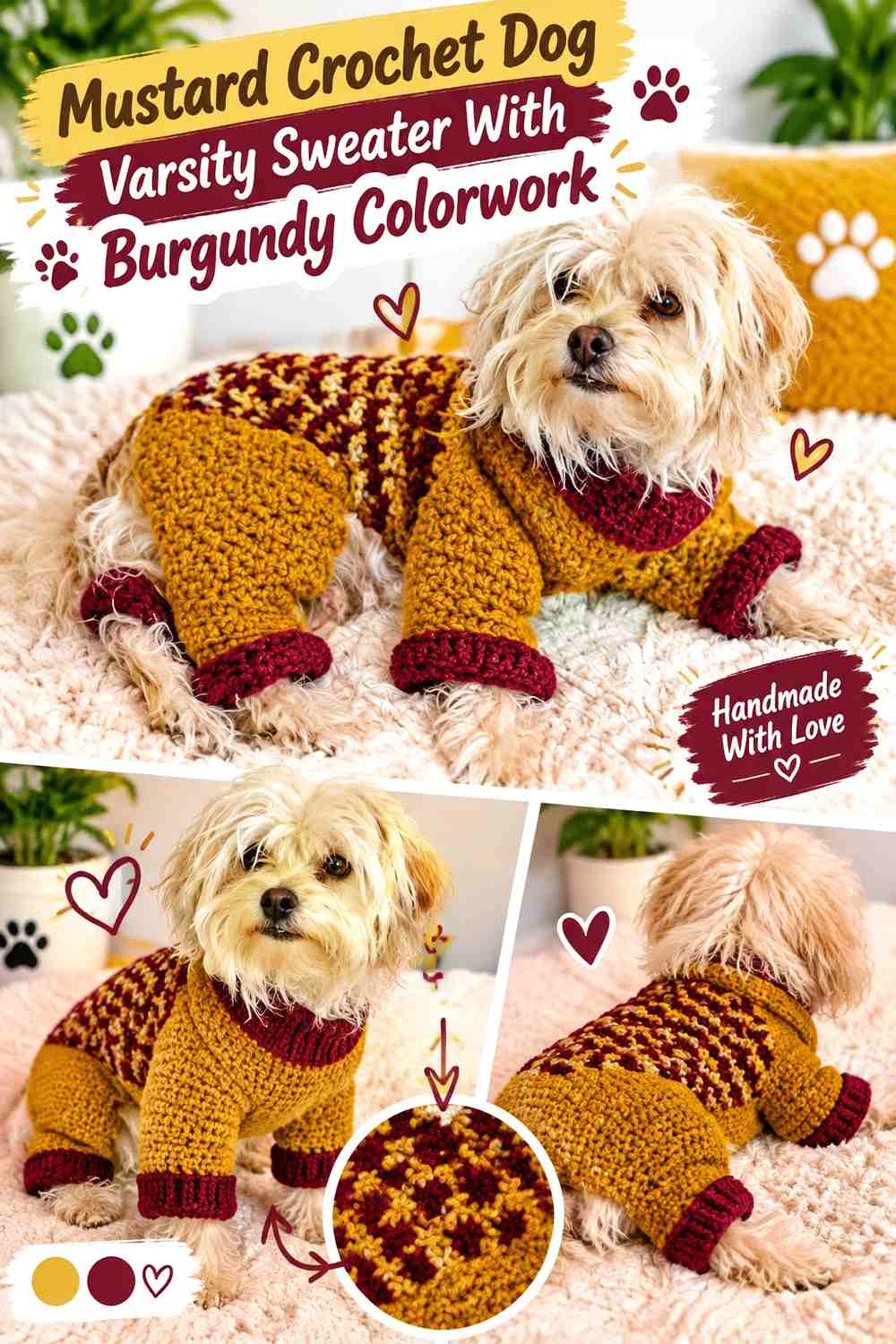
For the final idea, let mustard cover most of the sweater and use burgundy in a repeated upper-body colorwork or stripe pattern. This creates a lighter overall garment while retaining enough dark repetition to feel structured rather than randomly decorated.
Burgundy Colorwork Needs Consistent Repetition on Mustard
Repeat the burgundy shapes or bands according to a clear visual rhythm. Several unrelated burgundy marks can look scattered on such a bright background.
Keep enough mustard visible between dark elements for individual pieces of the colorwork to remain distinct.
Mustard Should Return Below the Burgundy Varsity Pattern
A solid mustard lower body gives the eye somewhere to rest after the patterned upper section. This also prevents the sweater from becoming evenly two-color from neckline to hem.
If the collar is burgundy, a mustard lower edge helps restore the dominant body color at the opposite end.
Creator Credit: Tejiendo Con Candy Tejiendo Con Candy tutorial
Which Burgundy and Mustard Dog Varsity Sweater Direction Should You Choose?
For the clearest classic varsity effect, start with a burgundy body and mustard ribbing, a burgundy body with two mustard stripes, or a mustard body with burgundy sleeves. These schemes tie color changes directly to recognizable sweater sections.
If crochet texture matters more, the burgundy cable sweater with mustard edging or the burgundy body with mustard collar and hem leaves more uninterrupted space for stitches to show.
Choose the granny-panel or colorwork versions when you want repeated color interaction. Those approaches need more careful distribution because burgundy and mustard appear several times across the garment rather than in just one or two structural zones.
For the most restrained treatment, keep the body burgundy and add one mustard back accent. That uses the varsity palette without requiring multiple stripes or blocks.
Conclusion
Burgundy and mustard work especially well for a crochet dog varsity sweater when they are not forced into equal proportions. Burgundy can provide the darker body field while mustard defines ribbing, stripes, yokes, sleeves, or a single back detail. Reversing those roles produces a brighter sweater with the same two-color identity.
Choose ribbed trim or collar-and-hem placement when you want simple color blocking. Use wide stripes, a yoke, or granny panels when color should play a larger role. If cream is added, keep it narrow and purposeful so burgundy and mustard remain the colors that define the sweater.
Most importantly, let color changes follow a construction that already fits the dog. Use the credited tutorials for the actual sweater shaping and treat the varsity palette as an independent adaptation rather than changing neck, chest, leg openings, or underside coverage merely to accommodate a color idea.
Frequently Asked Questions
Should burgundy or mustard be the main color in a crochet dog varsity sweater?
Either can lead. Burgundy creates a darker, more traditional-looking base and makes small mustard accents highly visible. A mustard body creates a brighter sweater and benefits from broader burgundy trim to give the design enough visual weight.
Where should mustard go on a burgundy crochet dog sweater?
Collars, ribbing, lower borders, sleeve-like leg sections, yokes, and one or two controlled stripes are useful locations. You do not need mustard on every opening; selecting a few repeated areas usually creates a clearer varsity effect.
Can I add cream to a burgundy and mustard varsity sweater?
Yes. Cream works best as a narrow separator, pinstripe, or small accent. Keep it subordinate to burgundy and mustard so the sweater does not become an evenly balanced three-color design.
How can I make burgundy and mustard stripes look more like varsity styling?
Use a limited stripe zone instead of striping the entire sweater uniformly. Two narrow mustard bands on a burgundy body, or a burgundy-mustard-cream collar treatment, can create a more focused athletic effect.
Will mustard show clearly against burgundy crochet texture?
Usually the hues will look different, but value still matters. Compare your actual yarns side by side or in grayscale if the mustard will appear in very narrow details. Large mustard trim can remain visible even when the values are relatively close.
Should varsity-style color changes go through cable or raised crochet texture?
They can, but they do not have to. Keeping detailed cables or raised stitches in solid burgundy often makes the texture easier to see, while mustard can be placed around smoother collars, ribbing, or borders.
Can I adapt a basic crochet dog sweater tutorial into burgundy and mustard varsity colors?
Yes. Keep the creator’s construction and fit guidance intact, then plan color changes around existing structural areas such as the collar, body, leg openings, and lower edge. Avoid altering the sweater’s proportions simply to force a decorative stripe or color block into place.