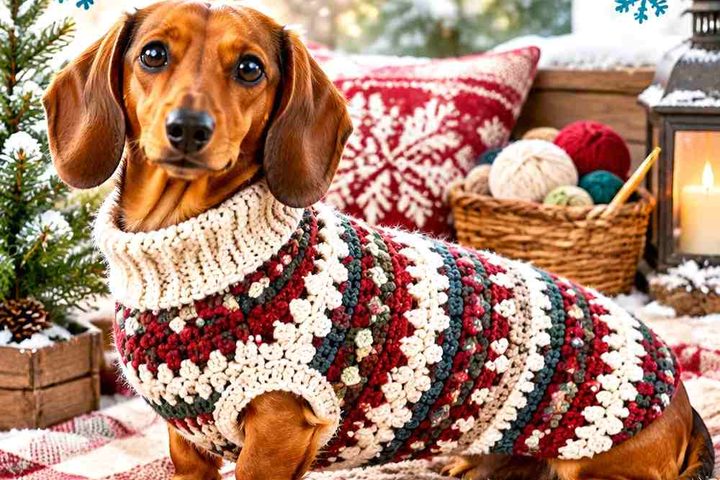
Crochet granny square dog cardigans are especially suited to retro color because each square gives you several places to control the palette. A mustard center can sit inside an avocado round, cream can separate two darker shades, or a chocolate join can turn individually colorful squares into one connected garment.
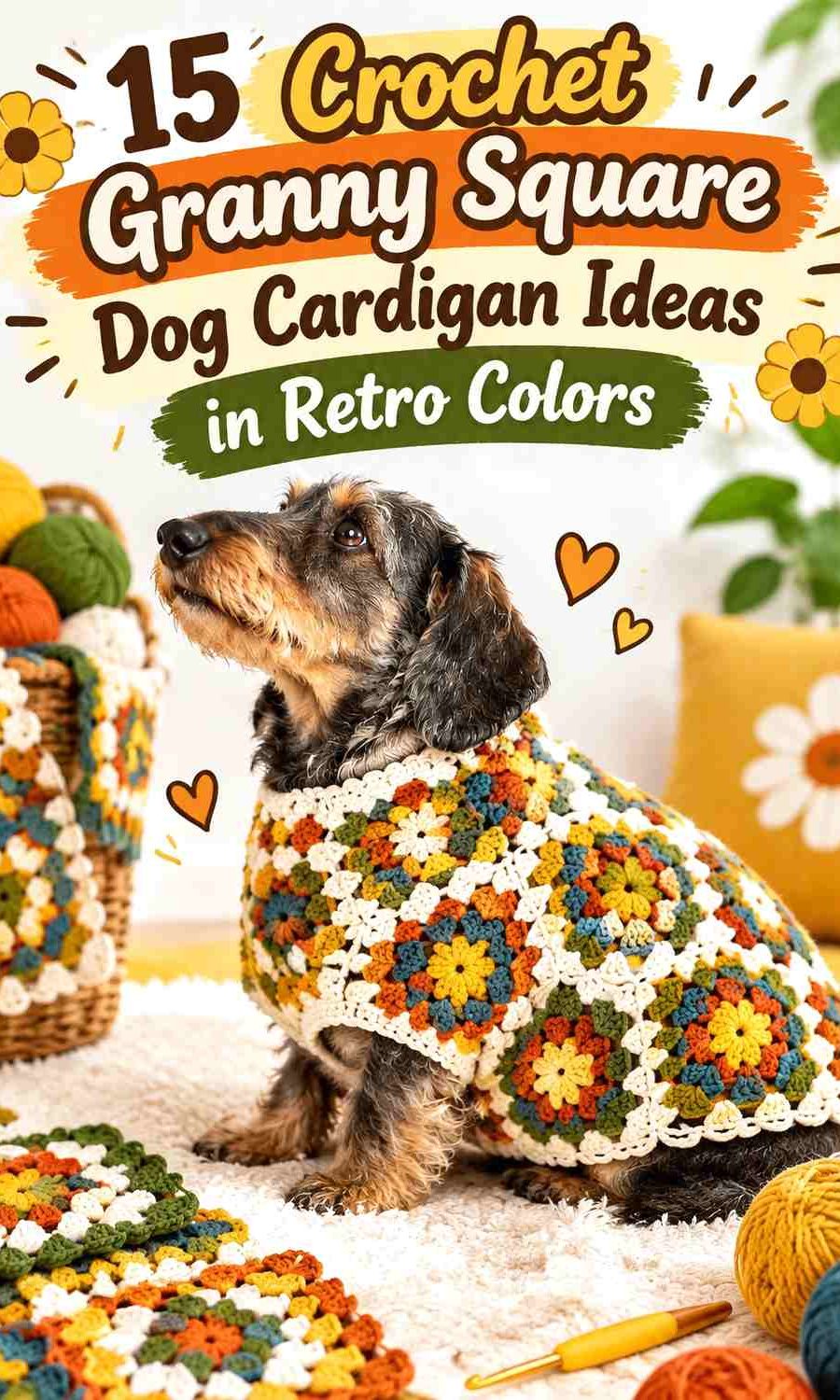
The most useful approach is to decide which color should dominate before making a large stack of motifs. Also consider how the colors will continue into the neckline, belly section, leg openings, joins, and outer edging. A palette that looks balanced in one granny square can become much busier after that square is repeated across an entire dog cardigan.
The tutorials credited below support granny-square dog garments or closely related crochet dog sweater and coat construction. The retro palettes are color adaptations for inspiration; they should not be assumed to be the colors used by the individual creators. Always follow the original tutorial for its construction details and check the garment against your dog’s actual measurements and movement.
Quick List
- Mustard, Avocado, and Cream Crochet Granny Square Dog Cardigan
- Burnt Orange, Chocolate, and Oatmeal Crochet Granny Square Dog Cardigan
- Teal, Rust, and Mustard Crochet Granny Square Dog Cardigan
- Olive, Dusty Rose, and Cream Crochet Granny Square Dog Cardigan
- Brick Red, Camel, and Sage Crochet Granny Square Dog Cardigan
- Turquoise, Coral, and Butter Yellow Crochet Granny Square Dog Cardigan
- Plum, Ochre, and Moss Crochet Granny Square Dog Cardigan
- Avocado, Tangerine, and Ivory Crochet Granny Square Dog Cardigan
- Denim Blue, Marigold, and Rust Crochet Granny Square Dog Cardigan
- Chocolate, Mint, and Peach Crochet Granny Square Dog Cardigan
- Burgundy, Harvest Gold, and Tan Crochet Granny Square Dog Cardigan
- Forest Green, Burnt Orange, and Cream Crochet Granny Square Dog Cardigan
- Dusty Blue, Mustard, and Terracotta Crochet Granny Square Dog Cardigan
- Espresso, Pale Yellow, and Orange Crochet Granny Square Dog Cardigan
- Raspberry, Olive, and Camel Crochet Granny Square Dog Cardigan
Give Retro Colors Clear Jobs Across a Granny Square Dog Cardigan
A three-color retro palette does not need three colors used in equal amounts. On a small dog garment, equal blocks of several strong shades can make the individual granny squares harder to read. Instead, choose a dominant color for the largest visual share, a supporting shade for repeated motif rounds, and an accent for smaller centers or trim.
Remember that a dog cardigan is viewed as a whole garment rather than as isolated squares. Check how the squares look across the back, how the join color divides them, and whether the neckline and belly area continue the same hierarchy.
Check Light and Dark Contrast Before Joining the Granny Squares
Different hues do not automatically create strong contrast. Rust and olive, for example, can look clearly different in the skein while still having similar visual weight once crocheted.
Lay the proposed colors beside one another and, if necessary, view them in grayscale. If two important motif rounds merge together, place cream, pale yellow, oatmeal, or another lighter shade between them rather than relying only on a change in hue.
Keep Retro Color Details Practical for a Dog Cardigan
The most decorative color placement should not distract from fit. Check the neck opening, front-leg areas, chest or belly coverage, and back length before deciding where an elaborate border belongs. A contrasting edge can be useful visually because it defines the garment shape, but avoid adding loose decorative pieces simply to carry another accent color.
For a multicolor cardigan, secure and finish color changes carefully and keep the inside of the garment comfortable against the dog.
1. Mustard, Avocado, and Cream Crochet Granny Square Dog Cardigan
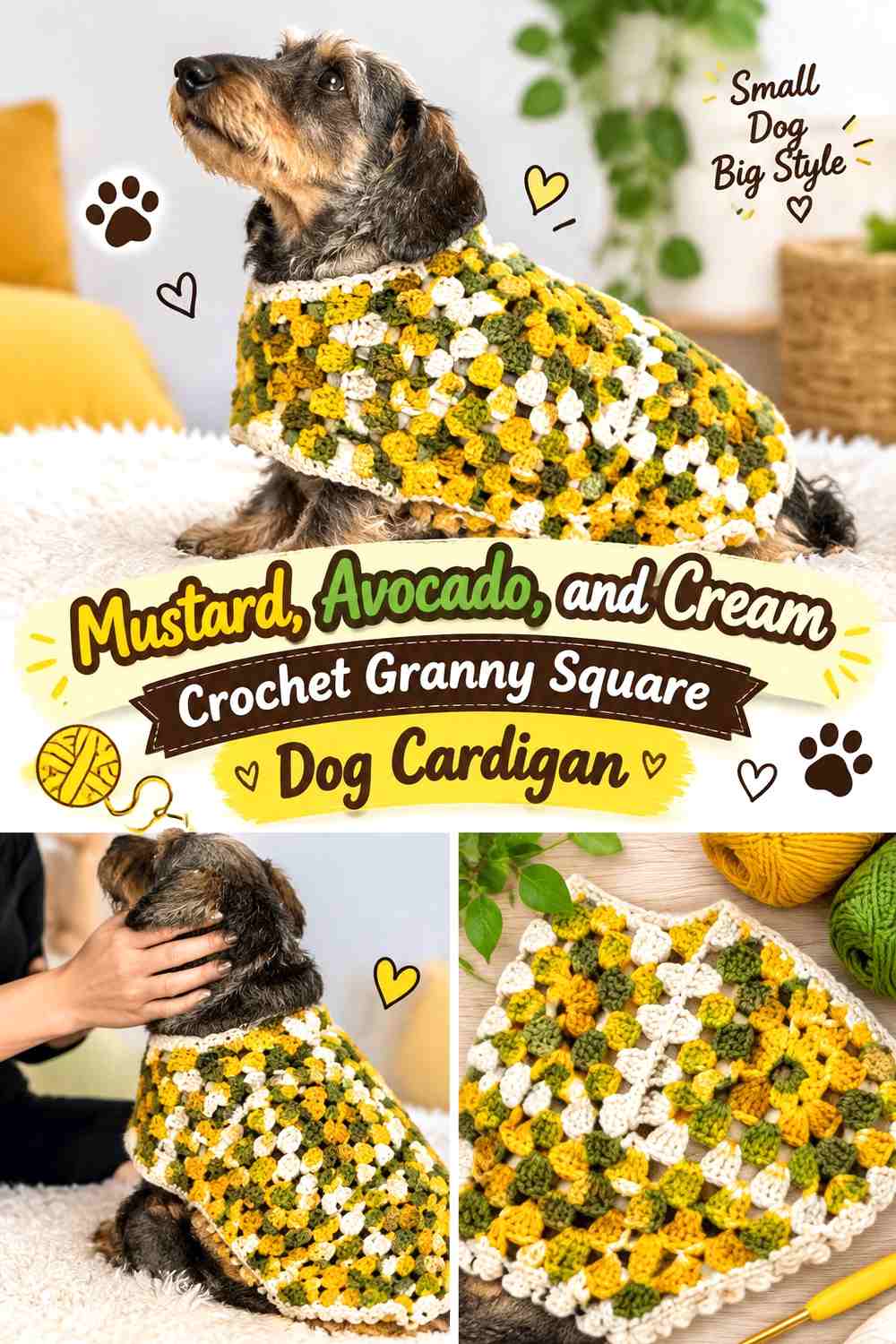
Mustard and avocado immediately establish a strong vintage direction, while cream gives the two earthy colors enough separation to keep the granny-square structure readable. Let avocado cover the largest share of the cardigan, use mustard repeatedly through the square centers or intermediate rounds, and reserve cream for narrower dividing rounds, joins, or edging.
Avocado Can Anchor the Main Granny Square Dog Cardigan Panels
Avocado works well as the dominant color because it is less visually sharp than mustard. Repeating it around the outer portion of several squares can help the back of the cardigan read as one garment instead of a collection of unrelated motifs.
If every granny-square round alternates equally between avocado, mustard, and cream, the cardigan can become visually fragmented. Giving avocado more surface area creates a clearer hierarchy.
Mustard Makes Stronger Granny Square Centers Than an All-Over Field
Mustard has enough presence to work in smaller repeated doses. Try it in granny-square centers or a consistent inner round so the eye picks up the same warm note across the dog’s back.
Keeping mustard away from every outer edge also leaves room for the join or trim color to define the silhouette.
Cream Separates Mustard and Avocado Around the Dog Cardigan Edges
Use cream where mustard and avocado begin to merge visually, particularly around small motif details or the neckline. A cream joining or finishing round can also lighten the area around the dog’s shoulders without removing the retro character of the palette.
If bright white feels too sharp beside these earthy shades, preserve the light-dark separation with a softer light neutral instead.
Creator Credit: Fifty Shades of Yarn
2. Burnt Orange, Chocolate, and Oatmeal Crochet Granny Square Dog Cardigan

This palette pushes the cardigan toward a warmer, deeper 1970s direction. Burnt orange should provide the recognizable retro color, chocolate can define square boundaries and garment edges, and oatmeal can stop the two darker warm shades from becoming one heavy block.
Burnt Orange Can Lead Across the Crochet Dog Cardigan Back
Give burnt orange the broadest repeated role if you want the cardigan to look warm before it looks dark. It can appear in outer motif rounds or alternate across the main back squares while chocolate stays more controlled.
This keeps the strongest warm shade visible even when the dog cardigan is viewed from a distance.
Chocolate Can Frame Burnt Orange Granny Squares Without Taking Over
Chocolate is useful for joins, narrow square borders, neckline trim, or the lower edge because it creates definition. Using too much chocolate across small squares, however, can visually shrink the lighter parts of the motifs.
Keep it as a framing color rather than automatically using it for every large section.
Oatmeal Gives Burnt Orange and Chocolate More Breathing Room
Oatmeal can sit between the two darker colors or occupy a few deliberately lighter squares. It is especially helpful around detailed granny-square centers where burnt orange against chocolate would otherwise have limited value contrast.
For substitutions, preserve oatmeal’s light neutral role rather than worrying about finding one exact beige.
Creator Credit: Kaylin Cierra Rose
3. Teal, Rust, and Mustard Crochet Granny Square Dog Cardigan
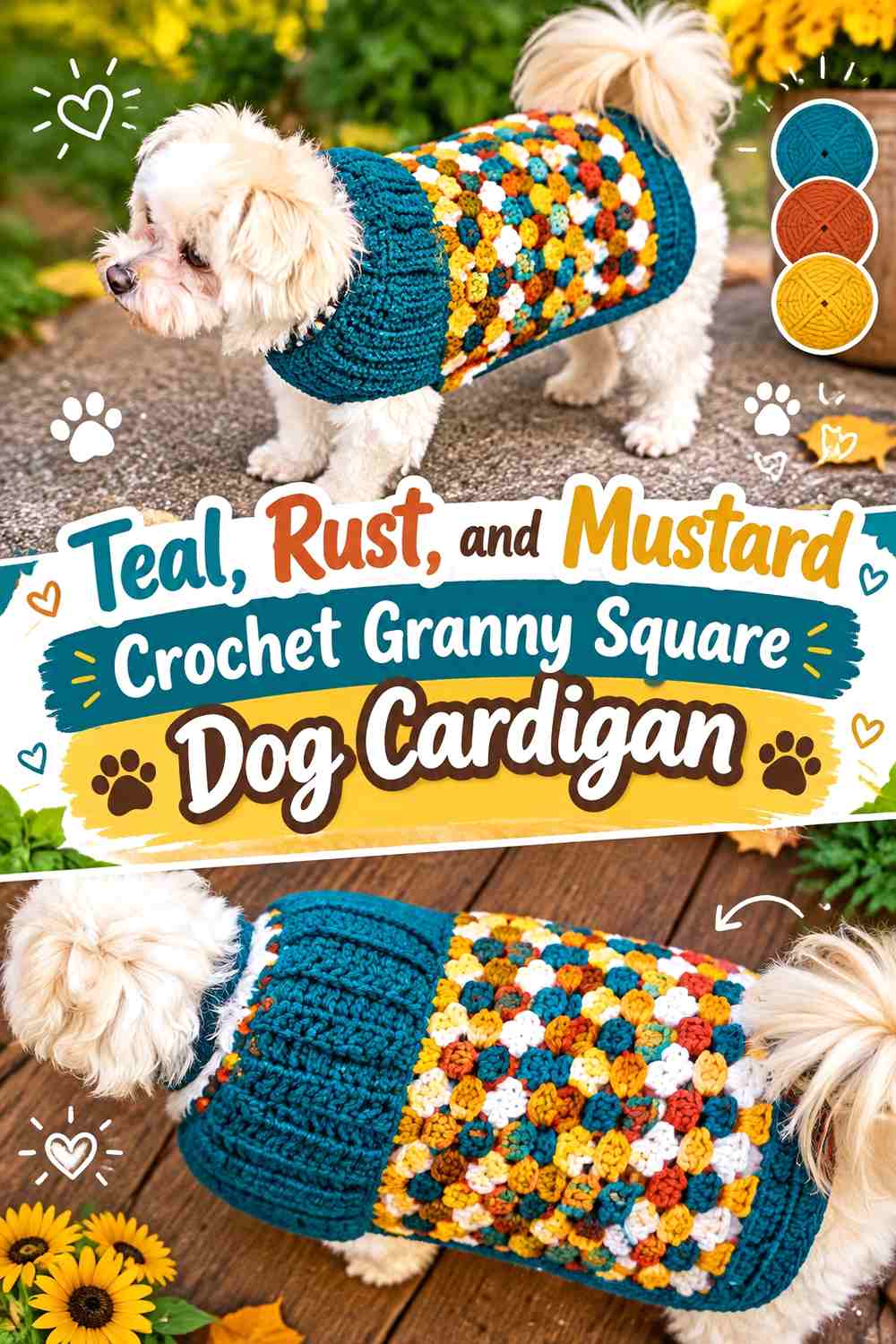
Teal cools down the classic rust-and-mustard combination, giving this dog cardigan more color tension than an all-earth-tone palette. Use teal as the grounding shade, rust as the warm secondary color, and mustard as the smaller high-impact accent.
Teal Gives the Crochet Dog Cardigan a Cooler Visual Base
Place teal in outer granny-square rounds, joins, or larger repeated areas so the cardigan has a consistent cool background. This gives rust and mustard something to contrast against instead of letting every square become equally warm.
A teal neckline can also visually connect back panels made from several different square arrangements.
Rust Bridges Teal and Mustard Across the Granny Squares
Rust sits comfortably between the cool teal and brighter mustard because it adds warmth without being as light as mustard. Use it in intermediate motif rounds or repeat it across selected centers.
If teal and rust are similar in value, insert mustard strategically between them instead of placing all three colors in random order.
Mustard Needs Controlled Repetition Beside Teal and Rust
Small mustard centers, corner details, or a narrow finishing stripe can carry enough emphasis. When mustard occupies the same area as teal and rust in every square, it can compete rather than accent.
Repeat it consistently but sparingly so the dog cardigan maintains a recognizable motif rhythm.
Creator Credit: TwinStarHooks 💫
4. Olive, Dusty Rose, and Cream Crochet Granny Square Dog Cardigan
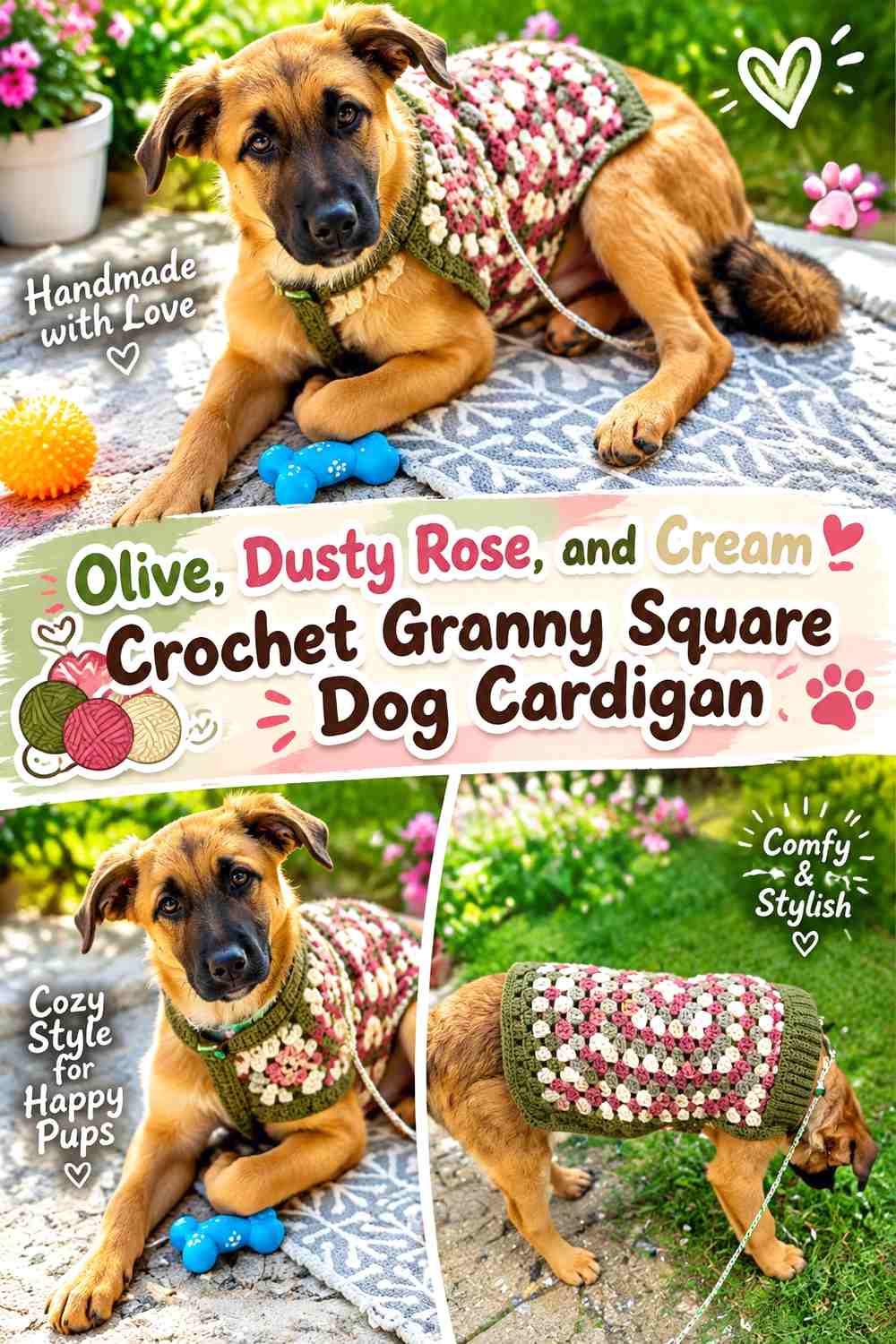
Olive and dusty rose create a muted retro pairing that is softer than the orange-and-mustard combinations often associated with vintage crochet. Cream becomes important here because the two muted colors can sit relatively close in visual strength.
Olive Can Carry the Outer Granny Square Rounds
Using olive toward the exterior of the motifs makes the cardigan feel grounded while allowing dusty rose centers to stay noticeable. It also gives repeated squares a consistent boundary when several motifs cover the dog’s back.
Keep the olive placement regular if the rose centers vary from square to square.
Dusty Rose Works Better as a Repeated Accent Than Random Color
Dusty rose can occupy centers, selected inner rounds, or small areas around the neckline. Repeating it in the same relative location across the granny squares keeps the color intentional.
If the chosen rose is extremely pale, compare it against cream before committing; too little value difference can make the two blend.
Cream Keeps Olive and Dusty Rose Motifs Distinct
Cream is most useful where it actively separates the two muted shades. A narrow cream round between a dusty rose center and olive outer area can make the motif construction easier to see.
Cream can also be used for joining when you want the grid of granny squares to become part of the cardigan’s design.
Creator Credit: Ariela Mais Crochê
5. Brick Red, Camel, and Sage Crochet Granny Square Dog Cardigan
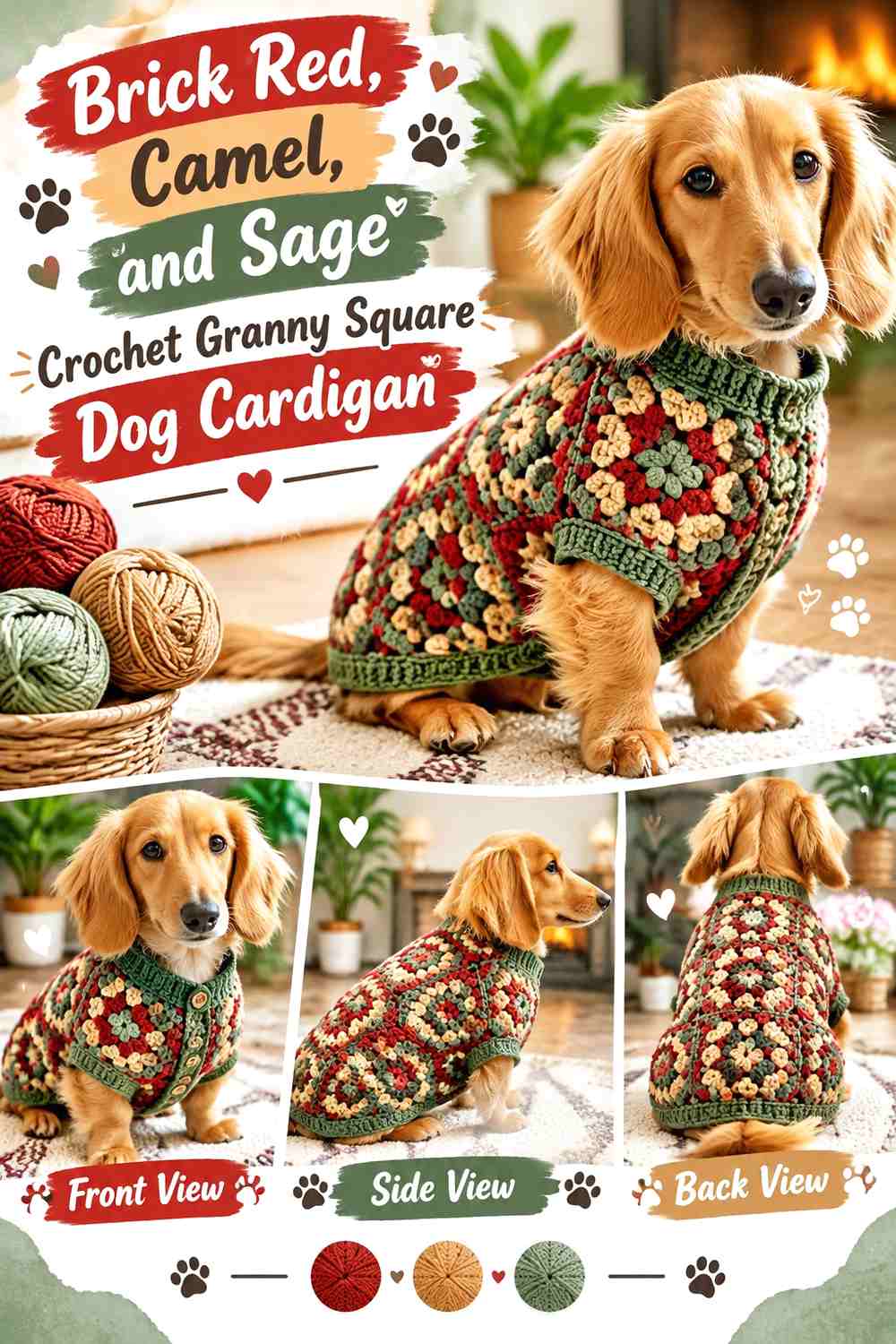
Brick red brings depth, camel adds a warm neutral, and sage introduces a softened green without repeating the familiar avocado-and-mustard formula. This is a useful retro palette when you want the granny squares to feel earthy but not especially dark.
Brick Red Can Define the Strongest Crochet Granny Square Details
Use brick red where you want the eye to land first: centers, selected outer rounds, or a controlled trim. Because it is the deepest chromatic shade in this palette, it does not need to cover most of the cardigan.
Small repeated brick-red areas can create enough visual rhythm across the back.
Camel Can Connect Brick Red and Sage Across the Dog Cardigan
Camel works as the visual bridge. It can occupy larger square rounds, joins, or sections near the chest where a quieter color helps keep the garment from becoming too busy.
If you substitute camel, retain its medium-light warm-neutral character so brick red remains the darkest visual anchor.
Sage Prevents Brick Red and Camel From Becoming Too Warm
Sage adds a cool-muted counterpoint. Place it around selected centers or use it as an alternating outer-square color.
Keep sage and camel distinguishable in value; if they are too similar, brick red may become the only clearly readable color when the cardigan is seen from a distance.
Creator Credit: Crochet With Tiffany
6. Turquoise, Coral, and Butter Yellow Crochet Granny Square Dog Cardigan
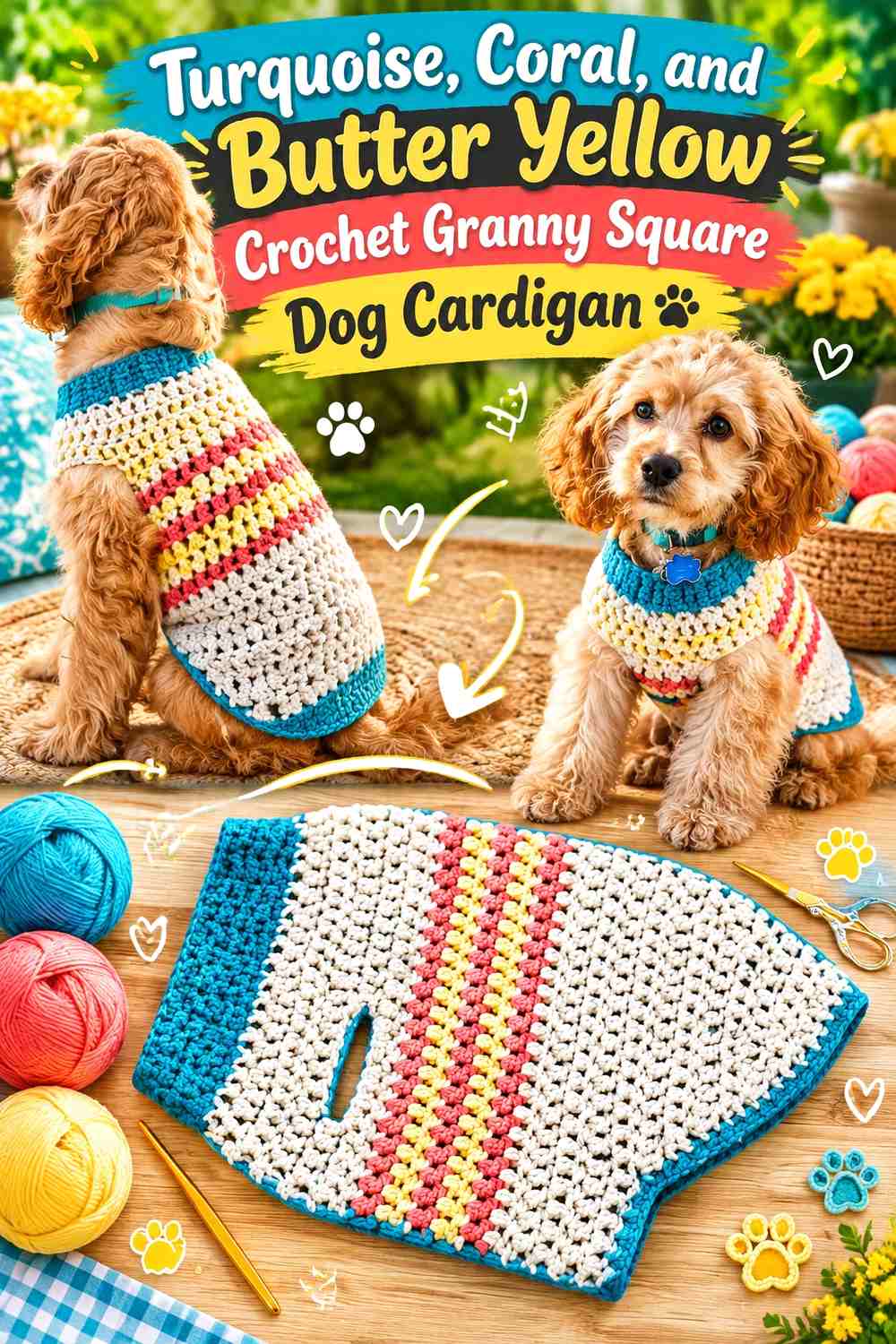
This palette moves toward the brighter side of retro crochet. Turquoise, coral, and butter yellow can all attract attention, so the cardigan needs a stricter hierarchy than a neutral-heavy scheme.
Turquoise Can Hold the Largest Share of the Dog Cardigan
Let turquoise form larger outer rounds, repeated back motifs, or the main joining area. Giving the coolest shade the greatest coverage stops coral and yellow from competing across every square.
A consistent turquoise edge can also visually contain the more colorful centers.
Coral Works as the Warm Counterpoint to Turquoise
Use coral repeatedly in centers or one identifiable motif round. It should appear often enough to feel intentional but not necessarily occupy the same area as turquoise.
If your coral is especially bright, reduce its surface area rather than adding another neutral that changes the character of the three-color palette.
Butter Yellow Can Highlight Small Turquoise and Coral Details
Butter yellow is useful between the stronger turquoise and coral or as a small center accent. Its lighter value can make compact granny-square details easier to distinguish.
Before using it as the join color, check whether you want every seam to become highly visible; a light join can emphasize the full grid of the cardigan.
Creator Credit: it’s erin b.
7. Plum, Ochre, and Moss Crochet Granny Square Dog Cardigan
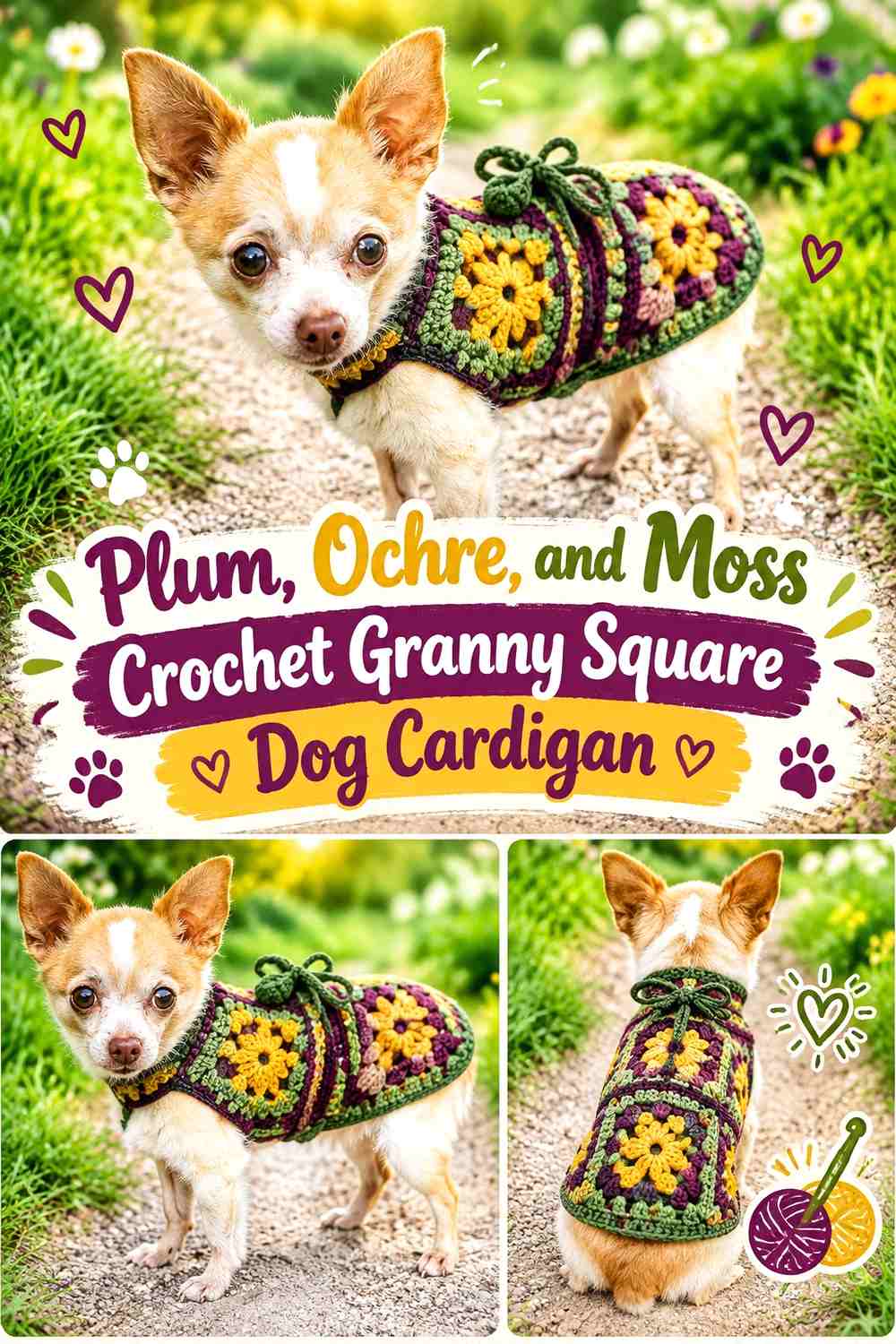
Plum adds an unexpected dark note to the usual earthy retro range. Ochre provides warmth, while moss keeps the combination muted enough for all three colors to coexist without looking like primary-color blocks.
Plum Can Ground the Crochet Dog Cardigan Neckline and Borders
Plum is the darkest visual anchor here, so it is especially effective in narrow borders, neckline finishing, joins, or selected outer motif rounds. Those placements define the cardigan without allowing plum to cover every square.
If the garment is small, large uninterrupted plum sections may visually overpower ochre.
Ochre Makes the Granny Square Centers Easier to Notice
Place ochre in centers or an inner motif round where its warmth can contrast with plum and moss. Repeating ochre at predictable intervals gives the cardigan a stronger motif rhythm than scattering it randomly.
A softer ochre rather than a very bright yellow keeps the vintage direction intact.
Moss Creates a Quieter Transition Between Plum and Ochre
Moss can occupy the medium-value portions of the squares and keep the jump from deep plum to ochre from feeling abrupt. It is also a good candidate for larger areas across the back.
When substituting moss, look for a softened green that stays visibly different from both plum and ochre.
Creator Credit: Last Minute Laura
8. Avocado, Tangerine, and Ivory Crochet Granny Square Dog Cardigan
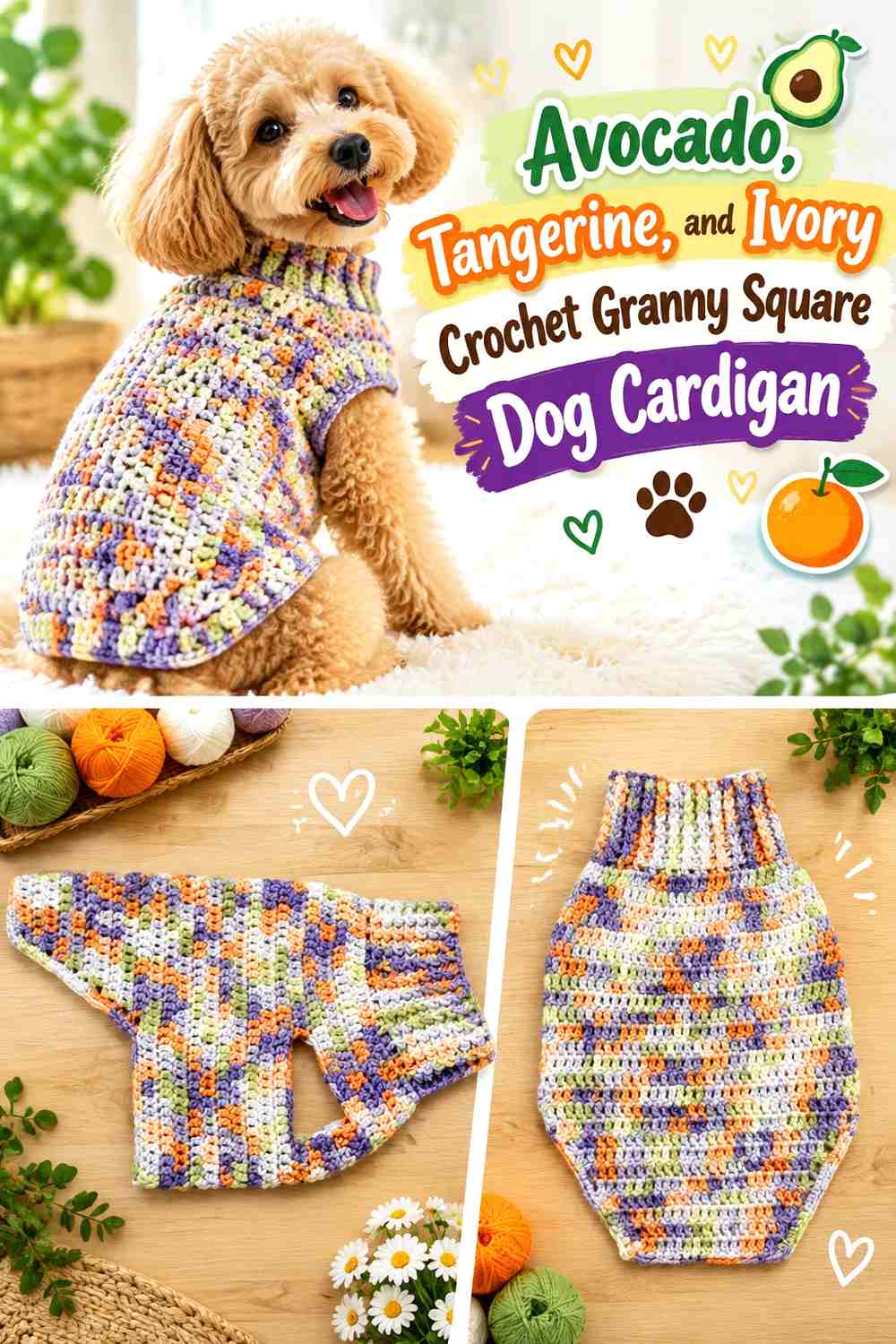
Avocado and tangerine are unmistakably retro together, but their strength means ivory has an important balancing job. Rather than dividing the cardigan into three equal colors, use ivory as deliberate negative space between the green and orange.
Avocado Can Control the Overall Crochet Dog Cardigan Shape
Avocado works well around the outside of granny squares, across joins, or along the lower cardigan edge. Repeating it at structural boundaries gives the garment continuity even when tangerine moves around inside individual motifs.
Tangerine Creates Strong Retro Granny Square Focal Points
Keep tangerine concentrated in centers, selected rings, or occasional statement squares. Because orange advances strongly against avocado, a relatively small amount can influence the whole cardigan.
Avoid adding tangerine independently to every cuff, border, center, and join unless you deliberately want it to become dominant.
Ivory Keeps Avocado and Tangerine From Merging Into Visual Noise
Ivory can separate adjacent rounds, lighten the neckline, or provide the join between especially colorful squares. It gives the eye a pause while preserving the warm vintage character.
If ivory is replaced, retain a noticeably light neutral so the palette does not become uniformly medium-dark.
Creator Credit: Crochet It
9. Denim Blue, Marigold, and Rust Crochet Granny Square Dog Cardigan
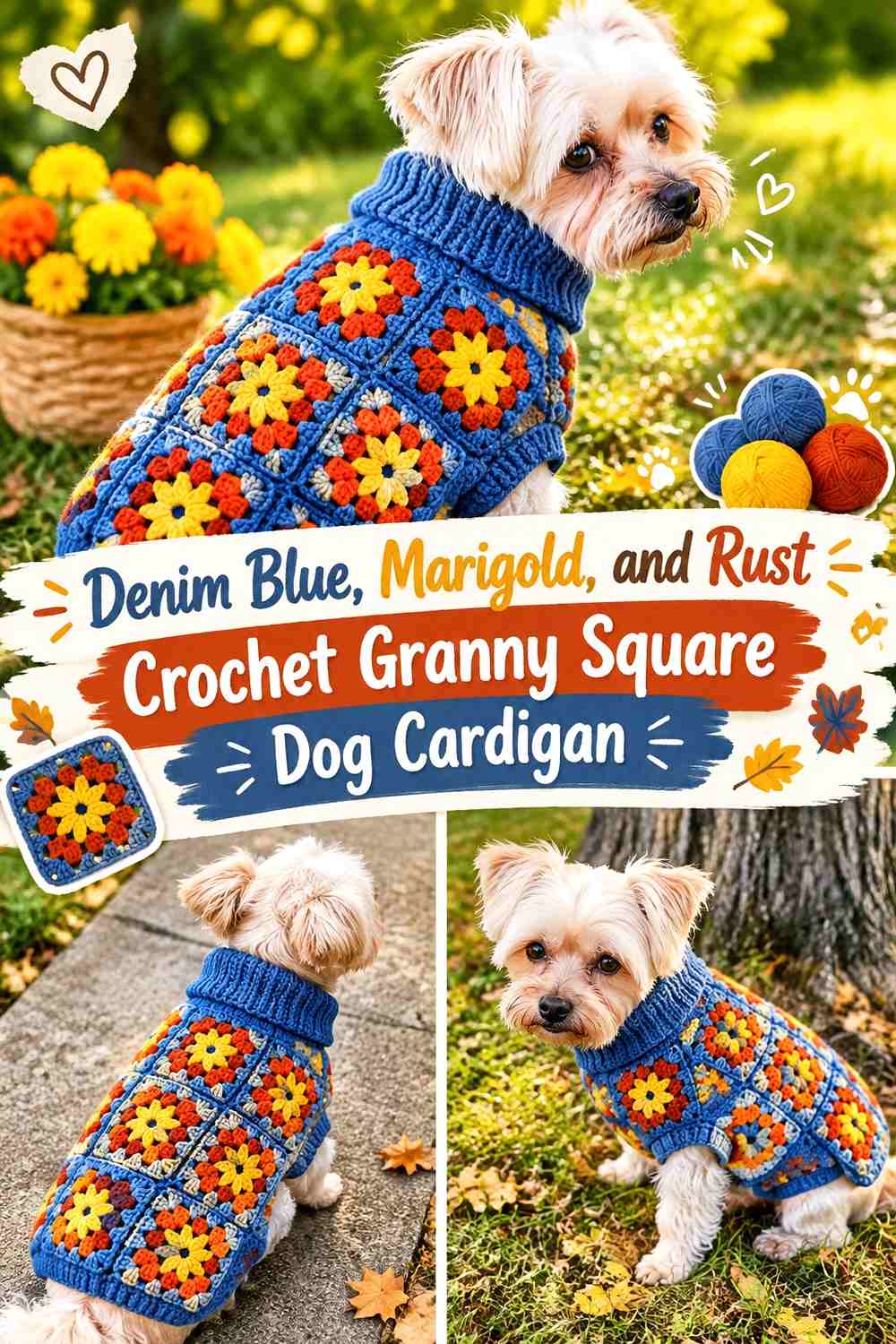
Denim blue gives marigold and rust a cooler framework. Since marigold and rust are related warm shades, their placement should make their difference obvious rather than putting similar amounts directly beside each other everywhere.
Denim Blue Can Unite the Crochet Dog Cardigan Joins
Using denim blue for joins or outer rounds gives the granny-square grid a consistent framework. It can also make the cardigan easier to coordinate visually because the two warmer shades remain contained inside a repeated blue structure.
Marigold Needs Enough Contrast Around Small Granny Square Centers
Marigold is useful as a bright center or narrow inner round, especially when it sits next to denim blue. Against rust alone, however, the two warm colors may feel less separated.
Place denim between them when motif definition matters more than a blended effect.
Rust Can Repeat Through the Denim Blue Cardigan Without Becoming the Border
Rust works well as the secondary warm color around marigold centers or in alternate granny squares. Keeping it inside the blue framework prevents the entire cardigan edge from becoming visually heavy.
A muted terracotta can substitute for rust if it preserves the deeper, quieter relationship with marigold.
Creator Credit: Vibes with Dani
10. Chocolate, Mint, and Peach Crochet Granny Square Dog Cardigan
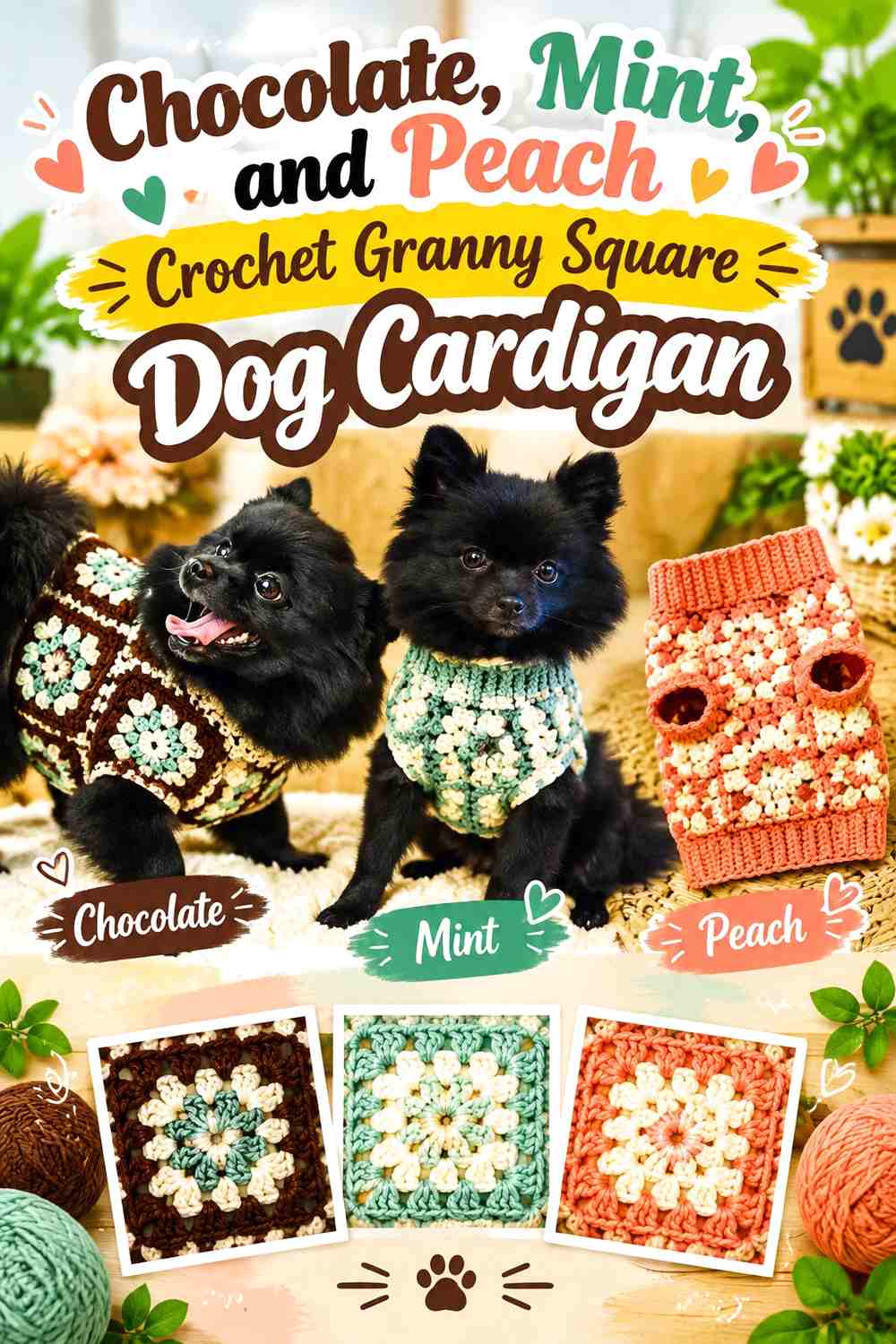
Chocolate makes an effective dark frame for two much lighter retro colors. Mint brings coolness, while peach adds warmth, producing a softer mid-century-inspired direction than the heavier orange-and-brown palettes.
Chocolate Should Frame Mint and Peach Rather Than Cover Them
Use chocolate for granny-square borders, joins, neckline finishing, or other narrow structural areas. Its darkness gives the light colors sharp definition, but too much chocolate can make a small dog cardigan look substantially darker than the individual motifs suggest.
Mint Can Carry More Surface Area Than Peach
Mint is well suited to larger square rounds because it keeps the palette light while contrasting clearly with chocolate. Letting it dominate also prevents peach from making the cardigan uniformly warm.
Check mint and peach side by side before crocheting; very pale versions can have little value separation.
Peach Can Warm Up Mint Granny Square Centers
Use peach in centers, inner rounds, or selected motifs where it can break up larger mint areas. Repeating peach through the back panel is more cohesive than confining it to one isolated square.
If the peach and mint are too similar in value, let chocolate touch both so their shapes remain readable.
Creator Credit: SheiLa Teré
11. Burgundy, Harvest Gold, and Tan Crochet Granny Square Dog Cardigan
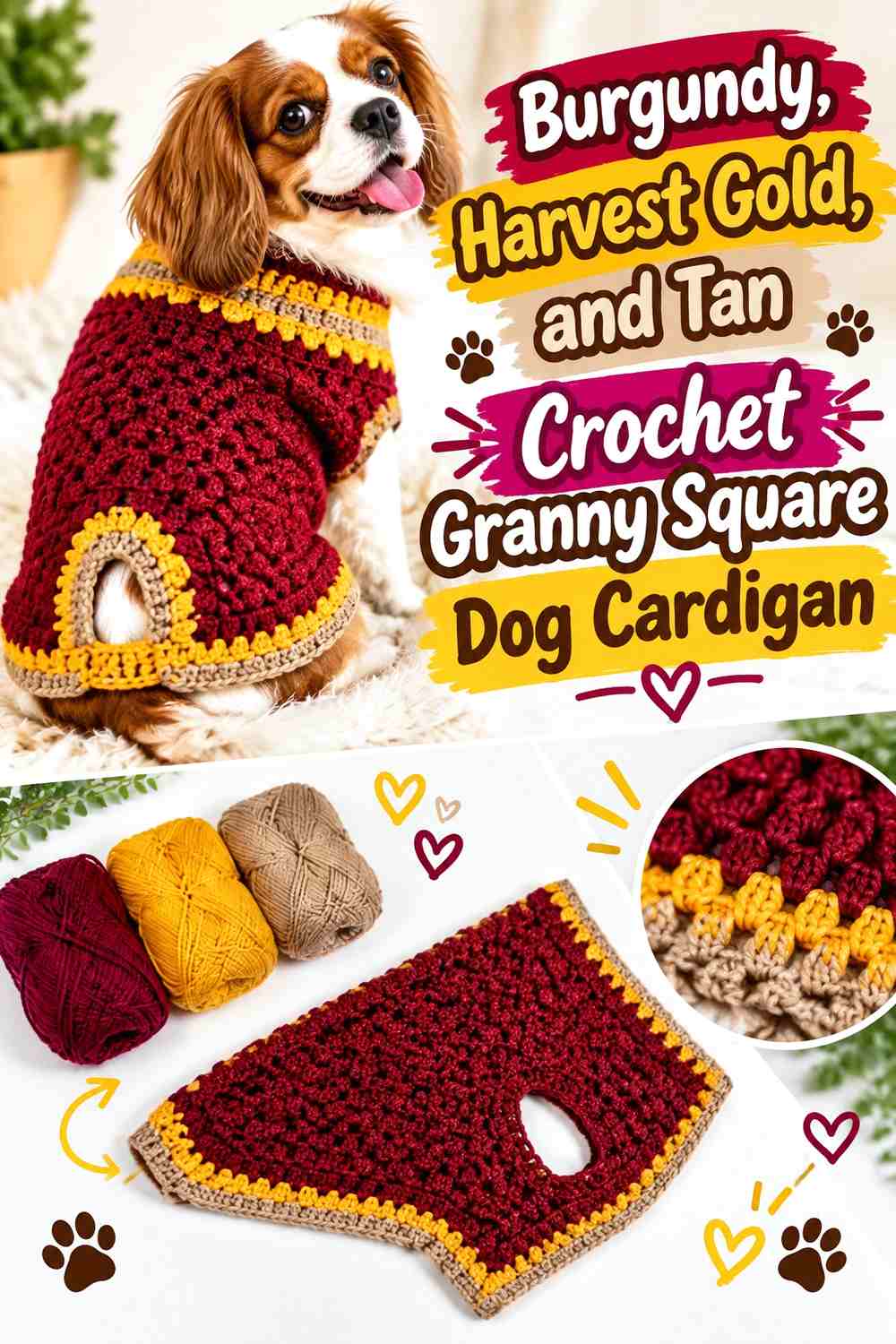
Burgundy and harvest gold produce strong dark-light contrast, while tan prevents the dog cardigan from becoming a two-color statement. This scheme suits crocheters who want a richer retro look without relying on orange.
Burgundy Can Be the Dark Anchor Around the Dog Cardigan
Use burgundy for outer motif rounds, selective joins, or trim when you want a defined edge. Since it is visually heavy, keeping some tan between burgundy sections prevents the back panel from becoming one dark mass.
Harvest Gold Can Highlight Burgundy Granny Square Centers
Harvest gold is strongest in controlled repeated areas. Centers and narrow interior rounds allow it to brighten the cardigan without competing with every other element.
Place it near burgundy when you specifically want high contrast; place tan between them when you want a softer transition.
Tan Keeps Burgundy and Harvest Gold From Competing
Tan can take the largest share of selected motifs or serve as a quieter join. It gives the palette a neutral zone and makes both stronger colors look more deliberate.
When replacing tan, choose another warm neutral that remains clearly lighter than burgundy.
Creator Credit: Loops Only Crochet
12. Forest Green, Burnt Orange, and Cream Crochet Granny Square Dog Cardigan
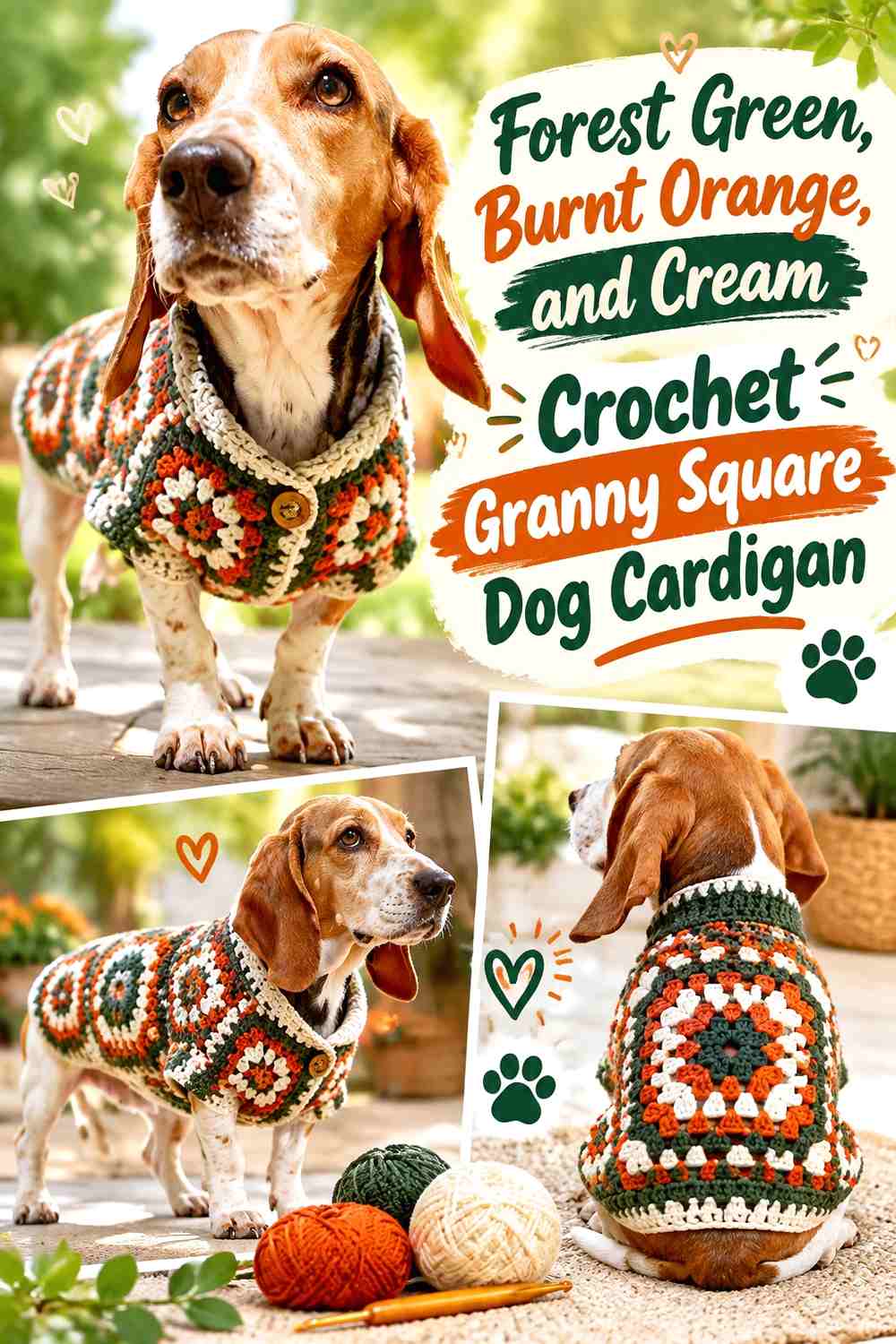
Forest green creates more depth than avocado or sage, so cream becomes essential for keeping the cardigan from feeling too dark. Burnt orange supplies the retro warmth and can be repeated through the motifs without occupying the entire garment.
Forest Green Can Define the Crochet Dog Cardigan Structure
Use forest green around square edges, in the joins, or across selected back motifs. These placements emphasize the patchwork construction while maintaining a consistent dark outline.
Keep the green away from every interior round if you want the individual colors inside each square to remain easy to distinguish.
Burnt Orange Can Repeat Inside Forest Green Granny Squares
Burnt orange centers or middle rounds create a clear warm focal point against forest green. Repeat that placement instead of shifting orange randomly between centers, joins, and borders.
A repeated orange position gives even differently arranged squares a common visual language.
Cream Opens Up Forest Green and Burnt Orange Motifs
Cream can form a narrow ring around orange centers, interrupt larger green sections, or lighten the neckline and outer trim. Its main job is value separation.
If you reduce cream too much, check whether forest green starts to visually dominate the dog’s entire back.
Creator Credit: Yarnspirations
13. Dusty Blue, Mustard, and Terracotta Crochet Granny Square Dog Cardigan
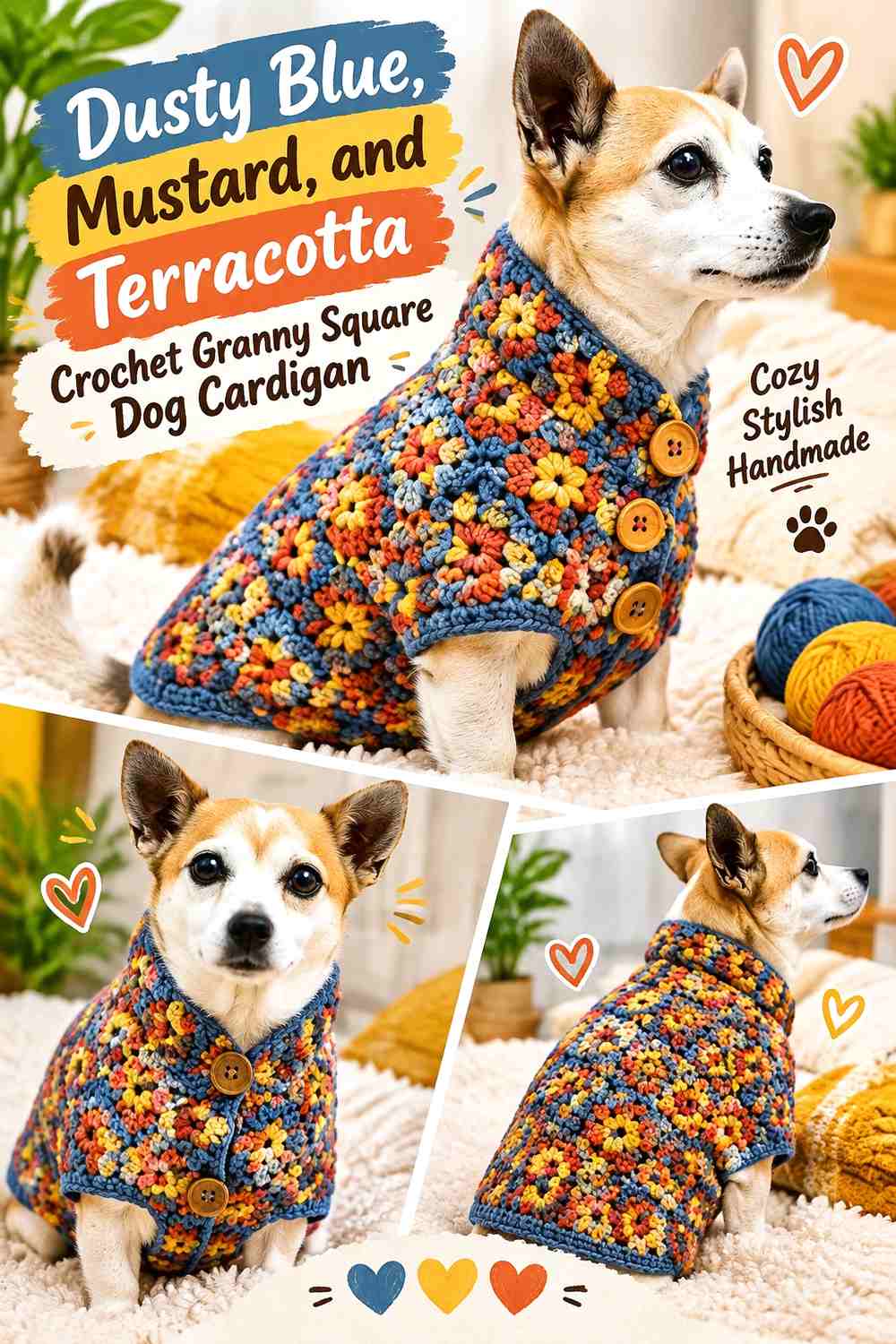
Dusty blue gives mustard and terracotta a muted cool partner, making this palette feel softer than one based on teal. The three colors can work in similar amounts only if their values remain sufficiently distinct.
Dusty Blue Can Become the Main Crochet Dog Cardigan Field
Use dusty blue through outer granny-square rounds or joins to create a restrained background. This lets mustard and terracotta provide warmth without turning every inch of the cardigan orange or yellow.
Mustard Can Lift Dusty Blue Granny Square Centers
Mustard makes a useful small focal point because it is warmer and often lighter than dusty blue. Centers, corner accents, or a narrow repeated round are enough to establish its role.
If mustard begins to dominate, reduce the number of squares containing a large mustard area rather than removing the shade completely.
Terracotta Can Connect Mustard to Dusty Blue Without Harsh Contrast
Terracotta provides a middle warm tone that is less sharp than mustard. Use it in intermediate rounds or alternate motifs.
When choosing a replacement, preserve its muted orange-red quality and compare its value with dusty blue so the two do not collapse into the same visual weight.
Creator Credit: ALEX CROCHET UNCINETTO MODERNO DI ALEX
14. Espresso, Pale Yellow, and Orange Crochet Granny Square Dog Cardigan
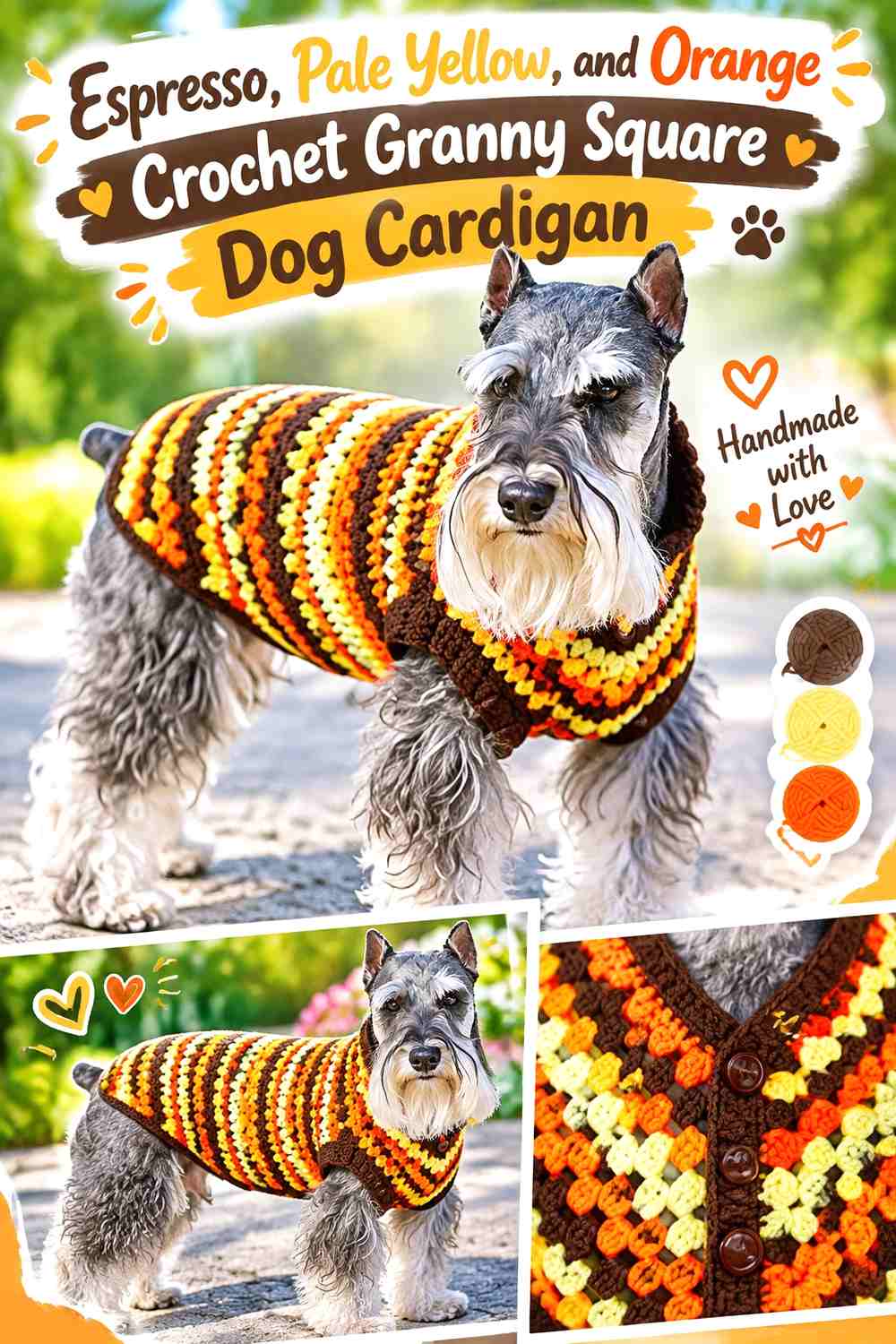
Espresso creates the strongest dark-light contrast in this collection when paired with pale yellow. Orange acts as the medium warm color and prevents the dog cardigan from looking like a simple two-tone graphic.
Espresso Can Outline the Crochet Dog Cardigan Without Filling Every Square
Use espresso for joins, square borders, neckline edging, or a narrow lower trim. These placements give the cardigan a clear silhouette while keeping the lighter colors visible across the back.
An all-over espresso field would change the balance dramatically, so decide whether you want a dark cardigan with light accents or a light cardigan with dark definition.
Pale Yellow Keeps Espresso Granny Squares Open and Readable
Pale yellow works effectively around centers or across selected larger rounds because it provides strong value contrast with espresso. It can also make small motif changes easier to notice.
Keep it away from areas most likely to show wear if that matters to your intended use; color placement should remain practical as well as decorative.
Orange Bridges Pale Yellow and Espresso Across the Dog Cardigan
Orange is the middle step between the light and dark extremes. It can fill intermediate motif rounds or repeat across every second square.
A softened orange maintains the retro direction while preventing the palette from becoming excessively high-contrast.
Creator Credit: Left Hand Crochet & Knit Tutorials
15. Raspberry, Olive, and Camel Crochet Granny Square Dog Cardigan
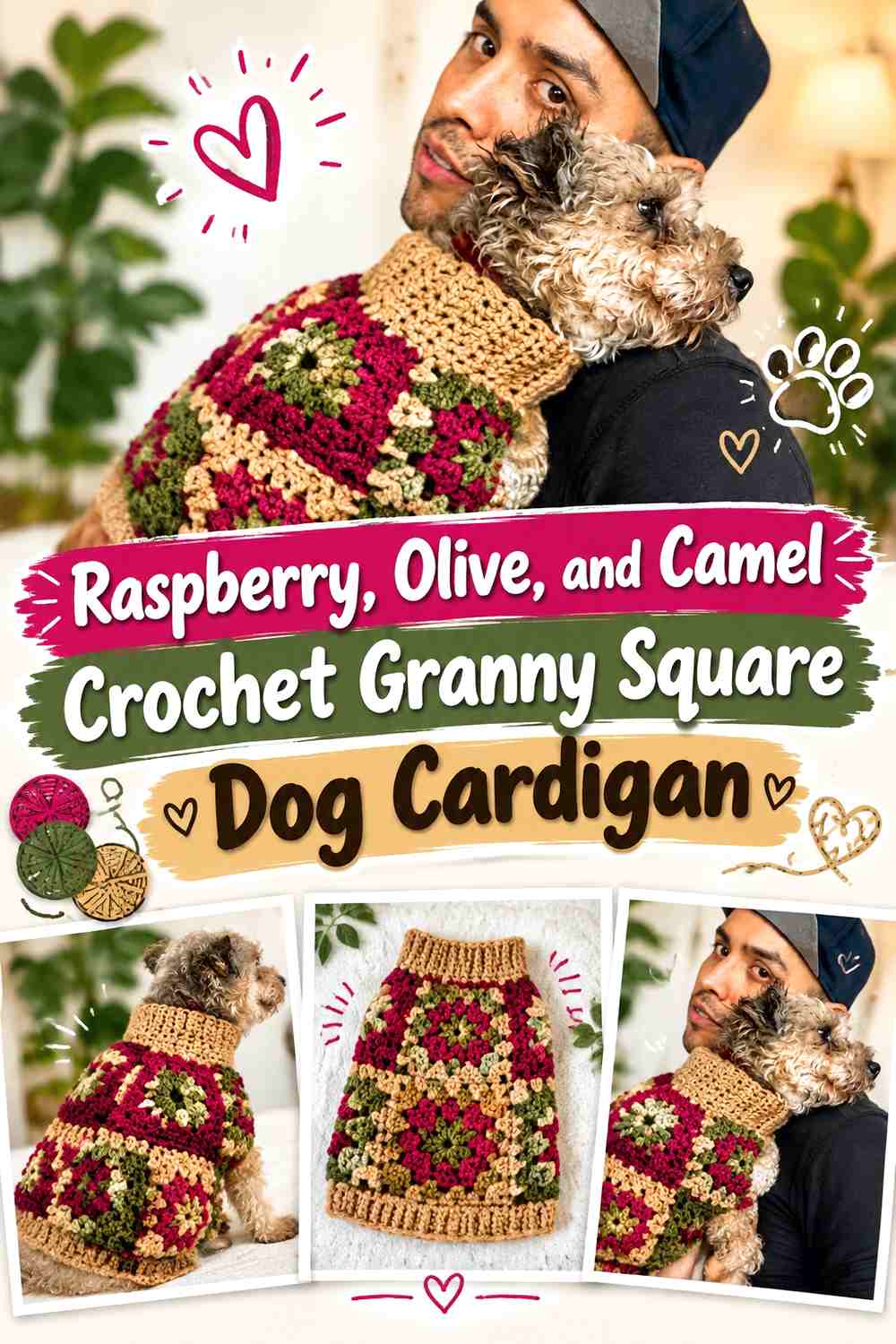
Raspberry provides a less expected retro accent while olive and camel keep it grounded. This palette works particularly well when raspberry remains concentrated instead of appearing equally across every part of the dog cardigan.
Olive Can Hold the Main Crochet Dog Cardigan Panels Together
Use olive across outer motif rounds, joins, or the largest back sections. Its muted character gives raspberry a stable background and keeps the cardigan connected visually.
Repeating olive at the garment edges can also make differently colored granny-square centers feel like part of the same set.
Raspberry Makes Olive Granny Square Centers More Distinct
Raspberry is most effective in small repeated focal areas. Try it in motif centers or one consistent internal round rather than using it for every join and border.
If your raspberry is highly saturated, reduce its coverage so it remains an accent rather than becoming the dominant color.
Camel Softens the Jump Between Raspberry and Olive
Camel can separate the two stronger hues and give the dog cardigan lighter sections around the neck, joins, or motif interiors. It is particularly useful when raspberry and olive are both relatively dark.
For substitution, preserve camel’s warm neutral role and enough lightness to maintain separation.
Creator Credit: CARLOS PERALTA
Which Retro Crochet Dog Cardigan Palette Should You Choose?
For the strongest classic 1970s direction, mustard with avocado, burnt orange with chocolate, and avocado with tangerine place familiar earthy retro shades at the center of the design.
For a cooler cardigan, teal with rust, dusty blue with terracotta, or denim blue with marigold gives the granny squares a cooler framework while keeping a warm vintage accent.
For softer contrast, olive with dusty rose or chocolate with mint and peach reduces the emphasis on strong orange-and-yellow combinations. If you prefer a darker finished garment, plum with moss, burgundy with harvest gold, or forest green with burnt orange creates more visual depth.
Whichever direction you choose, compare the full set of yarns before making all of the squares. A palette that succeeds in one motif still needs to work after the same colors are repeated across the back, neckline, joins, belly area, and edging.
Conclusion
The most successful retro crochet granny square dog cardigan palettes have a clear hierarchy. One color controls the overall garment, another supports the granny-square pattern, and the strongest accent appears often enough to connect the motifs without competing for every inch of space.
Choose mustard, avocado, rust, or burnt orange when you want an unmistakably warm retro direction. Move toward dusty blue, teal, mint, or sage when you want to cool those vintage shades down. Cream, oatmeal, tan, camel, and ivory are especially useful when two stronger colors need more separation.
Before committing to the complete cardigan, make a sample granny square and view it from farther away as well as up close. Then consider how that square will repeat across your dog’s back and how the join, neckline, leg openings, and lower edge will affect the final balance. Use the original credited tutorial for exact construction and fitting details.
Frequently Asked Questions
What colors make a crochet granny square dog cardigan look retro?
Mustard, avocado, burnt orange, rust, harvest gold, chocolate, olive, teal, dusty blue, cream, and similar muted warm or earthy shades can create a strong retro direction. You do not need to use all of them together. Two characteristic colors plus a neutral are often easier to control across a small dog garment.
How many colors should I use in a retro granny square dog cardigan?
Three colors provide enough variety for centers, outer rounds, joins, and trim without automatically making a small cardigan overly busy. More colors can work, but give them clear roles rather than using every shade in equal quantities.
Should the granny square joins match the darkest retro color?
Not necessarily. A dark join such as chocolate, forest green, or espresso strongly outlines each square. A light join such as cream or ivory makes the grid equally visible but produces a lighter effect. A join that matches the dominant motif color creates a more blended back panel.
How can I tell whether two retro yarn colors have enough contrast?
Place the yarns beside each other and compare their lightness as well as their hue. Viewing a photo in grayscale can help reveal whether two seemingly different colors have similar values. If important granny-square details disappear, introduce a lighter or darker color between them.
Where should the brightest retro color go on a dog cardigan?
Bright shades such as mustard, marigold, coral, or tangerine are often easiest to control in granny-square centers, narrow motif rounds, or repeated accents. Using the brightest color everywhere—from the centers to the joins and edging—can remove the visual hierarchy.
Can I change the colors shown in a dog sweater tutorial to a retro granny square palette?
Yes, when the construction allows color changes or compatible granny-square adaptation, but the new color plan should remain separate from the creator’s exact construction instructions. Check measurements, square dimensions, joining requirements, neckline, leg openings, and overall fit before adapting the garment.
What should I check before putting a finished granny square cardigan on my dog?
Check that the neck, chest or belly section, front-leg areas, and garment length do not restrict normal movement. Make sure yarn ends are securely finished and avoid loose decorative pieces that could be pulled or chewed. If the dog appears uncomfortable in the garment, remove it and reassess the fit.