Icy Blue and Sand Beige create a useful light, cool-and-neutral palette for a crochet cat tunnel mat. Icy Blue can make the resting surface or tunnel entrance more distinct, while Sand Beige can soften the contrast and connect the mat with neutral floors, baskets, or fabric tunnels.

A cat tunnel mat has different visual priorities from a standard rug. Much of the center may disappear beneath or inside the tunnel, while the sections at each opening can remain visible all day. That makes entrance bands, exposed ends, side edges, and borders particularly useful places for intentional color contrast.
Shape matters too. A narrow rectangular mat can run beneath a long tunnel, an oval can soften the area around an opening, and a round pad can work as a landing or resting zone at one end. The tutorials linked below include pet mats, a direct crochet cat tunnel, and flat crochet rug constructions that can be adapted to this use. The Icy Blue and Sand Beige palettes are independent editorial adaptations rather than claims about the creators’ original color choices.
Quick List
- Icy Blue Field With Sand Beige Entrance Band Crochet Cat Tunnel Mat
- Sand Beige Field With Icy Blue Center Track Crochet Cat Tunnel Mat
- Icy Blue and Sand Beige Lengthwise Split Crochet Cat Tunnel Mat
- Icy Blue and Sand Beige Broad-Stripe Crochet Cat Tunnel Mat
- Icy Blue Basketweave With Sand Beige Flat Edge Crochet Cat Tunnel Mat
- Sand Beige Moss-Stitch With Icy Blue Frame Crochet Cat Tunnel Mat
- Icy Blue Oval With Sand Beige Perimeter Crochet Cat Tunnel Mat
- Sand Beige Round Entry Pad With Icy Blue Center Crochet Cat Tunnel Mat
- Icy Blue Corners With Sand Beige Center Crochet Cat Tunnel Mat
- Icy Blue Center With Sand Beige Rectangular Border Crochet Cat Tunnel Mat
- Icy Blue and Sand Beige Double-End Color-Block Crochet Cat Tunnel Mat
- Icy Blue and Sand Beige Concentric Round Crochet Cat Tunnel Mat
- Icy Blue and Sand Beige Diagonal C2C Crochet Cat Tunnel Mat
- Icy Blue Field With Sand Beige Textured Bars Crochet Cat Tunnel Mat
Plan Icy Blue and Sand Beige Around the Cat Tunnel Openings
Before choosing a color layout, place the tunnel where it will normally sit and notice which sections of the mat remain visible. If most of the center disappears under the tunnel, detailed colorwork there has much less visual impact than a contrasting section near an entrance.
Icy Blue can work well at an opening because the cooler shade separates readily from many beige, tan, brown, or natural-looking tunnel fabrics. Sand Beige can do the opposite when the tunnel itself is blue or dark.
For a tunnel with two open ends, repeat at least one palette color at both entrances. That repetition keeps the mat visually connected even when the tunnel hides the middle.
Compare Icy Blue and Sand Beige Before Using Small Details
Icy Blue and Sand Beige are different hues, but their lightness may still be similar. If both yarns are pale, narrow stripes or small motifs can merge once worked into crochet.
Place the yarns together and look at them from a distance. A grayscale photo can also show whether there is enough value contrast for a narrow Sand Beige line to remain visible against Icy Blue.
Stronger separation matters most for thin borders, stripes, geometric blocks, and entry bands. Broad color fields can tolerate a softer value difference because their shape remains easier to see.
Keep Icy Blue and Sand Beige Tunnel Mats Low Profile
A mat positioned inside or beneath a tunnel should not add unnecessary bulk. Thick raised stitches can reduce interior space or create an uneven surface beneath a lightweight fabric tunnel.
Avoid long fringe, tassels, loose loops, or poorly secured decorative pieces where claws, collars, or tags could catch. Integrated color blocking is a better way to add interest to a pet mat.
Measure the actual tunnel footprint before adapting a rug or pet-mat tutorial. The original construction can guide the crochet technique, but the finished mat should be sized for the tunnel and its intended placement rather than copied blindly.
1. Icy Blue Field With Sand Beige Entrance Band Crochet Cat Tunnel Mat

Let Icy Blue cover most of the rectangular resting surface and reserve Sand Beige for a broad section at the tunnel entrance. This keeps the cool color dominant while giving the part that remains most visible a warmer neutral break.
The entrance band can also help the mat look intentional when the tunnel covers most of the blue center. If both ends of the tunnel are commonly visible, repeat a smaller Sand Beige section at the opposite opening.
Icy Blue Should Cover the Main Cat Tunnel Resting Zone
Keep the longest uninterrupted portion Icy Blue so the mat has one clear dominant shade.
A single field is especially useful under a tunnel because much of it will already be visually broken up by the tunnel itself. Extra small color changes through the hidden center add complexity without much payoff.
Sand Beige Can Make the Icy Blue Tunnel Entrance Easier to See
Place Sand Beige where the mat first emerges from beneath the tunnel.
The warmer neutral creates a defined landing area without taking over the entire project. Make the band wide enough to look purposeful rather than like an accidental final color change.
Sand Beige Can Repeat at the Far End of the Icy Blue Tunnel Mat
If both tunnel openings are exposed, a second Sand Beige section can visually connect them.
The two bands do not have to occupy equal amounts of space, but repetition prevents one end from looking unrelated to the rest of the mat.
Creator Credit: First The Coffee Crochet
2. Sand Beige Field With Icy Blue Center Track Crochet Cat Tunnel Mat

Reverse the hierarchy by giving Sand Beige most of the surface and running Icy Blue lengthwise through the middle. The blue track remains visible through the tunnel openings and visually leads into the tunnel instead of stopping across its width.
This layout is particularly useful when the sides of the mat extend beyond a narrow tunnel because Sand Beige remains visible around the outside while Icy Blue concentrates directly beneath the tunnel path.
Icy Blue Can Create a Visual Path Through the Sand Beige Tunnel Mat
Run Icy Blue from one entrance toward the other instead of placing it only in the middle.
A continuous blue section makes more sense for a long tunnel than an isolated center patch because the color follows the direction of movement through the space.
Sand Beige Should Remain Wide Enough Beside the Icy Blue Track
Allow enough Sand Beige to show along both sides when the tunnel is in position.
If the tunnel covers the entire beige area, the project will appear almost completely blue during use and lose the intended two-color relationship.
Icy Blue at Both Openings Keeps the Sand Beige Tunnel Mat Connected
Let at least a little of the center track extend beyond each entrance.
That small visible repeat helps viewers understand that the blue continues through the tunnel rather than existing as two unrelated end details.
Creator Credit: Sim von Kraft
3. Icy Blue and Sand Beige Lengthwise Split Crochet Cat Tunnel Mat
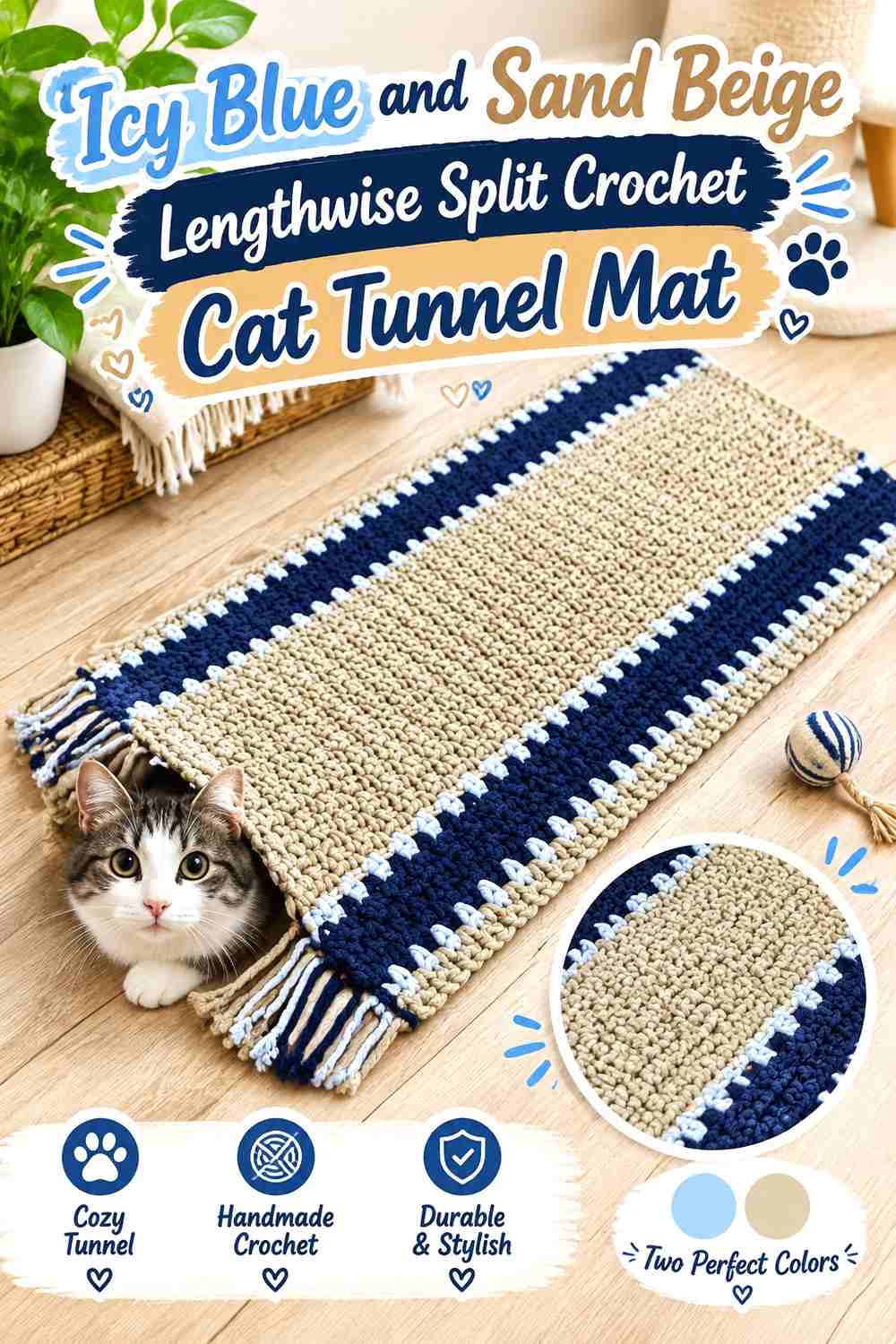
Divide the mat lengthwise so Icy Blue occupies one side and Sand Beige the other. This creates a strong two-color treatment without requiring stripes, motifs, or a contrasting border.
The split is most effective when some of the mat remains visible along both sides of the tunnel. If the tunnel covers the entire width, only the color at each exposed end may be noticeable.
Icy Blue Needs Enough Width Beside Sand Beige to Read as an Equal Block
Avoid reducing Icy Blue to a narrow strip if the design is intended to look deliberately divided.
Large sections allow the color relationship to remain readable even when part of the mat is hidden under the tunnel.
Sand Beige Should Meet Icy Blue Along a Clean Lengthwise Boundary
Keep the color change visually consistent from one end to the other.
A straight division emphasizes the long tunnel shape and prevents the mat from looking as though the yarn was changed randomly midway through the project.
Icy Blue and Sand Beige Can Swap Sides at a Second Tunnel Mat
If you are making more than one mat for different tunnels or rooms, reversing the sides creates a related variation without adding new colors.
Preserve the same approximate color roles so the pair still looks coordinated.
Creator Credit: Marcelo Nunes Croche
4. Icy Blue and Sand Beige Broad-Stripe Crochet Cat Tunnel Mat

Broad stripes distribute both colors across the full length of the mat, making the palette more likely to remain visible regardless of where the tunnel sits.
Use wider sections rather than numerous narrow stripes. A tunnel already creates a strong visual interruption, so the mat does not need a high-frequency pattern underneath it.
Icy Blue Stripes Should Remain Wide Enough to Show Beyond the Tunnel
Plan at least some blue sections near the entrances rather than concentrating all Icy Blue in the hidden center.
A broad stripe can remain recognizable even when only part of it extends from beneath the tunnel.
Sand Beige Should Give the Icy Blue Stripes Visual Rest
Use Sand Beige between blue sections to create a quieter interval.
If Icy Blue is the stronger or darker shade, Sand Beige can occupy slightly more surface without making the palette feel beige-dominant.
Icy Blue and Sand Beige Stripe Placement Should Match the Tunnel Length
Sketch the tunnel footprint over the planned stripe arrangement before crocheting.
If every color transition falls beneath the tunnel, the exposed ends may each look nearly solid and the striped concept will be lost during use.
Creator Credit: Maruti Crochet Art
5. Icy Blue Basketweave With Sand Beige Flat Edge Crochet Cat Tunnel Mat

Use basketweave texture through an Icy Blue central panel and keep Sand Beige around the perimeter in a flatter treatment. The contrast between textured center and simpler edge adds interest without depending on several colors.
This option needs more attention to thickness than a plain pet mat. If the mat will go inside the tunnel rather than beneath it, check that the texture does not make the interior uncomfortably bulky.
Icy Blue Can Keep Basketweave Texture Visually Unified
Work most of the raised surface in Icy Blue instead of alternating colors through every block.
A single color lets the basket-like structure provide the pattern while the Sand Beige edge remains easy to identify.
Sand Beige Can Keep the Icy Blue Basketweave Edge Visually Calm
Use Sand Beige around the flatter perimeter so the border does not compete with the textured center.
This is especially useful at the entrance, where a simple light edge can remain visible after the tunnel covers much of the basketweave section.
Icy Blue Basketweave Should Not Overfill a Sand Beige Tunnel Opening
Compare the finished texture depth with the actual tunnel clearance.
If the raised fabric takes up too much interior room, use the construction as an under-tunnel mat instead of forcing a thick panel inside a narrow tunnel.
Creator Credit: Life and Yarn
6. Sand Beige Moss-Stitch With Icy Blue Frame Crochet Cat Tunnel Mat
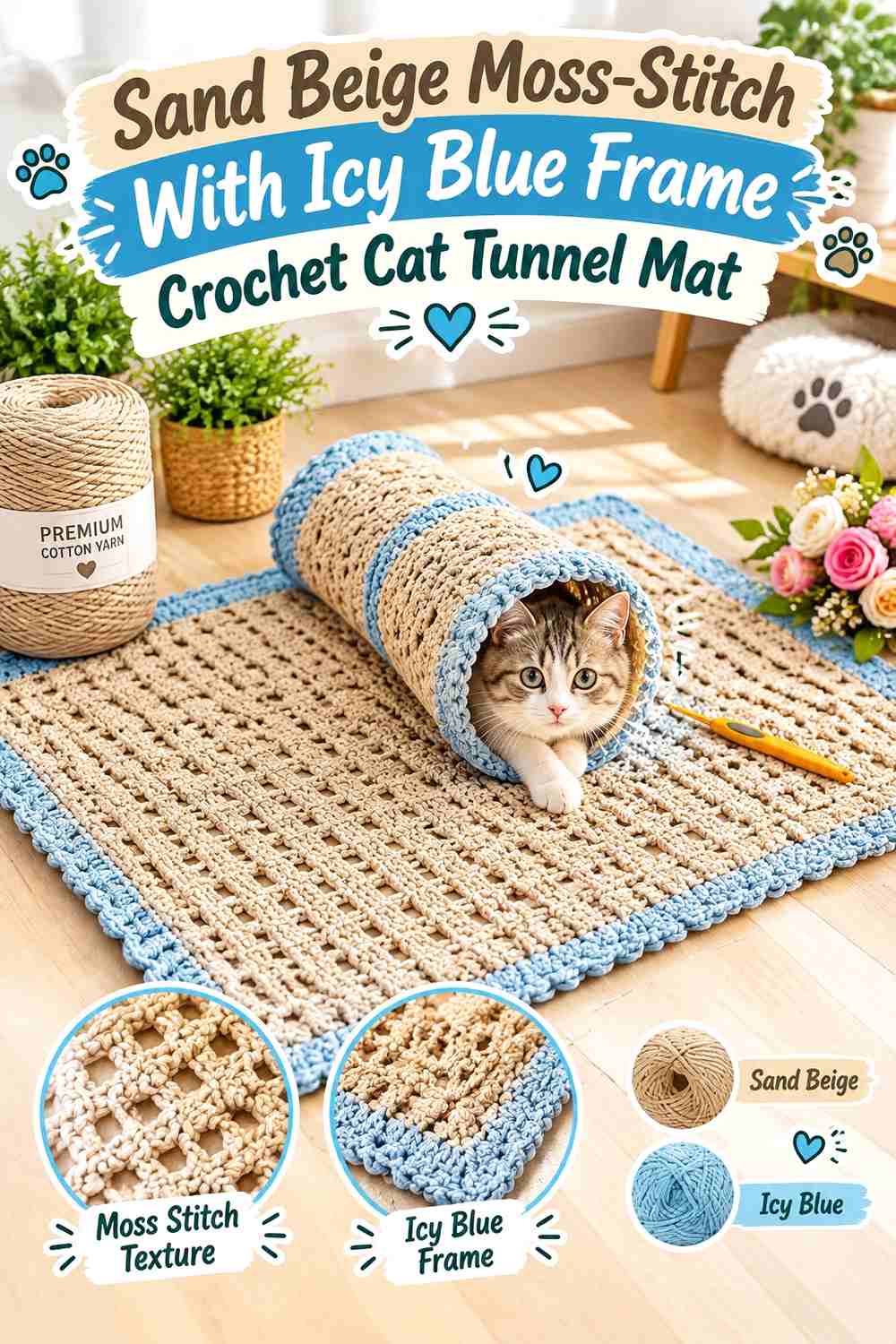
Moss stitch gives the Sand Beige field a small, consistent texture while Icy Blue creates a clear outer frame. The combination works well when you want a visually quiet resting surface with a stronger colored boundary.
The blue frame is particularly useful if the mat sits on a pale floor where Sand Beige alone would have little separation.
Sand Beige Can Keep the Moss-Stitch Tunnel Mat Visually Soft
Use Sand Beige across most of the interior field rather than introducing frequent blue changes.
The subtle stitch pattern provides enough surface variation without turning the tunnel mat into a busy striped piece.
Icy Blue Can Separate the Sand Beige Mat From a Light Floor
Run Icy Blue around the perimeter when the surrounding floor, rug, or tunnel is beige, cream, or another pale neutral.
A darker or clearer blue outline can make the mat edge easier to distinguish without changing the calm center.
Icy Blue Should Remain Visible at the Sand Beige Tunnel Entrances
Carry the border continuously across the exposed ends.
If the tunnel covers the side borders, the entrance edge may be the only place where Icy Blue remains obvious during everyday use.
Creator Credit: Mary Souza crochê
7. Icy Blue Oval With Sand Beige Perimeter Crochet Cat Tunnel Mat
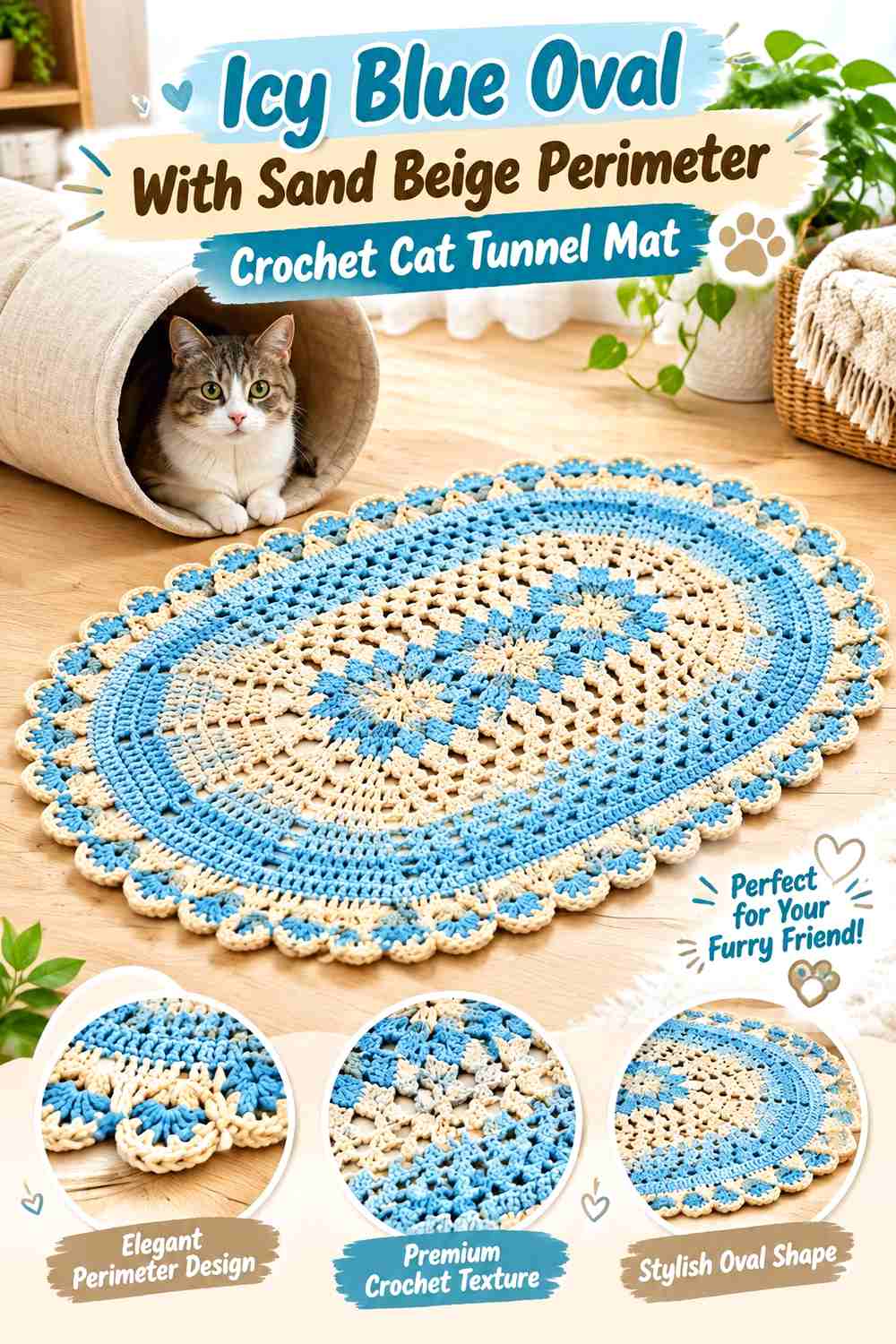
An oval works well as a pad at one tunnel opening or beneath a shorter curved tunnel. Make the center Icy Blue and use Sand Beige around the expanding outer edge.
Unlike a long rectangle, an oval draws attention outward from the tunnel mouth, making it useful when the mat doubles as an exposed lounging area.
Icy Blue Can Give the Oval Tunnel Mat a Clear Resting Center
Keep most of the inner oval Icy Blue so the visible resting area has one dominant shade.
If the tunnel overlaps one end, enough blue should remain uncovered to preserve the central color field.
Sand Beige Can Soften the Icy Blue Oval Perimeter
Use Sand Beige in the outer rounds to move gradually from the cool center toward a warmer neutral edge.
The perimeter treatment is particularly visible on an oval because the border follows the entire curved outline rather than disappearing into straight side seams.
Sand Beige Should Stay Proportional to the Icy Blue Oval Center
Avoid expanding the neutral border until it becomes larger than the blue field unless a Sand Beige-dominant result is intentional.
A moderate edge keeps the mat recognizably Icy Blue-led.
Creator Credit: Croche com Maria Silva
8. Sand Beige Round Entry Pad With Icy Blue Center Crochet Cat Tunnel Mat
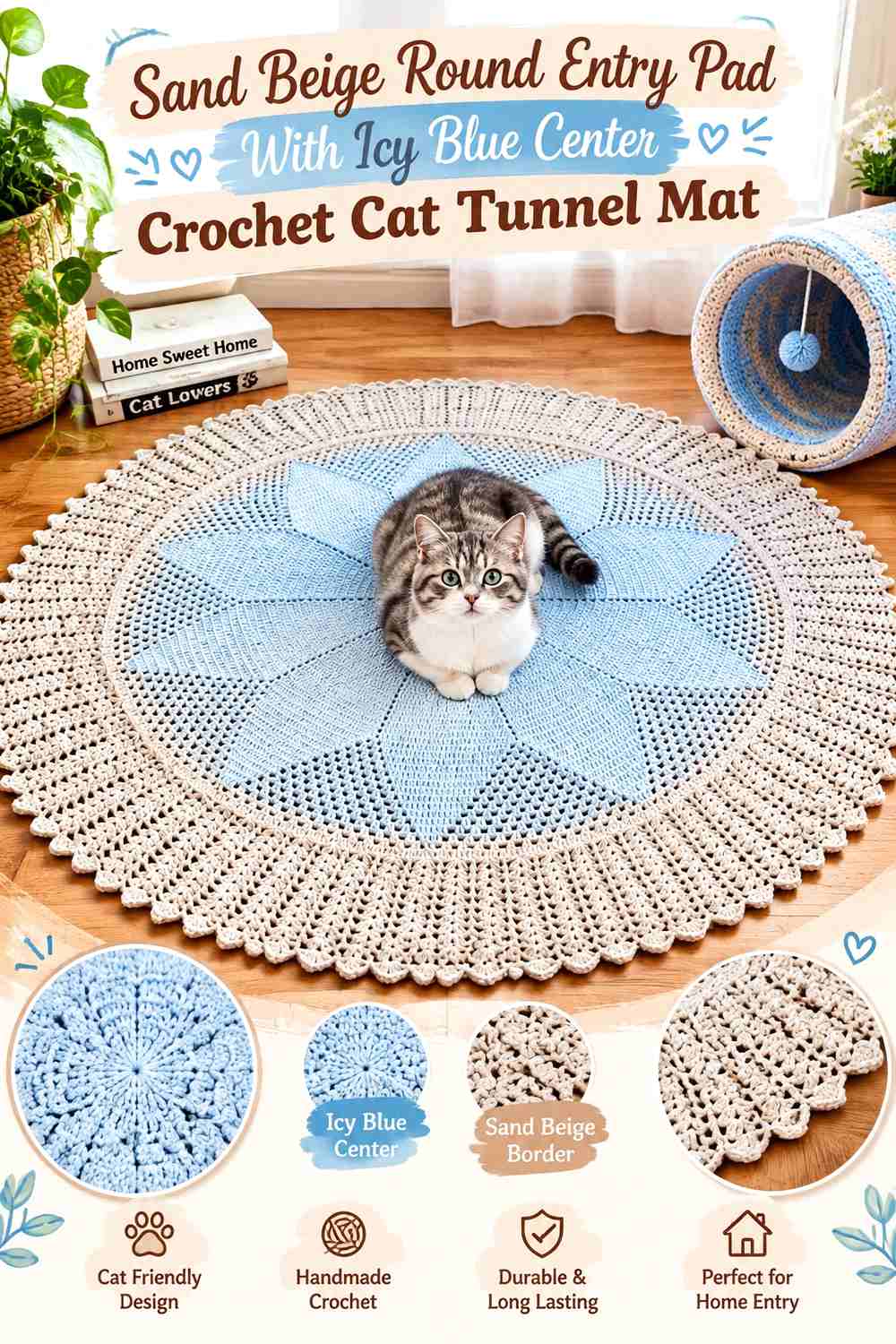
Use a round mat as a landing zone immediately outside one tunnel opening. Sand Beige can form most of the outer circle while Icy Blue creates a defined central area aligned with the tunnel entrance.
This idea is less about running under the whole tunnel and more about giving one end a coordinated resting pad.
Icy Blue Can Mark the Center of a Sand Beige Tunnel Entry Pad
Place Icy Blue where the cat first steps or settles after leaving the tunnel.
The center color provides a strong focal point without requiring motifs or appliqués that could complicate the pet surface.
Sand Beige Can Extend the Icy Blue Pad Beyond the Tunnel Mouth
Use Sand Beige through the wider outer rounds to create more visual space around the smaller blue center.
A broad neutral perimeter makes the pad easier to coordinate with natural-looking tunnel fabric while preserving the cool center.
Icy Blue Should Stay Visible When the Sand Beige Pad Meets the Tunnel
Position the tunnel so it does not cover the entire blue area.
Leaving part of Icy Blue exposed ensures the palette still reads as two-color instead of becoming a Sand Beige circle with hidden detail.
Creator Credit: Ateliê Isabela Fernanda
9. Icy Blue Corners With Sand Beige Center Crochet Cat Tunnel Mat
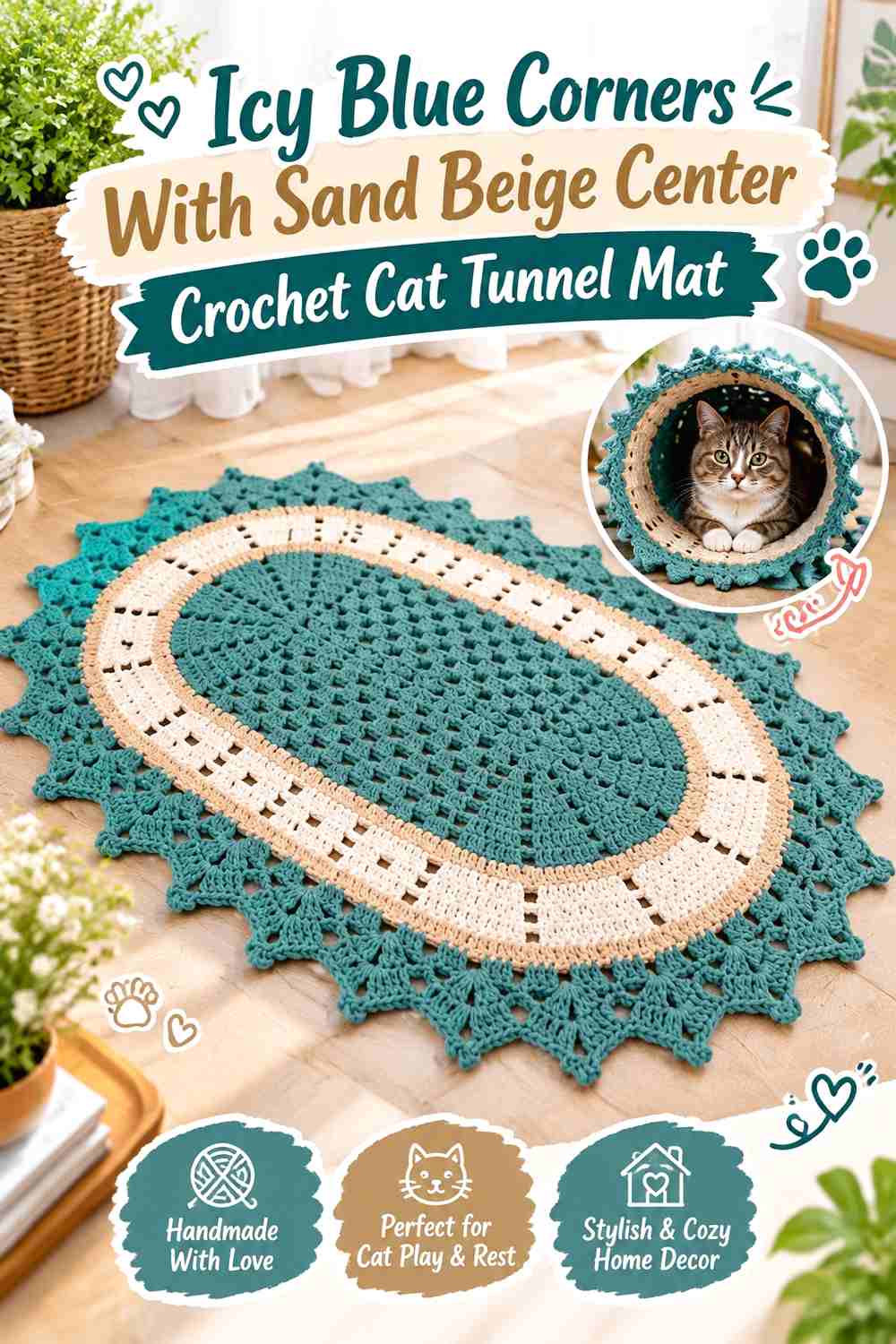
Let Sand Beige dominate the center while Icy Blue appears at the four corners or in clearly defined corner sections. This keeps the main resting surface neutral but places the cooler shade in areas that can remain visible around the tunnel footprint.
Front corners are especially useful because a tunnel often leaves them exposed even when it covers most of the mat.
Sand Beige Should Keep the Cat Tunnel Mat Center Uninterrupted
Use Sand Beige through the broad central section so the mat does not become fragmented by too many small color changes.
A simple center also makes the blue corners look deliberate rather than incidental.
Icy Blue Front Corners Can Frame the Sand Beige Tunnel Entrance
Place Icy Blue where the front corners remain visible on either side of the tunnel mouth.
The two blue areas act as visual brackets and help define where the Sand Beige mat begins.
Icy Blue Rear Corners Can Repeat the Sand Beige Entrance Treatment
If the far end of the tunnel is also visible, repeat the blue corner idea there.
If the tunnel sits against a wall and hides the rear completely, concentrating Icy Blue at the front may provide more practical visual value.
Creator Credit: janine freitas
10. Icy Blue Center With Sand Beige Rectangular Border Crochet Cat Tunnel Mat
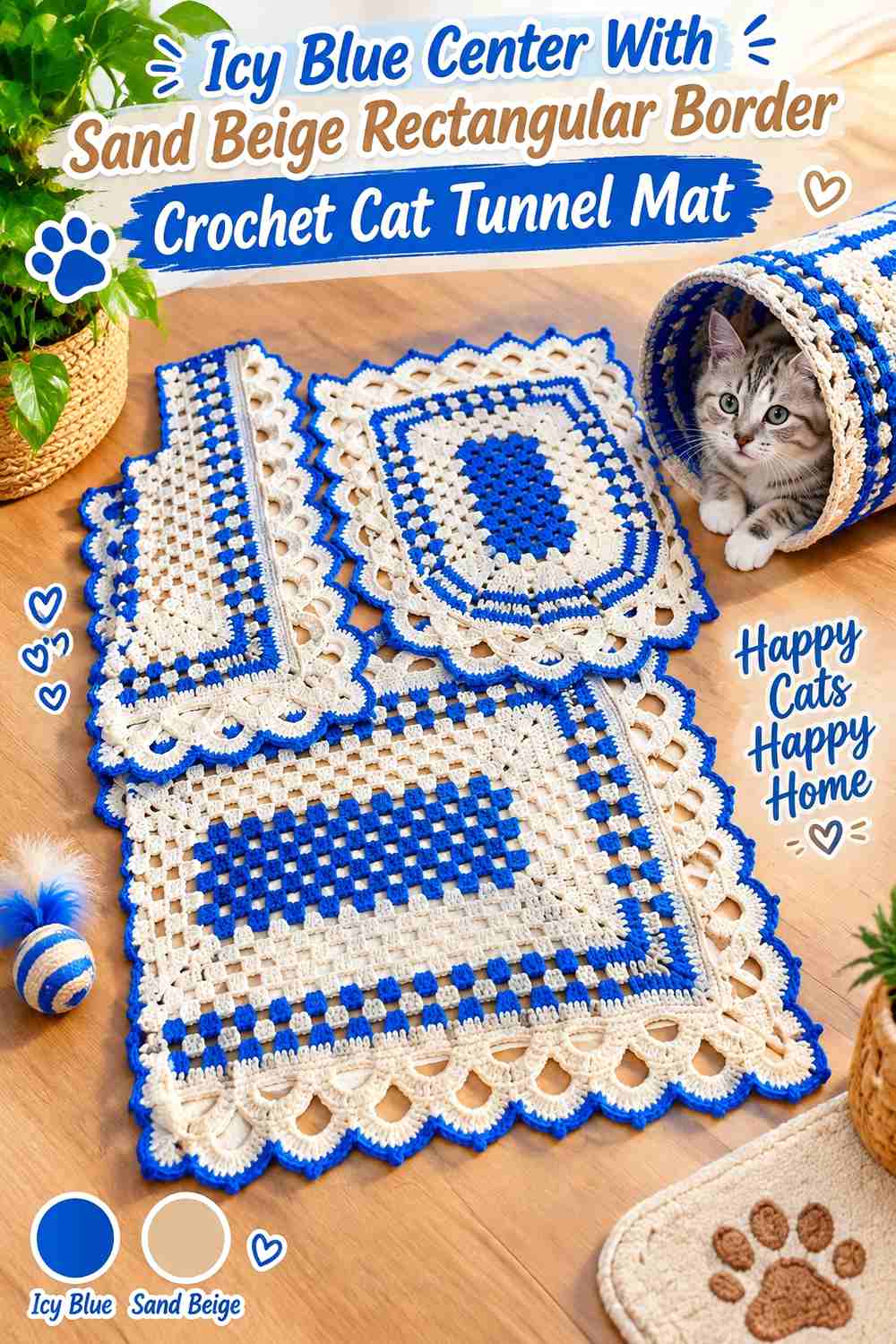
This framed layout puts Icy Blue in a large central rectangle and Sand Beige around all four sides. It works well beneath a straight tunnel when you want a neutral outline visible beyond the tunnel footprint.
The width of the border matters. If it is too narrow, the tunnel may cover it completely; if it is too wide, Sand Beige can become the real dominant shade.
Icy Blue Should Stay Large Enough Inside the Sand Beige Frame
Protect the central blue field by planning the border only after considering the tunnel width.
You want enough Icy Blue to remain visible through or beyond the openings instead of reducing it to a hidden interior block.
Sand Beige Can Outline the Icy Blue Tunnel Footprint
A neutral frame works especially well when the tunnel itself is darker than the mat.
The beige edge creates separation between the blue resting field and surrounding floor without adding a third color.
Sand Beige at the Short Ends Can Keep Icy Blue Connected to Both Openings
Make sure the frame continues across the entrance and exit edges.
Those short sections often stay visible even when the long side borders disappear beneath the tunnel.
Creator Credit: Crochê da Alessandra
11. Icy Blue and Sand Beige Double-End Color-Block Crochet Cat Tunnel Mat
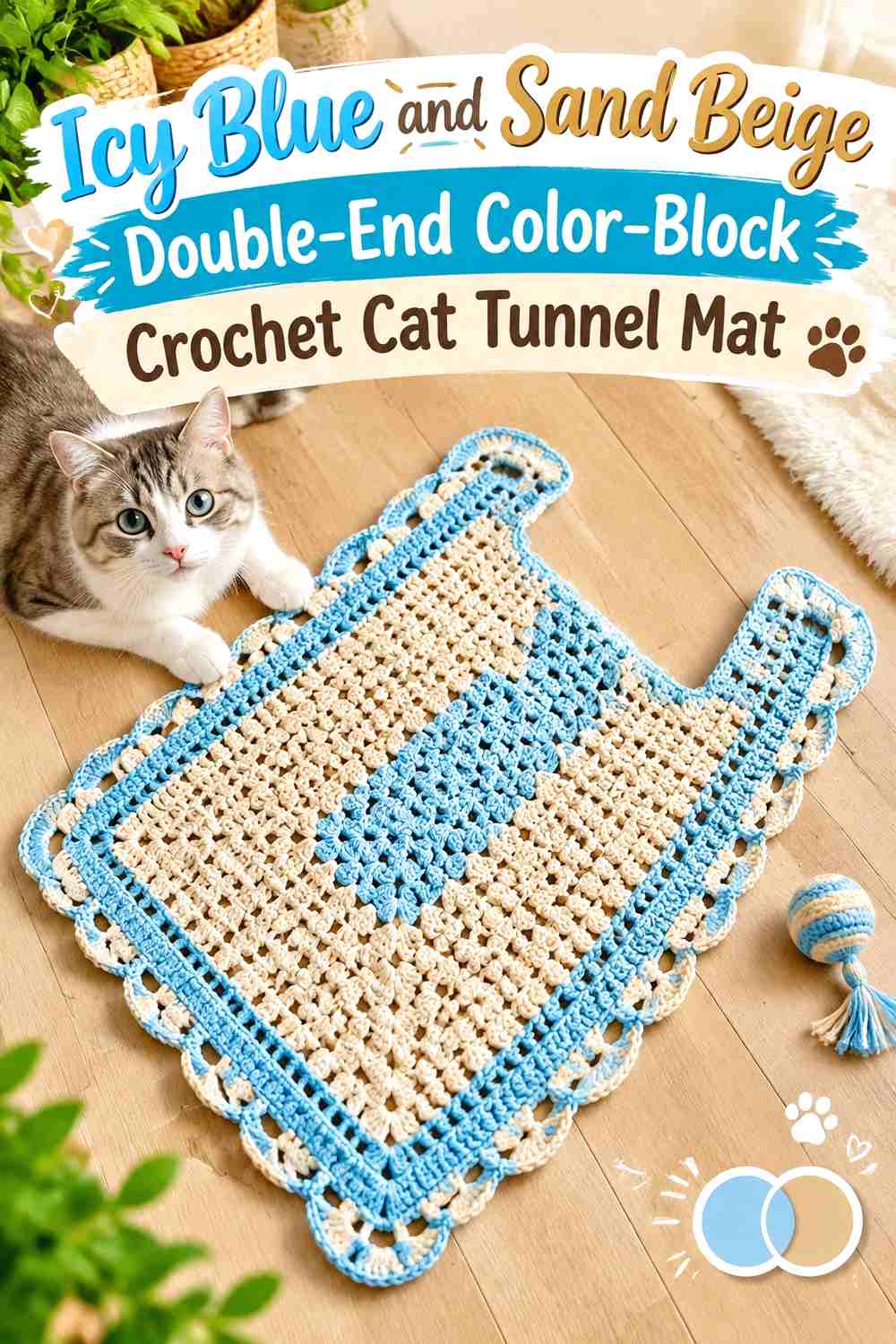
Place a large Icy Blue block at one end, Sand Beige through the center, and another Icy Blue block at the opposite end. This puts the strongest cool color exactly where a two-ended tunnel is most likely to leave the mat exposed.
The central Sand Beige section can remain mostly hidden beneath the tunnel without weakening the visible palette.
Icy Blue End Blocks Can Define Both Sand Beige Tunnel Openings
Use similarly sized blue sections at each end when the tunnel is viewed from both directions.
Repeated color gives the mat visual symmetry without requiring a complex stitch pattern.
Sand Beige Can Stay Quiet Beneath the Icy Blue-Ended Tunnel
Let the neutral run through the middle where the tunnel covers most of the surface.
This is a practical example of putting the less visually important color transition in the least visible area.
Icy Blue Blocks Should Extend Beyond the Sand Beige Tunnel Footprint
Measure how far the tunnel reaches before deciding where the blue starts.
If most of each Icy Blue block disappears underneath, move the transition farther outward so the intended entrance treatment remains visible.
Creator Credit: Paula Brito feat Heco Ateliê
12. Icy Blue and Sand Beige Concentric Round Crochet Cat Tunnel Mat

For a tunnel opening that benefits from a round landing pad, alternate larger concentric areas of Icy Blue and Sand Beige. Keep the changes broad so the mat does not become a collection of narrow rings.
This arrangement allows both colors to remain visible from almost every viewing angle.
Icy Blue Can Anchor the Center of a Sand Beige Round Tunnel Mat
Start with an Icy Blue central area when you want the cool shade to line up directly with the tunnel opening.
The blue center can then remain partially visible even if the tunnel overlaps one side of the round mat.
Sand Beige Rings Can Expand the Icy Blue Resting Area Visually
Use Sand Beige in a substantial outer section rather than a very thin line.
A broader neutral ring gives the round shape definition and prevents the entire pad from reading as one solid blue circle.
Icy Blue Can Return at the Sand Beige Outer Edge
If you want stronger perimeter definition, repeat a controlled amount of Icy Blue at the final edge.
Keep that return narrow enough that it frames rather than overwhelms the Sand Beige ring.
Creator Credit: Meladora’s Creations for Crochet
13. Icy Blue and Sand Beige Diagonal C2C Crochet Cat Tunnel Mat

A corner-to-corner construction gives the two colors a diagonal relationship across a rectangular mat. Icy Blue can occupy one large corner while Sand Beige takes the opposite side.
The diagonal remains useful even when the tunnel hides the middle because different colors can still appear at opposite exposed ends.
Icy Blue Can Occupy One Large Corner Against Sand Beige
Give the blue enough blocks to create a substantial section rather than a narrow triangular accent.
A large diagonal field remains recognizable from outside the tunnel and makes the C2C geometry easier to read.
Sand Beige Should Balance the Icy Blue C2C Section Without Too Many Extra Colors
Keep the second half Sand Beige if the goal is a clean two-color project.
The C2C structure already creates plenty of visual movement, so a multicolor leftover-yarn treatment is not necessary for this adaptation.
Icy Blue and Sand Beige Should Reach Opposite Tunnel Openings
Plan the diagonal orientation so each entrance reveals a different balance of the two colors.
That gives the mat a more noticeable directional change than placing the diagonal entirely underneath the tunnel.
Creator Credit: Blog do crochê
14. Icy Blue Field With Sand Beige Textured Bars Crochet Cat Tunnel Mat

Finish with a largely Icy Blue rectangular mat interrupted by a few broad Sand Beige bars. The bars can sit near the openings or other exposed sections instead of repeating constantly through the hidden center.
This gives you a textured, graphic treatment while keeping the palette simple enough for a narrow tunnel area.
Icy Blue Should Remain the Main Surface Between Sand Beige Bars
Give Icy Blue more uninterrupted area than the accent color.
That preserves a clear hierarchy and prevents the rectangular mat from turning into an equal-width stripe pattern.
Sand Beige Bars Can Mark the Icy Blue Tunnel Entry Zones
Place one broad Sand Beige section near each tunnel opening.
The repeated neutral areas help define where the covered tunnel ends and the exposed mat begins.
Sand Beige Texture Should Stay Low Against the Icy Blue Field
If the bars use a different stitch or thicker material treatment, check their height carefully.
A tunnel mat benefits from a reasonably even surface, especially when a lightweight tunnel rests directly on top of it.
Creator Credit: Mariela Caramela
Comparing the 14 Icy Blue and Sand Beige Cat Tunnel Mat Ideas
For the most straightforward rectangular tunnel setup, the Icy Blue Field With Sand Beige Entrance Band and Sand Beige Field With Icy Blue Center Track ideas give each color a clear job without adding complicated patterning.
If both tunnel openings remain visible, the Double-End Color-Block and Broad-Stripe versions keep color at both ends instead of hiding the strongest contrast beneath the tunnel.
For more texture, the Icy Blue Basketweave and Sand Beige Moss-Stitch ideas make the crochet surface part of the visual design. Basketweave creates stronger relief, while moss stitch offers a more restrained texture.
For a separate landing area at the tunnel mouth, choose the Icy Blue Oval, Sand Beige Round Entry Pad, or Concentric Round version. These shapes work better when the mat extends outside the tunnel rather than running beneath its full length.
For stronger geometry, the Lengthwise Split, Rectangular Frame, and Diagonal C2C arrangements create larger blocks that remain easier to recognize than very small motifs in a partially covered pet mat.
Conclusion
Icy Blue and Sand Beige work well for a crochet cat tunnel mat because the two colors can divide the hidden and exposed portions of the project without requiring a busy palette.
Use Icy Blue across the main field when you want a cooler, clearer focal color, then position Sand Beige at entrances, borders, or side areas that remain visible around the tunnel. Reverse the hierarchy when a neutral mat suits the surrounding room better and you want Icy Blue to guide the eye through the tunnel opening.
Rectangular arrangements make sense beneath long tunnels, while oval and round variations can create more defined resting zones outside an entrance. Texture can add interest, but keep the finished mat appropriately flat for the available tunnel space and the individual cat.
Use each credited tutorial for its original construction method, stitch guidance, and shaping, then adapt the Icy Blue and Sand Beige placement to your tunnel’s actual footprint and the portions of the mat that remain visible during use.
Frequently Asked Questions
Should Icy Blue or Sand Beige dominate a crochet cat tunnel mat?
Either can lead. Icy Blue works well as the larger field when you want the mat to have a cooler visual identity, while Sand Beige makes a quieter neutral base. Choose the dominant shade according to which parts of the mat will remain visible around the tunnel.
Where should Sand Beige go on a mostly Icy Blue tunnel mat?
Entrance bands, borders, exposed ends, and side edges are particularly useful. These areas are more likely to remain visible than the center beneath the tunnel, so Sand Beige contributes more to the finished appearance there.
How can I keep Icy Blue and Sand Beige visible under a long cat tunnel?
Repeat the colors near both ends rather than concentrating all contrast in the middle. Double-end blocks, broad stripes, or a center track that extends beyond both openings can preserve the palette after the tunnel is placed on top.
Is a textured Icy Blue and Sand Beige mat suitable inside a cat tunnel?
It depends on the texture and tunnel clearance. A shallow stitch texture may work, while thick raised crochet can reduce usable interior space. Check the finished surface against the actual tunnel and your cat’s preferences before choosing a highly dimensional stitch.
Is a rectangular or round Icy Blue and Sand Beige tunnel mat more useful?
A rectangle generally fits beneath a long straight tunnel more efficiently. A round or oval mat can work better as a landing or lounging pad outside an entrance. Choose the shape according to where the mat will sit rather than color alone.
How do I check whether Icy Blue and Sand Beige have enough contrast?
Place the yarns side by side and look at them from a distance. You can also photograph them in grayscale. If they appear almost identical in lightness, use broader color blocks or choose a lighter or darker version of one shade for small details.
Can I substitute different shades for Icy Blue and Sand Beige?
Yes. Preserve the relationship rather than searching for exact commercial color names. Choose a cool light-to-medium blue for the Icy Blue role and a warm, muted beige for the Sand Beige role, then make sure the amount of light-and-dark contrast still supports your planned borders, stripes, or blocks.