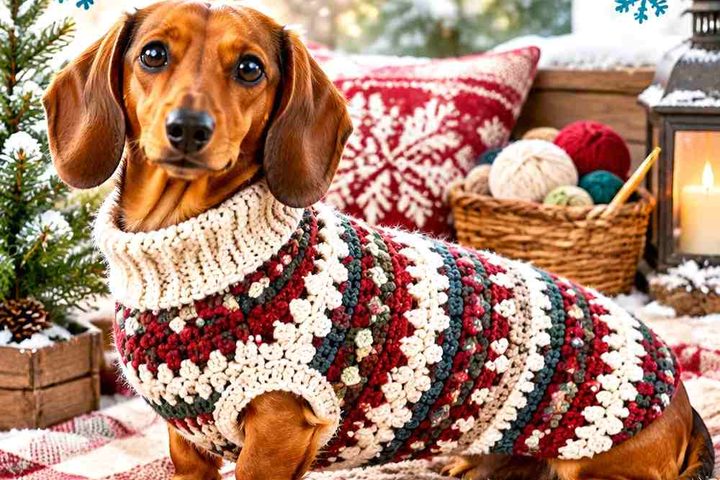
Forest green and camel brown are especially useful on a crochet cable stitch dog coat because they can divide texture from structure. Forest green is dark enough to give raised cables a consistent background, while camel brown can identify collars, hems, side straps, chest sections, and other flatter areas without constantly interrupting the cable relief.

The back is usually the most important color zone on a cable coat. Keeping that surface largely forest green allows shadows around post stitches and raised cable crossings to remain visible. Camel brown then works best where the garment naturally changes direction: around the neckline, along the lower edge, beside a cable panel, or on a separate fastening section.
One verified tutorial below specifically demonstrates a crochet cable dog sweater; the other credited tutorials support dog-sweater or dog-coat construction that can serve as a base only when you already know how to incorporate an independent cable treatment without compromising fit.
Quick List:
- Forest Green Central Cable and Camel Brown Collar Crochet Dog Coat
- Forest Green Twin-Cable and Camel Brown Edge Crochet Dog Coat
- Forest Green Cable Back and Camel Brown Belly-Strap Crochet Dog Coat
- Forest Green Cable Panel and Camel Brown Side-Panel Crochet Dog Coat
- Forest Green Cable Coat With Camel Brown Turtleneck
- Forest Green Wide-Cable and Camel Brown Hem Crochet Dog Coat
- Forest Green Diamond-Cable and Camel Brown Collar Crochet Dog Coat
- Forest Green Cable Yoke and Camel Brown Lower-Body Crochet Dog Coat
- Forest Green Cable Coat With Camel Brown Leg-Opening Trim
- Forest Green Cable Back With Camel Brown Button-Flap Crochet Dog Coat
- Forest Green and Camel Brown Framed-Cable Crochet Dog Coat
- Forest Green Cable Coat With Camel Brown Shoulder Accents
- Forest Green Textured Cable and Camel Brown Chest Crochet Dog Coat
- Forest Green Cable Coat With Camel Brown Collar-and-Hem Frame
- Forest Green and Camel Brown Split-Panel Cable Crochet Dog Coat
Let Forest Green Carry Most of the Crochet Cable Texture
Raised crochet cables already create substantial visual activity. Keeping the cable section forest green gives the eye one consistent color field in which to read the crossings, vertical lines, and shadows. Switching repeatedly between forest green and camel brown inside the same cable can make the color changes compete with the relief.
Camel brown is more useful as a structural contrast. Put it beside the cable instead of through it: on a collar, side panel, belly strap, lower edge, or smooth chest section. This separates decorative texture from practical garment zones.
If your particular forest green is extremely dark, examine a cable swatch under ordinary indoor lighting before committing to the whole coat. A slightly lighter green can preserve the same forest palette while making raised details easier to see.
Use Camel Brown to Frame Forest Green Without Hiding the Cables
Camel brown has enough warmth and lightness to create separation from a deep forest green, but it does not need to outline every opening. A collar plus lower edge may provide enough repetition. Adding camel around both leg openings, the chest, every seam, and multiple back bands can leave the green cable panel looking boxed in.
Think of camel as a frame rather than a second textured field. When the brown stays on smoother sections, the contrast also helps the forest-green cable area appear more deliberate.
A narrow camel line works when the two colors have strong value contrast. If your green and brown are closer in lightness, give camel a broader section such as a full collar or strap so the color difference remains visible.
Keep Cable Placement Separate From Dog-Coat Fit Decisions
A cable panel should adapt to the available back area rather than dictate the dimensions of the coat. Follow the construction source for neck, chest, leg-opening, and body shaping, and place the cable only where it can fit without changing those measurements arbitrarily.
Raised texture can also make a section feel visually and physically denser than a smoother crochet fabric. Avoid forcing elaborate cable work into narrow underbody areas simply to repeat the design. The back gives cable stitches more room, while flatter stitches can be more practical around the chest and belly.
1. Forest Green Central Cable and Camel Brown Collar Crochet Dog Coat

This layout gives forest green nearly the entire visible body while one central cable runs along the back. Camel brown is concentrated at the collar, creating a warm frame at the neckline without cutting through the raised green texture. The result keeps the cable unmistakably central while still making the two-color palette obvious.
Forest Green Makes the Central Crochet Cable the Main Back Feature
Keep the full cable panel forest green from its upper starting point through the visible back. The consistent dark field allows the changes in relief to create the detail rather than depending on color switching.
Leave additional forest green on each side of the cable so the raised section does not feel squeezed between contrasting borders.
Camel Brown Can Define the Forest Green Collar Without Reaching Into the Cable
A full camel collar gives the secondary shade enough surface to register immediately. Stop that color change at the neckline instead of continuing camel stripes into the cable panel.
If you want one more brown repeat, use a restrained lower edge rather than interrupting the center back.
Creator Credit: Maria’s Blue Crayon
2. Forest Green Twin-Cable and Camel Brown Edge Crochet Dog Coat
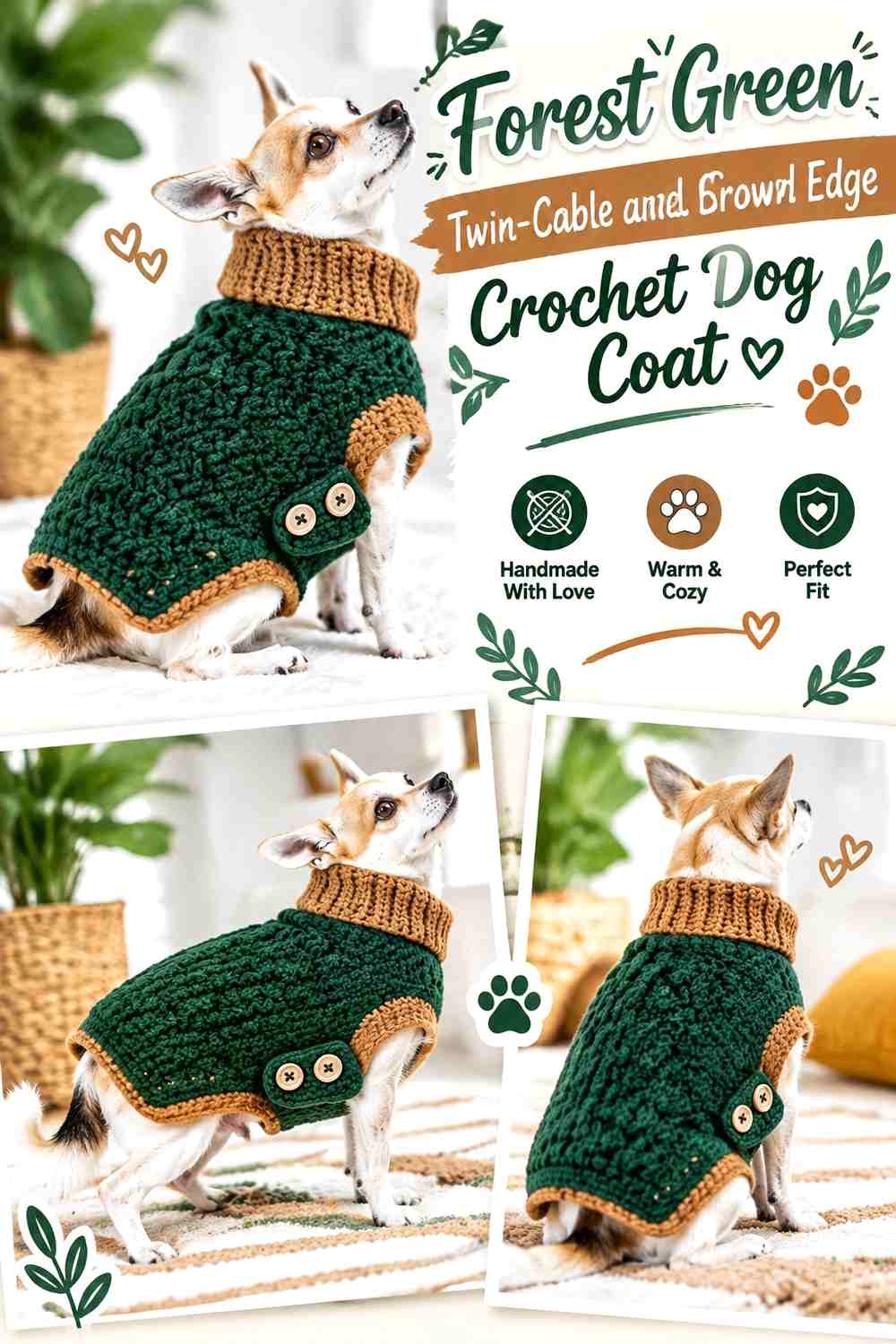
Two narrower forest-green cables can create more symmetry across the back than one central braid. Camel brown works well along the outer coat edge, where it frames both textured columns while leaving the space between them green.
Forest Green Twin Cables Need a Quiet Forest Green Center
Keep the area between the two cables forest green rather than filling it with camel. That shared background visually connects the raised columns and prevents them from looking like two unrelated motifs.
This is also useful when the cables are narrow because uninterrupted green gives each edge more contrast through shadow.
Camel Brown Can Frame Both Forest Green Cable Columns From the Outside
Place camel around the coat perimeter or lower finishing edge instead of between the two cables. The lighter brown then creates an outer boundary without dividing the central composition.
If the outer edging is already substantial, leave the collar forest green to avoid over-framing the coat.
Creator Credit: Marly Bird
3. Forest Green Cable Back and Camel Brown Belly-Strap Crochet Dog Coat

This idea separates decoration and function particularly clearly. Forest green covers the back and cable texture, while camel brown identifies a belly or side-fastening section. From above the coat remains predominantly green; from the side, the brown closure becomes an intentional part of the color scheme.
Forest Green Should Stay Continuous Across the Cable Back
Keep the back cable and its surrounding fabric in forest green so the main view of the coat remains unified. Avoid adding camel cross-stripes simply because the closure uses brown.
A continuous green field is particularly useful when the cable is wide or visually complex.
Camel Brown Can Make the Forest Green Coat Closure Easy to Identify
A camel belly strap or side fastening section gives the secondary color a functional location. Because this section is separate from the cable, it can be relatively broad without competing with the back texture.
Repeat camel once near the neckline if the closure otherwise looks isolated.
Creator Credit: Heart Hook Home
4. Forest Green Cable Panel and Camel Brown Side-Panel Crochet Dog Coat
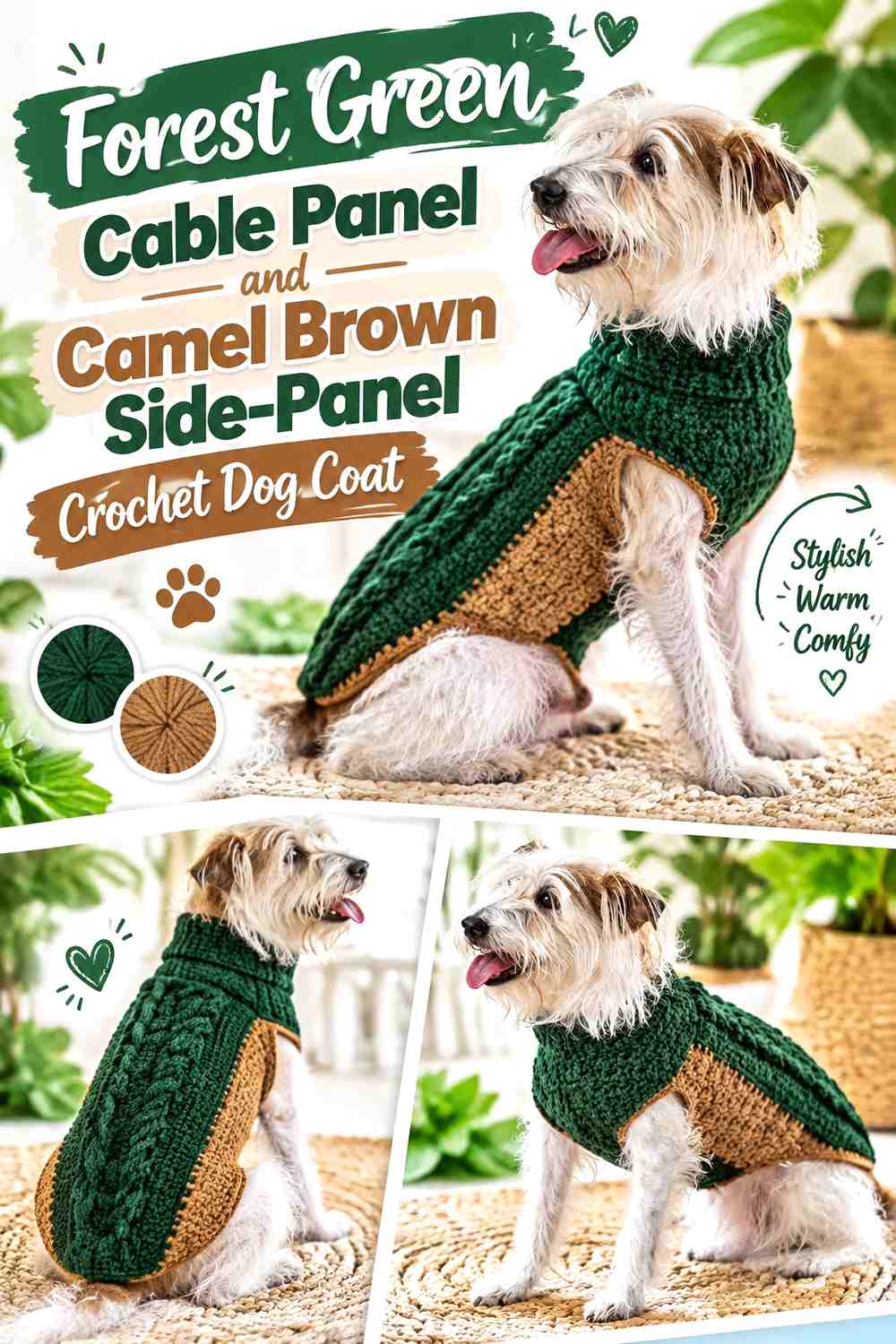
Keep a broad forest-green cable panel through the center of the back and let camel brown occupy smoother side areas. This creates stronger color blocking than trim alone while still protecting the cable from internal color changes.
Forest Green Needs Enough Width for the Cable Panel to Breathe
Do not reduce the green center to a narrow strip just to increase the amount of camel. The cable requires surrounding fabric for its shape to remain readable.
A wide forest-green panel also makes the coat look green-dominant even when the brown sides occupy substantial space.
Camel Brown Side Panels Can Emphasize the Forest Green Cable Center
Camel on either side creates a natural frame around the darker central texture. Keep the two side areas visually balanced where the coat construction permits.
Avoid adding another camel strip directly through the green center; the side panels already provide enough contrast.
Creator Credit: Yarnspirations
5. Forest Green Cable Coat With Camel Brown Turtleneck
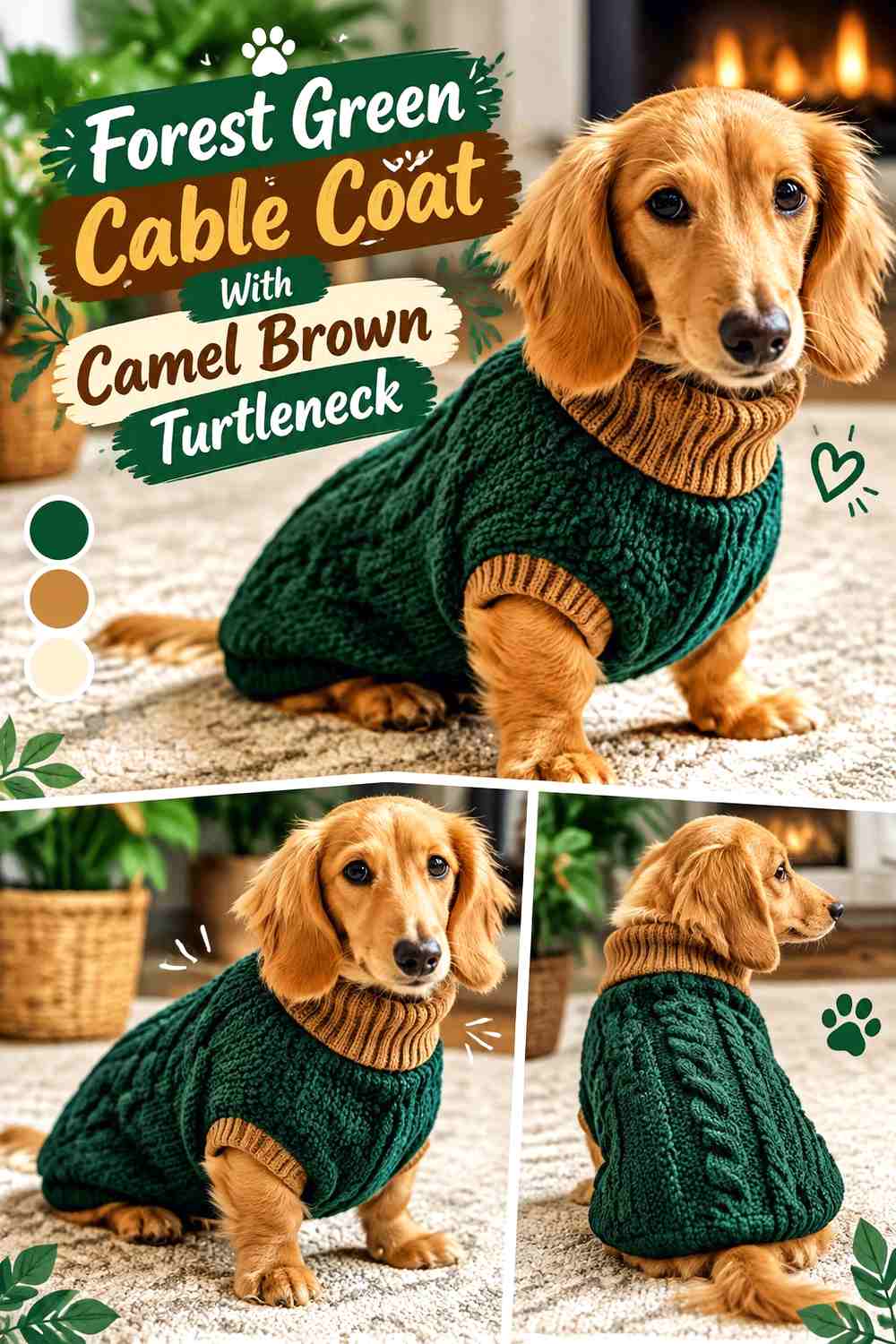
A tall camel-brown neckline gives the supporting color more prominence without touching the forest-green back cable. This is useful when you want a strongly two-color coat but prefer the body itself to remain almost entirely green.
Camel Brown Can Carry the Full Turtleneck Above Forest Green
A substantial collar has enough area to make camel clearly intentional. Keep its texture simpler than the back if you want the forest-green cable to remain the more detailed surface.
The sharp color change at the base of the collar also gives the beginning of the green cable a clear visual starting point.
Forest Green Should Resume Immediately Below the Camel Brown Collar
Carry forest green continuously from the shoulders into the cable panel. Extra brown shoulder stripes can weaken the clean collar-to-body transition.
If another camel repeat is needed, move it to the bottom edge where it will not compete with the upper cable.
Creator Credit: Crochet with Tiffany
6. Forest Green Wide-Cable and Camel Brown Hem Crochet Dog Coat
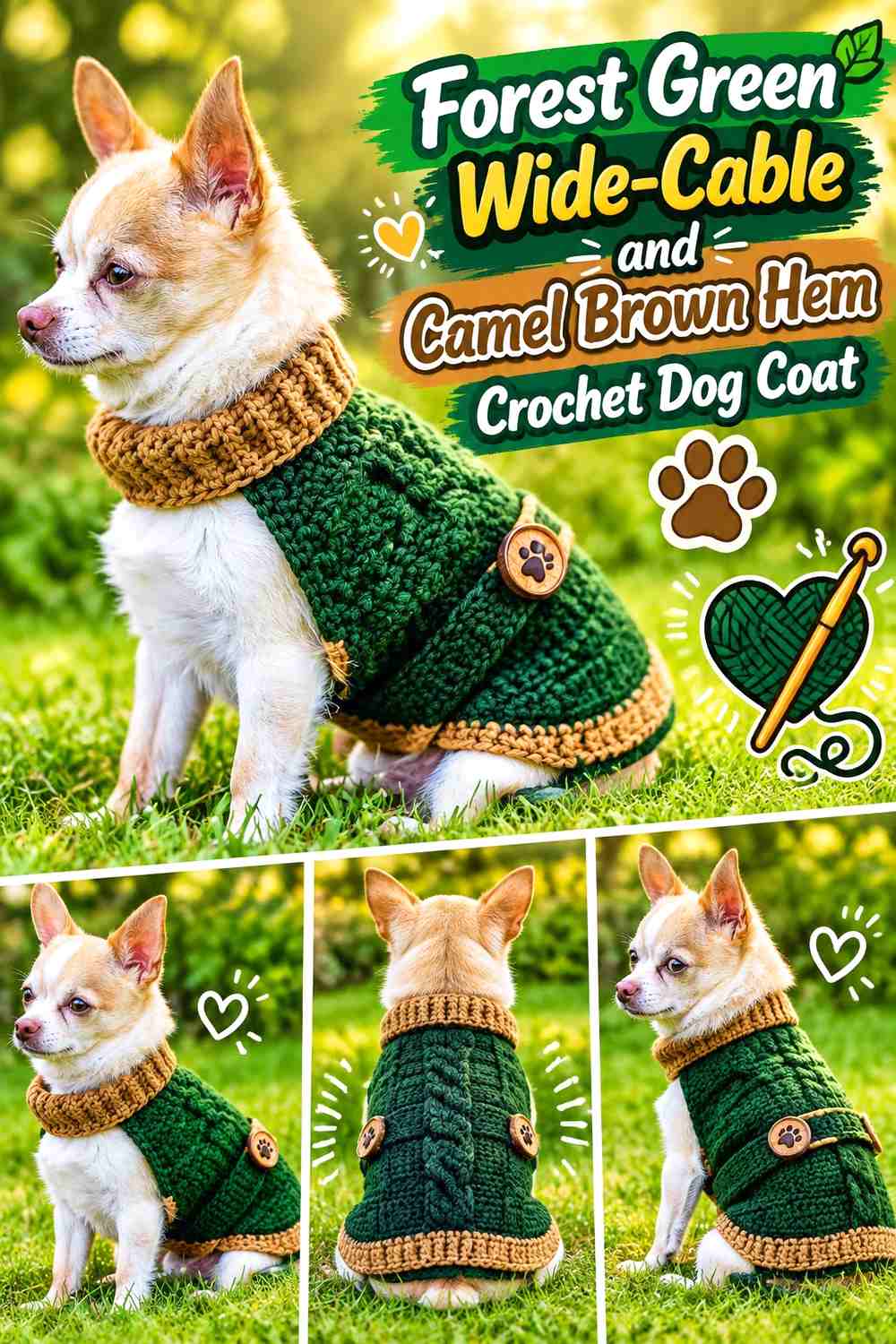
A broad cable can occupy much of the forest-green back, leaving camel brown only at the lower finish. This is one of the most restrained two-color directions and works well when the cable itself is already highly decorative.
Forest Green Wide Cables Need Minimal Color Interruption
Keep the large textured area entirely green. A wide cable contains enough changes in height and direction that additional camel sections inside it would create unnecessary competition.
Allow green to extend beyond the cable edges so the texture still has a visual margin.
Camel Brown Can Finish the Forest Green Coat at the Hem
Use camel only around the lower back edge when you want a warm finishing line without a heavily outlined garment. The hem becomes a subtle endpoint to the vertical cable.
If camel also appears at the collar, keep both sections relatively simple and let the green center remain dominant.
Creator Credit: Last Minute Laura
7. Forest Green Diamond-Cable and Camel Brown Collar Crochet Dog Coat
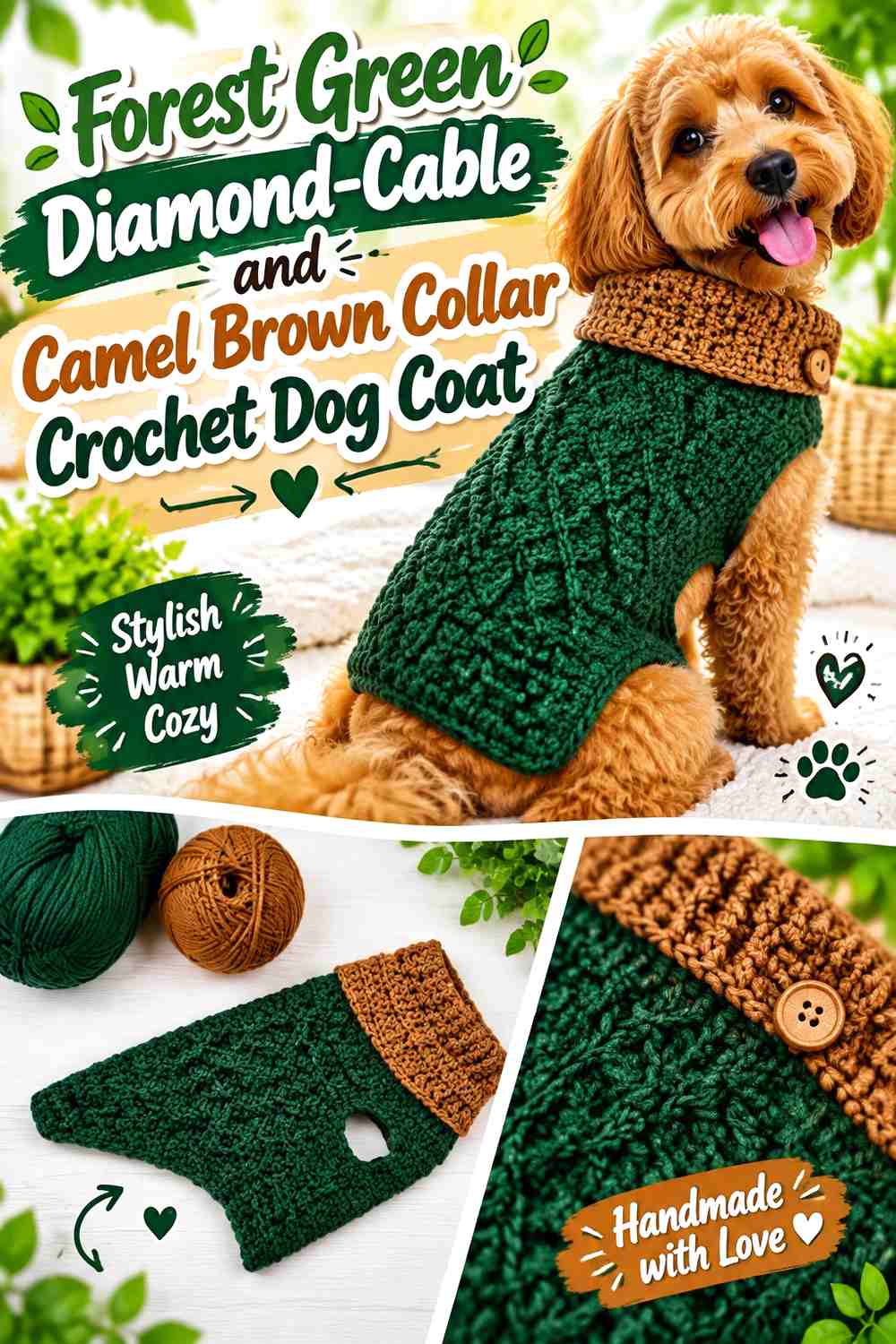
A diamond-like cable arrangement naturally creates a wider decorative area than a single braid. Forest green keeps that geometry cohesive, while camel brown can stay at the neckline and avoid fragmenting the pattern.
Forest Green Keeps Diamond Cable Shapes Connected
Use one green shade across the entire diamond-cable section so crossings and open spaces relate through texture rather than color.
If the cable arrangement expands and contracts across the back, keep the surrounding stitches green as well instead of tracing every shape with brown.
Camel Brown Gives a Forest Green Diamond-Cable Coat a Warm Top Edge
A camel collar provides enough contrast to stop the coat from appearing monochromatic while allowing the diamond pattern to remain visually uninterrupted.
A narrow camel lower edge can repeat the color, but it is optional if the collar already has enough presence.
Creator Credit: Loops Only Crochet
8. Forest Green Cable Yoke and Camel Brown Lower-Body Crochet Dog Coat
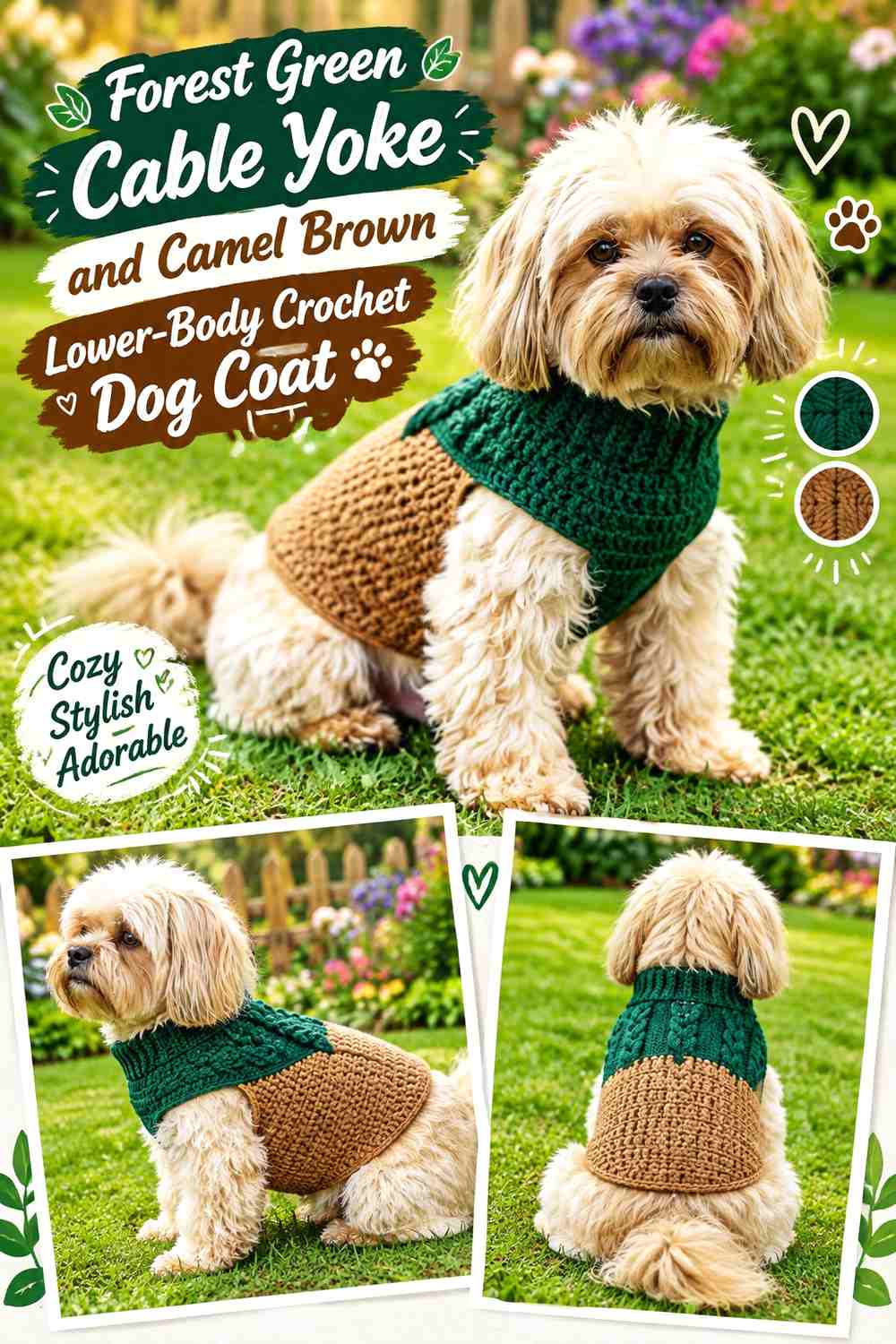
This version places the forest-green cable texture higher on the coat and lets camel brown occupy part of the lower body. The result gives both colors larger areas while still keeping the cable itself monochromatic.
Forest Green Cable Texture Works Best as a Defined Upper Zone
Concentrate the cable around the upper back where it has enough space to remain readable. End the textured color zone at a logical garment transition rather than changing color halfway through an individual cable element.
The surrounding yoke can remain green to reinforce the cable’s shape.
Camel Brown Can Ground the Lower Forest Green Cable Coat
A broader camel lower section balances the dark yoke and changes the coat from trim-led to true color blocking. Keep this brown section smoother so the visual distinction is texture as well as color.
If camel occupies a large lower area, keep the collar forest green to preserve the darker top.
Creator Credit: Crochet It
9. Forest Green Cable Coat With Camel Brown Leg-Opening Trim
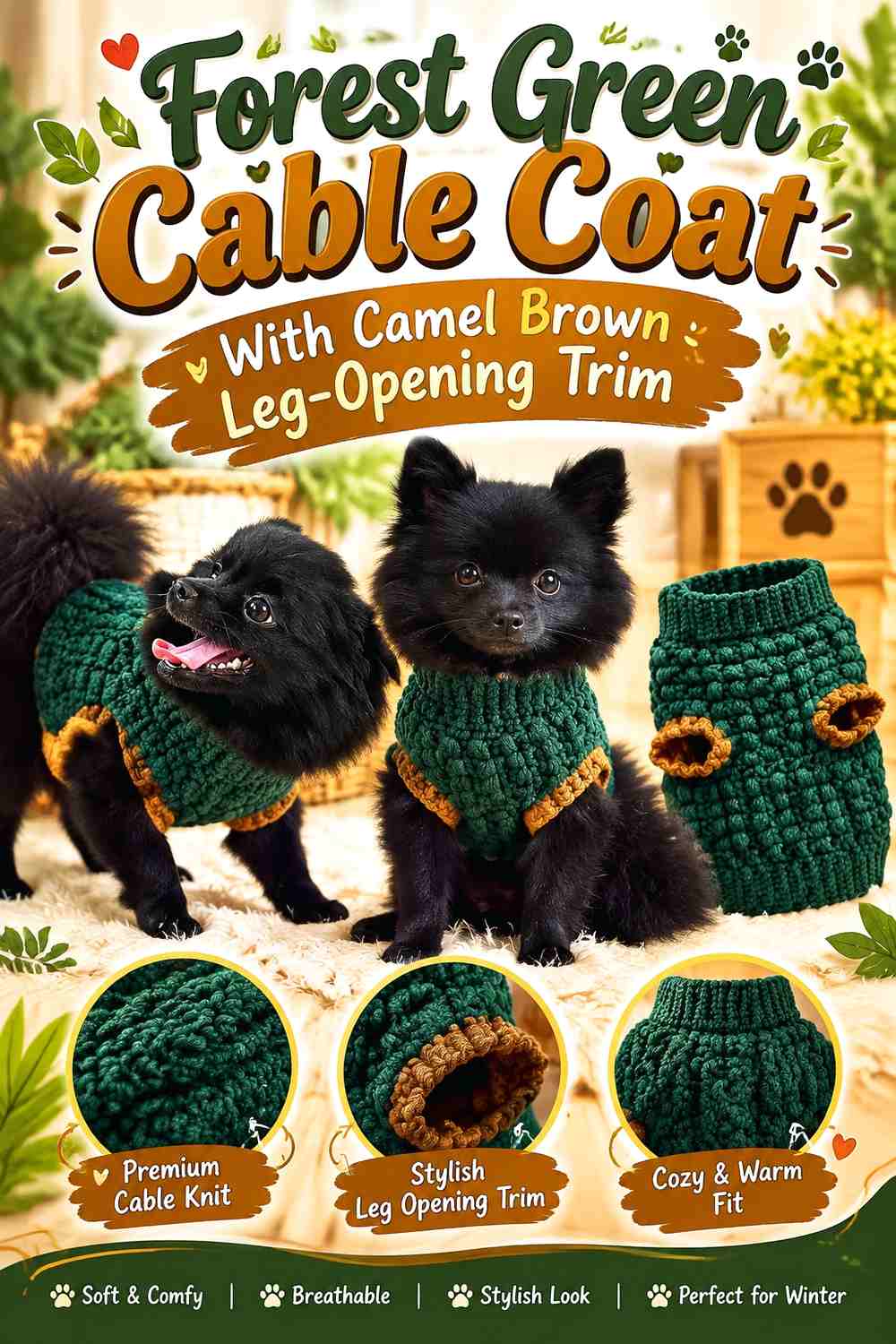
This treatment keeps almost the entire coat forest green and uses camel only around the front-leg openings. The brown accents repeat naturally as a pair and add color without touching the cable panel.
Forest Green Should Dominate the Back and Collar
Keep both the cable body and neckline green when camel is concentrated around the legs. This prevents the secondary color from appearing in too many disconnected places.
A solid green collar also gives the back cable a continuous transition from the top of the coat.
Camel Brown Can Mark Forest Green Leg Openings Without Over-Outlining
Use camel narrowly around the openings where the coat construction already requires finishing. Because there are two repeated accents, they create enough color presence on their own.
Avoid adding wide camel borders around the entire underside if you want the leg treatment to stay distinctive.
Creator Credit: SheiLa Teré
10. Forest Green Cable Back With Camel Brown Button-Flap Crochet Dog Coat
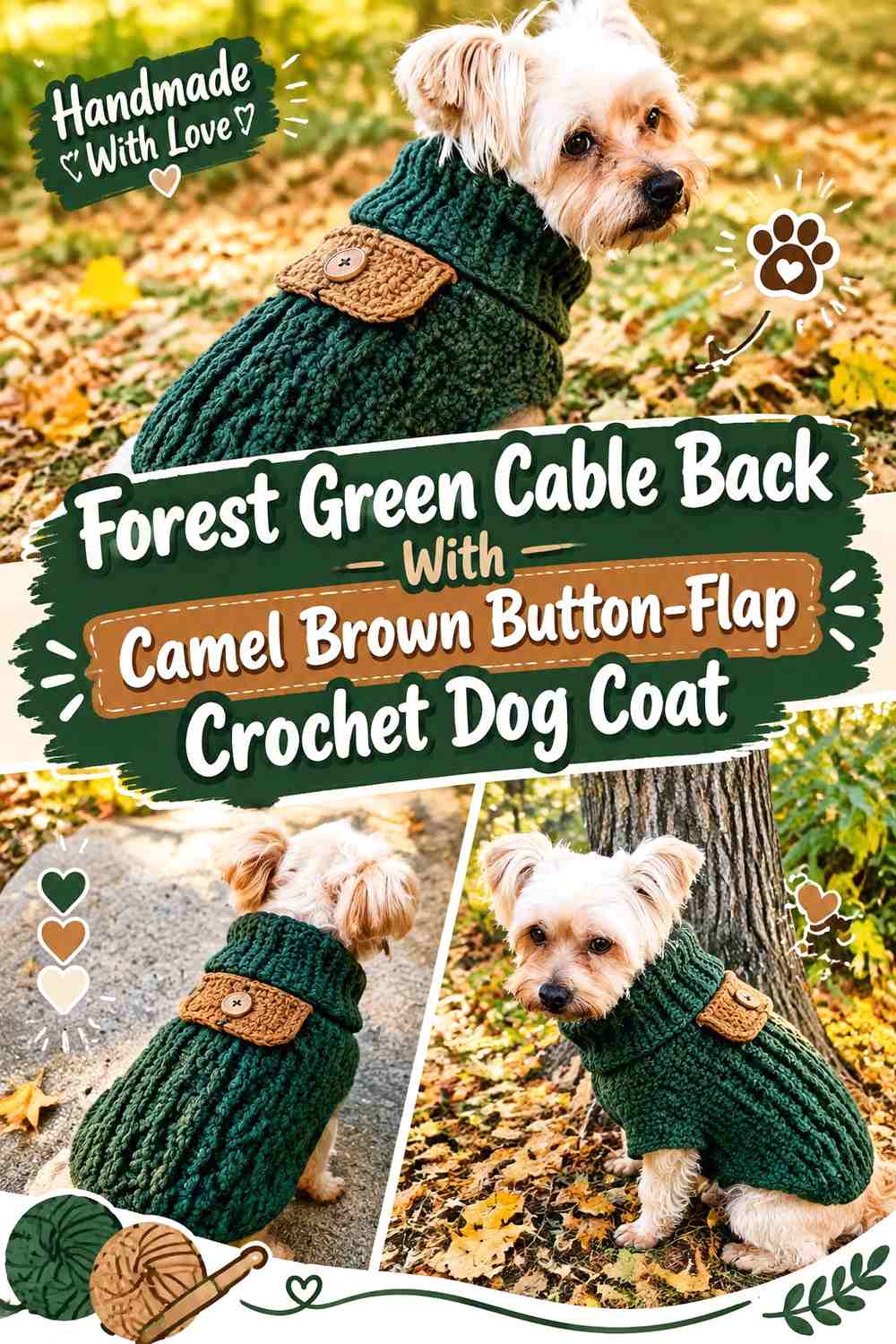
A separate camel-brown fastening flap creates a practical color block while the forest-green cable remains visible from above. This arrangement is particularly useful when a coat construction already includes an opening rather than requiring a pullover fit.
Forest Green Can Protect the Cable From Button-Flap Visual Clutter
Keep the button or fastening area away from the central cable wherever the construction allows. The raised forest-green pattern then remains one continuous decorative feature.
A plain green field between the cable and flap can also provide useful visual separation.
Camel Brown Can Make the Forest Green Button Flap Deliberate
Use camel across the full flap rather than only around individual closures. The larger color area makes the brown look structural instead of decorative.
Do not add extra buttons simply for color balance; the closure quantity and placement should follow the actual coat construction.
Creator Credit: Vibes with Dani
11. Forest Green and Camel Brown Framed-Cable Crochet Dog Coat
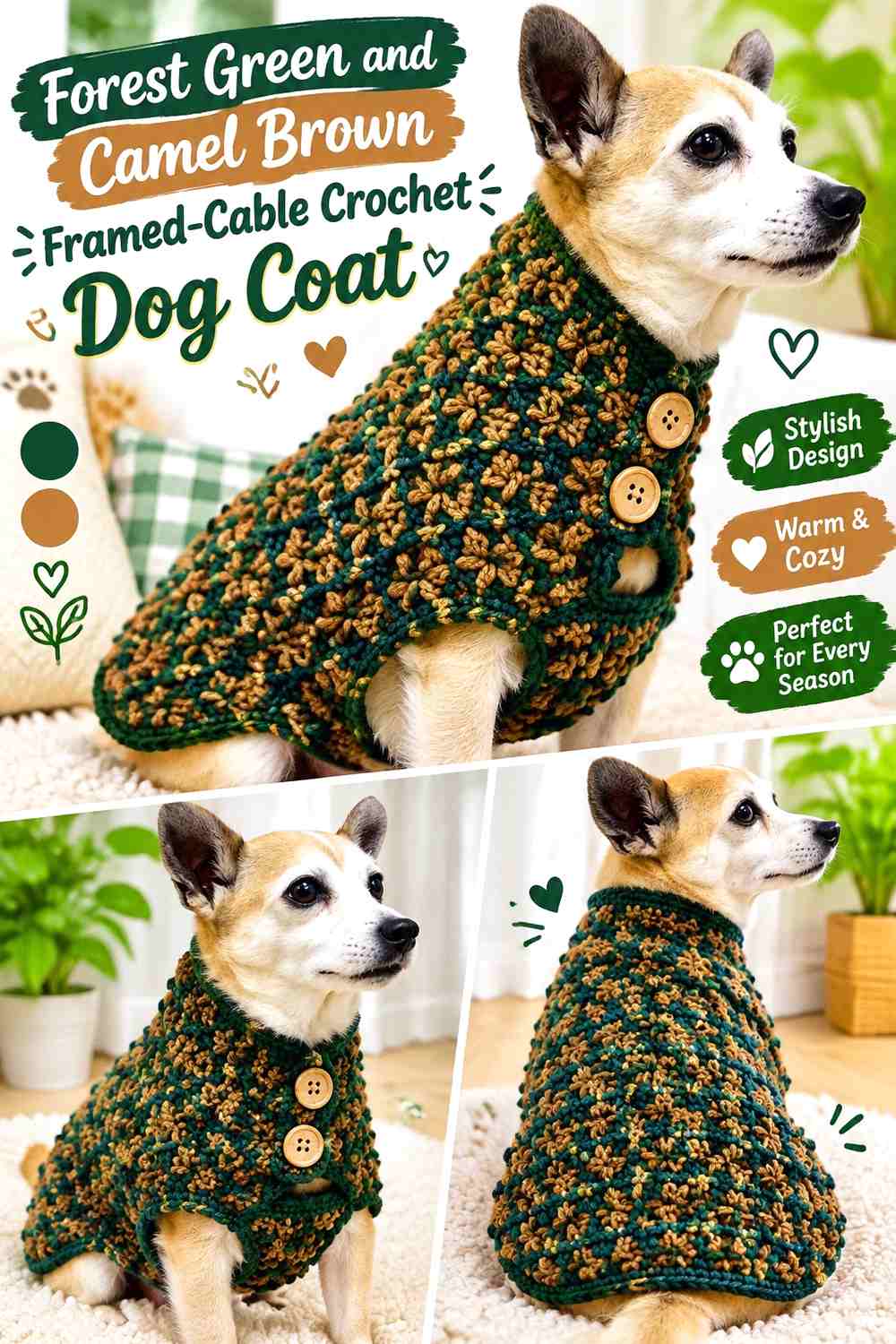
Here, forest green forms the cable panel while camel brown runs in narrow vertical areas beside it. The effect is more deliberate than a general brown edge because the brown specifically frames the cable rather than the entire coat.
Camel Brown Can Define the Sides of a Forest Green Cable
Place narrow camel areas beside the cable panel, leaving enough green around the actual raised stitches. This creates a visual channel that makes the cable look more centered.
Avoid making the camel bands so wide that the green center becomes a thin stripe.
Forest Green Should Continue Through the Camel Brown Frame
Keep the cable itself and the fabric immediately beneath its crossings forest green. The brown belongs beside the texture, not inside it.
Returning to green at the lower edge can keep the central color connected from neckline to hem.
Creator Credit: ALEX CROCHET UNCINETTO MODERNO DI ALEX
12. Forest Green Cable Coat With Camel Brown Shoulder Accents
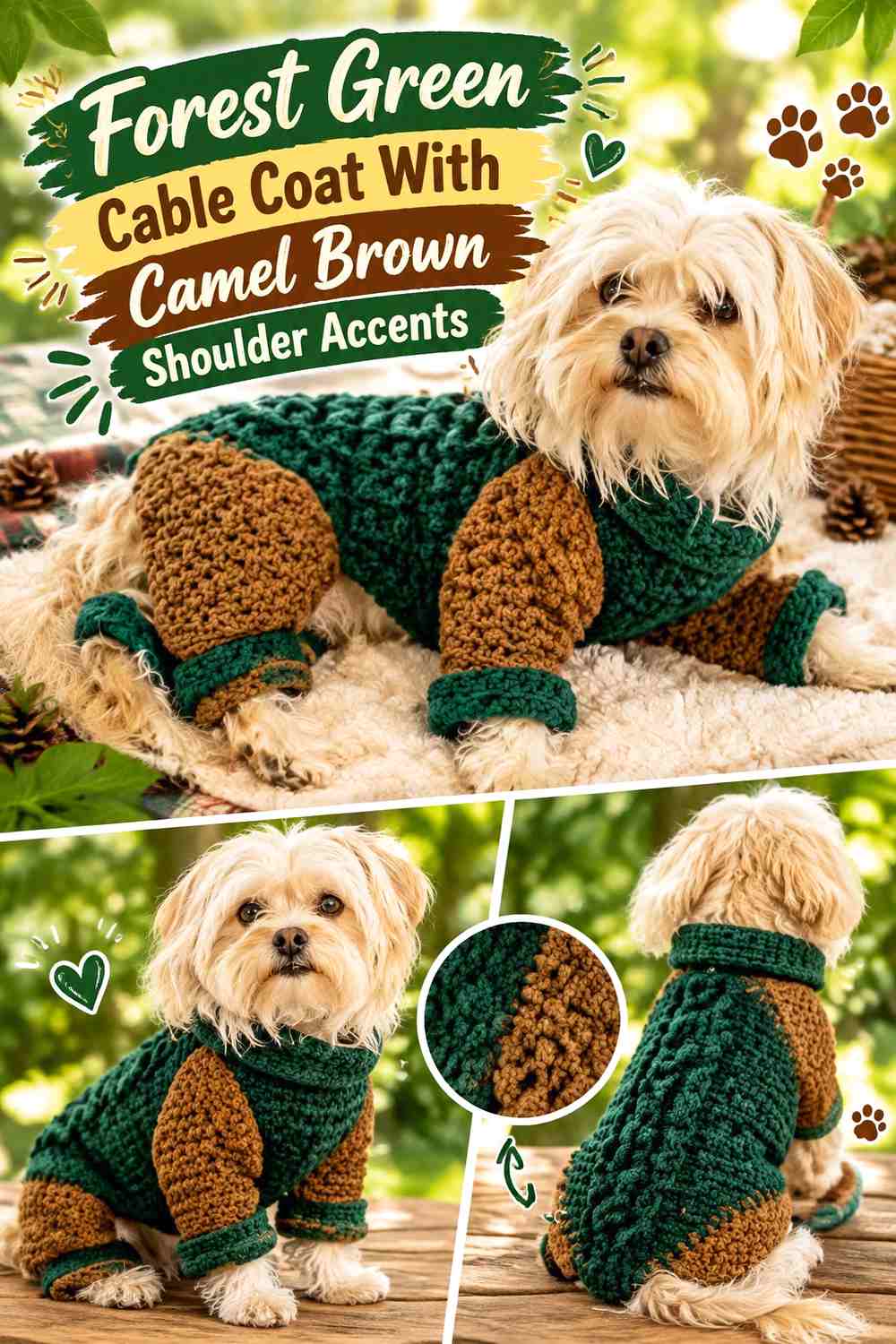
Camel brown can appear near the shoulders while the central back remains forest green. This creates a stronger upper-body frame without turning the collar itself entirely brown.
Camel Brown Shoulder Accents Can Lead Into a Forest Green Cable
Place camel where the upper body transitions toward the back, then let the color stop before the cable begins. The brown can guide the eye toward the darker center without crossing through it.
Keep both shoulder accents comparable in visual weight when the coat construction is symmetrical.
Forest Green Should Take Over Before the Main Cable Starts
Beginning the actual cable in forest green keeps all of its crossings consistent. If a color change lands directly inside a raised section, it may interrupt the relief more than intended.
A green collar can also keep this idea distinct from the full camel-turtleneck version.
Creator Credit: Tejiendo Con Candy
13. Forest Green Textured Cable and Camel Brown Chest Crochet Dog Coat
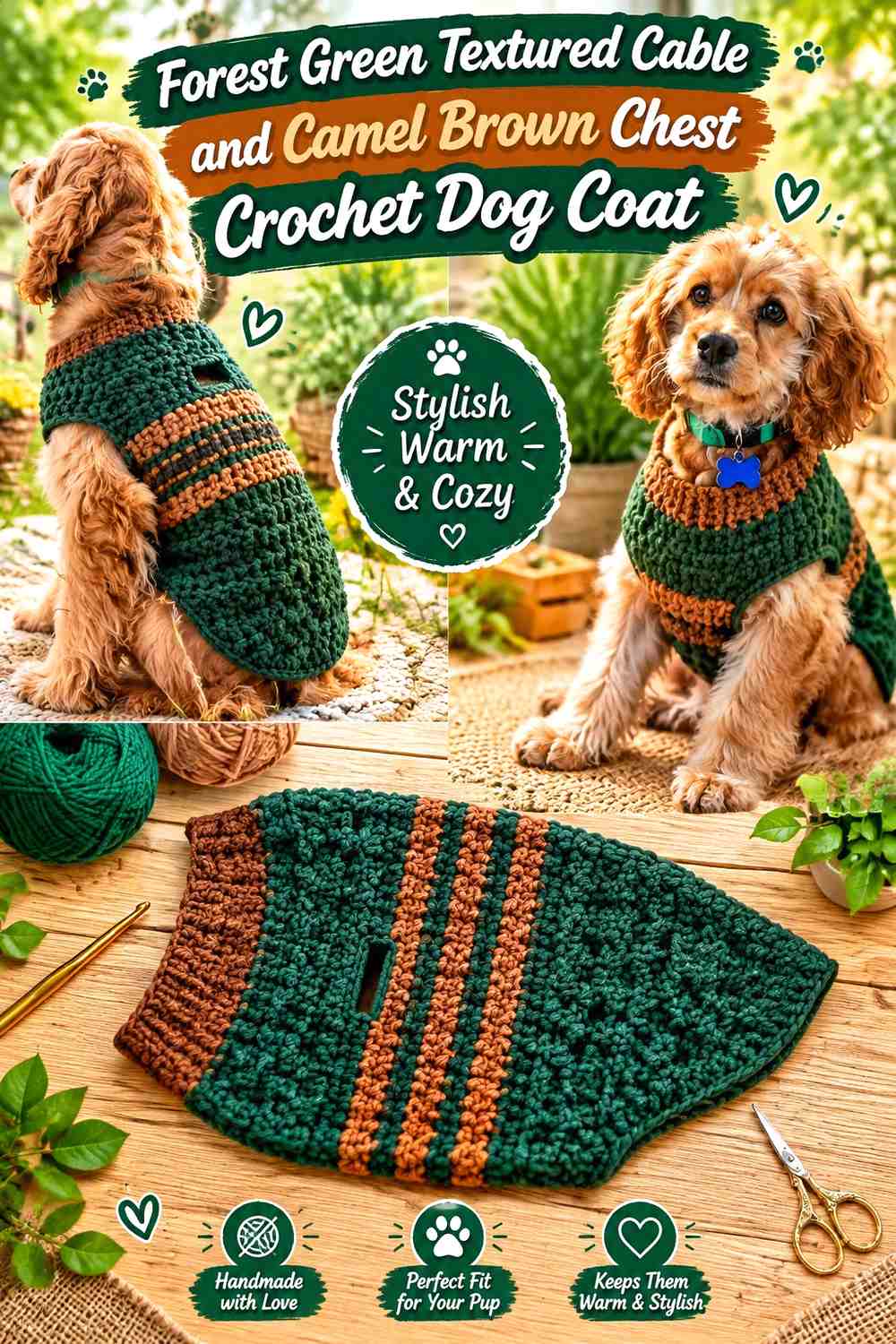
This distribution places nearly all visible back detail in forest green while assigning camel brown to the chest. From above, the coat looks strongly green; from the front or side, the warmer brown becomes much more noticeable.
Forest Green Can Hold All of the Main Cable Texture
Use one green color across both the cable and adjacent textured stitches so the top surface reads as one connected field.
This is useful when the cable is only one part of a broader textured back rather than a completely isolated panel.
Camel Brown Can Separate the Chest From the Forest Green Back
A camel chest section gives the secondary shade a substantial role without interfering with the cable. The color change also follows an actual functional part of the garment rather than an arbitrary stripe.
Keep the transition clean around the sides so brown does not climb unevenly into the back texture.
Creator Credit: it’s erin b.
14. Forest Green Cable Coat With Camel Brown Collar-and-Hem Frame
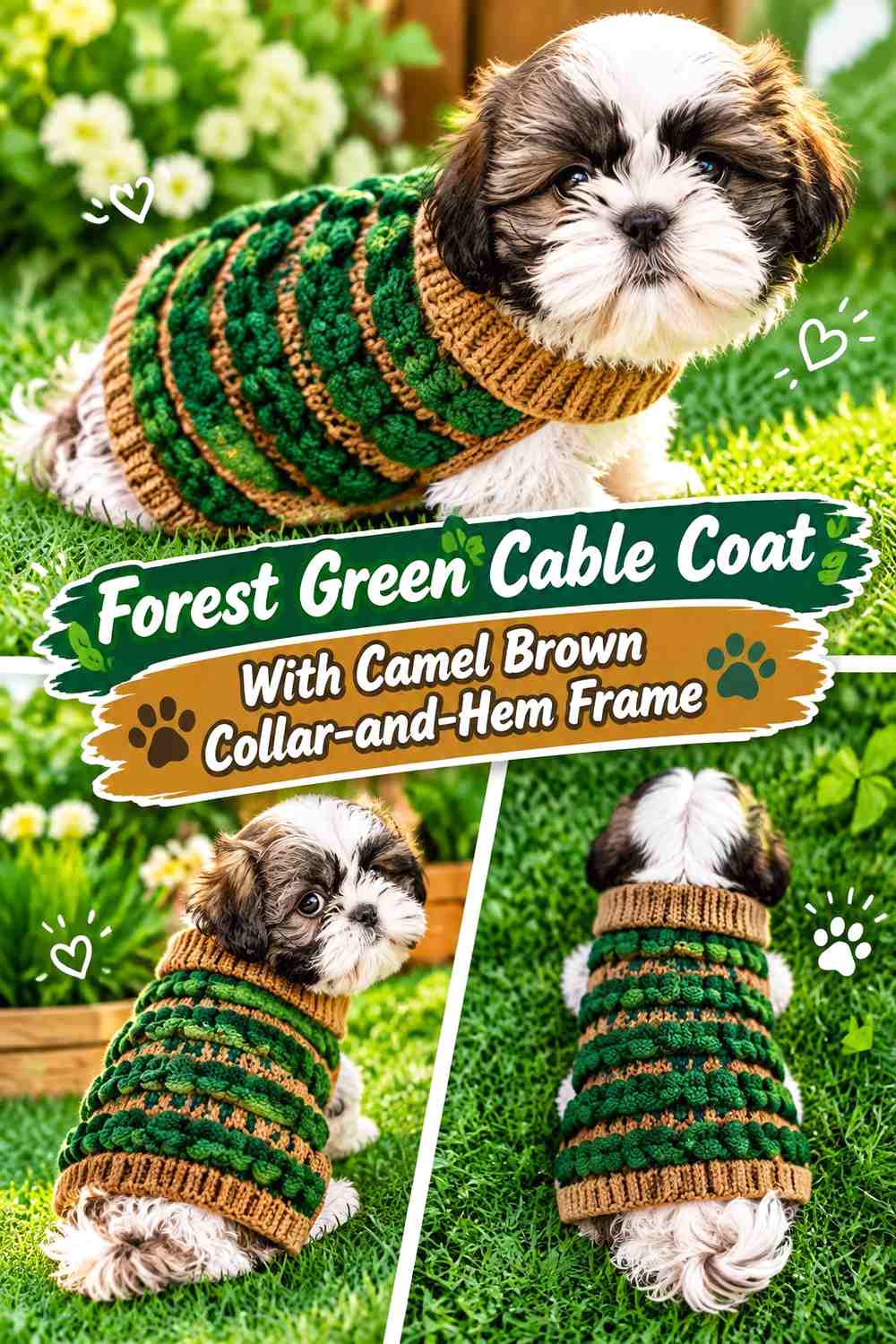
Camel brown at both the neckline and lower edge creates a clear top-and-bottom frame around a forest-green cable body. This treatment gives the two colors strong repetition without placing brown along the sides.
Camel Brown Can Bookend a Forest Green Cable Coat
A camel collar and hem create two separate warm zones while allowing the green cable to run uninterrupted between them. They do not need to have equal depth; the neckline may naturally occupy more space.
Keeping the sides green preserves the sense of one long forest-green center.
Forest Green Needs Enough Length Between Camel Brown Borders
If the coat is short, very deep brown bands at both ends can squeeze the green center visually. Reduce one of the camel areas before sacrificing the cable panel.
The back should still appear primarily forest green when viewed from above.
Creator Credit: Lanitas y colores
15. Forest Green and Camel Brown Split-Panel Cable Crochet Dog Coat
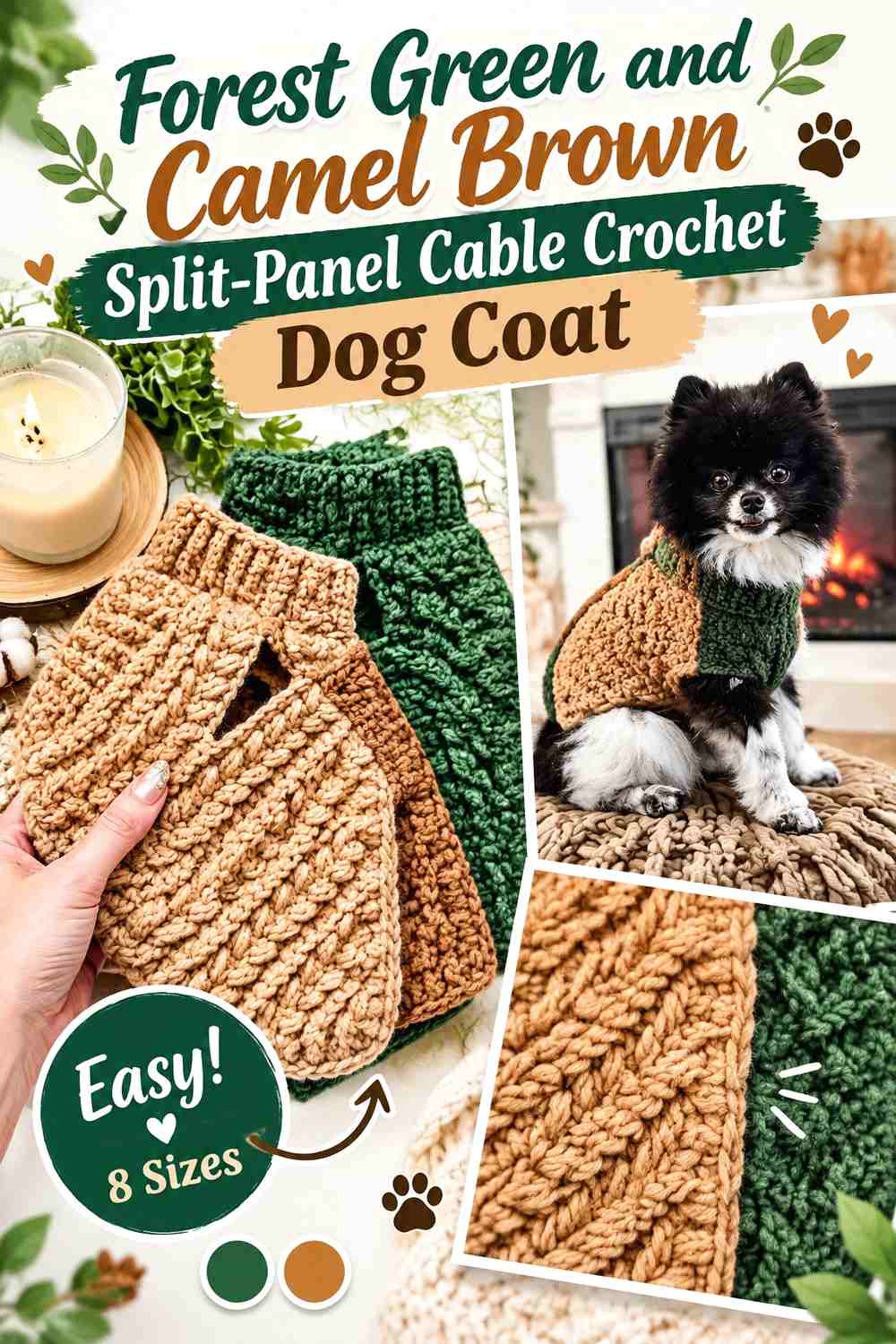
The final idea gives both colors substantial but unequal space. Keep the main cable panel forest green and place camel brown on one defined supporting panel or set of outer sections. The coat becomes clearly two-color while the raised cable still has a consistent green background.
Forest Green Should Own the Main Cable Panel
Make the largest and most detailed textured section forest green. That decision gives the viewer an immediate hierarchy even when camel occupies more area than simple trim.
Do not alternate green and brown inside every cable crossing; keep the color split aligned with panel boundaries.
Camel Brown Can Balance the Forest Green Panel Without Matching Its Texture
Use smoother camel sections beside or beneath the green cable panel. The texture contrast prevents both colors from competing for the same visual role.
If the brown area becomes nearly equal to the green center, repeat a small amount of forest green at the collar or lower edge to reinforce the dominant cable color.
Creator Credit: Briana K
Which Forest Green and Camel Brown Cable Coat Layout Should You Choose?
For the strongest cable emphasis, choose the central-cable, wide-cable, diamond-cable, or cable-and-hem ideas. They keep camel away from most of the textured back and let forest green do nearly all of the cable work.
For stronger two-color blocking, the camel side-panel, lower-body, chest, or split-panel versions give brown substantially more surface while preserving a green cable zone.
If you want the simplest adaptation to an existing dog-coat construction, concentrate camel around a collar, hem, leg opening, or fastening strap. Those areas already provide natural boundaries, so you can introduce contrast without forcing color changes into a cable repeat.
Conclusion
Forest green and camel brown work particularly well on a crochet cable stitch dog coat when the two colors are not asked to do the same job. Forest green can provide the continuous field that keeps raised cables readable, while camel brown can organize collars, straps, hems, chest areas, and side panels around that texture.
Choose a mostly green coat with camel trim when cable definition matters most. Use broad camel side or lower panels when you want the palette itself to have more visual weight. For a balanced middle ground, a camel collar plus one lower repeat creates enough color connection without over-framing the cable.
Use the credited tutorials for their demonstrated garment construction and fit. Where the source does not include cables, add cable texture only through a compatible independent design rather than reconstructing or altering the creator’s instructions in ways that compromise the coat’s shape.
Frequently Asked Questions
Should Forest Green or Camel Brown Be the Main Color in a Cable Stitch Dog Coat?
Forest green is especially useful as the dominant color when the cable is the main feature because a continuous green field keeps the raised texture visually connected. Camel brown can still cover substantial side, chest, or collar areas when you want a stronger two-color coat.
Where Should Camel Brown Go on a Forest Green Cable Dog Coat?
Collars, lower edging, side panels, chest sections, leg-opening trim, and fastening straps are useful locations because they sit outside the main cable texture. Choose only the areas that contribute to the particular coat rather than outlining every opening.
Can Camel Brown Be Used Inside a Forest Green Crochet Cable?
It can, but frequent color changes may make the viewer notice the color sequence before the cable relief. Keeping an entire cable forest green and placing camel immediately beside it usually gives the texture clearer definition.
How Can I Make a Dark Forest Green Cable More Visible?
Crochet a swatch and view it under the lighting in which the coat will usually be seen. If raised details disappear, consider a slightly lighter forest green or preserve more uninterrupted green space around the cable rather than adding many contrasting outlines.
Does Camel Brown Need to Match the Forest Green in Lightness?
No. A clear light-dark difference can help camel trim remain visible, while closer values create a quieter blend. Compare the actual yarns side by side because named colors alone do not tell you how much value contrast they have.
Should the Camel Brown Collar and Hem Be the Same Width?
Not necessarily. The collar may need more visual or structural depth than the hem. Repeating the same color is enough to connect the two areas; identical proportions are not required.
Can I Add a Cable Panel to Any Crochet Dog Coat Tutorial?
Not automatically. Cable stitches can change fabric texture, gauge, and density, so the modification needs to remain compatible with the coat’s measurements and construction. When the credited tutorial does not include cables, preserve its shaping and use a separate, properly swatched cable design only if you can maintain the intended fit.