A crochet Christmas mantel swag works differently from a short ornament garland. It needs enough visual continuity to travel across the mantel, enough flexibility to create a center dip or side drape, and enough contrast for individual leaves and accents to remain visible from across the room.

Winter greenery gives you several ways to build that structure. Fir and pine-inspired pieces can establish a dense evergreen base, holly adds sharper leaf shapes, mistletoe creates lighter branching sections, and eucalyptus or fern motifs can soften transitions. Pinecones and berries are most effective when treated as accents rather than competing with every leaf along the strand.
The color schemes below are editorial adaptations. The linked tutorials support garlands, leaves, mistletoe, holly, fern, pinecones, and related crochet components; they do not necessarily use the exact mantel-swag palettes suggested here.
Quick List
- Forest Green, Cream, and Cranberry Holly Crochet Christmas Mantel Swag
- Pine Green and Oatmeal Leaf-Vine Crochet Christmas Mantel Swag
- Fir Green, Burgundy, and Ivory Holly Crochet Christmas Mantel Swag
- Moss Green and Winter White Mistletoe Crochet Christmas Mantel Swag
- Spruce Green, Sage, and Flax Fern Crochet Christmas Mantel Swag
- Deep Green, Dusty Eucalyptus, and Cream Fern Crochet Christmas Mantel Swag
- Sage, Pine Green, and Ivory Mistletoe Crochet Christmas Mantel Swag
- Olive Green, Rust, and Oatmeal Leaf Crochet Christmas Mantel Swag
- Forest Green, Soft Gray, and Cream Fern Crochet Christmas Mantel Swag
- Pine Green, Cocoa, and Natural Cream Pinecone Crochet Christmas Mantel Swag
- Holly Green, Muted Red, and Warm White Crochet Christmas Mantel Swag
- Evergreen, Flax, and Antique Gold Crochet Christmas Mantel Swag
- Moss Green, Fir Green, and Oatmeal Layered-Leaf Crochet Christmas Mantel Swag
Plan Winter Greenery Around the Mantel Drape
A swag that dips below the mantel needs color balance across a horizontal span. If every dark green motif is concentrated in the center, the middle can look visually heavy while the ends disappear. Repeat the dominant green from one side to the other, even when the leaf shapes change.
Then decide where the secondary color should repeat. Cream berries, cranberry accents, brown pinecones, or oatmeal leaves usually look more connected when they appear in several separated areas rather than one isolated cluster.
Use Several Greens Without Losing Leaf Definition
Forest, fir, pine, moss, sage, and eucalyptus green can all appear in winter crochet, but using several at once only works when their values or temperatures are distinguishable enough to preserve the individual motifs.
A pale sage leaf beside deep fir usually reads clearly. Two nearly identical dark greens may simply look like one color from mantel-viewing distance. When that happens, separate them with oatmeal, cream, a brown pinecone, or deliberate open space instead of introducing another green.
Keep Christmas Mantel Accents Smaller Than the Greenery
A small berry color repeated throughout a long swag becomes visually important very quickly. The same is true of mustard, gold, burgundy, or rust.
Let the foliage establish the length and rhythm first. Then add stronger accents where the swag curves, gathers, or changes direction. This keeps the greenery visible and prevents the mantel from looking like a chain of unrelated ornaments.
1. Forest Green, Cream, and Cranberry Holly Crochet Christmas Mantel Swag

Forest green gives this swag a strong traditional greenery base, while cranberry supplies a controlled Christmas accent and cream keeps the strand from becoming too dark. Use green through most of the foliage and joining sections, repeat cranberry in small berry-like clusters, and reserve cream for occasional leaves, berries, ties, or connecting details.
This palette works particularly well when the swag forms one central dip because the cranberry accents can be repeated on both sides rather than collected only at the lowest point.
Keep Forest Green Dominant Across the Crochet Mantel Swag
Forest green should travel through the entire horizontal line so the arrangement reads as one piece of greenery. If you alternate too many cream sections through the main strand, the swag can begin to look segmented.
Use cream strategically around dense leaf clusters instead.
Repeat Cranberry Against Forest Green Instead of Making One Red Cluster
Several small cranberry accents create better visual continuity than one large concentration. Place them near turns, leaf groups, or the outer thirds of the mantel so the red color guides the eye across the complete swag.
Creator Credit: Crochet DoodabsDesigns
2. Pine Green and Oatmeal Leaf-Vine Crochet Christmas Mantel Swag
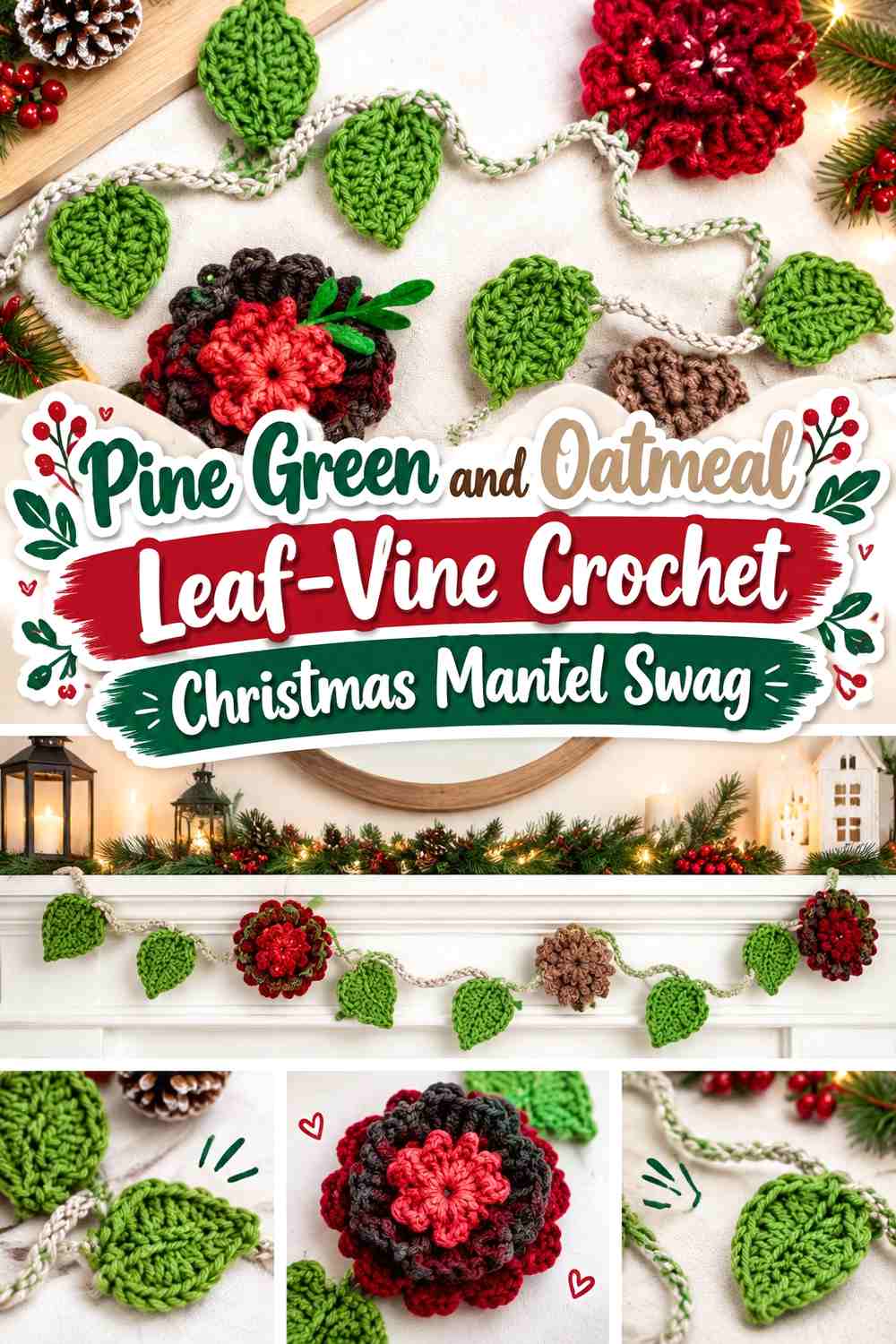
Pine green and oatmeal create one of the simplest palettes here. Pine can form nearly all of the leaf vine, while oatmeal becomes a lighter secondary color at selected intervals. Because the palette is restrained, leaf direction and spacing become more important than frequent color changes.
The supporting tutorial teaches a continuous crochet leaf garland, making it especially useful for establishing the long vine structure of a mantel adaptation.
Let Pine Green Carry the Full Crochet Mantel Length
Use pine green consistently along the connecting vine and most leaves. This creates continuity across the mantel even if individual leaf spacing changes around the center dip.
The uninterrupted green also lets the repeated crochet leaf shape provide most of the surface detail.
Use Oatmeal Leaves to Break Up Pine Green Near the Swag Drape
A few oatmeal leaves around the deepest part of the swag can keep overlapping green motifs from becoming one dark mass. Repeat oatmeal nearer the ends so the light color does not appear accidental.
Creator Credit: Hooked by Robin
3. Fir Green, Burgundy, and Ivory Holly Crochet Christmas Mantel Swag

Fir green and burgundy give this holly-inspired swag a deeper holiday palette than bright green and red. Ivory is important because both main colors can carry substantial visual weight. Keep fir green across most leaves, limit burgundy to berry-scale accents, and allow ivory to interrupt particularly dense foliage sections.
Keep Fir Green Holly Leaves More Prominent Than Burgundy
Holly leaves should remain the dominant visual feature. Burgundy berries need relatively little area to stand out against fir green, so increasing their number is not necessary simply to make the swag feel festive.
Place Ivory Beside Fir Green Where Burgundy Details Need Separation
Ivory can appear through a joining cord, occasional pale leaf, or small neutral accent. It is especially useful where several burgundy details sit close together and need a lighter background.
Creator Credit: Natagor Finlayson
4. Moss Green and Winter White Mistletoe Crochet Christmas Mantel Swag

Moss green and winter white create a lighter botanical Christmas direction. Moss should define the leaves and branch structure, while white can appear in berry-like details or occasional connecting accents.
Mistletoe naturally creates more open space than dense holly or fir, so this palette suits a swag where you want the mantel edge to remain visible between branching motifs.
Let Moss Green Mistletoe Clusters Create the Mantel Rhythm
Repeat moss clusters at measured intervals instead of packing every inch of the connecting strand. The open gaps help each branching shape remain recognizable and allow the swag to drape more lightly.
Keep Winter White Small Against Moss Green Leaves
White needs relatively little surface area to become noticeable. Use it as a repeated detail rather than trying to match the amount of green.
That keeps the design botanical first and snowy second.
Creator Credit: Gi-Zu Crochet
5. Spruce Green, Sage, and Flax Fern Crochet Christmas Mantel Swag
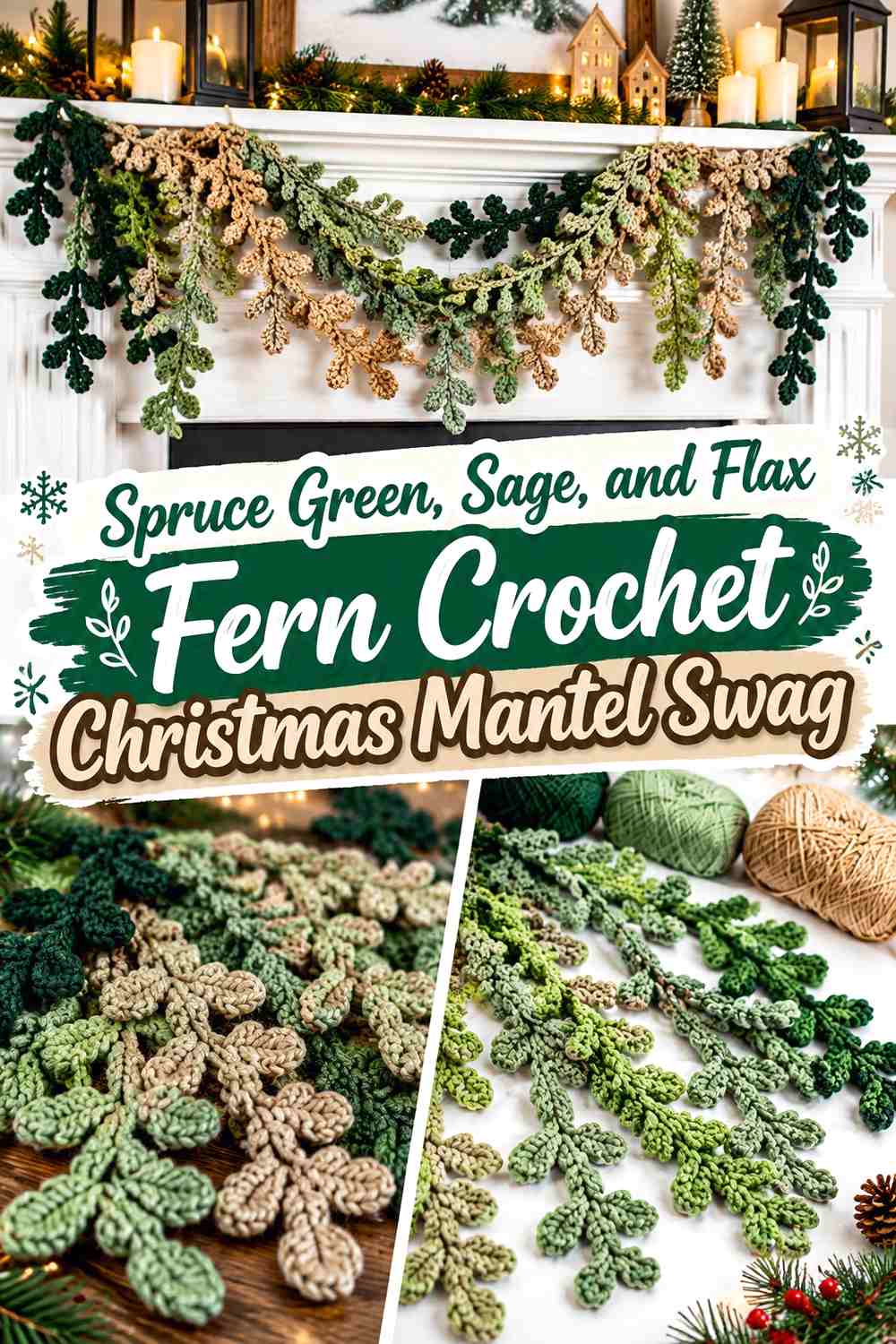
Spruce green gives the swag a deeper evergreen foundation, while sage softens the transitions and flax provides a restrained neutral. Fern-like motifs add feathery texture, so broad color blocks are more useful than changing shade within every small leaflet.
Give Spruce Green Ferns the Strongest Mantel Presence
Use spruce on the largest or most prominent fronds, particularly near the center and outer anchor points. Repeating the same deep shade across the swag creates a visual framework for the lighter sage pieces.
Layer Sage Beside Spruce Green and Leave Flax Visible
Sage can sit slightly behind or between spruce fronds to build depth without requiring another saturated color. Flax should remain visible in selected joining areas so overlapping greenery does not become too visually dense.
Creator Credit: Ayup_April
6. Deep Green, Dusty Eucalyptus, and Cream Fern Crochet Christmas Mantel Swag

This version combines a dark botanical base with a grayer green. Deep green should define the strongest fronds, while dusty eucalyptus tones soften selected branches. Cream can create occasional highlights where several muted greens overlap.
Alternate Deep Green and Dusty Eucalyptus Ferns in Larger Groups
Avoid changing green shade every few stitches. Instead, create recognizable groups of deep and muted greenery so the difference can be seen from normal room distance.
Dusty eucalyptus color is particularly useful toward the swag ends, where a lighter value can keep the drape from appearing visually heavy.
Use Cream Between Deep Green and Dusty Eucalyptus Layers
If several fern pieces overlap at the center, a small amount of cream can create separation. Keep it secondary so the mantel swag still reads primarily as winter greenery.
Creator Credit: Mdays
7. Sage, Pine Green, and Ivory Mistletoe Crochet Christmas Mantel Swag

Sage makes the mistletoe branches softer, pine green provides deeper definition, and ivory supplies the lightest accent. Instead of making every branch identical, use sage across most of the swag and introduce pine green in selected clusters to establish depth.
The supporting tutorial demonstrates a detailed mistletoe branch, making it useful as a botanical component for a repeated mantel arrangement.
Let Sage Mistletoe Cover More Mantel Space Than Pine Green
Sage can take the dominant role because its lighter value keeps numerous leaves from looking heavy when grouped together. Pine green then works as a secondary layer around focal sections.
Repeat Ivory Around Sage and Pine Green Mistletoe
Ivory can appear in small berry-like elements or minimal connecting details. Repeat it across the swag rather than concentrating it only in the center so the light accents feel integrated.
Creator Credit: Happy Patty Crochet
8. Olive Green, Rust, and Oatmeal Leaf Crochet Christmas Mantel Swag

Olive and rust move this Christmas swag toward a woodland palette, while oatmeal keeps it light enough for winter decor. Olive should remain the primary leaf color, and rust can appear in smaller foliage accents, ties, or pinecone-like additions rather than taking over the full strand.
The linked tutorial teaches individual leaves and a leaf-garland concept, so the Christmas greenery direction is an adaptation of that useful construction idea.
Use Olive Green as the Connecting Color Across the Mantel
Repeat olive leaves from end to end even if rust becomes more concentrated around the middle. This continuous green repetition is what keeps the arrangement recognizable as winter greenery.
Keep Rust Smaller Than Oatmeal Around Olive Leaves
Rust is a strong warm accent against olive. Use oatmeal near some rust details to prevent the two earthy shades from creating one dark section along the mantel.
Creator Credit: Crochet with Yarnhild
9. Forest Green, Soft Gray, and Cream Fern Crochet Christmas Mantel Swag
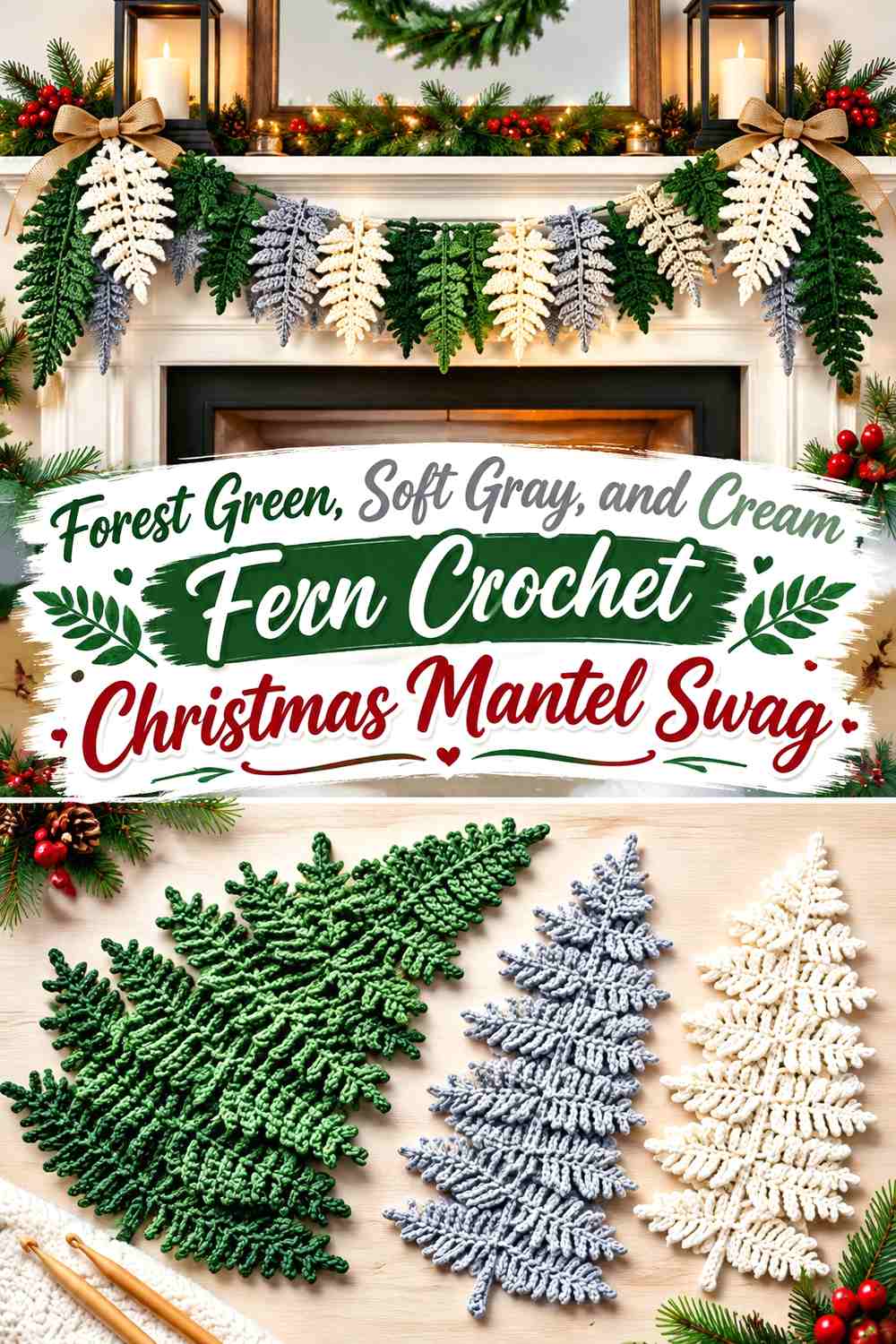
Forest green, soft gray, and cream create a cooler winter version without relying on blue. The forest-green ferns can establish the main foliage, gray can introduce frosted-looking tonal variation, and cream can lighten the joining areas.
Keep Forest Green Ferns at the Main Mantel Focal Points
Place forest green where the swag dips or where larger groups collect. Those darker areas establish the main shape before lighter gray fronds extend outward.
Use Soft Gray and Cream to Lighten Forest Green Toward the Ends
The swag ends can visually taper by gradually increasing gray or cream. This is a color-based way to make the arrangement feel lighter toward its edges without needing every motif to become physically smaller.
Creator Credit: HandmadebyRaine
10. Pine Green, Cocoa, and Natural Cream Pinecone Crochet Christmas Mantel Swag
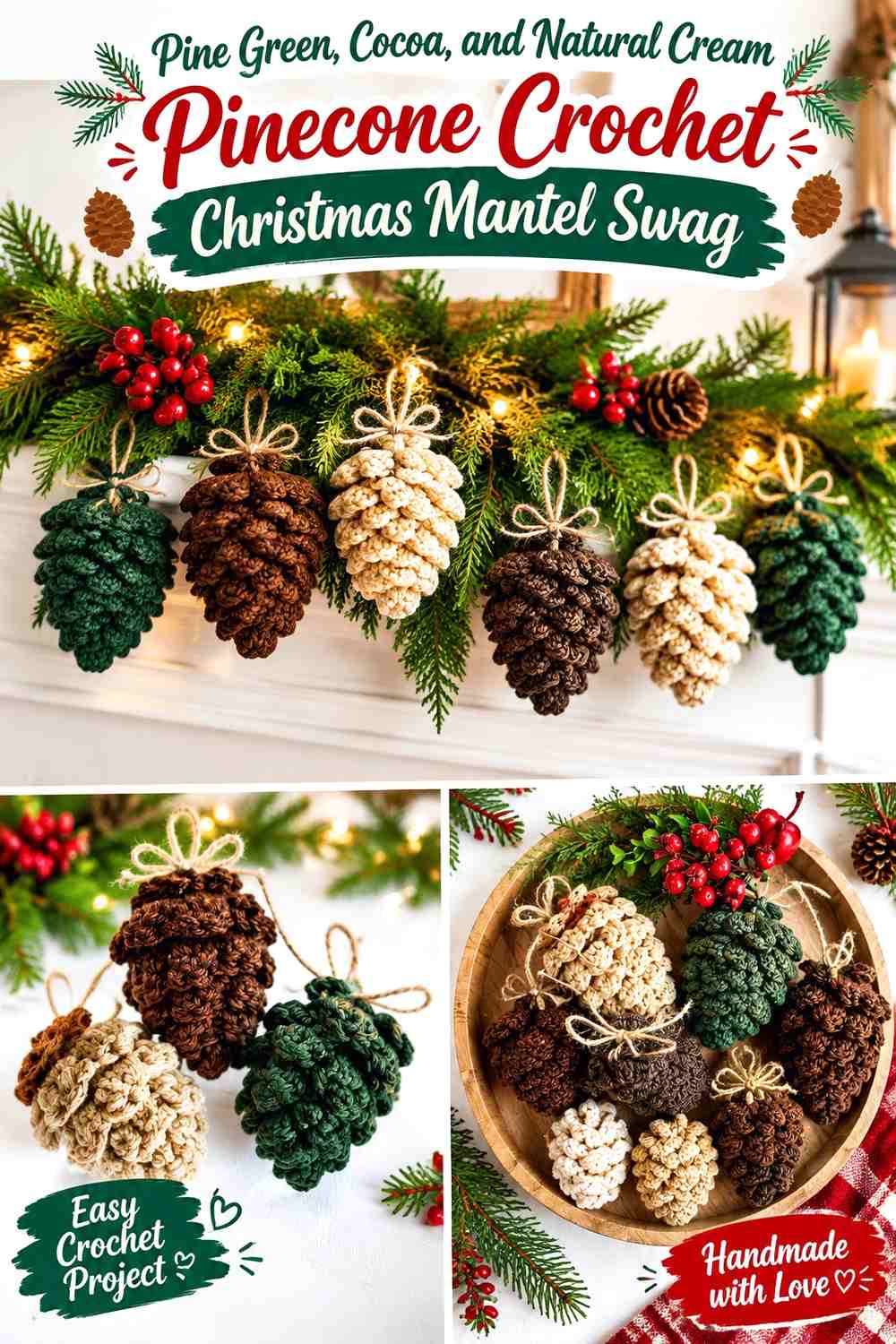
Pinecones introduce more dimensional texture than flat leaves, so their color should not compete with the complete greenery base. Pine green can dominate the strand, cocoa can define the cones, and natural cream can provide small visual breaks between darker components.
The linked tutorial demonstrates textured crochet pinecones that can be used as accents within a separately planned mantel swag.
Cluster Cocoa Pinecones Against Pine Green Instead of Spacing Them Everywhere
Use pinecones in a few intentional groups so they create focal areas rather than turning the whole swag into an alternating cone-and-leaf sequence.
A pair of clusters near the center or outer thirds can be enough to establish the woodland theme.
Add Natural Cream Where Cocoa and Pine Green Become Too Dark
Cocoa pinecones can lose some definition when surrounded entirely by deep pine green. A cream tie, small leaf, or visible section of connecting cord can provide the lighter value needed to reveal the cone silhouette.
Creator Credit: Passionate Crafter
11. Holly Green, Muted Red, and Warm White Crochet Christmas Mantel Swag

Holly green, muted red, and warm white give a classic palette more restraint. The green leaves should cover most of the swag, red can be repeated through small berry-scale details, and warm white can soften transitions near the center or ends.
Keep Holly Green Continuous Across the Crochet Mantel Swag
Even if the leaf clusters are constructed separately, repeat holly green frequently enough that the finished display reads as one botanical line.
A long interruption of white or red can make the swag look like two disconnected sections.
Keep Muted Red Small Beside Warm White and Holly Green
Red has enough contrast to work in very small amounts. Warm white can separate clusters where several red details appear close together and prevent the accent from overtaking the leaf shapes.
Creator Credit: CreamCreamCat
12. Evergreen, Flax, and Antique Gold Crochet Christmas Mantel Swag

Evergreen should dominate this version, while flax keeps the base neutral and an antique-gold color provides a small warm holiday accent. Rather than using gold throughout every leaf, reserve it for the connecting cord, small repeated details, or selected ties.
The linked tutorial provides a Christmas garland construction reference; the greenery components and evergreen-led color placement are separate adaptations.
Let Evergreen Cover Most of the Crochet Mantel Swag
The more visible gold becomes, the less botanical the swag will feel. Keep evergreen responsible for the majority of the horizontal line and treat flax as the quiet supporting shade.
Repeat Antique Gold Sparingly Against Evergreen and Flax
A small gold accent repeated several times is more cohesive than one large gold section. Place it where the swag bends or attaches so it emphasizes the overall drape rather than competing with the leaves.
Creator Credit: Crochet With Tiffany
13. Moss Green, Fir Green, and Oatmeal Layered-Leaf Crochet Christmas Mantel Swag

The final palette uses two greens deliberately. Moss provides the lighter foliage layer, fir supplies darker depth, and oatmeal creates occasional neutral space. Rather than mixing the greens randomly, arrange them in overlapping groups so the darker shade appears to sit beneath or behind the lighter motifs.
The supporting tutorial is a leaf-based wreath reference rather than a Christmas mantel swag, but its repeated-leaf arrangement is useful when planning layered foliage along a horizontal display.
Layer Moss Green Over Fir Green Through the Mantel Center
The center usually carries the greatest visual density, making it a useful place to show both greens. Keep enough of each leaf exposed so the layered arrangement does not become one indistinguishable dark strip.
Extend Oatmeal Beyond the Moss and Fir Green Clusters
Use more neutral space toward the swag ends or between major leaf groups. Oatmeal can visually separate the two greens while also giving the long mantel arrangement places to rest.
Creator Credit: Fiber Flux
Which Winter Greenery Crochet Mantel Swag Palette Should You Choose?
For a traditional Christmas mantel, forest green with cream and cranberry or holly green with muted red and warm white gives the clearest holiday color direction. Keeping red in small repeated accents prevents it from competing with the foliage.
For a quieter woodland mantel, pine green with oatmeal, spruce with sage and flax, or pine with cocoa and natural cream lets the crochet leaf and pinecone texture do more of the decorating.
Moss and winter white, sage with pine and ivory, or forest green with soft gray and cream creates a lighter winter look. Olive and rust is the warmest earthy option, while evergreen with flax and antique gold adds a festive accent without depending on red.
Conclusion
A crochet Christmas mantel swag with winter greenery works best when the color plan follows its long horizontal shape. Start with one green that repeats from end to end, then use a second green or neutral to create depth. Stronger accents such as cranberry, burgundy, rust, cocoa, or antique gold can be much smaller because their repetition across the mantel gives them greater visual importance.
Use holly when you want defined leaf edges and traditional berry accents, mistletoe when you want a lighter branching silhouette, fern when you want fine layered texture, and pinecones when selected dimensional focal points would improve the arrangement.
Follow each linked creator for the crochet component or garland construction they demonstrate, then plan your own mantel length, drape, color distribution, and combination of winter greenery separately.
Frequently Asked Questions
Which green works best for a crochet Christmas mantel swag?
Forest, pine, and fir green create the deepest evergreen look. Moss, olive, and sage produce softer variations. For a multigreen swag, combine shades that are sufficiently different in lightness or tone so individual leaves remain visible when they overlap.
How many colors should I use in a winter-greenery crochet mantel swag?
Two or three defined roles are usually enough: a dominant foliage green, a supporting green or neutral, and an optional accent such as cranberry, cream, brown, rust, or gold. Additional colors are most useful when they solve a contrast problem rather than simply adding variety.
How can I keep dark crochet greenery visible against a dark mantel?
Introduce lighter components near the mantel edge. Oatmeal, flax, cream, pale sage, or soft gray can separate dark fir or forest-green foliage from a dark surround. You do not need to recolor the whole swag; repeated lighter sections may provide enough contrast.
Should crochet berries be spread evenly across the Christmas swag?
They can be repeated without being perfectly evenly spaced. Small berry clusters near the center dip, outer thirds, or major greenery groups often look more intentional than single berries placed at identical intervals. Keep the accent balanced across both sides of the mantel.
Can pinecones and mistletoe be used in the same crochet mantel swag?
Yes. Let one component take the stronger role. For example, mistletoe can create most of the leafy line while pinecones appear in a few denser focal clusters. Using both everywhere can make the swag unnecessarily crowded.
How do I make a crochet mantel swag look fuller without adding more colors?
Layer different foliage shapes in the same palette. A forest-green fern behind sage leaves, for example, creates depth through shape and value rather than additional hues. You can also overlap clusters more closely around the center while keeping the ends lighter.
Should the center of a crochet Christmas mantel swag be darker or lighter?
Either can work. A darker center creates a stronger focal dip, especially with fir, forest green, or pinecones. A lighter cream, sage, or oatmeal center can keep a heavily layered arrangement from looking too dense. Check the swag while it is actually hanging, because gravity and overlap can change how much color is visible.