Crochet pinecones are a natural fit for Scandinavian-inspired door wreaths because their raised scales already provide the texture that a restrained palette needs. Instead of filling the entire wreath with many decorative colors, you can let pinecones, evergreen-inspired foliage, and the circular wreath form supply most of the detail.

The key is restraint. Pine green can establish the woodland base, flax or oatmeal can lighten the ring, and brown can concentrate attention on the pinecones. Muted red, mustard, dusty blue, or rust can be introduced in much smaller amounts when you want a seasonal accent without losing the quieter Nordic direction.
The tutorial references below cover complete wreaths, crochet pinecones, wreath components, and useful foliage techniques. When a source teaches a pinecone or greenery rather than a full door wreath, use it for that component and arrange the finished pieces on a suitable wreath base instead of assuming the creator demonstrates this exact adaptation.
Quick List
- Pine Green, Flax, and Cocoa Scandinavian Pinecone Crochet Door Wreath
- Fir Green, Natural Cream, and Walnut Scandinavian Pinecone Crochet Door Wreath
- Charcoal, Oatmeal, and Pine Green Scandinavian Pinecone Crochet Door Wreath
- Dusty Blue, Birch Cream, and Taupe Scandinavian Pinecone Crochet Door Wreath
- Sage Green, Mushroom, and Chocolate Scandinavian Pinecone Crochet Door Wreath
- Forest Green, Muted Red, and Cream Scandinavian Pinecone Crochet Door Wreath
- Olive Green, Rust, and Linen Scandinavian Pinecone Crochet Door Wreath
- Spruce Green, Mustard, and Warm White Scandinavian Pinecone Crochet Door Wreath
- Moss Green, Clay, and Oatmeal Scandinavian Pinecone Crochet Door Wreath
- Deep Teal, Natural Cream, and Chestnut Scandinavian Pinecone Crochet Door Wreath
- Birch Cream, Soft Gray, and Pine Green Scandinavian Pinecone Crochet Door Wreath
- Burgundy, Fir Green, and Flax Scandinavian Pinecone Crochet Door Wreath
- Stone, Chocolate Brown, and Sage Scandinavian Pinecone Crochet Door Wreath
- Black, Natural Cream, and Moss Scandinavian Pinecone Crochet Door Wreath
- Ice Blue, Pine Green, and Warm Beige Scandinavian Pinecone Crochet Door Wreath
Keep Scandinavian Pinecone Wreath Colors Visually Simple
A pinecone wreath already contains substantial texture. Every cone adds overlapping scales, and crocheted foliage introduces more edges. Using too many equally strong colors can make those individual forms difficult to distinguish.
Start with one dominant wreath color, usually a green or neutral. Give the pinecones a second clearly defined role, then decide whether a third shade is actually necessary. When you do add an accent, repeat it deliberately rather than placing one unrelated spot of color on only one side.
Let Brown Pinecones Contrast With the Wreath Base
A realistic brown pinecone is not the only option, but the cone should remain visible against whatever sits behind it. Dark chocolate pinecones can disappear against very deep forest green, while pale taupe cones can merge into an oatmeal wreath.
Compare the pinecone and base colors before making an entire set. If their values are similar, introduce a lighter leaf, narrow neutral section, or contrasting hanging loop between them instead of adding several new colors.
Use Muted Green to Connect Pinecones Around the Door Wreath
Greenery is useful for more than filling empty spaces. Repeating pine, fir, sage, moss, or olive around the circle can visually connect pinecone clusters placed several inches apart.
For a restrained Scandinavian-inspired wreath, you do not need to cover the entire base in leaves. Concentrated sprigs beside pinecones can preserve visible negative space, especially when the wreath base itself contributes an attractive flax, cream, gray, or natural-brown color.
1. Pine Green, Flax, and Cocoa Scandinavian Pinecone Crochet Door Wreath
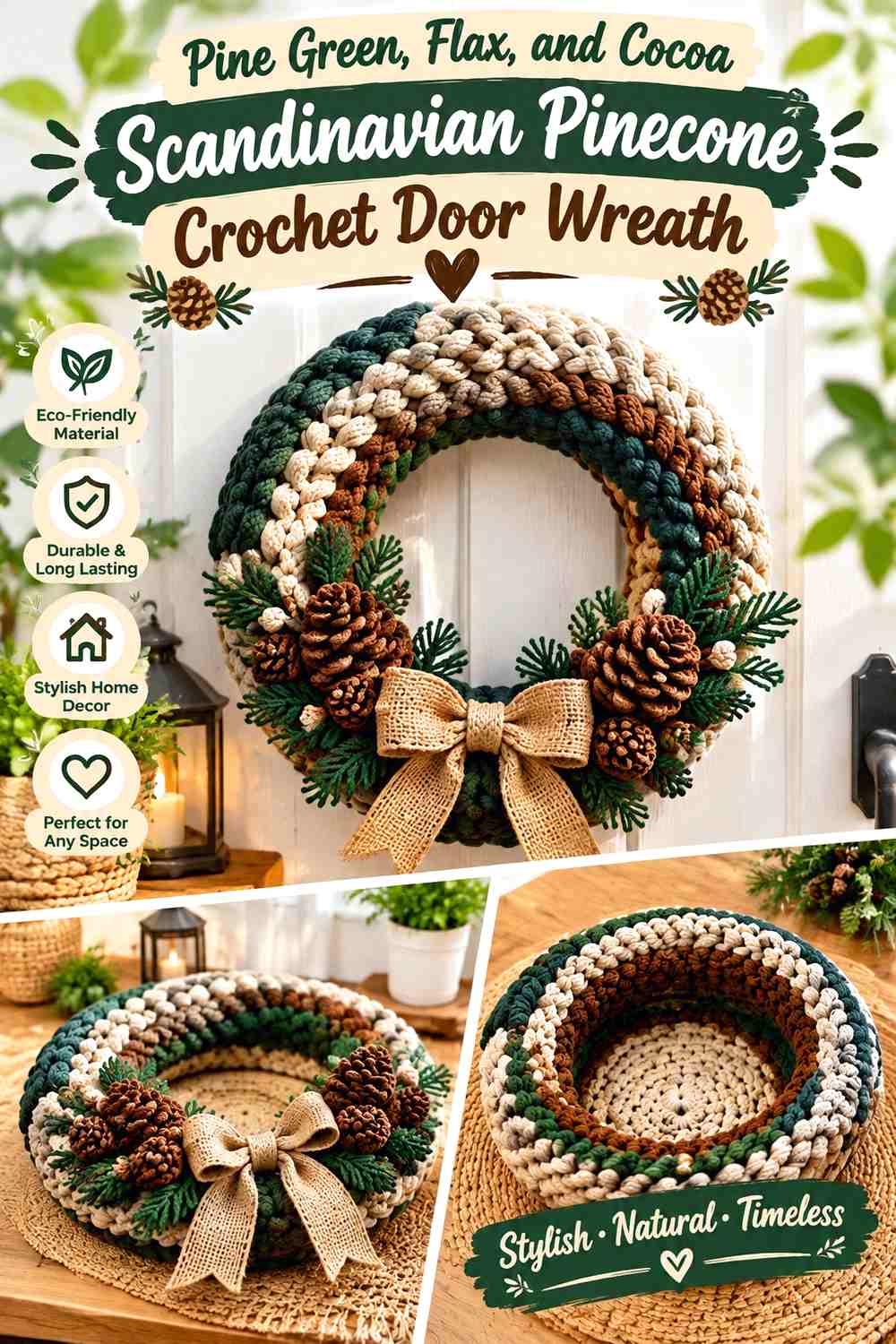
Pine green gives this wreath its woodland identity, flax prevents the ring from becoming uniformly dark, and cocoa keeps the pinecones natural-looking without creating the heavy contrast of near-black brown. Let pine green carry most of the foliage, keep some flax visible on the wreath base, and group cocoa pinecones rather than spacing them mechanically around the entire circle.
Let Pine Green Connect the Cocoa Pinecones Around the Door Wreath
Use pine green sprigs between the main cocoa clusters so the eye can follow a continuous botanical theme without requiring pinecones on every part of the ring.
Leaving occasional stretches of flax uncovered can make the darker foliage and pinecone scales easier to appreciate.
Keep Flax Visible Behind Pine Green and Cocoa Texture
Do not treat flax only as a tiny accent. Visible neutral sections give the textured crochet elements breathing room and reinforce the pared-back character of the design.
This source demonstrates a complete crochet wreath that includes pinecones, making it a particularly close construction reference for the concept.
Creator Credit: Crochet With Tiffany
2. Fir Green, Natural Cream, and Walnut Scandinavian Pinecone Crochet Door Wreath

Fir green is slightly deeper in visual weight than natural cream, so this palette works well with a green-led botanical cluster placed on a mostly quiet wreath. Walnut pinecones can sit among the foliage, while cream appears through the base, hanging loop, or a few small decorative details.
Keep Fir Green Concentrated Around Walnut Pinecone Clusters
Instead of covering the entire ring with fir green, gather foliage around several walnut pinecones. The grouped placement makes each pinecone arrangement more substantial while preserving the clean circular outline elsewhere.
Use Natural Cream to Separate Fir Green From Walnut
Fir and walnut can both become visually dark. A little natural cream beside the cluster—through the covered base or a small neutral detail—can make the cone edges easier to distinguish.
The supporting tutorial demonstrates a woodland wreath with several crocheted nature motifs, so it is useful for arranging botanical components around a circular base. YouTube
Creator Credit: Concrete Gems Crochet
3. Charcoal, Oatmeal, and Pine Green Scandinavian Pinecone Crochet Door Wreath

This palette reverses the usual green-heavy formula. Oatmeal can cover most of the ring, charcoal can appear in selected pinecones or narrow structural details, and pine green can be limited to foliage. The result puts greater emphasis on shape and texture than on a large mass of green.
Let Oatmeal Dominate the Charcoal Pinecone Wreath Base
A broad oatmeal base makes the circular form easy to see from a distance. It also creates enough contrast for darker pinecones to retain the layered look of their crochet scales.
Use Pine Green Sparingly Beside Charcoal Pinecones
A small pine-green sprig beside each charcoal or deep-gray cone is enough to establish the botanical reference. Covering the entire oatmeal base in green would remove the main feature that distinguishes this palette.
The linked tutorial teaches a complete crochet pinecone, so it is most useful for producing the dimensional cones that can then be arranged on a separate wreath. YouTube
Creator Credit: Kristines Crochets
4. Dusty Blue, Birch Cream, and Taupe Scandinavian Pinecone Crochet Door Wreath
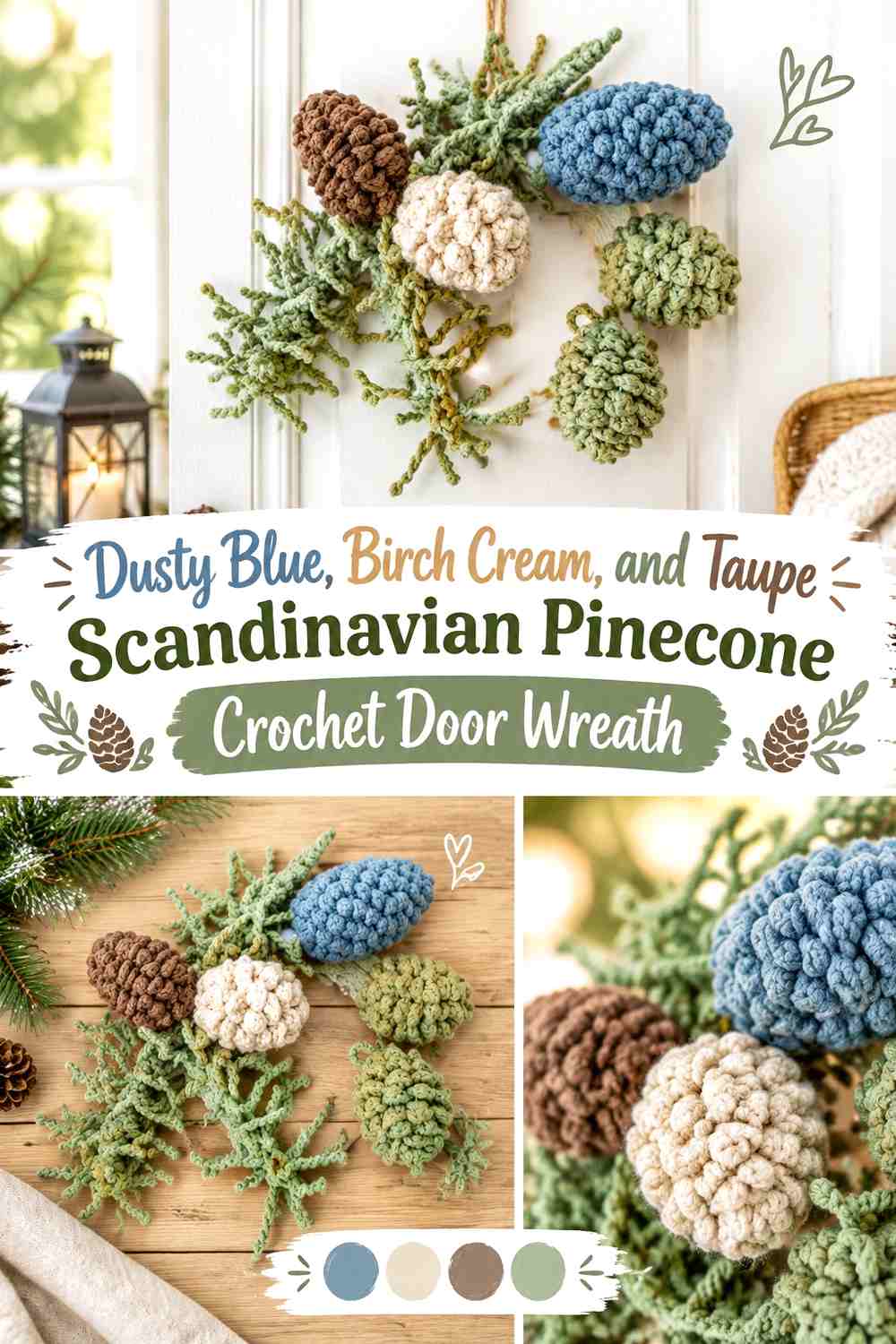
Dusty blue gives the pinecone wreath a cooler winter direction without requiring bright holiday colors. Birch cream can cover most of the ring, while taupe keeps the pinecones soft enough to fit the muted palette.
Place Dusty Blue Between Taupe Pinecone Groups
Rather than crocheting every pinecone blue, use dusty blue for selected foliage, narrow base sections, or small repeated accents. Taupe remains the identifiable pinecone color while blue changes the overall seasonal direction.
Let Birch Cream Keep Dusty Blue and Taupe Light
Birch cream should occupy enough visual area to stop the two muted colors from blending into one low-contrast band. A cream-covered ring is especially useful if both blue and taupe sit near the same medium value.
The supporting tutorial demonstrates a crochet pinecone suitable for incorporating into an autumn or winter decoration or wreath. YouTube
Creator Credit: topszydełkowo
5. Sage Green, Mushroom, and Chocolate Scandinavian Pinecone Crochet Door Wreath
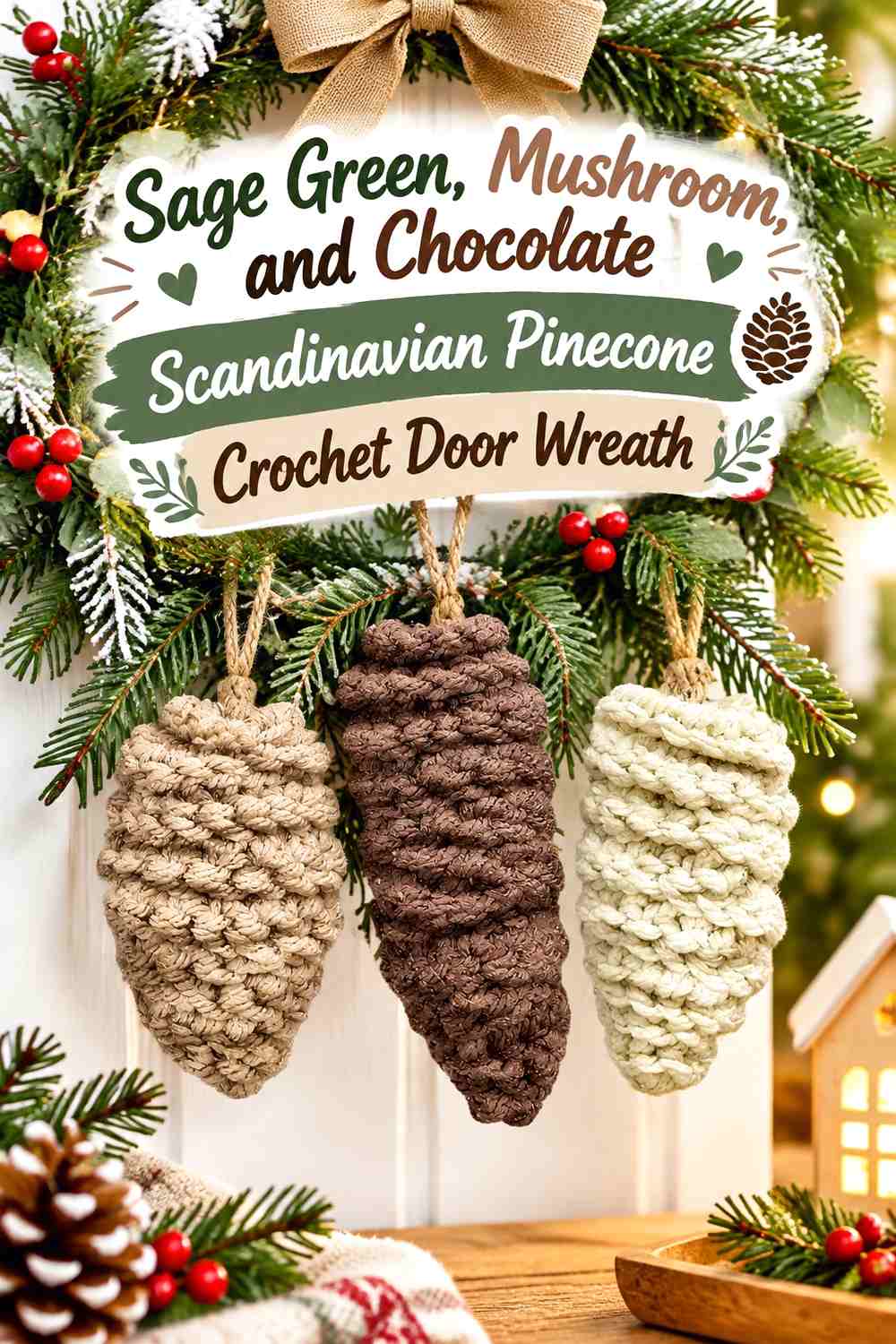
Sage makes this wreath softer than a deep evergreen version. Mushroom can handle the neutral base or selected foliage, and chocolate should be concentrated on the pinecones so the textured cones remain the darkest recognizable element.
Use Chocolate Pinecones as Anchors Against Sage Green
Arrange chocolate cones in a few deliberate clusters rather than creating a dense ring. Their dark value makes them visually prominent even when they occupy relatively little space.
Let Mushroom Soften the Sage Green Door Wreath Base
Mushroom can separate sage foliage from a pale door or wall without creating the high contrast of white. If the sage itself is very muted, choose a mushroom shade that remains visibly lighter or darker rather than nearly identical.
The tutorial reference focuses on crocheted pinecones, making it useful for creating the focal motifs before they are incorporated into a separate wreath arrangement. Ravelry
Creator Credit: The Secret Yarnery
6. Forest Green, Muted Red, and Cream Scandinavian Pinecone Crochet Door Wreath

Forest green and muted red create the most recognizably festive palette in the collection, but cream keeps it from becoming visually crowded. Forest green should still dominate. Use muted red as a controlled berry-like or ribbon-like accent rather than giving it the same surface area as the green.
Keep Forest Green Dominant Over Muted Red
Most foliage and wreath coverage can remain forest green, while muted red appears at a few repeated points. That keeps the wreath botanical first and festive second.
Place Cream Beside Forest Green and Muted Red Details
Cream can separate a dark pinecone cluster from saturated foliage or create a quiet section of the ring between red accents.
The source supports a dimensional pinecone ornament concept, which can be repeated and adapted for a larger door-wreath arrangement. Ravelry
Creator Credit: Hectanooga1
7. Olive Green, Rust, and Linen Scandinavian Pinecone Crochet Door Wreath

Olive and rust move the wreath toward an autumn-to-winter palette, while linen keeps it restrained. Use olive for foliage, rust for selected pinecones or accents, and linen for the majority of the exposed base.
Keep Olive Green Around the Rust Pinecones
Olive gives rust enough hue separation without producing a bright green-and-orange combination. Concentrate both colors in the same clusters to leave cleaner linen sections elsewhere on the wreath.
Let Linen Break Up Olive Green Around the Door Wreath
Visible linen prevents an organic cluster from turning into a full foliage ring. This negative space is particularly useful when the crochet pinecones have pronounced surface texture.
The linked tutorial teaches crocheted holly leaves, making it an adaptation reference for adding structured foliage around pinecones rather than a complete pinecone wreath source. YouTube
Creator Credit: Cosy Rosie Crochet
8. Spruce Green, Mustard, and Warm White Scandinavian Pinecone Crochet Door Wreath
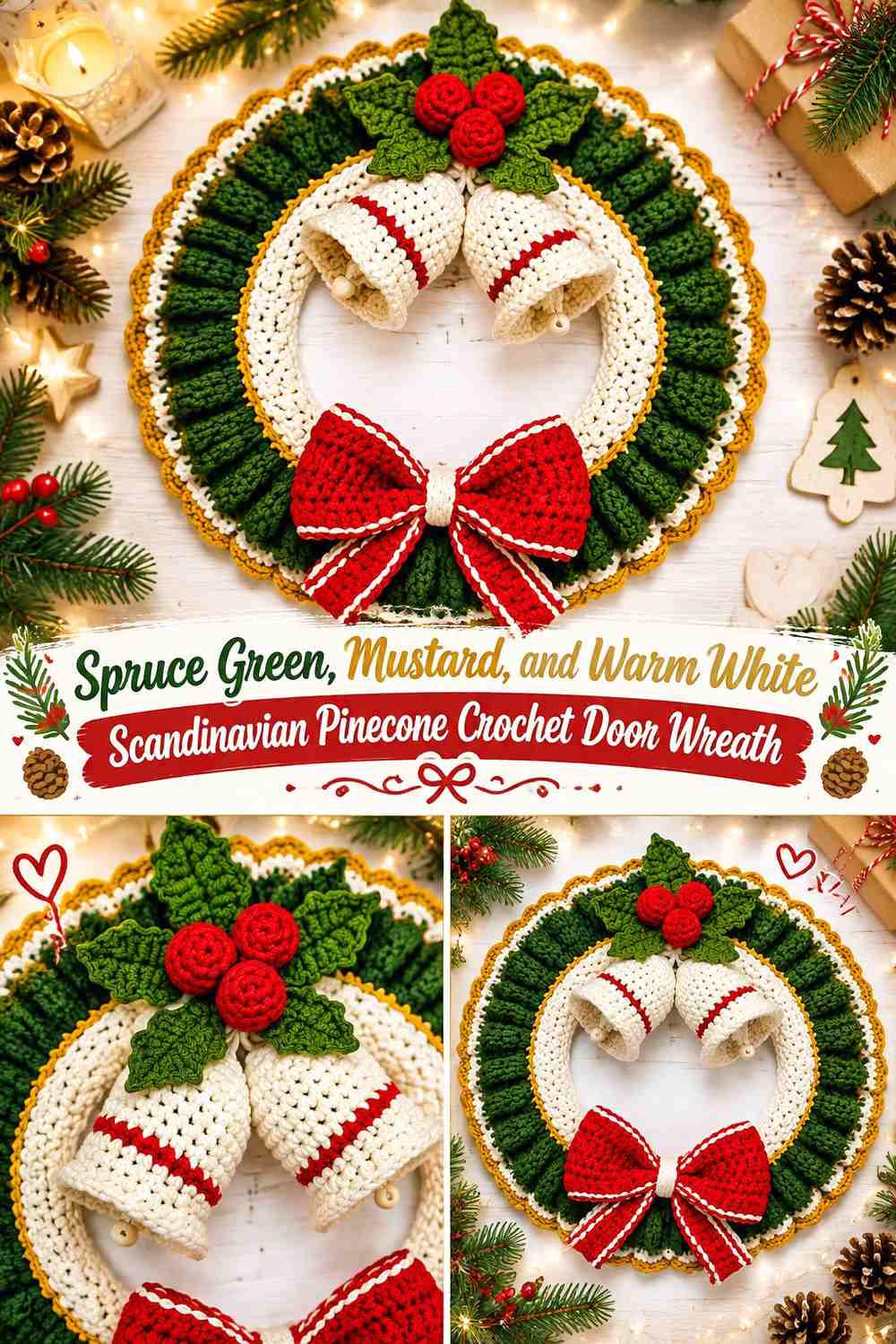
Spruce provides a cool, dark green foundation, mustard adds warmth in small doses, and warm white stops the combination from becoming too dense. Use mustard sparingly on small embellishments or selected cone details rather than turning it into a large wreath section.
Give Spruce Green Most of the Crochet Wreath Surface
Spruce works best as the structural color here. It can cover the ring or dominate the foliage while warm white and mustard appear as secondary details.
Repeat Mustard Against Warm White Instead of Only Spruce Green
A mustard accent is easier to notice beside warm white. Repeating that relationship at two or three points keeps the accent integrated rather than producing one isolated yellow area.
The supporting tutorial demonstrates a full crochet Christmas wreath with additional decorative components, providing a useful wreath-construction reference for this adaptation. YouTube
Creator Credit: Cleyoché Crafts
9. Moss Green, Clay, and Oatmeal Scandinavian Pinecone Crochet Door Wreath

Moss and clay create a subdued woodland palette that feels warmer than fir-and-white. Oatmeal should remain clearly visible so the two earthy shades do not merge into one continuous medium-dark ring.
Let Moss Green Form the Main Botanical Sections
Use moss for larger foliage areas, with clay appearing mainly on pinecones or small decorative elements. That gives the wreath a clear green-led hierarchy even though all three shades are muted.
Place Oatmeal Between Moss Green and Clay Clusters
Oatmeal works as intentional negative space. It can appear through the covered wreath form or in simple connecting sections between the denser botanical areas.
The source demonstrates a crochet wreath ornament rather than a full-size pinecone door wreath, so use it primarily as a circular wreath-construction reference when planning a larger adaptation. YouTube
Creator Credit: Tuba Crochet
10. Deep Teal, Natural Cream, and Chestnut Scandinavian Pinecone Crochet Door Wreath

Deep teal replaces traditional evergreen with a cooler blue-green. Chestnut pinecones bring the palette back toward natural woodland tones, while natural cream provides enough contrast to preserve the circular wreath shape.
Use Deep Teal as the Supporting Color for Chestnut Pinecones
Teal works well on foliage or selected ring sections because it contrasts with chestnut without requiring a bright shade. Keep the pinecones chestnut-led so the cone silhouettes remain immediately recognizable.
Let Natural Cream Open Up the Deep Teal Wreath
A full teal-covered ring can look heavy once chestnut pinecones are added. Leaving a meaningful share of natural cream visible around the circle creates a lighter balance.
The supporting tutorial is a small wreath project rather than a pinecone door wreath, so use its ring idea as an adaptation reference while building the pinecone details independently. YouTube
Creator Credit: Crochet Jewel
11. Birch Cream, Soft Gray, and Pine Green Scandinavian Pinecone Crochet Door Wreath

This is one of the most neutral-led options. Birch cream can dominate the wreath, soft gray can appear in selected pinecones, and pine green can be limited to a few sprigs. The reduced amount of green gives the wreath a more graphic winter appearance.
Give Birch Cream Most of the Crochet Door Wreath
Keeping the base predominantly cream ensures that gray pinecones remain visible and that small areas of pine green have more impact.
Use Soft Gray Pinecones Beside Pine Green Sprigs
Gray cones provide a deliberately stylized alternative to brown while still allowing the raised pinecone structure to do the identifying work. Pine green beside them restores enough botanical color to keep the arrangement grounded in the woodland theme.
The supporting wreath source uses a substantial yarn-covered form and incorporates pinecone embellishment, making it a useful reference for combining a bold wreath base with cone decorations. MJ’s off the Hook Designs
Creator Credit: MJ’s Off The Hook Designs
12. Burgundy, Fir Green, and Flax Scandinavian Pinecone Crochet Door Wreath

Burgundy brings deeper seasonal color than muted red. Because both burgundy and fir green are visually heavy, flax needs enough space to prevent the wreath from becoming a dark ring.
Keep Burgundy Smaller Than Fir Green on the Door Wreath
Use burgundy for berries, a small decorative bow, or a few pinecone details rather than matching the amount of fir green. This maintains the woodland emphasis.
Let Flax Separate Burgundy From Fir Green
A flax-covered section of the ring can create a clean transition between strong colors. It is particularly useful if both burgundy and fir are dark enough to merge from a distance.
The tutorial supports wreath construction and embellishment rather than this exact pinecone palette, so treat the colors and pinecone placement as independent adaptations. CrochetTrends
Creator Credit: CrochetCraftsmann
13. Stone, Chocolate Brown, and Sage Scandinavian Pinecone Crochet Door Wreath

Stone creates a restrained neutral base, chocolate defines the pinecones, and sage provides quiet foliage. The combination works particularly well when you want every component to remain distinct without using white or a highly saturated green.
Keep Chocolate Brown Pinecones Against Stone Sections
Chocolate cones show most clearly where at least part of their outline sits against the lighter stone base. Do not bury every pinecone completely within sage leaves.
Repeat Sage Green Around the Stone Door Wreath
Use smaller sage sprigs at intervals between larger pinecone clusters. Repetition keeps the botanical theme continuous even when much of the neutral ring remains uncovered.
The linked tutorial teaches a crochet leaf garland specifically suitable for wrapping around a wreath, making it a practical foliage reference for this pinecone adaptation. YouTube
Creator Credit: Hooked by Robin
14. Black, Natural Cream, and Moss Scandinavian Pinecone Crochet Door Wreath
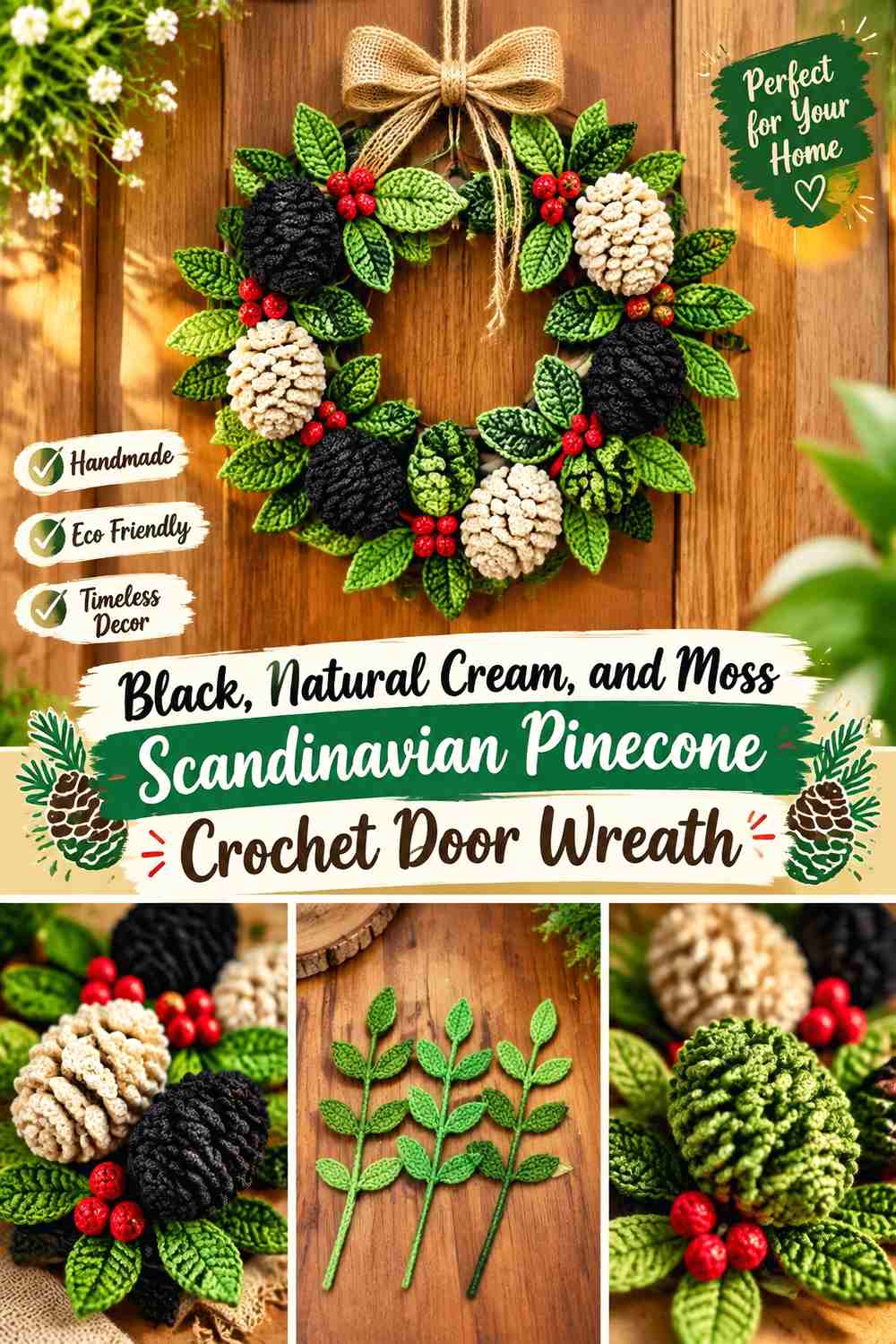
Black gives this wreath a modern graphic edge, so it should remain the smallest color. Natural cream can dominate the ring and selected pinecones, while moss provides botanical contrast.
Use Black Only to Define Natural Cream Pinecones
Instead of making every cone solid black, consider black as a small structural or center accent around predominantly natural pieces. Thick black areas can overpower the softer cream-and-moss relationship very quickly.
Let Moss Green Carry More Space Than Black
Moss can appear repeatedly through botanical sprigs, while black is restricted to small points. This creates a stronger natural connection around the circle without losing the dark Scandinavian-inspired accent.
The supporting tutorial demonstrates eucalyptus-style crochet leaves, so use it for a soft foliage component rather than treating it as a full wreath or pinecone tutorial. YouTube
Creator Credit: Mhalee’s Crochet
15. Ice Blue, Pine Green, and Warm Beige Scandinavian Pinecone Crochet Door Wreath

Ice blue brings a frosty winter note to the final palette, but warm beige keeps it from feeling overly cool. Pine green can serve as the botanical bridge between the two, appearing repeatedly in leaves or small sprigs.
Keep Ice Blue as a Controlled Accent Against Pine Green
Use ice blue on selected pinecones, tiny berries, or narrow wreath details rather than covering the complete ring. Pine green should remain more abundant if you want the wreath to retain a recognizable woodland base.
Let Warm Beige Separate Ice Blue and Pine Green
Warm beige is particularly useful between the cooler shades. It can cover the wreath base, form a hanging loop, or remain visible between clusters so the individual blue and green shapes do not merge.
The linked tutorial demonstrates holly leaves and berries that can be incorporated into larger holiday decor, making it a useful supplementary foliage-and-accent reference for a pinecone wreath. YouTube
Creator Credit: Winding Road Crochet
Which Scandinavian Pinecone Door Wreath Palette Should You Choose?
For the most natural woodland direction, pine green with flax and cocoa, fir with natural cream and walnut, or stone with chocolate and sage keeps brown pinecones central to the design.
For a lighter neutral wreath, birch cream with soft gray and pine, dusty blue with birch and taupe, or sage with mushroom and chocolate shifts more visual space toward pale and muted shades.
If you want a stronger seasonal accent, forest green with muted red and cream or burgundy with fir and flax adds red without requiring a conventional bright Christmas palette. Mustard with spruce or rust with olive provides a warmer alternative.
Black with natural cream and moss gives the strongest graphic contrast, while ice blue with pine and warm beige pushes the design furthest toward a cool winter color scheme.
Conclusion
A Scandinavian-inspired crochet pinecone door wreath does not need dense decoration around every inch of the ring. Pinecones already provide substantial dimension, so one of the most useful design choices is deciding what to leave quiet.
Choose a green-led palette when you want a recognizable woodland wreath, or begin with oatmeal, flax, stone, birch cream, or natural cream when you want the crochet texture and individual pinecones to receive more attention. Brown, gray, rust, and taupe can all work for the pinecones as long as they remain distinguishable from the base behind them.
When adapting the tutorial references, follow each creator for the construction they actually demonstrate. Then plan the final door-wreath palette, pinecone grouping, foliage repetition, and negative space around the needs of your own composition.
Frequently Asked Questions
What colors make a crochet pinecone wreath look Scandinavian-inspired?
Restrained greens and natural neutrals are a useful starting point: pine, fir, sage, moss, oatmeal, flax, cream, stone, taupe, and natural brown. A small amount of burgundy, muted red, mustard, rust, dusty blue, or ice blue can introduce seasonal color without requiring many competing shades.
Should crochet pinecones always be brown on a Scandinavian door wreath?
No. Brown provides a natural direction, but gray, oatmeal, cream, rust, charcoal, or even muted blue can work when the dimensional pinecone texture remains clear. What matters most visually is having enough separation between the cone and the surrounding foliage or wreath base.
How many colors should I use in a crochet pinecone door wreath?
Three clearly defined roles are often enough: a dominant wreath or foliage shade, a pinecone color, and a lighter or stronger supporting accent. A two-color wreath can also work when the crochet texture provides enough variety.
How can I stop dark green crochet foliage and brown pinecones from blending together?
Compare them for light/dark value rather than hue alone. If both are dark, place flax, oatmeal, cream, sage, or another lighter shade behind or between some of the cones. You can also leave portions of the lighter wreath base visible around the cluster.
Should pinecones cover the entire Scandinavian crochet wreath?
They do not have to. Grouping pinecones at a few deliberate points can make each cluster more noticeable and preserve negative space around the rest of the ring. This can be particularly effective when the wreath base itself has an attractive neutral color or texture.
Can I mix different crochet pinecone styles on one door wreath?
Yes, but compare their finished visual scale before making the full set. If one cone is substantially fuller or more textured than another, use that difference deliberately—for example, larger cones in a focal cluster and smaller ones as supporting details—rather than distributing them randomly.
What color should I use for the hanging loop on a Scandinavian pinecone wreath?
Match the dominant neutral when you want the hanger to disappear into the composition, or repeat one existing accent when you want it to become part of the design. Introducing an entirely new color only for the hanging loop can make a restrained three-color wreath feel less cohesive.