Crochet friendship bracelets become much more personal when color and small motifs work together. A cherry-red heart on a blush band can feel completely different from a cobalt evil-eye motif, a rust mushroom, or a teal-and-lilac butterfly even when the bracelet construction stays simple.

For a charm-style bracelet, the band should usually support the motif rather than compete with it. A multicolor charm needs a quieter band, while a one-color heart or star can handle stronger stripes around the wrist. Repeating one charm color somewhere in the band is an effective way to make the whole bracelet feel connected.
The tutorials below include complete friendship and flower bracelets along with heart, rainbow, butterfly, mushroom, star, and other motifs that can be adapted into bracelet charms. When a creator teaches the motif rather than a finished charm bracelet, the band placement and editorial palette below are independent adaptations.
Quick List
- Coral Pink, Butter Yellow, and Sage Crochet Flower Friendship Charm Bracelet
- Turquoise, Tangerine, and Lemon Crochet Woven Friendship Charm Bracelet
- Cherry Red, Blush, and Cream Crochet Heart Friendship Charm Bracelet
- Cobalt, White, and Black Crochet Evil Eye Friendship Charm Bracelet
- Sky Blue, Sunshine Yellow, and Coral Crochet Rainbow Friendship Charm Bracelet
- Lavender, Butter Yellow, and Sage Crochet Daisy Friendship Charm Bracelet
- Teal, Lilac, and Coral Crochet Butterfly Friendship Charm Bracelet
- Rust, Cream, and Moss Crochet Mushroom Friendship Charm Bracelet
- Hot Pink, Orange, and Lemon Crochet Star Friendship Charm Bracelet
- Aqua, White, and Sunflower Yellow Crochet Floral Friendship Bracelet
- Mint, Peach, and Cream Crochet Flower Chain Friendship Bracelet
- Plum, Fuchsia, and Leaf Green Crochet Blossom Friendship Bracelet
- Raspberry, Rose Pink, and Ivory Crochet Heart Friendship Bracelet
- Coral, Hot Pink, and Leaf Green Crochet Hibiscus Friendship Charm Bracelet
- Red, White, and Turquoise Crochet Color-Block Friendship Charm Bracelet
- Lilac, Mint, and Golden Yellow Crochet Adjustable Friendship Charm Bracelet
- Cobalt, Lime, and Orange Crochet Stacking Friendship Charm Bracelet
Give the Crochet Charm a Clear Color Role
On a small bracelet, the charm is usually the first thing the eye notices. Give its dominant shade enough uninterrupted area to preserve the shape. A red heart should still look red after cream edging is added, and a teal butterfly needs enough teal wing surface that lilac and coral remain supporting colors.
If a charm contains three or more shades, simplify the bracelet band. Repeating every charm color in equally sized stripes can make the wrist area much busier than the motif itself.
Repeat One Charm Color in the Friendship Bracelet Band
A repeated shade creates a visual connection between separately crocheted parts. A sage band can echo leaves on a flower charm, black ties can connect with an evil-eye center, and rust accents can relate a mushroom cap to its bracelet base.
The repeat does not need to be large. A narrow stripe, tie end, loop, or edging detail can be enough to make the color scheme look deliberate.
1. Coral Pink, Butter Yellow, and Sage Crochet Flower Friendship Charm Bracelet

Coral pink can lead the small flower motifs, butter yellow can define their centers, and sage can create the connecting bracelet band or leaf-like visual breaks. The palette stays colorful without requiring every flower to be a different shade.
If several flowers repeat around the wrist, keep their color hierarchy consistent. Changing the center, petals, and band color on every motif can turn a simple friendship bracelet into an overly busy rainbow.
Coral Pink Should Carry Most of the Crochet Flower Petals
Use coral across the broadest visible petal area so each flower remains recognizable as part of the same bracelet.
Butter yellow works best as the small center because its warmer light value stands out without competing with the pink.
Sage Should Separate Coral Pink Flowers Along the Friendship Bracelet
Leave visible sage between neighboring flowers instead of placing coral blooms edge to edge.
That green spacing gives each motif a clearer outline and provides visual rest across the wrist.
Creator Credit: Willow & Wild
2. Turquoise, Tangerine, and Lemon Crochet Woven Friendship Charm Bracelet
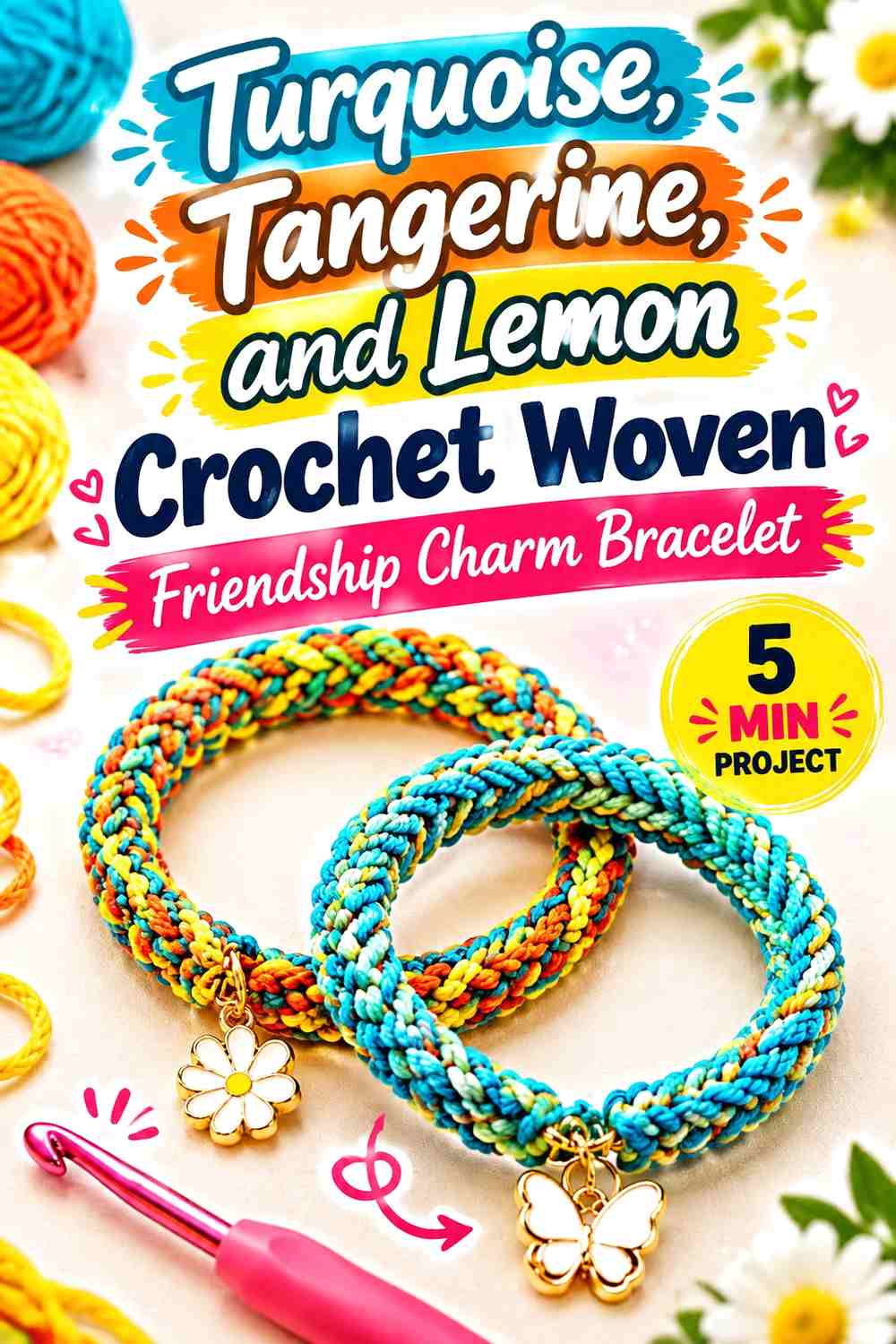
A colorful woven bracelet can use turquoise as the repeating anchor, tangerine as the warm secondary shade, and lemon as the smallest bright accent. This gives the band a retro friendship-bracelet feel without dividing it into equally strong stripes.
If you later add a tiny motif or charm, repeat turquoise or tangerine there instead of introducing a fourth saturated color.
Turquoise Should Repeat Most Often in the Crochet Friendship Band
Use turquoise frequently enough that the bracelet still has one dominant color when viewed from across the wrist.
Tangerine can then appear in wider or more noticeable accent sections without making the entire band orange-led.
Lemon Should Stay Smaller Than Turquoise and Tangerine
A little yellow can brighten the woven effect, but large lemon sections may compete with both stronger colors.
Use it as a narrow stripe, small center detail, or tiny connecting accent.
Creator Credit: CreativeAffy | Crochet Artist
3. Cherry Red, Blush, and Cream Crochet Heart Friendship Charm Bracelet
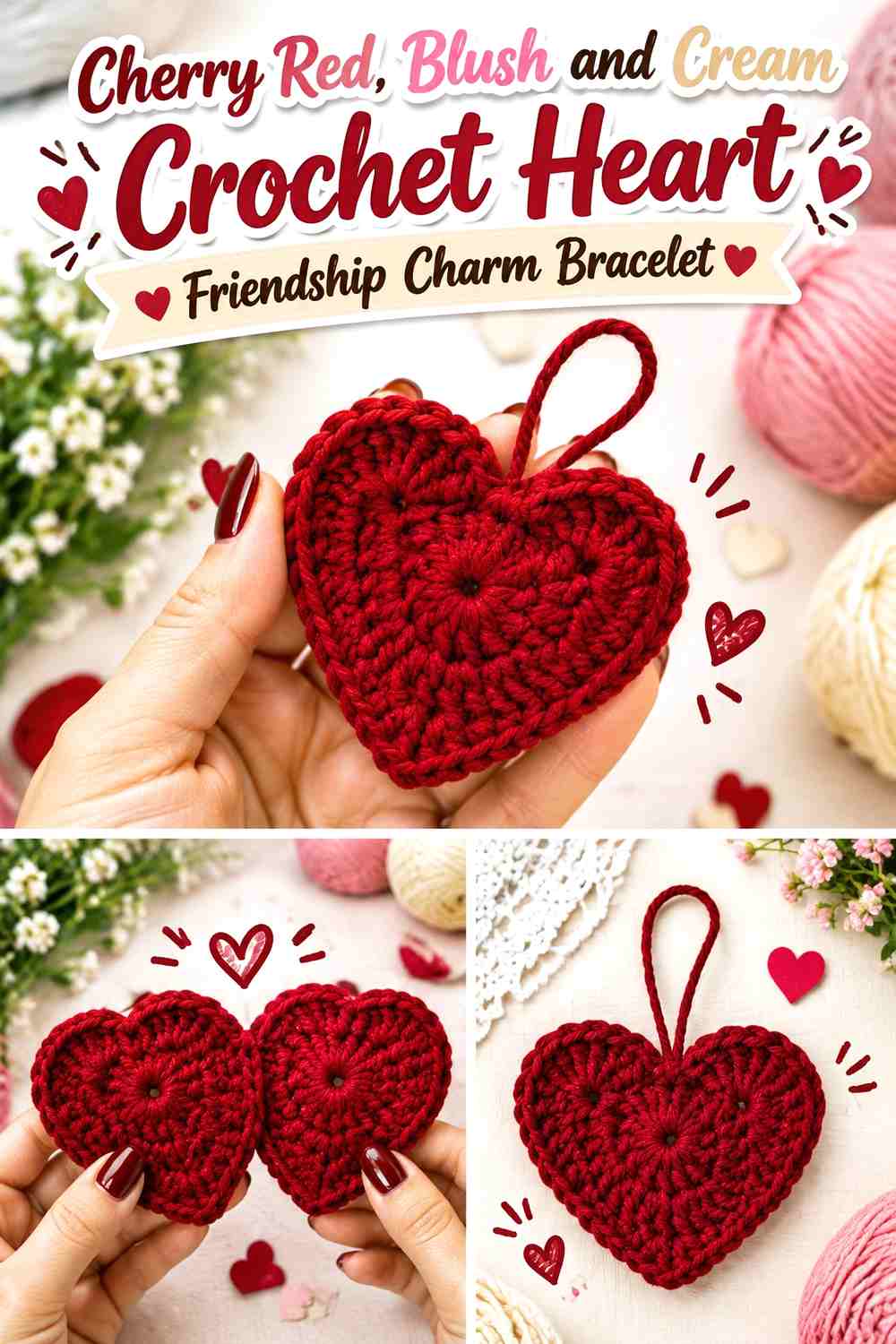
A cherry-red crochet heart makes an immediately readable friendship symbol. Blush can form the band or a smaller second heart, while cream provides separation between the two pink-red values.
Keep the central heart comparatively simple. The pointed lower edge and rounded upper lobes need a clean outline to remain recognizable at bracelet scale.
Cherry Red Should Define the Crochet Heart Charm
Let cherry red reach most of the heart’s outer edge rather than covering it with a broad cream border.
Cream is more useful as a tiny center, attachment loop, or band detail where it does not alter the main silhouette.
Blush Should Soften the Cherry Red Friendship Bracelet Band
A blush band keeps the bracelet romantic without creating an all-red accessory.
Repeat a narrow cherry-red detail near the closure so the heart does not feel visually isolated at the center.
Creator Credit: VivCrochets
4. Cobalt, White, and Black Crochet Evil Eye Friendship Charm Bracelet
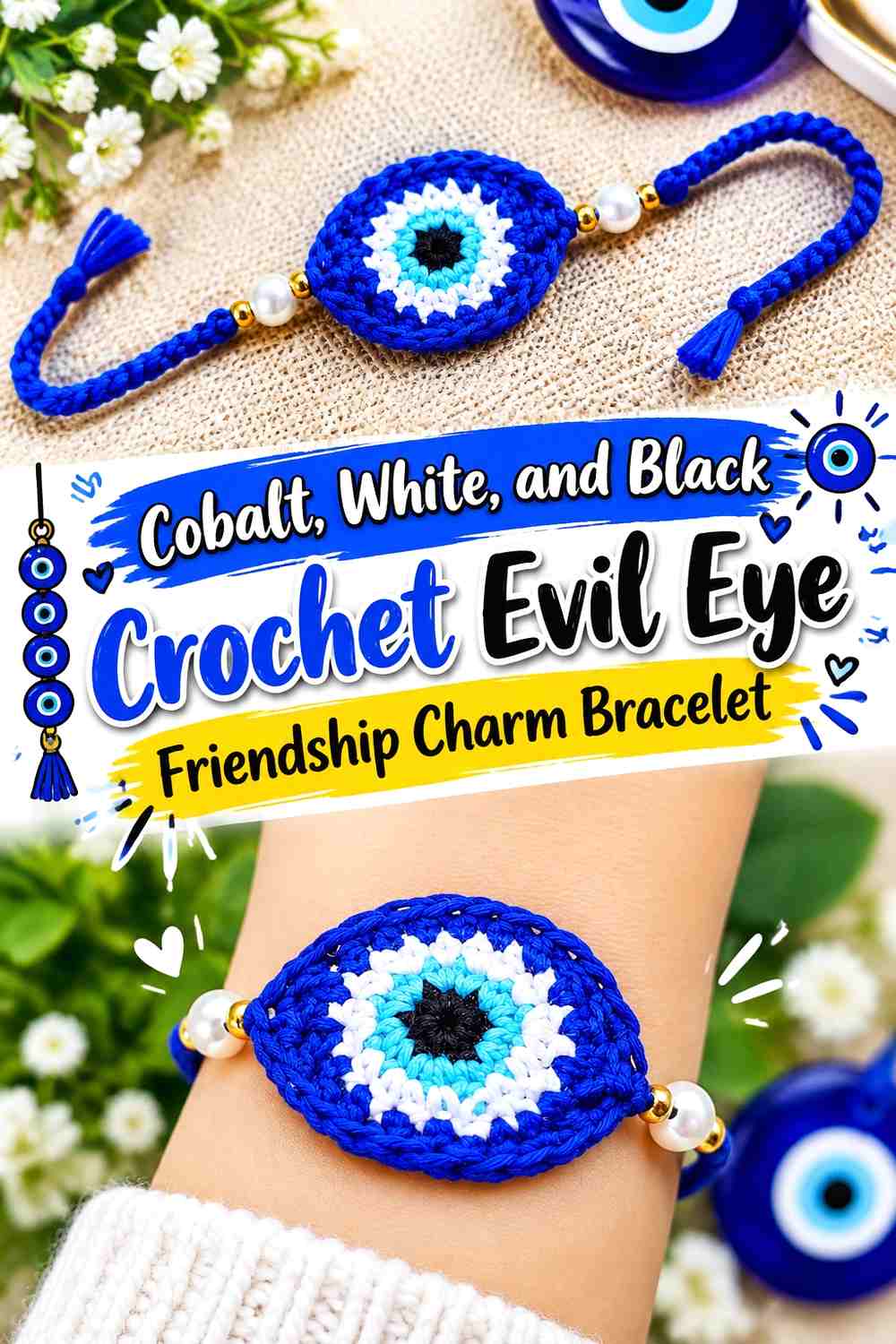
Cobalt naturally suits the largest visible ring of an eye-inspired motif, while white creates a light separator and black defines the center. Let cobalt repeat in the bracelet ties or band so the motif feels integrated rather than attached as an unrelated disk.
Because the charm already has several concentric color changes, the surrounding band should stay comparatively restrained.
Cobalt Should Carry the Main Crochet Evil Eye Color
Give cobalt enough area around the center to remain the motif’s defining color.
If black becomes too broad, the eye can look unusually heavy against a narrow bracelet band.
White Should Separate Cobalt From Black on the Friendship Bracelet
Use white between the dark center and saturated blue where the eye construction allows it.
That light break is what keeps two strong colors from merging when the motif is viewed at normal wrist distance.
Creator Credit: YarnIt Crochet
5. Sky Blue, Sunshine Yellow, and Coral Crochet Rainbow Friendship Charm Bracelet

A rainbow charm does not have to contain every spectrum color. Sky blue, sunshine yellow, and coral can create a compact three-color arch that feels bright without becoming visually crowded.
Use sky blue on the band so the yellow and coral remain concentrated in the charm. That distribution also keeps the bracelet wearable with other colorful friendship bands.
Coral Should Stay Distinct From Sunshine Yellow in the Crochet Rainbow
Give each warm shade a clear stripe rather than blending them through frequent small changes.
Sky blue can provide the cooler outer or inner section that separates the two warm colors visually.
Sky Blue Should Repeat From the Rainbow Into the Friendship Band
Using the same blue on the ties or bracelet base connects the charm to the rest of the project.
Avoid repeating all three rainbow colors in equally wide band stripes, which can make the charm itself less important.
Creator Credit: Crochet Lovers
6. Lavender, Butter Yellow, and Sage Crochet Daisy Friendship Charm Bracelet
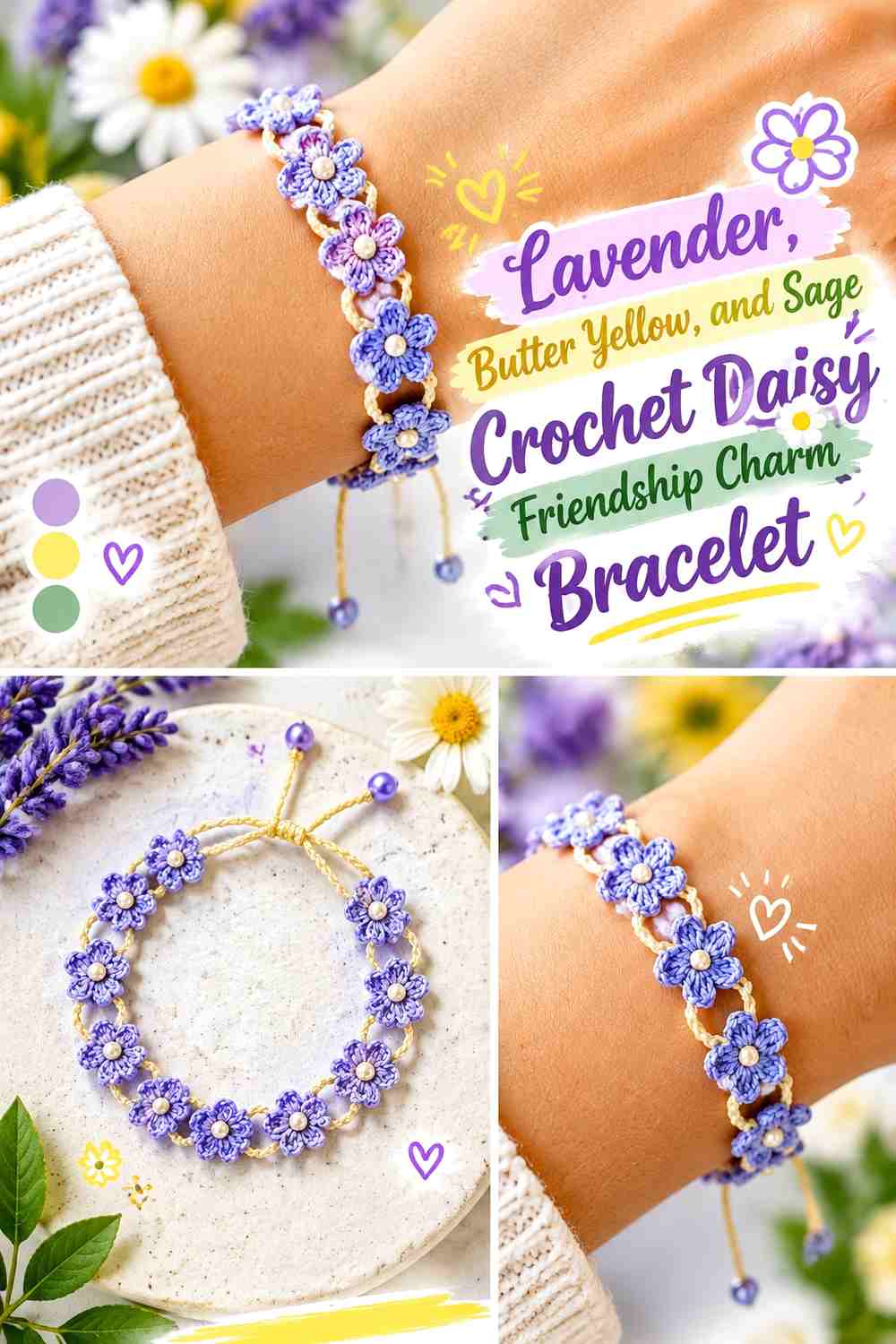
Lavender petals create a playful alternative to standard white daisies, while butter yellow keeps the centers recognizable and sage gives the connecting band a botanical role.
Because lavender and sage can both be muted, the yellow center becomes particularly important for giving each flower a clear focal point.
Lavender Should Cover Most of the Crochet Daisy Petals
Keep lavender consistent across the flower shapes if several daisies repeat around the bracelet.
Changing every flower to a new petal color can weaken the calm lavender-and-sage direction.
Butter Yellow Should Break Up Lavender and Sage on the Friendship Bracelet
Use yellow in the flower centers where its brighter value naturally attracts attention.
Keep it off most of the band so the small centers remain special rather than becoming another repeated stripe.
Creator Credit: Crochet And Craft House
7. Teal, Lilac, and Coral Crochet Butterfly Friendship Charm Bracelet
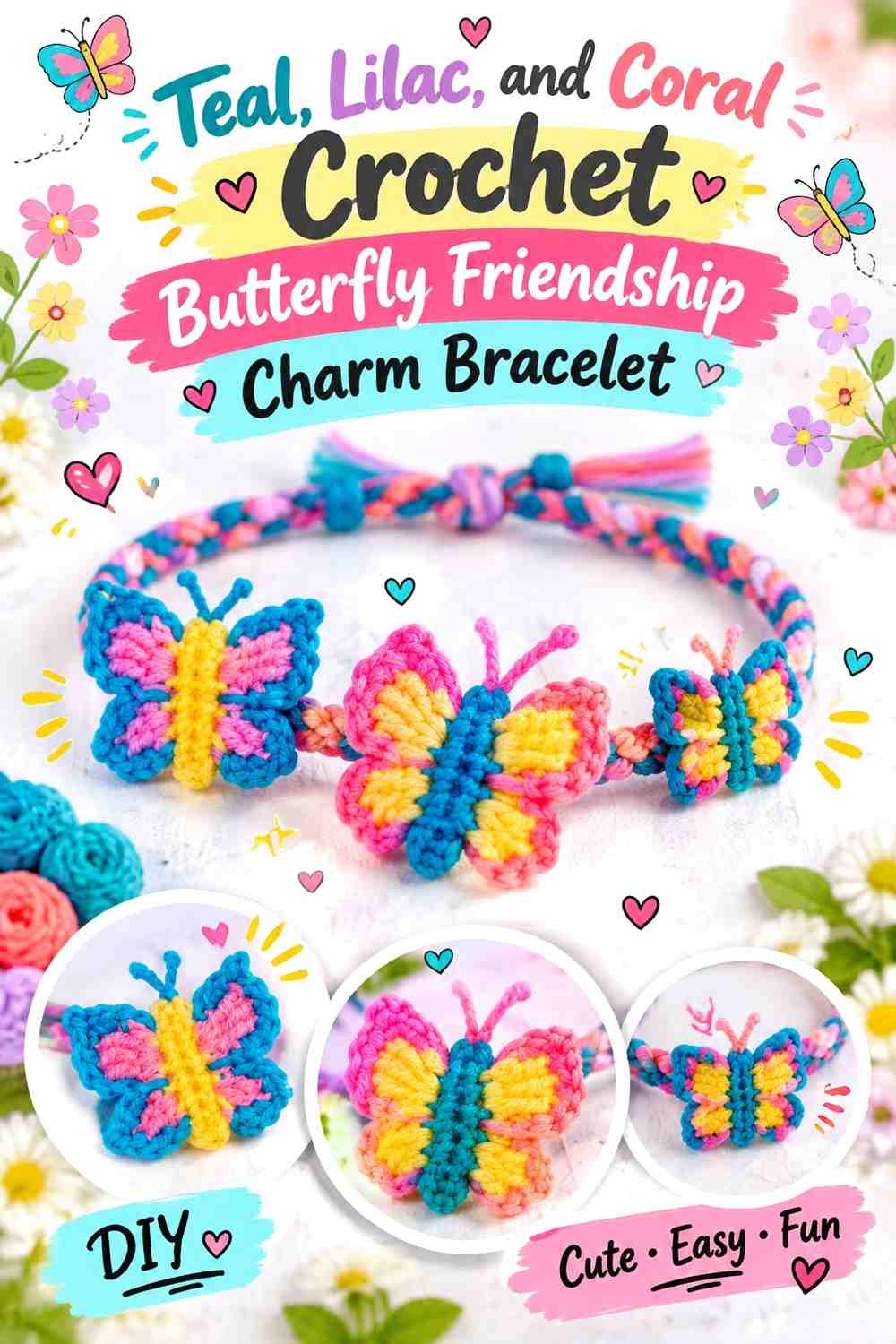
Teal can define the larger butterfly wings, lilac can lighten smaller wing sections, and coral can form one tiny center or wing marking. A lilac or teal band then keeps the butterfly connected to the bracelet.
Leave enough negative space around the outer wings that the butterfly does not visually merge into nearby bracelet details.
Teal Should Define the Main Crochet Butterfly Wing Shape
Use teal around broad wing areas or the outer silhouette so the charm remains easy to identify.
Lilac works better inside the wings than as an equally wide outer border.
Coral Should Stay Small Against Teal and Lilac Butterfly Wings
A coral body or tiny repeated marking is enough to introduce warm contrast.
Large coral wing sections can overpower the cooler teal-and-lilac friendship palette.
Creator Credit: Jess Crafting
8. Rust, Cream, and Moss Crochet Mushroom Friendship Charm Bracelet
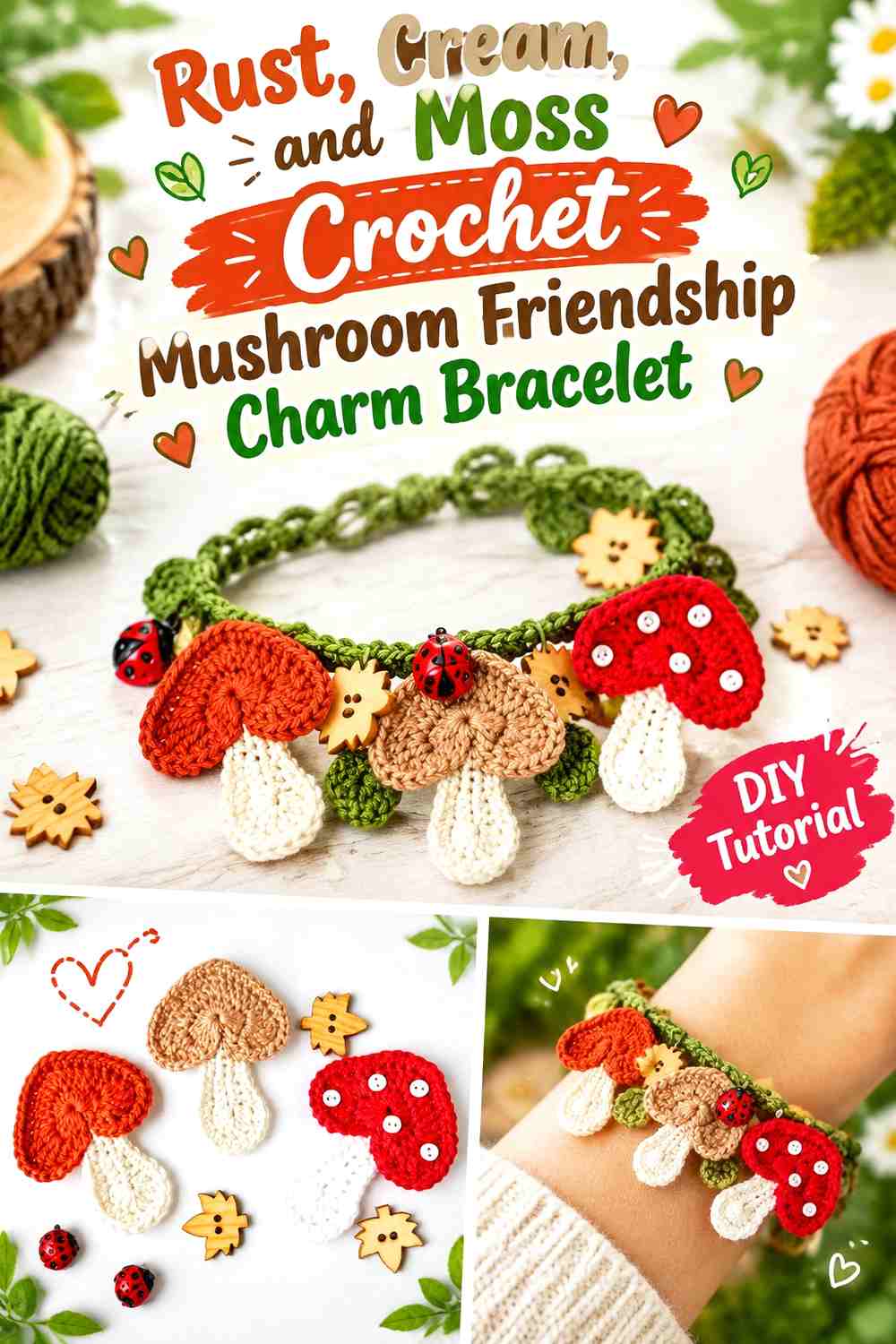
Rust gives a mushroom cap a warm woodland focus, cream can form the stem or cap spots, and moss creates the friendship band or small foliage-inspired accent.
Keep rust concentrated at the charm so the mushroom remains the clear focal point rather than turning the entire bracelet brown-orange.
Rust Should Carry the Crochet Mushroom Cap
Give the cap one broad rust field and keep cream details relatively small.
Too many pale spots can fragment a tiny charm and make its rounded cap harder to see.
Moss Should Separate the Rust Mushroom From the Friendship Band
A moss band introduces a cool earthy contrast and keeps the mushroom from sitting against another reddish-brown background.
A small cream detail near the attachment point can further clarify the charm if needed.
Creator Credit: GoldenLucyCrafts
9. Hot Pink, Orange, and Lemon Crochet Star Friendship Charm Bracelet

A five-pointed star can handle a stronger color combination because its silhouette is simple. Hot pink can dominate the star, orange can create a small center or edging area, and lemon can appear on the bracelet band or one contrasting point detail.
Avoid assigning a different color to every point. Repetition makes the star read more clearly.
Hot Pink Should Keep the Crochet Star Points Connected
Use pink across most of the star so all five points appear to belong to one central motif.
Orange is more effective as a smaller internal area than as alternating star points.
Lemon Should Brighten Hot Pink and Orange Without Splitting the Star
Keep lemon on the band, attachment loop, or another small structural detail.
This lets the star remain pink-led while still creating a three-color friendship bracelet.
Creator Credit: GratiaProject
10. Aqua, White, and Sunflower Yellow Crochet Floral Friendship Bracelet

Aqua creates a fresh bracelet base, white can form flower petals or lighter details, and sunflower yellow supplies small high-contrast centers. This palette works well when the bracelet construction itself is decorative and does not need an additional oversized charm.
Keep yellow contained so the aqua band remains a visible part of the finished accessory.
Aqua Should Remain Visible Around the White Crochet Flowers
Leave enough band area exposed between motifs for the bracelet to retain its main color.
If white flowers cover the entire wrist, the aqua may look like an attachment detail rather than a deliberate palette choice.
Sunflower Yellow Should Stay Small Beside Aqua and White
Use yellow where a floral center or tiny accent naturally belongs.
Its strong warmth is most useful in small repeated points rather than broad bracelet sections.
Creator Credit: Crochet Aura
11. Mint, Peach, and Cream Crochet Flower Chain Friendship Bracelet
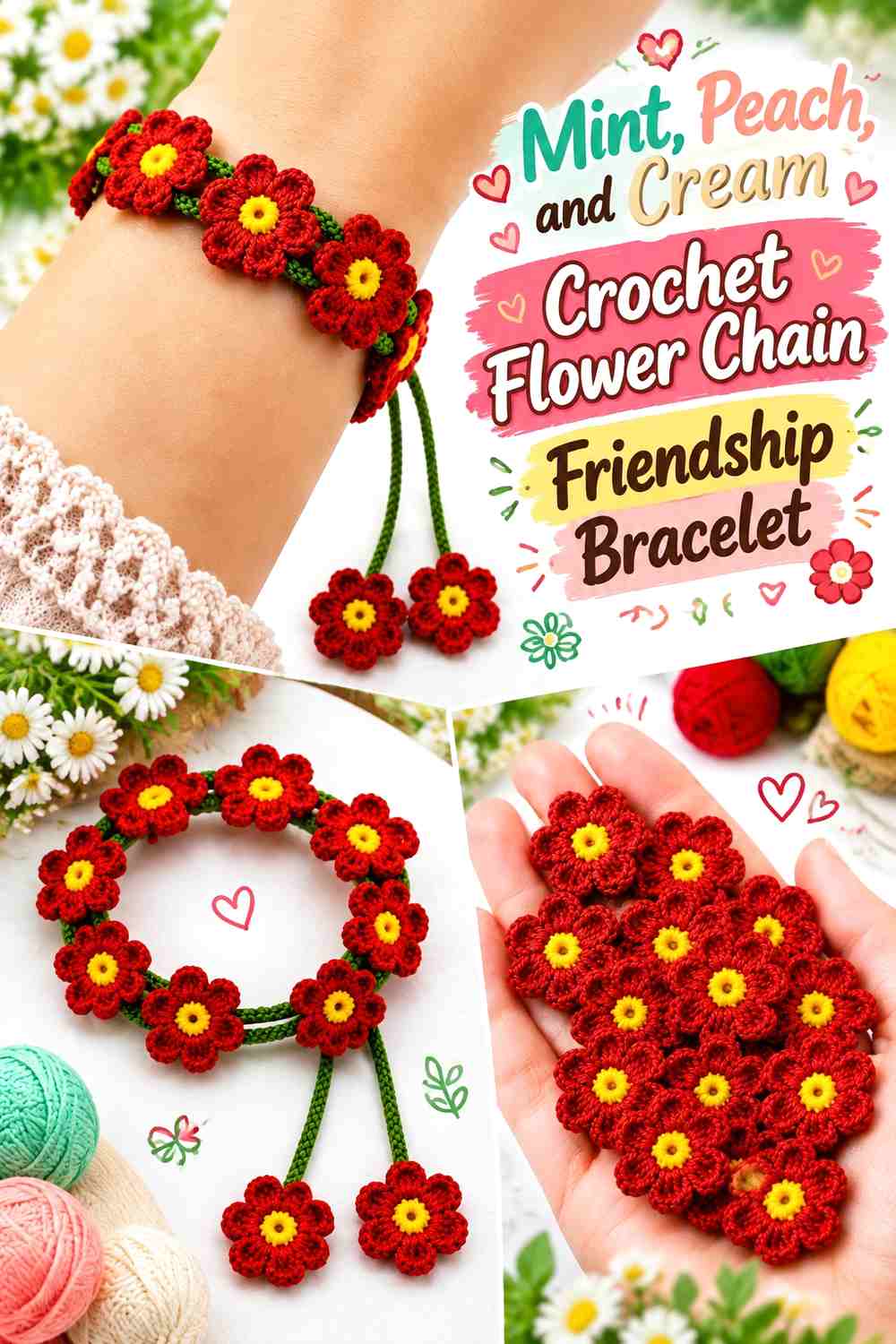
Mint can form the narrow connecting chain, peach can lead the flowers, and cream can lighten centers or ties. This creates a softer colorful bracelet than primary or neon combinations.
The open spacing between flowers is important. Let mint remain visible rather than crowding peach motifs across the entire wrist.
Peach Should Lead the Crochet Flower Chain Motifs
Use peach consistently on the main petals so repeated flowers feel connected.
Cream centers can provide enough variation without changing every bloom to a different pastel.
Mint Should Remain Visible Between Peach and Cream Flowers
The green chain acts as negative space and provides the botanical cue that keeps the bracelet from looking like a row of unrelated pink shapes.
Repeat mint in the ties if the connecting sections otherwise feel too short to establish the color.
Creator Credit: Knittinglov
12. Plum, Fuchsia, and Leaf Green Crochet Blossom Friendship Bracelet
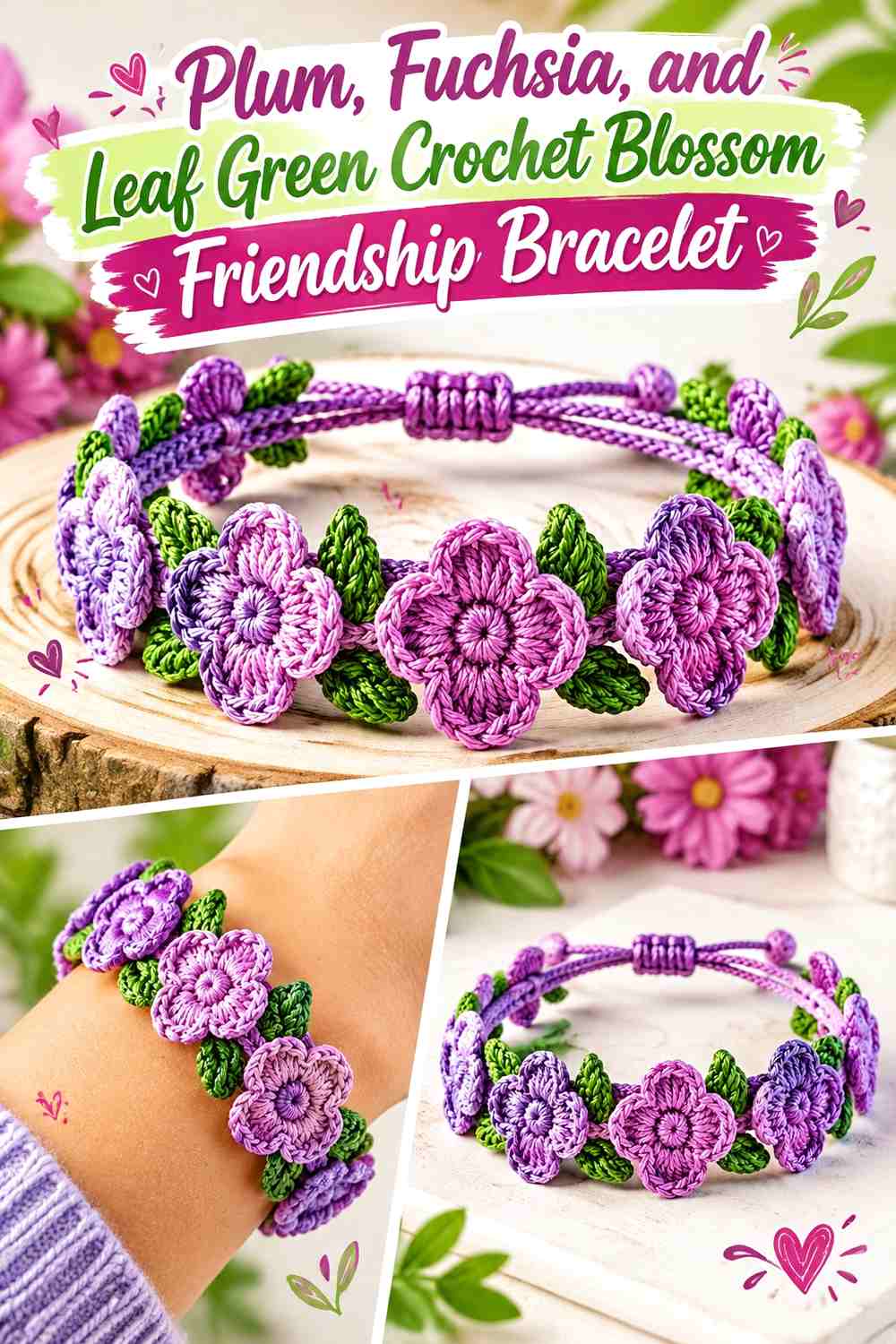
Plum gives repeated floral motifs depth, while fuchsia can brighten selected petals and leaf green supplies contrast between blooms. Because both flower colors are strong, green spacing becomes important.
Keep the darkest plum in a consistent location across the repeating motifs so the bracelet develops a visible rhythm.
Plum Should Anchor the Fuchsia Crochet Blossoms
Use plum in centers, outer petals, or another repeated structural position.
Randomly moving the dark shade around each flower can make identical motifs look unrelated.
Leaf Green Should Separate Plum and Fuchsia Across the Bracelet
Use green between flowers or along the connecting band.
That cooler hue gives the two purples enough breathing room and keeps the friendship bracelet from becoming one continuous pink strip.
Creator Credit: Quiereme Mucho – Crochet y Amigurumis
13. Raspberry, Rose Pink, and Ivory Crochet Heart Friendship Bracelet

Raspberry can carry the strongest heart motif, rose pink can form the band or secondary hearts, and ivory can create small separators. This produces a tonal friendship palette without relying on high contrast.
The key is making raspberry noticeably deeper than rose pink so the heart remains distinct.
Raspberry Should Be Darker Than the Rose Pink Crochet Band
A clear value change keeps the heart visible even though both colors belong to the same family.
If the two yarns appear too similar, add ivory near the charm instead of introducing another pink.
Ivory Should Stay Secondary to Raspberry and Rose Pink Hearts
Use ivory at the tie, edge, or tiny center where it can clarify the motif.
A wide ivory band would change the bracelet from tonal pink to neutral-led.
Creator Credit: KnittingWorld_
14. Coral, Hot Pink, and Leaf Green Crochet Hibiscus Friendship Charm Bracelet
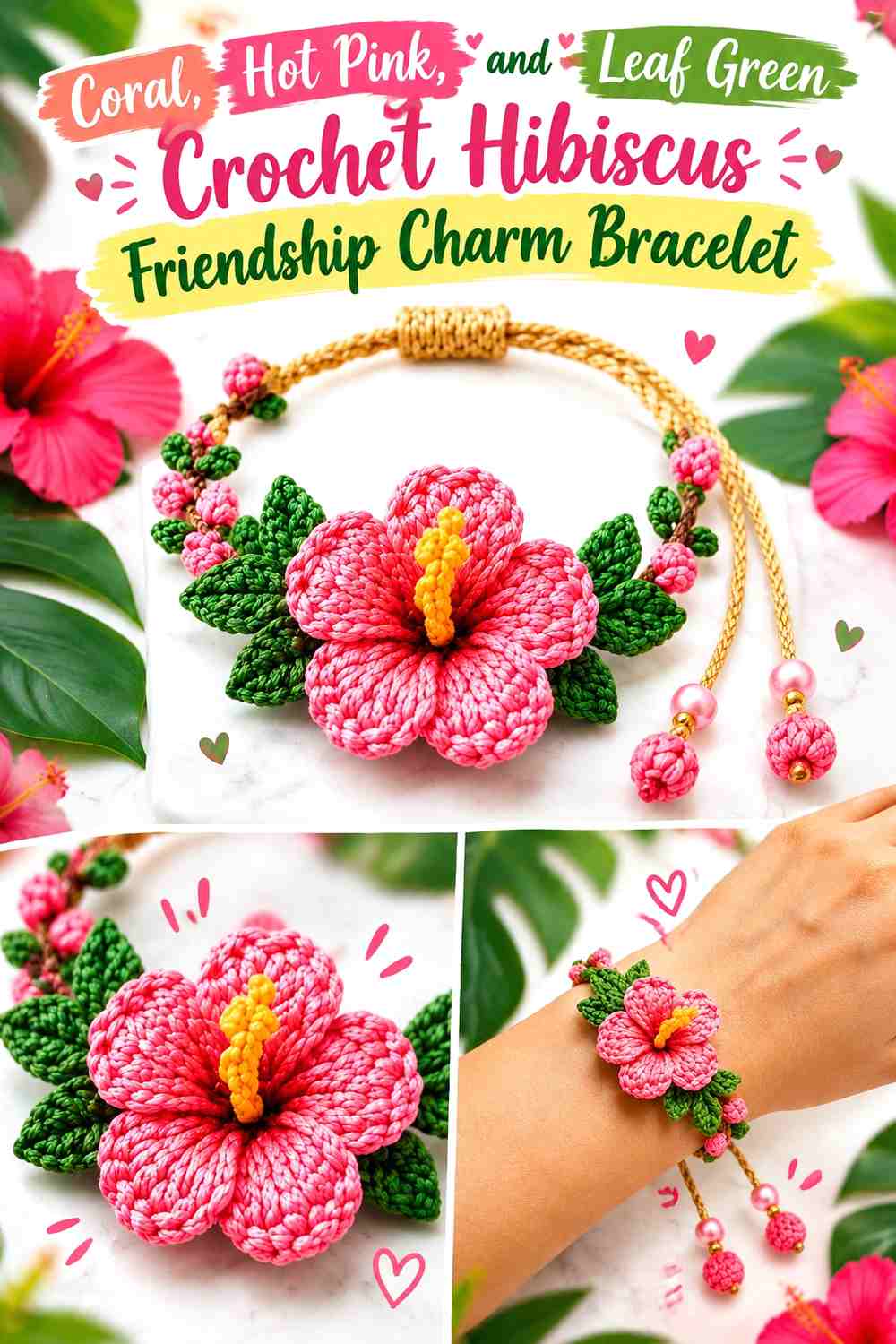
A hibiscus-style bracelet can carry more dramatic flower color than a daisy chain. Coral can dominate the petals, hot pink can deepen the center, and leaf green can create the bracelet connection or foliage detail.
Keep the flower concentrated near one focal point if it is visually fuller than the other motifs in this collection.
Coral Should Carry Most of the Crochet Hibiscus Petals
Use coral through the broader flower areas so the bloom has one obvious main shade.
Hot pink should remain nearer the center or in selected petal sections where it creates depth.
Leaf Green Should Balance Coral and Hot Pink on the Friendship Bracelet
A green band gives the two warm colors a cooler base and keeps the flower from blending into the wrist ties.
Avoid adding another strong floral color unless you deliberately want a multibloom bracelet.
Creator Credit: Talented Girl
15. Red, White, and Turquoise Crochet Color-Block Friendship Charm Bracelet

Red and white create a bold friendship-band foundation, while turquoise can become the unexpected accent that makes the bracelet more playful. Use one of the red or white sections to support a tiny center motif, knot-like accent, or attachment point rather than adding many new colors.
This approach works well when you want the band itself to provide most of the visual interest.
Red Should Be Stronger Than White in the Crochet Friendship Band
Give red slightly more visual area if you want a vivid bracelet rather than a predominantly pale one.
White can work as the separator that keeps neighboring color sections crisp.
Turquoise Should Stay Smaller Than Red and White on the Bracelet
Use turquoise once or twice as a focal accent rather than alternating it throughout the entire band.
Its cooler hue will remain noticeable even in a small amount.
Creator Credit: Martenitsa Spirit
16. Lilac, Mint, and Golden Yellow Crochet Adjustable Friendship Charm Bracelet
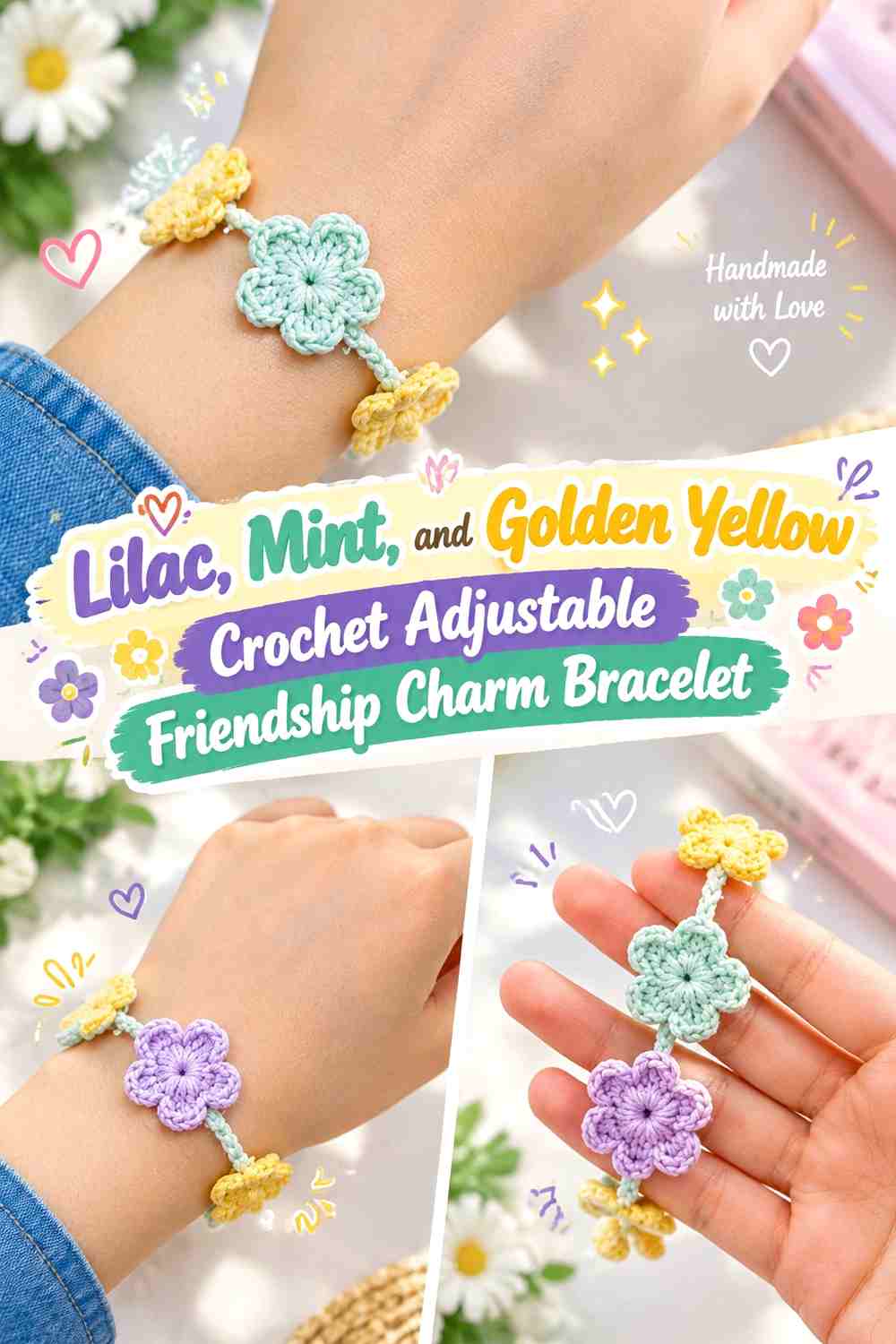
An adjustable friendship bracelet can use lilac as its main band color, mint as a repeated secondary stripe or section, and golden yellow as the small focal accent. The restrained three-color balance leaves room to add a tiny charm without the wrist becoming visually overloaded.
If you attach a separate motif, repeat lilac or mint in it rather than creating an entirely new palette.
Lilac Should Carry Most of the Crochet Adjustable Bracelet
Use lilac through the longest band sections so the friendship bracelet has one recognizable main color.
Mint can interrupt the band at planned intervals without dividing it into equal blocks.
Golden Yellow Should Act as a Small Accent Beside Lilac and Mint
Place yellow at the charm attachment, tie ends, or another compact point.
Its warmth creates enough contrast to be noticed without requiring a broad stripe.
Creator Credit: crochet Sinarra
17. Cobalt, Lime, and Orange Crochet Stacking Friendship Charm Bracelet

Cobalt, lime, and orange create the boldest stacking palette in the list. Let cobalt anchor most of the bracelet, use lime as the brighter secondary shade, and reserve orange for one small accent or charm point.
If you make several bracelets for friends, reverse the dominant color on each while repeating all three shades. The set will coordinate without every bracelet being identical.
Cobalt Should Ground Lime and Orange on the Crochet Bracelet
Use cobalt through the longest visible sections so the two brighter colors have a stable base.
This is particularly useful when several friendship bracelets will be stacked together on one wrist.
Orange Should Stay Smaller Than Cobalt and Lime in the Friendship Stack
Use orange once or twice instead of giving all three colors equal stripe widths.
The smallest warm accent often becomes the most noticeable precisely because it appears less frequently.
Creator Credit: Lexie Loves Stitching
Which Colorful Friendship Charm Bracelet Palette Should You Choose?
For cheerful floral bracelets, coral with butter yellow and sage, lavender with yellow and green, or peach with mint and cream creates clear motif separation while keeping the colors friendly and wearable.
For bolder bracelets, cobalt, turquoise, hot pink, orange, lime, or fuchsia can carry more visual weight. Use only one or two of those shades broadly and keep the remaining bright colors in small charms or accents.
Woodland and whimsical charms work especially well with earthier combinations. Rust and moss suit mushrooms, while teal and lilac give butterflies a fantasy direction. Hearts can be tonal in raspberry and rose, and rainbow motifs can use a selective three-color scheme rather than every possible hue.
Conclusion
Colorful crochet friendship charm bracelets work best when the band and motif have separate jobs. The bracelet needs enough repeated color to feel coordinated around the wrist, while the heart, flower, rainbow, mushroom, star, butterfly, or eye motif needs enough contrast to remain recognizable.
For a coordinated set of best-friend bracelets, choose three or four shared colors and change which one dominates each bracelet. One friend might receive a coral-led flower bracelet, another a teal butterfly, and another a pink heart, while sage or cream repeats across the set.
Before attaching a charm permanently, place it on the finished band and view the bracelet from normal wearing distance. If the motif disappears into the band, change the attachment area or add a small contrasting separator rather than automatically introducing another color. Follow each credited creator’s tutorial for the bracelet or motif construction it actually teaches, then adapt the palette and charm placement independently.
Frequently Asked Questions
How many colors should a crochet friendship charm bracelet use?
Three main colors are often enough. Give one color the largest role, use a second for support, and reserve the third for the charm center, edge, stripe, or another small accent.
How can I make a crochet charm stand out from the bracelet band?
Choose a charm color that differs in lightness or hue from the section directly behind it. A cream separator can also help when two darker colors, such as burgundy and brown, are too similar.
Can matching friendship bracelets use different charms?
Yes. You can repeat the same band palette while changing the central motifs. Hearts, stars, flowers, butterflies, rainbows, mushrooms, and eye-inspired motifs can all belong to one coordinated set when one or two colors repeat.
Should the bracelet band match the crochet charm?
It does not need to match exactly. Repeating just one charm color in the band is usually enough to connect the two pieces while preserving contrast.
How can I use rainbow colors without making a friendship bracelet too busy?
Choose three or four colors instead of using every rainbow shade, or keep the rainbow confined to the charm while the band uses one repeated color. This gives the motif more visual importance.
What colors work well for best-friend crochet bracelets?
Bright combinations such as turquoise and orange, coral and sage, lilac and mint, or cobalt and lime work well when you want playful bracelets. Softer friendship sets can use blush, cream, dusty rose, sage, and lavender.
Do all the linked tutorials make the exact charm bracelets described here?
No. Some teach complete friendship or floral bracelets, while others demonstrate individual hearts, butterflies, rainbows, mushrooms, stars, or other motifs that can be adapted into bracelet charms. Follow each creator’s original construction and use the color placement and bracelet combinations here as independent adaptations.