Peach and mulberry give a crochet ruffle ankle cuff a useful light-and-dark contrast. Peach can keep gathered or scalloped edges visibly light, while mulberry can define the fitted cuff band, ties, or lower border. Reversing those roles creates a darker ruffle with a softer peach anchor around the ankle.

Because ankle cuffs have relatively little surface area, color placement matters more than the number of shades used. A peach ruffle attached to a mulberry band can provide all the contrast the piece needs. Adding frequent stripes through both the band and ruffle can make the cuff look busier without improving the design.
Fit and color should also be planned separately. The supporting tutorials below include ruffled anklet warmers and short crochet boot-cuff constructions that provide useful cuff-building concepts. Not every source includes the editorial ruffle described here, so follow the original creator for the base construction and treat the peach-and-mulberry ruffle placement as an independent adaptation.
Quick List
- Mulberry Band And Peach Double Ruffle Crochet Ankle Cuff
- Peach Band And Mulberry Scalloped Crochet Ankle Cuff
- Peach And Mulberry Lace Ruffle Crochet Ankle Cuff
- Mulberry And Peach Picot Ruffle Crochet Ankle Cuff
- Peach And Mulberry C2c Texture Crochet Ruffle Ankle Cuff
- Mulberry Body And Peach Wide Ruffle Crochet Ankle Cuff
- Peach Ribbed And Mulberry Edge Crochet Ruffle Ankle Cuff
- Mulberry Ribbed And Peach Frill Crochet Ankle Cuff
- Peach And Mulberry Button Accent Crochet Ruffle Ankle Cuff
- Mulberry Peach And Cream Layered Crochet Ruffle Ankle Cuff
- Peach And Mulberry Minimal Crochet Ruffle Ankle Cuff
- Mulberry And Peach Textured Crochet Ruffle Ankle Cuff
Decide Whether Peach or Mulberry Should Own the Ankle Band
The fitted band is the visual anchor of an ankle cuff. A mulberry band creates a darker base that makes a peach ruffle look especially light, while a peach band produces a softer foundation and lets even a narrow mulberry edge become noticeable.
Avoid splitting a short band into too many tiny stripes unless striping is the main design idea. Ruffles already create shadows, curves, and movement, so one relatively solid band usually gives the decorative edge a clearer background.
Also check the colors after the fabric gathers around the ankle. Mulberry may look deeper inside ribbing or folds than it does in the skein, while peach can appear more prominent along outward-facing ruffle edges.
Use Peach and Mulberry to Separate the Ruffle From the Cuff
The clearest two-color arrangement assigns one shade to the fitted band and the other to most of the ruffle. This creates a visible transition exactly where the fabric changes from close-fitting to flared.
For a more integrated result, repeat the band color in a narrow final edge on the contrasting ruffle. A peach ruffle on a mulberry cuff, for example, can finish with a small mulberry outline. That repeat ties the two areas together without turning the ruffle into a heavily striped feature.
If you plan multiple ruffle layers, establish a hierarchy. One dominant peach ruffle with a smaller mulberry tier will usually look more deliberate than several equal layers competing for attention.
Check Peach and Mulberry Contrast in Ribs, Scallops, and Lace
Peach and mulberry are different hues, but their lightness can vary considerably between yarns. A pale peach beside deep mulberry produces strong value contrast, while a dark muted peach and softened mulberry can appear closer than expected.
Compare the actual yarns side by side before using them for tiny picots or narrow lace sections. If the contrast is weak, keep the colors in larger blocks. A complete peach ruffle beside a mulberry band will remain more readable than alternating the same two shades through very small details.
1. Mulberry Band And Peach Double Ruffle Crochet Ankle Cuff

This is the strongest dark-base/light-ruffle arrangement. Let mulberry form the close-fitting ankle band and move into peach for the visible ruffle area. Two peach tiers can create depth without requiring another color, while a small mulberry repeat at the outer edge reconnects the frill to the band.
Let Mulberry Anchor the Peach Ruffles
Keep most of the fitted portion mulberry so the lighter ruffles have a stable visual base. A solid dark band also prevents the ankle section from competing with the layered edge.
If the band uses ribbing, check the mulberry in normal lighting. Deep grooves can make a dark color look even heavier, so there may be little need for extra dark trim.
Keep Peach Visible Across Both Mulberry Ruffle Layers
Use peach for enough of each ruffle that the layers remain identifiable once they overlap. Very narrow peach tiers may disappear behind one another when the cuff is worn.
If stronger definition is wanted, add mulberry only at the final edge rather than changing the whole lower ruffle to dark purple-red.
Creator Credit: Melody Yarn Tinka
2. Peach Band And Mulberry Scalloped Crochet Ankle Cuff
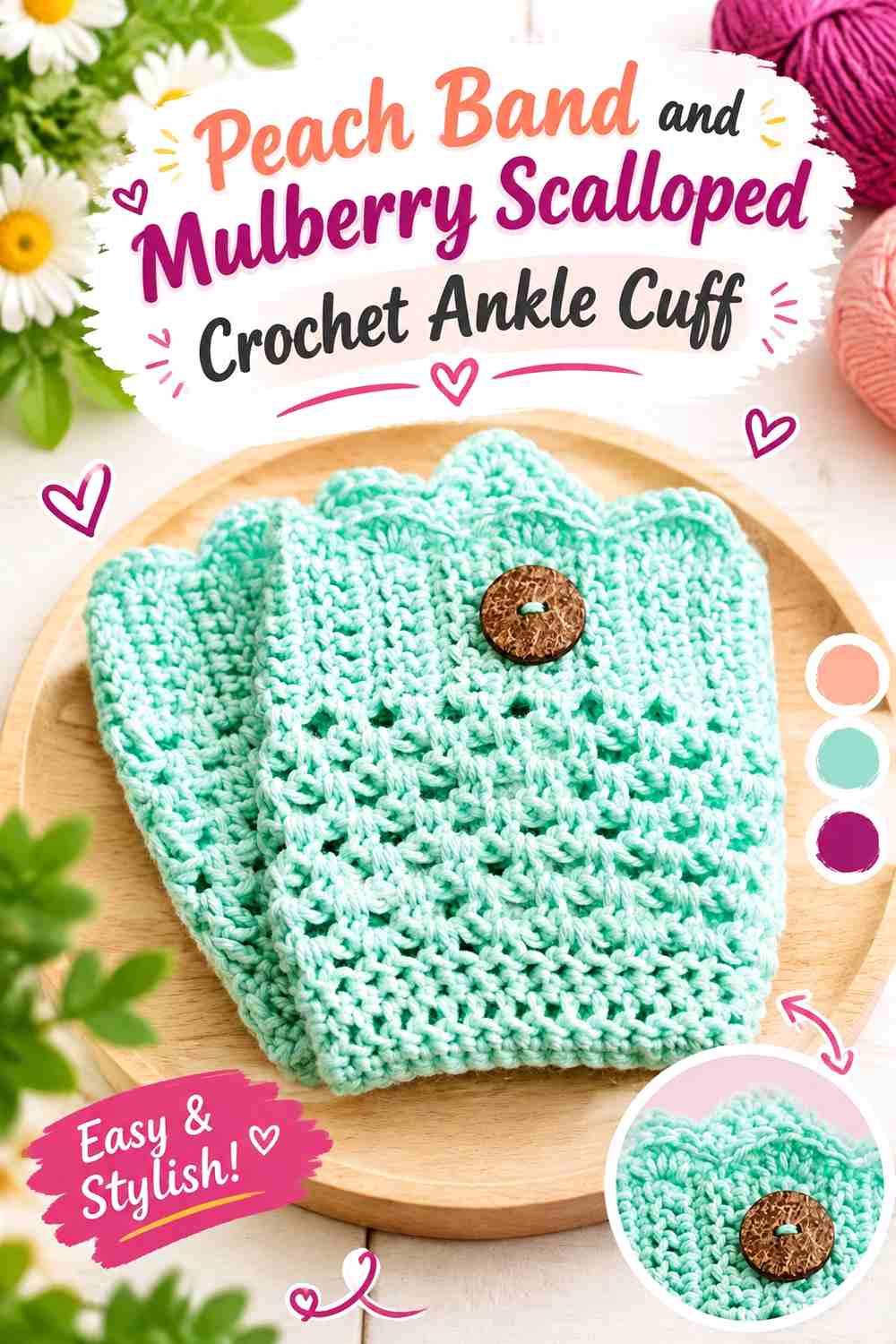
A peach band makes the ankle cuff lighter overall, while mulberry scallops provide a strong dark decorative edge. This arrangement works well when you want the ruffle effect to be relatively controlled rather than deeply gathered.
Keep Peach Broad Behind the Mulberry Scallops
Let the fitted cuff remain predominantly peach so each mulberry curve has enough light background around it.
Introducing several dark stripes through the band would reduce the contrast between the plain cuff and decorative edge.
Trace the Peach Cuff With Mulberry Scallops
Use mulberry consistently through the scalloped edge so the curves read as one continuous design around the ankle.
If you want more peach at the bottom, place it inside the scallop and keep only the outermost line mulberry. That creates a lighter frill while retaining a defined dark silhouette.
Creator Credit: iKNITS
3. Peach And Mulberry Lace Ruffle Crochet Ankle Cuff
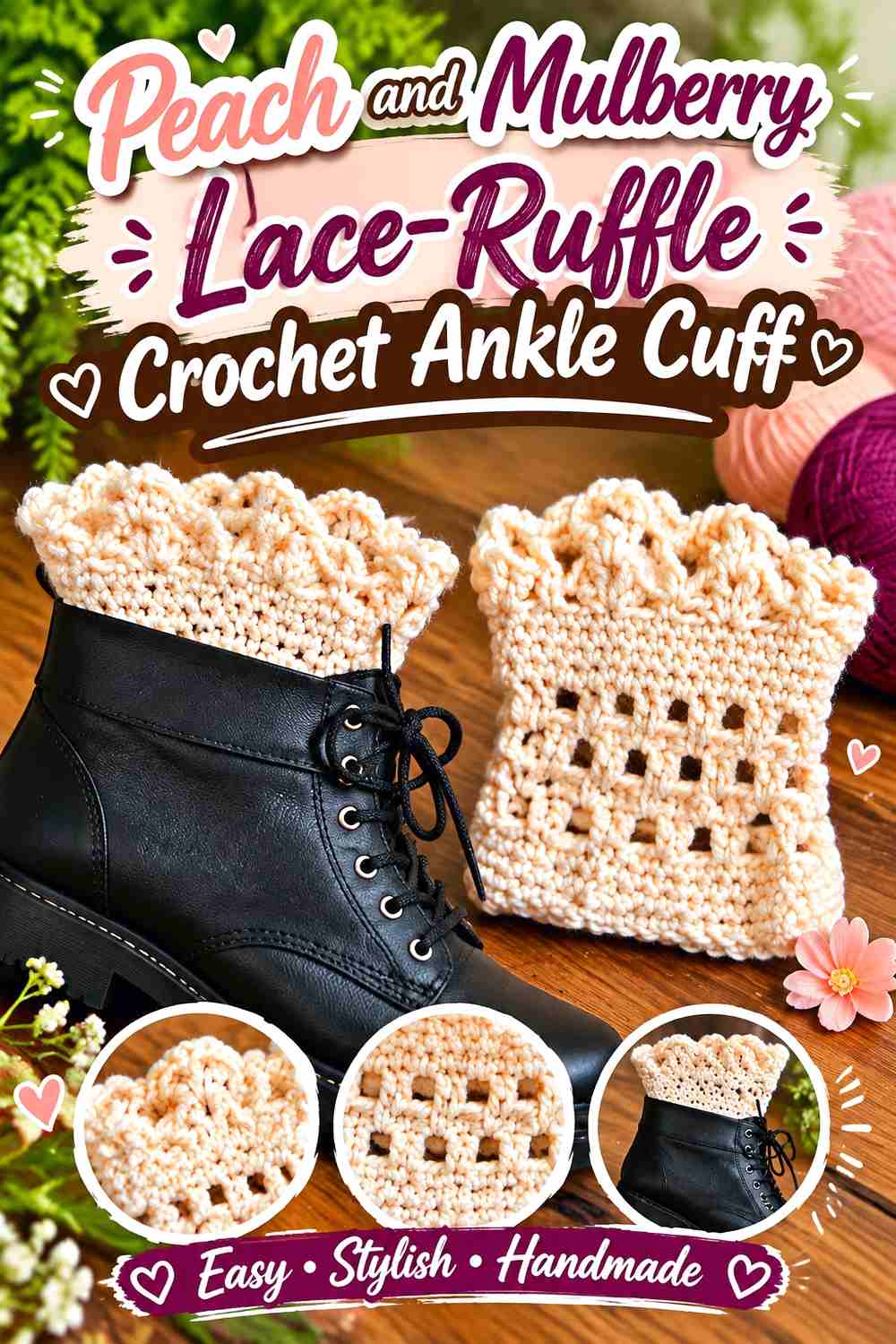
Lace introduces open spaces that allow skin, tights, or socks beneath the cuff to influence how the colors appear. Use mulberry for the more solid band and peach for the open ruffle when you want the lace to feel lighter and less visually dense.
Use Peach to Keep the Mulberry Lace Ruffle Light
Peach works well across an open lace section because the color remains soft while the holes create additional visual separation.
If the lace is very open, make sure enough peach stitches remain visible to distinguish the ruffle from the background beneath it.
Keep Mulberry Solid Above the Peach Lace
A denser mulberry upper band gives the lace a clear starting point. This contrast between solid dark fabric and lighter openwork is more useful than changing color repeatedly inside the lace itself.
A narrow mulberry repeat at the ruffle edge can be added when you want a stronger finish.
Creator Credit: Carolynn Markey
4. Mulberry And Peach Picot Ruffle Crochet Ankle Cuff
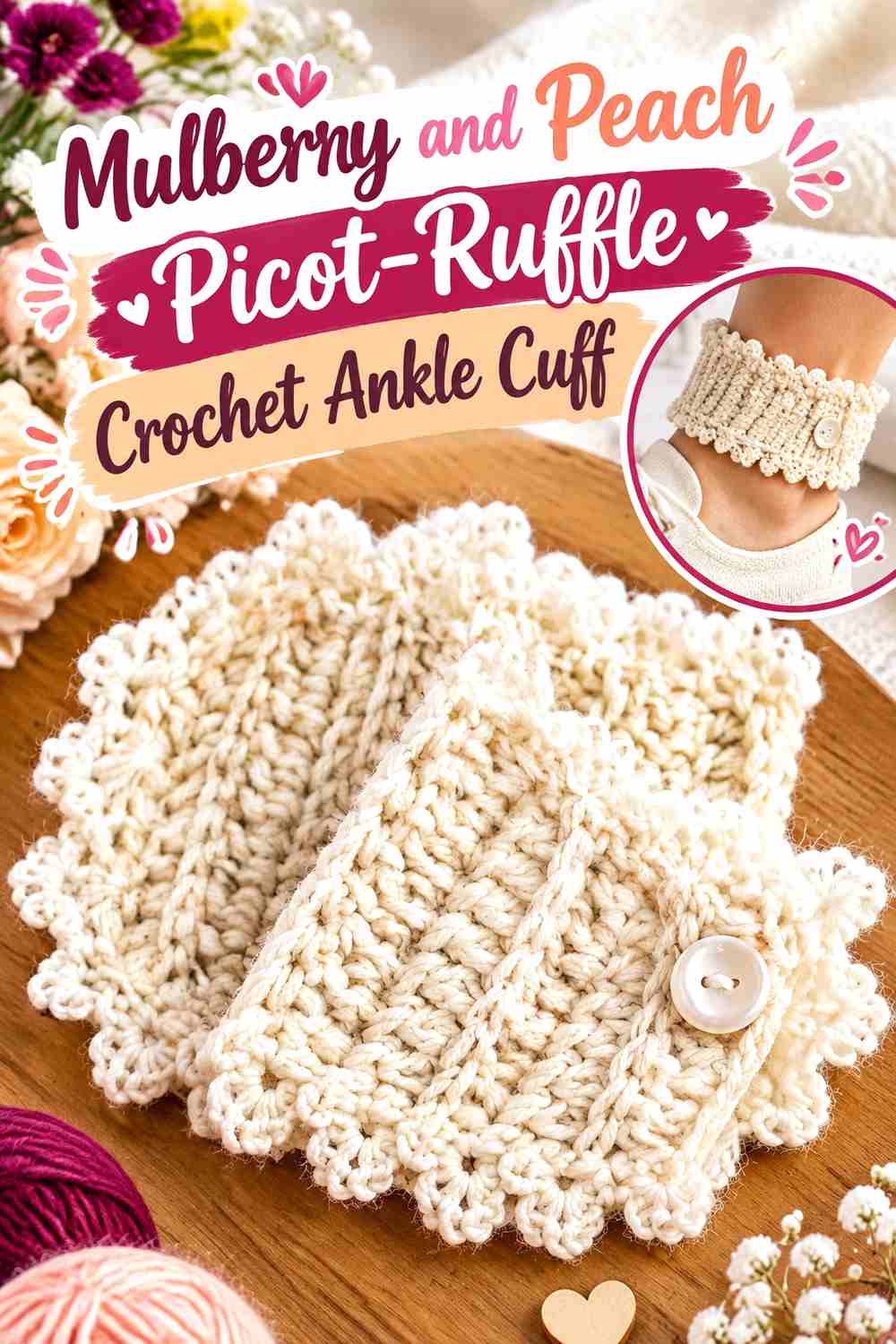
This version uses smaller pointed edging rather than a very deep frill. Peach can form the body and shallow ruffle while mulberry marks the picot tips or final border. The darker detail becomes noticeable without adding much visual weight around the ankle.
Let Peach Carry the Main Ruffle Above Mulberry Picots
Keep peach through most of the flared section so the cuff still looks soft and lightly colored from a distance.
The small pointed edge already creates texture, so there is little need to alternate colors throughout every part of the ruffle.
Use Mulberry to Define Peach Picot Points
Mulberry can trace the final decorative edge and make each peach point easier to see.
Keep the dark line narrow. If mulberry expands too far upward, the picot treatment may start reading as a full dark ruffle instead of a defined edge.
Creator Credit: Knit and Crochet Design
5. Peach And Mulberry C2c Texture Crochet Ruffle Ankle Cuff
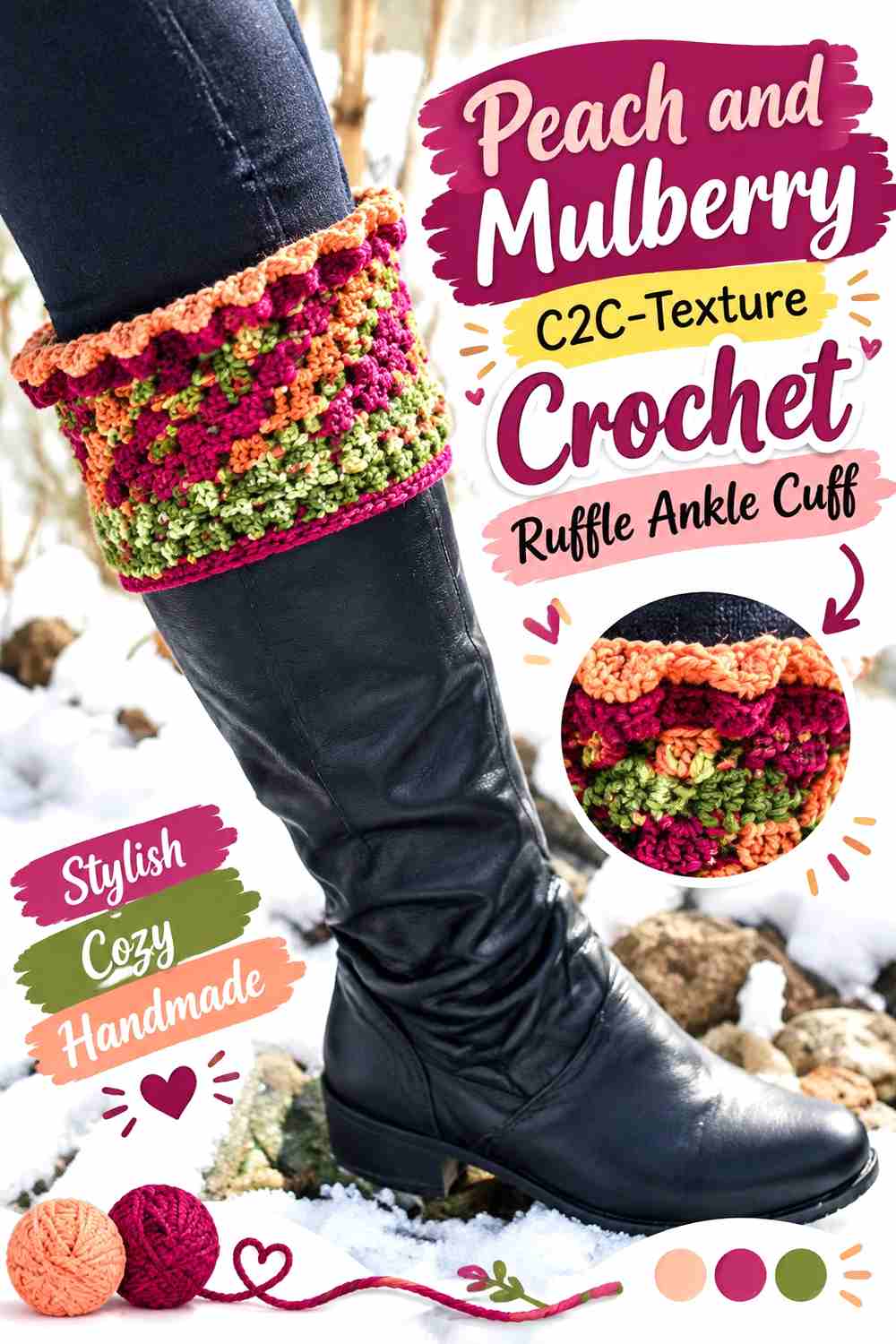
A corner-to-corner-inspired cuff surface creates small diagonal blocks before the ruffle is added. Keep the textural band mostly mulberry and use peach in selected blocks or entirely across the ruffle so the diagonal structure does not compete with another complicated color sequence.
Keep Mulberry Strong Across the Peach C2C Cuff Band
Use mulberry for the majority of the diagonal-texture section. This creates a darker framework and prevents each small block from becoming a separate color decision.
A few peach blocks can repeat the ruffle color higher on the cuff if you want more integration.
Let Peach Separate From the Mulberry C2C Texture at the Ruffle
Changing cleanly to peach at the beginning of the ruffle establishes a clear division between the textured band and flared edge.
That transition can be more effective than trying to continue a detailed two-color C2C arrangement into a heavily gathered section.
Creator Credit: The Crochet Crowd
6. Mulberry Body And Peach Wide Ruffle Crochet Ankle Cuff
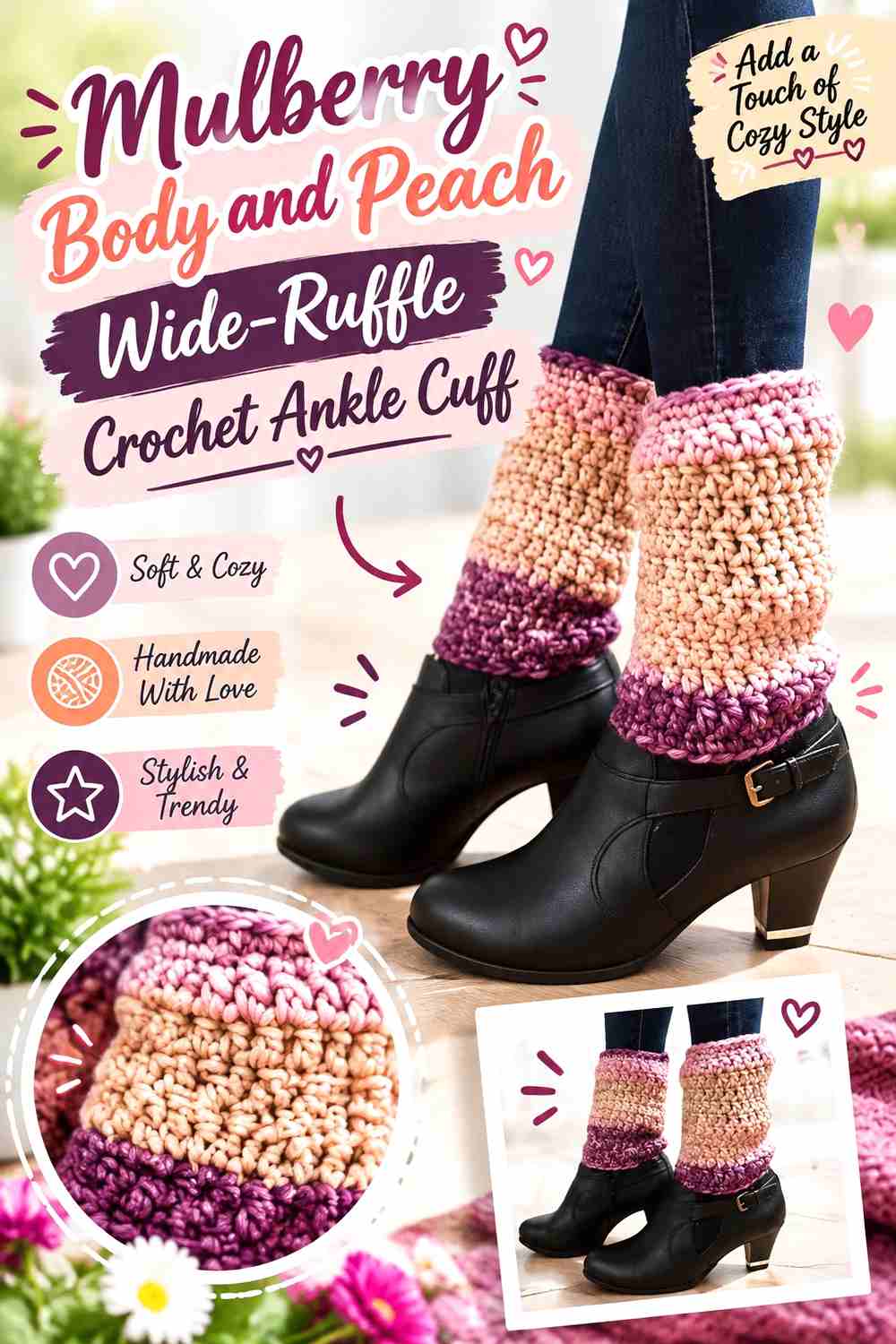
A wide ruffle makes color proportion especially important because the frill may occupy almost as much visual area as the fitted band. Keep the ankle section solid mulberry and allow peach to dominate the flare so each part has a clear role.
Keep Mulberry Uninterrupted Above the Peach Wide Ruffle
A broad solid band gives the larger peach ruffle a calm anchor. Frequent color changes above it can make the overall cuff look visually top-heavy.
If a tie or small closure is included in the construction, repeating mulberry there keeps the fitted portion cohesive.
Give Peach Enough Depth Below the Mulberry Cuff
A wide ruffle needs enough peach surface to show the folds clearly. If the color changes back to mulberry too soon, the pale section can become little more than a separator.
For stronger edge definition, reserve mulberry for the very final outline.
Creator Credit: Dream9Design
7. Peach Ribbed And Mulberry Edge Crochet Ruffle Ankle Cuff
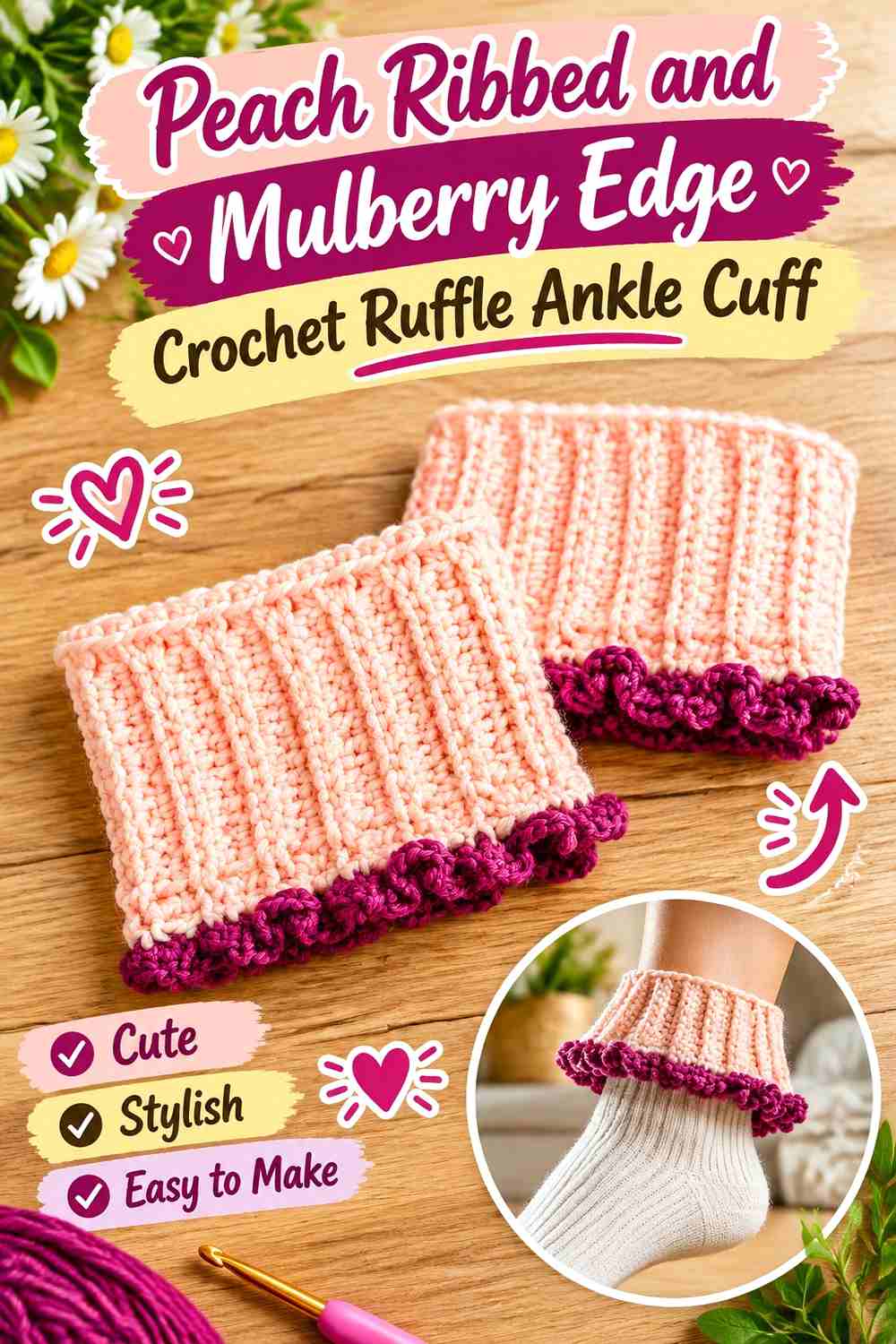
Peach ribbing creates a lighter fitted band where the vertical texture remains visible, while mulberry can provide a narrow transition before the ruffle. This is useful when you want the dark shade to define rather than dominate.
Let Peach Show the Ribbed Ankle-Cuff Texture
Use peach throughout most of the ribbing so the raised and recessed lines stay relatively easy to see.
A pale band also gives you more freedom to use mulberry at both the transition and the decorative edge without making the whole cuff look dark.
Use Mulberry Between the Peach Ribbing and Ruffle
A narrow mulberry line can mark the point where the fitted band changes into a flare.
Repeat the same mulberry at the bottom of the peach ruffle when you want a framed effect, but avoid adding multiple dark bands through the middle of the frill.
Creator Credit: Sewrella
8. Mulberry Ribbed And Peach Frill Crochet Ankle Cuff
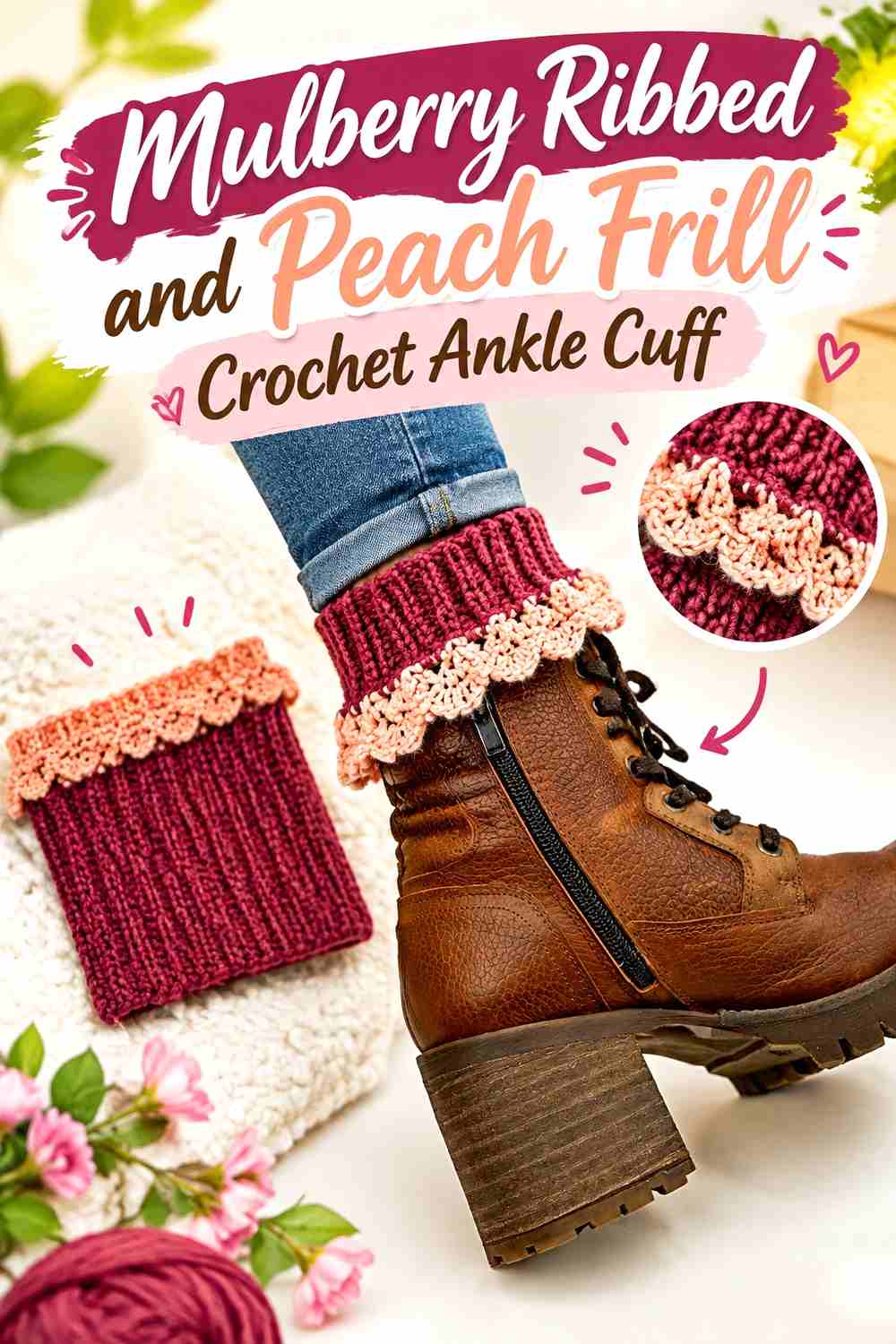
This reverses the previous version. Deep mulberry ribbing gives the cuff a strong fitted base, while a lighter peach frill sits below or above it. The simple division is particularly useful when the ribbing itself is visually prominent.
Keep Mulberry Ribbing Consistent Behind the Peach Frill
A single dark ribbed color keeps attention on the vertical texture and produces a strong contrast where peach begins.
If you introduce peach inside every other rib, the band may become more visually active than the ruffle.
Let Peach Lighten the Mulberry Ribbed Cuff Edge
Use peach for the complete frill or scallop so it remains easy to distinguish from the darker foundation.
For a subtler color connection, work a very narrow mulberry outer edge rather than another full dark layer.
Creator Credit: KnitcroAddict
9. Peach And Mulberry Button Accent Crochet Ruffle Ankle Cuff
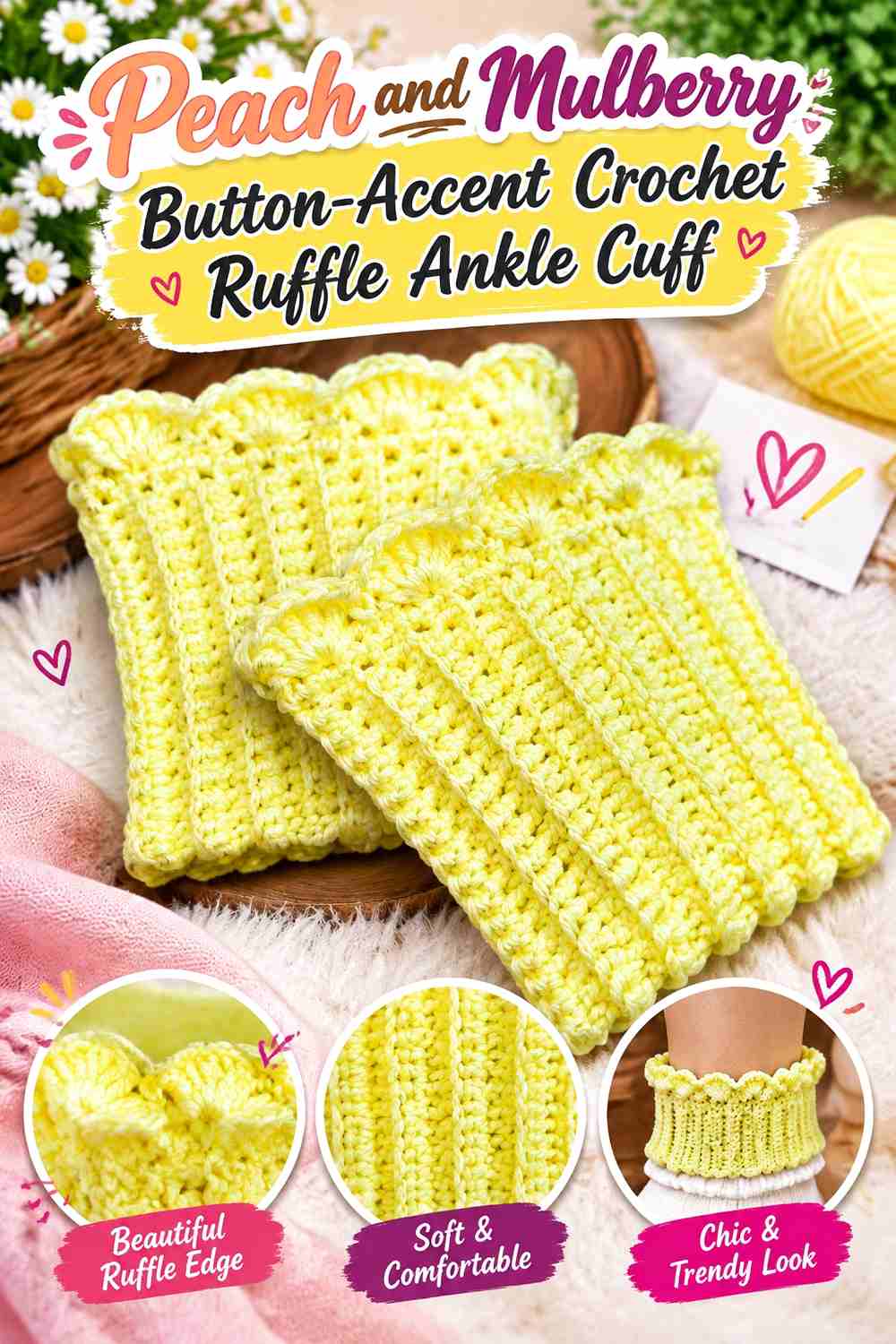
A decorative button or overlap area gives one color another place to repeat beyond the ruffle. Keep the band peach, use mulberry for the ruffled edge, and repeat mulberry around the button area so the dark shade appears at both the decorative top and bottom.
Keep Peach Calm Around the Mulberry Button Accent
A mostly peach band gives the closure detail enough clear space to remain visible.
Avoid adding many additional mulberry stripes directly beside the button because they can reduce its role as a focal point.
Connect Mulberry From the Peach Closure to the Ruffle
Use the same mulberry at the closure and ruffle edge to create a top-to-bottom color relationship.
The two dark areas do not need to be equal in size; a small button accent can still visually connect with a much broader lower ruffle.
Creator Credit: Bag-O-Day Crochet
10. Mulberry Peach And Cream Layered Crochet Ruffle Ankle Cuff
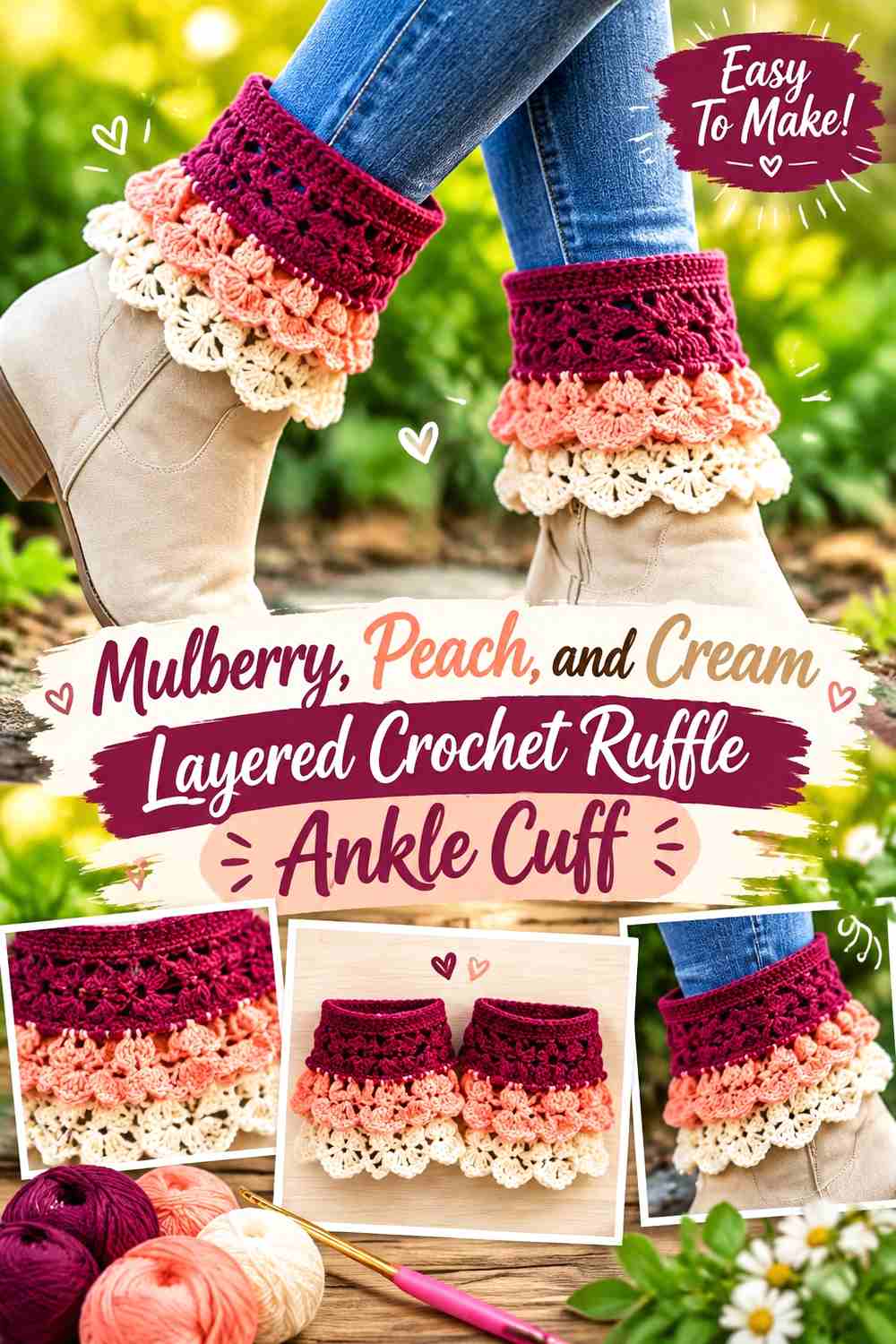
Cream can act as a light separator when peach and mulberry feel too direct together. Keep mulberry on the fitted cuff, peach on the main ruffle, and use cream only for a smaller middle tier or narrow transition. The neutral should clarify the two main colors rather than become an equal third part.
Keep Mulberry Larger Than Cream on the Ankle Band
Mulberry should remain the dark anchor. Restrict cream to a narrow section near the point where the band begins to flare.
A wide cream band could shift the palette away from the requested peach-and-mulberry relationship.
Let Peach Remain the Main Ruffle Below Mulberry
Use peach for the largest flared layer so the warm light color stays prominent when the cuff is viewed from the side.
Cream can sit just above or beneath it to create additional separation from the mulberry band.
Use Cream Sparingly Between Peach and Mulberry
If peach already contrasts clearly with mulberry, cream may only need to appear once.
Preserve its role as a bridge: lighter than the dark band, quieter than the primary peach ruffle, and small enough that the main pairing remains obvious.
Creator Credit: Journey C. Designs
11. Peach And Mulberry Minimal Crochet Ruffle Ankle Cuff
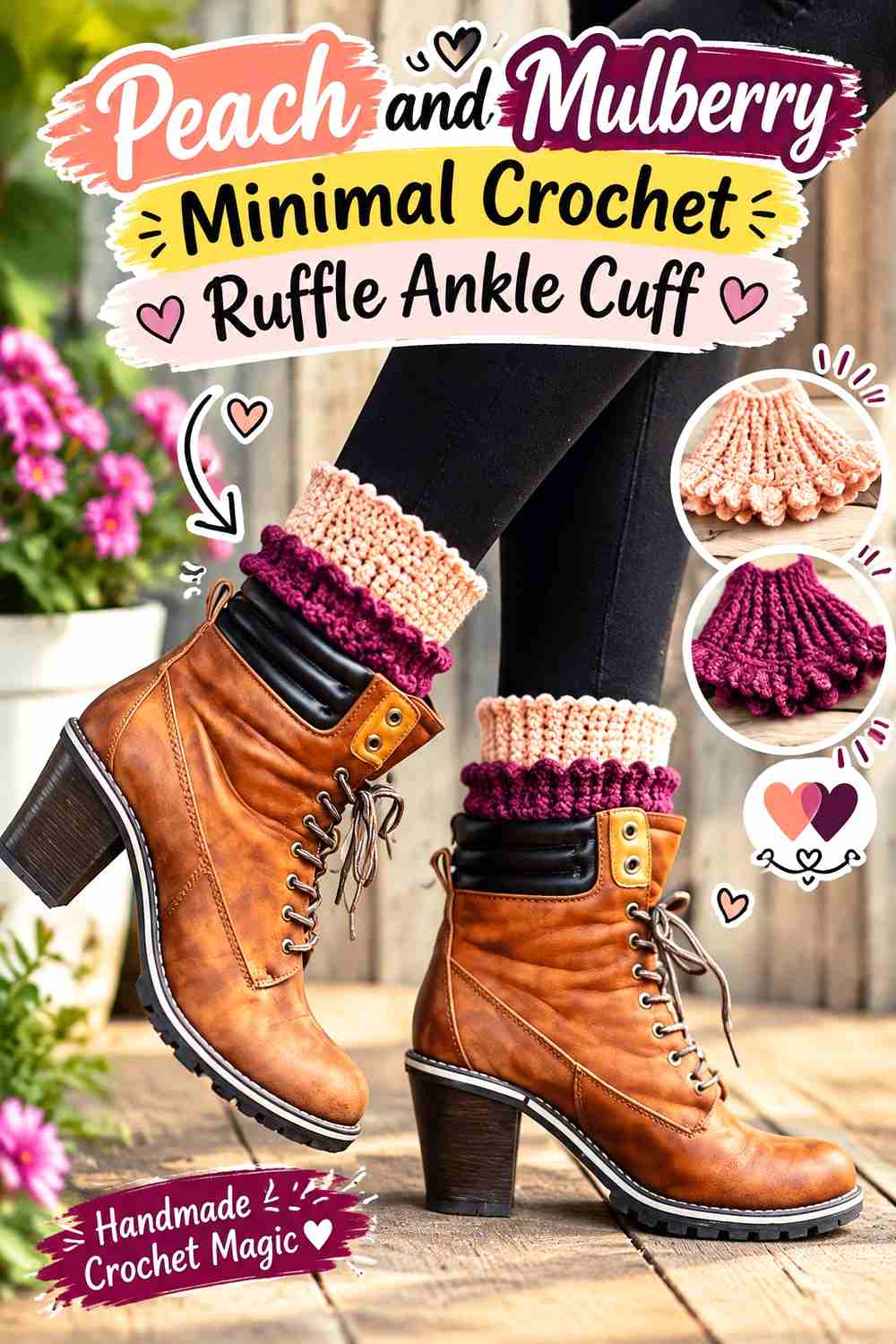
A minimal version keeps the fitted tube simple and adds just one shallow ruffle. Use peach for most of the cuff and mulberry only at the decorative edge, or reverse the hierarchy when you want a darker accessory. The limited construction makes color proportion the main visual decision.
Give Peach One Large Uninterrupted Ankle-Cuff Area
A broad peach field keeps the accessory light and makes the final dark detail more meaningful.
Without elaborate texture, there is little reason to break the band into many small color sections.
Use Mulberry Once Against the Peach Ruffle Edge
Choose one strong mulberry detail—the complete shallow ruffle, its outer edge, or the upper border.
Restricting the dark shade gives the minimal cuff a cleaner color hierarchy than using the same accent repeatedly in unrelated locations.
Creator Credit: Diving Ducks Crochet
12. Mulberry And Peach Textured Crochet Ruffle Ankle Cuff

The final idea combines a more pronounced cuff texture with a simple peach ruffle. Let mulberry carry the textured body and use peach only when the fabric begins to flare. This keeps the stitch surface and color hierarchy aligned: dark texture above, light movement below.
Keep Mulberry Across the Main Textured Ankle Cuff
A continuous mulberry body lets ridges, posts, or other raised details create the visual variation instead of relying on stripes.
If the dark shade hides some texture, view it in the lighting where you expect to wear the cuffs before deciding that another body color is necessary.
Use Peach to Separate the Ruffle From Mulberry Texture
A clean change into peach gives the decorative edge an immediate identity and prevents it from disappearing into the darker texture above.
If you want the ruffle more integrated, finish it with a narrow mulberry outline rather than reintroducing dark stripes throughout the whole layer.
Repeat Mulberry at the Peach Ruffle Edge Only When Needed
The dark outline should add definition, not reduce the amount of peach visible in the frill.
Skip it when the two colors already separate strongly enough on their own.
Creator Credit: Posh Pooch Designs
Comparing the Peach and Mulberry Ruffle Ankle Cuff Directions
For the clearest two-color separation, the mulberry-band/peach-ruffle, peach-band/mulberry-scallop, wide-ruffle, and minimal versions use large uninterrupted areas. They make it immediately obvious which color belongs to the fitted band and which belongs to the decorative edge.
For a more textural result, the ribbed, C2C-inspired, lace, and picot directions combine color with visible stitch structure. In these versions, avoid making every individual ridge or lace section a separate color change; the texture already creates enough movement.
The button-accent version repeats mulberry in small focal areas, while the cream-layered option creates the softest transition between peach and dark mulberry. Cream is most useful when the two main yarns need additional value separation rather than as a default third color.
Conclusion
Peach and mulberry can create very different crochet ruffle ankle cuffs simply by changing which shade controls the fitted band and which controls the flare.
Use a mulberry band when you want a defined dark anchor with peach ruffles standing out below it. Reverse the balance for a lighter ankle cuff where mulberry scallops, picots, buttons, or narrow edges provide the strongest contrast.
Keep ruffle depth in mind when planning the palette. A small scallop can handle a strong mulberry outline, while a wide layered ruffle often benefits from more uninterrupted peach so its folds stay visible. The supporting tutorials provide ankle-wear and short-cuff construction references; follow the original creators for their exact methods and adapt the peach-and-mulberry ruffle treatment independently.
Frequently Asked Questions
Should peach or mulberry dominate a crochet ruffle ankle cuff?
Either can lead. Peach creates a lighter cuff where small mulberry details look strong, while a mulberry band provides a darker anchor for peach ruffles. Decide whether you want the fitted band or decorative frill to carry more visual weight.
Where should peach go on a mulberry ankle cuff?
Peach works especially well on the main ruffle, scalloped edge, lace section, tie, or narrow transition band. Concentrating it in one visible area usually produces more useful contrast than scattering tiny peach details throughout a dark cuff.
How can I keep a mulberry ruffle from looking too heavy?
Reduce the amount of mulberry in the flared section or place peach immediately beside it. A peach outer edge, smaller mulberry tier, or peach upper ruffle can lighten the overall effect while retaining the dark accent.
Can I use cream with peach and mulberry ankle cuffs?
Yes, but keep cream secondary. It is most useful as a narrow separator between dark mulberry and peach when the main colors need additional light-value contrast.
Should the ruffle be the same color as the ankle band?
It can be, but contrasting the ruffle usually makes the change from fitted band to flare easier to see. If both areas use one color, introduce the second shade at the outer ruffle edge or tie to preserve the two-color theme.
How do I check whether peach and mulberry have enough contrast?
Compare the actual yarns together and view them from a short distance. A grayscale photo can also reveal whether their lightness differs enough for small scallops or picots. If not, use the colors in larger sections instead.
How do I keep a peach and mulberry ruffle ankle cuff from looking too busy?
Give one shade most of the fitted band and use the second for the complete ruffle or one defined edge. When the cuff already contains ribbing, lace, bobbles, or scallops, fewer color changes usually make those structural details easier to see.