A Thanksgiving table runner can do much more than add fall color. Its width determines how much room remains for place settings, its texture affects what can sit safely on top, and its construction changes how easily the length can be adjusted. The 26 ideas below range from unmistakably seasonal pumpkins and leaves to hexagons, granny squares, Tunisian fabric, farmhouse stripes, pineapple lace, pointed ends, and decorative fringe.

Some featured tutorials were created specifically for autumn or harvest decorating. Others teach versatile table-runner constructions that can be adapted for Thanksgiving with a suitable palette and styling. That distinction matters: changing color does not turn every design into a Thanksgiving motif, but it can make a well-chosen neutral construction work beautifully with pumpkins, foliage, candles, or dinnerware already on the table.
Quick List
- Crochet Falling-Leaf Thanksgiving Table Runner
- Crochet Pumpkin Filet Thanksgiving Table Runner
- Crochet Harvest Lace Thanksgiving Table Runner
- Crochet Color-Block Farmhouse Thanksgiving Table Runner
- Crochet Moss-Stitch Tassel Thanksgiving Table Runner
- Crochet Lattice-Texture Thanksgiving Table Runner
- Crochet Granny-Square Harvest Table Runner
- Crochet Hexagon Patchwork Thanksgiving Table Runner
- Crochet Puff-Texture Thanksgiving Table Runner
- Crochet Three-Stitch Colorwork Thanksgiving Table Runner
- Crochet Rustic Openwork Thanksgiving Table Runner
- Crochet Long-Fringe Thanksgiving Table Runner
- Crochet Narrow Fringe Thanksgiving Table Runner
- Crochet High-Contrast Thanksgiving Table Runner
- Crochet Classic Center-Lace Thanksgiving Table Runner
- Crochet Traditional Long Thanksgiving Table Runner
- Crochet Two-Point Pineapple Thanksgiving Table Runner
- Crochet Openwork Rectangle Thanksgiving Table Runner
- Crochet Simple Repeating Thanksgiving Table Runner
- Crochet Box-Grid Thanksgiving Table Runner
- Crochet Pointed-End Thanksgiving Table Runner
- Crochet Six-Pineapple Thanksgiving Table Runner
- Crochet Tunisian Thanksgiving Table Runner
- Crochet Shell-Stitch Thanksgiving Table Runner
- Crochet Neutral Farmhouse Thanksgiving Table Runner
- Crochet Decorative-Tassel Thanksgiving Table Runner
Plan the Runner Around the Thanksgiving Table
The runner should fit the usable center of the table, not simply look attractive in isolation. Before choosing a tutorial, decide whether serving bowls, candles, pumpkins, or a floral centerpiece will sit on the crochet. A wide runner can compete with dinner plates on a narrower table, while an especially slim design may disappear beneath a large centerpiece.
For motif constructions, measure a finished and blocked motif before planning the complete layout. As a planning example, if one blocked motif measures 5 inches across, eight motifs placed in a straight line would span about 40 inches before joins, borders, or decorative ends are considered. That is useful layout math, not a substitute for the tutorial’s sizing information. Also decide whether you want the runner ends to stop on the tabletop or hang over the edges.
Texture, Yarn, and Dinner-Table Practicality
Texture matters more on a dining table than it does on a purely decorative console. Large puff stitches, dimensional motifs, and heavy joins can create an uneven surface, so keep glasses, serving dishes, and narrow-footed decorations away from strongly raised areas when stability matters. Flatter filet, mesh, moss-stitch, and Tunisian designs give you different placement options.
Check the yarn label for actual washing and care instructions rather than assuming a fiber can handle a particular cleaning method. Cotton is commonly chosen for table linens because it can create clear stitch definition and a relatively substantial fabric, but properties still vary by yarn. Most importantly, a crochet table runner should not automatically be treated as a trivet. Do not place hot cookware on it unless the materials and finished item are specifically suitable for that use.
Choose the Thanksgiving Look by Construction
For the most obvious seasonal statement, pumpkins, leaves, and harvest-themed lace do the decorating before anything else is added. Joined granny squares and hexagons are useful when you want color placement to carry the fall theme, while neutral farmhouse runners are easier to reuse after Thanksgiving.
Openwork and pineapple styles let the tabletop show through and can feel lighter beneath a centerpiece. Dense textured runners have more visual weight and may look better with simpler decorations. Fringe and tassels shift attention toward the ends of the table, so they work especially well when those ends remain visible. Before committing, picture the runner with the dishes and centerpiece you actually plan to use rather than choosing from the isolated finished object alone.
Crochet Falling Leaf Thanksgiving Table Runner
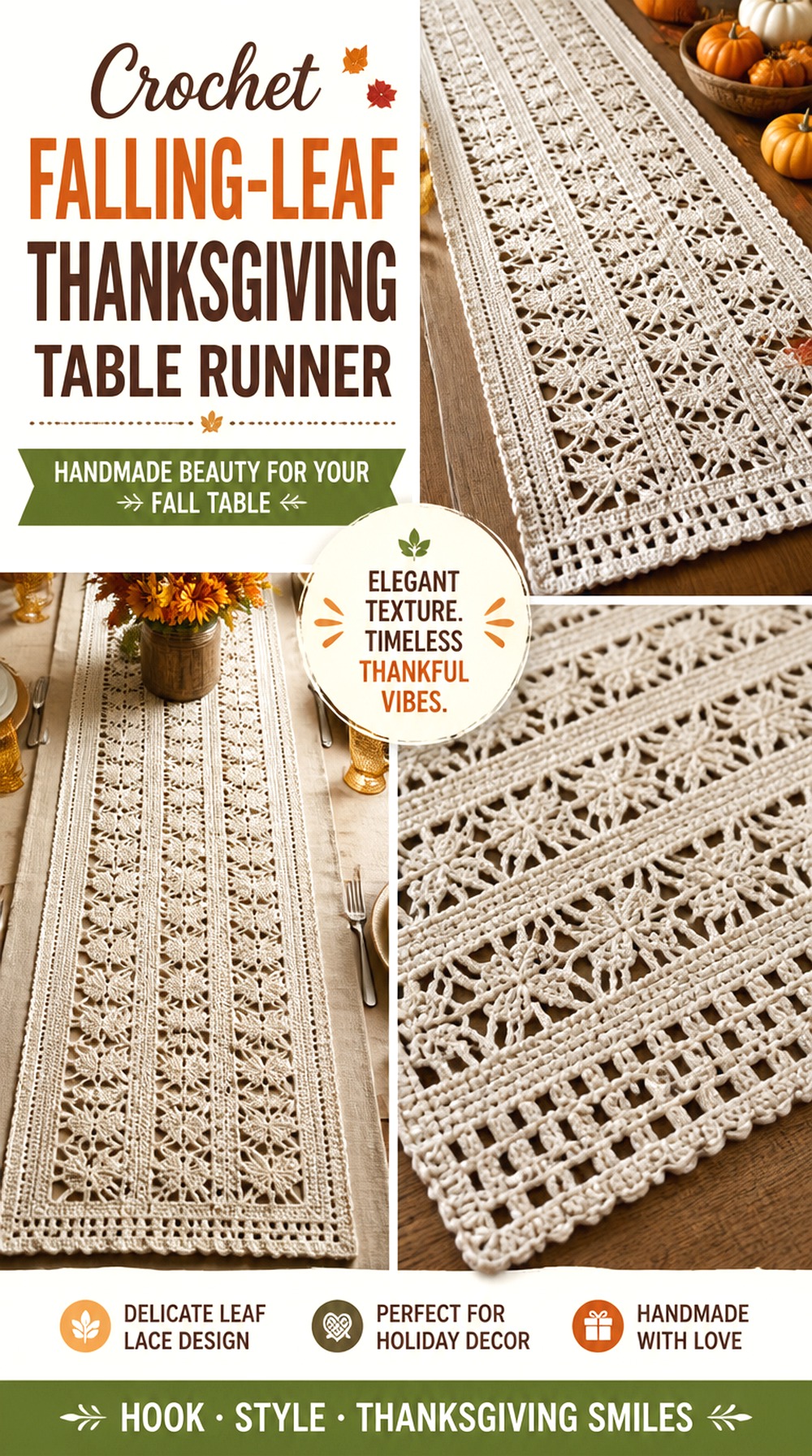
This design makes the autumn theme part of the runner itself. The Vem Crochetar tutorial centers the finished piece on a leaf-inspired form, giving it a stronger seasonal identity than a plain rectangle recolored in orange or brown. It can work well on a Thanksgiving table where you want the crochet to remain visible around a restrained centerpiece rather than functioning only as background texture.
Because leaves create more noticeable outlines than a uniform stitch repeat, pay attention to how much of the runner will remain uncovered. A large serving arrangement placed down the middle can hide the very detail that makes this option different.
Give the Leaf Shape Enough Visible Space
Before deciding on centerpiece placement, lay out objects that are roughly the same size as your serving dishes or decorations. If they hide most of the leaf forms, this runner may be better paired with a compact centerpiece or used on a console where the crochet remains visible. The motif is the visual focus, so treating it like an ordinary background runner can waste its strongest feature.
Blocking Matters Around Defined Leaf Edges
Leaf-shaped details look clearer when their points and edges sit where they are intended. If your finished sections pull in different directions, check the yarn’s care instructions and use an appropriate blocking method before setting the table. Do not try to correct noticeably uneven sections by stretching only one point aggressively; compare the overall shape so the runner stays balanced from side to side.
Keep Dimensional Decorations Separate From Busy Motifs
A runner with recognizable foliage already contributes considerable visual detail. Instead of covering it with many artificial leaves or scattered decorations, consider giving the crochet some negative space. Plain candles, simple ceramics, or a small central arrangement can make the stitched leaf shapes easier to read and prevent the Thanksgiving table from becoming visually crowded.
Crochet Pumpkin Filet Thanksgiving Table Runner
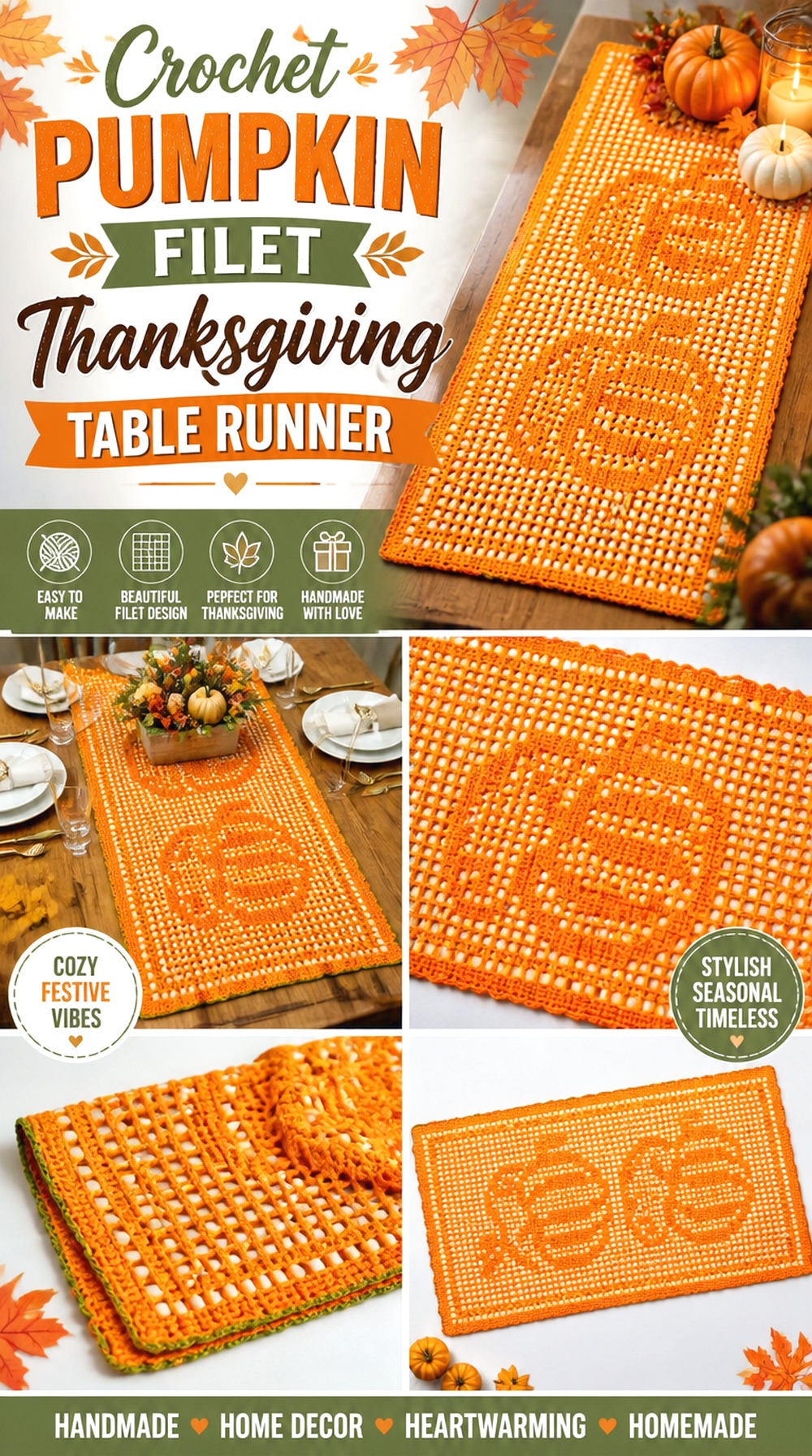
A pumpkin graphic makes this one of the clearest Thanksgiving-specific choices in the collection. HandmadebyRaine’s tutorial uses a pumpkin table-runner design, so the seasonal message comes from the crochet rather than relying entirely on accompanying decor. The open-and-solid contrast associated with filet-style imagery also gives the runner a lighter visual footprint than a heavily textured fabric.
This is a strong option for a formal or traditional fall table where you want recognizable imagery without adding three-dimensional crochet pumpkins. The main planning question is visibility: pumpkin graphics need enough uninterrupted surface to remain readable.
Protect the Pumpkin Motif From Centerpiece Clutter
A filet image loses impact when a vase or serving bowl covers the center of the design. Before final table setup, identify where the pumpkin shapes appear and keep at least the most recognizable sections uncovered. If the dining table must hold many serving dishes, displaying this runner on a buffet or sideboard may preserve the graphic better.
Contrast Helps Filet Imagery Read Clearly
Filet designs depend on the relationship between open and filled areas. A tabletop or under-layer that contrasts gently with the yarn can make the pumpkin more legible than a background that is almost the same color. You do not need extreme contrast; the goal is simply to prevent the open spaces from visually disappearing into the surface beneath them.
Check Finished Length Before Repeating Seasonal Graphics
When adapting a graphic runner, changing length can be less straightforward than extending a simple row repeat because motif placement affects the composition. Confirm how the creator handles the full design before planning alterations. If your table needs a different length, consider whether changing end space is more practical than inserting or removing graphic elements on your own.
Original Tutorial and Creator Credit
Creator: HandmadebyRaine
Crochet Harvest Lace Thanksgiving Table Runner
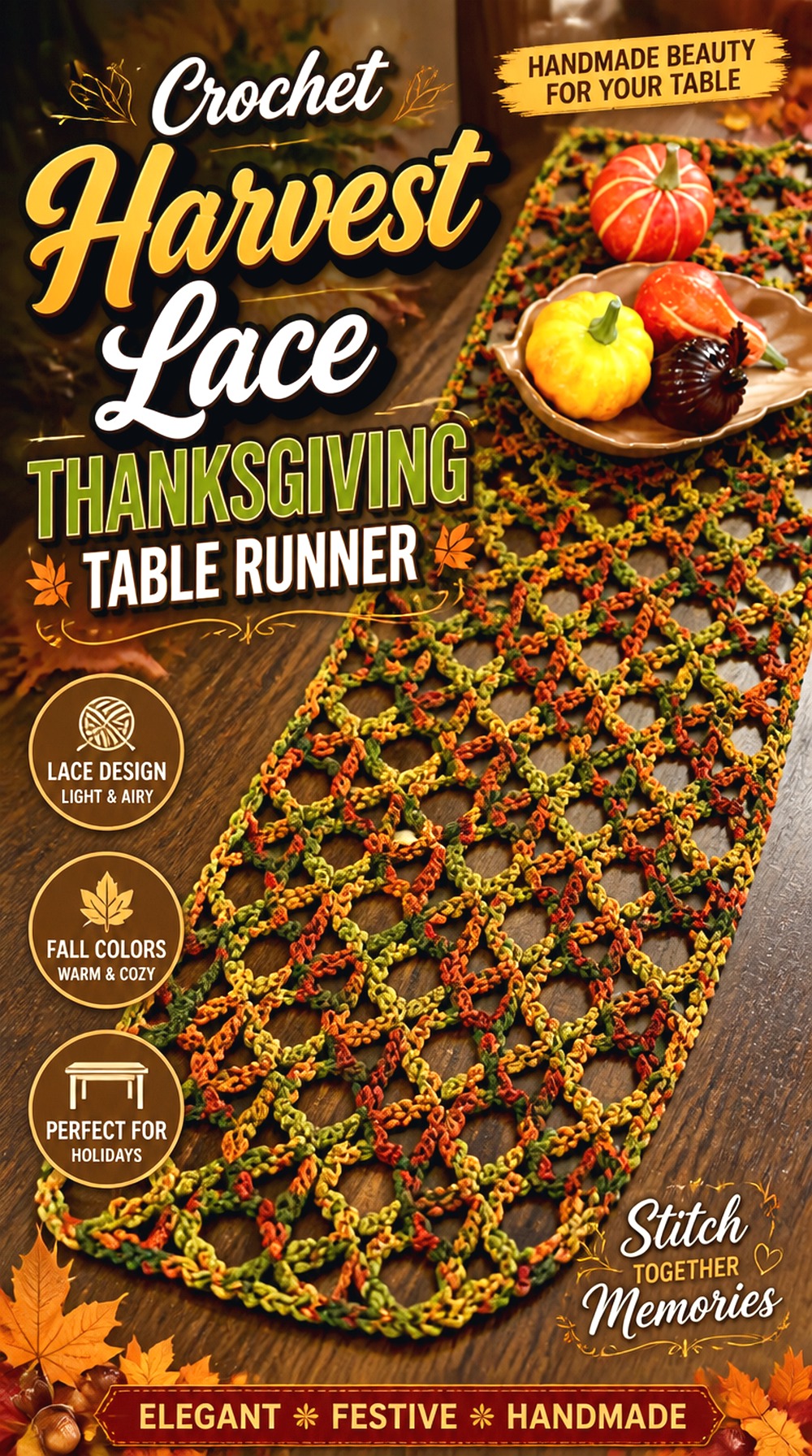
Sara Sach Crochet Designs offers a Harvest Table Runner tutorial that is already positioned around autumn styling, making it a natural Thanksgiving candidate. The finished idea leans decorative rather than purely minimalist, so it can serve as the main textile feature on a table instead of needing multiple other fall accents to establish the season.
A harvest runner works especially well when you want Thanksgiving decor that is broader than a single pumpkin or turkey motif. It can bridge early-fall styling and the holiday itself, which may make it more useful if you decorate several weeks before Thanksgiving.
Let Harvest Texture Replace Extra Table Scatter
When the runner already carries substantial lace or decorative detail, scattered faux leaves, confetti, and many tiny pumpkins can make the centerline difficult to read. Start with the finished crochet, then add only the decor needed to frame it. This approach also leaves more usable table space for food, which matters more at Thanksgiving than it might for a purely decorative photo setup.
Decorative Ends Need Their Own Measurement Check
If the design includes fringe or pronounced finishing at the short ends, consider that length separately from the crocheted body. Decide whether you want those ends lying flat on the tabletop or hanging over. A runner can fit the tabletop itself yet still become too long once decorative finishing is included, particularly on a shorter dining table.
Choose an Autumn Palette With Enough Separation
Harvest colors do not need to include every shade of orange, yellow, brown, red, and green. A restricted palette can make lace structure easier to see. If you change the tutorial’s colors, place candidate yarns side by side in the room where the runner will be used; several medium-dark fall colors can blend together under indoor evening lighting.
Original Tutorial and Creator Credit
Creator: Sara Sach Crochet Designs
Crochet Color Block Farmhouse Thanksgiving Table Runner
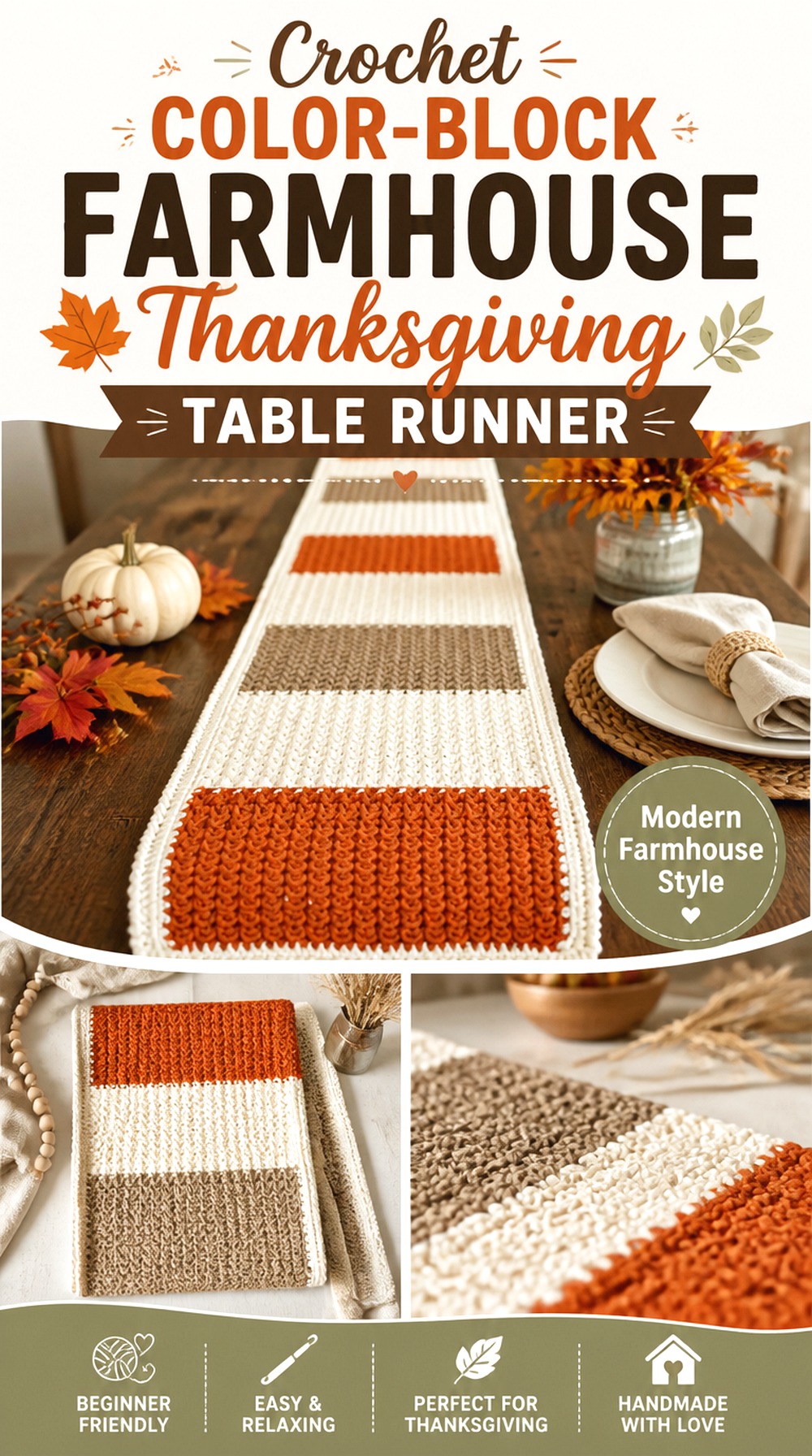
The Turtle Trunk’s farmhouse runner combines textured even-moss fabric with a framed edge and color-block potential. The creator specifically shows the design in warm neutral and burnt-orange tones and notes that the colors can be changed for holiday use, so it translates naturally to Thanksgiving without needing an added motif.
This is a good choice when pumpkins and foliage will already be present on the table. Instead of competing with those decorations, the runner contributes controlled bands of color and a tactile surface.
Plan Color Blocks Against the Actual Centerpiece
If your centerpiece contains a lot of orange, repeating the same strong shade throughout the runner may make the center feel visually dense. Consider letting cream, beige, mushroom, brown, or another quieter tone occupy more space and using the stronger harvest shade as an accent. Lay the yarn beside your dishes and decorations before deciding on the final sequence.
Watch the Border for Waviness
The creator notes that a wavy border may benefit from changing to a smaller hook for the border rounds. That is a useful finishing checkpoint because a runner can have a straight main body yet look untidy once the edging is added. Assess the border on a flat surface before weaving every end away so you can address obvious rippling early.
A Flatter Texture Makes Centerpiece Placement Easier
Even-moss texture gives the fabric visual interest without relying on very large raised motifs. That can make this construction easier to work around plates or decor than heavily bobbled runners. Still, test any narrow-footed candleholder or stemmed vessel on the actual finished fabric rather than assuming every textured crochet surface is equally stable.
Original Tutorial and Creator Credit
Creator: The Turtle Trunk
Crochet Moss Stitch Tassel Thanksgiving Table Runner
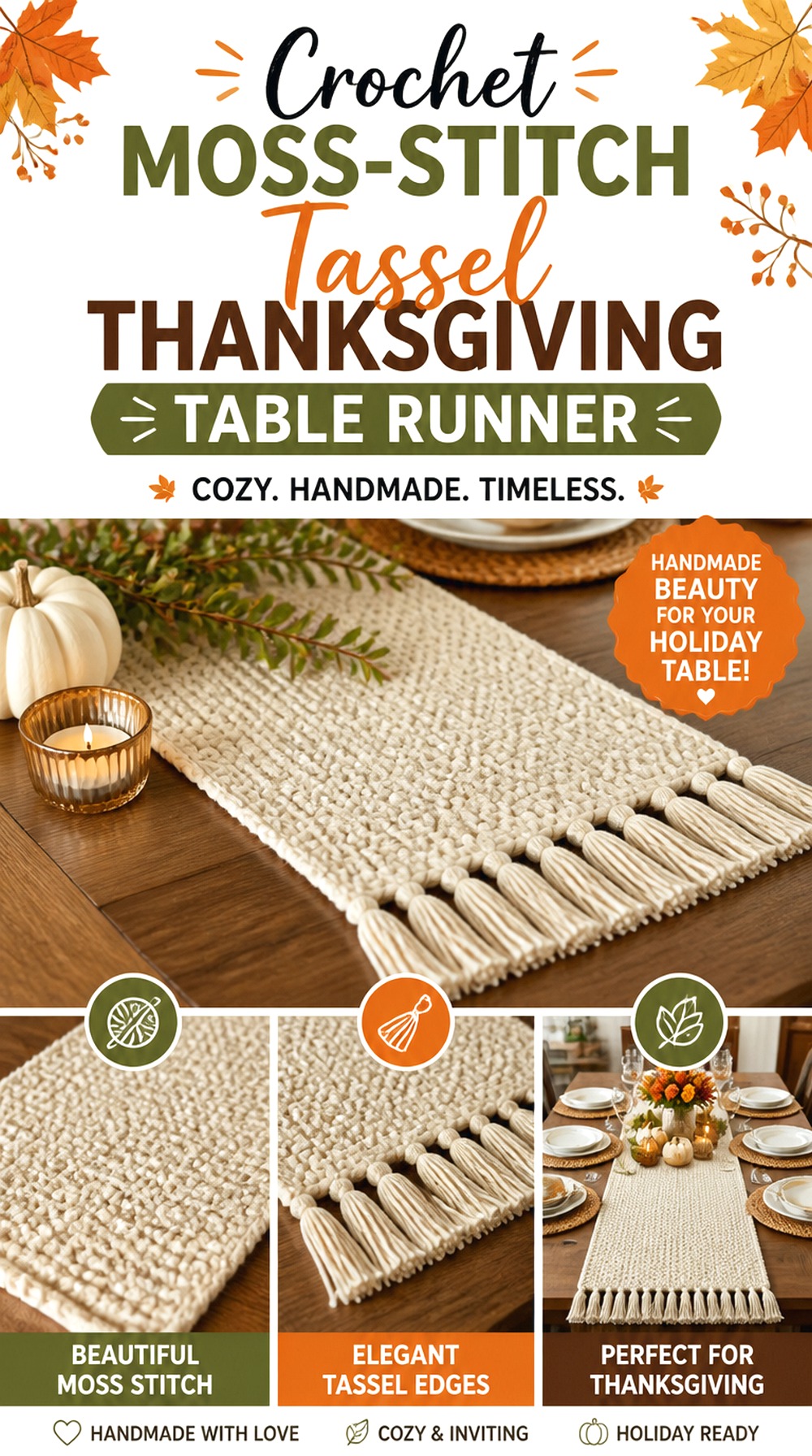
Jo to the World Creations’ modern table-runner tutorial is a strong basis for a Thanksgiving runner when you prefer simple fabric with decorative tassel ends rather than obvious holiday imagery. The moss-stitch look creates small-scale texture that can carry a warm neutral, rust, mustard, olive, or other autumn color without overwhelming place settings.
Its biggest visual difference is the balance between a restrained rectangular body and more decorative short ends. That makes it particularly suitable when the runner extends beyond the tabletop and the ends remain visible.
Decide First Whether the Tassels Will Hang or Lie Flat
Tassels look very different when hanging freely over the table edge than when compressed beneath dishes or decor. Measure the crocheted body and decorative ends separately when planning placement. If your table is short, you may prefer the tassels to stop near the edge instead of extending far into seated guests’ space.
Moss Stitch Lets Color Do More of the Seasonal Work
Because the surface pattern is relatively controlled, the Thanksgiving character can come from one carefully chosen shade or a quiet pairing rather than a complicated motif. This is useful in a room that already has patterned dishes or a busy centerpiece. When changing yarn, make a small swatch first so you can judge both the color and how clearly the compact texture appears.
Original Tutorial and Creator Credit
Creator: Jo to the World Creations
Crochet Lattice Texture Thanksgiving Table Runner
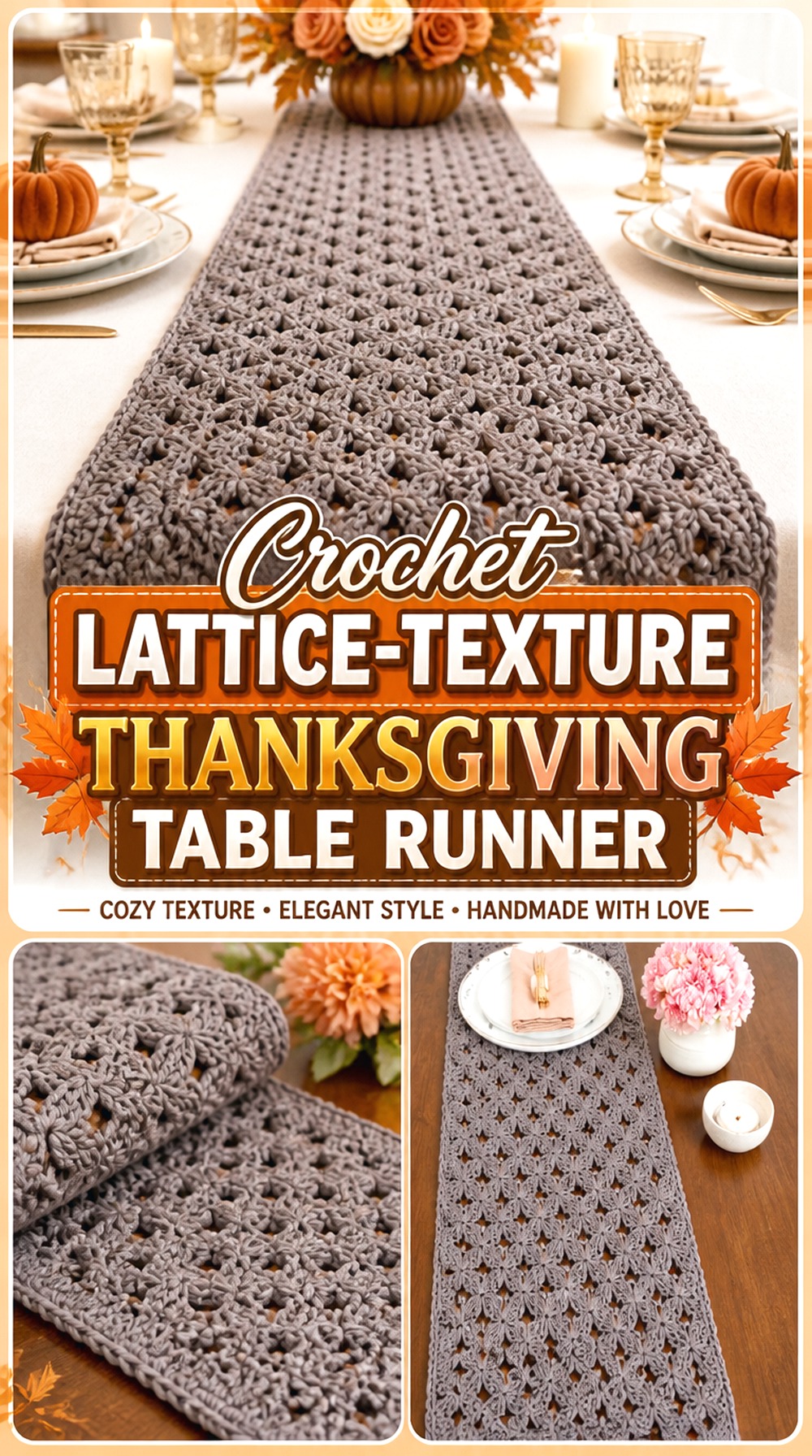
The Crochet Crowd’s textured table-runner tutorial creates a more architectural surface than a plain rectangular repeat. Its macramé-inspired, lattice-like appearance gives a neutral yarn enough visual interest to stand on its own, which can be useful if you want a Thanksgiving table based on natural textures instead of novelty motifs.
Placed on wood, the open sections allow some of the tabletop to remain part of the finished look. That makes this direction particularly attractive for farmhouse, rustic, or understated harvest settings.
Open Lattice Changes What Can Sit on the Runner
Large open spaces are decorative, but they are not the same as a continuous flat fabric. Test the bases of candlesticks, small vases, and serving pieces before the meal. A broad centerpiece base may sit comfortably, while narrow feet can interact awkwardly with openings. Keep practical table use in mind rather than choosing objects only for how they look.
Neutral Yarn Can Highlight Construction Better Than Many Colors
This runner gets much of its personality from the textured structure itself. A single cream, flax, oatmeal, or similarly quiet shade can allow shadows around the raised and open areas to remain visible. If you use several fall colors, check that frequent color changes do not compete with the lattice effect you chose the construction for.
Finish the Long Edges Before Judging the Shape
Highly textured fabric can look uneven while it is still being worked. Assess the completed piece on a flat surface and follow the creator’s finishing guidance before deciding whether the runner is truly distorted. If a problem remains, compare tension across the full length rather than stretching isolated sections into position.
Original Tutorial and Creator Credit
Creator: The Crochet Crowd
Crochet Granny Square Harvest Table Runner
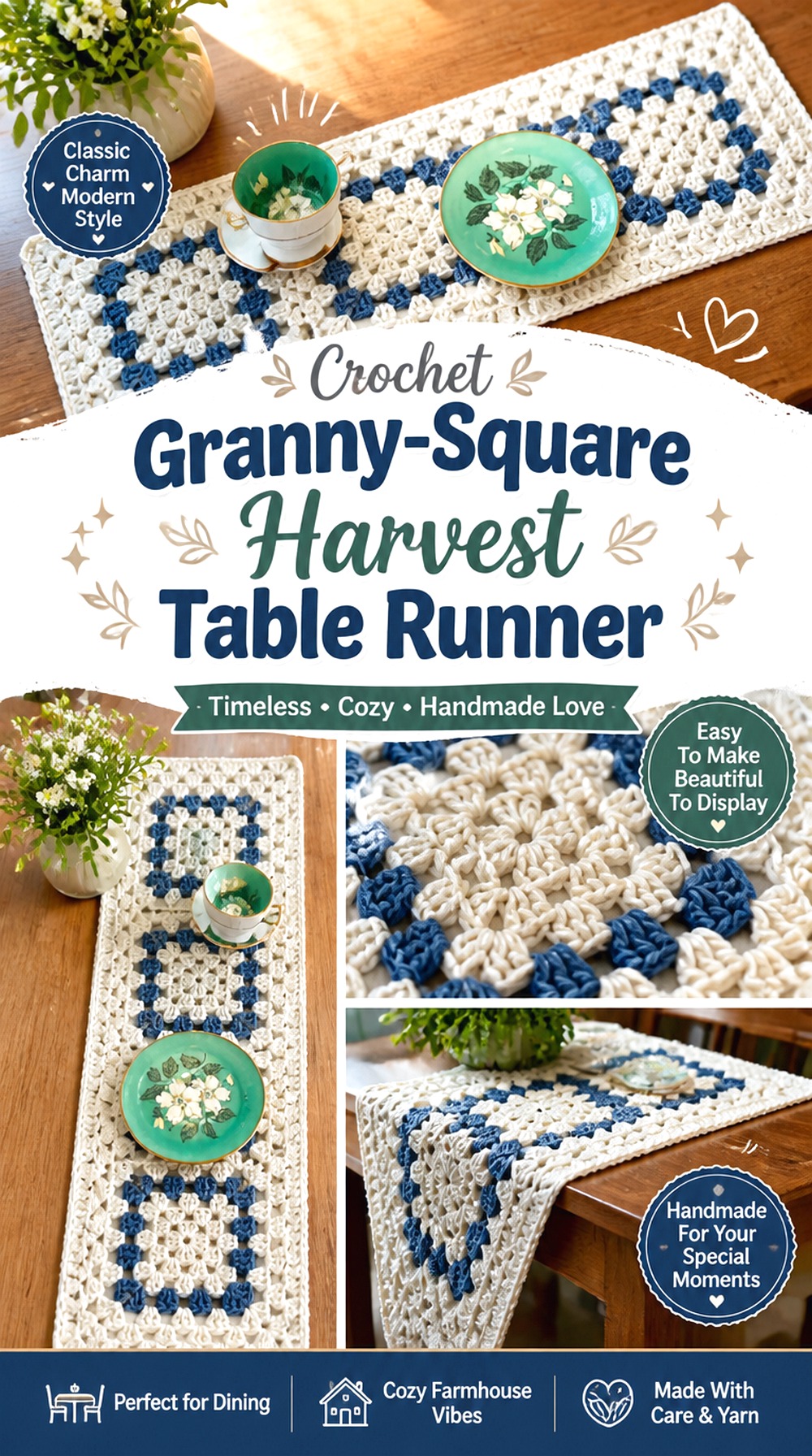
A joined granny-square runner gives you control over color placement one motif at a time. The American Crochet Association tutorial focuses on creating a table runner from granny squares, so it is a useful route when you want rust, mustard, cream, olive, brown, or other harvest tones distributed deliberately rather than blended through long rows.
The modular construction also makes the join part of the visual design. Compared with a one-piece runner, the eye notices both individual squares and the larger arrangement they create.
Block Squares Before Committing to the Full Layout
Small differences between motifs become much more obvious when several squares are joined in a straight table runner. Compare blocked dimensions first and correct noticeable variation before final assembly. If one square is consistently larger, forcing it into the layout can cause rippling or a centerline that refuses to lie straight.
Arrange Harvest Colors Before You Join Anything
Place all completed squares on the floor or table and photograph a few arrangements. Check whether strong shades accidentally cluster at one end or whether identical centers form an unintended stripe. This planning stage costs little but can make a multicolor runner look deliberate rather than like a random collection of leftover motifs.
Joins Add Width and Visual Weight
Do not estimate the runner’s final size from a single motif alone. Joining method, borders, and any surrounding rounds can change the complete dimensions. Use your actual blocked squares and the tutorial’s construction as the basis for planning rather than assuming that multiplying one raw square measurement gives the exact final size.
Original Tutorial and Creator Credit
Creator: American Crochet Association
Crochet Hexagon Patchwork Thanksgiving Table Runner
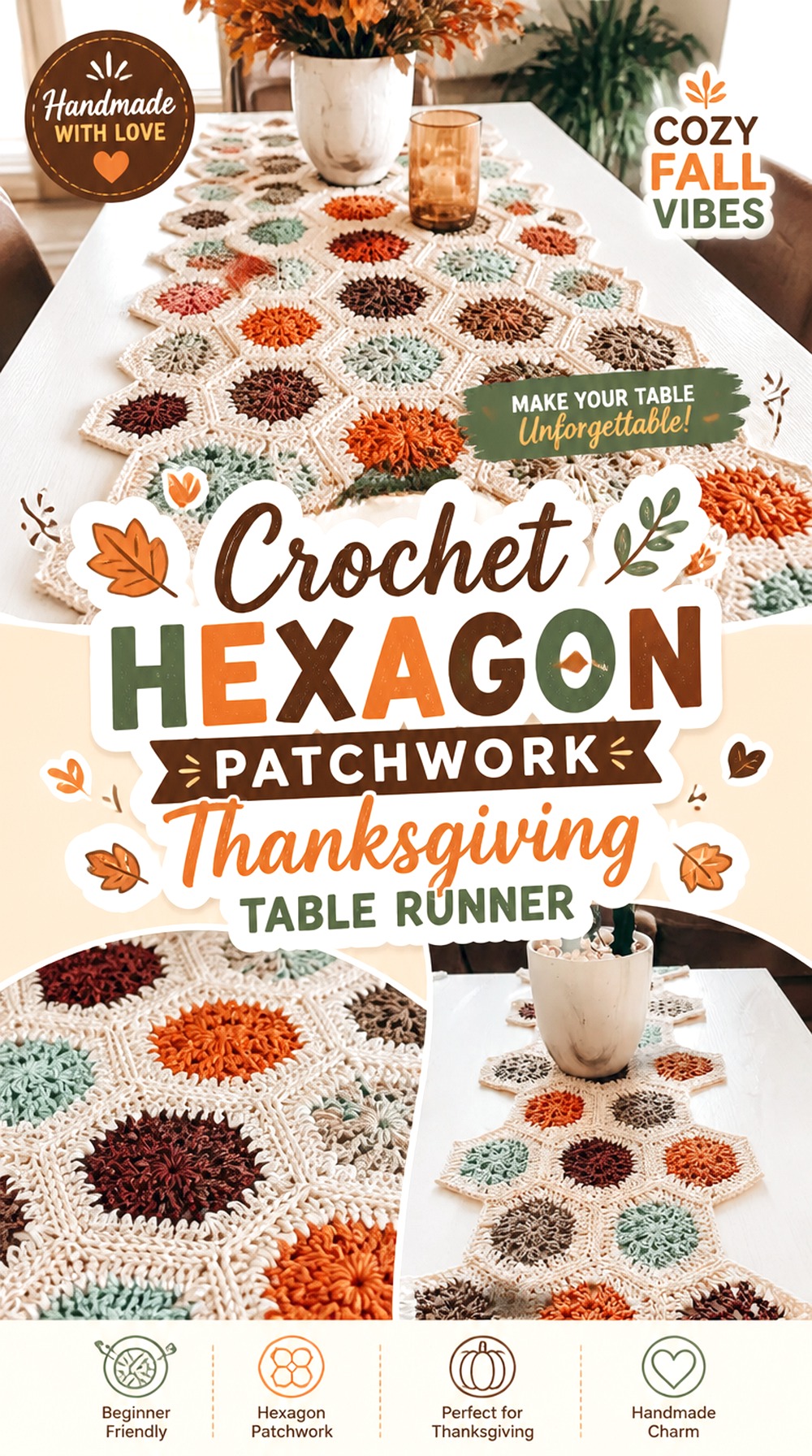
CJ Design uses crochet hexagons to construct a table runner, giving this option a distinctly different geometry from square-based patchwork. Hexagons naturally create angled outer edges and can produce a more organic flow down the center of a table, which suits a harvest palette particularly well.
This is an appealing direction for scraps or planned color families because each motif can carry its own combination while the repeated six-sided shape keeps the overall runner coherent.
Lay Out Every Hexagon Before Joining
Hexagons create diagonal relationships that are less obvious while individual motifs are being made. Arrange the complete set before joining and step back from it. Look for color clusters, an accidental zigzag in a dominant shade, or a layout that becomes wider than expected in the middle.
Angled Sides Need More Table-Space Planning
A hexagon runner does not occupy the same rectangular footprint along its entire length. Measure the widest part of the assembled layout and make sure plates still have enough clear table surface. This matters on narrow tables where projecting motif points may extend farther toward place settings than a straight-sided runner would.
Joining Becomes Part of the Pattern
A highly contrasting joining color can outline every hexagon and make the patchwork look graphic. A closer match allows the motifs to blend into a larger field. Decide which effect belongs on your Thanksgiving table before joining, because changing the join visually can alter the entire character of the finished piece.
Original Tutorial and Creator Credit
Creator: CJ Design
Crochet Puff Texture Thanksgiving Table Runner
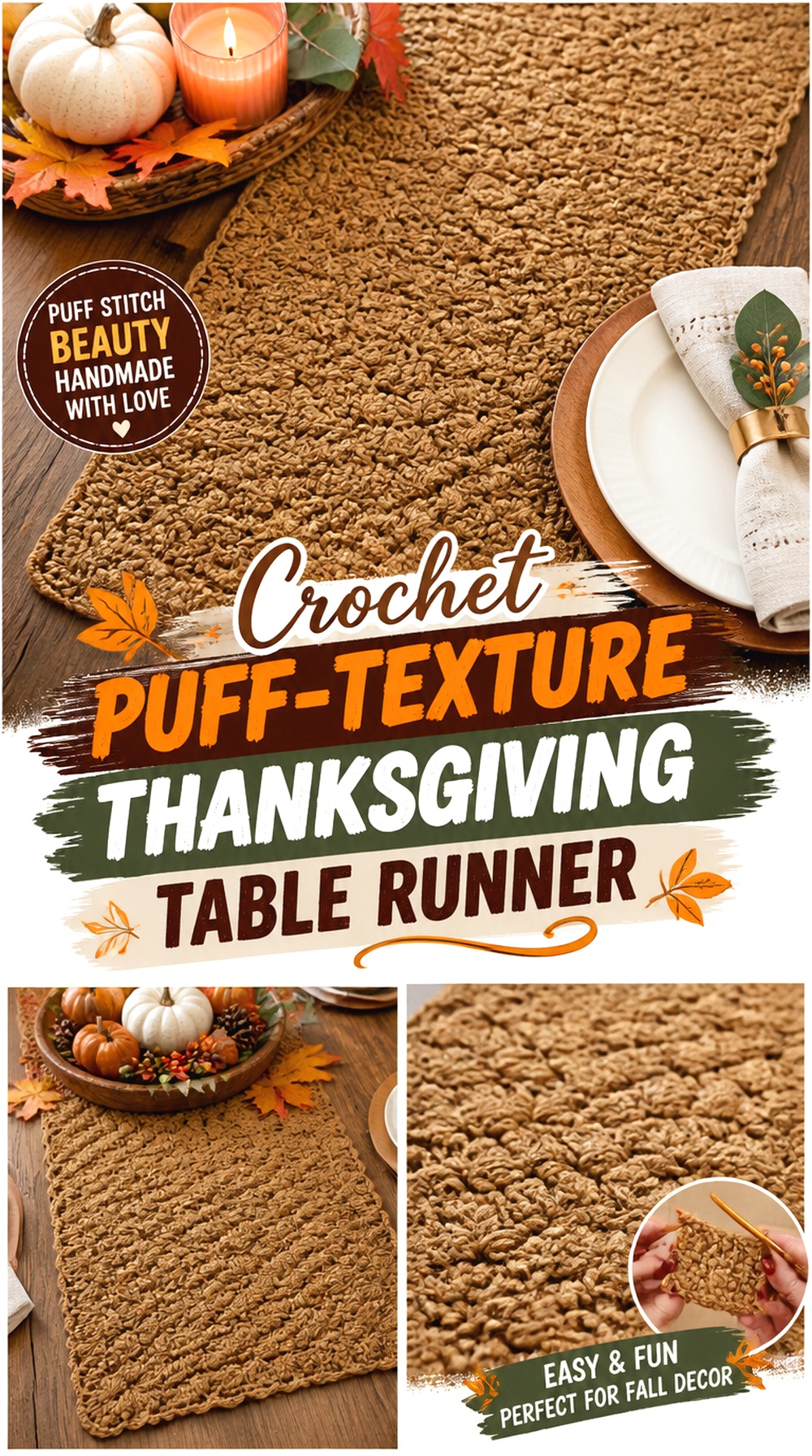
Raji’s Craft Hobby presents a table runner with noticeable stitch texture rather than relying on motifs or elaborate colorwork. That makes it useful when you want a solid autumn shade to have more depth under simple dinnerware. The raised texture creates shadow and definition, allowing the crochet itself to remain visible even in one color.
This type of runner is better treated as a decorative center strip than as a completely flat mat for every object on the table. The more pronounced the surface, the more important placement becomes.
Keep Stemware Off the Most Raised Areas
Dimensional stitches can make slender bases less stable than they would be on bare wood or a flat textile. Before guests arrive, test candleholders, glasses, and narrow vases in their intended positions. Move unstable pieces onto the clear tabletop rather than trying to force the entire tablescape onto the runner.
Side Lighting Makes Texture More Visible
If the runner is worked in a single muted shade, the raised stitch pattern may show more clearly when natural or room light crosses the surface instead of hitting it straight on. This can help a cream, brown, rust, or olive runner look detailed without adding extra colors or embellishments.
Original Tutorial and Creator Credit
Creator: Raji’s Craft Hobby
Crochet Three Stitch Colorwork Thanksgiving Table Runner
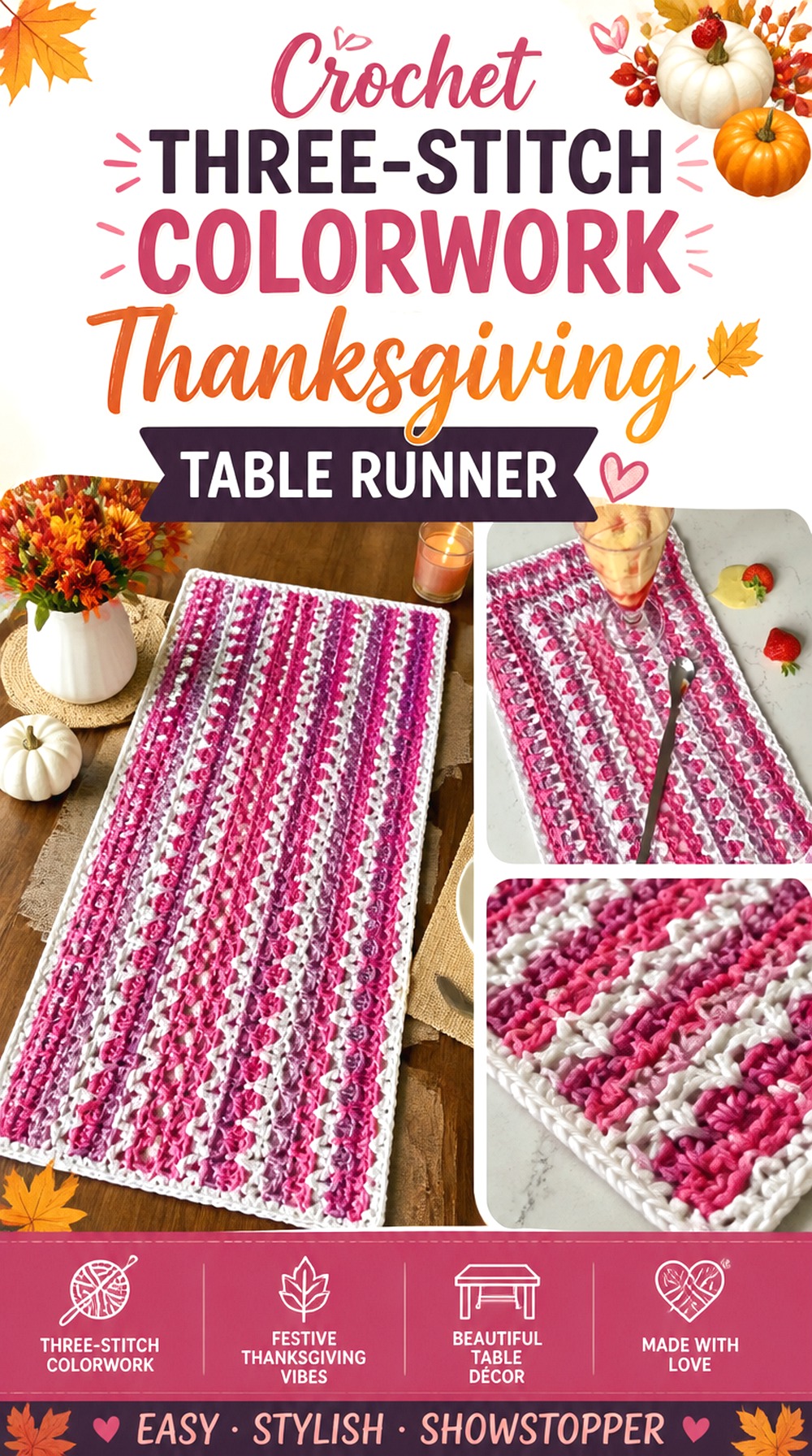
Cosy Rosie Crochet’s modern runner combines three stitch treatments in one design, giving you a way to create variation without breaking the project into separate motifs. The construction is particularly useful for Thanksgiving if you want several coordinated colors but still prefer a continuous runner rather than granny squares or hexagons.
Different stitch sections can make each shade behave visually in its own way, so a small palette can appear more varied than the same colors would in a uniform repeat.
Test Color Changes Across All Three Textures
One yarn shade may look solid in a dense section but lighter or busier in a more open stitch. Before buying a large amount, compare the planned shades in small swatches if practical. This helps you avoid a color that looks perfect in the skein but disappears when placed beside another shade in the finished texture.
Use Stitch Changes to Organize the Harvest Palette
Instead of alternating colors mechanically, think about which texture deserves the strongest autumn shade. A deep rust or gold can act as a focal band while quieter cream or beige sections prevent the complete runner from becoming too saturated. The stitch variation already creates movement, so the color plan does not have to do all the work.
Check the Edge After Every Major Section
When stitch patterns with different natural densities are combined, tension differences can show along the outer edge. Lay the work down periodically and make sure one section is not pulling in or spreading significantly. Catching that change early is easier than trying to disguise a noticeable width shift during finishing.
Original Tutorial and Creator Credit
Creator: Cosy Rosie Crochet
Crochet Rustic Openwork Thanksgiving Table Runner
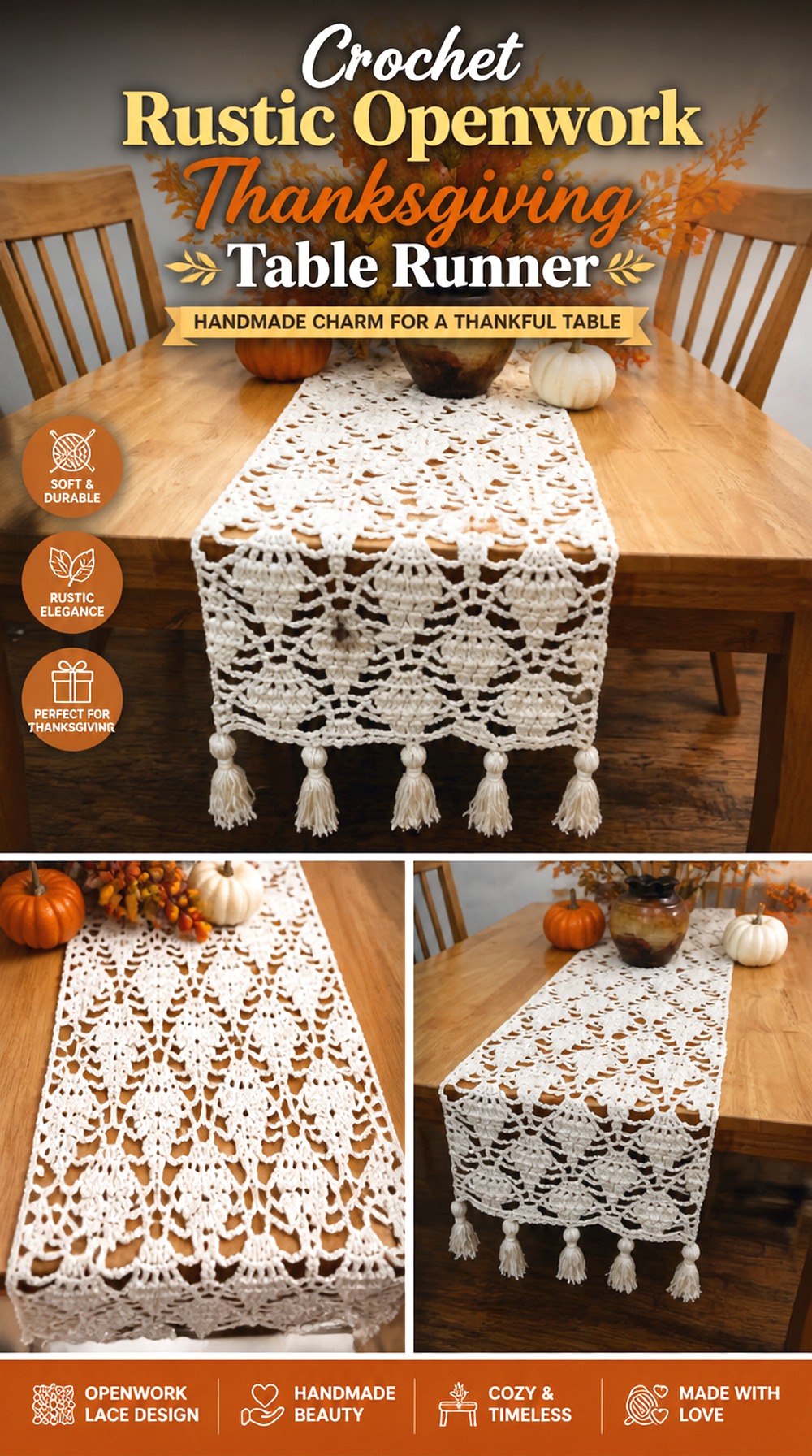
Crochet Tejido Color describes this runner as modern and rustic, a combination that fits naturally into a Thanksgiving setting built around wood, pottery, linen, dried foliage, or simple pumpkins. The openwork structure keeps it lighter than a thick solid runner while still creating a clearly handmade center strip.
Rather than treating the tutorial as inherently Thanksgiving-specific, adapt the neutral construction through yarn choice and surrounding decor. It is especially useful if you want the piece to remain on the table after the holiday.
Let the Table Surface Show Through
Openwork has the greatest visual impact when there is enough contrast between the yarn and the table beneath it. On a pale tabletop, a medium autumn neutral may show the openings more clearly than cream. On dark wood, an undyed or lighter shade can create definition without needing bright seasonal colors.
Rustic Does Not Require Rough Texture
A rustic visual direction can come from color, stitch openness, wood surfaces, and simple styling rather than a scratchy or difficult-care yarn. Choose the fiber according to the finished drape and care you want, then use the yarn label for washing guidance. Appearance alone does not tell you how a fiber will behave after use.
Original Tutorial and Creator Credit
Creator: Crochet Tejido Color
Crochet Long Fringe Thanksgiving Table Runner
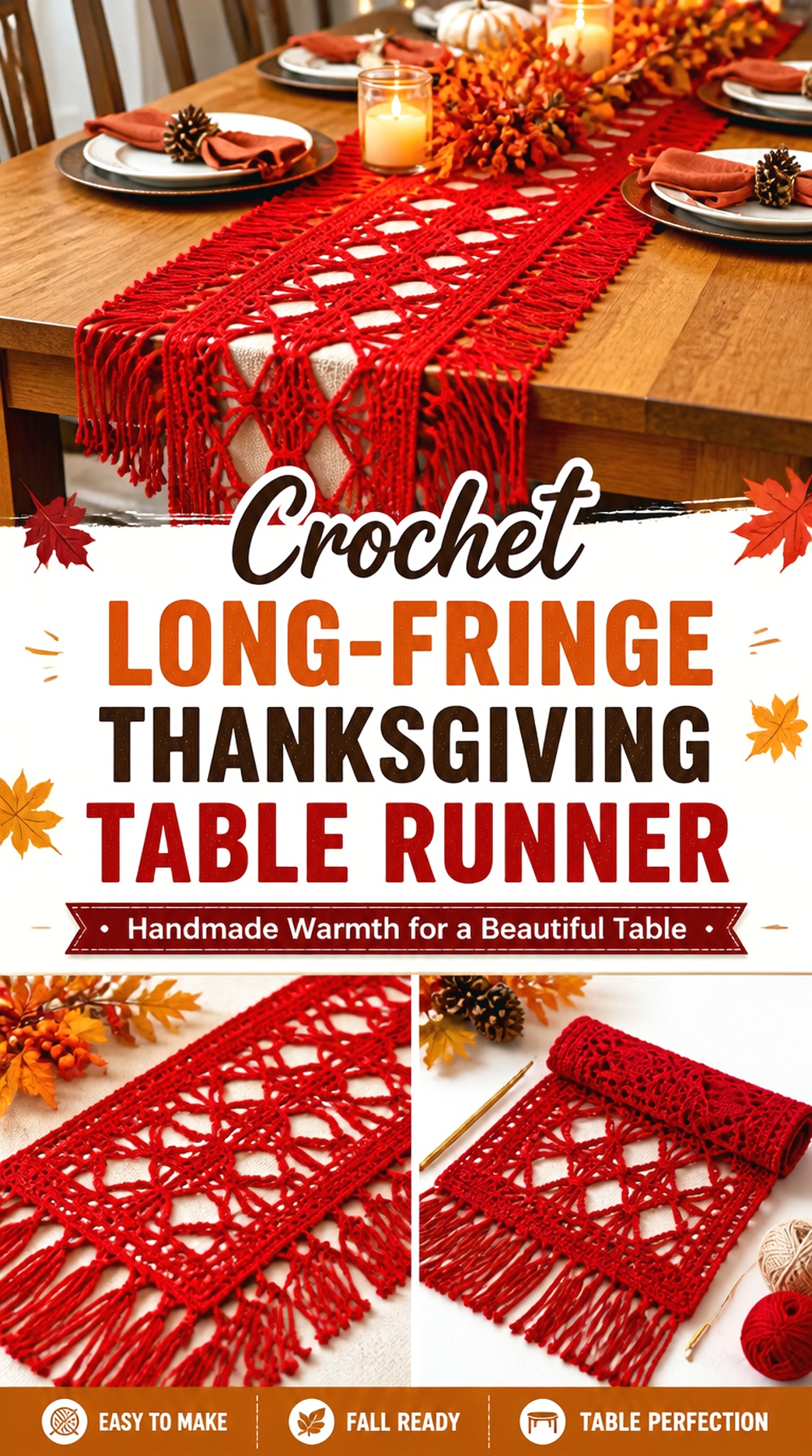
Mirian Artes em Crochê’s runner gives fringe a prominent role in the finished silhouette. That makes the short ends part of the design rather than a minor afterthought, which is helpful when the runner will extend over both ends of a long dining table.
For Thanksgiving, this construction can work in one deep harvest color or a neutral that lets the fringe create movement. It is less useful when the runner will be completely contained on the tabletop, because much of its personality comes from the decorative finish.
Count Fringe in the Display Length
Measure the runner as it will actually be used, including the decorative ends. If you only plan around the crocheted center, the finished fringe may hang farther than expected. This is especially relevant where people sit at the heads of the table or where the ends could brush chairs.
Straight Fringe Looks More Intentional
After the runner has settled or been blocked appropriately, compare the finished fringe lengths and trim only if the construction calls for it. Uneven fringe tends to be more noticeable on a formal dining table than on a casual throw. Keep enough length to preserve movement rather than cutting aggressively just to make every strand appear identical.
Original Tutorial and Creator Credit
Creator: Mirian Artes em Crochê
Crochet Narrow Fringe Thanksgiving Table Runner
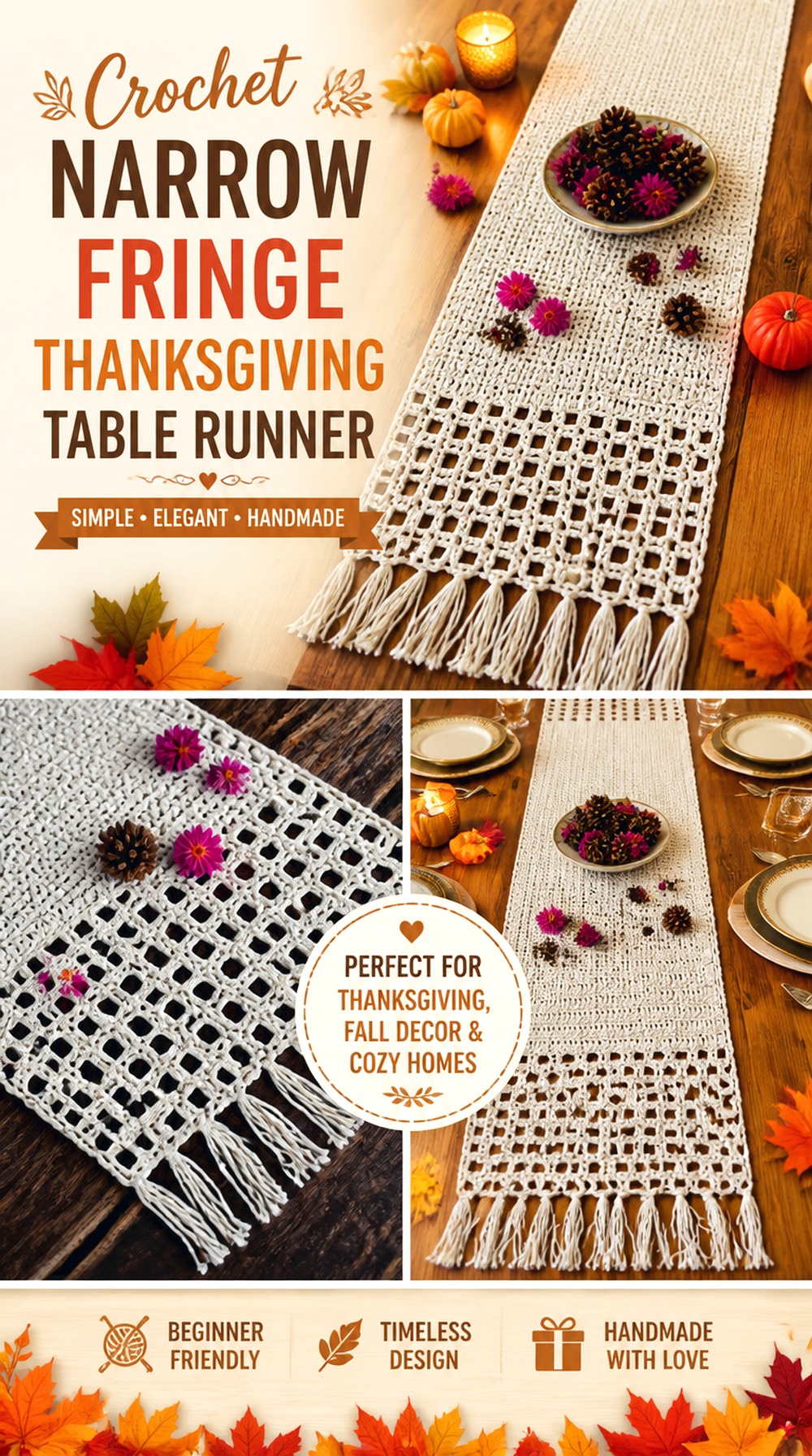
Kristines Crochets presents a design that can function as a table runner or scarf, which highlights its long, relatively narrow proportions and drape. For Thanksgiving, that makes it useful on a console, buffet, narrow dining table, or any surface where a broad centerpiece runner would take up too much room.
Its fringe adds softness without requiring a shaped motif. Because the original tutorial is not specifically Thanksgiving-themed, the seasonal effect should come from a deliberate autumn color choice and how the runner is styled.
A Narrow Runner Preserves More Place-Setting Space
Measure the distance between opposite place settings before selecting width. On a compact table, a narrow strip can provide crochet texture while leaving more exposed surface for plates and serving pieces. That can be more practical than shrinking an ornate wide design until its motif proportions no longer look right.
Drape Determines How the Ends Behave
A runner with enough flexibility to double as a scarf can hang differently from a dense, rigid table textile. Test the finished end over your actual table edge. If it curls or shifts, follow appropriate finishing and blocking guidance rather than relying on heavy decorations to pin it down.
Original Tutorial and Creator Credit
Creator: Kristines Crochets
Crochet High Contrast Thanksgiving Table Runner
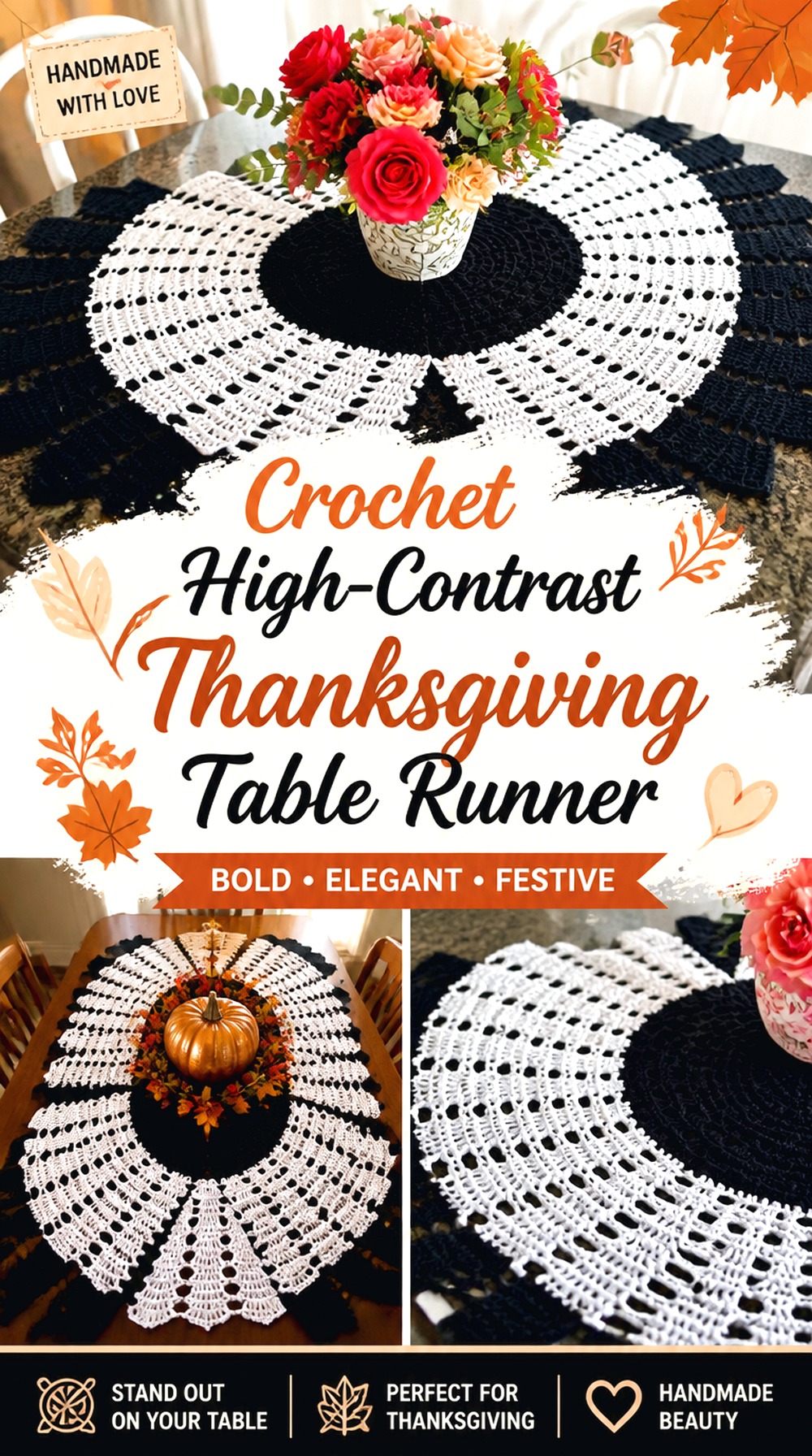
Mara Crochê’s finished runner shows how strongly a table textile can read when contrasting tones define the crochet rather than a seasonal motif. For Thanksgiving, you can keep that graphic principle while choosing colors that suit the room—cream with espresso brown, warm ivory with rust, or another pairing that remains clearly separated.
This option is especially useful on a simple table where the runner itself needs enough visual weight to anchor otherwise plain dinnerware.
Contrast Can Compete With Patterned Plates
Before selecting a dramatic two-color combination, place your dinner plates or placemats beside the yarns. If both the tableware and runner have strong pattern contrast, the complete setting can become busy. In that situation, reducing the runner to a quieter tonal contrast may make both elements easier to appreciate.
Repeat the Darker Shade Purposefully
If adapting the color scheme, decide whether the darker shade should frame the design, appear as an accent, or carry equal visual weight. Randomly distributing two strong colors can change the rhythm of the finished runner. Use the tutorial’s construction as the guide and treat recoloring as a planned composition rather than simple substitution.
Original Tutorial and Creator Credit
Creator: Mara Crochê
Crochet Classic Center Lace Thanksgiving Table Runner
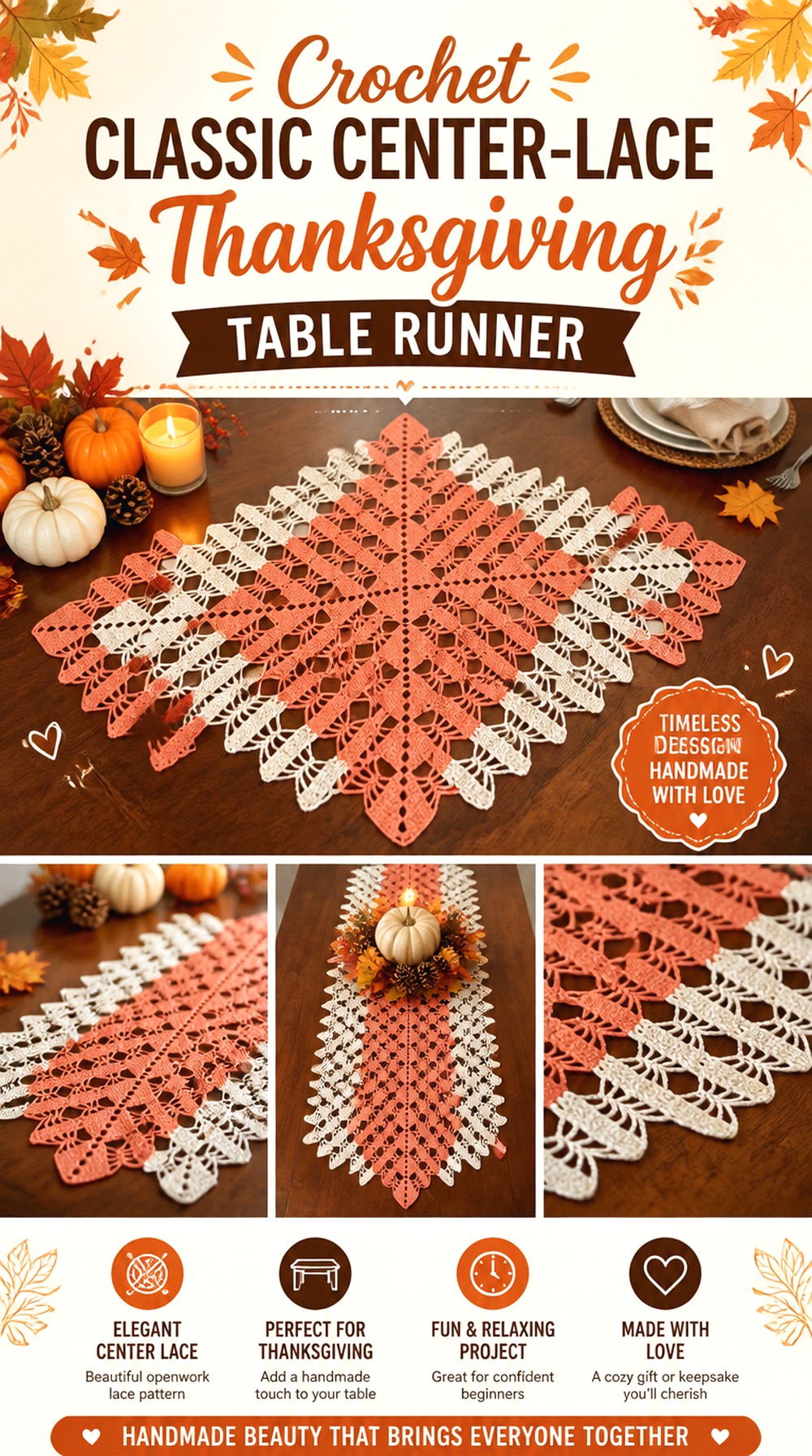
Que Bonito es Tejer’s step-by-step table-runner tutorial offers a traditional decorative direction that can be adapted to Thanksgiving without locking the piece into one holiday. This makes it a useful choice if you prefer a runner that can stay in rotation after autumn decorations are removed.
A classic crochet runner often works best when its stitchwork remains visible, so use seasonal styling around it rather than covering the entire center. Cream, warm beige, muted gold, or another table-compatible shade can create an autumn atmosphere while keeping the design reusable.
Decide Whether You Want Seasonal or Year-Round Yarn
A strongly pumpkin-orange runner makes its Thanksgiving role obvious but may spend most of the year in storage. A warmer neutral can support the same holiday table when paired with fall dishes and decorations, then return to everyday use later. Make that decision before starting rather than choosing color solely from a holiday photograph.
Use a Simple Centerpiece Over Detailed Lace
When stitchwork carries a lot of visual detail, a restrained centerpiece usually preserves more of the crochet. Try one vessel, a low arrangement, or a compact grouping instead of a long row of small objects. The goal is to let both the runner and centerpiece remain identifiable rather than blending them into one busy band.
Original Tutorial and Creator Credit
Creator: Que Bonito es Tejer
Crochet Traditional Long Thanksgiving Table Runner
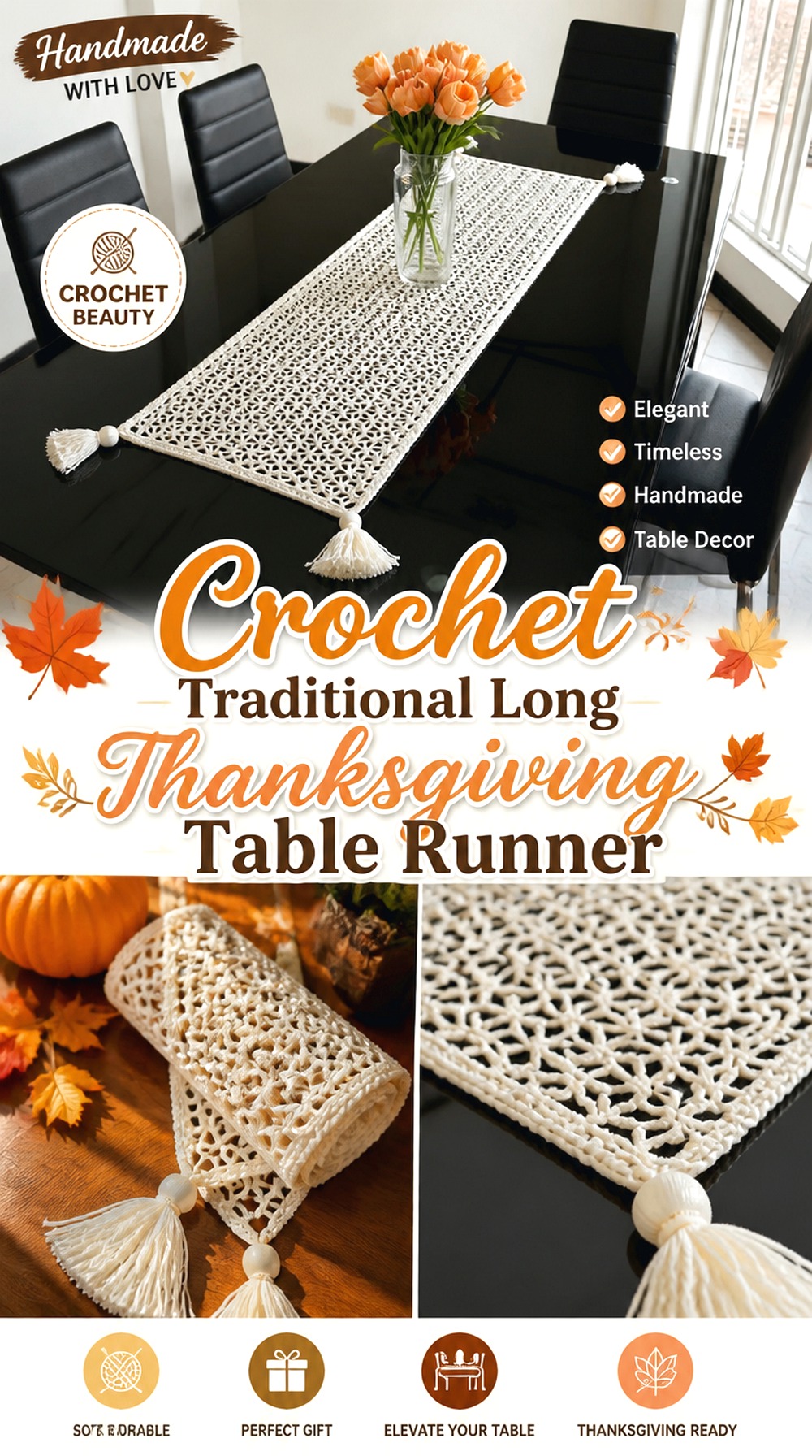
Crochet MC’s complete table-runner tutorial provides another classic long-format construction that can be adapted around a Thanksgiving palette. Its strength in this roundup is versatility: instead of a fixed seasonal picture, it provides a decorative crochet base that can coordinate with whatever autumn centerpiece or dinnerware you already own.
This direction makes sense if your Thanksgiving decorations change from year to year. A runner in a neutral or restrained warm shade can move between pumpkins, greenery, dried flowers, metallic accents, or minimalist table settings without looking tied to one theme.
Check Length Against Serving Zones
A long runner can look balanced on an empty table but behave differently once platters and bowls are added. Mark the planned centerpiece and serving zones before deciding how far the runner should extend. If food will occupy most of the table center, a simpler textile can be more practical than a complex motif that remains hidden for the entire meal.
Straight Long Edges Reveal Tension Changes
Extended runner sides make even small changes in width easier to notice. Lay the work flat periodically rather than waiting until the end. If one section begins narrowing or spreading, compare your tension and stitch placement while the affected area is still recent enough to address without undoing a large portion of the project.
Original Tutorial and Creator Credit
Creator: Crochet MC
Crochet Two Point Pineapple Thanksgiving Table Runner
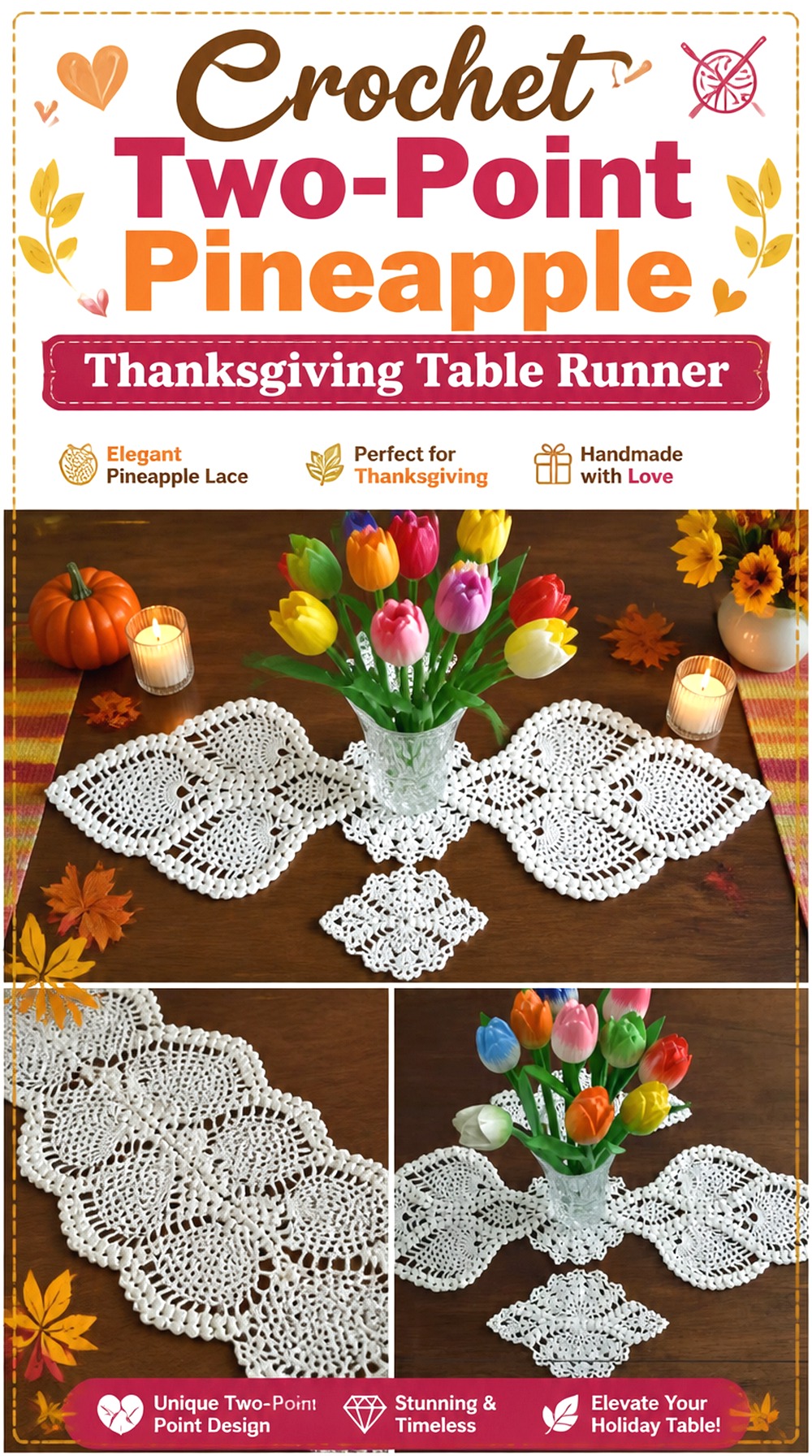
Esperanza y Ana Celia Rosas present a two-point crochet centerpiece featuring pineapple forms and a puff border. Its tapered ends distinguish it immediately from straight rectangular runners and make it feel closer to an heirloom centerpiece stretched along the table’s centerline.
For Thanksgiving, the pineapple lace can work in ivory, wheat, warm gold, or another autumn-compatible color without needing to imitate leaves or pumpkins. This is a better choice for display-focused tables than for a setup where every inch of the runner will be covered with serving dishes.
Pointed Ends Change the Visual Length
Tapered ends make a runner feel longer without keeping its full width from one end to the other. That can be useful when you want an elongated centerpiece shape but need more open table surface near the ends. Measure the widest central section separately from the pointed portions when evaluating fit.
Raised Puff Edging Needs Placement Awareness
A puff border introduces dimensional texture around the outer edge. Keep narrow-based objects away from pronounced raised sections if they do not sit securely. The runner can still support a centerpiece visually without having every candleholder or serving vessel physically resting on the crochet.
Pineapple Lace Benefits From Clear Background Contrast
The open pineapple forms become easier to see when the table surface beneath them differs from the yarn. Check the effect on the actual dining table before choosing the final color; a shade that looks detailed on a white background in a craft space may blend into a similarly colored tablecloth.
Original Tutorial and Creator Credit
Creator: Esperanza y Ana Celia Rosas
Crochet Openwork Rectangle Thanksgiving Table Runner
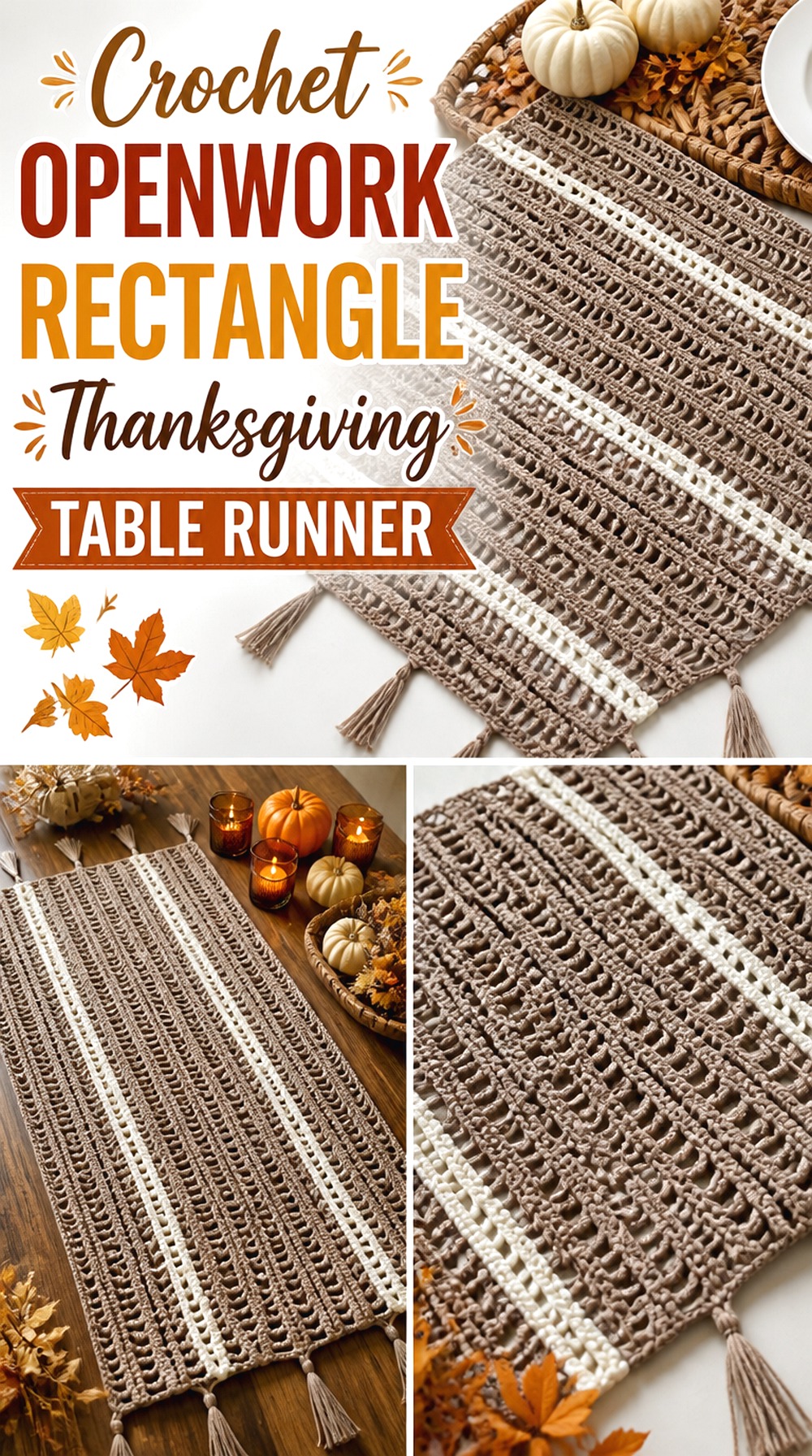
Beyond Diary’s tutorial connects a rectangular placemat format with table-runner use, making it a useful option for readers who prefer clean geometry and controlled openwork. The concept is easy to place visually because the piece keeps a straightforward rectangular footprint rather than pointed or heavily scalloped sides.
For Thanksgiving, that simplicity leaves plenty of room for the seasonal character to come from yarn color, center decorations, and dinnerware. It is a particularly practical direction for a narrow table where irregular motif edges might take up too much width.
Rectangle Proportions Are Easy to Mock Up
Before crocheting, place a folded towel, paper strip, or existing runner on the table at your proposed dimensions. This immediately shows whether the width intrudes into plates or whether the runner looks too narrow under the centerpiece. A physical mock-up is more reliable than judging dimensions in isolation.
Openwork Makes the Under-Surface Part of the Design
If the runner will sit over a tablecloth, remember that the cloth color will show through the crochet. Test the yarn against both the bare table and any planned linen. That small check can completely change which Thanksgiving shade gives the clearest stitch definition.
Original Tutorial and Creator Credit
Creator: Beyond Diary
Crochet Simple Repeating Thanksgiving Table Runner
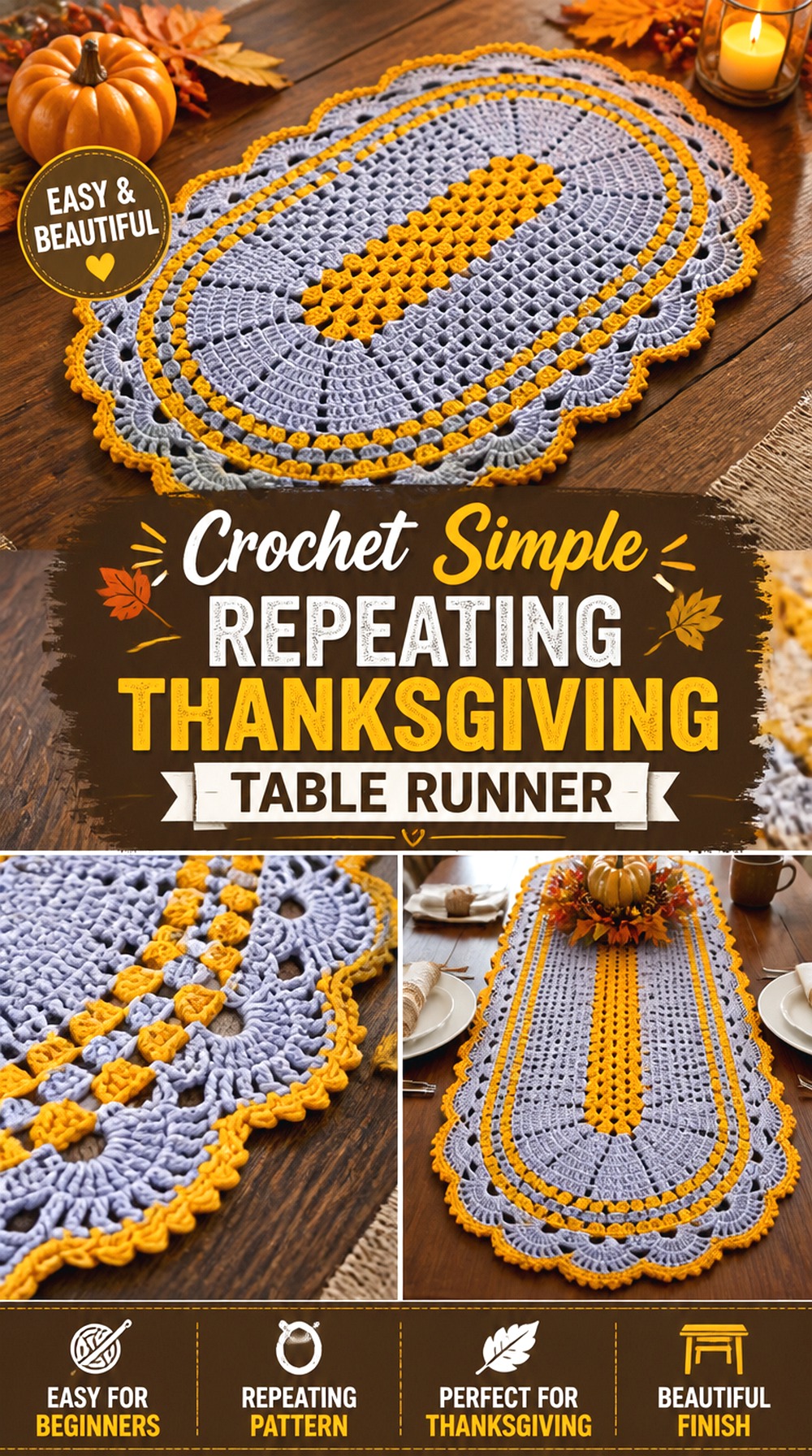
The Art Zone’s table-runner tutorial offers a straightforward decorative construction that works well as a Thanksgiving base when you do not want the textile itself to dictate the entire theme. Instead, the runner can support fall dishes, pumpkins, branches, or candles while remaining usable beyond November.
This kind of understated runner is often the better choice on a busy holiday table. A recognizable pumpkin motif may be attractive on an empty surface, but a simple repeat can remain visually coherent even after serving dishes cover large sections.
Simple Repeats Put More Attention on Finishing
When there is no dramatic motif to distract the eye, crooked edges and inconsistent width become more noticeable. Stop occasionally and lay the project flat. Compare both long edges rather than judging only the active row, and address tension changes before they continue for a large portion of the runner.
Seasonal Styling Can Stay Removable
Consider making the runner in a reusable base color and adding Thanksgiving character with items that are not permanently attached. This keeps the crochet flexible for another season and avoids embellishments that could interfere with washing, storage, or placing objects on the textile.
Original Tutorial and Creator Credit
Creator: The Art Zone
Crochet Box Grid Thanksgiving Table Runner
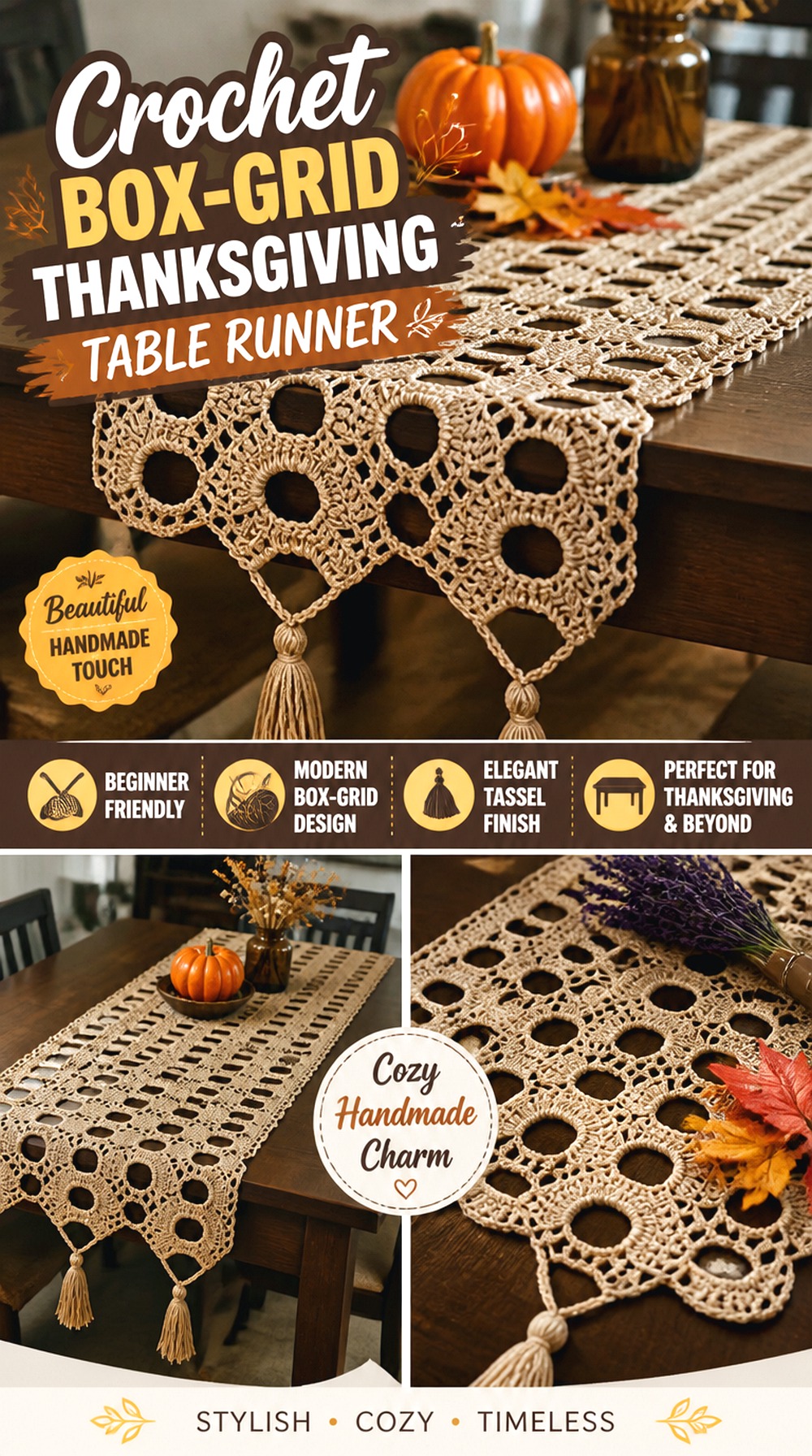
Hobisever’s tutorial creates a runner organized around repeating box-like open sections and includes decorative end finishing, producing a stronger geometric rhythm than a plain solid rectangle. That grid can look particularly effective in one harvest shade because the tabletop shows through and defines the repeating openings.
The construction also lends itself to a table where you want visual length without a heavy block of crochet covering the center. For Thanksgiving, think of the geometry as the structure and let color or surrounding foliage supply the seasonal cue.
Grid Openings Need a Stable Centerpiece Base
A broad tray, bowl, or vase base can bridge open spaces more easily than small narrow feet. Test your actual decorations rather than assuming the geometric holes will not matter. If a centerpiece feels unstable, place it directly on the table and allow the runner to frame it from either side.
Tassel Proportion Should Match the Table Edge
The source’s decorative end treatment adds another element beyond the grid itself. If you alter the runner’s length, reassess whether the end treatment still looks proportional. Long tassels can suit a runner that hangs freely, while a tabletop-only version may look cleaner with less emphasis at the ends.
The Grid Can Carry a Single Strong Fall Color
Because the openings already break up the fabric, a saturated rust, ochre, forest green, or brown does not necessarily read as one heavy block. Still, test the yarn against your tabletop: openwork depends on the underlying surface to complete the visual pattern.
Original Tutorial and Creator Credit
Creator: Hobisever
Crochet Pointed End Thanksgiving Table Runner
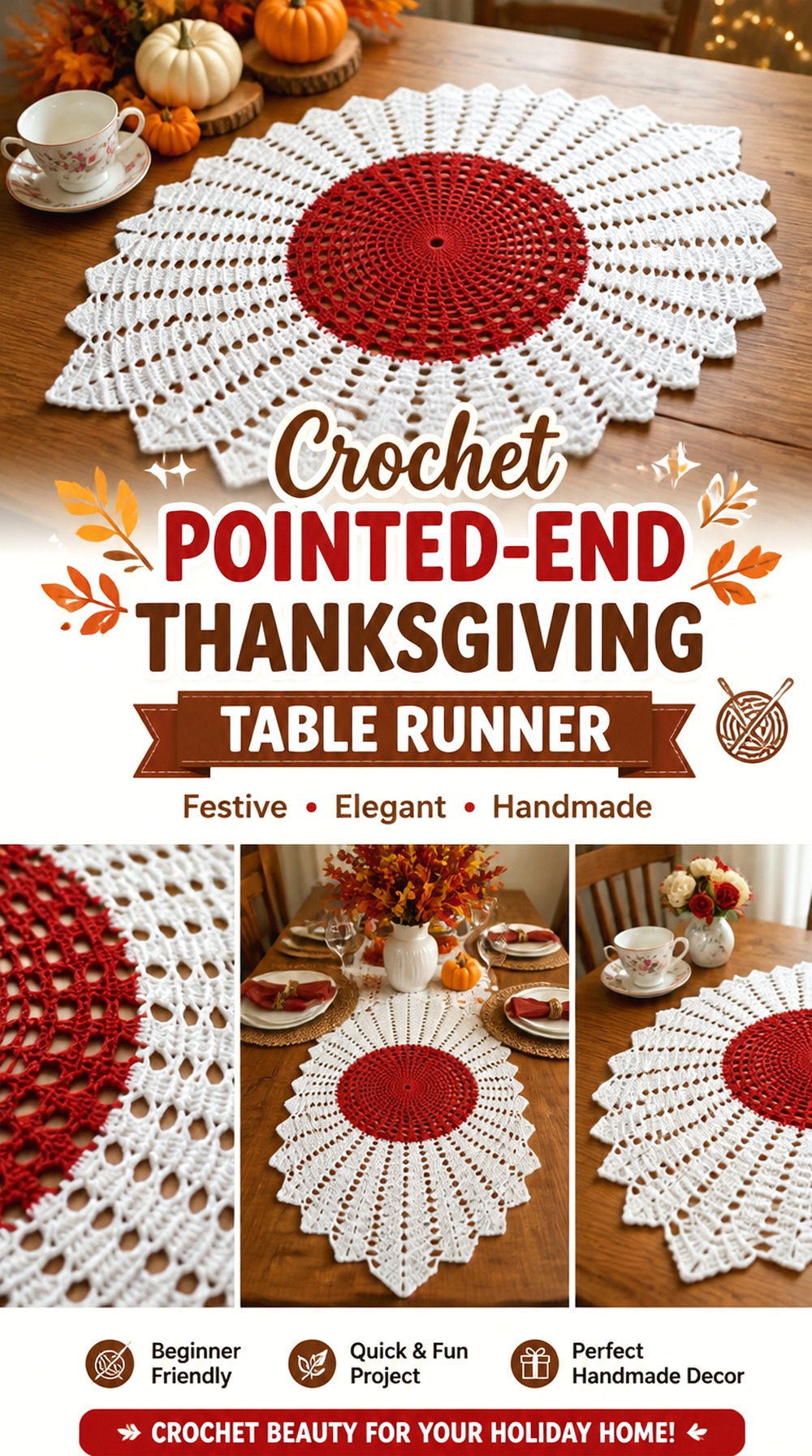
Alextitia Tuto Crochet’s runner develops from a central section into distinct pointed ends, creating a shaped centerpiece rather than a conventional straight rectangle. The tutorial shows the center developing first and then the tapered sections, so the finished silhouette becomes one of the project’s defining features.
For Thanksgiving, this structure suits a table where you want the widest decoration concentrated in the middle while leaving more exposed surface toward the ends. A warm solid shade can emphasize the outline without requiring additional fall motifs.
Center the Widest Section Before Styling
Because the width changes along the runner, placement should start from the midpoint rather than one short end. Align the broadest section with the main centerpiece or center of the table, then check how the two points extend outward. Small placement errors become more obvious in symmetrical pointed designs.
Tapering Gives Place Settings More Clearance
The reduced width toward the ends can be useful on a table where the head place settings sit close to the center strip. Compare this with a full-width rectangular runner before choosing. The shaped silhouette may preserve more bare tabletop without making the overall piece look undersized.
Symmetry Is the Main Finishing Check
Once both ends are complete, lay the runner flat and compare the points rather than inspecting them separately. Look at length, angle, and how the two sides transition from the central section. A pointed runner looks most intentional when its mirrored structure is visually balanced.
Original Tutorial and Creator Credit
Creator: Alextitia Tuto Crochet
Crochet Six Pineapple Thanksgiving Table Runner
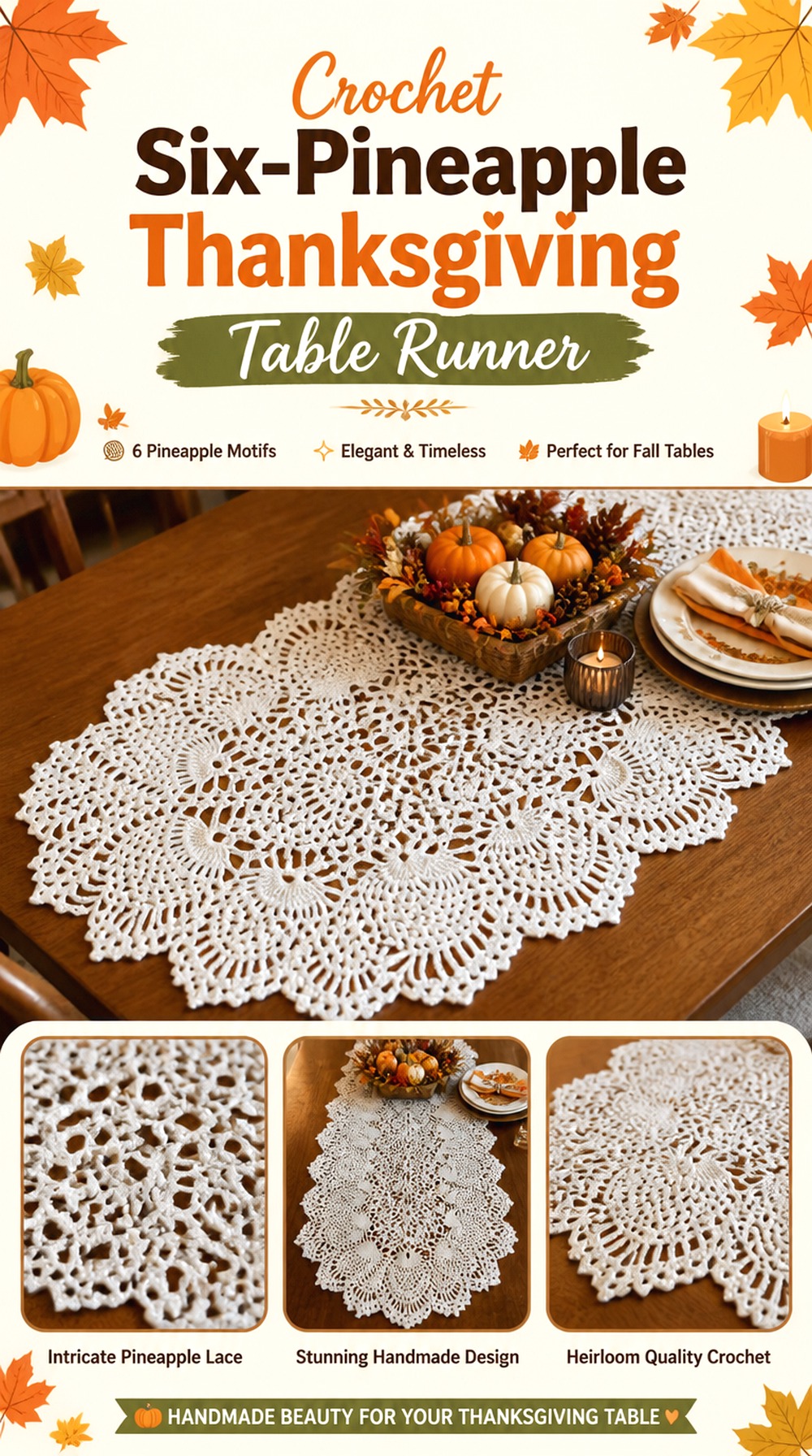
Rosa Isela’s runner uses six pineapple forms, giving the design a repeated lace motif with a clear beginning, middle, and end. Unlike a continuous texture that can often be extended almost invisibly, a fixed series of large motifs creates a more composed, centerpiece-like appearance.
This works well for Thanksgiving when you prefer classic crochet lace to novelty fall graphics. A wheat, cream, amber, or muted rust version could echo harvest colors while letting the pineapple structure remain the main decorative feature.
Treat the Pineapples as a Complete Composition
Before trying to change length, study how the six motifs relate to one another and to the outer shape. Removing or inserting a large motif can affect more than inches; it can change the symmetry and balance of the runner. Confirm the tutorial’s construction before planning any major alteration.
Give Large Motifs Room Under a Low Centerpiece
A tall vase hides only a small footprint, while a long tray can cover several pineapple sections at once. If the lace motif is the reason you chose this design, keep the centerpiece compact enough that guests can still see the repeated forms from both sides of the table.
Original Tutorial and Creator Credit
Creator: Rosa Isela
Crochet Tunisian Thanksgiving Table Runner
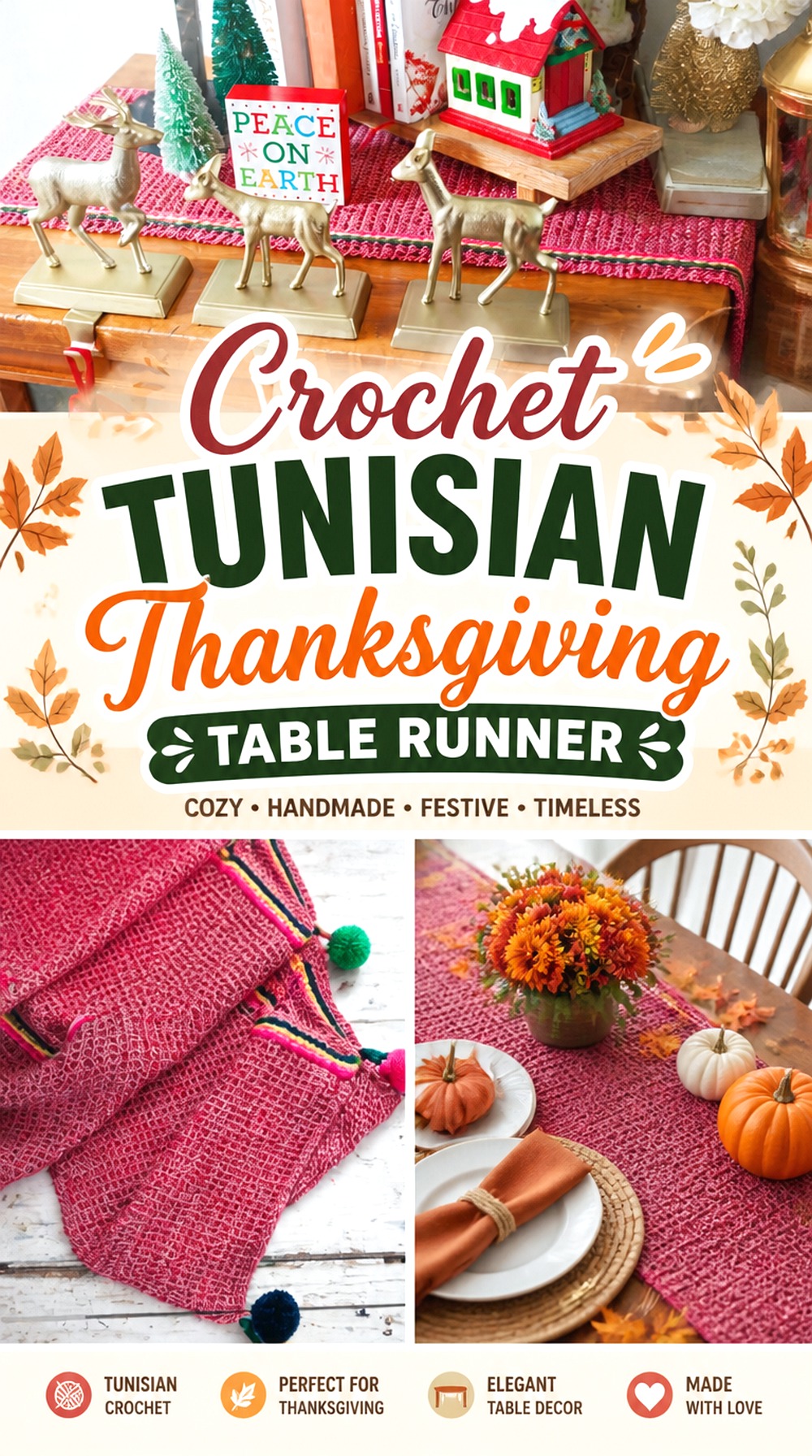
yokieB Crochet & Knit uses Tunisian crochet for this table-runner tutorial, giving the project a fabric character that stands apart from the standard crochet constructions elsewhere in this roundup. The source was presented as holiday decor, but the structure itself can be adapted for Thanksgiving with autumn yarn choices.
Tunisian simple stitch has a woven-looking surface, so this direction works particularly well for a modern Thanksgiving table where you want the handmade element to feel orderly and graphic rather than lacy.
Make a Practice Swatch If Tunisian Crochet Is New
The tutorial includes a quick Tunisian simple stitch introduction, which makes it useful as a learning route, but a small swatch is still worthwhile before starting a long runner. Use it to judge tension, fabric density, and whether the yarn produces the surface you expected.
Watch for Curl Before Final Table Setup
Some Tunisian fabrics can have a tendency to curl depending on stitch, yarn, tension, and finishing. Assess the runner after following the tutorial’s construction and finishing guidance rather than assuming it will behave like a standard crochet rectangle. If the edges do not sit as intended, resolve that before decorating over the piece.
A Woven Look Suits Minimal Thanksgiving Decor
This fabric can carry fall color without requiring pumpkins, leaves, or fringe. Try pairing a simple autumn shade with clean pottery, a narrow line of foliage, or one low centerpiece. That lets the Tunisian texture read clearly instead of competing with multiple decorative themes.
Original Tutorial and Creator Credit
Creator: yokieB Crochet & Knit
Crochet Shell Stitch Thanksgiving Table Runner
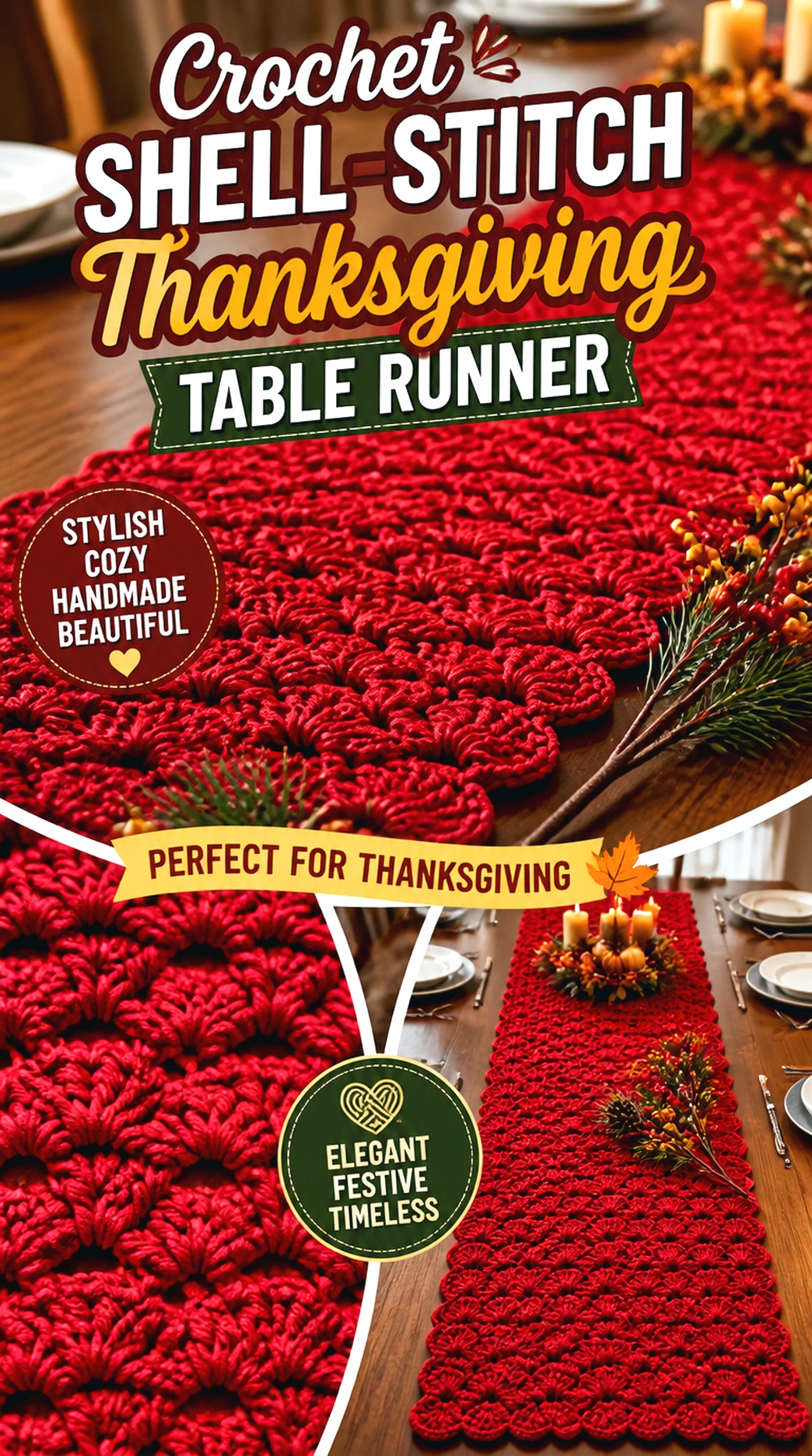
Kelly Rene Everyday’s source is also presented as a Christmas runner, but the shell-stitch construction itself is not limited to that holiday. Reworked in a Thanksgiving-compatible yarn, it offers a softly scalloped, repeating surface with more movement than a plain solid rectangle.
This is a useful adaptation for readers who want a recognizable crochet stitch pattern without pumpkins or leaves. Because the seasonal shift comes from color rather than motif, the finished runner can potentially stay useful well beyond Thanksgiving.
Recolor the Construction, Not the Source Theme
The original tutorial uses Christmas styling, so treat it as construction inspiration rather than calling the source itself a Thanksgiving project. Warm cream, brown, muted gold, terracotta, olive, or another palette suited to your room can move the shell texture toward autumn without changing the underlying crochet design.
Shells Create a Busier Edge Rhythm
Before adding heavily patterned placemats, check how their edges look beside the shell pattern. Two strong repeating patterns can compete. Solid dinnerware or quieter linens may allow the scalloped crochet texture to provide enough decorative movement on its own.
Original Tutorial and Creator Credit
Creator: Kelly Rene Everyday
Crochet Neutral Farmhouse Thanksgiving Table Runner
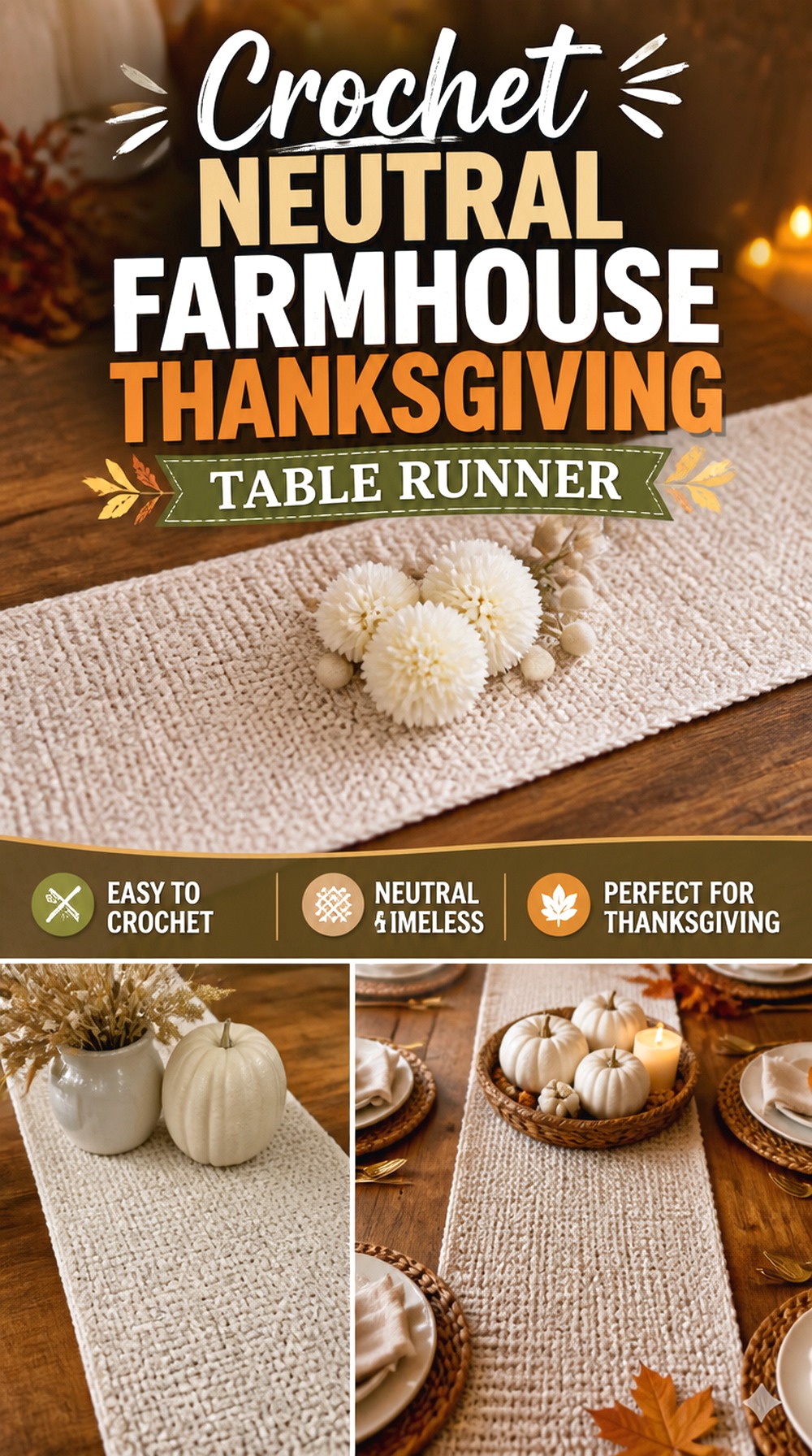
B.Hooked Crochet’s farmhouse table runner uses a simple repeating construction and a restrained finished look, making it a strong background piece for a Thanksgiving table that already has a substantial centerpiece. Instead of adding a literal fall graphic, it contributes long, continuous crochet texture that can work with wood, pottery, candles, or foliage.
This is also one of the more flexible styling directions in the collection. A quiet neutral can remain useful year-round, while a warmer autumn shade can give the same construction a more seasonal presence.
Choose This When the Centerpiece Should Lead
If you plan to use a large pumpkin arrangement, floral display, or many serving pieces, an understated runner can be more useful than another highly decorative element. The farmhouse texture gives the table a handmade foundation without demanding that every inch of the crochet remain visible.
A Long Repeat Makes Proportion the Main Decision
With a continuous design, the relationship between width and length matters more than motif count. Compare the runner’s planned width with your table first, then decide how much length you want visible beyond the centerpiece. Avoid making it wider simply to create more visual impact if that starts crowding place settings.
Neutral Does Not Have to Mean Plain
Cream and gray are not the only reusable choices. Mushroom, flax, warm taupe, muted olive, cocoa, or other subdued shades can still feel autumnal while remaining useful after Thanksgiving. Compare yarn under your actual dining-room lighting; subtle colors can change significantly between daylight and evening light.
Original Tutorial and Creator Credit
Creator: B.Hooked Crochet
Crochet Decorative Tassel Thanksgiving Table Runner
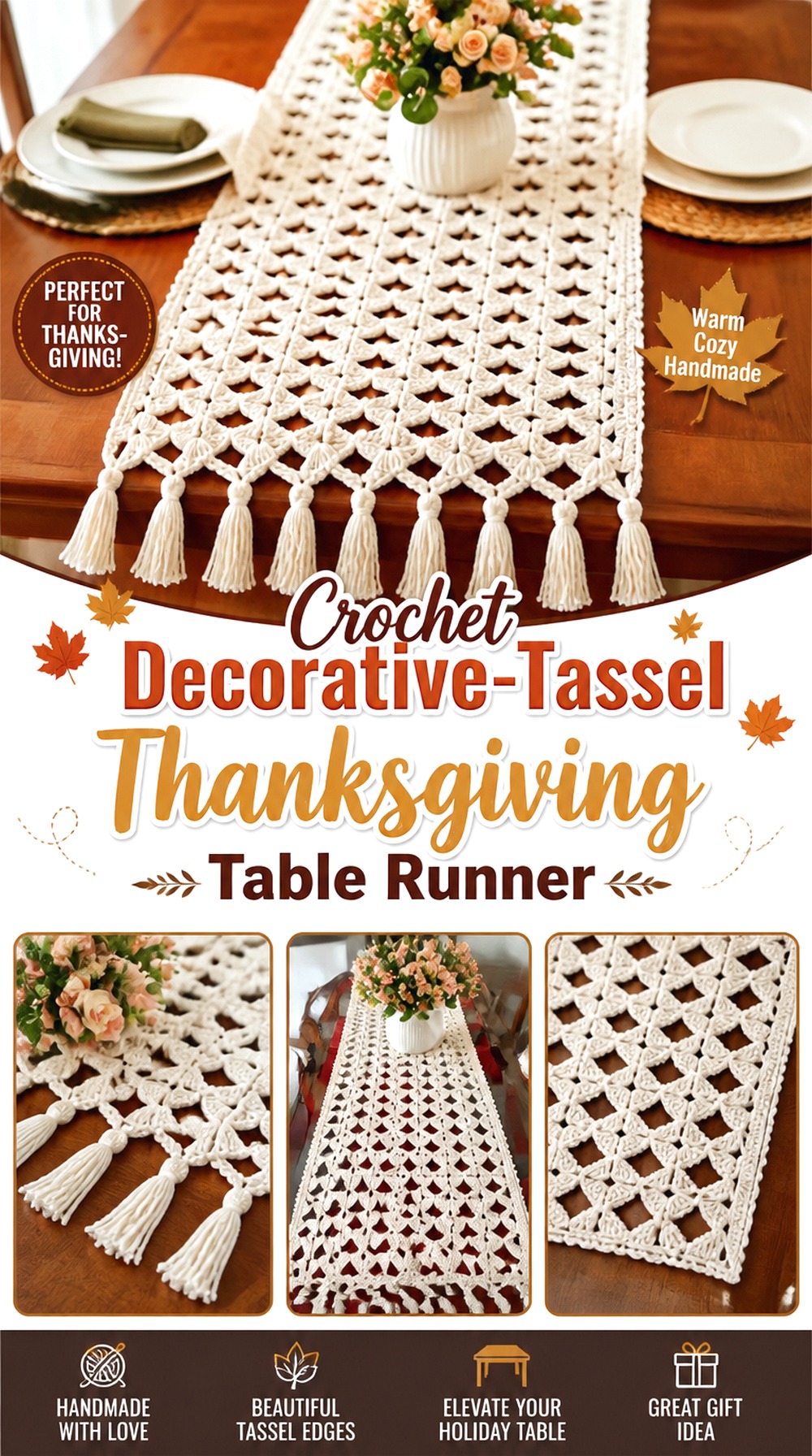
Passo a Passo Crochê & Artes finishes its runner with a pronounced tassel detail, giving the project a polished focal point at the end rather than spreading decoration across the entire textile. That is useful when you want Thanksgiving styling concentrated at the ends of a long table and a calmer central area beneath serving pieces.
For a harvest version, let the tassel and runner share a coordinated palette rather than adding many unrelated colors. This keeps the decorative finish intentional and prevents it from competing with the rest of the tablescape.
Make the Tassel Visible on Purpose
A decorative tassel adds little if it is folded underneath the runner or hidden behind a chair. Before choosing the finished length, decide exactly where the end will fall. This project makes the most sense when at least one decorative end remains visible from the dining room or entry angle.
Check End Weight Against the Runner Body
A substantial tassel can pull differently from the crocheted center. After attaching the finishing details according to the tutorial, lay the runner out and check whether the end still hangs or rests evenly. If the table edge is very smooth, verify that the runner stays positioned as intended before adding fragile decorations.
Keep the Center Relatively Calm
Because this design already emphasizes its ends, you can let the central table area remain simpler. A low bowl, candles, or one compact harvest arrangement gives the tassels space to contribute to the overall silhouette rather than turning every part of the runner into a separate focal point.
Which Thanksgiving Table Runner Style Should You Choose?
Choose the pumpkin or leaf runners when you want the crochet itself to establish the Thanksgiving theme. Granny squares and hexagons offer the most freedom for distributing several harvest colors, while the Tunisian, moss-stitch, farmhouse, and simple-repeat runners work better when your dishes and centerpiece already provide plenty of seasonal detail.
For a formal or heirloom look, the pineapple, center-lace, pointed-end, and openwork designs place more emphasis on shape and stitch definition. Choose fringe or tassel runners when the short ends will remain visible. If the dining table is narrow or crowded with food, favor slimmer, flatter constructions and keep strongly textured or openwork sections away from objects that need a stable base.
Conclusion
The most useful Thanksgiving runner is the one that fits both your table and the way you actually serve the meal. Choose pumpkins or leaves for an unmistakable seasonal centerpiece, modular squares or hexagons for flexible color planning, farmhouse and Tunisian textures for a quieter backdrop, or pineapple and pointed designs when shape matters most.
Before starting, compare usable table width, centerpiece footprint, desired overhang, stitch texture, and how much of the finished crochet will remain visible once dinner is served. For construction details, sizing, joins, finishing, and any project-specific materials, follow the original creator tutorials linked with each idea. That keeps your planning flexible without guessing at pattern details the designers have already demonstrated.
Frequently Asked Questions
How wide should a crochet Thanksgiving table runner be?
There is no single correct width because dining tables and place settings vary. Measure the clear center strip after accounting for plates, glasses, and any serving pieces that normally sit near guests. A wide decorative runner may suit a large table, while a narrow one can preserve more usable surface on a compact table. Mocking up the intended width with folded fabric or paper before crocheting is an easy way to judge proportion.
Should a Thanksgiving table runner hang over the ends of the table?
It can, but it does not have to. Fringe, tassels, and tapered points often look more intentional when the ends remain visible, while a motif centerpiece may work entirely on top of the table. If the runner will hang over, include decorative finishing when evaluating the total length and check whether guests will sit at the table ends. The finished display should not interfere with chairs or seated diners.
What yarn is practical for a crochet table runner?
Choose yarn by the structure, drape, care, and appearance you want rather than assuming one fiber is universally correct. Cotton is common in table linens and can give clear stitch definition, while other fibers produce different drape and texture. Always check the specific yarn label for washing and drying instructions. If spills are likely, consider care requirements before choosing a yarn simply because its color suits the Thanksgiving palette.
Can I turn a regular crochet table-runner tutorial into a Thanksgiving runner?
Yes, when the underlying construction suits the table. Neutral farmhouse, shell, moss-stitch, Tunisian, lace, and geometric designs can often take on an autumn character through yarn color and surrounding decor. Be transparent about the distinction, though: a Christmas shell-runner tutorial recolored in rust is still an adapted construction, not an original Thanksgiving tutorial. Motif-specific projects may require more planning than a simple color change.
How do I keep a crochet table runner from looking crowded with a centerpiece?
Decide which element should be the focal point. If the runner contains pumpkins, leaves, pineapples, strong color blocks, or complex motifs, use a compact centerpiece that leaves important crochet areas exposed. When the centerpiece is large or detailed, a quieter farmhouse or solid-texture runner usually provides better balance. Photographing a trial arrangement from the doorway and from a seated position can reveal crowding that is harder to notice while standing over the table.
Should I block crochet motifs before joining a Thanksgiving table runner?
Blocking can be especially useful for motif-based runners because inconsistent square, hexagon, or lace-unit dimensions become more obvious once several pieces are joined. Follow an appropriate method for the yarn you are using and compare finished motif dimensions before assembly. Blocking will not correct major construction errors, but it can help you evaluate shape and consistency before joining turns several small discrepancies into one visibly uneven runner.
Can a crochet Thanksgiving table runner protect the table from hot serving dishes?
Do not assume so. A decorative crochet runner is not automatically a heat-resistant pad or trivet, and appearance alone does not tell you whether the fiber or construction is suitable for direct heat. Use appropriate heat-protective equipment for hot cookware and follow manufacturer guidance for the yarn or product involved. Treat the runner primarily as table decor unless its materials and construction are specifically intended and verified for another use.