Persimmon and oat milk make a warm, understated pairing for a crochet Sphynx cat sweater. Persimmon can give the body a rich focal color, while oat milk softens the neckline, cuffs, or shoulder section. Reverse the arrangement and a persimmon mock neck becomes the strongest detail against a light neutral body.

The mock neck is what separates these ideas from an ordinary cat pullover. It should rise above the base of the neck without behaving like a deep folded turtleneck. On a Sphynx sweater, that means paying attention to collar height, stretch, seam bulk, and what happens when the cat lowers its head or turns sharply.
Several tutorials below are specifically for cats, including top-down and sleeved constructions. The remaining sources are pet or dog sweater tutorials that offer useful approaches to made-to-measure sizing, tiny garments, texture, longer sleeves, colorwork, collars, or harness access. Those sources should be adapted to the cat’s measurements rather than treated as ready-made Sphynx sizing.
Quick List
- Crochet Classic Persimmon Mock Neck Sphynx Cat Sweater
- Crochet Raglan Oat Milk Mock Neck Sphynx Cat Sweater
- Crochet Short-Sleeve Two-Tone Mock Neck Sphynx Cat Sweater
- Crochet Minimal Cream-Band Mock Neck Sphynx Cat Sweater
- Crochet Made-to-Measure Standing Neck Sphynx Cat Sweater
- Crochet Berry-Texture Short Mock Neck Sphynx Cat Sweater
- Crochet Lightweight Persimmon Mock Neck Sphynx Cat Sweater
- Crochet Puff-Panel Oat Milk Mock Neck Sphynx Cat Sweater
- Crochet Long-Sleeve Persimmon Mock Neck Sphynx Cat Sweater
- Crochet Fold-Free Turtleneck-Inspired Sphynx Cat Sweater
- Crochet Colorwork-Yoke Mock Neck Sphynx Cat Sweater
- Crochet Harness-Aware Textured Mock Neck Sphynx Cat Sweater
- Crochet Soft Cowl-to-Mock Neck Sphynx Cat Sweater
- Crochet Classic Oat Milk Trim Mock Neck Sphynx Cat Sweater
- Crochet Ribbed Vintage Mock Neck Sphynx Cat Sweater
Keep a Mock Neck Shorter Than a Full Turtleneck
A mock neck should stand above the main sweater without needing to fold back on itself. That distinction matters on a small pet garment because every extra layer adds thickness beneath the jaw and around the shoulders.
Finish enough of the collar to test it before continuing into the body. Watch what happens when the cat looks downward, turns to groom, walks, and sits. If the edge reaches the jaw or folds into a thick roll, reduce the collar height rather than relying on the fabric to soften with wear.
Stretch also matters. A collar can look comfortably loose once worn but still be difficult to pass over the head. Test both dressing and removal before committing to the rest of the sweater.
Ribbing can provide useful flexibility, but crochet ribbing varies considerably. Swatch the actual yarn and collar stitch rather than assuming a ribbed appearance automatically means high stretch.
Keep the Inside Smooth for a Sphynx Cat
On a Sphynx sweater, the inner surface deserves as much attention as the decorative side. Color-change joins, thick seams, tightly woven-in ends, and raised stitch transitions can become noticeable when there is no dense coat between the fabric and the body.
Feel the completed neck and armhole edges with your fingertips. A section that feels unusually hard, bulky, or ridged compared with the surrounding crochet is worth reconsidering.
This becomes especially important with two colors. Instead of placing frequent persimmon-to-oat-milk changes throughout the collar, larger color blocks can reduce the number of joins in sensitive areas.
Raised texture can still be useful, but the broad back is a better location for it than the underside of the neck or the narrow front-leg area.
Use Persimmon and Oat Milk to Clarify the Neckline
The simplest color arrangement is a persimmon body with an oat milk mock neck. The contrast makes the collar shape obvious while keeping the majority of the sweater visually warm.
For a lighter-looking sweater, reverse the colors. A mostly oat milk body with a persimmon collar and cuffs gives the garment a clear frame without requiring stripes.
You can also divide the upper sweater into zones: oat milk neck, persimmon shoulder yoke, and oat milk body; or persimmon collar, cream shoulder band, and persimmon torso.
Avoid making every section alternate colors. A compact pet garment often looks more coherent when one shade clearly dominates and the second color explains the construction.
1. Crochet Classic Persimmon Mock Neck Sphynx Cat Sweater

Treasurie’s cat-specific sweater is worked from the neck down in one piece and includes a ribbed neckband, leg openings, shaped back, and adjustable sizing. That makes it a useful foundation for replacing a conventional ribbed collar with a slightly taller but still controlled mock neck.
Use persimmon for the body and oat milk for a short standing collar.
Add Height Without Creating a Fold
The mock neck only needs enough additional depth to rise visibly above the shoulder line. If the collar begins folding outward by itself, the extra height is no longer contributing much to the intended silhouette.
Check the collar on the cat before progressing far into the body.
Let Oat Milk Frame the Face
A light collar against persimmon creates a clear visual boundary around the upper sweater.
You can repeat oat milk in a very narrow lower edge if the collar otherwise feels disconnected, but the body does not need additional striping.
Recheck the Collar After the Shoulders Expand
A neckline that seems stable by itself can behave differently after the shoulder section adds weight below it.
Try the developing sweater on again after the upper body is established and confirm that the collar still stands without pulling backward.
Creator Credit: Treasurie
2. Crochet Raglan Oat Milk Mock Neck Sphynx Cat Sweater
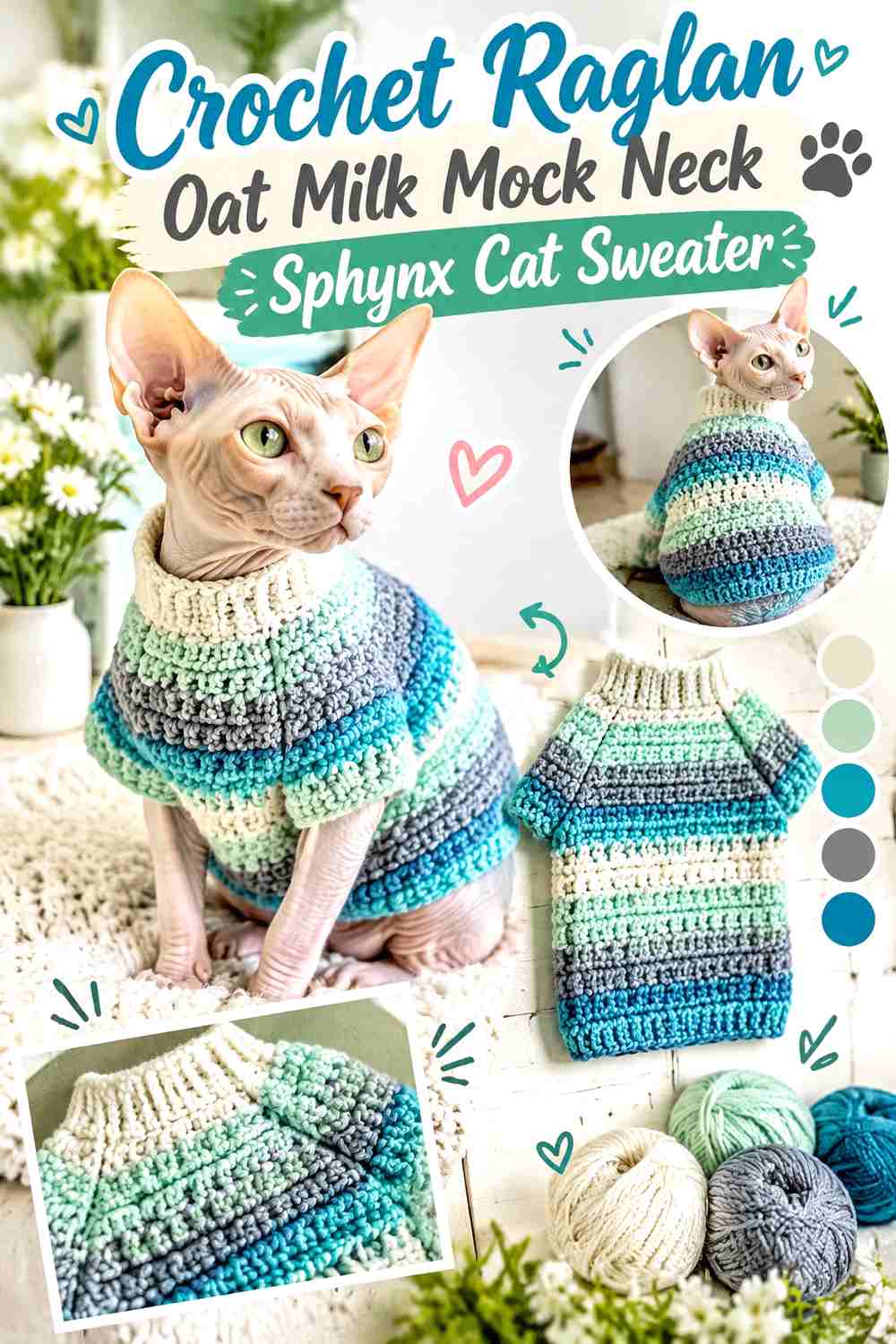
MJ’s Off The Hook Designs provides a cat-specific, seamless top-down raglan pullover with sizing from kitten through adult cat. The construction creates clearly defined sleeve, back, and front sections, which makes it useful when you want the mock neck to transition into visible shoulder shaping.
Make the body oat milk and use persimmon for the mock neck and narrow raglan accents.
Let the Raglan Lines Start Below the Collar
Keep the standing collar visually separate from the shaping below it. A short plain persimmon neck followed by an oat milk transition makes it easier to see where the actual body construction begins.
If you use persimmon again along the shoulder lines, keep those accents narrow.
A Seamless Body Reduces Interior Bulk
A top-down one-piece construction can limit the number of major assembly seams inside the garment.
That does not eliminate the need to inspect yarn joins and color changes, but it gives you fewer structural seams competing with the collar.
Check Sleeve Placement Before Deepening the Neck
A taller collar should not distract from fitting the raglan correctly. Confirm that the front-leg sections align naturally before deciding whether the neckline needs another round or additional edging.
The sweater’s movement is more important than an exact collar depth.
Creator Credit: MJ’s Off The Hook Designs
3. Crochet Short-Sleeve Two-Tone Mock Neck Sphynx Cat Sweater

Punto a punto y más demonstrates a crochet cat sweater with a full body, separated sleeves, ribbed finishing, and visible front-leg coverage. That makes it useful for a mock-neck sweater where the cuffs become part of the two-color plan.
Use persimmon across the main torso and repeat oat milk at the standing neck and short sleeves.
Coordinate Collar and Cuffs Without Matching Their Depth
The neck and cuffs can share the same color without being the same width.
Keep the mock neck deep enough to read as a collar, but make sleeve edging only as substantial as the leg openings comfortably allow.
Watch the Space Between Neck and Sleeves
On a small cat garment, a high collar and prominent sleeves can visually crowd the shoulder area.
Leaving the shoulder section solid persimmon creates enough separation for both oat milk details to remain distinct.
Test Forward Reach Before Finishing the Sleeves
Watch the cat extend the front legs.
If the sleeves push backward toward the armpits, reduce their length or edge depth instead of tightening them around the legs.
Creator Credit: Punto a punto y más
4. Crochet Minimal Cream-Band Mock Neck Sphynx Cat Sweater

LittleGemsCreations – Fibre Artist demonstrates a cat-specific crochet sweater and directly frames the project as useful for hairless cats as well as other feline wearers.
For this version, keep almost the entire sweater persimmon and use oat milk only on the mock neck and a slim lower border.
Use One Clean Contrast Band at the Neck
A strong persimmon body does not need elaborate color changes to make the mock neck visible.
One oat milk collar creates enough contrast and also limits the number of color joins near the cat’s upper body.
Keep the Neck Surface Simple
If the torso contains any visible stitch texture, use a relatively smooth collar.
The standing shape itself provides visual interest, so extra raised stitches at the neck may only add thickness.
Resize the Collar Independently
Do not assume the body and neck need to scale by the same percentage when adjusting the sweater.
Fit the head opening and resting neck circumference directly, then make body changes according to the cat’s chest and torso.
Creator Credit: LittleGemsCreations – Fibre Artist
5. Crochet Made-to-Measure Standing Neck Sphynx Cat Sweater

Loops Only Crochet demonstrates a customizable pet sweater that starts with ribbed neckline construction and then develops through the body, leg openings, chest, and shaped back. The tutorial is demonstrated on a dog, so its main value here is the measurement-led construction rather than the source dimensions.
Use an oat milk body with a persimmon standing collar and upper shoulder band.
Decide Neck Height From the Individual Cat
Made-to-measure construction gives you freedom to make the collar proportionate to the actual wearer.
Measure circumference and test height separately. A collar can have the correct circumference and still be too tall beneath the chin.
Keep the Shoulder Band Below the Mock Neck
A short oat milk gap between the persimmon collar and a later persimmon body accent can make the upper garment less visually dense.
Alternatively, let the collar be the only persimmon element near the head.
Recalculate Dog-Based Proportions for the Cat
Do not copy front-leg spacing or torso length simply because the neck has been successfully resized.
Use the cat’s measurements throughout and treat every transition in the source as a construction concept rather than a universal proportion.
Creator Credit: Loops Only Crochet
6. Crochet Berry-Texture Short Mock Neck Sphynx Cat Sweater
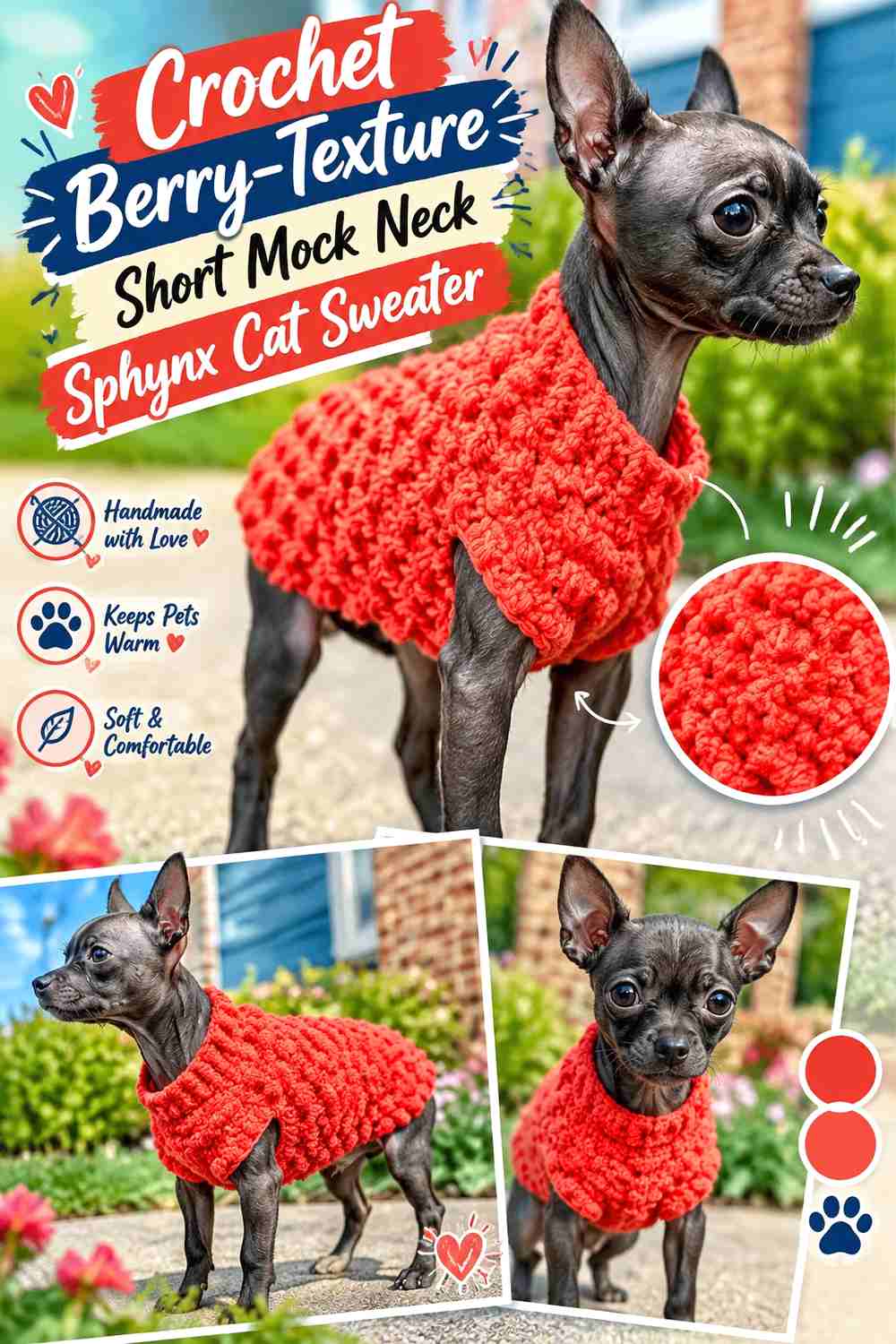
Heart Hook Home’s Tiny Dog Sweater uses a compact one-piece construction with uneven berry texture and very small sizing. That makes it a useful reference for a small pet garment where the body carries texture but the mock neck remains restrained.
Use oat milk for the textured torso and persimmon for a smooth, short standing collar.
Keep Berry Texture Below the Neck
The dimensional body already has substantial surface character.
A smoother mock neck avoids stacking raised texture directly beneath the jaw and makes the collar silhouette cleaner.
Scale Texture to the Finished Cat Sweater
A repeat that works across a dog sweater may occupy a different proportion of a narrow cat body.
Swatch the texture and decide whether a smaller panel or partial textured back makes more sense than full coverage.
Leave the Front-Leg Zone Less Bulky
If the berry fabric feels noticeably thicker, transition to a flatter stitch near the front legs.
The back can carry most of the texture without requiring every surface to match.
Creator Credit: Heart Hook Home
7. Crochet Lightweight Persimmon Mock Neck Sphynx Cat Sweater

Crochet It’s small pet sweater tutorial uses a lighter-weight construction than several chunkier projects in this list, making it useful inspiration for a slimmer mock neck and less bulky torso.
Use persimmon as the main color and make only the inner or upper collar edge oat milk.
A Slim Collar Can Still Read as a Mock Neck
The collar does not have to be thick to stand visibly above the body.
A few well-proportioned rounds in a fabric with enough structure may produce a cleaner result than doubling a lighter yarn unnecessarily.
Use Oat Milk as an Edge Highlight
Instead of making the whole neck cream, add a narrow oat milk line at the top of the persimmon collar.
This visually emphasizes collar height without dividing the upper sweater into large color blocks.
Watch for Vertical Stretch
Lighter fabrics can change length once worn.
Check whether the collar settles lower or the torso stretches toward the rear before deciding on final body edging.
Creator Credit: Crochet It
8. Crochet Puff-Panel Oat Milk Mock Neck Sphynx Cat Sweater

SheiLa Teré’s pet sweater tutorial incorporates puff and V-stitch texture in a compact garment, giving this idea a useful foundation for separating a smooth collar from a dimensional back panel.
Make the main sweater persimmon, work the mock neck in oat milk, and use a limited oat milk puff-textured section along the center back.
Give the Neck and Puffs Different Roles
The mock neck provides shape; the puff panel provides surface interest.
Keeping those effects apart prevents the upper sweater from becoming too thick and makes both details easier to see.
Stop Raised Texture Before the Armpits
Puff stitches can add thickness where the cat’s front legs need the most freedom.
Concentrate them on the back and transition to a flatter fabric on the chest and sides.
Check Every Raised Loop
Before regular wear, run your hands over the finished sweater and look for loops that catch easily.
Simplify vulnerable texture rather than leaving obvious snag points near harness hardware or scratching paws.
Creator Credit: SheiLa Teré
9. Crochet Long-Sleeve Persimmon Mock Neck Sphynx Cat Sweater

Vibes with Dani demonstrates a long-sleeve pet sweater, and the supporting pattern information specifically notes that the construction can be adjusted for a dog or cat. That makes this one of the more relevant adaptation sources when sleeve coverage is a priority.
Use an oat milk torso with a persimmon mock neck and matching persimmon sleeves.
Let the Neck Open Comfortably Before Handling the Legs
Sleeves already add another dressing step.
Make sure the mock neck passes over the head without force so you are not simultaneously struggling with a tight collar and longer front-leg sections.
Keep Sleeve Length Independent From Neck Height
There is no need to make the sleeves deeper because the collar is taller.
Fit each component according to its own movement requirements, especially around the elbows and front paws.
Use Persimmon as a Three-Part Frame
A persimmon neck and two matching sleeves can surround the oat milk torso without adding body stripes.
The arrangement is visually strong but still easy to read.
Creator Credit: Vibes with Dani
10. Crochet Fold-Free Turtleneck-Inspired Sphynx Cat Sweater
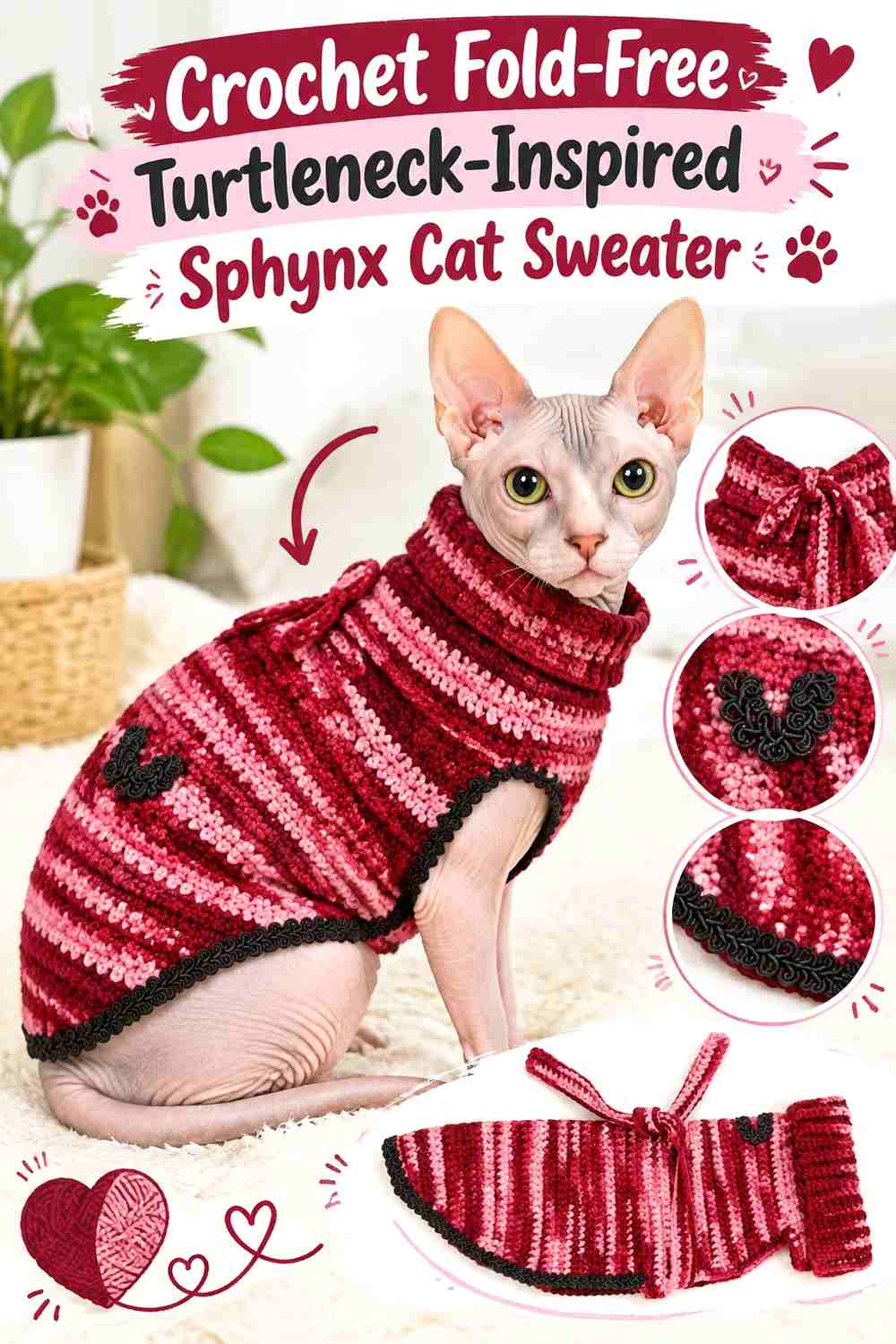
Last Minute Laura has a pet sweater tutorial specifically built around a turtleneck-style collar, making it useful for understanding a taller neckline before deliberately shortening that idea into a mock neck. The associated pattern imagery also shows the garment used on both a small dog and a cat.
Use a persimmon torso with an oat milk collar that rises but does not fold.
Stop Before the Turtleneck Becomes a Roll
The defining adaptation is restraint. Work enough collar depth to create a standing neckline, then test it instead of automatically continuing to a fold-over height.
The top edge should stay comfortably below the jaw during normal head movement.
Take Advantage of a Taller-Collar Construction
A source already designed around significant neck coverage helps you see how the shoulder area expands below a deeper collar.
Preserve that useful transition while reducing only the unnecessary height.
Keep the Cream Collar Visually Clean
A solid oat milk neck creates a strong contrast against persimmon without requiring striping.
If you want another light accent, use it sparingly at the lower edge rather than through the sensitive neck area.
Creator Credit: Last Minute Laura
11. Crochet Colorwork-Yoke Mock Neck Sphynx Cat Sweater

Yarnspirations’ family dog sweater uses a planned colorwork yoke and multiple sizes, providing a useful construction reference for a two-color upper body. The dimensions remain dog-specific, so the Sphynx version should be rebuilt around the cat’s measurements.
For this idea, use a solid persimmon mock neck, an oat milk-and-persimmon shoulder yoke, and a predominantly oat milk lower body.
Give the Collar a Solid Color Before Pattern Begins
A plain mock neck creates a visual pause before the busier yoke.
It also avoids carrying colorwork into an area where additional yarn management could make the fabric less flexible.
Check Stretch Below the Neck
A collar that passes easily over the head does not guarantee the patterned section below it will do the same.
Swatch the colorwork and test the entire upper body before completing the torso.
End the Pattern Before the Front Legs
A yoke can be decorative without continuing into every shaped section.
Switching to simpler fabric before the leg openings makes fit adjustments easier and protects the graphic pattern from distortion.
Creator Credit: Yarnspirations
12. Crochet Harness-Aware Textured Mock Neck Sphynx Cat Sweater

Briana K’s Wheat Stitch Dog Sweater combines a textured body with a ribbed neckline and harness-access concept. It is a dog construction, but it provides useful planning ideas when a cat sweater must coexist with fitted walking equipment.
Use a short oat milk mock neck above a persimmon textured body, keeping any harness-contact areas comparatively flat.
Fit the Harness With the Mock Neck in Place
A harness may sit differently once the sweater adds fabric around the neck and shoulders.
Test the actual equipment rather than guessing where straps or hardware will fall.
Keep Texture Away From Pressure Points
Raised stitches can be attractive across the open back but less useful directly under straps.
A flatter section beneath harness contact points can reduce unnecessary layering.
Treat Leash Access Only as an Opening
Any crochet opening is there to expose the harness hardware, not to carry leash force.
Keep the sweater structurally separate from the walking equipment.
Creator Credit: Briana K
13. Crochet Soft Cowl-to-Mock Neck Sphynx Cat Sweater

Marly Bird’s cowl-neck dog coat provides a useful contrast to a mock neck because the source deliberately uses much more neckline volume. The adaptation here is to borrow the upper-body transition while removing most of the cowl depth.
Use a cream body with a persimmon mock neck that hints at the cowl shape without folding or gathering.
Reduce Volume Instead of Tightening the Cowl
A mock neck is not simply a cowl pulled tighter.
Shorten the collar and remove excess depth while preserving enough circumference for comfortable dressing and head movement.
Keep the Standing Edge Away From the Ears
A tall, loose collar can shift upward as the cat moves.
Test the final height while the cat turns its head and make sure the fabric remains at the neck rather than creeping toward the ears.
Let Persimmon Stay Concentrated at the Top
A single dark collar above an oat milk body gives this sweater a clean, almost color-blocked appearance.
The simplicity is useful when the neckline itself is the defining feature.
Creator Credit: Marly Bird
14. Crochet Classic Oat Milk Trim Mock Neck Sphynx Cat Sweater

Crochet with Tiffany’s dog-coat tutorial offers several size options and adjustment guidance, making it a straightforward general pet-sweater reference when you want the mock neck and color treatment to provide most of the design interest.
Use persimmon for the body with oat milk at the mock neck, front-leg edges, and lower border.
Build the Neck Before Repeating the Trim
The collar is the most important oat milk section. Finish and fit it first.
Only after the upper garment is working correctly should you decide how much cream edging the leg openings and hem need.
Keep Every Trim Band Proportional
A narrow leg opening can lose useful space if its contrasting border becomes too deep.
The mock neck can be visually substantial while the other oat milk edges remain much slimmer.
Resize From the Body, Not the Color Plan
If adapting a dog-oriented size, establish appropriate cat proportions first.
Do not lengthen or widen the torso simply to make the oat milk edging appear symmetrical.
Creator Credit: Crochet with Tiffany
15. Crochet Ribbed Vintage Mock Neck Sphynx Cat Sweater
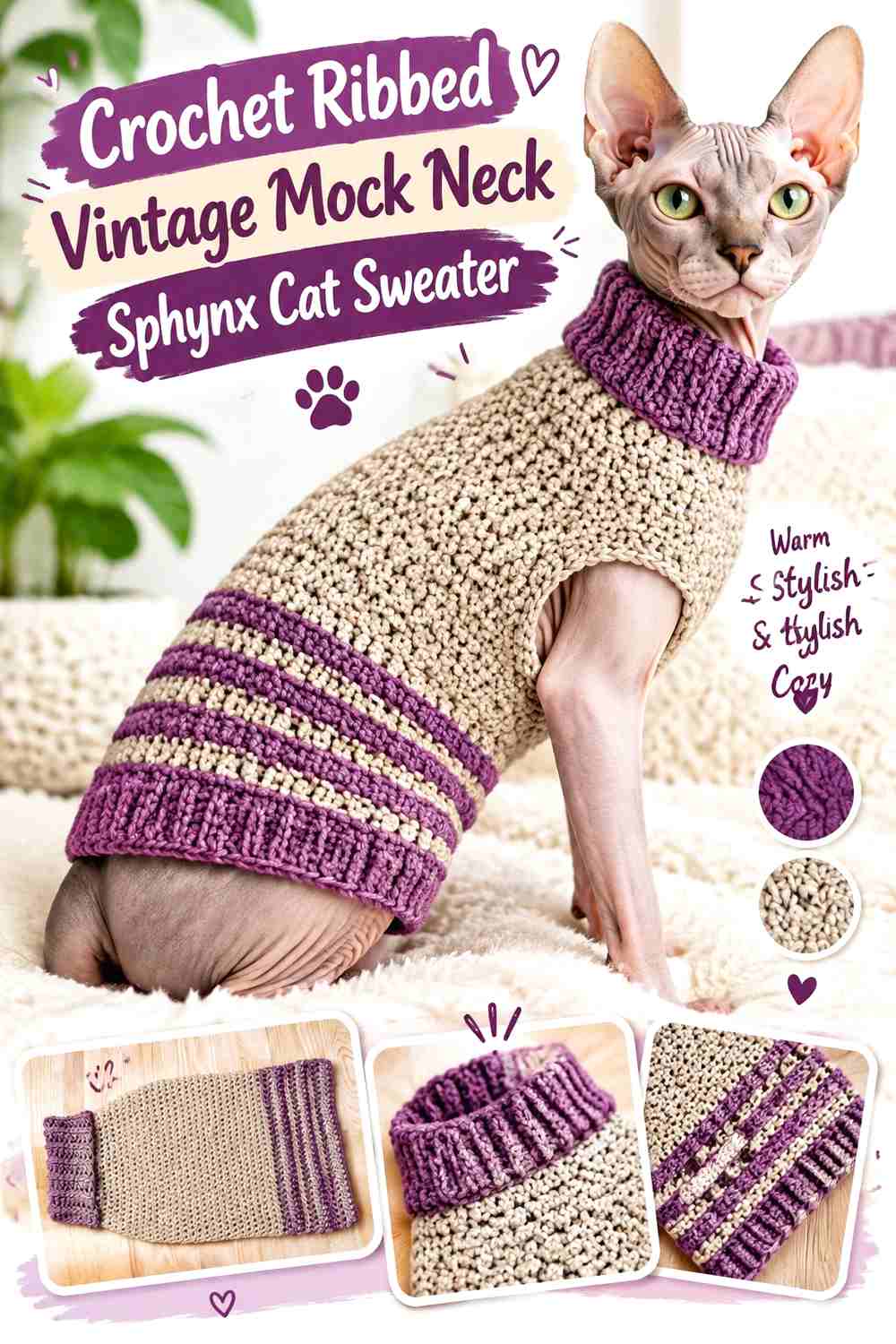
Woolpedia’s dog sweater tutorial provides a classic crochet garment foundation with dedicated video support in both right- and left-handed versions. The right-handed public tutorial serves as the construction reference here.
For the Sphynx adaptation, make the body oat milk and create a more pronounced persimmon ribbed mock neck with restrained matching trim.
Use Ribbing to Define the Vintage Look
A visibly ribbed standing collar gives a straightforward sweater a slightly retro appearance.
Keep the body comparatively simple so the neck texture remains noticeable.
Measure Ribbing in Its Relaxed State
Ribbed crochet can contract considerably.
The collar should sit comfortably when relaxed rather than depending on constant stretching to fit the cat’s neck.
Repeat Persimmon Only Where It Adds Structure
A narrow persimmon lower edge can balance the collar, but avoid adding broad bands solely for symmetry.
The mock neck should remain the darkest and strongest element of this version.
Creator Credit: Woolpedia
Comparing the 15 Mock Neck Sweater Directions
IdeaMain Construction DifferenceMock Neck TreatmentMain CheckClassic persimmonCat-specific neck-down bodyOat milk standing collarCollar after shoulder expansionRaglanCat-specific top-down raglanPersimmon neck above yokeSleeve alignmentShort-sleeveCat-specific sleeved sweaterCream neck matching cuffsFront-leg reachMinimal cream bandCat-specific compact sweaterSingle contrast collarIndependent neck sizingMade-to-measureMeasurement-led pet bodyPersimmon standing neckCat-specific proportionsBerry textureTiny textured constructionSmooth short collarUpper-body bulkLightweightFiner sweater fabricSlim edged mock neckVertical stretchPuff panelDimensional back detailSmooth cream collarSnagging and armpit thicknessLong sleeveMore front-leg coveragePersimmon neck and sleevesDressing and sleeve movementTurtleneck-inspiredTaller-collar sourceShortened fold-free collarJaw clearanceColorwork yokeTwo-color upper bodySolid collar above patternYoke stretchHarness-awareTextured functional bodyShort cream collarEquipment pressure pointsCowl conversionHigh-volume neck sourceReduced standing collarCollar migrationClassic trimMulti-size coat baseCream collar and edgingTrim depthRibbed vintageTraditional ribbed basePronounced persimmon ribbingRelaxed neck circumference
Conclusion
For the most cat-relevant starting points, the Treasurie, MJ’s Off The Hook Designs, LittleGemsCreations – Fibre Artist, and Punto a punto y más tutorials give you constructions already designed for feline bodies. They are the strongest places to begin before experimenting with collar height.
If the cat’s proportions do not match standard sizing, the Loops Only Crochet approach offers a useful measurement-led route, provided you recalculate the dog-oriented construction for the cat rather than copying its proportions. The Vibes with Dani source is particularly useful when longer sleeves are part of the plan, while the Last Minute Laura turtleneck gives you a logical starting point for understanding how a higher collar transitions into the shoulders.
For surface interest, the Heart Hook Home, SheiLa Teré, Briana K, and Yarnspirations ideas let texture or colorwork become the secondary feature while the mock neck stays comparatively simple.
Whichever direction you choose, treat the mock neck as a fit decision before a styling decision. It should pass over the head without force, stand without forming a heavy fold, stay below the jaw, and feel smooth on the inside. Use each creator’s original tutorial for its exact construction details and recheck the cat’s fit whenever you change yarn, collar depth, texture, sleeve length, or body dimensions.
Frequently Asked Questions
How tall should a crochet mock neck be on a Sphynx cat sweater?
There is no universal height. The collar should rise visibly above the shoulder line while remaining below the jaw when the cat lowers or turns its head. Test the developing collar directly rather than choosing a fixed height from another garment.
What is the difference between a mock neck and a turtleneck on a cat sweater?
A mock neck is shorter and normally stands without folding over. A turtleneck uses more vertical fabric and may fold or roll. On a compact cat garment, a mock neck can provide the higher-neck appearance with less fabric around the jaw and shoulders.
Is persimmon or oat milk better for the mock neck?
Both work. An oat milk collar on a persimmon body creates a softer contrast, while a persimmon neck on an oat milk sweater becomes a stronger focal point. Using the collar color again at one or two small edges can make the design feel coordinated.
Can I adapt a dog sweater tutorial for a Sphynx cat?
Yes as a construction reference, but do not assume the source’s dimensions or proportions transfer directly. Measure the cat’s neck, chest, front-leg position, and body length and rebuild the fit around those measurements.
Should the mock neck be ribbed?
It can be, especially if the chosen ribbing gives useful stretch and recovers well after dressing. A smooth standing collar can also work. Swatch the actual stitch because crochet fabrics that look ribbed do not all stretch to the same degree.
How can I prevent the mock neck from feeling bulky?
Keep the collar short, limit the number of color joins and seams inside it, and avoid combining a doubled collar with heavily raised stitches. Feel the inside of the finished neck and correct any hard joins or ridges before regular wear.
What should I check before letting a Sphynx cat wear the finished sweater?
Check that the neck passes over the head comfortably, the collar stays below the jaw, the front legs move freely, and no inner seam or yarn end feels unusually rough or hard. Observe the cat while wearing the garment and remove it if the fit shifts or the cat appears uncomfortable.