Evergreen and ivory give a gingerbread-cookie dog sweater a cleaner, more wintry look than the usual brown holiday palette. The cookie theme can come from shape rather than literal color: an ivory gingerbread figure on an evergreen back, an evergreen cookie silhouette inside an ivory panel, or simple icing-like lines worked as flat surface details.
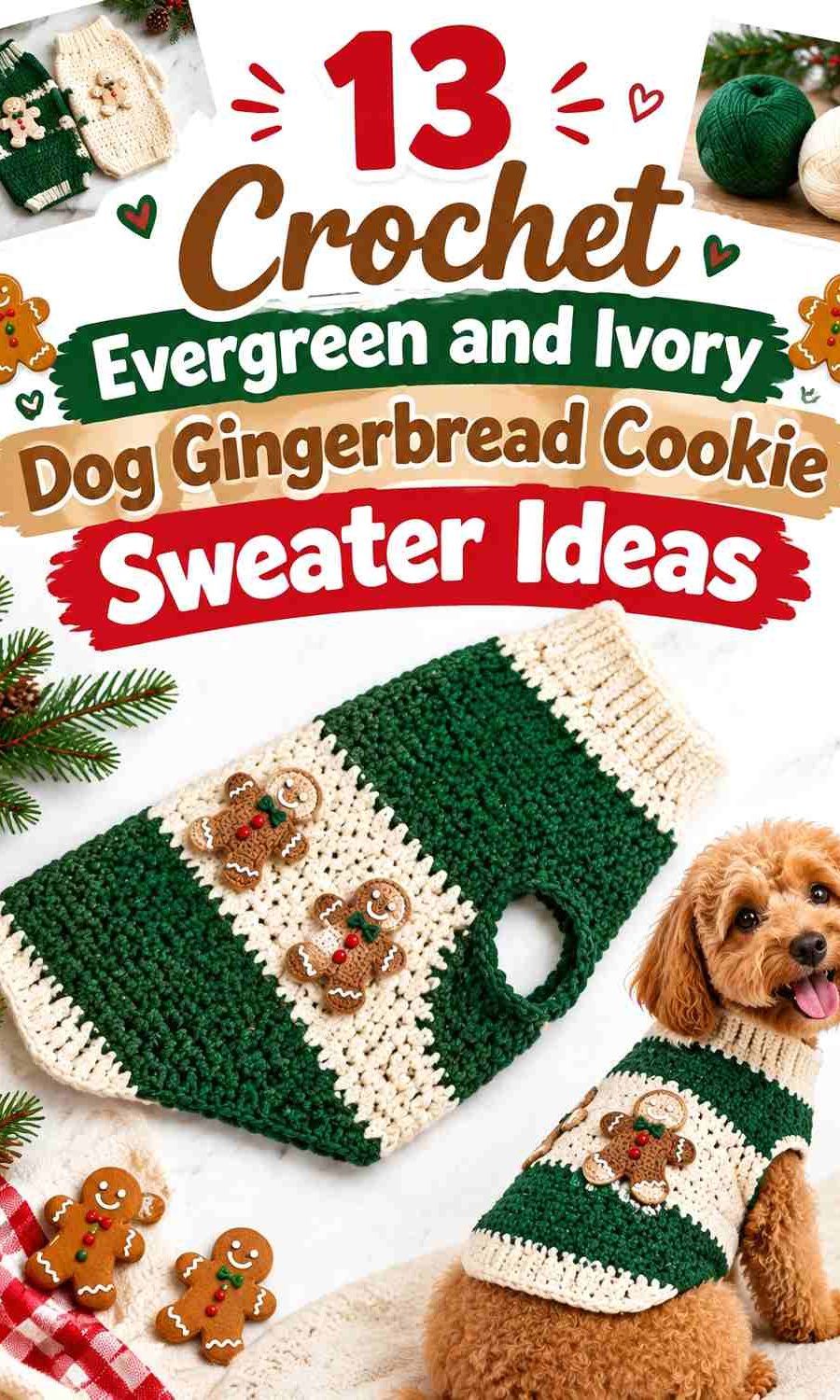
The main decision is how the cookie motif becomes part of the garment. Tapestry or stranded colorwork keeps the design relatively flat but can change gauge and stretch. A separately crocheted appliqué is easier to position after the sweater fits, but it adds another layer. Texture can suggest cookie edges or icing without turning the entire sweater into a detailed picture.
The tutorials below teach 13 different dog-sweater constructions. They do not all contain gingerbread motifs or use evergreen and ivory. Treat the cookie styling as an adaptation added only after the neck, chest, front-leg openings, belly, and back length work for the individual dog.
Quick List
- Crochet Center-Back Gingerbread Cookie Dog Sweater
- Crochet Ribbed-Collar Cookie Panel Dog Sweater
- Crochet Nordic Gingerbread Yoke Dog Sweater
- Crochet Framed Ivory Cookie Dog Sweater
- Crochet Textured Evergreen Cookie Patch Dog Sweater
- Crochet Button-Belly Gingerbread Dog Sweater
- Crochet Lightweight Mini Cookie Dog Sweater
- Crochet Puff-Icing Gingerbread Dog Sweater
- Crochet Long-Sleeve Cookie Cuff Dog Sweater
- Crochet Striped Cookie Badge Dog Sweater
- Crochet Made-to-Measure Cookie Trail Dog Sweater
- Crochet Custom-Fit Gingerbread Silhouette Dog Sweater
- Crochet Harness-Aware Gingerbread Cookie Dog Sweater
Choose a Flat Cookie Motif Before Adding Extra Decoration
A dog sweater does not need beads, buttons, bells, or loose bows to make a gingerbread figure recognizable. A simple body silhouette, rounded head, short arms and legs, and contrasting flat “icing” marks can communicate the theme clearly.
For an appliqué, attach the perimeter securely so paws, harness hardware, or furniture cannot easily slip underneath it. Keep facial and icing details flat rather than using small detachable pieces.
If you use colorwork, swatch the motif fabric alongside the sweater’s main stitch. Two-color crochet may become firmer or narrower than the surrounding fabric, especially if carried yarn is held too tightly.
For a textured cookie, use raised stitches selectively. The broad back can accommodate texture more easily than the armpits, belly, or narrow chest area.
Use Evergreen and Ivory to Make the Cookie Read Clearly
An ivory cookie silhouette on evergreen provides the strongest contrast and keeps the sweater looking seasonal without needing another color. Evergreen can then be used for stitched icing lines inside the ivory shape.
The reverse arrangement also works. An ivory sweater with an evergreen gingerbread figure feels lighter and more graphic, especially on a smaller garment.
Another option is to use ivory as a frame rather than the cookie itself. A broad ivory back panel can contain a smaller evergreen figure, allowing the motif to stay simple while remaining easy to see.
Avoid filling every part of the sweater with stripes and motifs. If the back already contains a large cookie, solid sleeves, collar, and belly sections usually give the design better balance.
Fit the Sweater and Harness Before Positioning the Cookie
Finish enough of the sweater to establish how it stretches around the dog before choosing the motif location. The flat center of the garment is not always the visual center once it is worn.
If the dog uses a harness, put it on during planning. A large gingerbread figure placed between the shoulders may disappear under a harness panel, while a lower motif may bend when the dog sits.
Keep dense colorwork and thick appliqués out of high-movement areas. The cookie can stop before chest shaping or be reduced to a smaller badge if the available back space is limited.
Whenever yarn or stitch texture changes, recheck gauge and movement instead of assuming the original tutorial dimensions will remain unchanged.
1. Crochet Center-Back Gingerbread Cookie Dog Sweater

Loops Only Crochet demonstrates a customizable sweater worked from a ribbed neckline through the body, front-leg openings, and shaped back. That made-to-measure structure is especially useful when the gingerbread figure should be sized only after the actual back width is known.
Use evergreen for the sweater and place one large ivory cookie silhouette in the central back area.
Fit the Back Before Sizing the Cookie
Do not build the sweater around a predetermined motif width. Establish the dog’s chest and back dimensions first, then simplify or scale the cookie to the usable space.
Leave enough evergreen around the figure that its arms and legs do not run into side shaping.
Keep the Icing Details Flat
Small evergreen stitched lines can suggest cuffs, buttons, or facial features without adding detachable pieces.
The cookie should remain smooth enough that harness straps and scratching paws do not easily catch the decoration.
Let Rear Shaping Stay Outside the Figure
Finish the main cookie silhouette before the sweater begins its strongest rear taper whenever possible.
A stable rectangular area makes the motif easier to read than a figure forced through repeated width changes.
Creator Credit: Loops Only Crochet
2. Crochet Ribbed-Collar Cookie Panel Dog Sweater

Heart Hook Home’s dog-sweater construction combines a ribbed-style collar with a textured body and is offered in several small-to-medium sizes.
For this version, make the sweater evergreen and reserve one smooth ivory rectangle on the upper back for a small gingerbread figure.
Give the Motif a Smooth Background
A cookie silhouette can become visually lost on a highly textured body.
A flatter back panel provides enough contrast that the gingerbread shape remains clear even if the motif itself is simple.
Repeat Ivory at the Collar
An ivory collar visually connects the back panel to the rest of the sweater without requiring extra stripes.
Keep the leg openings evergreen if you want the cookie panel to remain the main light-colored feature.
Check Panel Tension Against the Textured Body
Two stitch structures may grow differently.
Swatch them together before creating a large panel so the ivory section does not pull the surrounding evergreen fabric inward or create rippling.
Creator Credit: Heart Hook Home
3. Crochet Nordic Gingerbread Yoke Dog Sweater

The Yarnspirations family dog sweater uses a Nordic-style colorwork yoke and multiple sizes, providing a useful construction reference for integrating small repeated holiday shapes into the upper sweater rather than attaching a single large appliqué.
Simplify the palette to evergreen and ivory and use tiny gingerbread-inspired silhouettes around the yoke.
Use Repetition Instead of One Large Cookie
A curved yoke is better suited to several small geometric figures than one detailed character stretched around the shoulders.
Simplified cookie heads, tiny figures, or alternating cookie-and-dot shapes can create the theme without distorting badly around the body.
Keep the Torso Mostly Solid
Once the yoke carries repeated motifs, a solid evergreen lower body prevents the sweater from looking crowded.
An ivory hem can echo the yoke without introducing another picture.
Check Two-Color Stretch Before Adding More Motifs
A decorative yoke is only useful if the upper sweater still expands comfortably over the chest and during dressing.
If the two-color fabric feels firmer than the plain body, reduce motif density rather than extending the yoke farther down.
Creator Credit: Yarnspirations
4. Crochet Framed Ivory Cookie Dog Sweater

Marly Bird’s crochet dog-sweater tutorial focuses on a decorative colorwork yoke and chart-reading, which provides useful inspiration for a more graphic gingerbread treatment.
For this adaptation, use evergreen for the garment and create one broad ivory frame containing a simplified evergreen cookie.
Reverse the Usual Motif Colors
Instead of an ivory cookie on green, let the ivory rectangle become the background and work the cookie in evergreen.
The reversed contrast makes this idea clearly different from a standard appliqué sweater.
Keep the Frame Away From the Armpits
A framed colorwork section can become denser than the surrounding fabric.
Place it on the broad back rather than extending it into the narrow side and chest areas where flexibility matters more.
Give the Frame More Space Than the Cookie
A narrow margin makes the motif look cramped.
Leave visible ivory around the head, arms, and legs so the figure reads clearly even from a distance.
Creator Credit: Marly Bird
5. Crochet Textured Evergreen Cookie Patch Dog Sweater

Crochet with Tiffany’s dog-coat tutorial provides several sizes and adjustment guidance, making it a practical base for a sweater where the cookie decoration is added only after the main garment fits.
Use ivory for most of the sweater and make one evergreen crocheted gingerbread patch for the back.
Attach the Patch After the Final Fitting
Complete the sweater body first and mark the most stable back area while the dog is wearing it.
That prevents an appliqué from ending up too close to a side edge after the garment stretches around the chest.
Keep the Patch Flexible
A very dense appliqué can weigh down a lighter sweater.
Compare the patch with the body fabric before sewing it on and reduce thickness if it makes the back sag.
Use Texture Only Around the Cookie Edge
A slightly raised outline can make an evergreen cookie visible against ivory without covering the entire figure in dimensional stitches.
Keep the center flatter to limit bulk.
Creator Credit: Crochet with Tiffany
6. Crochet Button-Belly Gingerbread Dog Sweater

Last Minute Laura’s one-piece dog-sweater tutorial uses custom fitting and a button element, making it useful when easier dressing matters as much as the holiday motif. The construction is presented as a customizable sweater rather than a fixed-size decorative costume.
For this idea, keep the fastening area plain and place the gingerbread design entirely on the evergreen back.
Finish the Closure Before Positioning the Cookie
The sweater can shift slightly depending on how the lower fastening is adjusted.
Close and fit the garment correctly first, then identify where the visual center actually falls.
Keep Decorative Details Away From the Buttons
Buttons already create raised hardware.
The cookie motif should stay on the upper back so there is no unnecessary cluster of closures, appliqué edges, and surface detail in the same area.
Use Ivory as a Single Back Accent
A large ivory cookie supplies plenty of contrast against evergreen.
There is little need for additional ivory stripes if the fastening construction already gives the sweater another visual feature.
Creator Credit: Last Minute Laura
7. Crochet Lightweight Mini Cookie Dog Sweater

Crochet It’s small dog sweater tutorial uses a lighter yarn category and compact finished proportions, providing a useful reference for a smaller-scale gingerbread motif.
Use an ivory body with a small evergreen gingerbread medallion between the shoulders.
Simplify the Figure for a Small Back
A miniature motif does not need tiny cuffs, facial expressions, and several icing lines.
Pointed arms and legs, a rounded head, and one or two flat markings can be enough to communicate the cookie shape.
Match the Patch Weight to the Sweater
A light body fabric can be distorted by a thick appliqué.
Use a similarly light fabric for the motif or work the design directly into the sweater if that produces a flatter result.
Leave Plenty of Ivory Around the Motif
Negative space becomes especially important on a small garment.
A compact evergreen figure can look clearer with a generous plain background than a larger shape squeezed between the side edges.
Creator Credit: Crochet It
8. Crochet Puff-Icing Gingerbread Dog Sweater

SheiLa Teré’s dog-sweater tutorial uses puff and V-stitch texture, giving this version a different way to suggest the raised icing associated with decorated cookies.
Make the body evergreen, create a flat ivory gingerbread silhouette, and use limited raised texture only for selected decorative lines.
Treat Puffs Like Icing Accents
A few dimensional marks can provide enough cookie character.
Avoid outlining every edge with heavy texture, which could turn a simple motif into a bulky patch.
Keep the Chest and Leg Areas Flat
The gingerbread treatment belongs on the broad visible back.
Use simpler fabric around the armpits and underside so the seasonal texture does not interfere with movement.
Check Every Raised Detail for Snagging
Handle the finished motif before regular wear.
If an exposed loop catches fingers easily, replace it with a flatter stitched detail rather than leaving an obvious snag point.
Creator Credit: SheiLa Teré
9. Crochet Long-Sleeve Cookie Cuff Dog Sweater

Vibes with Dani demonstrates a pet sweater with fuller sleeve coverage, making this a distinct choice for a gingerbread design that carries its color story onto the front legs.
Use an evergreen torso, an ivory cookie on the back, and ivory sleeve cuffs with small evergreen line accents.
Keep the Sleeves Simpler Than the Cookie
The main gingerbread figure should remain the focal point.
Solid sleeves with restrained cuff contrast prevent the front of the garment from competing with the decorated back.
Echo Icing Lines at the Cuffs
A narrow evergreen line over an ivory cuff can suggest cookie icing without adding another literal gingerbread figure.
This connects the sleeves to the motif while preserving visual balance.
Test Sleeve Length During Walking
If a cuff bunches or moves toward the paw, shorten it before considering a tighter finish.
Normal stride matters more than maintaining a particular decorative cuff depth.
Creator Credit: Vibes with Dani
10. Crochet Striped Cookie Badge Dog Sweater

The Crochet Crowd’s dog-sweater tutorial discusses construction and color changes, making it a useful reference for a sweater that combines controlled striping with one gingerbread badge.
Work broad evergreen and ivory sections, then place a small contrasting cookie badge on a solid-colored area.
Do Not Place the Badge on a Matching Stripe
An ivory cookie disappears on an ivory band.
Position the motif against evergreen so its full outline remains visible, even if another ivory stripe sits nearby.
Use Broad Bands Instead of Candy-Cane Striping
Frequent narrow stripes can compete with the cookie figure.
Two or three larger color zones give the motif enough visual space and make later length adjustments easier.
Leave a Solid Rear Section
Finish the last portion of the back in one color.
That provides room to adjust garment length without redesigning the entire stripe-and-badge arrangement.
Creator Credit: The Crochet Crowd
11. Crochet Made-to-Measure Cookie Trail Dog Sweater

it’s erin b. demonstrates a customizable dog sweater with an adaptable body, leg openings, color changes, and shaping. The tutorial is designed around adjusting the project to the pet rather than relying on one finished size.
Instead of one large gingerbread figure, this version uses a short trail of small ivory cookies running down an evergreen back.
Space the Cookies After the Back Length Is Known
Finish enough of the torso to determine how much usable back remains.
Then choose whether two, three, or another small number of motifs can fit without crowding the tail end or shoulder area.
Vary the Motif Scale Slightly
The cookie figures do not all need to be identical.
A slightly larger central cookie with smaller companions can create movement while using the same basic motif language.
Stop the Trail Before Rear Shaping
Keep the smallest figure clear of the area where the sweater changes shape substantially.
The motifs will stay more readable on a relatively stable section of fabric.
Creator Credit: it’s erin b.
12. Crochet Custom-Fit Gingerbread Silhouette Dog Sweater

Maria’s Blue Crayon provides a step-by-step custom-fit dog-sweater tutorial built around measuring the individual animal rather than selecting only a standard size.
Use that measurement-first structure for an ivory sweater with one large evergreen gingerbread silhouette extending along the back.
Let the Dog Determine the Motif Proportions
A long, narrow dog and a short, broad dog provide very different canvases.
Stretch or simplify the motif concept according to the actual usable back shape rather than forcing one standard cookie outline onto every sweater.
Use the Silhouette Instead of Tiny Details
A dark evergreen figure on ivory can be recognizable from its overall shape alone.
That allows you to avoid small decorative parts and keeps the design flatter.
Fit the Sweater Again After the Motif Is Added
A large patch or dense colorwork area can subtly alter back drape.
Put the finished sweater on the dog again and check that the body still lies smoothly without pulling at the neck or sides.
Creator Credit: Maria’s Blue Crayon
13. Crochet Harness-Aware Gingerbread Cookie Dog Sweater

Briana K’s Wheat Stitch dog-sweater construction combines a textured body with a video-supported pattern and harness-oriented planning, making it especially useful when the gingerbread design must share the back with walking equipment.
Use evergreen for most of the textured sweater, keep the harness-contact area simple, and position an ivory cookie lower or to one side where it remains visible.
Put the Harness On Before Choosing the Cookie Position
A perfectly centered motif can be almost completely hidden by a harness panel.
Locate the actual straps and leash attachment first, then find the largest unobstructed area for the cookie.
Keep Hardware Off Thick Motif Edges
Do not position a dense appliqué border directly beneath a strap or clip.
A flatter buffer zone around the harness makes the walking equipment easier to fit and reduces unnecessary bulk.
Never Use the Cookie or Sweater as a Leash Point
Any crochet opening provides access only.
The leash should remain attached to the properly fitted walking equipment rather than to the appliqué, sweater edge, or decorative stitches.
Creator Credit: Briana K
Comparing the 13 Gingerbread Cookie Sweater Directions
IdeaCookie TreatmentMain Construction StrengthMain CheckCenter-back cookieOne large ivory figureMade-to-measure sweaterMotif size after fittingRibbed-collar panelCookie inside smooth panelTextured body contrastMixed fabric tensionNordic yokeSmall repeated cookiesColorwork upper sectionYoke stretchFramed cookieReversed green figureGraphic colorworkFrame placementTextured patchSeparate evergreen appliquéMulti-size coat basePatch weightButton-bellyBack-only ivory cookieEasier dressingClosure before placementLightweight miniSmall green medallionLighter fabricMotif thicknessPuff icingFlat cookie with raised detailsDimensional textureSnaggingLong sleeveCookie plus matching cuffsFront-leg coverageSleeve movementStriped badgeSmall cookie on broad bandsControlled color changesMotif visibilityCookie trailRepeated small figuresAdaptable body lengthSpacingLarge silhouetteBroad single-color graphicCustom fitBack drapeHarness-awareOffset cookieHarness-compatible planningStrap clearance
Conclusion
The easiest way to make an evergreen-and-ivory gingerbread dog sweater look intentional is to choose one clear motif strategy before adding extra holiday detail. A single ivory cookie on an evergreen back gives the cleanest classic result, while the reversed framed design and large evergreen silhouette offer more graphic alternatives.
For individualized sizing, the Loops Only Crochet, it’s erin b., and Maria’s Blue Crayon constructions let the sweater dimensions come before the motif. Heart Hook Home and SheiLa Teré offer more texture-focused foundations, while the Yarnspirations and Marly Bird directions are useful when colorwork should become part of the garment rather than a separate patch.
Vibes with Dani adds genuine sleeve coverage, Last Minute Laura provides a different fastening approach, and the Briana K construction is the most relevant option when harness compatibility affects motif placement.
Keep cookie details flat and secure, use evergreen and ivory in large enough areas for the design to remain readable, and follow each creator’s tutorial for its exact sweater construction. Any time you introduce colorwork, appliqué, texture, a different yarn, or substantial decorative panels, check the fit again before regular wear.
Frequently Asked Questions
How can a gingerbread cookie motif work without brown yarn?
The cookie theme can come from the silhouette rather than realistic color. A rounded head, short arms and legs, and simple icing-like lines are enough to suggest a gingerbread figure. Ivory on evergreen or evergreen on ivory provides strong contrast while preserving the requested palette.
Is appliqué or colorwork better for a dog sweater?
An appliqué is easier to position after the sweater fits, but it adds another fabric layer. Colorwork keeps the motif integrated with the body but may alter gauge and stretch. Choose according to the sweater construction and how much flexibility the back needs.
Where should the gingerbread cookie sit?
The broad center back is usually the simplest place, provided a harness does not cover it. Fit the sweater and the dog’s normal walking equipment before committing to placement.
Can I use buttons as the gingerbread cookie’s eyes?
Flat crocheted or stitched details are more practical for a pet garment than small detachable decorative pieces. Keep facial features and icing securely integrated into the motif rather than relying on loose embellishments.
How large should the cookie motif be?
There is no universal measurement. Complete enough of the sweater to determine the usable back area, then leave visible background fabric around the figure. A simpler, smaller motif usually reads better than one forced into every available inch.
What if the colorwork cookie makes the back feel tight?
Compare the motif section with a plain swatch. If the two-color fabric is noticeably firmer, reduce motif width, adjust the technique appropriately, or use a separate flat appliqué instead of continuing a restrictive colorwork panel.
Can I add gingerbread motifs to a harness-access sweater?
Yes, but locate the actual harness straps and leash connection first. Keep thick motif edges away from pressure points and leave the harness opening unobstructed. The crochet sweater itself should never serve as the leash attachment.