Thanksgiving napkin rings can be understated bands, textured rings, buttoned wraps, or small table decorations that happen to hold a folded napkin. This collection covers that full range, from ribbing and braided crochet to acorns, autumn leaves, pumpkins, turkeys, wheat, corn, and other harvest motifs.

The first ideas are supported by tutorials that specifically make crochet napkin rings or holders. Later projects use verified fall and Thanksgiving motif tutorials as toppers for a separate crochet ring base. Those adaptations are identified clearly so you can decide whether you want a complete ring tutorial or more freedom to design your own combination.
Use the comparisons below to think about napkin thickness, topper scale, structure, laundering, and how much visual detail you want at each place setting.
Quick List
- Crochet Autumn Leaf Wrap Napkin Ring
- Crochet Leaf-Centered Thanksgiving Napkin Ring
- Crochet Acorn Cluster Thanksgiving Napkin Ring
- Crochet Sleek Harvest Napkin Holder
- Crochet Daisy Harvest Flower Napkin Holder
- Crochet Braided Harvest Napkin Ring
- Crochet Rustic Bow Napkin Ring
- Crochet Harvest Button Tab Napkin Ring
- Crochet Puff-Flower Thanksgiving Napkin Ring
- Crochet Ribbed Linen-Look Napkin Ring
- Crochet Simple Fall Loop Napkin Ring
- Crochet Bobble Texture Napkin Ring
- Crochet Chevron Overlay Napkin Ring
- Crochet Turkey Appliqué Napkin Ring
- Crochet Pumpkin Topper Napkin Ring
- Crochet Oak Leaf Topper Napkin Ring
- Crochet Sunflower Button-Top Napkin Ring
- Crochet Pumpkin Pie Place-Card Napkin Ring
- Crochet Pilgrim Hat Place-Marker Napkin Ring
- Crochet Apple Harvest Napkin Ring
- Crochet Turkey Feather Accent Napkin Ring
- Crochet Woodland Mushroom Napkin Ring
- Crochet Corn Harvest Napkin Ring
- Crochet Wheat Stalk Napkin Ring
Choose the Ring Construction Before the Thanksgiving Motif
A napkin ring has to do more than look seasonal. First decide how you want it to hold the napkin. A permanently joined loop gives a clean finish and works well when you use the same napkins and fold repeatedly. A buttoned tab offers more flexibility and is easier to open around a bulky fold. A decorated band or rigid-backed ring can provide more support for dimensional toppers.
Before making a complete set, test one finished ring with the actual napkin you plan to use. Thick cotton, linen, layered fabric, and tightly rolled napkins can all change the needed circumference. The ring should hold the fold without visibly compressing it. If you intend to add a turkey, pie, flower, or other topper, test the plain base first because the decoration may make the finished piece feel visually and physically heavier.
Plan Topper Scale So the Napkin Still Sits Neatly
Small appliqués are useful for Thanksgiving napkin rings because they let you turn a simple crochet loop into a themed place setting. Scale matters, however. A topper that is attractive on a garland or towel holder may cover most of a folded napkin when attached unchanged to a narrow ring.
For adapted projects in this list, make the tutorial motif first or check any finished dimensions the creator supplies before committing to a full table set. Hold the motif against your napkin and plate to see whether it feels like an accent or a centerpiece. If it is too large, changing yarn weight and hook size can sometimes change scale, but that may also change stitch definition and firmness. Another option is to use the motif beside the ring as a place marker rather than forcing an oversized decoration onto the band.
Pick Yarn and Finishing for a Reusable Dinner Table
Napkin rings are handled repeatedly, stored between seasons, and sometimes placed close to food, so neat finishing is worth more than elaborate decoration. Smooth yarn usually keeps small leaves, lettering-free motifs, ribbing, and textured stitches easier to see. Very fuzzy yarn can soften stitch definition and may overwhelm tiny appliqués.
Fiber choice also affects shape and care. Cotton often creates a crisp-looking small accessory, while springier fibers may give a softer ring. Rather than assuming a finished piece can be machine washed, follow the care information for the yarn you actually use and consider whether buttons, cardboard inserts, stuffing, beads, bells, or other additions need different treatment.
Whichever design you choose, weave in ends securely and check sewn-on toppers before setting the table. A small amount of extra finishing work can make a repeated set look much more consistent.
Crochet Autumn Leaf Wrap Napkin Ring
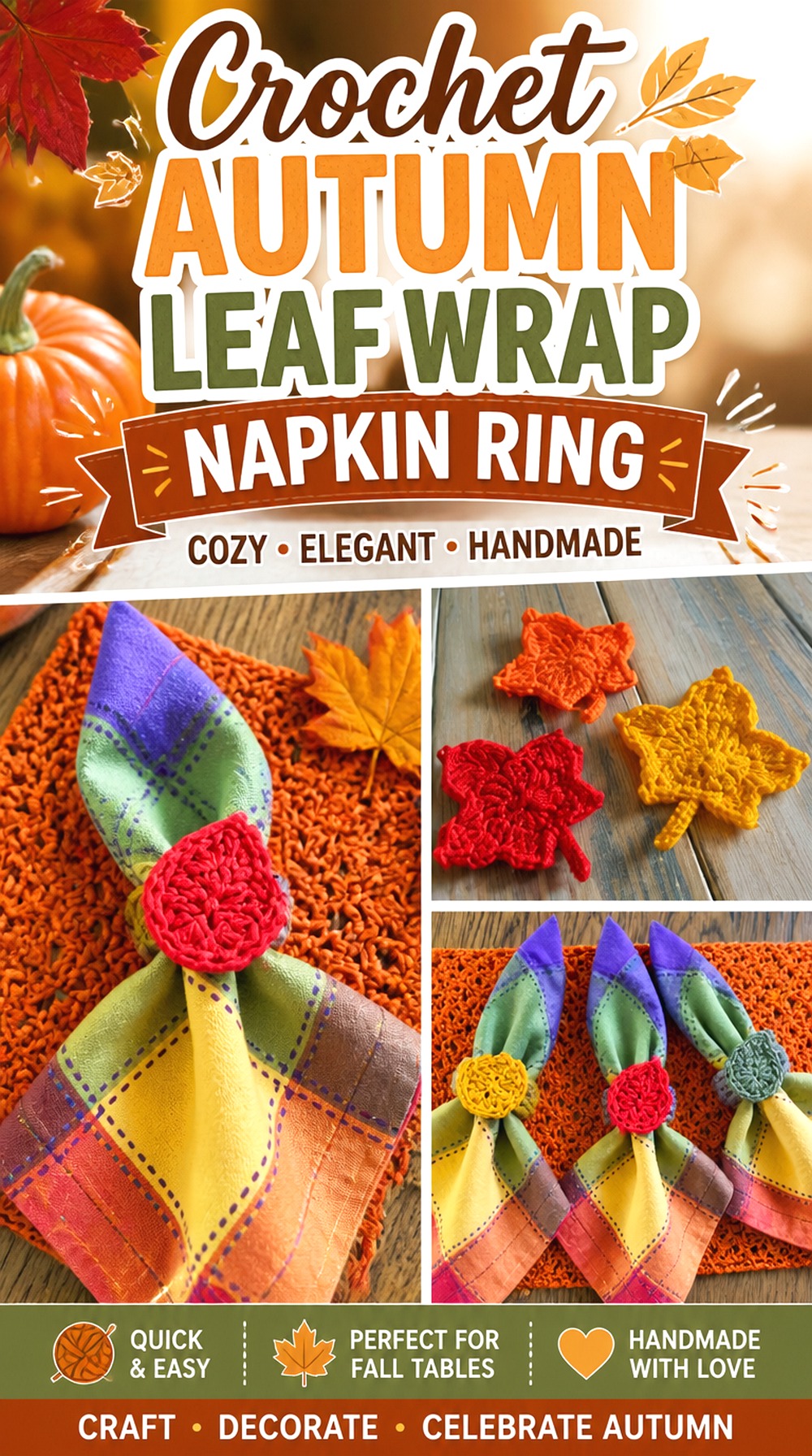
This leaf-accented ring is a strong starting point for a Thanksgiving table because the tutorial teaches the napkin ring and its autumn decoration as one finished project. The design keeps the base relatively understated, letting a contrasting leaf provide the seasonal focus. That balance works especially well when plates, runners, or printed napkins already introduce other harvest details.
Instead of treating every place setting as a miniature centerpiece, this style gives you one recognizable fall shape and plenty of open visual space. It can also be coordinated with several leaf colors without changing the underlying ring construction.
Let the Leaf Sit Where Guests Can Actually See It
Before attaching the decorative leaf permanently, place a folded napkin inside the ring and rotate the motif to the intended front. A leaf positioned attractively on an empty ring can disappear underneath a thick roll or point sideways after the napkin is inserted.
For a repeated table set, use the first finished piece as the orientation reference. Matching the direction of every leaf can make the entire table look calmer, while deliberately alternating directions creates a more casual scattered-leaf effect.
Keep the Base Quieter Than the Autumn Accent
The ring and leaf do not need equal visual weight. A neutral band paired with an orange, rust, gold, or brown leaf keeps attention on the seasonal shape. Reversing that relationship—strong-colored band with a quiet leaf—creates a more graphic result.
If your napkins already have a botanical print, compare the motif against the fabric before choosing color. A lower-contrast leaf may integrate better than another competing focal point.
Original Tutorial and Creator Credit
Creator: Wind Rose Fiber Studio
Crochet Leaf Centered Thanksgiving Napkin Ring
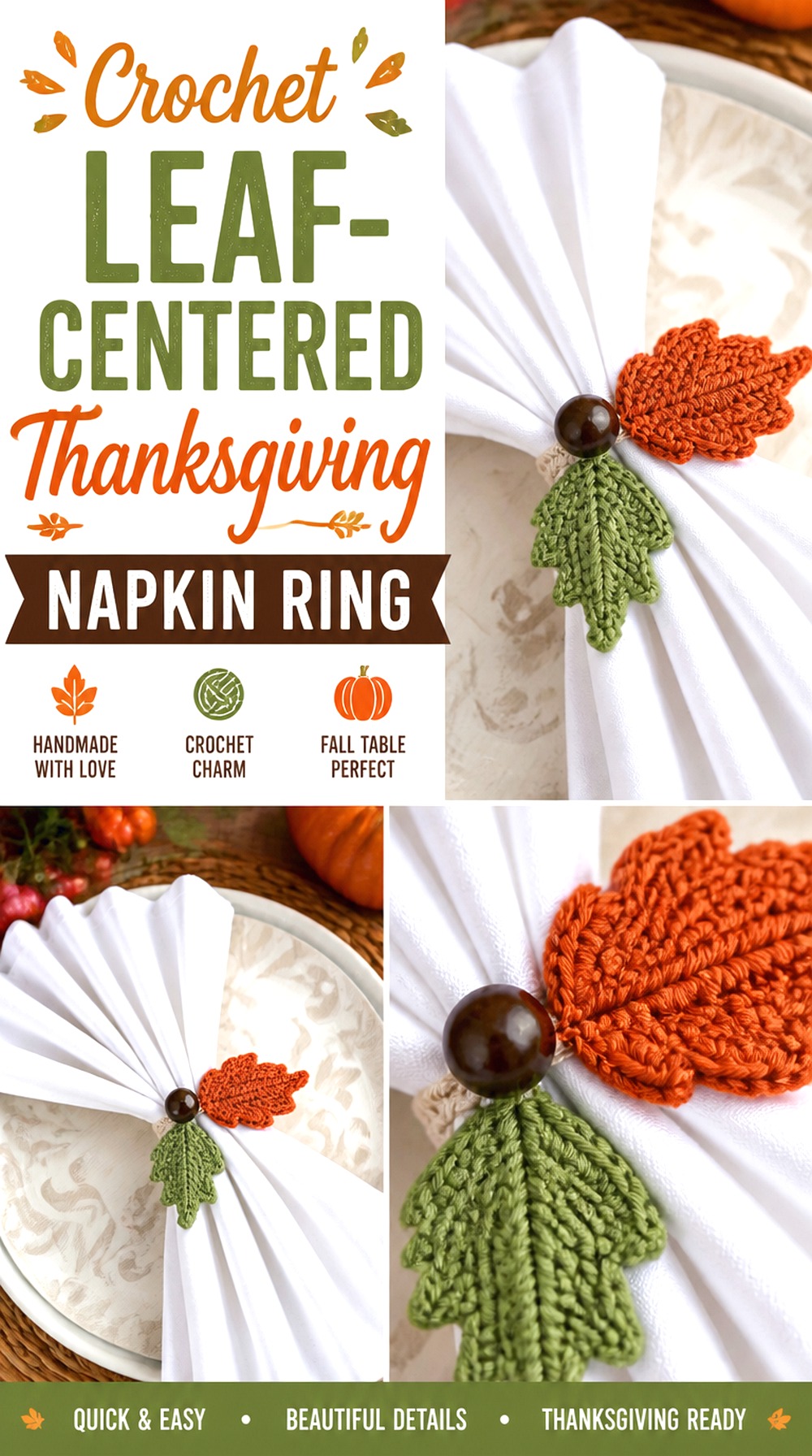
This option keeps the Thanksgiving theme recognizable without becoming strongly novelty-driven. Anita Louise Crochet’s tutorial specifically presents a leaf napkin ring for Thanksgiving, so it suits readers who want a complete seasonal project rather than adapting an unrelated motif. The leaf functions as the focal point while the ring remains visually secondary.
Compared with a bulky acorn or stuffed topper, a flatter botanical embellishment is easier to pair with formal dinnerware and layered table linens. It also gives you room to coordinate several autumn colors without changing the recognizable silhouette of the finished holder.
Match the Leaf Proportion to Your Napkin Fold
The amount of fabric visible behind the motif changes the finished look. A narrow rolled napkin can make the leaf feel prominent, while a broad folded napkin creates more background around it.
Test one ring on the exact fold you intend to use before making the rest. If the decoration looks lost, changing the napkin fold may solve the visual problem without altering the crochet. If it feels crowded, a simpler fold can restore some breathing room.
Botanical Shapes Benefit From Careful Blocking
A Thanksgiving leaf reads most clearly when its edges and points are easy to distinguish. If your chosen yarn leaves the motif curling or the stem twisting, use a finishing method appropriate for that fiber rather than assuming every material should be treated the same way.
The goal is not to flatten every bit of texture. It is simply to make the leaf sit predictably enough that repeated rings look intentional when placed around the table.
Original Tutorial and Creator Credit
Creator: Anita Louise Crochet
Crochet Acorn Cluster Thanksgiving Napkin Ring
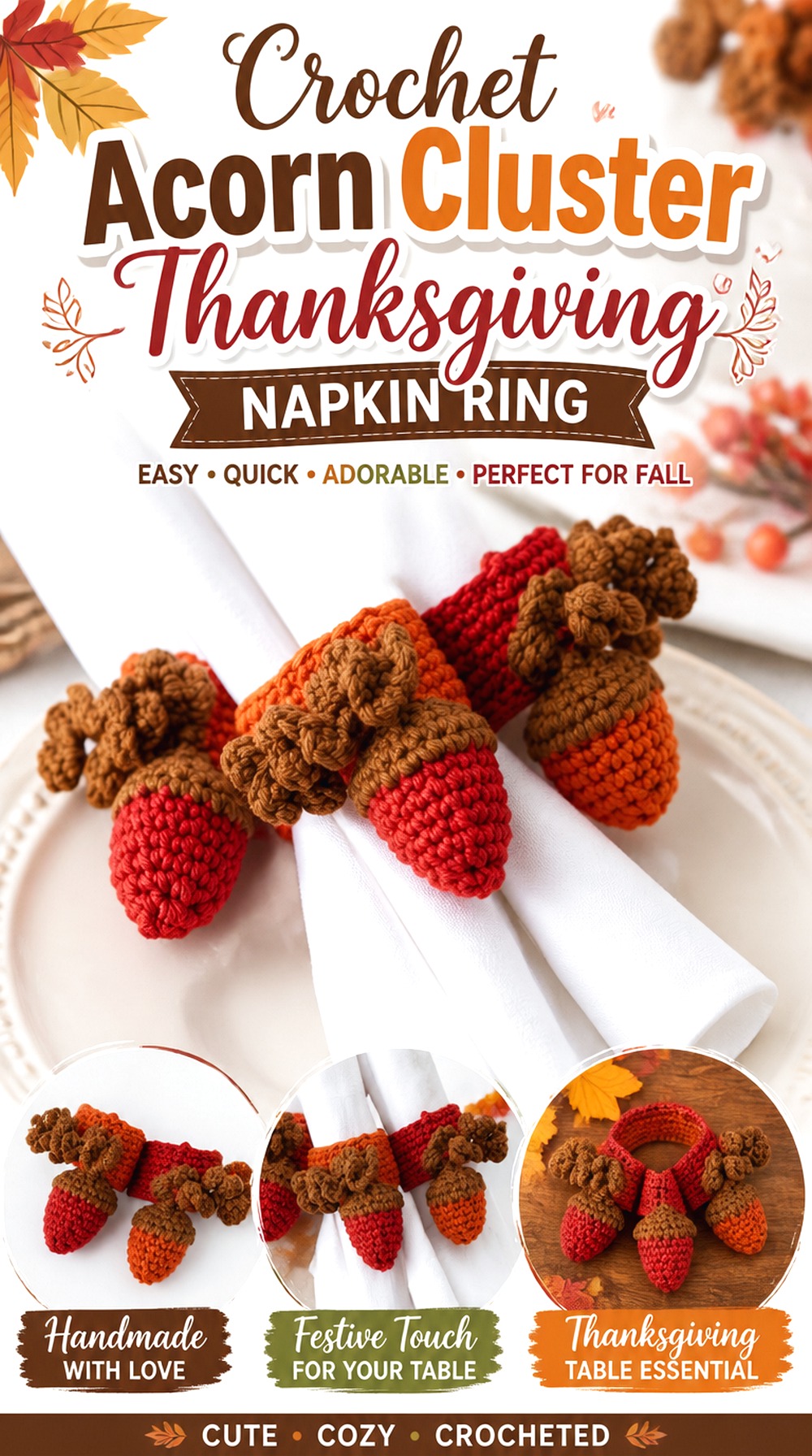
Acorns create a more dimensional harvest look than a flat leaf, and The Crochet Crowd’s project is specifically a Thanksgiving napkin holder rather than a general fall appliqué. The small woodland shapes give the ring enough personality to work with plain napkins and simple plates, where a flatter band might disappear.
This style is a good choice when you want each place setting to carry an obvious seasonal accent without using a turkey motif. Because the decoration has more depth, consider the amount of space available beside plates, flatware, and glassware before making a full matching set.
Dimensional Acorns Need a Stable Attachment Point
A projecting topper can rotate under its own weight if it is attached to a very loose or stretchy ring. Test the completed holder on the napkin and gently move it as a guest might when sitting down.
If the acorns consistently fall toward one side, the issue may be the base fit rather than the decoration. A ring that sits more securely around the folded napkin gives a dimensional motif a better chance of remaining at the front.
Use Woodland Texture Without Overcrowding the Setting
Acorns already bring cap texture, rounded forms, and multiple colors into a small area. That makes them effective with uncomplicated linens. If you also use patterned dishes, leaf-shaped place cards, printed napkins, and a busy centerpiece, the table can lose a clear focal hierarchy.
Try viewing a complete place setting from normal seated distance. If the ring is hard to distinguish, simplifying nearby decorative elements may work better than adding more detail to the crochet.
Crochet Sleek Harvest Napkin Holder

A plain crochet holder can be more useful than a heavily themed ring when the rest of your Thanksgiving table already includes pumpkins, foliage, patterned china, or strong centerpiece colors. Franci Klein Crochê’s tutorial focuses on the napkin-ring form itself, making it suitable as a clean foundation for a harvest palette.
The advantage here is flexibility. A simple holder can remain on the table for fall gatherings beyond Thanksgiving, and it gives textured napkins more room to show. Instead of relying on a topper for seasonal identity, use yarn color, fiber texture, and the surrounding table setting to establish the autumn mood.
A Simple Ring Makes Fit More Noticeable
Without a flower or appliqué distracting the eye, uneven sizing is easier to spot. Make one sample and test it around your folded napkin before repeating the project. The ring should slide on without forcing the fabric through, yet it should not fall away when the napkin is lifted.
If you plan to switch between thin and thick napkins, consider whether a permanently closed loop will give you enough flexibility for both.
Use Minimal Crochet to Balance a Detailed Tablescape
This design is especially useful when the table already carries visual information elsewhere. A plain warm-toned ring can create separation between a printed napkin and a decorative plate rather than competing with either.
Think of the holder as part of the table’s rhythm: repeated small bands at every setting can connect the color scheme even when they are not individually elaborate. Consistent finishing and sizing become the main design features.
Original Tutorial and Creator Credit
Creator: Franci Klein Crochê
Crochet Daisy Harvest Flower Napkin Holder
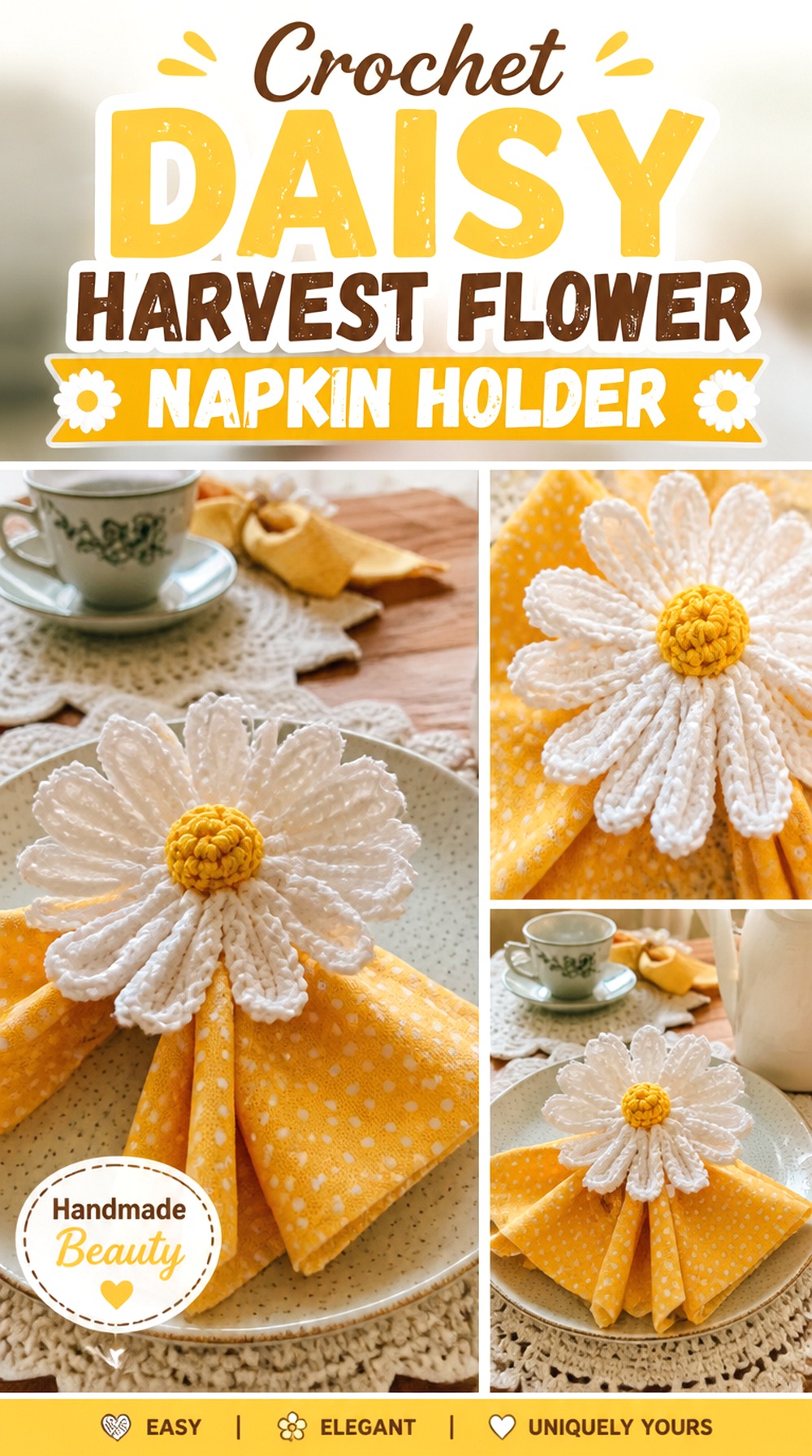
A flower-centered napkin holder offers a softer alternative to literal Thanksgiving icons. Joquebede Fernandes demonstrates a daisy crochet napkin holder, and the floral format can sit comfortably on a harvest table when paired with deeper gold, cream, brown, rust, or muted green tones.
The important difference from a sunflower adaptation later in this list is that this source is already a complete napkin-holder tutorial. You are not figuring out how to attach a separate appliqué to an unrelated band. That makes it appealing when you want floral table decor but prefer to follow a project designed from the beginning around a napkin.
Keep Petal Definition Clear Against Printed Fabric
A flower with individually visible petals can disappear against a busy floral or plaid napkin. Before making the entire set, place one finished flower against the fabric from normal viewing distance.
If the silhouette blends in, choose a stronger value contrast rather than automatically adding more colors. Cream petals on dark rust fabric or a deeper flower on ivory linen can read more clearly than several similarly toned shades layered together.
A Flower Can Bridge Summer and Thanksgiving Decor
The daisy form is not tied exclusively to one holiday. That can be an advantage if you host during early fall or want napkin rings that do not need to be packed away immediately after Thanksgiving.
Let the palette do some seasonal work. The same floral form can feel garden-inspired in bright colors or more harvest-oriented when surrounded by autumn linens, wood tones, dried foliage, and warm table accessories.
Original Tutorial and Creator Credit
Creator: Joquebede Fernandes
Crochet Braided Harvest Napkin Ring
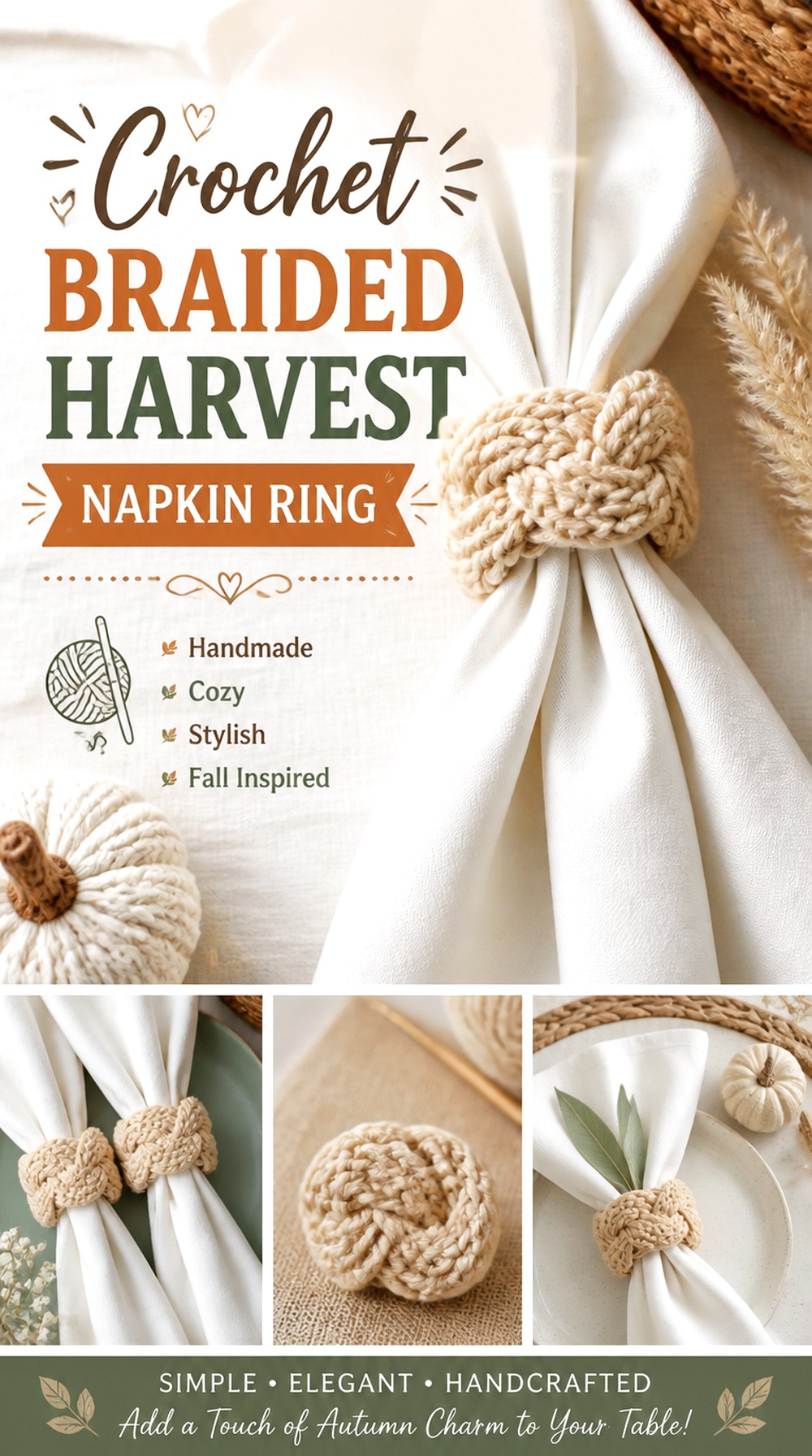
Raised braided texture gives this napkin ring visual interest without attaching a separate seasonal object. But First We Crochet’s tutorial produces a modern braided ring that can move into Thanksgiving naturally through color and table styling.
This is a useful middle ground between a plain band and a novelty topper. The texture catches light and creates a handcrafted focal point, but there are no leaves, pumpkins, or small sewn pieces to store carefully. It can suit a table where the napkins themselves feature Thanksgiving motifs, because the ring contributes texture instead of another competing image.
Braided Texture Needs Enough Contrast to Be Seen
A dimensional surface can lose its effect when made in very fuzzy or highly variegated yarn. If the braid is the main design feature you want guests to notice, smooth yarn and a color that shows shadows between raised sections may make the structure easier to read.
Compare the ring under the lighting you will actually use. Candlelike warm lighting and bright daytime windows can reveal texture very differently.
Check the Inside Surface as Carefully as the Outside
Guests interact with the inside of the ring when sliding the napkin out. Loose ends, stiff joins, or bulky finishing can catch on delicate fabric even when the outer braid looks polished.
Run the finished ring over the napkin a few times before making the whole set. If it drags or distorts the fold, improve the finishing or slightly adjust the fit rather than expecting the napkin to compensate.
Original Tutorial and Creator Credit
Creator: But First We Crochet
Crochet Rustic Bow Napkin Ring
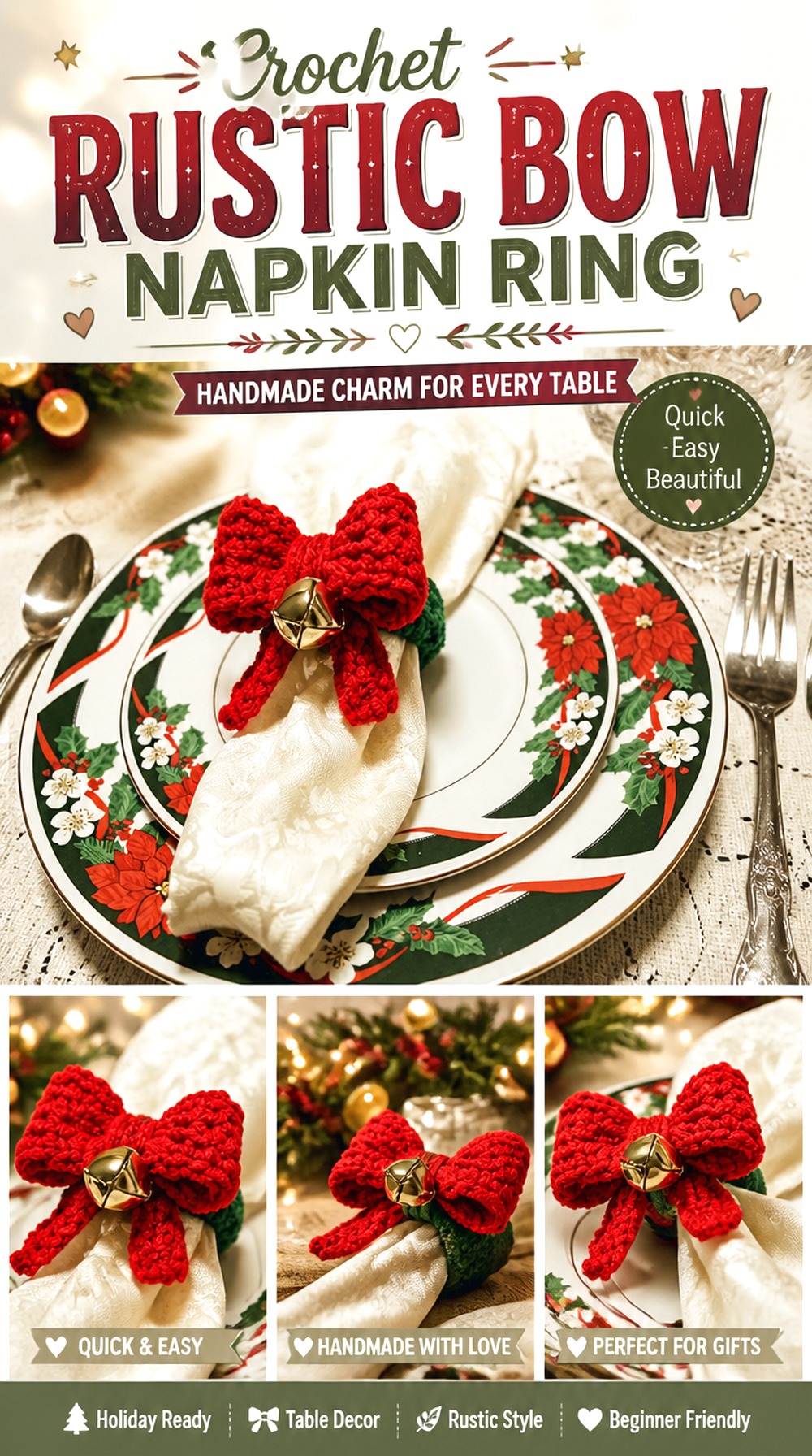
A crochet bow can bring a tied-harvest-bundle feeling to Thanksgiving without using a literal food or animal motif. The YARNutopia tutorial is originally presented as a Bows and Bells holiday napkin ring, so the Thanksgiving version is an adaptation: keep the ring-and-bow concept, use harvest colors, and omit the jingle-bell styling if you want a quieter fall result.
Because the source already teaches a complete napkin-ring construction, the adaptation is mainly visual rather than structural. This is a useful option for rustic, farmhouse, or traditional tables where ribbon-like details already appear in place cards or centerpiece arrangements.
Decide Whether the Bow Should Be Crisp or Relaxed
A compact bow gives the setting a tidy, tailored appearance. A softer bow can feel more casual but may spread into nearby flatware. Make one finished sample, place it beside the fork and plate, and check how much horizontal room the loops occupy.
Yarn choice affects this more than color alone. A material that holds its shape creates a different bow profile from one that drapes easily.
Skip Unnecessary Hardware for a Quieter Thanksgiving Look
The original project uses bells for its holiday styling, but a Thanksgiving table does not require them. Removing that element can also reduce bulk and small detachable components.
If you want an accent in the bow’s center, consider whether a securely sewn button or simply the crochet wrap itself is enough. Every added piece changes storage, laundering, and the way the ring feels when handled.
Original Tutorial and Creator Credit
Creator: Fuad Azmat / YARNutopia by Nadia
Crochet Harvest Button Tab Napkin Ring

A buttoned napkin ring solves a practical problem: you can open the holder instead of pushing a bulky folded napkin through a fixed loop. Fiber Flux’s Harvest Button Napkin Ring was designed specifically for a fall tablescape and uses the button as both closure and decoration.
That makes this idea particularly useful if your Thanksgiving napkins are thick, textured, or folded differently from one place setting to another. The tab shape also looks different from the continuous-loop rings elsewhere in the collection. A wooden-looking or otherwise simple button can reinforce the harvest mood without needing an additional appliqué.
An Opening Closure Makes Fit Easier to Control
A button closure gives you more flexibility during setup, but placement still matters. Test the completed tab around the actual folded napkin and make sure the fabric is held without being pinched into a narrow waist.
If you substitute yarn, the finished stretch and thickness can change. Use the tutorial’s construction as your guide while checking your own result instead of assuming a different material will behave exactly like the original.
Choose the Button for Function Before Decoration
The button is handled every time the ring opens, so it should be easy to pass through the closure and securely attached. A decorative button that is awkward to fasten may become frustrating across a large Thanksgiving table.
Also consider care. If your crochet fiber is washable but the button requires different treatment, the finished ring inherits the limitations of both materials.
Original Tutorial and Creator Credit
Creator: Fiber Flux
Crochet Puff Flower Thanksgiving Napkin Ring
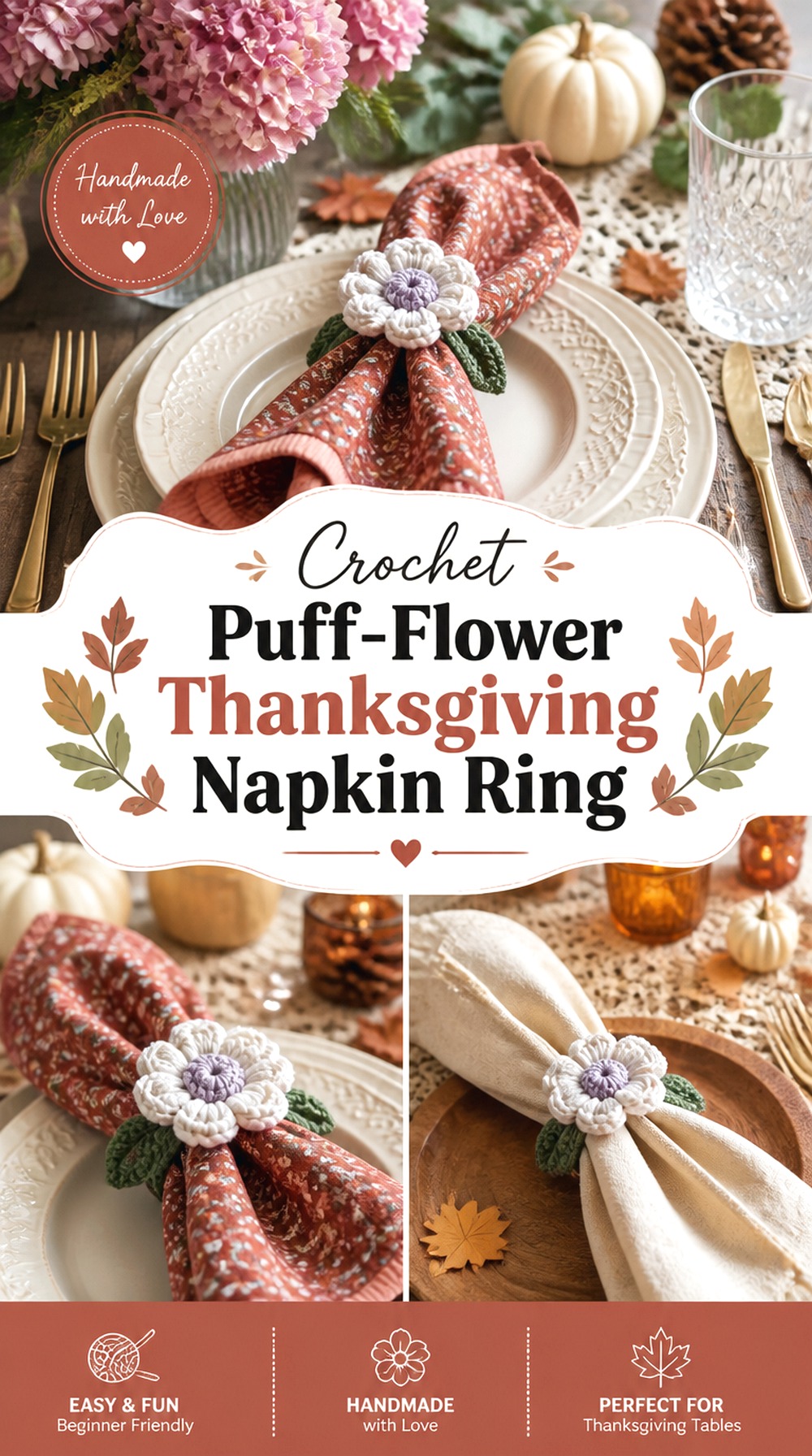
Made on Mill’s flower napkin ring brings dimensional crochet texture into a small, integrated design. The original project was presented for a garden-party setting, but the flower-centered construction can be shifted toward Thanksgiving with an autumn palette rather than changing the basic form.
Its finer visual scale distinguishes it from the larger appliqué toppers later in this article. Instead of attaching a substantial motif to a broad band, the flower and holder are designed together. That makes it a good choice when you want decorative detail without allowing the ring to dominate the entire folded napkin.
Fine Yarn Creates a Different Table Presence
The source uses cotton thread for its flower rings, which helps explain their delicate appearance. If you substitute a substantially heavier yarn, expect more than a simple color change: the flower can become larger, thicker, and more prominent.
Decide whether you want fine table jewelry or a chunkier handmade accent before substituting materials. Scale affects how the ring sits beside dinnerware as much as it affects the crochet itself.
Dimensional Petals Need Thoughtful Storage
Raised flower texture can flatten when a full set is tightly stacked under heavier decorations. Between seasons, give the rings enough room that the flower centers and petals are not crushed into a permanent position.
Before Thanksgiving, reshape them according to the needs of the fiber rather than applying heat or aggressive blocking automatically. A little storage planning helps detailed rings retain the form that makes them special.
Original Tutorial and Creator Credit
Creator: Made on Mill
Crochet Ribbed Linen Look Napkin Ring
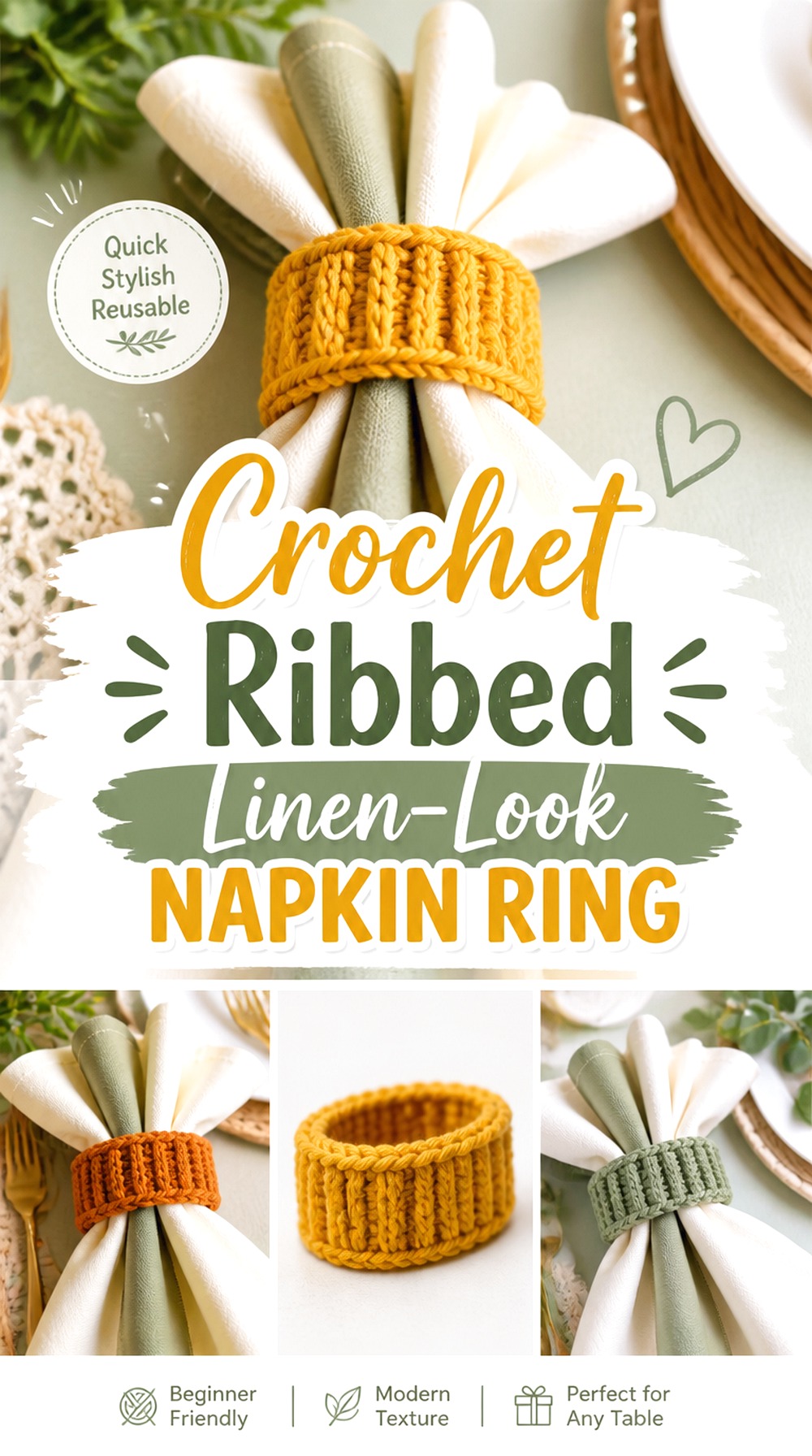
Ribbing gives a plain crochet band enough texture to look deliberate without adding a separate motif. Moms and Crafters’ tutorial specifically presents crochet napkin rings for cozy fall decor and discusses how tension influences the finished shape.
This version pairs particularly well with linen or linen-look napkins because both materials can contribute understated texture. It is also a practical choice when you need many matching rings: there are no individual appliqués to orient, stuff, or sew onto every band. You can let the repeated rib pattern and autumn palette establish consistency across the table.
Tension Changes More Than the Ring’s Circumference
With ribbing, loose and tight crochet can alter both fit and the visibility of the ridges. Make a short sample or complete one test ring before committing to the set.
If the fabric feels too soft to hold the napkin neatly, simply making the same design in more colors will not solve the structural problem. Adjust the variables that affect the fabric itself, then repeat the version that behaves the way you want.
Smooth Yarn Lets the Ribs Do the Decorating
Ribbing relies on light and shadow. Highly fuzzy yarn can obscure that surface and turn a deliberate textured ring into a visually soft tube.
That does not make fuzzy yarn unusable; it simply changes the design priority. If you want prominent ribs, select a yarn that displays individual stitches clearly. If you care more about a plush fall feeling, you may accept less visible texture.
Original Tutorial and Creator Credit
Creator: Moms and Crafters
Crochet Simple Fall Loop Napkin Ring
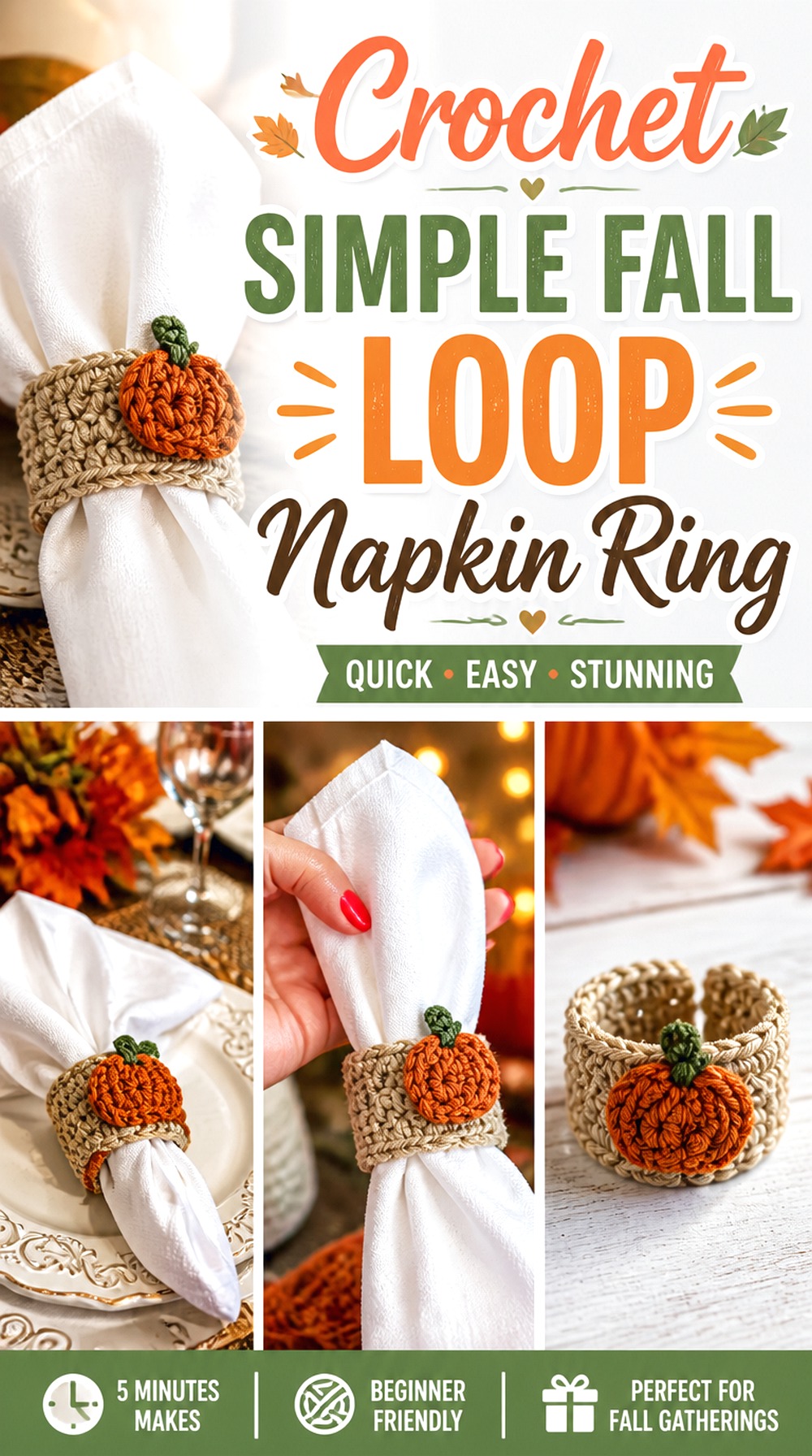
Frannie’s Hair demonstrates a straightforward fall napkin ring designed as a quick, accessible table project. This is the option to consider when you want the crochet itself to remain secondary to Thanksgiving dishes, place cards, centerpiece foliage, or patterned napkins.
A clean loop is also useful as a foundation concept if you later decide to add your own small appliqué. Before embellishing it, however, the plain version deserves consideration on its own. Repetition can be decorative: a row of evenly sized rust, mustard, brown, olive, or neutral rings can create a strong table rhythm without a single novelty topper.
Repetition Makes Small Inconsistencies Easier to See
One slightly uneven ring is barely noticeable by itself. Eight or twelve lined up around a table can reveal differences in width, circumference, and joining.
Keep the first ring available while making the rest instead of packing it away immediately. Comparing new pieces to the original sample helps you catch gradual tension changes before they become obvious across the whole set.
Use the Plain Loop as a Flexible Seasonal Base
If you enjoy changing decor, a simple ring can outlast one Thanksgiving theme. You might use it plain one year and attach a removable decorative element another year, provided the attachment is secure and suitable for table use.
This approach also makes storage easier because the base does not have projecting leaves, stuffed pieces, or petals that need protection.
Original Tutorial and Creator Credit
Creator: Frannie’s Hair
Crochet Bobble Texture Napkin Ring
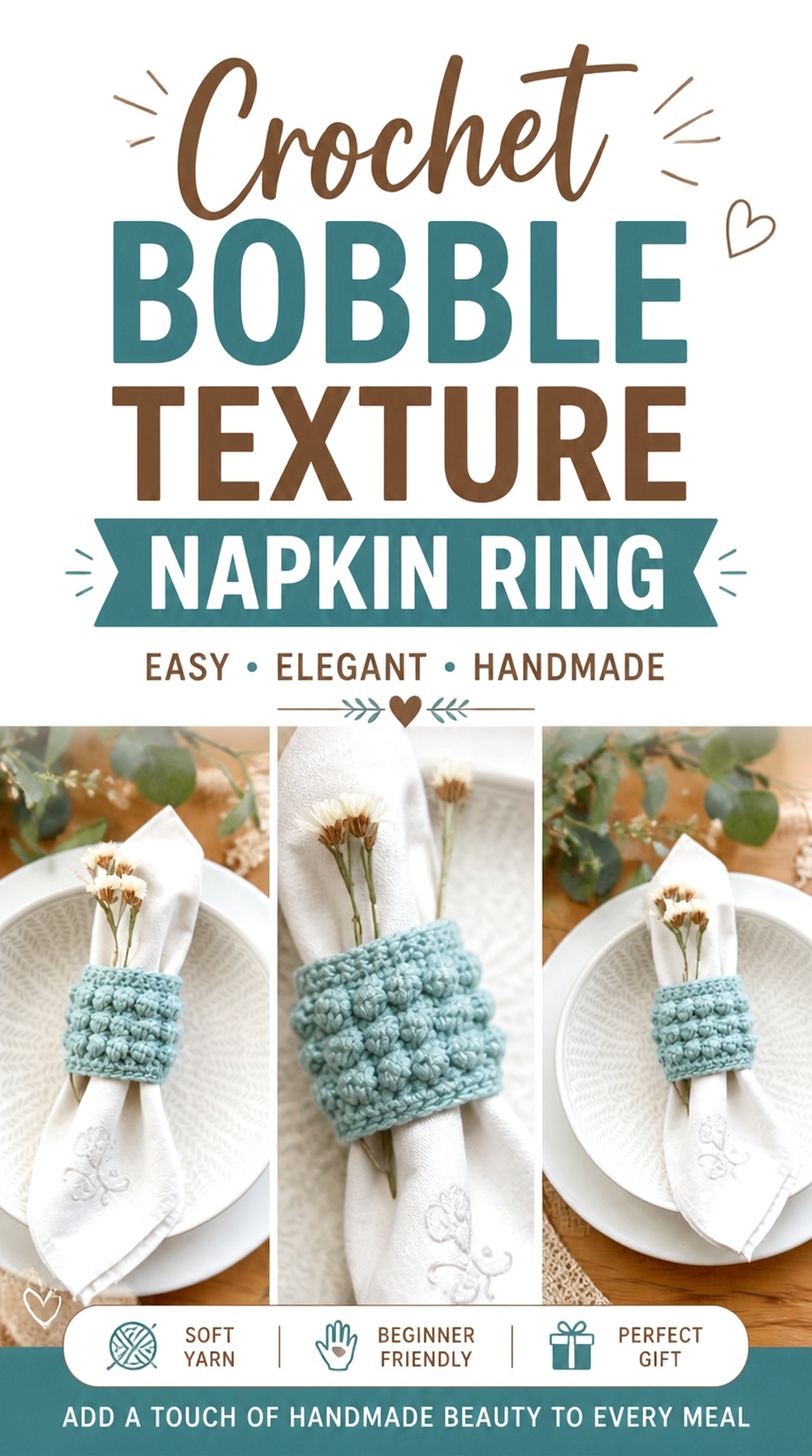
Bobble stitches change the silhouette of a napkin ring without requiring an attached appliqué. HanJan Crochet’s tutorial includes two bobble arrangements, giving the finished ring a more sculptural surface than a basic band.
For Thanksgiving, this texture can echo berries, seeds, or simply the heavier tactile character of fall textiles without literally representing any of them. It works especially well when your color scheme is restrained and you want stitch texture to provide the interest. Compared with flowers and stuffed motifs, the decoration remains integrated into the fabric of the ring itself.
Bobbles Add Thickness as Well as Pattern
Raised stitches occupy physical space. Check the ring around a folded napkin to make sure the textured surface does not feel too bulky next to the plate or make the napkin sit awkwardly high.
This matters more if you use thicker yarn than the tutorial. A texture that is subtle in one material can become a dominant sculptural feature in another.
Straight and Diagonal Texture Create Different Rhythm
The source presents more than one bobble arrangement, so think about how the repeated lines relate to your table. Straight texture can feel orderly and traditional, while a diagonal arrangement introduces more movement.
You do not need a different color for every ring to create variety. Alternating the texture direction while keeping a consistent palette can give neighboring place settings a subtle difference without breaking the overall scheme.
Original Tutorial and Creator Credit
Creator: HanJan Crochet
Crochet Chevron Overlay Napkin Ring
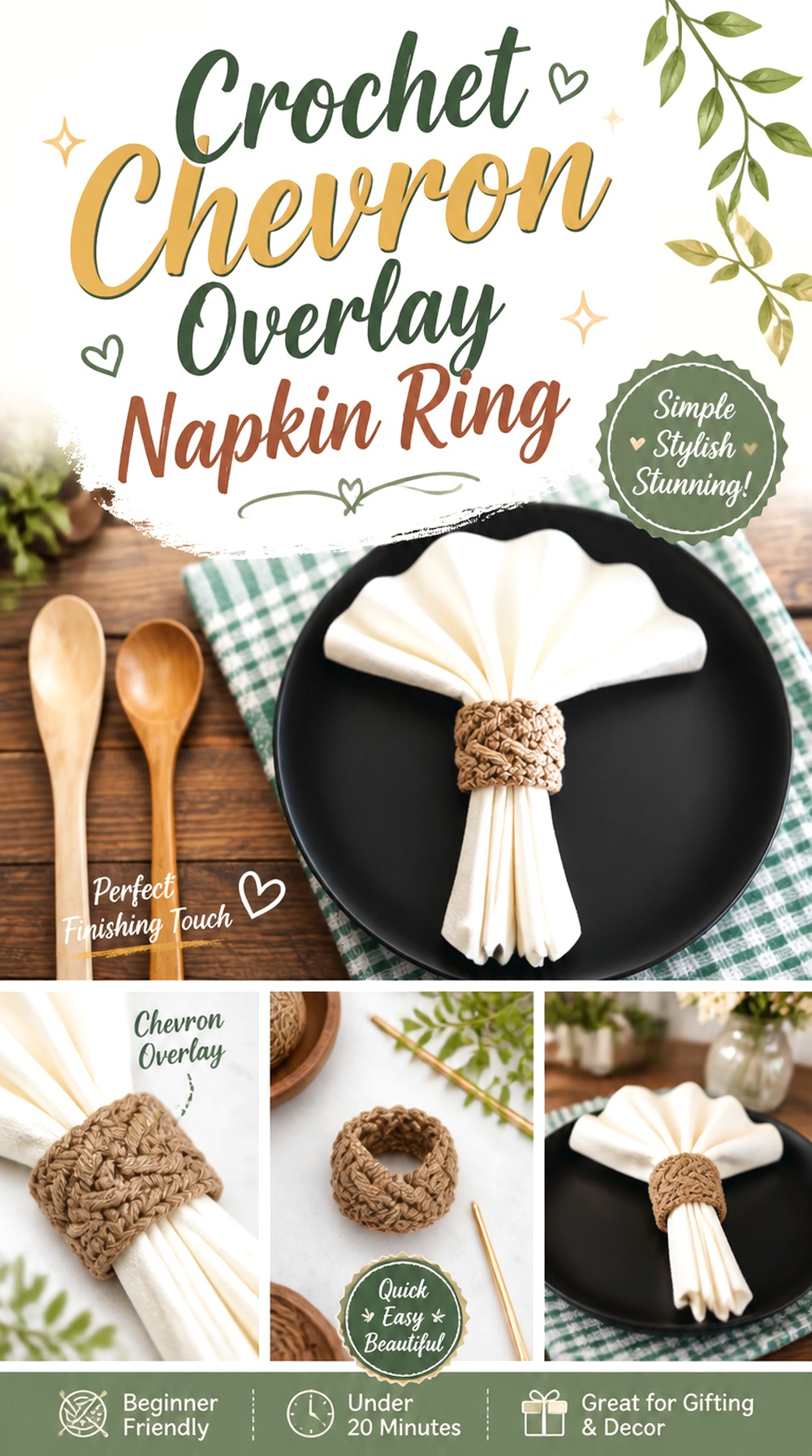
Crochet With Julie’s napkin ring uses a chevron-style overlay to create a strong graphic surface. Unlike a leaf or flower ring, the Thanksgiving connection can come entirely from color and surrounding decor, leaving the crochet itself geometric and contemporary.
This option suits a table with clean plates, modern flatware, or simple linen where a repeated V-shaped texture can provide structure. It is also a useful alternative for anyone who likes seasonal color but does not want overt holiday imagery. Because the texture is built into the band, there are no separate toppers to orient at each place setting.
Raised Geometry Rewards Consistent Tension
Chevron texture looks strongest when its repeated points have a similar height and spacing. If your tension changes noticeably between rings, the geometric pattern may emphasize those differences more than a plain band would.
Make the first finished ring your visual reference. Compare width, texture depth, and how the motif meets at the join before moving on to a large set.
Let Autumn Color Support the Pattern Instead of Hiding It
Deep rust, ochre, brown, olive, cream, and muted red can all move a geometric ring toward Thanksgiving, but stitch visibility still matters. Very dark yarn under low dinner lighting can make an intricate overlay difficult to see.
Before buying yarn for a full set, crochet enough of the texture to view it under your dining-room lighting. The right color is one that supports both the tablescape and the stitch pattern.
Original Tutorial and Creator Credit
Creator: Crochet With Julie
Crochet Turkey Appliqué Napkin Ring
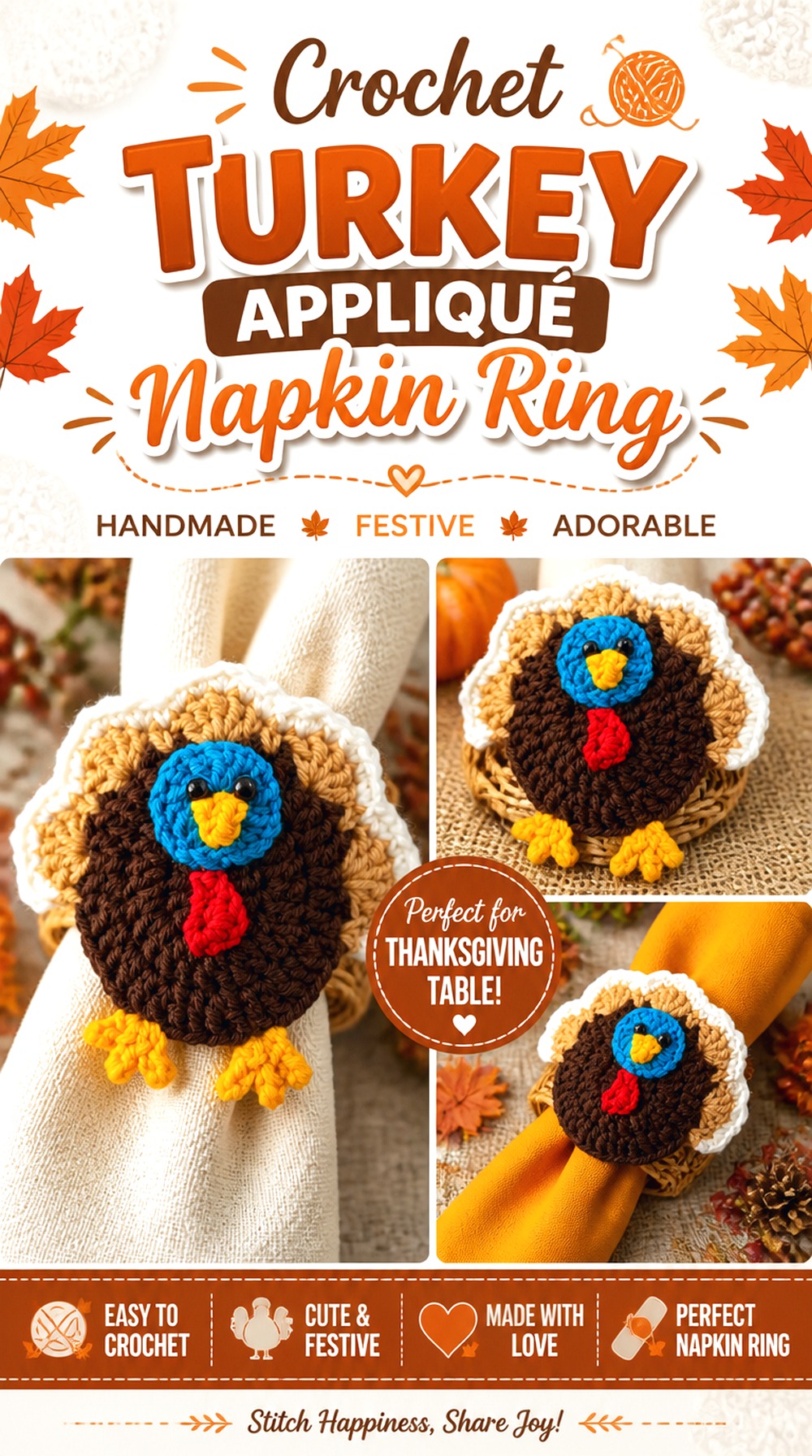
A turkey topper makes the Thanksgiving theme unmistakable. Jayda InStitches’ tutorial teaches a Thanksgiving turkey appliqué, not a complete napkin ring, so this idea is an adaptation: crochet the turkey from the original tutorial and attach it to a separate, well-fitting ring base.
That separation actually gives you useful design freedom. The ring can stay neutral while the turkey carries the color, or the band can coordinate with one shade from the tail. Because a multicolored turkey contains more detail than most of the earlier projects, it works best when the napkin behind it is relatively uncluttered.
Make the Turkey Before Choosing the Ring Width
Do not assume the motif will automatically look proportional on a narrow band. Complete the turkey according to the creator’s tutorial, then hold it against your proposed napkin ring and folded napkin.
If most of the motif hangs unsupported beyond the band, consider whether a wider base would look more intentional. The attachment area should support the decoration without turning the ring into a stiff plaque around the napkin.
Tail Colors Can Organize the Whole Tablescape
A turkey’s multiple colors give you an easy palette source. Instead of adding unrelated fall shades everywhere, select one or two colors from the finished motif for napkins, place cards, or a table runner.
This creates visual connection without making every object identical. It is particularly helpful if you want colorful Thanksgiving decor but are unsure how many autumn shades to combine.
Secure Small Facial or Decorative Details Carefully
If your turkey includes separate small pieces, inspect them after assembly and before putting the rings into service. Napkin holders are handled, pulled, and sometimes passed around the table.
For settings involving young children, loose embellishments deserve extra attention. The project is table decor, not a toy, and small detachable components should be treated accordingly.
Original Tutorial and Creator Credit
Creator: Jayda InStitches
Crochet Pumpkin Topper Napkin Ring
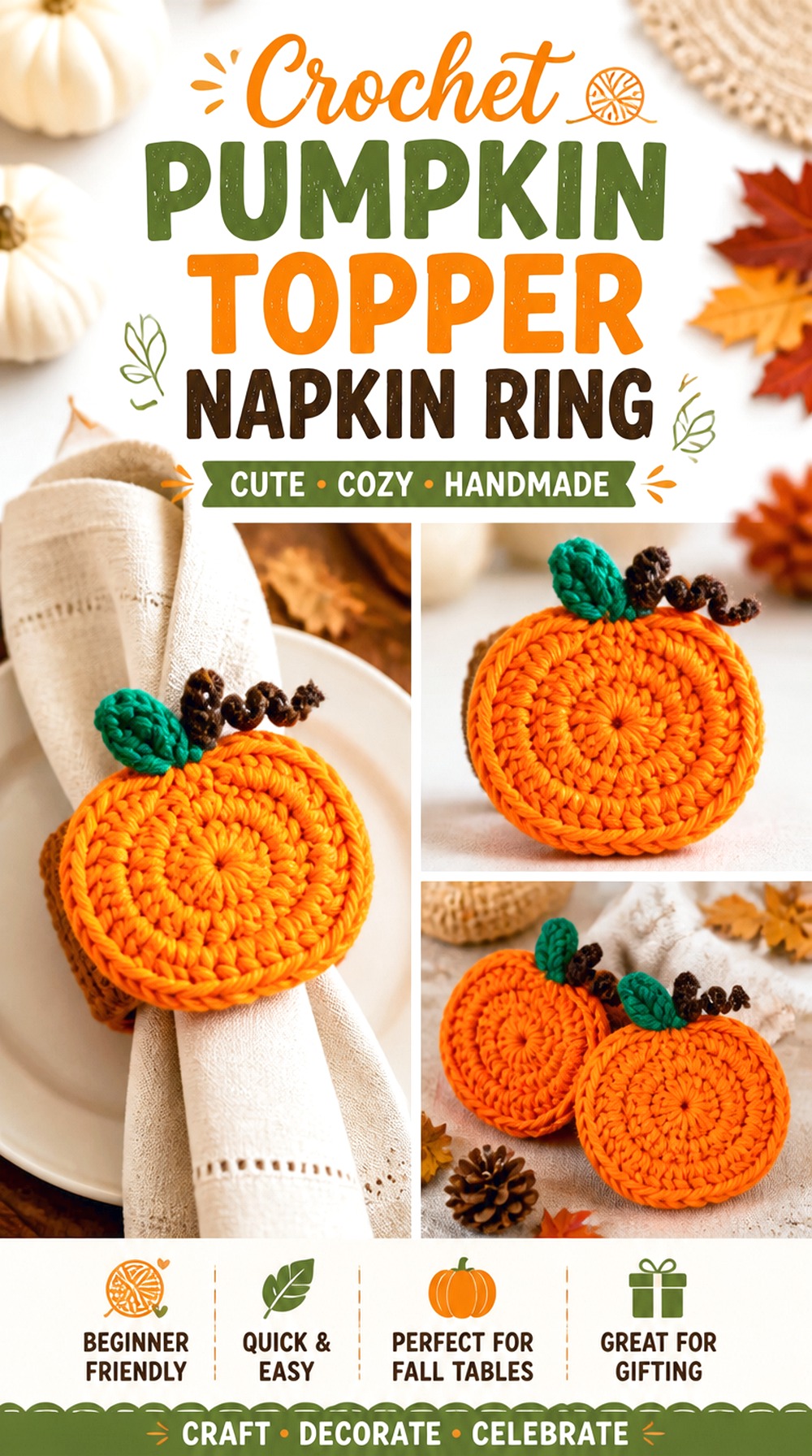
A flat pumpkin appliqué can provide a clear fall focal point without the bulk of a stuffed pumpkin. Naztazia’s tutorial specifically teaches a pumpkin appliqué intended for autumn and Thanksgiving uses, making it a practical motif source for adapting a plain ring.
This project differs from the pumpkin-pie idea later in the list because it keeps the silhouette simple and botanical. Attach the completed motif to a neutral or coordinating band, then let the pumpkin sit at the center of the folded napkin. It can also work well with place cards positioned just above the ring.
Check Pumpkin Width Against Your Dinnerware
A flat appliqué may still extend well beyond a narrow ring. Before sewing it on, place the motif over a folded napkin beside your actual plate and flatware.
If it intrudes into the fork area or becomes hidden under the plate edge, adjust the placement or choose a different fold. Designing the whole place setting together is often easier than altering the crochet after all the rings are finished.
Use Surface Detail Sparingly on a Small Topper
Pumpkin shaping can already create enough visual information to make the motif recognizable. Extra buttons, beads, bows, or embroidery are optional rather than necessary.
If you do add anything beyond the source design, consider how it changes thickness and care. For a repeated set, one clean detail executed consistently usually looks more deliberate than many unrelated embellishments.
Keep the Band From Competing With the Pumpkin
A heavily textured or multicolored base can make a small pumpkin difficult to distinguish. Try pairing the appliqué with a quieter loop so the silhouette remains the main feature.
If you want texture in both pieces, use contrast strategically—for example, a subtle ribbed band with a clearly outlined pumpkin—rather than making both elements equally busy.
Original Tutorial and Creator Credit
Creator: naztazia
Crochet Oak Leaf Topper Napkin Ring
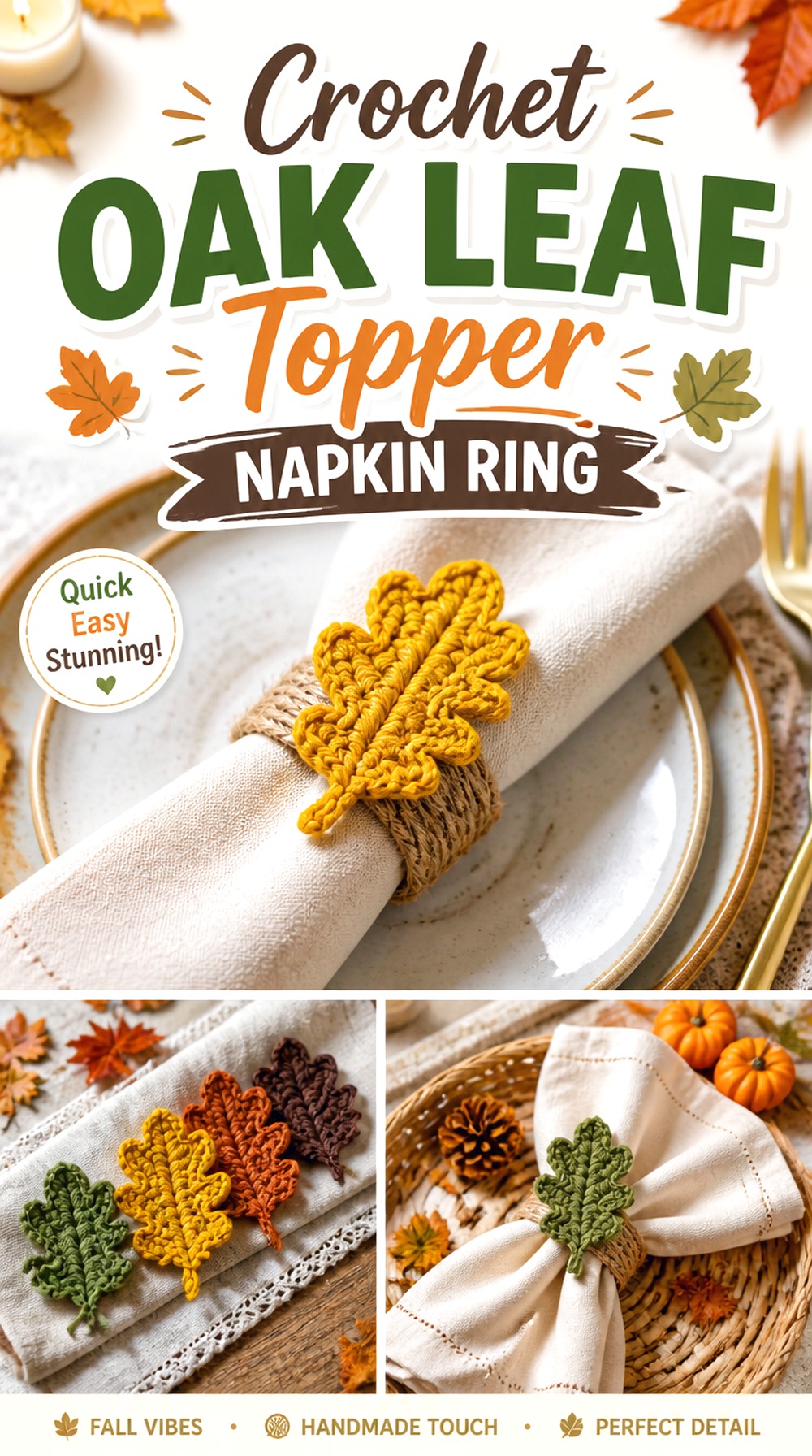
An oak leaf creates a woodland Thanksgiving look that feels different from the rounded pumpkin and multicolored turkey motifs. Hopeful Turns’ tutorial teaches an autumn oak leaf, which can be used as a separate topper on a simple napkin ring.
Because the leaf is elongated rather than circular, orientation becomes part of the design. It can sit across the band, follow the length of a folded napkin, or angle slightly toward a place card. A single oak leaf also provides a quieter alternative to a cluster of several leaves, making it useful on tables where the centerpiece already includes substantial foliage.
Use the Leaf’s Direction to Guide the Eye
Try the motif vertically and diagonally before sewing it in place. A vertical leaf can visually lengthen a short napkin fold, while an angled leaf can create a more informal fallen-leaf effect.
For a formal table, keep the direction consistent at every place setting. For a natural woodland arrangement, alternate the angles intentionally rather than allowing them to vary accidentally.
Pointed Leaves Need Enough Stitch Definition
Oak-leaf character comes from the outer contour. If the yarn is so fuzzy that the lobes merge visually, the topper may read as a generic textured shape from across the table.
A smoother yarn can preserve the outline more clearly. If you change the yarn from the tutorial, make one motif first and judge it at dining distance rather than only looking closely while crocheting.
Match Attachment Points to the Leaf’s Shape
An elongated motif attached at only one tiny central point may twist as the napkin moves. Before fastening it permanently, identify where the leaf naturally contacts the ring without pulling its edges out of shape.
The goal is support, not flattening. Secure enough of the motif to control rotation while allowing the recognizable leaf contour to remain visible.
Original Tutorial and Creator Credit
Creator: Hopeful Turns
Crochet Sunflower Button Top Napkin Ring

A sunflower is a natural bridge between late-summer decor and Thanksgiving. Simply Made by Erin’s tutorial teaches a sunflower appliqué designed to work around a button on another type of holder, which creates an interesting adaptation opportunity for a napkin ring with a suitable button closure.
Instead of sewing the flower permanently to the band, you could explore a removable flower concept if your ring construction and button are compatible. That makes this idea different from the integrated daisy holder earlier in the collection. Verify fit carefully, because the original sunflower was not designed specifically for a napkin ring.
Treat the Button Opening as a Compatibility Check
Do not assume the sunflower will fit any decorative button. The source design is built around a particular removable-flower concept, so the opening, button profile, and spacing all affect whether the motif can sit securely.
If you adapt it to a napkin ring, make the flower and test it on the actual closure before producing multiples. A flower that is difficult to remove defeats the advantage of an interchangeable topper.
Reduce Scale Before the Flower Overwhelms the Napkin
The source discusses how different yarn and hook choices affect the finished sunflower’s size. That matters because a motif intended for a towel holder may be much more visually dominant on a napkin ring.
Rather than blindly downsizing, make a sample in your proposed materials. You still want clear petals and a recognizable center after any scale change.
Removable Toppers Can Simplify Seasonal Storage
If your adaptation works securely, keeping the ring and sunflower separate during storage can help prevent crushed petals. It also creates the possibility of reusing the base with another seasonal topper.
Label sets or store coordinating pieces together so small flowers do not become separated. Always check the attachment again before setting the table after a long period in storage.
Original Tutorial and Creator Credit
Creator: Simply Made by Erin Crochet
Crochet Pumpkin Pie Place Card Napkin Ring
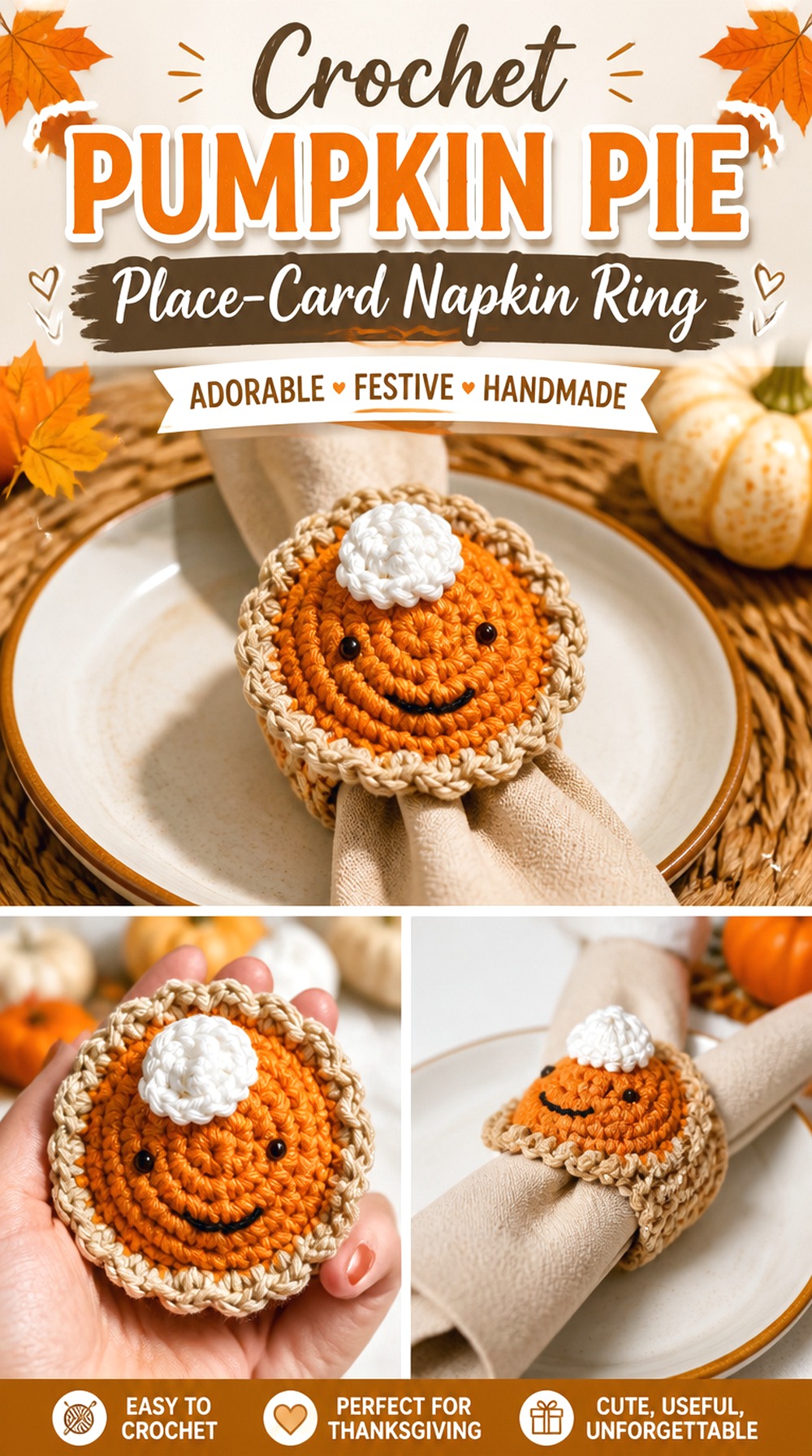
A tiny slice of pumpkin pie pushes the napkin ring toward playful Thanksgiving table decor. Heather Corinne Crochets teaches a pumpkin pie amigurumi project rather than a napkin-ring topper, so scale is the first issue to evaluate.
Instead of automatically sewing the entire dimensional pie to a narrow band, consider using the finished piece as a combined napkin accent and place-card marker. A simple crochet ring can hold the napkin while the pie sits against or immediately above it. This preserves the dimensional form without asking the ring to support more weight than it comfortably can.
Dimensional Pie Needs More Table Clearance
Unlike a flat leaf, a stuffed motif occupies depth as well as width. Set one sample beside your dinner plate, glassware, and silverware before making a set.
If the pie pushes the napkin too far toward the plate or makes the place setting feel crowded, shift it to the top of the folded napkin rather than forcing it into the same footprint as a conventional ring topper.
Place-Card Use Gives the Motif a Second Purpose
A substantial Thanksgiving decoration becomes more justifiable when it helps identify seating. You can position a separate paper name card with the pie rather than adding lettering directly to the crochet.
Keeping the name component separate makes the crocheted pieces reusable for future dinners. It also avoids permanently assigning an elaborate handmade ring to one guest.
Avoid Treating Amigurumi as Ordinary Flat Trim
Stuffed pieces require different handling from appliqués. Check seams, decorative features, and any small attached elements before use, particularly if children will be seated at the table.
If the original design includes facial details or safety eyes, remember that decorative table use and child-safe toy use are different questions. Do not infer suitability for unsupervised young children from the project’s appearance.
Original Tutorial and Creator Credit
Creator: Heather Corinne Crochets
Crochet Pilgrim Hat Place Marker Napkin Ring
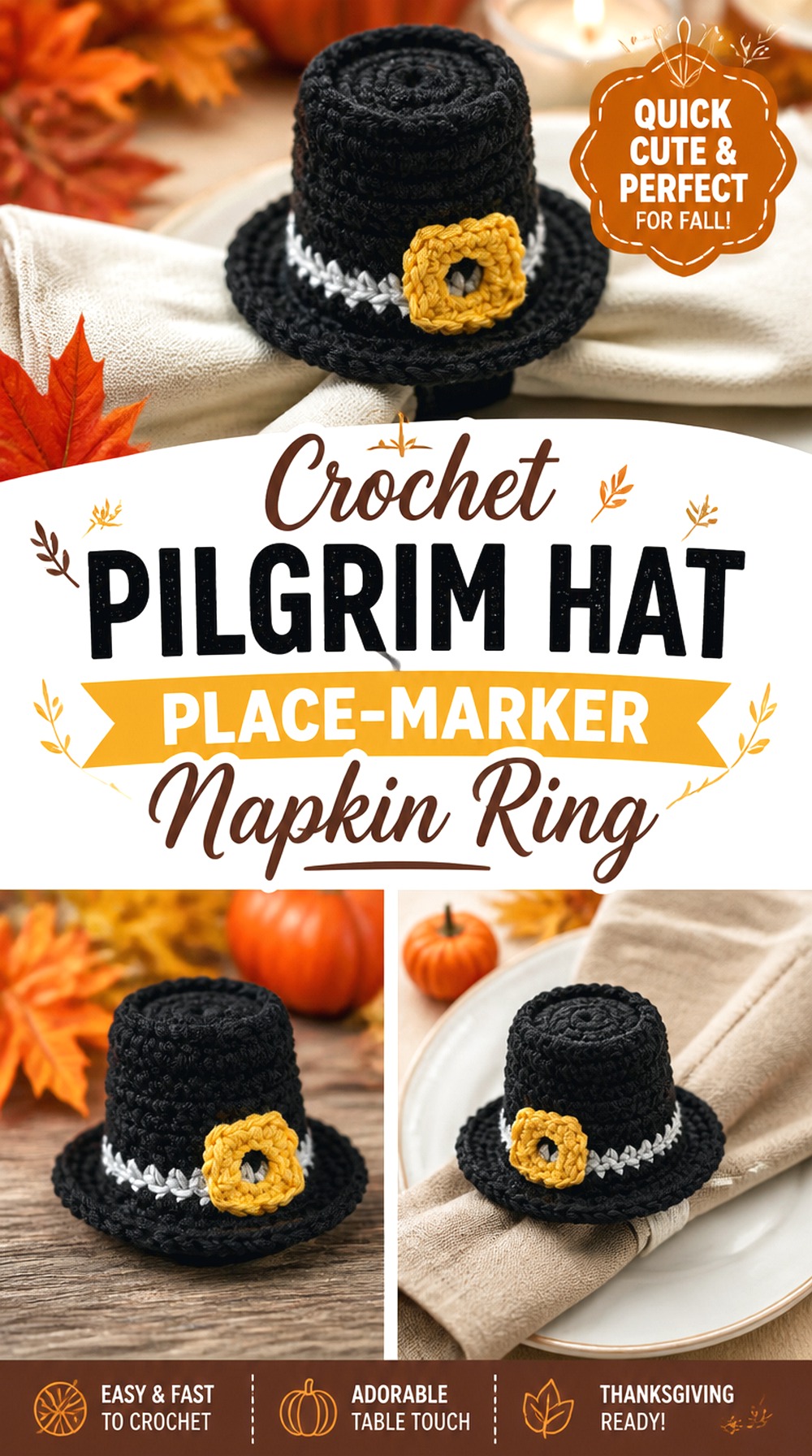
A small pilgrim hat creates one of the most literal Thanksgiving place-setting ideas in this collection. Sara Sach’s design for Posh Pooch Designs is a dimensional Thanksgiving decoration rather than a napkin ring, and the source itself notes place-marker use.
That makes it better suited to sitting with a napkin ring than being permanently mounted on a narrow crochet loop. Pair a plain band with the hat positioned immediately above it, or attach it only if the scale and weight remain practical. The stronger dimensional silhouette makes this a good fit for otherwise simple place settings.
Use the Hat as a Marker Instead of Forcing It Onto the Band
If a topper naturally stands upright, keeping it upright may look better than sewing it sideways onto a ring. Set the hat at the center of the folded napkin and let a simple band beneath it do the holding.
This approach also reduces stress on the ring and makes the dimensional project easier to store separately after the meal.
Test Height Against Sight Lines and Dinnerware
Vertical decorations can interfere with more than flatware. A tall accent may block a name card, lean into glassware, or look oversized on a small salad plate setting.
Build one complete mock place setting before making multiple hats. What looks charming alone on a craft table may need repositioning once dishes, glasses, and serving pieces surround it.
Keep Name Labels Separate From the Crochet
If you use each hat as a place marker, slide a small paper card beside it or use another removable labeling method. Avoid permanently stitching names unless you specifically want dedicated pieces.
A reusable neutral set can return year after year even as your guest list changes, which makes the extra dimensional crochet more worthwhile.
Original Tutorial and Creator Credit
Creator: Posh Pooch Designs
Crochet Apple Harvest Napkin Ring

Apples broaden the harvest theme beyond the most expected Thanksgiving symbols. Jess Crafting’s tutorial teaches a flat apple appliqué for autumn decor, making it suitable for attaching to a simple ring after you confirm the motif’s finished scale.
This idea works especially well for an orchard-inspired table with wood tones, leaves, cider colors, or baskets incorporated elsewhere in the decor. The recognizable round fruit shape provides a strong focal point without the multiple separate tail pieces of a turkey or the bulk of dimensional pie. It can also transition easily into general fall dining.
Decide Between Red, Green, and Muted Harvest Tones as a Group
The apple does not have to be bright red. Before choosing yarn, look at the napkin, plate, table runner, and centerpiece together. A darker red, russet-inspired tone, or green may fit your existing palette more naturally.
The important point is contrast. Make sure the fruit silhouette remains visible against the napkin rather than choosing a shade only because it looks seasonal in the skein.
Keep the Stem and Leaf From Catching on Fabric
Small projecting pieces give the apple its identity but can also snag during use if they are loose or poorly positioned. After attaching the motif, slide the napkin in and out several times and see whether any edge catches.
If it does, reconsider where the appliqué sits on the band or how the projecting detail is secured instead of simply tightening the napkin ring.
Flat Fruit Motifs Pair Well With Place Cards
Because the apple is relatively graphic and flat, a small rectangular place card can sit immediately above or behind it without creating excessive bulk.
You could also coordinate card stock with the leaf or stem color rather than adding more crochet decoration. This keeps the handmade motif prominent while still providing a practical seating cue.
Original Tutorial and Creator Credit
Creator: Jess Crafting
Crochet Turkey Feather Accent Napkin Ring
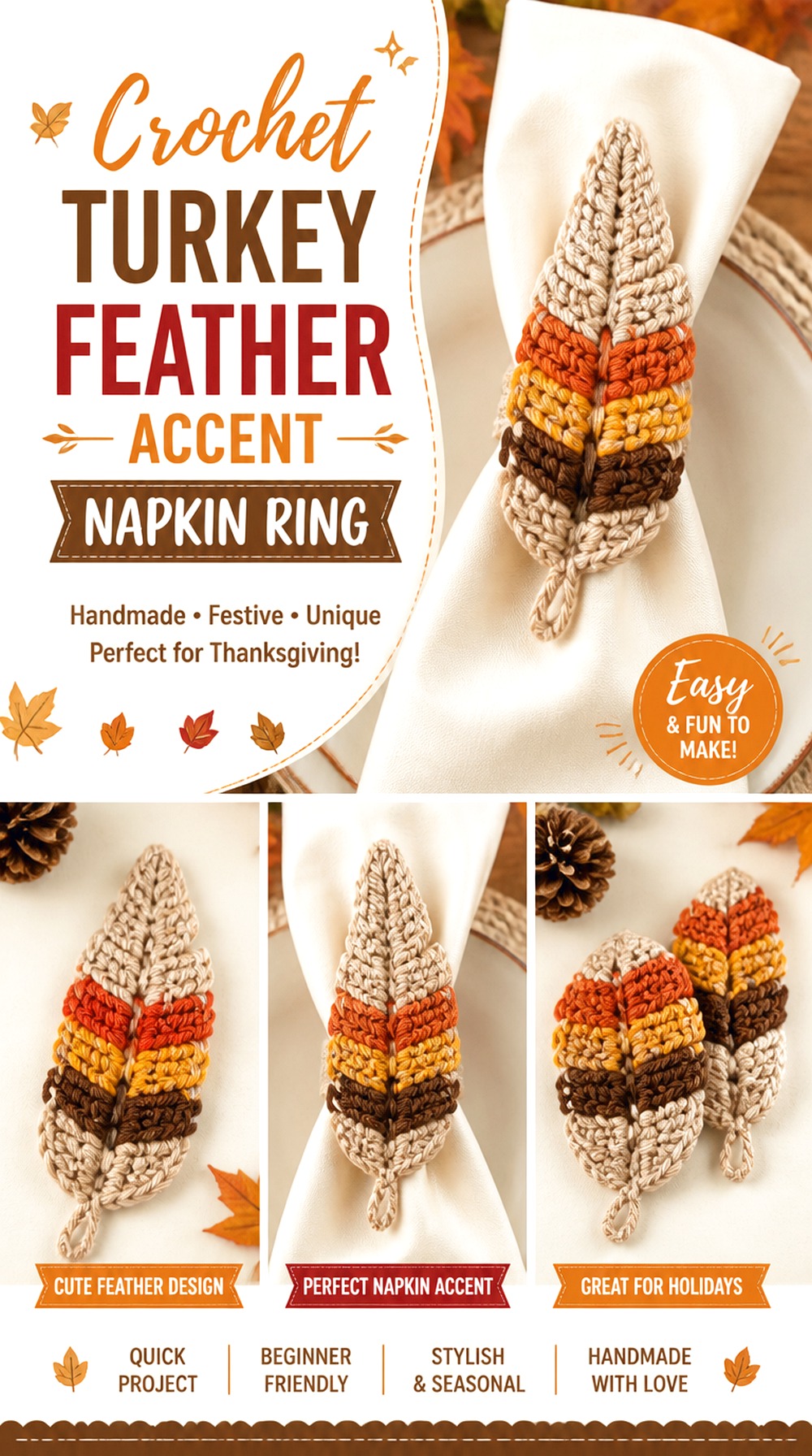
Not every turkey-themed ring needs an entire turkey. A single crochet feather or a small fan of feathers can reference the bird while producing a lighter, more abstract Thanksgiving accent. Hectanooga1’s tutorial teaches crochet feathers that can be used as appliqués and embellishments rather than napkin rings.
For this adaptation, the ring remains a separate project. The feather becomes the topper, which lets you control how much color appears at each place setting. A single rust or gold feather feels restrained; several contrasting feathers can create a much more playful turkey-tail impression.
One Feather and a Fan Create Very Different Weight
Start by making one motif and placing it on the band. You may find that a single feather gives enough shape, especially with a printed napkin.
If you want a fan, arrange all the feathers before sewing any of them down. Overlapping several pieces increases thickness at the attachment point and can change how the ring sits against the napkin.
Use Direction to Suggest Movement
A feather pointing vertically feels tidy, while an angled feather gives the ring a looser, gathered-harvest appearance. Several feathers can radiate outward to suggest a turkey tail without creating a literal bird face.
Choose the arrangement at full place-setting scale. Motifs that look nicely spread on a flat work surface may need to be narrower once they sit between a plate and fork.
Prioritize Secure Ends on Narrow Motifs
Feathers can contain narrow tips and elongated edges that receive more handling than a compact circular appliqué. Check the finished motif for loose tails before attaching it to the ring.
After assembly, gently flex the ring and feather together. If the topper folds sharply at one attachment point, a broader support area may help it stay oriented without distorting the crochet.
Original Tutorial and Creator Credit
Creator: Hectanooga1
Crochet Woodland Mushroom Napkin Ring
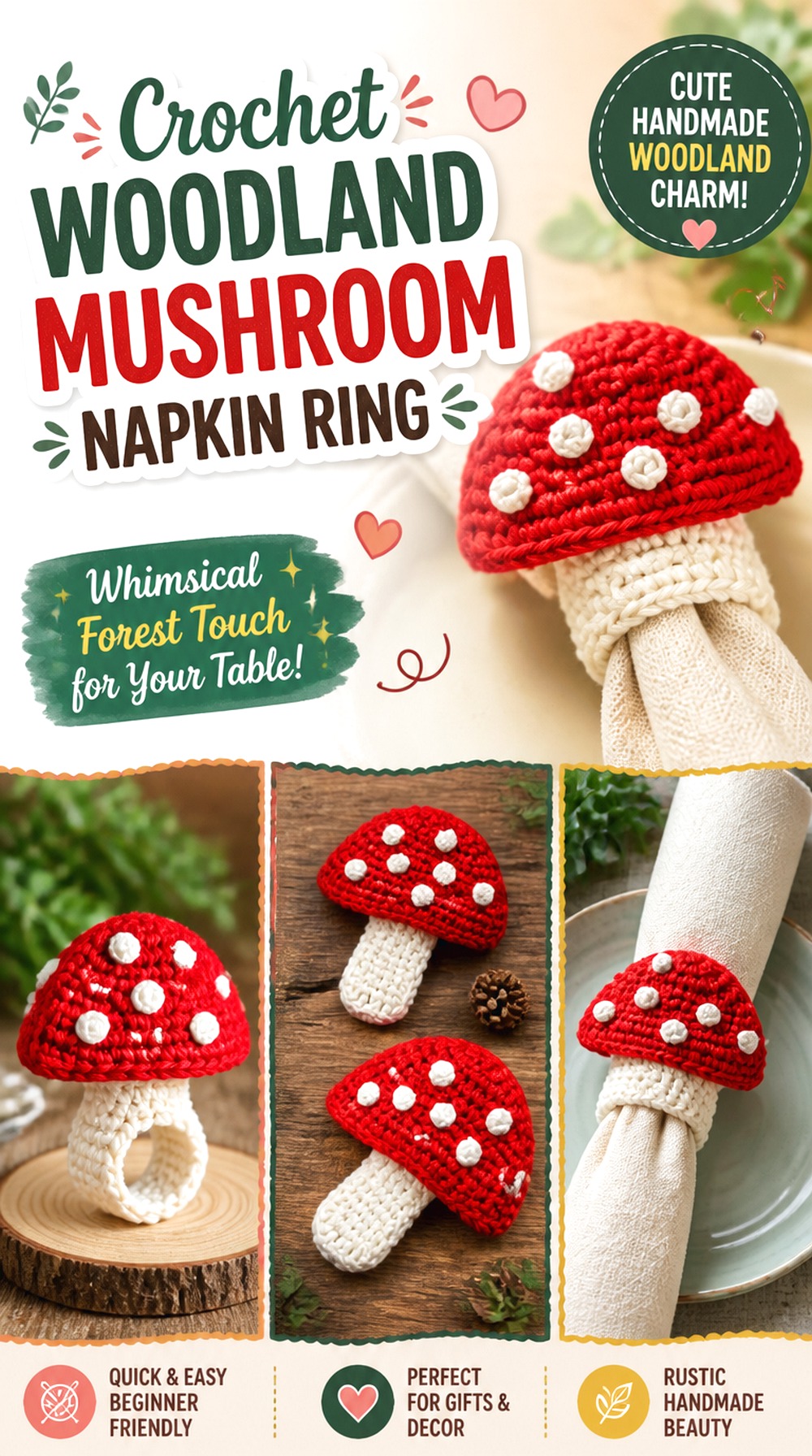
A mushroom napkin ring is less traditional than a pumpkin or turkey, but it fits naturally into a woodland harvest table with leaves, acorns, mossy greens, and warm brown linens. Pops de Milk Crochet’s tutorial teaches a mushroom/toadstool appliqué, so the ring construction must come from your own compatible base.
The motif’s vertical stem-and-cap silhouette gives this idea a noticeably different shape from the round apple, pumpkin, and sunflower toppers. It works especially well if your Thanksgiving decor leans rustic, nature-inspired, or storybook rather than formal.
Keep the Cap Visible Above the Ring
Attach the appliqué too low and the cap may disappear into the gathered napkin fabric. Before sewing, slide the ring onto the napkin and hold the mushroom where you want the cap to sit.
Mark the attachment position only after viewing the entire place setting. This prevents a carefully crocheted motif from being hidden by the very fabric it is meant to decorate.
Woodland Decor Works Better With a Controlled Motif Mix
If you use mushroom rings, an acorn centerpiece, leaf garland, pinecones, and several other woodland shapes, decide which element should dominate. Repetition creates cohesion more reliably than placing a different object everywhere.
One approach is to keep all napkin rings as mushrooms while allowing leaves and acorns to appear only in the centerpiece. That gives each part of the table a clearer role.
Consider the Stem When Choosing a Base Width
A very narrow mushroom stem attached to a broad band can look visually disconnected, while a tiny band may not provide enough support for a larger cap.
Hold the completed appliqué over several possible base widths before choosing one. The best pairing is the one where the motif appears intentionally connected rather than simply tacked onto the front.
Original Tutorial and Creator Credit
Creator: Pops de Milk Crochet
Crochet Corn Harvest Napkin Ring
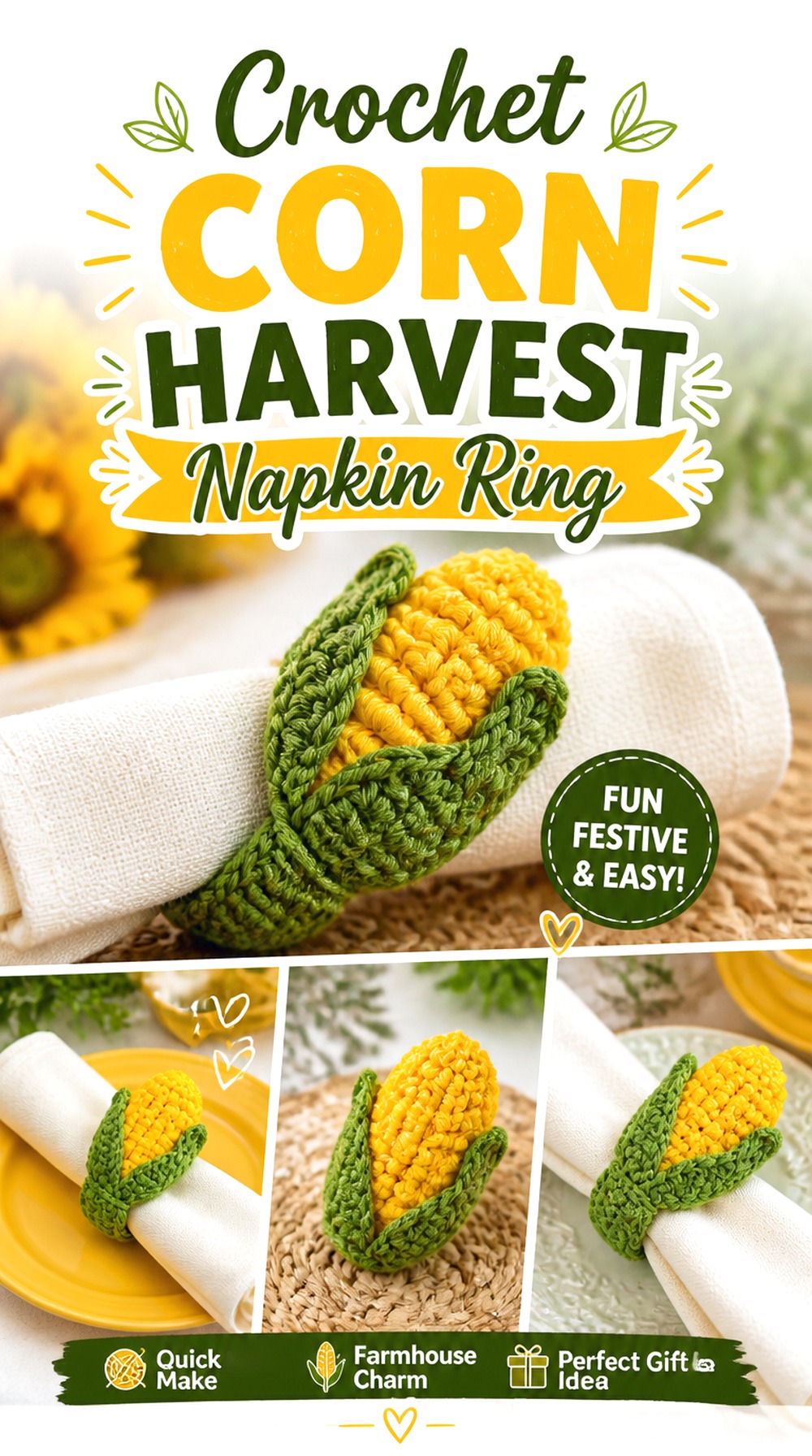
Corn brings the harvest idea directly to the table without repeating another pumpkin or leaf. Crochet Crafters’ video teaches a corn appliqué, providing a flat motif that can be mounted on a separate napkin ring after you confirm its size.
The long shape works well vertically on a rolled napkin and can create an interesting contrast beside round plates. Yellow, green, cream, and muted maize tones also give you a color route that is distinct from the rust-and-orange palette common in Thanksgiving crochet. This is a useful option for farm-inspired or rustic tables.
Vertical Placement Helps an Elongated Motif Feel Intentional
A corn appliqué naturally has a top and bottom. Try aligning it with the length of the folded napkin rather than turning it horizontally across the band.
That orientation usually leaves more room for flatware and lets the motif’s silhouette remain recognizable. If the napkin is short or very tightly rolled, test a slight diagonal instead of allowing the corn to extend awkwardly beyond the fabric.
Use Green Sparingly if the Husk Is the Main Contrast
The yellow-and-green combination can become visually strong in a small topper. Look at the motif against the napkin before choosing the band color.
A green ring beneath green husk details may blur the outer silhouette, while a neutral or contrasting base can separate the appliqué more clearly. The exact solution depends on your yarn and linens, so judge the finished combination rather than the skeins separately.
Keep the Adaptation Flat Enough for Table Use
A flat appliqué is one of this idea’s advantages. Avoid adding so much extra padding or embellishment that the corn starts behaving like a dimensional ornament.
If you want more texture, let the crochet stitches provide it. A low-profile topper is easier to slide beside a plate and easier to stack for storage after Thanksgiving.
Original Tutorial and Creator Credit
Creator: Crochet Crafters
Crochet Wheat Stalk Napkin Ring
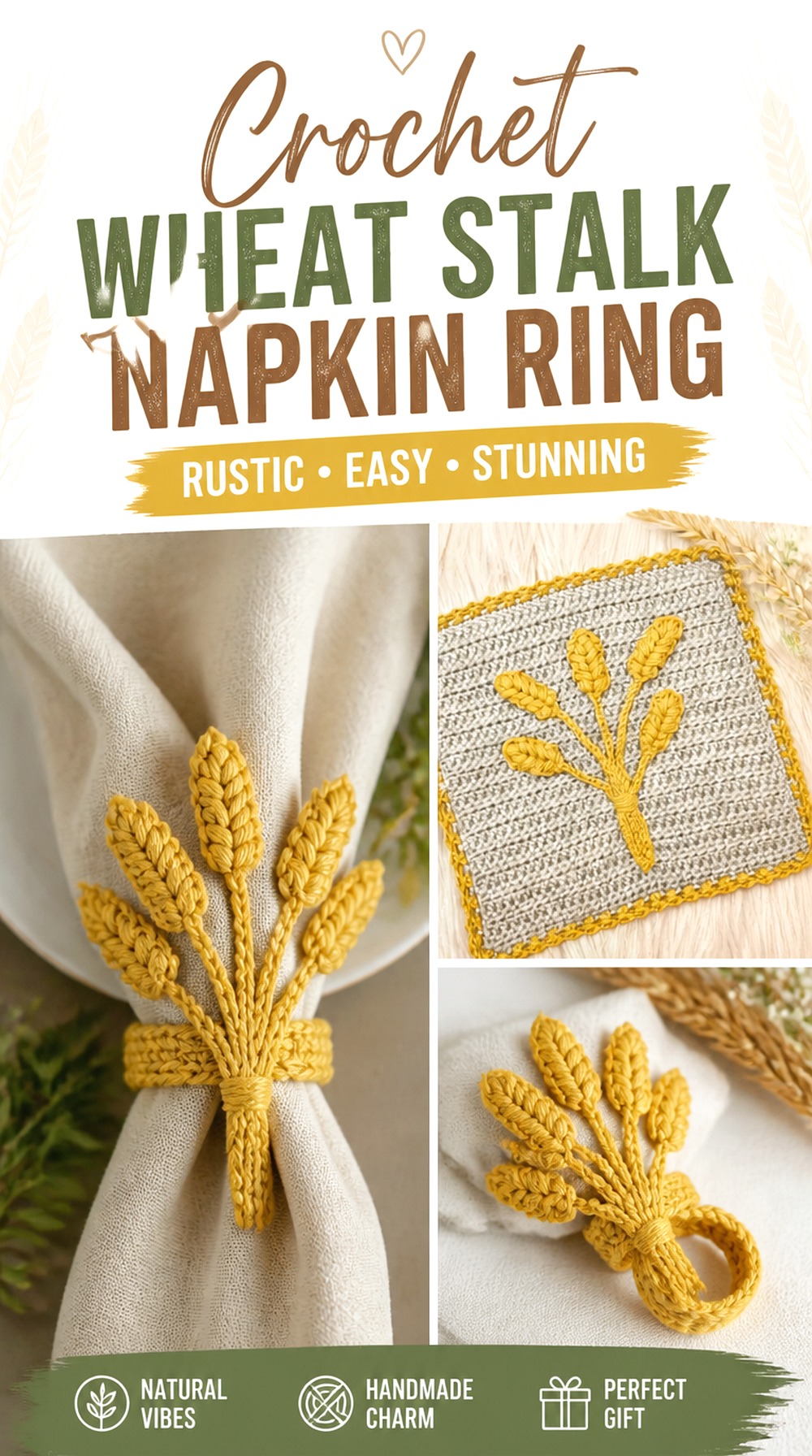
A wheat stalk offers one of the most understated harvest motifs in the collection. Sweet Potato 3’s tutorial teaches a crochet wheat-stalk appliqué created for fall decor, making it a natural candidate for a Thanksgiving napkin-ring topper.
Unlike broad circular motifs, wheat creates a narrow vertical line that can complement long folded napkins and formal place settings. A single stalk feels restrained; a tiny grouped bundle creates a fuller farmhouse look. Because the original project is an appliqué rather than a ring, plan the base and attachment separately.
Single Stalks Suit Narrow, Formal Place Settings
When plates and flatware are close together, a slender motif leaves more horizontal room than a turkey, flower, or pie. Position one stalk along the napkin fold and let its shape provide the seasonal cue.
This can be particularly effective on neutral linen, where the wheat silhouette has enough contrast to read clearly without becoming the dominant object at the table.
A Small Bundle Needs an Attachment Plan
The source discusses using individual stalks or grouped wheat forms. If you create a bundle for a napkin ring, arrange the stalks first and identify where they overlap before sewing them to the base.
Joining them only at a tiny bottom point may allow the upper stems to spread unpredictably. Support the arrangement enough to preserve the bundle shape while keeping the individual stalks visible.
Wheat Can Coordinate With Natural Table Materials
This motif works especially well when your table already includes wood, woven placemats, linen, dried foliage, or muted ceramics. It contributes a harvest reference without requiring bright novelty colors.
Keep the surrounding palette controlled if you want the slender stalk to remain visible. Against a strongly patterned napkin, a simple high-contrast yarn may be more effective than a nuanced multicolor combination.
Original Tutorial and Creator Credit
Creator: Sweet Potato 3
Which Thanksgiving Napkin Ring Style Fits Your Table?
For the most straightforward project, choose one of the tutorials that already produces a complete ring: the autumn leaf, acorn, braided, buttoned, flower, ribbed, bobble, or chevron styles. They remove the extra decision of pairing a separate motif with a base.
Choose the adapted appliqué ideas when customization matters more. Pumpkins, apples, corn, oak leaves, wheat, feathers, and mushrooms can all be positioned differently or combined with a ring construction you already like.
Dimensional options such as pumpkin pie and the pilgrim hat need the most table space and are often better treated as napkin accents or place markers instead of conventional ring toppers. For a formal or crowded table, the slender wheat, oak leaf, ribbed band, or chevron ring will usually create less visual bulk.
Conclusion
The right crochet Thanksgiving napkin ring depends on how much decoration your table actually needs. Choose a ribbed, braided, bobble, or chevron ring when texture is enough; use leaves, wheat, or corn for a quieter harvest theme; and reach for turkeys, pie, acorns, or pilgrim hats when you want each place setting to feel unmistakably Thanksgiving-focused.
Before repeating any design, make one sample and test it with your real napkin fold, plates, and flatware. That simple checkpoint catches scale and fit problems early. For exact construction, materials, and creator-specific techniques, follow the original tutorials credited with each idea rather than trying to reconstruct them from a roundup.
Frequently Asked Questions
Should a crochet Thanksgiving napkin ring fit tightly around the napkin?
It should hold the folded or rolled napkin securely without visibly crushing the fabric. There is no universal circumference because napkin thickness, folding style, yarn, stitch pattern, and crochet tension all affect fit. Make one test ring with the exact napkins you intend to use. If you frequently change napkin styles, a buttoned or otherwise adjustable construction may give you more flexibility than a permanently joined loop.
Can I attach any crochet fall appliqué to a napkin ring?
Not automatically. First compare the finished appliqué with the width of the ring, the folded napkin, and the available space beside the plate. Large or heavy motifs can rotate a loose band or crowd flatware. A flat pumpkin, apple, leaf, wheat stalk, or corn motif is usually easier to adapt than a dimensional stuffed project, but every topper should still be tested before you make a full set.
What type of yarn works well for Thanksgiving napkin rings?
Choose yarn based on the effect and care you need rather than relying on one universal fiber. Smooth yarn can make ribbing, leaves, chevrons, and small appliqués easier to see, while softer or fuzzier yarn creates a more relaxed surface but may hide detail. Cotton can provide a crisp feel for small table accessories, but always check the actual yarn’s care instructions, especially when the finished ring also includes buttons, stuffing, cardboard, beads, or other materials.
How can I keep a crochet topper from rotating underneath the napkin?
Start by checking the fit of the ring itself. A loose, stretchy band gives a dimensional or off-center topper room to roll downward. Then look at the attachment area. A leaf, flower, or appliqué may need support across more than one tiny point to stay facing forward. Test the assembled ring by inserting and removing the napkin several times before repeating the design for every place setting.
Can crochet Thanksgiving napkin rings double as place cards?
Yes, particularly the larger decorative ideas such as pilgrim hats, pumpkin pie accents, apples, or other clearly visible toppers. Keep the guest name on a removable paper tag or card if you want to reuse the crochet pieces in future years. Make sure the place-card element does not block the topper or push the napkin into glassware, plates, or flatware.
How should I store dimensional crochet napkin rings after Thanksgiving?
Avoid tightly compressing flowers, acorns, stuffed motifs, or other projecting details under heavier decorations. Store them with enough room to preserve their shape, and keep removable toppers with their matching bases. Before the next use, inspect joins, buttons, and sewn-on pieces and reshape the crochet in a way appropriate for its fiber. Flat bands and appliqués generally require less storage space than dimensional table decorations.