Red and green can make a crochet dog sweater unmistakably festive, but the two colors do not have to be divided equally. A red body with narrow green edging looks very different from a green sweater with a statement red collar, even though both use the same Christmas colors.

The most useful choice is deciding which color should lead and where the second color should appear. On a dog sweater, the back provides the largest uninterrupted color area, while the collar, chest, leg openings, cuffs, and lower edge give you smaller places for contrast. Cream, white, or oatmeal can also separate red and green when both shades are strong.
The tutorials credited below provide construction references for crochet dog sweaters and coats. The red-and-green schemes are editorial color adaptations, so use the creator’s tutorial for its exact construction details while planning the palette separately.
Quick List:
- Classic Christmas Red and Forest Green Crochet Dog Sweater
- Cranberry Red, Pine Green, and Cream Crochet Christmas Dog Sweater
- Bright Red and Emerald Green Crochet Christmas Dog Sweater
- Burgundy Red and Olive Green Crochet Christmas Dog Sweater
- Candy-Apple Red, Kelly Green, and White Crochet Christmas Dog Sweater
- Brick Red and Moss Green Crochet Christmas Dog Sweater
- Cherry Red and Deep Green Crochet Christmas Dog Sweater
- Red, Green, and Cream Striped Crochet Christmas Dog Sweater
- Red Body and Green Ribbing Crochet Christmas Dog Sweater
- Green Body and Red Collar Crochet Christmas Dog Sweater
- Red and Green Granny-Square Crochet Christmas Dog Sweater
- Deep Red and Pine Green Textured Crochet Christmas Dog Sweater
- Red and Green Fair-Isle-Style Crochet Christmas Dog Sweater
- Red and Green Color-Block Crochet Christmas Dog Sweater
- Muted Red and Sage Green Crochet Christmas Dog Sweater
- Dark Red, Bottle Green, and Oatmeal Crochet Christmas Dog Sweater
- Red and Green Long-Sleeve Crochet Christmas Dog Sweater
How to Balance Red and Green on a Crochet Christmas Dog Sweater
Start by giving one color more visual responsibility. When red covers most of the back, green can define the collar, lower edge, or leg openings without making every section compete. Reverse those roles and the sweater immediately feels greener and slightly less dominated by traditional Christmas red.
Small dog sweaters make this hierarchy especially important because the available surface is limited. Several equally wide, strongly contrasting bands can quickly fragment the back. If you want both colors to appear frequently, vary their visual area or introduce a narrow neutral separator instead of giving every color equal-sized sections.
Placement should also follow the sweater’s shape. A contrasting neckline naturally frames the top of the garment, while a contrasting hem draws attention toward its length. Use narrow accents around leg openings carefully; repeating a strong contrast around every opening can make those small structural areas visually busier than the main back panel.
Check Red and Green Contrast Before Crocheting the Whole Dog Sweater
Red and green are different hues, but that does not automatically mean they have strong light-and-dark contrast. A dark burgundy and dark bottle green, for example, can appear much closer in value than their color names suggest. That matters when the sweater includes small motifs, narrow stripes, raised texture, or colorwork that depends on one shade being clearly visible against another.
Place the yarns side by side and look at them from a little distance. A grayscale photo can also help reveal whether two seemingly different colors are actually close in value. If details disappear, lighten one color, darken the other, or introduce cream, oatmeal, or white where separation is needed.
For textured sweaters, also consider whether color changes help or hide the surface. A solid back often makes raised crochet texture easier to read, while frequent red-and-green changes can make the eye notice the palette before the stitches.
Let Red and Green Placement Follow the Dog Sweater’s Fit
Color can emphasize the collar, chest, or back, but decorative placement should not take priority over a comfortable garment. Check the neck, chest, foreleg openings, and underside according to the construction you are using, and keep the rear underside appropriately clear.
For a pet garment, flat color changes are usually easier to manage than loosely attached holiday decorations. If you add embellishment beyond the basic sweater construction, avoid leaving loose pieces where a dog could chew or catch them, particularly when the dog is unsupervised.
1. Classic Christmas Red and Forest Green Crochet Dog Sweater
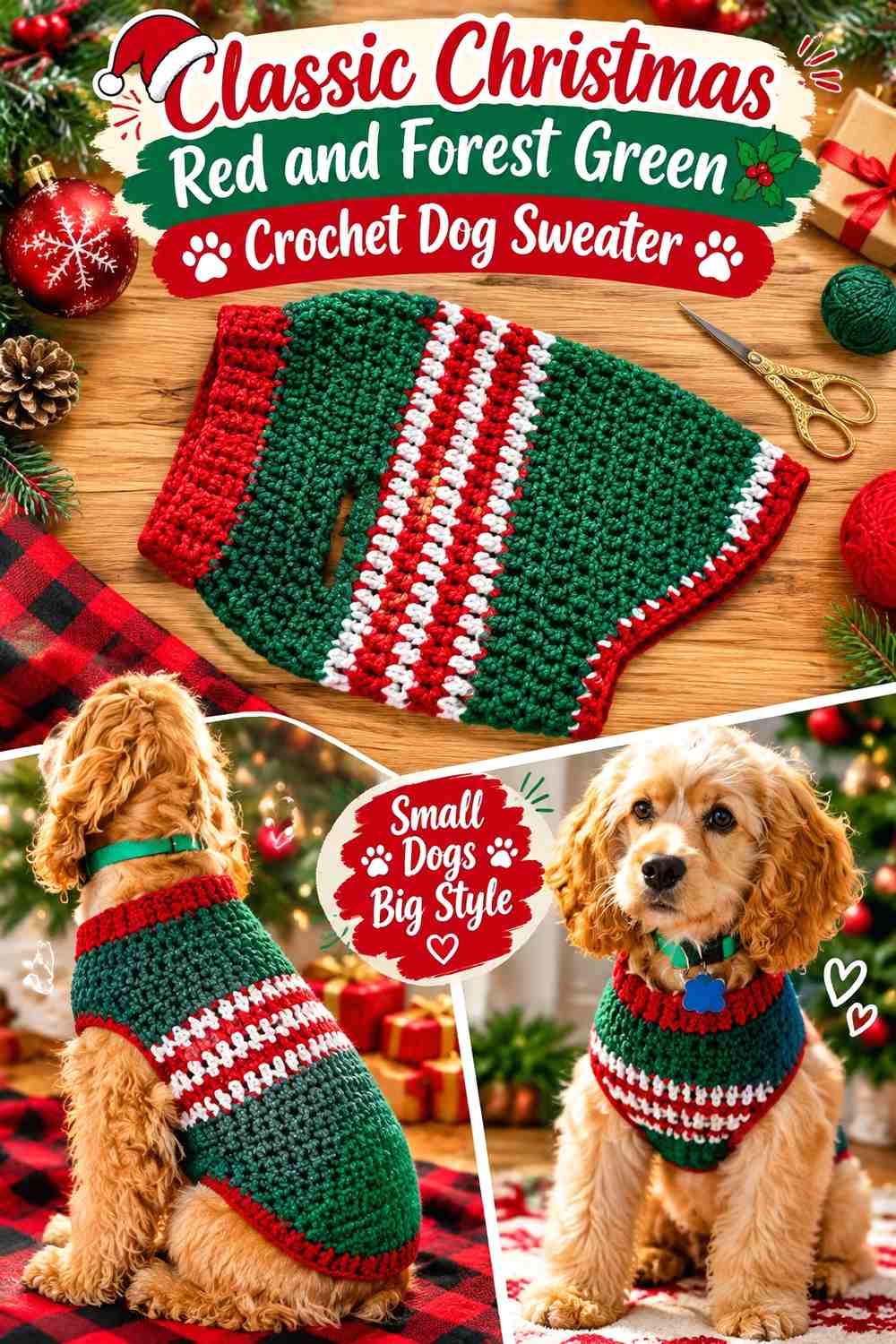
Christmas red can cover the main back and chest sections while forest green gives the sweater a darker frame. This arrangement makes the red immediately readable from above without requiring alternating colors across the entire garment. Forest green works particularly well as a secondary color because the collar, lower edge, and selected trim provide enough space to repeat it without challenging the red for dominance.
Forest Green Can Frame the Christmas Red Dog Sweater
Use forest green where the sweater naturally changes direction, such as around the neckline or outer edge. Those areas create a visual boundary around the larger red field and make the palette look planned rather than randomly alternated.
If the sweater already has several structural edges, you do not need to make every one green. Keeping some edging red prevents the secondary color from outlining every opening and breaking the sweater into too many small sections.
Christmas Red Needs Enough Back-Panel Space to Stay Dominant
Leave a reasonably continuous area of Christmas red across the back if red is meant to lead. Too many narrow forest-green interruptions can turn a red sweater into an evenly striped one.
This is particularly useful when the back includes visible stitch texture. A larger uninterrupted red area lets the crochet surface remain part of the design instead of asking the texture and the color changes to compete for attention.
Creator Credit: it’s erin b.
2. Cranberry Red, Pine Green, and Cream Crochet Christmas Dog Sweater

Cranberry red and pine green create a deeper Christmas palette than bright primary-looking shades. Because both can carry substantial visual weight, cream is useful as a small separator rather than a third equal color. Try cranberry across most of the back, pine at the collar and selected bands, and cream in narrow transitions or edging.
Cream Separates Cranberry Red and Pine Green Clearly
Place a slim cream break between cranberry red and pine green when the two darker shades appear next to each other. That lighter interval makes individual bands or sections easier to distinguish and prevents the sweater from becoming one dark mass at a distance.
Cream is particularly useful around a narrow stripe or small detail. It does not need to cover a large part of the sweater to change how clearly the two Christmas colors read.
Pine Green Should Repeat Against Cranberry Red
If pine green appears only at the collar, it can feel detached from the rest of a cranberry-red sweater. Echo it once or twice elsewhere, perhaps near the lower edge or another small trim area.
Repetition matters more than using equal amounts. Cranberry can remain obviously dominant while a few deliberately spaced pine-green details connect the full sweater.
Creator Credit: Loops Only Crochet
3. Bright Red and Emerald Green Crochet Christmas Dog Sweater
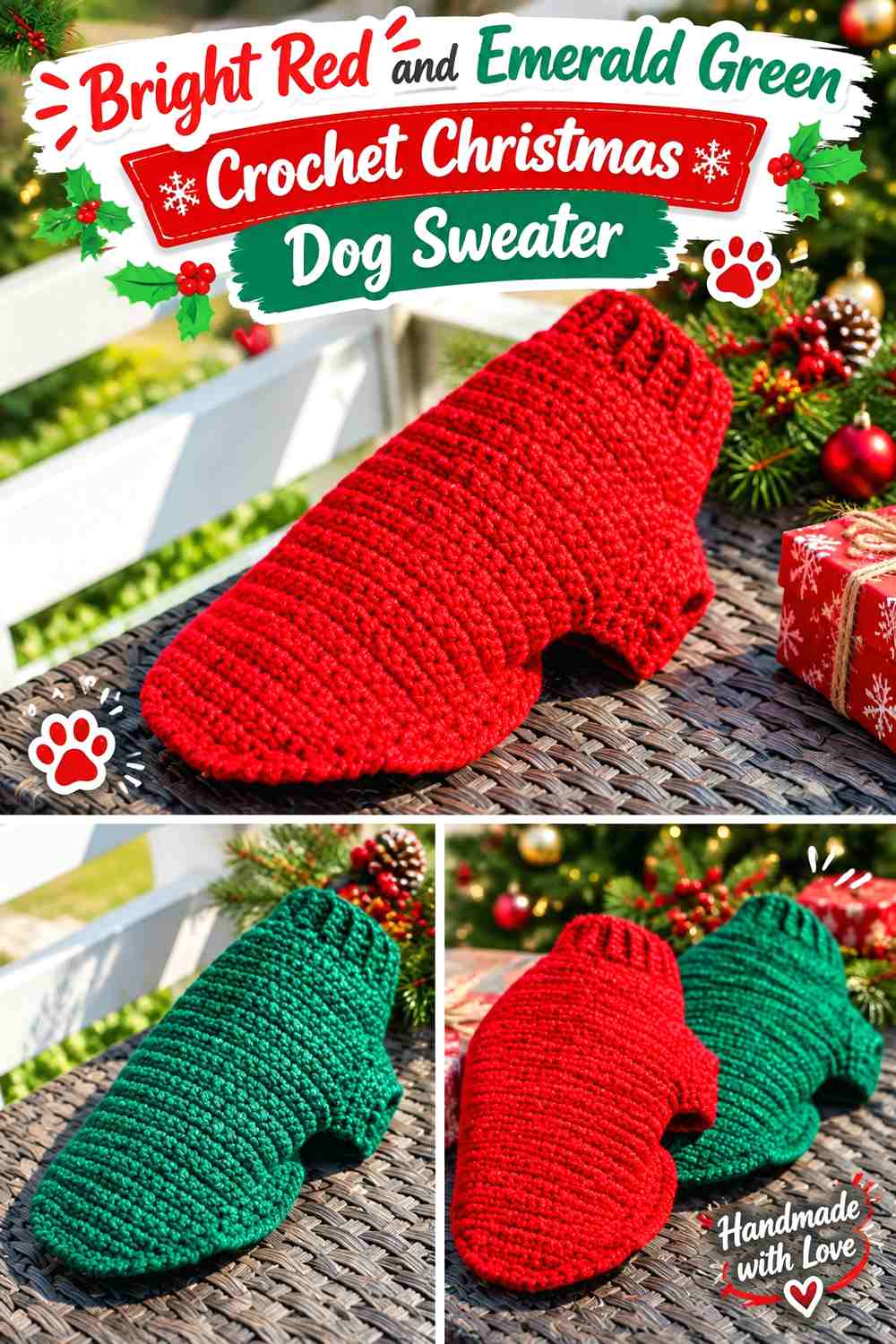
Bright red and emerald green create one of the strongest color statements in this collection. Because both shades can demand attention, the sweater benefits from unequal color distribution. A broad red back with emerald accents—or the reverse—usually gives the eye a clearer place to settle than alternating both colors everywhere.
Bright Red and Emerald Green Need Unequal Visual Weight
Choose the color you want noticed first and give it the larger areas. If bright red occupies the back, emerald green can be confined to the collar, a broad chest section, and one repeated edge.
Using both colors in similarly sized blocks can make a small sweater look divided into competing sections. Unequal coverage keeps the combination energetic without sacrificing a clear overall color identity.
Emerald Green Can Concentrate Around a Bright Red Collar or Hem
Emerald green has enough presence to work in relatively small areas. A green collar against a red body creates a clean transition around the neckline, while repeating green near the hem prevents the collar from looking isolated.
If emerald edging begins to dominate every opening, return some areas to red. The goal is to connect the green accents, not to outline every piece of the sweater.
Creator Credit: Fifty Shades of Yarn
4. Burgundy Red and Olive Green Crochet Christmas Dog Sweater
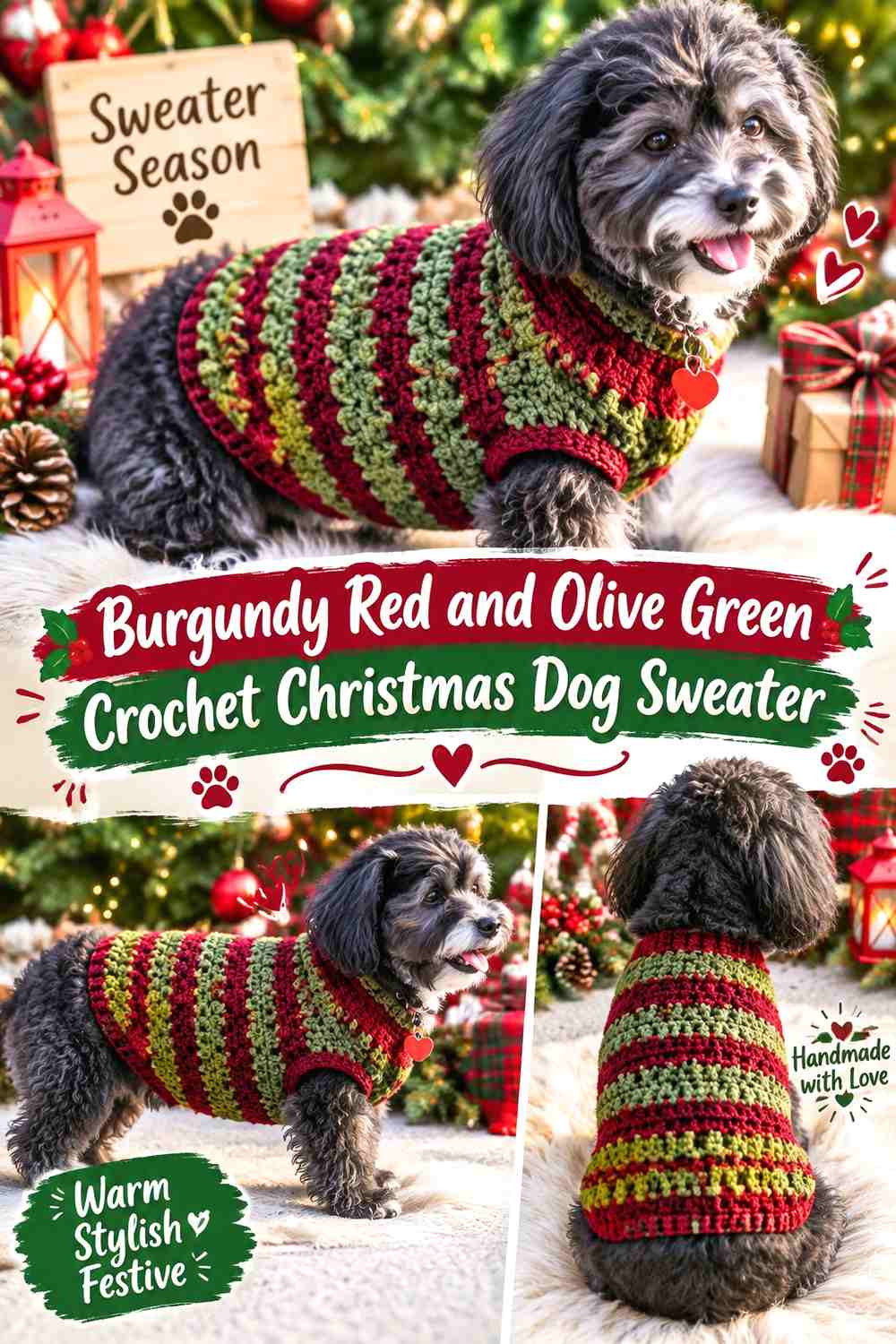
Burgundy red and olive green move the Christmas palette toward a quieter, earthier direction. These shades can be closer in visual depth than bright holiday red and green, so they are well suited to larger color areas rather than tiny high-contrast motifs. Burgundy can lead across the back while olive softens the collar, lower edge, or broad secondary band.
Olive Green Softens a Burgundy Red Dog Sweater
A muted olive does not compete with burgundy in the same way a vivid green might. Use it when you want the sweater to retain recognizable red-and-green holiday coloring without looking highly saturated.
Olive is particularly effective as a broad supporting area rather than a very thin line. Giving it enough surface makes the muted green intentional and keeps it from disappearing beside the deeper burgundy.
Burgundy Red and Olive Green Need a Contrast Check Around Texture
If the sweater uses noticeable raised or ribbed texture, compare burgundy and olive before distributing both across that surface. Similar dark values can make color changes harder to see, especially in narrow textured areas.
When that happens, keep the most detailed section mostly burgundy and move olive to smoother trim or larger blocks. Another option is introducing a small light neutral where the two shades need clearer separation.
Creator Credit: The Crochet Crowd
5. Candy-Apple Red, Kelly Green, and White Crochet Christmas Dog Sweater
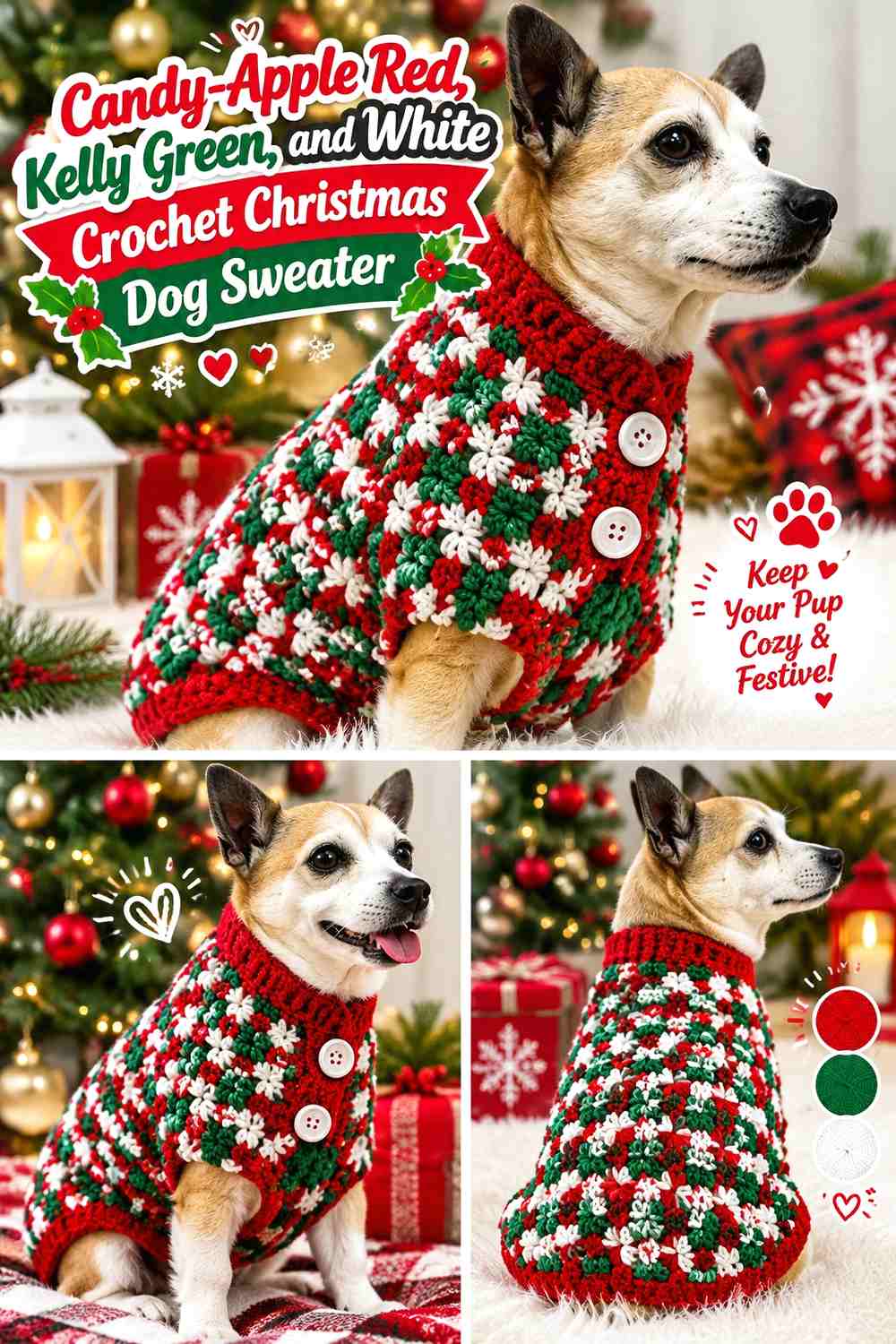
Candy-apple red and Kelly green create a cheerful, high-energy Christmas combination. White gives the two strong colors breathing room and is especially useful in stripes or around small areas where red and green would otherwise touch repeatedly. Let red or green dominate rather than turning all three colors into equal bands.
White Keeps Candy-Apple Red and Kelly Green Sections Distinct
A slim white transition can separate a red collar from a green body, divide broad back stripes, or frame a small colorwork area. The light neutral creates a clearer edge between two saturated colors without introducing another competing hue.
Keep the white strategic. Too much can shift the sweater from a red-and-green design toward a three-color design in which no shade clearly leads.
Kelly Green Should Repeat Beyond One Candy-Apple Red Detail
When candy-apple red covers most of the sweater, repeat Kelly green in at least one visually separate area instead of using it only once. A collar plus a lower trim, for example, makes the green feel integrated.
Avoid scattering many tiny green marks across the red body unless a deliberate motif calls for them. Larger, repeated green placements generally read more clearly on a compact dog sweater.
Creator Credit: ALEX CROCHET UNCINETTO MODERNO DI ALEX
6. Brick Red and Moss Green Crochet Christmas Dog Sweater
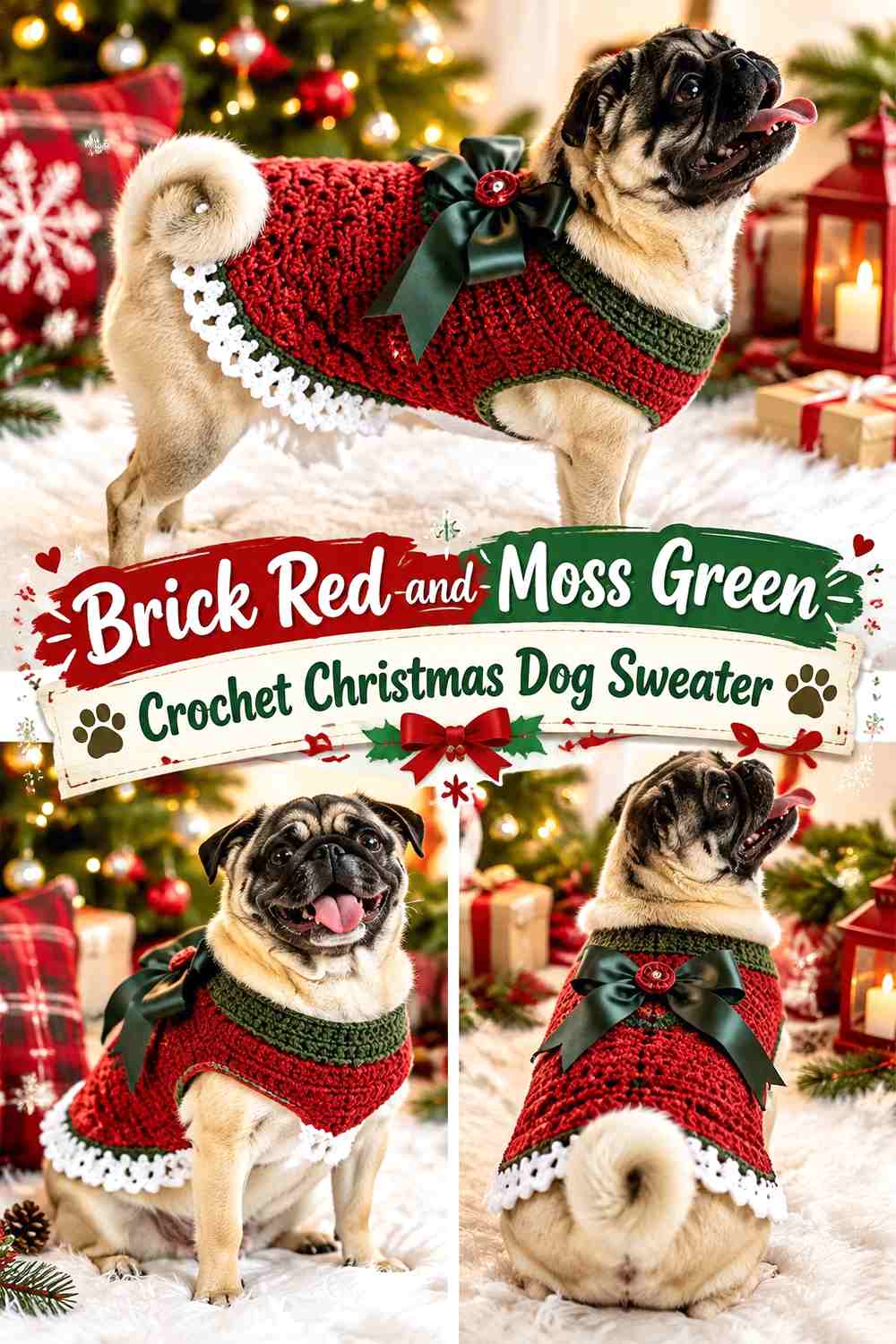
Brick red and moss green offer a subdued Christmas scheme with an earthy character. Brick red works well as the larger field because its warm, muted appearance gives moss green room to act as a secondary shade without producing extremely sharp contrast. This palette suits simple color blocking and broad trim especially well.
Brick Red Gives the Crochet Dog Sweater a Warm Main Field
Use brick red across the uninterrupted back when you want its muted warmth to define the garment. Moss green can then sit around the collar or across one substantial band rather than competing through frequent switches.
Because brick red is softer than a vivid Christmas red, maintaining a broad area of it helps the intended red component remain obvious.
Moss Green Works Well Around Brick Red Edges
Moss green can give a brick-red sweater a quiet outline at the collar or lower edge. The combination works particularly well when the color transition follows an actual garment boundary instead of stopping randomly through a textured section.
If moss and brick look too similar in value, make the green area broader rather than relying on a very thin line to show the contrast.
Creator Credit: Crochet Cuties Creations by Esther
7. Cherry Red and Deep Green Crochet Christmas Dog Sweater
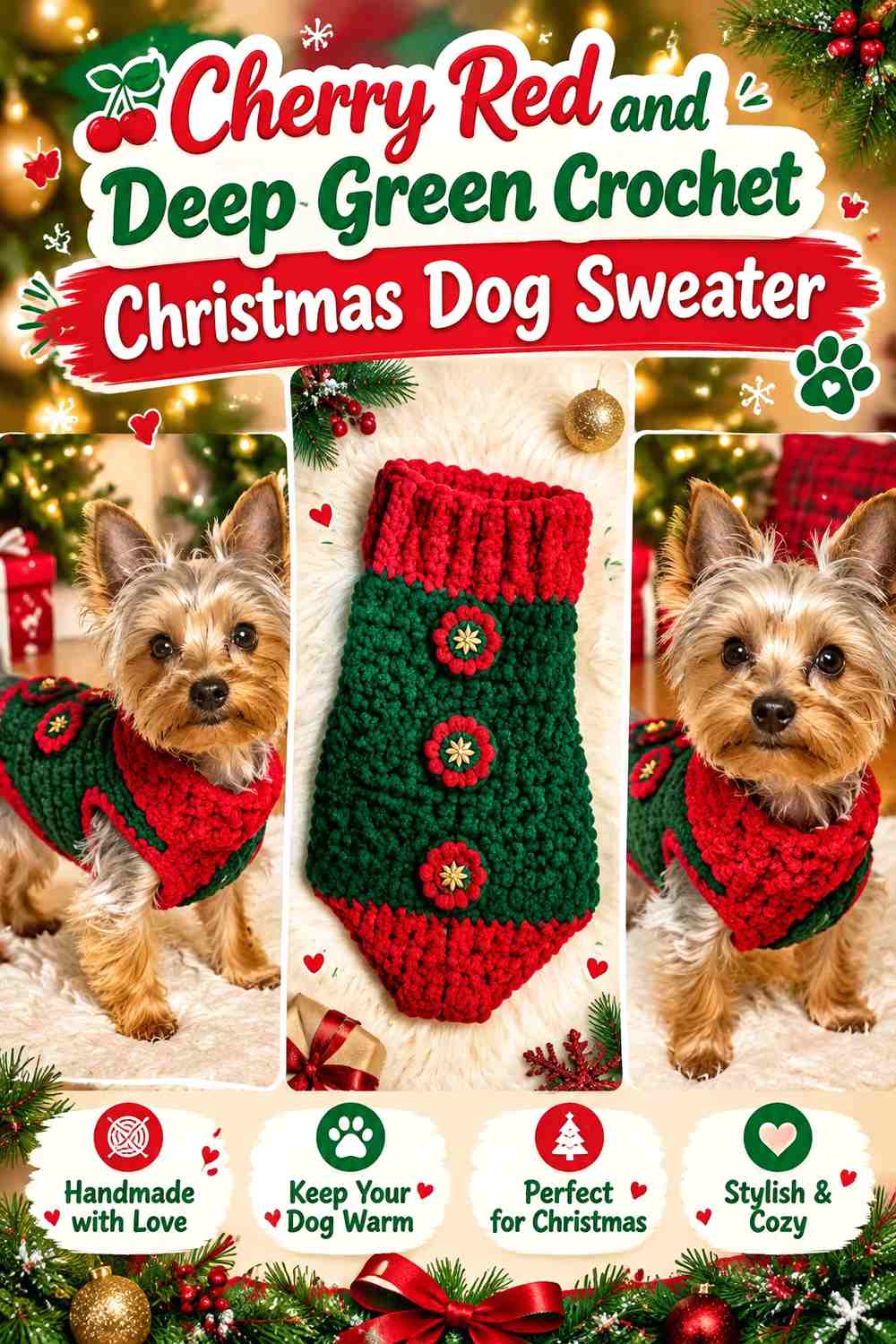
Cherry red can act as the brighter component while a deep green provides visual weight underneath it. For a small dog sweater, consider using deep green across the body and cherry red at the neckline and a few clearly defined accents. This keeps the stronger red noticeable without dividing the entire surface into alternating holiday colors.
Cherry Red Can Highlight the Neckline Against Deep Green
A cherry-red collar immediately establishes the Christmas palette when the body is mostly deep green. Repeating the red farther down the back or at the lower edge connects the neckline to the rest of the garment.
Keep the repeat deliberate rather than adding red to every possible trim point. On a small sweater, one or two secondary placements can be enough.
Deep Green Gives Cherry Red Accents More Space
Using deep green as the broad background lets cherry red function as a true accent. This is useful when you want the dog sweater to read primarily green while retaining a clear holiday reference.
Before using tiny cherry-red details on deep green, check their visibility. If both yarns are dark, increase the size of the red area or choose a red with a clearer value difference.
Creator Credit: Crochet/Häkeln/Heklanje Tashahandmade Andrić
8. Red, Green, and Cream Striped Crochet Christmas Dog Sweater
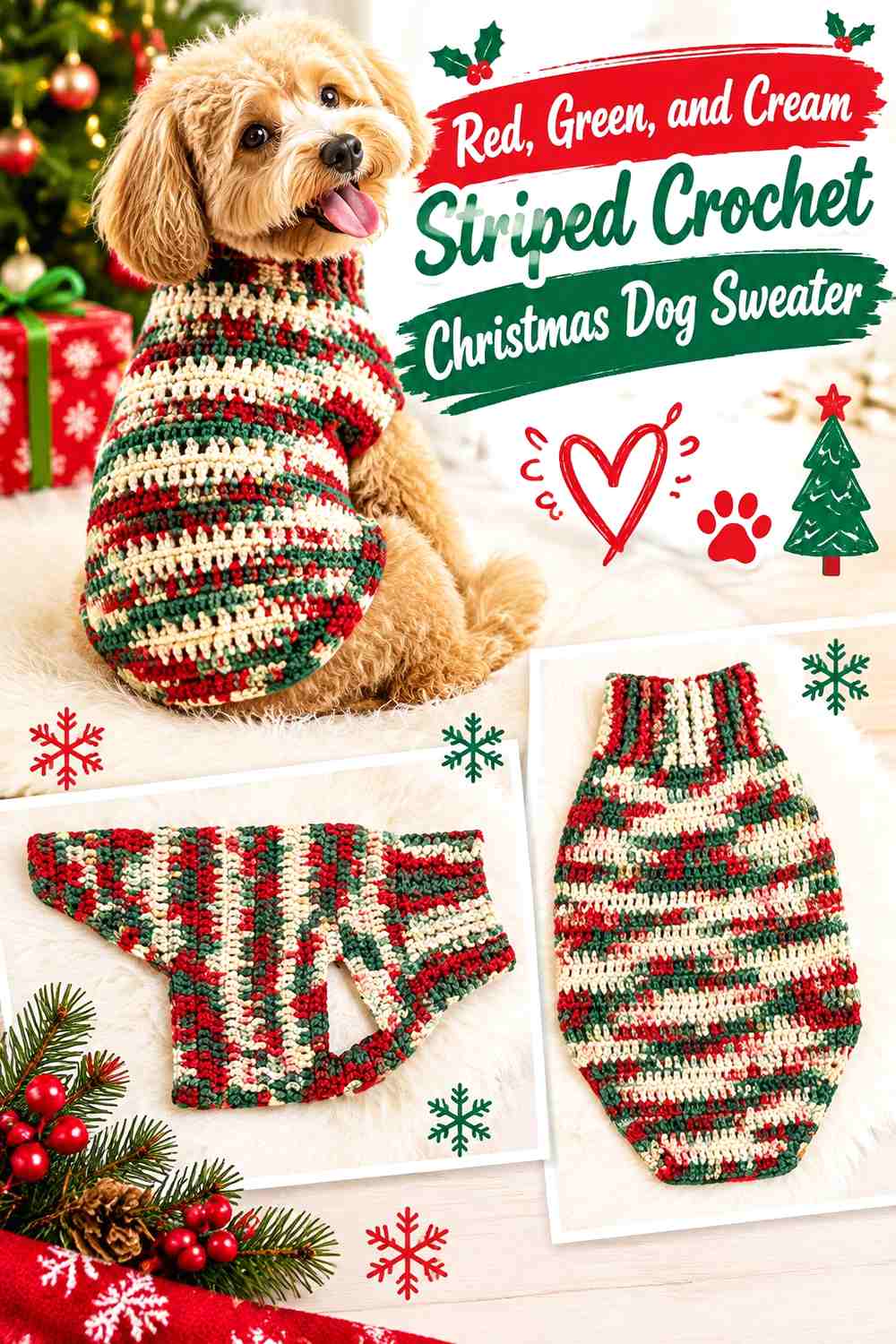
Stripes are a direct way to use red and green across the whole garment, but a consistent equal-width sequence is not the only option. Cream can create breathing room between stronger bands, while changing stripe widths lets either red or green remain dominant. The compact shape of a dog sweater makes stripe proportion particularly noticeable.
Cream Can Separate Red and Green Crochet Stripes
Insert cream where direct red-green transitions begin to look crowded. Even a narrow neutral interval can make the stripe sequence easier to follow and keep individual colors distinct.
You do not need cream between every pair of stripes. Selective use creates more variation and prevents the neutral from taking over the Christmas palette.
Red and Green Stripe Widths Can Follow the Dog Sweater’s Shape
Broad stripes can work across the main back, while smaller areas near the neckline may look cleaner with fewer color changes. Avoid forcing the same stripe rhythm into every part of the garment if the available space changes significantly.
A wider dominant red band followed by a narrower green band is also an easy way to establish hierarchy without abandoning the striped look.
Creator Credit: Crochet It
9. Red Body and Green Ribbing Crochet Christmas Dog Sweater

This scheme keeps color changes tied to construction. Make red the main body color, then use green wherever ribbing or defined edging already creates a visual change. The result is less busy than all-over stripes because the green corresponds with recognizable sweater details.
Green Ribbing Gives a Red Crochet Dog Sweater a Clear Frame
Green at the neckline and lower ribbed areas can define the outline while leaving the central red body uninterrupted. If the construction includes another ribbed edge, decide whether repeating green there strengthens the frame or starts to over-outline the sweater.
The strongest version of this idea usually lets red remain plainly visible between the green boundaries.
Red Should Stay Continuous Where Crochet Texture Matters
If the body has a texture you want to emphasize, leaving that section red avoids interrupting the stitch surface with unnecessary color changes. Green can do its work at the ribbing, where texture and color already shift together.
This also makes substitution simple: preserve the darker-or-lighter relationship between the red body and green trim even if you change the exact shades.
Creator Credit: Last Minute Laura
10. Green Body and Red Collar Crochet Christmas Dog Sweater

Reverse the previous balance by letting green dominate the body and placing red near the dog’s face and at selected finishing areas. This scheme works especially well when the main crochet texture deserves an uninterrupted green field.
A Red Collar Creates a Strong Focal Point on a Green Dog Sweater
The collar occupies a natural transition between the dog and the garment, so red used there receives plenty of visual attention without covering much surface. It is an efficient choice when you want a primarily green sweater that still looks unmistakably Christmas-themed.
Repeat a restrained amount of red elsewhere so the collar does not feel like a separate piece.
Green Should Remain Continuous Across the Textured Body
When green is the lead color, avoid fragmenting the back with too many red additions. Let the texture run through a substantial green area, then bring red back at an edge or selected band.
This is particularly helpful with pronounced crochet texture: the viewer can read the stitch surface first and the red trim second.
Creator Credit: SheiLa Teré
11. Red and Green Granny-Square Crochet Christmas Dog Sweater
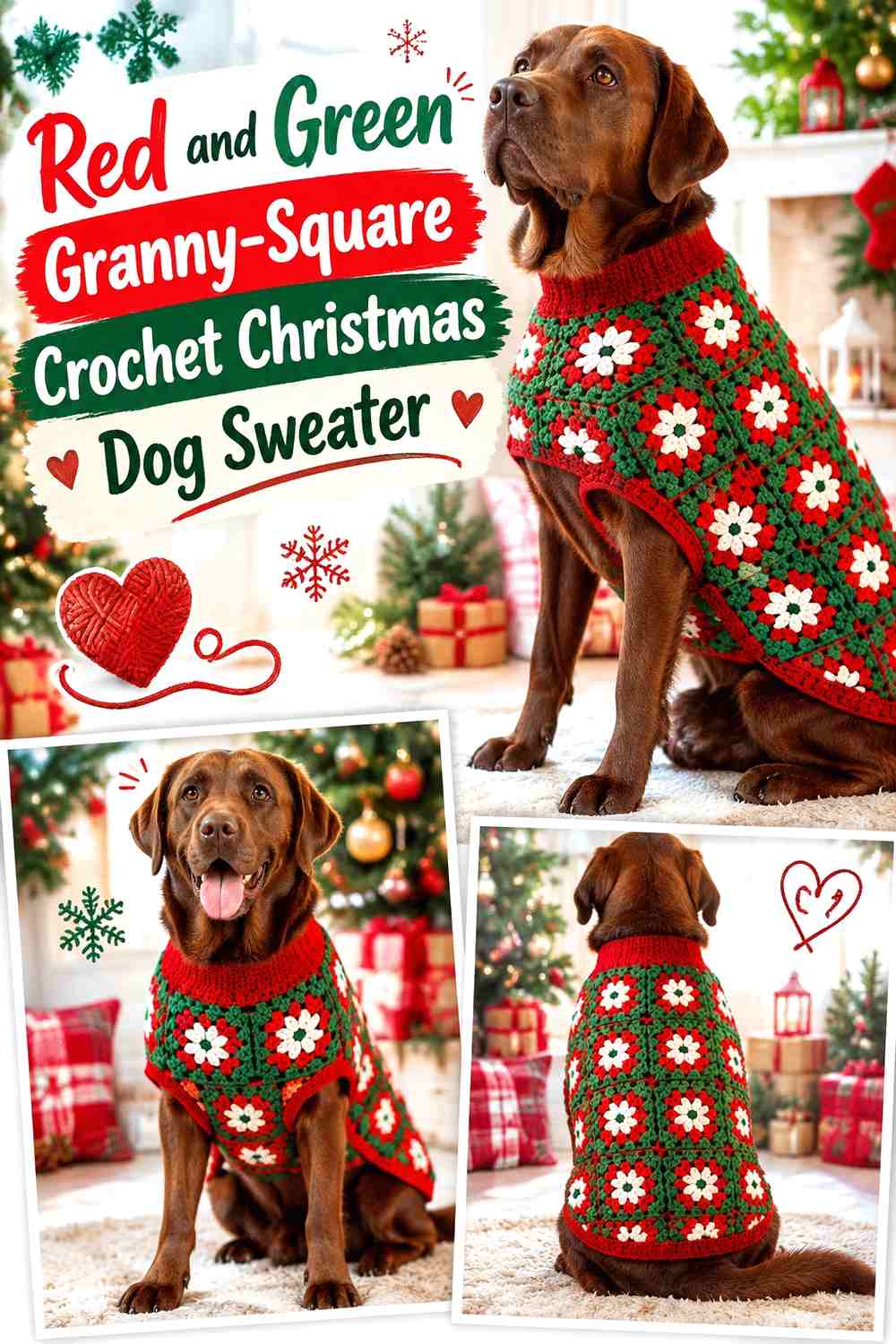
Granny squares give red and green many possible roles: centers, middle rounds, outer frames, or alternating motifs. The key is repetition. Rather than creating every square as a different Christmas combination, establish a limited arrangement that repeats across the back so the patchwork remains connected.
Red and Green Granny Squares Need a Repeated Color Order
Choose a repeatable relationship, such as red centers with green outer sections, then invert it only where the overall layout benefits. Repetition helps the separate motifs read as one sweater rather than unrelated squares.
Before joining motifs, lay them out in the planned arrangement. It is much easier to spot clusters of too much red or green while the squares can still be moved.
A Light Neutral Can Separate Red and Green Granny-Square Motifs
Cream or another light neutral can be useful in outer motif sections or joins when red and green squares begin to merge visually. It creates boundaries without requiring additional holiday colors.
Keep the neutral consistent across the sweater. Changing the joining or framing color from motif to motif can add more visual information than the small garment needs.
Creator Credit: Ahuyama Crochet
12. Deep Red and Pine Green Textured Crochet Christmas Dog Sweater
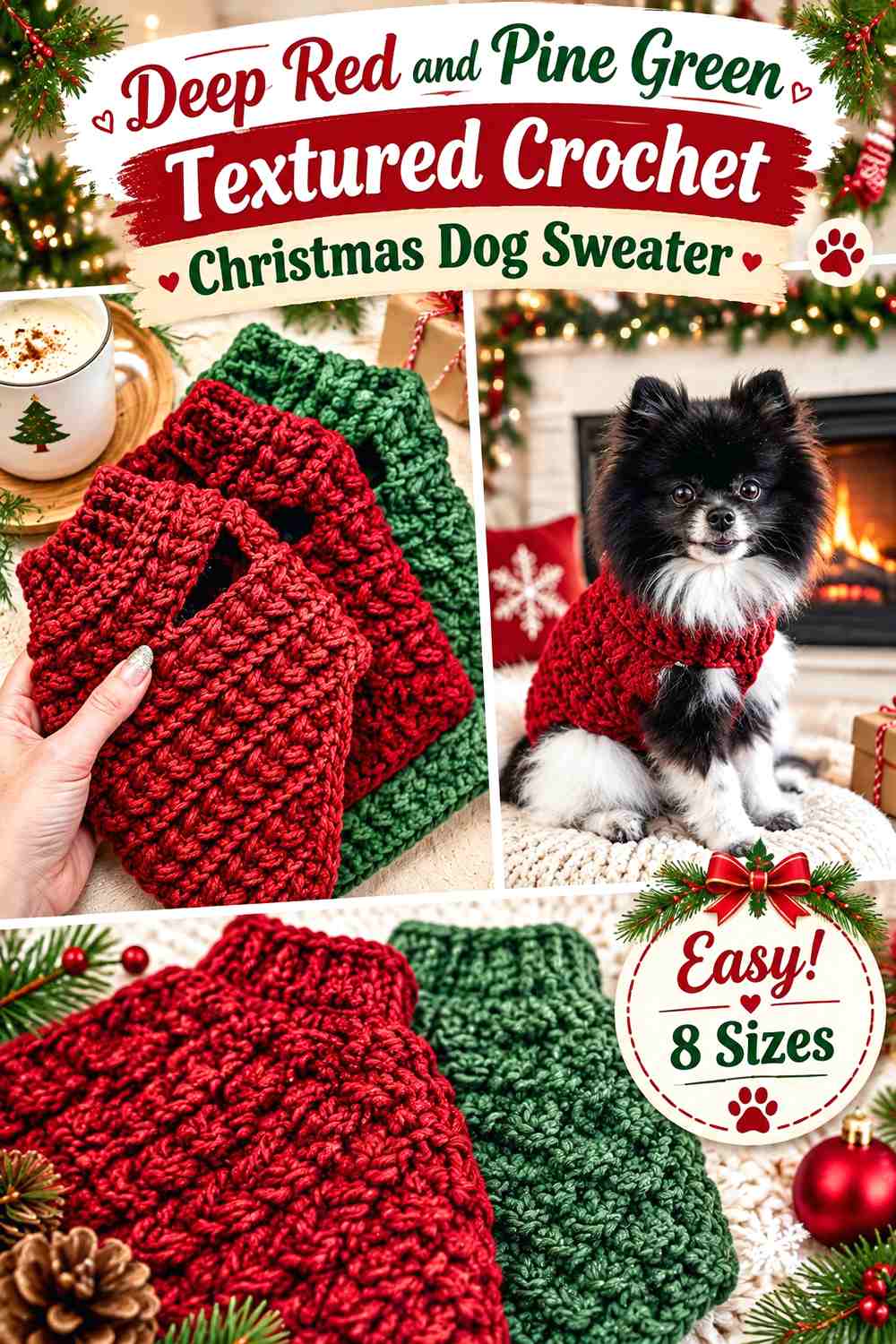
A textured dog sweater does not need frequent color changes to feel festive. Deep red can carry the raised or patterned body surface while pine green is reserved for less intricate areas, or those roles can be reversed. Separating texture from frequent color switching helps both features remain legible.
Deep Red Lets Crochet Texture Lead Without Constant Green Changes
Keep the most textured portion primarily deep red when you want the stitch surface to remain easy to see. Pine green can appear around the neckline, lower edge, or another smoother section.
This approach is particularly useful if the two shades are similarly dark. Large areas give each color enough room to register even when their value contrast is modest.
Pine Green Can Define Deep Red Texture at the Sweater Edges
A pine-green boundary around a deep-red body provides a clear transition between the main texture and finishing areas. The darker green can visually contain the red without requiring another bright accent.
If the edge begins to look too heavy, reduce the green coverage rather than adding a third strong color. A smaller secondary area keeps attention on the textured back.
Creator Credit: Briana K
13. Red and Green Fair-Isle-Style Crochet Christmas Dog Sweater
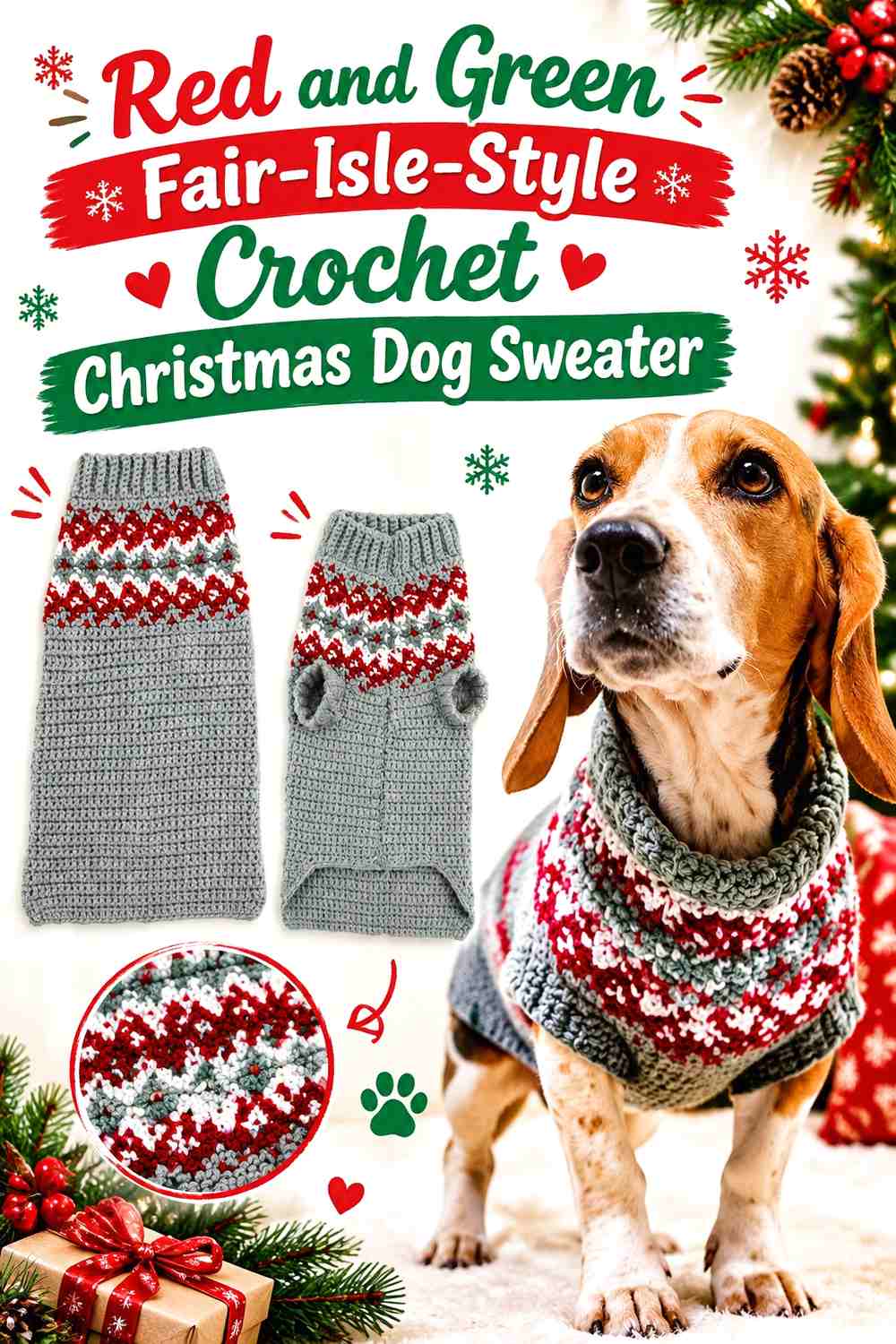
Red-and-green colorwork can create a more detailed Christmas sweater than simple stripes or blocking. Because smaller motifs depend on clear separation, choose one color as the background and use the other for the repeated design rather than switching the background constantly.
Red and Green Colorwork Needs Clear Value Contrast
Test the red and green together before committing to small motifs. If they are almost the same darkness, the design may be obvious up close but lose definition from a normal viewing distance.
A lighter red against a dark green or a deeper red against a lighter green can create clearer motif edges. A neutral can also be introduced selectively if the design needs an additional separation point.
Green Background Areas Can Keep Red Christmas Motifs Organized
A continuous green field allows repeated red details to look connected across the back. Keep the red motif spacing deliberate and let some green remain visible between elements.
The collar and hem do not have to repeat the full colorwork. Solid red or green finishing can give the eye a break and keep the detailed area concentrated where it has the most room.
Creator Credit: Marly Bird
14. Red and Green Color-Block Crochet Christmas Dog Sweater
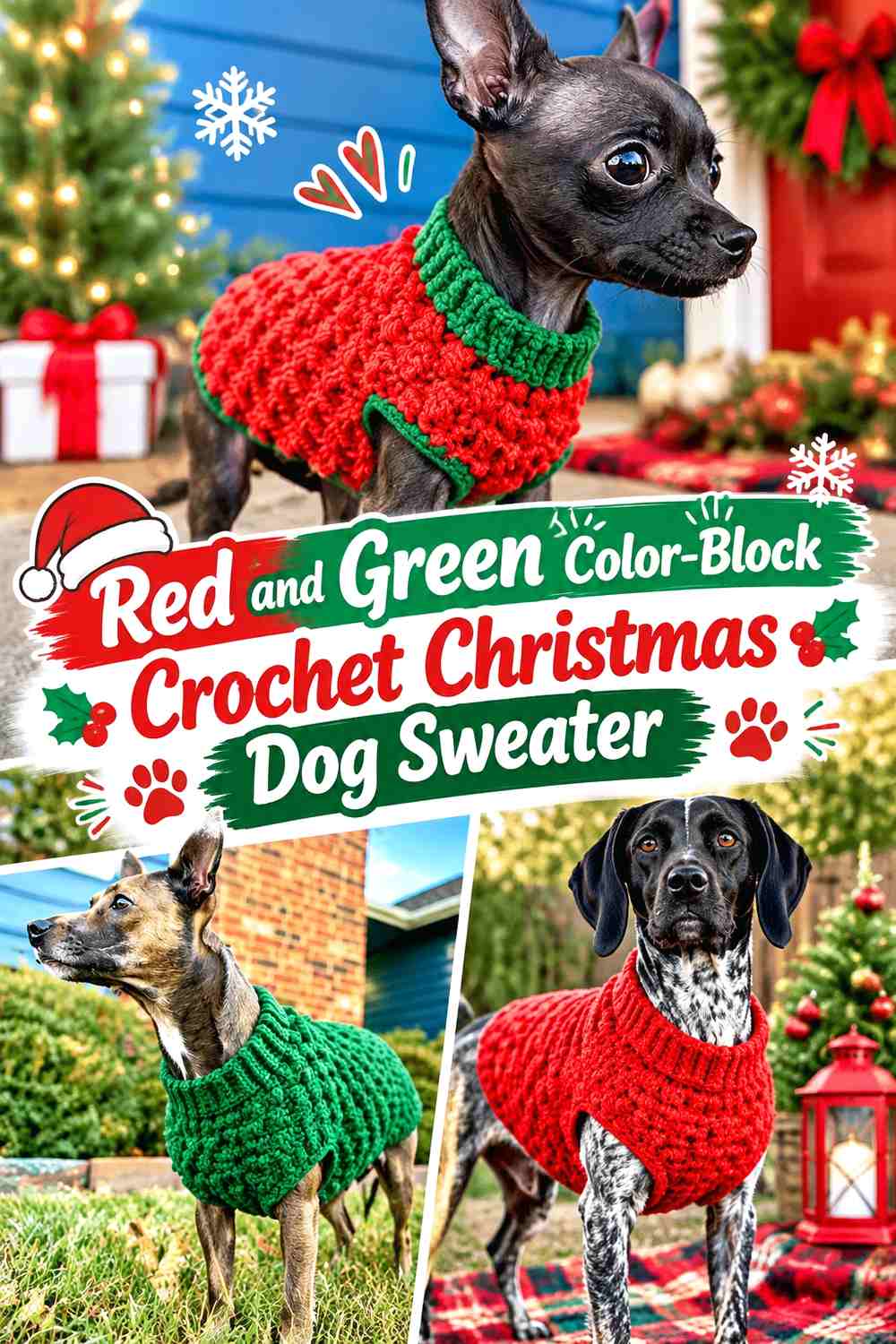
Color blocking is useful when you want both red and green to occupy substantial areas without creating many yarn changes. Place one shade across the upper portion of the sweater and the other across the lower back or chest, then use the garment’s natural transitions to make the division intentional.
Red and Green Color Blocks Should Meet at a Deliberate Sweater Line
A color change is easier to read when it aligns with a logical section of the garment rather than appearing randomly through the middle of a detailed texture. Look for a broad back area or other visually stable point where the block boundary can remain clear.
If the transition feels abrupt, a narrow neutral line can separate the two fields without turning the sweater into a striped design.
Green Can Ground the Lower Body While Red Leads Near the Collar
Red near the neckline receives immediate attention, while a larger green section farther down creates balance. This is a useful arrangement when you want both colors to have significant surface area without making them equal.
Reverse the placement if you prefer a greener first impression. What matters is maintaining one clear upper-to-lower color plan.
Creator Credit: Heart Hook Home
15. Muted Red and Sage Green Crochet Christmas Dog Sweater
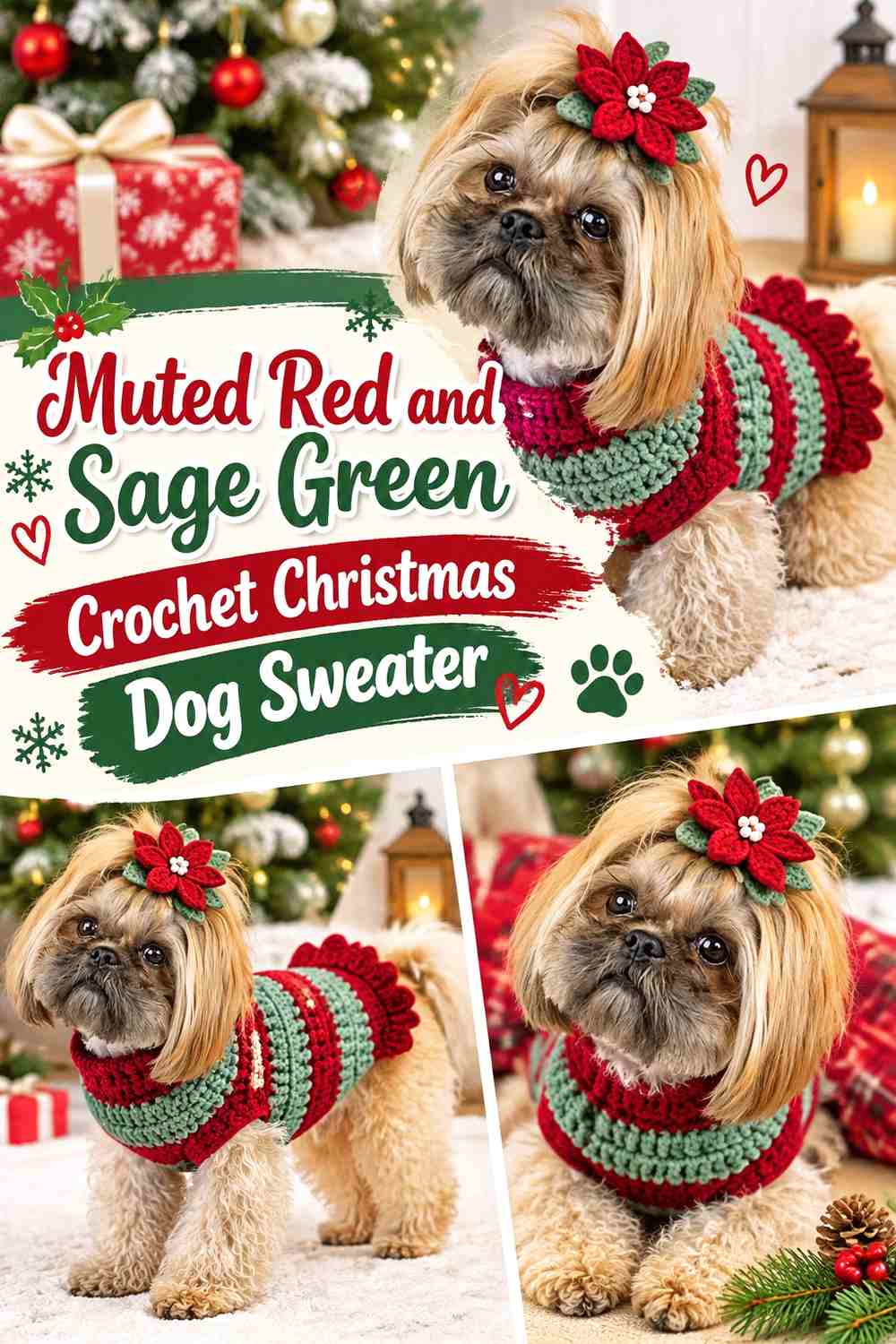
Muted red and sage offer a softer alternative to vivid holiday colors. Because sage is lighter and quieter than many traditional Christmas greens, it can cover more of the sweater without competing aggressively with red. This palette works particularly well with simple blocks, broad bands, and understated trim.
Sage Green Gives Muted Red a Softer Christmas Contrast
Use sage across a larger body section and reserve muted red for the collar or back accents when you want green to lead. The difference in saturation helps the palette feel less intense while still keeping its red-and-green identity.
Avoid adding a very vivid third color unless you deliberately want to change the quiet character of the scheme.
Muted Red Still Needs Enough Area Beside Sage Green
A very small amount of softened red can disappear visually beside a broad sage body. Give it a meaningful placement, such as a collar plus one repeated band, rather than relying on tiny scattered marks.
If substituting shades, preserve the subdued character of both colors. Replacing only one with a highly saturated version changes the balance more than changing its exact hue.
Creator Credit: Crochet Guru
16. Dark Red, Bottle Green, and Oatmeal Crochet Christmas Dog Sweater

Dark red and bottle green produce a rich, low-value Christmas palette, but the two shades can lose separation when placed directly together. Oatmeal solves that problem by acting as a controlled light accent. It can frame a dark band, divide the body from the collar, or appear in small finishing areas.
Oatmeal Separates Dark Red and Bottle Green
Use oatmeal wherever the boundary between dark red and bottle green needs to stay visible. A narrow light section can create more definition than simply increasing the amount of either dark color.
Keep oatmeal subordinate if you want the sweater to remain clearly red and green. Its job is to provide contrast and spacing, not to become the main field.
Bottle Green Can Anchor Dark Red Without Hiding It
Bottle green works well on a collar or broad lower section because its depth provides a stable visual base. Keep dark red across enough of the back that it remains identifiable rather than shrinking into a few nearly invisible accents.
Check both colors under the lighting in which the sweater is likely to be seen. Two deep shades that look distinct in bright light may appear more similar in dimmer conditions.
Creator Credit: TwinStarHooks 💫
17. Red and Green Long-Sleeve Crochet Christmas Dog Sweater

A long-sleeve construction creates extra places to distribute the Christmas palette. Instead of striping every surface, use the sleeves as deliberate secondary color areas. A red body with green sleeves, for example, establishes an immediate color hierarchy while making the sleeve construction part of the visual design.
Green Sleeves Can Balance a Red Crochet Dog Sweater Body
When the body is predominantly red, green sleeves create two repeated supporting areas without interrupting the back. Repeating a small amount of green at the neckline can connect the sleeves visually to the rest of the sweater.
Avoid introducing a different color strategy on each sleeve. Matching their main color keeps the compact garment from becoming unnecessarily busy.
Red Cuffs Can Connect Green Sleeves Back to the Red Body
If the sleeves are green, red cuffs provide a simple way to bring the dominant body color outward. The repetition makes the transition feel deliberate while keeping most of each sleeve green.
Color placement should follow comfortable sleeve and leg-opening construction rather than changing fit for decoration. Check movement carefully and use the tutorial’s construction guidance instead of extending or tightening sleeves purely for the color effect.
Creator Credit: Vibes with Dani
Which Red and Green Crochet Dog Sweater Color Scheme Should You Choose?
For the most recognizable traditional Christmas look, start with Christmas red and forest green, bright red and emerald, or the red-green striped scheme. These combinations put familiar festive colors front and center.
For something quieter, burgundy with olive, brick red with moss, or muted red with sage reduces saturation while keeping the holiday connection. Dark red with bottle green works well when you want an especially deep palette, but the oatmeal separator becomes more important because the two main colors can sit close in value.
Choose granny-square or Fair-Isle-style colorwork when color repetition itself should be a major feature. Choose red-body/green-ribbing, green-body/red-collar, or color blocking when you prefer fewer color changes and clearer areas of dominant and supporting color.
Conclusion
Red and green can produce far more than one type of crochet Christmas dog sweater. The biggest visual decision is not simply which two yarn colors to choose, but which color gets the largest area and where the second color returns.
Choose bright red and emerald or Kelly green when you want stronger holiday contrast. Move toward cranberry and pine, burgundy and olive, or brick and moss for a deeper or more muted result. If both colors are dark, add a small cream or oatmeal separator where motifs, stripes, or boundaries need more definition.
Most importantly, plan color around the actual sweater structure. The back, collar, chest, cuffs, trim, and leg openings already provide natural places for changes. Use those areas to organize the palette, then follow the original tutorial for construction and check the finished garment for comfortable movement and clearance.
Frequently Asked Questions
Should Red or Green Be the Main Color in a Crochet Christmas Dog Sweater?
Either can lead. Red creates a more immediately red-forward Christmas look, while a green body with red collar or trim gives the sweater a greener overall appearance. Choose the dominant color first, then assign the other shade to specific supporting areas instead of trying to use both equally everywhere.
How Can I Tell Whether Red and Green Have Enough Contrast?
Place the yarns next to each other and compare how light or dark they appear, not just how different their hues are. A grayscale photo can make value differences easier to notice. This is especially useful before working small red-and-green motifs, narrow stripes, or detailed colorwork.
Can I Add Cream or White to a Red and Green Crochet Dog Sweater?
Yes. A light neutral can separate strong red and green areas, outline motifs, or break up stripes. Use it in a smaller supporting role if you still want red and green to define the overall sweater.
How Can I Make a Red and Green Crochet Dog Sweater Look Less Busy?
Reduce the number of color changes and give one shade a clearly larger area. A red body with green trim, a green body with a red collar, or two large color blocks will generally look less fragmented than many narrow alternating sections.
What Red and Green Shades Work for a More Muted Christmas Dog Sweater?
Consider relationships such as burgundy with olive, brick red with moss, or a softened red with sage. When substituting, preserve the muted quality and the intended light/dark relationship rather than worrying about finding an exact named shade.
Where Should Red and Green Be Placed on a Crochet Dog Sweater?
The back is useful for the dominant shade because it offers the largest visible area. Collars, cuffs, ribbing, lower edges, chest sections, and selected leg-opening trim can carry the supporting color. Let color placement follow the garment’s construction and keep fit, movement, and underside clearance as separate practical priorities.