A baby raccoon amigurumi has several color features that need to work together: the rounded body, dark eye mask, lighter muzzle, little ears and paws, and the unmistakable striped tail. The tail can handle stronger repeated contrast, while the face usually benefits from fewer, carefully separated color areas.

Classic gray, black, and white is only one direction. Mushroom and espresso can make the markings softer, blue gray and navy can create a cooler woodland look, and muted teal, plum, or sage can introduce a more stylized palette while keeping the characteristic mask-and-tail structure intact.
The tutorials below support raccoon amigurumi constructions in full-size, plush, miniature, keychain, and compact forms. The proposed palettes are independent adaptations rather than claims that each creator used these exact colors.
Quick List
- Silver Gray, Charcoal, and Snow White Crochet Classic Baby Raccoon Amigurumi
- Mushroom, Espresso, and Cream Crochet Chubby Baby Raccoon Amigurumi
- Blue Gray, Navy, and Pearl White Crochet Mini Baby Raccoon Amigurumi
- Taupe, Cocoa, and Oatmeal Crochet Baby Raccoon Amigurumi
- Sage Gray, Black, and Warm White Crochet Baby Raccoon Amigurumi
- Rust Brown, Espresso, and Sand Crochet Mini Baby Raccoon Amigurumi
- Charcoal, Dusty Blue, and Cream Crochet No-Sew Baby Raccoon Amigurumi
- Greige, Dark Brown, and Ivory Crochet Baby Raccoon Amigurumi
- Olive Gray, Cocoa, and Ecru Crochet Fluffy-Tail Baby Raccoon Amigurumi
- Frost Gray, Deep Teal, and Cream Crochet Plush Baby Raccoon Amigurumi
- Lavender Gray, Deep Plum, and Oatmeal Crochet Baby Raccoon Amigurumi
- Pewter Gray, Soft Black, and Buttercream Crochet Plush Baby Raccoon Amigurumi
- Stone Gray, Burgundy, and Cream Crochet Baby Raccoon Amigurumi
- Warm Beige, Espresso, and Ivory Crochet Mini Baby Raccoon Amigurumi
- Moss Gray, Walnut, and Linen Crochet Woodland Baby Raccoon Amigurumi
- Cloud Gray, Slate, and Soft White Crochet Tiny Baby Raccoon Amigurumi
- Charcoal Gray, Silver, and Warm White Crochet Dressed Baby Raccoon Amigurumi
Plan the Crochet Raccoon Mask Before Choosing Tail-Stripe Contrast
The face and tail both use darker markings, but they do not need identical amounts of contrast. A tiny eye mask can disappear if its color is too close to the body, while a thick tail has enough surface area for softer tonal bands to remain visible.
Start with the face. Choose a body and mask combination that keeps the eyes and pale muzzle distinct. Then repeat the mask shade—or a softened version of it—in the tail bands.
This repetition ties the whole raccoon together without adding unrelated colors.
Make the Crochet Striped Tail Part of the Main Color Scheme
The tail should not look like an accessory attached to an otherwise unrelated plush. Repeat at least one important body or facial color through the tail.
For a classic raccoon, alternate the body gray with the darkest mask shade. For a quieter version, pair mushroom with cocoa or greige with brown. A stylized raccoon might use blue gray and navy or lavender gray and plum.
Keep the stripe widths visually consistent unless an intentionally irregular tail is part of your own design. The repeating color rhythm is what makes the tail recognizable from a distance.
Keep the Crochet Baby Raccoon Muzzle Clear Between the Dark Mask Areas
The eye mask already places substantial dark color around the center of the face. A lighter muzzle gives the nose and mouth area breathing room and prevents the two mask sections from becoming one large dark facial block.
Cream, ivory, oatmeal, ecru, and soft white all work. They do not have to be dramatically lighter than the body, but they should remain distinguishable under the lighting where the finished amigurumi will be displayed.
1. Silver Gray, Charcoal, and Snow White Crochet Classic Baby Raccoon Amigurumi

Silver gray creates a familiar raccoon body without making the toy visually heavy. Charcoal can define the mask, paws, and alternate tail bands, while snow white lightens the muzzle and small belly details.
Keep silver gray dominant across the rounded head and torso. That broad midtone gives both the dark mask and white muzzle enough room to remain separate.
Let Charcoal Define the Silver Gray Crochet Raccoon Mask
Use charcoal where the eye-mask shape needs its strongest contrast. Keep enough silver gray between the mask and ears so the whole upper face does not become one dark section.
Snow white around the muzzle creates another break and helps preserve the baby-like rounded face.
Alternate Charcoal and Silver Gray Across the Crochet Raccoon Tail
Repeating the same two main coat colors in the tail creates a strong connection between front and back. The tail can tolerate more charcoal than the face because the bands are larger and separated by silver gray.
Keep snow white out of most tail bands unless you deliberately want a three-color tail.
Creator Credit: Stella’s Yarn Universe
2. Mushroom, Espresso, and Cream Crochet Chubby Baby Raccoon Amigurumi

Mushroom creates a softer and warmer body than conventional silver gray. Espresso gives the mask and tail enough depth, while cream opens the face without producing a stark black-and-white effect.
This palette works particularly well on a rounded raccoon because the related neutrals allow the chubby silhouette to remain more noticeable than the individual color changes.
Keep Mushroom Broad Around the Espresso Crochet Raccoon Mask
Use mushroom across the cheeks, forehead, body, and legs. Espresso should stay concentrated around the eyes and other small dark features.
If espresso spreads too far across the forehead, the face can look narrower, which works against the rounded baby-raccoon effect.
Give the Mushroom Crochet Raccoon Tail Clear Espresso Bands
Espresso can become more prominent on the tail than on the face. Allow enough mushroom between bands that each dark section remains individually readable.
For an even softer tail, substitute a deep cocoa while preserving a noticeable difference from mushroom.
Creator Credit: Crafting at the Poole
3. Blue Gray, Navy, and Pearl White Crochet Mini Baby Raccoon Amigurumi
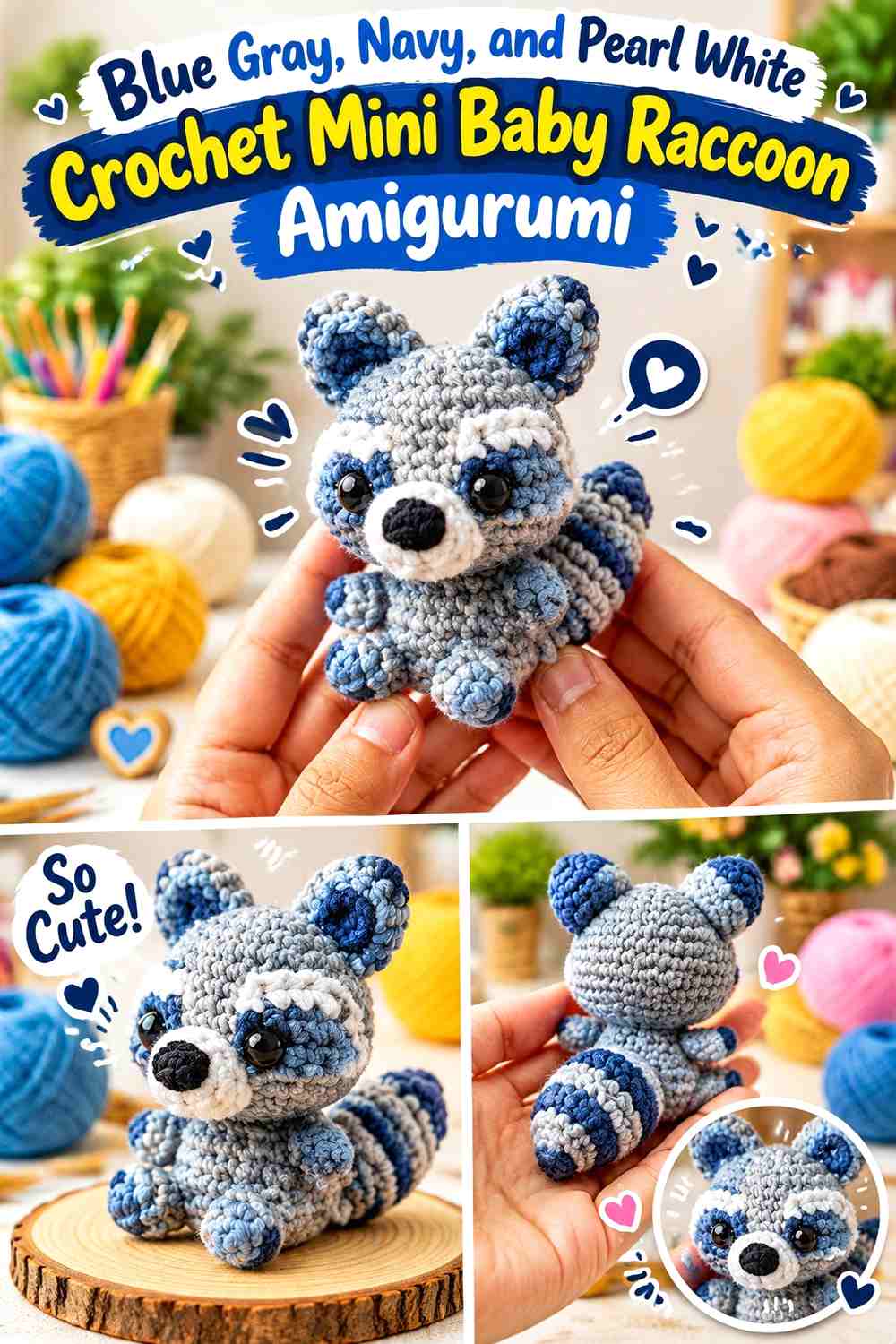
Blue gray gives a miniature raccoon a cooler woodland direction, while navy replaces black as the main marking color. Pearl white keeps the muzzle visible without making the palette feel overly crisp.
On a small amigurumi, limit the number of color areas because every change occupies a larger proportion of the finished toy.
Use Navy Carefully Around the Blue Gray Crochet Raccoon Eyes
A compact face does not need a large mask to communicate the raccoon look. Keep navy immediately around the eye area and allow blue gray to remain visible around the forehead and cheeks.
Pearl white can create a small central muzzle that separates the darkest sections.
Keep Navy and Blue Gray Crochet Tail Stripes Simple
The tail is an excellent place to repeat navy because its elongated form gives each band more room. Two strongly differentiated colors are easier to read than a three- or four-color sequence on a mini raccoon.
Use pearl white mainly on the face instead of adding it to every tail stripe.
Creator Credit: Addha Amigurumis
4. Taupe, Cocoa, and Oatmeal Crochet Baby Raccoon Amigurumi

Taupe and cocoa create a warmer neutral raccoon, while oatmeal supplies the pale facial area. The softer contrast makes the markings less graphic than black on gray but keeps the mask-and-tail structure recognizable.
This is a useful palette when you want the finished amigurumi to coordinate with beige, brown, and natural nursery colors.
Let Oatmeal Open the Taupe and Cocoa Crochet Raccoon Face
Oatmeal belongs primarily around the muzzle and possibly a restrained chest area. Its lighter value prevents cocoa facial details from sitting directly against medium taupe everywhere.
Keep the forehead mostly taupe so the light muzzle does not expand into a full white face.
Repeat Cocoa Against Taupe on the Crochet Raccoon Tail
Cocoa tail bands create a warm version of the traditional dark-ringed tail. Use the same cocoa in the eye mask so the back and front feel deliberately connected.
If cocoa and taupe merge from a distance, deepen cocoa rather than adding black as a fourth color.
Creator Credit: Queiroz Ateliê
5. Sage Gray, Black, and Warm White Crochet Baby Raccoon Amigurumi
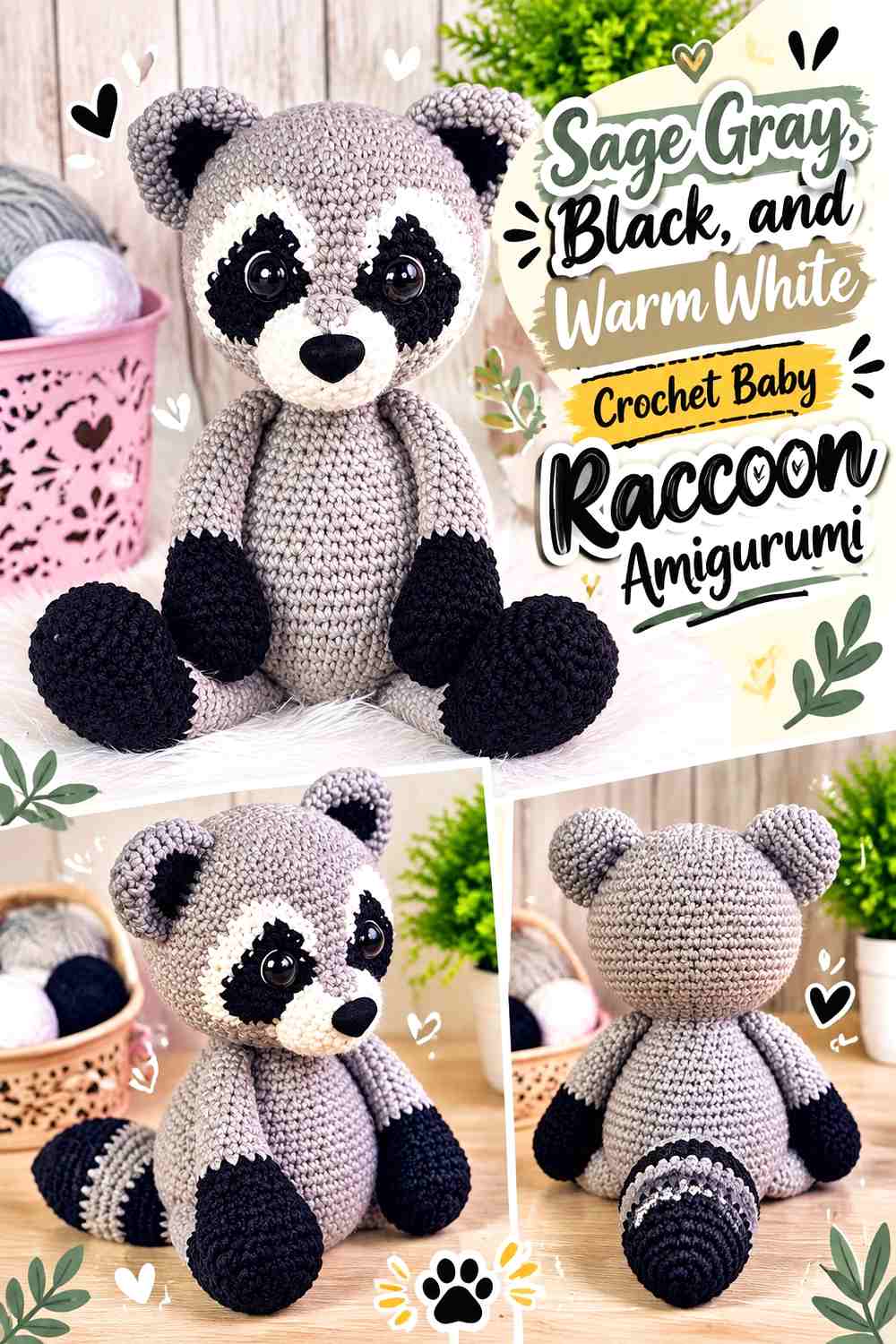
Sage gray gives the body a subtle muted-green undertone while black retains the familiar mask and striped-tail contrast. Warm white softens the muzzle and prevents the cool green-gray body from feeling too stark.
Because black is considerably stronger than sage, use it with clear boundaries.
Keep Black Compact on the Sage Gray Crochet Raccoon Mask
Let sage gray remain visible between the ears, around the cheeks, and along the sides of the mask. This preserves the main body color even when the black eye area is strong.
Warm white can sit below the mask to stop the center of the face from becoming too dark.
Use Wider Sage Gray Breaks Between Black Crochet Tail Bands
Give the lighter body color enough space between black stripes. A tail containing too much black can look visually disconnected from an otherwise sage-gray body.
Repeating one small black paw or ear detail elsewhere is enough to connect the dark tail.
Creator Credit: Todoamigurumi
6. Rust Brown, Espresso, and Sand Crochet Mini Baby Raccoon Amigurumi
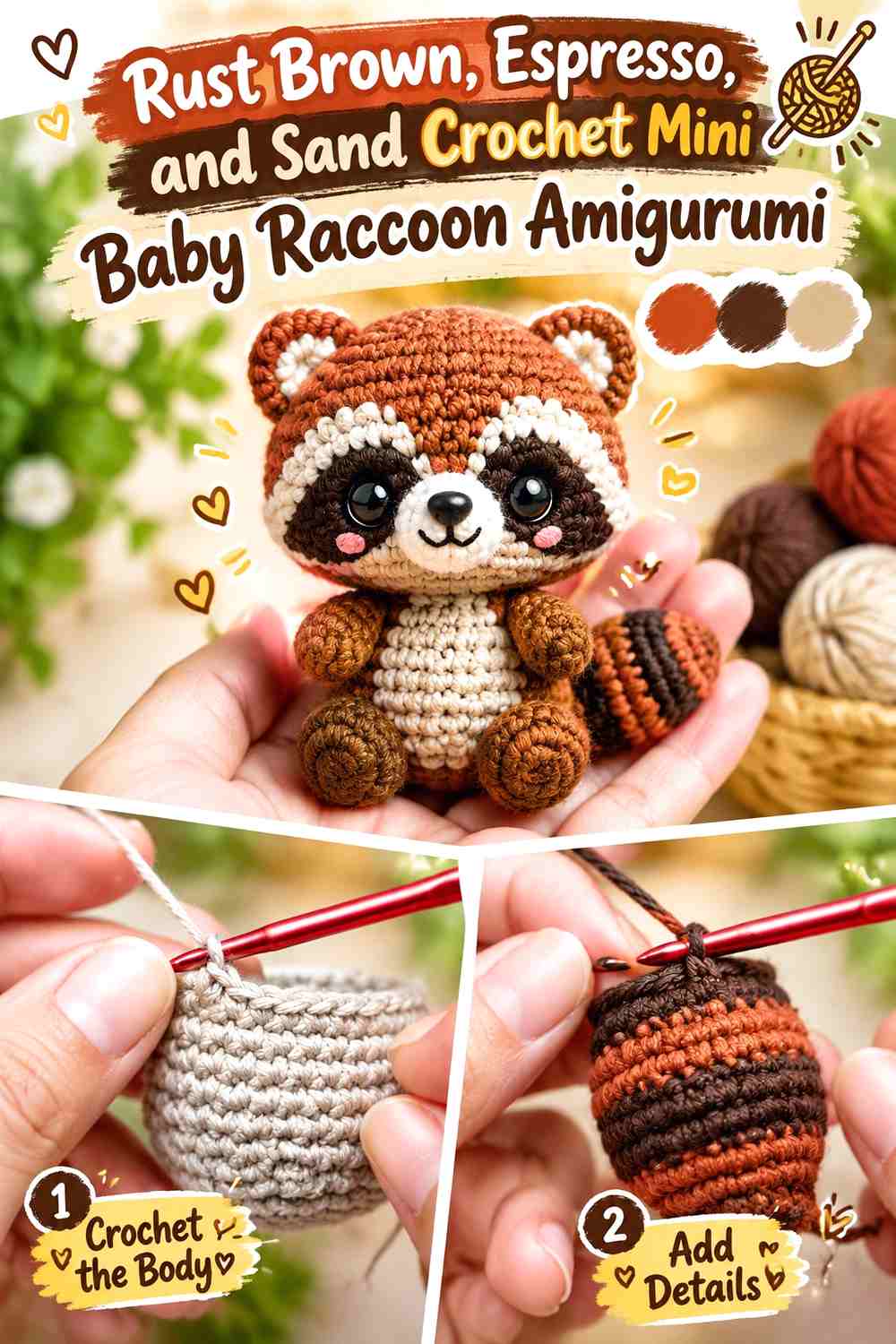
Rust brown turns the raccoon toward an autumn woodland palette while espresso provides the familiar dark markings. Sand keeps the muzzle light and prevents the entire miniature from becoming a block of warm brown.
This color direction works well when you want a raccoon-inspired character rather than a strictly naturalistic gray coat.
Let Rust Brown Dominate the Espresso Crochet Raccoon Body
Use rust across most of the head and torso. Espresso can then make the mask obvious without needing to extend into large areas of the coat.
Sand should remain a small but useful light point near the muzzle.
Alternate Espresso With Rust Brown on the Crochet Raccoon Tail
The striped tail is where the unusual body color becomes easiest to understand. Repeating rust between espresso bands connects it directly to the torso.
Avoid inserting sand into every stripe; the pale color is more valuable at the face.
Creator Credit: lululandia crochet
7. Charcoal, Dusty Blue, and Cream Crochet No-Sew Baby Raccoon Amigurumi
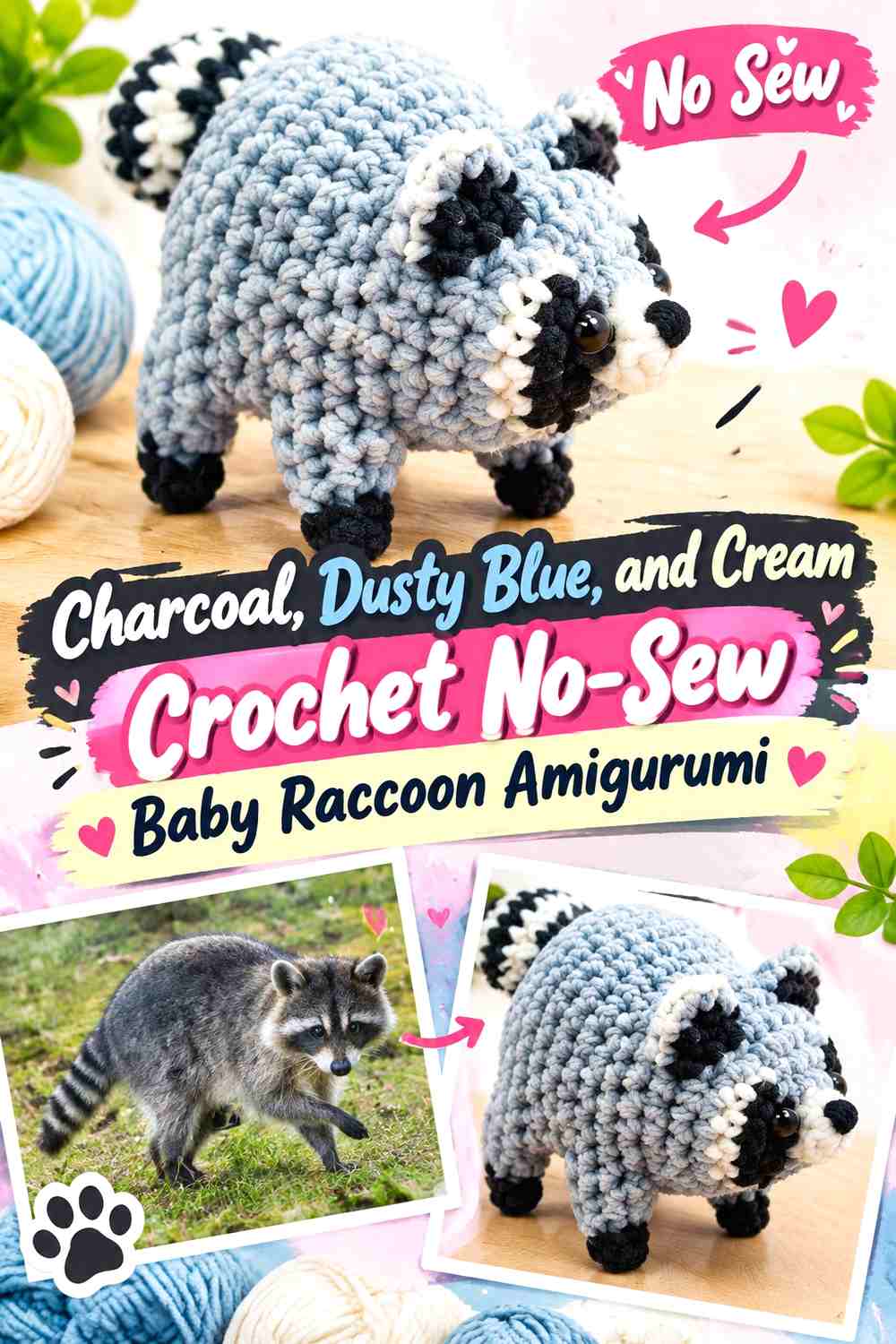
Dusty blue can act as the body color while charcoal supplies the mask and tail bands. Cream keeps the central face light and gives the cooler palette a softer counterpoint.
A compact no-sew-style form benefits from large color zones because the body itself contains fewer visual separations.
Let Dusty Blue Surround the Charcoal Crochet Raccoon Mask
Keep dusty blue visible above and beside the dark eye area. The contrast remains clear while the head still reads primarily blue-gray rather than charcoal.
Cream should stay concentrated around the muzzle instead of forming a broad facial panel.
Carry Charcoal Through the Dusty Blue Crochet Raccoon Tail
Repeat charcoal bands consistently so the strongest face color also becomes the tail’s anchor. Dusty blue should remain visible between every major stripe.
This is more cohesive than introducing black only for the tail while charcoal is used on the face.
Creator Credit: ComplicatedKnots
8. Greige, Dark Brown, and Ivory Crochet Baby Raccoon Amigurumi

Greige sits between warm beige and cool gray, making it useful when you want a neutral raccoon that does not lean strongly silver or brown. Dark brown supplies the mask and rings, while ivory creates the light facial center.
The subtle body color means value contrast should do more of the work.
Use Ivory to Divide Dark Brown From the Greige Crochet Raccoon Face
Place ivory around the muzzle so the darkest nose and mask areas do not touch too broadly. This gives the face a three-level value structure: dark mask, medium body, light muzzle.
Keep ivory smaller than greige so the animal still reads as a gray-beige raccoon.
Make Dark Brown Distinct From Greige on the Crochet Striped Tail
Compare the two yarns from a distance before committing to the whole tail. If the bands blend, choose a deeper chocolate or espresso brown.
The tail needs enough separation for its rings to remain visible even when it curls against the body.
Creator Credit: Eny’s crochet
9. Olive Gray, Cocoa, and Ecru Crochet Fluffy-Tail Baby Raccoon Amigurumi

Olive gray introduces a natural green undertone while cocoa keeps the mask warm. Ecru supplies a lighter muzzle that stays within the earthy palette.
A fluffy or furry-looking tail can soften color boundaries, so choose bands with more value difference than you might use on a smooth crochet surface.
Keep Cocoa Dark Enough Against Olive Gray Crochet Raccoon Fur
Fuzzy texture can make neighboring shades visually blend. Cocoa therefore needs to remain clearly deeper than olive gray if you want the eye mask to survive the softer surface.
Ecru gives the middle of the face a cleaner visual break.
Widen Cocoa Bands on the Olive Gray Crochet Fluffy Tail
If the tail texture is especially fluffy, narrow stripes may lose their edges. Broader cocoa and olive-gray sections preserve the striped effect more clearly.
The color arrangement should remain recognizable even when individual stitches are less visible.
Creator Credit: Les artistes du crochet
10. Frost Gray, Deep Teal, and Cream Crochet Plush Baby Raccoon Amigurumi

Frost gray keeps this plush raccoon light, while deep teal offers a stylized alternative to black. Cream can soften the muzzle and belly, giving the saturated accent enough breathing room.
Deep teal is visually strong, so treat it as the marking color rather than a second body shade.
Keep Deep Teal Focused Around the Frost Gray Crochet Raccoon Mask
Use teal where the raccoon’s characteristic facial contrast matters most. Leaving broad frost-gray cheeks prevents the unconventional color from taking over the entire head.
Cream around the muzzle creates another step between pale gray and deep teal.
Repeat Deep Teal Through the Frost Gray Crochet Tail Rings
The tail is the best place to reinforce the unusual marking color. Alternate teal with frost gray rather than adding a separate dark blue or charcoal.
That repetition makes the palette look deliberate from face to tail.
Creator Credit: Baftani fantezi
11. Lavender Gray, Deep Plum, and Oatmeal Crochet Baby Raccoon Amigurumi
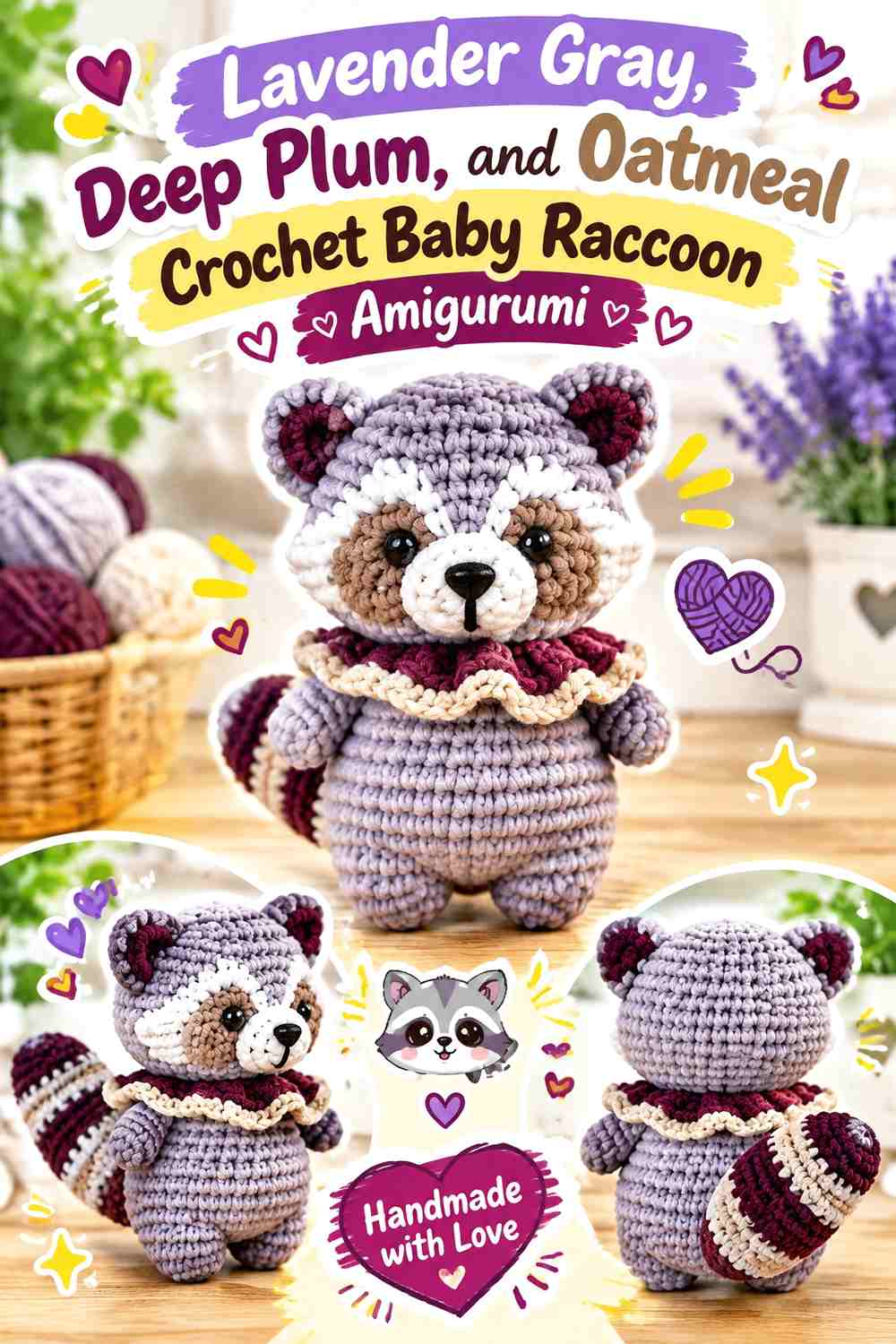
Lavender gray creates a gentle stylized body, while deep plum provides enough darkness for the raccoon mask and tail. Oatmeal adds a neutral muzzle so the toy does not become entirely purple-toned.
The palette works because the color roles still follow familiar raccoon anatomy even though the hues are less naturalistic.
Let Lavender Gray Stay Visible Around the Deep Plum Crochet Mask
Keep the plum mask relatively compact and preserve lavender gray across the forehead and cheeks. This allows the body color to remain the first overall impression.
Oatmeal can soften the center of the face without competing with either purple shade.
Use Deep Plum as the Dark Stripe on the Lavender Gray Crochet Tail
Repeating plum through the tail gives the unusual mask color a second purpose. Keep each lavender-gray section clearly visible so the tail does not become one deep purple shape.
If plum feels too saturated, choose a charcoal-plum rather than changing the entire body palette.
Creator Credit: Ochy Crochet
12. Pewter Gray, Soft Black, and Buttercream Crochet Plush Baby Raccoon Amigurumi

Pewter gray provides a slightly deeper body than silver, soft black gives the mask definition, and buttercream warms the muzzle. The difference between cool gray and warm cream keeps the plush from looking strictly monochrome.
Use the light accent sparingly because the eye mask and striped tail already create substantial pattern.
Let Buttercream Break Up the Soft Black and Pewter Crochet Face
Buttercream can create a compact muzzle directly beneath the mask. Its warmth helps separate the pale facial area from the cooler pewter body.
Keep the ears mainly pewter and soft black so the face does not accumulate too many light patches.
Alternate Soft Black and Pewter Gray on the Crochet Plush Tail
A plush surface can blur stripe edges, so keep the two values clearly different. Soft black is useful here because it remains strong even when the yarn texture diffuses the boundary.
Buttercream is better reserved for the face than introduced into the tail.
Creator Credit: СХЕМЫ АМИГУРУМИ ♡
13. Stone Gray, Burgundy, and Cream Crochet Baby Raccoon Amigurumi

Stone gray gives the body a calm neutral base, while burgundy replaces the usual black in the mask and tail. Cream keeps the face readable and prevents the wine-red markings from dominating.
This palette is more decorative, but the familiar placement of the dark markings keeps the raccoon identity clear.
Keep Burgundy Smaller Than Stone Gray on the Crochet Raccoon Face
Use burgundy around the eyes without allowing it to spread through the whole forehead. Stone gray should remain visible between the mask, ears, and cream muzzle.
This maintains a clear dominant body color.
Repeat Burgundy in Controlled Stone Gray Crochet Tail Bands
The tail can carry slightly more burgundy because the stripes create natural separation. Keep stone-gray bands wide enough to connect visually with the torso.
Avoid introducing another red or pink into the tail; the two-color ring pattern is already strong.
Creator Credit: Crocheting with Natasha
14. Warm Beige, Espresso, and Ivory Crochet Mini Baby Raccoon Amigurumi
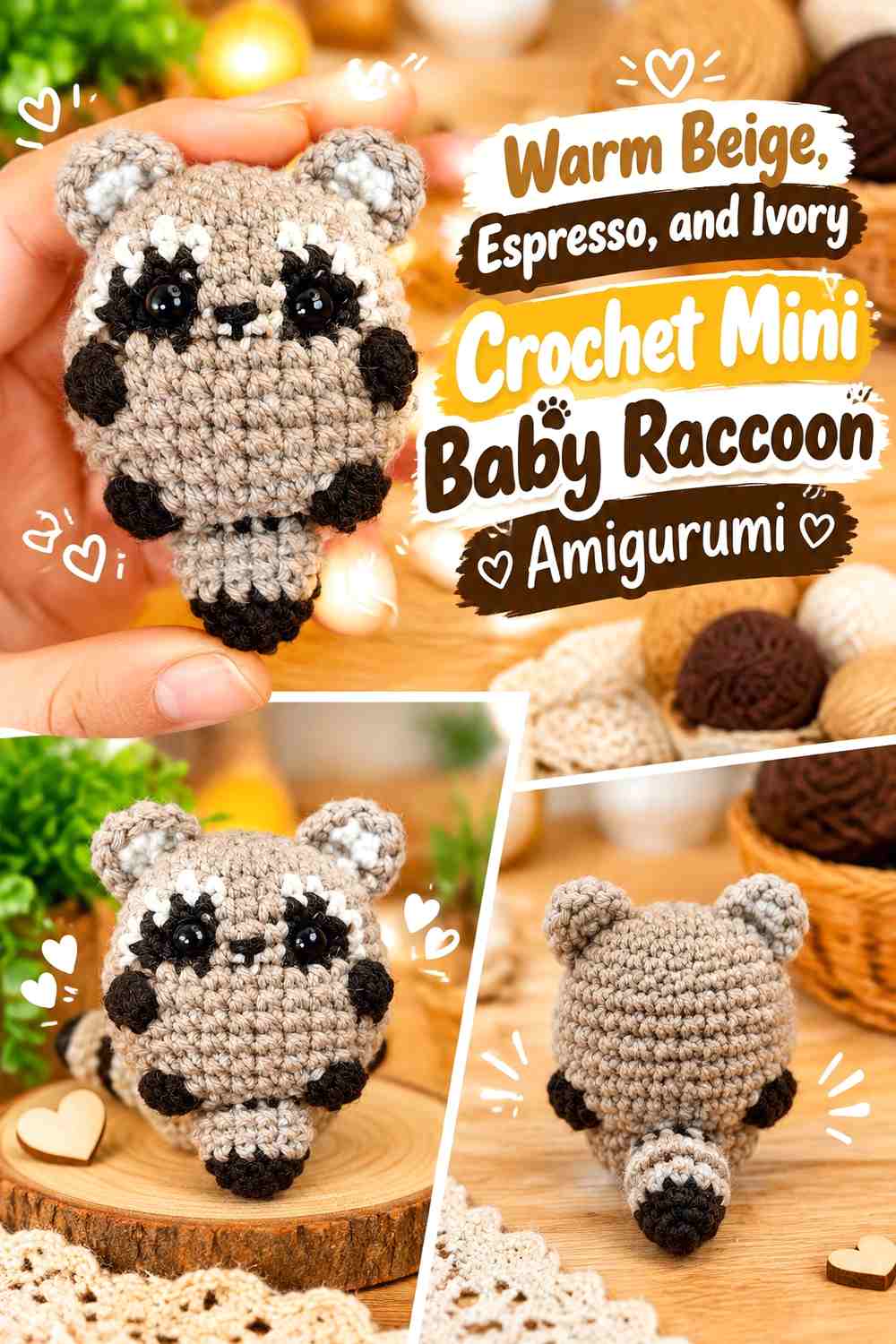
Warm beige creates a nursery-friendly neutral body, espresso provides the main dark markings, and ivory gives the tiny muzzle enough light. The restricted palette is particularly useful on a keychain-scale raccoon where very small color blocks can become visually crowded.
Let the striped tail carry most of the repetition.
Use Espresso Precisely on the Warm Beige Crochet Raccoon Mask
The mask should remain easy to see without becoming the entire face. Keep warm beige visible between the mask and ear bases, while ivory stays centered around the muzzle.
On a miniature piece, that simple three-value structure is usually enough.
Keep Espresso and Warm Beige Crochet Tail Stripes Easy to Read
Use clearly separated warm beige and espresso sections rather than adding ivory bands. The tail will look more connected to the body, and the reduced color count keeps a tiny project visually clean.
If espresso is too harsh, a deep chocolate brown can preserve the same role.
Creator Credit: Cefichet
15. Moss Gray, Walnut, and Linen Crochet Woodland Baby Raccoon Amigurumi

Moss gray creates an earthy woodland body, walnut gives the mask and tail their darker pattern, and linen brightens the muzzle. The green-gray undertone is subtle enough to stay natural-looking while making this raccoon different from standard silver versions.
Keep walnut warm and deep so it does not blend into moss.
Let Moss Gray Dominate the Walnut Crochet Raccoon Body
Use moss gray continuously across the torso, cheeks, and limbs. Walnut belongs primarily around the eyes and in compact paw details.
Linen can lighten the muzzle without spreading so far that the face becomes mostly pale.
Repeat Walnut Against Moss Gray on the Crochet Woodland Tail
Walnut and moss gray create a softer striped tail than black and white, but the rings should still remain obvious. Check the yarns side by side before committing.
If both colors are similar in darkness, choose a lighter moss or deeper walnut rather than adding black.
Creator Credit: Crochetando com Poly Helfstein
16. Cloud Gray, Slate, and Soft White Crochet Tiny Baby Raccoon Amigurumi
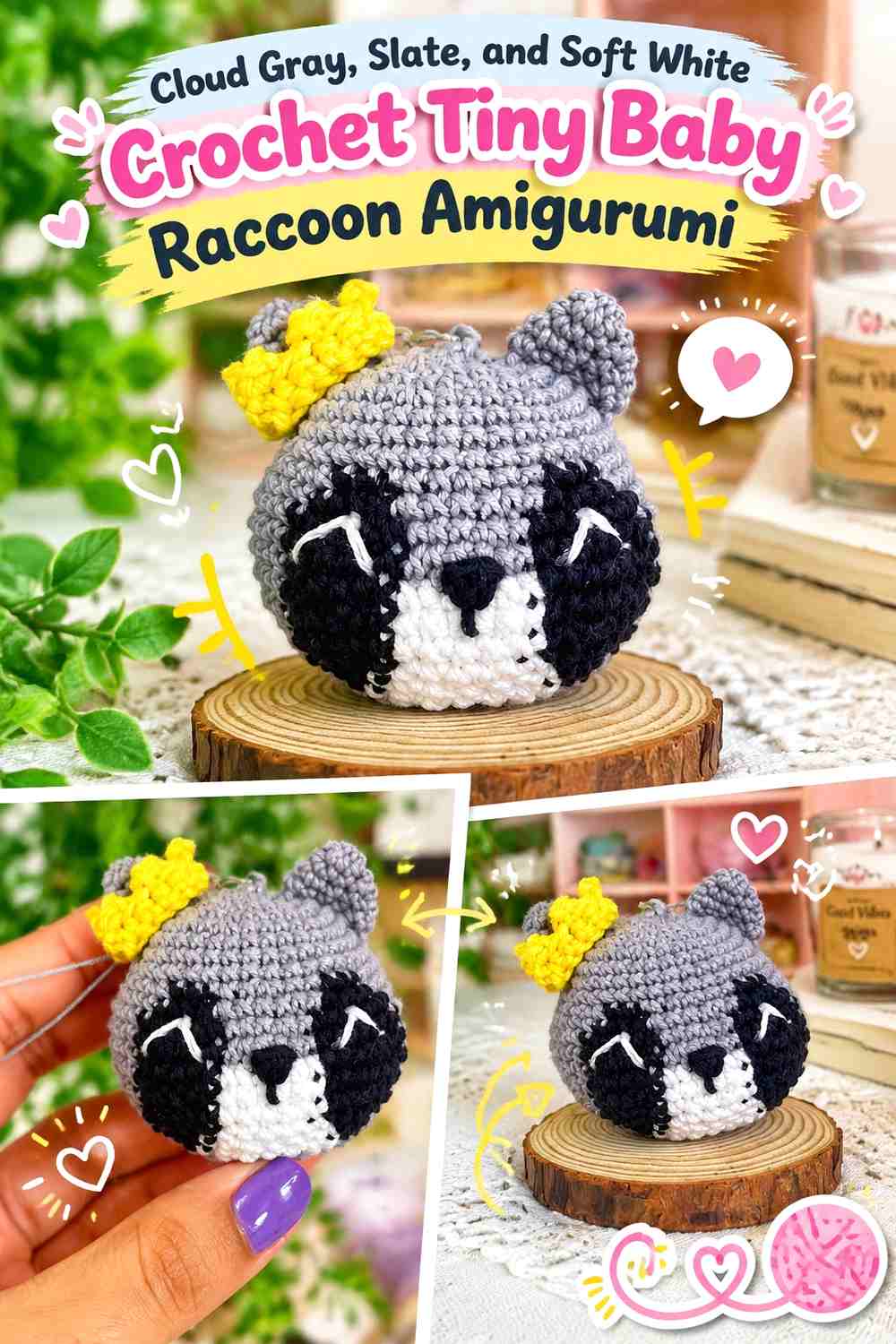
Cloud gray keeps a miniature raccoon pale, slate provides medium-dark markings, and soft white creates the brightest facial point. This lower-contrast alternative works when black would appear disproportionately strong on a very small toy.
The tail still needs visible rings, so slate must remain clearly deeper than cloud gray.
Keep Soft White Compact on the Cloud Gray Crochet Raccoon Face
A small white muzzle gives the miniature face definition without consuming too much of the head. Slate can form the mask around it, with cloud gray remaining visible around both.
Keeping each role simple makes small facial details easier to interpret.
Use Slate for Clear Cloud Gray Crochet Tail Rings
Repeat slate in evenly spaced visual sections against the pale body color. Because the project is small, avoid introducing soft white between the tail bands.
Two tail colors create a cleaner pattern and keep the white accent exclusive to the face.
Creator Credit: Arañitas
17. Charcoal Gray, Silver, and Warm White Crochet Dressed Baby Raccoon Amigurumi
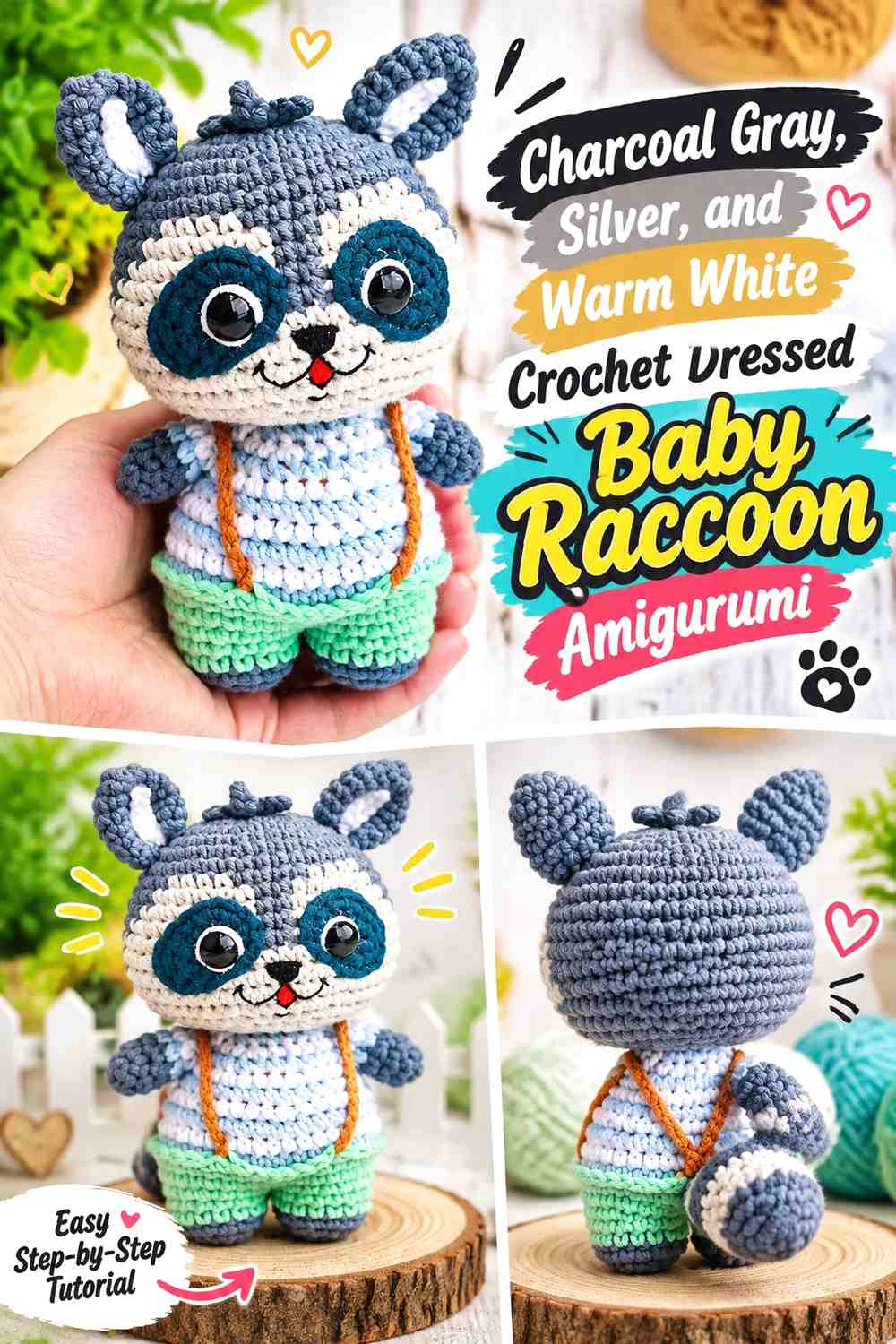
Charcoal gray reverses the typical light-body formula by making the raccoon substantially darker. Silver can form the lighter tail bands and facial transitions, while warm white highlights the muzzle. If clothing is added, keep it within this controlled neutral hierarchy or introduce one separate accent only.
The darker coat makes value planning especially important around the mask.
Use Silver to Separate the Charcoal Gray Crochet Raccoon Mask
A black mask on charcoal gray may disappear, so silver or another medium gray can create a boundary around the eye area while the darkest details remain compact.
Warm white at the muzzle supplies the brightest point and prevents the face from looking visually closed.
Alternate Silver Against Charcoal Gray on the Crochet Raccoon Tail
A reversed light-on-dark striped tail distinguishes this idea from the pale-gray raccoons above. Keep warm white out of most bands so silver remains the dedicated supporting tail color.
If clothing is added, choose an accent that does not interfere with the tail’s charcoal-and-silver rhythm.
Creator Credit: Ami Saigon
Which Crochet Baby Raccoon Palette Makes the Striped Tail Stand Out Most?
For the clearest classic stripes, silver gray with charcoal, sage gray with black, or pewter with soft black provides strong light-dark separation.
For a gentler woodland look, mushroom and espresso, taupe and cocoa, greige and dark brown, or moss gray and walnut keeps the rings visible without making the tail extremely graphic.
If you prefer a stylized raccoon, blue gray and navy, frost gray and deep teal, lavender gray and plum, or stone gray and burgundy changes the hue while preserving the key relationship: one dominant coat shade repeated between distinctly darker tail bands.
The face should guide the final choice. If a dark color works beautifully on the tail but overwhelms the tiny eye mask, use less of it on the head rather than weakening the stripe contrast everywhere.
Conclusion
The striped tail is one of the strongest color opportunities in a crochet baby raccoon, but it works best when it repeats the logic already established on the face. Choose a dominant body shade, one clearly darker mask-and-stripe color, and a lighter muzzle shade where the center of the face needs separation.
For a classic result, stay with silver, charcoal, and white. For a warmer plush, move toward mushroom, taupe, cocoa, espresso, and oatmeal. Blue gray, sage, teal, plum, burgundy, and moss can create more distinctive versions as long as the mask and tail remain visibly separated from the main coat.
Use the credited tutorials for their actual construction methods, then adapt the color balance according to whether you want the masked face, chubby body, or striped tail to attract attention first.
Frequently Asked Questions
What colors work best for a crochet baby raccoon with a striped tail?
Gray, black, charcoal, brown, cream, and white create the most familiar raccoon palette. Mushroom, taupe, greige, blue gray, sage gray, and moss gray can also work as body colors when paired with a noticeably darker marking shade.
Should the crochet raccoon tail stripes match the eye mask?
They do not have to match exactly, but repeating the same dark color creates strong visual continuity. If the face uses charcoal, for example, charcoal tail bands can connect the front and back of the amigurumi.
How can I make crochet raccoon tail stripes easier to see?
Increase the light-dark difference between adjacent bands. Two yarns can be different colors but still have similar values. Viewing them side by side or in grayscale can reveal whether the stripe pattern will remain visible.
Should the crochet raccoon muzzle be white?
Not necessarily. Cream, oatmeal, ivory, ecru, buttercream, and another lighter version of the body color can all work. The useful goal is to give the nose and mouth area enough separation from the dark eye mask.
Can I use colored stripes instead of black on a crochet raccoon tail?
Yes. Navy, deep teal, plum, burgundy, espresso, cocoa, or slate can replace black. Keep the alternate stripe noticeably different from the body shade so the ringed-tail effect remains clear.
Why does my crochet raccoon face look too dark?
The eye mask may occupy too much area or the muzzle may not provide enough light contrast. Reduce the dark color around the cheeks and preserve more of the main body shade between the mask, ears, and pale muzzle.
What should I consider if the crochet baby raccoon is intended for a young child?
Consider embroidered facial features instead of detachable small components, and secure the ears, limbs, and striped tail carefully. Any embellishments should be assessed for the intended use before the finished amigurumi is given to a young child.