A baby snow leopard amigurumi gives you several useful places to work with color without making the toy overly busy. The body can stay pale and soft, darker spots can define the back and sides, a lighter muzzle and belly can open up the face, and tail markings can repeat the darkest color without covering the whole plush.
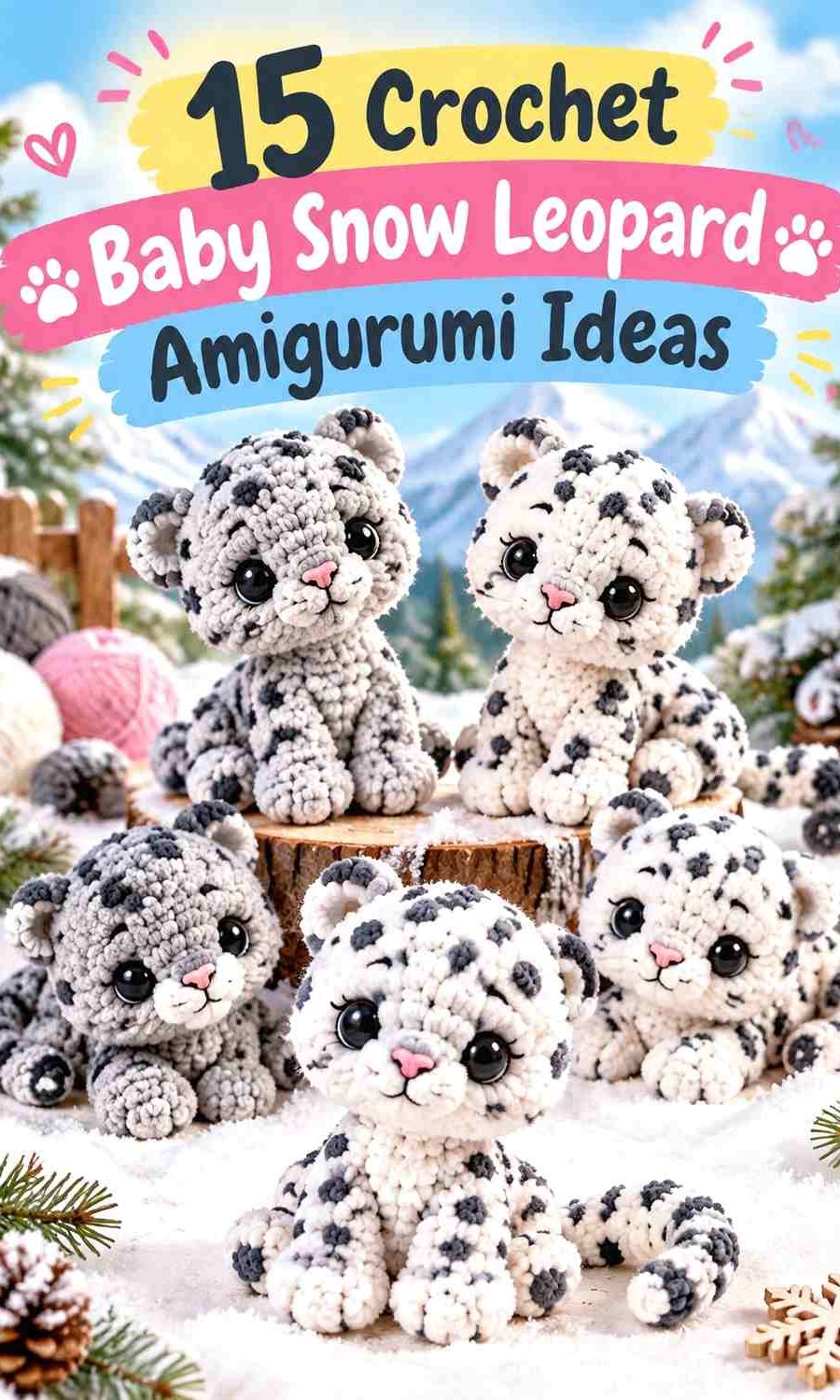
Contrast matters because small amigurumi markings can disappear quickly. Dark charcoal rosettes on a pale gray body create a crisp spotted look, while taupe, slate, or soft brown markings make the same idea quieter. The right choice depends on whether you want the markings, rounded cub shape, or facial expression to be noticed first.
The creator tutorials linked below include cheetah, tiger, and cat amigurumi constructions that can serve as foundations for a snow-leopard-inspired color adaptation; they are not all exact snow leopard tutorials. Follow each creator for the actual construction, then treat the palettes and marking placement here as independent color-planning ideas.
Quick List
- Frost Gray, Charcoal, and Snow White Crochet Baby Snow Leopard Amigurumi
- Silver Gray, Soft Black, and Cream Crochet Baby Snow Leopard Amigurumi
- Dove Gray, Espresso, and Ivory Crochet Baby Snow Leopard Amigurumi
- Blue Gray, Charcoal, and Pearl White Crochet Baby Snow Leopard Amigurumi
- Mushroom Gray, Cocoa, and Oatmeal Crochet Baby Snow Leopard Amigurumi
- Lavender Gray, Deep Plum, and Cream Crochet Baby Snow Leopard Amigurumi
- Sage Gray, Espresso, and Ecru Crochet Baby Snow Leopard Amigurumi
- Pale Taupe, Charcoal, and Blush Beige Crochet Baby Snow Leopard Amigurumi
- Ice Blue Gray, Navy, and Soft White Crochet Baby Snow Leopard Amigurumi
- Stone Gray, Black, and Dusty Rose Crochet Baby Snow Leopard Amigurumi
- Greige, Dark Brown, and Cream Crochet Baby Snow Leopard Amigurumi
- Cloud Gray, Slate, and Buttercream Crochet Baby Snow Leopard Amigurumi
- Pearl Gray, Cocoa, and Muted Peach Crochet Baby Snow Leopard Amigurumi
- Beige Gray, Espresso, and Oatmeal Crochet Baby Snow Leopard Amigurumi
- Charcoal Gray, Silver, and Warm White Crochet Baby Snow Leopard Amigurumi
Keep the Crochet Snow Leopard Body Lighter Than the Main Spots
A pale or medium-light body makes dark markings easier to control. Frost gray, pearl gray, greige, blue gray, mushroom, and soft taupe all create enough visual room for charcoal, slate, brown, or navy spots.
The markings do not need to cover every available surface. A few repeated areas across the head, back, outer legs, and tail can communicate the spotted direction while leaving enough uninterrupted body color for the cub shape to remain clear.
If the body and markings look different in hue but nearly identical in lightness, check them from a distance before committing. Stronger value separation is particularly useful for tiny facial markings.
Use Cream and White to Open Up the Crochet Snow Leopard Face
A lighter muzzle can keep dark nose and eye details from sitting directly on the main gray body color. Cream, ivory, oatmeal, and soft white can also work on the chest, belly, inner ears, or paws when you want those areas to read separately.
Avoid spreading the light accent everywhere. If the whole face, belly, feet, and tail tip become white, the supporting color can start competing with the main body shade.
Use the palest yarn where it solves a specific visibility problem—especially around the muzzle and small facial details.
Plan Crochet Snow Leopard Spots Around Texture and Scale
Small markings need clearer contrast than broad body sections. On a tiny amigurumi, several closely packed dark spots may visually merge. On a larger plush, you have more room to vary spots and broken rosette-like markings while keeping gray visible between them.
Very fuzzy yarn can also soften the boundaries between colors. If crisp markings are important, give the spot color enough contrast to survive that softer surface appearance.
The tail offers another useful place for repetition. Darker rings or spaced markings can carry the spot color away from the body and make the palette feel connected from head to tail.
1. Frost Gray, Charcoal, and Snow White Crochet Baby Snow Leopard Amigurumi
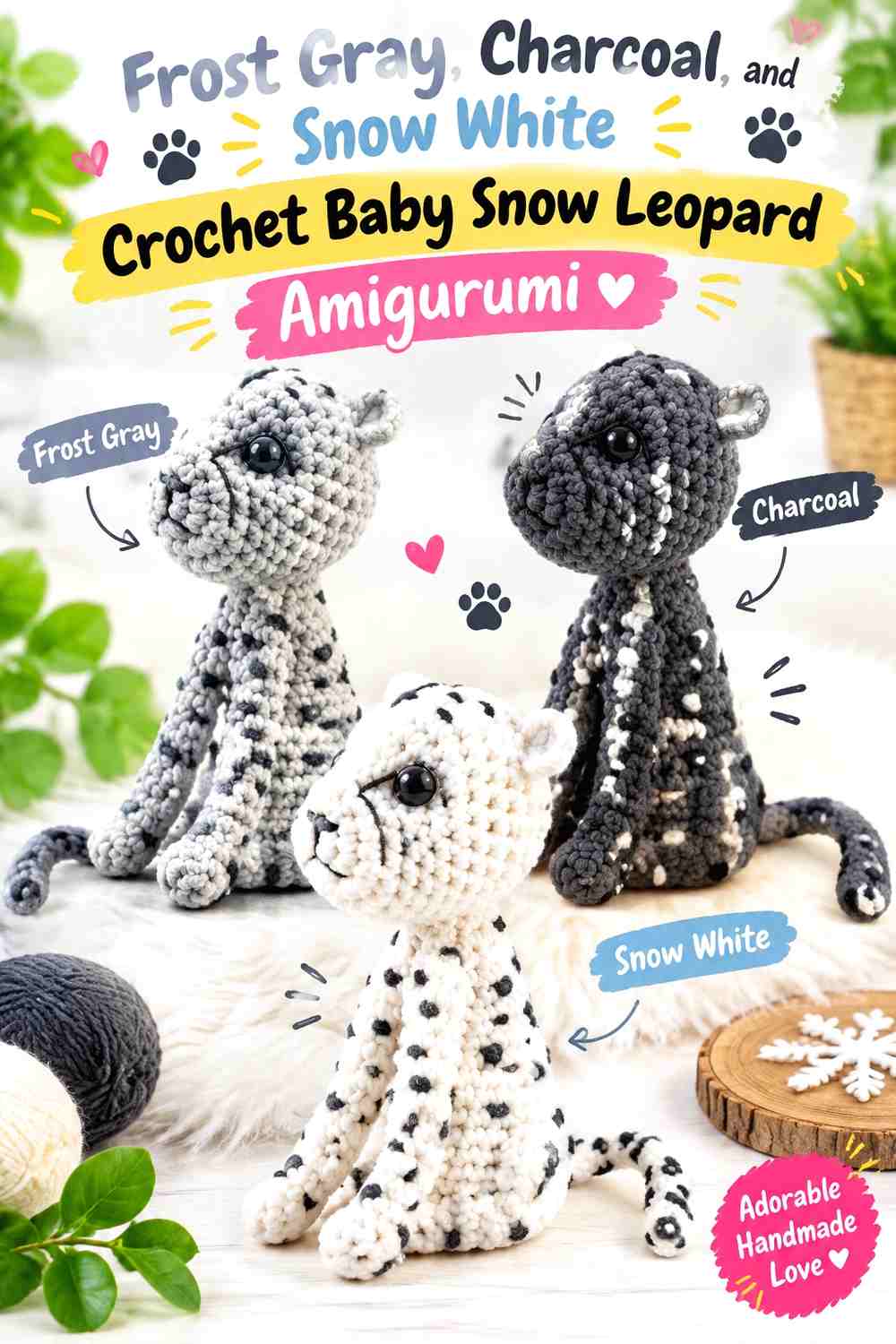
Frost gray creates the classic pale foundation for this color direction. Charcoal can handle the strongest markings, while snow white belongs on smaller areas such as the muzzle, chest, inner ears, or paws.
Keep frost gray dominant so the spots look placed on the cub rather than turning the whole body into a dark patterned surface.
Let Frost Gray Cover Most of the Crochet Baby Snow Leopard Body
Use frost gray continuously across the head, torso, and major limb surfaces. The uninterrupted pale field helps the rounded amigurumi shape remain easy to read even after spots are added.
If you want stronger definition around the belly, introduce snow white there rather than breaking the back into additional colors.
Keep Charcoal Crochet Snow Leopard Spots Separated by Frost Gray
Leave enough frost gray between charcoal markings so several small spots do not merge into one dark patch. On the face, use fewer, smaller charcoal details than on the back or tail.
Snow white can sit around the muzzle where additional separation is useful.
Creator Credit: Canal crochet
2. Silver Gray, Soft Black, and Cream Crochet Baby Snow Leopard Amigurumi
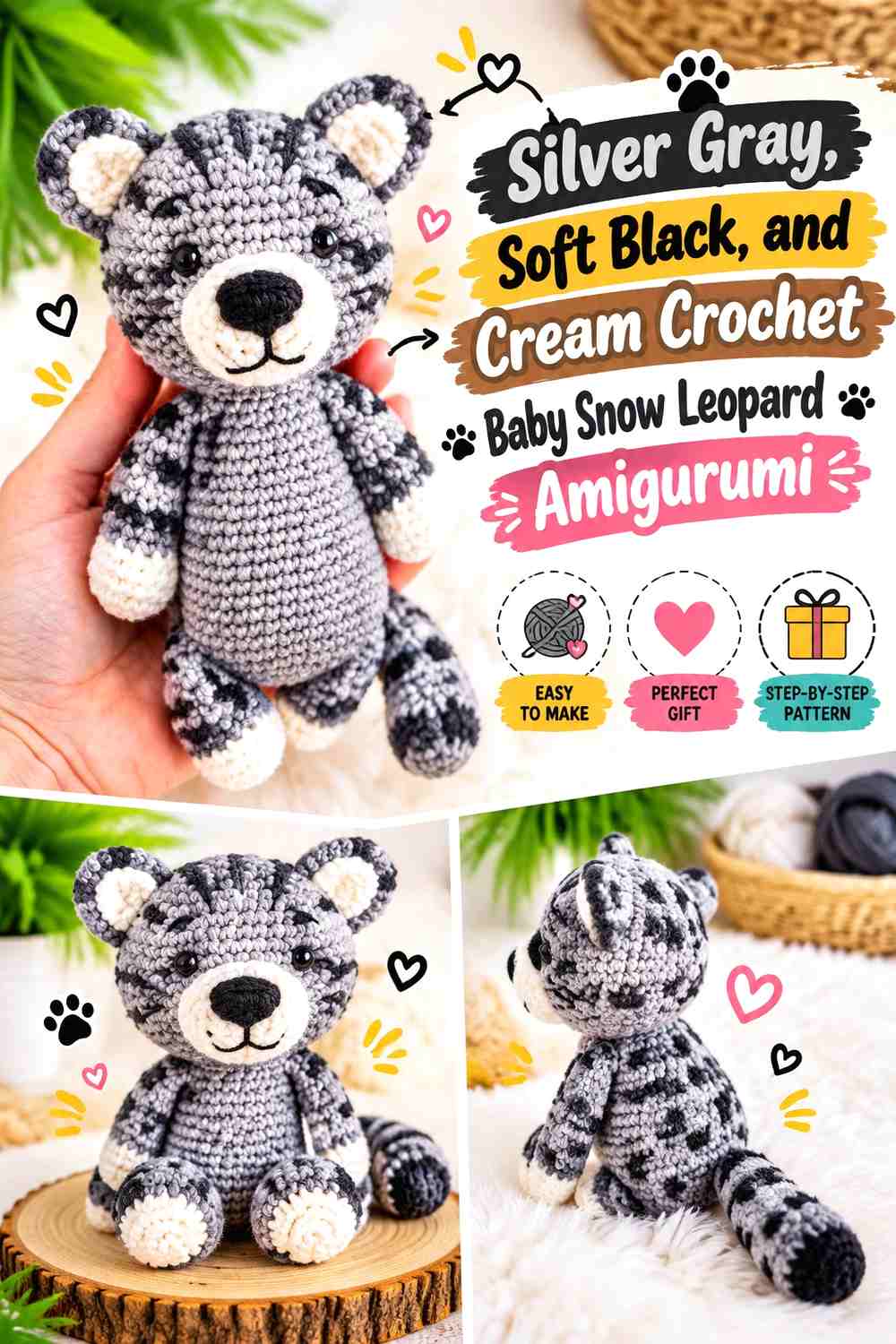
Silver gray creates a slightly cooler body than warm greige or taupe. Soft black gives the markings strong definition, while cream prevents the facial area from becoming too stark.
This palette works especially well when you want the spotted pattern to be one of the first things noticed.
Use Silver Gray as the Main Crochet Snow Leopard Color
Keep silver gray across most of the body, including the outer legs and head. A consistent body shade makes the soft black spots easier to distribute without losing the overall cub silhouette.
Cream can stay limited to the lower face and other small light areas.
Reserve Soft Black for Silver Gray Crochet Spots and Tail Marks
Soft black carries much more visual weight than silver gray, so it does not need large amounts. Use it on spaced markings and repeat it on the tail to connect the pattern.
If true black feels too sharp, choose a very dark charcoal while preserving strong contrast.
Creator Credit: Little Crochet Farm
3. Dove Gray, Espresso, and Ivory Crochet Baby Snow Leopard Amigurumi
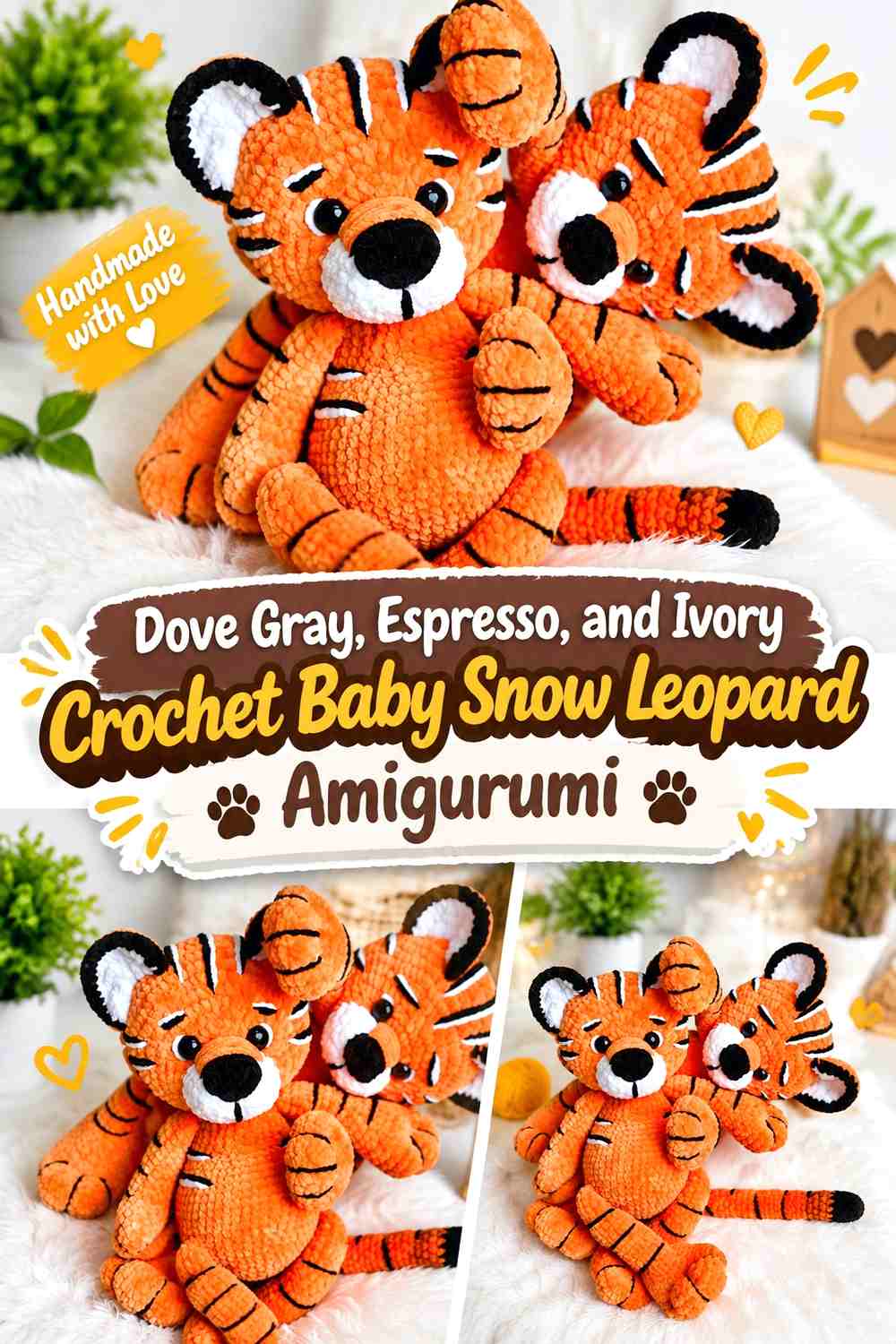
Dove gray with espresso creates a warmer snow-leopard interpretation than gray with black. Ivory can lighten the muzzle and belly while keeping the entire palette soft.
This is useful when the finished amigurumi will sit among beige, cream, tan, or natural-toned nursery decor.
Let Dove Gray Keep the Espresso Crochet Snow Leopard Warm
Use dove gray as the broad body field and treat espresso as the pattern color. Because both shades lean softer than icy gray and black, preserving enough value difference matters.
Place the darkest espresso markings where the body curves are least likely to hide them.
Use Ivory Around the Dove Gray Crochet Snow Leopard Muzzle
Ivory can brighten the muzzle without producing a very cold contrast. It also gives dark nose or mouth embroidery a lighter surface to sit against.
Keep ivory smaller than dove gray so the face still belongs visually to the same body.
Creator Credit: Medintseva toys
4. Blue Gray, Charcoal, and Pearl White Crochet Baby Snow Leopard Amigurumi
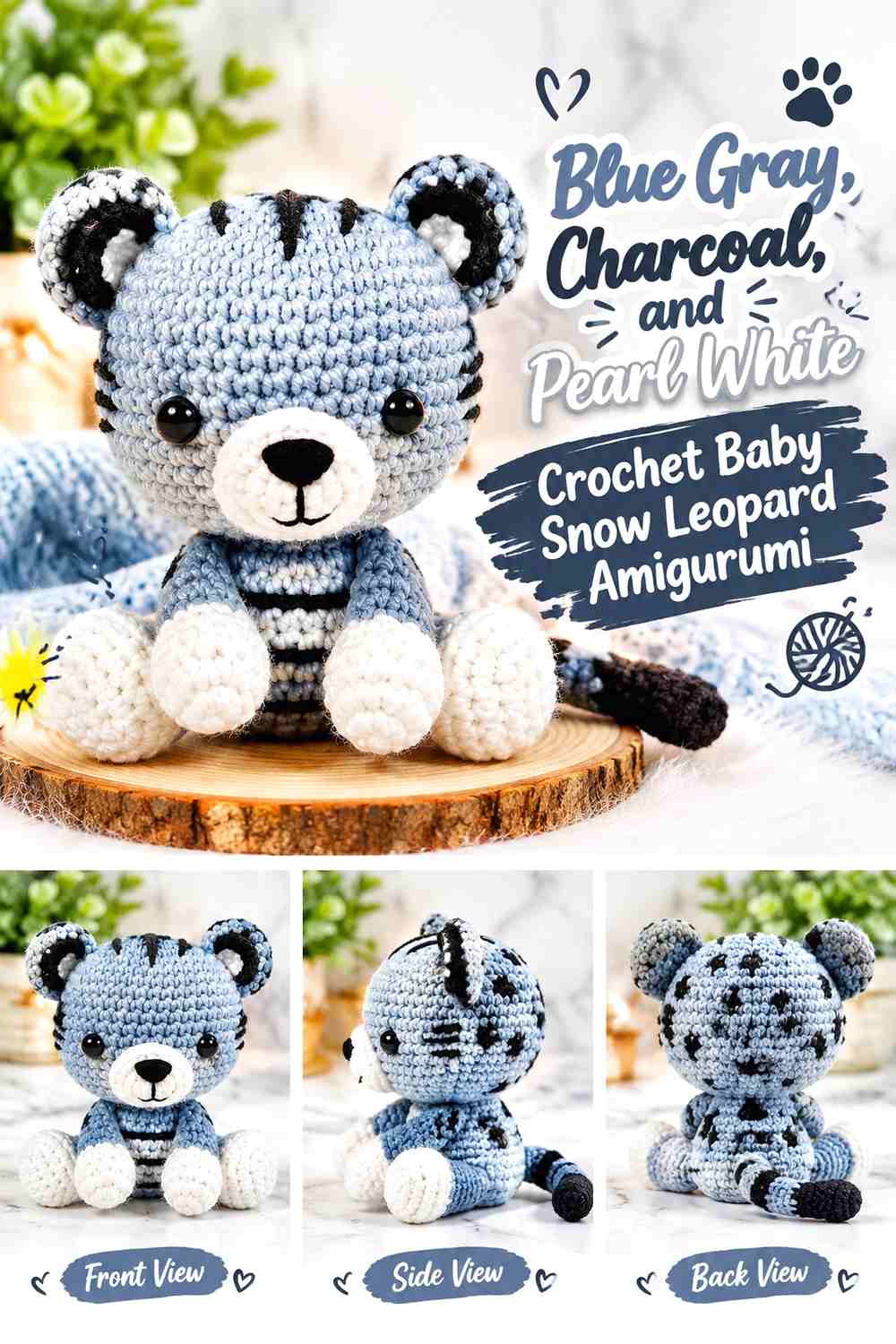
Blue gray gives the body a cooler mountain-inspired direction without requiring a bright blue yarn. Charcoal can define the markings, and pearl white can soften the underside and muzzle.
The color difference is subtle enough for the toy to remain neutral but distinct from a standard plain gray cat.
Keep Blue Gray Broad Beneath the Charcoal Crochet Markings
Let blue gray cover the large body surfaces and avoid introducing pearl white into the back pattern. That keeps the darker spots clearly associated with one consistent body color.
The cooler body can also make pearl white feel naturally connected instead of looking like a separate bright patch.
Repeat Charcoal From the Blue Gray Crochet Head Into the Tail
Use charcoal in a small number of head markings and repeat it along the tail. That repeated path creates a more connected pattern than concentrating all the dark color in one body area.
Leave the pearl white tail accent small if charcoal rings already provide enough contrast.
Creator Credit: Odinka Wisanindhi
5. Mushroom Gray, Cocoa, and Oatmeal Crochet Baby Snow Leopard Amigurumi
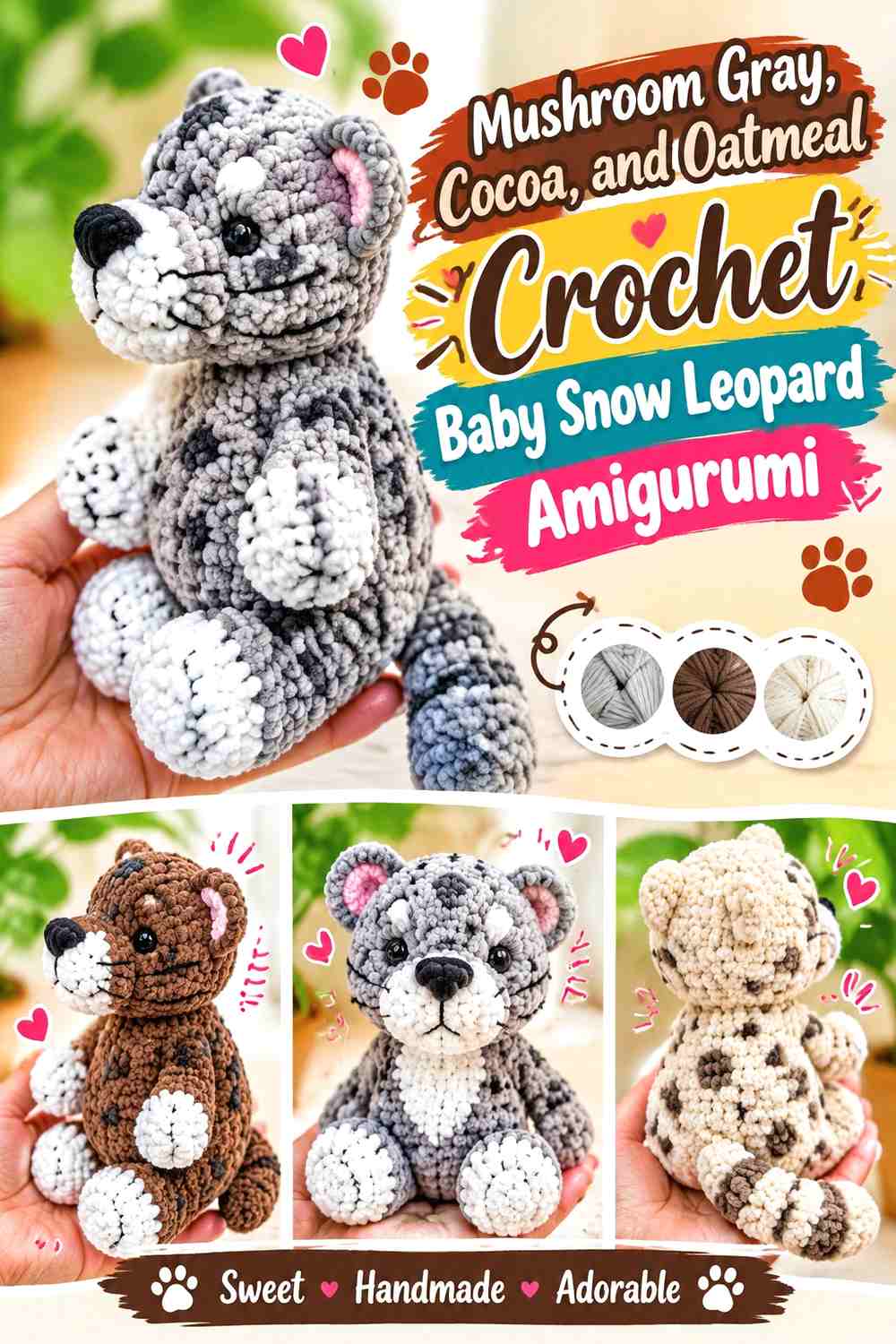
Mushroom gray softens the cool character of the usual snow-leopard palette. Cocoa works as a deep warm marking color, and oatmeal provides a restrained light accent.
This combination gives the amigurumi a natural neutral direction without depending on high-contrast black.
Let Mushroom Gray Lead the Cocoa Crochet Snow Leopard Body
Keep mushroom gray across most of the head and torso so cocoa remains a supporting pattern rather than becoming an equal body color.
If the markings feel faint, deepen cocoa instead of adding more spots.
Use Oatmeal to Separate Cocoa From the Mushroom Gray Crochet Face
Oatmeal works well on the muzzle and inner ears where a lighter break helps facial details remain visible. The warmer neutral also prevents the brown-gray palette from feeling overly dark around the eyes.
Keep the oatmeal paws limited if you want the body color to remain dominant.
Creator Credit: Amigurumi_Joys
6. Lavender Gray, Deep Plum, and Cream Crochet Baby Snow Leopard Amigurumi
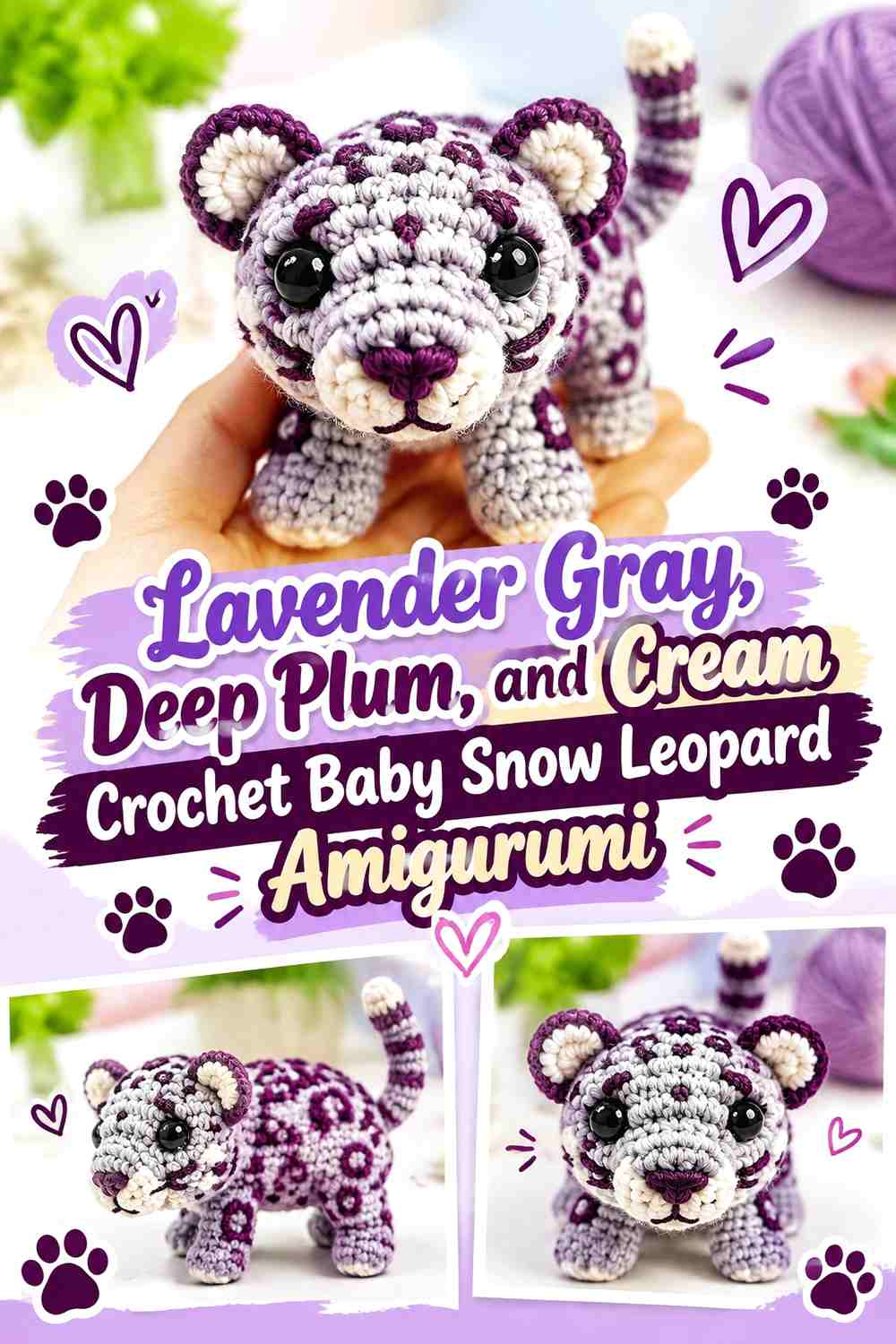
Lavender gray and deep plum create a stylized interpretation while preserving the familiar light-body, dark-marking hierarchy. Cream keeps the muzzle and belly neutral so the purple influence does not cover every part of the toy.
This palette works best when deep plum is clearly darker than the body.
Keep Lavender Gray Continuous Across the Crochet Snow Leopard Head
A broad lavender-gray face makes the unusual body color feel intentional. Small deep-plum markings can then add pattern without making the cub look heavily multicolored.
Cream should remain closest to the muzzle rather than appearing between every spot.
Use Deep Plum Sparingly on Lavender Gray Crochet Snow Leopard Spots
Deep plum will attract attention quickly, particularly around the forehead and ears. Use it more generously on the back and tail than on the face.
If the purple direction becomes too strong, replace some plum markings with a deep charcoal-plum rather than adding another neutral.
Creator Credit: Stella’s Yarn Universe
7. Sage Gray, Espresso, and Ecru Crochet Baby Snow Leopard Amigurumi
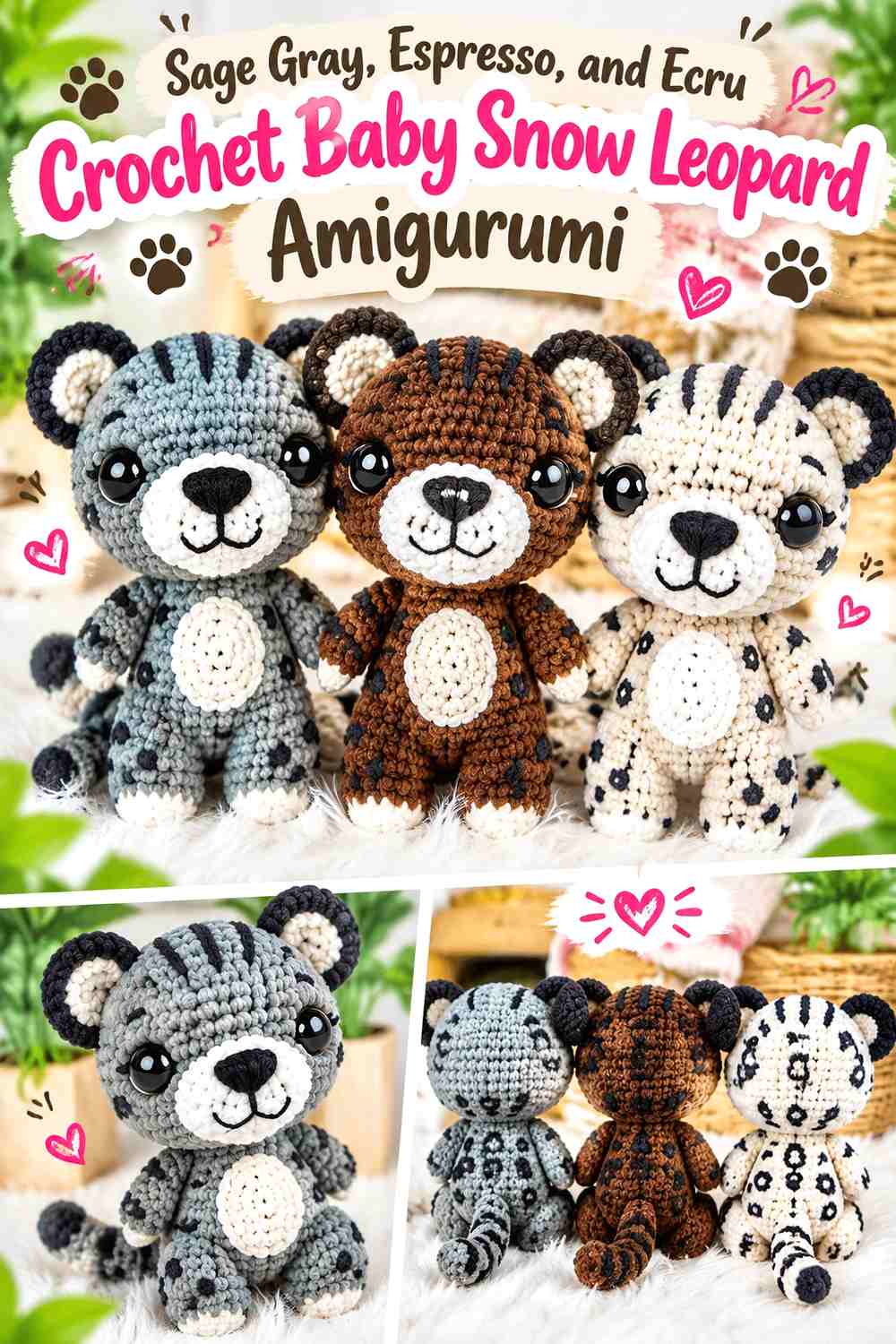
Sage gray adds a muted green undertone while remaining neutral enough for an animal-inspired palette. Espresso creates warmer spots, and ecru lightens the underside.
This is a useful option when conventional silver gray feels too cool for the surrounding decor.
Let Sage Gray Dominate the Espresso Crochet Snow Leopard Shape
Use sage gray across all major body sections so the subtle green character remains visible. Keep espresso concentrated on markings, ears, or tail sections.
Too much espresso will quickly turn this into a brown-led palette.
Put Ecru on the Sage Gray Crochet Snow Leopard Belly and Muzzle
Ecru gives the lower body a lighter area without the brightness of white. It also separates espresso facial details from the sage-gray body.
If the ecru is very close to the body value, keep it around larger areas rather than relying on it to define tiny features.
Creator Credit: Skein Spider
8. Pale Taupe, Charcoal, and Blush Beige Crochet Baby Snow Leopard Amigurumi
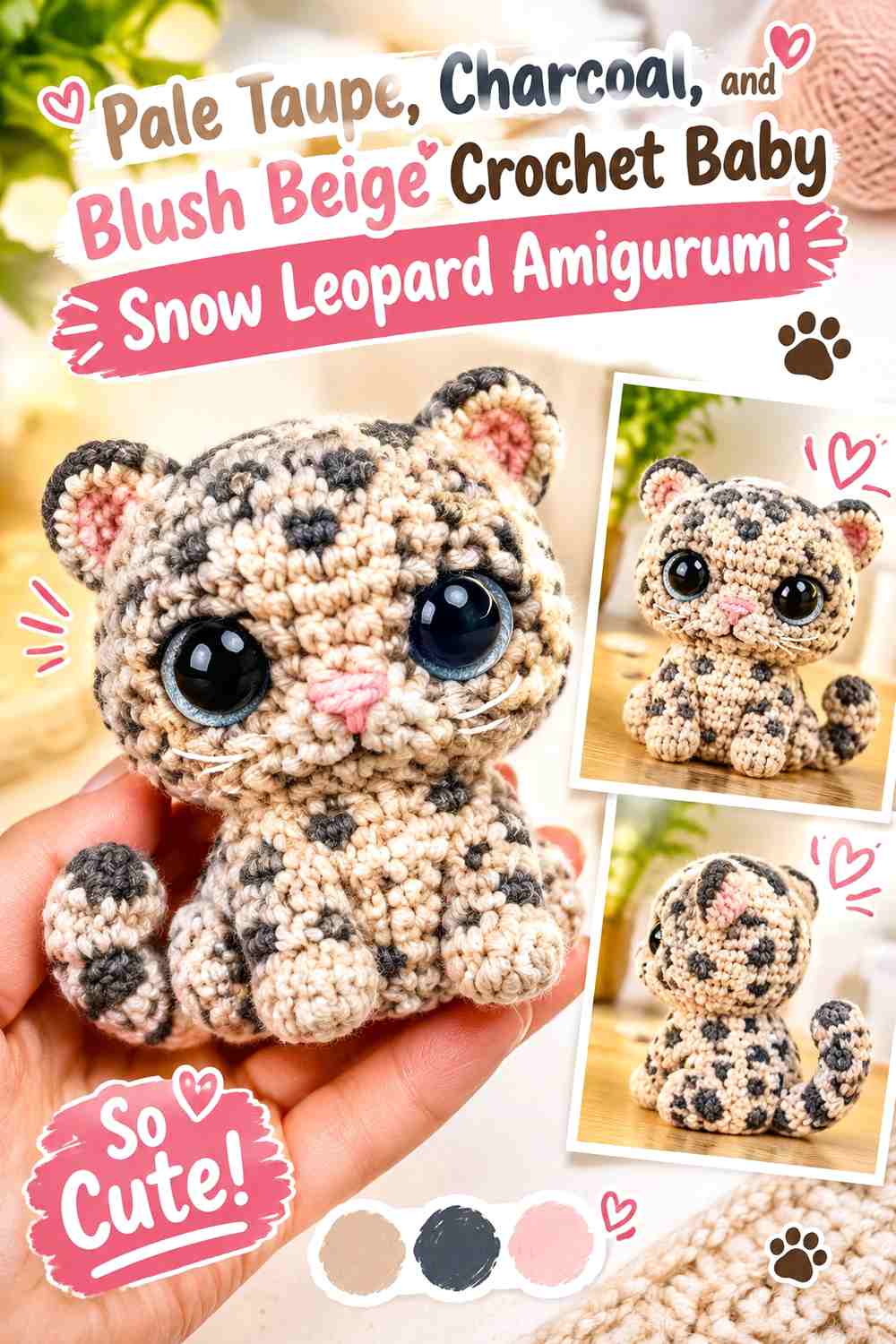
Pale taupe produces a warmer neutral cub, while charcoal gives it the strong pattern contrast needed to keep the spots clear. Blush beige can soften the inner ears, muzzle, or paw details without turning them bright pink.
This palette is particularly useful when you want a gentle nursery-style direction.
Use Pale Taupe Across the Main Charcoal Crochet Snow Leopard Body
Keep pale taupe uninterrupted on most of the torso and limbs. Charcoal markings will already create enough activity, so the body does not need additional color blocking.
The warm base also gives the cub a distinct look from the cooler silver-gray options.
Keep Blush Beige Small Around the Pale Taupe Crochet Snow Leopard Face
Blush beige can work in the inner ears or a very small muzzle detail. Keeping it restrained prevents the accent from changing the snow-leopard color hierarchy.
Charcoal should remain the darkest and most structurally important detail color.
Creator Credit: Gul’s Cozy Crochet
9. Ice Blue Gray, Navy, and Soft White Crochet Baby Snow Leopard Amigurumi
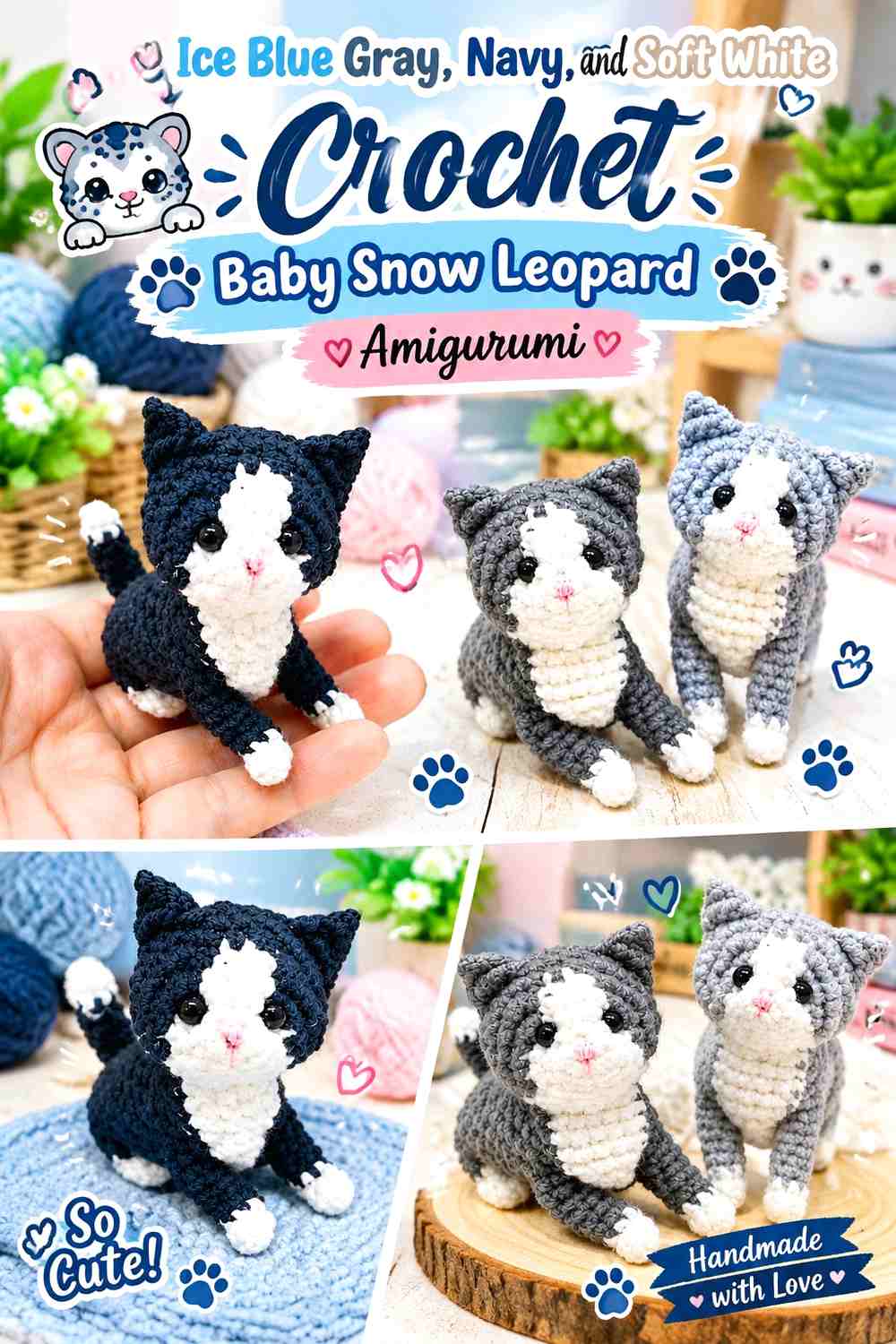
Ice blue gray with navy offers a cool alternative to charcoal spots. Soft white keeps the belly and muzzle light while preserving the frosty direction.
Because navy can look slightly softer than black, it suits a stylized cub where you want clear but not severe markings.
Let Ice Blue Gray Control the Navy Crochet Snow Leopard Surface
Use ice blue gray over most of the body, leaving navy only for spots, tail bands, and selected facial accents.
Avoid using navy on large ears, paws, and spots simultaneously unless you intentionally want a dark-heavy design.
Use Soft White to Brighten the Ice Blue Gray Crochet Snow Leopard Muzzle
Soft white can give the nose and mouth area a clear light field. This becomes especially useful when navy facial embroidery would otherwise sit directly on a medium-blue-gray body.
Repeat white on the chest only if you want a stronger two-tone underside.
Creator Credit: ChundraChun
10. Stone Gray, Black, and Dusty Rose Crochet Baby Snow Leopard Amigurumi
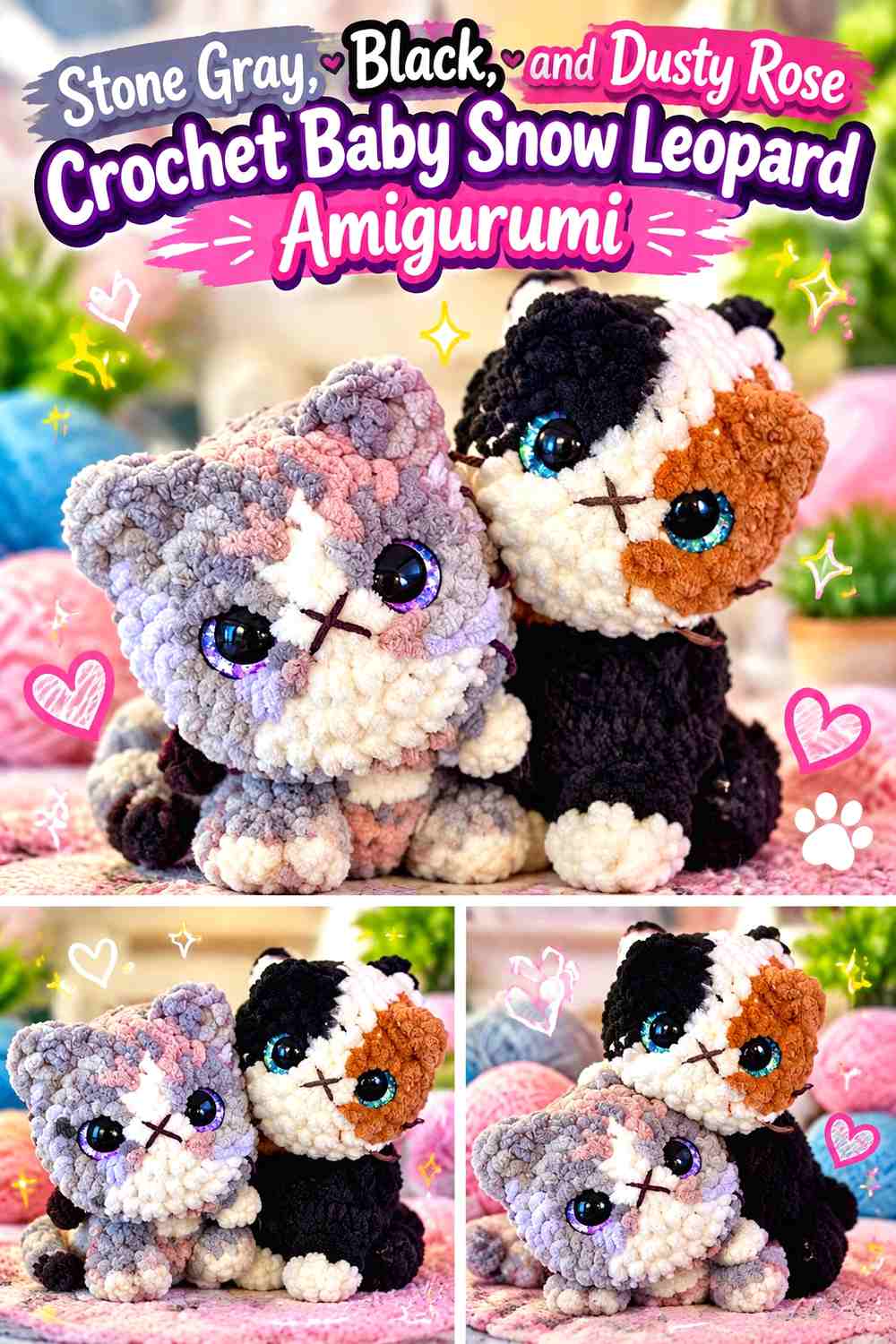
Stone gray and black give the body and spots clear separation, while dusty rose introduces a small playful accent in the inner ears or nose area.
The dusty rose should remain noticeably smaller than both neutral colors so the spotted coat stays central.
Keep Stone Gray Between Every Major Black Crochet Snow Leopard Marking
Black spots can visually join very quickly on a small amigurumi. Leave clear stone-gray gaps around them, particularly across the forehead and sides of the body.
Larger areas such as the back can handle slightly more dark pattern than the face.
Use Dusty Rose Only on Small Stone Gray Crochet Snow Leopard Details
Inner ears or a restrained nose detail are better places for dusty rose than full paws or broad body sections. That keeps the accent decorative rather than making it a third major coat color.
If you prefer a fully neutral cub, simply replace dusty rose with cream.
Creator Credit: Annie Carraway Art
11. Greige, Dark Brown, and Cream Crochet Baby Snow Leopard Amigurumi
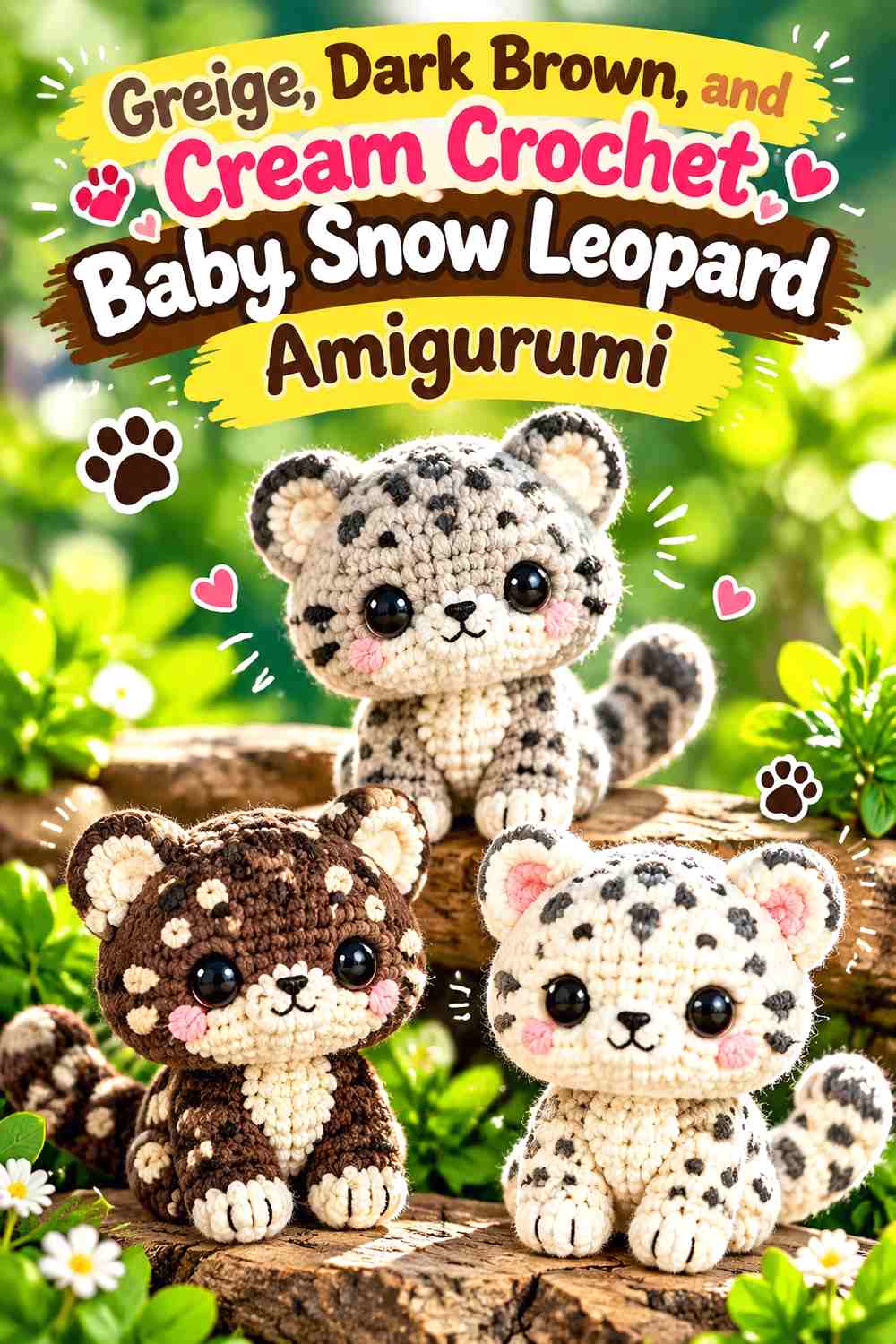
Greige sits between gray and beige, making it useful for a warm neutral amigurumi. Dark brown can form the spots, while cream gives the face and belly a lighter break.
The result is less graphic than gray and black but still has enough contrast to show the coat pattern.
Let Greige Stay Visible Around the Dark Brown Crochet Spots
Do not pack the brown markings too closely. Greige needs to remain the main visible coat color for the toy to keep a light snow-leopard direction.
On the tail, alternate dark sections with longer greige areas instead of making every section equally narrow.
Use Cream to Open the Greige Crochet Snow Leopard Face
A cream muzzle creates enough separation for dark-brown nose and mouth details. It can also continue down a small chest area to connect the face with the underside.
Avoid expanding cream over too many limbs if you want the greige body to remain dominant.
Creator Credit: MokotCrochet
12. Cloud Gray, Slate, and Buttercream Crochet Baby Snow Leopard Amigurumi
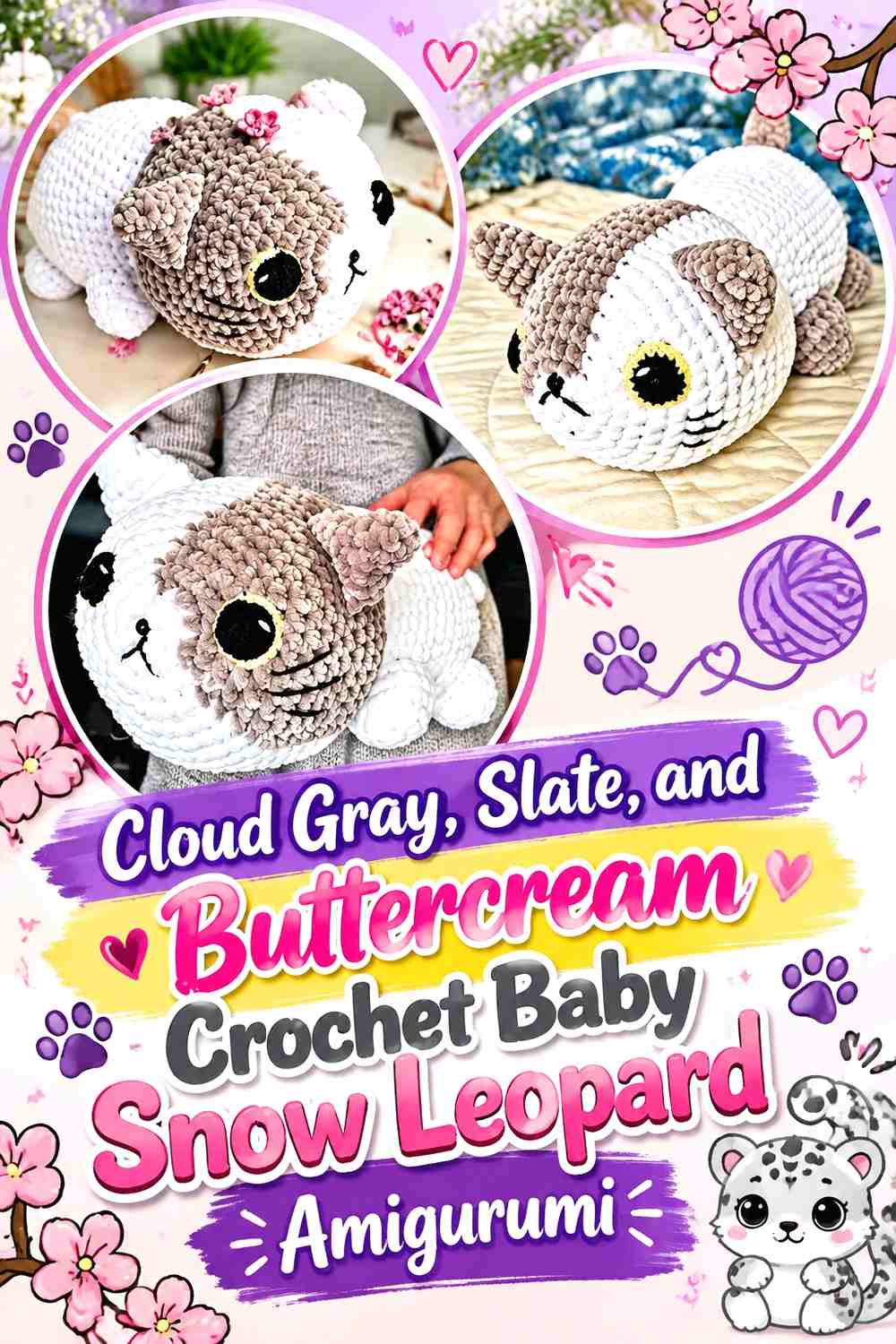
Cloud gray keeps the body very light, while slate provides softer markings than black. Buttercream adds a subtle warm highlight around the muzzle or belly.
This combination works when you want a pale plush whose markings remain visible but do not become the strongest visual element.
Use Cloud Gray Across Most of the Slate Crochet Snow Leopard
The lighter the body, the more noticeable even medium-dark markings become. Keep slate spots fairly spaced and let cloud gray continue around the outer silhouette.
This also helps the ears and legs stay visually connected to the torso.
Keep Buttercream Warmer Than the Cloud Gray Crochet Muzzle
A slightly warm light accent can distinguish the muzzle from an already pale body without requiring a big jump in brightness.
If buttercream and cloud gray merge too much, enlarge the muzzle area rather than adding darker outlines everywhere.
Creator Credit: Amigurumi Forge
13. Pearl Gray, Cocoa, and Muted Peach Crochet Baby Snow Leopard Amigurumi
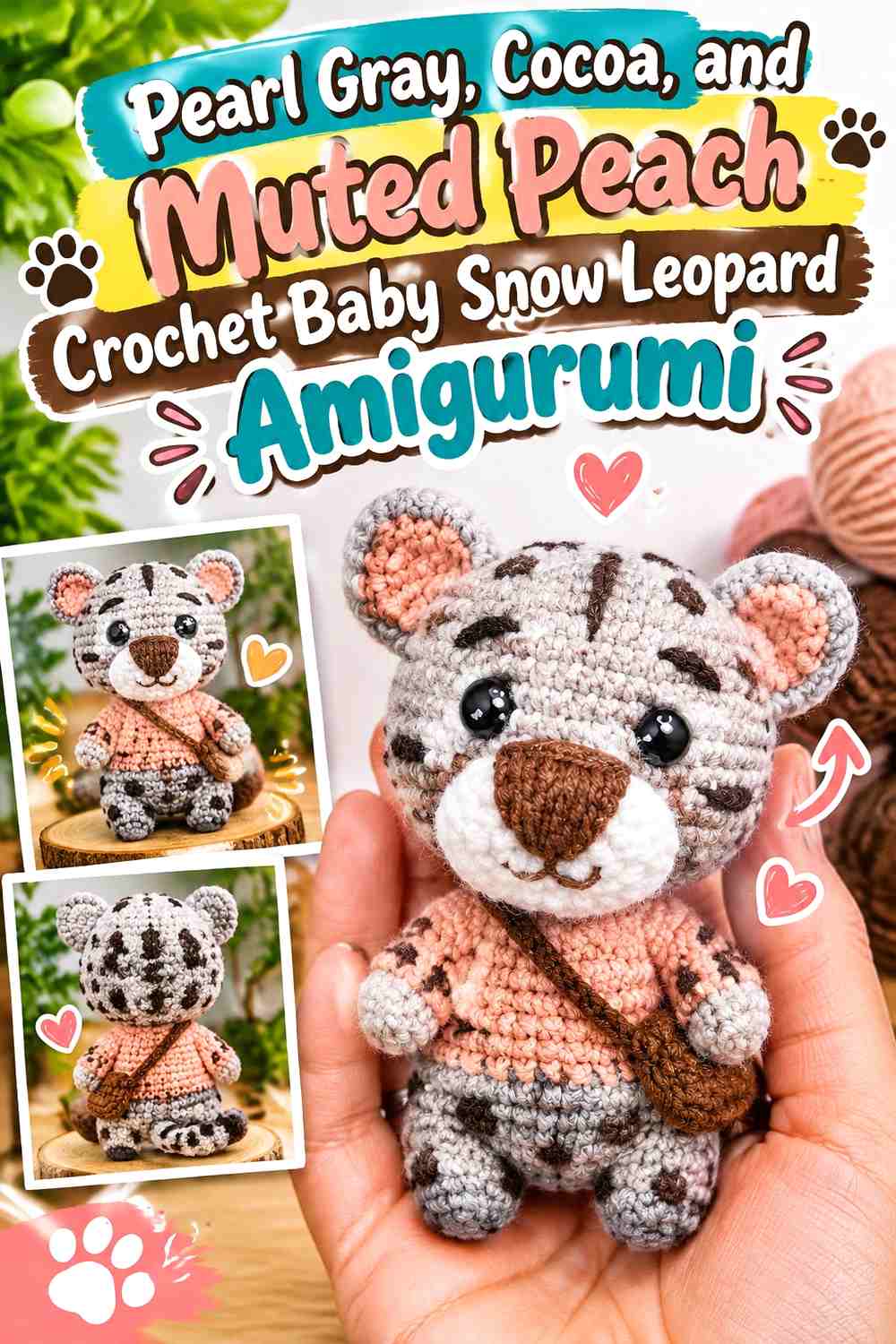
Pearl gray supplies a clean neutral body, cocoa introduces warm spots, and muted peach gives the smallest facial accent. It is a softer alternative to black-and-white while keeping a clearly defined pattern.
Cocoa should remain the main contrast color; peach is there only to soften tiny face or ear details.
Let Pearl Gray Separate the Cocoa Crochet Snow Leopard Spots
Maintain visible pearl-gray spaces around the cocoa pattern, especially on smaller limbs. Too many brown spots on the legs can make them look darker than the torso.
The tail can handle more repeated cocoa because its elongated shape provides more space.
Use Muted Peach Only Near the Pearl Gray Crochet Snow Leopard Face
A small peach inner ear or nose accent can add warmth without changing the coat palette. Keep it away from the body spots so cocoa remains the only marking color.
If the toy is intended for an entirely neutral display, oatmeal can replace peach.
Creator Credit: yarnacadabra
14. Beige Gray, Espresso, and Oatmeal Crochet Baby Snow Leopard Amigurumi
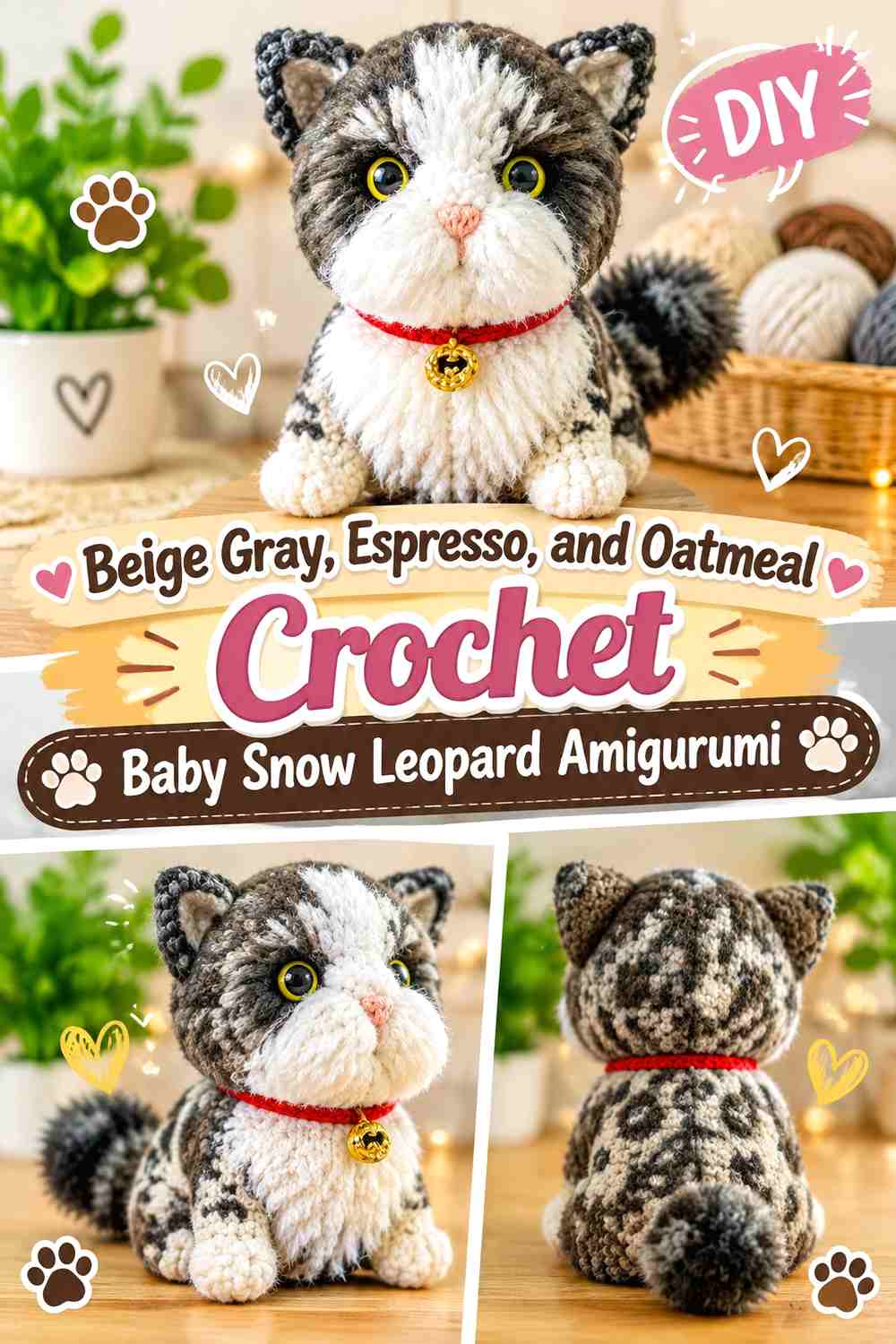
Beige gray produces a subdued, warm-bodied cub, while espresso gives the spots and tail markings depth. Oatmeal works on the muzzle and lower body where you want a gentle light shift.
This is one of the quietest palettes in the collection and relies more on value than strong hue changes.
Keep Beige Gray Broad Around the Espresso Crochet Snow Leopard Markings
Use espresso in short, separated areas rather than covering entire limbs. Beige gray should still be the first color visible when the plush is viewed as a whole.
For a softer spotted effect, choose a dark taupe instead of true espresso.
Let Oatmeal Lighten the Beige Gray Crochet Snow Leopard Underside
Oatmeal works particularly well on the chest and muzzle because it stays within the same warm neutral family.
Keep the paws mostly beige gray if you want the body to look continuous from legs to torso.
Creator Credit: Crochet Things By B
15. Charcoal Gray, Silver, and Warm White Crochet Baby Snow Leopard Amigurumi
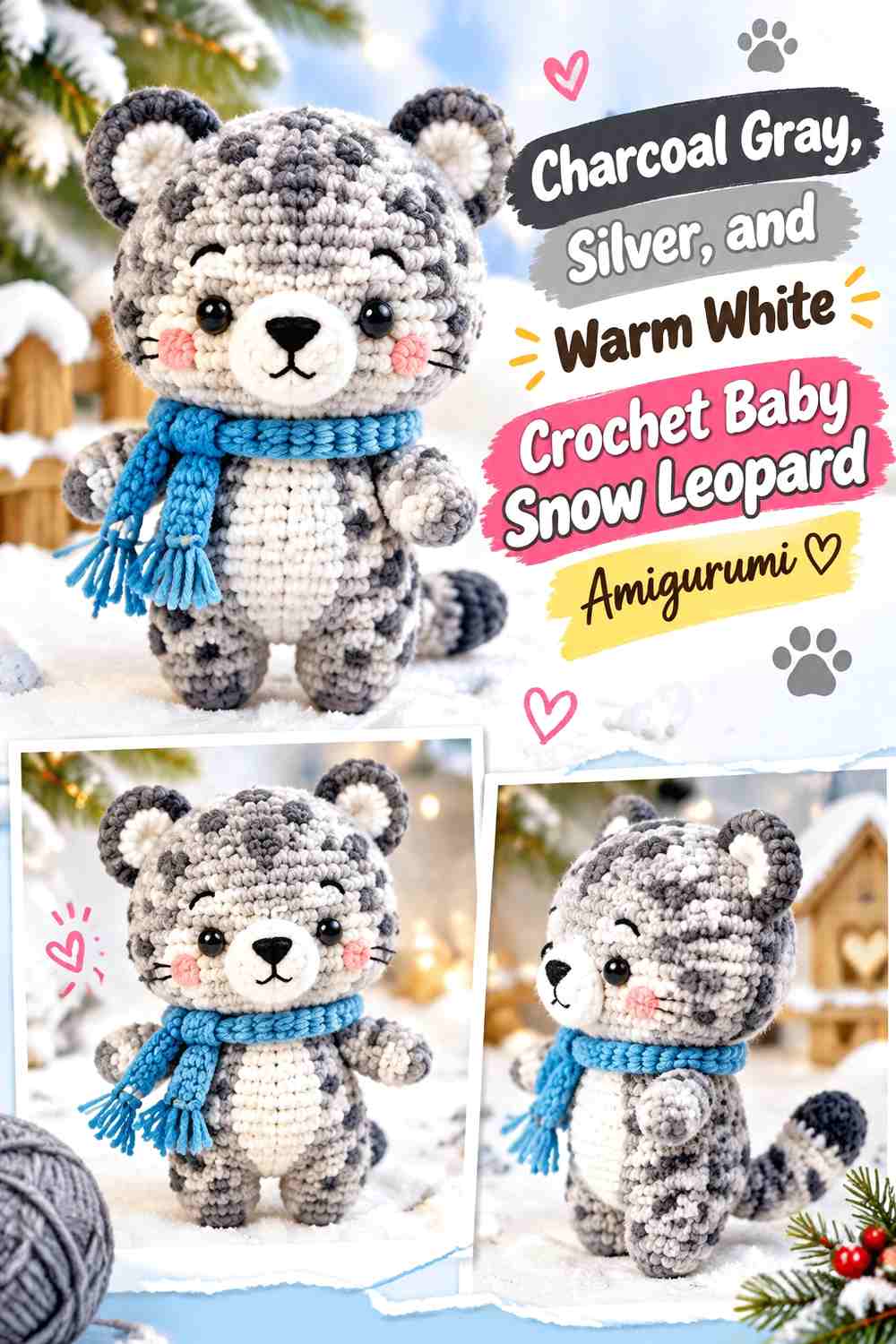
This final palette reverses the usual arrangement by making charcoal gray the main body and using silver for many of the markings. Warm white then brightens the muzzle and chest.
The darker body creates a more stylized snow leopard, so it works best when the silver pattern remains clearly visible.
Use Charcoal Gray as the Main Crochet Snow Leopard Body Color
Keep charcoal continuous across the head, torso, and outer limbs rather than alternating it equally with silver. The dark body should read as a deliberate reinterpretation, not a collection of unrelated dark patches.
Warm white can provide the strongest light point at the face.
Let Silver Create Lighter Spots on the Charcoal Gray Crochet Snow Leopard
Instead of dark markings on a pale body, place silver spots across charcoal. This reversal can still preserve the spotted identity while giving the toy a dramatically different overall balance.
Keep silver slightly darker than warm white so the muzzle remains visually separate from the pattern.
Creator Credit: Ami Saigon
Which Crochet Baby Snow Leopard Palette Should You Choose?
For a more classic pale spotted direction, start with frost gray and charcoal, silver gray and soft black, blue gray and charcoal, or cloud gray and slate. These combinations make it straightforward to keep a light body and darker markings clearly separated.
For a warmer neutral amigurumi, dove gray and espresso, mushroom and cocoa, greige and dark brown, or beige gray and espresso reduces the coolness while preserving the same dominant-body and dark-spot hierarchy.
If you want a more stylized cub, lavender gray and plum, sage gray and espresso, ice blue gray and navy, or the reversed charcoal gray and silver palette creates a more distinctive result without needing to change the underlying feline construction.
Conclusion
The most important color decision for a crochet baby snow leopard is not the exact shade of gray—it is the relationship between the body, markings, and lighter facial areas.
For crisp spots, choose a noticeably darker charcoal, black, navy, or brown against the main body. For a softer plush, reduce that value difference and let the markings blend more gently. Keep cream, ivory, oatmeal, or white concentrated around the muzzle, belly, or another area where the lighter color improves definition.
Use the credited tutorials for their actual amigurumi construction methods. Where the tutorial is a tiger, cheetah, or cat rather than an exact snow leopard, treat the snow-leopard coloring and spot arrangement as your own adaptation rather than as part of the creator’s original design.
Frequently Asked Questions
What colors work well for a crochet baby snow leopard?
Pale gray, silver, greige, blue gray, mushroom, and soft taupe all work as body colors. Charcoal, black, slate, dark brown, or navy can provide the markings, while cream, ivory, oatmeal, or soft white can lighten the muzzle and belly.
How can I stop crochet snow leopard spots from looking too crowded?
Leave visible body color between markings. Small spots placed too closely can merge visually, especially around the face and narrow legs. Use fewer markings in tight areas and reserve denser repetition for the back or tail.
Should the crochet snow leopard belly be white?
It does not have to be. Cream, oatmeal, ivory, pearl gray, or another lighter version of the body palette can create a softer transition. The important point is whether you want the underside to be visibly separate from the main body.
How should I color the crochet snow leopard tail?
Repeat the main dark marking color in spaced bands, broken markings, or other simple repeated accents. Keep enough of the body color visible between them so the tail remains connected to the rest of the amigurumi.
Can I use brown instead of black for crochet snow leopard spots?
Yes. Cocoa, espresso, and dark brown create a warmer and softer contrast than black. Make sure the brown remains noticeably darker than the body if you want small spots to stay visible.
What if plush yarn makes the crochet snow leopard markings look blurry?
Increase the value contrast between the body and spot yarns, or simplify the markings into slightly larger areas. A very subtle tonal difference may become less visible on a fuzzy surface.
What should I consider if the crochet snow leopard is intended for a young child?
Consider embroidered facial features instead of detachable components, and secure all attached parts appropriately. The exact construction and finishing choices should be checked with the intended use in mind.